


ETSI TS 103 389 V3.0.1 (2015-11)
Railway Telecommunications (RT); Global System for Mobile communications (GSM); Usage of Session Initiation Protocol (SIP) on the Network Switching Subsystem (NSS) to Fixed Terminal Subsystem (FTS) interface for GSM Operation on Railways
Railway Telecommunications (RT); Global System for Mobile communications (GSM); Usage of Session Initiation Protocol (SIP) on the Network Switching Subsystem (NSS) to Fixed Terminal Subsystem (FTS) interface for GSM Operation on Railways
RTS/RT-0049
General Information
Standards Content (Sample)
TECHNICAL SPECIFICATION
Railway Telecommunications (RT);
Global System for Mobile communications (GSM);
Usage of Session Initiation Protocol (SIP)
on theNetwork Switching Subsystem (NSS)
to Fixed Terminal Subsystem (FTS)
interface for GSM Operation on Railways
2 ETSI TS 103 389 V3.0.1 (2015-11)
Reference
RTS/RT-0049
Keywords
GSM-R, railways
ETSI
650 Route des Lucioles
F-06921 Sophia Antipolis Cedex - FRANCE
Tel.: +33 4 92 94 42 00 Fax: +33 4 93 65 47 16
Siret N° 348 623 562 00017 - NAF 742 C
Association à but non lucratif enregistrée à la
Sous-Préfecture de Grasse (06) N° 7803/88
Important notice
The present document can be downloaded from:
http://www.etsi.org/standards-search
The present document may be made available in electronic versions and/or in print. The content of any electronic and/or
print versions of the present document shall not be modified without the prior written authorization of ETSI. In case of any
existing or perceived difference in contents between such versions and/or in print, the only prevailing document is the
print of the Portable Document Format (PDF) version kept on a specific network drive within ETSI Secretariat.
Users of the present document should be aware that the document may be subject to revision or change of status.
Information on the current status of this and other ETSI documents is available at
http://portal.etsi.org/tb/status/status.asp
If you find errors in the present document, please send your comment to one of the following services:
https://portal.etsi.org/People/CommiteeSupportStaff.aspx
Copyright Notification
No part may be reproduced or utilized in any form or by any means, electronic or mechanical, including photocopying
and microfilm except as authorized by written permission of ETSI.
The content of the PDF version shall not be modified without the written authorization of ETSI.
The copyright and the foregoing restriction extend to reproduction in all media.
© European Telecommunications Standards Institute 2015.
All rights reserved.
TM TM TM
DECT , PLUGTESTS , UMTS and the ETSI logo are Trade Marks of ETSI registered for the benefit of its Members.
TM
3GPP and LTE™ are Trade Marks of ETSI registered for the benefit of its Members and
of the 3GPP Organizational Partners.
GSM® and the GSM logo are Trade Marks registered and owned by the GSM Association.
ETSI
3 ETSI TS 103 389 V3.0.1 (2015-11)
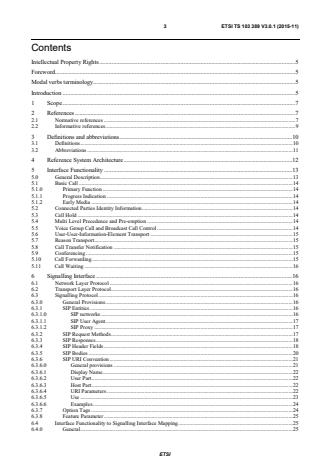
Contents
Intellectual Property Rights . 5
Foreword . 5
Modal verbs terminology . 5
Introduction . 5
1 Scope . 7
2 References . 7
2.1 Normative references . 7
2.2 Informative references . 9
3 Definitions and abbreviations . 10
3.1 Definitions . 10
3.2 Abbreviations . 11
4 Reference System Architecture . 12
5 Interface Functionality . 13
5.0 General Description . 13
5.1 Basic Call . 14
5.1.0 Primary Function . 14
5.1.1 Progress Indication . 14
5.1.2 Early Media . 14
5.2 Connected Parties Identity Information . 14
5.3 Call Hold . 14
5.4 Multi Level Precedence and Pre-emption . 14
5.5 Voice Group Call and Broadcast Call Control . 14
5.6 User-User-Information-Element Transport . 15
5.7 Reason Transport . 15
5.8 Call Transfer Notification . 15
5.9 Conferencing . 15
5.10 Call Forwarding . 15
5.11 Call Waiting . 16
6 Signalling Interface . 16
6.1 Network Layer Protocol . 16
6.2 Transport Layer Protocol . 16
6.3 Signalling Protocol . 16
6.3.0 General Provisions . 16
6.3.1 SIP Entities . 16
6.3.1.0 SIP networks . 16
6.3.1.1 SIP User Agent . 17
6.3.1.2 SIP Proxy . 17
6.3.2 SIP Request Methods . 17
6.3.3 SIP Responses . 18
6.3.4 SIP Header Fields . 18
6.3.5 SIP Bodies . 20
6.3.6 SIP URI Convention . 21
6.3.6.0 General provisions . 21
6.3.6.1 Display Name . 22
6.3.6.2 User Part . 22
6.3.6.3 Host Part . 22
6.3.6.4 URI Parameters . 22
6.3.6.5 Use . 23
6.3.6.6 Examples . 24
6.3.7 Option Tags . 24
6.3.8 Feature Parameter . 25
6.4 Interface Functionality to Signalling Interface Mapping . 25
6.4.0 General . 25
ETSI
4 ETSI TS 103 389 V3.0.1 (2015-11)
6.4.1 Basic Call . 25
6.4.2 Connected Parties Identity Information . 26
6.4.3 Media Session Renegotiation and Call Hold . 28
6.4.4 Early Media . 30
6.4.5 Multi Level Precedence and Pre-emption . 32
6.4.5.0 General Provisions . 32
6.4.5.1 Resource Priority . 33
6.4.5.2 Reason Indication for Precedence and Pre-emption Events . 33
6.4.5.3 Signalling Procedure for Precedence Call Blocking . 33
6.4.5.4 Signalling Procedure for Pre-emption . 34
6.4.6 Group Call and Broadcast Call Control . 35
6.4.7 User-to-User-Information-Element Transport . 35
6.4.8 Release Cause Transport . 35
6.4.9 SIP Session Timer . 36
6.4.10 OPTIONS Processing . 37
6.4.10.0 General Provisions . 37
6.4.10.1 OPTIONS Heartbeating . 38
6.4.11 Signalling for Group Call and Broadcast Call Control . 38
6.4.12 Call Transfer Notification . 40
6.4.13 Conferencing. 43
6.4.14 Call Forwarding . 46
6.4.15 Call Waiting . 48
7 Media Interface . 49
7.1 Network Layer Protocol . 49
7.2 Transport Layer Protocol . 49
7.3 Real-Time Transport Protocol . 49
7.3.0 Genaral Provisions . 49
7.3.1 Media inactivity detection . 50
7.4 Media Codecs . 50
7.4.0 General Provisions . 50
7.4.1 DTMF . 50
8 Recorder Interface . 51
8.1 Reference Architecture . 51
8.2 Interface Functionality . 52
8.2.0 General . 52
8.2.1 Recording Session . 52
8.3 Signalling Interface . 52
8.4 Media interface . 54
8.4.0 General . 54
8.4.1 Media mxing . 55
8.4.2 Multiple streams . 55
Annex A (normative): Locating SIP Entities . . 56
Annex B (informative): Quality of Service framework . 59
Annex C (informative): Security Framework . 60
Annex D (informative): Mapping of EIRENE to Interface Features. 61
Annex E (informative): Group Call Control Scenarios . 63
Annex F (informative): Bibliography . 65
History . 66
ETSI
5 ETSI TS 103 389 V3.0.1 (2015-11)
Intellectual Property Rights
IPRs essential or potentially essential to the present document may have been declared to ETSI. The information
pertaining to these essential IPRs, if any, is publicly available for ETSI members and non-members, and can be found
in ETSI SR 000 314: "Intellectual Property Rights (IPRs); Essential, or potentially Essential, IPRs notified to ETSI in
respect of ETSI standards", which is available from the ETSI Secretariat. Latest updates are available on the ETSI Web
server (http://ipr.etsi.org).
Pursuant to the ETSI IPR Policy, no investigation, including IPR searches, has been carried out by ETSI. No guarantee
can be given as to the existence of other IPRs not referenced in ETSI SR 000 314 (or the updates on the ETSI Web
server) which are, or may be, or may become, essential to the present document.
Foreword
This Technical Specification (TS) has been produced by ETSI Technical Committee Railway Telecommunications
(RT).
Modal verbs terminology
In the present document "shall", "shall not", "should", "should not", "may", "need not", "will", "will not", "can" and
"cannot" are to be interpreted as described in clause 3.2 of the ETSI Drafting Rules (Verbal forms for the expression of
provisions).
"must" and "must not" are NOT allowed in ETSI deliverables except when used in direct citation.
Introduction
While a number of interoperability specifications for various interfaces at various layers of GSM-R systems exist, the
interface between the Network Switching Subsystem (NSS) and the Fixed Terminal Subsystem (FTS) has not yet been
addressed by any interoperability specification activity.
In most of the GSM-R system deployments available at the time of the creation of the present document, the Network
Switching Subsystem and the Fixed Terminal Subsystem are interconnected using TDM based interfaces such as
DSS1 [i.2].
ETSI TS 102 610 [9] specifies the usage and format of UUIE for call-related end-to-end functionality in GSM-R
systems but no other interworking topics.
The present document addresses the interoperability specification gap between the Network Switching Subsystem and
the Fixed Terminal Subsystem with an interface based on the Internet Protocol (IP) [2], the Session Initiation Protocol
(SIP) [3], the Session Description Protocol (SDP) [6] and the Real-Time Transport Protocol (RTP) [7].
In addition to the table of contents, the following explanation will help you navigate through and understand the
contents of the present document:
• Clauses 1 to 3 are predefined by ETSI.
• Clause 4 shows and explains the reference system architecture and identifies the interface(s) for the present
document.
• Clause 5 holds the functional requirements for the interface subject to the present document.
• Clause 6 specifies in detail the signalling interface for all supported functions and services.
• Clause 7 specifies in detail the media interface.
• Clause 8 specifies the additions and changes for a voice recorder interface.
• Annex A explains the mechanism to locate SIP entities at the present interface.
ETSI
6 ETSI TS 103 389 V3.0.1 (2015-11)
• Annex B contains recommendations on the use and implementation of standardized Quality of Service
mechanisms at the present interface.
• Annex C contains recommendations about the security mechanisms.
• Annex D contains a mapping table of EIRENE [1] to interface features.
• Annex E contains a description of group call control scenarios.
ETSI
7 ETSI TS 103 389 V3.0.1 (2015-11)
1 Scope
The present document defines the signalling and media interface between the Network Switching Subsystem and the
Fixed Terminal Subsystem in order to provide a clear set of services needed for GSM-R operations. This includes voice
call service and available call-related supplementary services. In addition, requirements for specific implementation of
the signalling and media interface within either the Network Switching Subsystem or the Fixed Terminal Subsystem are
stated where applicable. The present document addresses the Internet Layer and upwards of the Internet Protocol Suite
IETF RFC 1122 [i.18] on the signalling and media interface.
Any service other than voice call service and call-related supplementary services (such as data services, Short Message
Service, etc.) is out of scope of the present document; additional features may be addressed in future releases.
The present document does not specify any other interface between the Network Switching Subsystem and the Fixed
Terminal Subsystem nor does it cover any internal interfaces of either NSS or FTS. Such interfaces may be addressed in
a future release of the present document.
The present document does not address any specific 3GPP Release or Architecture.
2 References
2.1 Normative references
References are either specific (identified by date of publication and/or edition number or version number) or
non-specific. For specific references, only the cited version applies. For non-specific references, the latest version of the
reference document (including any amendments) applies.
Referenced documents which are not found to be publicly available in the expected location might be found at
http://docbox.etsi.org/Reference.
NOTE: While any hyperlinks included in this clause were valid at the time of publication, ETSI cannot guarantee
their long term validity.
The following referenced documents are necessary for the application of the present document.
[1] UIC P001D010 (Version 15.1): "UIC Project EIRENE System Requirements Specification".
NOTE: Available at http://www.uic.org/IMG/pdf/eirene_srs_15.1.pdf.
[2] IETF RFC 791 (1981): "Internet Protocol".
[3] IETF RFC 3261 (2002): "SIP: Session Initiation Protocol".
[4] IETF RFC 3264 (2002): "An Offer/Answer Model Session Description Protocol (SDP)".
[5] IETF RFC 4733 (2006): "RTP Payload for DTMF Digits, Telephony Tones, and Telephony
Signals".
[6] IETF RFC 4566 (2006): "SDP: Session Description Protocol".
[7] IETF RFC 3550 (2003): "RTP: A Transport Protocol for Real-Time Applications".
[8] IETF RFC 3326 (2002): "The Reason Header Field for the Session Initiation Protocol (SIP)".
[9] ETSI TS 102 610 (V1.1.0): "Railways Telecommunications (RT); Global System for Mobile
communications (GSM); Usage of the User-to-User Information Element for GSM Operation on
Railways".
[10] IETF RFC 5234 (2008): "Augmented BNF for Syntax Specifications: ABNF".
[11] IETF RFC 3262 (2002): "Reliability of Provisional Responses in Session Initiation Protocol
(SIP)".
ETSI
8 ETSI TS 103 389 V3.0.1 (2015-11)
[12] IETF RFC 4412 (2006): "Communications Resource Priority for the Session Initiation Protocol
(SIP)".
[13] IETF RFC 3325 (2002): "Private Extensions to the Session Initiation Protocol (SIP) for Asserted
Identity within Trusted Networks".
[14] IETF RFC 5876 (2010): "Updates to Asserted Identity in the Session Initiation Protocol (SIP)".
[15] IETF RFC 3323 (2002): "A Privacy Mechanism for the Session Initiation Protocol (SIP)".
[16] IETF RFC 4028 (2005): "Session Timers in the Session Initiation Protocol (SIP)".
[17] IETF RFC 3311 (2002): "The Session Initiation Protocol (SIP) UPDATE Method".
[18] Void.
[19] Void.
[20] Void.
[21] Void.
[22] Recommendation ITU-T Q.850 (1998): "Usage of cause and location in the Digital Subscriber
Signalling System No. 1 and the Signalling System No. 7 ISDN user part".
[23] Recommendation ITU-T E.164 (2010): "The international public telecommunication numbering
plan".
[24] Recommendation ITU-T Q.955.3 (1993): "Stage 3 description for community of interest
supplementary services using DSS 1: Multi-level precedence and pre-emption (MLPP)".
[25] IETF RFC 3986 (2005): "Uniform Resource Identifier (URI): Generic Syntax".
[26] IETF RFC 768 (1980): "User Datagram Protocol".
[27] Recommendation ITU-T G.711 (1988): "Pulse code modulation (PCM) of voice frequencies".
[28] IETF RFC 2833 (2000): "RTP Payload for DTMF Digits, Telephony Tones and Telephony
Signals".
[29] Void.
[30] IETF RFC 3840 (2004): "Indicating User Agent Capabilities in the Session Initiation Protocol
(SIP)".
[31] IETF RFC 4574 (2006): "The Session Description Protocol (SDP) Label Attribute".
[32] Recommendation ITU-T I.255.3 (1990): "Multi-Level Precedence and Pre-emption service".
[33] IETF RFC 4579 (2006): "Session Initiation Protocol (SIP) Call Control - Conferencing for User
Agents".
[34] IETF RFC 3891 (2004): "The Session Initiation Protocol (SIP) "Replaces" Header".
[35] IETF RFC 7462 (2015): "URNs for the Alert-Info Header Field of the Session Initiation Protocol
(SIP)".
[36] IETF RFC 4244 (2005): "An Extension to the Session Initiation Protocol (SIP) for Request History
Information".
[37] IETF RFC 4458 (2006): "Session Initiation Protocol (SIP) URIs for Applications such as
Voicemail and Interactive Voice Response (IVR)".
[38] ETSI TS 129 163: "Digital cellular telecommunications system (Phase 2+); Universal Mobile
Telecommunications System (UMTS); LTE; Interworking between the IP Multimedia (IM) Core
Network (CN) subsystem and Circuit Switched (CS) networks (3GPP TS 29.163 Release 12)".
ETSI
9 ETSI TS 103 389 V3.0.1 (2015-11)
2.2 Informative references
References are either specific (identified by date of publication and/or edition number or version number) or
non-specific. For specific references, only the cited version applies. For non-specific references, the latest version of the
reference document (including any amendments) applies.
NOTE: While any hyperlinks included in this clause were valid at the time of publication, ETSI cannot guarantee
their long term validity.
The following referenced documents are not necessary for the application of the present document but they assist the
user with regard to a particular subject area.
[i.1] IETF RFC 7433 (2015): "A Mechanism for Transporting User to User Call Control Information in
SIP".
[i.2] ETSI ETS 300 403-1 (V1.3.2): "Integrated Services Digital Network (ISDN); Digital Subscriber
Signalling System No. one (DSS1) protocol; Signalling network layer for circuit-mode basic call
control; Part 1: Protocol specification (ITU-T Recommendation Q.931 (1993), modified)".
[i.3] IETF RFC 6086 (2011): "Session Initiation Protocol (SIP) INFO Method and Package
Framework".
[i.4] IETF RFC 3428 (2002): "Session Initiation Protocol (SIP) Extension for Instant Messaging".
[i.5] IETF RFC 3515 (2001): "The Session Initiation Protocol (SIP) Refer Method".
[i.6] IETF RFC 3265 (2002): "Session Initiation Protocol (SIP)-Specific Event Notification".
[i.7] IETF RFC 3903 (2004): "Session Initiation Protocol (SIP) Extension for Event State Publication".
[i.8] IETF RFC 1594 (1994): "FYI on Questions and Answers to Commonly asked "New Internet User"
Questions".
[i.9] IETF RFC 3665 (2003): "Session Initiation Protocol (SIP) Basic Call Flow Examples".
[i.10] IETF RFC 3960 (2004): "Early Media and Ringing Tone Generation in the Session Initiation
Protocol (SIP)".
[i.11] ETSI EN 300 925 (V7.0.2): "Digital cellular telecommunications system (Phase 2+) (GSM);
Voice Group Call Service (VGCS) - Stage 1 (GSM 02.68 version 7.0.2 Release 1998)".
[i.12] ETSI EN 300 926 (V8.0.1): "Digital cellular telecommunications system (Phase 2+) (GSM);
Voice Broadcast Service (VBS) - Stage 1 (GSM 02.69 version 8.0.1 Release 1999)".
[i.13] IETF RFC 3263 (2002): "Session Initiation Protocol (SIP): Locating SIP Servers".
[i.14] IETF RFC 1035 (1987): "Domain names - implementation and specification".
[i.15] IETF RFC 2181 (1997): "Clarifications to the DNS Specification".
[i.16] IETF RFC 2663 (1999): "IP Network Address Translator (NAT) Terminology and
Considerations".
[i.17] Void.
[i.18] IETF RFC 1122 (1989): "Requirements for Internet Hosts -- Communication Layers".
[i.19] IETF RFC 3551: "RTP Profile for Audio and Video Conferences with Minimal Control".
[i.20] IETF draft RFC draft-siprec-protocol-16: "Session Recording Protocol".
[i.21] IETF RFC 5009 (2007): "Private Header (P-Header) Extension to the Session Initiation Protocol
(SIP) for Authorization of Early Media".
[i.22] IETF RFC 2474 (1998): "Definitions of the Differentiated Services Field (DS Field) in the IPv4
and IPv6 Headers".
ETSI
10 ETSI TS 103 389 V3.0.1 (2015-11)
[i.23] IETF RFC 2475 (1998): "An Architecture for Differentiated Services".
[i.24] IETF RFC 4594 (2006): "Configuration Guidelines for DiffServ Service Classes".
[i.25] IETF RFC 5865 (2010): "A Differentiated Services Code Point (DSCP) for Capacity-Admitted
Traffic".
3 Definitions and abbreviations
3.1 Definitions
For the purposes of the present document, the following terms and definitions apply:
call: SIP Dialog between two Signalling Endpoints
NOTE 1: As defined in IETF RFC 3261 [3].
NOTE 2: Established for the purpose of a voice communication and related data exchange.
client: As defined in IETF RFC 3261 [3].
Communication Session (CS): session that is the subject of recording
dialog: As defined in IETF RFC 3261 [3].
final response: As defined in IETF RFC 3261 [3].
Fixed Terminal Subsystem (FTS): part of the EIRENE [1] system that provides access to this network (and services)
via controller equipment (in general referred to as Fixed Terminals)
Fully Qualified Domain Name (FQDN): As defined in IETF RFC 1594 [i.8].
header: As defined in IETF RFC 3261 [3].
header field: As defined in IETF RFC 3261 [3].
initiator, calling party, caller: As defined in IETF RFC 3261 [3].
invitee, invited user, called party, callee: As defined in IETF RFC 3261 [3].
Media Endpoint, RTP Endpoint: entity that terminates RTP stream(s) under the control of a single SIP Endpoint in
the same subsystem
NOTE: This entity may be physically separated from the SIP Endpoint.
method: As defined in IETF RFC 3261 [3].
Network Switching Subsystem (NSS): part of the PLMN infrastructure that performs all necessary functions in order
to handle the call services to and from the mobile stations as well as to and from fixed terminals
operational priority: different call types have call priorities during railway communications.
NOTE 1: As defined in EIRENE SRS [1].
NOTE 2: This behaviour is mentioned as operational priority of a call.
option tag: As defined in IETF RFC 3261 [3].
provisional response: As defined in IETF RFC 3261 [3].
proxy, proxy server: As defined in IETF RFC 3261 [3].
Recording Session (RS): SIP session created between SRC and SRS for the purpose of recording a Communication
Session
request: As defined in IETF RFC 3261 [3].
ETSI
11 ETSI TS 103 389 V3.0.1 (2015-11)
response: As defined in IETF RFC 3261 [3].
server: As defined in IETF RFC 3261 [3].
session: As defined in IETF RFC 3261 [3].
Signalling Endpoint, SIP Endpoint: entity that acts as a SIP User Agent
NOTE: Within the scope of the present document this term refers to NSS and FTS.
Signalling Proxy, SIP Proxy: Proxy Server as defined by IETF RFC 3261 [3].
(SIP) transaction: As defined in IETF RFC 3261 [3].
tag: As defined in IETF RFC 3261 [3].
User Agent (UA): As defined in IETF RFC 3261 [3].
User Agent Client (UAC): As defined in IETF RFC 3261 [3].
User Agent Server (UAS): As defined in IETF RFC 3261 [3].
3.2 Abbreviations
For the purposes of the present document, the following abbreviations apply:
ACK ACKnowledgement
AF Assured Forwarding
AoCC Advice of Charge (Charging)
AoCI Advice of Charge (Information)
B2BUA Back to Back User Agent
BAIC Barring of All Incoming Calls
BAOC Barring of All Outgoing Calls
BIC-Roam Barring of Incoming Calls when Roaming Outside the Home PLMN Country
BNF Backus Naur Form
BOIC Barring of Outgoing International Calls
BOIC-exHC BOIC except those to Home PLMN Country
CCBS Completion of Calls to Busy Subscribers
CFB Call Forwarding on Mobile Subscriber Busy
CFNRc Call forwarding on Mobile Subscriber Not Reachable
CFNRy Call Forwarding on No Reply
CFU Call Forwarding Unconditional
CLIP Calling Line Identification Presentation
CLIR Calling Line Identification Restriction
CN Core Node
CoLP Connected Line Identification Presentation
CoLR Connected Line Identification Restriction
CS Communication Session
CSRC Contributing SouRCe
CUG Closed User Group
CW Call Waiting
DL Down Link
DNS Domain Name Service
DSCP Differentiated Service Code Point
DTMF Dual Tone Multi Frequency
ECT Explicit Call Transfer
EF Expedited Forwarding
EIRENE European Integrated Railway Radio Enhanced Network
eMLPP enhanced Multi-Level Precedence and Pre-emption
FQDN Fully Qualified Domain Name
FTP File Transfer Protocol
FTS Fixed Terminal Subsystem
GSM-R Global System Mobile-Railways
HOLD Call hold
ETSI
12 ETSI TS 103 389 V3.0.1 (2015-11)
HTTP Hyper Text Transfer Protocol
IETF Internet Engineering Task Force
IN Intelligent Network
INF INForm
INV INVite
IP Internet Protocol
ITU-T International Telecommunication Union – Telecommunication standardisation sector
MLPP Multi-Level Precedence and Pre-emption
MO/PP Mobile Originated/Point-to-Point
MPTY Multi Party Service
MT/PP Mobile Terminated/Point-to-Point
NAPT Network Address Port Translation
NAT Network Address Translation
NSS Network Switching Subsystem
OK OKay
OPT OPTion
OSI Open Systems Interconnection
PABX Private Access Branch eXchange
PCM Pulse Code Modulation
PCMA Pulse Code Modulation – A law
PCM-A Pulse Code Modulation – A law
PCMU Pulse Code Modulation – u-law
PHB Per Hop Behaviour
PLMN Public Land Mobile Network
PRA PRovisional Acknowledgment
PRACK Provisional Response Acknowledgement
PSTN Public Switched Telephone Network
QoS Quality of Service
RFC Request For Comments
RS Recording Session
RTP Real-Time Transport Protocol
SDP Session Description Protocol
SE Session Expires
SIP Session Initiation Protocol
SRC Session Recording Client
SRS Session Recording Server
SRTP Secured Real-time Protocol
SSRC Synchronization SouRCe
TDM Time Division Multiplexing
ToS Type of Service
UA User Agent
UAC User Agent Client
UAS User Agent Server
UDP User Datagram Protocol
UIC Union Internationale des Chemins de Fer, International Union of Railways
UPD UPDate
URI Uniform Resource Identifier
URL Uniform Resource Locator
URN Uniform Resource Name
USSD Unstructured Supplementary Service Data
UUI User-to-User Information
UUIE User to User Information Element
UUS1 User-to-User Signalling 1
VBS Voice Broadcast Service
VGCS Voice Group Call Service
4 Reference System Architecture
The system architecture used to identify the interface that is the subject of the present document is a simplification of a
GSM-R system down to a minimum of logical entities relevant to the present document.
ETSI
13 ETSI TS 103 389 V3.0.1 (2015-11)
Within the context of the present document a GSM-R system is logically divided into a GSM-R Network and a Fixed
Terminal Subsystem. The interface between the Mobile Terminals and the NSS as well as the interface between the
Fixed Terminals and the FTS are explicitly not addressed in the present document. The focus of the present document is
solely:
• the Signalling Interface; and
• the Media Interface;
between the logical subsystem NSS and the logical subsystem FTS.
It is important to note that this architecture does not necessarily reflect any physical entities in a GSM-R system.
Figure 4.1 illustrates the reference system architecture.
Figure 4.1: Reference System Architecture
Depending on the deployment scenario and the NSS/FTS design there may be one or more Signalling Endpoints, one or
more Media Endpoints and zero or more Signalling Proxies on either side of the interface.
The Media Endpoint(s) are controlled by (a) Signalling Endpoint(s) in the same subsystem. This control mechanism is
out of scope of the present document.
One Signalling Endpoint may establish more than one call. Also one Signalling Proxy and one Media Endpoint may be
involved in one or more calls.
The maximum number of Signalling Endpoints allowed to be involved in a single call on the present interface is
two-one on each side.
Optionally deployed Signalling Proxies may be involved in the signalling flow for either incoming traffic or outgoing
traffic or both incoming and outgoing traffic at either side of the interface. This depends on the FTS/NSS design and the
deployment scenario. The entities involved might differ depending on the call direction, but have to be the same for all
calls in the same direction in a single deployment scenario.
Annex A includes several deployment scenario examples that illustrate some of the Signalling Proxy deployment
options.
5 Interface Functionality
5.0 General Description
This clause specifies functional requirements of the interface. The technical details are specified in clauses 6 and 7 of
the present document.
ETSI
14 ETSI TS 103 389 V3.0.1 (2015-11)
5.1 Basic Call
5.1.0 Primary Function
The primary function to be delivered by the present interface is the means to initiate and tear down full duplex audio
(voice) connections between the NSS and FTS with a single, logical, SIP Endpoint involved per connection on each
side of the present interface that controls the connection as well as its respective Media Endpoint (compare clause 4).
Such a connection can be initialized by either NSS or FTS. The initiation phase shall specifically provide means and
mechanisms for per call/connection capability exchange, media negotiation, progress indication as well as error
indication and handling.
5.1.1 Progress Indication
Progress indication shall be provided via explicit signalling. In addition a progress tone generation policy, clearly
stating which party shall generate which progress tones and when, is defined.
5.1.2 Early Media
Furthermore, the basic call procedure shall provide a means for media (i.e. audio) exchange prior to call setup
completion. This shall be possible in the direction callee to caller only. This functionality is needed in order to provide
pre-call announcements to the user before the dialog is established.
5.2 Connected Parties Identity Information
The calling party shall provide its identity information with the connection request.
The calling party shall be informed about the identity of the remote party.
The identity information shall contain a routable number in the underlying network's address space and in addition - if
available - an EIRENE functional number.
Upon change of identity of either connected party an immediate identity update shall be transmitted to the other side.
5.3 Call Hold
Both endpoints of an established call shall be able to suspend an associated media stream and resume it at a later time.
The endpoint holding the call shall inform the other party that the call is suspended and shall further inform the other
party when the call is reconnected. The media stream is not just interrupted, but possibly redirected to some other
source which generates, for example, an announcement or "music on hold".
5.4 Multi Level Precedence and Pre-emption
In order to allow differentiated/preferred treatment of calls of different/higher operational priority (e.g. emergency calls)
when facing resource limits, the interface shall support signalling mechanisms and procedures to provide multi-level
precedence signalling and as well as call pre-emption functionality. Additionally, MLPP is used by the Signalling
Endpoints to handle different priorities at the operational level. In particular this includes flagging of session priority
and signalling flows for precedence blocking as well as pre-emption of calls, but not for reservation of resources.
The present document defines how call precedence and pre-emption is performed, but it does not define the algorithm
that causes precedence blocking or call pre-emption to be performed.
5.5 Voice Group Call and Broadcast Call Control
Voice Group Calls [i.11] and Voice Broadcast Calls [i.12] are service implementations in the NSS.
The interface subject to the present document shall provide mechanisms for the FTS to control voice group calls and
voice broadcast calls from the perspective of Fixed Terminal users as defined by EIRENE [1]. Control of voice group
calls and voice broadcast calls from the perspective of other users is out-of-scope of the present document.
ETSI
15 ETSI TS 103 389 V3.0.1 (2015-11)
The following control mechanisms shall be supported on the present interface:
• Termination ("kill") of VGCS/VBS calls.
• Requests for muting and unmuting of the mobile terminal downlink of VGCS calls.
When an FTS subscriber is involved in such a call then it is connected by means of a point to point call on the present
interface. The VGCS/VBS call is identified at the application level purely on the basis of the NSS subscriber number
contained in the call signalling.
5.6 User-User-Information-Element Transport
User-to-User-Information-Elements (UUIE) [i.2] are used in GSM-R systems to carry EIRENE specific information
and are exchanged within basic call control messages. ETSI TS 102 610 [9] specifies in detail the use and content of
UUIEs in GSM-R and also distinguishes between international and national EIRENE UUIE tags.
The interface subject to the present document shall support a mechanism to transparently transpor
...
Questions, Comments and Discussion
Ask us and Technical Secretary will try to provide an answer. You can facilitate discussion about the standard in here.
Loading comments...