


ETSI TS 103 463-1 V1.2.1 (2020-05)
Access, Terminals, Transmission and Multiplexing (ATTM); Sustainable Digital Multiservice Communities; Key Performance Indicators for Sustainable Digital Multiservice Areas; Part 1: Description of Key Performance Indicators
Access, Terminals, Transmission and Multiplexing (ATTM); Sustainable Digital Multiservice Communities; Key Performance Indicators for Sustainable Digital Multiservice Areas; Part 1: Description of Key Performance Indicators
RTS/ATTMSDMC-7
General Information

Standards Content (Sample)
TECHNICAL SPECIFICATION
Access, Terminals, Transmission and Multiplexing (ATTM);
Sustainable Digital Multiservice Communities;
Key Performance Indicators for
Sustainable Digital Multiservice Areas;
Part 1: Description of Key Performance Indicators
2 ETSI TS 103 463-1 V1.2.1 (2020-05)
Reference
RTS/ATTMSDMC-7
Keywords
KPI, smart grid, smart meter, sustainability
ETSI
650 Route des Lucioles
F-06921 Sophia Antipolis Cedex - FRANCE
Tel.: +33 4 92 94 42 00 Fax: +33 4 93 65 47 16
Siret N° 348 623 562 00017 - NAF 742 C
Association à but non lucratif enregistrée à la
Sous-Préfecture de Grasse (06) N° 7803/88
Important notice
The present document can be downloaded from:
http://www.etsi.org/standards-search
The present document may be made available in electronic versions and/or in print. The content of any electronic and/or
print versions of the present document shall not be modified without the prior written authorization of ETSI. In case of any
existing or perceived difference in contents between such versions and/or in print, the prevailing version of an ETSI
deliverable is the one made publicly available in PDF format at www.etsi.org/deliver.
Users of the present document should be aware that the document may be subject to revision or change of status.
Information on the current status of this and other ETSI documents is available at
https://portal.etsi.org/TB/ETSIDeliverableStatus.aspx
If you find errors in the present document, please send your comment to one of the following services:
https://portal.etsi.org/People/CommiteeSupportStaff.aspx
Copyright Notification
No part may be reproduced or utilized in any form or by any means, electronic or mechanical, including photocopying
and microfilm except as authorized by written permission of ETSI.
The content of the PDF version shall not be modified without the written authorization of ETSI.
The copyright and the foregoing restriction extend to reproduction in all media.
© ETSI 2020.
All rights reserved.
DECT™, PLUGTESTS™, UMTS™ and the ETSI logo are trademarks of ETSI registered for the benefit of its Members.
3GPP™ and LTE™ are trademarks of ETSI registered for the benefit of its Members and
of the 3GPP Organizational Partners.
oneM2M™ logo is a trademark of ETSI registered for the benefit of its Members and
of the oneM2M Partners. ®
GSM and the GSM logo are trademarks registered and owned by the GSM Association.
ETSI
3 ETSI TS 103 463-1 V1.2.1 (2020-05)
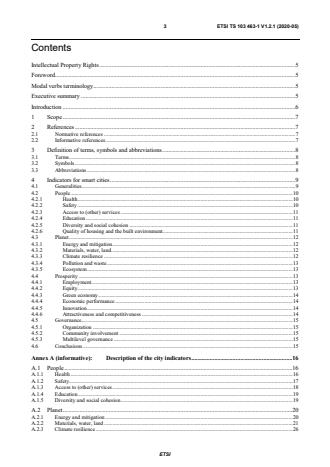
Contents
Intellectual Property Rights . 5
Foreword . 5
Modal verbs terminology . 5
Executive summary . 5
Introduction . 6
1 Scope . 7
2 References . 7
2.1 Normative references . 7
2.2 Informative references . 7
3 Definition of terms, symbols and abbreviations . 8
3.1 Terms . 8
3.2 Symbols . 8
3.3 Abbreviations . 8
4 Indicators for smart cities . 9
4.1 Generalities. 9
4.2 People . 10
4.2.1 Health . 10
4.2.2 Safety . 10
4.2.3 Access to (other) services . 11
4.2.4 Education . 11
4.2.5 Diversity and social cohesion . 11
4.2.6 Quality of housing and the built environment. 11
4.3 Planet . 12
4.3.1 Energy and mitigation . 12
4.3.2 Materials, water, land. 12
4.3.3 Climate resilience . 12
4.3.4 Pollution and waste . 13
4.3.5 Ecosystem . 13
4.4 Prosperity . 13
4.4.1 Employment . 13
4.4.2 Equity . 13
4.4.3 Green economy . 14
4.4.4 Economic performance . 14
4.4.5 Innovation . 14
4.4.6 Attractiveness and competitiveness . 14
4.5 Governance. 15
4.5.1 Organization . 15
4.5.2 Community involvement . 15
4.5.3 Multilevel governance . 15
4.6 Conclusions . 15
Annex A (informative): Description of the city indicators . 16
A.1 People . 16
A.1.1 Health . 16
A.1.2 Safety . 17
A.1.3 Access to (other) services . 18
A.1.4 Education . 19
A.1.5 Diversity and social cohesion . 19
A.2 Planet . 20
A.2.1 Energy and mitigation . 20
A.2.2 Materials, water, land . 21
A.2.3 Climate resilience . 26
ETSI
4 ETSI TS 103 463-1 V1.2.1 (2020-05)
A.2.4 Pollution and waste . 28
A.2.5 Ecosystem. 34
A.3 Prosperity . 36
A.3.1 Employment . 36
A.3.2 Equity . 38
A.3.3 Green economy . 40
A.3.4 Economic performance . 43
A.3.5 Innovation. 45
A.3.6 Attractiveness and competitiveness . 49
A.4 Governance . 53
A.4.1 Organization . 53
A.4.2 Community involvement . 57
A.4.3 Multi-level governance . 60
Annex B (informative): Change History . 62
History . 63
ETSI
5 ETSI TS 103 463-1 V1.2.1 (2020-05)
Intellectual Property Rights
Essential patents
IPRs essential or potentially essential to normative deliverables may have been declared to ETSI. The information
pertaining to these essential IPRs, if any, is publicly available for ETSI members and non-members, and can be found
in ETSI SR 000 314: "Intellectual Property Rights (IPRs); Essential, or potentially Essential, IPRs notified to ETSI in
respect of ETSI standards", which is available from the ETSI Secretariat. Latest updates are available on the ETSI Web
server (https://ipr.etsi.org/).
Pursuant to the ETSI IPR Policy, no investigation, including IPR searches, has been carried out by ETSI. No guarantee
can be given as to the existence of other IPRs not referenced in ETSI SR 000 314 (or the updates on the ETSI Web
server) which are, or may be, or may become, essential to the present document.
Trademarks
The present document may include trademarks and/or tradenames which are asserted and/or registered by their owners.
ETSI claims no ownership of these except for any which are indicated as being the property of ETSI, and conveys no
right to use or reproduce any trademark and/or tradename. Mention of those trademarks in the present document does
not constitute an endorsement by ETSI of products, services or organizations associated with those trademarks.
Foreword
This Technical Specification (TS) has been produced by ETSI Technical Committee Access, Terminals, Transmission
and Multiplexing (ATTM).
The present document is part 1 of a multi-part deliverable covering Key Performance Indicators (KPIs) for Sustainable
Digital Multiservice Areas (Smart Areas both urban and rural) expressing sustainability performance in terms of People,
Planet, Prosperity and Governance as identified below:
Part 1: "Description of Key Performance Indicators";
Part 2: "Global KPIs for Sustainable Digital Multiservice Areas".
Modal verbs terminology
In the present document "shall", "shall not", "should", "should not", "may", "need not", "will", "will not", "can" and
"cannot" are to be interpreted as described in clause 3.2 of the ETSI Drafting Rules (Verbal forms for the expression of
provisions).
"must" and "must not" are NOT allowed in ETSI deliverables except when used in direct citation.
Executive summary
The present document describes the selection of indicators for assessing indicators on city level. Starting from the
definition of a smart city, indicators have been selected that can function as Key Performance Indicators for tracking the
progress towards city objectives.
ETSI
6 ETSI TS 103 463-1 V1.2.1 (2020-05)
The indicators for smart cities focus on monitoring the evolution of a city towards an even smarter city. The time
component -"development over the years"- is an important feature. The city indicators may be used to show to what
extent overall policy goals have been reached, or are within reach. With a starting point in the smart city definition, and
taking into account the wishes of cities and citizens with regard to smart city indicators, the indicators are arranged in an
extended triple bottom line sustainability framework, including the themes people, planet, prosperity, governance and
propagation, and completed with specific smart city indicators. Under the main themes subthemes conforming to major
policy ambitions have been identified. Under these subthemes in total 73 city indicators have been selected. The
selection has been based on an inventory of 43 existing indicator frameworks for cities indicators. The majority of the
indicators in the ICT users selection have been derived from existing indicator frameworks. New indicators have been
suggested to fill gaps in existing frameworks.
Annex A of the present document presents the selection of indicators for ICT users.
Introduction
ICT users aim to speed up the transition to low carbon, resource-efficient cities by facilitating and enabling stakeholders
in smart cities to learn from each other, create trust in solutions, and monitor progress, by means of a common
performance measurement framework. The ultimate goal is to support the wide-scale deployment of smart city solutions
and services in order to create impact on major societal challenges related to the cities' fast growth and the Union's
20/20/20 energy and climate targets. The expected benefits for different stakeholders can be summarized as follows:
• Cities will benefit from the ICT users results as they support their strategic planning and allow measuring their
progress towards smart city goals. In addition, benefits are created from the enhanced collaboration within and
between cities, providing the possibility to compare solutions and to find best practices.
• Policy makers will benefit from the indicators that help to set policy targets and monitor their achievement.
ICT users KPI framework's sub-themes are formulated as policy goals and thereby the use of the indicators
and therefore the indicators are especially useful to follow progress towards policy goals.
• Solution providers will benefit from better insight into business opportunities for their products and services,
and into the possibilities for replication in a different city or context.
• Industrial stakeholders will benefit from the recommendations for new business, e.g. based on open data.
Citizens will benefit from the indicators as they may help to get a better understanding of complex projects and
their impacts.
All these opportunities should bring environmental benefits such as reduction of CO emissions, increased energy
efficiency, increased share of renewables, as well as improve the quality of life through better mobility, better
communication between local authorities and their citizens, empowerment of citizens (i.e. smart citizens). For the
development of the performance measurement framework, ICT users are building on existing smart city and sustainable
city indicator systems. The bases of the ICT users indicator framework (Based on CITYkeys deliverable 1.4 [i.1]) are
the traditional sustainability impact categories People, Prosperity and Planet, but the performance measurement
framework includes specific smart city KPIs that go beyond the traditional categories in showing not only the impact
but also indices of the success factors for smart city endeavours and the suitability for dissemination to other cities and
circumstances. The transparent and flexible ICT Users 'performance measurement framework will be able to handle
different sizes of cities in different smart city development stages and thereby support different development strategies
of smart cities and -initiatives over a wide range of characteristics.
ETSI
7 ETSI TS 103 463-1 V1.2.1 (2020-05)
1 Scope
The present document defines indicators (KPIs) for Smart Cities expressing city level in terms of People, Planet,
Prosperity, Governance and Propagation.
2 References
2.1 Normative references
References are either specific (identified by date of publication and/or edition number or version number) or
non-specific. For specific references, only the cited version applies. For non-specific references, the latest version of the
referenced document (including any amendments) applies.
Referenced documents which are not found to be publicly available in the expected location might be found at
https://docbox.etsi.org/Reference.
NOTE: While any hyperlinks included in this clause were valid at the time of publication, ETSI cannot guarantee
their long term validity.
The following referenced documents are necessary for the application of the present document.
[1] Recommendation ITU-T L.1440: "Methodology for environmental impact assessment of
information and communication technologies at city level".
[2] Recommendation ITU-T L.1430: "Methodology for assessment of the environmental impact of
information and communication technology greenhouse gas and energy projects".
[3] ISO 1996-2:1987: "Acoustics -- Description and measurement of environmental noise - Part 2:
Acquisition of data pertinent to land use".
[4] ISO 37120:2018: "Sustainable cities and communities -- Indicators for city services and quality of
life".
2.2 Informative references
References are either specific (identified by date of publication and/or edition number or version number) or
non-specific. For specific references, only the cited version applies. For non-specific references, the latest version of the
referenced document (including any amendments) applies.
NOTE: While any hyperlinks included in this clause were valid at the time of publication, ETSI cannot guarantee
their long term validity.
The following referenced documents are not necessary for the application of the present document but they assist the
user with regard to a particular subject area.
[i.1] European project CITYkeys deliverable D1.4: "D1.4-CITYkeys-D14-Smart-City-KPIs-Final-
20160201".
NOTE: Available at http://citykeys-project.eu/citykeys/resources/general/download/CITYkeys-D1-4-Smart-City-
smart-project-KPIs-and-related-methodology-final-WSWE-A7LN3E.
[i.2] ETSI GS OEU 019: "Operational energy Efficiency for Users (OEU); KPIs for Smart Cities".
[i.3] ITU, 2014: "Key performance indicators (KPIs) definitions for smart sustainable cities". ITU focus
group on smart sustainable cities.
[i.4] ISO 14000 series: "Environmental management".
ETSI
8 ETSI TS 103 463-1 V1.2.1 (2020-05)
[i.5] OECD Frascati Manual 2002: "Proposed Standard Practice for Surveys on Research and
Experimental Development".
NOTE: Available at http://www.oecd-ilibrary.org/science-and-technology/frascati-manual-
2002_9789264199040-en.
[i.6] Eurostat Urban audit (urb) Reference Metadata in Euro SDMX Metadata Structure (ESMS).
NOTE: Available at http://ec.europa.eu/eurostat/cache/metadata/en/urb_esms.htm.
[i.7] European Environment Agency: "Urban Atlas".
NOTE: Available at https://www.eea.europa.eu/data-and-maps/data/copernicus-land-monitoring-service-urban-
atlas.
[i.8] Department of Energy & Climate Change: "Electricity Generation Costs", 2013.
NOTE: Available at
https://www.gov.uk/government/uploads/system/uploads/attachment_data/file/223940/DECC_Electricity
_Generation_Costs_for_publication_-_24_07_13.pdf.
[i.9] ECM: "European Cities Marketing Benchmarking report", 2015.
NOTE: Available at http://www.europeancitiesmarketing.com/.
[i.10] ISO 14001: "Environmental management systems".
[i.11] UNEP 2008 annual report.
NOTE: Available at http://wedocs.unep.org/bitstream/handle/20.500.11822/7742/-
UNEP%202008%20Annual%20Report-2009837.pdf?sequence=3&isAllowed=y.
3 Definition of terms, symbols and abbreviations
3.1 Terms
For the purposes of the present document, the following terms apply:
CITYkeys: european project funded by European Union, programme H2020
3.2 Symbols
Void.
3.3 Abbreviations
For the purposes of the present document, the following abbreviations apply:
CAQI Common Air Quality Index
CO Carbon dioxide
DE Domestic Extraction
DECC Department of Energy and Climate Change
DMC Domestic Material Consumption
DMI Direct Material Input
EC European Commission
ECM European Cities Marketing
EEA European Environment Agency
ESPON European Spatial Planning Observation Network
GDP Gross Domestic Product
GERD Gross domestic Expenditure on R&D
ETSI
9 ETSI TS 103 463-1 V1.2.1 (2020-05)
GJ GigaJoule
GPP Green Public Procurement
ICT Information and Communications Technology
ISWA International Solid Waste Association
ITU International Telecommunications Union
KPI Key Performance Indicators
LIHC London Intercommunity Health Centre
OECD Organization for Economic Co-operation and Development
PM Particle Matter
PNP Private Not-for-Profit institutions
SHP Shape files (GIS file format)
TOE Tonne of Oil Equivalent
NOTE: 1 TOE = 41,868 GJ.
UHI Urban Heat Island
UNEP United Nations Environment Programme
WEI Water Exploitation Index
WHO World Health Organization
4 Indicators for smart cities
4.1 Generalities
From the long list of city indicators, based among others on CITYkeys deliverable D1.4 [i.1] and ETSI
GS OEU 019 [i.2], an indicator was chosen. If several indicators were equally suitable, the preference went to an
indicator that cities already use and/or are familiar with. In the next clauses, the tables of selected city indicators are
shown, discussing the title, the unit, a short description, the source framework(s) and the type of indicator:
• The title of the city indicator is phrased as evaluating a static situation. A static indicator, assessing the
situation at a certain recurrence in time, will allow monitoring over various time periods.
• Important in the choice for the unit of the indicator is the comparability of indicators across a variety of cities
differing in size, demography, dominant type of companies/sectors, etc. Here too, absolute values are not
suitable. Consequently, most city indicators are defined as '%' or use a Likert scale, for instance, the share of
population with good access to public transport expressed in percentage.
• For the city indicator set the traditional quantitative indicator was judged feasible.
• The short description explains the indicator into more detail. More elaborate descriptions of the city indicators
can be found in annex A.
• Also for city indicators, existing indicators of already developed frameworks have been used for the ICT users'
framework when available. For these indicators, the original frameworks are mentioned in the description as
the 'source framework'. In addition, new indicators have been developed by the consortium members when
they felt this was necessary for performing a complete evaluation of smart cities. The indicator titles of these
indicators are marked in red.
Some of these indicators have been defined on current Recommendation ITU-T L.1430 [2], Recommendation
ITU-T L.1440 [1] and ITU deliverables on KPIs definitions for Smart and Sustainable Cities [i.3].
Main indicators defined in the present document are presented as follow:
a) People:
- Encouraging a healthy lifestyle.
- Cybersecurity.
- Data privacy.
ETSI
10 ETSI TS 103 463-1 V1.2.1 (2020-05)
- Digital literacy.
- Ground floor usage.
b) Planet:
- Domestic material consumption.
- Brownfield use.
- Local food production.
- Urban heat island.
c) Prosperity:
- Share of certified companies.
- Innovation hubs in the city.
- Open data.
d) Governance:
- Smart city policy.
4.2 People
4.2.1 Health
Table 1
Indicator title Indicator unit Definition
Access to basic health care services % of people Share of population with access to basic health care
services within 500 m
Encouraging a healthy lifestyle Likert The extent to which policy efforts are undertaken to
encourage a healthy lifestyle
4.2.2 Safety
Table 2
Indicator title Indicator unit Definition
Traffic accidents #/100 000 Number of transportation fatalities per 100 000 population
Crime rate #/100 000 Number of violence, annoyances and crimes per 100 000 population
Cybersecurity Likert The level of cybersecurity of the cities' systems
Data privacy Likert The level of data protection by the city
ETSI
11 ETSI TS 103 463-1 V1.2.1 (2020-05)
4.2.3 Access to (other) services
Table 3
Indicator title Indicator unit Definition
Access to public transport % of people Share of population with access to a public transport stop
within 500 m
Access to vehicle sharing solutions for #/100 000 Number of vehicles available for sharing per 100 000
city travel inhabitants
Length of bike route network % in km % of bicycle paths and lanes in relation to the length of
streets (excluding motorways)
Access to public amenities % of people Share of population with access to at least one type of
public amenity within 500 m
Access to commercial amenities % of people Share of population with access to at least six types of
commercial amenities providing goods for daily use within
500 m
Access to high speed internet # Fixed (wired)-broadband subscriptions per 100 inhabitants
Access to public free Wi-Fi % of m² Public space Wi-Fi coverage
Flexibility in delivery services Likert The extent to which there is flexibility in delivery services
4.2.4 Education
Table 4
Indicator title Indicator unit Definition
Access to educational resources Likert The extent to which the city provides easy access (either
physically or digitally) to a wide coverage of educational
resources
Environmental education % of schools The percentage of schools with environmental education
programs
Digital literacy % of people Percentage of target group reached
4.2.5 Diversity and social cohesion
No indicators identified at city level.
4.2.6 Quality of housing and the built environment
Table 5
Indicator title Indicator unit Definition
Diversity of housing types Simpson Diversity Index Simpson Diversity Index of total housing stock in the city
Preservation of cultural heritage Likert The extent to which preservation of cultural heritage of
the city is considered in urban planning
Ground floor usage % of m² Percentage of ground floor surface of buildings that is
used for commercial or public purposes as percentage of
total ground floor surface
Public outdoor recreation space m²/cap Square meters of public outdoor recreation space per
capita
Green space hectares/100 000 Green area (hectares) per 100 000 population
ETSI
12 ETSI TS 103 463-1 V1.2.1 (2020-05)
4.3 Planet
4.3.1 Energy and mitigation
Table 6
Indicator title Indicator unit Definition
Energy consumption/demand
Annual final energy consumption MWh/cap/yr Annual final energy consumption for all uses and
forms of energy
Renewable energy production
Renewable energy generated within the city % of MWh The percentage of total energy derived from
renewable sources, as a share of the city's total
energy consumption
CO -emissions
CO emissions t CO/cap/yr CO emissions in tonnes per capita per year
2 2 2
Local freight transport fuel mix % The ratio of renewable fuels in the local freight
transport fuel mix
4.3.2 Materials, water, land
Table 7
Indicator title Indicator unit Definition
Materials
Domestic material consumption t/cap/year The total amount of material directly used in the city per capita
Water
Water consumption
litres/cap/year Total water consumption per capita per day
Grey and rain water use % of houses Percentage of houses equipped to reuse grey and rain water
Water Exploitation Index Annual total water abstraction as a percentage of available long-
% of m
term freshwater resources in the geographically relevant area
(basin) from which the city gets its water
Water losses Percentage of water loss of the total water consumption
% of m
Land
2 2
Population density
#/km Number of people per km
Local food production
% of tonnes Share of food consumption produced within a radius of 100 km
Brownfield use
Share of brownfield area that has been redeveloped in the past
% of km
period as percentage of total brownfield area
4.3.3 Climate resilience
Table 8
Indicator title Indicator unit Definition
Climate resilience strategy Likert scale The extent to which the city has developed and implemented a climate
resilient strategy
Urban Heat Island °C Maximum difference in air temperature within the city compared to the
countryside during the summer months
ETSI
13 ETSI TS 103 463-1 V1.2.1 (2020-05)
4.3.4 Pollution and waste
Table 9
Indicator title Indicator unit Definition
Air quality
Nitrogen dioxide emissions (NO )
g/cap Annual nitrogen dioxides emissions per capita
Fine particulate matter emissions (PM 2,5) g/cap Annual particulate matter emissions (PM 2,5) per
capita
Air quality index - Annual concentration of relevant air pollutants
Miscellaneous
Noise pollution % of people Share of the population affected by noise > 55 dB(a) at
night time
Waste
Recycling rate % of tonnes Percentage of city's solid waste that is recycled
Municipal solid waste t/cap/yr The amount of municipal solid waste generated per
capita annually
4.3.5 Ecosystem
Table 10
Indicator title Indicator unit Definition
Share of green and water spaces % in km² Share of green and water surface area as percentage of total
land area
Native species % of species Percentage change in number of native species
4.4 Prosperity
4.4.1 Employment
Table 11
Indicator title Indicator unit Definition
Unemployment rate % of people Percentage of the labour force unemployed
Youth unemployment rate % of people Percentage of youth labour force unemployed
4.4.2 Equity
Table 12
Indicator title Indicator unit Definition
Fuel poverty % of households The percentage of households unable to afford the most basic levels of
energy
Affordability of housing % of people % of population living in affordable housing
ETSI
14 ETSI TS 103 463-1 V1.2.1 (2020-05)
4.4.3 Green economy
Table 13
Indicator title Indicator unit Definition
Share of certified companies % of companies Share of companies based in the city holding an
ISO 14001 [i.10] certificate
Share of Green Public Procurement % in M euros Percentage annual procurement using environmental
criteria as share of total annual procurement of the city
administration
Green jobs % of jobs Share of jobs related to environmental service activities
that contribute substantially to preserving or restoring
environmental quality
Freight movement # Freight movement is defined as the number of freight
vehicles moving into an area (e.g. the city)
4.4.4 Economic performance
Table 14
Indicator title Indicator unit Definition
Gross Domestic Product €/cap City's gross domestic product per capita
New business registered #/100 000 Number of new businesses per 100 000 population
Median disposable income €/household Median disposable annual household income
4.4.5 Innovation
Table 15
Indicator title Indicator unit Definition
Creative industry % of people Share of people working in creative industries
Innovation hubs in the city #/100 000 # of innovation hubs in the city, whether private or public,
per 100 000 inhabitants
Accessibility of open data sets # stars The extent to which the open city data are easy to use
Research intensity % in euros R&D expenditure as percentage of city's GDP
Open data #/100 000 # of open government datasets per 100 000 inhabitants
4.4.6 Attractiveness and competitiveness
Table 16
Indicator title Indicator unit Definition
Congestion % in hours Increase in overall travel times when compared to free flow
situation (uncongested situation
Public transport use #/cap/year Annual number of public transport trips per capita
Net migration #/1000 Rate of population change due to migration per 1 000 inhabitants
Population Dependency Ratio #/100 Number of economically dependent persons (net consumers)
per 100 economically active persons (net producers)
International Events Hold #/100 000 The number of international events per 100 000 inhabitants
Tourism intensity nights/100 000 Number of tourist nights per year per 100 000 inhabitants
ETSI
15 ETSI TS 103 463-1 V1.2.1 (2020-05)
4.5 Governance
4.5.1 Organization
Table 17
Indicator title Indicator unit Definition
Cross-departmental integration Likert The extent to which administrative departments
contribute to "smart city" initiatives and management
Establishment within the administration Likert The extent to which the smart city strategy has been
assigned to one department/director and staff resources
have been allocated
Monitoring and evaluation Likert The extent to which the progress towards a smart city
and compliance with requirements is being monitored
and reported
Availability of government data Likert The extent to which government information is published
4.5.2 Community involvement
Table 18
Indicator title Indicator unit Definition
Citizen participation % of projects The number of projects in which citizens actively participated as a
percentage of the total projects executed
Open public participation #/100 000 Number of public participation processes per 100 000 per year
Voter participation % of people % of people that voted in the last municipal election as share of total
population eligible to vote
4.5.3 Multilevel governance
Table 19
Indicator title Indicator unit Definition
Strategies and policies
Smart city policy Likert The extent to which the city has a supportive smart
city policy
Budget
Expenditures by the municipality for a €/capita Annual expenditures by the municipality for a
transition towards a smart city
transition towards a smart city
Multilevel
Multilevel government Likert The extent to which the city cooperates with other
authorities from different levels
4.6 Conclusions
Based on the inventory of indicators from 43 existing indicator frameworks, a set of indicators for assessing smart city
performance has been designed for ICT users. The majority of indicators in the set are derived from existing urban
indicator frameworks.
The majority of these indicators concern energy use, emissions from CO and air pollutants, and waste generation, with
some possibilities in the people and prosperity themes. The resulting indicator selection responds to the wishes of cities
and citizens for the coverage of their priorities and reflects city goals. The ICT users indicator set, described in the
present document, focuses on impact indicators as these can be used for all types of interventions. A number of
generalized input, output and outcome indicators have been added that reflect the degree of smartness of a city.
ETSI
16 ETSI TS 103 463-1 V1.2.1 (2020-05)
Annex A (informative):
Description of the city indicators
A.1 People
A.1.1 Health
Table A.1
Access to basic health care services
Description incl. justification Since good health is the foundation for all other aspects of life, an good access to
health is essential for the general well-being and functioning of the society.
Health care access - as measured by the ease and timeliness with which people obtain
medical services - is a key indicator of quality of care.
Basic health care service consists of a minimum degree of health care considered to be
necessary to maintain adequate health and protection from disease and includes:
• General practitioners.
• Hospitals, including emergency and chronic treatments.
• Baby/youth clinics.
• Pharmacies.
Accessibility includes e.g. to physical distance (< 500 m), 24 hours availability, e-health
services, overcoming literacy and language barriers.
Definition Share of population with access to basic health care services within 500 m.
Calculation (population with access to basic health care services < 500 m / total population) × 100.
Strengths and weaknesses Strengths: The indicator provides an absolute measure for the ease of access of public
transportation.
Weaknesses: In order to truthfully measure the accessibility of basic health care
facilities, measuring only the physical dimension of accessibility is not sufficient. The
social (affordability of such services) and cultural barriers would have to be measured
as well, if the 'full picture' is to be shown.
Data requirements
Expected data source It might be possible to use city software and perform the exercise with the help of a
computer. One could also obtain a map of the area, point the health care facilities, draw
circles around them and use city resident information (available in city administrative
documents) to analyse which buildings outside this area are houses and how many
people are registered to them.
Expected availability The required information should be easily available with the above sources.
Collection interval Yearly.
Expected reliability Depending on the methods of data collection and required resolution.
Expected accessibility Information on the location of health care facilities is open information.
ETSI
17 ETSI TS 103 463-1 V1.2.1 (2020-05)
A.1.2 Safety
Table A.2
Traffic accidents
Description incl. Traffic accident rates and, specifically, fatality rates, can serve as indicators for the
justification overall safety of the transportation system, the complexity and congestion of the
roadway and transport network, the amount and effectiveness of traffic law
enforcement, the quality of the transportation fleet (public and private), and the condition
of the roads themselves (ISO 37120:2018 [4]). Traffic deaths represent the most severe
type of traffic safety failure, allowing cities to focus on their most urgent traffic safety
needs.
This indicator includes deaths due to any transportation-related proximate causes in any
mode of travel (automobile, public transport, walking, bicycling, etc.): any death directly
related to a transportation incident, even if death does not occur at the site of the
incident, but is directly attributable to the accident.
This indicator is particularly urgent in Central-Eastern European countries, where
improvements in traffic infrastructures have not kept up with the rapidly growing traffic
density.
Transportation fatalities are used here as a proxy for all transportation injuries. Whereas
many minor injuries are never reported-and thus cannot be measured- deaths are
almost always reported. It is also worth noting that differences in the quality of the
roadway, the quality of motorized vehicles, and the nature of law enforcement can
change the relationship between injury and fatality. Cities and countries may have
different definitions of causality, specifically related to the amount of time that can
elapse between a traffic incident and a death.
Definition Number of transportation fatalities per 100 000 population.
Calculation This indicator may be calculated as the number of fatalities related to transportation of
th
any kind (numerator), divided by one 100 000 of the city's total population
(denominator). The result may be expressed as the number of transportation fatalities
per 100 000 population.
The city may include in this indicator deaths due to any transportation-related proximate
causes in any mode of travel (automobile, public transport, walking, bicycling, etc.). The
city may count any death directly related to a transportation incident within city limits,
even
...
Questions, Comments and Discussion
Ask us and Technical Secretary will try to provide an answer. You can facilitate discussion about the standard in here.
Loading comments...