


ETSI EN 303 687 V1.1.1 (2023-06)
6 GHz WAS/RLAN; Harmonised Standard for access to radio spectrum
6 GHz WAS/RLAN; Harmonised Standard for access to radio spectrum
DEN/BRAN-230021
6 GHz WAS/RLAN - Harmonizirani standard za dostop do radijskega spektra
Ta dokument določa tehnične lastnosti in merilne metode za sisteme brezžičnega dostopa na 6 GHz, vključno z opremo radijskega lokalnega omrežja (WAS/RLAN).
Oprema WAS/RLAN, dostopna na 6 GHz , ki je vključena na področje uporabe tega dokumenta, se obravnava v naslednjih sklepih ECC in EU:
• Sklep ECC (20)01 o harmonizirani uporabi radiofrekvenčnega spektra v frekvenčnem pasu 5945–6425 MHz za brezžične dostopovne sisteme, vključno z radijskimi lokalnimi omrežji (WAS/RLAN)[i.3].
• Izvedbeni sklep Komisije (EU) 2021/1067 o harmonizirani uporabi radiofrekvenčnega spektra v frekvenčnem pasu 5945–6425 MHz za izvedbo brezžičnih dostopovnih sistemov, vključno z radijskimi lokalnimi omrežji (WAS/RLAN)[i.11].
OPOMBA 1: Opis kategorij in podkategorij opreme za sisteme brezžičnega dostopa na 6 GHz, vključno z opremo radijskega lokalnega omrežja, je podan v odstavku 4.2.
Ta dokument opisuje zahteve za dostop do spektra, ki omogočajo lažje deljenje spektra z drugo opremo.
OPOMBA 2: Razmerje med tem dokumentom in bistvenimi zahtevami člena 3.2 Direktive 2014/53/EU [i.1] je podano v dodatku A.
General Information
Standards Content (Sample)
Draft ETSI EN 303 687 V1.0.0 (2022-04)
HARMONISED EUROPEAN STANDARD
6 GHz WAS/RLAN;
Harmonised Standard for access to radio spectrum
2 Draft ETSI EN 303 687 V1.0.0 (2022-04)
Reference
DEN/BRAN-230021
Keywords
access, broadband, LAN, radio, regulation, testing
ETSI
650 Route des Lucioles
F-06921 Sophia Antipolis Cedex - FRANCE
Tel.: +33 4 92 94 42 00 Fax: +33 4 93 65 47 16
Siret N° 348 623 562 00017 - APE 7112B
Association à but non lucratif enregistrée à la
Sous-Préfecture de Grasse (06) N° w061004871
Important notice
The present document can be downloaded from:
http://www.etsi.org/standards-search
The present document may be made available in electronic versions and/or in print. The content of any electronic and/or
print versions of the present document shall not be modified without the prior written authorization of ETSI. In case of any
existing or perceived difference in contents between such versions and/or in print, the prevailing version of an ETSI
deliverable is the one made publicly available in PDF format at www.etsi.org/deliver.
Users of the present document should be aware that the document may be subject to revision or change of status.
Information on the current status of this and other ETSI documents is available at
https://portal.etsi.org/TB/ETSIDeliverableStatus.aspx
If you find errors in the present document, please send your comment to one of the following services:
https://portal.etsi.org/People/CommiteeSupportStaff.aspx
If you find a security vulnerability in the present document, please report it through our
Coordinated Vulnerability Disclosure Program:
https://www.etsi.org/standards/coordinated-vulnerability-disclosure
Notice of disclaimer & limitation of liability
The information provided in the present deliverable is directed solely to professionals who have the appropriate degree of
experience to understand and interpret its content in accordance with generally accepted engineering or
other professional standard and applicable regulations.
No recommendation as to products and services or vendors is made or should be implied.
In no event shall ETSI be held liable for loss of profits or any other incidental or consequential damages.
Any software contained in this deliverable is provided "AS IS" with no warranties, express or implied, including but not
limited to, the warranties of merchantability, fitness for a particular purpose and non-infringement of intellectual property
rights and ETSI shall not be held liable in any event for any damages whatsoever (including, without limitation, damages
for loss of profits, business interruption, loss of information, or any other pecuniary loss) arising out of or related to the use
of or inability to use the software.
Copyright Notification
No part may be reproduced or utilized in any form or by any means, electronic or mechanical, including photocopying and
microfilm except as authorized by written permission of ETSI.
The content of the PDF version shall not be modified without the written authorization of ETSI.
The copyright and the foregoing restriction extend to reproduction in all media.
© ETSI 2022.
All rights reserved.
ETSI
3 Draft ETSI EN 303 687 V1.0.0 (2022-04)
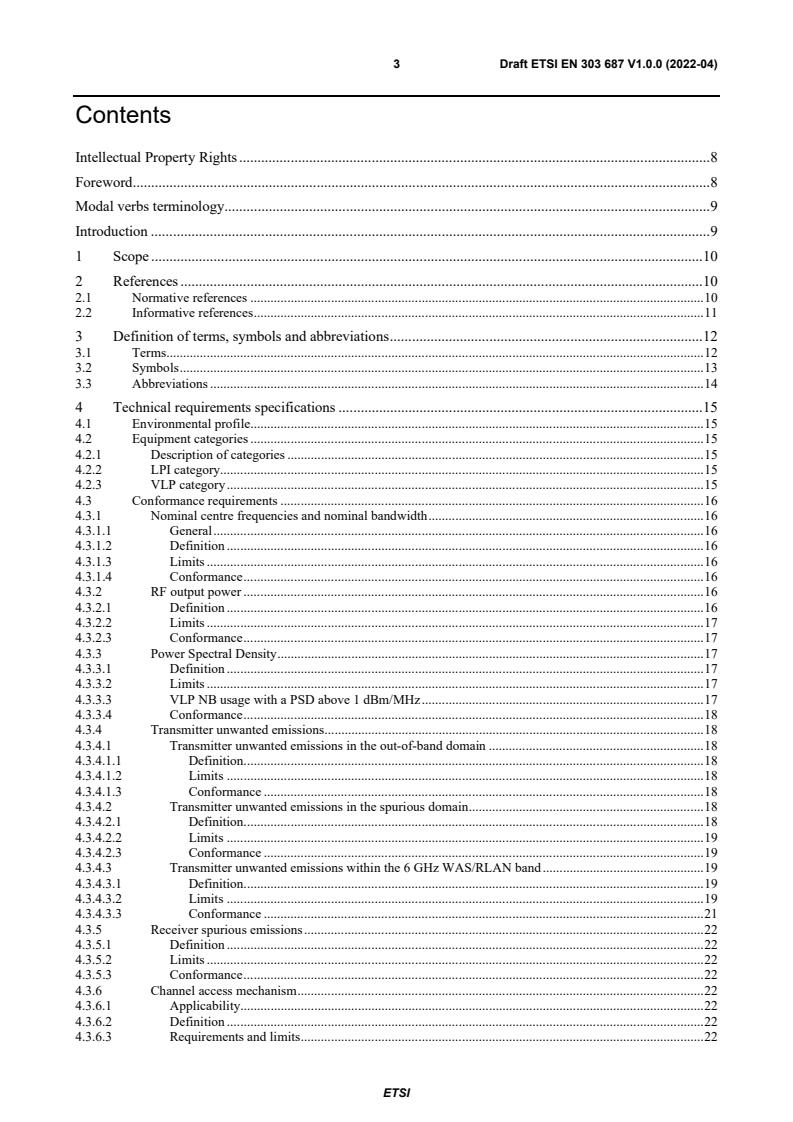
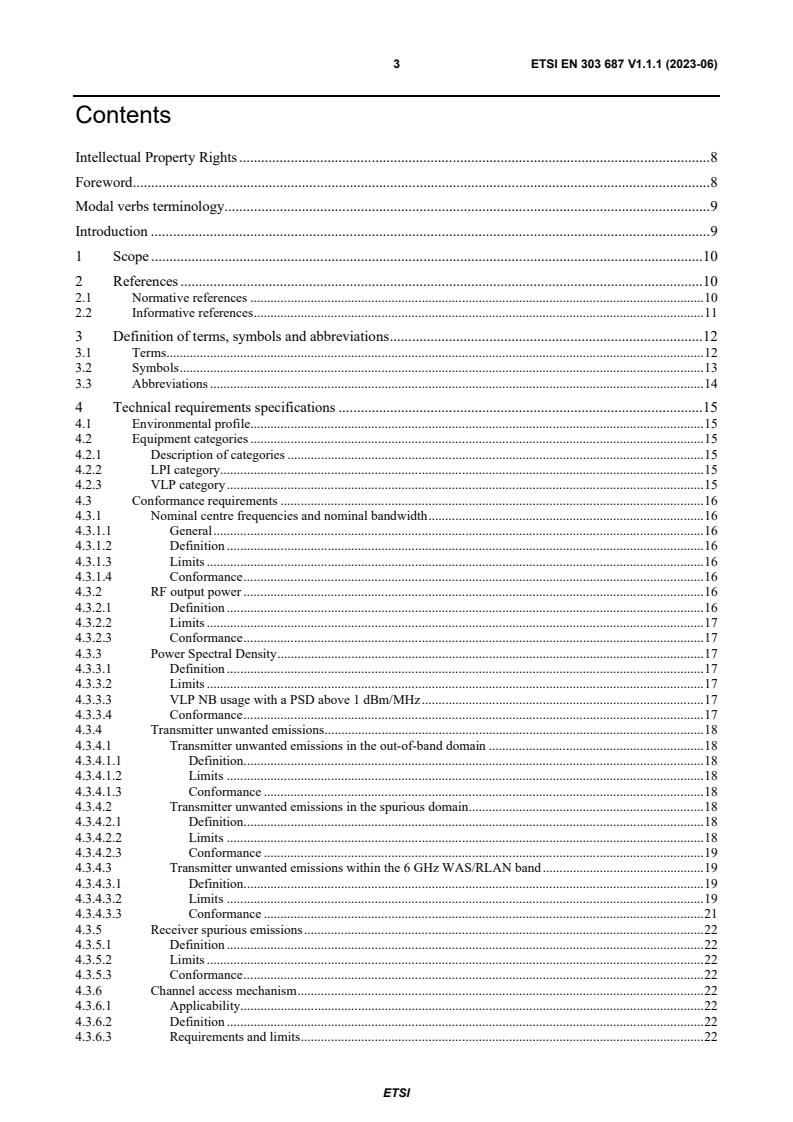
Contents
Intellectual Property Rights . 8
Foreword . 8
Modal verbs terminology . 9
Introduction . 9
1 Scope . 10
2 References . 10
2.1 Normative references . 10
2.2 Informative references . 11
3 Definition of terms, symbols and abbreviations . 12
3.1 Terms . 12
3.2 Symbols . 13
3.3 Abbreviations . 14
4 Technical requirements specifications . 15
4.1 Environmental profile . 15
4.2 Equipment categories . 15
4.2.1 Description of categories . 15
4.2.2 LPI category. 15
4.2.3 VLP category . 15
4.3 Conformance requirements . 16
4.3.1 Nominal centre frequencies and nominal bandwidth . 16
4.3.1.1 General . 16
4.3.1.2 Definition . 16
4.3.1.3 Limits . 16
4.3.1.4 Conformance . 16
4.3.2 RF output power . 16
4.3.2.1 Definition . 16
4.3.2.2 Limits . 17
4.3.2.3 Conformance . 17
4.3.3 Power Spectral Density . 17
4.3.3.1 Definition . 17
4.3.3.2 Limits . 17
4.3.3.3 VLP NB usage with a PSD above 1 dBm/MHz . 17
4.3.3.4 Conformance . 18
4.3.4 Transmitter unwanted emissions . 18
4.3.4.1 Transmitter unwanted emissions in the out-of-band domain . 18
4.3.4.1.1 Definition. 18
4.3.4.1.2 Limits . 18
4.3.4.1.3 Conformance . 18
4.3.4.2 Transmitter unwanted emissions in the spurious domain . 18
4.3.4.2.1 Definition. 18
4.3.4.2.2 Limits . 19
4.3.4.2.3 Conformance . 19
4.3.4.3 Transmitter unwanted emissions within the 6 GHz WAS/RLAN band . 19
4.3.4.3.1 Definition. 19
4.3.4.3.2 Limits . 19
4.3.4.3.3 Conformance . 21
4.3.5 Receiver spurious emissions . 22
4.3.5.1 Definition . 22
4.3.5.2 Limits . 22
4.3.5.3 Conformance . 22
4.3.6 Channel access mechanism . 22
4.3.6.1 Applicability. 22
4.3.6.2 Definition . 22
4.3.6.3 Requirements and limits . 22
ETSI
4 Draft ETSI EN 303 687 V1.0.0 (2022-04)
4.3.6.3.1 Channel access mechanism for Frame Based Equipment (FBE) . 22
4.3.6.3.2 Channel access mechanism for Load Based Equipment (LBE) . 24
4.3.6.3.3 ED Threshold level (Energy Detection Threshold level, FBE and LBE) . 29
4.3.6.3.4 Short Control Signalling transmissions (FBE and LBE) . 30
4.3.6.4 Conformance . 30
4.3.7 Receiver blocking . 30
4.3.7.1 Definition . 30
4.3.7.2 Performance criteria . 30
4.3.7.3 Limits . 30
4.3.7.4 Conformance . 31
4.3.8 Receiver selectivity . 31
4.3.8.1 Definition . 31
4.3.8.2 Performance criteria . 32
4.3.8.3 Limits . 32
4.3.8.4 Conformance . 32
4.3.9 Mechanical and electrical design . 32
4.3.9.1 Power feeding . 32
4.3.9.1.1 Description of types of power supply . 32
4.3.9.1.2 Wired power connection equipment . 33
4.3.9.2 Antenna design . 33
4.3.9.2.1 Description of types of antenna design . 33
4.3.9.2.2 Integral antenna . 33
4.3.9.3 Conformance . 33
4.3.10 User Access Restrictions . 33
4.3.10.1 Definition . 33
4.3.10.2 Requirements . 33
4.3.10.3 Conformance . 33
5 Testing for compliance with technical requirements . 34
5.1 Environmental conditions for testing . 34
5.1.1 Introduction. 34
5.1.2 Normal test conditions . 34
5.1.2.1 Normal temperature and humidity . 34
5.1.2.2 Normal power source . 34
5.1.3 Extreme test conditions . 34
5.2 Interpretation of the measurement results . 34
5.3 Definition of other test conditions . 34
5.3.1 Test sequences . 34
5.3.2 Test channels . 35
5.3.3 Antennas . 36
5.3.3.1 Integrated and dedicated antennas . 36
5.3.3.2 Transmit operating modes . 36
5.3.3.2.1 Operating mode 1 (single antenna) . 36
5.3.3.2.2 Operating mode 2 (multiple antennas, no beamforming) . 37
5.3.3.2.3 Operating mode 3 (multiple antennas, with beamforming) . 37
5.3.4 Presentation of equipment . 37
5.3.5 Measurement methods . 37
5.4 Essential radio test suites . 38
5.4.1 Product information . 38
5.4.2 Nominal centre frequencies . 39
5.4.2.1 Test conditions . 39
5.4.2.2 Test methods . 39
5.4.2.2.1 Conducted measurement. 39
5.4.2.2.2 Radiated measurement . 40
5.4.2.2.3 Test fixture measurement . 40
5.4.3 RF output power . 40
5.4.3.1 Test conditions . 40
5.4.3.2 Test methods . 41
5.4.3.2.1 Conducted measurement. 41
5.4.3.2.2 Radiated measurement . 42
5.4.3.2.3 Test fixture measurement . 43
5.4.4 Power Spectral Density . 43
ETSI
5 Draft ETSI EN 303 687 V1.0.0 (2022-04)
5.4.4.1 Test conditions . 43
5.4.4.2 Test methods . 43
5.4.4.2.1 Conducted measurement. 43
5.4.4.2.2 Radiated measurement . 46
5.4.4.2.3 Test fixture measurement . 46
5.4.5 Transmitter unwanted emissions outside the 6 GHz WAS/RLAN band . 46
5.4.5.1 Test conditions . 46
5.4.5.2 Test method . 46
5.4.5.2.1 Conducted measurement. 46
5.4.5.2.2 Radiated measurement . 49
5.4.5.2.3 Test fixture measurement . 49
5.4.6 Transmitter unwanted emissions within the 6 GHz WAS/RLAN band . 49
5.4.6.1 Test conditions . 49
5.4.6.2 Test method . 49
5.4.6.2.1 Conducted measurement. 49
5.4.6.2.2 Radiated measurement . 51
5.4.6.2.3 Test fixture measurement . 51
5.4.7 Receiver spurious emissions . 51
5.4.7.1 Test conditions . 51
5.4.7.2 Test methods . 52
5.4.7.2.1 Conducted measurement. 52
5.4.7.2.2 Radiated measurement . 54
5.4.7.2.3 Test fixture measurement . 54
5.4.8 Channel access mechanism . 54
5.4.8.1 Test conditions . 54
5.4.8.2 Test method for FBE . 54
5.4.8.2.1 Additional test conditions . 54
5.4.8.2.2 Conducted measurements . 54
5.4.8.2.3 Generic test procedure for measuring channel/frequency usage . 58
5.4.8.2.4 Radiated measurements . 58
5.4.8.2.5 Test fixture measurement . 59
5.4.8.3 Test method for LBE . 59
5.4.8.3.1 Additional test conditions . 59
5.4.8.3.2 Conducted measurements . 59
5.4.8.3.3 Generic test procedure for measuring channel/frequency usage . 67
5.4.8.3.4 Radiated measurements . 67
5.4.8.3.5 Test fixture measurement . 68
5.4.9 Receiver blocking . 68
5.4.9.1 Test conditions . 68
5.4.9.2 Test methods . 68
5.4.9.2.1 Conducted measurement. 68
5.4.9.2.2 Radiated measurement . 69
5.4.9.2.3 Test fixture measurement . 69
5.4.10 Receiver selectivity . 70
5.4.10.1 Test conditions . 70
5.4.10.2 Test methods . 70
5.4.10.2.1 Conducted measurement. 70
5.4.10.2.2 Radiated measurements . 71
5.4.10.2.3 Test fixture measurement . 71
5.4.11 Mechanical and electrical design . 71
5.4.12 VLP NB operation with a PSD exceeding 1 dBm/MHz . 72
5.4.12.1 Test conditions . 72
5.4.12.2 Test methods . 72
5.4.12.2.1 Conducted measurements . 72
5.4.12.2.2 Radiated measurements . 73
5.4.12.2.3 Test fixture measurement . 73
5.4.13 Assessment procedure for UAR. 73
5.4.13.1 Introduction . 73
5.4.13.2 Test conditions . 73
5.4.13.3 Test Method . 74
ETSI
6 Draft ETSI EN 303 687 V1.0.0 (2022-04)
Annex A (informative): Relationship between the present document and the essential
requirements of Directive 2014/53/EU . 75
Annex B (normative): Test sites and arrangements for radiated measurements . 77
B.1 Introduction . 77
B.2 Radiation test sites . 77
B.2.1 Open Area Test Site (OATS) . 77
B.2.2 Semi Anechoic Room (SAR) . 78
B.2.3 Fully Anechoic Room (FAR) . 79
B.2.4 Measurement distance . 80
B.3 Antennas . 81
B.3.1 Introduction . 81
B.3.2 Measurement antenna . 81
B.3.3 Substitution antenna . 81
B.4 Test fixture . 81
B.4.1 Introduction . 81
B.4.2 Description of the test fixture . 82
B.4.3 Using the test fixture for relative measurements at the extremes of the temperature range . 82
B.4.4 Using the test fixture for normalized measurements . 82
B.4.5 Using the test fixture for level independent measurements . 83
B.5 Guidance on the use of radiation test sites . 83
B.5.1 Introduction . 83
B.5.2 Power supplies for the battery powered UUT . 83
B.5.3 Site preparation . 83
B.6 Coupling of signals . 84
B.6.1 General . 84
B.6.2 Data signals . 84
B.7 Interference signals used for channel access mechanism tests . 84
B.7.1 Additive White Gaussian Noise (AWGN) test signal . 84
B.7.2 OFDM test signal 1 . 84
B.7.3 OFDM test signal 2 . 85
B.7.4 Verification of interference signal characteristics . 85
B.7.5 Waveforms for test signals . 86
Annex C (normative): Procedures for radiated measurements . 87
C.1 Introduction . 87
C.2 Radiated measurements in an OATS or SAR . 87
C.3 Radiated measurements in a FAR . 88
C.4 Substitution measurement . 88
C.5 Guidance for testing technical requirements . 88
C.5.1 Radio test suites and corresponding test sites . 88
C.5.2 Guidance for testing channel access mechanism . 89
C.5.2.1 Introduction. 89
C.5.2.2 Measurement set up . 89
C.5.2.3 Calibration of the measurement set up . 89
C.5.2.4 Test method . 90
C.5.3 Guidance for testing receiver blocking . 90
C.5.3.1 Introduction. 90
C.5.3.2 Measurement set up . 90
C.5.3.3 Calibration of the measurement set up . 90
C.5.3.4 Test method . 91
C.5.4 Guidance for testing receiver selectivity . 91
C.5.4.1 Introduction. 91
C.5.4.2 Measurement set up . 91
ETSI
7 Draft ETSI EN 303 687 V1.0.0 (2022-04)
C.5.4.3 Calibration of the measurement set up . 92
C.5.4.4 Test method . 92
Annex D (informative): Maximum measurement uncertainties . 93
Annex E (informative): Examples of spectrum masks . 94
E.1 Introduction . 94
E.2 Equipment configured for multi-channel operation in groups of four adjacent channels . 94
E.2.1 Example 1 . 94
E.2.2 Example 2 . 94
E.2.3 Example 3 . 95
E.2.4 Example 4 . 95
E.3 Equipment configured for multi-channel operation in 8 adjacent channels . 96
E.3.1 Example 5 . 96
E.3.2 Example 6 . 96
E.3.3 Example 7 . 97
E.3.4 Example 8 . 97
E.3.5 Example 9 . 98
Annex F (informative): Change history . 99
History . 100
ETSI
8 Draft ETSI EN 303 687 V1.0.0 (2022-04)
Intellectual Property Rights
Essential patents
IPRs essential or potentially essential to normative deliverables may have been declared to ETSI. The declarations
pertaining to these essential IPRs, if any, are publicly available for ETSI members and non-members, and can be
found in ETSI SR 000 314: "Intellectual Property Rights (IPRs); Essential, or potentially Essential, IPRs notified to
ETSI in respect of ETSI standards", which is available from the ETSI Secretariat. Latest updates are available on the
ETSI Web server (https://ipr.etsi.org/).
Pursuant to the ETSI Directives including the ETSI IPR Policy, no investigation regarding the essentiality of IPRs,
including IPR searches, has been carried out by ETSI. No guarantee can be given as to the existence of other IPRs not
referenced in ETSI SR 000 314 (or the updates on the ETSI Web server) which are, or may be, or may become,
essential to the present document.
Trademarks
The present document may include trademarks and/or tradenames which are asserted and/or registered by their owners.
ETSI claims no ownership of these except for any which are indicated as being the property of ETSI, and conveys no
right to use or reproduce any trademark and/or tradename. Mention of those trademarks in the present document does
not constitute an endorsement by ETSI of products, services or organizations associated with those trademarks.
DECT™, PLUGTESTS™, UMTS™ and the ETSI logo are trademarks of ETSI registered for the benefit of its
Members. 3GPP™ and LTE™ are trademarks of ETSI registered for the benefit of its Members and of the 3GPP
Organizational Partners. oneM2M™ logo is a trademark of ETSI registered for the benefit of its Members and of the ®
oneM2M Partners. GSM and the GSM logo are trademarks registered and owned by the GSM Association.
Foreword
This draft Harmonised European Standard (EN) has been produced by ETSI Technical Committee Broadband Radio
Access Networks (BRAN), and is now submitted for the combined Public Enquiry and Vote phase of the ETSI
standards EN Approval Procedure.
The present document has been prepared under the Commission's standardisation request C(2015) 5376 final [i.2] to
provide one voluntary means of conforming to the essential requirements of Directive 2014/53/EU on the harmonisation
of the laws of the Member States relating to the making available on the market of radio equipment and repealing
Directive 1999/5/EC [i.1].
Once the present document is cited in the Official Journal of the European Union under that Directive, compliance with
the normative clauses of the present document given in table A.1 confers, within the limits of the scop
...
Draft ETSI EN 303 687 V1.1.0 (2023-03)
HARMONISED EUROPEAN STANDARD
6 GHz WAS/RLAN;
Harmonised Standard for access to radio spectrum
2 Draft ETSI EN 303 687 V1.1.0 (2023-03)
Reference
DEN/BRAN-230021
Keywords
access, broadband, LAN, radio, regulation, testing
ETSI
650 Route des Lucioles
F-06921 Sophia Antipolis Cedex - FRANCE
Tel.: +33 4 92 94 42 00 Fax: +33 4 93 65 47 16
Siret N° 348 623 562 00017 - APE 7112B
Association à but non lucratif enregistrée à la
Sous-Préfecture de Grasse (06) N° w061004871
Important notice
The present document can be downloaded from:
https://www.etsi.org/standards-search
The present document may be made available in electronic versions and/or in print. The content of any electronic and/or
print versions of the present document shall not be modified without the prior written authorization of ETSI. In case of any
existing or perceived difference in contents between such versions and/or in print, the prevailing version of an ETSI
deliverable is the one made publicly available in PDF format at www.etsi.org/deliver.
Users of the present document should be aware that the document may be subject to revision or change of status.
Information on the current status of this and other ETSI documents is available at
https://portal.etsi.org/TB/ETSIDeliverableStatus.aspx
If you find errors in the present document, please send your comment to one of the following services:
https://portal.etsi.org/People/CommiteeSupportStaff.aspx
If you find a security vulnerability in the present document, please report it through our
Coordinated Vulnerability Disclosure Program:
https://www.etsi.org/standards/coordinated-vulnerability-disclosure
Notice of disclaimer & limitation of liability
The information provided in the present deliverable is directed solely to professionals who have the appropriate degree of
experience to understand and interpret its content in accordance with generally accepted engineering or
other professional standard and applicable regulations.
No recommendation as to products and services or vendors is made or should be implied.
In no event shall ETSI be held liable for loss of profits or any other incidental or consequential damages.
Any software contained in this deliverable is provided "AS IS" with no warranties, express or implied, including but not
limited to, the warranties of merchantability, fitness for a particular purpose and non-infringement of intellectual property
rights and ETSI shall not be held liable in any event for any damages whatsoever (including, without limitation, damages
for loss of profits, business interruption, loss of information, or any other pecuniary loss) arising out of or related to the use
of or inability to use the software.
Copyright Notification
No part may be reproduced or utilized in any form or by any means, electronic or mechanical, including photocopying and
microfilm except as authorized by written permission of ETSI.
The content of the PDF version shall not be modified without the written authorization of ETSI.
The copyright and the foregoing restriction extend to reproduction in all media.
© ETSI 2023.
All rights reserved.
ETSI
3 Draft ETSI EN 303 687 V1.1.0 (2023-03)
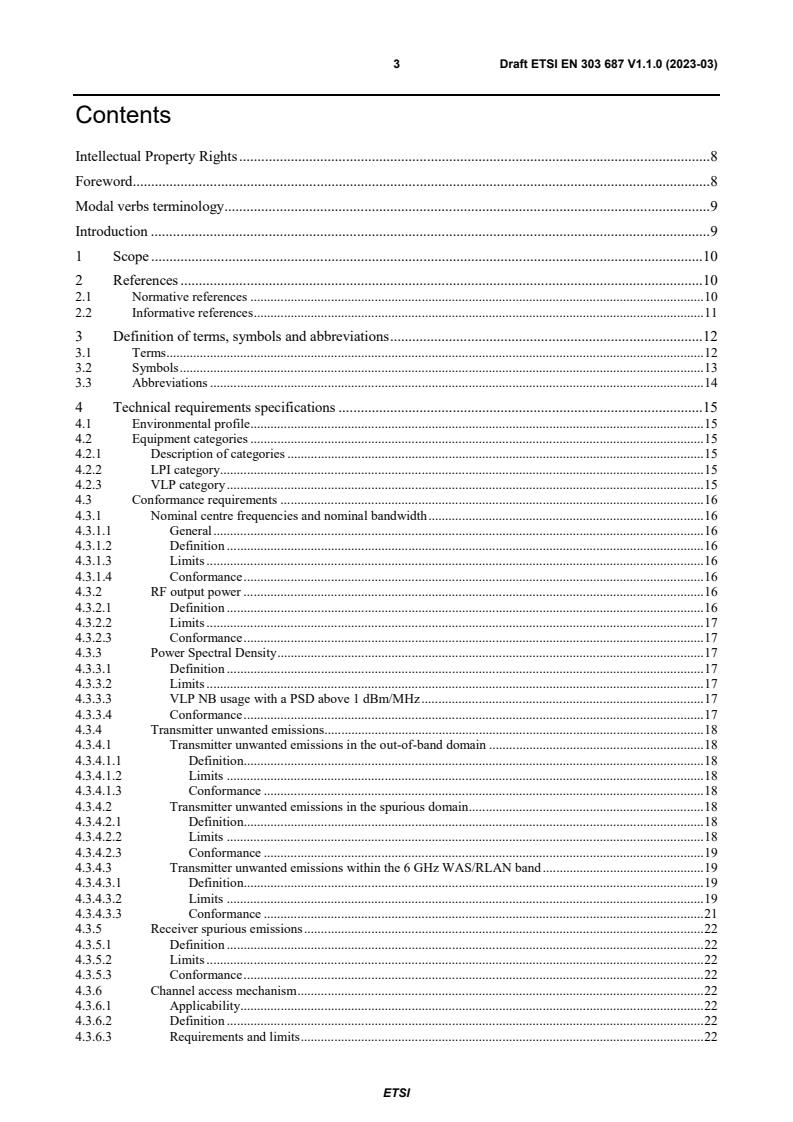
Contents
Intellectual Property Rights . 8
Foreword . 8
Modal verbs terminology . 9
Introduction . 9
1 Scope . 10
2 References . 10
2.1 Normative references . 10
2.2 Informative references . 11
3 Definition of terms, symbols and abbreviations . 12
3.1 Terms . 12
3.2 Symbols . 13
3.3 Abbreviations . 14
4 Technical requirements specifications . 15
4.1 Environmental profile . 15
4.2 Equipment categories . 15
4.2.1 Description of categories . 15
4.2.2 LPI category. 15
4.2.3 VLP category . 15
4.3 Conformance requirements . 16
4.3.1 Nominal centre frequencies and nominal bandwidth . 16
4.3.1.1 General . 16
4.3.1.2 Definition . 16
4.3.1.3 Limits . 16
4.3.1.4 Conformance . 16
4.3.2 RF output power . 16
4.3.2.1 Definition . 16
4.3.2.2 Limits . 17
4.3.2.3 Conformance . 17
4.3.3 Power Spectral Density . 17
4.3.3.1 Definition . 17
4.3.3.2 Limits . 17
4.3.3.3 VLP NB usage with a PSD above 1 dBm/MHz . 17
4.3.3.4 Conformance . 17
4.3.4 Transmitter unwanted emissions . 18
4.3.4.1 Transmitter unwanted emissions in the out-of-band domain . 18
4.3.4.1.1 Definition. 18
4.3.4.1.2 Limits . 18
4.3.4.1.3 Conformance . 18
4.3.4.2 Transmitter unwanted emissions in the spurious domain . 18
4.3.4.2.1 Definition. 18
4.3.4.2.2 Limits . 18
4.3.4.2.3 Conformance . 19
4.3.4.3 Transmitter unwanted emissions within the 6 GHz WAS/RLAN band . 19
4.3.4.3.1 Definition. 19
4.3.4.3.2 Limits . 19
4.3.4.3.3 Conformance . 21
4.3.5 Receiver spurious emissions . 22
4.3.5.1 Definition . 22
4.3.5.2 Limits . 22
4.3.5.3 Conformance . 22
4.3.6 Channel access mechanism . 22
4.3.6.1 Applicability. 22
4.3.6.2 Definition . 22
4.3.6.3 Requirements and limits . 22
ETSI
4 Draft ETSI EN 303 687 V1.1.0 (2023-03)
4.3.6.3.1 Channel access mechanism for Frame Based Equipment (FBE) . 22
4.3.6.3.2 Channel access mechanism for Load Based Equipment (LBE) . 24
4.3.6.3.3 ED Threshold level (Energy Detection Threshold level, FBE and LBE) . 29
4.3.6.3.4 Short Control Signalling transmissions (FBE and LBE) . 30
4.3.6.4 Conformance . 30
4.3.7 Receiver blocking . 30
4.3.7.1 Definition . 30
4.3.7.2 Performance criteria . 30
4.3.7.3 Limits . 30
4.3.7.4 Conformance . 31
4.3.8 Receiver selectivity . 31
4.3.8.1 Definition . 31
4.3.8.2 Performance criteria . 32
4.3.8.3 Limits . 32
4.3.8.4 Conformance . 32
4.3.9 Mechanical and electrical design . 32
4.3.9.1 Power feeding . 32
4.3.9.1.1 Description of types of power supply . 32
4.3.9.1.2 Wired power connection equipment . 33
4.3.9.2 Antenna design . 33
4.3.9.2.1 Description of types of antenna design . 33
4.3.9.2.2 Integral antenna . 33
4.3.9.3 Conformance . 33
4.3.10 User Access Restrictions . 33
4.3.10.1 Definition . 33
4.3.10.2 Requirements . 33
4.3.10.3 Conformance . 33
5 Testing for compliance with technical requirements . 34
5.1 Environmental conditions for testing . 34
5.1.1 Introduction. 34
5.1.2 Normal test conditions . 34
5.1.2.1 Normal temperature and humidity . 34
5.1.2.2 Normal power source . 34
5.1.3 Extreme test conditions . 34
5.2 Interpretation of the measurement results . 34
5.3 Definition of other test conditions . 35
5.3.1 Test sequences . 35
5.3.2 Test channels . 35
5.3.3 Antennas . 36
5.3.3.1 Integrated and dedicated antennas . 36
5.3.3.2 Transmit operating modes . 36
5.3.3.2.1 Operating mode 1 (single antenna) . 36
5.3.3.2.2 Operating mode 2 (multiple antennas, no beamforming) . 37
5.3.3.2.3 Operating mode 3 (multiple antennas, with beamforming) . 37
5.3.4 Presentation of equipment . 37
5.3.5 Measurement methods . 37
5.4 Essential radio test suites . 38
5.4.1 Product information . 38
5.4.2 Nominal centre frequencies . 39
5.4.2.1 Test conditions . 39
5.4.2.2 Test methods . 39
5.4.2.2.1 Conducted measurement. 39
5.4.2.2.2 Radiated measurement . 40
5.4.2.2.3 Test fixture measurement . 40
5.4.3 RF output power . 40
5.4.3.1 Test conditions . 40
5.4.3.2 Test methods . 41
5.4.3.2.1 Conducted measurement. 41
5.4.3.2.2 Radiated measurement . 42
5.4.3.2.3 Test fixture measurement . 43
5.4.4 Power Spectral Density . 43
ETSI
5 Draft ETSI EN 303 687 V1.1.0 (2023-03)
5.4.4.1 Test conditions . 43
5.4.4.2 Test methods . 43
5.4.4.2.1 Conducted measurement. 43
5.4.4.2.2 Radiated measurement . 46
5.4.4.2.3 Test fixture measurement . 46
5.4.5 Transmitter unwanted emissions outside the 6 GHz WAS/RLAN band . 46
5.4.5.1 Test conditions . 46
5.4.5.2 Test method . 46
5.4.5.2.1 Conducted measurement. 46
5.4.5.2.2 Radiated measurement . 49
5.4.5.2.3 Test fixture measurement . 49
5.4.6 Transmitter unwanted emissions within the 6 GHz WAS/RLAN band . 49
5.4.6.1 Test conditions . 49
5.4.6.2 Test method . 49
5.4.6.2.1 Conducted measurement. 49
5.4.6.2.2 Radiated measurement . 51
5.4.6.2.3 Test fixture measurement . 51
5.4.7 Receiver spurious emissions . 51
5.4.7.1 Test conditions . 51
5.4.7.2 Test methods . 52
5.4.7.2.1 Conducted measurement. 52
5.4.7.2.2 Radiated measurement . 54
5.4.7.2.3 Test fixture measurement . 54
5.4.8 Channel access mechanism . 54
5.4.8.1 Test conditions . 54
5.4.8.2 Test method for FBE . 54
5.4.8.2.1 Additional test conditions . 54
5.4.8.2.2 Conducted measurements . 54
5.4.8.2.3 Generic test procedure for measuring channel/frequency usage . 58
5.4.8.2.4 Radiated measurements . 58
5.4.8.2.5 Test fixture measurement . 59
5.4.8.3 Test method for LBE . 59
5.4.8.3.1 Additional test conditions . 59
5.4.8.3.2 Conducted measurements . 59
5.4.8.3.3 Generic test procedure for measuring channel/frequency usage . 67
5.4.8.3.4 Radiated measurements . 67
5.4.8.3.5 Test fixture measurement . 68
5.4.9 Receiver blocking . 68
5.4.9.1 Test conditions . 68
5.4.9.2 Test methods . 68
5.4.9.2.1 Conducted measurement. 68
5.4.9.2.2 Radiated measurement . 69
5.4.9.2.3 Test fixture measurement . 69
5.4.10 Receiver selectivity . 70
5.4.10.1 Test conditions . 70
5.4.10.2 Test methods . 70
5.4.10.2.1 Conducted measurement. 70
5.4.10.2.2 Radiated measurements . 71
5.4.10.2.3 Test fixture measurement . 71
5.4.11 Mechanical and electrical design . 72
5.4.12 VLP NB operation with a PSD exceeding 1 dBm/MHz . 72
5.4.12.1 Test conditions . 72
5.4.12.2 Test methods . 72
5.4.12.2.1 Conducted measurements . 72
5.4.12.2.2 Radiated measurements . 73
5.4.12.2.3 Test fixture measurement . 73
5.4.13 Assessment procedure for UAR. 74
5.4.13.1 Introduction . 74
5.4.13.2 Test conditions . 74
5.4.13.3 Test Method . 74
ETSI
6 Draft ETSI EN 303 687 V1.1.0 (2023-03)
Annex A (informative): Relationship between the present document and the essential
requirements of Directive 2014/53/EU . 75
Annex B (normative): Test sites and arrangements for radiated measurements . 77
B.1 Introduction . 77
B.2 Radiated test sites . 77
B.2.1 Open Area Test Site (OATS) . 77
B.2.2 Semi Anechoic Room (SAR) . 78
B.2.3 Fully Anechoic Room (FAR) . 79
B.2.4 Measurement distance . 80
B.3 Antennas . 81
B.3.1 Introduction . 81
B.3.2 Measurement antenna . 81
B.3.3 Substitution antenna . 81
B.4 Test fixture . 81
B.4.1 Introduction . 81
B.4.2 Description of the test fixture . 82
B.4.3 Using the test fixture for relative measurements at the lower and upper extreme temperatures . 82
B.4.4 Using the test fixture for normalized measurements . 82
B.4.5 Using the test fixture for level independent measurements . 83
B.5 Arrangement of the radiated test sites . 83
B.5.1 Introduction . 83
B.5.2 Power supplies for the battery powered UUT . 83
B.5.3 Site preparation . 83
B.6 Coupling of signals . 84
B.6.1 General . 84
B.6.2 Data signals . 84
B.7 Interference signals used for channel access mechanism tests . 84
B.7.1 Additive White Gaussian Noise (AWGN) test signal . 84
B.7.2 OFDM test signal 1 . 84
B.7.3 OFDM test signal 2 . 85
B.7.4 Interference signal characteristics . 85
B.7.4.1 Verification of flatness and bandwidth . 85
B.7.4.2 Measurement of PSD . 86
B.7.5 Waveforms for test signals . 86
Annex C (normative): Procedures for radiated measurements . 87
C.1 Introduction . 87
C.2 Radiated measurements in an OATS or SAR . 87
C.3 Radiated measurements in a FAR . 88
C.4 Substitution measurement . 88
C.5 Testing technical requirements on equipment with an integral antenna . 88
C.5.1 Radio test suites and corresponding test sites . 88
C.5.2 Channel access mechanism testing . 89
C.5.2.1 Introduction. 89
C.5.2.2 Measurement set up . 89
C.5.2.3 Calibration of the measurement set up . 89
C.5.2.4 Test method . 90
C.5.3 Receiver blocking testing . 90
C.5.3.1 Introduction. 90
C.5.3.2 Measurement set up . 90
C.5.3.3 Calibration of the measurement set up . 91
C.5.3.4 Test method . 91
C.5.4 Receiver selectivity testing . 92
ETSI
7 Draft ETSI EN 303 687 V1.1.0 (2023-03)
C.5.4.1 Introduction. 92
C.5.4.2 Measurement set up . 92
C.5.4.3 Calibration of the measurement set up . 92
C.5.4.4 Test method . 93
Annex D (informative): Maximum measurement uncertainty . 94
Annex E (informative): Examples of spectrum masks . 95
E.1 Introduction . 95
E.2 Equipment configured for multi-channel operation in groups of four adjacent channels . 95
E.2.1 Example 1 . 95
E.2.2 Example 2 . 95
E.2.3 Example 3 . 96
E.2.4 Example 4 . 96
E.3 Equipment configured for multi-channel operation in 8 adjacent channels . 97
E.3.1 Example 5 . 97
E.3.2 Example 6 . 98
E.3.3 Example 7 . 98
E.3.4 Example 8 . 99
E.3.5 Example 9 . 99
Annex F (informative): Change history . 100
History . 101
ETSI
8 Draft ETSI EN 303 687 V1.1.0 (2023-03)
Intellectual Property Rights
Essential patents
IPRs essential or potentially essential to normative deliverables may have been declared to ETSI. The declarations
pertaining to these essential IPRs, if any, are publicly available for ETSI members and non-members, and can be
found in ETSI SR 000 314: "Intellectual Property Rights (IPRs); Essential, or potentially Essential, IPRs notified to
ETSI in respect of ETSI standards", which is available from the ETSI Secretariat. Latest updates are available on the
ETSI Web server (https://ipr.etsi.org/).
Pursuant to the ETSI Directives including the ETSI IPR Policy, no investigation regarding the essentiality of IPRs,
including IPR searches, has been carried out by ETSI. No guarantee can be given as to the existence of other IPRs not
referenced in ETSI SR 000 314 (or the updates on the ETSI Web server) which are, or may be, or may become,
essential to the present document.
Trademarks
The present document may include trademarks and/or tradenames which are asserted and/or registered by their owners.
ETSI claims no ownership of these except for any which are indicated as being the property of ETSI, and conveys no
right to use or reproduce any trademark and/or tradename. Mention of those trademarks in the present document does
not constitute an endorsement by ETSI of products, services or organizations associated with those trademarks.
DECT™, PLUGTESTS™, UMTS™ and the ETSI logo are trademarks of ETSI registered for the benefit of its
Members. 3GPP™ and LTE™ are trademarks of ETSI registered for the benefit of its Members and of the 3GPP
Organizational Partners. oneM2M™ logo is a trademark of ETSI registered for the benefit of its Members and of the ®
oneM2M Partners. GSM and the GSM logo are trademarks registered and owned by the GSM Association.
Foreword
This draft Harmonised European Standard (EN) has been produced by ETSI Technical Committee Broadband Radio
Access Networks (BRAN), and is now submitted for the combined Public Enquiry and Vote phase of the ETSI
standards EN Approval Procedure.
The present document has been prepared under the Commission's standardisation request C(2015) 5376 final [i.2] to
provide one voluntary means of conforming to the essential requirements of Directive 2014/53/EU on the harmonisation
of the laws of the Member States rel
...
HARMONISED EUROPEAN STANDARD
6 GHz WAS/RLAN;
Harmonised Standard for access to radio spectrum
2 ETSI EN 303 687 V1.1.1 (2023-06)
Reference
DEN/BRAN-230021
Keywords
access, broadband, LAN, radio, regulation, testing
ETSI
650 Route des Lucioles
F-06921 Sophia Antipolis Cedex - FRANCE
Tel.: +33 4 92 94 42 00 Fax: +33 4 93 65 47 16
Siret N° 348 623 562 00017 - APE 7112B
Association à but non lucratif enregistrée à la
Sous-Préfecture de Grasse (06) N° w061004871
Important notice
The present document can be downloaded from:
https://www.etsi.org/standards-search
The present document may be made available in electronic versions and/or in print. The content of any electronic and/or
print versions of the present document shall not be modified without the prior written authorization of ETSI. In case of any
existing or perceived difference in contents between such versions and/or in print, the prevailing version of an ETSI
deliverable is the one made publicly available in PDF format at www.etsi.org/deliver.
Users of the present document should be aware that the document may be subject to revision or change of status.
Information on the current status of this and other ETSI documents is available at
https://portal.etsi.org/TB/ETSIDeliverableStatus.aspx
If you find errors in the present document, please send your comment to one of the following services:
https://portal.etsi.org/People/CommiteeSupportStaff.aspx
If you find a security vulnerability in the present document, please report it through our
Coordinated Vulnerability Disclosure Program:
https://www.etsi.org/standards/coordinated-vulnerability-disclosure
Notice of disclaimer & limitation of liability
The information provided in the present deliverable is directed solely to professionals who have the appropriate degree of
experience to understand and interpret its content in accordance with generally accepted engineering or
other professional standard and applicable regulations.
No recommendation as to products and services or vendors is made or should be implied.
In no event shall ETSI be held liable for loss of profits or any other incidental or consequential damages.
Any software contained in this deliverable is provided "AS IS" with no warranties, express or implied, including but not
limited to, the warranties of merchantability, fitness for a particular purpose and non-infringement of intellectual property
rights and ETSI shall not be held liable in any event for any damages whatsoever (including, without limitation, damages
for loss of profits, business interruption, loss of information, or any other pecuniary loss) arising out of or related to the use
of or inability to use the software.
Copyright Notification
No part may be reproduced or utilized in any form or by any means, electronic or mechanical, including photocopying and
microfilm except as authorized by written permission of ETSI.
The content of the PDF version shall not be modified without the written authorization of ETSI.
The copyright and the foregoing restriction extend to reproduction in all media.
© ETSI 2023.
All rights reserved.
ETSI
3 ETSI EN 303 687 V1.1.1 (2023-06)
Contents
Intellectual Property Rights . 8
Foreword . 8
Modal verbs terminology . 9
Introduction . 9
1 Scope . 10
2 References . 10
2.1 Normative references . 10
2.2 Informative references . 11
3 Definition of terms, symbols and abbreviations . 12
3.1 Terms . 12
3.2 Symbols . 13
3.3 Abbreviations . 14
4 Technical requirements specifications . 15
4.1 Environmental profile . 15
4.2 Equipment categories . 15
4.2.1 Description of categories . 15
4.2.2 LPI category. 15
4.2.3 VLP category . 15
4.3 Conformance requirements . 16
4.3.1 Nominal centre frequencies and nominal bandwidth . 16
4.3.1.1 General . 16
4.3.1.2 Definition . 16
4.3.1.3 Limits . 16
4.3.1.4 Conformance . 16
4.3.2 RF output power . 16
4.3.2.1 Definition . 16
4.3.2.2 Limits . 17
4.3.2.3 Conformance . 17
4.3.3 Power Spectral Density . 17
4.3.3.1 Definition . 17
4.3.3.2 Limits . 17
4.3.3.3 VLP NB usage with a PSD above 1 dBm/MHz . 17
4.3.3.4 Conformance . 17
4.3.4 Transmitter unwanted emissions . 18
4.3.4.1 Transmitter unwanted emissions in the out-of-band domain . 18
4.3.4.1.1 Definition. 18
4.3.4.1.2 Limits . 18
4.3.4.1.3 Conformance . 18
4.3.4.2 Transmitter unwanted emissions in the spurious domain . 18
4.3.4.2.1 Definition. 18
4.3.4.2.2 Limits . 18
4.3.4.2.3 Conformance . 19
4.3.4.3 Transmitter unwanted emissions within the 6 GHz WAS/RLAN band . 19
4.3.4.3.1 Definition. 19
4.3.4.3.2 Limits . 19
4.3.4.3.3 Conformance . 21
4.3.5 Receiver spurious emissions . 22
4.3.5.1 Definition . 22
4.3.5.2 Limits . 22
4.3.5.3 Conformance . 22
4.3.6 Channel access mechanism . 22
4.3.6.1 Applicability. 22
4.3.6.2 Definition . 22
4.3.6.3 Requirements and limits . 22
ETSI
4 ETSI EN 303 687 V1.1.1 (2023-06)
4.3.6.3.1 Channel access mechanism for Frame Based Equipment (FBE) . 22
4.3.6.3.2 Channel access mechanism for Load Based Equipment (LBE) . 24
4.3.6.3.3 ED Threshold level (Energy Detection Threshold level, FBE and LBE) . 29
4.3.6.3.4 Short Control Signalling transmissions (FBE and LBE) . 30
4.3.6.4 Conformance . 30
4.3.7 Receiver blocking . 30
4.3.7.1 Definition . 30
4.3.7.2 Performance criteria . 30
4.3.7.3 Limits . 30
4.3.7.4 Conformance . 31
4.3.8 Receiver selectivity . 31
4.3.8.1 Definition . 31
4.3.8.2 Performance criteria . 32
4.3.8.3 Limits . 32
4.3.8.4 Conformance . 32
4.3.9 Mechanical and electrical design . 32
4.3.9.1 Power feeding . 32
4.3.9.1.1 Description of types of power supply . 32
4.3.9.1.2 Wired power connection equipment . 33
4.3.9.2 Antenna design . 33
4.3.9.2.1 Description of types of antenna design . 33
4.3.9.2.2 Integral antenna . 33
4.3.9.3 Conformance . 33
4.3.10 User Access Restrictions . 33
4.3.10.1 Definition . 33
4.3.10.2 Requirements . 33
4.3.10.3 Conformance . 33
5 Testing for compliance with technical requirements . 34
5.1 Environmental conditions for testing . 34
5.1.1 Introduction. 34
5.1.2 Normal test conditions . 34
5.1.2.1 Normal temperature and humidity . 34
5.1.2.2 Normal power source . 34
5.1.3 Extreme test conditions . 34
5.2 Interpretation of the measurement results . 34
5.3 Definition of other test conditions . 35
5.3.1 Test sequences . 35
5.3.2 Test channels . 35
5.3.3 Antennas . 36
5.3.3.1 Integrated and dedicated antennas . 36
5.3.3.2 Transmit operating modes . 36
5.3.3.2.1 Operating mode 1 (single antenna) . 36
5.3.3.2.2 Operating mode 2 (multiple antennas, no beamforming) . 37
5.3.3.2.3 Operating mode 3 (multiple antennas, with beamforming) . 37
5.3.4 Presentation of equipment . 37
5.3.5 Measurement methods . 37
5.4 Essential radio test suites . 38
5.4.1 Product information . 38
5.4.2 Nominal centre frequencies . 39
5.4.2.1 Test conditions . 39
5.4.2.2 Test methods . 39
5.4.2.2.1 Conducted measurement. 39
5.4.2.2.2 Radiated measurement . 40
5.4.2.2.3 Test fixture measurement . 40
5.4.3 RF output power . 40
5.4.3.1 Test conditions . 40
5.4.3.2 Test methods . 41
5.4.3.2.1 Conducted measurement. 41
5.4.3.2.2 Radiated measurement . 42
5.4.3.2.3 Test fixture measurement . 43
5.4.4 Power Spectral Density . 43
ETSI
5 ETSI EN 303 687 V1.1.1 (2023-06)
5.4.4.1 Test conditions . 43
5.4.4.2 Test methods . 43
5.4.4.2.1 Conducted measurement. 43
5.4.4.2.2 Radiated measurement . 46
5.4.4.2.3 Test fixture measurement . 46
5.4.5 Transmitter unwanted emissions outside the 6 GHz WAS/RLAN band . 46
5.4.5.1 Test conditions . 46
5.4.5.2 Test method . 46
5.4.5.2.1 Conducted measurement. 46
5.4.5.2.2 Radiated measurement . 49
5.4.5.2.3 Test fixture measurement . 49
5.4.6 Transmitter unwanted emissions within the 6 GHz WAS/RLAN band . 49
5.4.6.1 Test conditions . 49
5.4.6.2 Test method . 49
5.4.6.2.1 Conducted measurement. 49
5.4.6.2.2 Radiated measurement . 51
5.4.6.2.3 Test fixture measurement . 51
5.4.7 Receiver spurious emissions . 51
5.4.7.1 Test conditions . 51
5.4.7.2 Test methods . 52
5.4.7.2.1 Conducted measurement. 52
5.4.7.2.2 Radiated measurement . 54
5.4.7.2.3 Test fixture measurement . 54
5.4.8 Channel access mechanism . 54
5.4.8.1 Test conditions . 54
5.4.8.2 Test method for FBE . 54
5.4.8.2.1 Additional test conditions . 54
5.4.8.2.2 Conducted measurements . 54
5.4.8.2.3 Generic test procedure for measuring channel/frequency usage . 58
5.4.8.2.4 Radiated measurements . 58
5.4.8.2.5 Test fixture measurement . 59
5.4.8.3 Test method for LBE . 59
5.4.8.3.1 Additional test conditions . 59
5.4.8.3.2 Conducted measurements . 59
5.4.8.3.3 Generic test procedure for measuring channel/frequency usage . 67
5.4.8.3.4 Radiated measurements . 67
5.4.8.3.5 Test fixture measurement . 68
5.4.9 Receiver blocking . 68
5.4.9.1 Test conditions . 68
5.4.9.2 Test methods . 68
5.4.9.2.1 Conducted measurement. 68
5.4.9.2.2 Radiated measurement . 69
5.4.9.2.3 Test fixture measurement . 69
5.4.10 Receiver selectivity . 70
5.4.10.1 Test conditions . 70
5.4.10.2 Test methods . 70
5.4.10.2.1 Conducted measurement. 70
5.4.10.2.2 Radiated measurements . 71
5.4.10.2.3 Test fixture measurement . 71
5.4.11 Mechanical and electrical design . 72
5.4.12 VLP NB operation with a PSD exceeding 1 dBm/MHz . 72
5.4.12.1 Test conditions . 72
5.4.12.2 Test methods . 72
5.4.12.2.1 Conducted measurements . 72
5.4.12.2.2 Radiated measurements . 73
5.4.12.2.3 Test fixture measurement . 73
5.4.13 Assessment procedure for UAR. 74
5.4.13.1 Introduction . 74
5.4.13.2 Test conditions . 74
5.4.13.3 Test Method . 74
ETSI
6 ETSI EN 303 687 V1.1.1 (2023-06)
Annex A (informative): Relationship between the present document and the essential
requirements of Directive 2014/53/EU . 75
Annex B (normative): Test sites and arrangements for radiated measurements . 77
B.1 Introduction . 77
B.2 Radiated test sites . 77
B.2.1 Open Area Test Site (OATS) . 77
B.2.2 Semi Anechoic Room (SAR) . 78
B.2.3 Fully Anechoic Room (FAR) . 79
B.2.4 Measurement distance . 80
B.3 Antennas . 81
B.3.1 Introduction . 81
B.3.2 Measurement antenna . 81
B.3.3 Substitution antenna . 81
B.4 Test fixture . 81
B.4.1 Introduction . 81
B.4.2 Description of the test fixture . 82
B.4.3 Using the test fixture for relative measurements at the lower and upper extreme temperatures . 82
B.4.4 Using the test fixture for normalized measurements . 82
B.4.5 Using the test fixture for level independent measurements . 83
B.5 Arrangement of the radiated test sites . 83
B.5.1 Introduction . 83
B.5.2 Power supplies for the battery powered UUT . 83
B.5.3 Site preparation . 83
B.6 Coupling of signals . 84
B.6.1 General . 84
B.6.2 Data signals . 84
B.7 Interference signals used for channel access mechanism tests . 84
B.7.1 Additive White Gaussian Noise (AWGN) test signal . 84
B.7.2 OFDM test signal 1 . 84
B.7.3 OFDM test signal 2 . 85
B.7.4 Interference signal characteristics . 85
B.7.4.1 Verification of flatness and bandwidth . 85
B.7.4.2 Measurement of PSD . 86
B.7.5 Waveforms for test signals . 86
Annex C (normative): Procedures for radiated measurements . 87
C.1 Introduction . 87
C.2 Radiated measurements in an OATS or SAR . 87
C.3 Radiated measurements in a FAR . 88
C.4 Substitution measurement . 88
C.5 Testing technical requirements on equipment with an integral antenna . 88
C.5.1 Radio test suites and corresponding test sites . 88
C.5.2 Channel access mechanism testing . 89
C.5.2.1 Introduction. 89
C.5.2.2 Measurement set up . 89
C.5.2.3 Calibration of the measurement set up . 89
C.5.2.4 Test method . 90
C.5.3 Receiver blocking testing . 90
C.5.3.1 Introduction. 90
C.5.3.2 Measurement set up . 90
C.5.3.3 Calibration of the measurement set up . 91
C.5.3.4 Test method . 91
C.5.4 Receiver selectivity testing . 92
ETSI
7 ETSI EN 303 687 V1.1.1 (2023-06)
C.5.4.1 Introduction. 92
C.5.4.2 Measurement set up . 92
C.5.4.3 Calibration of the measurement set up . 92
C.5.4.4 Test method . 93
Annex D (informative): Maximum measurement uncertainty . 94
Annex E (informative): Examples of spectrum masks . 95
E.1 Introduction . 95
E.2 Equipment configured for multi-channel operation in groups of four adjacent channels . 95
E.2.1 Example 1 . 95
E.2.2 Example 2 . 95
E.2.3 Example 3 . 96
E.2.4 Example 4 . 96
E.3 Equipment configured for multi-channel operation in 8 adjacent channels . 97
E.3.1 Example 5 . 97
E.3.2 Example 6 . 98
E.3.3 Example 7 . 98
E.3.4 Example 8 . 99
E.3.5 Example 9 . 99
Annex F (informative): Change history . 100
History . 101
ETSI
8 ETSI EN 303 687 V1.1.1 (2023-06)
Intellectual Property Rights
Essential patents
IPRs essential or potentially essential to normative deliverables may have been declared to ETSI. The declarations
pertaining to these essential IPRs, if any, are publicly available for ETSI members and non-members, and can be
found in ETSI SR 000 314: "Intellectual Property Rights (IPRs); Essential, or potentially Essential, IPRs notified to
ETSI in respect of ETSI standards", which is available from the ETSI Secretariat. Latest updates are available on the
ETSI Web server (https://ipr.etsi.org/).
Pursuant to the ETSI Directives including the ETSI IPR Policy, no investigation regarding the essentiality of IPRs,
including IPR searches, has been carried out by ETSI. No guarantee can be given as to the existence of other IPRs not
referenced in ETSI SR 000 314 (or the updates on the ETSI Web server) which are, or may be, or may become,
essential to the present document.
Trademarks
The present document may include trademarks and/or tradenames which are asserted and/or registered by their owners.
ETSI claims no ownership of these except for any which are indicated as being the property of ETSI, and conveys no
right to use or reproduce any trademark and/or tradename. Mention of those trademarks in the present document does
not constitute an endorsement by ETSI of products, services or organizations associated with those trademarks.
DECT™, PLUGTESTS™, UMTS™ and the ETSI logo are trademarks of ETSI registered for the benefit of its
Members. 3GPP™ and LTE™ are trademarks of ETSI registered for the benefit of its Members and of the 3GPP
Organizational Partners. oneM2M™ logo is a trademark of ETSI registered for the benefit of its Members and of the ®
oneM2M Partners. GSM and the GSM logo are trademarks registered and owned by the GSM Association.
Foreword
This Harmonised European Standard (EN) has been produced by ETSI Technical Committee Broadband Radio Access
Networks (BRAN).
The present document has been prepared under the Commission's standardisation request C(2015) 5376 final [i.2] to
provide one voluntary means of conforming to the essential requirements of Directive 2014/53/EU on the harmonisation
of the laws of the Member States relating to the making available on the market of radio equipment and repealing
Directive 1999/5/EC [i.1].
Once the present document is cited in the Official Journal of
...
SLOVENSKI STANDARD
01-september-2023
6 GHz WAS/RLAN - Harmonizirani standard za dostop do radijskega spektra
6 GHz WAS/RLAN Harmonised Standard for access to radio spectrum
Ta slovenski standard je istoveten z: ETSI EN 303 687 V1.1.1 (2023-06)
ICS:
33.060.01 Radijske komunikacije na Radiocommunications in
splošno general
2003-01.Slovenski inštitut za standardizacijo. Razmnoževanje celote ali delov tega standarda ni dovoljeno.
HARMONISED EUROPEAN STANDARD
6 GHz WAS/RLAN;
Harmonised Standard for access to radio spectrum
2 ETSI EN 303 687 V1.1.1 (2023-06)
Reference
DEN/BRAN-230021
Keywords
access, broadband, LAN, radio, regulation, testing
ETSI
650 Route des Lucioles
F-06921 Sophia Antipolis Cedex - FRANCE
Tel.: +33 4 92 94 42 00 Fax: +33 4 93 65 47 16
Siret N° 348 623 562 00017 - APE 7112B
Association à but non lucratif enregistrée à la
Sous-Préfecture de Grasse (06) N° w061004871
Important notice
The present document can be downloaded from:
https://www.etsi.org/standards-search
The present document may be made available in electronic versions and/or in print. The content of any electronic and/or
print versions of the present document shall not be modified without the prior written authorization of ETSI. In case of any
existing or perceived difference in contents between such versions and/or in print, the prevailing version of an ETSI
deliverable is the one made publicly available in PDF format at www.etsi.org/deliver.
Users of the present document should be aware that the document may be subject to revision or change of status.
Information on the current status of this and other ETSI documents is available at
https://portal.etsi.org/TB/ETSIDeliverableStatus.aspx
If you find errors in the present document, please send your comment to one of the following services:
https://portal.etsi.org/People/CommiteeSupportStaff.aspx
If you find a security vulnerability in the present document, please report it through our
Coordinated Vulnerability Disclosure Program:
https://www.etsi.org/standards/coordinated-vulnerability-disclosure
Notice of disclaimer & limitation of liability
The information provided in the present deliverable is directed solely to professionals who have the appropriate degree of
experience to understand and interpret its content in accordance with generally accepted engineering or
other professional standard and applicable regulations.
No recommendation as to products and services or vendors is made or should be implied.
In no event shall ETSI be held liable for loss of profits or any other incidental or consequential damages.
Any software contained in this deliverable is provided "AS IS" with no warranties, express or implied, including but not
limited to, the warranties of merchantability, fitness for a particular purpose and non-infringement of intellectual property
rights and ETSI shall not be held liable in any event for any damages whatsoever (including, without limitation, damages
for loss of profits, business interruption, loss of information, or any other pecuniary loss) arising out of or related to the use
of or inability to use the software.
Copyright Notification
No part may be reproduced or utilized in any form or by any means, electronic or mechanical, including photocopying and
microfilm except as authorized by written permission of ETSI.
The content of the PDF version shall not be modified without the written authorization of ETSI.
The copyright and the foregoing restriction extend to reproduction in all media.
© ETSI 2023.
All rights reserved.
ETSI
3 ETSI EN 303 687 V1.1.1 (2023-06)
Contents
Intellectual Property Rights . 8
Foreword . 8
Modal verbs terminology . 9
Introduction . 9
1 Scope . 10
2 References . 10
2.1 Normative references . 10
2.2 Informative references . 11
3 Definition of terms, symbols and abbreviations . 12
3.1 Terms . 12
3.2 Symbols . 13
3.3 Abbreviations . 14
4 Technical requirements specifications . 15
4.1 Environmental profile . 15
4.2 Equipment categories . 15
4.2.1 Description of categories . 15
4.2.2 LPI category. 15
4.2.3 VLP category . 15
4.3 Conformance requirements . 16
4.3.1 Nominal centre frequencies and nominal bandwidth . 16
4.3.1.1 General . 16
4.3.1.2 Definition . 16
4.3.1.3 Limits . 16
4.3.1.4 Conformance . 16
4.3.2 RF output power . 16
4.3.2.1 Definition . 16
4.3.2.2 Limits . 17
4.3.2.3 Conformance . 17
4.3.3 Power Spectral Density . 17
4.3.3.1 Definition . 17
4.3.3.2 Limits . 17
4.3.3.3 VLP NB usage with a PSD above 1 dBm/MHz . 17
4.3.3.4 Conformance . 17
4.3.4 Transmitter unwanted emissions . 18
4.3.4.1 Transmitter unwanted emissions in the out-of-band domain . 18
4.3.4.1.1 Definition. 18
4.3.4.1.2 Limits . 18
4.3.4.1.3 Conformance . 18
4.3.4.2 Transmitter unwanted emissions in the spurious domain . 18
4.3.4.2.1 Definition. 18
4.3.4.2.2 Limits . 18
4.3.4.2.3 Conformance . 19
4.3.4.3 Transmitter unwanted emissions within the 6 GHz WAS/RLAN band . 19
4.3.4.3.1 Definition. 19
4.3.4.3.2 Limits . 19
4.3.4.3.3 Conformance . 21
4.3.5 Receiver spurious emissions . 22
4.3.5.1 Definition . 22
4.3.5.2 Limits . 22
4.3.5.3 Conformance . 22
4.3.6 Channel access mechanism . 22
4.3.6.1 Applicability. 22
4.3.6.2 Definition . 22
4.3.6.3 Requirements and limits . 22
ETSI
4 ETSI EN 303 687 V1.1.1 (2023-06)
4.3.6.3.1 Channel access mechanism for Frame Based Equipment (FBE) . 22
4.3.6.3.2 Channel access mechanism for Load Based Equipment (LBE) . 24
4.3.6.3.3 ED Threshold level (Energy Detection Threshold level, FBE and LBE) . 29
4.3.6.3.4 Short Control Signalling transmissions (FBE and LBE) . 30
4.3.6.4 Conformance . 30
4.3.7 Receiver blocking . 30
4.3.7.1 Definition . 30
4.3.7.2 Performance criteria . 30
4.3.7.3 Limits . 30
4.3.7.4 Conformance . 31
4.3.8 Receiver selectivity . 31
4.3.8.1 Definition . 31
4.3.8.2 Performance criteria . 32
4.3.8.3 Limits . 32
4.3.8.4 Conformance . 32
4.3.9 Mechanical and electrical design . 32
4.3.9.1 Power feeding . 32
4.3.9.1.1 Description of types of power supply . 32
4.3.9.1.2 Wired power connection equipment . 33
4.3.9.2 Antenna design . 33
4.3.9.2.1 Description of types of antenna design . 33
4.3.9.2.2 Integral antenna . 33
4.3.9.3 Conformance . 33
4.3.10 User Access Restrictions . 33
4.3.10.1 Definition . 33
4.3.10.2 Requirements . 33
4.3.10.3 Conformance . 33
5 Testing for compliance with technical requirements . 34
5.1 Environmental conditions for testing . 34
5.1.1 Introduction. 34
5.1.2 Normal test conditions . 34
5.1.2.1 Normal temperature and humidity . 34
5.1.2.2 Normal power source . 34
5.1.3 Extreme test conditions . 34
5.2 Interpretation of the measurement results . 34
5.3 Definition of other test conditions . 35
5.3.1 Test sequences . 35
5.3.2 Test channels . 35
5.3.3 Antennas . 36
5.3.3.1 Integrated and dedicated antennas . 36
5.3.3.2 Transmit operating modes . 36
5.3.3.2.1 Operating mode 1 (single antenna) . 36
5.3.3.2.2 Operating mode 2 (multiple antennas, no beamforming) . 37
5.3.3.2.3 Operating mode 3 (multiple antennas, with beamforming) . 37
5.3.4 Presentation of equipment . 37
5.3.5 Measurement methods . 37
5.4 Essential radio test suites . 38
5.4.1 Product information . 38
5.4.2 Nominal centre frequencies . 39
5.4.2.1 Test conditions . 39
5.4.2.2 Test methods . 39
5.4.2.2.1 Conducted measurement. 39
5.4.2.2.2 Radiated measurement . 40
5.4.2.2.3 Test fixture measurement . 40
5.4.3 RF output power . 40
5.4.3.1 Test conditions . 40
5.4.3.2 Test methods . 41
5.4.3.2.1 Conducted measurement. 41
5.4.3.2.2 Radiated measurement . 42
5.4.3.2.3 Test fixture measurement . 43
5.4.4 Power Spectral Density . 43
ETSI
5 ETSI EN 303 687 V1.1.1 (2023-06)
5.4.4.1 Test conditions . 43
5.4.4.2 Test methods . 43
5.4.4.2.1 Conducted measurement. 43
5.4.4.2.2 Radiated measurement . 46
5.4.4.2.3 Test fixture measurement . 46
5.4.5 Transmitter unwanted emissions outside the 6 GHz WAS/RLAN band . 46
5.4.5.1 Test conditions . 46
5.4.5.2 Test method . 46
5.4.5.2.1 Conducted measurement. 46
5.4.5.2.2 Radiated measurement . 49
5.4.5.2.3 Test fixture measurement . 49
5.4.6 Transmitter unwanted emissions within the 6 GHz WAS/RLAN band . 49
5.4.6.1 Test conditions . 49
5.4.6.2 Test method . 49
5.4.6.2.1 Conducted measurement. 49
5.4.6.2.2 Radiated measurement . 51
5.4.6.2.3 Test fixture measurement . 51
5.4.7 Receiver spurious emissions . 51
5.4.7.1 Test conditions . 51
5.4.7.2 Test methods . 52
5.4.7.2.1 Conducted measurement. 52
5.4.7.2.2 Radiated measurement . 54
5.4.7.2.3 Test fixture measurement . 54
5.4.8 Channel access mechanism . 54
5.4.8.1 Test conditions . 54
5.4.8.2 Test method for FBE . 54
5.4.8.2.1 Additional test conditions . 54
5.4.8.2.2 Conducted measurements . 54
5.4.8.2.3 Generic test procedure for measuring channel/frequency usage . 58
5.4.8.2.4 Radiated measurements . 58
5.4.8.2.5 Test fixture measurement . 59
5.4.8.3 Test method for LBE . 59
5.4.8.3.1 Additional test conditions . 59
5.4.8.3.2 Conducted measurements . 59
5.4.8.3.3 Generic test procedure for measuring channel/frequency usage . 67
5.4.8.3.4 Radiated measurements . 67
5.4.8.3.5 Test fixture measurement . 68
5.4.9 Receiver blocking . 68
5.4.9.1 Test conditions . 68
5.4.9.2 Test methods . 68
5.4.9.2.1 Conducted measurement. 68
5.4.9.2.2 Radiated measurement . 69
5.4.9.2.3 Test fixture measurement . 69
5.4.10 Receiver selectivity . 70
5.4.10.1 Test conditions . 70
5.4.10.2 Test methods . 70
5.4.10.2.1 Conducted measurement. 70
5.4.10.2.2 Radiated measurements . 71
5.4.10.2.3 Test fixture measurement . 71
5.4.11 Mechanical and electrical design . 72
5.4.12 VLP NB operation with a PSD exceeding 1 dBm/MHz . 72
5.4.12.1 Test conditions . 72
5.4.12.2 Test methods . 72
5.4.12.2.1 Conducted measurements . 72
5.4.12.2.2 Radiated measurements . 73
5.4.12.2.3 Test fixture measurement . 73
5.4.13 Assessment procedure for UAR. 74
5.4.13.1 Introduction . 74
5.4.13.2 Test conditions . 74
5.4.13.3 Test Method . 74
ETSI
6 ETSI EN 303 687 V1.1.1 (2023-06)
Annex A (informative): Relationship between the present document and the essential
requirements of Directive 2014/53/EU . 75
Annex B (normative): Test sites and arrangements for radiated measurements . 77
B.1 Introduction . 77
B.2 Radiated test sites . 77
B.2.1 Open Area Test Site (OATS) . 77
B.2.2 Semi Anechoic Room (SAR) . 78
B.2.3 Fully Anechoic Room (FAR) . 79
B.2.4 Measurement distance . 80
B.3 Antennas . 81
B.3.1 Introduction . 81
B.3.2 Measurement antenna . 81
B.3.3 Substitution antenna . 81
B.4 Test fixture . 81
B.4.1 Introduction . 81
B.4.2 Description of the test fixture . 82
B.4.3 Using the test fixture for relative measurements at the lower and upper extreme temperatures . 82
B.4.4 Using the test fixture for normalized measurements . 82
B.4.5 Using the test fixture for level independent measurements . 83
B.5 Arrangement of the radiated test sites . 83
B.5.1 Introduction . 83
B.5.2 Power supplies for the battery powered UUT . 83
B.5.3 Site preparation . 83
B.6 Coupling of signals . 84
B.6.1 General . 84
B.6.2 Data signals . 84
B.7 Interference signals used for channel access mechanism tests . 84
B.7.1 Additive White Gaussian Noise (AWGN) test signal . 84
B.7.2 OFDM test signal 1 . 84
B.7.3 OFDM test signal 2 . 85
B.7.4 Interference signal characteristics . 85
B.7.4.1 Verification of flatness and bandwidth . 85
B.7.4.2 Measurement of PSD . 86
B.7.5 Waveforms for test signals . 86
Annex C (normative): Procedures for radiated measurements . 87
C.1 Introduction . 87
C.2 Radiated measurements in an OATS or SAR . 87
C.3 Radiated measurements in a FAR . 88
C.4 Substitution measurement . 88
C.5 Testing technical requirements on equipment with an integral antenna . 88
C.5.1 Radio test suites and corresponding test sites . 88
C.5.2 Channel access mechanism testing . 89
C.5.2.1 Introduction. 89
C.5.2.2 Measurement set up . 89
C.5.2.3 Calibration of the measurement set up . 89
C.5.2.4 Test method . 90
C.5.3 Receiver blocking testing . 90
C.5.3.1 Introduction. 90
C.5.3.2 Measurement set up . 90
C.5.3.3 Calibration of the measurement set up . 91
C.5.3.4 Test method . 91
C.5.4 Receiver selectivity testing . 92
ETSI
7 ETSI EN 303 687 V1.1.1 (2023-06)
C.5.4.1 Introduction. 92
C.5.4.2 Measurement set up . 92
C.5.4.3 Calibration of the measurement set up . 92
C.5.4.4 Test method . 93
Annex D (informative): Maximum measurement uncertainty . 94
Annex E (informative): Examples of spectrum masks . 95
E.1 Introduction . 95
E.2 Equipment configured for multi-channel operation in groups of four adjacent channels . 95
E.2.1 Example 1 . 95
E.2.2 Example 2 . 95
E.2.3 Example 3 . 96
E.2.4 Example 4 . 96
E.3 Equipment configured for multi-channel operation in 8 adjacent channels . 97
E.3.1 Example 5 . 97
E.3.2 Example 6 . 98
E.3.3 Example 7 . 98
E.3.4 Example 8 . 99
E.3.5 Example 9 . 99
Annex F (informative): Change history . 100
History . 101
ETSI
8 ETSI EN 303 687 V1.1.1 (2023-06)
Intellectual Property Rights
Essential patents
IPRs essential or potentially essential to normative deliverables may have been declared to ETSI. The declarations
pertaining to these essential IPRs, if any, are publicly available for ETSI members and non-members, and can be
found in ETSI SR 000 314: "Intellectual Property Rights (IPRs); Essential, or potentially Essential, IPRs notified to
ETSI in respect of ETSI standards", which is available from the ETSI Secretariat. Latest updates are available on the
ETSI Web server (https://ipr.etsi.org/).
Pursuant to the ETSI Directives including the ETSI IPR Policy, no investigation regarding the essentiality of IPRs,
including IPR searches, has been carried out by ETSI. No guarantee can be given as to the existence of other IPRs not
referenced in ETSI SR 000 314 (or the updates on the ETSI Web server) which are, or may be, or may become,
essential to the present document.
Trademarks
The present document may include trademarks and/or tradenames which are asserted and/or registered by their owners.
ETSI claims no ownership of these except for any which are indicated as being the property of ETSI, and conveys no
right to use or reproduce any trademark and/or tradename. Mention of those trademarks in the present document does
not constitute an endorsement by ETSI of products, services or organizations associated with those trademarks.
DECT™, PLUGTESTS™, UMTS™ and the ETSI logo are trademarks of ETSI registered for the benefit of its
Members. 3GPP™
...
Questions, Comments and Discussion
Ask us and Technical Secretary will try to provide an answer. You can facilitate discussion about the standard in here.
Loading comments...