

ETSI EN 300 175-8 V2.6.1 (2015-07)
Digital Enhanced Cordless Telecommunications (DECT); Common Interface (CI); Part 8: Speech and audio coding and transmission
General Information
- Abstract
REN/DECT-000304-8
- Status
- Published
- Publication Date
- 28-Jul-2015
- Technical Committee
- DECT - Digital Enhanced Cordless Telecommunications (DECT)
- Current Stage
- 12 - Completion
- Due Date
- 07-Aug-2015
- Completion Date
- 29-Jul-2015
Buy Documents


ETSI EN 300 175-8 V2.5.4 (2015-03) - Digital Enhanced Cordless Telecommunications (DECT); Common Interface (CI); Part 8: Speech and audio coding and transmission

ETSI EN 300 175-8 V2.6.1 (2015-07) - Digital Enhanced Cordless Telecommunications (DECT); Common Interface (CI); Part 8: Speech and audio coding and transmission

Overview
ETSI EN 300 175-8 V2.6.1 (2015-07) specifies the speech and audio coding and transmission elements of the DECT (Digital Enhanced Cordless Telecommunications) Common Interface (CI). It defines how analog speech information is encoded, levelled and transmitted across the DECT digital link to ensure interoperable, real‑time two‑way voice services. The standard covers narrowband (3.1 kHz), wideband (7 kHz) and super‑wideband (14 kHz) speech services, and includes New Generation DECT enhancements such as wideband voice and new slot types.
Key technical topics and requirements
- Codec support and encoding: Normative support and characteristics for codecs used over DECT CI, including G.726 (32 kbit/s ADPCM), G.711 (64 kbit/s PCM), G.722 (64 kbit/s wideband), G.729.1 (up to 32 kbit/s wideband) and MPEG‑4 ER AAC‑LD for super‑wideband audio.
- Audio bandwidths: Defined services for 3.1 kHz narrowband, 7 kHz wideband and 14 kHz super‑wideband transmission.
- Transmission performance: Standardized frequency responses, reference speech (loudness) levels at the air interface, relative level and acoustic reference level requirements to ensure satisfactory interworking between Portable Parts (PP) and Fixed Parts (FP).
- Device classes and audio types: Audio performance profiles for various PPs and FPs (e.g., handsets, handsfree, HATS‑ or P.311‑tested devices), including volume control and adaptive FP volume control.
- Echo control: Guidance on DECT echo control functions (Annex A) to help manufacturers and installers choose options.
- Interfaces and network connections: FP considerations for connection to PSTN/ISDN, private networks and Internet (VoIP). Analog FP-to-PSTN requirements aligned where possible with ETSI TBR 038.
- Test methods: References to ETSI EN 300 176‑1 and EN 300 176‑2 for DECT test procedures, taking account of digital system characteristics.
Practical applications
- Implementation and certification of cordless handsets, headsets and handsfree speakerphones interoperable across DECT systems.
- Design of Fixed Parts (base stations/gateways) that connect DECT systems to PSTN, ISDN or IP networks while preserving audio quality and signalling compatibility.
- Development of chipsets, firmware and codecs for DECT terminals and infrastructure.
- Test laboratories and compliance teams using specified audio types, HATS/P.311 test profiles and referenced test methods.
Who should use this standard
- Device manufacturers (handsets, base stations, VoIP gateways)
- Chipset and codec developers
- Test labs and conformity assessors
- Network integrators and VoIP service providers
- Regulatory and standards engineers ensuring interoperability and audio quality in DECT deployments
Related standards
- ETSI EN 300 176‑1 and EN 300 176‑2 (DECT test methods)
- ETSI TBR 038 (alignment for analog PSTN interfaces)
- ITU/ITU‑T codec recommendations referenced within the document (e.g., G.711, G.722)
Keywords: DECT, DECT CI, speech codec, audio coding, wideband, super‑wideband, G.722, G.711, G.726, G.729.1, AAC‑LD, telephony, handsfree, interoperability.
Buy Documents
ETSI EN 300 175-8 V2.5.4 (2015-03) - Digital Enhanced Cordless Telecommunications (DECT); Common Interface (CI); Part 8: Speech and audio coding and transmission
ETSI EN 300 175-8 V2.6.1 (2015-07) - Digital Enhanced Cordless Telecommunications (DECT); Common Interface (CI); Part 8: Speech and audio coding and transmission
Frequently Asked Questions
ETSI EN 300 175-8 V2.6.1 (2015-07) is a standard published by the European Telecommunications Standards Institute (ETSI). Its full title is "Digital Enhanced Cordless Telecommunications (DECT); Common Interface (CI); Part 8: Speech and audio coding and transmission". This standard covers: REN/DECT-000304-8
REN/DECT-000304-8
ETSI EN 300 175-8 V2.6.1 (2015-07) is available in PDF format for immediate download after purchase. The document can be added to your cart and obtained through the secure checkout process. Digital delivery ensures instant access to the complete standard document.
Standards Content (Sample)
Draft ETSI EN 300 175-8 V2.5.4 (2015-03)
EUROPEAN STANDARD
Digital Enhanced Cordless Telecommunications (DECT);
Common Interface (CI);
Part 8: Speech and audio coding and transmission
2 Draft ETSI EN 300 175-8 V2.5.4 (2015-03)
Reference
REN/DECT-000304-8
Keywords
7 kHz, audio, broadband, codec, DECT,
handsfree, IMT-2000, loudspeaking, mobility,
narrowband, quality, radio, speech, TDD, TDMA,
telephony, terminal
ETSI
650 Route des Lucioles
F-06921 Sophia Antipolis Cedex - FRANCE
Tel.: +33 4 92 94 42 00 Fax: +33 4 93 65 47 16
Siret N° 348 623 562 00017 - NAF 742 C
Association à but non lucratif enregistrée à la
Sous-Préfecture de Grasse (06) N° 7803/88
Important notice
The present document can be downloaded from:
http://www.etsi.org/standards-search
The present document may be made available in electronic versions and/or in print. The content of any electronic and/or
print versions of the present document shall not be modified without the prior written authorization of ETSI. In case of any
existing or perceived difference in contents between such versions and/or in print, the only prevailing document is the
print of the Portable Document Format (PDF) version kept on a specific network drive within ETSI Secretariat.
Users of the present document should be aware that the document may be subject to revision or change of status.
Information on the current status of this and other ETSI documents is available at
http://portal.etsi.org/tb/status/status.asp
If you find errors in the present document, please send your comment to one of the following services:
https://portal.etsi.org/People/CommiteeSupportStaff.aspx
Copyright Notification
No part may be reproduced or utilized in any form or by any means, electronic or mechanical, including photocopying
and microfilm except as authorized by written permission of ETSI.
The content of the PDF version shall not be modified without the written authorization of ETSI.
The copyright and the foregoing restriction extend to reproduction in all media.
© European Telecommunications Standards Institute 2015.
All rights reserved.
TM TM TM
DECT , PLUGTESTS , UMTS and the ETSI logo are Trade Marks of ETSI registered for the benefit of its Members.
TM
3GPP and LTE™ are Trade Marks of ETSI registered for the benefit of its Members and
of the 3GPP Organizational Partners.
GSM® and the GSM logo are Trade Marks registered and owned by the GSM Association.
ETSI
3 Draft ETSI EN 300 175-8 V2.5.4 (2015-03)
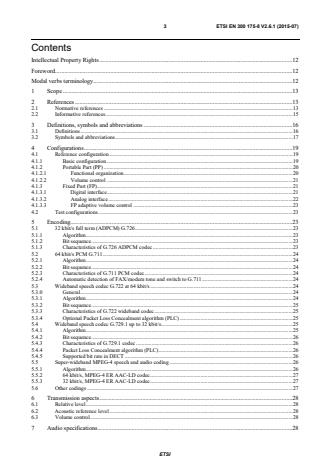
Contents
Intellectual Property Rights . 12
Foreword . 12
Modal verbs terminology . 12
1 Scope . 13
2 References . 13
2.1 Normative references . 13
2.2 Informative references . 15
3 Definitions, symbols and abbreviations . 16
3.1 Definitions . 16
3.2 Symbols and abbreviations . 17
4 Configurations . 19
4.1 Reference configuration . 19
4.1.1 Basic configuration . 19
4.1.2 Portable Part (PP) . 20
4.1.2.1 Functional organization . 20
4.1.2.2 Volume control . 21
4.1.3 Fixed Part (FP) . 21
4.1.3.1 Digital interface . 21
4.1.3.2 Analog interface . 22
4.1.3.3 FP adaptive volume control . 23
4.2 Test configurations . 23
5 Encoding . 23
5.1 32 kbit/s full term (ADPCM) G.726 . 23
5.1.1 Algorithm . 23
5.1.2 Bit sequence . 23
5.1.3 Characteristics of G.726 ADPCM codec . 23
5.2 64 kbit/s PCM G.711 . 24
5.2.1 Algorithm . 24
5.2.2 Bit sequence . 24
5.2.3 Characteristics of G.711 PCM codec . 24
5.2.4 Automatic detection of FAX/modem tone and switch to G.711 . 24
5.3 Wideband speech codec G.722 at 64 kbit/s . 24
5.3.0 General . 24
5.3.1 Algorithm . 24
5.3.2 Bit sequence . 25
5.3.3 Characteristics of G.722 wideband codec . 25
5.3.4 Optional Packet Loss Concealment algorithm (PLC) . 25
5.4 Wideband speech codec G.729.1 up to 32 kbit/s . 25
5.4.1 Algorithm . 25
5.4.2 Bit sequence . 26
5.4.3 Characteristics of G.729.1 codec . 26
5.4.4 Packet Loss Concealment algorithm (PLC) . 26
5.4.5 Supported bit rate in DECT . 26
5.5 Super-wideband MPEG-4 speech and audio coding . 26
5.5.1 Algorithm . 26
5.5.2 64 kbit/s, MPEG-4 ER AAC-LD codec . 27
5.5.3 32 kbit/s, MPEG-4 ER AAC-LD codec . 27
5.6 Other codings . 27
6 Transmission aspects . 28
6.1 Relative level . 28
6.2 Acoustic reference level . 28
6.3 Volume control . 28
7 Audio specifications . 28
ETSI
4 Draft ETSI EN 300 175-8 V2.5.4 (2015-03)
7.1 Overall description . 28
7.1.1 Introduction to DECT audio specifications . 28
7.1.2 Introduction to the audio types . 28
7.1.3 List of Audio types . 29
7.1.4 Audio types for Portable Parts . 30
7.1.5 Audio types for Fixed Parts . 31
7.1.6 Complete DECT system . 31
7.1.7 Structure of the specification of the audio types . 31
7.1.8 Audio Types and codecs . 37
7.1.9 Audio Types and physical interfaces . 37
7.2 Audio types applicable to Portable Parts . 37
7.2.0 General . 37
7.2.1 Performance levels of DECT Portable Parts (handsets). 37
7.2.2 Type 0: Reference PP (RePP) . 38
7.2.3 PP Type 1a: "Classic" GAP narrowband handset . 38
7.2.3.1 Introduction . 38
7.2.3.2 Compatible services and codecs . 39
7.2.3.3 Specification. 39
7.2.4 PP Type 1b: "Improved" GAP narrowband handset . 39
7.2.4.1 Introduction . 39
7.2.4.2 Compatible services and codecs . 39
7.2.4.3 Specification. 39
7.2.5 PP Type 1c: HATS-tested "standard" narrowband handset . 39
7.2.5.1 Introduction . 39
7.2.5.2 Compatible services and codecs . 39
7.2.5.3 Specification. 40
7.2.6 PP Type 1d: HATS-tested "improved" narrowband handset . 40
7.2.6.1 Introduction . 40
7.2.6.2 Compatible services and codecs . 40
7.2.6.3 Specification. 40
7.2.7 PP Type 3a: HATS tested narrowband "standard" loudspeaking handsfree . 40
7.2.7.1 Introduction . 40
7.2.7.2 Compatible services and codecs . 41
7.2.7.3 Specification. 41
7.2.8 PP Type 3b: HATS tested narrowband "improved" loudspeaking handsfree . 41
7.2.8.1 Introduction . 41
7.2.8.2 Compatible services and codecs . 41
7.2.8.3 Specification. 41
7.2.9 PP Type 2a: P.311-tested wideband handset. 41
7.2.9.1 Introduction . 41
7.2.9.2 Compatible services and codecs . 41
7.2.9.3 Specification. 41
7.2.10 PP Type 2b: HATS-tested "standard" wideband handset or headset . 42
7.2.10.1 Introduction . 42
7.2.10.2 Compatible services and codecs . 42
7.2.10.3 Specification. 42
7.2.11 PP Type 2c: HATS tested "improved" wideband handset or headset . 42
7.2.11.1 Introduction . 42
7.2.11.2 Compatible services and codecs . 42
7.2.11.3 Specification. 42
7.2.12 PP Type 4a: HATS tested wideband "standard" loudspeaking handsfree . 43
7.2.12.1 Introduction . 43
7.2.12.2 Compatible services and codecs . 43
7.2.12.3 Specification. 43
7.2.13 PP Type 4b: HATS tested wideband "improved" loudspeaking and handsfree . 43
7.2.13.1 Introduction . 43
7.2.13.2 Compatible services and codecs . 43
7.2.13.3 Specification. 43
7.2.14 PP Type 5a: super-wideband 14 kHz handset . 44
7.2.14.1 Introduction . 44
7.2.14.2 Compatible services and codecs . 44
7.2.14.3 Specification. 44
ETSI
5 Draft ETSI EN 300 175-8 V2.5.4 (2015-03)
7.2.15 PP Type 5b: super-wideband 14 kHz loudspeaking handsfree . 44
7.2.15.1 Introduction . 44
7.2.15.2 Compatible services and codecs . 44
7.2.15.3 Specification. 44
7.2.16 PP Type 6: PPs with external 2 wire, 3,1 kHz telephony interface . 44
7.2.16.1 Introduction . 44
7.2.16.2 Compatible services and codecs . 44
7.2.16.3 Specification. 44
7.3 Audio transmission types applicable to Fixed Parts . 44
7.3.0 General . 44
7.3.1 FP Type 0: Reference FP (ReFP) . 45
7.3.2 FP Type 1a: "classical" Fixed Part for ISDN Network . 45
7.3.2.1 Introduction . 45
7.3.2.2 Compatible services and codecs . 46
7.3.2.3 Specifications . 46
7.3.2.3.1 Transcoding and equalization . 46
7.3.2.3.2 PP type detection . 46
7.3.2.3.3 Activation of audio processing functions . 46
7.3.2.3.4 Transmission specification . 46
7.3.3 FP Type 1b: "new" Fixed Part for ISDN Network . 47
7.3.3.1 Introduction . 47
7.3.3.2 Compatible services and codecs . 47
7.3.3.3 Specification. 47
7.3.3.3.1 Transcoding and equalization . 47
7.3.3.3.2 PP type detection . 47
7.3.3.3.3 Activation of audio processing functions . 48
7.3.3.3.4 Transmission specification . 48
7.3.4 FP Type 2: FP with analog 2-wire interface, 3,1 kHz service . 48
7.3.4.1 Introduction . 48
7.3.4.2 Compatible services, physical interfaces and codecs . 48
7.3.4.3 Specification. 49
7.3.4.3.1 Transcoding, equalization and conversion . 49
7.3.4.3.2 PP type detection and activation of audio processing functions . 49
7.3.4.3.3 Transmission specification . 49
7.3.5 FP Type 3: VoIP narrowband Fixed Part . 49
7.3.5.1 Introduction . 49
7.3.5.2 Compatible services, physical interfaces and codecs . 49
7.3.5.3 Specification. 50
7.3.5.3.1 Transcoding and equalization . 50
7.3.5.3.2 PP type detection . 50
7.3.5.3.3 Activation of audio processing functions . 50
7.3.5.3.4 Transmission specification . 51
7.3.6 FP Type 4: ISDN wideband Fixed Part . 51
7.3.6.1 Introduction . 51
7.3.6.2 Compatible services and codecs . 51
7.3.6.3 Specification. 51
7.3.6.3.1 Transcoding and equalization . 51
7.3.6.3.2 PP type detection . 52
7.3.6.3.3 Activation of audio processing functions . 52
7.3.6.3.4 Transmission specification . 52
7.3.7 FP Type 5: VoIP wideband Fixed Part . 52
7.3.7.1 Introduction . 52
7.3.7.2 Compatible services, physical interfaces and codecs . 53
7.3.7.3 Specification. 53
7.3.7.3.1 Transcoding and equalization . 53
7.3.7.3.2 PP type detection . 53
7.3.7.3.3 Activation of audio processing functions . 54
7.3.7.3.4 Transmission specification . 54
7.3.8 FP Type 6a: FP handling an Internal call inside a DECT FP (any service) . 54
7.3.8.1 Introduction . 54
7.3.8.2 Compatible services, physical interfaces and codecs . 54
7.3.8.3 Specification. 54
ETSI
6 Draft ETSI EN 300 175-8 V2.5.4 (2015-03)
7.3.9 FP Type 6b: FP handling an n-party conference inside a DECT FP (any service) . 54
7.3.9.1 Introduction . 54
7.3.9.2 Compatible services, physical interfaces and codecs . 55
7.3.9.3 Specification for the conference bridge. 55
7.3.10 FP Type 7: DECT Repeater part (REP) . 55
7.3.10.1 Introduction . 55
7.3.10.2 Compatible services, physical interfaces and codecs . 55
7.3.10.3 Specification. 55
7.4 Additional features . 55
7.4.1 Introduction. 55
7.4.2 Echo canceller in Fixed Part . 56
7.4.3 Echo suppressor in Fixed Part. 56
7.5 Transmission characteristics for Portable Parts . 57
7.5.1 Transmission characteristics for Portable Part type 1a ("Classic GAP" handset) . 57
7.5.1.1 PP frequency responses . 57
7.5.1.1.1 Sending . 57
7.5.1.1.2 Receiving . 57
7.5.1.2 PP sending and receiving loudness ratings . 58
7.5.1.2.1 Nominal values . 58
7.5.1.2.2 User-controlled volume control in PP . 58
7.5.1.2.3 PP adaptive volume control . 59
7.5.1.3 Sidetone . 59
7.5.1.3.1 Talker sidetone . 59
7.5.1.3.2 Listener sidetone . 59
7.5.1.4 Terminal coupling loss . 59
7.5.1.4.1 Weighted Terminal Coupling Loss (TCLw) . 59
7.5.1.4.2 Stability loss . 60
7.5.1.5 Distortion . 60
7.5.1.5.1 Sending . 60
7.5.1.5.2 Receiving . 60
7.5.1.5.3 Sidetone . 60
7.5.1.6 Out of band signals. 60
7.5.1.6.1 Sending (discrimination against out of band input signals) . 60
7.5.1.6.2 Receiving (spurious out of band signals) . 61
7.5.1.7 Noise . 61
7.5.1.7.1 Sending . 61
7.5.1.7.2 Band-limited noise. 61
7.5.1.7.3 Receiving . 61
7.5.1.7.4 Level of sampling frequency (receiving) . 61
7.5.1.8 Acoustic shock . 61
7.5.1.8.0 General . 61
7.5.1.8.1 Continuous signal . 61
7.5.1.8.2 Peak signal . 61
7.5.1.9 PP Delay . 61
7.5.1.10 PP ambient noise rejection . 61
7.5.2 Additional requirements for PP type 1b ("improved GAP" handset) . 62
7.5.2.1 Terminal coupling loss . 62
7.5.2.1.1 Weighted Terminal Coupling Loss (TCLw) . 62
7.5.2.2 Attenuation Range in Sending Direction during Double Talk A . 62
H,S,dt
7.5.2.3 Attenuation Range in Receiving Direction during Double Talk A . 62
H,R,dt
7.5.2.4 Activation in Sending Direction . 63
7.5.2.5 Activation in Receiving Direction . 63
7.5.3 Transmission characteristics for PP types 1c and 1d (HATS tested, narrowband telephony handsets) . 64
7.5.3.1 PP frequency responses . 64
7.5.3.1.1 Sending . 64
7.5.3.1.2 Receiving . 65
7.5.3.2 PP sending and receiving loudness ratings . 67
7.5.3.2.1 Nominal values . 67
7.5.3.2.2 User-controlled volume control in PP . 67
7.5.3.2.3 PP adaptive volume control . 68
7.5.3.3 Sidetone . 68
7.5.3.3.1 Talker sidetone . 68
ETSI
7 Draft ETSI EN 300 175-8 V2.5.4 (2015-03)
7.5.3.3.2 D Factor . 68
7.5.3.3.3 Sidetone delay . 68
7.5.3.4 Terminal coupling loss . 69
7.5.3.4.1 TCLw of Portable Part . 69
7.5.3.4.2 Stability loss . 69
7.5.3.5 Distortion . 69
7.5.3.5.1 Sending Distortion . 69
7.5.3.5.2 Receiving Distortion . 69
7.5.3.6 Out of band signals. 70
7.5.3.6.1 Out-of-band Signals in Send direction . 70
7.5.3.6.2 Out-of-band signals in receiving direction . 70
7.5.3.7 Noise . 70
7.5.3.7.1 Sending . 70
7.5.3.7.2 Receiving . 71
7.5.3.8 Acoustic shock . 71
7.5.3.8.0 General . 71
7.5.3.8.1 Continuous signal . 71
7.5.3.8.2 Peak signal . 71
7.5.3.9 Delay . 71
7.5.3.10 Variation of gain with input level-sending . 71
7.5.3.11 Double Talk Performance . 72
7.5.3.11.0 General . 72
7.5.3.11.1 Attenuation Range in Sending Direction during Double Talk A . 72
H,S,dt
7.5.3.11.2 Attenuation Range in Receiving Direction during Double Talk A . 73
H,S,dt
7.5.3.11.3 Detection of Echo Components during Double Talk . 73
7.5.3.11.4 Minimum activation level and sensitivity of double talk detection . 73
7.5.3.12 Switching characteristics . 73
7.5.3.12.0 General . 73
7.5.3.12.1 Activation in Sending Direction . 74
7.5.3.12.2 Activation in Receiving Direction . 74
7.5.3.12.3 Silence Suppression and Comfort Noise Generation . 74
7.5.3.12.4 Performance
...
EUROPEAN STANDARD
Digital Enhanced Cordless Telecommunications (DECT);
Common Interface (CI);
Part 8: Speech and audio coding and transmission
2 ETSI EN 300 175-8 V2.6.1 (2015-07)
Reference
REN/DECT-000304-8
Keywords
7 kHz, audio, broadband, codec, DECT,
handsfree, IMT-2000, loudspeaking, mobility,
narrowband, quality, radio, speech, TDD, TDMA,
telephony, terminal
ETSI
650 Route des Lucioles
F-06921 Sophia Antipolis Cedex - FRANCE
Tel.: +33 4 92 94 42 00 Fax: +33 4 93 65 47 16
Siret N° 348 623 562 00017 - NAF 742 C
Association à but non lucratif enregistrée à la
Sous-Préfecture de Grasse (06) N° 7803/88
Important notice
The present document can be downloaded from:
http://www.etsi.org/standards-search
The present document may be made available in electronic versions and/or in print. The content of any electronic and/or
print versions of the present document shall not be modified without the prior written authorization of ETSI. In case of any
existing or perceived difference in contents between such versions and/or in print, the only prevailing document is the
print of the Portable Document Format (PDF) version kept on a specific network drive within ETSI Secretariat.
Users of the present document should be aware that the document may be subject to revision or change of status.
Information on the current status of this and other ETSI documents is available at
http://portal.etsi.org/tb/status/status.asp
If you find errors in the present document, please send your comment to one of the following services:
https://portal.etsi.org/People/CommiteeSupportStaff.aspx
Copyright Notification
No part may be reproduced or utilized in any form or by any means, electronic or mechanical, including photocopying
and microfilm except as authorized by written permission of ETSI.
The content of the PDF version shall not be modified without the written authorization of ETSI.
The copyright and the foregoing restriction extend to reproduction in all media.
© European Telecommunications Standards Institute 2015.
All rights reserved.
TM TM TM
DECT , PLUGTESTS , UMTS and the ETSI logo are Trade Marks of ETSI registered for the benefit of its Members.
TM
3GPP and LTE™ are Trade Marks of ETSI registered for the benefit of its Members and
of the 3GPP Organizational Partners.
GSM® and the GSM logo are Trade Marks registered and owned by the GSM Association.
ETSI
3 ETSI EN 300 175-8 V2.6.1 (2015-07)
Contents
Intellectual Property Rights . 12
Foreword . 12
Modal verbs terminology . 12
1 Scope . 13
2 References . 13
2.1 Normative references . 13
2.2 Informative references . 15
3 Definitions, symbols and abbreviations . 16
3.1 Definitions . 16
3.2 Symbols and abbreviations . 17
4 Configurations . 19
4.1 Reference configuration . 19
4.1.1 Basic configuration . 19
4.1.2 Portable Part (PP) . 20
4.1.2.1 Functional organization . 20
4.1.2.2 Volume control . 21
4.1.3 Fixed Part (FP) . 21
4.1.3.1 Digital interface . 21
4.1.3.2 Analog interface . 22
4.1.3.3 FP adaptive volume control . 23
4.2 Test configurations . 23
5 Encoding . 23
5.1 32 kbit/s full term (ADPCM) G.726 . 23
5.1.1 Algorithm . 23
5.1.2 Bit sequence . 23
5.1.3 Characteristics of G.726 ADPCM codec . 23
5.2 64 kbit/s PCM G.711 . 24
5.2.1 Algorithm . 24
5.2.2 Bit sequence . 24
5.2.3 Characteristics of G.711 PCM codec . 24
5.2.4 Automatic detection of FAX/modem tone and switch to G.711 . 24
5.3 Wideband speech codec G.722 at 64 kbit/s . 24
5.3.0 General . 24
5.3.1 Algorithm . 24
5.3.2 Bit sequence . 25
5.3.3 Characteristics of G.722 wideband codec . 25
5.3.4 Optional Packet Loss Concealment algorithm (PLC) . 25
5.4 Wideband speech codec G.729.1 up to 32 kbit/s . 25
5.4.1 Algorithm . 25
5.4.2 Bit sequence . 26
5.4.3 Characteristics of G.729.1 codec . 26
5.4.4 Packet Loss Concealment algorithm (PLC) . 26
5.4.5 Supported bit rate in DECT . 26
5.5 Super-wideband MPEG-4 speech and audio coding . 26
5.5.1 Algorithm . 26
5.5.2 64 kbit/s, MPEG-4 ER AAC-LD codec . 27
5.5.3 32 kbit/s, MPEG-4 ER AAC-LD codec . 27
5.6 Other codings . 27
6 Transmission aspects . 28
6.1 Relative level . 28
6.2 Acoustic reference level . 28
6.3 Volume control . 28
7 Audio specifications . 28
ETSI
4 ETSI EN 300 175-8 V2.6.1 (2015-07)
7.1 Overall description . 28
7.1.1 Introduction to DECT audio specifications . 28
7.1.2 Introduction to the audio types . 28
7.1.3 List of Audio types . 29
7.1.4 Audio types for Portable Parts . 30
7.1.5 Audio types for Fixed Parts . 31
7.1.6 Complete DECT system . 31
7.1.7 Structure of the specification of the audio types . 31
7.1.8 Audio Types and codecs . 37
7.1.9 Audio Types and physical interfaces . 37
7.2 Audio types applicable to Portable Parts . 37
7.2.0 General . 37
7.2.1 Performance levels of DECT Portable Parts (handsets). 37
7.2.2 Type 0: Reference PP (RePP) . 38
7.2.3 PP Type 1a: "Classic" GAP narrowband handset . 38
7.2.3.1 Introduction . 38
7.2.3.2 Compatible services and codecs . 39
7.2.3.3 Specification. 39
7.2.4 PP Type 1b: "Improved" GAP narrowband handset . 39
7.2.4.1 Introduction . 39
7.2.4.2 Compatible services and codecs . 39
7.2.4.3 Specification. 39
7.2.5 PP Type 1c: HATS-tested "standard" narrowband handset . 39
7.2.5.1 Introduction . 39
7.2.5.2 Compatible services and codecs . 39
7.2.5.3 Specification. 40
7.2.6 PP Type 1d: HATS-tested "improved" narrowband handset . 40
7.2.6.1 Introduction . 40
7.2.6.2 Compatible services and codecs . 40
7.2.6.3 Specification. 40
7.2.7 PP Type 3a: HATS tested narrowband "standard" loudspeaking handsfree . 40
7.2.7.1 Introduction . 40
7.2.7.2 Compatible services and codecs . 41
7.2.7.3 Specification. 41
7.2.8 PP Type 3b: HATS tested narrowband "improved" loudspeaking handsfree . 41
7.2.8.1 Introduction . 41
7.2.8.2 Compatible services and codecs . 41
7.2.8.3 Specification. 41
7.2.9 PP Type 2a: P.311-tested wideband handset. 41
7.2.9.1 Introduction . 41
7.2.9.2 Compatible services and codecs . 41
7.2.9.3 Specification. 41
7.2.10 PP Type 2b: HATS-tested "standard" wideband handset or headset . 42
7.2.10.1 Introduction . 42
7.2.10.2 Compatible services and codecs . 42
7.2.10.3 Specification. 42
7.2.11 PP Type 2c: HATS tested "improved" wideband handset or headset . 42
7.2.11.1 Introduction . 42
7.2.11.2 Compatible services and codecs . 42
7.2.11.3 Specification. 42
7.2.12 PP Type 4a: HATS tested wideband "standard" loudspeaking handsfree . 43
7.2.12.1 Introduction . 43
7.2.12.2 Compatible services and codecs . 43
7.2.12.3 Specification. 43
7.2.13 PP Type 4b: HATS tested wideband "improved" loudspeaking and handsfree . 43
7.2.13.1 Introduction . 43
7.2.13.2 Compatible services and codecs . 43
7.2.13.3 Specification. 43
7.2.14 PP Type 5a: super-wideband 14 kHz handset . 44
7.2.14.1 Introduction . 44
7.2.14.2 Compatible services and codecs . 44
7.2.14.3 Specification. 44
ETSI
5 ETSI EN 300 175-8 V2.6.1 (2015-07)
7.2.15 PP Type 5b: super-wideband 14 kHz loudspeaking handsfree . 44
7.2.15.1 Introduction . 44
7.2.15.2 Compatible services and codecs . 44
7.2.15.3 Specification. 44
7.2.16 PP Type 6: PPs with external 2 wire, 3,1 kHz telephony interface . 44
7.2.16.1 Introduction . 44
7.2.16.2 Compatible services and codecs . 44
7.2.16.3 Specification. 44
7.3 Audio transmission types applicable to Fixed Parts . 44
7.3.0 General . 44
7.3.1 FP Type 0: Reference FP (ReFP) . 45
7.3.2 FP Type 1a: "classical" Fixed Part for ISDN Network . 45
7.3.2.1 Introduction . 45
7.3.2.2 Compatible services and codecs . 46
7.3.2.3 Specifications . 46
7.3.2.3.1 Transcoding and equalization . 46
7.3.2.3.2 PP type detection . 46
7.3.2.3.3 Activation of audio processing functions . 46
7.3.2.3.4 Transmission specification . 46
7.3.3 FP Type 1b: "new" Fixed Part for ISDN Network . 47
7.3.3.1 Introduction . 47
7.3.3.2 Compatible services and codecs . 47
7.3.3.3 Specification. 47
7.3.3.3.1 Transcoding and equalization . 47
7.3.3.3.2 PP type detection . 47
7.3.3.3.3 Activation of audio processing functions . 48
7.3.3.3.4 Transmission specification . 48
7.3.4 FP Type 2: FP with analog 2-wire interface, 3,1 kHz service . 48
7.3.4.1 Introduction . 48
7.3.4.2 Compatible services, physical interfaces and codecs . 48
7.3.4.3 Specification. 49
7.3.4.3.1 Transcoding, equalization and conversion . 49
7.3.4.3.2 PP type detection and activation of audio processing functions . 49
7.3.4.3.3 Transmission specification . 49
7.3.5 FP Type 3: VoIP narrowband Fixed Part . 49
7.3.5.1 Introduction . 49
7.3.5.2 Compatible services, physical interfaces and codecs . 49
7.3.5.3 Specification. 50
7.3.5.3.1 Transcoding and equalization . 50
7.3.5.3.2 PP type detection . 50
7.3.5.3.3 Activation of audio processing functions . 50
7.3.5.3.4 Transmission specification . 51
7.3.6 FP Type 4: ISDN wideband Fixed Part . 51
7.3.6.1 Introduction . 51
7.3.6.2 Compatible services and codecs . 51
7.3.6.3 Specification. 51
7.3.6.3.1 Transcoding and equalization . 51
7.3.6.3.2 PP type detection . 52
7.3.6.3.3 Activation of audio processing functions . 52
7.3.6.3.4 Transmission specification . 52
7.3.7 FP Type 5: VoIP wideband Fixed Part . 52
7.3.7.1 Introduction . 52
7.3.7.2 Compatible services, physical interfaces and codecs . 53
7.3.7.3 Specification. 53
7.3.7.3.1 Transcoding and equalization . 53
7.3.7.3.2 PP type detection . 53
7.3.7.3.3 Activation of audio processing functions . 54
7.3.7.3.4 Transmission specification . 54
7.3.8 FP Type 6a: FP handling an Internal call inside a DECT FP (any service) . 54
7.3.8.1 Introduction . 54
7.3.8.2 Compatible services, physical interfaces and codecs . 54
7.3.8.3 Specification. 54
ETSI
6 ETSI EN 300 175-8 V2.6.1 (2015-07)
7.3.9 FP Type 6b: FP handling an n-party conference inside a DECT FP (any service) . 54
7.3.9.1 Introduction . 54
7.3.9.2 Compatible services, physical interfaces and codecs . 55
7.3.9.3 Specification for the conference bridge. 55
7.3.10 FP Type 7: DECT Repeater part (REP) . 55
7.3.10.1 Introduction . 55
7.3.10.2 Compatible services, physical interfaces and codecs . 55
7.3.10.3 Specification. 55
7.4 Additional features . 55
7.4.1 Introduction. 55
7.4.2 Echo canceller in Fixed Part . 56
7.4.3 Echo suppressor in Fixed Part. 56
7.5 Transmission characteristics for Portable Parts . 57
7.5.1 Transmission characteristics for Portable Part type 1a ("Classic GAP" handset) . 57
7.5.1.1 PP frequency responses . 57
7.5.1.1.1 Sending . 57
7.5.1.1.2 Receiving . 57
7.5.1.2 PP sending and receiving loudness ratings . 58
7.5.1.2.1 Nominal values . 58
7.5.1.2.2 User-controlled volume control in PP . 58
7.5.1.2.3 PP adaptive volume control . 59
7.5.1.3 Sidetone . 59
7.5.1.3.1 Talker sidetone . 59
7.5.1.3.2 Listener sidetone . 59
7.5.1.4 Terminal coupling loss . 59
7.5.1.4.1 Weighted Terminal Coupling Loss (TCLw) . 59
7.5.1.4.2 Stability loss . 60
7.5.1.5 Distortion . 60
7.5.1.5.1 Sending . 60
7.5.1.5.2 Receiving . 60
7.5.1.5.3 Sidetone . 60
7.5.1.6 Out of band signals. 60
7.5.1.6.1 Sending (discrimination against out of band input signals) . 60
7.5.1.6.2 Receiving (spurious out of band signals) . 61
7.5.1.7 Noise . 61
7.5.1.7.1 Sending . 61
7.5.1.7.2 Band-limited noise. 61
7.5.1.7.3 Receiving . 61
7.5.1.7.4 Level of sampling frequency (receiving) . 61
7.5.1.8 Acoustic shock . 61
7.5.1.8.0 General . 61
7.5.1.8.1 Continuous signal . 61
7.5.1.8.2 Peak signal . 61
7.5.1.9 PP Delay . 61
7.5.1.10 PP ambient noise rejection . 61
7.5.2 Additional requirements for PP type 1b ("improved GAP" handset) . 62
7.5.2.1 Terminal coupling loss . 62
7.5.2.1.1 Weighted Terminal Coupling Loss (TCLw) . 62
7.5.2.2 Attenuation Range in Sending Direction during Double Talk A . 62
H,S,dt
7.5.2.3 Attenuation Range in Receiving Direction during Double Talk A . 62
H,R,dt
7.5.2.4 Activation in Sending Direction . 63
7.5.2.5 Activation in Receiving Direction . 63
7.5.3 Transmission characteristics for PP types 1c and 1d (HATS tested, narrowband telephony handsets) . 64
7.5.3.1 PP frequency responses . 64
7.5.3.1.1 Sending . 64
7.5.3.1.2 Receiving . 65
7.5.3.2 PP sending and receiving loudness ratings . 67
7.5.3.2.1 Nominal values . 67
7.5.3.2.2 User-controlled volume control in PP . 67
7.5.3.2.3 PP adaptive volume control . 68
7.5.3.3 Sidetone . 68
7.5.3.3.1 Talker sidetone . 68
ETSI
7 ETSI EN 300 175-8 V2.6.1 (2015-07)
7.5.3.3.2 D Factor . 68
7.5.3.3.3 Sidetone delay . 68
7.5.3.4 Terminal coupling loss . 69
7.5.3.4.1 TCLw of Portable Part . 69
7.5.3.4.2 Stability loss . 69
7.5.3.5 Distortion . 69
7.5.3.5.1 Sending Distortion . 69
7.5.3.5.2 Receiving Distortion . 69
7.5.3.6 Out of band signals. 70
7.5.3.6.1 Out-of-band Signals in Send direction . 70
7.5.3.6.2 Out-of-band signals in receiving direction . 70
7.5.3.7 Noise . 70
7.5.3.7.1 Sending . 70
7.5.3.7.2 Receiving . 71
7.5.3.8 Acoustic shock . 71
7.5.3.8.0 General . 71
7.5.3.8.1 Continuous signal . 71
7.5.3.8.2 Peak signal . 71
7.5.3.9 Delay . 71
7.5.3.10 Variation of gain with input level-sending . 71
7.5.3.11 Double Talk Performance . 72
7.5.3.11.0 General . 72
7.5.3.11.1 Attenuation Range in Sending Direction during Double Talk A . 72
H,S,dt
7.5.3.11.2 Attenuation Range in Receiving Direction during Double Talk A . 73
H,S,dt
7.5.3.11.3 Detection of Echo Components during Double Talk . 73
7.5.3.11.4 Minimum activation level and sensitivity of double talk detection . 73
7.5.3.12 Switching characteristics . 73
7.5.3.12.0 General . 73
7.5.3.12.1 Activation in Sending Direction . 74
7.5.3.12.2 Activation in Receiving Direction . 74
7.5.3.12.3 Silence Suppression and Comfort Noise Generation . 74
7.5.3.12.4 Performance in sending direction in the presence
...
2003-01.Slovenski inštitut za standardizacijo. Razmnoževanje celote ali delov tega standarda ni dovoljeno.Digital Enhanced Cordless Telecommunications (DECT); Common Interface (CI); Part 8: Speech and audio coding and transmission33.070.30'(&7Digital Enhanced Cordless Telecommunications (DECT)ICS:Ta slovenski standard je istoveten z:EN 300 175-8 V2.6.1SIST EN 300 175-8 V2.6.1:2015en,fr,de01-november-2015SIST EN 300 175-8 V2.6.1:2015SLOVENSKI
STANDARD
EUROPEAN STANDARD SIST EN 300 175-8 V2.6.1:2015
ETSI ETSI EN 300 175-8 V2.6.1 (2015-07) 2
Reference REN/DECT-000304-8 Keywords 7 kHz, audio, broadband, codec, DECT, handsfree, IMT-2000, loudspeaking, mobility, narrowband, quality, radio, speech, TDD, TDMA, telephony, terminal ETSI 650 Route des Lucioles F-06921 Sophia Antipolis Cedex - FRANCE
Tel.: +33 4 92 94 42 00
Fax: +33 4 93 65 47 16
Siret N° 348 623 562 00017 - NAF 742 C Association à but non lucratif enregistrée à la Sous-Préfecture de Grasse (06) N° 7803/88
Important notice The present document can be downloaded from: http://www.etsi.org/standards-search The present document may be made available in electronic versions and/or in print. The content of any electronic and/or print versions of the present document shall not be modified without the prior written authorization of ETSI. In case of any existing or perceived difference in contents between such versions and/or in print, the only prevailing document is the print of the Portable Document Format (PDF) version kept on a specific network drive within ETSI Secretariat. Users of the present document should be aware that the document may be subject to revision or change of status. Information on the current status of this and other ETSI documents is available at http://portal.etsi.org/tb/status/status.asp If you find errors in the present document, please send your comment to one of the following services: https://portal.etsi.org/People/CommiteeSupportStaff.aspx Copyright Notification No part may be reproduced or utilized in any form or by any means, electronic or mechanical, including photocopying and microfilm except as authorized by written permission of ETSI. The content of the PDF version shall not be modified without the written authorization of ETSI. The copyright and the foregoing restriction extend to reproduction in all media.
© European Telecommunications Standards Institute 2015. All rights reserved.
DECTTM, PLUGTESTSTM, UMTSTM and the ETSI logo are Trade Marks of ETSI registered for the benefit of its Members. 3GPPTM and LTE™ are Trade Marks of ETSI registered for the benefit of its Members and of the 3GPP Organizational Partners. GSM® and the GSM logo are Trade Marks registered and owned by the GSM Association. SIST EN 300 175-8 V2.6.1:2015
ETSI ETSI EN 300 175-8 V2.6.1 (2015-07) 3 Contents Intellectual Property Rights . 12 Foreword . 12 Modal verbs terminology . 12 1 Scope . 13 2 References . 13 2.1 Normative references . 13 2.2 Informative references . 15 3 Definitions, symbols and abbreviations . 16 3.1 Definitions . 16 3.2 Symbols and abbreviations . 17 4 Configurations . 19 4.1 Reference configuration . 19 4.1.1 Basic configuration . 19 4.1.2 Portable Part (PP) . 20 4.1.2.1 Functional organization . 20 4.1.2.2 Volume control . 21 4.1.3 Fixed Part (FP) . 21 4.1.3.1 Digital interface . 21 4.1.3.2 Analog interface . 22 4.1.3.3 FP adaptive volume control . 23 4.2 Test configurations . 23 5 Encoding . 23 5.1 32 kbit/s full term (ADPCM) G.726 . 23 5.1.1 Algorithm . 23 5.1.2 Bit sequence . 23 5.1.3 Characteristics of G.726 ADPCM codec . 23 5.2 64 kbit/s PCM G.711 . 24 5.2.1 Algorithm . 24 5.2.2 Bit sequence . 24 5.2.3 Characteristics of G.711 PCM codec . 24 5.2.4 Automatic detection of FAX/modem tone and switch to G.711 . 24 5.3 Wideband speech codec G.722 at 64 kbit/s . 24 5.3.0 General . 24 5.3.1 Algorithm . 24 5.3.2 Bit sequence . 25 5.3.3 Characteristics of G.722 wideband codec . 25 5.3.4 Optional Packet Loss Concealment algorithm (PLC) . 25 5.4 Wideband speech codec G.729.1 up to 32 kbit/s . 25 5.4.1 Algorithm . 25 5.4.2 Bit sequence . 26 5.4.3 Characteristics of G.729.1 codec . 26 5.4.4 Packet Loss Concealment algorithm (PLC) . 26 5.4.5 Supported bit rate in DECT . 26 5.5 Super-wideband MPEG-4 speech and audio coding . 26 5.5.1 Algorithm . 26 5.5.2 64 kbit/s, MPEG-4 ER AAC-LD codec . 27 5.5.3 32 kbit/s, MPEG-4 ER AAC-LD codec . 27 5.6 Other codings . 27 6 Transmission aspects . 28 6.1 Relative level . 28 6.2 Acoustic reference level . 28 6.3 Volume control . 28 7 Audio specifications . 28 SIST EN 300 175-8 V2.6.1:2015
ETSI ETSI EN 300 175-8 V2.6.1 (2015-07) 4 7.1 Overall description . 28 7.1.1 Introduction to DECT audio specifications . 28 7.1.2 Introduction to the audio types . 28 7.1.3 List of Audio types . 29 7.1.4 Audio types for Portable Parts . 30 7.1.5 Audio types for Fixed Parts . 31 7.1.6 Complete DECT system . 31 7.1.7 Structure of the specification of the audio types . 31 7.1.8 Audio Types and codecs . 37 7.1.9 Audio Types and physical interfaces . 37 7.2 Audio types applicable to Portable Parts . 37 7.2.0 General . 37 7.2.1 Performance levels of DECT Portable Parts (handsets). 37 7.2.2 Type 0: Reference PP (RePP) . 38 7.2.3 PP Type 1a: "Classic" GAP narrowband handset . 38 7.2.3.1 Introduction . 38 7.2.3.2 Compatible services and codecs . 39 7.2.3.3 Specification. 39 7.2.4 PP Type 1b: "Improved" GAP narrowband handset . 39 7.2.4.1 Introduction . 39 7.2.4.2 Compatible services and codecs . 39 7.2.4.3 Specification. 39 7.2.5 PP Type 1c: HATS-tested "standard" narrowband handset . 39 7.2.5.1 Introduction . 39 7.2.5.2 Compatible services and codecs . 39 7.2.5.3 Specification. 40 7.2.6 PP Type 1d: HATS-tested "improved" narrowband handset . 40 7.2.6.1 Introduction . 40 7.2.6.2 Compatible services and codecs . 40 7.2.6.3 Specification. 40 7.2.7 PP Type 3a: HATS tested narrowband "standard" loudspeaking handsfree . 40 7.2.7.1 Introduction . 40 7.2.7.2 Compatible services and codecs . 41 7.2.7.3 Specification. 41 7.2.8 PP Type 3b: HATS tested narrowband "improved" loudspeaking handsfree . 41 7.2.8.1 Introduction . 41 7.2.8.2 Compatible services and codecs . 41 7.2.8.3 Specification. 41 7.2.9 PP Type 2a: P.311-tested wideband handset. 41 7.2.9.1 Introduction . 41 7.2.9.2 Compatible services and codecs . 41 7.2.9.3 Specification. 41 7.2.10 PP Type 2b: HATS-tested "standard" wideband handset or headset . 42 7.2.10.1 Introduction . 42 7.2.10.2 Compatible services and codecs . 42 7.2.10.3 Specification. 42 7.2.11 PP Type 2c: HATS tested "improved" wideband handset or headset . 42 7.2.11.1 Introduction . 42 7.2.11.2 Compatible services and codecs . 42 7.2.11.3 Specification. 42 7.2.12 PP Type 4a: HATS tested wideband "standard" loudspeaking handsfree . 43 7.2.12.1 Introduction . 43 7.2.12.2 Compatible services and codecs . 43 7.2.12.3 Specification. 43 7.2.13 PP Type 4b: HATS tested wideband "improved" loudspeaking and handsfree . 43 7.2.13.1 Introduction . 43 7.2.13.2 Compatible services and codecs . 43 7.2.13.3 Specification. 43 7.2.14 PP Type 5a: super-wideband 14 kHz handset . 44 7.2.14.1 Introduction . 44 7.2.14.2 Compatible services and codecs . 44 7.2.14.3 Specification. 44 SIST EN 300 175-8 V2.6.1:2015
ETSI ETSI EN 300 175-8 V2.6.1 (2015-07) 5 7.2.15 PP Type 5b: super-wideband 14 kHz loudspeaking handsfree . 44 7.2.15.1 Introduction . 44 7.2.15.2 Compatible services and codecs . 44 7.2.15.3 Specification. 44 7.2.16 PP Type 6: PPs with external 2 wire, 3,1 kHz telephony interface . 44 7.2.16.1 Introduction . 44 7.2.16.2 Compatible services and codecs . 44 7.2.16.3 Specification. 44 7.3 Audio transmission types applicable to Fixed Parts . 44 7.3.0 General . 44 7.3.1 FP Type 0: Reference FP (ReFP) . 45 7.3.2 FP Type 1a: "classical" Fixed Part for ISDN Network . 45 7.3.2.1 Introduction . 45 7.3.2.2 Compatible services and codecs . 46 7.3.2.3 Specifications . 46 7.3.2.3.1 Transcoding and equalization . 46 7.3.2.3.2 PP type detection . 46 7.3.2.3.3 Activation of audio processing functions . 46 7.3.2.3.4 Transmission specification . 46 7.3.3 FP Type 1b: "new" Fixed Part for ISDN Network . 47 7.3.3.1 Introduction . 47 7.3.3.2 Compatible services and codecs . 47 7.3.3.3 Specification. 47 7.3.3.3.1 Transcoding and equalization . 47 7.3.3.3.2 PP type detection . 47 7.3.3.3.3 Activation of audio processing functions . 48 7.3.3.3.4 Transmission specification . 48 7.3.4 FP Type 2: FP with analog 2-wire interface, 3,1 kHz service . 48 7.3.4.1 Introduction . 48 7.3.4.2 Compatible services, physical interfaces and codecs . 48 7.3.4.3 Specification. 49 7.3.4.3.1 Transcoding, equalization and conversion . 49 7.3.4.3.2 PP type detection and activation of audio processing functions . 49 7.3.4.3.3 Transmission specification . 49 7.3.5 FP Type 3: VoIP narrowband Fixed Part . 49 7.3.5.1 Introduction . 49 7.3.5.2 Compatible services, physical interfaces and codecs . 49 7.3.5.3 Specification. 50 7.3.5.3.1 Transcoding and equalization . 50 7.3.5.3.2 PP type detection . 50 7.3.5.3.3 Activation of audio processing functions . 50 7.3.5.3.4 Transmission specification . 51 7.3.6 FP Type 4: ISDN wideband Fixed Part . 51 7.3.6.1 Introduction . 51 7.3.6.2 Compatible services and codecs . 51 7.3.6.3 Specification. 51 7.3.6.3.1 Transcoding and equalization . 51 7.3.6.3.2 PP type detection . 52 7.3.6.3.3 Activation of audio processing functions . 52 7.3.6.3.4 Transmission specification . 52 7.3.7 FP Type 5: VoIP wideband Fixed Part . 52 7.3.7.1 Introduction . 52 7.3.7.2 Compatible services, physical interfaces and codecs . 53 7.3.7.3 Specification. 53 7.3.7.3.1 Transcoding and equalization . 53 7.3.7.3.2 PP type detection . 53 7.3.7.3.3 Activation of audio processing functions . 54 7.3.7.3.4 Transmission specification . 54 7.3.8 FP Type 6a: FP handling an Internal call inside a DECT FP (any service) . 54 7.3.8.1 Introduction . 54 7.3.8.2 Compatible services, physical interfaces and codecs . 54 7.3.8.3 Specification. 54 SIST EN 300 175-8 V2.6.1:2015
ETSI ETSI EN 300 175-8 V2.6.1 (2015-07) 6 7.3.9 FP Type 6b: FP handling an n-party conference inside a DECT FP (any service) . 54 7.3.9.1 Introduction . 54 7.3.9.2 Compatible services, physical interfaces and codecs . 55 7.3.9.3 Specification for the conference bridge. 55 7.3.10 FP Type 7: DECT Repeater part (REP) . 55 7.3.10.1 Introduction . 55 7.3.10.2 Compatible services, physical interfaces and codecs . 55 7.3.10.3 Specification. 55 7.4 Additional features . 55 7.4.1 Introduction. 55 7.4.2 Echo canceller in Fixed Part . 56 7.4.3 Echo suppressor in Fixed Part. 56 7.5 Transmission characteristics for Portable Parts . 57 7.5.1 Transmission characteristics for Portable Part type 1a ("Classic GAP" handset) . 57 7.5.1.1 PP frequency responses . 57 7.5.1.1.1 Sending . 57 7.5.1.1.2 Receiving . 57 7.5.1.2 PP sending and receiving loudness ratings . 58 7.5.1.2.1 Nominal values . 58 7.5.1.2.2 User-controlled volume control in PP . 58 7.5.1.2.3 PP adaptive volume control . 59 7.5.1.3 Sidetone . 59 7.5.1.3.1 Talker sidetone . 59 7.5.1.3.2 Listener sidetone . 59 7.5.1.4 Terminal coupling loss . 59 7.5.1.4.1 Weighted Terminal Coupling Loss (TCLw) . 59 7.5.1.4.2 Stability loss . 60 7.5.1.5 Distortion . 60 7.5.1.5.1 Sending . 60 7.5.1.5.2 Receiving . 60 7.5.1.5.3 Sidetone . 60 7.5.1.6 Out of band signals. 60 7.5.1.6.1 Sending (discrimination against out of band input signals) . 60 7.5.1.6.2 Receiving (spurious out of band signals) . 61 7.5.1.7 Noise . 61 7.5.1.7.1 Sending . 61 7.5.1.7.2 Band-limited noise. 61 7.5.1.7.3 Receiving . 61 7.5.1.7.4 Level of sampling frequency (receiving) . 61 7.5.1.8 Acoustic shock . 61 7.5.1.8.0 General . 61 7.5.1.8.1 Continuous signal . 61 7.5.1.8.2 Peak signal . 61 7.5.1.9 PP Delay . 61 7.5.1.10 PP ambient noise rejection . 61 7.5.2 Additional requirements for PP type 1b ("improved GAP" handset) . 62 7.5.2.1 Terminal coupling loss . 62 7.5.2.1.1 Weighted Terminal Coupling Loss (TCLw) . 62 7.5.2.2 Attenuation Range in Sending Direction during Double Talk AH,S,dt . 62 7.5.2.3 Attenuation Range in Receiving Direction during Double Talk AH,R,dt . 62 7.5.2.4 Activation in Sending Direction . 63 7.5.2.5 Activation in Receiving Direction . 63 7.5.3 Transmission characteristics for PP types 1c and 1d (HATS tested, narrowband telephony handsets) . 64 7.5.3.1 PP frequency responses . 64 7.5.3.1.1 Sending . 64 7.5.3.1.2 Receiving . 65 7.5.3.2 PP sending and receiving loudness ratings . 67 7.5.3.2.1 Nominal values . 67 7.5.3.2.2 User-controlled volume control in PP . 67 7.5.3.2.3 PP adaptive volume control . 68 7.5.3.3 Sidetone . 68 7.5.3.3.1 Talker sidetone . 68 SIST EN 300 175-8 V2.6.1:2015
ETSI ETSI EN 300 175-8 V2.6.1 (2015-07) 7 7.5.3.3.2 D Factor . 68 7.5.3.3.3 Sidetone delay . 68 7.5.3.4 Terminal coupling loss . 69 7.5.3.4.1 TCLw of Portable Part . 69 7.5.3.4.2 Stability loss . 69 7.5.3.5 Distortion . 69 7.5.3.5.1 Sending Distortion . 69 7.5.3.5.2 Receiving Distortion . 69 7.5.3.6 Out of band signals. 70 7.5.3.6.1 Out-of-band Signals in Send direction . 70 7.5.3.6.2 Out-of-band signals in receiving direction . 70 7.5.3.7 Noise . 70 7.5.3.7.1 Sending . 70 7.5.3.7.2 Receiving . 71 7.5.3.8 Acoustic shock . 71 7.5.3.8.0 General . 71 7.5.3.8.1 Continuous signal . 71 7.5.3.8.2 Peak signal . 71 7.5.3.9 Delay . 71 7.5.3.10 Variation of gain with input level-sending . 71 7.5.3.11 Double Talk Performance . 72 7.5.3.11.0 General . 72 7.5.3.11.1 Attenuation Range in Sending Direction during Double Talk AH,S,dt . 72 7.5.3.11.2 Attenuation Range in Receiving Direction during Double Talk AH,S,dt . 73 7.5.3.11.3 Detection of Echo Components during Double Talk . 73 7.5.3.11.4 Minimum activation level and sensitivity of double talk detection . 73 7.5.3.12 Switching characteristics . 73 7.5.3.12.0 General . 73 7.5.3.12.1 Activation in Sending Direction . 74 7.5.3.12.2 Activation in Receiving Direction . 74 7.5.3.12.3 Silence Suppression and Comfort Noise Generation . 74 7.5.3.12.4 Performance in sending direction in the presence of background
...