

ETSI EN 300 220-1 V2.4.1 (2012-05)
Electromagnetic compatibility and Radio spectrum Matters (ERM); Short Range Devices (SRD); Radio equipment to be used in the 25 MHz to 1 000 MHz frequency range with power levels ranging up to 500 mW; Part 1: Technical characteristics and test methods
General Information
- Abstract
REN/ERM-TG28-434
- Status
- Published
- Publication Date
- 24-May-2012
- Technical Committee
- ERM TG28 - ERM Generic SRD's
- Current Stage
- 12 - Completion
- Due Date
- 22-May-2012
- Completion Date
- 25-May-2012
Buy Documents
en_30022001v020401o - Electromagnetic compatibility and Radio spectrum Matters (ERM); Short Range Devices (SRD); Radio equipment to be used in the 25 MHz to 1 000 MHz frequency range with power levels ranging up to 500 mW; Part 1: Technical characteristics and test methods

Overview
ETSI EN 300 220-1 V2.4.1 (2012-05) (ETSI EN 300 220-1 V2.4.1) is a European standard for Electromagnetic Compatibility (EMC) and Radio Spectrum Matters (ERM) covering Short Range Devices (SRD) operating in the 25 MHz to 1 000 MHz frequency range with power levels up to 500 mW. Part 1 specifies technical characteristics and test methods for SRD equipment that may use either an RF output connector with a dedicated antenna or an integral antenna, across all modulation types and with or without speech.
Key topics and technical requirements
The standard defines performance criteria, test conditions and measurement methods for transmitter and receiver parameters. Major technical topics include:
- Scope of device types: non-specific SRDs, alarms, identification systems, radio-determination, telecommand/telemetry, RFID, detection and movement/alert applications.
- Test environment and power sources: normal and extreme temperature/humidity conditions, mains and battery test procedures.
- Presentation for testing: model selection, equipment with integral antennas, and use of test fixtures or artificial antennas.
- Transmitter measurements and limits:
- Frequency error and frequency stability (including low-voltage conditions)
- Average (conducted) power and effective radiated power (ERP/EIRP)
- Adjacent channel power and modulation bandwidth
- Unwanted emissions / spurious emissions (conducted and radiated)
- Spread spectrum (FHSS, DSSS) requirements and declarations
- Transient power and duty cycle considerations
- Receiver categories and performance criteria, marking and mechanical/electrical design requirements, and auxiliary test equipment guidance.
- Test fixtures, radiated measurement arrangements and measurement instrumentation (measuring receiver, artificial antenna, validation of test-fixtures).
Practical applications and who uses this standard
This standard is essential for anyone designing, testing or certifying SRDs in Europe and similar regulatory environments:
- Product manufacturers and RF engineers - to design SRD hardware and confirm compliance for market entry.
- Test laboratories and conformity assessors - to perform standardized measurements and report results for regulatory approvals.
- Regulatory bodies and certification agencies - to reference harmonized technical requirements for spectrum management and EMC.
- System integrators and product owners (RFID systems, alarm/telemetry vendors) - to ensure reliable operation without harmful interference.
Related standards
- Identical to EN 300 220-1 V2.4.1 and published by ETSI (ETSI EN 300 220-1 V2.4.1 (2012-05)).
- Applicable alongside other EMC, radio spectrum and product-specific standards when performing compliance and certification activities.
Keywords: SIST EN 300 220-1, ETSI EN 300 220, SRD, short range devices, 25–1000 MHz, 500 mW, EMC testing, radio equipment, RFID, spurious emissions, effective radiated power.
Buy Documents
en_30022001v020401o - Electromagnetic compatibility and Radio spectrum Matters (ERM); Short Range Devices (SRD); Radio equipment to be used in the 25 MHz to 1 000 MHz frequency range with power levels ranging up to 500 mW; Part 1: Technical characteristics and test methods
Frequently Asked Questions
ETSI EN 300 220-1 V2.4.1 (2012-05) is a standard published by the European Telecommunications Standards Institute (ETSI). Its full title is "Electromagnetic compatibility and Radio spectrum Matters (ERM); Short Range Devices (SRD); Radio equipment to be used in the 25 MHz to 1 000 MHz frequency range with power levels ranging up to 500 mW; Part 1: Technical characteristics and test methods". This standard covers: REN/ERM-TG28-434
REN/ERM-TG28-434
ETSI EN 300 220-1 V2.4.1 (2012-05) is available in PDF format for immediate download after purchase. The document can be added to your cart and obtained through the secure checkout process. Digital delivery ensures instant access to the complete standard document.
Standards Content (Sample)
Final draft ETSI EN 300 220-1 V2.4.1 (2012-01)
European Standard
Electromagnetic compatibility
and Radio spectrum Matters (ERM);
Short Range Devices (SRD);
Radio equipment to be used in the 25 MHz to 1 000 MHz
frequency range with power levels ranging up to 500 mW;
Part 1: Technical characteristics and test methods
2 Final draft ETSI EN 300 220-1 V2.4.1 (2012-01)
Reference
REN/ERM-TG28-434
Keywords
radio, SRD, testing
ETSI
650 Route des Lucioles
F-06921 Sophia Antipolis Cedex - FRANCE
Tel.: +33 4 92 94 42 00 Fax: +33 4 93 65 47 16
Siret N° 348 623 562 00017 - NAF 742 C
Association à but non lucratif enregistrée à la
Sous-Préfecture de Grasse (06) N° 7803/88
Important notice
Individual copies of the present document can be downloaded from:
http://www.etsi.org
The present document may be made available in more than one electronic version or in print. In any case of existing or
perceived difference in contents between such versions, the reference version is the Portable Document Format (PDF).
In case of dispute, the reference shall be the printing on ETSI printers of the PDF version kept on a specific network drive
within ETSI Secretariat.
Users of the present document should be aware that the document may be subject to revision or change of status.
Information on the current status of this and other ETSI documents is available at
http://portal.etsi.org/tb/status/status.asp
If you find errors in the present document, please send your comment to one of the following services:
http://portal.etsi.org/chaircor/ETSI_support.asp
Copyright Notification
No part may be reproduced except as authorized by written permission.
The copyright and the foregoing restriction extend to reproduction in all media.
© European Telecommunications Standards Institute 2012.
All rights reserved.
TM TM TM
DECT , PLUGTESTS , UMTS and the ETSI logo are Trade Marks of ETSI registered for the benefit of its Members.
TM
3GPP and LTE™ are Trade Marks of ETSI registered for the benefit of its Members and
of the 3GPP Organizational Partners.
GSM® and the GSM logo are Trade Marks registered and owned by the GSM Association.
ETSI
3 Final draft ETSI EN 300 220-1 V2.4.1 (2012-01)
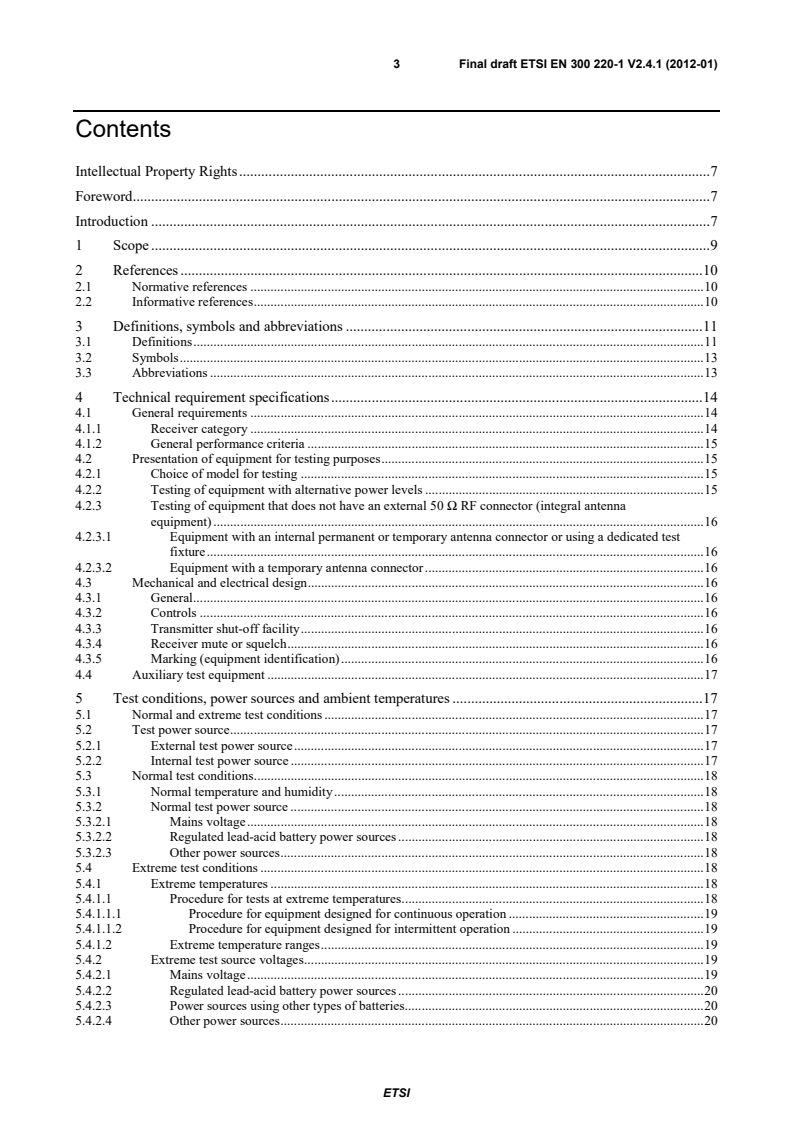
Contents
Intellectual Property Rights . 7
Foreword . 7
Introduction . 7
1 Scope . 9
2 References . 10
2.1 Normative references . 10
2.2 Informative references . 10
3 Definitions, symbols and abbreviations . 11
3.1 Definitions . 11
3.2 Symbols . 13
3.3 Abbreviations . 13
4 Technical requirement specifications . 14
4.1 General requirements . 14
4.1.1 Receiver category . 14
4.1.2 General performance criteria . 15
4.2 Presentation of equipment for testing purposes . 15
4.2.1 Choice of model for testing . 15
4.2.2 Testing of equipment with alternative power levels . 15
4.2.3 Testing of equipment that does not have an external 50 Ω RF connector (integral antenna
equipment) . 16
4.2.3.1 Equipment with an internal permanent or temporary antenna connector or using a dedicated test
fixture . 16
4.2.3.2 Equipment with a temporary antenna connector . 16
4.3 Mechanical and electrical design . 16
4.3.1 General . 16
4.3.2 Controls . 16
4.3.3 Transmitter shut-off facility . 16
4.3.4 Receiver mute or squelch . 16
4.3.5 Marking (equipment identification) . 16
4.4 Auxiliary test equipment . 17
5 Test conditions, power sources and ambient temperatures . 17
5.1 Normal and extreme test conditions . 17
5.2 Test power source . 17
5.2.1 External test power source . 17
5.2.2 Internal test power source . 17
5.3 Normal test conditions . 18
5.3.1 Normal temperature and humidity . 18
5.3.2 Normal test power source . 18
5.3.2.1 Mains voltage . 18
5.3.2.2 Regulated lead-acid battery power sources . 18
5.3.2.3 Other power sources . 18
5.4 Extreme test conditions . 18
5.4.1 Extreme temperatures . 18
5.4.1.1 Procedure for tests at extreme temperatures . 18
5.4.1.1.1 Procedure for equipment designed for continuous operation . 19
5.4.1.1.2 Procedure for equipment designed for intermittent operation . 19
5.4.1.2 Extreme temperature ranges . 19
5.4.2 Extreme test source voltages . 19
5.4.2.1 Mains voltage . 19
5.4.2.2 Regulated lead-acid battery power sources . 20
5.4.2.3 Power sources using other types of batteries . 20
5.4.2.4 Other power sources . 20
ETSI
4 Final draft ETSI EN 300 220-1 V2.4.1 (2012-01)
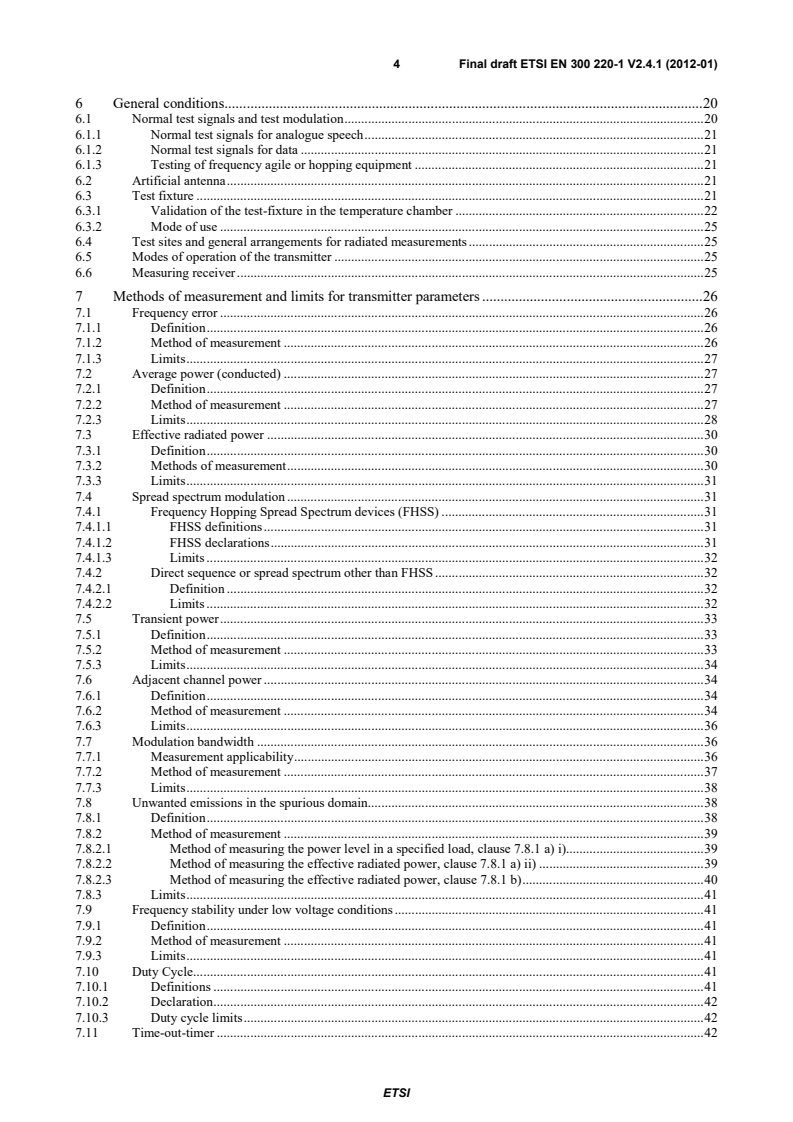
6 General conditions . 20
6.1 Normal test signals and test modulation . 20
6.1.1 Normal test signals for analogue speech . 21
6.1.2 Normal test signals for data . 21
6.1.3 Testing of frequency agile or hopping equipment . 21
6.2 Artificial antenna . 21
6.3 Test fixture . 21
6.3.1 Validation of the test-fixture in the temperature chamber . 22
6.3.2 Mode of use . 25
6.4 Test sites and general arrangements for radiated measurements . 25
6.5 Modes of operation of the transmitter . 25
6.6 Measuring receiver . 25
7 Methods of measurement and limits for transmitter parameters . 26
7.1 Frequency error . 26
7.1.1 Definition . 26
7.1.2 Method of measurement . 26
7.1.3 Limits . 27
7.2 Average power (conducted) . 27
7.2.1 Definition . 27
7.2.2 Method of measurement . 27
7.2.3 Limits . 28
7.3 Effective radiated power . 30
7.3.1 Definition . 30
7.3.2 Methods of measurement . 30
7.3.3 Limits . 31
7.4 Spread spectrum modulation . 31
7.4.1 Frequency Hopping Spread Spectrum devices (FHSS) . 31
7.4.1.1 FHSS definitions . 31
7.4.1.2 FHSS declarations . 31
7.4.1.3 Limits . 32
7.4.2 Direct sequence or spread spectrum other than FHSS . 32
7.4.2.1 Definition . 32
7.4.2.2 Limits . 32
7.5 Transient power . 33
7.5.1 Definition . 33
7.5.2 Method of measurement . 33
7.5.3 Limits . 34
7.6 Adjacent channel power . 34
7.6.1 Definition . 34
7.6.2 Method of measurement . 34
7.6.3 Limits . 36
7.7 Modulation bandwidth . 36
7.7.1 Measurement applicability . 36
7.7.2 Method of measurement . 37
7.7.3 Limits . 38
7.8 Unwanted emissions in the spurious domain. 38
7.8.1 Definition . 38
7.8.2 Method of measurement . 39
7.8.2.1 Method of measuring the power level in a specified load, clause 7.8.1 a) i). 39
7.8.2.2 Method of measuring the effective radiated power, clause 7.8.1 a) ii) . 39
7.8.2.3 Method of measuring the effective radiated power, clause 7.8.1 b) . 40
7.8.3 Limits . 41
7.9 Frequency stability under low voltage conditions . 41
7.9.1 Definition . 41
7.9.2 Method of measurement . 41
7.9.3 Limits . 41
7.10 Duty Cycle. 41
7.10.1 Definitions . 41
7.10.2 Declaration . 42
7.10.3 Duty cycle limits . 42
7.11 Time-out-timer . 42
ETSI
5 Final draft ETSI EN 300 220-1 V2.4.1 (2012-01)
7.11.1 Definition . 42
7.11.2 Declaration . 42
7.11.3 Limit . 42
8 Receiver parameters . 43
8.1 Receiver sensitivity . 43
8.1.1 Definition . 43
8.1.2 Method of measurement with continuous bit streams . 43
8.1.3 Method of measurement with messages . 44
8.1.4 Limits . 45
8.2 Receiver LBT threshold . 45
8.2.1 Definitions . 45
8.2.2 Method of measurements . 45
8.2.3 Limits . 46
8.3 Adjacent channel selectivity . 46
8.3.1 Definition . 46
8.3.2 Method of measurement . 47
8.3.3 Limits . 48
8.3.4 Receiver saturation at adjacent channel . 48
8.3.4.1 Definition . 48
8.3.4.2 Method of measurements . 48
8.3.4.3 Limits . 48
8.4 Blocking . 48
8.4.1 Definition . 48
8.4.2 Method of measurement . 49
8.4.3 Limit for blocking . 50
8.5 Spurious response rejection . 50
8.5.1 Definition . 50
8.5.2 Introduction to the method of measurement . 50
8.5.2.1 Method of measurement . 51
8.5.3 Limits for spurious response rejection . 51
8.6 Receiver spurious radiation . 52
8.6.1 Definition . 52
8.6.2 Method of measuring the power level in a specified load, clause 8.6.1 a) i) . 52
8.6.3 Method of measuring the effective radiated power, clause 8.6.1 a) ii) . 52
8.6.4 Method of measuring the effective radiated power, clause 8.6.1 b) . 53
8.6.5 Limits . 53
9 Spectrum access techniques . 54
9.1 Principle for Listen Before Talk (LBT) . 54
9.2 LBT timing parameters . 54
9.2.1 Minimum transmitter off-time . 54
9.2.1.1 Definition . 54
9.2.1.2 Limit . 54
9.2.2 LBT minimum listening time. 55
9.2.2.1 Definition . 55
9.2.2.2 Limit for minimum listening time . 55
9.2.3 Dead Time . 55
9.2.3.1 Definition . 55
9.2.3.2 Limit . 55
9.2.4 Acknowledge transmissions. 55
9.2.5 Maximum transmitter on-time . 56
9.2.5.1 Definition . 56
9.2.5.2 Limit . 56
9.2.5.2.1 Tx on-time for a single transmission . 56
9.2.5.2.2 Tx on-time for a transmission dialogue . 56
9.2.5.2.3 Maximum Tx on-time within a period of 1 hour for devices using LBT + AFA . 56
9.2.6 Declaration of LBT parameters . 56
9.2.7 Equipment with or without LBT using transmitter time-out-timer . 56
10 Measurement uncertainty . 57
Annex A (normative): Radiated measurement . 58
ETSI
6 Final draft ETSI EN 300 220-1 V2.4.1 (2012-01)
A.1 Test sites and general arrangements for measurements involving the use of radiated fields . 58
A.1.1 Anechoic Chamber . 58
A.1.2 Anechoic Chamber with a conductive ground plane . 59
A.1.3 Open Area Test Site (OATS) . 60
A.1.4 Test antenna . 61
A.1.5 Substitution antenna . 61
A.1.6 Measuring antenna . 62
A.2 Guidance on the use of radiation test sites . 62
A.2.1 Verification of the test site . 62
A.2.2 Preparation of the EUT . 62
A.2.3 Power supplies to the EUT . 62
A.2.4 Volume control setting for analogue speech tests . 62
A.2.5 Range length . 63
A.2.6 Site preparation . 63
A.3 Coupling of signals . 64
A.3.1 General . 64
A.3.2 Data Signals. 64
A.3.3 Speech and analogue signals . 64
A.3.3.1 Acoustic coupler description. 64
A.3.3.2 Calibration . 65
A.4 Standard test position . 65
Annex B (normative): Specification for measurement filter . 66
Annex C (normative): Technical performance of the spectrum analyser . 68
Annex D (normative): Application: Social alarm systems . 69
D.1 General . 69
D.2 Classification of effective radiated power levels . 69
D.3 Receiver parameters and limits . 69
Annex E (normative): Supplementary parameters for receivers . 70
E.1 Receiver sensitivity (conducted) . 70
E.2 Average usable sensitivity (field strength) . 70
E.2.1 Definition . 70
E.2.2 Limits . 71
Annex F (informative): Bibliography . 72
History . 73
ETSI
7 Final draft ETSI EN 300 220-1 V2.4.1 (2012-01)
Intellectual Property Rights
IPRs essential or potentially essential to the present document may have been declared to ETSI. The information
pertaining to these essential IPRs, if any, is publicly available for ETSI members and non-members, and can be found
in ETSI SR 000 314: "Intellectual Property Rights (IPRs); Essential, or potentially Essential, IPRs notified to ETSI in
respect of ETSI standards", which is available from the ETSI Secretariat. Latest updates are available on the ETSI Web
server (http://ipr.etsi.org).
Pursuant to the ETSI IPR Policy, no investigation, including IPR searches, has been carried out by ETSI. No guarantee
can be given as to the existence of other IPRs not referenced in ETSI SR 000 314 (or the updates on the ETSI Web
server) which are, or may be, or may become, essential to the present document.
Foreword
This final draft European Standard (EN) has been produced by ETSI Technical Committee Electromagnetic
compatibility and Radio spectrum Matters (ERM), and is now submitted for the ETSI standards One-step Approval
Procedure.
For non EU countries the present document may be used for regulatory (Type Approval) purposes.
The present document includes improvements to the previous version of the standard that take advantage of technical
developments within the SRD industry. It also serves the purpose of providing the requirements and associated
measurement methods to improve the intra- SRD co-existence and promote efficient spectrum use.
The present document is part 1 of a multi-part deliverable covering the Short Range Devices (SRD); Radio equipment
to be used in the 25 MHz to 1 000 MHz frequency range with power levels ranging up to 500 mW, as identified below:
Part 1: "Technical characteristics and test methods";
Part 2: "Harmonized EN covering essential requirements under article 3.2 of the R&TTE Directive".
Proposed national transposition dates
Date of latest announcement of this EN (doa): 3 months after ETSI publication
Date of latest publication of new National Standard
or endorsement of this EN (dop/e): 6 months after doa
Date of withdrawal of any conflicting National Standard (dow): 18 months after doa
Introduction
Clauses 1 and 3 provide a general description on the types of equipment covered by the present document and the
definitions and abbreviations used.
Clause 4 provides a guide as to the number of samples required in order that tests may be carried out, and any markings
on the equipment which the provider should provide.
The present document describes a generic categorization of receiver performance in clause 4.1.1.
Clauses 5 and 6 give guidance on the test and general conditions for testing of the device.
Clause 7 specifies the spectrum utilization parameters which are required to be measured. The clauses provide details
on how the equipment should be tested and the conditions which should be applied.
Clause 8 specifies receiver parameters.
ETSI
8 Final draft ETSI EN 300 220-1 V2.4.1 (2012-01)
Clause 9 specifies spectrum access techniques in case of Listen Before Talk (LBT) protocol is used to control the
transmitter.
Clause 10 gives the maximum measurement uncertainty values.
Annex A (normative) provides specifications concerning radiated measurements.
Annex B (normative) contains specifications for a filter for transmitter measurement arrangements.
Annex C (normative) provides the spectrum analyser specification.
Annex D (normative) covers normative requirements for social alarms.
Annex E (normative) covers supplementary requirements for receivers.
Annex F (informative) Bibliography covers other supplementary information.
ETSI
9 Final draft ETSI EN 300 220-1 V2.4.1 (2012-01)
1 Scope
The present document applies to the following Short Range Device major equipment types:
1) Non-specific Short Range Devices.
2) Alarms, identification systems, radio-determination, telecommand, telemetry, etc.
3) Radio Frequency Identification (RFID).
4) Detection, movement and alert applications.
These radio equipment types are capable of operating in the frequency bands within the 25 MHz to 1 000 MHz range as
specified in table 1:
- either with a Radio Frequency (RF) output connection and dedicated antenna or with an integral antenna;
- for all types of modulation;
- with or without speech.
Table 1 shows a list of the frequency bands as designated to Short Range Devices by some European Commission
Decisions [i.4] and [i.5] and the CEPT/ERC/REC 70-03 [i.1] as known at the date of publication of the present
document.
Table 1: Frequency bands commonly designated to Short Range Devices within 25 MHz to 1 000 MHz
Frequency Bands/frequencies Applications
Transmit and Receive 26,995 MHz, 27,045 MHz, 27,095 MHz, Model control
27,145 MHz, 27,195 MHz,
34,995 MHz to 35,225 MHz,
40,665 MHz, 40,675 MHz, 40,685 MHz,
40,695 MHz
Transmit and Receive 26,957 MHz to 27,283 MHz Non-specific use
Transmit and Receive 40,660 MHz to 40,700 MHz Non-specific use
Transmit and Receive 138,200 MHz to 138,450 MHz Non-specific use
Transmit and Receive 169,400 MHz to 169,475 MHz Tracking, tracing and data
acquisition and meter reading
Transmit and Receive 169,475 MHz to 169,4875 MHz Social alarms
Transmit and Receive 169,5875 MHz to 169,6000 MHz Social alarms
Transmit and Receive 433,050 MHz to 434,790 MHz Non-specific use
Transmit and Receive 863,000 MHz to 870,000 MHz Non-specific use
Transmit and Receive 864,800 MHz to 865,000 MHz Wireless audio applications
Transmit and Receive 868,000 MHz to 868,600 MHz Non-specific use
Transmit and Receive 868,600 MHz to 868,700 MHz Alarms
Transmit and Receive 868,700 MHz to 869,200 MHz Non-specific use
Transmit and Receive 869,200 MHz to 869,250 MHz Social alarms
Transmit and Receive 869,250 MHz to 869,300 MHz Alarms (0,1 % duty cycle)
Transmit and Receive 869,300 MHz to 869,400 MHz Alarms (1 % duty cycle)
Transmit and Receive 869,400 MHz to 869,650 MHz Non-specific use
Transmit and Receive 869,650 MHz to 869,700 MHz Alarms
Transmit and Receive 869,700 MHz to 870,000 MHz Non-specific use
NOTE 1: It should be noted that table 1 represents the most widely implemented position within the European
Union and the CEPT countries, but it should not be assumed that all designated bands are available in all
countries.
NOTE 2: In addition, it should be noted that other frequency bands may be available for short range devices in a
country within the frequency range 25 MHz to 1 000 MHz covered by the present document. See
European Commission Decisions on Short Range Devices [i.4] and [i.5] and CEPT/ERC/REC 70-03 [i.1] as
implemented through National Radio Interfaces (NRI) or additional NRI as relevant.
ETSI
10 Final draft ETSI EN 300 220-1 V2.4.1 (2012-01)
NOTE 3: On non-harmonized parameters, national administrations may impose certain conditions such as the type
of modulation, frequency, channel/frequency separations, maximum transmitter radiated power, duty
cycle, and the inclusion of an automatic transmitter shut-off facility, as a condition for the issue of
Individual Rights for use of spectrum or General Authorization, or as a condition for use under "licence
exemption" as it is in most cases for Short Range Devices.
The present document covers fixed stations, mobile stations and portable stations.
2 References
References are either specific (identified by date of publication and/or edition number or version number) or
non-specific. For specific references, only the cited version applies. For non-specific references, the latest version of the
reference document (including any amendments) applies.
Referenced documents which are not found to be publicly available in the expected location might be found at
http://docbox.etsi.org/Reference.
NOTE: While any hyperlinks included in this clause were valid at the time of publication, ETSI cannot guarantee
their long term validity.
2.1 Normative references
The following referenced documents are necessary for the application of the present document.
[1] ITU-T Recommendation O.153: "Basic parameters for the measurement of error performance at
bit rates below the primary rate".
[2] ETSI TR 100 028 (all parts) (V1.4.1): "Electromagnetic compatibility and Radio spectrum Matters
(ERM); Uncertainties in the measurement of mobile radio equipment characteristics".
[3] CISPR 16 (2006) (parts 1-1, 1-4 and 1-5): "Specification for radio disturbance and immunity
measuring apparatus and methods; Part 1: Radio disturbance and immunity measuring apparatus".
[4] ITU-T Recommendation O.41: "Psophometer for use on telephone-type circuits".
[5] ETSI TR 102 273 (all parts) (V1.2.1): "Electromagnetic compatibility and Radio spectrum Matters
(ERM); Improvement on Radiated Methods of Measurement (using test site) and evaluation of the
corresponding measurement uncertainties".
[6] ANSI C63.5 (2006): "American National Standard for Calibration of Antennas Used for Radiated
Emission Measurements in Electro Magnetic Interference".
2.2 Informative references
The following referenced documents are not necessary for the application of the present document but they assist the
user with regard to a particular subject area.
[i.1] CEPT/ERC/REC 70-03: "Relating to the use of Short Range Devices (SRD)".
[i.2] ITU-R Radio Regulations.
[i.3] Directive 1999/5/EC of the European Parliament and of the Council of 9
...
2003-01.Slovenski inštitut za standardizacijo. Razmnoževanje celote ali delov tega standarda ni dovoljeno.Electromagnetic compatibility and Radio spectrum Matters (ERM) - Short Range Devices (SRD) - Radio equipment to be used in the 25 MHz to 1 000 MHz frequency range with power levels ranging up to 500 mW - Part 1: Technical characteristics and test methods33.100.01Elektromagnetna združljivost na splošnoElectromagnetic compatibility in general33.060.20Sprejemna in oddajna opremaReceiving and transmitting equipmentICS:Ta slovenski standard je istoveten z:EN 300 220-1 Version 2.4.1SIST EN 300 220-1 V2.4.1:2012en01-september-2012SIST EN 300 220-1 V2.4.1:2012SLOVENSKI
STANDARD
European Standard SIST EN 300 220-1 V2.4.1:2012
ETSI ETSI EN 300 220-1 V2.4.1 (2012-05) 2
Reference REN/ERM-TG28-434 Keywords radio, SRD, testing ETSI 650 Route des Lucioles F-06921 Sophia Antipolis Cedex - FRANCE
Tel.: +33 4 92 94 42 00
Fax: +33 4 93 65 47 16
Siret N° 348 623 562 00017 - NAF 742 C Association à but non lucratif enregistrée à la Sous-Préfecture de Grasse (06) N° 7803/88
Important notice Individual copies of the present document can be downloaded from: http://www.etsi.org The present document may be made available in more than one electronic version or in print. In any case of existing or perceived difference in contents between such versions, the reference version is the Portable Document Format (PDF). In case of dispute, the reference shall be the printing on ETSI printers of the PDF version kept on a specific network drive within ETSI Secretariat. Users of the present document should be aware that the document may be subject to revision or change of status. Information on the current status of this and other ETSI documents is available at http://portal.etsi.org/tb/status/status.asp If you find errors in the present document, please send your comment to one of the following services: http://portal.etsi.org/chaircor/ETSI_support.asp Copyright Notification No part may be reproduced except as authorized by written permission. The copyright and the foregoing restriction extend to reproduction in all media.
© European Telecommunications Standards Institute 2012. All rights reserved.
DECTTM, PLUGTESTSTM, UMTSTM and the ETSI logo are Trade Marks of ETSI registered for the benefit of its Members. 3GPPTM and LTE™ are Trade Marks of ETSI registered for the benefit of its Members and of the 3GPP Organizational Partners. GSM® and the GSM logo are Trade Marks registered and owned by the GSM Association. SIST EN 300 220-1 V2.4.1:2012
ETSI ETSI EN 300 220-1 V2.4.1 (2012-05) 3 Contents Intellectual Property Rights . 7 Foreword . 7 Introduction . 7 1 Scope . 9 2 References . 10 2.1 Normative references . 10 2.2 Informative references . 10 3 Definitions, symbols and abbreviations . 11 3.1 Definitions . 11 3.2 Symbols . 13 3.3 Abbreviations . 13 4 Technical requirement specifications . 14 4.1 General requirements . 14 4.1.1 Receiver category . 14 4.1.2 General performance criteria . 15 4.2 Presentation of equipment for testing purposes . 15 4.2.1 Choice of model for testing . 15 4.2.2 Testing of equipment with alternative power levels . 16 4.2.3 Testing of equipment that does not have an external 50 Ω RF connector (integral antenna equipment) . 16 4.2.3.1 Equipment with an internal permanent or temporary antenna connector or using a dedicated test fixture . 16 4.2.3.2 Equipment with a temporary antenna connector . 16 4.3 Mechanical and electrical design . 16 4.3.1 General . 16 4.3.2 Controls . 16 4.3.3 Transmitter shut-off facility . 16 4.3.4 Receiver mute or squelch . 16 4.3.5 Marking (equipment identification) . 17 4.4 Auxiliary test equipment . 17 5 Test conditions, power sources and ambient temperatures . 17 5.1 Normal and extreme test conditions . 17 5.2 Test power source . 17 5.2.1 External test power source . 17 5.2.2 Internal test power source . 18 5.3 Normal test conditions . 18 5.3.1 Normal temperature and humidity . 18 5.3.2 Normal test power source . 18 5.3.2.1 Mains voltage . 18 5.3.2.2 Regulated lead-acid battery power sources . 18 5.3.2.3 Other power sources . 18 5.4 Extreme test conditions . 18 5.4.1 Extreme temperatures . 18 5.4.1.1 Procedure for tests at extreme temperatures . 18 5.4.1.1.1 Procedure for equipment designed for continuous operation . 19 5.4.1.1.2 Procedure for equipment designed for intermittent operation . 19 5.4.1.2 Extreme temperature ranges . 19 5.4.2 Extreme test source voltages . 19 5.4.2.1 Mains voltage . 19 5.4.2.2 Regulated lead-acid battery power sources . 20 5.4.2.3 Power sources using other types of batteries . 20 5.4.2.4 Other power sources . 20 SIST EN 300 220-1 V2.4.1:2012
ETSI ETSI EN 300 220-1 V2.4.1 (2012-05) 4 6 General conditions . 20 6.1 Normal test signals and test modulation . 20 6.1.1 Normal test signals for analogue speech . 21 6.1.2 Normal test signals for data . 21 6.1.3 Testing of frequency agile or hopping equipment . 21 6.2 Artificial antenna . 21 6.3 Test fixture . 21 6.3.1 Validation of the test-fixture in the temperature chamber . 23 6.3.2 Mode of use . 25 6.4 Test sites and general arrangements for radiated measurements . 25 6.5 Modes of operation of the transmitter . 25 6.6 Measuring receiver . 25 7 Methods of measurement and limits for transmitter parameters . 26 7.1 Frequency error . 26 7.1.1 Definition . 26 7.1.2 Method of measurement . 26 7.1.3 Limits . 27 7.2 Average power (conducted) . 27 7.2.1 Definition . 27 7.2.2 Method of measurement . 27 7.2.3 Limits . 28 7.3 Effective radiated power . 30 7.3.1 Definition . 30 7.3.2 Methods of measurement . 30 7.3.3 Limits . 31 7.4 Spread spectrum modulation . 31 7.4.1 Frequency Hopping Spread Spectrum devices (FHSS) . 31 7.4.1.1 FHSS definitions . 31 7.4.1.2 FHSS declarations . 31 7.4.1.3 Limits . 32 7.4.2 Direct sequence or spread spectrum other than FHSS . 32 7.4.2.1 Definition . 32 7.4.2.2 Limits . 32 7.5 Transient power . 33 7.5.1 Definition . 33 7.5.2 Method of measurement . 33 7.5.3 Limits . 34 7.6 Adjacent channel power . 34 7.6.1 Definition . 34 7.6.2 Method of measurement . 34 7.6.3 Limits . 36 7.7 Modulation bandwidth . 36 7.7.1 Measurement applicability . 36 7.7.2 Method of measurement . 37 7.7.3 Limits . 38 7.8 Unwanted emissions in the spurious domain. 38 7.8.1 Definition . 38 7.8.2 Method of measurement . 39 7.8.2.1 Method of measuring the power level in a specified load, clause 7.8.1 a) i). 39 7.8.2.2 Method of measuring the effective radiated power, clause 7.8.1 a) ii) . 39 7.8.2.3 Method of measuring the effective radiated power, clause 7.8.1 b) . 40 7.8.3 Limits . 41 7.9 Frequency stability under low voltage conditions . 41 7.9.1 Definition . 41 7.9.2 Method of measurement . 41 7.9.3 Limits . 41 7.10 Duty Cycle. 41 7.10.1 Definitions . 41 7.10.2 Declaration . 42 7.10.3 Duty cycle limits . 42 7.11 Time-out-timer . 42 SIST EN 300 220-1 V2.4.1:2012
ETSI ETSI EN 300 220-1 V2.4.1 (2012-05) 5 7.11.1 Definition . 42 7.11.2 Declaration . 42 7.11.3 Limit . 42 8 Receiver parameters . 43 8.1 Receiver sensitivity . 43 8.1.1 Definition . 43 8.1.2 Method of measurement with continuous bit streams . 43 8.1.3 Method of measurement with messages . 44 8.1.4 Limits . 45 8.2 Receiver LBT threshold . 45 8.2.1 Definitions . 45 8.2.2 Method of measurements . 45 8.2.3 Limits . 46 8.3 Adjacent channel selectivity . 46 8.3.1 Definition . 46 8.3.2 Method of measurement . 47 8.3.3 Limits . 48 8.3.4 Receiver saturation at adjacent channel . 48 8.3.4.1 Definition . 48 8.3.4.2 Method of measurements . 48 8.3.4.3 Limits . 48 8.4 Blocking . 48 8.4.1 Definition . 48 8.4.2 Method of measurement . 49 8.4.3 Limit for blocking . 50 8.5 Spurious response rejection . 50 8.5.1 Definition . 50 8.5.2 Introduction to the method of measurement . 50 8.5.2.1 Method of measurement . 51 8.5.3 Limits for spurious response rejection . 51 8.6 Receiver spurious radiation . 52 8.6.1 Definition . 52 8.6.2 Method of measuring the power level in a specified load, clause 8.6.1 a) i) . 52 8.6.3 Method of measuring the effective radiated power, clause 8.6.1 a) ii) . 52 8.6.4 Method of measuring the effective radiated power, clause 8.6.1 b) . 53 8.6.5 Limits . 53 9 Spectrum access techniques . 54 9.1 Principle for Listen Before Talk (LBT) . 54 9.2 LBT timing parameters . 54 9.2.1 Minimum transmitter off-time . 54 9.2.1.1 Definition . 54 9.2.1.2 Limit . 54 9.2.2 LBT minimum listening time. 55 9.2.2.1 Definition . 55 9.2.2.2 Limit for minimum listening time . 55 9.2.3 Dead Time . 55 9.2.3.1 Definition . 55 9.2.3.2 Limit . 55 9.2.4 Acknowledge transmissions. 55 9.2.5 Maximum transmitter on-time . 56 9.2.5.1 Definition . 56 9.2.5.2 Limit . 56 9.2.5.2.1 Tx on-time for a single transmission . 56 9.2.5.2.2 Tx on-time for a transmission dialogue . 56 9.2.5.2.3 Maximum Tx on-time within a period of 1 hour for devices using LBT + AFA . 56 9.2.6 Declaration of LBT parameters . 56 9.2.7 Equipment with or without LBT using transmitter time-out-timer . 56 10 Measurement uncertainty . 57 Annex A (normative): Radiated measurement . 58 SIST EN 300 220-1 V2.4.1:2012
ETSI ETSI EN 300 220-1 V2.4.1 (2012-05) 6 A.1 Test sites and general arrangements for measurements involving the use of radiated fields . 58 A.1.1 Anechoic Chamber . 58 A.1.2 Anechoic Chamber with a conductive ground plane . 59 A.1.3 Open Area Test Site (OATS) . 60 A.1.4 Test antenna . 61 A.1.5 Substitution antenna . 61 A.1.6 Measuring antenna . 62 A.2 Guidance on the use of radiation test sites . 62 A.2.1 Verification of the test site . 62 A.2.2 Preparation of the EUT . 62 A.2.3 Power supplies to the EUT . 62 A.2.4 Volume control setting for analogue speech tests . 62 A.2.5 Range length . 63 A.2.6 Site preparation . 63 A.3 Coupling of signals . 64 A.3.1 General . 64 A.3.2 Data Signals. 64 A.3.3 Speech and analogue signals . 64 A.3.3.1 Acoustic coupler description. 64 A.3.3.2 Calibration . 65 A.4 Standard test position . 65 Annex B (normative): Specification for measurement filter . 66 Annex C (normative): Technical performance of the spectrum analyser . 68 Annex D (normative): Application: Social alarm systems . 69 D.1 General . 69 D.2 Classification of effective radiated power levels . 69 D.3 Receiver parameters and limits . 69 Annex E (normative): Supplementary parameters for receivers . 70 E.1 Receiver sensitivity (conducted) . 70 E.2 Average usable sensitivity (field strength) . 70 E.2.1 Definition . 70 E.2.2 Limits . 71 Annex F (informative): Bibliography . 72 History . 73
ETSI ETSI EN 300 220-1 V2.4.1 (2012-05) 7 Intellectual Property Rights IPRs essential or potentially essential to the present document may have been declared to ETSI. The information pertaining to these essential IPRs, if any, is publicly available for ETSI members and non-members, and can be found in ETSI SR 000 314: "Intellectual Property Rights (IPRs); Essential, or potentially Essential, IPRs notified to ETSI in respect of ETSI standards", which is available from the ETSI Secretariat. Latest updates are available on the ETSI Web server (http://ipr.etsi.org). Pursuant to the ETSI IPR Policy, no investigation, including IPR searches, has been carried out by ETSI. No guarantee can be given as to the existence of other IPRs not referenced in ETSI SR 000 314 (or the updates on the ETSI Web server) which are, or may be, or may become, essential to the present document. Foreword This European Standard (EN) has been produced by ETSI Technical Committee Electromagnetic compatibility and Radio spectrum Matters (ERM). For non EU countries the present document may be used for regulatory (Type Approval) purposes. The present document includes improvements to the previous version of the standard that take advantage of technical developments within the SRD industry. It also serves the purpose of providing the requirements and associated measurement methods to improve the intra- SRD co-existence and promote efficient spectrum use. The present document is part 1 of a multi-part deliverable covering the Short Range Devices (SRD); Radio equipment to be used in the 25 MHz to 1 000 MHz frequency range with power levels ranging up to 500 mW, as identified below: Part 1: "Technical characteristics and test methods"; Part 2: "Harmonized EN covering essential requirements under article 3.2 of the R&TTE Directive".
National transposition dates Date of adoption of this EN: 8 May 2012 Date of latest announcement of this EN (doa): 31 August 2012 Date of latest publication of new National Standard or endorsement of this EN (dop/e):
28 February 2013 Date of withdrawal of any conflicting National Standard (dow): 28 February 2014
Introduction Clauses 1 and 3 provide a general description on the types of equipment covered by the present document and the definitions and abbreviations used. Clause 4 provides a guide as to the number of samples required in order that tests may be carried out, and any markings on the equipment which the provider should provide. The present document describes a generic categorization of receiver performance in clause 4.1.1. Clauses 5 and 6 give guidance on the test and general conditions for testing of the device. Clause 7 specifies the spectrum utilization parameters which are required to be measured. The clauses provide details on how the equipment should be tested and the conditions which should be applied. Clause 8 specifies receiver parameters. SIST EN 300 220-1 V2.4.1:2012
ETSI ETSI EN 300 220-1 V2.4.1 (2012-05) 8 Clause 9 specifies spectrum access techniques in case of Listen Before Talk (LBT) protocol is used to control the transmitter. Clause 10 gives the maximum measurement uncertainty values. Annex A (normative) provides specifications concerning radiated measurements. Annex B (normative) contains specifications for a filter for transmitter measurement arrangements. Annex C (normative) provides the spectrum analyser specification. Annex D (normative) covers normative requirements for social alarms. Annex E (normative) covers supplementary requirements for receivers. Annex F (informative) Bibliography covers other supplementary information. SIST EN 300 220-1 V2.4.1:2012
ETSI ETSI EN 300 220-1 V2.4.1 (2012-05) 9 1 Scope The present document applies to the following Short Range Device major equipment types: 1) Non-specific Short Range Devices. 2) Alarms, identification systems, radio-determination, telecommand, telemetry, etc. 3) Radio Frequency Identification (RFID). 4) Detection, movement and alert applications. These radio equipment types are capable of operating in the frequency bands within the 25 MHz to 1 000 MHz range as specified in table 1: - either with a Radio Frequency (RF) output connection and dedicated antenna or with an integral antenna; - for all types of modulation; - with or without speech. Table 1 shows a list of the frequency bands as designated to Short Range Devices by some European Commission Decisions [i.4] and [i.5] and the CEPT/ERC/REC 70-03 [i.1] as known at the date of publication of the present document. Table 1: Frequency bands commonly designated to Short Range Devices within 25 MHz to 1 000 MHz
Frequency Bands/frequencies Applications Transmit and Receive 26,995 MHz, 27,045 MHz, 27,095 MHz, 27,145 MHz, 27,195 MHz,
34,995 MHz to 35,225 MHz, 40,665 MHz, 40,675 MHz, 40,685 MHz, 40,695 MHz Model control Transmit and Receive 26,957 MHz to 27,283 MHz Non-specific use Transmit and Receive 40,660 MHz to 40,700 MHz Non-specific use Transmit and Receive 138,200 MHz to 138,450 MHz Non-specific use Transmit and Receive 169,400 MHz to 169,475 MHz Tracking, tracing and data acquisition and meter reading Transmit and Receive 169,475 MHz to 169,4875 MHz Social alarms Transmit and Receive 169,5875 MHz to 169,6000 MHz Social alarms Transmit and Receive 433,050 MHz to 434,790 MHz Non-specific use Transmit and Receive 863,000 MHz to 870,000 MHz Non-specific use Transmit and Receive 864,800 MHz to 865,000 MHz Wireless audio applications Transmit and Receive 868,000 MHz to 868,600 MHz Non-specific use Transmit and Receive 868,600 MHz to 868,700 MHz Alarms Transmit and Receive 868,700 MHz to 869,200 MHz Non-specific use Transmit and Receive 869,200 MHz to 869,250 MHz Social alarms Transmit and Receive 869,250 MHz to 869,300 MHz Alarms (0,1 % duty cycle) Transmit and Receive 869,300 MHz to 869,400 MHz Alarms (1 % duty cycle) Transmit and Receive 869,400 MHz to 869,650 MHz Non-specific use Transmit and Receive 869,650 MHz to 869,700 MHz
Alarms
Transmit and Receive 869,700 MHz to 870,000 MHz Non-specific use
NOTE 1: It should be noted that table 1 represents the most widely implemented position within the European Union and the CEPT countries, but it should not be assumed that all designated bands are available in all countries. NOTE 2: In addition, it should be noted that other frequency bands may be available for short range devices in a country within the frequency range 25 MHz to 1 000 MHz covered by the present document. See European Commission Decisions on Short Range Devices [i.4] and [i.5] and CEPT/ERC/REC 70-03 [i.1] as implemented through National Radio Interfaces (NRI) or additional NRI as relevant. SIST EN 300 220-1 V2.4.1:2012
ETSI ETSI EN 300 220-1 V2.4.1 (2012-05) 10 NOTE 3: On non-harmonized parameters, national administrations may impose certain conditions such as the type of modulation, frequency, channel/frequency separations, maximum transmitter radiated power, duty cycle, and the inclusion of an automatic transmitter shut-off facility, as a condition for the issue of Individual Rights for use of spectrum or General Authorization, or as a condition for use under "licence exemption" as it is in most cases for Short Range Devices. The present document covers fixed stations, mobile stations and portable stations. 2 References References are either specific (identified by date of publication and/or edition number or version number) or non-specific. For specific references, only the cited version applies. For non-specific references, the latest version of the reference document (including any amendments) applies. Referenced documents which are not found to be publicly available in the expected location might be found at http://docbox.etsi.org/Reference. NOTE: While any hyperlinks included in this clause were valid at the time of publication, ETSI cannot guarantee their long term validity. 2.1 Normative references The following referenced documents are necessary for the application of the present document. [1] ITU-T Recommendation O.153: "Basic parameters for the measurement of error performance at bit rates below the primary rate". [2] ETSI TR 100 028 (all parts) (V1.4.1): "Electromagnetic compatibility and Radio spectrum Matters (ERM); Uncertainties in the measurement of mobile radio equipment characteristics". [3] CISPR 16 (2006) (parts 1-1, 1-4 and 1-5): "Specification for radio disturbance and immunity measuring apparatus and methods; Part 1: Radio disturbance and immunity measuring apparatus". [4] ITU-T Recommendation O.41: "Psophometer for use on telephone-type circuits". [5] ETSI TR 102 273 (all parts) (V1.2.1): "Electromagnetic compatibility and Radio spectrum Matters (ERM); Improvement on Radiated Methods of Measurement (using test site) and evaluation of the corresponding measurement uncertainties". [6] ANSI C63.5 (2006): "American National Standard for Calibration of Antennas Used for Radiated Emission Measurements in Electro Magnetic Interference". 2.2 Informative references The following referenced documents are not necessary for the application of the present document but they assist the user with regard to a particular subject area. [i.1] CEPT/ERC/REC 70-03: "Relating to the use of Short Range Devices (SRD)". [i.2] ITU-R Radio Regulations. [i.3] Directive 1999/5/EC of the European Parliament and of the Council of 9 March 1999 on radio equipment and telecommunications terminal equipment and the mutual recognition of their conformity (R&TTE Di
...