


ETSI TR 104 221 V1.1.1 (2025-01)
Securing Artificial Intelligence (SAI); Problem Statement
Securing Artificial Intelligence (SAI); Problem Statement
DTR/SAI-008
General Information

Standards Content (Sample)
TECHNICAL REPORT
Securing Artificial Intelligence (SAI);
Problem Statement
2 ETSI TR 104 221 V1.1.1 (2025-01)
Reference
DTR/SAI-008
Keywords
artificial intelligence, security
ETSI
650 Route des Lucioles
F-06921 Sophia Antipolis Cedex - FRANCE
Tel.: +33 4 92 94 42 00 Fax: +33 4 93 65 47 16
Siret N° 348 623 562 00017 - APE 7112B
Association à but non lucratif enregistrée à la
Sous-Préfecture de Grasse (06) N° w061004871
Important notice
The present document can be downloaded from the
ETSI Search & Browse Standards application.
The present document may be made available in electronic versions and/or in print. The content of any electronic and/or
print versions of the present document shall not be modified without the prior written authorization of ETSI. In case of any
existing or perceived difference in contents between such versions and/or in print, the prevailing version of an ETSI
deliverable is the one made publicly available in PDF format on ETSI deliver repository.
Users should be aware that the present document may be revised or have its status changed,
this information is available in the Milestones listing.
If you find errors in the present document, please send your comments to
the relevant service listed under Committee Support Staff.
If you find a security vulnerability in the present document, please report it through our
Coordinated Vulnerability Disclosure (CVD) program.
Notice of disclaimer & limitation of liability
The information provided in the present deliverable is directed solely to professionals who have the appropriate degree of
experience to understand and interpret its content in accordance with generally accepted engineering or
other professional standard and applicable regulations.
No recommendation as to products and services or vendors is made or should be implied.
No representation or warranty is made that this deliverable is technically accurate or sufficient or conforms to any law
and/or governmental rule and/or regulation and further, no representation or warranty is made of merchantability or fitness
for any particular purpose or against infringement of intellectual property rights.
In no event shall ETSI be held liable for loss of profits or any other incidental or consequential damages.
Any software contained in this deliverable is provided "AS IS" with no warranties, express or implied, including but not
limited to, the warranties of merchantability, fitness for a particular purpose and non-infringement of intellectual property
rights and ETSI shall not be held liable in any event for any damages whatsoever (including, without limitation, damages
for loss of profits, business interruption, loss of information, or any other pecuniary loss) arising out of or related to the use
of or inability to use the software.
Copyright Notification
No part may be reproduced or utilized in any form or by any means, electronic or mechanical, including photocopying and
microfilm except as authorized by written permission of ETSI.
The content of the PDF version shall not be modified without the written authorization of ETSI.
The copyright and the foregoing restriction extend to reproduction in all media.
© ETSI 2025.
All rights reserved.
ETSI
3 ETSI TR 104 221 V1.1.1 (2025-01)
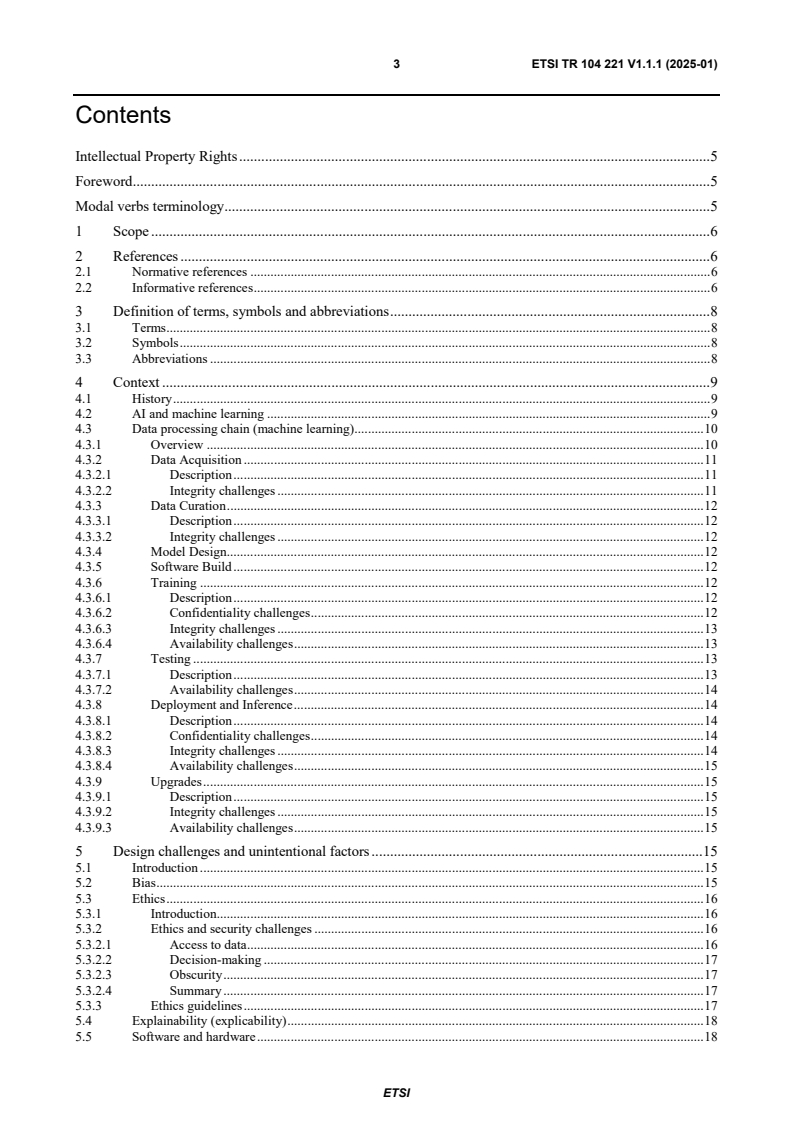
Contents
Intellectual Property Rights . 5
Foreword . 5
Modal verbs terminology . 5
1 Scope . 6
2 References . 6
2.1 Normative references . 6
2.2 Informative references . 6
3 Definition of terms, symbols and abbreviations . 8
3.1 Terms . 8
3.2 Symbols . 8
3.3 Abbreviations . 8
4 Context . 9
4.1 History . 9
4.2 AI and machine learning . 9
4.3 Data processing chain (machine learning) . 10
4.3.1 Overview . 10
4.3.2 Data Acquisition . 11
4.3.2.1 Description . 11
4.3.2.2 Integrity challenges . 11
4.3.3 Data Curation . 12
4.3.3.1 Description . 12
4.3.3.2 Integrity challenges . 12
4.3.4 Model Design. 12
4.3.5 Software Build . 12
4.3.6 Training . 12
4.3.6.1 Description . 12
4.3.6.2 Confidentiality challenges . 12
4.3.6.3 Integrity challenges . 13
4.3.6.4 Availability challenges . 13
4.3.7 Testing . 13
4.3.7.1 Description . 13
4.3.7.2 Availability challenges . 14
4.3.8 Deployment and Inference . 14
4.3.8.1 Description . 14
4.3.8.2 Confidentiality challenges . 14
4.3.8.3 Integrity challenges . 14
4.3.8.4 Availability challenges . 15
4.3.9 Upgrades . 15
4.3.9.1 Description . 15
4.3.9.2 Integrity challenges . 15
4.3.9.3 Availability challenges . 15
5 Design challenges and unintentional factors . 15
5.1 Introduction . 15
5.2 Bias . 15
5.3 Ethics . 16
5.3.1 Introduction. 16
5.3.2 Ethics and security challenges . 16
5.3.2.1 Access to data . 16
5.3.2.2 Decision-making . 17
5.3.2.3 Obscurity . 17
5.3.2.4 Summary . 17
5.3.3 Ethics guidelines . 17
5.4 Explainability (explicability) . 18
5.5 Software and hardware . 18
ETSI
4 ETSI TR 104 221 V1.1.1 (2025-01)
6 Attack types . 19
6.1 Poisoning . 19
6.2 Input attack and evasion . 19
6.3 Backdoor Attacks . 19
6.4 Reverse Engineering. 20
7 Misuse of AI . 20
8 Real world use cases and attacks . 20
8.1 Overview . 20
8.2 Ad-blocker attacks . 20
8.3 Malware Obfuscation . 21
8.4 Deepfakes . 21
8.5 Handwriting reproduction . 21
8.6 Human voice . 21
8.7 Fake conversation . 22
Annex A: Bibliography . 23
History . 24
ETSI
5 ETSI TR 104 221 V1.1.1 (2025-01)
Intellectual Property Rights
Essential patents
IPRs essential or potentially essential to normative deliverables may have been declared to ETSI. The declarations
pertaining to these essential IPRs, if any, are publicly available for ETSI members and non-members, and can be
found in ETSI SR 000 314: "Intellectual Property Rights (IPRs); Essential, or potentially Essential, IPRs notified to
ETSI in respect of ETSI standards", which is available from the ETSI Secretariat. Latest updates are available on the
ETSI IPR online database.
Pursuant to the ETSI Directives including the ETSI IPR Policy, no investigation regarding the essentiality of IPRs,
including IPR searches, has been carried out by ETSI. No guarantee can be given as to the existence of other IPRs not
referenced in ETSI SR 000 314 (or the updates on the ETSI Web server) which are, or may be, or may become,
essential to the present document.
Trademarks
The present document may include trademarks and/or tradenames which are asserted and/or registered by their owners.
ETSI claims no ownership of these except for any which are indicated as being the property of ETSI, and conveys no
right to use or reproduce any trademark and/or tradename. Mention of those trademarks in the present document does
not constitute an endorsement by ETSI of products, services or organizations associated with those trademarks.
DECT™, PLUGTESTS™, UMTS™ and the ETSI logo are trademarks of ETSI registered for the benefit of its
Members. 3GPP™, LTE™ and 5G™ logo are trademarks of ETSI registered for the benefit of its Members and of the
3GPP Organizational Partners. oneM2M™ logo is a trademark of ETSI registered for the benefit of its Members and of ®
the oneM2M Partners. GSM and the GSM logo are trademarks registered and owned by the GSM Association.
Foreword
This Technical Report (TR) has been produced by ETSI Technical Committee Securing Artificial Intelligence (SAI).
Modal verbs terminology
In the present document "should", "should not", "may", "need not", "will", "will not", "can" and "cannot" are to be
interpreted as described in clause 3.2 of the ETSI Drafting Rules (Verbal forms for the expression of provisions).
"must" and "must not" are NOT allowed in ETSI deliverables except when used in direct citation.
ETSI
6 ETSI TR 104 221 V1.1.1 (2025-01)
1 Scope
The present document describes the problem of securing AI-based systems and solutions, with a focus on machine
learning, and the challenges relating to confidentiality, integrity and availability at each stage of the machine learning
lifecycle. It also describes some of the broader challenges of AI systems including bias, ethics and explainability. A
number of different attack vectors are described, as well as several real-world use cases and attacks.
NOTE: The present document updates and replaces ETSI GR SAI 004 [i.32].
2 References
2.1 Normative references
Normative references are not applicable in the present document.
2.2 Informative references
References are either specific (identified by date of publication and/or edition number or version number) or
non-specific. For specific references, only the cited version applies. For non-specific references, the latest version of the
referenced document (including any amendments) applies.
NOTE: While any hyperlinks included in this clause were valid at the time of publication, ETSI cannot guarantee
their long term validity.
The following referenced documents are not necessary for the application of the present document but they assist the
user with regard to a particular subject area.
[i.1] Florian Tramèr, Pascal Dupré, Gili Rusak, Giancarlo Pellegrino, Dan Boneh: "AdVersarial:
Perceptual Ad Blocking meets Adversarial Machine Learning", in Proceedings of the 2019, ACM
SIGSAC Conference on Computer and Communications Security, pp. 2005-2021,
November 2019.
[i.2] Stuart Millar, Niall McLaughlin, Jesus Martinez del Rincon, Paul Miller, Ziming Zhao:
"DANdroid: A Multi-View Discriminative Adversarial Network for Obfuscated Android Malware
th
Detection", in Proceedings of the 10 ACM Conference on Data and Application Security and
Privacy, 2019.
[i.3] Leslie D.: "Understanding artificial intelligence ethics and safety: A guide for the responsible
design and implementation of AI systems in the public sector", The Alan Turing Institute, 2019.
[i.4] High Level Expert Group on Artificial Intelligence, European Commission: "Ethics Guidelines for
Trustworthy AI", April 2019.
[i.5] UK Department for Digital, Culture, Media & Sport: "Data Ethics Framework", August 2018.
[i.6] Song C., Ristenpart T., and Shmatikov V.: "Machine Learning Models that Remember Too
Much", ACM CCS 17, Dallas, TX, USA.
[i.7] Finn C., Abbeel P., Levine S.:"Model-Agnostic Meta-Learning for Fast Adaptation of Deep
Networks".
[i.8] Chen X., Liu C., Li B., Lu K., Song D.: "Targeted Backdoor Attacks on Deep Learning Systems
Using Data Poisoning".
[i.9] Tom S. F. Haines, Oisin Mac Aodha, and Gabriel J. Brostow: "My Text in Your Handwriting",
ACM Trans. Graph. 35, 3, Article 26 (June 2016), 18 pages.
[i.10] K. Eykholt et al.: "Robust Physical-World Attacks on Deep Learning Visual Classification", 2018
IEEE/CVF Conference on Computer Vision and Pattern Recognition, Salt Lake City, UT, 2018,
pp. 1625-1634.
ETSI
7 ETSI TR 104 221 V1.1.1 (2025-01)
[i.11] Florian Tramèr, Fan Zhang, Ari Juels, Michael K. Reiter, and Thomas Ristenpart: "Stealing
th
machine learning models via prediction APIs", in Proceedings of the 25 USENIX Conference on
Security Symposium (SEC"16). USENIX Association, USA, pp. 601-618, 2016.
[i.12] Seong Joon Oh, Max Augustin, Bernt Schiele, Mario Fritz: "Towards reverse-engineering
black-box neural networks Max-Planck Institute for Informatics", Saarland Informatics Campus,
Saarbrucken, Germany Published as a conference paper at ICLR 2018.
[i.13] Aaron van den Oord, Sander Dieleman, Heiga Zen, Karen Simonyan, Oriol Vinyals, Alex Graves,
Nal Kalchbrenner, Andrew Senior, Koray Kavukcuoglu: "WaveNet: A Generative Model for Raw
Audio", September 2016.
[i.14] Miles Brundage, Shahar Avin, Jack Clark, Helen Toner, Peter Eckersley, Ben Garfinkel, Allan
Dafoe, Paul Scharre, Thomas Zeitzoff, Bobby Filar, Hyrum Anderson, Heather Roff, Gregory C.
Allen, Jacob Steinhardt, Carrick Flynn, Seán Ó hÉigeartaigh, Simon Beard, Haydn Belfield,
Sebastian Farquhar, Clare Lyle, Rebecca Crootof, Owain Evans, Michael Page, Joanna Bryson,
Roman Yampolskiy, Dario Amodei: "The Malicious Use of Artificial Intelligence: Forecasting,
Prevention, and Mitigation".
[i.15] Oscar Schwarz, IEEE Tech Talk: "Artificial Intelligence, Machine Learning", November 2019.
[i.16] Haberer, J. et al.: "Gutachten der Datenethikkommission", 2019.
[i.17] Hagendorff T.: "The Ethics of AI Ethics: An Evaluation of Guidelines", Minds & Machines,
vol. 30, pp. 99-120, 2020.
[i.18] Uesato J., Kumar A., Szepesvari C., Erez T., Ruderman A., Anderson K., Heess N. and Kohli P.:
"Rigorous agent evaluation: An adversarial approach to uncover catastrophic failures", 2018,
arXiv preprint arXiv:1812.01647.
[i.19] Weng T.W., Zhang H., Chen H., Song Z., Hsieh C.J., Boning D., Dhillon I.S. and Daniel L.:
"Towards fast computation of certified robustness for relu networks", 2018, arXiv preprint
arXiv:1804.09699.
[i.20] Kingston J. K. C.: "Artificial Intelligence and Legal Liability", 2018.
[i.21] Won-Suk Lee, Sung Min Ahn, Jun-Won Chung, Kyoung Oh Kim, Kwang An Kwon, Yoonjae
Kim, Sunjin Sym, Dongbok Shin, Inkeun Park, Uhn Lee, and Jeong-Heum Baek.: "Assessing
Concordance with Watson for Oncology, a Cognitive Computing Decision Support System for
Colon Cancer Treatment in Korea", JCO Clinical Cancer Informatics 2018.
[i.22] Pr. Ronald C. Arkin: "The Case for Ethical Autonomy in Unmanned Systems, Journal of Military
Ethics", 9:4, pp. 332-341, 2010.
[i.23] Pega Systems: "What Consumers Really Think About AI: A Global Study", 2017.
[i.24] Reza Shokri, Marco Stronati, Congzheng Song, Vitaly Shmatikov: "Membership Inference
Attacks Against Machine Learning Models", IEEE security and privacy, 2017.
[i.25] Matt Fredrikson, Somesh Jha, Thomas Ristenpart: "Model Inversion Attacks that Exploit
Confidence Information and Basic Countermeasures", ACM CCS 2015.
[i.26] Association for Computing Machinery: "Top Two Levels of The ACM Computing Classification
System (1998)".
[i.27] Yim J., Chopra R., Spitz T., Winkens J., Obika A., Kelly C., Askham H., Lukic M., Huemer J.,
Fasler K. and Moraes G.: "Predicting conversion to wet age-related macular degeneration using
deep learning", Nature Medicine, pp.1-8, 2020.
[i.28] McKinney S.M., Sieniek M., Godbole V., Godwin J., Antropova N., Ashrafian H., Back T.,
Chesus M., Corrado G.C., Darzi A. and Etemadi M.: "International evaluation of an AI system for
breast cancer screening", Nature, 577(7788), pp. 89-94, 2020.
[i.29] Massachusetts Institute of Technology (MIT): "Moral Machine".
ETSI
8 ETSI TR 104 221 V1.1.1 (2025-01)
[i.30] Organisation for Economic Co-operation and Development (OECD): "Council recommendation
on Artificial Intelligence".
[i.31] Someone built chatbots that talk like the characters from HBO's Silicon Valley.
[i.32] ETSI GR SAI 004 (2020-12): "Securing Artificial Intelligence (SAI); Problem Statement".
[i.33] Regulation (EU) 2024/1689 of the European Parliament and of the Council of 13 June 2024 laying
down harmonised rules on artificial intelligence and amending Regulations (EC) No 300/2008,
(EU) No 167/2013, (EU) No 168/2013, (EU) 2018/858, (EU) 2018/1139 and (EU) 2019/2144 and
Directives 2014/90/EU, (EU) 2016/797 and (EU) 2020/1828 (Artificial Intelligence Act).
[i.34] ENISA: "Foresight 2030 Threats".
3 Definition of terms, symbols and abbreviations
3.1 Terms
For the purposes of the present document, the following terms apply:
artificial intelligence: ability of a system to handle representations, both explicit and implicit, and procedures to
perform tasks that would be considered intelligent if performed by a human
availability: property of being accessible and usable on demand by an authorized entity
confidentiality: assurance that information is accessible only to those authorized to have access
full knowledge attack: attack carried out by an attacker who has full knowledge of the system inputs and outputs and
its internal design and operations
integrity: assurance of the accuracy and completeness of information and processing methods
opaque system: system or object which can be viewed solely in terms of its input, output and transfer characteristics
without any knowledge of its internal workings
partial knowledge attack: attack carried out by an attacker who has full knowledge of the system inputs and outputs,
but only a limited understanding of its internal design and operations
zero knowledge attack: attack carried out by an attacker who has knowledge of the system inputs and outputs, but no
knowledge about its internal design or operations
3.2 Symbols
Void.
3.3 Abbreviations
For the purposes of the present document, the following abbreviations apply:
ACM Association for Computing Machinery
AI Artificial Intelligence
ASIC Application Specific Integrated Circuit
CCS Cascading Style Sheet
CCTV Closed Circuit Television
CNN Convolutional Neural Network
CVF Computer Vision Foundation
DAN Discriminative Adversarial Network
EPFL École Polytechnique Fédérale de Lausanne
FG Focus Group
FPGA Field Programmable Gate Array
ETSI
9 ETSI TR 104 221 V1.1.1 (2025-01)
GPU Graphics Processing Unit
HTML Hyper Text Markup Language
IEEE Institute of Electrical and Electronics Engineers
ITU International Telecommunications Union
MIT Massachusetts Institute of Technology
ML5G Machine Learning for Future Networks including 5G
NIST National Institute of Standards and Technology (USA)
OECD Organisation for Economic Co-operation and Development
OS Operating System
RNN Recurrent Neural Network
TEE Trusted Execution Environment
UN United Nations
URL Uniform Resource Locator
4 Context
4.1 History
The term 'artificial intelligence' originated at a conference in the 1950s at Dartmouth College in Hanover, New
Hampshire, USA. At that time, it was suggested that true artificial intelligence could be created within a generation. By
the early 1970s, despite millions of dollars of investment, it became clear that the complexity of creating true artificial
intelligence was much greater than anticipated, and investment began to drop off. The years that followed are often
referred to as an 'AI winter' which saw little interest or investment in the field, until the early 1980s when another wave
of investment kicked off. By the late 1980s, interest had again waned, largely due to the absence of sufficient
computing capacity to implement systems, and there followed a second AI winter.
In recent years, interest and investment in AI has once again surfaced, due to the implementation of some practical AI
systems enabled by:
• The evolution of advanced techniques in machine learning, neural networks and deep learning.
• The availability of significant data sets to enable robust training.
• Advances in high performance computing enabling rapid training and development.
• Advances in high-performance devices enabling practical implementation.
After the emergence of practical AI systems, suggested theoretical attacks on such systems have become plentiful.
Increasingly, real-world practical attacks with sufficient motivation and impact are being observed, particularly those
using forms of generative AI and for masquerade (e.g. deep fakes) and are forecast as increasing in impact and viability
over the coming years [i.34].
4.2 AI and machine learning
The field of artificial intelligence is broad, so in order to identify the issues in securing AI, the first step is to define
what AI means.
The breadth of the field creates a challenge when trying to create accurate definitions.
EXAMPLE 1: The Association for Computing Machinery (ACM) Computing Classification System [i.26] breaks
down Artificial Intelligence into eleven different categories, each of which has multiple
sub-categories.
EXAMPLE 2: The AI Act [i.33] does not directly define Artificial Intelligence but rather defines an 'AI system'
as a machine-based system that is designed to operate with varying levels of autonomy and that
may exhibit adaptiveness after deployment, and that, for explicit or implicit objectives, infers,
from the input it receives, how to generate outputs such as predictions, content, recommendations,
or decisions that can influence physical or virtual environments.
ETSI
10 ETSI TR 104 221 V1.1.1 (2025-01)
This represents a complex classification system with a large group of technology areas at varying stages of maturity,
some of which have not yet seen real implementations, but does not serve as a useful concise definition. For the
purposes of the present document, the following outline definition is used:
• Artificial intelligence is the ability of a system to handle representations, both explicit and implicit, and
procedures to perform tasks that would be considered intelligent if performed by a human.
NOTE: The above definition is consistent with the definition of AI system found in the AI Act [i.33] on the
understanding that the tasks performed can influence physical or virtual environments.
This definition still represents a broad spectrum of possibilities. However, there are a limited set of technologies which
are now becoming realizable, largely driven by the evolution of machine learning and deep learning techniques.
Therefore, the present document focusses on the discipline of machine learning and some of its variants, including:
• Supervised learning - where all the training data is labelled, and the model can be trained to predict the output
based on a new set of inputs.
• Semi-supervised learning - where the data set is partially labelled. In this case, even the unlabelled data can
be used to improve the quality of the model.
• Unsupervised learning - where the data set is unlabelled, and the model looks for structure in the data,
including grouping and clustering.
• Reinforcement learning - where a policy defining how to act is learned by agents through experience to
maximize their reward; and agents gain experience by interacting in an environment through state transitions.
Within each of these machine learning paradigms, there are various model structures that might be used, with one of the
most common approaches being the use of deep neural networks, where learning is carried out over a series of
hierarchical layers that mimic the behaviour of the human brain.
There are also a number of different training techniques which can be used, including adversarial learning, where the
training set contains not only samples which reflect the desired outcomes, but also adversarial samples, which are
intended to challenge or disrupt the expected behaviour.
4.3 Data processing chain (machine learning)
4.3.1 Overview
The question of securing AI systems can be simply stated as ensuring the confidentiality, integrity and availability of
those systems throughout their lifecycle. The lifecycle for machine learning can be considered to have the following
stages, as shown in Figure 1:
1) Data acquisition
2) Data curation
3) Model design
4) Build
5) Train
6) Test
7) Deployment
8) Results
9) Updates
Stages 4), 5) and 6) (Build, Train, Test) can together be considered as an iterative implementation cycle.
In the machine learning lifecycle, the training phase can be considered as the most critical, since it is this stage that
establishes the baseline behaviour of the system.
ETSI
11 ETSI TR 104 221 V1.1.1 (2025-01)
Figure 1: Typical machine learning lifecycle
The level of activity within each phase is dependent on the type of machine learning being used.
EXAMPLE: In unsupervised learning, there is no requirement for data labelling within the data curation stage.
The following clauses address the challenges of ensuring confidentiality, integrity and availability as they apply within
those specific stages, with a summary shown in Table 1.
NOTE: The following clauses consider only those challenges which are specific to machine learning systems, and
do not consider challenges which are generic across all hardware and software systems.
Table 1: Challenges in confidentiality, integrity and availability in the machine learning lifecycle
Clause Lifecycle Phase Issues
4.3.2 Data Acquisition Integrity
4.3.3 Data Curation Integrity
4.3.4 Model Design Generic issues only
4.3.5 Software Build Generic issues only
4.3.6 Train Confidentiality, Integrity, Availability
4.3.7 Test Availability
4.3.8 Deployment Confidentiality, Integrity, Availability
4.3.9 Upgrades Integrity, Availability
4.3.2 Data Acquisition
4.3.2.1 Description
In an AI system, data can be obtained from a multitude of sources, including sensors (such as CCTV cameras, mobile
phones, medical devices) and digital assets (such as data from trading platforms, document extracts, log files). Data can
also be in many different forms (including text, images, video and audio) and can be structured or unstructured. In
addition to security challenges related to the data itself, it is important to consider the security of transmission and
storage.
4.3.2.2 Integrity challenges
The integrity, or quality, of a data set is a critical success factor for machine learning systems. Data can be poisoned
through a deliberate malicious act, i.e. a poisoning attack (described in clause 6.1), but can also become 'poisoned' (or
degraded) accidentally (e.g. where insufficient care is taken in collecting data which is consistent and fit for purpose).
ETSI
12 ETSI TR 104 221 V1.1.1 (2025-01)
4.3.3 Data Curation
4.3.3.1 Description
This phase involves preparing the collected data for use with the intended machine learning approach. This can include
integrating data from multiple sources and formats, identifying missing components of the data, removing errors and
sources of noise, conversion of data into new formats, labelling the data, data augmentation using real and synthetic
data, or scaling the data set using data synthesis approaches.
4.3.3.2 Integrity challenges
When repairing, augmenting or converting data sets, it is important to ensure that the processes do not risk impacting on
the quality and integrity of the data. For supervised machine learning systems, it is important that the data labelling is
accurate and as complete as possible, and to ensure that the labelling retains its integrity and is not compromised,
e.g. through poisoning attacks. It is also important to address the challenge of ensuring the data set is unbiased.
Techniques for data augmentation can impact on the integrity of the data.
4.3.4 Model Design
The design of a machine learning system usually contains various artefacts including diagrams, equations, cost
functions and optimization algorithms. For complex models such as Convolutional Neural Networks (CNNs) or
Recurrent Neural Networks (RNNs) there can be multiple artefacts representing each layer of the model.
There are no security challenges which are specific to machine learning systems, but generic challenges should be
considered.
4.3.5 Software Build
This refers to the specification, design and implementation of the software, including the use of commercially available
tools and languages.
There are no security challenges which are specific to machine learning systems, but generic challenges should be
considered.
4.3.6 Training
4.3.6.1 Description
The training phase of the machine learning process is one of the most critical steps, since it establishes the baseline
behaviour of the application. This is the area that is most likely to present unique challenges in relation to security, as
learning is at the core of the machine learning process.
The training stage consists of running the model iteratively with a baseline data set for which the desired output is
known. With each iteration, the model parameters are adjusted to achieve more accurate performance, and this is
repeated until an optimal or acceptable level of accuracy is achieved. It is critical that the training data set is of high
quality, as any inaccuracies or inconsistencies can lead to the model behaving incorrectly.
It is possible to use third party components to support the algorithm training phase, and these can sometimes be
accessed remotely, e.g. through cloud-based services. In all such cases, the security challenges in clauses 4.3.6.2 to
4.3.6.4 should be considered, together with the generic challenges of using external or cloud-based components and
services.
4.3.6.2 Confidentiality challenges
The training dataset confidentiality can be compromised by an attacker with some knowledge of the algorithm
implementation (full or partial knowledge attack), or even by a malicious actor with no knowledge of the internal
operation of the algorithm (zero knowledge attack) [i.6].
ETSI
13 ETSI TR 104 221 V1.1.1 (2025-01)
EXAMPLE 1: With zero knowledge of the original training data set, or the model parameters, an attacker creates
an augmented training data set with malicious synthetic inputs which are specifically designed to
output labels containing information about the original training data. When trained with both the
original and augmented data sets, the algorithm can be trained to leak information about the
original training data in response to the malicious inputs.
EXAMPLE 2: With some knowledge of the model parameters, an attacker can leverage unused bits within the
parameters to leak information.
4.3.6.3 Integrity challenges
An integrity vulnerability can sometimes be introduced through the use of transfer learning, where a pre-trained
network can be finely tuned with a few training samples for malicious purposes. Although not intended to be so,
meta-learning can be argued to introduce vulnerabilities, in that the system is optimized for transfer learning with only a
very small number of samples [i.7]. Furthermore, features generated by a model can be used, without further training,
for inference purposes other than that which they were intended.
A backdoor vulnerability is when a special pattern is included during the training phase, and then a trigger is used to
generate an output during the inference phase [i.8]. This type of attack can include poisoning during the training phase
as a component of its attack, but it is important to emphasize that a backdoor attack requires action in both the training
and implementation phases, whereas a poisoning attack requires action only in the training phase. Such a backdoor can
also be facilitated through transfer learning.
Another vulnerability is to do with the learning algorithm, which can be modified by an attacker with full or partial
knowledge of the algorithm to ensure an incorrect inference for certain samples, whilst maintaining correct performance
for the client test set.
4.3.6.4 Availability challenges
In this case, the availability of the machine learning model can be compromised by poisoning attacks on the training
data set, which result in the wrong inference result. Normally, this refers to poisoning attacks at the input layer,
however, poisoning attacks can also be carried out on the algorithm or its associated parameters.
In addition, in unsupervised learning approaches such as clustering, feature selection is an important step. There are
techniques for simultaneous feature selection and clustering which result in feature weightings, or saliency measures. If
the attacker has full or partial knowledge of these weightings, they could modify feature values to perform an
availability attack in which the salient features are made unavailable by reversing the weights. This attack of denying
salient features to the system is known as 'denial of features'.
4.3.7 Testing
4.3.7.1 Description
During the testing phase, a portion of the training data set (which has been set aside, and not used during the training
phase) is used to validate the performance of the model and its parameters. This includes validating that the model
operates correctly from a functional perspective, that the training data set has sufficient coverage of expected inputs,
and that the parameters have been correctly configured. Adversarial testing can also be used to test that unexpected or
previously unseen inputs do not cause the system to malfunction or become unavailable.
In addition, as with traditional software systems, the code which has been written to implement the model also needs to
be tested.
The AI Act [i.33] places a significant focus on test and verification of AI systems. In particular Article 9.6 of [i.33]
requires that high-risk AI systems are tested both for the purpose of identifying the most appropriate and targeted risk
management measures, and to ensure that they perform consistently for their intended purpose.
ETSI
14 ETSI TR 104 221 V1.1.1 (2025-01)
4.3.7.2 Availability challenges
Learnt models can be vulnerable to adversarial samples that result in the functionality not meeting the specification and
therefore the required function or service not being available to the user. Therefore, it is important that the test set has
sufficient coverage from a testing perspective. Test sets can include adversarial test samples generated by an adversary
and those naturally occurring through lack of generalization. Adversarial testing tries to quickly find testing samples
that can cause failure [i.18].
A related area, formal verification of machine learning models, can help in ensuring that the system meets the original
specification. However, enumerating all possible outputs for a given set of inputs can often be intractable due to the
huge number of choices for the inputs. Efficient approaches to formal verification can be obtained by setting geometric
bounds on the output [i.19].
Standardization of adversarial testing and formal verification algorithms will be important in terms of ensuring the
robustness of learnt models.
4.3.8 Deployment and Inference
4.3.8.1 Description
Deployment of machine learning systems has the same challenges as generic systems, including choices about
architecture, hardware/software deployment and use of features such as Trusted Execution Environments (TEEs). In
addition to these and other similarly generic considerations, it is important to consider any additional performance
requirements of a machine learning system. For example, the choice of a TEE can provide a better level of protection
for the core system components but may not be able to provide the level of performance provided by generic processors
or GPUs.
Hardware deployments are attractive due to high levels of performance and are being explored for both the deployment
of machine learning systems and by attackers wishing to exploit vulnerabilities. The increasing preponderance of
sp
...
Questions, Comments and Discussion
Ask us and Technical Secretary will try to provide an answer. You can facilitate discussion about the standard in here.
Loading comments...