


ETSI I-ETS 300 220 ed.1 (1993-10)
Radio Equipment and Systems (RES); Short Range Devices (SRDs); Technical characteristics and test methods for radio equipment to be used in the 25 MHz to 1 000 MHz frequency range with power levels ranging up to 500 mW
Radio Equipment and Systems (RES); Short Range Devices (SRDs); Technical characteristics and test methods for radio equipment to be used in the 25 MHz to 1 000 MHz frequency range with power levels ranging up to 500 mW
DI/RES-08-0101
Radijska oprema in sistemi (RES) - Naprave kratkega dosega (SRDs) - Tehnične karakteristike in preskušalne metode za radijsko opremo, ki se uporablja v frekvenčnem območju od 25 MHz do 1 000 MHz z nivoji izhodne moči do 500 mW
General Information
Standards Content (Sample)
2003-01.Slovenski inštitut za standardizacijo. Razmnoževanje celote ali delov tega standarda ni dovoljeno.Radio Equipment and Systems (RES); Short Range Devices (SRDs); Technical characteristics and test methods for radio equipment to be used in the 25 MHz to 1 000 MHz frequency range with power levels ranging up to 500 mW33.060.20Sprejemna in oddajna opremaReceiving and transmitting equipmentICS:Ta slovenski standard je istoveten z:I-ETS 300 220 Edition 1PSIST I-ETS 300 220:1998en01-avgust-1998PSIST I-ETS 300 220:1998SLOVENSKI
STANDARD
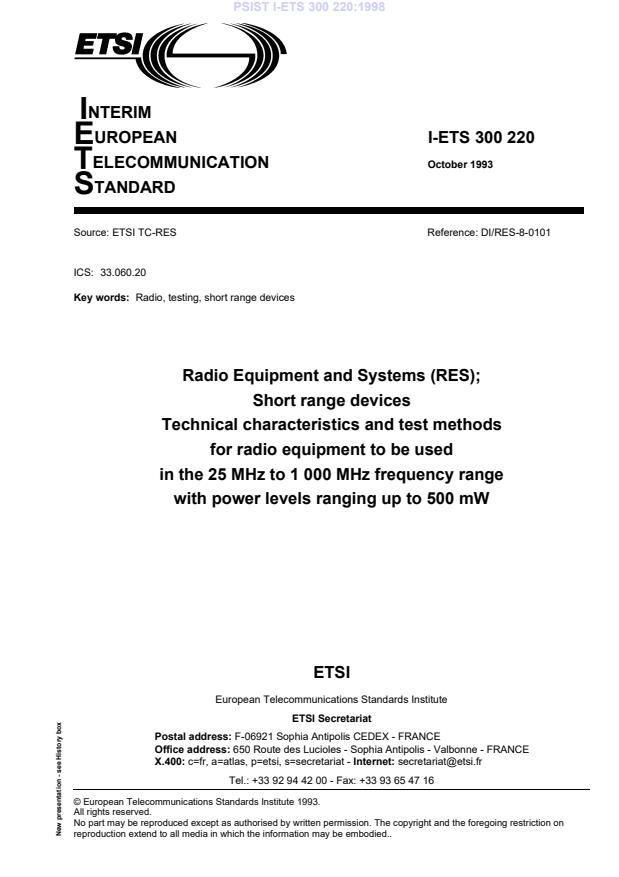
INTERIMEUROPEANI-ETS 300 220TELECOMMUNICATIONOctober 1993STANDARDSource: ETSI TC-RESReference: DI/RES-8-0101ICS:33.060.20Key words:Radio, testing, short range devicesRadio Equipment and Systems (RES);Short range devicesTechnical characteristics and test methodsfor radio equipment to be usedin the 25 MHz to 1 000 MHz frequency rangewith power levels ranging up to 500 mWETSIEuropean Telecommunications Standards InstituteETSI SecretariatPostal address: F-06921 Sophia Antipolis CEDEX - FRANCEOffice address: 650 Route des Lucioles - Sophia Antipolis - Valbonne - FRANCEX.400: c=fr, a=atlas, p=etsi, s=secretariat - Internet: secretariat@etsi.frTel.: +33 92 94 42 00 - Fax: +33 93 65 47 16© European Telecommunications Standards Institute 1993.All rights reserved.No part may be reproduced except as authorised by written permission. The copyright and the foregoing restriction onreproduction extend to all media in which the information may be embodied.PSIST I-ETS 300 220:1998
Page 2I-ETS 300 220: October 1993Whilst every care has been taken in the preparation and publication of this document, errors in content,typographical or otherwise, may occur. If you have comments concerning its accuracy, please write to"ETSI Editing and Committee Support Dept." at the address shown on the title page.PSIST I-ETS 300 220:1998
Page 3I-ETS 300 220: October 1993ContentsForeword.7Introduction.81Scope.92Normative references.93Definitions, symbols and abbreviations.103.1Definitions.103.2Symbols.103.3Abbreviations.114General.114.1Presentation of equipment for testing purposes.114.1.1Choice of model for type testing.114.1.2Definitions of alignment range and switching range.114.1.3Definition of the categories of the alignment range (AR1 and AR2).124.1.4Choice of frequencies.124.1.5Testing of single frequency equipment of category AR1.124.1.6Testing of single frequency equipment of category AR2.124.1.7Testing of two frequencies equipment of category AR1.124.1.8Testing of two frequency equipment of category AR2.124.1.9Testing of multi-frequency equipment (more than two frequencies) ofcategory AR1.134.1.10Testing of multi-frequency equipment (more than two frequencies) ofcategory AR2 (switching range less than alignment range).134.1.11Testing of multi-frequency equipment (more than two frequencies) ofcategory AR2 (switching range equals the alignment range).134.1.12Testing of equipment without a permanent external 50 ohm antennaconnector.144.1.12.1Equipment with a permanent internal 50 ohm RFconnector.144.1.12.2Equipment with a temporary
50 ohm RF connector.144.2Mechanical and electrical design.144.2.1General.144.2.2Controls.144.2.3Transmitter shut-off facility.144.2.4Marking (equipment identification).144.2.5Receiver mute or squelch.154.3Declarations by the applicant.154.4Auxiliary test equipment.154.5Interpretation of the measurement results.155Test conditions, power sources and ambient temperatures.155.1Normal and extreme test conditions.155.2External test power source.155.3Normal test conditions.165.3.1Normal temperature and humidity.165.3.2Normal test power source.165.3.2.1Mains voltage.165.3.2.2Regulated lead-acid battery power sources.165.3.2.3Other power sources.165.4Extreme test conditions.165.4.1Extreme temperatures.165.4.1.1Procedure for tests at extreme temperatures.16PSIST I-ETS 300 220:1998
Page 4I-ETS 300 220: October 19935.4.1.1.1Procedure for equipment designed forcontinuous operation.175.4.1.1.2Procedure for equipment designed forintermittent operation.175.4.1.2Extreme temperature ranges.175.4.2Extreme test source voltages.175.4.2.1Mains voltage.175.4.2.2Regulated lead-acid battery power sources.175.4.2.3Power sources using other types of batteries.185.4.2.4Other power sources.186General conditions.186.1Normal test signals and test modulation.186.1.1Normal test signals for analogue speech.186.1.2Normal test signals for data.186.2Artificial antenna.196.3Test fixture.196.4Test sites and general arrangements for radiated measurements.196.5Modes of operation of the transmitter.196.6Measuring receiver.207Methods of measurement and limits for transmitter parameters.207.1Frequency error.207.1.1Definition.207.1.2Method of measurement.207.1.3Limits.217.2Carrier power (conducted).217.2.1Definition.217.2.2Method of measurement.217.2.3Limits.227.3Effective radiated power (radiated).227.3.1Definition.227.3.2Methods of measurement.227.3.3Limits.237.4Response of the transmitter to modulation frequencies.247.4.1Frequency deviation.247.4.1.1Definition.247.4.1.2Analogue signals within the audio bandwidth.247.4.1.2.1Method of measurement.247.4.1.2.2Limits.247.4.1.3Analogue signals above the audio bandwidth.247.4.1.3.1Method of measurement.247.4.1.3.2Limits.257.4.2Modulation depth.267.4.2.1Definition.267.4.2.2Analogue signals within the audio bandwidth.267.4.2.2.1Method of measurement.267.4.2.2.2Limits.267.4.2.3Analogue signals above the audio bandwidth.267.4.2.3.1Method of measurement.267.4.2.3.2Limits.267.5Adjacent channel power.277.5.1Definition.277.5.2Method of measurement.277.5.2.1Method of measurement using a power measuringreceiver.277.5.3Limits.287.6Range of modulation bandwidth for wide band equipment (>25 kHz).297.6.1Definition.297.6.2Method of measurement.297.6.3Limits.297.7Spurious emissions.307.7.1Definition.30PSIST I-ETS 300 220:1998
Page 5I-ETS 300 220: October 19937.7.2Method of measuring the power level in a specified load, subclause( 7.7.1a.i).307.7.3Method of measuring the effective radiated power, subclause( 7.7.1 a.ii).307.7.4Method of measuring the effective radiated power, subclause( 7.7.1 b).327.7.5Limits.328Methods of measurement and limits for receiver parameters.328.1Spurious radiation.328.1.1Definition.328.1.2Method of measuring the power level in a specified load, subclause( 8.1.1a.i).328.1.3Method of measuring the effective radiated power, subclause( 8.1.1 a.ii).338.1.4Method of measuring the effective radiated power, subclause( 8.1.1 b).338.1.5Limits.349Measurement uncertainty.34Annex A (informative):Defined applications using I-ETS 300 220.35A.1Application: Low power devices.35A.1.1General.35A.1.2Definition.35A.1.3Technical parameters.35Annex B (normative):Radiated measurements.36B.1Test sites and general arrangements for measurements involving the use of radiated fields.36B.1.1Outdoor test site.36B.1.1.1Test support for body worn equipment.37B.1.1.2Standard position.37B.1.2Test antenna.37B.1.3Substitution antenna.37B.1.4Optional additional indoor site.38B.2Guidance on the use of radiation test sites.39B.2.1Measuring distance.39B.2.2Test antenna.39B.2.3Substitution antenna.39B.2.4Artificial antenna.39B.2.5Auxiliary cables.40B.3Further optional alternative indoor test site using an anechoic chamber.40B.3.1Example of the construction of a shielded anechoic chamber.40B.3.2Influence of parasitic reflections in anechoic chambers.41B.3.3Calibration of the shielded RF anechoic chamber.41Annex C (normative):Specifications for adjacent channel power measurement arrangements.43C.1Power measuring receiver specification.43C.1.1IF filter.43C.1.2Variable attenuator.44C.1.3rms value indicator.44C.1.4Oscillator and amplifier.44Annex D (informative):Graphic representation of the selection of equipment and frequencies fortesting of single and multi-frequency equipment.45Annex E (normative):Correction factor for pulsed systems.47E.1Introduction.47E.2Method of measurement.47PSIST I-ETS 300 220:1998
Page 6I-ETS 300 220: October 1993E.3Limit.47Annex F (normative):Technical performance of the spectrum analyser.48History.49PSIST I-ETS 300 220:1998
Page 7I-ETS 300 220: October 1993ForewordThis Interim European Telecommunication Standard (I-ETS) has been prepared by the Radio Equipmentand Systems (RES) Technical Committee of the European Telecommunications Standards Institute (ETSI)and having passed through ETSI standards approval procedure, is now published.This is a general standard based upon CEPT Recommendations T/R 20-03 [1] and T/R 20-04 [2]. All types of modulation for radio devices, except Code Division Multiple Access (CDMA), are covered by thisI-ETS.For regulatory purposes the equipment is divided into
four main classes based on frequency range andmaximum output power (see table 1), and further divided into classes based on the use inside or outside theIndustrial Scientific and Medical (ISM) bands and on the use of the antenna (see table 2).Table 1ClassFrequency rangeMHzPower level(conducted or radiated)milliWatts (mW)I25 to 1 00010II300 to 1 00025III25 to 300100IV300 to 1 000500Table 2Sub-classFrequency bandAntenna type/connectoraI.S.M.IntegralbNon-I.S.M.IntegralcI.S.M.External socketdNon-I.S.M.External socketThe CEPT Recommendation T/R 01-04 [6] covering Low Power Devices (LPD) is supported by class I.a.,from the above tables, see Annex A, Clause A.1. For non-harmonised parameters, national administrations may impose conditions on the type of modulation,channel/frequency separations, maximum transmitter output power/effective radiated power, equipmentmarking and the inclusion of an automatic transmitter shut-off facility as a condition of the issue of anindividual or general licence, or, as a condition of use under licence exemption. The extreme temperatureranges are fixed and are given in subclause 5.4.1.2.This I-ETS does not cover requirements for radiated emissions below 25 MHz. Additional standards or specifications may be required for equipment such as that intended for connection tothe Public Switched Telephone Network (PSTN).PSIST I-ETS 300 220:1998
Page 8I-ETS 300 220: October 1993IntroductionThis I-ETS is intended to specify the minimum performance and the methods of measurement for shortrange devices as specified in the scope.When ETSI publishes a standard covering a specific application for short range devices, it will supersede thisgeneral standard.Interference from other services and systems has not been taken into account in this I-ETS.Included are methods of measurement for equipments fitted with antenna sockets and/or integral antenna. Equipment designed for use with an integral antenna may be supplied with a temporary external/internal orpermanent internal 50 ohm connector for the purpose of testing, providing, the characteristics beingmeasured are not expected to be affected.The performance of the equipment submitted for type testing should be representative of the performance ofthe corresponding production model. In order to avoid any ambiguity in that assessment, this I-ETS containsinstructions for the presentation of equipment for type testing purposes (see subclause 4.1), conditions oftesting (see Clause 5).This I-ETS was drafted on the assumption that:-"Type test measurements, performed in an accredited test laboratory, shall be accepted by the variousNational Regulatory Authorities in order to grant type approval, provided the National regulatoryrequirements are met.
In addition national administrations may accept a "certificate of conformity"based on the type test report".This is in compliance with CEPT Recommendation T/R 71-03 [7].Clauses 1 and 3 provide a general description on the types of equipment covered by this I-ETS and thedefinitions and abbreviations used.
Clause 4 provides a guide as to the number of samples required in-orderthat type tests may be carried out, and any markings on the equipment which the applicant should provide.Clauses 7 and 8 provide the limits of the parameters which are required to be tested.
These limits have beenchosen to minimise harmful interference to other equipment and services.
It also provides details on how theequipment should be tested and the conditions which should be applied.Clause 9 gives the maximum measurement uncertainty values.Annex A provides information on specific applications covered by this I-ETS.Annex B provides specifications concerning radiated measurements.Annex C contains specifications for adjacent channel power measurement arrangements.Annex D is a graphic representation of subclause 4.1, referring to the presentation of equipment for testingpurposes.Annex E provides information on the correction curve to be used for pulsed systems.Annex F provides information on the spectrum analyser specification.PSIST I-ETS 300 220:1998
Page 9I-ETS 300 220: October 19931ScopeThis I-ETS covers the minimum characteristics considered necessary in order to make the best use of theavailable frequencies.It does not necessarily include all the characteristics which may be required by a user, nor does it necessarilyrepresent the optimum performance achievable.It applies to short range devices:-with an antenna connection and/or with an integral antenna;-for alarms, telecommand, telemetry, etc., applications;-with or without speech;-operating on radio frequencies between 25 MHz and 1 000 MHz, with power levels up to 500 mW,radiated or terminated.This I-ETS covers fixed stations, mobile stations and portable stations. It applies also to Low Power Devices(LPD), as defined in the CEPT Recommendation T/R 01-04 [6]. In this I-ETS basic requirements are givenfor the different frequency bands, channel separation etc., where appropriate.2Normative referencesThis I-ETS incorporates by dated or undated reference, provisions from other publications. These normativereferences are cited at the appropriate places in the text and the publications listed hereafter. For datedreferences, subsequent amendments to or revisions of any of these publications apply to this I-ETS onlywhen incorporated in it by amendment or revision. For undated references the latest edition of the publicationreferred to applies.[1]CEPT Recommendation T/R 20-03: "Low power telecommand andtelemetry equipment operating on collective frequencies in the ISMfrequency bands".[2]CEPT Recommendation T/R 20-04: "Low power narrow band telecommandand telemetry equipment for use outside the ISM frequency bands".[3]CCITT Recommendation O.153: "Basic parameters for the measurement oferror performance at bit rates below the primary rate".[4]CISPR Publication 16: "Specifications for radio interference measuringapparatus and measurement methods".[5]ETR 028: "Radio Equipment and Systems; Uncertainties in themeasurement of mobile radio equipment characteristics".[6]CEPT Recommendation T/R 01-04: "Use of Low Power Devices (LPD)using integral antennas and operating in harmonised frequency bands".[7]CEPT Recommendation T/R 71-03: "Procedures for type testing andapproval for radio equipment intended for non public systems".PSIST I-ETS 300 220:1998
Page 10I-ETS 300 220: October 19933Definitions, symbols and abbreviations3.1DefinitionsFor the purpose of this I-ETS the following definitions apply.Alarm: the use of radio communication for indicating an alarm condition at a distant location.Assigned frequency band: the frequency band within which the device is authorised to operate.Conducted measurements: measurements which are made using a direct 50 ohm connection to theequipment under test.Fixed station: equipment intended for use in a fixed location.Full tests: in all cases except where qualified as "limited", tests shall be performed according to this I-ETS.Integral antenna: an antenna, with or without a connector, designed as an indispensable part of theequipment.Limited tests: the limited tests, see subclauses 4.1.1 to 4.1.10, are as follows:-transmitter frequency error, see subclause 7.1;-transmitter carrier power conducted, see subclause 7.2;-transmitter effective radiated power, see subclause 7.3;-transmitter adjacent channel power, see subclause 7.5.Mobile station: equipment normally fixed in a vehicle.Portable station: equipment intended to be carried, attached or implanted.Radiated measurements: measurements which involve the absolute measurement of a radiated field.Telecommand: the use of
radio communication for the transmission of signals to initiate, modify orterminate functions of equipment at a distance.Telemetry: the use of
radio communication for indicating or recording data at a distance.Wideband:
equipment to be used in a non-channelised continuous frequency band covering more than 25kHz, or to be used in a channelised frequency band with a channel spacing greater than 25 kHz.3.2SymbolsFor the purposes of this I-ETS the following symbols apply.Efield strengthNaClSodium chlorideEoreference field strengthRdistanceRoreference distancelwavelengthPSIST I-ETS 300 220:1998
Page 11I-ETS 300 220: October 19933.3AbbreviationsFor the purposes of this I-ETS the following abbreviations apply.AR1Alignment Range 1 (see subclauses 4.1.2 and 4.1.3)AR2Alignment Range 2 (see subclauses 4.1.2 and 4.1.3)CDMACode Division Multiple Access (spread spectrum)EMCElectro-Magnetic CompatibilityETRETSI Technical ReportIFIntermediate FrequencyISMIndustrial, Scientific and MedicalNOTE:This I-ETS includes the following designated ISM frequency bands:-26,957 MHz - 27,283 MHz;-40,660 MHz - 40,700 MHz;-433,050 MHz - 434,790 MHz.RFRadio Frequencyrmsroot-mean-squaredTxTransmitterVSWRVoltage Standing Wave Ratio4General4.1Presentation of equipment for testing purposesEach equipment submitted for type testing shall fulfil the requirements of this standard on all frequencies overwhich it is intended to operate.The applicant shall complete the appropriate application form when submitting equipment for type testing.To simplify and harmonise the type testing procedures between the different test laboratories, measurementsshall be performed, according to this I-ETS, on samples of equipment defined in subclauses 4.1.1 to 4.1.12.The measurements, wherever possible, shall be made by use of a direct connection to the equipment undertest (antenna socket or temporary 50 ohm connector) as stated in this I-ETS, in order to ensure that themeasurement uncertainties are minimised.NOTE:These subclauses are intended to give confidence that the requirements set out in thisstandard have been met without the necessity of performing measurements on allfrequencies.4.1.1Choice of model for type testingThe applicant shall provide one or more production model(s) of the equipment, as appropriate, for typetesting.If type approval is given on the basis of tests on a preliminary model, the corresponding production modelsmust be identical in all electrical and functional respects
with the preliminary model tested.In the case of portable equipment without an external antenna connector, see subclause 4.1.12.4.1.2Definitions of alignment range and switching rangeThe applicant shall, when submitting equipment for test, state the alignment ranges of the receiver andtransmitter.PSIST I-ETS 300 220:1998
Page 12I-ETS 300 220: October 1993The alignment range is defined as the frequency range over which the receiver or the transmitter can beprogrammed and/or realigned to operate, without any physical change to components other thanprogrammable read only memories or crystals (for the receiver or transmitter).The applicant shall also state the switching range of the receiver and the transmitter (which may differ).The switching range is the maximum frequency range over which the receiver or the transmitter can beoperated without reprogramming or realignment. 4.1.3Definition of the categories of the alignment range (AR1 and AR2)The alignment range for the receiver and transmitter, which may be different, falls into one of two categories:AR1:this corresponds to a limit of less than or equal to 10 % of the highest frequency of thealignment range, which is equal to or less than 500 MHz, or less than or equal to 5 % where thehighest alignment frequency is above 500 MHz;AR2:this corresponds to a limit of greater than 10 % of the highest frequency of the alignment range,which is equal to or less than 500 MHz, or greater than 5 % where the highest alignmentfrequency is above 500 MHz.4.1.4Choice of frequenciesThe frequencies for testing shall be chosen by the applicant, in accordance with subclauses 4.1.5 to 4.1.11and Annex D.4.1.5Testing of single frequency equipment of category AR1Full tests shall be carried out on a frequency within 100 kHz of the centre frequency of the alignment rangeon one sample of the equipment.4.1.6Testing of single frequency equipment of category AR2Three samples shall be tested. Tests shall be carried out on a total of three frequencies:-sample one shall be within 100 kHz of the highest frequency of the alignment range;-sample two shall be within 100 kHz of the lowest frequency of the alignment range;-sample three shall be within 100 kHz of the centre frequency of the alignment range.Full tests shall be carried out on all three frequencies.4.1.7Testing of two frequencies equipment of category AR1One sample shall be submitted to enable tests to be carried out on both frequencies.The upper frequency shall be within 100 kHz of the highest frequency of the switching range.
The lowerfrequency shall be within 100 kHz of the lowest frequency of the switching range.
In addition the average ofthe two frequencies shall be within 100 kHz of the centre frequency of the alignment range.Full tests shall be carried out on the upper frequency and limited tests on the lower frequency.4.1.8Testing of two frequency equipment of category AR2Three samples of the equipment shall be tested. Tests shall be carried out on a total of four frequencies:-sample one, two frequencies shall be measured. The highest frequency shall be within 100 kHz of thecentre frequency of the alignment range. The upper frequency shall be within 100 kHz of the highestPSIST I-ETS 300 220:1998
Page 13I-ETS 300 220: October 1993frequency of the switching range and the lower frequency shall be within 100 kHz of the lowestfrequency of the switching range.Full tests shall be carried out on the upper frequency and limited tests on the lower frequency;-sample two, the frequency shall be within 100 kHz of the highest frequency of the alignment range.Full tests shall be carried out on this frequency;-sample three, the frequency shall be within 100 kHz of the lowest frequency of the alignment range.Full tests shall be carried out on this frequency.4.1.9Testing of multi-frequency equipment (more than two frequencies) of category AR1One sample of the equipment shall be submitted to enable tests to be carried out on three frequencies.The centre frequency of the switching range shall be within 100 kHz of the centre frequency of the alignmentrange. The upper frequency shall be within 100 kHz of the highest frequency of the switching range and thelower frequency shall be within 100 kHz of the lowest frequency of the switching range.Full tests shall be carried out on the centre frequency and limited tests on the upper and lower frequency.4.1.10Testing of multi-frequency equipment (more than two frequencies) of category AR2(switching range less than alignment range)Three samples of the equipment shall be tested.
Tests shall be carried out on a total of five frequencies:-sample one, three frequencies shall be measured. The centre frequency of the switching range shallbe within 100 kHz of the centre frequency of the alignment range. The upper frequency shall be within100 kHz of the highest frequency of the switching range and the lower frequency shall be within 100kHz of the lowest frequency of the switching range.Full tests
shall be carried out on the centre frequency and limited tests on the upper and lowerfrequency;-sample two, the frequency shall be within 100 kHz of the highest frequency of the alignment range;-full tests shall be carried out on this frequency;-sample three, the frequency shall be within 100 kHz of the lowest frequency of the alignment range.Full tests shall be carried out on this frequency.4.1.11Testing of multi-frequency equipment (more than two frequencies) of category AR2(switching range equals the alignment range)One sample of the equipment shall be submitted to enable tests to be carried out on three frequencies.The switching range of the sample shall correspond to the alignment range.The centre frequency shall be within 100 kHz of the centre frequency of the switching range. The upperfrequency shall be within 100 kHz of the highest frequency of the switching range and the lower frequencyshall be within 100 kHz of the lowest frequency of the switching range.Full tests shall be carried out on all three frequencies.PSIST I-ETS 300 220:1998
Page 14I-ETS 300 220: October 19934.1.12Testing of equipment without a permanent external 50 ohm antenna connectorTo facilitate relative measurements, use can be made of a test fixture as described in subclause 6.3 or theequipment can be supplied with a permanent internal or temporary internal/external 50 ohm Radio Frequency(RF) connector.4.1.12.1Equipment with a permanent internal 50 ohm RF connectorThe way to access a permanent internal 50 ohm RF connector shall be stated by the applicant with the aid ofa diagram.
The fact that use has been made of the permanent internal 50 ohm RF socket shall be recordedin the test report.4.1.12.2Equipment with a temporary
50 ohm RF connectorThe applicant shall submit two sets of equipment to the test laboratory, one fitted with a temporary 50 ohmRF connector with the antenna disconnected and the other with the antenna connected.
Each equipmentshall be used for the appropriate tests.The way the temporary 50 ohm RF connector is implemented shall be stated by the applicant with the aid ofa diagram.
The fact that use has been made of the temporary 50 ohm RF connector to facilitatemeasurements shall be stated in the test report. The addition of a temporary 50 ohm connector should notinfluence the performance of the equipment under test.4.2Mechanical and electrical design4.2.1GeneralThe equipment submitted by the manufacturer, or his representative, shall be designed, constructed andmanufactured in accordance with sound engineering practice, and with the aim of minimising harmfulinterference to other equipment and services.Transmitters and receivers may be individual or combination units, but shall operate with the correct powersource.4.2.2ControlsThose controls which if maladjusted may increase the interfering potentialities of the equipment shall not beeasily accessible to the user.4.2.3Transmitter shut-off facilityIf the transmitter is equipped with an automatic transmitter shut-off facility, it should be made inoperative forthe duration of the test.4.2.4Marking (equipment identification)The equipment shall be marked in a visible place.
This marking shall be legible and durable.The marking shall include as a minimum:-the name of the applicant or his trade mark;-the type designation.PSIST I-ETS 300 220:1998
Page 15I-ETS 300 220: October 19934.2.5Receiver mute or squelchIf the receiver is equipped with a mute, squelch or battery-saving circuit, this circuit shall be made inoperativefor the duration of the tests.4.3Declarations by the applicantWhen submitting equipment for type testing, the applicant shall supply the necessary information accordingto the appropriate application form.4.4Auxiliary test equipmentAll necessary test signal sources and setting up information shall accompany the equipment when it issubmitted for type testing.4.5Interpretation of the measurement resultsThe interpretation of the results recorded on the appropriate test report form for the measurements describedin this I-ETS shall be as follows:-the measured value related to the corresponding limit will be used to decide whether an equipmentmeets the requirements of the standard;-the measurement uncertainty value for the measurement of each parameter shall be included in thetest report;-the recorded value of the measurement uncertainty shall be, for each measurement, equal to or lowerthan the figures in the table of measurement uncertainty (see Clause 9).5Test conditions, power sources and ambient temperatures5.1Normal and extreme test conditionsType testing shall be made under normal test conditions, and also, where stated, under extreme testconditions.The test conditions and procedures shall be as specified in subclauses 5.2 to 5.5.5.2External test power sourceDuring type tests the power source of the equipment shall be replaced by an external test power source,capable of producing normal and extreme test voltages as specified in subclauses 5.3.2 and 5.4.2.
Theinternal impedance of the external test power source shall be low enough for its effect on the test results tobe negligible.
For the purpose of the tests, the voltage of the external test power source shall be measuredat the input terminals of the equipment.For battery operated equipment the battery shall be removed and the external test power source shall besuitably de-coupled and applied as close to the equipment battery terminals as practicable.
For radiatedmeasurements any external power leads should be so arranged so as not to affect the measurements.
Ifnecessary, the external test power
source may be replaced with the supplied or recommended internalbatteries at the required voltage, this shall be stated on the test report. For radiated measurements onportable equipments with integral antenna, fully charged internal batteries should be used. The batteries usedshould be as supplied or recommended by the applicant.During tests the external test power source voltages shall be within a tolerance <± 1 % relative to the voltageat the beginning of each test.
The value of this tolerance can be critical for certain measurements.
Using asmaller tolerance will provide a better uncertainty value for these measurements.
If internal batteries arePSIST I-ETS 300 220:1998
Page 16I-ETS 300 220: October 1993used, at the end of each test the voltage shall be within a tolerance of <±
5 % relative to the voltage at thebeginning of each test.5.3Normal test conditions5.3.1Normal temperature and humidityThe normal temperature and humidity conditions for tests shall be any convenient combination oftemperature and humidity within the following ranges:-temperature +15°C to +35°C;-relative humidity 20 % to 75 %.When it is impracticable to carry out tests under these conditions, a note to this effect, stating the ambienttemperature and relative humidity during the tests, shall be added to the test report.5.3.2Normal test power source5.3.2.1Mains voltageThe normal test voltage for equipment to be connected to the mains shall be the nominal mains voltage.
Forthe purpose of this I-ETS, the nominal voltage shall be the declared voltage, or any of the declared voltages,for which the equipment was designed.The frequency of the test power source corresponding to the AC mains shall be between 49 Hz and 51 Hz.5.3.2.2Regulated lead-acid battery power sourcesWhen the radio equipment is intended for operation from the usual types of regulated lead-acid battery powersource the normal test voltage shall be 1,1 multiplied by the nominal voltage of the battery (6 volts, 12 voltsetc.).5.3.2.3Other power sourcesFor operation from other power sources or types of battery (primary or secondary), the normal test voltageshall be that declared by the equipment applicant and approved by the test authority.
Such values shall bestated in the test report.5.4Extreme test conditions5.4.1Extreme temperatures5.4.1.1Procedure for tests at extreme temperaturesBefore measurements are made the equipment shall have reached thermal balance in the test chamber. Theequipment shall be switched off during the temperature stabilizing period.In the case of equipment containing temperature stabilisation circuits designed to operate continuously, thetemperature stabilisation circuits
shall be switched on for 15 minutes after thermal balance has beenobtained, and the equipment shall then meet the specified requirements.If the thermal balance is not checked by measurements, a temperature stabilizing period of at least one hour,or such period as may be decided by the accredited test laboratory, shall be allowed.
The sequence ofmeasurements shall be chosen, and the humidity content in the test chamber shall be controlled so thatexcessive condensation does not occur.PSIST I-ETS 300 220:1998
Page 17I-ETS 300 220: October 19935.4.1.1.1Procedure for equipment designed for continuous operationIf the applicant states that the equipment is designed for continuous operation, the test procedure shall be asfollows:-before tests at the upper extreme temperature the equipment shall be placed in the test chamber andleft until thermal balance is attained. The equipment shall then be switched on in the transmit conditionfor a period of half an hour after which the equipment shall meet the specified requirements;-for tests at the lower extreme temperature the equipment shall be left in the test chamber until thermalbalance is attained, then switched to the
on condition for a period of one minute after which theequipment sh
...
Questions, Comments and Discussion
Ask us and Technical Secretary will try to provide an answer. You can facilitate discussion about the standard in here.
Loading comments...