


ETSI TS 102 894-2 V1.2.1 (2014-09)
Intelligent Transport Systems (ITS); Users and applications requirements; Part 2: Applications and facilities layer common data dictionary
Intelligent Transport Systems (ITS); Users and applications requirements; Part 2: Applications and facilities layer common data dictionary
RTS/ITS-00148
General Information
Standards Content (Sample)
TECHNICAL SPECIFICATION
Intelligent Transport Systems (ITS);
Users and applications requirements;
Part 2: Applications and facilities layer
common data dictionary
2 ETSI TS 102 894-2 V1.2.1 (2014-09)
Reference
RTS/ITS-00148
Keywords
application, data, ITS
ETSI
650 Route des Lucioles
F-06921 Sophia Antipolis Cedex - FRANCE
Tel.: +33 4 92 94 42 00 Fax: +33 4 93 65 47 16
Siret N° 348 623 562 00017 - NAF 742 C
Association à but non lucratif enregistrée à la
Sous-Préfecture de Grasse (06) N° 7803/88
Important notice
The present document can be downloaded from:
http://www.etsi.org
The present document may be made available in electronic versions and/or in print. The content of any electronic and/or
print versions of the present document shall not be modified without the prior written authorization of ETSI. In case of any
existing or perceived difference in contents between such versions and/or in print, the only prevailing document is the
print of the Portable Document Format (PDF) version kept on a specific network drive within ETSI Secretariat.
Users of the present document should be aware that the document may be subject to revision or change of status.
Information on the current status of this and other ETSI documents is available at
http://portal.etsi.org/tb/status/status.asp
If you find errors in the present document, please send your comment to one of the following services:
http://portal.etsi.org/chaircor/ETSI_support.asp
Copyright Notification
No part may be reproduced or utilized in any form or by any means, electronic or mechanical, including photocopying
and microfilm except as authorized by written permission of ETSI.
The content of the PDF version shall not be modified without the written authorization of ETSI.
The copyright and the foregoing restriction extend to reproduction in all media.
© European Telecommunications Standards Institute 2014.
All rights reserved.
TM TM TM
DECT , PLUGTESTS , UMTS and the ETSI logo are Trade Marks of ETSI registered for the benefit of its Members.
TM
3GPP and LTE™ are Trade Marks of ETSI registered for the benefit of its Members and
of the 3GPP Organizational Partners.
GSM® and the GSM logo are Trade Marks registered and owned by the GSM Association.
ETSI
3 ETSI TS 102 894-2 V1.2.1 (2014-09)
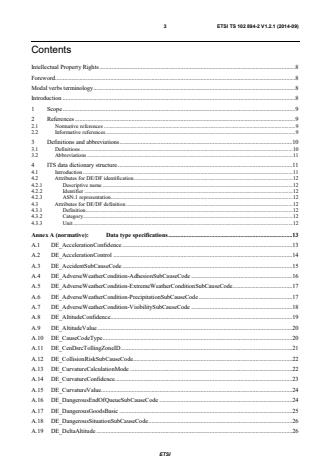
Contents
Intellectual Property Rights . 8
Foreword . 8
Modal verbs terminology . 8
Introduction . 8
1 Scope . 9
2 References . 9
2.1 Normative references . 9
2.2 Informative references . 9
3 Definitions and abbreviations . 10
3.1 Definitions . 10
3.2 Abbreviations . 11
4 ITS data dictionary structure . 11
4.1 Introduction . 11
4.2 Attributes for DE/DF identification . 12
4.2.1 Descriptive name . 12
4.2.2 Identifier . 12
4.2.3 ASN.1 representation . 12
4.3 Attributes for DE/DF definition . 12
4.3.1 Definition . 12
4.3.2 Category . 12
4.3.3 Unit . 12
Annex A (normative): Data type specifications . 13
A.1 DE_AccelerationConfidence . 13
A.2 DE_AccelerationControl . 14
A.3 DE_AccidentSubCauseCode . 15
A.4 DE_AdverseWeatherCondition-AdhesionSubCauseCode . 16
A.5 DE_AdverseWeatherCondition-ExtremeWeatherConditionSubCauseCode . 17
A.6 DE_AdverseWeatherCondition-PrecipitationSubCauseCode . 17
A.7 DE_AdverseWeatherCondition-VisibilitySubCauseCode . 18
A.8 DE_AltitudeConfidence. 19
A.9 DE_AltitudeValue . 20
A.10 DE_CauseCodeType . 20
A.11 DE_CenDsrcTollingZoneID . 21
A.12 DE_CollisionRiskSubCauseCode . 22
A.13 DE_CurvatureCalculationMode . 22
A.14 DE_CurvatureConfidence . 23
A.15 DE_CurvatureValue. 24
A.16 DE_DangerousEndOfQueueSubCauseCode . 24
A.17 DE_DangerousGoodsBasic . 25
A.18 DE_DangerousSituationSubCauseCode . 26
A.19 DE_DeltaAltitude . 26
ETSI
4 ETSI TS 102 894-2 V1.2.1 (2014-09)
A.20 DE_DeltaLatitude . 27
A.21 DE_DeltaLongitude . 27
A.22 DE_DriveDirection . 28
A.23 DE_DrivingLaneStatus . 28
A.24 DE_EmbarkationStatus . 28
A.25 DE_EmergencyPriority . 29
A.26 DE_EmergencyVehicleApproachingSubCauseCode . 29
A.27 DE_EnergyStorageType . 29
A.28 DE_ExteriorLights . 30
A.29 DE_HardShoulderStatus . 30
A.30 DE_HazardousLocation-AnimalOnTheRoadSubCauseCode . 31
A.31 DE_HazardousLocation-DangerousCurveSubCauseCode . 32
A.32 DE_HazardousLocation-ObstacleOnTheRoadSubCauseCode . 33
A.33 DE_HazardousLocation-SurfaceConditionSubCauseCode . 34
A.34 DE_HeadingConfidence . 35
A.35 DE_HeadingValue . 35
A.36 DE_HeightLonCarr . 36
A.37 DE_HumanPresenceOnTheRoadSubCauseCode . 36
A.38 DE_HumanProblemSubCauseCode . 37
A.39 DE_InformationQuality . 37
A.40 DE_LanePosition . 37
A.41 DE_Latitude . 38
A.42 DE_LateralAccelerationValue . 38
A.43 DE_LightBarSirenInUse . 39
A.44 DE_Longitude . 39
A.45 DE_LongitudinalAccelerationValue . 40
A.46 DE_NumberOfOccupants . 40
A.47 DE_PathDeltaTime . 41
A.48 DE_PerformanceClass . 41
A.49 DE_PosCentMass . 42
A.50 DE_PositioningSolutionType . 42
A.51 DE_PositionOfOccupants . 43
A.52 DE_PosFrontAx . 44
A.53 DE_PosLonCarr . 44
A.54 DE_PosPillar . 44
A.55 DE_PostCrashSubCauseCode . 45
A.56 DE_ProtectedZoneID. 45
A.57 DE_ProtectedZoneRadius . 46
ETSI
5 ETSI TS 102 894-2 V1.2.1 (2014-09)
A.58 DE_ProtectedZoneType. 46
A.59 DE_PtActivationData . 46
A.60 DE_PtActivationType . 47
A.61 DE_RelevanceDistance . 47
A.62 DE_RelevanceTrafficDirection . 48
A.63 DE_RequestResponseIndication . 48
A.64 DE_RescueAndRecoveryWorkInProgressSubCauseCode . 49
A.65 DE_RoadType . 49
A.66 DE_RoadworksSubCauseCode . 50
A.67 DE_SemiAxisLength . 51
A.68 DE_SequenceNumber . 51
A.69 DE_SignalViolationSubCauseCode . 52
A.70 DE_SlowVehicleSubCauseCode . 52
A.71 DE_SpecialTransportType. 53
A.72 DE_SpeedConfidence . 53
A.73 DE_SpeedLimit . 54
A.74 DE_SpeedValue . 54
A.75 DE_StationarySince . 54
A.76 DE_StationaryVehicleSubCauseCode . 55
A.77 DE_StationID . 55
A.78 DE_StationType . 56
A.79 DE_SteeringWheelAngleConfidence . 56
A.80 DE_SteeringWheelAngleValue . 57
A.81 DE_SubCauseCodeType . 57
A.82 DE_TimestampIts . 58
A.83 DE_Temperature . 58
A.84 DE_TrafficConditionSubCauseCode . 59
A.85 DE_TrafficRule . 59
A.86 DE_TransmissionInterval . 60
A.87 DE_TurningRadius . 60
A.88 DE_ValidityDuration . 60
A.89 DE_VDS . 61
A.90 DE_VehicleBreakdownSubCauseCode . 61
A.91 DE_VehicleLengthConfidenceIndication . 62
A.92 DE_VehicleLengthValue . 62
A.93 DE_VehicleMass . 62
A.94 DE_VehicleRole . 63
A.95 DE_VehicleWidth . 63
ETSI
6 ETSI TS 102 894-2 V1.2.1 (2014-09)
A.96 DE_VerticalAccelerationValue . 64
A.97 DE_WheelBaseVehicle . 64
A.98 DE_WMInumber . 64
A.99 DE_WrongWayDrivingSubCauseCode . 65
A.100 DE_YawRateConfidence . 66
A.101 DE_YawRateValue . 67
A.102 DF_ActionID . 67
A.103 DF_Altitude . 68
A.104 DF_CauseCode . 68
A.105 DF_CenDsrcTollingZone . 69
A.106 DF_ClosedLanes . 69
A.107 DF_Curvature . 70
A.108 DF_DangerousGoodsExtended . 71
A.109 DF_DeltaReferencePosition . 72
A.110 DF_EventHistory . 72
A.111 DF_EventPoint . 73
A.112 DF_Heading . 73
A.113 DF_ItineraryPath . 74
A.114 DF_ItsPduHeader . 74
A.115 DF_LateralAcceleration. 75
A.116 DF_LongitudinalAcceleration . 75
A.117 DF_PathHistory . 76
A.118 DF_PathPoint . 76
A.119 DF_PosConfidenceEllipse . 77
A.120 DF_PositionOfPillars . 77
A.121 DF_ProtectedCommunicationZone . 78
A.122 DF_ProtectedCommunicationZonesRSU . 78
A.123 DF_PtActivation . 79
A.124 DF_ReferencePosition . 80
A.125 DF_RestrictedTypes . 80
A.126 DF_Speed . 81
A.127 DF_SteeringWheelAngle . 81
A.128 DF_Traces . 82
A.129 DF_VerticalAcceleration . 82
A.130 DF_VehicleIdentification . 83
A.131 DF_VehicleLength . 83
A.132 DF_YawRate . 84
Annex B (normative): ASN.1 module of the common data dictionary . 85
ETSI
7 ETSI TS 102 894-2 V1.2.1 (2014-09)
Annex C (informative): Bibliography . 93
History . 94
ETSI
8 ETSI TS 102 894-2 V1.2.1 (2014-09)
Intellectual Property Rights
IPRs essential or potentially essential to the present document may have been declared to ETSI. The information
pertaining to these essential IPRs, if any, is publicly available for ETSI members and non-members, and can be found
in ETSI SR 000 314: "Intellectual Property Rights (IPRs); Essential, or potentially Essential, IPRs notified to ETSI in
respect of ETSI standards", which is available from the ETSI Secretariat. Latest updates are available on the ETSI Web
server (http://ipr.etsi.org).
Pursuant to the ETSI IPR Policy, no investigation, including IPR searches, has been carried out by ETSI. No guarantee
can be given as to the existence of other IPRs not referenced in ETSI SR 000 314 (or the updates on the ETSI Web
server) which are, or may be, or may become, essential to the present document.
Foreword
This Technical Specification (TS) has been produced by ETSI Technical Committee Intelligent Transport Systems
(ITS).
The present document is part 2 of a multi-part deliverable covering the Intelligent Transport Systems (ITS); Users and
applications requirements, as identified below:
Part 1: "Facility layer structure, functional requirements and specifications";
Part 2: "Applications and facilities layer common data dictionary".
The specifications of data elements of the facilities layer messages have been tested within various European Projects
such as DRIVE C2X, CVIS, SCORE@F, simTD and ETSI Interoperability Test events. Feedbacks from these testing
activities have been considered in the present document. The specifications in the present document have also been
checked and harmonized with common data dictionary specifications as specified by SAE International.
Modal verbs terminology
In the present document "shall", "shall not", "should", "should not", "may", "may not", "need", "need not", "will",
"will not", "can" and "cannot" are to be interpreted as described in clause 3.2 of the ETSI Drafting Rules (Verbal forms
for the expression of provisions).
"must" and "must not" are NOT allowed in ETSI deliverables except when used in direct citation.
Introduction
ITS applications are enabled by the data exchanges among ITS stations (ITS-S) via wireless or wired communications.
A basic set of application [i.1] has been defined by ETSI TC ITS. Accordingly, a set of higher layer messages and
communication protocols have been specified in support of this application set.
Even though each message has specific requirements on the data being included and transmitted to other ITS-Ss, ETSI
TC ITS has identified a set of data types which are commonly used in multiple ITS applications and facilities layer
messages. A common data dictionary is therefore defined for this common set.
For each data type, this common dictionary includes a textual description of the semantic of the data type in question. It
also includes the ASN.1 definition of the data type. Therefore, this common data dictionary can be imported by any
message when necessary during the encoding and decoding procedure.
ETSI
9 ETSI TS 102 894-2 V1.2.1 (2014-09)
1 Scope
The present document defines a repository of a set of data elements and data element sets, denoted as data frames, that
are commonly used in the ITS applications and facilities layer messages. Each data element is defined with a set of
attributes, enabling the identification of the data element in question in a number of perspectives, e.g. descriptive name,
ASN.1 definition, data definition, minimum data granularity requirement, etc.
The present document focuses on the data elements being used by the Cooperative Awareness basic service as outlined
in ETSI EN 302 637-2 [i.2] and by the Decentralized Environmental Notification basic service as outlined in ETSI
EN 302 637-3 [i.3].
The present document does not specify the syntax and requirements of data elements in the specific context of any
message. Such syntax and requirements are specified in the corresponding message standards such as ETSI
EN 302 637-2 [i.2] and ETSI EN 302 637-3 [i.3].
2 References
References are either specific (identified by date of publication and/or edition number or version number) or
non-specific. For specific references, only the cited version applies. For non-specific references, the latest version of the
referenced document (including any amendments) applies.
Referenced documents which are not found to be publicly available in the expected location might be found at
http://docbox.etsi.org/Reference
NOTE: While any hyperlinks included in this clause were valid at the time of publication, ETSI cannot guarantee
their long term validity.
2.1 Normative references
The following referenced documents are necessary for the application of the present document.
[1] Recommendation ITU-T X.680: "Information technology - Abstract Syntax Notation One
(ASN.1): Specification of basic notation".
[2] ISO 8855: "Road vehicles -- Vehicle dynamics and road-holding ability -- Vocabulary".
[3] CEN/TS 16157-3:2011: "Intelligent transport systems. DATEX II data exchange specifications for
traffic management and information. Situation publication".
2.2 Informative references
The following referenced documents are not necessary for the application of the present document but they assist the
user with regard to a particular subject area.
[i.1] ETSI TR 102 638 (V1.1.1): "Intelligent Transport Systems (ITS); Vehicular Communications;
Basic Set of Applications; Definitions".
[i.2] ETSI EN 302 637-2: "Intelligent Transport Systems (ITS); Vehicular Communications; Basic Set
of Applications; Part 2: Specification of Cooperative Awareness Basic Service".
[i.3] ETSI EN 302 637-3: "Intelligent Transport Systems (ITS); Vehicular Communications; Basic Set
of Applications; Part 3: Specifications of Decentralized Environmental Notification Basic
Service".
[i.4] European Agreement (Applicable as from 1 January 2011): "Concerning the International Carriage
of Dangerous Goods by Road".
NOTE: Available at: http://www.unece.org/trans/danger/publi/adr/adr2011/11ContentsE.html.
ETSI
10 ETSI TS 102 894-2 V1.2.1 (2014-09)
[i.5] United Nations: "Recommendations on the Transport of Dangerous Goods - Model Regulations",
Twelfth revised edition.
NOTE: Available at: http://www.unece.org/trans/danger/publi/unrec/12_e.html.
[i.6] ETSI TS 101 539-1 (V1.1.1): "Intelligent Transport Systems (ITS); V2X Applications; Part 1:
Road Hazard Signalling (RHS) application requirements specification".
[i.7] ISO 3779 (2011-07): "Road vehicles -- Vehicle identification number (VIN) Content and
structure".
[i.8] VDV recommendation 420 (1992): "Technical Requirements for Automatic Vehicle Location /
Control Systems - Radio Data Transmission (BON Version) with Supplement 1 and
Supplement 2".
[i.9] ISO 1176:1990 "Road vehicles -- Masses -- Vocabulary and codes".
[i.10] ISO 8601:2004: "Data elements and interchange format -- Information interchange --
Representation of dates and times".
[i.11] ETSI TS 101 556-1 (V1.1.1): "Intelligent Transport Systems (ITS); Infrastructure to Vehicle
Communication; Electric Vehicle Charging Spot Notification Specification".
[i.12] SAE J2735: "ISO/CEN/SAE JOINT MSG GROUP suggested revisions to the adopted SAE J2735
Dedicated Short Range Communications (DSRC) Message Set Dictionary - MAP and SPAT
message".
[i.13] ISO/WD TS 19321: "Intelligent transport systems - Cooperative ITS - Dictionary of in-vehicle
information (IVI) data structures".
[i.14] ETSI TS 101 556-3 (draft V0.9.0): "Intelligent Transport Systems (ITS); Infrastructure to Vehicle
Communications; Communications system for the planning and reservation of EV energy supply
using wireless networks".
3 Definitions and abbreviations
3.1 Definitions
For the purposes of the present document, the following terms and definitions apply:
bounding box: rectangular shape covering all parts of an empty load vehicle projected from top view
NOTE: The empty load vehicle is defined in ISO 1176 [i.9], clause 4.6.
data element: data type that contains one single data
data frame: data type that contains more than one data element in a predefined order
ITS data dictionary: repository of data elements and data frames used in the ITS applications and ITS facilities layer
ITS messages: messages exchanged at ITS facilities layer among ITS stations or messages exchanged at ITS
applications layer among ITS stations
ETSI
11 ETSI TS 102 894-2 V1.2.1 (2014-09)
3.2 Abbreviations
For the purposes of the present document, the following abbreviations apply:
ABS Anti-lock Braking System
ACC Adaptive Cruise Control
AEB Autonomous Emergency Braking
ASN Abstract Syntax Notation
ASN.1 Abstract Syntax Notation One
CAM Cooperative Awareness Message
CAN Controller Area Network
CEN European Committee for Standardization
CVIS Cooperative Vehicle-Infrastructure Systems
DE Data Element
DENM Decentralized Environmental Notification Message
DF Data Frame
DR Dead Reckoning
DSRC Dedicated Short Range Communication
ESP Electronic Stability Program
GNSS Global Navigation Satellite System
ITS-S ITS Station
IVI In Vehicle Information
LDM Local Dynamic Map
OEM Original Equipment Manufacturer
RSU Road Side Unit
SAE Society of Automotive Engineers
SPAT Signal Phase And Timing
TC Technical Committee
VDS Vehicle Descriptor Section
WGS84 World Geodetic System 84
WMI World Manufacturer Identifier
4 ITS data dictionary structure
4.1 Introduction
The ITS data dictionary is a repository that includes a list of data elements (DE) and data frames (DF) that represent
data as well as information necessary for the realization of ITS applications and ITS facilities.
A DE/DF may be used to construct ITS facilities layer or ITS applications layer messages, if needs are identified by the
message in question. Examples of ITS facilities layer message are Cooperative Awareness Message (CAM) as specified
in ETSI EN 302 637-2 [i.2] and Decentralized Environmental Notification Message (DENM) as specified in ETSI
EN 302 637-3 [i.3]. These messages are named as ITS messages in the scope of the present document.
According to the usage purpose, a DE or a DF can be classified into the following categories:
• Message management: the DE/DF is used to support the management of an ITS facilities layer or ITS
application layer message and communication protocol, e.g. protocol version.
• Application usage: the DE/DF includes information and data that are useful for the realization of one or
multiple ITS applications.
The present document includes DE and DF definitions for the Cooperative Awareness Message (CAM) as given in
ETSI EN 302 637-2 [i.2] and for the Decentralized Environmental Notification Message (DENM) as given in ETSI
EN 302 637-3 [i.3].
The complete list of DE and DF is provided in the normative annex A of the present document.
Each DE and DF is defined by a set of attributes, enabling the identification of the data in question. These attributes are
defined in clause 4.2 and clause 4.3.
ETSI
12 ETSI TS 102 894-2 V1.2.1 (2014-09)
4.2 Attributes for DE/DF identification
4.2.1 Descriptive name
This attribute provides a descriptive name of the DE or DF. The descriptive name shall be identical as being used in the
messages specifications such as ETSI EN 302 637-2 [i.2] and ETSI EN 302 637-3 [i.3]. It shall also be unique within
the common data dictionary. Furthermore, the descriptive name may be used in other ITS applications and facilities
layer components, e.g. LDM.
4.2.2 Identifier
This attribute provides a unique identifier of the defined DE or DF. It always starts with the term "DataType" followed
by a sequence number as unique identifier. In the present document a three digits sequence number is used.
NOTE: The identifier of a DataType is applicable within the present document, it may also be referenced in other
standards.
4.2.3 ASN.1 representation
This attribute provide the ASN.1 representation of the defined DE or DF. The ASN.1 definition shall follow the
specifications as defined in Recommendation ITU-T X.680 [1]. The ASN.1 type name shall be identical to the
descriptive name.
4.3 Attributes for DE/DF definition
4.3.1 Definition
This attribute provides a textual explication of the defined DE or DF.
4.3.2 Category
This attribute indicates the category that DE or DF in question belongs to. Currently, the following categories are
defined:
• Vehicle information: the DE or DF describes one or a set of in vehicle data.
• GeoReference information: the DE or DF provides geographical description of the data.
• Road topology information: the DE or DF describes one or a set of road topology information.
• Traffic information: the DE or DF describes one or a set of road traffic information.
• Infrastructure information: the DE or DF describes one or a set of ITS infrastructure information.
• Personal information: the DE or DF describes one or a set of ITS personal information.
• Communication information: the DE or DF describes one or a set of data that are relevant to the ITS
application layer or ITS facilities layer communication protocol.
• Other information: the DE or DF that does not belong to any of the above categories.
A DE or DF shall belong to at least one of the above categories. One DE or DF may belong to more than one category.
It is expected that more categories will be added in the future.
4.3.3 Unit
The applied unit for the data, if necessary.
ETSI
13 ETSI TS 102 894-2 V1.2.1 (2014-09)
Annex A (normative):
Data type specifications
A.1 DE_AccelerationConfidence
Descriptive Name AccelerationConfidence
Identifier DataType_ 1
AccelerationConfidence ::= INTEGER {pointOneMeterPerSecSquared(1),
ASN.1 representation
outOfRange(101), unavailable(102)} (0 . 102)
Definition The absolute accuracy of a reported vehicle acceleration value with a predefined
confidence level (e.g. 95 %). The required confidence level is defined by the
corresponding standards applying the DE.
The value shall be set to:
• 1 if the acceleration accuracy is equal to or less than 0,1 m/s .
• n (n > 1 and n < 100) if the acceleration accuracy is equal to or less than
n × 0,1 m/s .
• 100 if the acceleration accuracy is equal to or less than 10 m/s .
• 101 if the acceleration accuracy is out of range i.e. greater than 10 m/s .
• 102 if the data is unavailable.
The DE is used in LateralAcceleration DF as defined in clause A.115,
LongitudinalAcceleration DF as defined in clause A.116, or VerticalAcceleration DF as
defined in clause A.129.
NOTE: The fact that an acceleration value is received with confidence set to
'unavailable(102)' can be caused by several reasons, such as:
− the sensor cannot deliver the accuracy at the defined confidence level
because it is a low-end sensor,
− the sensor cannot calculate the accuracy due to lack of variables, or
− there has been a vehicle bus (e.g. CAN bus) error.
In all 3 cases above, the reported acceleration value may be valid and used
by the application.
If an acceleration value is received and its confidence is set to 'outOfRange(101)', it
means that the value is not valid and therefore cannot be trusted. Such value is not
useful for the application.
Unit
0,1 m/s
Category Vehicle information
ETSI
14 ETSI TS 102 894-2 V1.2.1 (2014-09)
A.2 DE_AccelerationControl
Descriptive Name
AccelerationControl
Identifier DataType_ 2
AccelerationControl ::= BIT STRING {
ASN.1 representation
brakePedalEngaged (0),
gasPedalEngaged (1),
emergencyBrakeEngaged (2),
collisionWarningEngaged (3),
accEngaged (4),
cruiseControlEngaged (5),
speedLimiterEngaged (6)
} (SIZE(7))
Definition
Current controlling mechanism for longitudinal movement of the vehicle. The data may
be provided via the in-vehicle network. It indicates whether a specific in-vehicle
acceleration control system is engaged or not. Currently, this DE includes the
information of the vehicle brake pedal, gas pedal, emergency brake system, collision
warning system, adaptive cruise control system, cruise control system and speed
limiter system.
The corresponding bit shall be set to 1 under the following conditions:
• brakePedalEngaged(0): Driver is stepping on the brake pedal,
• gasPedalEngaged(1): Driver is stepping on the gas pedal,
• emergencyBrakeEngaged(2): emergency brake system is engaged,
• collisionWarningEngaged(3): collision warning system is engaged,
• accEngaged(4): ACC is engaged,
• cruiseControlEngaged(5): cruise control is engaged,
• speedLimiterEngaged(6): speed limiter is engaged.
Otherwise (for example when the corresponding system is not available due to non-
equipped system or information is unavailable), the corresponding bit shall be set to 0.
NOTE: The system engagement condition is OEM specific and therefore out of
scope of the present document.
Unit N/A
Category Vehicle information
ETSI
15 ETSI TS 102 894-2 V1.2.1 (2014-09)
A.3 DE_AccidentSubCauseCode
Descriptive Name
AccidentSubCauseCode
Identifier DataType_ 3
AccidentSubCauseCode ::= INTEGER {unavailable(0),
ASN.1 representation
multiVehicleAccident(1), heavyAccident(2), accidentInvolvingLorry(3),
accidentInvolvingBus(4), accidentInvolvingHazardousMaterials(5),
accidentOnOppositeLane(6), unsecuredAccident(7), assistanceRequested(8)}
(0.255)
Definition Encoded value of the sub cause codes of the event type "accident" as defined in
clause A.10. Sub event cause and value setting rule is defined according to
clause 7.1.4 of ETSI EN 302 637-3 [i.3].
The sub causes are described as following:
• unavailable(0): in case the information on the sub cause of the accident is
unavailable,
• multiVehicleAccident(1): in case more than two vehicles are involved in
accident,
• heavyAccident(2): in case the airbag of the vehicle involved in th
...
Questions, Comments and Discussion
Ask us and Technical Secretary will try to provide an answer. You can facilitate discussion about the standard in here.
Loading comments...