

ETSI EN 300 392-7 V3.2.1 (2010-06)
Terrestrial Trunked Radio (TETRA); Voice plus Data (V+D); Part 7: Security
General Information
- Abstract
REN/TETRA-06179
- Status
- Published
- Publication Date
- 27-Jun-2010
- Technical Committee
- TCCE 6 - TCCE Security
- Current Stage
- 12 - Completion
- Due Date
- 01-Jul-2010
- Completion Date
- 28-Jun-2010
Buy Documents
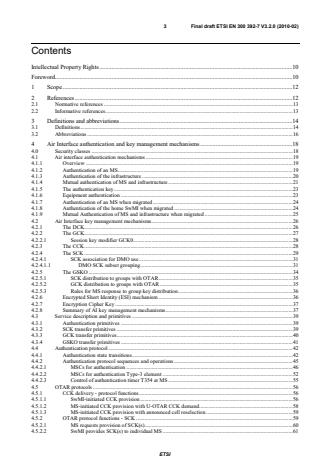
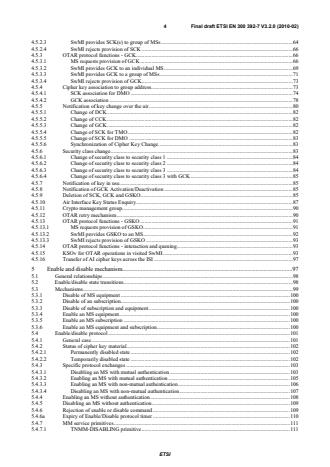
ETSI EN 300 392-7 V3.2.0 (2010-02) - Terrestrial Trunked Radio (TETRA); Voice plus Data (V+D); Part 7: Security
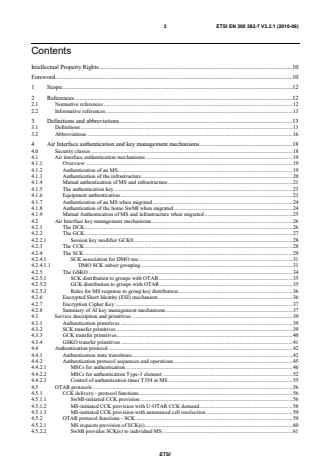
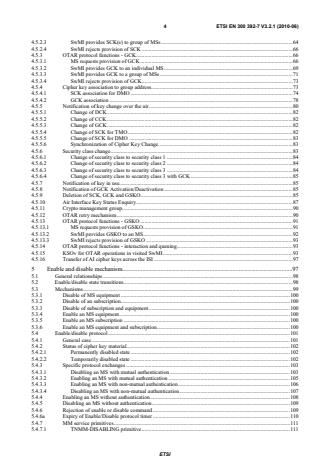
ETSI EN 300 392-7 V3.2.1 (2010-06) - Terrestrial Trunked Radio (TETRA); Voice plus Data (V+D); Part 7: Security

Overview
ETSI EN 300 392-7 V3.2.1 (2010-06) specifies the security framework for Terrestrial Trunked Radio (TETRA) Voice plus Data (V+D) systems. The document defines air-interface security, authentication and key management for both the air interface and the Inter‑System Interface (ISI), operational procedures for enabling/disabling mobile stations (MS), over‑the‑air rekeying (OTAR) protocols, and optional air‑interface encryption for voice, data and control signalling. This edition updates Part 7 to include ISI key management provisions.
Keywords: TETRA, V+D, security, air interface, authentication, key management, ISI, OTAR, encryption
Key technical topics and requirements
- Air‑interface authentication and key management (Clause 4):
- Authentication services defined for MS→infrastructure and infrastructure→MS, including mutual authentication.
- Definition and handling of authentication keys (e.g., DCK, GCK, CCK, SCK, GSKO) and their roles in securing sessions and groups.
- Mechanisms for migrated MS/SwMI authentication and related state transitions.
- OTAR and key distribution (Clause 4.5):
- Protocols for delivering cipher and group keys to individual MS or groups, including retries, queuing, and interaction rules.
- Procedures for notifying and synchronizing key changes over the air.
- Enable/disable mechanisms (Clause 5):
- Protocols and state models to enable/disable MS equipment and subscriptions (temporary or permanent).
- Impact on cipher key material and security state during enable/disable operations.
- Air‑interface confidentiality (Clause 6):
- Optional encryption mechanisms for circuit speech, circuit/packet data and control signalling; includes cipher key association and mobility procedures.
- Operational scope and limits:
- The standard does not specify internal Authentication Centre details or low‑level error handling in degraded mode - these are implementation specific.
Practical applications and who uses it
- Network operators and service providers implement authentication, key management and OTAR to secure public safety, utilities and enterprise TETRA networks.
- Equipment vendors and system integrators use the standard to design compliant MS, base stations and gateway equipment (air interface and ISI key handling).
- Security architects and auditors reference Part 7 to assess confidentiality, key lifecycle and enable/disable controls for TETRA deployments.
- Public safety organizations rely on the standard to ensure secure voice and data communications, group key management for team calls, and remote disabling of lost/stolen devices.
Related standards
- ETSI/ETR documents cited for protocol primitives and threat analysis (e.g., ETR 086-3) and other TETRA V+D parts covering air interface, interfaces to other systems and management services.
This standard is essential for anyone implementing or operating secure TETRA V+D systems, providing a normative basis for authentication, key lifecycle, OTAR and air‑interface confidentiality.
Buy Documents
ETSI EN 300 392-7 V3.2.0 (2010-02) - Terrestrial Trunked Radio (TETRA); Voice plus Data (V+D); Part 7: Security
ETSI EN 300 392-7 V3.2.1 (2010-06) - Terrestrial Trunked Radio (TETRA); Voice plus Data (V+D); Part 7: Security
Frequently Asked Questions
ETSI EN 300 392-7 V3.2.1 (2010-06) is a standard published by the European Telecommunications Standards Institute (ETSI). Its full title is "Terrestrial Trunked Radio (TETRA); Voice plus Data (V+D); Part 7: Security". This standard covers: REN/TETRA-06179
REN/TETRA-06179
ETSI EN 300 392-7 V3.2.1 (2010-06) is available in PDF format for immediate download after purchase. The document can be added to your cart and obtained through the secure checkout process. Digital delivery ensures instant access to the complete standard document.
Standards Content (Sample)
Final draft ETSI EN 300 392-7 V3.2.0 (2010-02)
European Standard (Telecommunications series)
Terrestrial Trunked Radio (TETRA);
Voice plus Data (V+D);
Part 7: Security
2 Final draft ETSI EN 300 392-7 V3.2.0 (2010-02)
Reference
REN/TETRA-06179
Keywords
security, TETRA, V+D
ETSI
650 Route des Lucioles
F-06921 Sophia Antipolis Cedex - FRANCE
Tel.: +33 4 92 94 42 00 Fax: +33 4 93 65 47 16
Siret N° 348 623 562 00017 - NAF 742 C
Association à but non lucratif enregistrée à la
Sous-Préfecture de Grasse (06) N° 7803/88
Important notice
Individual copies of the present document can be downloaded from:
http://www.etsi.org
The present document may be made available in more than one electronic version or in print. In any case of existing or
perceived difference in contents between such versions, the reference version is the Portable Document Format (PDF).
In case of dispute, the reference shall be the printing on ETSI printers of the PDF version kept on a specific network drive
within ETSI Secretariat.
Users of the present document should be aware that the document may be subject to revision or change of status.
Information on the current status of this and other ETSI documents is available at
http://portal.etsi.org/tb/status/status.asp
If you find errors in the present document, please send your comment to one of the following services:
http://portal.etsi.org/chaircor/ETSI_support.asp
Copyright Notification
No part may be reproduced except as authorized by written permission.
The copyright and the foregoing restriction extend to reproduction in all media.
© European Telecommunications Standards Institute 2010.
All rights reserved.
TM TM TM TM
DECT , PLUGTESTS , UMTS , TIPHON , the TIPHON logo and the ETSI logo are Trade Marks of ETSI registered
for the benefit of its Members.
TM
3GPP is a Trade Mark of ETSI registered for the benefit of its Members and of the 3GPP Organizational Partners.
LTE™ is a Trade Mark of ETSI currently being registered
for the benefit of its Members and of the 3GPP Organizational Partners.
GSM® and the GSM logo are Trade Marks registered and owned by the GSM Association.
ETSI
3 Final draft ETSI EN 300 392-7 V3.2.0 (2010-02)
Contents
Intellectual Property Rights . 10
Foreword . 10
1 Scope . 12
2 References . 12
2.1 Normative references . 13
2.2 Informative references . 13
3 Definitions and abbreviations . 14
3.1 Definitions . 14
3.2 Abbreviations . 16
4 Air Interface authentication and key management mechanisms . 18
4.0 Security classes . 18
4.1 Air interface authentication mechanisms . 19
4.1.1 Overview . 19
4.1.2 Authentication of an MS . 19
4.1.3 Authentication of the infrastructure . 20
4.1.4 Mutual authentication of MS and infrastructure . 21
4.1.5 The authentication key . 23
4.1.6 Equipment authentication . 23
4.1.7 Authentication of an MS when migrated . 24
4.1.8 Authentication of the home SwMI when migrated . 24
4.1.9 Mutual Authentication of MS and infrastructure when migrated . 25
4.2 Air Interface key management mechanisms . 26
4.2.1 The DCK . 26
4.2.2 The GCK . 27
4.2.2.1 Session key modifier GCK0 . 28
4.2.3 The CCK . 28
4.2.4 The SCK . 29
4.2.4.1 SCK association for DMO use . 31
4.2.4.1.1 DMO SCK subset grouping . 31
4.2.5 The GSKO . 34
4.2.5.1 SCK distribution to groups with OTAR . 35
4.2.5.2 GCK distribution to groups with OTAR . 35
4.2.5.3 Rules for MS response to group key distribution . 36
4.2.6 Encrypted Short Identity (ESI) mechanism . 36
4.2.7 Encryption Cipher Key . 37
4.2.8 Summary of AI key management mechanisms . 37
4.3 Service description and primitives . 39
4.3.1 Authentication primitives . 39
4.3.2 SCK transfer primitives . 39
4.3.3 GCK transfer primitives . 40
4.3.4 GSKO transfer primitives . 41
4.4 Authentication protocol . 42
4.4.1 Authentication state transitions . 42
4.4.2 Authentication protocol sequences and operations . 45
4.4.2.1 MSCs for authentication . 46
4.4.2.2 MSCs for authentication Type-3 element . 52
4.4.2.3 Control of authentication timer T354 at MS . 55
4.5 OTAR protocols . 56
4.5.1 CCK delivery - protocol functions . 56
4.5.1.1 SwMI-initiated CCK provision . 56
4.5.1.2 MS-initiated CCK provision with U-OTAR CCK demand. 58
4.5.1.3 MS-initiated CCK provision with announced cell reselection . 59
4.5.2 OTAR protocol functions - SCK . 59
4.5.2.1 MS requests provision of SCK(s) . 60
4.5.2.2 SwMI provides SCK(s) to individual MS . 61
ETSI
4 Final draft ETSI EN 300 392-7 V3.2.0 (2010-02)
4.5.2.3 SwMI provides SCK(s) to group of MSs . 64
4.5.2.4 SwMI rejects provision of SCK . 66
4.5.3 OTAR protocol functions - GCK . 66
4.5.3.1 MS requests provision of GCK . 66
4.5.3.2 SwMI provides GCK to an individual MS . 69
4.5.3.3 SwMI provides GCK to a group of MSs . 71
4.5.3.4 SwMI rejects provision of GCK . 73
4.5.4 Cipher key association to group address . 73
4.5.4.1 SCK association for DMO . 74
4.5.4.2 GCK association . 78
4.5.5 Notification of key change over the air . 80
4.5.5.1 Change of DCK . 82
4.5.5.2 Change of CCK . 82
4.5.5.3 Change of GCK . 82
4.5.5.4 Change of SCK for TMO . 82
4.5.5.5 Change of SCK for DMO . 83
4.5.5.6 Synchronization of Cipher Key Change . 83
4.5.6 Security class change . 83
4.5.6.1 Change of security class to security class 1 . 84
4.5.6.2 Change of security class to security class 2 . 84
4.5.6.3 Change of security class to security class 3 . 84
4.5.6.4 Change of security class to security class 3 with GCK . 85
4.5.7 Notification of key in use . 85
4.5.8 Notification of GCK Activation/Deactivation . 85
4.5.9 Deletion of SCK, GCK and GSKO . 85
4.5.10 Air Interface Key Status Enquiry . 87
4.5.11 Crypto management group . 90
4.5.12 OTAR retry mechanism . 90
4.5.13 OTAR protocol functions - GSKO . 91
4.5.13.1 MS requests provision of GSKO . 91
4.5.13.2 SwMI provides GSKO to an MS . 92
4.5.13.3 SwMI rejects provision of GSKO . 93
4.5.14 OTAR protocol functions - interaction and queuing . 93
4.5.15 KSOv for OTAR operations in visited SwMI . 93
4.5.16 Transfer of AI cipher keys across the ISI . 97
5 Enable and disable mechanism . 97
5.1 General relationships . 98
5.2 Enable/disable state transitions . 98
5.3 Mechanisms . 99
5.3.1 Disable of MS equipment . 100
5.3.2 Disable of an subscription . 100
5.3.3 Disable of subscription and equipment . 100
5.3.4 Enable an MS equipment . 100
5.3.5 Enable an MS subscription . 100
5.3.6 Enable an MS equipment and subscription . 100
5.4 Enable/disable protocol . 101
5.4.1 General case . 101
5.4.2 Status of cipher key material. 102
5.4.2.1 Permanently disabled state . 102
5.4.2.2 Temporarily disabled state . 102
5.4.3 Specific protocol exchanges . 103
5.4.3.1 Disabling an MS with mutual authentication . 103
5.4.3.2 Enabling an MS with mutual authentication . 105
5.4.3.3 Enabling an MS with non-mutual authentication . 106
5.4.3.4 Disabling an MS with non-mutual authentication . 107
5.4.4 Enabling an MS without authentication . 108
5.4.5 Disabling an MS without authentication . 109
5.4.6 Rejection of enable or disable command . 109
5.4.6a Expiry of Enable/Disable protocol timer . 110
5.4.7 MM service primitives . 111
5.4.7.1 TNMM-DISABLING primitive . 111
ETSI
5 Final draft ETSI EN 300 392-7 V3.2.0 (2010-02)
5.4.7.2 TNMM-ENABLING primitive . 111
6 Air Interface (AI) encryption . 111
6.1 General principles. 111
6.2 Security class . 112
6.2.0 Notification of security class . 113
6.2.0.1 Security Class of Neighbouring Cells . 113
6.2.0.2 Identification of MS security capabilities . 113
6.2.1 Constraints on LA arising from cell class . 114
6.3 Key Stream Generator (KSG) . 114
6.3.1 KSG numbering and selection . 114
6.3.2 Interface parameters . 115
6.3.2.1 Initial Value (IV) . 115
6.3.2.2 Cipher Key . 115
6.4 Encryption mechanism . 116
6.4.1 Allocation of KSS to logical channels . 116
6.4.2 Allocation of KSS to logical channels with PDU association . 118
6.4.2.1 General . 118
6.4.2.2 KSS allocation on phase modulation channels . 118
6.4.2.3 KSS allocation on QAM channels . 120
6.4.2.3.1 Fixed mapping . 120
6.4.2.3.2 Offset mapping . 121
6.4.3 Synchronization of data calls where data is multi-slot interleaved . 122
6.4.4 Recovery of stolen frames from interleaved data . 123
6.5 Use of cipher keys . 123
6.5.1 Identification of encryption state of downlink MAC PDUs . 124
6.5.1.1 Class 1 cells . 124
6.5.1.2 Class 2 cells . 125
6.5.1.3 Class 3 cells . 125
6.5.2 Identification of encryption state of uplink MAC PDUs . 125
6.6 Mobility procedures . 126
6.6.1 General requirements . 126
6.6.1.1 Additional requirements for class 3 systems . 126
6.6.2 Protocol description . 126
6.6.2.1 Negotiation of ciphering parameters . 126
6.6.2.1.1 Class 1 cells . 126
6.6.2.1.2 Class 2 cells . 127
6.6.2.1.3 Class 3 cells . 127
6.6.2.2 Initial and undeclared cell re-selection . 127
6.6.2.3 Unannounced cell re-selection . 128
6.6.2.4 Announced cell re-selection type-3 . 129
6.6.2.5 Announced cell re-selection type-2 . 129
6.6.2.6 Announced cell re-selection type-1 . 129
6.6.2.7 Key forwarding . 129
6.7 Encryption control . 131
6.7.1 Data to be encrypted . 131
6.7.1.1 Downlink control channel requirements . 131
6.7.1.2 Encryption of MAC header elements . 131
6.7.1.3 Traffic channel encryption control . 131
6.7.1.4 Handling of PDUs that do not conform to negotiated ciphering mode . 132
6.7.2 Service description and primitives . 132
6.7.2.1 Mobility Management (MM) . 133
6.7.2.2 Mobile Link Entity (MLE) . 133
6.7.2.3 Layer 2 . 135
6.7.3 Protocol functions . 135
6.7.3.1 MM . 135
6.7.3.2 MLE . 135
6.7.3.3 LLC . 135
6.7.3.4 MAC . 136
6.7.4 PDUs for cipher negotiation . 136
Annex A (normative): PDU and element definitions . 137
ETSI
6 Final draft ETSI EN 300 392-7 V3.2.0 (2010-02)
A.1 Authentication PDUs . 137
A.1.1 D-AUTHENTICATION demand . 137
A.1.2 D-AUTHENTICATION reject . 137
A.1.3 D-AUTHENTICATION response . 138
A.1.4 D-AUTHENTICATION result . 138
A.1.5 U-AUTHENTICATION demand . 138
A.1.6 U-AUTHENTICATION reject . 139
A.1.7 U-AUTHENTICATION response . 139
A.1.8 U-AUTHENTICATION result . 140
A.2 OTAR PDUs . 140
A.2.1 D-OTAR CCK Provide . 140
A.2.2 U-OTAR CCK Demand . 140
A.2.3 U-OTAR CCK Result . 141
A.2.4 D-OTAR GCK Provide . 141
A.2.5 U-OTAR GCK Demand . 142
A.2.6 U-OTAR GCK Result . 143
A.2.6a D-OTAR GCK Reject . 143
A.2.7 D-OTAR SCK Provide . 144
A.2.8 U-OTAR SCK Demand . 145
A.2.9 U-OTAR SCK Result . 145
A.2.9a D-OTAR SCK Reject . 146
A.2.10 D-OTAR GSKO Provide . 146
A.2.11 U-OTAR GSKO Demand . 147
A.2.12 U-OTAR GSKO Result . 147
A.2.12a D-OTAR GSKO Reject . 147
A.3 PDUs for key association to GTSI . 148
A.3.1 D-OTAR KEY ASSOCIATE demand . 148
A.3.2 U-OTAR KEY ASSOCIATE status . 149
A.4 PDUs to synchronize key or security class change . 149
A.4.1 D-CK CHANGE demand . 149
A.4.2 U-CK CHANGE result . 150
A.4.2a U-OTAR KEY DELETE result . 151
A.4.2b U-OTAR KEY STATUS response . 152
A.4.3 D-DM-SCK ACTIVATE DEMAND . 153
A.4.4 U-DM-SCK ACTIVATE RESULT . 154
A.4a PDUs to delete air interface keys in MS . 155
A.4a.1 D-OTAR KEY DELETE demand . 155
A.4a.2 U-OTAR KEY DELETE result . 155
A.4b PDUs to obtain Air Interface Key Status . . 156
A.4b.1 D-OTAR KEY STATUS demand . 156
A.4b.2 U-OTAR KEY STATUS response . 157
A.5 Other security domain PDUs . 158
A.5.1 U-TEI PROVIDE . 158
A.5.2 U-OTAR PREPARE . 159
A.5.3 D-OTAR NEWCELL . 159
A.5.4 D-OTAR CMG GTSI PROVIDE . 159
A.5.5 U-OTAR CMG GTSI RESULT . 160
A.6 PDUs for Enable and Disable . 160
A.6.1 D-DISABLE . 160
A.6.2 D-ENABLE . 161
A.6.3 U-DISABLE STATUS . 161
A.7 MM PDU type 3 information elements coding . 162
A.7.1 Authentication downlink . 162
A.7.2 Authentication uplink . 162
A.8 PDU Information elements coding . 163
A.8.1 Acknowledgement flag . 163
ETSI
7 Final draft ETSI EN 300 392-7 V3.2.0 (2010-02)
A.8.2 Address extension. 163
A.8.3 Authentication challenge . 163
A.8.4 Authentication reject reason . 163
A.8.5 Authentication result . 164
A.8.6 Authentication sub-type . 164
A.8.7 CCK identifier . 164
A.8.8 CCK information . 164
A.8.9 CCK Location area information . 165
A.8.10 CCK request flag . 165
A.8.11 Change of security class . 165
A.8.12 Ciphering parameters . 166
A.8.13 CK provision flag . 166
A.8.14 CK provisioning information . 166
A.8.15 CK request flag . 167
A.8.16 Class Change flag . 167
A.8.17 DCK forwarding result . 167
A.8.18 Disabling type . 167
A.8.19 Enable/Disable result . 168
A.8.20 Encryption mode . 168
A.8.20.1 Class 1 cells . 168
A.8.20.2 Class 2 cells . 168
A.8.20.3 Class 3 cells . 169
A.8.21 Equipment disable . 169
A.8.22 Equipment enable . 169
A.8.23 Equipment status . 169
A.8.23a Explicit response . 170
A.8.24 Frame number . 170
A.8.25 Future key flag . 170
A.8.26 GCK data . 170
A.8.27 GCK key and identifier . 170
A.8.28 GCK Number (GCKN) . 171
A.8.28a GCK Provision result . 171
A.8.28b GCK rejected . 171
A.8.29 GCK select number . 171
A.8.29a GCK Supported . 172
A.8.30 GCK Version Number (GCK-VN) . 172
A.8.31 Group association . 172
A.8.31a Group Identity Security Related Information .
...
European Standard (Telecommunications series)
Terrestrial Trunked Radio (TETRA);
Voice plus Data (V+D);
Part 7: Security
2 ETSI EN 300 392-7 V3.2.1 (2010-06)
Reference
REN/TETRA-06179
Keywords
security, TETRA, V+D
ETSI
650 Route des Lucioles
F-06921 Sophia Antipolis Cedex - FRANCE
Tel.: +33 4 92 94 42 00 Fax: +33 4 93 65 47 16
Siret N° 348 623 562 00017 - NAF 742 C
Association à but non lucratif enregistrée à la
Sous-Préfecture de Grasse (06) N° 7803/88
Important notice
Individual copies of the present document can be downloaded from:
http://www.etsi.org
The present document may be made available in more than one electronic version or in print. In any case of existing or
perceived difference in contents between such versions, the reference version is the Portable Document Format (PDF).
In case of dispute, the reference shall be the printing on ETSI printers of the PDF version kept on a specific network drive
within ETSI Secretariat.
Users of the present document should be aware that the document may be subject to revision or change of status.
Information on the current status of this and other ETSI documents is available at
http://portal.etsi.org/tb/status/status.asp
If you find errors in the present document, please send your comment to one of the following services:
http://portal.etsi.org/chaircor/ETSI_support.asp
Copyright Notification
No part may be reproduced except as authorized by written permission.
The copyright and the foregoing restriction extend to reproduction in all media.
© European Telecommunications Standards Institute 2010.
All rights reserved.
TM TM TM TM
DECT , PLUGTESTS , UMTS , TIPHON , the TIPHON logo and the ETSI logo are Trade Marks of ETSI registered
for the benefit of its Members.
TM
3GPP is a Trade Mark of ETSI registered for the benefit of its Members and of the 3GPP Organizational Partners.
LTE™ is a Trade Mark of ETSI currently being registered
for the benefit of its Members and of the 3GPP Organizational Partners.
GSM® and the GSM logo are Trade Marks registered and owned by the GSM Association.
ETSI
3 ETSI EN 300 392-7 V3.2.1 (2010-06)
Contents
Intellectual Property Rights . 10
Foreword . 10
1 Scope . 12
2 References . 12
2.1 Normative references . 12
2.2 Informative references . 13
3 Definitions and abbreviations . 13
3.1 Definitions . 13
3.2 Abbreviations . 16
4 Air Interface authentication and key management mechanisms . 18
4.0 Security classes . 18
4.1 Air interface authentication mechanisms . 19
4.1.1 Overview . 19
4.1.2 Authentication of an MS . 19
4.1.3 Authentication of the infrastructure . 20
4.1.4 Mutual authentication of MS and infrastructure . 21
4.1.5 The authentication key . 23
4.1.6 Equipment authentication . 23
4.1.7 Authentication of an MS when migrated . 24
4.1.8 Authentication of the home SwMI when migrated . 24
4.1.9 Mutual Authentication of MS and infrastructure when migrated . 25
4.2 Air Interface key management mechanisms . 26
4.2.1 The DCK . 26
4.2.2 The GCK . 27
4.2.2.1 Session key modifier GCK0 . 28
4.2.3 The CCK . 28
4.2.4 The SCK . 29
4.2.4.1 SCK association for DMO use . 31
4.2.4.1.1 DMO SCK subset grouping . 31
4.2.5 The GSKO . 34
4.2.5.1 SCK distribution to groups with OTAR . 35
4.2.5.2 GCK distribution to groups with OTAR . 35
4.2.5.3 Rules for MS response to group key distribution . 36
4.2.6 Encrypted Short Identity (ESI) mechanism . 36
4.2.7 Encryption Cipher Key . 37
4.2.8 Summary of AI key management mechanisms . 37
4.3 Service description and primitives . 39
4.3.1 Authentication primitives . 39
4.3.2 SCK transfer primitives . 39
4.3.3 GCK transfer primitives . 40
4.3.4 GSKO transfer primitives . 41
4.4 Authentication protocol . 42
4.4.1 Authentication state transitions . 42
4.4.2 Authentication protocol sequences and operations . 45
4.4.2.1 MSCs for authentication . 46
4.4.2.2 MSCs for authentication Type-3 element . 52
4.4.2.3 Control of authentication timer T354 at MS . 55
4.5 OTAR protocols . 56
4.5.1 CCK delivery - protocol functions . 56
4.5.1.1 SwMI-initiated CCK provision . 56
4.5.1.2 MS-initiated CCK provision with U-OTAR CCK demand. 58
4.5.1.3 MS-initiated CCK provision with announced cell reselection . 59
4.5.2 OTAR protocol functions - SCK . 59
4.5.2.1 MS requests provision of SCK(s) . 60
4.5.2.2 SwMI provides SCK(s) to individual MS . 61
ETSI
4 ETSI EN 300 392-7 V3.2.1 (2010-06)
4.5.2.3 SwMI provides SCK(s) to group of MSs . 64
4.5.2.4 SwMI rejects provision of SCK . 66
4.5.3 OTAR protocol functions - GCK . 66
4.5.3.1 MS requests provision of GCK . 66
4.5.3.2 SwMI provides GCK to an individual MS . 69
4.5.3.3 SwMI provides GCK to a group of MSs . 71
4.5.3.4 SwMI rejects provision of GCK . 73
4.5.4 Cipher key association to group address . 73
4.5.4.1 SCK association for DMO . 74
4.5.4.2 GCK association . 78
4.5.5 Notification of key change over the air . 80
4.5.5.1 Change of DCK . 82
4.5.5.2 Change of CCK . 82
4.5.5.3 Change of GCK . 82
4.5.5.4 Change of SCK for TMO . 82
4.5.5.5 Change of SCK for DMO . 83
4.5.5.6 Synchronization of Cipher Key Change . 83
4.5.6 Security class change . 83
4.5.6.1 Change of security class to security class 1 . 84
4.5.6.2 Change of security class to security class 2 . 84
4.5.6.3 Change of security class to security class 3 . 84
4.5.6.4 Change of security class to security class 3 with GCK . 85
4.5.7 Notification of key in use . 85
4.5.8 Notification of GCK Activation/Deactivation . 85
4.5.9 Deletion of SCK, GCK and GSKO . 85
4.5.10 Air Interface Key Status Enquiry . 87
4.5.11 Crypto management group . 90
4.5.12 OTAR retry mechanism . 90
4.5.13 OTAR protocol functions - GSKO . 91
4.5.13.1 MS requests provision of GSKO . 91
4.5.13.2 SwMI provides GSKO to an MS . 92
4.5.13.3 SwMI rejects provision of GSKO . 93
4.5.14 OTAR protocol functions - interaction and queuing . 93
4.5.15 KSOv for OTAR operations in visited SwMI . 93
4.5.16 Transfer of AI cipher keys across the ISI . 97
5 Enable and disable mechanism . 97
5.1 General relationships . 98
5.2 Enable/disable state transitions . 98
5.3 Mechanisms . 99
5.3.1 Disable of MS equipment . 100
5.3.2 Disable of an subscription . 100
5.3.3 Disable of subscription and equipment . 100
5.3.4 Enable an MS equipment . 100
5.3.5 Enable an MS subscription . 100
5.3.6 Enable an MS equipment and subscription . 100
5.4 Enable/disable protocol . 101
5.4.1 General case . 101
5.4.2 Status of cipher key material. 102
5.4.2.1 Permanently disabled state . 102
5.4.2.2 Temporarily disabled state . 102
5.4.3 Specific protocol exchanges . 103
5.4.3.1 Disabling an MS with mutual authentication . 103
5.4.3.2 Enabling an MS with mutual authentication . 105
5.4.3.3 Enabling an MS with non-mutual authentication . 106
5.4.3.4 Disabling an MS with non-mutual authentication . 107
5.4.4 Enabling an MS without authentication . 108
5.4.5 Disabling an MS without authentication . 109
5.4.6 Rejection of enable or disable command . 109
5.4.6a Expiry of Enable/Disable protocol timer . 110
5.4.7 MM service primitives . 111
5.4.7.1 TNMM-DISABLING primitive . 111
ETSI
5 ETSI EN 300 392-7 V3.2.1 (2010-06)
5.4.7.2 TNMM-ENABLING primitive . 111
6 Air Interface (AI) encryption . 111
6.1 General principles. 111
6.2 Security class . 112
6.2.0 Notification of security class . 113
6.2.0.1 Security Class of Neighbouring Cells . 113
6.2.0.2 Identification of MS security capabilities . 113
6.2.1 Constraints on LA arising from cell class . 114
6.3 Key Stream Generator (KSG) . 114
6.3.1 KSG numbering and selection . 114
6.3.2 Interface parameters . 115
6.3.2.1 Initial Value (IV) . 115
6.3.2.2 Cipher Key . 115
6.4 Encryption mechanism . 116
6.4.1 Allocation of KSS to logical channels . 116
6.4.2 Allocation of KSS to logical channels with PDU association . 118
6.4.2.1 General . 118
6.4.2.2 KSS allocation on phase modulation channels . 118
6.4.2.3 KSS allocation on QAM channels . 120
6.4.2.3.1 Fixed mapping . 120
6.4.2.3.2 Offset mapping . 121
6.4.3 Synchronization of data calls where data is multi-slot interleaved . 122
6.4.4 Recovery of stolen frames from interleaved data . 123
6.5 Use of cipher keys . 123
6.5.1 Identification of encryption state of downlink MAC PDUs . 124
6.5.1.1 Class 1 cells . 124
6.5.1.2 Class 2 cells . 125
6.5.1.3 Class 3 cells . 125
6.5.2 Identification of encryption state of uplink MAC PDUs . 125
6.6 Mobility procedures . 126
6.6.1 General requirements . 126
6.6.1.1 Additional requirements for class 3 systems . 126
6.6.2 Protocol description . 126
6.6.2.1 Negotiation of ciphering parameters . 126
6.6.2.1.1 Class 1 cells . 126
6.6.2.1.2 Class 2 cells . 127
6.6.2.1.3 Class 3 cells . 127
6.6.2.2 Initial and undeclared cell re-selection . 127
6.6.2.3 Unannounced cell re-selection . 128
6.6.2.4 Announced cell re-selection type-3 . 129
6.6.2.5 Announced cell re-selection type-2 . 129
6.6.2.6 Announced cell re-selection type-1 . 129
6.6.2.7 Key forwarding . 129
6.7 Encryption control . 131
6.7.1 Data to be encrypted . 131
6.7.1.1 Downlink control channel requirements . 131
6.7.1.2 Encryption of MAC header elements . 131
6.7.1.3 Traffic channel encryption control . 131
6.7.1.4 Handling of PDUs that do not conform to negotiated ciphering mode . 132
6.7.2 Service description and primitives . 132
6.7.2.1 Mobility Management (MM) . 133
6.7.2.2 Mobile Link Entity (MLE) . 133
6.7.2.3 Layer 2 . 135
6.7.3 Protocol functions . 135
6.7.3.1 MM . 135
6.7.3.2 MLE . 135
6.7.3.3 LLC . 135
6.7.3.4 MAC . 136
6.7.4 PDUs for cipher negotiation . 136
Annex A (normative): PDU and element definitions . 137
ETSI
6 ETSI EN 300 392-7 V3.2.1 (2010-06)
A.1 Authentication PDUs . 137
A.1.1 D-AUTHENTICATION demand . 137
A.1.2 D-AUTHENTICATION reject . 137
A.1.3 D-AUTHENTICATION response . 138
A.1.4 D-AUTHENTICATION result . 138
A.1.5 U-AUTHENTICATION demand . 138
A.1.6 U-AUTHENTICATION reject . 139
A.1.7 U-AUTHENTICATION response . 139
A.1.8 U-AUTHENTICATION result . 140
A.2 OTAR PDUs . 140
A.2.1 D-OTAR CCK Provide . 140
A.2.2 U-OTAR CCK Demand . 140
A.2.3 U-OTAR CCK Result . 141
A.2.4 D-OTAR GCK Provide . 141
A.2.5 U-OTAR GCK Demand . 142
A.2.6 U-OTAR GCK Result . 143
A.2.6a D-OTAR GCK Reject . 143
A.2.7 D-OTAR SCK Provide . 144
A.2.8 U-OTAR SCK Demand . 145
A.2.9 U-OTAR SCK Result . 145
A.2.9a D-OTAR SCK Reject . 146
A.2.10 D-OTAR GSKO Provide . 146
A.2.11 U-OTAR GSKO Demand . 147
A.2.12 U-OTAR GSKO Result . 147
A.2.12a D-OTAR GSKO Reject . 147
A.3 PDUs for key association to GTSI . 148
A.3.1 D-OTAR KEY ASSOCIATE demand . 148
A.3.2 U-OTAR KEY ASSOCIATE status . 149
A.4 PDUs to synchronize key or security class change . 149
A.4.1 D-CK CHANGE demand . 149
A.4.2 U-CK CHANGE result . 150
A.4.2a U-OTAR KEY DELETE result . 151
A.4.2b U-OTAR KEY STATUS response . 152
A.4.3 D-DM-SCK ACTIVATE DEMAND . 153
A.4.4 U-DM-SCK ACTIVATE RESULT . 154
A.4a PDUs to delete air interface keys in MS . 155
A.4a.1 D-OTAR KEY DELETE demand . 155
A.4a.2 U-OTAR KEY DELETE result . 155
A.4b PDUs to obtain Air Interface Key Status . . 156
A.4b.1 D-OTAR KEY STATUS demand . 156
A.4b.2 U-OTAR KEY STATUS response . 157
A.5 Other security domain PDUs . 158
A.5.1 U-TEI PROVIDE . 158
A.5.2 U-OTAR PREPARE . 159
A.5.3 D-OTAR NEWCELL . 159
A.5.4 D-OTAR CMG GTSI PROVIDE . 159
A.5.5 U-OTAR CMG GTSI RESULT . 160
A.6 PDUs for Enable and Disable . 160
A.6.1 D-DISABLE . 160
A.6.2 D-ENABLE . 161
A.6.3 U-DISABLE STATUS . 161
A.7 MM PDU type 3 information elements coding . 162
A.7.1 Authentication downlink . 162
A.7.2 Authentication uplink . 162
A.8 PDU Information elements coding . 163
A.8.1 Acknowledgement flag . 163
ETSI
7 ETSI EN 300 392-7 V3.2.1 (2010-06)
A.8.2 Address extension. 163
A.8.3 Authentication challenge . 163
A.8.4 Authentication reject reason . 163
A.8.5 Authentication result . 164
A.8.6 Authentication sub-type . 164
A.8.7 CCK identifier . 164
A.8.8 CCK information . 164
A.8.9 CCK Location area information . 165
A.8.10 CCK request flag . 165
A.8.11 Change of security class . 165
A.8.12 Ciphering parameters . 166
A.8.13 CK provision flag . 166
A.8.14 CK provisioning information . 166
A.8.15 CK request flag . 167
A.8.16 Class Change flag . 167
A.8.17 DCK forwarding result . 167
A.8.18 Disabling type . 167
A.8.19 Enable/Disable result . 168
A.8.20 Encryption mode . 168
A.8.20.1 Class 1 cells . 168
A.8.20.2 Class 2 cells . 168
A.8.20.3 Class 3 cells . 169
A.8.21 Equipment disable . 169
A.8.22 Equipment enable . 169
A.8.23 Equipment status . 169
A.8.23a Explicit response . 170
A.8.24 Frame number . 170
A.8.25 Future key flag . 170
A.8.26 GCK data . 170
A.8.27 GCK key and identifier . 170
A.8.28 GCK Number (GCKN) . 171
A.8.28a GCK Provision result . 171
A.8.28b GCK rejected . 171
A.8.29 GCK select number . 171
A.8.29a GCK Supported . 172
A.8.30 GCK Version Number (GCK-VN) . 172
A.8.31 Group association . 172
A.8.31a Group Identity Security Related Information . 173
A.8.32 GSKO Version Number (GSKO-VN) .
...
2003-01.Slovenski inštitut za standardizacijo. Razmnoževanje celote ali delov tega standarda ni dovoljeno.Prizemni snopovni radio (TETRA) - Govor in podatki (V+D) - 7. del: VarnostTerrestrial Trunked Radio (TETRA) - Voice plus Data (V+D) - Part 7: Security33.070.10Prizemni snopovni radio (TETRA)Terrestrial Trunked Radio (TETRA)ICS:Ta slovenski standard je istoveten z:EN 300 392-7 Version 3.2.1SIST EN 300 392-7 V3.2.1:2010en01-oktober-2010SIST EN 300 392-7 V3.2.1:2010SLOVENSKI
STANDARD
ETSI ETSI EN 300 392-7 V3.2.1 (2010-06) 2
Reference REN/TETRA-06179 Keywords security, TETRA, V+D ETSI 650 Route des Lucioles F-06921 Sophia Antipolis Cedex - FRANCE
Tel.: +33 4 92 94 42 00
Fax: +33 4 93 65 47 16
Siret N° 348 623 562 00017 - NAF 742 C Association à but non lucratif enregistrée à la Sous-Préfecture de Grasse (06) N° 7803/88
Important notice Individual copies of the present document can be downloaded from: http://www.etsi.org The present document may be made available in more than one electronic version or in print. In any case of existing or perceived difference in contents between such versions, the reference version is the Portable Document Format (PDF). In case of dispute, the reference shall be the printing on ETSI printers of the PDF version kept on a specific network drive within ETSI Secretariat. Users of the present document should be aware that the document may be subject to revision or change of status. Information on the current status of this and other ETSI documents is available at http://portal.etsi.org/tb/status/status.asp If you find errors in the present document, please send your comment to one of the following services: http://portal.etsi.org/chaircor/ETSI_support.asp Copyright Notification No part may be reproduced except as authorized by written permission. The copyright and the foregoing restriction extend to reproduction in all media.
© European Telecommunications Standards Institute 2010. All rights reserved.
DECTTM, PLUGTESTSTM, UMTSTM, TIPHONTM, the TIPHON logo and the ETSI logo are Trade Marks of ETSI registered for the benefit of its Members. 3GPPTM is a Trade Mark of ETSI registered for the benefit of its Members and of the 3GPP Organizational Partners. LTE™ is a Trade Mark of ETSI currently being registered for the benefit of its Members and of the 3GPP Organizational Partners. GSM® and the GSM logo are Trade Marks registered and owned by the GSM Association. SIST EN 300 392-7 V3.2.1:2010
ETSI ETSI EN 300 392-7 V3.2.1 (2010-06) 3 Contents Intellectual Property Rights . 10 Foreword . 10 1 Scope . 12 2 References . 12 2.1 Normative references . 12 2.2 Informative references . 13 3 Definitions and abbreviations . 13 3.1 Definitions . 13 3.2 Abbreviations . 16 4 Air Interface authentication and key management mechanisms . 18 4.0 Security classes . 18 4.1 Air interface authentication mechanisms . 19 4.1.1 Overview . 19 4.1.2 Authentication of an MS . 19 4.1.3 Authentication of the infrastructure . 20 4.1.4 Mutual authentication of MS and infrastructure . 21 4.1.5 The authentication key . 23 4.1.6 Equipment authentication . 23 4.1.7 Authentication of an MS when migrated . 24 4.1.8 Authentication of the home SwMI when migrated . 24 4.1.9 Mutual Authentication of MS and infrastructure when migrated . 25 4.2 Air Interface key management mechanisms . 26 4.2.1 The DCK . 26 4.2.2 The GCK . 27 4.2.2.1 Session key modifier GCK0 . 28 4.2.3 The CCK . 28 4.2.4 The SCK . 29 4.2.4.1 SCK association for DMO use . 31 4.2.4.1.1 DMO SCK subset grouping . 31 4.2.5 The GSKO . 34 4.2.5.1 SCK distribution to groups with OTAR . 35 4.2.5.2 GCK distribution to groups with OTAR . 35 4.2.5.3 Rules for MS response to group key distribution . 36 4.2.6 Encrypted Short Identity (ESI) mechanism . 36 4.2.7 Encryption Cipher Key . 37 4.2.8 Summary of AI key management mechanisms . 37 4.3 Service description and primitives . 39 4.3.1 Authentication primitives . 39 4.3.2 SCK transfer primitives . 39 4.3.3 GCK transfer primitives . 40 4.3.4 GSKO transfer primitives . 41 4.4 Authentication protocol . 42 4.4.1 Authentication state transitions . 42 4.4.2 Authentication protocol sequences and operations . 45 4.4.2.1 MSCs for authentication . 46 4.4.2.2 MSCs for authentication Type-3 element . 52 4.4.2.3 Control of authentication timer T354 at MS . 55 4.5 OTAR protocols . 56 4.5.1 CCK delivery - protocol functions . 56 4.5.1.1 SwMI-initiated CCK provision . 56 4.5.1.2 MS-initiated CCK provision with U-OTAR CCK demand. 58 4.5.1.3 MS-initiated CCK provision with announced cell reselection . 59 4.5.2 OTAR protocol functions - SCK . 59 4.5.2.1 MS requests provision of SCK(s) . 60 4.5.2.2 SwMI provides SCK(s) to individual MS . 61 SIST EN 300 392-7 V3.2.1:2010
ETSI ETSI EN 300 392-7 V3.2.1 (2010-06) 4 4.5.2.3 SwMI provides SCK(s) to group of MSs . 64 4.5.2.4 SwMI rejects provision of SCK . 66 4.5.3 OTAR protocol functions - GCK . 66 4.5.3.1 MS requests provision of GCK . 66 4.5.3.2 SwMI provides GCK to an individual MS . 69 4.5.3.3 SwMI provides GCK to a group of MSs . 71 4.5.3.4 SwMI rejects provision of GCK . 73 4.5.4 Cipher key association to group address . 73 4.5.4.1 SCK association for DMO . 74 4.5.4.2 GCK association . 78 4.5.5 Notification of key change over the air . 80 4.5.5.1 Change of DCK . 82 4.5.5.2 Change of CCK . 82 4.5.5.3 Change of GCK . 82 4.5.5.4 Change of SCK for TMO . 82 4.5.5.5 Change of SCK for DMO . 83 4.5.5.6 Synchronization of Cipher Key Change . 83 4.5.6 Security class change . 83 4.5.6.1 Change of security class to security class 1 . 84 4.5.6.2 Change of security class to security class 2 . 84 4.5.6.3 Change of security class to security class 3 . 84 4.5.6.4 Change of security class to security class 3 with GCK . 85 4.5.7 Notification of key in use . 85 4.5.8 Notification of GCK Activation/Deactivation . 85 4.5.9 Deletion of SCK, GCK and GSKO . 85 4.5.10 Air Interface Key Status Enquiry . 87 4.5.11 Crypto management group . 90 4.5.12 OTAR retry mechanism . 90 4.5.13 OTAR protocol functions - GSKO . 91 4.5.13.1 MS requests provision of GSKO . 91 4.5.13.2 SwMI provides GSKO to an MS . 92 4.5.13.3 SwMI rejects provision of GSKO . 93 4.5.14 OTAR protocol functions - interaction and queuing . 93 4.5.15 KSOv for OTAR operations in visited SwMI . 93 4.5.16 Transfer of AI cipher keys across the ISI . 97 5 Enable and disable mechanism . 97 5.1 General relationships . 98 5.2 Enable/disable state transitions . 98 5.3 Mechanisms . 99 5.3.1 Disable of MS equipment . 100 5.3.2 Disable of an subscription . 100 5.3.3 Disable of subscription and equipment . 100 5.3.4 Enable an MS equipment . 100 5.3.5 Enable an MS subscription . 100 5.3.6 Enable an MS equipment and subscription . 100 5.4 Enable/disable protocol . 101 5.4.1 General case . 101 5.4.2 Status of cipher key material. 102 5.4.2.1 Permanently disabled state . 102 5.4.2.2 Temporarily disabled state . 102 5.4.3 Specific protocol exchanges . 103 5.4.3.1 Disabling an MS with mutual authentication . 103 5.4.3.2 Enabling an MS with mutual authentication . 105 5.4.3.3 Enabling an MS with non-mutual authentication . 106 5.4.3.4 Disabling an MS with non-mutual authentication . 107 5.4.4 Enabling an MS without authentication . 108 5.4.5 Disabling an MS without authentication . 109 5.4.6 Rejection of enable or disable command . 109 5.4.6a Expiry of Enable/Disable protocol timer . 110 5.4.7 MM service primitives . 111 5.4.7.1 TNMM-DISABLING primitive . 111 SIST EN 300 392-7 V3.2.1:2010
ETSI ETSI EN 300 392-7 V3.2.1 (2010-06) 5 5.4.7.2 TNMM-ENABLING primitive . 111 6 Air Interface (AI) encryption . 111 6.1 General principles. 111 6.2 Security class . 112 6.2.0 Notification of security class . 113 6.2.0.1 Security Class of Neighbouring Cells . 113 6.2.0.2 Identification of MS security capabilities . 113 6.2.1 Constraints on LA arising from cell class . 114 6.3 Key Stream Generator (KSG) . 114 6.3.1 KSG numbering and selection . 114 6.3.2 Interface parameters . 115 6.3.2.1 Initial Value (IV) . 115 6.3.2.2 Cipher Key . 115 6.4 Encryption mechanism . 116 6.4.1 Allocation of KSS to logical channels . 116 6.4.2 Allocation of KSS to logical channels with PDU association . 118 6.4.2.1 General . 118 6.4.2.2 KSS allocation on phase modulation channels . 118 6.4.2.3 KSS allocation on QAM channels . 120 6.4.2.3.1 Fixed mapping . 120 6.4.2.3.2 Offset mapping . 121 6.4.3 Synchronization of data calls where data is multi-slot interleaved . 122 6.4.4 Recovery of stolen frames from interleaved data . 123 6.5 Use of cipher keys . 123 6.5.1 Identification of encryption state of downlink MAC PDUs . 124 6.5.1.1 Class 1 cells . 124 6.5.1.2 Class 2 cells . 125 6.5.1.3 Class 3 cells . 125 6.5.2 Identification of encryption state of uplink MAC PDUs . 125 6.6 Mobility procedures . 126 6.6.1 General requirements . 126 6.6.1.1 Additional requirements for class 3 systems . 126 6.6.2 Protocol description . 126 6.6.2.1 Negotiation of ciphering parameters . 126 6.6.2.1.1 Class 1 cells . 126 6.6.2.1.2 Class 2 cells . 127 6.6.2.1.3 Class 3 cells . 127 6.6.2.2 Initial and undeclared cell re-selection . 127 6.6.2.3 Unannounced cell re-selection . 128 6.6.2.4 Announced cell re-selection type-3 . 129 6.6.2.5 Announced cell re-selection type-2 . 129 6.6.2.6 Announced cell re-selection type-1 . 129 6.6.2.7 Key forwarding . 129 6.7 Encryption control . 131 6.7.1 Data to be encrypted . 131 6.7.1.1 Downlink control channel requirements . 131 6.7.1.2 Encryption of MAC header elements . 131 6.7.1.3 Traffic channel encryption control . 131 6.7.1.4 Handling of PDUs that do not conform to negotiated ciphering mode . 132 6.7.2 Service description and primitives . 132 6.7.2.1 Mobility Management (MM) . 133 6.7.2.2 Mobile Link Entity (MLE) . 133 6.7.2.3 Layer 2 . 135 6.7.3 Protocol functions . 135 6.7.3.1 MM . 135 6.7.3.2 MLE . 135 6.7.3.3 LLC . 135 6.7.3.4 MAC . 136 6.7.4 PDUs for cipher negotiation . 136 Annex A (normative): PDU and element definitions . 137 SIST EN 300 392-7 V3.2.1:2010
ETSI ETSI EN 300 392-7 V3.2.1 (2010-06) 6 A.1 Authentication PDUs . 137 A.1.1 D-AUTHENTICATION demand . 137 A.1.2 D-AUTHENTICATION reject . 137 A.1.3 D-AUTHENTICATION response . 138 A.1.4 D-AUTHENTICATION result . 138 A.1.5 U-AUTHENTICATION demand . 138 A.1.6 U-AUTHENTICATION reject . 139 A.1.7 U-AUTHENTICATION response . 139 A.1.8 U-AUTHENTICATION result . 140 A.2 OTAR PDUs . 140 A.2.1 D-OTAR CCK Provide . 140 A.2.2 U-OTAR CCK Demand . 140 A.2.3 U-OTAR CCK Result . 141 A.2.4 D-OTAR GCK Provide . 141 A.2.5 U-OTAR GCK Demand . 142 A.2.6 U-OTAR GCK Result . 143 A.2.6a D-OTAR GCK Reject . 143 A.2.7 D-OTAR SCK Provide . 144 A.2.8 U-OTAR SCK Demand . 145 A.2.9 U-OTAR SCK Result . 145 A.2.9a D-OTAR SCK Reject . 146 A.2.10 D-OTAR GSKO Provide . 146 A.2.11 U-OTAR GSKO Demand . 147 A.2.12 U-OTAR GSKO Result . 147 A.2.12a D-OTAR GSKO Reject . 147 A.3 PDUs for key association to GTSI . 148 A.3.1 D-OTAR KEY ASSOCIATE demand . 148 A.3.2 U-OTAR KEY ASSOCIATE status . 149 A.4 PDUs to synchronize key or security class change . 149 A.4.1 D-CK CHANGE demand . 149 A.4.2 U-CK CHANGE result . 150 A.4.2a U-OTAR KEY DELETE result . 151 A.4.2b U-OTAR KEY STATUS response . 152 A.4.3 D-DM-SCK ACTIVATE DEMAND . 153 A.4.4 U-DM-SCK ACTIVATE RESULT . 154 A.4a PDUs to delete air interface keys in MS . 155 A.4a.1 D-OTAR KEY DELETE demand . 155 A.4a.2 U-OTAR KEY DELETE result . 155 A.4b PDUs to obtain Air Interface Key Status . 156 A.4b.1 D-OTAR KEY STATUS demand . 156 A.4b.2 U-OTAR KEY STATUS response . 157 A.5 Other security domain PDUs . 158 A.5.1 U-TEI PROVIDE . 158 A.5.2 U-OTAR PREPARE . 159 A.5.3 D-OTAR NEWCELL . 159 A.5.4 D-OTAR CMG GTSI PROVIDE . 159 A.5.5 U-OTAR CMG GTSI RESULT . 160 A.6 PDUs for Enable and Disable . 160 A.6.1 D-DISABLE . 160 A.6.2 D-ENABLE . 161 A.6.3 U-DISABLE STATUS . 161 A.7 MM PDU type 3 information elements coding . 162 A.7.1 Authentication downlink . 162 A.7.2 Authentication uplink . 162 A.8 PDU Information elements coding . 163 A.8.1 Acknowledgement flag . 163 SIST EN 300 392-7 V3.2.1:2010
ETSI ETSI EN 300 392-7 V3.2.1 (2010-06) 7 A.8.2 Address extension. 163 A.8.3 Authentication challenge . 163 A.8.4 Authentication reject reason . 163 A.8.5 Authentication result . 164 A.8.6 Authentication sub-type . 164 A.8.7 CCK identifier . 164 A.8.8 CCK information . 164 A.8.9 CCK Location area information . 165 A.8.10 CCK request flag . 165 A.8.11 Change of security class . 165 A.8.12 Ciphering parameters . 166 A.8.13 CK provision flag . 166 A.8.14 CK provisioning information . 166 A.8.15 CK request flag . 167 A.8.16 Class Change flag . 167 A.8.17 DCK forwarding result . 167 A.8.18 Disabling type . 167 A.8.19 Enable/Disable result . 168 A.8.20 Encryption mode . 168 A.8.20.1 Class 1 cells . 168 A.8.20.2 Class 2 cells . 168 A.8.20.3 Class 3 cells . 169 A.8.21 Equipment disable . 169 A.8.22 Equipment enable . 169 A.8.23 Equipment status . 169 A.8.23a Explicit response . 170 A.8.24 Frame number . 170 A.8.25 Future key flag . 170 A.8.26 GCK data . 170 A.8.27 GCK key and identifier . 170 A.8.28 GCK Number (GCKN) . 171 A.8.28a GCK Provision result . 171 A.8.28b GCK rejected . 171 A.8.29 GCK select number . 171 A.8.29a GCK Supported . 172 A.8.30 GCK Version Number (GCK-VN) . 172 A.8.31 Group association . 172 A.8.31a Group Identity Security Related Information . 173 A.8.3
...