

ETSI EN 300 743 V1.6.1 (2018-10)
Digital Video Broadcasting (DVB); Subtitling systems
General Information
- Abstract
REN/JTC-DVB-378
- Status
- Published
- Publication Date
- 29-Oct-2018
- Technical Committee
- BROADCAS - EBU/CENELEC/ETSI on Broadcasting
- Current Stage
- 12 - Completion
- Due Date
- 05-Nov-2018
- Completion Date
- 30-Oct-2018
Buy Documents

ETSI EN 300 743 V1.6.1 (2018-07) - Digital Video Broadcasting (DVB); Subtitling systems


ETSI EN 300 743 V1.6.1 (2018-10) - Digital Video Broadcasting (DVB); Subtitling systems


Overview
ETSI EN 300 743 V1.6.1 (2018-10) - Digital Video Broadcasting (DVB) - Subtitling systems defines how subtitles, logos and other graphical elements are coded and carried in DVB bitstreams. The standard (identical to ETSI EN 300 743 V1.6.1 (2018‑10)) specifies the use of Colour Look-Up Tables (CLUTs) to define graphical colours and relies on the MPEG‑2 Transport Stream (ISO/IEC 13818‑1) for carriage and signalling. It covers subtitle stream syntax, decoder models, transport in PES/TS layers, and rendering considerations for broadcast and digital TV.
Key topics and technical requirements
- Subtitle stream syntax and segments: display definition, page composition, region composition, CLUT definition, object data, end of display set, disparity signalling, alternative CLUTs, etc.
- Colour management: CLUT definitions, default CLUTs and map‑tables; rules for translating between 2‑, 4‑ and 8‑bit colour representations.
- Transport and signalling: carriage of subtitling data in PES packets and MPEG‑2 Transport Stream, including relevant signalling for service discovery and timing.
- Timing and synchronization: use of Presentation Time Stamps (PTS) and subtitle epochs to synchronise subtitles with audio/video.
- Decoder model and memory: subtitle decoder architecture, buffer and pixel/region/composition memory models, rendering bandwidth considerations (region moves, fills, CLUT updates).
- Object encoding and pixel code strings: formats for character and graphical objects, progressive pixel blocks and pixel‑code semantics.
- Interoperability and forward compatibility: guidelines for version evolution, delivery order, and handling of unsupported elements.
- Rendering issues: spatial scaling, colour‑system conversions and practical considerations for overlaying subtitles on video.
Practical applications and users
This standard is essential for:
- Broadcasters and network operators implementing DVB subtitle services for digital terrestrial, satellite and cable TV.
- Set‑top box, Smart TV and receiver manufacturers building subtitle decoders and rendering engines.
- Content creators and subtitling vendors preparing broadcast‑ready subtitle streams, logos and graphical overlays.
- System integrators and middleware developers responsible for PES/TS multiplexing and transport signalling.
Benefits include reliable subtitle rendering across devices, predictable colour reproduction via CLUTs, and standardised carriage in MPEG‑2 Transport Streams for interoperability.
Related standards
- ISO/IEC 13818‑1 (MPEG‑2 Transport Stream) - transport layer referenced by this standard.
- ETSI EN 300 743 V1.6.1 (2018‑10) - the ETSI equivalent referenced by ETSI EN 300 743 V1.6.1 (2018-10).
Keywords: DVB subtitling, ETSI EN 300 743 V1.6.1 (2018-10), subtitle transport, MPEG‑2 Transport Stream, CLUT, subtitle decoder, digital TV broadcasting, subtitle rendering.
Buy Documents
ETSI EN 300 743 V1.6.1 (2018-07) - Digital Video Broadcasting (DVB); Subtitling systems
ETSI EN 300 743 V1.6.1 (2018-10) - Digital Video Broadcasting (DVB); Subtitling systems
Frequently Asked Questions
ETSI EN 300 743 V1.6.1 (2018-10) is a standard published by the European Telecommunications Standards Institute (ETSI). Its full title is "Digital Video Broadcasting (DVB); Subtitling systems". This standard covers: REN/JTC-DVB-378
REN/JTC-DVB-378
ETSI EN 300 743 V1.6.1 (2018-10) is available in PDF format for immediate download after purchase. The document can be added to your cart and obtained through the secure checkout process. Digital delivery ensures instant access to the complete standard document.
Standards Content (Sample)
Draft ETSI EN 300 743 V1.6.1 (2018-07)
EUROPEAN STANDARD
Digital Video Broadcasting (DVB);
Subtitling systems
2 Draft ETSI EN 300 743 V1.6.1 (2018-07)
Reference
REN/JTC-DVB-378
Keywords
broadcasting, digital, DVB, TV, video
ETSI
650 Route des Lucioles
F-06921 Sophia Antipolis Cedex - FRANCE
Tel.: +33 4 92 94 42 00 Fax: +33 4 93 65 47 16
Siret N° 348 623 562 00017 - NAF 742 C
Association à but non lucratif enregistrée à la
Sous-Préfecture de Grasse (06) N° 7803/88
Important notice
The present document can be downloaded from:
http://www.etsi.org/standards-search
The present document may be made available in electronic versions and/or in print. The content of any electronic and/or
print versions of the present document shall not be modified without the prior written authorization of ETSI. In case of any
existing or perceived difference in contents between such versions and/or in print, the only prevailing document is the
print of the Portable Document Format (PDF) version kept on a specific network drive within ETSI Secretariat.
Users of the present document should be aware that the document may be subject to revision or change of status.
Information on the current status of this and other ETSI documents is available at
https://portal.etsi.org/TB/ETSIDeliverableStatus.aspx
If you find errors in the present document, please send your comment to one of the following services:
https://portal.etsi.org/People/CommiteeSupportStaff.aspx
Copyright Notification
No part may be reproduced or utilized in any form or by any means, electronic or mechanical, including photocopying
and microfilm except as authorized by written permission of ETSI.
The content of the PDF version shall not be modified without the written authorization of ETSI.
The copyright and the foregoing restriction extend to reproduction in all media.
© ETSI 2018.
© European Broadcasting Union 2018.
All rights reserved.
TM TM TM
DECT , PLUGTESTS , UMTS and the ETSI logo are trademarks of ETSI registered for the benefit of its Members.
TM TM
3GPP and LTE are trademarks of ETSI registered for the benefit of its Members and
of the 3GPP Organizational Partners.
oneM2M logo is protected for the benefit of its Members. ®
GSM and the GSM logo are trademarks registered and owned by the GSM Association.
ETSI
3 Draft ETSI EN 300 743 V1.6.1 (2018-07)
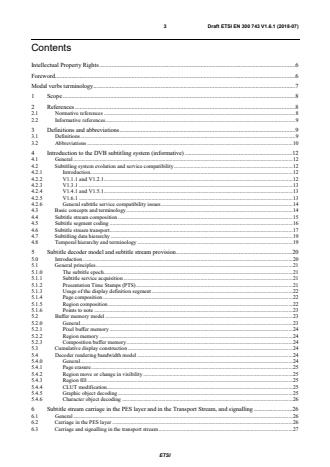
Contents
Intellectual Property Rights . 6
Foreword . 6
Modal verbs terminology . 7
1 Scope . 8
2 References . 8
2.1 Normative references . 8
2.2 Informative references . 9
3 Definitions and abbreviations . 9
3.1 Definitions . 9
3.2 Abbreviations . 10
4 Introduction to the DVB subtitling system (informative) . 12
4.1 General . 12
4.2 Subtitling system evolution and service compatibility . 12
4.2.1 Introduction. 12
4.2.2 V1.1.1 and V1.2.1 . 12
4.2.3 V1.3.1 . 13
4.2.4 V1.4.1 and V1.5.1 . 13
4.2.5 V1.6.1 . 13
4.2.6 General subtitle service compatibility issues . 14
4.3 Basic concepts and terminology . 14
4.4 Subtitle stream composition . 15
4.5 Subtitle segment coding . 16
4.6 Subtitle stream transport . 17
4.7 Subtitling data hierarchy . 19
4.8 Temporal hierarchy and terminology . 19
5 Subtitle decoder model and subtitle stream provision . 20
5.0 Introduction . 20
5.1 General principles. 21
5.1.0 The subtitle epoch . 21
5.1.1 Subtitle service acquisition . 21
5.1.2 Presentation Time Stamps (PTS) . 21
5.1.3 Usage of the display definition segment . 22
5.1.4 Page composition . 22
5.1.5 Region composition . 22
5.1.6 Points to note . 23
5.2 Buffer memory model . 23
5.2.0 General . 23
5.2.1 Pixel buffer memory . 24
5.2.2 Region memory . 24
5.2.3 Composition buffer memory . 24
5.3 Cumulative display construction . 24
5.4 Decoder rendering bandwidth model . 24
5.4.0 General . 24
5.4.1 Page erasure . 25
5.4.2 Region move or change in visibility . 25
5.4.3 Region fill . 25
5.4.4 CLUT modification. 25
5.4.5 Graphic object decoding . 25
5.4.6 Character object decoding . 26
6 Subtitle stream carriage in the PES layer and in the Transport Stream, and signalling . 26
6.1 General . 26
6.2 Carriage in the PES layer . 26
6.3 Carriage and signalling in the transport stream . 27
ETSI
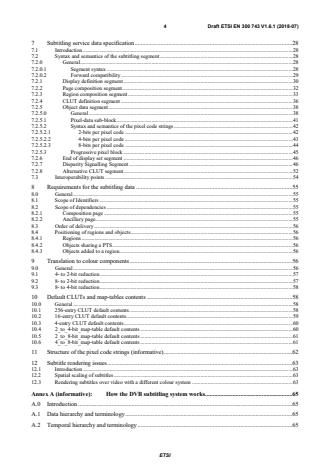
4 Draft ETSI EN 300 743 V1.6.1 (2018-07)
7 Subtitling service data specification . 28
7.1 Introduction . 28
7.2 Syntax and semantics of the subtitling segment . 28
7.2.0 General . 28
7.2.0.1 Segment syntax . 28
7.2.0.2 Forward compatibility . 29
7.2.1 Display definition segment . 30
7.2.2 Page composition segment . 32
7.2.3 Region composition segment . 33
7.2.4 CLUT definition segment . 36
7.2.5 Object data segment . 38
7.2.5.0 General . 38
7.2.5.1 Pixel-data sub-block . 41
7.2.5.2 Syntax and semantics of the pixel code strings . 42
7.2.5.2.1 2-bits per pixel code . 42
7.2.5.2.2 4-bits per pixel code . 43
7.2.5.2.3 8-bits per pixel code . 44
7.2.5.3 Progressive pixel block . 45
7.2.6 End of display set segment . 46
7.2.7 Disparity Signalling Segment . 46
7.2.8 Alternative CLUT segment . 52
7.3 Interoperability points . 54
8 Requirements for the subtitling data . 55
8.0 General . 55
8.1 Scope of Identifiers . 55
8.2 Scope of dependencies . 55
8.2.1 Composition page . 55
8.2.2 Ancillary page . 55
8.3 Order of delivery . 56
8.4 Positioning of regions and objects . 56
8.4.1 Regions . 56
8.4.2 Objects sharing a PTS . 56
8.4.3 Objects added to a region . 56
9 Translation to colour components . 56
9.0 General . 56
9.1 4- to 2-bit reduction . 57
9.2 8- to 2-bit reduction . 57
9.3 8- to 4-bit reduction . 58
10 Default CLUTs and map-tables contents . 58
10.0 General . 58
10.1 256-entry CLUT default contents . 58
10.2 16-entry CLUT default contents . 59
10.3 4-entry CLUT default contents . 60
10.4 2_to_4-bit_map-table default contents . 60
10.5 2_to_8-bit_map-table default contents . 61
10.6 4_to_8-bit_map-table default contents . 61
11 Structure of the pixel code strings (informative) . 62
12 Subtitle rendering issues . 63
12.1 Introduction . 63
12.2 Spatial scaling of subtitles . 63
12.3 Rendering subtitles over video with a different colour system . 63
Annex A (informative): How the DVB subtitling system works . 65
A.0 Introduction . 65
A.1 Data hierarchy and terminology . 65
A.2 Temporal hierarchy and terminology . 65
ETSI
5 Draft ETSI EN 300 743 V1.6.1 (2018-07)
A.3 Decoder temporal model . 65
A.4 Decoder display technology model . 65
A.4.1 Region based with indexed colours . 65
A.4.2 Colour quantization . 66
A.5 Examples of the subtitling system in operation . 66
A.5.1 Double buffering . 66
A.5.1.0 General . 66
A.5.1.1 Instant graphics . 66
A.5.1.2 Stenographic subtitles . 69
Annex B (informative): Use of the DDS for SDTV, HDTV and UHDTV services . 72
B.1 Introduction . 72
B.2 SDTV services . 72
B.3 HDTV services . 72
B.4 UHDTV services . 73
Annex C (informative): Illustration of the application of the disparity_shift_update_sequence
mechanism for 3D content . 74
Annex D (informative): Guidelines on the use of ETSI EN 300 743 for 3D content . 78
Annex E (informative): Conversion of PNG files into progressively coded bitmap subtitles . 82
Annex F (informative): Bibliography . 84
History . 85
ETSI
6 Draft ETSI EN 300 743 V1.6.1 (2018-07)
Intellectual Property Rights
Essential patents
IPRs essential or potentially essential to normative deliverables may have been declared to ETSI. The information
pertaining to these essential IPRs, if any, is publicly available for ETSI members and non-members, and can be found
in ETSI SR 000 314: "Intellectual Property Rights (IPRs); Essential, or potentially Essential, IPRs notified to ETSI in
respect of ETSI standards", which is available from the ETSI Secretariat. Latest updates are available on the ETSI Web
server (https://ipr.etsi.org/).
Pursuant to the ETSI IPR Policy, no investigation, including IPR searches, has been carried out by ETSI. No guarantee
can be given as to the existence of other IPRs not referenced in ETSI SR 000 314 (or the updates on the ETSI Web
server) which are, or may be, or may become, essential to the present document.
Trademarks
The present document may include trademarks and/or tradenames which are asserted and/or registered by their owners.
ETSI claims no ownership of these except for any which are indicated as being the property of ETSI, and conveys no
right to use or reproduce any trademark and/or tradename. Mention of those trademarks in the present document does
not constitute an endorsement by ETSI of products, services or organizations associated with those trademarks.
Foreword
This draft European Standard (EN) has been produced by Joint Technical Committee (JTC) Broadcast of the European
Broadcasting Union (EBU), Comité Européen de Normalisation ELECtrotechnique (CENELEC) and the European
Telecommunications Standards Institute (ETSI), and is now submitted for the combined Public Enquiry and Vote phase
of the ETSI standards EN Approval Procedure.
NOTE: The EBU/ETSI JTC Broadcast was established in 1990 to co-ordinate the drafting of standards in the
specific field of broadcasting and related fields. Since 1995 the JTC Broadcast became a tripartite body
by including in the Memorandum of Understanding also CENELEC, which is responsible for the
standardization of radio and television receivers. The EBU is a professional association of broadcasting
organizations whose work includes the co-ordination of its members' activities in the technical, legal,
programme-making and programme-exchange domains. The EBU has active members in about
60 countries in the European broadcasting area; its headquarters is in Geneva.
European Broadcasting Union
CH-1218 GRAND SACONNEX (Geneva)
Switzerland
Tel: +41 22 717 21 11
Fax: +41 22 717 24 81
The Digital Video Broadcasting Project (DVB) is an industry-led consortium of broadcasters, manufacturers, network
operators, software developers, regulatory bodies, content owners and others committed to designing global standards
for the delivery of digital television and data services. DVB fosters market driven solutions that meet the needs and
economic circumstances of broadcast industry stakeholders and consumers. DVB standards cover all aspects of digital
television from transmission through interfacing, conditional access and interactivity for digital video, audio and data.
The consortium came together in 1993 to provide global standardization, interoperability and future proof
specifications.
Proposed national transposition dates
Date of latest announcement of this EN (doa): 3 months after ETSI publication
Date of latest publication of new National Standard
or endorsement of this EN (dop/e): 6 months after doa
Date of withdrawal of any conflicting National Standard (dow): 6 months after doa
ETSI
7 Draft ETSI EN 300 743 V1.6.1 (2018-07)
Modal verbs terminology
In the present document "shall", "shall not", "should", "should not", "may", "need not", "will", "will not", "can" and
"cannot" are to be interpreted as described in clause 3.2 of the ETSI Drafting Rules (Verbal forms for the expression of
provisions).
"must" and "must not" are NOT allowed in ETSI deliverables except when used in direct citation.
ETSI
8 Draft ETSI EN 300 743 V1.6.1 (2018-07)
1 Scope
The present document specifies the method by which subtitles, logos and other graphical elements may be coded and
carried in DVB bitstreams. The system applies Colour Look-Up Tables (CLUTs) to define the colours of the graphical
elements. The transport of the coded graphical elements is based on the MPEG-2 Transport Stream described in
ISO/IEC 13818-1 [1].
2 References
2.1 Normative references
References are either specific (identified by date of publication and/or edition number or version number) or
non-specific. For specific references, only the cited version applies. For non-specific references, the latest version of the
referenced document (including any amendments) applies.
Referenced documents which are not found to be publicly available in the expected location might be found at
https://docbox.etsi.org/Reference/.
NOTE: While any hyperlinks included in this clause were valid at the time of publication ETSI cannot guarantee
their long term validity.
The following referenced documents are necessary for the application of the present document.
[1] ISO/IEC 13818-1: "Information technology - Generic coding of moving pictures and associated
audio information. Part 1: Systems".
[2] ETSI EN 300 468: "Digital Video Broadcasting (DVB); Specification for Service Information (SI)
in DVB systems".
[3] Recommendation ITU-R BT.601: "Studio encoding parameters of digital television for standard
4:3 and wide-screen 16:9 aspect ratios".
[4] Recommendation ITU-R BT.656-4: "Interface for digital component video signals in 525-line and
625-line television systems operating at the 4:2:2 level of Recommendation ITU-R BT.601
(Part A)".
[5] ETSI EN 300 743 (V1.2.1): "Digital Video Broadcasting (DVB); Subtitling systems".
[6] ETSI EN 300 743 (V1.3.1): "Digital Video Broadcasting (DVB); Subtitling systems".
[7] ETSI EN 300 743 (V1.4.1): "Digital Video Broadcasting (DVB); Subtitling systems".
[8] ETSI EN 300 743 (V1.5.1): "Digital Video Broadcasting (DVB); Subtitling systems".
[9] ETSI TS 101 154: "Digital Video Broadcasting (DVB); Specification for the use of Video and
Audio Coding in Broadcasting Applications based on the MPEG-2 Transport Stream".
[10] Recommendation ITU-R BT.709: "Parameter values for the HDTV standards for production and
international programme exchange".
[11] Recommendation ITU-R BT.2020-2: "Parameter values for ultra-high definition television systems
for production and international programme exchange".
[12] Recommendation ITU-R BT.2100-1: "Image parameter values for high dynamic range television
for use in production and international programme exchange".
[13] Recommendation ITU-R BT.1886: "Reference electro-optical transfer function for flat panel
displays used in HDTV studio production".
[14] IETF RFC 1950: "ZLIB Compressed Data Format Specification", (Version 3.3).
[15] IETF RFC 1951: "DEFLATE Compressed Data Format Specification", (Version 1.3).
ETSI
9 Draft ETSI EN 300 743 V1.6.1 (2018-07)
[16] ISO/IEC 15948: "Information technology, Computer graphics and image processing, Portable
Network Graphics (PNG): Functional specification".
[17] ETSI ETS 300 743: "Digital Video Broadcasting (DVB); Subtitling systems".
2.2 Informative references
References are either specific (identified by date of publication and/or edition number or version number) or
non-specific. For specific references, only the cited version applies. For non-specific references, the latest version of the
referenced document (including any amendments) applies.
NOTE: While any hyperlinks included in this clause were valid at the time of publication, ETSI cannot guarantee
their long term validity.
The following referenced documents are not necessary for the application of the present document but they assist the
user with regard to a particular subject area.
Not applicable.
3 Definitions and abbreviations
3.1 Definitions
For the purposes of the present document, the following terms and definitions apply:
ancillary page: means of conveying subtitle elements that may be shared by multiple subtitle services within a subtitle
stream, used for example to carry logos or character glyphs
Colour Look-Up Table (CLUT): look-up table applied in each region for translating the objects' pseudo-colours into
the correct colours to be displayed
CLUT family: family of CLUTs sharing the same CLUT_id, which consists of three CLUTs for rendering in
Recommendation ITU-R BT.601 [3] colour space, each of which is pre-populated with a default CLUT; - one with
4 entries, one with 16 entries, and one with 256 entries; and optionally one or more alternative CLUTs (provided in the
ACS) for rendering in colour and/or dynamic range systems other than Recommendation ITU-R BT.601 [3]
composition page: means of conveying subtitle elements for one specific subtitle service
default CLUT: CLUT populated with a set of preset colour entries that provide a useful range of colours within the
limit of the maximum number of entries in the respective CLUT
display definition: definition of the video image display resolution for which a subtitle stream has been prepared
display set: set of subtitle segments of a specific subtitle service to which the same PTS value is associated
epoch: period of time for which the decoder maintains an invariant memory layout, in the form of the defined page
compositions
next_bits(n): function that provides the next 'n' bits in the bitstream, without advancing the bitstream pointer, which
permits the comparison of those bit values with another sequence of bit values of the same length
object: graphical unit, identified by its own object_id, that can be positioned within a region; examples of an object
include a character glyph, a logo, a map, etc.
Packet IDentifier (PID): Transport packet identifier, as defined in ISO/IEC 13818-1 [1].
page: set of subtitles for a subtitle service during a certain period, consisting of one or more page instances whereby
each page update or refresh will result in a new page instance. A page contains a number of regions, and in each region
there can be a number of objects
ETSI
10 Draft ETSI EN 300 743 V1.6.1 (2018-07)
page composition: composition (use and positioning) of regions that may be displayed within the page, whereby only
one page composition is active for displaying at any one time, and changes can occur at any new page instance, for
example some regions might not be displayed yet, or some regions might no longer be displayed
page instance: period of time, typically initiated with the PTS of a display set, during which that page does not change
i.e. there is no change to the page composition, to any region composition, to any object within a region or any
applicable CLUT
PES packet: See ISO/IEC 13818-1 [1].
pixel-data: string of data bytes that contains, in coded form, the representation of a graphical object
Presentation Time Stamp (PTS): See ISO/IEC 13818-1 [1].
region: rectangular area on the page in which objects can be positioned
region composition: composition (use and positioning) of objects within a region
reserved: When used in a clause defining the coded bit stream, this field indicates that the value may be used for
extensions in the future. Unless specified otherwise within the present document, all "reserved" bits are expected to be
set to "1".
reserved_zero_future_use: When used in clauses defining the coded bit stream, this field indicates that the value may
be used in future revisions for ETSI-defined extensions. All "reserved_zero_future_use" bits are expected to be set to
"0".
subtitle element: subtitle data used within a page composition and contained within a subtitle segment, for example
regions, region compositions, CLUT definitions and object data
subtitle segment: basic syntactical element of a subtitle stream
subtitle service: service, displayed as a series of one or more pages, that provides subtitling for a program for a certain
purpose and to satisfy a single communication requirement, such as subtitles in a specific language for one program or
subtitles for the hard of hearing
subtitle stream: stream containing one or more subtitle services and consisting of subtitling segments carried in
transport packets identified by the same PID
transport packet: See ISO/IEC 13818-1 [1].
transport stream: stream of transport packets carrying one or more MPEG programs, as defined in
ISO/IEC 13818-1 [1].
3.2 Abbreviations
For the purposes of the present document, the following abbreviations apply:
3DTV plano-stereoscopic Three-Dimensional TeleVision
ACS Alternative CLUT Segment
B Blue value of colour representation in default CLUT
bslbf bit string, left bit first
Cb Chrominance value representing B-Y colour difference signal
NOTE: As defined in Recommendation ITU-R BT.601 [3], clause 7.2.3.
CLUT Colour Look-Up Table
CLUT_id CLUT identifier
Cr Chrominance value representing R-Y colour difference signal
NOTE: As defined in Recommendation ITU-R BT.601 [3], clause 7.2.3.
DDS Display Definition Segment
DSS Disparity Signalling Segment
DTV Digital TeleVision
DVB Digital Video Broadcasting
ETSI
11 Draft ETSI EN 300 743 V1.6.1 (2018-07)
EDS End of Display Set Segment
NOTE: As defined in ETSI EN 300 468 [2].
G Green value of colour representation in default CLUT
GOP Group Of Pictures
HDR High Dynamic Range
HDTV High Definition TeleVision
HLG Hybrid Log-Gamma
IRD Integrated Receiver Decoder
MPEG Moving Pictures Experts Group
NOTE: WG11 in SC 29 of JTC1 of ISO/IEC.
PCR Programme Clock Reference
NOTE: As defined in ISO/IEC 13818-1 [1].
PCS Page Composition Segment
PES Packetized Elementary Stream
NOTE: As defined in ISO/IEC 13818-1 [1].
PID Packet IDentifier
NOTE: As defined in ISO/IEC 13818-1 [1].
PMT Program Map Table
NOTE: As defined in ISO/IEC 13818-1 [1].
PNG Portable Network Graphics
NOTE: As defined in ISO/IEC 15948 [16].
PQ Perceptual Quantization
PSI Program Specific Information
NOTE: As defined in ISO/IEC 13818-1 [1].
PTS Presentation Time Stamp
NOTE: As defined in ISO/IEC 13818-1 [1].
R Red value of colour representation in default CLUT
RCS Region Composition Segment
ROM Read-Only Memory
SDR Standard Dynamic Range
NOTE: As defined in ETSI EN 300 468 [2].
SDTV Standard Definition TeleVision
SI Service Information
STC System Time Clock
NOTE: As defined in ISO/IEC 13818-1 [1].
T Transparency value
TS Transport Stream
NOTE: As defined in ISO/IEC 13818-1 [1].
UHDTV Ultra-High Definition TeleVision
uimsbf unsigned integer, most significant bit first
tcimsbf two's complement integer, msb (sign) bit first
ETSI
12 Draft ETSI EN 300 743 V1.6.1 (2018-07)
Y luminance value
NOTE: As defined in Recommendation ITU-R BT.601 [3], clause 7.2.3.
CDS CLUT Definition Segment
ODS Object Data Segment
RGB Red Green Blue
CRC Cyclic Redundancy Check
AV Audio Video
PLTE Palette Table
IDAT Image Data
IHDR Image Header
4 Introduction to the DVB subtitling system
(informative)
4.1 General
The present clause provides an informative introduction to the DVB subtitling system.
Clause 4.2 first provides an account of the evolution of the present document in relation to the continual enhancement
of video formats used by DVB services.
Clause 4.3 introduces the basic concepts and terminology for DVB subtitling.
Clause 4.4 describes the composition of the DVB subtitling data structure.
Clause 4.5 describes the DVB subtitling segment coding method.
Clause 4.6 describes the method of transport of DVB subtitling content.
Clause 4.7 describes the subtitling data hierarchy.
Clause 4.8 describes the subtitling temporal hierarchy and terminology.
The normative specification of the subtitling system is contained in clauses 5 to 10.
4.2 Subtitling system evolution and service compatibility
4.2.1 Introduction
The present document has been revised several times in order to introduce new features and maintain its applicability as
new types of DVB service emerged, namely HDTV, 3DTV, and most recently UHDTV, all of which are specified in
ETSI TS 101 154 [9] as regards codec usage, and ETSI EN 300 468 [2] as regards signalling. Maintenance revisions
have been made in addition to these. The remainder of the present clause summarizes the history of the present
document in relation to its revisions, whereas clause 4.2.6 provides a summary of subtitle service compatibility issues
resulting from the multiple versions of the present document.
4.2.2 V1.1.1 and V1.2.1
The first edition of the present document [17], published in 1997, specified the subtitling system only for SDTV
services, as defined in ETSI TS 110 154 [9] and ETSI EN 300 468 [2].
ETSI EN 300 743 [5] (V1.2.1) of the present document was a general maintenance revision.
ETSI
13 Draft ETSI EN 300 743 V1.6.1 (2018-07)
4.2.3 V1.3.1
ETSI EN 300 743 [6] (V1.3.1) of the present document added support for subtitles for HDTV services, as defined in
ETSI TS 101 154 [9] and ETSI EN 300 468 [2]. In V1.3.1 a new optional segment was specified, namely the display
definition segment (DDS). The DDS explicitly defines the display resolution for which that stream has been created,
i.e. it allows subtitles with display resolutions other than that for SDTV to be provided, and optionally allows subtitles
to be positioned within a window that constitutes only a part of the full display resolution.
The DDS is not needed with subtitle streams associated with SDTV services, thus they can be encoded in accordance
with ETSI EN 300 743 (V1.2.1) [5]. Such streams will nevertheless be decodable by decoders compliant with any later
versions of the present document.
Subtitles are encoded using Recommendation ITU-R BT.601 [3] colorimetry, i.e. the same as that used in video
components of SDTV services. HDTV systems use Recommendation ITU-R BT.709 [10] colorimtery, but that
distinction was not taken into account when the present document was revised to include HDTV-resolution subtitles in
ETSI EN 300 743 (V1.3.1) [6]. Due to the small differences between these two systems, in practice it does not matter
which one is ultimately used to render the subtitles.
4.2.4 V1.4.1 and V1.5.1
Version 1.4.1 of the present document added support for subtitles for 3DTV services, as defined in ETSI TS 101 154 [9]
and ETSI EN 300 468 [2]. In ETSI EN 300 743 (V1.4.1) [7]a new optional subtitling segment was specified, namely
the disparity signalling segment (DSS). The DSS enables a region or part of a region to be attributed with a disparity
value, to facilitate the optimal rendering of subtitles over 3DTV content.
ETSI EN 300 743 (V1.5.1) [8] of the present document was a general maintenance revision.
4.2.5 V1.6.1
Version 1.6.1 of the present document adds explicit support of subtitling for UHDTV services, as defined in ETSI
TS 101 154 [9] and ETSI EN 300 468 [2].
The latest revision of the present document, V1.6.1, introduces technical extensions specifically for progressive-scan
subtitle object coding and the capability to provide the subtitle CLUT in other colour systems in addition to
Recommendation ITU-R BT.601 [3]. These extensions are partitioned clearly by the definition of a new subtitling_type
to be used in subtitle services that make use of any of these new features, so that no changes for existing
implementations according to V1.5.1 or earlier versions of the present document are implied.
Video content for UHDTV services, as defined in ETSI TS 110 154 [9], uses Recommendation ITU-R BT.2020-2 [11]
colorimetry. Since that colour system is vastly enhanced compared to Recommendation ITU-R BT.709 [10] and
Recommendation ITU-R BT.601 [3], the capability was introduced in V1.6.1 of the present document to enable the
subtitle service to provide the CLUT for rendering in Recommendation ITU-R BT.2020-2 [11] / Recommendation
ITU-R BT.2100-1 [12] colour volume, using the alternative CLUT segment (ACS), in addition to the legacy CLUT(s)
defined by the default CLUTs and the CLUT definition segment (CDS). This allows IRDs that support graphics
rendering in Recommendation ITU-R BT.2020-2 [11] and, if applicable, HDR to render directly both video and bitmap
subtitles without conversion of colour and dynamic range.
Version 1.6.1 of the present document also adds support of subtitles in progressive-scan format, whereby the subtitle
objects are in a format that can be converted conveniently from a suitably coded PNG [16] file. Such subtitle objects are
not compatible with IRDs that were designed to be compatible with version 1.5.1 of the present document or earlier.
The DDS is also included in subtitle streams intended for UHDTV services, whereby subtitle graphics rendering is
constrained to HDTV resolution. Where the display window feature of the DDS is not used, the UHDTV IRD upscales
the subtitles spatially before rendering them on a UHDTV resolution display.
Subtitle streams associated with SDTV or HDTV services and intended to be decoded by decoders designed to ETSI
EN 300 743 (V1.5.1) [8] or an earlier version naturally make use of neither the alternative CLUT segment (ACS), nor
of the new object coding method for progressively coded subtitle bitmaps.
ETSI
14 Draft ETSI EN 300 743 V1.6.1 (2018-07)
4.2.6 General subtitle service compatibility issues
While there is no explicit signallin
...
EUROPEAN STANDARD
Digital Video Broadcasting (DVB);
Subtitling systems
2 ETSI EN 300 743 V1.6.1 (2018-10)
Reference
REN/JTC-DVB-378
Keywords
broadcasting, digital, DVB, TV, video
ETSI
650 Route des Lucioles
F-06921 Sophia Antipolis Cedex - FRANCE
Tel.: +33 4 92 94 42 00 Fax: +33 4 93 65 47 16
Siret N° 348 623 562 00017 - NAF 742 C
Association à but non lucratif enregistrée à la
Sous-Préfecture de Grasse (06) N° 7803/88
Important notice
The present document can be downloaded from:
http://www.etsi.org/standards-search
The present document may be made available in electronic versions and/or in print. The content of any electronic and/or
print versions of the present document shall not be modified without the prior written authorization of ETSI. In case of any
existing or perceived difference in contents between such versions and/or in print, the only prevailing document is the
print of the Portable Document Format (PDF) version kept on a specific network drive within ETSI Secretariat.
Users of the present document should be aware that the document may be subject to revision or change of status.
Information on the current status of this and other ETSI documents is available at
https://portal.etsi.org/TB/ETSIDeliverableStatus.aspx
If you find errors in the present document, please send your comment to one of the following services:
https://portal.etsi.org/People/CommiteeSupportStaff.aspx
Copyright Notification
No part may be reproduced or utilized in any form or by any means, electronic or mechanical, including photocopying
and microfilm except as authorized by written permission of ETSI.
The content of the PDF version shall not be modified without the written authorization of ETSI.
The copyright and the foregoing restriction extend to reproduction in all media.
© ETSI 2018.
© European Broadcasting Union 2018.
All rights reserved.
TM TM TM
DECT , PLUGTESTS , UMTS and the ETSI logo are trademarks of ETSI registered for the benefit of its Members.
TM TM
3GPP and LTE are trademarks of ETSI registered for the benefit of its Members and
of the 3GPP Organizational Partners.
oneM2M™ logo is a trademark of ETSI registered for the benefit of its Members and
of the oneM2M Partners ®
GSM and the GSM logo are trademarks registered and owned by the GSM Association.
ETSI
3 ETSI EN 300 743 V1.6.1 (2018-10)
Contents
Intellectual Property Rights . 6
Foreword . 6
Modal verbs terminology . 7
1 Scope . 8
2 References . 8
2.1 Normative references . 8
2.2 Informative references . 9
3 Definitions and abbreviations . 9
3.1 Definitions . 9
3.2 Abbreviations . 10
4 Introduction to the DVB subtitling system (informative) . 12
4.1 General . 12
4.2 Subtitling system evolution and service compatibility . 12
4.2.1 Introduction. 12
4.2.2 V1.1.1 and V1.2.1 . 12
4.2.3 V1.3.1 . 13
4.2.4 V1.4.1 and V1.5.1 . 13
4.2.5 V1.6.1 . 13
4.2.6 General subtitle service compatibility issues . 14
4.3 Basic concepts and terminology . 14
4.4 Subtitle stream composition . 15
4.5 Subtitle segment coding . 16
4.6 Subtitle stream transport . 17
4.7 Subtitling data hierarchy . 19
4.8 Temporal hierarchy and terminology . 19
5 Subtitle decoder model and subtitle stream provision . 20
5.0 Introduction . 20
5.1 General principles. 21
5.1.0 The subtitle epoch . 21
5.1.1 Subtitle service acquisition . 21
5.1.2 Presentation Time Stamps (PTS) . 21
5.1.3 Usage of the display definition segment . 22
5.1.4 Page composition . 22
5.1.5 Region composition . 22
5.1.6 Points to note . 23
5.2 Buffer memory model . 23
5.2.0 General . 23
5.2.1 Pixel buffer memory . 24
5.2.2 Region memory . 24
5.2.3 Composition buffer memory . 24
5.3 Cumulative display construction . 24
5.4 Decoder rendering bandwidth model . 24
5.4.0 General . 24
5.4.1 Page erasure . 25
5.4.2 Region move or change in visibility . 25
5.4.3 Region fill . 25
5.4.4 CLUT modification. 25
5.4.5 Graphic object decoding . 25
5.4.6 Character object decoding . 26
6 Subtitle stream carriage in the PES layer and in the Transport Stream, and signalling . 26
6.1 General . 26
6.2 Carriage in the PES layer . 26
6.3 Carriage and signalling in the transport stream . 27
ETSI
4 ETSI EN 300 743 V1.6.1 (2018-10)
7 Subtitling service data specification . 28
7.1 Introduction . 28
7.2 Syntax and semantics of the subtitling segment . 28
7.2.0 General . 28
7.2.0.1 Segment syntax . 28
7.2.0.2 Forward compatibility . 30
7.2.1 Display definition segment . 30
7.2.2 Page composition segment . 32
7.2.3 Region composition segment . 34
7.2.4 CLUT definition segment . 36
7.2.5 Object data segment . 38
7.2.5.0 General . 38
7.2.5.1 Pixel-data sub-block . 41
7.2.5.2 Syntax and semantics of the pixel code strings . 42
7.2.5.2.1 2-bits per pixel code . 42
7.2.5.2.2 4-bits per pixel code . 43
7.2.5.2.3 8-bits per pixel code . 44
7.2.5.3 Progressive pixel block . 45
7.2.6 End of display set segment . 46
7.2.7 Disparity Signalling Segment . 46
7.2.8 Alternative CLUT segment . 52
7.3 Interoperability points . 54
8 Requirements for the subtitling data . 55
8.0 General . 55
8.1 Scope of Identifiers . 55
8.2 Scope of dependencies . 55
8.2.1 Composition page . 55
8.2.2 Ancillary page . 55
8.3 Order of delivery . 56
8.4 Positioning of regions and objects . 56
8.4.1 Regions . 56
8.4.2 Objects sharing a PTS . 56
8.4.3 Objects added to a region . 56
9 Translation to colour components . 56
9.0 General . 56
9.1 4- to 2-bit reduction . 57
9.2 8- to 2-bit reduction . 58
9.3 8- to 4-bit reduction . 58
10 Default CLUTs and map-tables contents . 58
10.0 General . 58
10.1 256-entry CLUT default contents . 58
10.2 16-entry CLUT default contents . 59
10.3 4-entry CLUT default contents . 60
10.4 2_to_4-bit_map-table default contents . 61
10.5 2_to_8-bit_map-table default contents . 61
10.6 4_to_8-bit_map-table default contents . 61
11 Structure of the pixel code strings (informative) . 62
12 Subtitle rendering issues . 63
12.1 Introduction . 63
12.2 Spatial scaling of subtitles . 63
12.3 Rendering subtitles over video with a different colour system . 63
Annex A (informative): How the DVB subtitling system works . 65
A.0 Introduction . 65
A.1 Data hierarchy and terminology . 65
A.2 Temporal hierarchy and terminology . 65
ETSI
5 ETSI EN 300 743 V1.6.1 (2018-10)
A.3 Decoder temporal model . 65
A.4 Decoder display technology model . 65
A.4.1 Region based with indexed colours . 65
A.4.2 Colour quantization . 66
A.5 Examples of the subtitling system in operation . 66
A.5.1 Double buffering . 66
A.5.1.0 General . 66
A.5.1.1 Instant graphics . 66
A.5.1.2 Stenographic subtitles . 69
Annex B (informative): Use of the DDS for SDTV, HDTV and UHDTV services . 72
B.1 Introduction . 72
B.2 SDTV services . 72
B.3 HDTV services . 72
B.4 UHDTV services . 73
Annex C (informative): Illustration of the application of the disparity_shift_update_sequence
mechanism for 3D content . 74
Annex D (informative): Guidelines on the use of ETSI EN 300 743 for 3D content . 78
Annex E (informative): Conversion of PNG files into progressively coded bitmap subtitles . 82
Annex F (informative): Bibliography . 84
History . 85
ETSI
6 ETSI EN 300 743 V1.6.1 (2018-10)
Intellectual Property Rights
Essential patents
IPRs essential or potentially essential to normative deliverables may have been declared to ETSI. The information
pertaining to these essential IPRs, if any, is publicly available for ETSI members and non-members, and can be found
in ETSI SR 000 314: "Intellectual Property Rights (IPRs); Essential, or potentially Essential, IPRs notified to ETSI in
respect of ETSI standards", which is available from the ETSI Secretariat. Latest updates are available on the ETSI Web
server (https://ipr.etsi.org/).
Pursuant to the ETSI IPR Policy, no investigation, including IPR searches, has been carried out by ETSI. No guarantee
can be given as to the existence of other IPRs not referenced in ETSI SR 000 314 (or the updates on the ETSI Web
server) which are, or may be, or may become, essential to the present document.
Trademarks
The present document may include trademarks and/or tradenames which are asserted and/or registered by their owners.
ETSI claims no ownership of these except for any which are indicated as being the property of ETSI, and conveys no
right to use or reproduce any trademark and/or tradename. Mention of those trademarks in the present document does
not constitute an endorsement by ETSI of products, services or organizations associated with those trademarks.
Foreword
This European Standard (EN) has been produced by Joint Technical Committee (JTC) Broadcast of the European
Broadcasting Union (EBU), Comité Européen de Normalisation ELECtrotechnique (CENELEC) and the European
Telecommunications Standards Institute (ETSI).
NOTE: The EBU/ETSI JTC Broadcast was established in 1990 to co-ordinate the drafting of standards in the
specific field of broadcasting and related fields. Since 1995 the JTC Broadcast became a tripartite body
by including in the Memorandum of Understanding also CENELEC, which is responsible for the
standardization of radio and television receivers. The EBU is a professional association of broadcasting
organizations whose work includes the co-ordination of its members' activities in the technical, legal,
programme-making and programme-exchange domains. The EBU has active members in about
60 countries in the European broadcasting area; its headquarters is in Geneva.
European Broadcasting Union
CH-1218 GRAND SACONNEX (Geneva)
Switzerland
Tel: +41 22 717 21 11
Fax: +41 22 717 24 81
The Digital Video Broadcasting Project (DVB) is an industry-led consortium of broadcasters, manufacturers, network
operators, software developers, regulatory bodies, content owners and others committed to designing global standards
for the delivery of digital television and data services. DVB fosters market driven solutions that meet the needs and
economic circumstances of broadcast industry stakeholders and consumers. DVB standards cover all aspects of digital
television from transmission through interfacing, conditional access and interactivity for digital video, audio and data.
The consortium came together in 1993 to provide global standardization, interoperability and future proof
specifications.
National transposition dates
Date of adoption of this EN: 22 October 2018
Date of latest announcement of this EN (doa): 31 January 2019
Date of latest publication of new National Standard
or endorsement of this EN (dop/e): 31 July 2019
Date of withdrawal of any conflicting National Standard (dow): 31 July 2019
ETSI
7 ETSI EN 300 743 V1.6.1 (2018-10)
Modal verbs terminology
In the present document "shall", "shall not", "should", "should not", "may", "need not", "will", "will not", "can" and
"cannot" are to be interpreted as described in clause 3.2 of the ETSI Drafting Rules (Verbal forms for the expression of
provisions).
"must" and "must not" are NOT allowed in ETSI deliverables except when used in direct citation.
ETSI
8 ETSI EN 300 743 V1.6.1 (2018-10)
1 Scope
The present document specifies the method by which subtitles, logos and other graphical elements may be coded and
carried in DVB bitstreams. The system applies Colour Look-Up Tables (CLUTs) to define the colours of the graphical
elements. The transport of the coded graphical elements is based on the MPEG-2 Transport Stream described in
ISO/IEC 13818-1 [1].
2 References
2.1 Normative references
References are either specific (identified by date of publication and/or edition number or version number) or
non-specific. For specific references, only the cited version applies. For non-specific references, the latest version of the
referenced document (including any amendments) applies.
Referenced documents which are not found to be publicly available in the expected location might be found at
https://docbox.etsi.org/Reference/.
NOTE: While any hyperlinks included in this clause were valid at the time of publication ETSI cannot guarantee
their long term validity.
The following referenced documents are necessary for the application of the present document.
[1] ISO/IEC 13818-1: "Information technology - Generic coding of moving pictures and associated
audio information. Part 1: Systems".
[2] ETSI EN 300 468: "Digital Video Broadcasting (DVB); Specification for Service Information (SI)
in DVB systems".
[3] Recommendation ITU-R BT.601: "Studio encoding parameters of digital television for standard
4:3 and wide-screen 16:9 aspect ratios".
[4] Recommendation ITU-R BT.656-4: "Interface for digital component video signals in 525-line and
625-line television systems operating at the 4:2:2 level of Recommendation ITU-R BT.601
(Part A)".
[5] ETSI EN 300 743 (V1.2.1): "Digital Video Broadcasting (DVB); Subtitling systems".
[6] ETSI EN 300 743 (V1.3.1): "Digital Video Broadcasting (DVB); Subtitling systems".
[7] ETSI EN 300 743 (V1.4.1): "Digital Video Broadcasting (DVB); Subtitling systems".
[8] ETSI EN 300 743 (V1.5.1): "Digital Video Broadcasting (DVB); Subtitling systems".
[9] ETSI TS 101 154: "Digital Video Broadcasting (DVB); Specification for the use of Video and
Audio Coding in Broadcasting Applications based on the MPEG-2 Transport Stream".
[10] Recommendation ITU-R BT.709: "Parameter values for the HDTV standards for production and
international programme exchange".
[11] Recommendation ITU-R BT.2020-2: "Parameter values for ultra-high definition television systems
for production and international programme exchange".
[12] Recommendation ITU-R BT.2100-1: "Image parameter values for high dynamic range television
for use in production and international programme exchange".
[13] Recommendation ITU-R BT.1886: "Reference electro-optical transfer function for flat panel
displays used in HDTV studio production".
[14] IETF RFC 1950: "ZLIB Compressed Data Format Specification", (Version 3.3).
[15] IETF RFC 1951: "DEFLATE Compressed Data Format Specification", (Version 1.3).
ETSI
9 ETSI EN 300 743 V1.6.1 (2018-10)
[16] ISO/IEC 15948: "Information technology, Computer graphics and image processing, Portable
Network Graphics (PNG): Functional specification".
[17] ETSI ETS 300 743: "Digital Video Broadcasting (DVB); Subtitling systems".
2.2 Informative references
References are either specific (identified by date of publication and/or edition number or version number) or
non-specific. For specific references, only the cited version applies. For non-specific references, the latest version of the
referenced document (including any amendments) applies.
NOTE: While any hyperlinks included in this clause were valid at the time of publication, ETSI cannot guarantee
their long term validity.
The following referenced documents are not necessary for the application of the present document but they assist the
user with regard to a particular subject area.
Not applicable.
3 Definitions and abbreviations
3.1 Definitions
For the purposes of the present document, the following terms and definitions apply:
ancillary page: means of conveying subtitle elements that may be shared by multiple subtitle services within a subtitle
stream, used for example to carry logos or character glyphs
Colour Look-Up Table (CLUT): look-up table applied in each region for translating the objects' pseudo-colours into
the correct colours to be displayed
CLUT family: family of CLUTs sharing the same CLUT_id, which consists of three CLUTs for rendering in
Recommendation ITU-R BT.601 [3] colour space, each of which is pre-populated with a default CLUT; - one with
4 entries, one with 16 entries, and one with 256 entries; and optionally one or more alternative CLUTs (provided in the
ACS) for rendering in colour and/or dynamic range systems other than Recommendation ITU-R BT.601 [3]
composition page: means of conveying subtitle elements for one specific subtitle service
default CLUT: CLUT populated with a set of preset colour entries that provide a useful range of colours within the
limit of the maximum number of entries in the respective CLUT
display definition: definition of the video image display resolution for which a subtitle stream has been prepared
display set: set of subtitle segments of a specific subtitle service to which the same PTS value is associated
epoch: period of time for which the decoder maintains an invariant memory layout, in the form of the defined page
compositions
next_bits(n): function that provides the next 'n' bits in the bitstream, without advancing the bitstream pointer, which
permits the comparison of those bit values with another sequence of bit values of the same length
object: graphical unit, identified by its own object_id, that can be positioned within a region; examples of an object
include a character glyph, a logo, a map, etc.
Packet IDentifier (PID): Transport packet identifier, as defined in ISO/IEC 13818-1 [1].
page: set of subtitles for a subtitle service during a certain period, consisting of one or more page instances whereby
each page update or refresh will result in a new page instance. A page contains a number of regions, and in each region
there can be a number of objects
ETSI
10 ETSI EN 300 743 V1.6.1 (2018-10)
page composition: composition (use and positioning) of regions that may be displayed within the page, whereby only
one page composition is active for displaying at any one time, and changes can occur at any new page instance, for
example some regions might not be displayed yet, or some regions might no longer be displayed
page instance: period of time, typically initiated with the PTS of a display set, during which that page does not change
i.e. there is no change to the page composition, to any region composition, to any object within a region or any
applicable CLUT
PES packet: See ISO/IEC 13818-1 [1].
pixel-data: string of data bytes that contains, in coded form, the representation of a graphical object
Presentation Time Stamp (PTS): See ISO/IEC 13818-1 [1].
region: rectangular area on the page in which objects can be positioned
region composition: composition (use and positioning) of objects within a region
reserved: When used in a clause defining the coded bit stream, this field indicates that the value may be used for
extensions in the future. Unless specified otherwise within the present document, all "reserved" bits are expected to be
set to "1".
reserved_zero_future_use: When used in clauses defining the coded bit stream, this field indicates that the value may
be used in future revisions for ETSI-defined extensions. All "reserved_zero_future_use" bits are expected to be set to
"0".
subtitle element: subtitle data used within a page composition and contained within a subtitle segment, for example
regions, region compositions, CLUT definitions and object data
subtitle segment: basic syntactical element of a subtitle stream
subtitle service: service, displayed as a series of one or more pages, that provides subtitling for a program for a certain
purpose and to satisfy a single communication requirement, such as subtitles in a specific language for one program or
subtitles for the hard of hearing
subtitle stream: stream containing one or more subtitle services and consisting of subtitling segments carried in
transport packets identified by the same PID
transport packet: See ISO/IEC 13818-1 [1].
transport stream: stream of transport packets carrying one or more MPEG programs, as defined in
ISO/IEC 13818-1 [1].
3.2 Abbreviations
For the purposes of the present document, the following abbreviations apply:
3DTV plano-stereoscopic Three-Dimensional TeleVision
ACS Alternative CLUT Segment
B Blue value of colour representation in default CLUT
bslbf bit string, left bit first
Cb Chrominance value representing B-Y colour difference signal
NOTE: As defined in Recommendation ITU-R BT.601 [3], clause 7.2.3.
CLUT Colour Look-Up Table
CLUT_id CLUT identifier
Cr Chrominance value representing R-Y colour difference signal
NOTE: As defined in Recommendation ITU-R BT.601 [3], clause 7.2.3.
DDS Display Definition Segment
DSS Disparity Signalling Segment
DTV Digital TeleVision
DVB Digital Video Broadcasting
ETSI
11 ETSI EN 300 743 V1.6.1 (2018-10)
EDS End of Display Set Segment
NOTE: As defined in ETSI EN 300 468 [2].
G Green value of colour representation in default CLUT
GOP Group Of Pictures
HDR High Dynamic Range
HDTV High Definition TeleVision
HLG Hybrid Log-Gamma
IRD Integrated Receiver Decoder
MPEG Moving Pictures Experts Group
NOTE: WG11 in SC 29 of JTC1 of ISO/IEC.
PCR Programme Clock Reference
NOTE: As defined in ISO/IEC 13818-1 [1].
PCS Page Composition Segment
PES Packetized Elementary Stream
NOTE: As defined in ISO/IEC 13818-1 [1].
PID Packet IDentifier
NOTE: As defined in ISO/IEC 13818-1 [1].
PMT Program Map Table
NOTE: As defined in ISO/IEC 13818-1 [1].
PNG Portable Network Graphics
NOTE: As defined in ISO/IEC 15948 [16].
PQ Perceptual Quantization
PSI Program Specific Information
NOTE: As defined in ISO/IEC 13818-1 [1].
PTS Presentation Time Stamp
NOTE: As defined in ISO/IEC 13818-1 [1].
R Red value of colour representation in default CLUT
RCS Region Composition Segment
ROM Read-Only Memory
SDR Standard Dynamic Range
NOTE: As defined in ETSI EN 300 468 [2].
SDTV Standard Definition TeleVision
SI Service Information
STC System Time Clock
NOTE: As defined in ISO/IEC 13818-1 [1].
T Transparency value
TS Transport Stream
NOTE: As defined in ISO/IEC 13818-1 [1].
UHDTV Ultra-High Definition TeleVision
uimsbf unsigned integer, most significant bit first
tcimsbf two's complement integer, msb (sign) bit first
ETSI
12 ETSI EN 300 743 V1.6.1 (2018-10)
Y luminance value
NOTE: As defined in Recommendation ITU-R BT.601 [3], clause 7.2.3.
CDS CLUT Definition Segment
ODS Object Data Segment
RGB Red Green Blue
CRC Cyclic Redundancy Check
AV Audio Video
PLTE Palette Table
IDAT Image Data
IHDR Image Header
4 Introduction to the DVB subtitling system
(informative)
4.1 General
The present clause provides an informative introduction to the DVB subtitling system.
Clause 4.2 first provides an account of the evolution of the present document in relation to the continual enhancement
of video formats used by DVB services.
Clause 4.3 introduces the basic concepts and terminology for DVB subtitling.
Clause 4.4 describes the composition of the DVB subtitling data structure.
Clause 4.5 describes the DVB subtitling segment coding method.
Clause 4.6 describes the method of transport of DVB subtitling content.
Clause 4.7 describes the subtitling data hierarchy.
Clause 4.8 describes the subtitling temporal hierarchy and terminology.
The normative specification of the subtitling system is contained in clauses 5 to 10.
4.2 Subtitling system evolution and service compatibility
4.2.1 Introduction
The present document has been revised several times in order to introduce new features and maintain its applicability as
new types of DVB service emerged, namely HDTV, 3DTV, and most recently UHDTV, all of which are specified in
ETSI TS 101 154 [9] as regards codec usage, and ETSI EN 300 468 [2] as regards signalling. Maintenance revisions
have been made in addition to these. The remainder of the present clause summarizes the history of the present
document in relation to its revisions, whereas clause 4.2.6 provides a summary of subtitle service compatibility issues
resulting from the multiple versions of the present document.
4.2.2 V1.1.1 and V1.2.1
The first edition of the present document [17], published in 1997, specified the subtitling system only for SDTV
services, as defined in ETSI TS 110 154 [9] and ETSI EN 300 468 [2].
ETSI EN 300 743 [5] (V1.2.1) of the present document was a general maintenance revision.
ETSI
13 ETSI EN 300 743 V1.6.1 (2018-10)
4.2.3 V1.3.1
ETSI EN 300 743 [6] (V1.3.1) of the present document added support for subtitles for HDTV services, as defined in
ETSI TS 101 154 [9] and ETSI EN 300 468 [2]. In V1.3.1 a new optional segment was specified, namely the display
definition segment (DDS). The DDS explicitly defines the display resolution for which that stream has been created,
i.e. it allows subtitles with display resolutions other than that for SDTV to be provided, and optionally allows subtitles
to be positioned within a window that constitutes only a part of the full display resolution.
The DDS is not needed with subtitle streams associated with SDTV services, thus they can be encoded in accordance
with ETSI EN 300 743 (V1.2.1) [5]. Such streams will nevertheless be decodable by decoders compliant with any later
versions of the present document.
Subtitles are encoded using Recommendation ITU-R BT.601 [3] colorimetry, i.e. the same as that used in video
components of SDTV services. HDTV systems use Recommendation ITU-R BT.709 [10] colorimtery, but that
distinction was not taken into account when the present document was revised to include HDTV-resolution subtitles in
ETSI EN 300 743 (V1.3.1) [6]. Due to the small differences between these two systems, in practice it does not matter
which one is ultimately used to render the subtitles.
4.2.4 V1.4.1 and V1.5.1
Version 1.4.1 of the present document added support for subtitles for 3DTV services, as defined in ETSI TS 101 154 [9]
and ETSI EN 300 468 [2]. In ETSI EN 300 743 (V1.4.1) [7] a new optional subtitling segment was specified, namely
the disparity signalling segment (DSS). The DSS enables a region or part of a region to be attributed with a disparity
value, to facilitate the optimal rendering of subtitles over 3DTV content.
ETSI EN 300 743 (V1.5.1) [8] of the present document was a general maintenance revision.
4.2.5 V1.6.1
Version 1.6.1 of the present document adds explicit support of subtitling for UHDTV services, as defined in ETSI
TS 101 154 [9] and ETSI EN 300 468 [2].
The latest revision of the present document, V1.6.1, introduces technical extensions specifically for progressive-scan
subtitle object coding and the capability to provide the subtitle CLUT in other colour systems in addition to
Recommendation ITU-R BT.601 [3]. These extensions are partitioned clearly by the definition of a new subtitling_type
to be used in subtitle services that make use of any of these new features, so that no changes for existing
implementations according to V1.5.1 or earlier versions of the present document are implied.
Video content for UHDTV services, as defined in ETSI TS 110 154 [9], uses Recommendation ITU-R BT.2020-2 [11]
colorimetry. Since that colour system is vastly enhanced compared to Recommendation ITU-R BT.709 [10] and
Recommendation ITU-R BT.601 [3], the capability was introduced in V1.6.1 of the present document to enable the
subtitle service to provide the CLUT for rendering in Recommendation ITU-R BT.2020-2 [11] / Recommendation
ITU-R BT.2100-1 [12] colour volume, using the alternative CLUT segment (ACS), in addition to the legacy CLUT(s)
defined by the default CLUTs and the CLUT definition segment (CDS). This allows IRDs that support graphics
rendering in Recommendation ITU-R BT.2020-2 [11] and, if applicable, HDR to render directly both video and bitmap
subtitles without conversion of colour and dynamic range.
Version 1.6.1 of the present document also adds support of subtitles in progressive-scan format, whereby the subtitle
objects are in a format that can be converted conveniently from a suitably coded PNG [16] file. Such subtitle objects are
not compatible with IRDs that were designed to be compatible with version 1.5.1 of the present document or earlier.
The DDS is also included in subtitle streams intended for UHDTV services, whereby subtitle graphics rendering is
constrained to HDTV resolution. Where the display window feature of the DDS is not used, the UHDTV IRD upscales
the subtitles spatially before rendering them on a UHDTV resolution display.
Subtitle streams associated with SDTV or HDTV services and intended to be decoded by decoders designed to ETSI
EN 300 743 (V1.5.1) [8] or an earlier version naturally make use of neither the alternative CLUT segment (ACS), nor
of the new object coding method for progressively coded subtitle bitmaps.
ETSI
14 ETSI EN 300 743 V1.6.1 (2018-10)
4.2.6 General subtitle service compatibility issues
While there is no explicit signalling in subtitling streams of the version of the present document with which the stream
conforms, an implicit signalling of compatibility is provided
...
2003-01.Slovenski inštitut za standardizacijo. Razmnoževanje celote ali delov tega standarda ni dovoljeno.Digitalna videoradiodifuzija (DVB) - Sistemi za podnasloveDigital Video Broadcasting (DVB) - Subtitling systems33.170Televizijska in radijska difuzijaTelevision and radio broadcastingICS:Ta slovenski standard je istoveten z:ETSI EN 300 743 V1.6.1 (2018-10)SIST EN 300 743 V1.6.1:2019en01-januar-2019SIST EN 300 743 V1.6.1:2019SLOVENSKI
STANDARD
EUROPEAN STANDARD SIST EN 300 743 V1.6.1:2019
ETSI ETSI EN 300 743 V1.6.1 (2018-10) 2
Reference REN/JTC-DVB-378 Keywords broadcasting, digital, DVB, TV, video ETSI 650 Route des Lucioles F-06921 Sophia Antipolis Cedex - FRANCE
Tel.: +33 4 92 94 42 00
Fax: +33 4 93 65 47 16
Siret N° 348 623 562 00017 - NAF 742 C Association à but non lucratif enregistrée à la Sous-Préfecture de Grasse (06) N° 7803/88
Important notice The present document can be downloaded from: http://www.etsi.org/standards-search The present document may be made available in electronic versions and/or in print. The content of any electronic and/or print versions of the present document shall not be modified without the prior written authorization of ETSI. In case of any existing or perceived difference in contents between such versions and/or in print, the only prevailing document is the print of the Portable Document Format (PDF) version kept on a specific network drive within ETSI Secretariat. Users of the present document should be aware that the document may be subject to revision or change of status. Information on the current status of this and other ETSI documents is available at https://portal.etsi.org/TB/ETSIDeliverableStatus.aspx If you find errors in the present document, please send your comment to one of the following services: https://portal.etsi.org/People/CommiteeSupportStaff.aspx Copyright Notification No part may be reproduced or utilized in any form or by any means, electronic or mechanical, including photocopying and microfilm except as authorized by written permission of ETSI. The content of the PDF version shall not be modified without the written authorization of ETSI. The copyright and the foregoing restriction extend to reproduction in all media.
© ETSI 2018. © European Broadcasting Union 2018. All rights reserved.
DECTTM, PLUGTESTSTM, UMTSTM and the ETSI logo are trademarks of ETSI registered for the benefit of its Members. 3GPPTM and LTETM are trademarks of ETSI registered for the benefit of its Members and of the 3GPP Organizational Partners. oneM2M™ logo is a trademark of ETSI registered for the benefit of its Members and of the oneM2M Partners GSM® and the GSM logo are trademarks registered and owned by the GSM Association. SIST EN 300 743 V1.6.1:2019
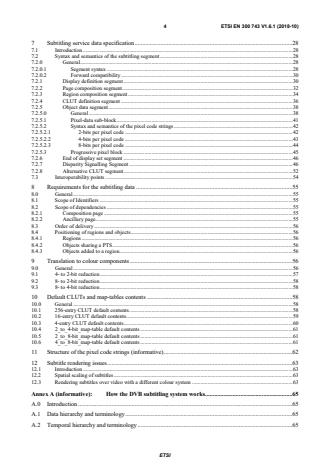
ETSI ETSI EN 300 743 V1.6.1 (2018-10) 3 Contents Intellectual Property Rights . 6 Foreword . 6 Modal verbs terminology . 7 1 Scope . 8 2 References . 8 2.1 Normative references . 8 2.2 Informative references . 9 3 Definitions and abbreviations . 9 3.1 Definitions . 9 3.2 Abbreviations . 10 4 Introduction to the DVB subtitling system (informative) . 12 4.1 General . 12 4.2 Subtitling system evolution and service compatibility . 12 4.2.1 Introduction. 12 4.2.2 V1.1.1 and V1.2.1 . 12 4.2.3 V1.3.1 . 13 4.2.4 V1.4.1 and V1.5.1 . 13 4.2.5 V1.6.1 . 13 4.2.6 General subtitle service compatibility issues . 14 4.3 Basic concepts and terminology . 14 4.4 Subtitle stream composition . 15 4.5 Subtitle segment coding . 16 4.6 Subtitle stream transport . 17 4.7 Subtitling data hierarchy . 19 4.8 Temporal hierarchy and terminology . 19 5 Subtitle decoder model and subtitle stream provision . 20 5.0 Introduction . 20 5.1 General principles. 21 5.1.0 The subtitle epoch . 21 5.1.1 Subtitle service acquisition . 21 5.1.2 Presentation Time Stamps (PTS) . 21 5.1.3 Usage of the display definition segment . 22 5.1.4 Page composition . 22 5.1.5 Region composition . 22 5.1.6 Points to note . 23 5.2 Buffer memory model . 23 5.2.0 General . 23 5.2.1 Pixel buffer memory . 24 5.2.2 Region memory . 24 5.2.3 Composition buffer memory . 24 5.3 Cumulative display construction . 24 5.4 Decoder rendering bandwidth model . 24 5.4.0 General . 24 5.4.1 Page erasure . 25 5.4.2 Region move or change in visibility . 25 5.4.3 Region fill . 25 5.4.4 CLUT modification. 25 5.4.5 Graphic object decoding . 25 5.4.6 Character object decoding . 26 6 Subtitle stream carriage in the PES layer and in the Transport Stream, and signalling . 26 6.1 General . 26 6.2 Carriage in the PES layer . 26 6.3 Carriage and signalling in the transport stream . 27 SIST EN 300 743 V1.6.1:2019
ETSI ETSI EN 300 743 V1.6.1 (2018-10) 4 7 Subtitling service data specification . 28 7.1 Introduction . 28 7.2 Syntax and semantics of the subtitling segment . 28 7.2.0 General . 28 7.2.0.1 Segment syntax . 28 7.2.0.2 Forward compatibility . 30 7.2.1 Display definition segment . 30 7.2.2 Page composition segment . 32 7.2.3 Region composition segment . 34 7.2.4 CLUT definition segment . 36 7.2.5 Object data segment . 38 7.2.5.0 General . 38 7.2.5.1 Pixel-data sub-block . 41 7.2.5.2 Syntax and semantics of the pixel code strings . 42 7.2.5.2.1 2-bits per pixel code . 42 7.2.5.2.2 4-bits per pixel code . 43 7.2.5.2.3 8-bits per pixel code . 44 7.2.5.3 Progressive pixel block . 45 7.2.6 End of display set segment . 46 7.2.7 Disparity Signalling Segment . 46 7.2.8 Alternative CLUT segment . 52 7.3 Interoperability points . 54 8 Requirements for the subtitling data . 55 8.0 General . 55 8.1 Scope of Identifiers . 55 8.2 Scope of dependencies . 55 8.2.1 Composition page . 55 8.2.2 Ancillary page . 55 8.3 Order of delivery . 56 8.4 Positioning of regions and objects . 56 8.4.1 Regions . 56 8.4.2 Objects sharing a PTS . 56 8.4.3 Objects added to a region . 56 9 Translation to colour components . 56 9.0 General . 56 9.1 4- to 2-bit reduction . 57 9.2 8- to 2-bit reduction . 58 9.3 8- to 4-bit reduction . 58 10 Default CLUTs and map-tables contents . 58 10.0 General . 58 10.1 256-entry CLUT default contents . 58 10.2 16-entry CLUT default contents . 59 10.3 4-entry CLUT default contents . 60 10.4 2_to_4-bit_map-table default contents . 61 10.5 2_to_8-bit_map-table default contents . 61 10.6 4_to_8-bit_map-table default contents . 61 11 Structure of the pixel code strings (informative) . 62 12 Subtitle rendering issues . 63 12.1 Introduction . 63 12.2 Spatial scaling of subtitles . 63 12.3 Rendering subtitles over video with a different colour system . 63 Annex A (informative): How the DVB subtitling system works . 65 A.0 Introduction . 65 A.1 Data hierarchy and terminology . 65 A.2 Temporal hierarchy and terminology . 65 SIST EN 300 743 V1.6.1:2019
ETSI ETSI EN 300 743 V1.6.1 (2018-10) 5 A.3 Decoder temporal model . 65 A.4 Decoder display technology model . 65 A.4.1 Region based with indexed colours . 65 A.4.2 Colour quantization . 66 A.5 Examples of the subtitling system in operation . 66 A.5.1 Double buffering . 66 A.5.1.0 General . 66 A.5.1.1 Instant graphics . 66 A.5.1.2 Stenographic subtitles . 69 Annex B (informative): Use of the DDS for SDTV, HDTV and UHDTV services . 72 B.1 Introduction . 72 B.2 SDTV services . 72 B.3 HDTV services . 72 B.4 UHDTV services . 73 Annex C (informative): Illustration of the application of the disparity_shift_update_sequence mechanism for 3D content . 74 Annex D (informative): Guidelines on the use of ETSI EN 300 743 for 3D content . 78 Annex E (informative): Conversion of PNG files into progressively coded bitmap subtitles . 82 Annex F (informative): Bibliography . 84 History . 85
ETSI ETSI EN 300 743 V1.6.1 (2018-10) 6 Intellectual Property Rights Essential patents IPRs essential or potentially essential to normative deliverables may have been declared to ETSI. The information pertaining to these essential IPRs, if any, is publicly available for ETSI members and non-members, and can be found in ETSI SR 000 314: "Intellectual Property Rights (IPRs); Essential, or potentially Essential, IPRs notified to ETSI in respect of ETSI standards", which is available from the ETSI Secretariat. Latest updates are available on the ETSI Web server (https://ipr.etsi.org/). Pursuant to the ETSI IPR Policy, no investigation, including IPR searches, has been carried out by ETSI. No guarantee can be given as to the existence of other IPRs not referenced in ETSI SR 000 314 (or the updates on the ETSI Web server) which are, or may be, or may become, essential to the present document. Trademarks The present document may include trademarks and/or tradenames which are asserted and/or registered by their owners. ETSI claims no ownership of these except for any which are indicated as being the property of ETSI, and conveys no right to use or reproduce any trademark and/or tradename. Mention of those trademarks in the present document does not constitute an endorsement by ETSI of products, services or organizations associated with those trademarks. Foreword This European Standard (EN) has been produced by Joint Technical Committee (JTC) Broadcast of the European Broadcasting Union (EBU), Comité Européen de Normalisation ELECtrotechnique (CENELEC) and the European Telecommunications Standards Institute (ETSI). NOTE: The EBU/ETSI JTC Broadcast was established in 1990 to co-ordinate the drafting of standards in the specific field of broadcasting and related fields. Since 1995 the JTC Broadcast became a tripartite body by including in the Memorandum of Understanding also CENELEC, which is responsible for the standardization of radio and television receivers. The EBU is a professional association of broadcasting organizations whose work includes the co-ordination of its members' activities in the technical, legal, programme-making and programme-exchange domains. The EBU has active members in about 60 countries in the European broadcasting area; its headquarters is in Geneva. European Broadcasting Union CH-1218 GRAND SACONNEX (Geneva) Switzerland Tel: +41 22 717 21 11 Fax: +41 22 717 24 81
The Digital Video Broadcasting Project (DVB) is an industry-led consortium of broadcasters, manufacturers, network operators, software developers, regulatory bodies, content owners and others committed to designing global standards for the delivery of digital television and data services. DVB fosters market driven solutions that meet the needs and economic circumstances of broadcast industry stakeholders and consumers. DVB standards cover all aspects of digital television from transmission through interfacing, conditional access and interactivity for digital video, audio and data. The consortium came together in 1993 to provide global standardization, interoperability and future proof specifications.
National transposition dates Date of adoption of this EN: 22 October 2018 Date of latest announcement of this EN (doa): 31 January 2019 Date of latest publication of new National Standard or endorsement of this EN (dop/e):
31 July 2019 Date of withdrawal of any conflicting National Standard (dow): 31 July 2019 SIST EN 300 743 V1.6.1:2019
ETSI ETSI EN 300 743 V1.6.1 (2018-10) 7 Modal verbs terminology In the present document "shall", "shall not", "should", "should not", "may", "need not", "will", "will not", "can" and "cannot" are to be interpreted as described in clause 3.2 of the ETSI Drafting Rules (Verbal forms for the expression of provisions). "must" and "must not" are NOT allowed in ETSI deliverables except when used in direct citation.
ETSI ETSI EN 300 743 V1.6.1 (2018-10) 8 1 Scope The present document specifies the method by which subtitles, logos and other graphical elements may be coded and carried in DVB bitstreams. The system applies Colour Look-Up Tables (CLUTs) to define the colours of the graphical elements. The transport of the coded graphical elements is based on the MPEG-2 Transport Stream described in ISO/IEC 13818-1 [1]. 2 References 2.1 Normative references References are either specific (identified by date of publication and/or edition number or version number) or non-specific. For specific references, only the cited version applies. For non-specific references, the latest version of the referenced document (including any amendments) applies. Referenced documents which are not found to be publicly available in the expected location might be found at https://docbox.etsi.org/Reference/. NOTE: While any hyperlinks included in this clause were valid at the time of publication ETSI cannot guarantee their long term validity. The following referenced documents are necessary for the application of the present document. [1] ISO/IEC 13818-1: "Information technology - Generic coding of moving pictures and associated audio information. Part 1: Systems". [2] ETSI EN 300 468: "Digital Video Broadcasting (DVB); Specification for Service Information (SI) in DVB systems". [3] Recommendation ITU-R BT.601: "Studio encoding parameters of digital television for standard 4:3 and wide-screen 16:9 aspect ratios". [4] Recommendation ITU-R BT.656-4: "Interface for digital component video signals in 525-line and 625-line television systems operating at the 4:2:2 level of Recommendation ITU-R BT.601 (Part A)". [5] ETSI EN 300 743 (V1.2.1): "Digital Video Broadcasting (DVB); Subtitling systems". [6] ETSI EN 300 743 (V1.3.1): "Digital Video Broadcasting (DVB); Subtitling systems". [7] ETSI EN 300 743 (V1.4.1): "Digital Video Broadcasting (DVB); Subtitling systems". [8] ETSI EN 300 743 (V1.5.1): "Digital Video Broadcasting (DVB); Subtitling systems". [9] ETSI TS 101 154: "Digital Video Broadcasting (DVB); Specification for the use of Video and Audio Coding in Broadcasting Applications based on the MPEG-2 Transport Stream". [10] Recommendation ITU-R BT.709: "Parameter values for the HDTV standards for production and international programme exchange". [11] Recommendation ITU-R BT.2020-2: "Parameter values for ultra-high definition television systems for production and international programme exchange". [12] Recommendation ITU-R BT.2100-1: "Image parameter values for high dynamic range television for use in production and international programme exchange". [13] Recommendation ITU-R BT.1886: "Reference electro-optical transfer function for flat panel displays used in HDTV studio production". [14] IETF RFC 1950: "ZLIB Compressed Data Format Specification", (Version 3.3). [15] IETF RFC 1951: "DEFLATE Compressed Data Format Specification", (Version 1.3). SIST EN 300 743 V1.6.1:2019
ETSI ETSI EN 300 743 V1.6.1 (2018-10) 9 [16] ISO/IEC 15948: "Information technology, Computer graphics and image processing, Portable Network Graphics (PNG): Functional specification". [17] ETSI ETS 300 743: "Digital Video Broadcasting (DVB); Subtitling systems". 2.2 Informative references References are either specific (identified by date of publication and/or edition number or version number) or non-specific. For specific references, only the cited version applies. For non-specific references, the latest version of the referenced document (including any amendments) applies. NOTE: While any hyperlinks included in this clause were valid at the time of publication, ETSI cannot guarantee their long term validity. The following referenced documents are not necessary for the application of the present document but they assist the user with regard to a particular subject area. Not applicable. 3 Definitions and abbreviations 3.1 Definitions For the purposes of the present document, the following terms and definitions apply: ancillary page: means of conveying subtitle elements that may be shared by multiple subtitle services within a subtitle stream, used for example to carry logos or character glyphs Colour Look-Up Table (CLUT): look-up table applied in each region for translating the objects' pseudo-colours into the correct colours to be displayed CLUT family: family of CLUTs sharing the same CLUT_id, which consists of three CLUTs for rendering in Recommendation ITU-R BT.601 [3] colour space, each of which is pre-populated with a default CLUT; - one with 4 entries, one with 16 entries, and one with 256 entries; and optionally one or more alternative CLUTs (provided in the ACS) for rendering in colour and/or dynamic range systems other than Recommendation ITU-R BT.601 [3] composition page: means of conveying subtitle elements for one specific subtitle service default CLUT: CLUT populated with a set of preset colour entries that provide a useful range of colours within the limit of the maximum number of entries in the respective CLUT display definition: definition of the video image display resolution for which a subtitle stream has been prepared display set: set of subtitle segments of a specific subtitle service to which the same PTS value is associated epoch: period of time for which the decoder maintains an invariant memory layout, in the form of the defined page compositions next_bits(n): function that provides the next 'n' bits in the bitstream, without advancing the bitstream pointer, which permits the comparison of those bit values with another sequence of bit values of the same length object: graphical unit, identified by its own object_id, that can be positioned within a region; examples of an object include a character glyph, a logo, a map, etc. Packet IDentifier (PID): Transport packet identifier, as defined in ISO/IEC 13818-1 [1]. page: set of subtitles for a subtitle service during a certain period, consisting of one or more page instances whereby each page update or refresh will result in a new page instance. A page contains a number of regions, and in each region there can be a number of objects SIST EN 300 743 V1.6.1:2019
ETSI ETSI EN 300 743 V1.6.1 (2018-10) 10 page composition: composition (use and positioning) of regions that may be displayed within the page, whereby only one page composition is active for displaying at any one time, and changes can occur at any new page instance, for example some regions might not be displayed yet, or some regions might no longer be displayed page instance: period of time, typically initiated with the PTS of a display set, during which that page does not change i.e. there is no change to the page composition, to any region composition, to any object within a region or any applicable CLUT PES packet: See ISO/IEC 13818-1 [1]. pixel-data: string of data bytes that contains, in coded form, the representation of a graphical object Presentation Time Stamp (PTS): See ISO/IEC 13818-1 [1]. region: rectangular area on the page in which objects can be positioned region composition: composition (use and positioning) of objects within a region reserved: When used in a clause defining the coded bit stream, this field indicates that the value may be used for extensions in the future. Unless specified otherwise within the present document, all "reserved" bits are expected to be set to "1". reserved_zero_future_use: When used in clauses defining the coded bit stream, this field indicates that the value may be used in future revisions for ETSI-defined extensions.
All "reserved_zero_future_use" bits are
expected to be set to "0". subtitle element: subtitle data used within a page composition and contained within a subtitle segment, for example regions, region compositions, CLUT definitions and object data subtitle segment: basic syntactical element of a subtitle stream subtitle service: service, displayed as a series of one or more pages, that provides subtitling for a program for a certain purpose and to satisfy a single communication requirement, such as subtitles in a specific language for one program or subtitles for the hard of hearing subtitle stream: stream containing one or more subtitle services and consisting of subtitling segments carried in transport packets identified by the same PID transport packet: See ISO/IEC 13818-1 [1]. transport stream: stream of transport packets carrying one or more MPEG programs, as defined in ISO/IEC 13818-1 [1]. 3.2 Abbreviations For the purposes of the present document, the following abbreviations apply: 3DTV plano-stereoscopic Three-Dimensional TeleVision ACS Alternative CLUT Segment B Blue value of colour representation in default CLUT bslbf bit string, left bit first Cb Chrominance value representing B-Y colour difference signal NOTE: As defined in Recommendation ITU-R BT.601 [3], clause 7.2.3. CLUT Colour Look-Up Table CLUT_id CLUT identifier Cr Chrominance value representing R-Y colour difference signal NOTE: As defined in Recommendation ITU-R BT.601 [3], clause 7.2.3. DDS Display Definition Segment DSS Disparity Signalling Segment DTV Digital TeleVision DVB Digital Video Broadcasting SIST EN 300 743 V1.6.1:2019
ETSI ETSI EN 300 743 V1.6.1 (2018-10) 11 EDS End of Display Set Segment NOTE: As defined in ETSI EN 300 468 [2]. G Green value of colour representation in default CLUT GOP Group Of Pictures HDR High Dynamic Range HDTV High Definition TeleVision HLG Hybrid Log-Gamma IRD Integrated Receiver Decoder MPEG Moving Pictures Experts Group NOTE: WG11 in SC 29 of JTC1 of ISO/IEC. PCR Programme Clock Reference NOTE: As defined in ISO/IEC 13818-1 [1]. PCS Page Composition Segment PES Packetized Elementary Stream NOTE: As defined in ISO/IEC 13818-1 [1]. PID Packet IDentifier NOTE: As defined in ISO/IEC 13818-1 [1]. PMT Program Map Table NOTE: As defined in ISO/IEC 13818-1 [1]. PNG Portable Network Graphics NOTE: As defined in ISO/IEC 15948 [16]. PQ
Perceptual Quantization PSI Program Specific Information NOTE: As defined in ISO/IEC 13818-1 [1]. PTS Presentation Time Stamp NOTE: As defined in ISO/IEC 13818-1 [1]. R Red value of colour representation in default CLUT RCS Region Composition Segment ROM Read-Only Memory SDR Standard Dynamic Range NOTE: As defined in ETSI EN 300 468 [2]. SDTV Standard Definition TeleVision SI Service Information STC System Time Clock NOTE: As defined in ISO/IEC 13818-1 [1]. T Transparency value TS Transport Stream NOTE: As defined in ISO/IEC 13818-1 [1]. UHDTV Ultra-High Definition TeleVision uimsbf unsigned integer, most significant bit first tcimsbf two's complement integer, msb (sign) bit first SIST EN 300 743 V1.6.1:2019
ETSI ETSI EN 300 743 V1.6.1 (2018-10) 12 Y luminance value NOTE: As defined in Recommendation ITU-R BT.601 [3], clause 7.2.3. CDS CLUT Definition Segment ODS Object Data Segment RGB Red Green Blue CRC Cyclic Redundancy Check AV Audio Video PLTE Palette Table IDAT Image Data IHDR Image Header 4 Introduction to the DVB subtitling system (informative) 4.1 General The present clause provides an informative introduction to the DVB subtitling system. Clause 4.2 first provides an account of the evolution of the present document in relation to the continual enhancement of video formats used by DVB services. Clause 4.3 introduces the basic concepts and terminology for DVB subtitling. Clause 4.4 describes the composition of the DVB subtitling data structure. Clause 4.5 describes the DVB subtitling segment coding method. Clause 4.6 describes the method of transport of DVB subtitling content. Clause 4.7 describes the subtitling data hierarchy. Clause 4.8 describes the subtitling temporal hierarchy and terminology. The normative specification of the subtitling system is contained in clauses 5 to 10. 4.2 Subtitling system evolution and service compatibility 4.2.1 Introduction The present document has been revised several times in order to introduce new features and maintain its applicability as new types of DVB service emerged, namely HDTV, 3DTV, and most recently UHDTV, all of which are specified in ETSI TS 101 154 [9] as regards codec usage, and ETSI EN 300 468 [2] as regards signalling. Maintenance revisions have been made in addition to these. The remainder of the present clause summarizes the history of the present document in relation to its revisions, whereas clause 4.2.6 provides a summary of subtitle service compatibility issues resulting from the multiple versions of the present document. 4.2.2 V1.1.1 and V1.2.1 The first edition of the present document [17], published in 1997, specified the subtitling system only for SDTV services, as defined in ETSI TS 110 154 [9] and ETSI EN 300 468 [2]. ETSI EN 300 743 [5] (V1.2.1) of the present document was a general maintenance revision. SIST EN 300 743 V1.6.1:2019
ETSI ETSI EN 300 743 V1.6.1 (2018-10) 13 4.2.3 V1.3.1 ETSI EN 300 743 [6] (V1.3.1) of the present document added support for subtitles for HDTV services, as defined in ETSI TS 101 154 [9] and ETSI EN 300 468 [2]. In V1.3.1 a new optional segment was specified, namely the display definition segment (DDS). The DDS explicitly defines the display resolution for which that stream has been created, i.e. it allows subtitles with display resolutions other than that for SDTV to be provided, and optionally allows subtitles to be positioned within a window that constitutes only a part of the full display resolution. The DDS is not needed with subtitle streams associated with SDTV services, thus they can be encoded in accordance with ETSI EN 300 743 (V1.2.1) [5]. Such streams will nevertheless be decodable by decoders compliant with any later versions of the present document. Subtitles are encoded using Recommendation ITU-R BT.601 [3] colorimetry, i.e. the same as that used in video components of SDTV services. HDTV systems use Recommendation ITU-R BT.709 [10] colorimtery, but that distinction was not taken into account when the present document was revised to include HDTV-resolution subtitles in ETSI EN 300 743 (V1.3.1) [6]. Due to the small differences between these two systems, in practice it does not matter which one is ultimately used to render the subtitles. 4.2.4 V1.4.1 and V1.5.1 Version 1.4.1 of the present document added support for subtitles for 3DTV services, as defined in ETSI TS 101 154 [9] and ETSI EN 300 468 [2]. In ETSI EN 300 743 (V1.4.1) [7] a new optional subtitling segment was specified, namely the disparity signalling segment (DSS). The DSS enables a region or part of a region to be attributed with a disparity value, to facilitate the optimal rendering of subtitles over 3DTV content. ETSI EN 300 743 (V1.5.1) [8] of the present document was a general maintenance revision. 4.2.5 V1.6.1 Version 1.6.1 of the present document adds explicit support of subtitling for UHDTV services, as defined in ETSI TS 101 154 [9] and ETSI EN 300 468 [2]. The latest revision of the present document, V1.6.1, introduces technical extensions specifically for progressive-scan subtitle object coding and the capability to provide the subtitle CLUT in other colour systems in addition to Recommendation ITU-R BT.601 [3]. These extensions are partitioned clearly by the definition of a new subtitling_type to be used in subtitle services that make use of any of these new features, so that no changes for existing implementations according to V1.5.1 or earlier versions of the present document are implied. Video content for UHDTV services, as defined in ETSI TS 110 154 [9], uses Recommendation ITU-R BT.2020-2 [11] colorimetry. Since that colour system is vastly enhanced compared to Recommendation ITU-R BT.709 [10] and Recommendation ITU-R BT.601 [3], the capability was introduced in V1.6.1 of the present document to enable the subtitle service to provide the CLUT for rendering in Recommendation ITU-R BT.2020-2 [11] / Recommendation ITU-R BT.2100-1 [12] colour volume, using the alternative CLUT segment (ACS), in addition to the legacy CLUT(s) defined by the default CLUTs and the CLUT definition segment (CDS). This allows IRDs that support graphics rendering in Recommendation ITU-R BT.2020-2 [11] and, if applicable, HDR to render directly both video and bitmap subtitles without conversion of colour and dynamic range. Version 1.6.1 of the present document also adds support of subtitles in progressive-scan format, whereby the subtitle objects are in a format that can be converted conveniently from a suitably coded PNG [16] file. Such subtitle objects are not compatible with IRDs that were designed to be compatible with version 1.5.1 of the present document or earlier. The DDS is also included in subtitle streams intended for UHDTV services, whereby subtitle graphics rendering is constrained to HDTV resolution. Where the display window feature of the DDS is not used, the UHDTV IRD upscales the subtitles spatially before rendering them on a UHDTV resolution display. Subtitle streams associated with SDTV or HDTV services and intended to be decoded by decoders designed to ETSI EN 300 743 (V1.5.1) [8] or an earlier version naturally make use of neither the alternative CLUT segment (ACS), nor of the new object coding method for progressively coded subtitle bitmaps. SIST EN 300 743 V1.6.1:2019
ETSI ETSI EN 300 743 V1.6.1 (2018-10) 14 4.2.6 General subtitle service compatibility issues While there is no explicit signalling in subtitling streams of the version of the present document with which the stream conforms, an implicit signalling of compatibility is provided via the subtitling_descriptor carried in the PMT of the associated service. The appropriate setting of the subtitling_type field of the subtitling descriptor in the PMT is thus important for subtitle decoder compatibility. IRDs are expected to ignore subtitle services signalled with a subtitling_type that they do not support. Table 1 provides an overview of the evolution of the present docu
...