


ETSI TS 102 602 V1.1.1 (2009-01)
Satellite Earth Stations and Systems (SES); Broadband Satellite Multimedia; Connection Control Protocol (C2P) for DVB-RCS; Specifications
Satellite Earth Stations and Systems (SES); Broadband Satellite Multimedia; Connection Control Protocol (C2P) for DVB-RCS; Specifications
DTS/SES-00275
General Information
Standards Content (Sample)
Technical Specification
Satellite Earth Stations and Systems (SES);
Broadband Satellite Multimedia;
Connection Control Protocol (C2P) for DVB-RCS;
Specifications
�
2 ETSI TS 102 602 V1.1.1 (2009-01)
Reference
DTS/SES-00275
Keywords
broadband, control, DVB, multimedia, protocol,
satellite
ETSI
650 Route des Lucioles
F-06921 Sophia Antipolis Cedex - FRANCE
Tel.: +33 4 92 94 42 00 Fax: +33 4 93 65 47 16
Siret N° 348 623 562 00017 - NAF 742 C
Association à but non lucratif enregistrée à la
Sous-Préfecture de Grasse (06) N° 7803/88
Important notice
Individual copies of the present document can be downloaded from:
http://www.etsi.org
The present document may be made available in more than one electronic version or in print. In any case of existing or
perceived difference in contents between such versions, the reference version is the Portable Document Format (PDF).
In case of dispute, the reference shall be the printing on ETSI printers of the PDF version kept on a specific network drive
within ETSI Secretariat.
Users of the present document should be aware that the document may be subject to revision or change of status.
Information on the current status of this and other ETSI documents is available at
http://portal.etsi.org/tb/status/status.asp
If you find errors in the present document, please send your comment to one of the following services:
http://portal.etsi.org/chaircor/ETSI_support.asp
Copyright Notification
No part may be reproduced except as authorized by written permission.
The copyright and the foregoing restriction extend to reproduction in all media.
© European Telecommunications Standards Institute 2009.
All rights reserved.
TM TM TM TM
DECT , PLUGTESTS , UMTS , TIPHON , the TIPHON logo and the ETSI logo are Trade Marks of ETSI registered
for the benefit of its Members.
TM
3GPP is a Trade Mark of ETSI registered for the benefit of its Members and of the 3GPP Organizational Partners.
LTE™ is a Trade Mark of ETSI currently being registered
for the benefit of its Members and of the 3GPP Organizational Partners.
ETSI
3 ETSI TS 102 602 V1.1.1 (2009-01)
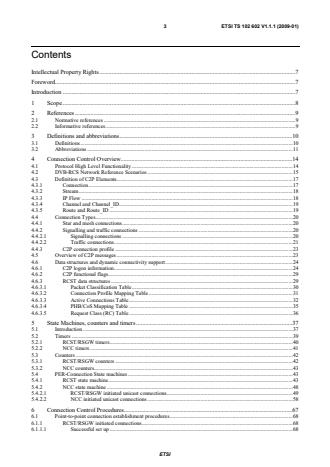
Contents
Intellectual Property Rights.7
Foreword.7
Introduction .7
1 Scope.8
2 References.9
2.1 Normative references.9
2.2 Informative references.9
3 Definitions and abbreviations.10
3.1 Definitions.10
3.2 Abbreviations.11
4 Connection Control Overview.14
4.1 Protocol High Level Functionality .14
4.2 DVB-RCS Network Reference Scenarios .15
4.3 Definition of C2P Elements.17
4.3.1 Connection.17
4.3.2 Stream.18
4.3.3 IP Flow.18
4.3.4 Channel and Channel_ID.19
4.3.5 Route and Route_ID .19
4.4 Connection Types.20
4.4.1 Star and mesh connections.20
4.4.2 Signalling and traffic connections .20
4.4.2.1 Signalling connections.20
4.4.2.2 Traffic connections.21
4.4.3 C2P connection profile .23
4.5 Overview of C2P messages.23
4.6 Data structures and dynamic connectivity support.24
4.6.1 C2P logon information.24
4.6.2 C2P functional flags.29
4.6.3 RCST data structures .29
4.6.3.1 Packet Classification Table .30
4.6.3.2 Connection Profile Mapping Table.31
4.6.3.3 Active Connections Table.32
4.6.3.4 PHB/CoS Mapping Table .35
4.6.3.5 Request Class (RC) Table .36
5 State Machines, counters and timers .37
5.1 Introduction.37
5.2 Timers.39
5.2.1 RCST/RSGW timers.40
5.2.2 NCC timers.41
5.3 Counters.42
5.3.1 RCST/RSGW counters.42
5.3.2 NCC counters.43
5.4 PER-Connection State machines.43
5.4.1 RCST state machine.43
5.4.2 NCC state machine .48
5.4.2.1 RCST/RSGW initiated unicast connections.49
5.4.2.2 NCC initiated unicast connections .58
6 Connection Control Procedures.67
6.1 Point-to-point connection establishment procedures.68
6.1.1 RCST/RSGW initiated connections.68
6.1.1.1 Successful set up.68
ETSI
4 ETSI TS 102 602 V1.1.1 (2009-01)
6.1.1.2 Successful set up - Resolved cross connection.70
6.1.2 NCC initiated connections .73
6.2 Point-to-multipoint connection establishment procedures .74
6.2.1 RCST/RSGW initiated connections.74
6.2.2 NCC initiated connections .75
6.3 Point-to-point Connection release procedures.76
6.3.1 RCST/RSGW initiated connections.77
6.3.1.1 Successful release by the RCST/RSGW .77
6.3.1.2 Successful release by the NCC.78
6.3.2 NCC initiated connections .79
6.4 Point-to-multipoint connection release procedures .80
6.4.1 RCST/RSGW initiated connections.80
6.4.2 NCC initiated connections .81
6.5 Point-to-point connection modify procedures (rate change) .82
6.5.1 RCST/RSGW initiated connections.83
6.5.2 NCC initiated connections .84
6.6 Point-to-multipoint connection modify procedures (rate change) .84
6.6.1 RCST/RSGW initiated connections.85
6.6.2 NCC initiated connections .86
6.7 RC modify procedures.86
6.7.1 RCST/RSGW initiated RC modify.87
6.7.2 NCC initiated RC modify .88
6.8 RCST Capability request/response procedures .88
6.8.1 RCST/RSGW initiated RCST Capability request.89
6.8.2 NCC initiated RCST Capability request .89
7 Connection Control Messages Formatting.90
7.1 Overview.90
7.2 RCST to NCC messages (DULM) .90
7.2.1 DULM format.90
7.2.1.1 DULM with ATM formatting .90
7.2.1.2 DULM with MPEG formatting.92
7.2.2 Connection Control IE Types Description.94
7.2.2.1 Message Header IE .96
7.2.2.2 Cause IE.98
7.2.2.3 Channel_ID IE.99
7.2.2.4 Source/Destination Address IE.99
7.2.2.5 Forward/Return Stream Identifier IE .100
7.2.2.5.1 Applicability.100
7.2.2.5.2 MPEG2-TS stream.101
7.2.2.5.3 ATM stream.101
7.2.2.6 Connection Type IE .102
7.2.2.7 Forward/Return Profile IE.102
7.2.2.8 Route_ID IE.104
7.2.2.9 RC_Capacity_Parameters IE.104
7.2.2.10 Other_Group_and_Logon_ID IE .104
7.2.2.11 Other_Channel_ID IE.105
7.2.2.12 Other_Route_ID IE .105
7.2.2.13 IPv6_Source_Address/IPv6_Destination_Address IE .105
7.2.2.14 Connection_Inactivity_Timeout IE.106
7.2.2.15 Maximum_Packet_Size IE.106
7.2.2.16 Traffic_Spec_and_Policy_Data IE.106
7.2.2.17 RCST_Capability IE.106
7.2.2.18 MAC Destination Address IE .107
7.2.2.19 Connection_Status_Stats IE.107
7.3 NCC to RCST messages (TIMu).108
7.3.1 TIMu format.108
8 Connection Control Messages.110
8.1 Point-to-point connection establishment message.113
8.1.1 Connection Establishment Request (CnxEstReq).113
8.1.1.1 RCST/RSGW initiated unicast connection .113
ETSI
5 ETSI TS 102 602 V1.1.1 (2009-01)
8.1.1.1.1 From initiating RCST/RSGW to NCC (DULM).113
8.1.1.1.2 From NCC to peer RCST/RSGW (TIMu).114
8.1.1.2 NCC initiated unicast connection (TIMu).115
8.1.2 Connection Establishment Response (CnxEstResp).116
8.1.2.1 RCST/RSGW initiated unicast connection .116
8.1.2.1.1 From peer RCST/RSGW to NCC (DULM) .117
8.1.2.1.2 From NCC to initiating RCST/RSGW (TIM) .118
8.1.2.2 NCC initiated unicast connection.118
8.2 Point-to-multipoint connection establishment messages.120
8.2.1 Connection Establishment Request (CnxEstReq).121
8.2.1.1 RSGW initiated regenerative multicast connection .121
8.2.1.2 RCST initiated multicast connection.121
8.2.1.3 NCC initiated multicast connection .122
8.2.2 Connection Establishment Response (CnxEstResp).124
8.2.2.1 RSGW initiated regenerative multicast connection .124
8.2.2.2 RCST initiated multicast connection.125
8.2.2.3 NCC initiated multicast connection .126
8.3 Connection release messages.127
8.3.1 Connection Release Request (CnxRelReq).127
8.3.2 Connection Release Response (CnxRelResp).128
8.4 Connection modify messages.128
8.4.1 Connection Modify Request (CnxModReq) .129
8.4.2 Connection Modify Response (CnxModResp) .130
8.5 RC Modify messages.131
8.5.1 RC Modify Request (RCModReq) .131
8.5.2 RC Modify Response (RCModResp) .132
8.6 RCST Capability messages .132
8.6.1 RCST Capability Request (RCSTCapReq).132
8.6.2 RCST Capability Response (RCSTCapResp).133
8.7 Connection Status Stats Messages.135
8.7.1 Connection Status Stats Request (CnxStatusStatsReq).135
8.7.2 Connection Status Stats Response (CnxStatusStatsResp).136
Annex A (informative): C2P state machines .137
A.1 RCST PER-CONNECTION state machine.139
A.2 NCC PER-CONNECTION state machine .139
A.3 RCST PER-RC state machine .139
A.4 NCC PER-RC state machine.139
A.5 Example of the mapping between C2P UML, PER-ST and PER-CONNECTION state machines.139
Annex B (informative): C2P scenarios.141
Annex C (informative): Examples of C2P exception procedures.146
C.1 Point-to-point connection establishment procedures.146
C.1.1 RCST/RSGW initiated connections .146
C.1.1.1 Successful set up - Initiating RCST/RSGW retry.146
C.1.1.2 Successful set up - NCC retry.147
C.1.1.3 Unsuccessful set up - Peer RCST/RSGW responses lost.148
C.1.1.4 Unsuccessful set up - Peer RCST/RSGW does not get any NCC set up message.149
C.1.1.5 Unsuccessful set up - Initiating RCST/RSGW retry.150
C.1.1.6 Unsuccessful set up - NCC no answer.151
C.1.1.7 Unsuccessful set up - NCC reject .152
C.1.1.8 Unsuccessful set up - Peer RCST/RSGW reject.153
C.1.1.9 Unsuccessful set up - Initiating RCST/RSGW release .154
C.1.1.10 Unsuccessful set up - NCC release .155
C.1.1.11 Unsuccessful set up - Peer RCST/RSGW release.156
C.1.2 NCC initiated connections.157
C.1.2.1 Successful set up - NCC retry.157
ETSI
6 ETSI TS 102 602 V1.1.1 (2009-01)
C.1.2.2 Unsuccessful set-up - One of the peer parties does not answer the NCC's setup requests.158
C.1.2.3 Unsuccessful set-up - One of the peer parties does not answer the NCC's setup requests nor the
NCC's release requests.159
C.1.2.4 Unsuccessful set-up - One of the peer parties rejects the connection .160
C.1.2.5 Unsuccessful set-up - NCC release.161
C.2 Point-to-multipoint connection establishment procedures .162
C.2.1 RCST/RSGW initiated connections .162
C.2.1.1 Successful set-up: RCST/RSGW multicast source retry .162
C.2.1.2 Unsuccessful set-up: NCC reject .163
C.2.1.3 Unsuccessful set-up: RCST/RSGW multicast source release.163
C.2.1.4 Unsuccessful set-up: NCC release .164
C.2.1.5 Unsuccessful set-up: Multicast source retry .165
C.2.2 NCC initiated connections.166
C.2.2.1 Successful set-up: NCC retry.166
C.2.2.2 Unsuccessful set-up: Multicast source reject.167
C.2.2.3 Unsuccessful set-up: NCC release .167
C.2.2.4 Unsuccessful set-up: Multicast source no answer.168
C.2.2.5 Unsuccessful set-up: Logoff multicast source .169
C.3 Point-to-point Connection release procedures.170
C.3.1 RCST/RSGW initiated connections .170
C.3.1.1 Successful release by the RCST/RSGW: RCST/RSGW retry or NCC no answer .170
C.3.1.2 Successful release initiated by the RCST/RSGW: RCST/RSGW no answer .171
C.3.1.3 Successful release initiated by the NCC: NCC retry .172
C.3.1.4 Successful release by the NCC: Peer RCST/RSGW logoff.173
C.3.1.5 Successful release by the RCST/RSGW: NCC busy .173
C.4 Point-to-multipoint connection release procedures.175
C.4.1 RCST/RSGW initiated connections .175
C.4.1.1 Successful release by the multicast source: NCC's responses get lost.175
C.4.1.2 Successful release by the multicast source: Multicast source's requests get lost .176
C.4.1.3 Successful release: NCC busy .177
C.4.1.4 Unsuccessful release by the NCC (of an RCST/RSGW initiated connection): Multicast source no
answer.179
C.5 Point-to-point connection modify procedures (rate change) .180
C.5.1 RCST/RSGW initiated connections .180
C.5.1.1 Unsuccessful connection modify profile - NCC's responses get lost.180
C.5.2 NCC initiated connections.182
C.5.2.1 Unsuccessful connection modify: RCST A's responses get lost .182
C.6 Point-to-multipoint connection modify procedures (rate change).184
C.6.1 RCST/RSGW initiated connections .184
C.6.1.1 Unsuccessful connection modify profile - NCC's responses lost.184
C.6.2 NCC initiated connections.186
C.6.2.1 Unsuccessful connection modify: RCST/RSGW connection modify responses lost.186
C.7 RC modify procedures.187
C.7.1 RCST/RSGW initiated RC modify .187
C.7.1.1 Unsuccessful RC modify - NCC no answer.187
C.7.2 NCC initiated RC modify.189
C.7.2.1 Unsuccessful RC modify - RCST/RSGW no answer .189
C.8 RCST Capability procedures.192
C.8.1 RCST/RSGW initiated RCST Capability notify .192
C.8.1.1 Unsuccessful RCST/RSGW initiated RCST Capability notify.192
C.8.2 NCC initiated Capability Notify.193
C.8.2.1 Unsuccessful NCC initiated RCST Capability Notify.193
History .194
ETSI
7 ETSI TS 102 602 V1.1.1 (2009-01)
Intellectual Property Rights
IPRs essential or potentially essential to the present document may have been declared to ETSI. The information
pertaining to these essential IPRs, if any, is publicly available for ETSI members and non-members, and can be found
in ETSI SR 000 314: "Intellectual Property Rights (IPRs); Essential, or potentially Essential, IPRs notified to ETSI in
respect of ETSI standards", which is available from the ETSI Secretariat. Latest updates are available on the ETSI Web
server (http://webapp.etsi.org/IPR/home.asp).
Pursuant to the ETSI IPR Policy, no investigation, including IPR searches, has been carried out by ETSI. No guarantee
can be given as to the existence of other IPRs not referenced in ETSI SR 000 314 (or the updates on the ETSI Web
server) which are, or may be, or may become, essential to the present document.
Foreword
This Technical Specification (TS) has been produced by ETSI Technical Committee Satellite Earth Stations and
Systems (SES).
Introduction
The present document is the first published version of a converged C2P specification for DVB-RCS systems, bringing
together requirements for a range of different system scenarios. The present document is based on existing C2P
implementation but with several important extensions and changes.
Readers of the present document are therefore advised that the present document may be subject to changes in order to
incorporate any possible corrections that may result from the testing and verification of the first implementations of the
present document.
ETSI
8 ETSI TS 102 602 V1.1.1 (2009-01)
1 Scope
The present BSM document defines and specifies a Connection Control Protocol (C2P) for DVB-RCS satellite
networks, relying on specific DVB-RCS layer 2 signalling (DULM on the return link, unicast TIM on the forward link).
C2P is part of the control plane layer 2 functionality and is generally used for the dynamic establishment and
management of connections between the ground elements of DVB-RCS networks (RCSTs, Gateways, NCC), regardless
of their architectures and topologies (single-beam/multiple-beam architectures, transparent/regenerative satellite
payloads, star/mesh topologies). In this context C2P can be seen as a complement to the functionality of the interfaces
already defined in the DVB-RCS and DVB-S/S2 standards [1] and [i.1].
The present document is organized as follows:
• Clause 4 contains the description of the network reference scenarios (clause 4.2), of the C2P core elements
(clause 4.3), of the connection types (clause 4.4) and of various data structures for dynamic connectivity
support (clause 4.6).
• Clause 5 describes the state machines, including the timer and counter definitions and examples of state
machines diagrams.
• Clause 6 describes the normal procedures and a few examples of exception procedures.
• Clause 7 describes the C2P Information Elements (IEs).
• Clause 8 defines the C2P messages.
• Annex A includes the description of C2P State Machines in UML format.
• Annex B includes examples of C2P scenarios.
• Annex C provides additional examples of exception procedures.
• Annex D includes examples of the formatting of C2P messages.
Further and more detailed background information for C2P definition and specification is provided in the C2P TR
Background Information document [i.5].
The specifications in the present document apply to DVB-RCS network elements that are part of the same Interactive
Network (IN). The RCSTs in the IN are Type A RCSTs (clause 8.1.1 in [1]). All RCSTs are capable of transmitting in
ATM or MPEG2-TS formats and of receiving in MPEG2-TS format.
The present document defines Version 01 of the C2P Specifications. This is the first release of the C2P Specifications.
ETSI
9 ETSI TS 102 602 V1.1.1 (2009-01)
2 References
References are either specific (identified by date of publication and/or edition number or version number) or
non-specific.
• For a specific reference, subsequent revisions do not apply.
• Non-specific reference may be made only to a complete document or a part thereof and only in the following
cases:
- if it is accepted that it will be possible to use all future changes of the referenced document for the
purposes of the referring document;
- for informative references.
Referenced documents which are not found to be publicly available in the expected location might be found at
http://docbox.etsi.org/Reference.
NOTE: While any hyperlinks included in this clause were valid at the time of publication ETSI cannot guarantee
their long term validity.
2.1 Normative references
The following referenced documents are indispensable for the application of the present document. For dated
references, only the edition cited applies. For non-specific references, the latest edition of the referenced document
(including any amendments) applies.
[1] ETSI EN 301 790 (v1.5.1): "Digital Video Broadcasting (DVB); Interaction channel for satellite
distribution systems".
[2] ITU-T Recommendation I.363-5: "B-ISDN ATM Adaptation Layer specification : Type 5 AAL".
[3] ITU-T Recommendation H.222.0: "Information technology - Generic coding of moving pictures
and associated audio information: Systems".
[4] ITU-T Recommendation I.361: "B-ISDN ATM layer specification".
2.2 Informative references
The following referenced documents are not essential to the use of the present document but they assist the user with
regard to a particular subject area. For non-specific references, the latest version of the referenced document (including
any amendments) applies.
[i.1] ETSI EN 302 307: "Digital Video Broadcasting (DVB); Second generation framing structure,
channel coding and modulation systems for Broadcasting, Interactive Services, News Gathering
and other broadband satellite applications".
[i.2] ETSI TS 102 462: "Satellite Earth Stations and Systems (SES); Broadband Satellite Multimedia
(BSM); QoS Functional Architecture".
[i.3] SatLabs System Recommendations (v1):"Quality of Service Specifications".
NOTE: Available at http://satlabs.org.
[i.4] SatLabs System Recommendations (v1): "Management and Control Planes Specifications".
NOTE: Available at http://satlabs.org.
[i.5] ETSI TR 102 603: "Satellite Earth Stations and Systems (SES); Broadband Satellite Multimedia
(BSM); Connection Control Protocol (C2P) for DVB-RCS; Background Information".
[i.6] ETSI TR 101 790: "Digital Video Broadcasting (DVB); Interaction channel for Satellite
Distribution Systems; Guidelines for the use of EN 301 790".
ETSI
10 ETSI TS 102 602 V1.1.1 (2009-01)
[i.7] ETSI TS 102 429-2: "Satellite Earth Stations and Systems (SES); Broadband Satellite Multimedia
(BSM); Regenerative Satellite Mesh - B (RSM-B); DVB-S/DVB-RCS family for regenerative
satellites; Part 2: Satellite Link Control layer".
[i.8] UML Specification v. 1.1 (OMG document ad/97-08-11).
NOTE: Available at http://www.omg.org.
[i.9] IETF RFC 1112: "Host Extensions for IP Multicasting".
[i.10] SatLabs System Recommendations (v2.1).
NOTE: Available at http://satlabs.org.
[i.11] AmerHis System, Interactive Broadband DVB-RCS/S OBP Communication System.
NOTE: Available at http://telecom.esa.int.
[i.12] IETF draft-combes-ipdvb-mib-rcs-04.doc: "The DVB-RCS MIB".
[i.13] IETF RFC 1901: "Introduction to Community-based SNMPv2".
[i.14] IETF RFC 3416: "Version 2 of the Protocol Operations for the Simple Network Management
Protocol (SNMP)".
[i.15] IETF RFC 1518: "An Architecture for IP Address Allocation with CIDR".
[i.16] IETF RFC 4632: "Classless Inter-domain Routing (CIDR): The Internet Address Assignment and
Aggregation Plan".
3 Definitions and abbreviations
3.1 Definitions
For the purposes of the present document, the following terms and definitions apply:
Class of Service (CoS): defines a specific behaviour regarding traffic handling/forwarding; can be used to categorize
the traffic into different classes
connection: Layer 2 logical association between two or more network entities characterized by a C2P Class of Service
(C2P CoS)
Connection Control Protocol (C2P): protocol that provides the interaction between RCSTs and NCC to support the
set-up, modification and release of connections
control plane: part of a layered protocol architecture that, among other functions, is concerned with connection control
functions, including the signalling necessary to set up, supervise and release connections
Digital Video Broadcasting Return Channel by Satellite (DVB-RCS): protocol for an interaction (or return) channel
in satellite links
Digital Video Broadcasting via Satellite (DVB-S): protocol for broadcasting TV signals and, by extension, data over
satellite
gateway: general term to identify both the TSGW and the RSGW
Interactive Network (IN): group of terminals serviced by an NCC
IP flow: sequence of IP packets from an IP source to an IP destination
NOTE: An IP flow may be identified based on the following attributes: IP source and destination address,
protocol type, source and destination ports, class of service.
ETSI
11 ETSI TS 102 602 V1.1.1 (2009-01)
management plane: part of a layered protocol architecture that provides two types of functions, namely layer
management and plane management functions
Management Station (MS): network element that manage
...
Questions, Comments and Discussion
Ask us and Technical Secretary will try to provide an answer. You can facilitate discussion about the standard in here.
Loading comments...