

ETSI EN 302 208 V3.4.1 (2023-10)
Radio Frequency Identification Equipment operating in the band 865 MHz to 868 MHz with power levels up to 2 W and in the band 915 MHz to 921 MHz with power levels up to 4 W; Harmonised Standard for access to radio spectrum
General Information
- Abstract
REN/ERM-TG34-270
- Status
- Not Published
- Technical Committee
- ERM TG34 - ERM RF Identification Devices
- Current Stage
- 12 - Delivery to the EC
- Due Date
- 10-Jan-2024
- Completion Date
- 05-Feb-2024
Buy Documents
ETSI EN 302 208 V3.4.0 (2022-06) - Radio Frequency Identification Equipment operating in the band 865 MHz to 868 MHz with power levels up to 2 W and in the band 915 MHz to 921 MHz with power levels up to 4 W; Harmonised Standard for access to radio spectrum
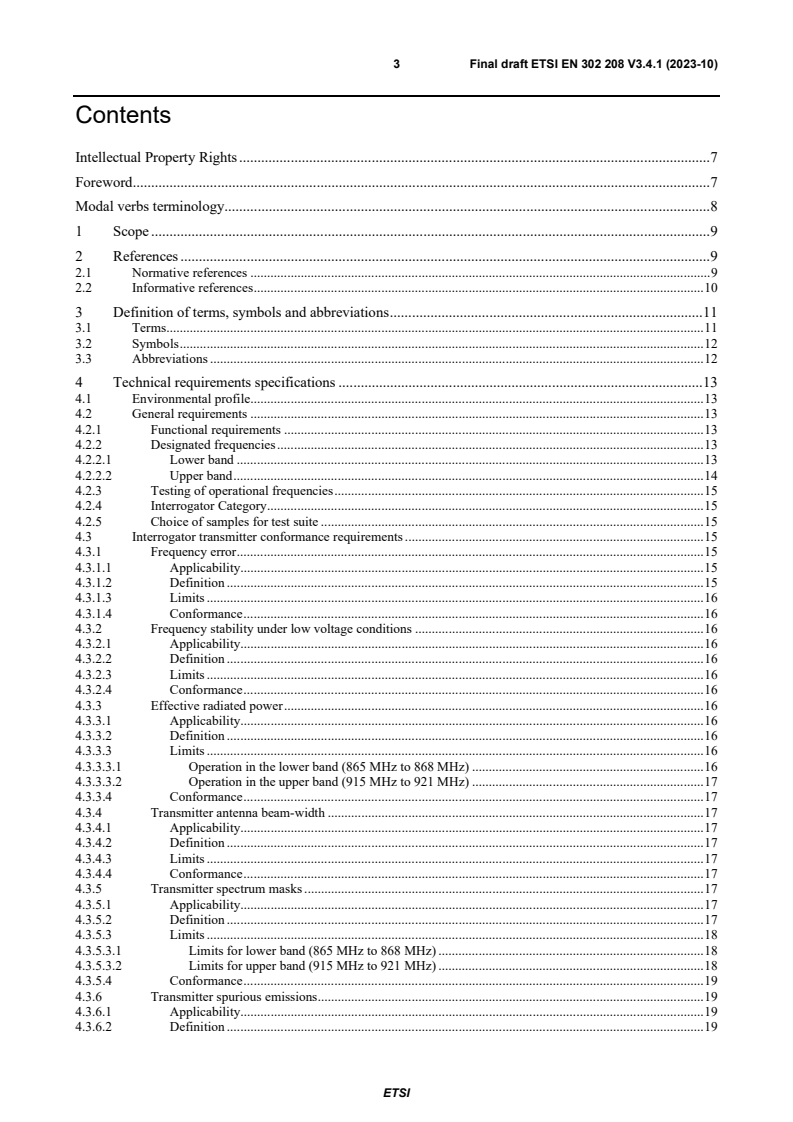
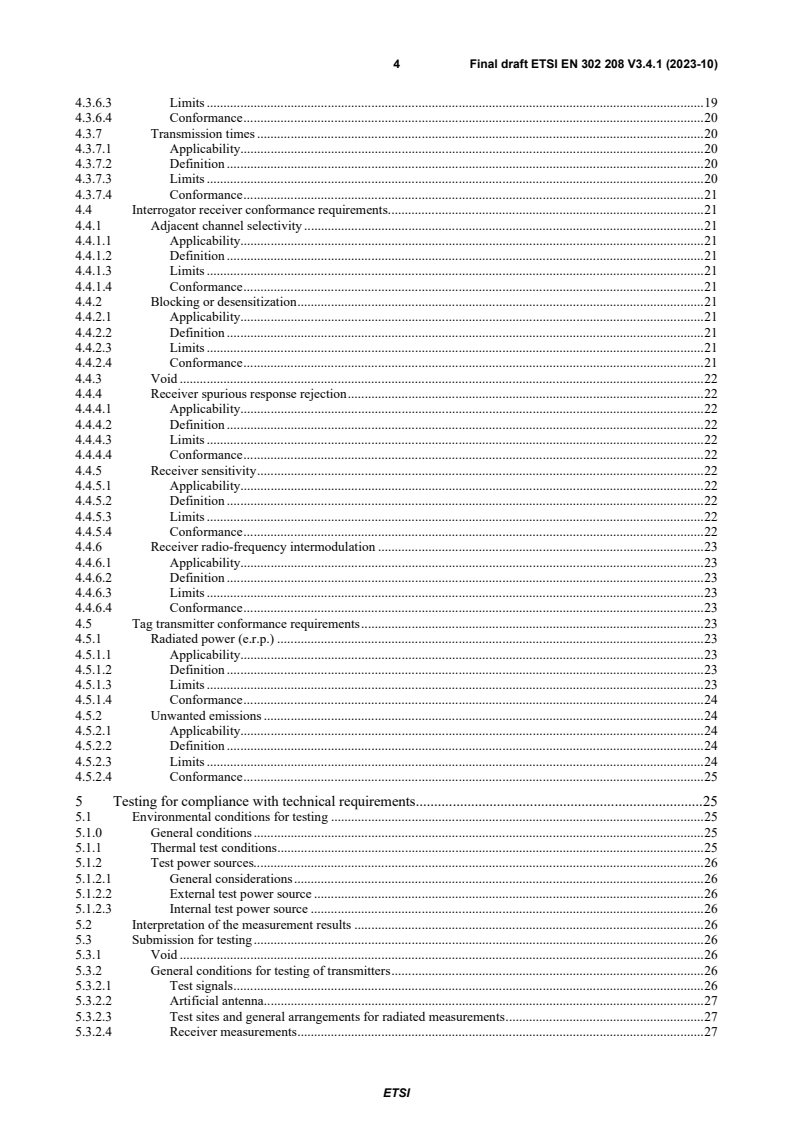
ETSI EN 302 208 V3.4.1 (2023-10) - Radio Frequency Identification Equipment operating in the band 865 MHz to 868 MHz with power levels up to 2 W and in the band 915 MHz to 921 MHz with power levels up to 4 W; Harmonised Standard for access to radio spectrum
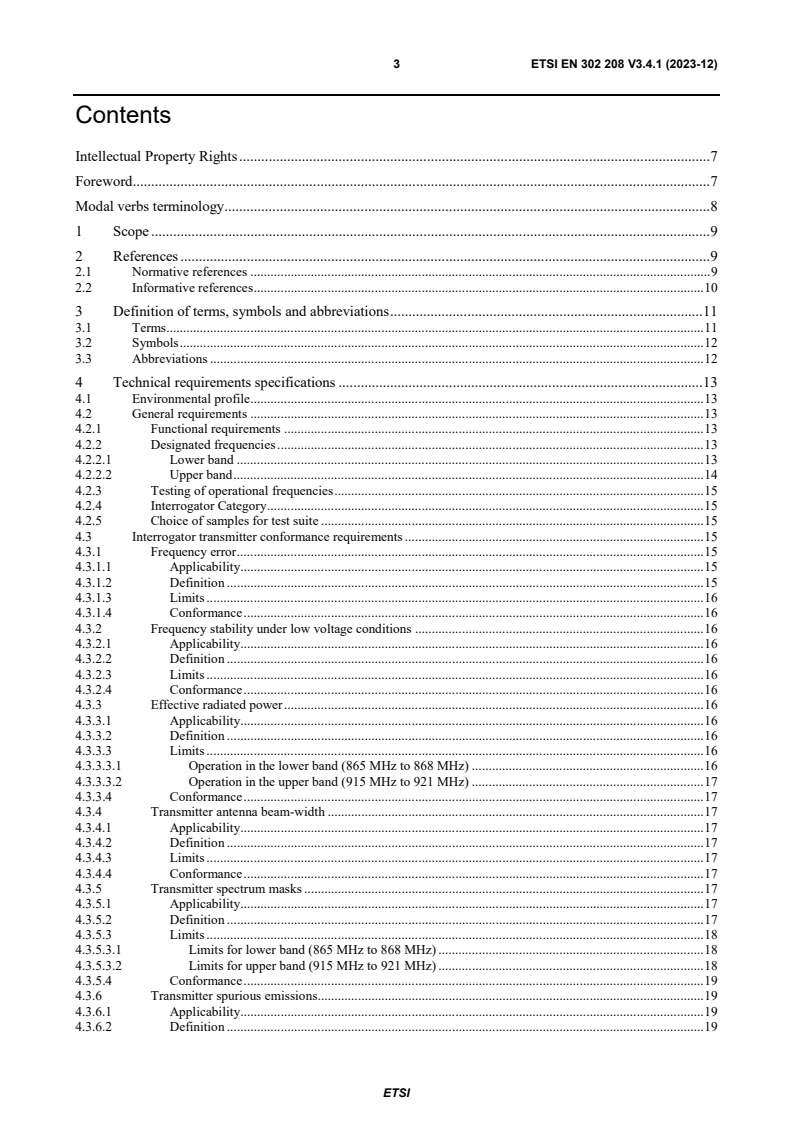
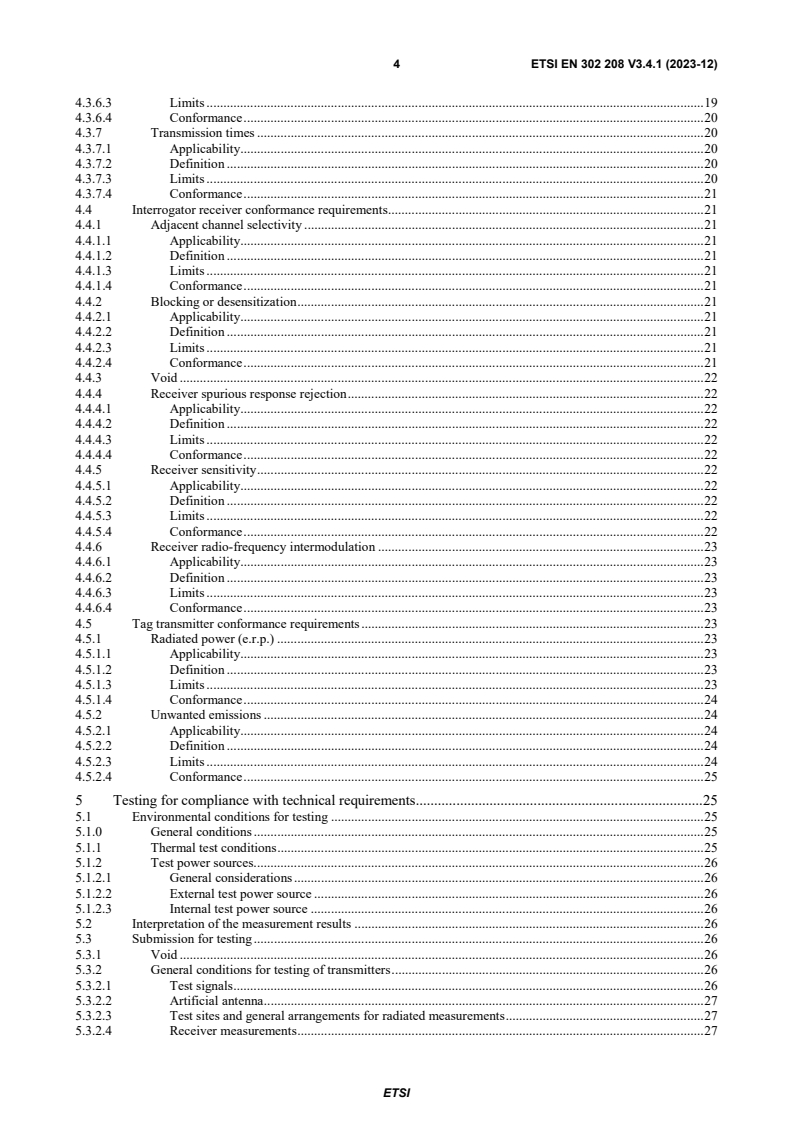
ETSI EN 302 208 V3.4.1 (2023-12) - Radio Frequency Identification Equipment operating in the band 865 MHz to 868 MHz with power levels up to 2 W and in the band 915 MHz to 921 MHz with power levels up to 4 W; Harmonised Standard for access to radio spectrum

Overview
ETSI EN 302 208 V3.4.1 (2023-10) (identical to ETSI EN 302 208 V3.4.1) is a harmonised European standard that specifies technical characteristics and measurement methods for Radio Frequency Identification (RFID) equipment operating in the 865–868 MHz and 915–921 MHz bands. It defines radio performance and conformance requirements for RFID interrogators (readers) and tags, with maximum power levels of 2 W e.r.p. in the 865–868 MHz band and 4 W e.r.p. in the 915–921 MHz band. The standard supports EU-wide spectrum access decisions and aims to ensure efficient use of the radio spectrum while avoiding harmful interference.
Key Topics and Technical Requirements
The document covers both functional and measurement requirements for RFID systems (interrogators + tags). Major technical topics include:
- Designated frequencies and testing of operational frequency ranges (tables list applicable ranges and channels)
- Power limits: up to 2 W e.r.p. (865–868 MHz) and up to 4 W e.r.p. (915–921 MHz)
- Interrogator categories: fixed and portable interrogators, with integral or external antennas
- Tag types: batteryless, battery-assisted, and battery-powered tags
- Transmitter requirements: frequency error, frequency stability, effective radiated power (e.r.p.), antenna beam‑width, transmitter spectrum masks and spurious emissions
- Receiver requirements: adjacent channel selectivity, blocking/desensitization, spurious response rejection, sensitivity, intermodulation performance
- Operational limits: transmission times and duty-cycle related constraints
- Measurement methods: specified conformance tests and sample selection for test suites
- Regulatory alignment: relationship to Article 3.2 of Radio Equipment Directive (2014/53/EU) is given (see annex A)
Applications and Who Uses This Standard
This harmonised standard is essential for stakeholders involved in development, deployment and compliance of UHF RFID systems:
- RFID manufacturers designing interrogators and tag products to meet EU spectrum access rules
- Test and certification laboratories performing conformance testing and EMC/radio assessments
- System integrators implementing UHF RFID for logistics, inventory, tolling, retail, access control, and industrial IoT applications
- Regulatory bodies and spectrum managers ensuring harmonised deployment and interference mitigation
- Compliance and RF engineers documenting e.r.p., spectrum masks and receiver performance for CE marking
Related Standards and Regulatory References
- Decision (EU) 2017/1483 (865–868 MHz usage conditions)
- Decision (EU) 2018/1538 (915–921 MHz usage conditions; limited EU implementation and 3-channel requirement)
- ERC Recommendation 70‑03 (country implementation overview for 915–921 MHz)
- Directive 2014/53/EU (Radio Equipment Directive) - Article 3.2 mapping in annex A
Keywords: RFID standard, 865 MHz, 868 MHz, 915 MHz, 921 MHz, 2 W e.r.p., 4 W e.r.p., harmonised standard, radio spectrum, interrogators, tags, ETSI, EU spectrum decision.
Buy Documents
ETSI EN 302 208 V3.4.0 (2022-06) - Radio Frequency Identification Equipment operating in the band 865 MHz to 868 MHz with power levels up to 2 W and in the band 915 MHz to 921 MHz with power levels up to 4 W; Harmonised Standard for access to radio spectrum
ETSI EN 302 208 V3.4.1 (2023-10) - Radio Frequency Identification Equipment operating in the band 865 MHz to 868 MHz with power levels up to 2 W and in the band 915 MHz to 921 MHz with power levels up to 4 W; Harmonised Standard for access to radio spectrum
ETSI EN 302 208 V3.4.1 (2023-12) - Radio Frequency Identification Equipment operating in the band 865 MHz to 868 MHz with power levels up to 2 W and in the band 915 MHz to 921 MHz with power levels up to 4 W; Harmonised Standard for access to radio spectrum
Frequently Asked Questions
ETSI EN 302 208 V3.4.1 (2023-10) is a standard published by the European Telecommunications Standards Institute (ETSI). Its full title is "Radio Frequency Identification Equipment operating in the band 865 MHz to 868 MHz with power levels up to 2 W and in the band 915 MHz to 921 MHz with power levels up to 4 W; Harmonised Standard for access to radio spectrum". This standard covers: REN/ERM-TG34-270
REN/ERM-TG34-270
ETSI EN 302 208 V3.4.1 (2023-10) is available in PDF format for immediate download after purchase. The document can be added to your cart and obtained through the secure checkout process. Digital delivery ensures instant access to the complete standard document.
Standards Content (Sample)
Draft ETSI EN 302 208 V3.4.0 (2022-06)
HARMONISED EUROPEAN STANDARD
Radio Frequency Identification Equipment operating in the
band 865 MHz to 868 MHz with power levels up to 2 W and
in the band 915 MHz to 921 MHz with power levels up to 4 W;
Harmonised Standard for access to radio spectrum
2 Draft ETSI EN 302 208 V3.4.0 (2022-06)
Reference
REN/ERM-TG34-270
Keywords
harmonised standard, ID, radio, RFID, SRD
ETSI
650 Route des Lucioles
F-06921 Sophia Antipolis Cedex - FRANCE
Tel.: +33 4 92 94 42 00 Fax: +33 4 93 65 47 16
Siret N° 348 623 562 00017 - APE 7112B
Association à but non lucratif enregistrée à la
Sous-Préfecture de Grasse (06) N° w061004871
Important notice
The present document can be downloaded from:
http://www.etsi.org/standards-search
The present document may be made available in electronic versions and/or in print. The content of any electronic and/or
print versions of the present document shall not be modified without the prior written authorization of ETSI. In case of any
existing or perceived difference in contents between such versions and/or in print, the prevailing version of an ETSI
deliverable is the one made publicly available in PDF format at www.etsi.org/deliver.
Users of the present document should be aware that the document may be subject to revision or change of status.
Information on the current status of this and other ETSI documents is available at
https://portal.etsi.org/TB/ETSIDeliverableStatus.aspx
If you find errors in the present document, please send your comment to one of the following services:
https://portal.etsi.org/People/CommiteeSupportStaff.aspx
If you find a security vulnerability in the present document, please report it through our
Coordinated Vulnerability Disclosure Program:
https://www.etsi.org/standards/coordinated-vulnerability-disclosure
Notice of disclaimer & limitation of liability
The information provided in the present deliverable is directed solely to professionals who have the appropriate degree of
experience to understand and interpret its content in accordance with generally accepted engineering or
other professional standard and applicable regulations.
No recommendation as to products and services or vendors is made or should be implied.
In no event shall ETSI be held liable for loss of profits or any other incidental or consequential damages.
Any software contained in this deliverable is provided "AS IS" with no warranties, express or implied, including but not
limited to, the warranties of merchantability, fitness for a particular purpose and non-infringement of intellectual property
rights and ETSI shall not be held liable in any event for any damages whatsoever (including, without limitation, damages
for loss of profits, business interruption, loss of information, or any other pecuniary loss) arising out of or related to the use
of or inability to use the software.
Copyright Notification
No part may be reproduced or utilized in any form or by any means, electronic or mechanical, including photocopying and
microfilm except as authorized by written permission of ETSI.
The content of the PDF version shall not be modified without the written authorization of ETSI.
The copyright and the foregoing restriction extend to reproduction in all media.
© ETSI 2022.
All rights reserved.
ETSI
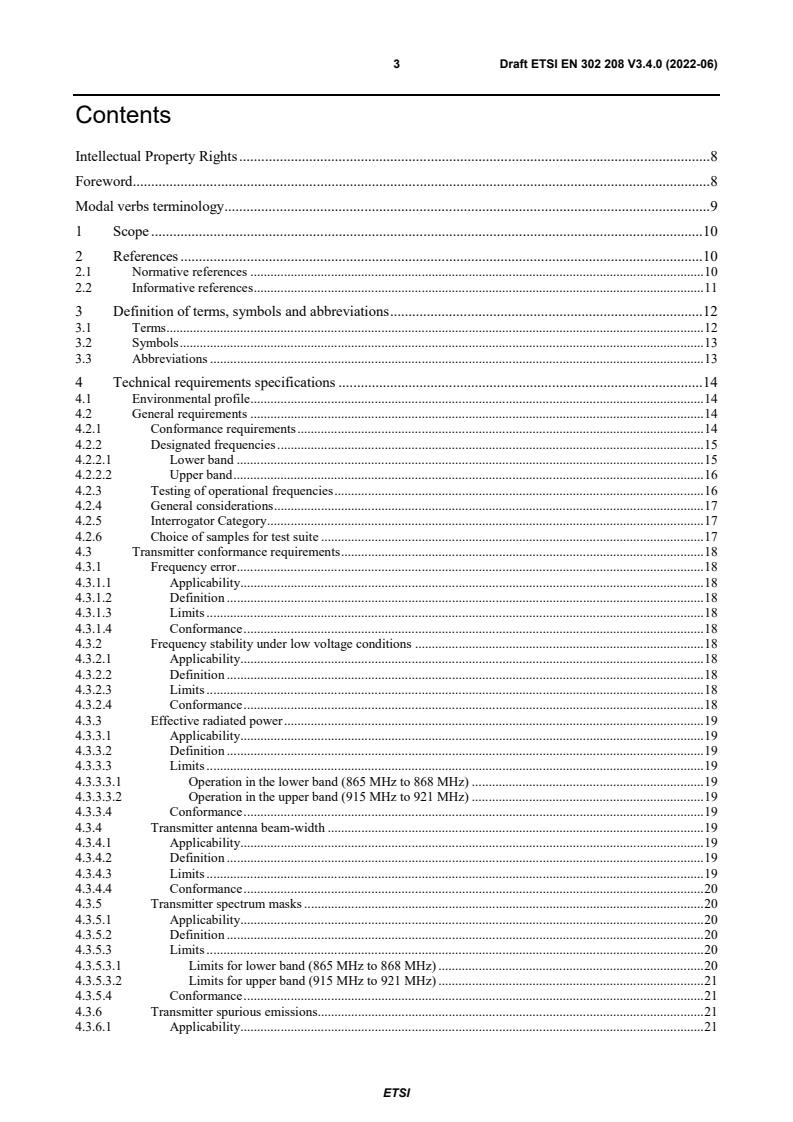
3 Draft ETSI EN 302 208 V3.4.0 (2022-06)
Contents
Intellectual Property Rights . 8
Foreword . 8
Modal verbs terminology . 9
1 Scope . 10
2 References . 10
2.1 Normative references . 10
2.2 Informative references . 11
3 Definition of terms, symbols and abbreviations . 12
3.1 Terms . 12
3.2 Symbols . 13
3.3 Abbreviations . 13
4 Technical requirements specifications . 14
4.1 Environmental profile . 14
4.2 General requirements . 14
4.2.1 Conformance requirements . 14
4.2.2 Designated frequencies . 15
4.2.2.1 Lower band . 15
4.2.2.2 Upper band . 16
4.2.3 Testing of operational frequencies . 16
4.2.4 General considerations . 17
4.2.5 Interrogator Category . 17
4.2.6 Choice of samples for test suite . 17
4.3 Transmitter conformance requirements . 18
4.3.1 Frequency error . 18
4.3.1.1 Applicability. 18
4.3.1.2 Definition . 18
4.3.1.3 Limits . 18
4.3.1.4 Conformance . 18
4.3.2 Frequency stability under low voltage conditions . 18
4.3.2.1 Applicability. 18
4.3.2.2 Definition . 18
4.3.2.3 Limits . 18
4.3.2.4 Conformance . 18
4.3.3 Effective radiated power . 19
4.3.3.1 Applicability. 19
4.3.3.2 Definition . 19
4.3.3.3 Limits . 19
4.3.3.3.1 Operation in the lower band (865 MHz to 868 MHz) . 19
4.3.3.3.2 Operation in the upper band (915 MHz to 921 MHz) . 19
4.3.3.4 Conformance . 19
4.3.4 Transmitter antenna beam-width . 19
4.3.4.1 Applicability. 19
4.3.4.2 Definition . 19
4.3.4.3 Limits . 19
4.3.4.4 Conformance . 20
4.3.5 Transmitter spectrum masks . 20
4.3.5.1 Applicability. 20
4.3.5.2 Definition . 20
4.3.5.3 Limits . 20
4.3.5.3.1 Limits for lower band (865 MHz to 868 MHz) . 20
4.3.5.3.2 Limits for upper band (915 MHz to 921 MHz) . 21
4.3.5.4 Conformance . 21
4.3.6 Transmitter spurious emis sions . 21
4.3.6.1 Applicability. 21
ETSI
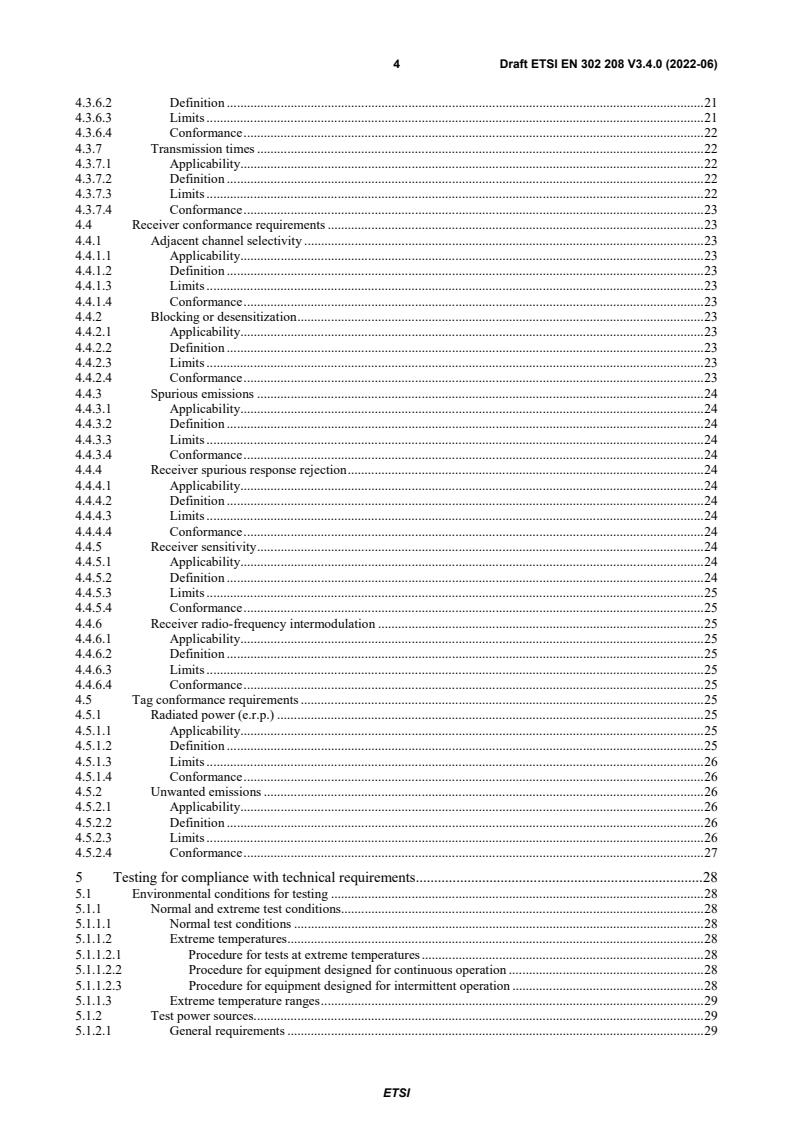
4 Draft ETSI EN 302 208 V3.4.0 (2022-06)
4.3.6.2 Definition . 21
4.3.6.3 Limits . 21
4.3.6.4 Conformance . 22
4.3.7 Transmission times . 22
4.3.7.1 Applicability. 22
4.3.7.2 Definition . 22
4.3.7.3 Limits . 22
4.3.7.4 Conformance . 23
4.4 Receiver conformance requirements . 23
4.4.1 Adjacent channel selectivity . 23
4.4.1.1 Applicability. 23
4.4.1.2 Definition . 23
4.4.1.3 Limits . 23
4.4.1.4 Conformance . 23
4.4.2 Blocking or desensitization . 23
4.4.2.1 Applicability. 23
4.4.2.2 Definition . 23
4.4.2.3 Limits . 23
4.4.2.4 Conformance . 23
4.4.3 Spurious emissions . 24
4.4.3.1 Applicability. 24
4.4.3.2 Definition . 24
4.4.3.3 Limits . 24
4.4.3.4 Conformance . 24
4.4.4 Receiver spurious response rejection . 24
4.4.4.1 Applicability. 24
4.4.4.2 Definition . 24
4.4.4.3 Limits . 24
4.4.4.4 Conformance . 24
4.4.5 Receiver sensitivity . 24
4.4.5.1 Applicability. 24
4.4.5.2 Definition . 24
4.4.5.3 Limits . 25
4.4.5.4 Conformance . 25
4.4.6 Receiver radio-frequency intermodulation . 25
4.4.6.1 Applicability. 25
4.4.6.2 Definition . 25
4.4.6.3 Limits . 25
4.4.6.4 Conformance . 25
4.5 Tag conformance requirements . 25
4.5.1 Radiated power (e.r.p.) . 25
4.5.1.1 Applicability. 25
4.5.1.2 Definition . 25
4.5.1.3 Limits . 26
4.5.1.4 Conformance . 26
4.5.2 Unwanted emissions . 26
4.5.2.1 Applicability. 26
4.5.2.2 Definition . 26
4.5.2.3 Limits . 26
4.5.2.4 Conformance . 27
5 Testing for compliance with technical requirements . 28
5.1 Environmental conditions for testing . 28
5.1.1 Normal and extreme test conditions. 28
5.1.1.1 Normal test conditions . 28
5.1.1.2 Extreme temperatures . 28
5.1.1.2.1 Procedure for tests at extreme temperatures . 28
5.1.1.2.2 Procedure for equipment designed for continuous operation . 28
5.1.1.2.3 Procedure for equipment designed for intermittent operation . 28
5.1.1.3 Extreme temperature ranges . 29
5.1.2 Test power sources. 29
5.1.2.1 General requirements . 29
ETSI
5 Draft ETSI EN 302 208 V3.4.0 (2022-06)
5.1.2.2 Normal test power source . 29
5.1.2.2.1 Mains voltage . 29
5.1.2.2.2 Regulated lead-acid battery power sources . 29
5.1.2.2.3 Other power sources . 30
5.1.2.3 Extreme test power source . 30
5.1.2.3.1 Mains voltage . 30
5.1.2.3.2 Regulated lead-acid battery power sources and gel-cell battery power sources . 30
5.1.2.3.3 Power sources using other types of batteries . 30
5.1.2.3.4 Other power sources . 30
5.1.3 Testing under extreme conditions . 30
5.2 Interpretation of the measurement results . 30
5.3 Submission of equipment for testing . 31
5.3.1 Mechanical and electrical design . 31
5.3.1.1 General requirements . 31
5.3.1.2 Controls . 31
5.3.1.3 Transmitter shut-off facility . 31
5.3.1.4 Battery saving circuit . 31
5.3.1.5 Declarations by the manufacturer . 31
5.3.1.6 Auxiliary test equipment . 31
5.3.2 General conditions for testing of transmitters . 31
5.3.2.1 Normal test signals and test modulation. 31
5.3.2.2 Normal test signals for data . 31
5.3.2.3 Artificial antenna . 31
5.3.2.4 Modes of operation of the transmitter . 32
5.3.2.5 Test sites and general arrangements for radiated measurements . 32
5.3.2.6 Measuring receiver . 32
5.3.2.7 Testing of operational frequencies . 32
5.4 Presentation of equipment for testing . 32
5.4.1 General requirements . 32
5.4.2 Choice of model for testing . 32
5.4.3 Provisions of samples for testing . 33
5.4.4 Equipment without an internal permanent or temporary antenna connector . 33
5.4.5 Test fixture . 33
5.4.6 Submission of additional equipment with a temporary antenna connector . 33
5.4.7 Void . 34
5.4.8 Adjustable carrier levels . 34
5.4.9 Test mode. 34
5.5 Essential transmitter test suites . 34
5.5.1 Measurement of frequency error for mains operated equipment . 34
5.5.2 Frequency stability under low voltage conditions . 34
5.5.3 Effective radiated power (e.r.p.) . 35
5.5.3.1 General . 35
5.5.3.2 Method of measurement . 35
5.5.3.2.1 General . 35
5.5.3.2.2 Radiated measurement . 35
5.5.3.2.3 Conducted measurement. 36
5.5.4 Transmitter antenna beam-width . 37
5.5.4.1 General . 37
5.5.4.2 Radiated measurement . 37
5.5.5 Transmitter spectrum mask . 38
5.5.5.1 Method of measurement . 38
5.5.6 Transmitter spurious emis sions . 39
5.5.6.1 Method of measurement . 39
5.5.6.2 Method of measuring the spurious power level in a specified load, clause 5.5.6.1 a) i) . 39
5.5.6.3 Method of measuring the spurious effective radiated power, clause 5.5.6.1 a) ii) . 40
5.5.6.4 Method of measuring spurious effective radiated power, clause 5.5.6.1 b) . 41
5.5.7 Transmission times . 41
5.5.7.1 Method of measurement . 41
5.5.8 Void . 42
5.5.9 Channel use . 42
5.5.9.1 Method of measurement . 42
5.6 Essential receiver test suites . 43
ETSI
6 Draft ETSI EN 302 208 V3.4.0 (2022-06)
5.6.1 Adjacent channel selectivity . 43
5.6.1.1 General . 43
5.6.1.2 Method 1: Measuring radiated signals . 43
5.6.1.3 Method 2: Conducted method of measurement. 44
5.6.2 Blocking or desensitization . 45
5.6.2.1 General . 45
5.6.2.2 Method 1: Measuring radiated signals . 45
5.6.2.3 Method 2: Conducted method of measurement. 46
5.6.3 Receiver spurious response rejection . 47
5.6.3.1 General . 47
5.6.3.2 Method 1: Measuring radiated signals . 47
5.6.3.3 Method 2: Conducted method of measurement. 48
5.6.4 Receiver sensitivity . 49
5.6.4.1 Method of measurement . 49
5.6.5 Receiver radio-frequency intermodulation . 50
5.6.5.1 General . 50
5.6.5.2 Method 1: Measuring radiated signals . 50
5.6.5.3 Method 2: Conducted method of measurement. 52
5.7 Essential tag test suites . 53
5.7.1 Tag radiated power (e.r.p.) . 53
5.7.1.1 General Requirements . 53
5.7.1.2 Measurement setup. 53
5.7.1.3 Method of measuring the power in an un-modulated sub-carrier, clause 5.7.1.1 a) . 54
5.7.1.4 Method of measuring the power in a modulated sub-carrier, clause 5.7.1.1 b) . 55
5.7.2 Unwanted emissions . 56
5.7.2.1 Method of measurement . 56
Annex A (informative): Relationship between the present document and the essential
requirements of Directive 2014/53/EU . 59
Annex B (normative): Radiated measurement . 61
B.1 Test sites and general arrangements for measurements involving the use of radiated fields . 61
B.1.1 General . 61
B.1.2 Anechoic chamber . 61
B.1.3 Anechoic chamber with a conductive ground plane . 62
B.1.4 Open Area Test Site (OATS) . 63
B.1.5 Test antenna . 64
B.1.6 Substitution antenna . 64
B.1.7 Measuring antenna . 65
B.1.8 Stripline arrangement . 65
B.1.8.1 General . 65
B.1.8.2 Description . 65
B.1.8.3 Calibration . 65
B.1.8.4 Mode of use . 65
B.2 Guidance on the use of radiation test sites . 65
B.2.1 General . 65
B.2.2 Verification of the test site . 66
B.2.3 Preparation of the EUT . 66
B.2.4 Power supplies to the EUT . 66
B.2.5 Range length . 66
B.2.6 Site preparation . 67
B.3 Coupling of signals . 67
B.3.1 General . 67
B.3.2 Data signals . 67
B.4 Standard test position . 68
B.5 Test fixture . 68
B.5.1 General . 68
B.5.2 Description . 68
B.5.3 Calibration . 69
ETSI
7 Draft ETSI EN 302 208 V3.4.0 (2022-06)
B.5.4 Mode of use . 70
Annex C (normative): Void . 71
Annex D (informative): Measurement uncertainty . 72
Annex E (informative): Receiver parameter assessment . 73
Annex F (informative): Bibliography . 74
Annex G (informative): Change history . 75
History . 76
ETSI
8 Draft ETSI EN 302 208 V3.4.0 (2022-06)
Intellectual Property Rights
Essential patents
IPRs essential or potentially essential to normative deliverables may have been declared to ETSI. The declarations
pertaining to these essential IPRs, if any, are publicly available for ETSI members and non-members, and can be
found in ETSI SR 000 314: "Intellectual Property Rights (IPRs); Essential, or potentially Essential, IPRs notified to
ETSI in respect of ETSI standards", which is available from the ETSI Secretariat. Latest updates are available on the
ETSI Web server (https://ipr.etsi.org/).
Pursuant to the ETSI Directives including the ETSI IPR Policy, no investigation regarding the essentiality of IPRs,
including IPR searches, has been carried out by ETSI. No guarantee can be given as to the existence of other IPRs not
referenced in ETSI SR 000 314 (or the updates on the ETSI Web server) which are, or may be, or may become,
essential to the present document.
Trademarks
The present document may include trademarks and/or tradenames which are asserted and/or registered by their owners.
ETSI claims no ownership of these except for any which are indicated as being the property of ETSI, and conveys no
right to use or reproduce any trademark and/or tradename. Mention of those trademarks in the present document does
not constitute an endorsement by ETSI of products, services or organizations associated with those trademarks.
DECT™, PLUGTESTS™, UMTS™ and the ETSI logo are trademarks of ETSI registered for the benefit of its
Members. 3GPP™ and LTE™ are trademarks of ETSI registered for the benefit of its Members and of the 3GPP
Organizational Partners. oneM2M™ logo is a trademark of ETSI registered for the benefit of its Members and of the ®
oneM2M Partners. GSM and the GSM logo are trademarks registered and owned by the GSM Association.
Foreword
This draft Harmonised European Standard (EN) has been produced by ETSI Technical Committee Electromagnetic
compatibility and Radio spectrum Matters (ERM), and is now submitted for the combined Public Enquiry and Vote
phase of the ETSI standards EN Approval Procedure.
The present document has been prepared under the Commission's standardisation request C(2015) 5376 final [i.10] to
provide one voluntary means of conforming to the essential requirements of Directive 2014/53/EU on the harmonisation
of the laws of the Member States relating to the making available on the market of radio equipment and repealing
Directive 1999/5/EC [i.3].
Once the present document is cited in the Official Journal of the European Union under that Directive, compliance with
the normative clauses of the present document given in table A.1 confers, within the limits of the scope of the present
document, a presumption of conformity with the corresponding essential requirements of that Directive and associated
EFTA regulations.
The present document replaces all previous versions of
...
Final draft ETSI EN 302 208 V3.4.1 (2023-10)
HARMONISED EUROPEAN STANDARD
Radio Frequency Identification Equipment operating in the
band 865 MHz to 868 MHz with power levels up to 2 W and
in the band 915 MHz to 921 MHz with power levels up to 4 W;
Harmonised Standard for access to radio spectrum
2 Final draft ETSI EN 302 208 V3.4.1 (2023-10)
Reference
REN/ERM-TG34-270
Keywords
harmonised standard, ID, radio, RFID, SRD
ETSI
650 Route des Lucioles
F-06921 Sophia Antipolis Cedex - FRANCE
Tel.: +33 4 92 94 42 00 Fax: +33 4 93 65 47 16
Siret N° 348 623 562 00017 - APE 7112B
Association à but non lucratif enregistrée à la
Sous-Préfecture de Grasse (06) N° w061004871
Important notice
The present document can be downloaded from:
https://www.etsi.org/standards-search
The present document may be made available in electronic versions and/or in print. The content of any electronic and/or
print versions of the present document shall not be modified without the prior written authorization of ETSI. In case of any
existing or perceived difference in contents between such versions and/or in print, the prevailing version of an ETSI
deliverable is the one made publicly available in PDF format at www.etsi.org/deliver.
Users of the present document should be aware that the document may be subject to revision or change of status.
Information on the current status of this and other ETSI documents is available at
https://portal.etsi.org/TB/ETSIDeliverableStatus.aspx
If you find errors in the present document, please send your comment to one of the following services:
https://portal.etsi.org/People/CommiteeSupportStaff.aspx
If you find a security vulnerability in the present document, please report it through our
Coordinated Vulnerability Disclosure Program:
https://www.etsi.org/standards/coordinated-vulnerability-disclosure
Notice of disclaimer & limitation of liability
The information provided in the present deliverable is directed solely to professionals who have the appropriate degree of
experience to understand and interpret its content in accordance with generally accepted engineering or
other professional standard and applicable regulations.
No recommendation as to products and services or vendors is made or should be implied.
In no event shall ETSI be held liable for loss of profits or any other incidental or consequential damages.
Any software contained in this deliverable is provided "AS IS" with no warranties, express or implied, including but not
limited to, the warranties of merchantability, fitness for a particular purpose and non-infringement of intellectual property
rights and ETSI shall not be held liable in any event for any damages whatsoever (including, without limitation, damages
for loss of profits, business interruption, loss of information, or any other pecuniary loss) arising out of or related to the use
of or inability to use the software.
Copyright Notification
No part may be reproduced or utilized in any form or by any means, electronic or mechanical, including photocopying and
microfilm except as authorized by written permission of ETSI.
The content of the PDF version shall not be modified without the written authorization of ETSI.
The copyright and the foregoing restriction extend to reproduction in all media.
© ETSI 2023.
All rights reserved.
ETSI
3 Final draft ETSI EN 302 208 V3.4.1 (2023-10)
Contents
Intellectual Property Rights . 7
Foreword . 7
Modal verbs terminology . 8
1 Scope . 9
2 References . 9
2.1 Normative references . 9
2.2 Informative references . 10
3 Definition of terms, symbols and abbreviations . 11
3.1 Terms . 11
3.2 Symbols . 12
3.3 Abbreviations . 12
4 Technical requirements specifications . 13
4.1 Environmental profile . 13
4.2 General requirements . 13
4.2.1 Functional requirements . 13
4.2.2 Designated frequencies . 13
4.2.2.1 Lower band . 13
4.2.2.2 Upper band . 14
4.2.3 Testing of operational frequencies . 15
4.2.4 Interrogator Category . 15
4.2.5 Choice of samples for test suite . 15
4.3 Interrogator transmitter conformance requirements . 15
4.3.1 Frequency error . 15
4.3.1.1 Applicability. 15
4.3.1.2 Definition . 15
4.3.1.3 Limits . 16
4.3.1.4 Conformance . 16
4.3.2 Frequency stability under low voltage conditions . 16
4.3.2.1 Applicability. 16
4.3.2.2 Definition . 16
4.3.2.3 Limits . 16
4.3.2.4 Conformance . 16
4.3.3 Effective radiated power . 16
4.3.3.1 Applicability. 16
4.3.3.2 Definition . 16
4.3.3.3 Limits . 16
4.3.3.3.1 Operation in the lower band (865 MHz to 868 MHz) . 16
4.3.3.3.2 Operation in the upper band (915 MHz to 921 MHz) . 17
4.3.3.4 Conformance . 17
4.3.4 Transmitter antenna beam-width . 17
4.3.4.1 Applicability. 17
4.3.4.2 Definition . 17
4.3.4.3 Limits . 17
4.3.4.4 Conformance . 17
4.3.5 Transmitter spectrum masks . 17
4.3.5.1 Applicability. 17
4.3.5.2 Definition . 17
4.3.5.3 Limits . 18
4.3.5.3.1 Limits for lower band (865 MHz to 868 MHz) . 18
4.3.5.3.2 Limits for upper band (915 MHz to 921 MHz) . 18
4.3.5.4 Conformance . 19
4.3.6 Transmitter spurious emissions . 19
4.3.6.1 Applicability. 19
4.3.6.2 Definition . 19
ETSI
4 Final draft ETSI EN 302 208 V3.4.1 (2023-10)
4.3.6.3 Limits . 19
4.3.6.4 Conformance . 20
4.3.7 Transmission times . 20
4.3.7.1 Applicability. 20
4.3.7.2 Definition . 20
4.3.7.3 Limits . 20
4.3.7.4 Conformance . 21
4.4 Interrogator receiver conformance requirements . 21
4.4.1 Adjacent channel selectivity . 21
4.4.1.1 Applicability. 21
4.4.1.2 Definition . 21
4.4.1.3 Limits . 21
4.4.1.4 Conformance . 21
4.4.2 Blocking or desensitization . 21
4.4.2.1 Applicability. 21
4.4.2.2 Definition . 21
4.4.2.3 Limits . 21
4.4.2.4 Conformance . 21
4.4.3 Void . 22
4.4.4 Receiver spurious response rejection . 22
4.4.4.1 Applicability. 22
4.4.4.2 Definition . 22
4.4.4.3 Limits . 22
4.4.4.4 Conformance . 22
4.4.5 Receiver sensitivity . 22
4.4.5.1 Applicability. 22
4.4.5.2 Definition . 22
4.4.5.3 Limits . 22
4.4.5.4 Conformance . 22
4.4.6 Receiver radio-frequency intermodulation . 23
4.4.6.1 Applicability. 23
4.4.6.2 Definition . 23
4.4.6.3 Limits . 23
4.4.6.4 Conformance . 23
4.5 Tag transmitter conformance requirements . 23
4.5.1 Radiated power (e.r.p.) . 23
4.5.1.1 Applicability. 23
4.5.1.2 Definition . 23
4.5.1.3 Limits . 23
4.5.1.4 Conformance . 24
4.5.2 Unwanted emissions . 24
4.5.2.1 Applicability. 24
4.5.2.2 Definition . 24
4.5.2.3 Limits . 24
4.5.2.4 Conformance . 25
5 Testing for compliance with technical requirements . 25
5.1 Environmental conditions for testing . 25
5.1.0 General conditions . 25
5.1.1 Thermal test conditions . 25
5.1.2 Test power sources. 26
5.1.2.1 General considerations . 26
5.1.2.2 External test power source . 26
5.1.2.3 Internal test power source . 26
5.2 Interpretation of the measurement results . 26
5.3 Submission for testing . 26
5.3.1 Void . 26
5.3.2 General conditions for testing of transmitters . 26
5.3.2.1 Test signals . 26
5.3.2.2 Artificial antenna . 27
5.3.2.3 Test sites and general arrangements for radiated measurements . 27
5.3.2.4 Receiver measurements . 27
ETSI
5 Final draft ETSI EN 302 208 V3.4.1 (2023-10)
5.3.2.5 Testing of operational frequencies . 27
5.4 Presentation of equipment for testing . 27
5.4.1 Void . 27
5.4.2 Choice of model for testing . 27
5.4.2.1 General considerations . 27
5.4.2.2 EUT with an external RF connector . 27
5.4.2.3 EUT without an external RF connector . 28
5.4.2.3.1 General Considerations . 28
5.4.2.3.2 EUT with an internal connector . 28
5.4.2.3.3 EUT with a temporary antenna connector . 28
5.4.2.3.4 Use of a Test Fixture . 28
5.4.3 Adjustable carrier levels . 28
5.4.4 Test mode. 28
5.5 Essential interrogator transmitter test suites . 29
5.5.1 Measurement of frequency error for mains operated equipment . 29
5.5.2 Frequency stability under low voltage conditions . 29
5.5.3 Effective radiated power (e.r.p.) . 30
5.5.3.1 General . 30
5.5.3.2 Method of measurement . 30
5.5.3.2.1 General . 30
5.5.3.2.2 Radiated measurement . 30
5.5.3.2.3 Conducted measurement. 31
5.5.4 Transmitter antenna beam-width . 32
5.5.4.1 General . 32
5.5.4.2 Radiated measurement . 32
5.5.5 Transmitter spectrum mask . 33
5.5.5.1 Method of measurement . 33
5.5.6 Transmitter spurious emissions . 34
5.5.6.1 Method of measurement . 34
5.5.6.2 Method of measuring the spurious power level in a specified load, clause 5.5.6.1 a) i) . 34
5.5.6.3 Method of measuring the spurious effective radiated power, clause 5.5.6.1 a) ii) . 35
5.5.6.4 Method of measuring spurious effective radiated power, clause 5.5.6.1 b) . 36
5.5.7 Transmission times . 36
5.5.7.1 Method of measurement . 36
5.5.8 Void . 37
5.5.9 Channel use . 37
5.5.9.1 Method of measurement . 37
5.6 Essential interrogator receiver test suites . 38
5.6.1 Adjacent channel selectivity . 38
5.6.1.1 General . 38
5.6.1.2 Method 1: Measuring radiated signals . 38
5.6.1.3 Method 2: Conducted method of measurement. 39
5.6.2 Blocking or desensitization . 40
5.6.2.1 General . 40
5.6.2.2 Method 1: Measuring radiated signals . 40
5.6.2.3 Method 2: Conducted method of measurement. 41
5.6.3 Receiver spurious response rejection . 42
5.6.3.1 General . 42
5.6.3.2 Method 1: Measuring radiated signals . 42
5.6.3.3 Method 2: Conducted method of measurement. 43
5.6.4 Receiver sensitivity . 44
5.6.4.1 Method of measurement . 44
5.6.5 Receiver radio-frequency intermodulation . 45
5.6.5.1 General . 45
5.6.5.2 Method 1: Measuring radiated signals . 45
5.6.5.3 Method 2: Conducted method of measurement. 46
5.7 Essential tag transmitter test suites . 48
5.7.1 Tag radiated power (e.r.p.) . 48
5.7.1.1 General Requirements . 48
5.7.1.2 Measurement setup. 48
5.7.1.3 Method of measuring the power in an un-modulated sub-carrier, clause 5.7.1.1 a) . 49
5.7.1.4 Method of measuring the power in a modulated sub-carrier, clause 5.7.1.1 b) . 50
ETSI
6 Final draft ETSI EN 302 208 V3.4.1 (2023-10)
5.7.2 Unwanted emissions . 51
5.7.2.1 Method of measurement . 51
Annex A (informative): Relationship between the present document and the essential
requirements of Directive 2014/53/EU . 54
Annex B (normative): Radiated measurement . 56
B.1 Test sites and general arrangements for measurements involving the use of radiated fields . 56
B.1.1 General . 56
B.1.2 Anechoic chamber . 56
B.1.3 Anechoic chamber with a conductive ground plane . 57
B.1.4 Open Area Test Site (OATS) . 58
B.1.5 Test antenna . 59
B.1.6 Substitution antenna . 59
B.1.7 Measuring antenna . 60
B.1.8 Stripline arrangement . 60
B.1.8.1 General . 60
B.1.8.2 Description . 60
B.1.8.3 Calibration . 60
B.1.8.4 Mode of use . 60
B.2 Guidance on the use of radiation test sites . 60
B.2.1 General . 60
B.2.2 Verification of the test site . 61
B.2.3 Preparation of the EUT . 61
B.2.4 Power supplies to the EUT . 61
B.2.5 Range length . 61
B.2.6 Site preparation . 62
B.3 Coupling of signals . 62
B.3.1 General . 62
B.3.2 Data signals . 62
B.4 Standard test position . 63
B.5 Test fixture . 63
B.5.1 General . 63
B.5.2 Description . 63
B.5.3 Calibration . 64
B.5.4 Mode of use . 65
Annex C (normative): Void . 66
Annex D (informative): Maximum measurement uncertainty . 67
Annex E (informative): Receiver parameter assessment . 68
Annex F (informative): Bibliography . 69
Annex G (informative): Change history . 70
History . 71
ETSI
7 Final draft ETSI EN 302 208 V3.4.1 (2023-10)
Intellectual Property Rights
Essential patents
IPRs essential or potentially essential to normative deliverables may have been declared to ETSI. The declarations
pertaining to these essential IPRs, if any, are publicly available for ETSI members and non-members, and can be
found in ETSI SR 000 314: "Intellectual Property Rights (IPRs); Essential, or potentially Essential, IPRs notified to
ETSI in respect of ETSI standards", which is available from the ETSI Secretariat. Latest updates are available on the
ETSI Web server (https://ipr.etsi.org/).
Pursuant to the ETSI Directives including the ETSI IPR Policy, no investigation regarding the essentiality of IPRs,
including IPR searches, has been carried out by ETSI. No guarantee can be given as to the existence of other IPRs not
referenced in ETSI SR 000 314 (or the updates on the ETSI Web server) which are, or may be, or may become,
essential to the present document.
Trademarks
The present document may include trademarks and/or tradenames which are asserted and/or registered by their owners.
ETSI claims no ownership of these except for any which are indicated as being the property of ETSI, and conveys no
right to use or reproduce any trademark and/or tradename. Mention of those trademarks in the present document does
not constitute an endorsement by ETSI of products, services or organizations associated with those trademarks.
DECT™, PLUGTESTS™, UMTS™ and the ETSI logo are trademarks of ETSI registered for the benefit of its
Members. 3GPP™ and LTE™ are trademarks of ETSI registered for the benefit of its Members and of the 3GPP
Organizational Partners. oneM2M™ logo is a trademark of ETSI registered for the benefit of its Members and of the ®
oneM2M Partners. GSM and the GSM logo are trademarks registered and owned by the GSM Association.
Foreword
This final draft European Standard (EN) has been produced by ETSI Technical Committee Electromagnetic
compatibility and Radio spectrum Matters (ERM), and is now submitted for the Vote phase of the ETSI Standardisation
Request deliverable Approval Procedure.
The present document has been prepared under the Commission's standardisation request C(2015) 5376 final [i.10] to
provide one voluntary means of conforming to the essential requirements of Directive 2014/53/EU on the harmonisation
of the laws of the Member States relating to the making available on the market of radio equipment and repealing
Directive 1999/5/EC [i.3].
Once the present document is cited in the Official Journal of the European Union under that Directive, compliance with
the normative clauses of the present document given in table A.1 confers, within the limits of the scope of the present
document, a presumption of conformity with the corresponding essential requirements of that Directive and associated
EFTA regulations.
The present document replaces all previous versions of ETSI EN 302 208.
Proposed national transposition dates
Date of latest announcement of this EN (doa): 3 months after ETSI publication
Date of latest publication of new National Standard
or endorsement of this EN (dop/e): 6 months after doa
Date of withdrawal of any conflicting National Standard (dow): 18 months after doa
ETSI
8 Final draft ETSI EN 302 208 V3.4.1 (2023-10)
Modal verbs terminology
In the present document "shall", "shall not", "should", "should not", "may", "need not", "will", "will not", "can" and
"cannot" are to be interpreted as described in clause 3.2 of the ETSI Drafting Rules (Verbal forms for the expression of
provisions).
"must" and "must not" are NOT allowed in ETSI deliverables except when used in direct citation.
ETSI
9 Final draft ETSI EN 302 208 V3.4.1 (2023-10)
1 Scope
The present document specifies technical characteristics and methods of measurements for Radio Frequency
Identification (RFID) devices used in the frequency band 865 MHz to 868 MHz and 915 MHz to 921 MHz.
Power limits up to a maximum of 2 W e.r.p. are specified for this equipment in the frequency band 865 MHz to
868 MHz and up to a maximum of 4 W e.r.p. in the frequency band 915 MHz to 921 MHz.
NOTE 1: The term frequency band is used for reference to dedicated bands as described in ERC
Recommendation 70-03 [i.9], while frequency range is used in the other cases.
The frequency usage conditions for RFID are EU wide harmonised in the band 865 MHz to 868 MHz according to
Decision (EU) 2017/1483 [i.15] and in the band 915 MHz to 921 MHz according to Decision (EU) 2018/1538 [i.14].
According to Decision (EU) 2018/1538 [i.14], EU member states are requested to implement 3 channels only in the
915 MHz to 921 MHz band.
It should be noted that the frequency band 915 MHz to 921 MHz has only a limited implementation status within the
European Union and the CEPT countries. ERC Recommendation 70-03 [i.9] provides in appendix 1 an overview of
countries where the band is implemented.
The present document applies to RFID interrogators and tags operating together as a system. For each specified band,
multiple high power channels are made available for use by interrogators. The tags respond with a modulated signal
preferably in the adjacent low power channels. Interrogators may be used with either integral or external antennas.
The types of equipment covered by the present document are as follows:
• fixed interrogators;
• portable interrogators;
• batteryless tags;
• battery assisted tags;
• battery powered tags.
These types of radio equipment are capable of operating in the frequency ranges given in table 1 and table 2.
The present document contains requirements to demonstrate that the specified radio equipment both effectively uses and
supports the efficient use of radio spectrum in order to avoid harmful interference.
NOTE 2: The relationship between the present document and essential requirements of article 3.2 of
Directive 2014/53/EU [i.3] is given in annex A.
2 References
2.1 Normative references
References are either specific (identified by date of publication and/or edition number or version number) or non-
specific. For specific references, only the cited version applies. For non-specific references, the latest version of the
referenced document (including any amendments) applies.
Referenced documents which are not found to be publicly available in the expected location might be found at
https://docbox.etsi.org/Reference/.
NOTE: While any hyperlinks included in this clause were valid at the time of publication, ETSI canno
...
ETSI EN 302 208 V3.4.1 (2023-12)
HARMONISED EUROPEAN STANDARD
Radio Frequency Identification Equipment operating in the
band 865 MHz to 868 MHz with power levels up to 2 W and
in the band 915 MHz to 921 MHz with power levels up to 4 W;
Harmonised Standard for access to radio spectrum
2 ETSI EN 302 208 V3.4.1 (2023-12)
Reference
REN/ERM-TG34-270
Keywords
harmonised standard, ID, radio, RFID, SRD
ETSI
650 Route des Lucioles
F-06921 Sophia Antipolis Cedex - FRANCE
Tel.: +33 4 92 94 42 00 Fax: +33 4 93 65 47 16
Siret N° 348 623 562 00017 - APE 7112B
Association à but non lucratif enregistrée à la
Sous-Préfecture de Grasse (06) N° w061004871
Important notice
The present document can be downloaded from:
https://www.etsi.org/standards-search
The present document may be made available in electronic versions and/or in print. The content of any electronic and/or
print versions of the present document shall not be modified without the prior written authorization of ETSI. In case of any
existing or perceived difference in contents between such versions and/or in print, the prevailing version of an ETSI
deliverable is the one made publicly available in PDF format at www.etsi.org/deliver.
Users of the present document should be aware that the document may be subject to revision or change of status.
Information on the current status of this and other ETSI documents is available at
https://portal.etsi.org/TB/ETSIDeliverableStatus.aspx
If you find errors in the present document, please send your comment to one of the following services:
https://portal.etsi.org/People/CommiteeSupportStaff.aspx
If you find a security vulnerability in the present document, please report it through our
Coordinated Vulnerability Disclosure Program:
https://www.etsi.org/standards/coordinated-vulnerability-disclosure
Notice of disclaimer & limitation of liability
The information provided in the present deliverable is directed solely to professionals who have the appropriate degree of
experience to understand and interpret its content in accordance with generally accepted engineering or
other professional standard and applicable regulations.
No recommendation as to products and services or vendors is made or should be implied.
In no event shall ETSI be held liable for loss of profits or any other incidental or consequential damages.
Any software contained in this deliverable is provided "AS IS" with no warranties, express or implied, including but not
limited to, the warranties of merchantability, fitness for a particular purpose and non-infringement of intellectual property
rights and ETSI shall not be held liable in any event for any damages whatsoever (including, without limitation, damages
for loss of profits, business interruption, loss of information, or any other pecuniary loss) arising out of or related to the use
of or inability to use the software.
Copyright Notification
No part may be reproduced or utilized in any form or by any means, electronic or mechanical, including photocopying and
microfilm except as authorized by written permission of ETSI.
The content of the PDF version shall not be modified without the written authorization of ETSI.
The copyright and the foregoing restriction extend to reproduction in all media.
© ETSI 2023.
All rights reserved.
ETSI
3 ETSI EN 302 208 V3.4.1 (2023-12)
Contents
Intellectual Property Rights . 7
Foreword . 7
Modal verbs terminology . 8
1 Scope . 9
2 References . 9
2.1 Normative references . 9
2.2 Informative references . 10
3 Definition of terms, symbols and abbreviations . 11
3.1 Terms . 11
3.2 Symbols . 12
3.3 Abbreviations . 12
4 Technical requirements specifications . 13
4.1 Environmental profile . 13
4.2 General requirements . 13
4.2.1 Functional requirements . 13
4.2.2 Designated frequencies . 13
4.2.2.1 Lower band . 13
4.2.2.2 Upper band . 14
4.2.3 Testing of operational frequencies . 15
4.2.4 Interrogator Category . 15
4.2.5 Choice of samples for test suite . 15
4.3 Interrogator transmitter conformance requirements . 15
4.3.1 Frequency error . 15
4.3.1.1 Applicability. 15
4.3.1.2 Definition . 15
4.3.1.3 Limits . 16
4.3.1.4 Conformance . 16
4.3.2 Frequency stability under low voltage conditions . 16
4.3.2.1 Applicability. 16
4.3.2.2 Definition . 16
4.3.2.3 Limits . 16
4.3.2.4 Conformance . 16
4.3.3 Effective radiated power . 16
4.3.3.1 Applicability. 16
4.3.3.2 Definition . 16
4.3.3.3 Limits . 16
4.3.3.3.1 Operation in the lower band (865 MHz to 868 MHz) . 16
4.3.3.3.2 Operation in the upper band (915 MHz to 921 MHz) . 17
4.3.3.4 Conformance . 17
4.3.4 Transmitter antenna beam-width . 17
4.3.4.1 Applicability. 17
4.3.4.2 Definition . 17
4.3.4.3 Limits . 17
4.3.4.4 Conformance . 17
4.3.5 Transmitter spectrum masks . 17
4.3.5.1 Applicability. 17
4.3.5.2 Definition . 17
4.3.5.3 Limits . 18
4.3.5.3.1 Limits for lower band (865 MHz to 868 MHz) . 18
4.3.5.3.2 Limits for upper band (915 MHz to 921 MHz) . 18
4.3.5.4 Conformance . 19
4.3.6 Transmitter spurious emis sions . 19
4.3.6.1 Applicability. 19
4.3.6.2 Definition . 19
ETSI
4 ETSI EN 302 208 V3.4.1 (2023-12)
4.3.6.3 Limits . 19
4.3.6.4 Conformance . 20
4.3.7 Transmission times . 20
4.3.7.1 Applicability. 20
4.3.7.2 Definition . 20
4.3.7.3 Limits . 20
4.3.7.4 Conformance . 21
4.4 Interrogator receiver conformance requirements . 21
4.4.1 Adjacent channel selectivity . 21
4.4.1.1 Applicability. 21
4.4.1.2 Definition . 21
4.4.1.3 Limits . 21
4.4.1.4 Conformance . 21
4.4.2 Blocking or desensitization . 21
4.4.2.1 Applicability. 21
4.4.2.2 Definition . 21
4.4.2.3 Limits . 21
4.4.2.4 Conformance . 21
4.4.3 Void . 22
4.4.4 Receiver spurious response rejection . 22
4.4.4.1 Applicability. 22
4.4.4.2 Definition . 22
4.4.4.3 Limits . 22
4.4.4.4 Conformance . 22
4.4.5 Receiver sensitivity . 22
4.4.5.1 Applicability. 22
4.4.5.2 Definition . 22
4.4.5.3 Limits . 22
4.4.5.4 Conformance . 22
4.4.6 Receiver radio-frequency intermodulation . 23
4.4.6.1 Applicability. 23
4.4.6.2 Definition . 23
4.4.6.3 Limits . 23
4.4.6.4 Conformance . 23
4.5 Tag transmitter conformance requirements . 23
4.5.1 Radiated power (e.r.p.) . 23
4.5.1.1 Applicability. 23
4.5.1.2 Definition . 23
4.5.1.3 Limits . 23
4.5.1.4 Conformance . 24
4.5.2 Unwanted emissions . 24
4.5.2.1 Applicability. 24
4.5.2.2 Definition . 24
4.5.2.3 Limits . 24
4.5.2.4 Conformance . 25
5 Testing for compliance with technical requirements . 25
5.1 Environmental conditions for testing . 25
5.1.0 General conditions . 25
5.1.1 Thermal test conditions . 25
5.1.2 Test power sources. 26
5.1.2.1 General considerations . 26
5.1.2.2 External test power source . 26
5.1.2.3 Internal test power source . 26
5.2 Interpretation of the measurement results . 26
5.3 Submission for testing . 26
5.3.1 Void . 26
5.3.2 General conditions for testing of transmitters . 26
5.3.2.1 Test signals . 26
5.3.2.2 Artificial antenna . 27
5.3.2.3 Test sites and general arrangements for radiated measurements . 27
5.3.2.4 Receiver measurements . 27
ETSI
5 ETSI EN 302 208 V3.4.1 (2023-12)
5.3.2.5 Testing of operational frequencies . 27
5.4 Presentation of equipment for testing . 27
5.4.1 Void . 27
5.4.2 Choice of model for testing . 27
5.4.2.1 General considerations . 27
5.4.2.2 EUT with an external RF connector . 27
5.4.2.3 EUT without an external RF connector . 28
5.4.2.3.1 General Considerations . 28
5.4.2.3.2 EUT with an internal connector . 28
5.4.2.3.3 EUT with a temporary antenna connector . 28
5.4.2.3.4 Use of a Test Fixture . 28
5.4.3 Adjustable carrier levels . 28
5.4.4 Test mode. 28
5.5 Essential interrogator transmitter test suites . 29
5.5.1 Measurement of frequency error for mains operated equipment . 29
5.5.2 Frequency stability under low voltage conditions . 29
5.5.3 Effective radiated power (e.r.p.) . 30
5.5.3.1 General . 30
5.5.3.2 Method of measurement . 30
5.5.3.2.1 General . 30
5.5.3.2.2 Radiated measurement . 30
5.5.3.2.3 Conducted measurement. 31
5.5.4 Transmitter antenna beam-width . 32
5.5.4.1 General . 32
5.5.4.2 Radiated measurement . 32
5.5.5 Transmitter spectrum mask . 33
5.5.5.1 Method of measurement . 33
5.5.6 Transmitter spurious emis sions . 34
5.5.6.1 Method of measurement . 34
5.5.6.2 Method of measuring the spurious power level in a specified load, clause 5.5.6.1 a) i) . 34
5.5.6.3 Method of measuring the spurious effective radiated power, clause 5.5.6.1 a) ii) . 35
5.5.6.4 Method of measuring spurious effective radiated power, clause 5.5.6.1 b) . 36
5.5.7 Transmission times . 36
5.5.7.1 Method of measurement . 36
5.5.8 Void . 37
5.5.9 Channel use . 37
5.5.9.1 Method of measurement . 37
5.6 Essential interrogator receiver test suites . 38
5.6.1 Adjacent channel selectivity . 38
5.6.1.1 General . 38
5.6.1.2 Method 1: Measuring radiated signals . 38
5.6.1.3 Method 2: Conducted method of measurement. 39
5.6.2 Blocking or desensitization . 40
5.6.2.1 General . 40
5.6.2.2 Method 1: Measuring radiated signals . 40
5.6.2.3 Method 2: Conducted method of measurement. 41
5.6.3 Receiver spurious response rejection . 42
5.6.3.1 General . 42
5.6.3.2 Method 1: Measuring radiated signals . 42
5.6.3.3 Method 2: Conducted method of measurement. 43
5.6.4 Receiver sensitivity . 44
5.6.4.1 Method of measurement . 44
5.6.5 Receiver radio-frequency intermodulation . 45
5.6.5.1 General . 45
5.6.5.2 Method 1: Measuring radiated signals . 45
5.6.5.3 Method 2: Conducted method of measurement. 46
5.7 Essential tag transmitter test suites . 48
5.7.1 Tag radiated power (e.r.p.) . 48
5.7.1.1 General Requirements . 48
5.7.1.2 Measurement setup. 48
5.7.1.3 Method of measuring the power in an un-modulated sub-carrier, clause 5.7.1.1 a) . 49
5.7.1.4 Method of measuring the power in a modulated sub-carrier, clause 5.7.1.1 b) . 50
ETSI
6 ETSI EN 302 208 V3.4.1 (2023-12)
5.7.2 Unwanted emissions . 51
5.7.2.1 Method of measurement . 51
Annex A (informative): Relationship between the present document and the essential
requirements of Directive 2014/53/EU . 54
Annex B (normative): Radiated measurement . 56
B.1 Test sites and general arrangements for measurements involving the use of radiated fields . 56
B.1.1 General . 56
B.1.2 Anechoic chamber . 56
B.1.3 Anechoic chamber with a conductive ground plane . 57
B.1.4 Open Area Test Site (OATS) . 58
B.1.5 Test antenna . 59
B.1.6 Substitution antenna . 59
B.1.7 Measuring antenna . 60
B.1.8 Stripline arrangement . 60
B.1.8.1 General . 60
B.1.8.2 Description . 60
B.1.8.3 Calibration . 60
B.1.8.4 Mode of use . 60
B.2 Guidance on the use of radiation test sites . 60
B.2.1 General . 60
B.2.2 Verification of the test site . 61
B.2.3 Preparation of the EUT . 61
B.2.4 Power supplies to the EUT . 61
B.2.5 Range length . 61
B.2.6 Site preparation . 62
B.3 Coupling of signals . 62
B.3.1 General . 62
B.3.2 Data signals . 62
B.4 Standard test position . 63
B.5 Test fixture . 63
B.5.1 General . 63
B.5.2 Description . 63
B.5.3 Calibration . 64
B.5.4 Mode of use . 65
Annex C (normative): Void . 66
Annex D (informative): Maximum measurement uncertainty . 67
Annex E (informative): Receiver parameter assessment . 68
Annex F (informative): Bibliography . 69
Annex G (informative): Change history . 70
History . 71
ETSI
7 ETSI EN 302 208 V3.4.1 (2023-12)
Intellectual Property Rights
Essential patents
IPRs essential or potentially essential to normative deliverables may have been declared to ETSI. The declarations
pertaining to these essential IPRs, if any, are publicly available for ETSI members and non-members, and can be
found in ETSI SR 000 314: "Intellectual Property Rights (IPRs); Essential, or potentially Essential, IPRs notified to
ETSI in respect of ETSI standards", which is available from the ETSI Secretariat. Latest updates are available on the
ETSI Web server (https://ipr.etsi.org/).
Pursuant to the ETSI Directives including the ETSI IPR Policy, no investigation regarding the essentiality of IPRs,
including IPR searches, has been carried out by ETSI. No guarantee can be given as to the existence of other IPRs not
referenced in ETSI SR 000 314 (or the updates on the ETSI Web server) which are, or may be, or may become,
essential to the present document.
Trademarks
The present document may include trademarks and/or tradenames which are asserted and/or registered by their owners.
ETSI claims no ownership of these except for any which are indicated as being the property of ETSI, and conveys no
right to use or reproduce any trademark and/or tradename. Mention of those trademarks in the present document does
not constitute an endorsement by ETSI of products, services or organizations associated with those trademarks.
DECT™, PLUGTESTS™, UMTS™ and the ETSI logo are trademarks of ETSI registered for the benefit of its
Members. 3GPP™ and LTE™ are trademarks of ETSI registered for the benefit of its Members and of the 3GPP
Organizational Partners. oneM2M™ logo is a trademark of ETSI registered for the benefit of its Members and of the ®
oneM2M Partners. GSM and the GSM logo are trademarks registered and owned by the GSM Association.
Foreword
This Harmonised European Standard (EN) has been produced by ETSI Technical Committee Electromagnetic
compatibility and Radio spectrum Matters (ERM).
The present document has been prepared under the Commission's standardisation request C(2015) 5376 final [i.10] to
provide one voluntary means of conforming to the essential requirements of Directive 2014/53/EU on the harmonisation
of the laws of the Member States relating to the making available on the market of radio equipment and repealing
Directive 1999/5/EC [i.3].
Once the present document is cited in the Official Journal of the European Union under that Directive, compliance with
the normative clauses of the present document given in table A.1 confers, within the limits of the scope of the present
document, a presumption of conformity with the corresponding essential requirements of that Directive and associated
EFTA regulations.
The present document replaces all previous versions of ETSI EN 302 208.
National transposition dates
Date of adoption of this EN: 18 December 2023
Date of latest announcement of this EN (doa): 31 March 2024
Date of latest publication of new National Standard
or endorsement of this EN (dop/e): 30 September 2024
Date of withdrawal of any conflicting National Standard (dow): 30 September 2025
ETSI
8 ETSI EN 302 208 V3.4.1 (2023-12)
Modal verbs terminology
In the present document "shall", "shall not", "should", "should not", "may", "need not", "will", "will not", "can" and
"cannot" are to be interpreted as described in clause 3.2 of the ETSI Drafting Rules (Verbal forms for the expression of
provisions).
"must" and "must not" are NOT allowed in ETSI deliverables except when used in direct citation.
ETSI
9 ETSI EN 302 208 V3.4.1 (2023-12)
1 Scope
The present document specifies technical characteristics and methods of measurements for Radio Frequency
Identification (RFID) devices used in the frequency band 865 MHz to 868 MHz and 915 MHz to 921 MHz.
Power limits up to a maximum of 2 W e.r.p. are specified for this equipment in the frequency band 865 MHz to
868 MHz and up to a maximum of 4 W e.r.p. in the frequency band 915 MHz to 921 MHz.
NOTE 1: The term frequency band is used for reference to dedicated bands as described in ERC
Recommendation 70-03 [i.9], while frequency range is used in the other cases.
The frequency usage conditions for RFID are EU wide harmonised in the band 865 MHz to 868 MHz according to
Decision (EU) 2017/1483 [i.15] and in the band 915 MHz to 921 MHz according to Decision (EU) 2018/1538 [i.14].
According to Decision (EU) 2018/1538 [i.14], EU member states are requested to implement 3 channels only in the
915 MHz to 921 MHz band.
It should be noted that the frequency band 915 MHz to 921 MHz has only a limited implementation status within the
European Union and the CEPT countries. ERC Recommendation 70-03 [i.9] provides in appendix 1 an overview of
countries where the band is implemented.
The present document applies to RFID interrogators and tags operating together as a system. For each specified band,
multiple high power channels are made available for use by interrogators. The tags respond with a modulated signal
preferably in the adjacent low power channels. Interrogators may be used with either integral or external antennas.
The types of equipment covered by the present document are as follows:
• fixed interrogators;
• portable interrogators;
• batteryless tags;
• battery assisted tags;
• battery powered tags.
These types of radio equipment are capable of operating in the frequency ranges given in table 1 and table 2.
The present document contains requirements to demonstrate that the specified radio equipment both effectively uses and
supports the efficient use of radio spectrum in order to avoid harmful interference.
NOTE 2: The relationship between the present document and essential requirements of article 3.2 of
Directive 2014/53/EU [i.3] is given in annex A.
2 References
2.1 Normative references
References are either specific (identified by date of publication and/or edition number or version number) or non-
specific. For specific references, only the cited version applies. For non-specific references, the latest version of the
referenced document (including any amendments) applies.
Referenced documents which are not found to be publicly available in the expected location might be found at
https://docbox.etsi.org/Reference/.
NOTE: While any hyperlinks included in this clause were valid at the time of publication, ETSI cannot guarantee
their long term validity.
The following referenced documents are necessary for the application of the present document.
[1] Void.
ETSI
...
SLOVENSKI STANDARD
01-februar-2024
Oprema za radiofrekvenčno identifikacijo, ki deluje v pasu od 865 MHz do 868 MHz
z močnostnimi nivoji do 2 W in v pasu od 915 MHz do 921 MHz z močnostnimi
nivoji do 4 W - Harmonizirani standard za dostop do radijskega spektra
Radio Frequency Identification Equipment operating in the band 865 MHz to 868 MHz
with power levels up to 2 W and in the band 915 MHz to 921 MHz with power levels up to
4 W - Harmonised Standard for access to radio spectrum
Ta slovenski standard je istoveten z: ETSI EN 302 208 V3.4.1 (2023-10)
ICS:
33.060.99 Druga oprema za radijske Other equipment for
komunikacije radiocommunications
2003-01.Slovenski inštitut za standardizacijo. Razmnoževanje celote ali delov tega standarda ni dovoljeno.
ETSI EN 302 208 V3.4.1 (2023-12)
HARMONISED EUROPEAN STANDARD
Radio Frequency Identification Equipment operating in the
band 865 MHz to 868 MHz with power levels up to 2 W and
in the band 915 MHz to 921 MHz with power levels up to 4 W;
Harmonised Standard for access to radio spectrum
2 ETSI EN 302 208 V3.4.1 (2023-12)
Reference
REN/ERM-TG34-270
Keywords
harmonised standard, ID, radio, RFID, SRD
ETSI
650 Route des Lucioles
F-06921 Sophia Antipolis Cedex - FRANCE
Tel.: +33 4 92 94 42 00 Fax: +33 4 93 65 47 16
Siret N° 348 623 562 00017 - APE 7112B
Association à but non lucratif enregistrée à la
Sous-Préfecture de Grasse (06) N° w061004871
Important notice
The present document can be downloaded from:
https://www.etsi.org/standards-search
The present document may be made available in electronic versions and/or in print. The content of any electronic and/or
print versions of the present document shall not be modified without the prior written authorization of ETSI. In case of any
existing or perceived difference in contents between such versions and/or in print, the prevailing version of an ETSI
deliverable is the one made publicly available in PDF format at www.etsi.org/deliver.
Users of the present document should be aware that the document may be subject to revision or change of status.
Information on the current status of this and other ETSI documents is available at
https://portal.etsi.org/TB/ETSIDeliverableStatus.aspx
If you find errors in the present document, please send your comment to one of the following services:
https://portal.etsi.org/People/CommiteeSupportStaff.aspx
If you find a security vulnerability in the present document, please report it through our
Coordinated Vulnerability Disclosure Program:
https://www.etsi.org/standards/coordinated-vulnerability-disclosure
Notice of disclaimer & limitation of liability
The information provided in the present deliverable is directed solely to professionals who have the appropriate degree of
experience to understand and interpret its content in accordance with generally accepted engineering or
other professional standard and applicable regulations.
No recommendation as to products and services or vendors is made or should be implied.
In no event shall ETSI be held liable for loss of profits or any other incidental or consequential damages.
Any software contained in this deliverable is provided "AS IS" with no warranties, express or implied, including but not
limited to, the warranties of merchantability, fitness for a particular purpose and non-infringement of intellectual property
rights and ETSI shall not be held liable in any event for any damages whatsoever (including, without limitation, damages
for loss of profits, business interruption, loss of information, or any other pecuniary loss) arising out of or related to the use
of or inability to use the software.
Copyright Notification
No part may be reproduced or utilized in any form or by any means, electronic or mechanical, including photocopying and
microfilm except as authorized by written permission of ETSI.
The content of the PDF version shall not be modified without the written authorization of ETSI.
The copyright and the foregoing restriction extend to reproduction in all media.
© ETSI 2023.
All rights reserved.
ETSI
3 ETSI EN 302 208 V3.4.1 (2023-12)
Contents
Intellectual Property Rights . 7
Foreword . 7
Modal verbs terminology . 8
1 Scope . 9
2 References . 9
2.1 Normative references . 9
2.2 Informative references . 10
3 Definition of terms, symbols and abbreviations . 11
3.1 Terms . 11
3.2 Symbols . 12
3.3 Abbreviations . 12
4 Technical requirements specifications . 13
4.1 Environmental profile . 13
4.2 General requirements . 13
4.2.1 Functional requirements . 13
4.2.2 Designated frequencies . 13
4.2.2.1 Lower band . 13
4.2.2.2 Upper band . 14
4.2.3 Testing of operational frequencies . 15
4.2.4 Interrogator Category . 15
4.2.5 Choice of samples for test suite . 15
4.3 Interrogator transmitter conformance requirements . 15
4.3.1 Frequency error . 15
4.3.1.1 Applicability. 15
4.3.1.2 Definition . 15
4.3.1.3 Limits . 16
4.3.1.4 Conformance . 16
4.3.2 Frequency stability under low voltage conditions . 16
4.3.2.1 Applicability. 16
4.3.2.2 Definition . 16
4.3.2.3 Limits . 16
4.3.2.4 Conformance . 16
4.3.3 Effective radiated power . 16
4.3.3.1 Applicability. 16
4.3.3.2 Definition . 16
4.3.3.3 Limits . 16
4.3.3.3.1 Operation in the lower band (865 MHz to 868 MHz) . 16
4.3.3.3.2 Operation in the upper band (915 MHz to 921 MHz) . 17
4.3.3.4 Conformance . 17
4.3.4 Transmitter antenna beam-width . 17
4.3.4.1 Applicability. 17
4.3.4.2 Definition . 17
4.3.4.3 Limits . 17
4.3.4.4 Conformance . 17
4.3.5 Transmitter spectrum masks . 17
4.3.5.1 Applicability. 17
4.3.5.2 Definition . 17
4.3.5.3 Limits . 18
4.3.5.3.1 Limits for lower band (865 MHz to 868 MHz) . 18
4.3.5.3.2 Limits for upper band (915 MHz to 921 MHz) . 18
4.3.5.4 Conformance . 19
4.3.6 Transmitter spurious emis sions . 19
4.3.6.1 Applicability. 19
4.3.6.2 Definition . 19
ETSI
4 ETSI EN 302 208 V3.4.1 (2023-12)
4.3.6.3 Limits . 19
4.3.6.4 Conformance . 20
4.3.7 Transmission times . 20
4.3.7.1 Applicability. 20
4.3.7.2 Definition . 20
4.3.7.3 Limits . 20
4.3.7.4 Conformance . 21
4.4 Interrogator receiver conformance requirements . 21
4.4.1 Adjacent channel selectivity . 21
4.4.1.1 Applicability. 21
4.4.1.2 Definition . 21
4.4.1.3 Limits . 21
4.4.1.4 Conformance . 21
4.4.2 Blocking or desensitization . 21
4.4.2.1 Applicability. 21
4.4.2.2 Definition . 21
4.4.2.3 Limits . 21
4.4.2.4 Conformance . 21
4.4.3 Void . 22
4.4.4 Receiver spurious response rejection . 22
4.4.4.1 Applicability. 22
4.4.4.2 Definition . 22
4.4.4.3 Limits . 22
4.4.4.4 Conformance . 22
4.4.5 Receiver sensitivity . 22
4.4.5.1 Applicability. 22
4.4.5.2 Definition . 22
4.4.5.3 Limits . 22
4.4.5.4 Conformance . 22
4.4.6 Receiver radio-frequency intermodulation . 23
4.4.6.1 Applicability. 23
4.4.6.2 Definition . 23
4.4.6.3 Limits . 23
4.4.6.4 Conformance . 23
4.5 Tag transmitter conformance requirements . 23
4.5.1 Radiated power (e.r.p.) . 23
4.5.1.1 Applicability. 23
4.5.1.2 Definition . 23
4.5.1.3 Limits . 23
4.5.1.4 Conformance . 24
4.5.2 Unwanted emissions . 24
4.5.2.1 Applicability. 24
4.5.2.2 Definition . 24
4.5.2.3 Limits . 24
4.5.2.4 Conformance . 25
5 Testing for compliance with technical requirements . 25
5.1 Environmental conditions for testing . 25
5.1.0 General conditions . 25
5.1.1 Thermal test conditions . 25
5.1.2 Test power sources. 26
5.1.2.1 General considerations . 26
5.1.2.2 External test power source . 26
5.1.2.3 Internal test power source . 26
5.2 Interpretation of the measurement results . 26
5.3 Submission for testing . 26
5.3.1 Void . 26
5.3.2 General conditions for testing of transmitters . 26
5.3.2.1 Test signals . 26
5.3.2.2 Artificial antenna . 27
5.3.2.3 Test sites and general arrangements for radiated measurements . 27
5.3.2.4 Receiver measurements . 27
ETSI
5 ETSI EN 302 208 V3.4.1 (2023-12)
5.3.2.5 Testing of operational frequencies . 27
5.4 Presentation of equipment for testing . 27
5.4.1 Void . 27
5.4.2 Choice of model for testing . 27
5.4.2.1 General considerations . 27
5.4.2.2 EUT with an external RF connector . 27
5.4.2.3 EUT without an external RF connector . 28
5.4.2.3.1 General Considerations . 28
5.4.2.3.2 EUT with an internal connector . 28
5.4.2.3.3 EUT with a temporary antenna connector . 28
5.4.2.3.4 Use of a Test Fixture . 28
5.4.3 Adjustable carrier levels . 28
5.4.4 Test mode. 28
5.5 Essential interrogator transmitter test suites . 29
5.5.1 Measurement of frequency error for mains operated equipment . 29
5.5.2 Frequency stability under low voltage conditions . 29
5.5.3 Effective radiated power (e.r.p.) . 30
5.5.3.1 General . 30
5.5.3.2 Method of measurement . 30
5.5.3.2.1 General . 30
5.5.3.2.2 Radiated measurement . 30
5.5.3.2.3 Conducted measurement. 31
5.5.4 Transmitter antenna beam-width . 32
5.5.4.1 General . 32
5.5.4.2 Radiated measurement . 32
5.5.5 Transmitter spectrum mask . 33
5.5.5.1 Method of measurement . 33
5.5.6 Transmitter spurious emis sions . 34
5.5.6.1 Method of measurement . 34
5.5.6.2 Method of measuring the spurious power level in a specified load, clause 5.5.6.1 a) i) . 34
5.5.6.3 Method of measuring the spurious effective radiated power, clause 5.5.6.1 a) ii) . 35
5.5.6.4 Method of measuring spurious effective radiated power, clause 5.5.6.1 b) . 36
5.5.7 Transmission times . 36
5.5.7.1 Method of measurement . 36
5.5.8 Void . 37
5.5.9 Channel use . 37
5.5.9.1 Method of measurement . 37
5.6 Essential interrogator receiver test suites . 38
5.6.1 Adjacent channel selectivity . 38
5.6.1.1 General . 38
5.6.1.2 Method 1: Measuring radiated signals . 38
5.6.1.3 Method 2: Conducted method of measurement. 39
5.6.2 Blocking or desensitization . 40
5.6.2.1 General . 40
5.6.2.2 Method 1: Measuring radiated signals . 40
5.6.2.3 Method 2: Conducted method of measurement. 41
5.6.3 Receiver spurious response rejection . 42
5.6.3.1 General . 42
5.6.3.2 Method 1: Measuring radiated signals . 42
5.6.3.3 Method 2: Conducted method of measurement. 43
5.6.4 Receiver sensitivity . 44
5.6.4.1 Method of measurement . 44
5.6.5 Receiver radio-frequency intermodulation . 45
5.6.5.1 General . 45
5.6.5.2 Method 1: Measuring radiated signals . 45
5.6.5.3 Method 2: Conducted method of measurement. 46
5.7 Essential tag transmitter test suites . 48
5.7.1 Tag radiated power (e.r.p.) . 48
5.7.1.1 General Requirements . 48
5.7.1.2 Measurement setup. 48
5.7.1.3 Method of measuring the power in an un-modulated sub-carrier, clause 5.7.1.1 a) . 49
5.7.1.4 Method of measuring the power in a modulated sub-carrier, clause 5.7.1.1 b) . 50
ETSI
6 ETSI EN 302 208 V3.4.1 (2023-12)
5.7.2 Unwanted emissions . 51
5.7.2.1 Method of measurement . 51
Annex A (informative): Relationship between the present document and the essential
requirements of Directive 2014/53/EU . 54
Annex B (normative): Radiated measurement . 56
B.1 Test sites and general arrangements for measurements involving the use of radiated fields . 56
B.1.1 General . 56
B.1.2 Anechoic chamber . 56
B.1.3 Anechoic chamber with a conductive ground plane . 57
B.1.4 Open Area Test Site (OATS) . 58
B.1.5 Test antenna . 59
B.1.6 Substitution antenna . 59
B.1.7 Measuring antenna . 60
B.1.8 Stripline arrangement . 60
B.1.8.1 General . 60
B.1.8.2 Description . 60
B.1.8.3 Calibration . 60
B.1.8.4 Mode of use . 60
B.2 Guidance on the use of radiation test sites . 60
B.2.1 General . 60
B.2.2 Verification of the test site . 61
B.2.3 Preparation of the EUT . 61
B.2.4 Power supplies to the EUT . 61
B.2.5 Range length . 61
B.2.6 Site preparation . 62
B.3 Coupling of signals . 62
B.3.1 General . 62
B.3.2 Data signals . 62
B.4 Standard test position . 63
B.5 Test fixture . 63
B.5.1 General . 63
B.5.2 Description . 63
B.5.3 Calibration . 64
B.5.4 Mode of use . 65
Annex C (normative): Void . 66
Annex D (informative): Maximum measurement uncertainty . 67
Annex E (informative): Receiver parameter assessment . 68
Annex F (informative): Bibliography . 69
Annex G (informative): Change history . 70
History . 71
ETSI
7 ETSI EN 302 208 V3.4.1 (2023-12)
Intellectual Property Rights
Essential patents
IPRs essential or potentially essential to normative deliverables may have been declared to ETSI. The declarations
pertaining to these essential IPRs, if any, are publicly available for ETSI members and non-members, and can be
found in ETSI SR 000 314: "Intellectual Property Rights (IPRs); Essential, or potentially Essential, IPRs notified to
ETSI in respect of ETSI standards", which is available from the ETSI Secretariat. Latest updates are available on the
ETSI Web server (https://ipr.etsi.org/).
Pursuant to the ETSI Directives including the ETSI IPR Policy, no investigation regarding the essentiality of IPRs,
including IPR searches, has been carried out by ETSI. No guarantee can be given as to the existence of other IPRs not
referenced in ETSI SR 000 314 (or the updates on the ETSI Web server) which are, or may be, or may become,
essential to the present document.
Trademarks
The present document may include trademarks and/or tradenames which are asserted and/or registered by their owners.
ETSI claims no ownership of these except for any which are indicated as being the property of ETSI, and conveys no
right to use or reproduce any trademark and/or tradename. Mention of those trademarks in the present document does
not constitute an endorsement by ETSI of products, services or organizations associated with those trademarks.
DECT™, PLUGTESTS™, UMTS™ and the ETSI logo are trademarks of ETSI registered for the benefit of its
Members. 3GPP™ and LTE™ are trademarks of ETSI registered for the benefit of its Members and of the 3GPP
Organizational Partners. oneM2M™ logo is a trademark of ETSI registered for the benefit of its Members and of the ®
oneM2M Partners. GSM and the GSM logo are trademarks registered and owned by the GSM Association.
Foreword
This Harmonised European Standard (EN) has been produced by ETSI Technical Committee Electromagnetic
compatibility and Radio spectrum Matters (ERM).
The present document has been prepared under the Commission's standardisation request C(2015) 5376 final [i.10] to
provide one voluntary means of conforming to the essential requirements of Directive 2014/53/EU on the harmonisation
of the laws of the Member States relating to the making available on the market of radio equipment and repealing
Directive 1999/5/EC [i.3].
Once the present document is cited in the Official Journal of the European Union under that Directive, compliance with
the normative clauses of the present document given in table A.1 confers, within the limits of the scope of the present
document, a presumption of conformity with the corresponding essential requirements of that Directive and associated
EFTA regulations.
The present document replaces all previous versions of ETSI EN 302 208.
National transposition dates
Date of adoption of this EN: 18 December 2023
Date of latest announcement of this EN (doa): 31 March 2024
Date of latest publication of new National Standard
or endorsement of this EN (dop/e): 30 September 2024
Date of withdrawal of any conflicting National Standard (dow): 30 September 2025
ETSI
8 ETSI EN 302 208 V3.4.1 (2023-12)
Modal verbs terminology
In the present document "shall", "shall not", "should", "should not", "may", "need not", "will", "will not", "can" and
"cannot" are to be interpreted as described in clause 3.2 of the ETSI Drafting Rules (Verbal forms for the expression of
provisions).
"must" and "must not" are NOT allowed in ETSI deliverables except when used in direct citation.
ETSI
9 ETSI EN 302 208 V3.4.1 (2023-12)
1 Scope
The present document specifies technical characteristics and methods of measurements for Radio Frequency
Identification (RFID) devices used in the frequency band 865 MHz to 868 MHz and 915 MHz to 921 MHz.
Power limits up to a maximum of 2 W e.r.p. are specified for this equipment in the frequency band 865 MHz to
868 MHz and up to a maximum of 4 W e.r.p. in the frequency band 915 MHz to 921 MHz.
NOTE 1: The term frequency band is used for reference to dedicated bands as described in ERC
Recommendation 70-03 [i.9], while frequency range is used in the other cases.
The frequency usage conditions for RFID are EU wide harmonised in the band 865 MHz to 868 MHz according to
Decision (EU) 2017/1483 [i.15] and in the band 915 MHz to 921 MHz according to Decision (EU) 2018/1538 [i.14].
According to Decision (EU) 2018/1538 [i.14], EU member states are requested to implement 3 channels only in the
915 MHz to 921 MHz band.
It should be noted that the frequency band 915 MHz to 921 MHz has only a limited implementation status within the
European Union and the CEPT countries. ERC Recommendation 70-03 [i.9] provides in appendix 1 an overview of
countries where the band is implemented.
The present document applies to RFID interrogators and tags operating together as a system. For each specified band,
multiple high power channels are made available for use by interrogators. The tags respond with a modulated signal
preferably in the adjacent low power channels. Interrogators may be used with either integral or external antennas.
The types of equipment covered by the present document are as follows:
• fixed interrogators;
• portable interrogators;
• batteryless tags;
• battery assisted tags;
• battery powered tags.
The
...