


ETSI EN 301 126-1 V2.1.1 (2025-07)
Fixed Radio Systems; Conformance testing; Part 1: Point-to-point equipment - Definitions, general requirements and test procedures
Fixed Radio Systems; Conformance testing; Part 1: Point-to-point equipment - Definitions, general requirements and test procedures
REN/ATTM-0462
Fiksni radijski sistemi - Preskušanje skladnosti - 1. del: Oprema tipa točka-točka - Definicije, splošne zahteve in preskusni postopki
Ta dokument podrobno opisuje standardizirane postopke za preskus skladnosti parametrov radijskega vmesnika za opremo tipa točka-točka (PP), ki se uporablja za digitalne fiksne radijske sisteme (DFRS). V tem dokumentu so obravnavani trije sklopi postopkov (za bistvene zahteve (ER), neobvezne zahteve (OR) in dopolnilne zahteve (CP)): • Postopki za radijske parametre v zvezi z bistvenimi in neobveznimi zahtevami, ki se navezujejo na člen 3.2 Direktive 2014/53/EU [i.1]. Zahteve za te parametre so podrobno opisane v standardu ETSI EN 302 217-2 [9]. • Postopki za dopolnilne zahteve, ki so pomembne za delovanje opreme tipa točka-točka, tudi če niso »bistvene« v skladu s členom 3.2 Direktive 2014/53/EU [i.1]. Ti parametri so podrobno opisani v točki 8 standarda ETSI EN 302 217-1 [8]. Ta dokument je namenjen predvsem uporabi v povezavi z zgoraj navedenimi standardi za opremo in bo omogočil enake rezultate preskusa, ne glede na organ, ki ta preskus izvaja. Uporabljati pa ga je mogoče tudi v povezavi z drugimi standardi za digitalne fiksne radijske sisteme, ki se navezujejo na opisane parametre in preskusne metode. Preskusi skladnosti, opisani v tem dokumentu, se navezujejo na specifične radijske parametre, ki se v standardih za radijsko opremo pri izvajanju preskusnih metod za prevodne motnje zahtevajo na antenskih vhodih. Preskusi skladnosti z drugimi standardi za omejitve (npr. za vhodno/izhodne vmesnike sistema (tj. nastavitev na vmesniku X/X', kot je prikazano na sliki 2, in povezan proces v osnovnem pasu) ne spadajo na področje uporabe tega dokumenta. Preskusi, opisani v tem dokumentu, se prav tako ne uporabljajo za radijsko opremo z nesnemljivo vgrajeno anteno, ki zahteva preskusne metode za sevalne motnje.
General Information
Standards Content (Sample)
Draft ETSI EN 301 126-1 V2.1.0 (2025-04)
EUROPEAN STANDARD
Fixed Radio Systems;
Conformance testing;
Part 1: Point-to-point equipment -
Definitions, general requirements and test procedures
2 Draft ETSI EN 301 126-1 V2.1.0 (2025-04)
Reference
REN/ATTM-0462
Keywords
FWS, point-to-point, testing
ETSI
650 Route des Lucioles
F-06921 Sophia Antipolis Cedex - FRANCE
Tel.: +33 4 92 94 42 00 Fax: +33 4 93 65 47 16
Siret N° 348 623 562 00017 - APE 7112B
Association à but non lucratif enregistrée à la
Sous-Préfecture de Grasse (06) N° w061004871
Important notice
The present document can be downloaded from the
ETSI Search & Browse Standards application.
The present document may be made available in electronic versions and/or in print. The content of any electronic and/or
print versions of the present document shall not be modified without the prior written authorization of ETSI. In case of any
existing or perceived difference in contents between such versions and/or in print, the prevailing version of an ETSI
deliverable is the one made publicly available in PDF format on ETSI deliver repository.
Users should be aware that the present document may be revised or have its status changed,
this information is available in the Milestones listing.
If you find errors in the present document, please send your comments to
the relevant service listed under Committee Support Staff.
If you find a security vulnerability in the present document, please report it through our
Coordinated Vulnerability Disclosure (CVD) program.
Notice of disclaimer & limitation of liability
The information provided in the present deliverable is directed solely to professionals who have the appropriate degree of
experience to understand and interpret its content in accordance with generally accepted engineering or
other professional standard and applicable regulations.
No recommendation as to products and services or vendors is made or should be implied.
In no event shall ETSI be held liable for loss of profits or any other incidental or consequential damages.
Any software contained in this deliverable is provided "AS IS" with no warranties, express or implied, including but not
limited to, the warranties of merchantability, fitness for a particular purpose and non-infringement of intellectual property
rights and ETSI shall not be held liable in any event for any damages whatsoever (including, without limitation, damages
for loss of profits, business interruption, loss of information, or any other pecuniary loss) arising out of or related to the use
of or inability to use the software.
Copyright Notification
No part may be reproduced or utilized in any form or by any means, electronic or mechanical, including photocopying and
microfilm except as authorized by written permission of ETSI.
The content of the PDF version shall not be modified without the written authorization of ETSI.
The copyright and the foregoing restriction extend to reproduction in all media.
© ETSI 2025.
All rights reserved.
ETSI
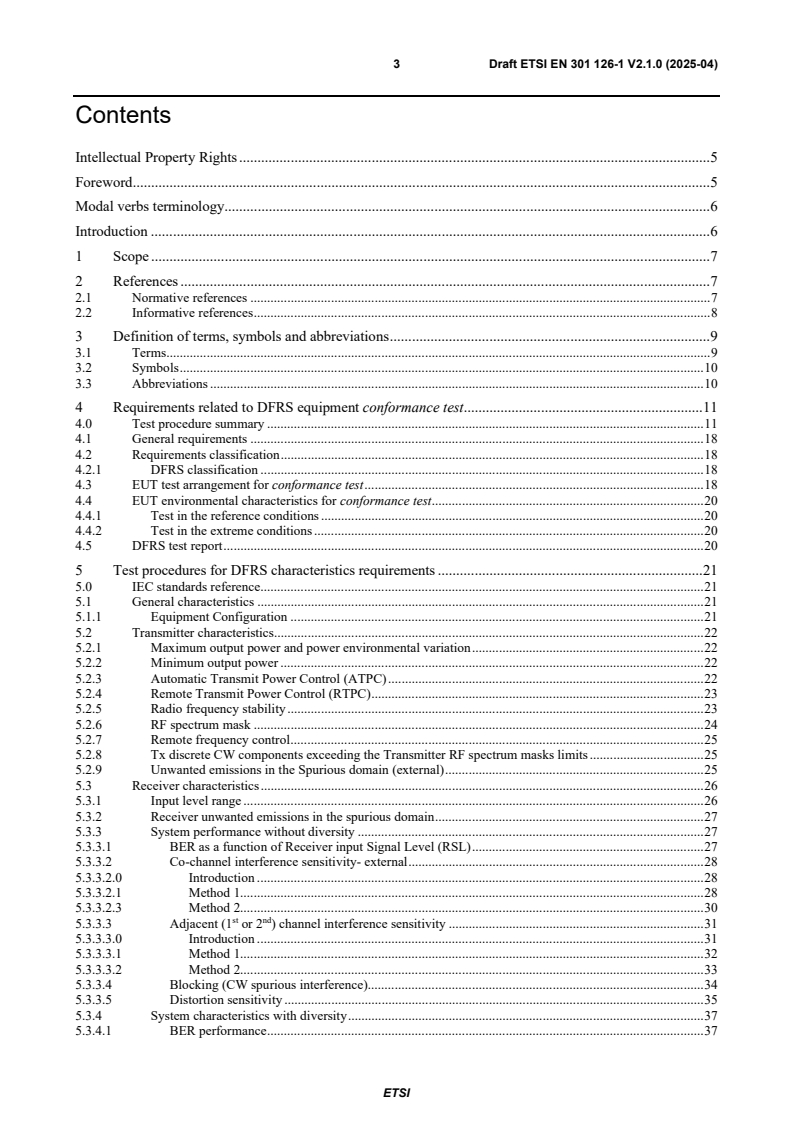
3 Draft ETSI EN 301 126-1 V2.1.0 (2025-04)
Contents
Intellectual Property Rights . 5
Foreword . 5
Modal verbs terminology . 6
Introduction . 6
1 Scope . 7
2 References . 7
2.1 Normative references . 7
2.2 Informative references . 8
3 Definition of terms, symbols and abbreviations . 9
3.1 Terms . 9
3.2 Symbols . 10
3.3 Abbreviations . 10
4 Requirements related to DFRS equipment conformance test . 11
4.0 Test procedure summary . 11
4.1 General requirements . 18
4.2 Requirements classification . 18
4.2.1 DFRS classification . 18
4.3 EUT test arrangement for conformance test . 18
4.4 EUT environmental characteristics for conformance test . 20
4.4.1 Test in the reference conditions . 20
4.4.2 Test in the extreme conditions . 20
4.5 DFRS test report . 20
5 Test procedures for DFRS characteristics requirements . 21
5.0 IEC standards reference . 21
5.1 General characteristics . 21
5.1.1 Equipment Configuration . 21
5.2 Transmitter characteristics. 22
5.2.1 Maximum output power and power environmental variation . 22
5.2.2 Minimum output power . 22
5.2.3 Automatic Transmit Power Control (ATPC) . 22
5.2.4 Remote Transmit Power Control (RTPC) . 23
5.2.5 Radio frequency stability . 23
5.2.6 RF spectrum mask . 24
5.2.7 Remote frequency control . 25
5.2.8 Tx discrete CW components exceeding the Transmitter RF spectrum masks limits . 25
5.2.9 Unwanted emissions in the Spurious domain (external) . 25
5.3 Receiver characteristics . 26
5.3.1 Input level range . 26
5.3.2 Receiver unwanted emissions in the spurious domain . 27
5.3.3 System performance without diversity . 27
5.3.3.1 BER as a function of Receiver input Signal Level (RSL) . 27
5.3.3.2 Co-channel interference sensitivity- external . 28
5.3.3.2.0 Introduction . 28
5.3.3.2.1 Method 1. 28
5.3.3.2.3 Method 2. 30
st nd
5.3.3.3 Adjacent (1 or 2 ) channel interference sensitivity . 31
5.3.3.3.0 Introduction . 31
5.3.3.3.1 Method 1. 32
5.3.3.3.2 Method 2. 33
5.3.3.4 Blocking (CW spurious interference). 34
5.3.3.5 Distortion sensitivity . 35
5.3.4 System characteristics with diversity . 37
5.3.4.1 BER performance . 37
ETSI
4 Draft ETSI EN 301 126-1 V2.1.0 (2025-04)
5.3.4.2 Interference sensitivity . 37
5.3.4.3 Distortion sensitivity . 37
Annex A (informative): Example of Test report template . 38
A.1 Test results . 38
A.1.1 Summary of tests . 38
A.1.2 General information about the tests . 39
A.1.3 Test result forms . 39
A.1.3.1 Transmitter characteristics . 39
A.1.3.1.1 Transmitter power range . 39
A.1.3.1.1.0 Generality . 39
A.1.3.1.1.1 Maximum output power and power environmental variation . 39
A.1.3.1.1.2 Minimum output power . 40
A.1.3.1.2 Automatic transmit power control (ATPC) . 41
A.1.3.1.3 Remote Transmit Power Control (RTPC) . 41
A.1.3.1.4 Remote Frequency Control (RFC) . 41
A.1.3.1.5 RF spectrum mask . 41
A.1.3.1.6 Spectral lines at the symbol rate . 43
A.1.3.1.7 Spurious emissions (Tx) - external . 43
A.1.3.1.8 Tx radio frequency stability (short term) . 45
A.1.3.2 Receiver characteristics . 45
A.1.3.2.1 Input level range . 45
A.1.3.2.2 Spurious emissions (Rx) - external . 46
A.1.3.3 System performance without diversity . 47
A.1.3.3.1 BER vs. Rx signal level . 47
A.1.3.3.2 Interference sensitivity . 49
A.1.3.3.2.1 Co-channel interference sensitivity - external and adjacent channel interference sensitivity . 49
A.1.3.3.2.2 CW spurious interference . 50
A.1.3.3.3 Distortion sensitivity . 50
A.1.3.4 System performance with diversity . 51
A.1.3.4.1 BER vs. Rx signal level . 51
A.1.3.4.2 Interference sensitivity . 53
A.1.3.4.2.1 Co-channel interference sensitivity . 53
A.1.3.4.2.2 Adjacent channel interference sensitivity . 53
A.1.3.4.3 Distortion sensitivity . 53
A.2 Photographs of EUT . 53
A.3 Test equipment used for tests . 53
A.4 Additional information supplementary to the test report. 54
Annex B (informative): Distortion sensitivity for diversity receivers . 55
Annex C (informative): Bibliography . 56
Annex D (informative): Change history . 57
History . 58
ETSI
5 Draft ETSI EN 301 126-1 V2.1.0 (2025-04)
Intellectual Property Rights
Essential patents
IPRs essential or potentially essential to normative deliverables may have been declared to ETSI. The declarations
pertaining to these essential IPRs, if any, are publicly available for ETSI members and non-members, and can be
found in ETSI SR 000 314: "Intellectual Property Rights (IPRs); Essential, or potentially Essential, IPRs notified to
ETSI in respect of ETSI standards", which is available from the ETSI Secretariat. Latest updates are available on the
ETSI IPR online database.
Pursuant to the ETSI Directives including the ETSI IPR Policy, no investigation regarding the essentiality of IPRs,
including IPR searches, has been carried out by ETSI. No guarantee can be given as to the existence of other IPRs not
referenced in ETSI SR 000 314 (or the updates on the ETSI Web server) which are, or may be, or may become,
essential to the present document.
Trademarks
The present document may include trademarks and/or tradenames which are asserted and/or registered by their owners.
ETSI claims no ownership of these except for any which are indicated as being the property of ETSI, and conveys no
right to use or reproduce any trademark and/or tradename. Mention of those trademarks in the present document does
not constitute an endorsement by ETSI of products, services or organizations associated with those trademarks.
DECT™, PLUGTESTS™, UMTS™ and the ETSI logo are trademarks of ETSI registered for the benefit of its
Members. 3GPP™, LTE™ and 5G™ logo are trademarks of ETSI registered for the benefit of its Members and of the
3GPP Organizational Partners. oneM2M™ logo is a trademark of ETSI registered for the benefit of its Members and of ®
the oneM2M Partners. GSM and the GSM logo are trademarks registered and owned by the GSM Association.
Foreword
This draft European Standard (EN) has been produced by ETSI Technical Committee Access, Terminals, Transmission
and Multiplexing (ATTM), and is now submitted for the combined Public Enquiry and Vote phase of the ETSI EN
Approval Procedure.
The present document is part 1 of a multi-part EN covering the Fixed Radio System; Conformance testing, as identified
below:
Part 1: "Point-to-point equipment - Definitions, general requirements and test procedures";
Part 2-1: "Point-to-Multipoint equipment - Definitions and general requirements";
Part 2-2: "Point-to-Multipoint equipment - Test procedures for FDMA systems";
Part 2-3: "Point-to-Multipoint equipment - Test procedures for TDMA systems";
Part 2-4: "Point-to-Multipoint equipment - Test procedures for FH-CDMA systems";
Part 2-5: "Point-to-Multipoint equipment - Test procedures for DS-CDMA systems";
Part 2-6: "Point-to-Multipoint equipment; Test procedures for Multi Carrier Time Division Multiple Access
(MC-TDMA) systems";
Part 3-1: "Point-to-Point antennas - Definitions, general requirements and test procedures";
Part 3-2: "Point-to-Multipoint antennas - Definitions, general requirements and test procedures".
ETSI
6 Draft ETSI EN 301 126-1 V2.1.0 (2025-04)
Proposed national transposition dates
Date of latest announcement of this EN (doa): 3 months after ETSI publication
Date of latest publication of new National Standard
or endorsement of this EN (dop/e): 6 months after doa
Date of withdrawal of any conflicting National Standard (dow): 6 months after doa
Modal verbs terminology
In the present document "shall", "shall not", "should", "should not", "may", "need not", "will", "will not", "can" and
"cannot" are to be interpreted as described in clause 3.2 of the ETSI Drafting Rules (Verbal forms for the expression of
provisions).
"must" and "must not" are NOT allowed in ETSI deliverables except when used in direct citation.
Introduction
The present document defines the conformance test requirements for radio specific parameters required directly by the
radio equipment relevant standards ETSI EN 302 217-1 [8] and ETSI EN 302 217-2 [9]. Test methods, and test report
format, for these parameters are also contained herein. It may be applied also for conformance test according other
(international or national) relevant standards that might contain a number of similar requirements.
The main body of the present document contains definitions, general requirements and test procedures (see note) for
conformance test of Digital Fixed Radio Systems (DFRS).
NOTE: It is assumed that where a clarification of a test procedure is needed, this should be described on the final
page of the test report titled "Additional information supplementary to the test report".
ETSI
7 Draft ETSI EN 301 126-1 V2.1.0 (2025-04)
1 Scope
The present document details standardized procedures for conformance test of radio interface parameters for Point to
Point (PP) equipment used for Digital Fixed Radio Systems (DFRS). Three sets of procedures (for ER, OR and CP) are
considered in the scope of the present document:
• Procedures for radio parameters relevant to Essential Requirements (ER) and Optional Requirements (OR),
relevant to article 3.2 of Directive 2014/53/EU [i.1]. Requirements for these parameters are detailed in ETSI
EN 302 217-2 [9].
• Procedures for Complementary Requirements (CP) that, even if not considered "essential" in the light of
article 3.2 of Directive 2014/53/EU [i.1], are considered important for the operations of PP equipment. These
parameters are detailed in clause 8 of ETSI EN 302 217-1 [8].
The present document is mainly intended to be applied in conjunction with the above equipment relevant standards and
will enable commonality of test results, irrespective of the body carrying out the test.
However, the present document can be used also in conjunction with other DFRS relevant standards that would refer to
the parameters and test methods hereby described.
The conformance tests described in the present document are those related to radio specific parameters required directly
by the radio equipment relevant standards at antenna ports in conducted test methods. Conformance tests to other
boundary standards (e.g. those for system input/output interfaces (i.e. set at X/X' interface, shown in figure 2, and
related baseband process) are outside the scope of the present document.
Also, tests described in the present document are not applicable to radio equipment with integral antenna of
undetachable antenna type requiring radiated test methods.
2 References
2.1 Normative references
References are either specific (identified by date of publication and/or edition number or version number) or
non-specific. For specific references, only the cited version applies. For non-specific references, the latest version of the
referenced document (including any amendments) applies.
Referenced documents which are not found to be publicly available in the expected location might be found in the ETSI
docbox.
NOTE: While any hyperlinks included in this clause were valid at the time of publication, ETSI cannot guarantee
their long-term validity.
The following referenced documents are necessary for the application of the present document.
[1] ETSI EN 300 019-1-3: "Environmental Engineering (EE); Environmental conditions and
environmental tests for telecommunications equipment; Part 1-3: Classification of environmental
conditions; Stationary use at weatherprotected locations".
[2] ETSI EN 300 019-1-4: "Environmental Engineering (EE); Environmental conditions and
environmental tests for telecommunications equipment; Part 1-4: Classification of environmental
conditions; Stationary use at non-weatherprotected locations".
[3] ETSI EN 300 019-2-3: "Environmental Engineering (EE); Environmental conditions and
environmental tests for telecommunications equipment; Part 2-3: Specification of environmental
tests; Stationary use at weatherprotected locations".
[4] ETSI EN 300 019-2-4: "Environmental Engineering (EE); Environmental conditions and
environmental tests for telecommunications equipment; Part 2-4: Specification of environmental
tests; Stationary use at non-weatherprotected locations".
ETSI
8 Draft ETSI EN 301 126-1 V2.1.0 (2025-04)
[5] ETSI EN 300 019-2-0: "Environmental Engineering (EE); Environmental conditions and
environmental tests for telecommunications equipment; Part 2: Specification of environmental
tests; Sub-part 0: Introduction".
[6] ETSI EN 300 132-2: "Environmental Engineering (EE); Power supply interface at the input of
Information and Communication Technology (ICT) equipment; Part 2: -48 V Direct Current
(DC)".
[7] ETSI EN 300 132-1: "Environmental Engineering (EE); Power supply interface at the input to
Information and Communication Technology (ICT) equipment; Part 1: Alternating Current (AC)".
[8] ETSI EN 302 217-1: "Fixed Radio Systems; Characteristics and requirements for point-to-point
equipment and antennas; Part 1: Overview, common characteristics and requirements not related to
access to radio spectrum".
[9] ETSI EN 302 217-2: "Fixed Radio Systems; Characteristics and requirements for point-to-point
equipment and antennas; Part 2: Digital systems operating in frequency bands from 1 GHz to
174,8 GHz; Harmonised Standard for access to radio spectrum".
[10] ETSI EN 301 126-3-1: "Fixed Radio Systems; Conformance testing; Part 3-1: Point-to-Point
antennas; Definitions, general requirements and test procedures".
2.2 Informative references
References are either specific (identified by date of publication and/or edition number or version number) or
non-specific. For specific references, only the cited version applies. For non-specific references, the latest version of the
referenced document (including any amendments) applies.
NOTE: While any hyperlinks included in this clause were valid at the time of publication, ETSI cannot guarantee
their long-term validity.
The following referenced documents are not necessary for the application of the present document but they assist the
user with regard to a particular subject area.
[i.1] Directive 2014/53/EU of the European Parliament and of the Council of 16 April 2014 on the
harmonisation of the laws of the Member States relating to the making available on the market of
radio equipment and repealing Directive 1999/5/EC.
[i.2] Recommendation ITU-R F.746: "Radio-frequency channel arrangements for radio-relay systems".
[i.3] Recommendation ITU-R F.1191: "Bandwidths and unwanted emissions of digital radio-relay
systems".
[i.4] Recommendation ITU-R SM.1539: "Variation of the boundary between the out-of-band and
spurious domains required for the application of Recommendations ITU-R SM.1541 and
ITU−R SM.329".
[i.5] ETSI EN 302 217-4: "Fixed Radio Systems; Characteristics and requirements for point-to-point
equipment and antennas; Part 4: Antennas".
[i.6] IEC 60835-1-2: "Methods of measurement for equipment used in digital microwave radio
transmission systems; Part 1: Measurements common to terrestrial radio-relay systems and
satellite earth stations; Section 2: Basic characteristics".
[i.7] IEC 60835-1-4: "Methods of measurement for equipment used in digital microwave radio
transmission systems; Part 1: Measurements common to terrestrial radio-relay systems and
satellite earth stations; Section 4: Transmission performance.
[i.8] IEC 60835-2-4: "Methods of measurement for equipment used in digital microwave radio
transmission systems; Part 2-4: Measurements on terrestrial radio-relay systems –
Transmitter/receiver including modulator/demodulator".
ETSI
9 Draft ETSI EN 301 126-1 V2.1.0 (2025-04)
[i.9] IEC 60835-2-7: "Methods of measurement for equipment used in digital microwave radio
transmission systems; Part 2: Measurements on terrestrial radio-relay systems; Section 7: Diversity
switching and combining equipment".
[i.10] IEC 60835-2-8: "Methods of measurement for equipment used in digital microwave radio
transmission systems; Part 2: Measurements on terrestrial radio-relay systems; Section 8: Adaptive
equalizer".
[i.11] IEC 60835-2-10: "Methods of measurement for equipment used in digital microwave radio
transmission systems; Part 2: Measurements on terrestrial radio-relay systems; Section 10: Overall
system performance".
[i.12] IEC 60835-2-11: "Methods of measurement for equipment used in digital microwave radio
transmission systems; Part 2: Measurements on terrestrial radio-relay systems; Section 11: Cross-
polarization interference canceller".
3 Definition of terms, symbols and abbreviations
3.1 Terms
For the purposes of the present document, the following terms apply:
In the present document the "terms" defined in this clause, when used elsewhere, are given in "italic" font.
Complementary Requirements (CR): requirements not relevant to the essential requirements
conformance test: type testing process to verify to what extent the EUT conforms to the relevant standard
Design Objectives: (DO): regulatory and market aspects taken into account for the equipment design and/or operative
performance to be guaranteed
NOTE: Information included in the technical documentation.
Essential Requirements (ER): basic set of parameters and functions which are necessary to meet any regulatory
obligations related to the relevant standard
NOTE: In the scope of the present document, ER are those covered by article 3.2 of Directive 2014/53/EU [i.1].
Requirements covered by articles 3.1 and 3.3 of that Directive 2014/53/EU [i.1] are not in the scope of the
present document.
full conformance: status of the Equipment Under Test (EUT) when it has successfully passed all the requirements of
the conformance test process and therefore meets all the requirements of the relevant standard which the EUT refers to
integral (integrated) antenna: antenna which is indicated in the technical documentation as part of the radio
equipment; it is not physically separable from the equipment
NOTE: Under this category different applications are possible, to which the following more detailed definitions
apply:
1) Detachable (integral) antenna: even when equipment with integral antenna is concerned, the
manufacturer's design might still permit, through specific procedure, to separate the antenna from
the equipment at an internal antenna port, physically suitable for testing purpose. In such cases the
assessment of the radio equipment and of the antenna against requirements of ETSI EN 302 217
parts 1 [8], 2 [9] and 4 [i.5] should be done separately with conducted test procedures.
2) Undetachable (integral) antenna: in this case the manufacturer's design does not permit the
physical access to the antenna port; nevertheless, for the equipment in the scope of ETSI
EN 302 217 parts 1 [8], 2 [9] and 4 [i.5], a "virtual" antenna port can be identified, according the
indication in the technical documentation, where all requirements can be referenced. However, in
this case only radiated test procedures (not in the scope of the present document) can be made.
ETSI
10 Draft ETSI EN 301 126-1 V2.1.0 (2025-04)
mandatory requirements: requirement which the Equipment Under Test (EUT) has to meet
NOTE: To achieve full conformance to a relevant standard all its requirements are mandatory.
manufacturer: organization requesting the approval
Optional Requirements (OR): requirement whose feature is not mandatory (e.g. Automatic Transmit Power Control
(ATPC), etc.)
NOTE: Once such an option has been implemented it becomes formally equivalent to an essential requirement.
relevant standard: standard (international or national) that provides the limits of the requirements for the equipment
under test
technical documentation: See Articles 10 and 21 of Directive 2014/53/EU [i.1] (see note).
NOTE: It is assumed that when tests are performed based on a relevant standard not related to obligation of
article 2 of that Directive, an equivalent documentation would also be provided before the test.
type testing: testing process (see note) for verifying full conformance
NOTE 1: A type test is to be carried out successfully in order to achieve full conformance; it implies that the EUT
has met all the requirements (ER, CR and, if any, OR) of the relevant standard against which it has been
tested.
NOTE 2: Type testing is when at least a representative sample of equipment is tested. The test result is considered
to be applicable and representative for all other pieces of equipment manufactured identically.
3.2 Symbols
For the purposes of the present document, the following symbols apply:
dB decibel
dBc decibels below the carrier power
dBm decibel relative to 1 mW
δf frequency variation with respect to a reference
δPout power output variation with respect to a reference
3.3 Abbreviations
For the purposes of the present document, the following abbreviations apply:
AC Alternating Current
ACAP Adjacent Channel Alternated Polarization
ATPC Automatic Transmit Power Control
BB Baseband
BER Bit Error Rate
BWe evaluation BandWidth
C/I Carrier to Interference
CC Co-channel
CCDP Co-Channel Dual Polarization
CR Complementary Requirement
CS Channel Spacing
CP Complementary Requirement
CW Continuous Wave
DFRS Digital Fixed Radio Systems
DC Direct Current
DO Design Objectives
ER Essential Requirement
Ext. Extreme conditions
IF Intermediate Frequency
EIRP Equivalent Isotropically Radiated Power
ETSI
11 Draft ETSI EN 301 126-1 V2.1.0 (2025-04)
EUT Equipment Under Test
IFbw Intermediate Frequency bandwidth
NOTE: Resolution bandwidth of a spectrum analyser.
ISDN Integrated Services Digital Network
OR Optional Requirement
PDH Plesiochronous Digital Hierarchy
PP Point to Point
Pout Power output level of the Tx
RBER Residual BER
Ref Reference conditions
RF Radio Frequency
RFC Radio Frequency Channel
RSL Received Signal Level
RTPC Remote Transmit Power Control
RX Receiver
SA Spectrum Analyser
SDH Synchronous Digital Hierarchy
TD Technical Documentation
TP Test Point
TR Test Required
Tx Transmitter
V Vertical
XPIC Cross-Polar Interference Canceller
4 Requirements related to DFRS equipment
conformance test
4.0 Test procedure summary
Table 1 summarizes the DFRS requirements in the light of their test procedures, based on the following classification:
• All technical elements (design objectives, DO) reported in the technical documentation, related to the intended
operation and the knowledge of the basic elements of the design.
• The list of functions and parameters which limits are included in ETSI EN 302 217-2 [9] (see note), relevant to
Essential Requirements (ERs) in article 3.2 of Directive 2014/53/EU Radio Equipment [i.1] or Optional
Requirement (OR), which, when optionally implemented in the design, are also considered as ER.
• The list of functions and parameters which limits may be included in ETSI EN 302 217-1 [8] (see note), as
Complementary Requirements (CRs) that, while not affecting the ER are considered important for the correct
function of the radio equipment itself.
• The test conditions (Ref or Ext) when test is required (TR). These are intended for a general, stand alone, use
of the present document; however, when used for assessment of ER and OR parameters according ETSI
EN 302 217-2 [9] (see note), the test conditions there described, if different, will prevail against those in the
present document.
NOTE: Or any other DFRS relevant standard referencing the present document for test procedures of similar
requirements.
ETSI
12 Draft ETSI EN 301 126-1 V2.1.0 (2025-04)
Table 1: "Requirements" classification
Power
Requirement for Climatic
Status for supply Limiting
conformance test conditions Test methods
conformance conditions values
(note 7) for test
(note 5)
Function or parameter
description
Clause in IEC 60835 series or
ER TD + TR Ref + Ref. +
CR OR TD TR Ref Ref. (note 6) present other Reference
or DO (note 1) Ext Ext.
document Standards
General information
Channel DO X Summary in
plan/operating Recommendation
frequency range ITU-R F.746 [i.2]
Duplex frequency DO X Summary in
separation (MHz) Recommendation
ITU-R F.746 [i.2]
Centre gap (MHz) DO X Summary in
Recommendation
ITU-R F.746 [i.2]
Co-polar channel Part 2 DO X xx MHz Summary in
spacing (CS) (note 2) Recommendation
(CCDP or ACAP) ITU-R F.746 [i.2]
Innermost channel DO X Summary in
spacing (MHz) Recommendation
ITU-R F.746 [i.2]
Environmental profile
Environmental Part 2 DO X 4.4 ETSI
conditions (note 3) EN 300 019-1-3 [1]
ETSI
EN 300 019-1-4 [2]
Weather protected Part 2 DO X X (note 3) ETSI
locations (note 4) EN 300 019-2-0 [5]
ETSI
EN 300 019-2-3 [3]
Non-weather protected Part 2 DO X X (note 3) ETSI
locations (note 4) EN 300 019-2-0 [5]
ETSI
EN 300 019-2-4 [4]
ETSI
ETSI
EN 302 217 parts
1 [8] and [9]
13 Draft ETSI EN 301 126-1 V2.1.0 (2025-04)
Power
Requirement for Climatic
Status for supply Limiting
conformance test conditions Test methods
conformance conditions values
(note 7) for test
(note 5)
Function or parameter
description
Clause in IEC 60835 series or
ER TD + TR Ref + Ref. +
CR OR TD TR Ref Ref. (note 6) present other Reference
or DO (note 1) Ext Ext.
document Standards
Branching/feeder
requirements
DO X X
Waveguide flanges (or Part 1
other connectors)
X X
Return loss Part 1 [xx dB]
Intermodulation Part 1 X X [xx dBm] within
products RX local band
Parameters for digital
Systems
ER X
Transmission capacity Part 2 xx Mbit/s
(note 8)
Baseband system Part 2 DO
(note 9)
loading
Transmitter
characteristics
ER X X X
Maximum power and Part 2 5.2.1 IEC 60835-2-4 [i.8],
≤xx dBm
(note 21)
EIRP (note 11) clause 3.4
DO X X X
Transmitter combined Part 2 ≤xx dBm 5.2.1, IEC 60835-2-4 [i.8],
(note 21)
nominal output power 5.2.2 clause 3.4
(function of
and EIRP limits antenna gain)
(note 10)
ER X X X
Transmitter output Part 2 - xx1 dB ≤ 5.2.1 IEC 60835-2-4 [i.8],
power environmental Pout variance clause 3.4
variation ≤ + xx2 dB
Transmitter power and Part 2
frequency control
DO X X X X
Automatic Transmitter Part 2 range: xx dB 5.2.1, IEC 60835-2-4 [i.8],
Power Control (ATPC) upper limit ≤xx 5.2.2 clause 3.4
dB.
DO X X X X
Remote Transmitter Part 2 range: xx dB 5.2.1, IEC 60835-2-4 [i.8],
Power Control (RTPC) 5.2.2 clause 3.4
upper limit ≤xx
IEC 60835-2-4 [i.8],
dBm Spectrum
mask clause 3.3
respected
ETSI
ETSI
EN 302 217 parts
1 [8] and [9]
14 Draft ETSI EN 301 126-1 V2.1.0 (2025-04)
Power
Requirement for Climatic
Status for supply Limiting
conformance test conditions Test methods
conformance conditions values
(note 7) for test
(note 5)
Function or parameter
description
Clause in IEC 60835 series or
ER TD + TR Ref + Ref. +
CR OR TD TR Ref Ref. (note 6) present other Reference
or DO (note 1) Ext Ext.
document Standards
Transmitter Remote Part 2 DO X X X X Initial and final 5.2.7 IEC 60835-2-4 [i.8],
Frequency Control spectrum mask clause 3.2
(RFC)
Transmitter emissions Part 1
Part 2
ER X X X
RF spectrum mask - Part 2 mask(s) of 5.2.6 IEC 60835-2-4 [i.8],
normal channels relevant clause 3.3
standard
(note 13)
DO X X
RF spectrum mask - Part 1 mask(s) of 5.2.6 IEC 60835-2-4 [i.8],
innermost channels relevant (up to SA clause 3.3
standard sensitivity (up to SA sensitivity
(note 13) limit) limit)
ER X X X X
Tx discrete CW Part 2 5.2.8 IEC 60835-1-2 [i.6],
≤xx dBm or
components clause 3
Atten ≥xx dBc
exceeding the
Transmitter RF
spectrum masks limits
Tx unwanted Part 2 ER X X X 5.2.9 IEC 60835-1-2 [i.6],
≤xx dBm in the
emissions in the clause 3
frequency
spurious domain
range
DO X X
Tx unwanted Part 1
≤xx dBm or
(note 15)
emissions - Internal
Atten ≥xx dBc
ER X X
Tx emission Part 2 ≤xx dBm/IFbw Same as IEC 60835-1-2 [i.6],
(note 14)
limitations outside the 5.2.9 clause 3
and frequency
allocated band
range
ER X X X
Tx Radio Frequency Part 2 5.2.5 IEC 60835-2-4 [i.8],
± xx ppm
stability clause 3.2
(=δf/f x 10 )
o
Receiver
Characteristics
X X X X
Receiver maximum Part 1 xx dBm or 5.3.1 IEC 60835-2-4 [i.8],
input level and input xx dB vs. BER clause 5.2
level range threshold
ETSI
ETSI
EN 302 217 parts
1 [8] and [9]
15 Draft ETSI EN 301 126-1 V2.1.0 (2025-04)
Power
Requirement for Climatic
Status for supply Limiting
conformance test conditions Test methods
conformance conditions values
(note 7) for test
(note 5)
Function or parameter
description
Clause in IEC 60835 series or
ER TD + TR Ref + Ref. +
CR OR TD TR Ref Ref. (note 6) present other Reference
or DO (note 1) Ext Ext.
document Standards
Receiver unwanted Part 2 ER X X X 5.3.2 IEC 60835-1-2 [i.6],
≤xx dBm in the
emissions in the frequency clause 3
spurious domain -
range
External
X X
Rx unwanted Part 1 ≤xx dBm or
(note 15)
emissions - Internal
Atten ≥xx dBc
X X
Receiver image Part 1 (note 16)
rejection
DO X X
Innermost channel Part 1 (note 16)
selectivity
System performance Part 2
without diversity
DO + ER X X X
BER vs. Rx signal level Part 2 BER ≤ limits at 5.3.3.1 IEC 60835-2-10 [i.11],
(note 17)
clause 3.1
given RSL
X X X X X
Equipment Residual Part 1 IEC 60835-2-10 [i.11],
≤xx errors
BER (RBER) clause 3.2
/period
Rx selectivity and Rx Part 1
distortion Sensitivity Part 2
Co-channel Part 2 ER X X X BER less than 5.3.3.2 IEC 60835-2-10 [i.11],
interference sensitivity limit at given clause 3.3
- External min C/I ratio
X X X
Co-channel Part 1 BER less than 5.3.3.2 IEC 60835-2-10 [i.11],
interference sensitivity limit at given clause 3.3
– Internal: For CCDP min C/I ratio
with XPIC (note 20)
st nd
DO + ER X X
Adjacent (1 and 2 ) Part 2 X BER less than 5.3.3.3 IEC 60835-2-10 [i.11],
(note 18) (note
channel interference limit at given clause 3.3
19)
sensitivity min C/I ratio
ER X X X
Blocking (CW spurious Part 2 BER less than 5.3.3.4
...
EUROPEAN STANDARD
Fixed Radio Systems;
Conformance testing;
Part 1: Point-to-point equipment -
Definitions, general requirements and test procedures
2 ETSI EN 301 126-1 V2.1.1 (2025-07)
Reference
REN/ATTM-0462
Keywords
FWS, point-to-point, testing
ETSI
650 Route des Lucioles
F-06921 Sophia Antipolis Cedex - FRANCE
Tel.: +33 4 92 94 42 00 Fax: +33 4 93 65 47 16
Siret N° 348 623 562 00017 - APE 7112B
Association à but non lucratif enregistrée à la
Sous-Préfecture de Grasse (06) N° w061004871
Important notice
The present document can be downloaded from the
ETSI Search & Browse Standards application.
The present document may be made available in electronic versions and/or in print. The content of any electronic and/or
print versions of the present document shall not be modified without the prior written authorization of ETSI. In case of any
existing or perceived difference in contents between such versions and/or in print, the prevailing version of an ETSI
deliverable is the one made publicly available in PDF format on ETSI deliver repository.
Users should be aware that the present document may be revised or have its status changed,
this information is available in the Milestones listing.
If you find errors in the present document, please send your comments to
the relevant service listed under Committee Support Staff.
If you find a security vulnerability in the present document, please report it through our
Coordinated Vulnerability Disclosure (CVD) program.
Notice of disclaimer & limitation of liability
The information provided in the present deliverable is directed solely to professionals who have the appropriate degree of
experience to understand and interpret its content in accordance with generally accepted engineering or
other professional standard and applicable regulations.
No recommendation as to products and services or vendors is made or should be implied.
In no event shall ETSI be held liable for loss of profits or any other incidental or consequential damages.
Any software contained in this deliverable is provided "AS IS" with no warranties, express or implied, including but not
limited to, the warranties of merchantability, fitness for a particular purpose and non-infringement of intellectual property
rights and ETSI shall not be held liable in any event for any damages whatsoever (including, without limitation, damages
for loss of profits, business interruption, loss of information, or any other pecuniary loss) arising out of or related to the use
of or inability to use the software.
Copyright Notification
No part may be reproduced or utilized in any form or by any means, electronic or mechanical, including photocopying and
microfilm except as authorized by written permission of ETSI.
The content of the PDF version shall not be modified without the written authorization of ETSI.
The copyright and the foregoing restriction extend to reproduction in all media.
© ETSI 2025.
All rights reserved.
ETSI
3 ETSI EN 301 126-1 V2.1.1 (2025-07)
Contents
Intellectual Property Rights . 5
Foreword . 5
Modal verbs terminology . 6
Introduction . 6
1 Scope . 7
2 References . 7
2.1 Normative references . 7
2.2 Informative references . 8
3 Definition of terms, symbols and abbreviations . 9
3.1 Terms . 9
3.2 Symbols . 10
3.3 Abbreviations . 10
4 Requirements related to DFRS equipment conformance test . 11
4.0 Test procedure summary . 11
4.1 General requirements . 18
4.2 Requirements classification . 18
4.2.1 DFRS classification . 18
4.3 EUT test arrangement for conformance test . 18
4.4 EUT environmental characteristics for conformance test . 20
4.4.1 Test in the reference conditions . 20
4.4.2 Test in the extreme conditions . 20
4.5 DFRS test report . 20
5 Test procedures for DFRS characteristics requirements . 21
5.0 IEC standards reference . 21
5.1 General characteristics . 21
5.1.1 Equipment Configuration . 21
5.2 Transmitter characteristics. 22
5.2.1 Maximum output power and power environmental variation . 22
5.2.2 Minimum output power . 22
5.2.3 Automatic Transmit Power Control (ATPC) . 22
5.2.4 Remote Transmit Power Control (RTPC) . 23
5.2.5 Radio frequency stability . 23
5.2.6 RF spectrum mask . 24
5.2.7 Remote frequency control . 25
5.2.8 Tx discrete CW components exceeding the Transmitter RF spectrum masks limits . 25
5.2.9 Unwanted emissions in the Spurious domain (external) . 25
5.3 Receiver characteristics . 26
5.3.1 Input level range . 26
5.3.2 Receiver unwanted emissions in the spurious domain . 27
5.3.3 System performance without diversity . 27
5.3.3.1 BER as a function of Receiver input Signal Level (RSL) . 27
5.3.3.2 Co-channel interference sensitivity- external . 28
5.3.3.2.0 Introduction . 28
5.3.3.2.1 Method 1. 28
5.3.3.2.2 Method 2. 30
st nd
5.3.3.3 Adjacent (1 or 2 ) channel interference sensitivity . 31
5.3.3.3.0 Introduction . 31
5.3.3.3.1 Method 1. 32
5.3.3.3.2 Method 2. 33
5.3.3.4 Blocking (CW spurious interference). 34
5.3.3.5 Distortion sensitivity . 35
5.3.4 System characteristics with diversity . 37
5.3.4.1 BER performance . 37
ETSI
4 ETSI EN 301 126-1 V2.1.1 (2025-07)
5.3.4.2 Interference sensitivity . 37
5.3.4.3 Distortion sensitivity . 37
Annex A (informative): Example of Test report template . 38
A.1 Test results . 38
A.1.1 Summary of tests . 38
A.1.2 General information about the tests . 39
A.1.3 Test result forms . 39
A.1.3.1 Transmitter characteristics . 39
A.1.3.1.1 Transmitter power range . 39
A.1.3.1.1.0 Generality . 39
A.1.3.1.1.1 Maximum output power and power environmental variation . 39
A.1.3.1.1.2 Minimum output power . 40
A.1.3.1.2 Automatic transmit power control (ATPC) . 41
A.1.3.1.3 Remote Transmit Power Control (RTPC) . 41
A.1.3.1.4 Remote Frequency Control (RFC) . 41
A.1.3.1.5 RF spectrum mask . 41
A.1.3.1.6 Spectral lines at the symbol rate . 43
A.1.3.1.7 Spurious emissions (Tx) - external . 43
A.1.3.1.8 Tx radio frequency stability (short term) . 45
A.1.3.2 Receiver characteristics . 45
A.1.3.2.1 Input level range . 45
A.1.3.2.2 Spurious emissions (Rx) - external . 46
A.1.3.3 System performance without diversity . 47
A.1.3.3.1 BER vs. Rx signal level . 47
A.1.3.3.2 Interference sensitivity . 49
A.1.3.3.2.1 Co-channel interference sensitivity - external and adjacent channel interference sensitivity . 49
A.1.3.3.2.2 CW spurious interference . 50
A.1.3.3.3 Distortion sensitivity . 50
A.1.3.4 System performance with diversity . 51
A.1.3.4.1 BER vs. Rx signal level . 51
A.1.3.4.2 Interference sensitivity . 53
A.1.3.4.2.1 Co-channel interference sensitivity . 53
A.1.3.4.2.2 Adjacent channel interference sensitivity . 53
A.1.3.4.3 Distortion sensitivity . 53
A.2 Photographs of EUT . 53
A.3 Test equipment used for tests . 53
A.4 Additional information supplementary to the test report. 54
Annex B (informative): Distortion sensitivity for diversity receivers . 55
Annex C (informative): Bibliography . 56
Annex D (informative): Change history . 57
History . 58
ETSI
5 ETSI EN 301 126-1 V2.1.1 (2025-07)
Intellectual Property Rights
Essential patents
IPRs essential or potentially essential to normative deliverables may have been declared to ETSI. The declarations
pertaining to these essential IPRs, if any, are publicly available for ETSI members and non-members, and can be
found in ETSI SR 000 314: "Intellectual Property Rights (IPRs); Essential, or potentially Essential, IPRs notified to
ETSI in respect of ETSI standards", which is available from the ETSI Secretariat. Latest updates are available on the
ETSI IPR online database.
Pursuant to the ETSI Directives including the ETSI IPR Policy, no investigation regarding the essentiality of IPRs,
including IPR searches, has been carried out by ETSI. No guarantee can be given as to the existence of other IPRs not
referenced in ETSI SR 000 314 (or the updates on the ETSI Web server) which are, or may be, or may become,
essential to the present document.
Trademarks
The present document may include trademarks and/or tradenames which are asserted and/or registered by their owners.
ETSI claims no ownership of these except for any which are indicated as being the property of ETSI, and conveys no
right to use or reproduce any trademark and/or tradename. Mention of those trademarks in the present document does
not constitute an endorsement by ETSI of products, services or organizations associated with those trademarks.
DECT™, PLUGTESTS™, UMTS™ and the ETSI logo are trademarks of ETSI registered for the benefit of its
Members. 3GPP™, LTE™ and 5G™ logo are trademarks of ETSI registered for the benefit of its Members and of the
3GPP Organizational Partners. oneM2M™ logo is a trademark of ETSI registered for the benefit of its Members and of ®
the oneM2M Partners. GSM and the GSM logo are trademarks registered and owned by the GSM Association.
Foreword
This European Standard (EN) has been produced by ETSI Technical Committee Access, Terminals, Transmission and
Multiplexing (ATTM).
The present document is part 1 of a multi-part EN covering the Fixed Radio System; Conformance testing, as identified
below:
Part 1: "Point-to-point equipment - Definitions, general requirements and test procedures";
Part 2-1: "Point-to-Multipoint equipment - Definitions and general requirements";
Part 2-2: "Point-to-Multipoint equipment - Test procedures for FDMA systems";
Part 2-3: "Point-to-Multipoint equipment - Test procedures for TDMA systems";
Part 2-4: "Point-to-Multipoint equipment - Test procedures for FH-CDMA systems";
Part 2-5: "Point-to-Multipoint equipment - Test procedures for DS-CDMA systems";
Part 2-6: "Point-to-Multipoint equipment; Test procedures for Multi Carrier Time Division Multiple Access
(MC-TDMA) systems";
Part 3-1: "Point-to-Point antennas - Definitions, general requirements and test procedures";
Part 3-2: "Point-to-Multipoint antennas - Definitions, general requirements and test procedures".
ETSI
6 ETSI EN 301 126-1 V2.1.1 (2025-07)
National transposition dates
Date of adoption of this EN: 2 July 2025
Date of latest announcement of this EN (doa): 31 October 2025
Date of latest publication of new National Standard
or endorsement of this EN (dop/e): 30 April 2026
Date of withdrawal of any conflicting National Standard (dow): 30 April 2026
Modal verbs terminology
In the present document "shall", "shall not", "should", "should not", "may", "need not", "will", "will not", "can" and
"cannot" are to be interpreted as described in clause 3.2 of the ETSI Drafting Rules (Verbal forms for the expression of
provisions).
"must" and "must not" are NOT allowed in ETSI deliverables except when used in direct citation.
Introduction
The present document defines the conformance test requirements for radio specific parameters required directly by the
radio equipment relevant standards ETSI EN 302 217-1 [8] and ETSI EN 302 217-2 [9]. Test methods, and test report
format, for these parameters are also contained herein. It may be applied also for conformance test according other
(international or national) relevant standards that might contain a number of similar requirements.
The main body of the present document contains definitions, general requirements and test procedures (see note) for
conformance test of Digital Fixed Radio Systems (DFRS).
NOTE: It is assumed that where a clarification of a test procedure is needed, this should be described on the final
page of the test report titled "Additional information supplementary to the test report".
ETSI
7 ETSI EN 301 126-1 V2.1.1 (2025-07)
1 Scope
The present document details standardized procedures for conformance test of radio interface parameters for Point to
Point (PP) equipment used for Digital Fixed Radio Systems (DFRS). Three sets of procedures (for ER, OR and CP) are
considered in the scope of the present document:
• Procedures for radio parameters relevant to Essential Requirements (ER) and Optional Requirements (OR),
relevant to article 3.2 of Directive 2014/53/EU [i.1]. Requirements for these parameters are detailed in ETSI
EN 302 217-2 [9].
• Procedures for Complementary Requirements (CP) that, even if not considered "essential" in the light of
article 3.2 of Directive 2014/53/EU [i.1], are considered important for the operations of PP equipment. These
parameters are detailed in clause 8 of ETSI EN 302 217-1 [8].
The present document is mainly intended to be applied in conjunction with the above equipment relevant standards and
will enable commonality of test results, irrespective of the body carrying out the test.
However, the present document can be used also in conjunction with other DFRS relevant standards that would refer to
the parameters and test methods hereby described.
The conformance tests described in the present document are those related to radio specific parameters required directly
by the radio equipment relevant standards at antenna ports in conducted test methods. Conformance tests to other
boundary standards (e.g. those for system input/output interfaces (i.e. set at X/X' interface, shown in figure 2, and
related baseband process) are outside the scope of the present document.
Also, tests described in the present document are not applicable to radio equipment with integral antenna of
undetachable antenna type requiring radiated test methods.
2 References
2.1 Normative references
References are either specific (identified by date of publication and/or edition number or version number) or
non-specific. For specific references, only the cited version applies. For non-specific references, the latest version of the
referenced document (including any amendments) applies.
Referenced documents which are not found to be publicly available in the expected location might be found in the
ETSI docbox.
NOTE: While any hyperlinks included in this clause were valid at the time of publication, ETSI cannot guarantee
their long-term validity.
The following referenced documents are necessary for the application of the present document.
[1] ETSI EN 300 019-1-3: "Environmental Engineering (EE); Environmental conditions and
environmental tests for telecommunications equipment; Part 1-3: Classification of environmental
conditions; Stationary use at weatherprotected locations".
[2] ETSI EN 300 019-1-4: "Environmental Engineering (EE); Environmental conditions and
environmental tests for telecommunications equipment; Part 1-4: Classification of environmental
conditions; Stationary use at non-weatherprotected locations".
[3] ETSI EN 300 019-2-3: "Environmental Engineering (EE); Environmental conditions and
environmental tests for telecommunications equipment; Part 2-3: Specification of environmental
tests; Stationary use at weatherprotected locations".
[4] ETSI EN 300 019-2-4: "Environmental Engineering (EE); Environmental conditions and
environmental tests for telecommunications equipment; Part 2-4: Specification of environmental
tests; Stationary use at non-weatherprotected locations".
ETSI
8 ETSI EN 301 126-1 V2.1.1 (2025-07)
[5] ETSI EN 300 019-2-0: "Environmental Engineering (EE); Environmental conditions and
environmental tests for telecommunications equipment; Part 2: Specification of environmental
tests; Sub-part 0: Introduction".
[6] ETSI EN 300 132-2: "Environmental Engineering (EE); Power supply interface at the input of
Information and Communication Technology (ICT) equipment; Part 2: -48 V Direct Current
(DC)".
[7] ETSI EN 300 132-1: "Environmental Engineering (EE); Power supply interface at the input to
Information and Communication Technology (ICT) equipment; Part 1: Alternating Current (AC)".
[8] ETSI EN 302 217-1: "Fixed Radio Systems; Characteristics and requirements for point-to-point
equipment and antennas; Part 1: Overview, common characteristics and requirements not related to
access to radio spectrum".
[9] ETSI EN 302 217-2: "Fixed Radio Systems; Characteristics and requirements for point-to-point
equipment and antennas; Part 2: Digital systems operating in frequency bands from 1 GHz to
174,8 GHz; Harmonised Standard for access to radio spectrum".
[10] ETSI EN 301 126-3-1: "Fixed Radio Systems; Conformance testing; Part 3-1: Point-to-Point
antennas; Definitions, general requirements and test procedures".
2.2 Informative references
References are either specific (identified by date of publication and/or edition number or version number) or
non-specific. For specific references, only the cited version applies. For non-specific references, the latest version of the
referenced document (including any amendments) applies.
NOTE: While any hyperlinks included in this clause were valid at the time of publication, ETSI cannot guarantee
their long-term validity.
The following referenced documents may be useful in implementing an ETSI deliverable or add to the reader's
understanding, but are not required for conformance to the present document.
[i.1] Directive 2014/53/EU of the European Parliament and of the Council of 16 April 2014 on the
harmonisation of the laws of the Member States relating to the making available on the market of
radio equipment and repealing Directive 1999/5/EC.
[i.2] Recommendation ITU-R F.746: "Radio-frequency channel arrangements for radio-relay systems".
[i.3] Recommendation ITU-R F.1191: "Bandwidths and unwanted emissions of digital radio-relay
systems".
[i.4] Recommendation ITU-R SM.1539: "Variation of the boundary between the out-of-band and
spurious domains required for the application of Recommendations ITU-R SM.1541 and
ITU−R SM.329".
[i.5] ETSI EN 302 217-4: "Fixed Radio Systems; Characteristics and requirements for point-to-point
equipment and antennas; Part 4: Antennas".
[i.6] IEC 60835-1-2: "Methods of measurement for equipment used in digital microwave radio
transmission systems; Part 1: Measurements common to terrestrial radio-relay systems and
satellite earth stations; Section 2: Basic characteristics".
[i.7] IEC 60835-1-4: "Methods of measurement for equipment used in digital microwave radio
transmission systems; Part 1: Measurements common to terrestrial radio-relay systems and
satellite earth stations; Section 4: Transmission performance".
[i.8] IEC 60835-2-4: "Methods of measurement for equipment used in digital microwave radio
transmission systems; Part 2-4: Measurements on terrestrial radio-relay systems –
Transmitter/receiver including modulator/demodulator".
ETSI
9 ETSI EN 301 126-1 V2.1.1 (2025-07)
[i.9] IEC 60835-2-7: "Methods of measurement for equipment used in digital microwave radio
transmission systems; Part 2: Measurements on terrestrial radio-relay systems; Section 7: Diversity
switching and combining equipment".
[i.10] IEC 60835-2-8: "Methods of measurement for equipment used in digital microwave radio
transmission systems; Part 2: Measurements on terrestrial radio-relay systems; Section 8: Adaptive
equalizer".
[i.11] IEC 60835-2-10: "Methods of measurement for equipment used in digital microwave radio
transmission systems; Part 2: Measurements on terrestrial radio-relay systems; Section 10: Overall
system performance".
[i.12] IEC 60835-2-11: "Methods of measurement for equipment used in digital microwave radio
transmission systems; Part 2: Measurements on terrestrial radio-relay systems; Section 11: Cross-
polarization interference canceller".
3 Definition of terms, symbols and abbreviations
3.1 Terms
For the purposes of the present document, the following terms apply:
NOTE: In the present document the "terms" defined in this clause, when used elsewhere, are given in "italic"
font.
Complementary Requirements (CR): requirements not relevant to the essential requirements
conformance test: type testing process to verify to what extent the EUT conforms to the relevant standard
Design Objectives: (DO): regulatory and market aspects taken into account for the equipment design and/or operative
performance to be guaranteed
NOTE: Information included in the technical documentation.
Essential Requirements (ER): basic set of parameters and functions which are necessary to meet any regulatory
obligations related to the relevant standard
NOTE: In the scope of the present document, ER are those covered by article 3.2 of Directive 2014/53/EU [i.1].
Requirements covered by articles 3.1 and 3.3 of that Directive 2014/53/EU [i.1] are not in the scope of the
present document.
full conformance: status of the Equipment Under Test (EUT) when it has successfully passed all the requirements of
the conformance test process and therefore meets all the requirements of the relevant standard which the EUT refers to
integral (integrated) antenna: antenna which is indicated in the technical documentation as part of the radio
equipment; it is not physically separable from the equipment
NOTE: Under this category different applications are possible, to which the following more detailed definitions
apply:
1) Detachable (integral) antenna: even when equipment with integral antenna is concerned, the
manufacturer's design might still permit, through specific procedure, to separate the antenna from
the equipment at an internal antenna port, physically suitable for testing purpose. In such cases the
assessment of the radio equipment and of the antenna against requirements of ETSI EN 302 217
parts 1 [8], 2 [9] and 4 [i.5] should be done separately with conducted test procedures.
2) Undetachable (integral) antenna: in this case the manufacturer's design does not permit the
physical access to the antenna port; nevertheless, for the equipment in the scope of ETSI
EN 302 217 parts 1 [8], 2 [9] and 4 [i.5], a "virtual" antenna port can be identified, according the
indication in the technical documentation, where all requirements can be referenced. However, in
this case only radiated test procedures (not in the scope of the present document) can be made.
ETSI
10 ETSI EN 301 126-1 V2.1.1 (2025-07)
mandatory requirements: requirement which the Equipment Under Test (EUT) has to meet
NOTE: To achieve full conformance to a relevant standard all its requirements are mandatory.
manufacturer: organization requesting the approval
Optional Requirements (OR): requirement whose feature is not mandatory (e.g. Automatic Transmit Power Control
(ATPC), etc.)
NOTE: Once such an option has been implemented it becomes formally equivalent to an essential requirement.
relevant standard: standard (international or national) that provides the limits of the requirements for the equipment
under test
technical documentation: See Articles 10 and 21 of Directive 2014/53/EU [i.1] (see note).
NOTE: It is assumed that when tests are performed based on a relevant standard not related to obligation of
article 2 of that Directive, an equivalent documentation would also be provided before the test.
type testing: testing process (see note) for verifying full conformance
NOTE 1: A type test is to be carried out successfully in order to achieve full conformance; it implies that the EUT
has met all the requirements (ER, CR and, if any, OR) of the relevant standard against which it has been
tested.
NOTE 2: Type testing is when at least a representative sample of equipment is tested. The test result is considered
to be applicable and representative for all other pieces of equipment manufactured identically.
3.2 Symbols
For the purposes of the present document, the following symbols apply:
dB decibel
dBc decibels below the carrier power
dBm decibel relative to 1 mW
δf frequency variation with respect to a reference
δPout power output variation with respect to a reference
3.3 Abbreviations
For the purposes of the present document, the following abbreviations apply:
AC Alternating Current
ACAP Adjacent Channel Alternated Polarization
ATPC Automatic Transmit Power Control
BB Baseband
BER Bit Error Rate
BWe evaluation BandWidth
C/I Carrier to Interference
CC Co-channel
CCDP Co-Channel Dual Polarization
CR Complementary Requirement
CS Channel Spacing
CP Complementary Requirement
CW Continuous Wave
DFRS Digital Fixed Radio Systems
DC Direct Current
DO Design Objectives
ER Essential Requirement
Ext. Extreme conditions
IF Intermediate Frequency
EIRP Equivalent Isotropically Radiated Power
ETSI
11 ETSI EN 301 126-1 V2.1.1 (2025-07)
EUT Equipment Under Test
IFbw Intermediate Frequency bandwidth
NOTE: Resolution bandwidth of a spectrum analyser.
ISDN Integrated Services Digital Network
LO Local Oscillator
OR Optional Requirement
PDH Plesiochronous Digital Hierarchy
PP Point to Point
Pout Power output level of the Tx
RBER Residual BER
Ref Reference conditions
RF Radio Frequency
RFC Radio Frequency Channel
RSL Received Signal Level
RTPC Remote Transmit Power Control
RX Receiver
RXD Receive Data
SA Spectrum Analyser
SDH Synchronous Digital Hierarchy
TD Technical Documentation
TP Test Point
TR Test Required
Tx Transmitter
V Vertical
XPIC Cross-Polar Interference Canceller
4 Requirements related to DFRS equipment
conformance test
4.0 Test procedure summary
Table 1 summarizes the DFRS requirements in the light of their test procedures, based on the following classification:
• All technical elements (design objectives, DO) reported in the technical documentation, related to the intended
operation and the knowledge of the basic elements of the design.
• The list of functions and parameters which limits are included in ETSI EN 302 217-2 [9] (see note), relevant to
Essential Requirements (ERs) in article 3.2 of Directive 2014/53/EU Radio Equipment [i.1] or Optional
Requirement (OR), which, when optionally implemented in the design, are also considered as ER.
• The list of functions and parameters which limits may be included in ETSI EN 302 217-1 [8] (see note), as
Complementary Requirements (CRs) that, while not affecting the ER are considered important for the correct
function of the radio equipment itself.
• The test conditions (Ref or Ext) when test is required (TR). These are intended for a general, stand alone, use
of the present document; however, when used for assessment of ER and OR parameters according ETSI
EN 302 217-2 [9] (see note), the test conditions there described, if different, will prevail against those in the
present document.
NOTE: Or any other DFRS relevant standard referencing the present document for test procedures of similar
requirements.
ETSI
12 ETSI EN 301 126-1 V2.1.1 (2025-07)
Table 1: "Requirements" classification
Power
Requirement for Climatic
Status for supply Limiting
conformance test conditions Test methods
conformance conditions values
(note 7) for test
(note 5)
Function or parameter
description
Clause in IEC 60835 series or
ER TD + TR Ref + Ref. +
CR OR TD TR Ref Ref. (note 6) present other Reference
or DO (note 1) Ext Ext.
document Standards
General information
Channel DO X Summary in
plan/operating Recommendation
frequency range
ITU-R F.746 [i.2]
Duplex frequency DO X Summary in
separation (MHz) Recommendation
ITU-R F.746 [i.2]
Centre gap (MHz)
DO X Summary in
Recommendation
ITU-R F.746 [i.2]
Co-polar channel Part 2 DO X xx MHz Summary in
spacing (CS) (note 2) Recommendation
(CCDP or ACAP) ITU-R F.746 [i.2]
Innermost channel DO X Summary in
spacing (MHz)
Recommendation
ITU-R F.746 [i.2]
Environmental profile
Environmental Part 2 DO X 4.4 ETSI
conditions (note 3) EN 300 019-1-3 [1]
ETSI
EN 300 019-1-4 [2]
Weather protected Part 2 DO X X (note 3) ETSI
locations (note 4) EN 300 019-2-0 [5]
ETSI
EN 300 019-2-3 [3]
Non-weather protected Part 2 DO X X (note 3) ETSI
locations
(note 4) EN 300 019-2-0 [5]
ETSI
EN 300 019-2-4 [4]
ETSI
ETSI
EN 302 217 parts
1 [8] and [9]
13 ETSI EN 301 126-1 V2.1.1 (2025-07)
Power
Requirement for Climatic
Status for supply Limiting
conformance test conditions Test methods
conformance conditions values
(note 7) for test
(note 5)
Function or parameter
description
Clause in IEC 60835 series or
ER TD + TR Ref + Ref. +
CR OR TD TR Ref Ref. (note 6) present other Reference
or DO (note 1) Ext Ext.
document Standards
Branching/feeder
requirements
DO X X
Waveguide flanges (or Part 1
other connectors)
X X
Return loss Part 1 [xx dB]
X X
Intermodulation Part 1 [xx dBm] within
products
RX local band
Parameters for digital
Systems
ER X
Transmission capacity Part 2 xx Mbit/s
(note 8)
DO
Baseband system Part 2
(note 9)
loading
Transmitter
characteristics
ER X X X
Maximum power and Part 2 5.2.1 IEC 60835-2-4 [i.8],
≤xx dBm
(note 21)
EIRP (note 11)
clause 3.4
DO X X X
Transmitter combined Part 2 ≤xx dBm 5.2.1, IEC 60835-2-4 [i.8],
(note 21)
nominal output power 5.2.2 clause 3.4
(function of
and EIRP limits
antenna gain)
(note 10)
ER X X X
Transmitter output Part 2 - xx1 dB ≤ 5.2.1 IEC 60835-2-4 [i.8],
power environmental Pout variance clause 3.4
variation
≤ + xx2 dB
Transmitter power and Part 2
frequency control
DO X X X X
Automatic Transmitter Part 2 range: xx dB 5.2.1, IEC 60835-2-4 [i.8],
Power Control (ATPC)
upper limit ≤xx 5.2.2 clause 3.4
dB.
Remote Transmitter DO X X X X
Part 2 range: xx dB 5.2.1, IEC 60835-2-4 [i.8],
Power Control (RTPC) 5.2.2 clause 3.4
upper limit ≤xx
IEC 60835-2-4 [i.8],
dBm Spectrum
mask clause 3.3
respected
ETSI
ETSI
EN 302 217 parts
1 [8] and [9]
14 ETSI EN 301 126-1 V2.1.1 (2025-07)
Power
Requirement for Climatic
Status for supply Limiting
conformance test conditions Test methods
conformance conditions values
(note 7) for test
(note 5)
Function or parameter
description
Clause in IEC 60835 series or
ER TD + TR Ref + Ref. +
CR OR TD TR Ref Ref. (note 6) present other Reference
or DO (note 1) Ext Ext.
document Standards
DO X X X X
Transmitter Remote Part 2 Initial and final 5.2.7 IEC 60835-2-4 [i.8],
Frequency Control
spectrum mask clause 3.2
(RFC)
Transmitter emissions Part 1
Part 2
RF spectrum mask - ER X X X
Part 2 mask(s) of 5.2.6 IEC 60835-2-4 [i.8],
normal channels relevant clause 3.3
standard
(note 13)
DO X X
RF spectrum mask - Part 1 mask(s) of 5.2.6 IEC 60835-2-4 [i.8],
innermost channels relevant (up to SA clause 3.3
standard
sensitivity (up to SA sensitivity
(note 13) limit) limit)
ER X X X X
Tx discrete CW Part 2 5.2.8 IEC 60835-1-2 [i.6],
≤xx dBm or
components clause 3
Atten ≥xx dBc
exceeding the
Transmitter RF
spectrum masks limits
ER X X X
Tx unwanted Part 2 5.2.9 IEC 60835-1-2 [i.6],
≤xx dBm in the
emissions in the clause 3
frequency
spurious domain
range
DO X X
Tx unwanted Part 1
≤xx dBm or
(note 15)
emissions - Internal
Atten ≥xx dBc
Tx emission ER X X
Part 2 ≤xx dBm/IFbw Same as IEC 60835-1-2 [i.6],
(note 14)
limitations outside the 5.2.9 clause 3
and frequency
allocated band
range
ER X X X
Tx Radio Frequency Part 2 5.2.5 IEC 60835-2-4 [i.8],
± xx ppm
stability
clause 3.2
(=δf/f x 10 )
o
Receiver
Characteristics
X X X X
Receiver maximum Part 1 xx dBm or 5.3.1 IEC 60835-2-4 [i.8],
input level and input xx dB vs. BER clause 5.2
level range
threshold
ETSI
ETSI
EN 302 217 parts
1 [8] and [9]
15 ETSI EN 301 126-1 V2.1.1 (2025-07)
Power
Requirement for Climatic
Status for supply Limiting
conformance test conditions Test methods
conformance conditions values
(note 7) for test
(note 5)
Function or parameter
description
Clause in IEC 60835 series or
ER TD + TR Ref + Ref. +
CR OR TD TR Ref Ref. (note 6) present other Reference
or DO (note 1) Ext Ext.
document Standards
ER X X X
Receiver unwanted Part 2 5.3.2 IEC 60835-1-2 [i.6],
≤xx dBm in the
emissions in the
frequency clause 3
spurious domain -
range
External
Rx unwanted X X
Part 1 ≤xx dBm or
(note 15)
emissions - Internal
Atten ≥xx dBc
X X
Receiver image Part 1 (note 16)
rejection
DO X X
Innermost channel Part 1 (note 16)
selectivity
System performance Part 2
without diversity
DO + ER X X X
BER vs. Rx signal level Part 2 BER ≤ limits at 5.3.3.1 IEC 60835-2-10 [i.11],
(note 17)
clause 3.1
given RSL
X X X X X
Equipment Residual Part 1 IEC 60835-2-10 [i.11],
≤xx errors
BER (RBER) clause 3.2
/period
Rx selectivity and Rx Part 1
distortion Sensitivity Part 2
ER X X X
Co-channel Part 2 BER less than 5.3.3.2 IEC 60835-2-10 [i.11],
interference sensitivity
limit at given clause 3.3
- External min C/I ratio
X X X
Co-channel Part 1 BER less than 5.3.3.2 IEC 60835-2-10 [i.11],
interference sensitivity
limit at given clause 3.3
– Internal: For CCDP min C/I ratio
with XPIC (note 20)
st nd
DO + ER X X
Adjacent (1 and 2 ) Part 2 X BER less than 5.3.3.3 IEC 60835-2-10 [i.11],
(note 18) (note
channel interference limit at given clause 3.3
19)
sensitivity min C/I ratio
ER X X X
Blocking (CW spurious Part 2 BER less than 5.3.3.4 IEC 60835-2-10 [i.11],
interference)
limit with given clause 3.3
C/I ratio
DO X
...
SLOVENSKI STANDARD
01-september-2025
Fiksni radijski sistemi - Preskušanje skladnosti - 1. del: Oprema tipa točka-točka -
Definicije, splošne zahteve in preskusni postopki
Fixed Radio Systems - Conformance testing - Part 1: Point-to-point equipment -
Definitions, general requirements and test procedures
Ta slovenski standard je istoveten z: ETSI EN 301 126-1 V2.1.1 (2025-07)
ICS:
33.060.30 Radiorelejni in fiksni satelitski Radio relay and fixed satellite
komunikacijski sistemi communications systems
2003-01.Slovenski inštitut za standardizacijo. Razmnoževanje celote ali delov tega standarda ni dovoljeno.
EUROPEAN STANDARD
Fixed Radio Systems;
Conformance testing;
Part 1: Point-to-point equipment -
Definitions, general requirements and test procedures
2 ETSI EN 301 126-1 V2.1.1 (2025-07)
Reference
REN/ATTM-0462
Keywords
FWS, point-to-point, testing
ETSI
650 Route des Lucioles
F-06921 Sophia Antipolis Cedex - FRANCE
Tel.: +33 4 92 94 42 00 Fax: +33 4 93 65 47 16
Siret N° 348 623 562 00017 - APE 7112B
Association à but non lucratif enregistrée à la
Sous-Préfecture de Grasse (06) N° w061004871
Important notice
The present document can be downloaded from the
ETSI Search & Browse Standards application.
The present document may be made available in electronic versions and/or in print. The content of any electronic and/or
print versions of the present document shall not be modified without the prior written authorization of ETSI. In case of any
existing or perceived difference in contents between such versions and/or in print, the prevailing version of an ETSI
deliverable is the one made publicly available in PDF format on ETSI deliver repository.
Users should be aware that the present document may be revised or have its status changed,
this information is available in the Milestones listing.
If you find errors in the present document, please send your comments to
the relevant service listed under Committee Support Staff.
If you find a security vulnerability in the present document, please report it through our
Coordinated Vulnerability Disclosure (CVD) program.
Notice of disclaimer & limitation of liability
The information provided in the present deliverable is directed solely to professionals who have the appropriate degree of
experience to understand and interpret its content in accordance with generally accepted engineering or
other professional standard and applicable regulations.
No recommendation as to products and services or vendors is made or should be implied.
In no event shall ETSI be held liable for loss of profits or any other incidental or consequential damages.
Any software contained in this deliverable is provided "AS IS" with no warranties, express or implied, including but not
limited to, the warranties of merchantability, fitness for a particular purpose and non-infringement of intellectual property
rights and ETSI shall not be held liable in any event for any damages whatsoever (including, without limitation, damages
for loss of profits, business interruption, loss of information, or any other pecuniary loss) arising out of or related to the use
of or inability to use the software.
Copyright Notification
No part may be reproduced or utilized in any form or by any means, electronic or mechanical, including photocopying and
microfilm except as authorized by written permission of ETSI.
The content of the PDF version shall not be modified without the written authorization of ETSI.
The copyright and the foregoing restriction extend to reproduction in all media.
© ETSI 2025.
All rights reserved.
ETSI
3 ETSI EN 301 126-1 V2.1.1 (2025-07)
Contents
Intellectual Property Rights . 5
Foreword . 5
Modal verbs terminology . 6
Introduction . 6
1 Scope . 7
2 References . 7
2.1 Normative references . 7
2.2 Informative references . 8
3 Definition of terms, symbols and abbreviations . 9
3.1 Terms . 9
3.2 Symbols . 10
3.3 Abbreviations . 10
4 Requirements related to DFRS equipment conformance test . 11
4.0 Test procedure summary . 11
4.1 General requirements . 18
4.2 Requirements classification . 18
4.2.1 DFRS classification . 18
4.3 EUT test arrangement for conformance test . 18
4.4 EUT environmental characteristics for conformance test . 20
4.4.1 Test in the reference conditions . 20
4.4.2 Test in the extreme conditions . 20
4.5 DFRS test report . 20
5 Test procedures for DFRS characteristics requirements . 21
5.0 IEC standards reference . 21
5.1 General characteristics . 21
5.1.1 Equipment Configuration . 21
5.2 Transmitter characteristics. 22
5.2.1 Maximum output power and power environmental variation . 22
5.2.2 Minimum output power . 22
5.2.3 Automatic Transmit Power Control (ATPC) . 22
5.2.4 Remote Transmit Power Control (RTPC) . 23
5.2.5 Radio frequency stability . 23
5.2.6 RF spectrum mask . 24
5.2.7 Remote frequency control . 25
5.2.8 Tx discrete CW components exceeding the Transmitter RF spectrum masks limits . 25
5.2.9 Unwanted emissions in the Spurious domain (external) . 25
5.3 Receiver characteristics . 26
5.3.1 Input level range . 26
5.3.2 Receiver unwanted emissions in the spurious domain . 27
5.3.3 System performance without diversity . 27
5.3.3.1 BER as a function of Receiver input Signal Level (RSL) . 27
5.3.3.2 Co-channel interference sensitivity- external . 28
5.3.3.2.0 Introduction . 28
5.3.3.2.1 Method 1. 28
5.3.3.2.2 Method 2. 30
st nd
5.3.3.3 Adjacent (1 or 2 ) channel interference sensitivity . 31
5.3.3.3.0 Introduction . 31
5.3.3.3.1 Method 1. 32
5.3.3.3.2 Method 2. 33
5.3.3.4 Blocking (CW spurious interference). 34
5.3.3.5 Distortion sensitivity . 35
5.3.4 System characteristics with diversity . 37
5.3.4.1 BER performance . 37
ETSI
4 ETSI EN 301 126-1 V2.1.1 (2025-07)
5.3.4.2 Interference sensitivity . 37
5.3.4.3 Distortion sensitivity . 37
Annex A (informative): Example of Test report template . 38
A.1 Test results . 38
A.1.1 Summary of tests . 38
A.1.2 General information about the tests . 39
A.1.3 Test result forms . 39
A.1.3.1 Transmitter characteristics . 39
A.1.3.1.1 Transmitter power range . 39
A.1.3.1.1.0 Generality . 39
A.1.3.1.1.1 Maximum output power and power environmental variation . 39
A.1.3.1.1.2 Minimum output power . 40
A.1.3.1.2 Automatic transmit power control (ATPC) . 41
A.1.3.1.3 Remote Transmit Power Control (RTPC) . 41
A.1.3.1.4 Remote Frequency Control (RFC) . 41
A.1.3.1.5 RF spectrum mask . 41
A.1.3.1.6 Spectral lines at the symbol rate . 43
A.1.3.1.7 Spurious emissions (Tx) - external . 43
A.1.3.1.8 Tx radio frequency stability (short term) . 45
A.1.3.2 Receiver characteristics . 45
A.1.3.2.1 Input level range . 45
A.1.3.2.2 Spurious emissions (Rx) - external . 46
A.1.3.3 System performance without diversity . 47
A.1.3.3.1 BER vs. Rx signal level . 47
A.1.3.3.2 Interference sensitivity . 49
A.1.3.3.2.1 Co-channel interference sensitivity - external and adjacent channel interference sensitivity . 49
A.1.3.3.2.2 CW spurious interference . 50
A.1.3.3.3 Distortion sensitivity . 50
A.1.3.4 System performance with diversity . 51
A.1.3.4.1 BER vs. Rx signal level . 51
A.1.3.4.2 Interference sensitivity . 53
A.1.3.4.2.1 Co-channel interference sensitivity . 53
A.1.3.4.2.2 Adjacent channel interference sensitivity . 53
A.1.3.4.3 Distortion sensitivity . 53
A.2 Photographs of EUT . 53
A.3 Test equipment used for tests . 53
A.4 Additional information supplementary to the test report. 54
Annex B (informative): Distortion sensitivity for diversity receivers . 55
Annex C (informative): Bibliography . 56
Annex D (informative): Change history . 57
History . 58
ETSI
5 ETSI EN 301 126-1 V2.1.1 (2025-07)
Intellectual Property Rights
Essential patents
IPRs essential or potentially essential to normative deliverables may have been declared to ETSI. The declarations
pertaining to these essential IPRs, if any, are publicly available for ETSI members and non-members, and can be
found in ETSI SR 000 314: "Intellectual Property Rights (IPRs); Essential, or potentially Essential, IPRs notified to
ETSI in respect of ETSI standards", which is available from the ETSI Secretariat. Latest updates are available on the
ETSI IPR online database.
Pursuant to the ETSI Directives including the ETSI IPR Policy, no investigation regarding the essentiality of IPRs,
including IPR searches, has been carried out by ETSI. No guarantee can be given as to the existence of other IPRs not
referenced in ETSI SR 000 314 (or the updates on the ETSI Web server) which are, or may be, or may become,
essential to the present document.
Trademarks
The present document may include trademarks and/or tradenames which are asserted and/or registered by their owners.
ETSI claims no ownership of these except for any which are indicated as being the property of ETSI, and conveys no
right to use or reproduce any trademark and/or tradename. Mention of those trademarks in the present document does
not constitute an endorsement by ETSI of products, services or organizations associated with those trademarks.
DECT™, PLUGTESTS™, UMTS™ and the ETSI logo are trademarks of ETSI registered for the benefit of its
Members. 3GPP™, LTE™ and 5G™ logo are trademarks of ETSI registered for the benefit of its Members and of the
3GPP Organizational Partners. oneM2M™ logo is a trademark of ETSI registered for the benefit of its Members and of ®
the oneM2M Partners. GSM and the GSM logo are trademarks registered and owned by the GSM Association.
Foreword
This European Standard (EN) has been produced by ETSI Technical Committee Access, Terminals, Transmission and
Multiplexing (ATTM).
The present document is part 1 of a multi-part EN covering the Fixed Radio System; Conformance testing, as identified
below:
Part 1: "Point-to-point equipment - Definitions, general requirements and test procedures";
Part 2-1: "Point-to-Multipoint equipment - Definitions and general requirements";
Part 2-2: "Point-to-Multipoint equipment - Test procedures for FDMA systems";
Part 2-3: "Point-to-Multipoint equipment - Test procedures for TDMA systems";
Part 2-4: "Point-to-Multipoint equipment - Test procedures for FH-CDMA systems";
Part 2-5: "Point-to-Multipoint equipment - Test procedures for DS-CDMA systems";
Part 2-6: "Point-to-Multipoint equipment; Test procedures for Multi Carrier Time Division Multiple Access
(MC-TDMA) systems";
Part 3-1: "Point-to-Point antennas - Definitions, general requirements and test procedures";
Part 3-2: "Point-to-Multipoint antennas - Definitions, general requirements and test procedures".
ETSI
6 ETSI EN 301 126-1 V2.1.1 (2025-07)
National transposition dates
Date of adoption of this EN: 2 July 2025
Date of latest announcement of this EN (doa): 31 October 2025
Date of latest publication of new National Standard
or endorsement of this EN (dop/e): 30 April 2026
Date of withdrawal of any conflicting National Standard (dow): 30 April 2026
Modal verbs terminology
In the present document "shall", "shall not", "should", "should not", "may", "need not", "will", "will not", "can" and
"cannot" are to be interpreted as described in clause 3.2 of the ETSI Drafting Rules (Verbal forms for the expression of
provisions).
"must" and "must not" are NOT allowed in ETSI deliverables except when used in direct citation.
Introduction
The present document defines the conformance test requirements for radio specific parameters required directly by the
radio equipment relevant standards ETSI EN 302 217-1 [8] and ETSI EN 302 217-2 [9]. Test methods, and test report
format, for these parameters are also contained herein. It may be applied also for conformance test according other
(international or national) relevant standards that might contain a number of similar requirements.
The main body of the present document contains definitions, general requirements and test procedures (see note) for
conformance test of Digital Fixed Radio Systems (DFRS).
NOTE: It is assumed that where a clarification of a test procedure is needed, this should be described on the final
page of the test report titled "Additional information supplementary to the test report".
ETSI
7 ETSI EN 301 126-1 V2.1.1 (2025-07)
1 Scope
The present document details standardized procedures for conformance test of radio interface parameters for Point to
Point (PP) equipment used for Digital Fixed Radio Systems (DFRS). Three sets of procedures (for ER, OR and CP) are
considered in the scope of the present document:
• Procedures for radio parameters relevant to Essential Requirements (ER) and Optional Requirements (OR),
relevant to article 3.2 of Directive 2014/53/EU [i.1]. Requirements for these parameters are detailed in ETSI
EN 302 217-2 [9].
• Procedures for Complementary Requirements (CP) that, even if not considered "essential" in the light of
article 3.2 of Directive 2014/53/EU [i.1], are considered important for the operations of PP equipment. These
parameters are detailed in clause 8 of ETSI EN 302 217-1 [8].
The present document is mainly intended to be applied in conjunction with the above equipment relevant standards and
will enable commonality of test results, irrespective of the body carrying out the test.
However, the present document can be used also in conjunction with other DFRS relevant standards that would refer to
the parameters and test methods hereby described.
The conformance tests described in the present document are those related to radio specific parameters required directly
by the radio equipment relevant standards at antenna ports in conducted test methods. Conformance tests to other
boundary standards (e.g. those for system input/output interfaces (i.e. set at X/X' interface, shown in figure 2, and
related baseband process) are outside the scope of the present document.
Also, tests described in the present document are not applicable to radio equipment with integral antenna of
undetachable antenna type requiring radiated test methods.
2 References
2.1 Normative references
References are either specific (identified by date of publication and/or edition number or version number) or
non-specific. For specific references, only the cited version applies. For non-specific references, the latest version of the
referenced document (including any amendments) applies.
Referenced documents which are not found to be publicly available in the expected location might be found in the
ETSI docbox.
NOTE: While any hyperlinks included in this clause were valid at the time of publication, ETSI cannot guarantee
their long-term validity.
The following referenced documents are necessary for the application of the present document.
[1] ETSI EN 300 019-1-3: "Environmental Engineering (EE); Environmental conditions and
environmental tests for telecommunications equipment; Part 1-3: Classification of environmental
conditions; Stationary use at weatherprotected locations".
[2] ETSI EN 300 019-1-4: "Environmental Engineering (EE); Environmental conditions and
environmental tests for telecommunications equipment; Part 1-4: Classification of environmental
conditions; Stationary use at non-weatherprotected locations".
[3] ETSI EN 300 019-2-3: "Environmental Engineering (EE); Environmental conditions and
environmental tests for telecommunications equipment; Part 2-3: Specification of environmental
tests; Stationary use at weatherprotected locations".
[4] ETSI EN 300 019-2-4: "Environmental Engineering (EE); Environmental conditions and
environmental tests for telecommunications equipment; Part 2-4: Specification of environmental
tests; Stationary use at non-weatherprotected locations".
ETSI
8 ETSI EN 301 126-1 V2.1.1 (2025-07)
[5] ETSI EN 300 019-2-0: "Environmental Engineering (EE); Environmental conditions and
environmental tests for telecommunications equipment; Part 2: Specification of environmental
tests; Sub-part 0: Introduction".
[6] ETSI EN 300 132-2: "Environmental Engineering (EE); Power supply interface at the input of
Information and Communication Technology (ICT) equipment; Part 2: -48 V Direct Current
(DC)".
[7] ETSI EN 300 132-1: "Environmental Engineering (EE); Power supply interface at the input to
Information and Communication Technology (ICT) equipment; Part 1: Alternating Current (AC)".
[8] ETSI EN 302 217-1: "Fixed Radio Systems; Characteristics and requirements for point-to-point
equipment and antennas; Part 1: Overview, common characteristics and requirements not related to
access to radio spectrum".
[9] ETSI EN 302 217-2: "Fixed Radio Systems; Characteristics and requirements for point-to-point
equipment and antennas; Part 2: Digital systems operating in frequency bands from 1 GHz to
174,8 GHz; Harmonised Standard for access to radio spectrum".
[10] ETSI EN 301 126-3-1: "Fixed Radio Systems; Conformance testing; Part 3-1: Point-to-Point
antennas; Definitions, general requirements and test procedures".
2.2 Informative references
References are either specific (identified by date of publication and/or edition number or version number) or
non-specific. For specific references, only the cited version applies. For non-specific references, the latest version of the
referenced document (including any amendments) applies.
NOTE: While any hyperlinks included in this clause were valid at the time of publication, ETSI cannot guarantee
their long-term validity.
The following referenced documents may be useful in implementing an ETSI deliverable or add to the reader's
understanding, but are not required for conformance to the present document.
[i.1] Directive 2014/53/EU of the European Parliament and of the Council of 16 April 2014 on the
harmonisation of the laws of the Member States relating to the making available on the market of
radio equipment and repealing Directive 1999/5/EC.
[i.2] Recommendation ITU-R F.746: "Radio-frequency channel arrangements for radio-relay systems".
[i.3] Recommendation ITU-R F.1191: "Bandwidths and unwanted emissions of digital radio-relay
systems".
[i.4] Recommendation ITU-R SM.1539: "Variation of the boundary between the out-of-band and
spurious domains required for the application of Recommendations ITU-R SM.1541 and
ITU−R SM.329".
[i.5] ETSI EN 302 217-4: "Fixed Radio Systems; Characteristics and requirements for point-to-point
equipment and antennas; Part 4: Antennas".
[i.6] IEC 60835-1-2: "Methods of measurement for equipment used in digital microwave radio
transmission systems; Part 1: Measurements common to terrestrial radio-relay systems and
satellite earth stations; Section 2: Basic characteristics".
[i.7] IEC 60835-1-4: "Methods of measurement for equipment used in digital microwave radio
transmission systems; Part 1: Measurements common to terrestrial radio-relay systems and
satellite earth stations; Section 4: Transmission performance".
[i.8] IEC 60835-2-4: "Methods of measurement for equipment used in digital microwave radio
transmission systems; Part 2-4: Measurements on terrestrial radio-relay systems –
Transmitter/receiver including modulator/demodulator".
ETSI
9 ETSI EN 301 126-1 V2.1.1 (2025-07)
[i.9] IEC 60835-2-7: "Methods of measurement for equipment used in digital microwave radio
transmission systems; Part 2: Measurements on terrestrial radio-relay systems; Section 7: Diversity
switching and combining equipment".
[i.10] IEC 60835-2-8: "Methods of measurement for equipment used in digital microwave radio
transmission systems; Part 2: Measurements on terrestrial radio-relay systems; Section 8: Adaptive
equalizer".
[i.11] IEC 60835-2-10: "Methods of measurement for equipment used in digital microwave radio
transmission systems; Part 2: Measurements on terrestrial radio-relay systems; Section 10: Overall
system performance".
[i.12] IEC 60835-2-11: "Methods of measurement for equipment used in digital microwave radio
transmission systems; Part 2: Measurements on terrestrial radio-relay systems; Section 11: Cross-
polarization interference canceller".
3 Definition of terms, symbols and abbreviations
3.1 Terms
For the purposes of the present document, the following terms apply:
NOTE: In the present document the "terms" defined in this clause, when used elsewhere, are given in "italic"
font.
Complementary Requirements (CR): requirements not relevant to the essential requirements
conformance test: type testing process to verify to what extent the EUT conforms to the relevant standard
Design Objectives: (DO): regulatory and market aspects taken into account for the equipment design and/or operative
performance to be guaranteed
NOTE: Information included in the technical documentation.
Essential Requirements (ER): basic set of parameters and functions which are necessary to meet any regulatory
obligations related to the relevant standard
NOTE: In the scope of the present document, ER are those covered by article 3.2 of Directive 2014/53/EU [i.1].
Requirements covered by articles 3.1 and 3.3 of that Directive 2014/53/EU [i.1] are not in the scope of the
present document.
full conformance: status of the Equipment Under Test (EUT) when it has successfully passed all the requirements of
the conformance test process and therefore meets all the requirements of the relevant standard which the EUT refers to
integral (integrated) antenna: antenna which is indicated in the technical documentation as part of the radio
equipment; it is not physically separable from the equipment
NOTE: Under this category different applications are possible, to which the following more detailed definitions
apply:
1) Detachable (integral) antenna: even when equipment with integral antenna is concerned, the
manufacturer's design might still permit, through specific procedure, to separate the antenna from
the equipment at an internal antenna port, physically suitable for testing purpose. In such cases the
assessment of the radio equipment and of the antenna against requirements of ETSI EN 302 217
parts 1 [8], 2 [9] and 4 [i.5] should be done separately with conducted test procedures.
2) Undetachable (integral) antenna: in this case the manufacturer's design does not permit the
physical access to the antenna port; nevertheless, for the equipment in the scope of ETSI
EN 302 217 parts 1 [8], 2 [9] and 4 [i.5], a "virtual" antenna port can be identified, according the
indication in the technical documentation, where all requirements can be referenced. However, in
this case only radiated test procedures (not in the scope of the present document) can be made.
ETSI
10 ETSI EN 301 126-1 V2.1.1 (2025-07)
mandatory requirements: requirement which the Equipment Under Test (EUT) has to meet
NOTE: To achieve full conformance to a relevant standard all its requirements are mandatory.
manufacturer: organization requesting the approval
Optional Requirements (OR): requirement whose feature is not mandatory (e.g. Automatic Transmit Power Control
(ATPC), etc.)
NOTE: Once such an option has been implemented it becomes formally equivalent to an essential requirement.
relevant standard: standard (international or national) that provides the limits of the requirements for the equipment
under test
technical documentation: See Articles 10 and 21 of Directive 2014/53/EU [i.1] (see note).
NOTE: It is assumed that when tests are performed based on a relevant standard not related to obligation of
article 2 of that Directive, an equivalent documentation would also be provided before the test.
type testing: testing process (see note) for verifying full conformance
NOTE 1: A type test is to be carried out successfully in order to achieve full conformance; it implies that the EUT
has met all the requirements (ER, CR and, if any, OR) of the relevant standard against which it has been
tested.
NOTE 2: Type testing is when at least a representative sample of equipment is tested. The test result is considered
to be applicable and representative for all other pieces of equipment manufactured identically.
3.2 Symbols
For the purposes of the present document, the following symbols apply:
dB decibel
dBc decibels below the carrier power
dBm decibel relative to 1 mW
δf frequency variation with respect to a reference
δPout power output variation with respect to a reference
3.3 Abbreviations
For the purposes of the present document, the following abbreviations apply:
AC Alternating Current
ACAP Adjacent Channel Alternated Polarization
ATPC Automatic Transmit Power Control
BB Baseband
BER Bit Error Rate
BWe evaluation BandWidth
C/I Carrier to Interference
CC Co-channel
CCDP Co-Channel Dual Polarization
CR Complementary Requirement
CS Channel Spacing
CP Complementary Requirement
CW Continuous Wave
DFRS Digital Fixed Radio Systems
DC Direct Current
DO Design Objectives
ER Essential Requirement
Ext. Extreme conditions
IF Intermediate Frequency
EIRP Equivalent Isotropically Radiated Power
ETSI
11 ETSI EN 301 126-1 V2.1.1 (2025-07)
EUT Equipment Under Test
IFbw Intermediate Frequency bandwidth
NOTE: Resolution bandwidth of a spectrum analyser.
ISDN Integrated Services Digital Network
LO Local Oscillator
OR Optional Requirement
PDH Plesiochronous Digital Hierarchy
PP Point to Point
Pout Power output level of the Tx
RBER Residual BER
Ref Reference conditions
RF Radio Frequency
RFC Radio Frequency Channel
RSL Received Signal Level
RTPC Remote Transmit Power Control
RX Receiver
RXD Receive Data
SA Spectrum Analyser
SDH Synchronous Digital Hierarchy
TD Technical Documentation
TP Test Point
TR Test Required
Tx Transmitter
V Vertical
XPIC Cross-Polar Interference Canceller
4 Requirements related to DFRS equipment
conformance test
4.0 Test procedure summary
Table 1 summarizes the DFRS requirements in the light of their test procedures, based on the following classification:
• All technical elements (design objectives, DO) reported in the technical documentation, related to the intended
operation and the knowledge of the basic elements of the design.
• The list of functions and parameters which limits are included in ETSI EN 302 217-2 [9] (see note), relevant to
Essential Requirements (ERs) in article 3.2 of Directive 2014/53/EU Radio Equipment [i.1] or Optional
Requirement (OR), which, when optionally implemented in the design, are also considered as ER.
• The list of functions and parameters which limits may be included in ETSI EN 302 217-1 [8] (see note), as
Complementary Requirements (CRs) that, while not affecting the ER are considered important for the correct
function of the radio equipment itself.
• The test conditions (Ref or Ext) when test is required (TR). These are intended for a general, stand alone, use
of the present document; however, when used for assessment of ER and OR parameters according ETSI
EN 302 217-2 [9] (see note), the test conditions there described, if different, will prevail against those in the
present document.
NOTE: Or any other DFRS relevant standard referencing the present document for test procedures of similar
requirements.
ETSI
12 ETSI EN 301 126-1 V2.1.1 (2025-07)
Table 1: "Requirements" classification
Power
Requirement for Climatic
Status for supply Limiting
conformance test conditions Test methods
conformance conditions values
(note 7) for test
(note 5)
Function or parameter
description
Clause in IEC 60835 series or
ER TD + TR Ref + Ref. +
CR OR TD TR Ref Ref. (note 6) present other Reference
or DO (note 1) Ext Ext.
document Standards
General information
Channel DO X Summary in
plan/operating Recommendation
frequency range
ITU-R F.746 [i.2]
Duplex frequency DO X Summary in
separation (MHz) Recommendation
ITU-R F.746 [i.2]
Centre gap (MHz)
DO X Summary in
Recommendation
ITU-R F.746 [i.2]
Co-polar channel Part 2 DO X xx MHz Summary in
spacing (CS) (note 2) Recommendation
(CCDP or ACAP) ITU-R F.746 [i.2]
Innermost channel DO X Summary in
spacing (MHz)
Recommendation
ITU-R F.746 [i.2]
Environmental profile
Environmental Part 2 DO X 4.4 ETSI
conditions (note 3) EN 300 019-1-3 [1]
ETSI
EN 300 019-1-4 [2]
Weather protected Part 2 DO X X (note 3) ETSI
locations (note 4) EN 300 019-2-0 [5]
ETSI
EN 300 019-2-3 [3]
Non-weather protected Part 2 DO X X (note 3) ETSI
locations
(note 4) EN 300 019-2-0 [5]
ETSI
EN 300 019-2-4 [4]
ETSI
ETSI
EN 302 217 parts
1 [8] and [9]
13 ETSI EN 301 126-1 V2.1.1 (2025-07)
Power
Requirement for Climatic
Status for supply Limiting
conformance test conditions Test methods
conformance conditions values
(note 7) for test
(note 5)
Function or parameter
description
Clause in IEC 60835 series or
ER TD + TR Ref + Ref. +
CR OR TD TR Ref Ref. (note 6) present other Reference
or DO (note 1) Ext Ext.
document Standards
Branching/feeder
requirements
DO X X
Waveguide flanges (or Part 1
other connectors)
X X
Return loss Part 1 [xx dB]
X X
Intermodulation Part 1 [xx dBm] within
products
RX local band
Parameters for digital
Systems
ER X
Transmission capacity Part 2 xx Mbit/s
(note 8)
DO
Baseband system Part 2
(note 9)
loading
Transmitter
characteristics
ER X X X
Maximum power and Part 2 5.2.1 IEC 60835-2-4 [i.8],
≤xx dBm
(note 21)
EIRP (note 11)
clause 3.4
DO X X X
Transmitter combined Part 2 ≤xx dBm 5.2.1, IEC 60835-2-4 [i.8],
(note 21)
nominal output power 5.2.2 clause 3.4
(function of
and EIRP limits
antenna gain)
(note 10)
ER X X X
Transmitter output Part 2 - xx1 dB ≤ 5.2.1 IEC 60835-2-4 [i.8],
power environmental Pout variance clause 3.4
variation
≤ + xx2 dB
Transmitter power and Part 2
frequency control
DO X X X X
Automatic Transmitter Part 2 range: xx dB 5.2.1, IEC 60835-2-4 [i.8],
Power Control (ATPC)
upper limit ≤xx 5.2.2 clause 3.4
dB.
Remote Transmitter DO X X X X
Part 2 range: xx dB 5.2.1, IEC 60835-2-4 [i.8],
Power Control (RTPC) 5.2.2 clause 3.4
upper limit ≤xx
IEC 60835-2-4 [i.8],
dBm Spectrum
mask clause 3.3
respected
ETSI
ETSI
EN 302 217 parts
1 [8] and [9]
14 ETSI EN 301 126-1 V2.1.1 (2025-07)
Power
Requirement for Climatic
Status for supply Limiting
conformance test conditions Test methods
conformance conditions values
(note 7) for test
(note 5)
Function or parameter
description
Clause in IEC 60835 series or
ER TD + TR Ref + Ref. +
CR OR TD TR Ref Ref. (note 6) present other Reference
or DO (note 1) Ext Ext.
document Standards
DO X X X X
Transmitter Remote Part 2 Initial and final 5.2.7 IEC 60835-2-4 [i.8],
Frequency Control
spectrum mask clause 3.2
(RFC)
Transmitter emissions Part 1
Part 2
RF spectrum mask - ER X X X
Part 2 mask(s) of 5.2.6 IEC 60835-2-4 [i.8],
normal channels relevant clause 3.3
standard
(note 13)
DO X X
RF spectrum mask - Part 1 mask(s) of 5.2.6 IEC 60835-2-4 [i.8],
innermost channels relevant (up to SA clause 3.3
standard
sensitivity (up to SA sensitivity
(note 13) limit) limit)
ER X X X X
Tx discrete CW Part 2 5.2.8 IEC 60835-1-2 [i.6],
≤xx dBm or
components clause 3
Atten ≥xx dBc
exceeding the
Transmitter RF
spectrum masks limits
ER X X X
Tx unwanted Part 2 5.2.9 IEC 60835-1-2 [i.6],
≤xx dBm in the
emissions in the clause 3
frequency
spurious domain
range
DO X X
Tx unwanted Part 1
≤xx dBm or
(note 15)
emissions - Internal
Atten ≥xx dBc
Tx emission ER X X
Part 2 ≤xx dBm/IFbw Same as IEC 60835-1-2 [i.6],
(note 14)
limitations outside the 5.2.9 clause 3
and frequency
allocated band
range
ER X X X
Tx Radio Frequency Part 2 5.2.5 IEC 60835-2-4 [i.8],
± xx ppm
stability
clause 3.2
(=δf/f x 10 )
o
Receiver
Characteristics
X X X X
Receiver maximum Part 1 xx dBm or 5.3.1 IEC 60835-2-4 [i.8],
input level and input xx dB vs. BER clause 5.2
level range
threshold
ETSI
ETSI
EN 302 217 parts
1 [8] and [9]
15 ETSI EN 301 126-1 V2.1.1 (2025-07)
Power
Requirement for Climatic
Status for supply Limiting
conformance test conditions Test methods
conformance conditions values
(note 7) for test
(note 5)
Function or parameter
description
Clause in IEC 60835 series or
ER TD + TR Ref + Ref. +
CR OR TD TR Ref Ref. (note 6) present other Reference
or DO (note 1) Ext Ext.
document Standards
ER X X X
Receiver unwanted Part 2 5.3.2 IEC 60835-1-2 [i.6],
≤xx dBm in the
emissions in the
frequency clause 3
spurious domain -
range
Ex
...
Questions, Comments and Discussion
Ask us and Technical Secretary will try to provide an answer. You can facilitate discussion about the standard in here.
Loading comments...