


ETSI EN 301 489-52 V1.3.1 (2024-11)
ElectroMagnetic Compatibility (EMC) standard for radio equipment and services; Part 52: Specific conditions for Cellular Communication User Equipment (UE) radio and ancillary equipment; Harmonised Standard for ElectroMagnetic Compatibility
ElectroMagnetic Compatibility (EMC) standard for radio equipment and services; Part 52: Specific conditions for Cellular Communication User Equipment (UE) radio and ancillary equipment; Harmonised Standard for ElectroMagnetic Compatibility
REN/ERM-EMC-420
Standard elektromagnetne združljivosti (EMC) za radijsko opremo in storitve - 52. del: Posebni pogoji za celično komunikacijsko uporabniško (UE) radijsko in pomožno opremo - Harmonizirani standard za elektromagnetno združljivost
Ta dokument določa veljavne preskusne pogoje, oceno zmogljivosti in kriterije zmogljivosti za celično komunikacijsko uporabniško opremo (UE), vključno z opremo v prostorih stranke (CPE), komunikatorji (STB), ki vsebujejo celično komunikacijsko tehnologijo, in povezano pomožno opremo v zvezi z elektromagnetno združljivostjo (EMC) za opremo, ki uporablja tehnologije, navedene v preglednici 1.
Ta dokument ne vključuje tehničnih specifikacij v zvezi z antenskim vhodom radijske opreme, sevanjem iz vhoda na ohišju radijske opreme ter kombinacijami radijske opreme in povezane pomožne opreme. Te tehnične specifikacije so običajno navedene v ustreznih standardih za izdelek na področju učinkovite uporabe radijskega spektra.
OPOMBA 1: Razmerje med tem dokumentom in bistvenimi zahtevami člena 3.1(b) Direktive 2014/53/EU [i.2] je podano v dodatku A.
OPOMBA 2: Ta dokument ne zajema radijskih baznih postaj, kot je navedeno v standardu ETSI EN 301 489-50 [i.13].
Ta dokument ne vključuje tehničnih specifikacij, ki se navezujejo na zahtevano oddajanje prevajanih motenj v zvezi z elektromagnetno združljivostjo (EMC) pod 9 kHz pri konektorju izmeničnega napajanja radijske opreme.
OPOMBA 3: Te tehnične specifikacije so običajno navedene v ustreznih standardih skupin izdelkov za opremo, priključeno v izmenično električno omrežje (npr. EN 61000-3-2 [i.14] in EN 61000-3-3 [i.15]).
General Information
Standards Content (Sample)
Draft ETSI EN 301 489-52 V1.2.5 (2024-08)
HARMONISED EUROPEAN STANDARD
ElectroMagnetic Compatibility (EMC)
standard for radio equipment and services;
Part 52: Specific conditions for Cellular Communication
User Equipment (UE) radio and ancillary equipment;
Harmonised Standard for ElectroMagnetic Compatibility
2 Draft ETSI EN 301 489-52 V1.2.5 (2024-08)
Reference
REN/ERM-EMC-420
Keywords
EMC, GSM, harmonised standard, LTE, MSR, NR,
OFDMA, radio, WCDMA, WMAN
ETSI
650 Route des Lucioles
F-06921 Sophia Antipolis Cedex - FRANCE
Tel.: +33 4 92 94 42 00 Fax: +33 4 93 65 47 16
Siret N° 348 623 562 00017 - APE 7112B
Association à but non lucratif enregistrée à la
Sous-Préfecture de Grasse (06) N° w061004871
Important notice
The present document can be downloaded from:
https://www.etsi.org/standards-search
The present document may be made available in electronic versions and/or in print. The content of any electronic and/or
print versions of the present document shall not be modified without the prior written authorization of ETSI. In case of any
existing or perceived difference in contents between such versions and/or in print, the prevailing version of an ETSI
deliverable is the one made publicly available in PDF format at www.etsi.org/deliver.
Users of the present document should be aware that the document may be subject to revision or change of status.
Information on the current status of this and other ETSI documents is available at
https://portal.etsi.org/TB/ETSIDeliverableStatus.aspx
If you find errors in the present document, please send your comment to one of the following services:
https://portal.etsi.org/People/CommiteeSupportStaff.aspx
If you find a security vulnerability in the present document, please report it through our
Coordinated Vulnerability Disclosure Program:
https://www.etsi.org/standards/coordinated-vulnerability-disclosure
Notice of disclaimer & limitation of liability
The information provided in the present deliverable is directed solely to professionals who have the appropriate degree of
experience to understand and interpret its content in accordance with generally accepted engineering or
other professional standard and applicable regulations.
No recommendation as to products and services or vendors is made or should be implied.
In no event shall ETSI be held liable for loss of profits or any other incidental or consequential damages.
Any software contained in this deliverable is provided "AS IS" with no warranties, express or implied, including but not
limited to, the warranties of merchantability, fitness for a particular purpose and non-infringement of intellectual property
rights and ETSI shall not be held liable in any event for any damages whatsoever (including, without limitation, damages
for loss of profits, business interruption, loss of information, or any other pecuniary loss) arising out of or related to the use
of or inability to use the software.
Copyright Notification
No part may be reproduced or utilized in any form or by any means, electronic or mechanical, including photocopying and
microfilm except as authorized by written permission of ETSI.
The content of the PDF version shall not be modified without the written authorization of ETSI.
The copyright and the foregoing restriction extend to reproduction in all media.
© ETSI 2024.
All rights reserved.
ETSI
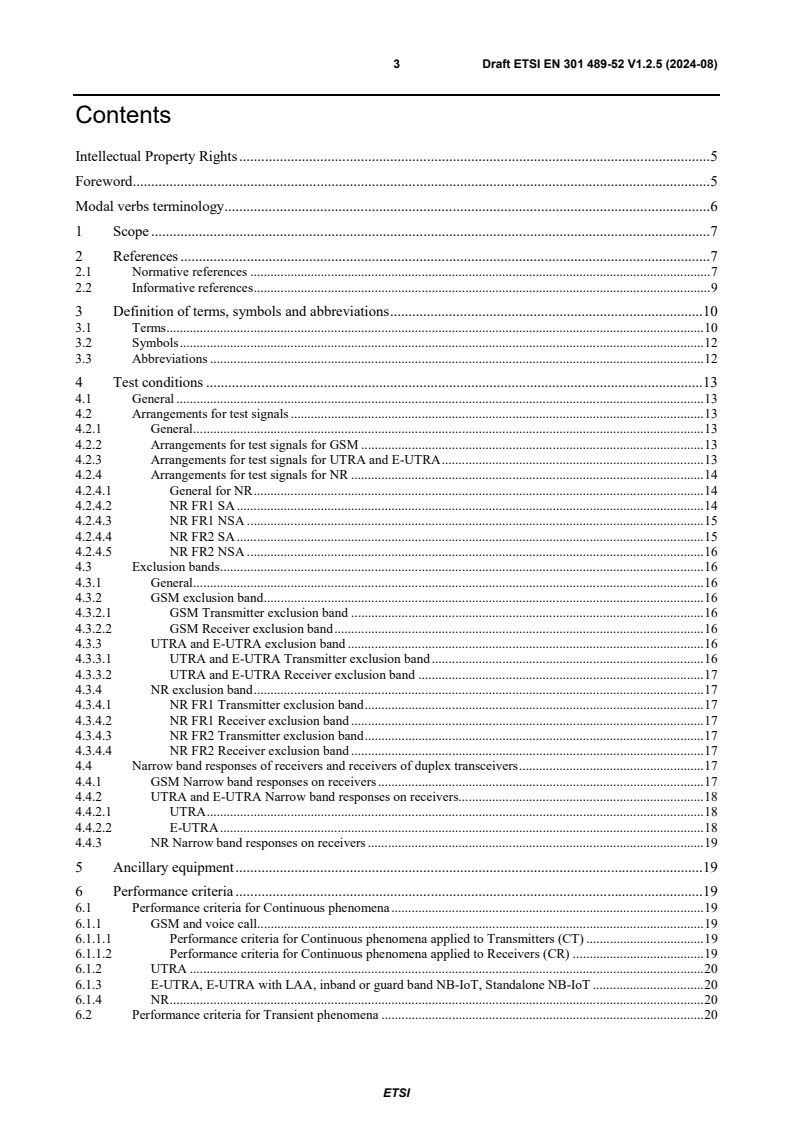
3 Draft ETSI EN 301 489-52 V1.2.5 (2024-08)
Contents
Intellectual Property Rights . 5
Foreword . 5
Modal verbs terminology . 6
1 Scope . 7
2 References . 7
2.1 Normative references . 7
2.2 Informative references . 9
3 Definition of terms, symbols and abbreviations . 10
3.1 Terms . 10
3.2 Symbols . 12
3.3 Abbreviations . 12
4 Test conditions . 13
4.1 General . 13
4.2 Arrangements for test signals . 13
4.2.1 General . 13
4.2.2 Arrangements for test signals for GSM . 13
4.2.3 Arrangements for test signals for UTRA and E-UTRA . 13
4.2.4 Arrangements for test signals for NR . 14
4.2.4.1 General for NR . 14
4.2.4.2 NR FR1 SA . 14
4.2.4.3 NR FR1 NSA . 15
4.2.4.4 NR FR2 SA . 15
4.2.4.5 NR FR2 NSA . 16
4.3 Exclusion bands . 16
4.3.1 General . 16
4.3.2 GSM exclusion band . 16
4.3.2.1 GSM Transmitter exclusion band . 16
4.3.2.2 GSM Receiver exclusion band . 16
4.3.3 UTRA and E-UTRA exclusion band . 16
4.3.3.1 UTRA and E-UTRA Transmitter exclusion band . 16
4.3.3.2 UTRA and E-UTRA Receiver exclusion band . 17
4.3.4 NR exclusion band . 17
4.3.4.1 NR FR1 Transmitter exclusion band . 17
4.3.4.2 NR FR1 Receiver exclusion band . 17
4.3.4.3 NR FR2 Transmitter exclusion band . 17
4.3.4.4 NR FR2 Receiver exclusion band . 17
4.4 Narrow band responses of receivers and receivers of duplex transceivers . 17
4.4.1 GSM Narrow band responses on receivers . 17
4.4.2 UTRA and E-UTRA Narrow band responses on receivers. 18
4.4.2.1 UTRA . 18
4.4.2.2 E-UTRA . 18
4.4.3 NR Narrow band responses on receivers . 19
5 Ancillary equipment . 19
6 Performance criteria . 19
6.1 Performance criteria for Continuous phenomena . 19
6.1.1 GSM and voice call. 19
6.1.1.1 Performance criteria for Continuous phenomena applied to Transmitters (CT) . 19
6.1.1.2 Performance criteria for Continuous phenomena applied to Receivers (CR) . 19
6.1.2 UTRA . 20
6.1.3 E-UTRA, E-UTRA with LAA, inband or guard band NB-IoT, Standalone NB-IoT . 20
6.1.4 NR . 20
6.2 Performance criteria for Transient phenomena . 20
ETSI
4 Draft ETSI EN 301 489-52 V1.2.5 (2024-08)
7 Requirements . 20
7.1 General . 20
7.2 Emission . 21
7.2.1 General . 21
7.2.2 Special conditions . 21
7.3 Immunity . 21
7.3.1 General . 21
7.3.2 Special conditions . 22
Annex A (informative): Relationship between the present document and the essential
requirements of Directive 2014/53/EU . 23
Annex B (normative): Performance assessment voice call, Audio breakthrough . 25
B.1 Calibration of audio levels . 25
B.2 Measurement of audio levels . 26
Annex C (normative): Performance assessment of data transfer call, Error Ratios . 27
C.1 Calibration of data transfer . 27
C.1.1 UTRA . 27
C.1.2 E-UTRA and NR . 27
C.2 Assessment of data transfer . 27
C.2.1 UTRA, Derivation of Error Ratios . 27
C.2.2 E-UTRA and NR, Derivation of Throughput Percentages . 27
C.3 EUT without data application ancillary . 28
C.4 EUT with data application ancillary . 28
Annex D (informative): Change history . 29
History . 30
ETSI
5 Draft ETSI EN 301 489-52 V1.2.5 (2024-08)
Intellectual Property Rights
Essential patents
IPRs essential or potentially essential to normative deliverables may have been declared to ETSI. The declarations
pertaining to these essential IPRs, if any, are publicly available for ETSI members and non-members, and can be
found in ETSI SR 000 314: "Intellectual Property Rights (IPRs); Essential, or potentially Essential, IPRs notified to
ETSI in respect of ETSI standards", which is available from the ETSI Secretariat. Latest updates are available on the
ETSI Web server (https://ipr.etsi.org/).
Pursuant to the ETSI Directives including the ETSI IPR Policy, no investigation regarding the essentiality of IPRs,
including IPR searches, has been carried out by ETSI. No guarantee can be given as to the existence of other IPRs not
referenced in ETSI SR 000 314 (or the updates on the ETSI Web server) which are, or may be, or may become,
essential to the present document.
Trademarks
The present document may include trademarks and/or tradenames which are asserted and/or registered by their owners.
ETSI claims no ownership of these except for any which are indicated as being the property of ETSI, and conveys no
right to use or reproduce any trademark and/or tradename. Mention of those trademarks in the present document does
not constitute an endorsement by ETSI of products, services or organizations associated with those trademarks.
DECT™, PLUGTESTS™, UMTS™ and the ETSI logo are trademarks of ETSI registered for the benefit of its
Members. 3GPP™ and LTE™ are trademarks of ETSI registered for the benefit of its Members and of the 3GPP
Organizational Partners. oneM2M™ logo is a trademark of ETSI registered for the benefit of its Members and of the ®
oneM2M Partners. GSM and the GSM logo are trademarks registered and owned by the GSM Association.
Foreword
This draft Harmonised European Standard (EN) has been produced by ETSI Technical Committee Electromagnetic
compatibility and Radio spectrum Matters (ERM), and is now submitted for the combined Public Enquiry and Vote
phase of the ETSI Standardisation Request deliverable Approval Procedure.
The present document has been prepared under the Commission's standardisation request C(2015) 5376 final [i.4] to
provide one voluntary means of conforming to the essential requirements of Directive 2014/53/EU on the harmonisation
of the laws of the Member States relating to the making available on the market of radio equipment and repealing
Directive 1999/5/EC [i.2].
Once the present document is cited in the Official Journal of the European Union under that Directive, compliance with
the normative clauses of the present document given in table A.1 confers, within the limits of the scope of the present
document, a presumption of conformity with the corresponding essential requirements of that Directive and associated
EFTA regulations.
The present document is part 52 of a multi-part deliverable. Full details of the entire series can be found in part 1 [1].
Proposed national transposition dates
Date of latest announcement of this EN (doa): 3 months after ETSI publication
Date of latest publication of new National Standard
or endorsement of this EN (dop/e): 6 months after doa
Date of withdrawal of any conflicting National Standard (dow): 18 months after doa
ETSI
6 Draft ETSI EN 301 489-52 V1.2.5 (2024-08)
Modal verbs terminology
In the present document "shall", "shall not", "should", "should not", "may", "need not", "will", "will not", "can" and
"cannot" are to be interpreted as described in clause 3.2 of the ETSI Drafting Rules (Verbal forms for the expression of
provisions).
"must" and "must not" are NOT allowed in ETSI deliverables except when used in direct citation.
ETSI
7 Draft ETSI EN 301 489-52 V1.2.5 (2024-08)
1 Scope
The present document specifies the applicable test conditions, performance assessment, and performance criteria for
Cellular Communication User Equipment (UE), including Customer Premise Equipment (CPE), Set Top Box (STB)
containing cellular communication technologies, and the associated ancillary equipment in respect of ElectroMagnetic
Compatibility (EMC) for equipment utilizing the technologies in table 1.
Table 1: Technologies User Equipment (UE) radio and ancillary equipment Cellular Communication
Cellular Mobile Communication Technology
Standard Set ETSI Deliverable
Technology Generation
Global System for Mobile 2G/3G IMT-2000 SC single carrier ETSI EN 301 511 [i.9]
communications (GSM)
CDMA Multi-Carrier (cdma2000) 2G/3G IS-95/CDMA2000 - IMT-MC ETSI EN 301 908-4 [i.10]
multi-carrier
CDMA Direct Spread (UTRA FDD) 3G IMT-2000 Direct Spread ETSI EN 301 908-2 [i.11]
Evolved Universal Terrestrial Radio 4G IMT-advanced ETSI EN 301 908-13 [i.12]
Access (E-UTRA)
New Radio (NR) 5G IMT-2020 ETSI TS 138 521-1 [15]
ETSI TS 138 521-2 [19]
ETSI TS 138 521-3 [16]
Technical specifications related to the antenna port of radio equipment, radiated emissions from the enclosure port of
radio equipment, and combinations of radio and associated ancillary equipment are not included in the present
document. Such technical specifications are normally found in the relevant product standards for the effective use of the
radio spectrum.
NOTE 1: The relationship between the present document and the essential requirements of article 3.1(b) of
Directive 2014/53/EU [i.2] is given in annex A.
NOTE 2: The present document does not cover the radio base stations as specified in ETSI EN 301 489-50 [i.13].
Technical specifications related to conducted emission EMC requirements below 9 kHz on the AC mains port of radio
equipment are not included in the present document.
NOTE 3: Such technical specifications are normally found in the relevant product family standards for AC mains
powered equipment (e.g. EN 61000-3-2 [i.14] and EN 61000-3-3 [i.15]).
2 References
2.1 Normative references
References are either specific (identified by date of publication and/or edition number or version number) or
non-specific. For specific references, only the cited version applies. For non-specific references, the latest version of the
referenced document (including any amendments) applies.
Referenced documents which are not found to be publicly available in the expected location might be found at
https://docbox.etsi.org/Reference/.
NOTE: While any hyperlinks included in this clause were valid at the time of publication, ETSI cannot guarantee
their long term validity.
The following referenced documents are necessary for the application of the present document.
[1] ETSI EN 301 489-1 (V2.2.3) (11-2019): "ElectroMagnetic Compatibility (EMC) standard for
radio equipment and services; Part 1: Common technical requirements; Harmonised Standard for
ElectroMagnetic Compatibility".
ETSI
8 Draft ETSI EN 301 489-52 V1.2.5 (2024-08)
[2] ETSI TS 134 108 (V15.2.0) (10-2019): "Universal Mobile Telecommunications System (UMTS);
LTE; Common test environments for User Equipment (UE); Conformance testing (3GPP
TS 34.108 version 15.2.0 Release 15)".
[3] Void.
[4] ETSI TS 134 109 (V17.0.0) (05-2022): "Universal Mobile Telecommunications System (UMTS);
Terminal logical test interface; Special conformance testing functions (3GPP TS 34.109
version 17.0.0 Release 17)".
[5] ETSI EN 300 296-1 (V1.4.1) (08-2013): "Electromagnetic compatibility and Radio spectrum
Matters (ERM); Land Mobile Service; Radio equipment using integral antennas intended primarily
for analogue speech; Part 1: Technical characteristics and methods of measurement".
[6] Recommendation ITU-T P.64 (07/2022): "Determination of sensitivity/frequency characteristics of
local telephone systems".
[7] Void.
[8] Void.
[9] ETSI TS 136 101 (V17.11.0) (10-2023): "LTE; Evolved Universal Terrestrial Radio Access
(E-UTRA); User Equipment (UE) radio transmission and reception (3GPP TS 36.101
version 17.8.0 Release 17)".
[10] ETSI TS 136 508 (V17.5.0) (05-2023): "LTE; Evolved Universal Terrestrial Radio Access
(E-UTRA) and Evolved Packet Core (EPC); Common test environments for User Equipment (UE)
conformance testing (3GPP TS 36.508 version 17.4.0 Release 17)".
[11] ETSI TS 136 509 (V17.4.0) (10-2023): "LTE; Evolved Universal Terrestrial Radio Access
(E-UTRA) and Evolved Packet Core (EPC); Special conformance testing functions for User
Equipment (UE) (3GPP TS 36.509 version 17.2.0 Release 17)".
[12] ETSI TS 136 521-1 (V17.6.1) (07-2023): "LTE; Evolved Universal Terrestrial Radio Access
(E-UTRA); User Equipment (UE) conformance specification; Radio transmission and reception;
Part 1: Conformance testing (3GPP TS 36.521-1 version 17.5.0 Release 17)".
[13] ETSI TS 138 508-1 (V17.10.0) (10-2023): "5G; 5GS; User Equipment (UE) conformance
specification; Part 1: Common test environment (3GPP TS 38.508-1 version 17.7.0 Release 17)".
[14] ETSI TS 138 101-1 (V17.11.0) (01-2023): "5G; NR; User Equipment (UE) radio transmission and
reception; Part 1: Range 1 Standalone (3GPP TS 38.101-1 version 17.8.0 Release 17)".
[15] ETSI TS 138 521-1 (V17.10.0) (10-2023): "5G; NR; User Equipment (UE) conformance
specification; Radio transmission and reception; Part 1: Range 1 standalone (3GPP TS 38.521-1
version 17.7.0 Release 17)".
[16] ETSI TS 138 521-3 (V17.10.0) (10-2023): "5G; NR; User Equipment (UE) conformance
specification; Radio transmission and reception; Part 3: Range 1 and Range 2 Interworking
operation with other radios (3GPP TS 38.521-3 version 17.7.0 Release 17)".
[17] EN 55035:2017 + A11:2020: "Electromagnetic compatibility of multimedia equipment - Immunity
requirements" (produced by CENELEC).
[18] Void.
[19] ETSI TS 138 521-2 (V17.4.0) (10-2023): "5G; NR; User Equipment (UE) conformance
specification; Radio transmission and reception; Part 2: Range 2 standalone (3GPP TS 38.521-2
version 17.1.0 Release 17)".
[20] ETSI TS 138 101-2 (V17.11.0) (10-2023): "5G; NR; User Equipment (UE) radio transmission and
reception; Part 2: Range 2 Standalone (3GPP TS 38.101-2 version 17.8.0 Release 17)".
ETSI
9 Draft ETSI EN 301 489-52 V1.2.5 (2024-08)
2.2 Informative references
References are either specific (identified by date of publication and/or edition number or version number) or
non-specific. For specific references, only the cited version applies. For non-specific references, the latest version of the
referenced document (including any amendments) applies.
NOTE: While any hyperlinks included in this clause were valid at the time of publication, ETSI cannot guarantee
their long term validity.
The following referenced documents are not necessary for the application of the present document but they assist the
user with regard to a particular subject area.
[i.1] ETSI TR 121 905 (V17.1.0) (05-2022): "Digital cellular telecommunications system (Phase 2+)
(GSM); Universal Mobile Telecommunications System (UMTS); LTE; 5G; Vocabulary for 3GPP
Specifications (3GPP TR 21.905 version 17.1.0 Release 17)".
[i.2] Directive 2014/53/EU of the European Parliament and of the Council of 16 April 2014 on the
harmonisation of the laws of the Member States relating to the making available on the market of
radio equipment and repealing Directive 1999/5/EC.
[i.3] ETSI TR 125 990 (V3.0.0): "Universal Mobile Telecommunications System (UMTS); Vocabulary
(3G TR 25.990 version 3.0.0 Release 1999)".
[i.4] Commission Implementing Decision C (2015) 5376 final of 4.8.2015 on a standardisation request
to the European Committee for Electrotechnical Standardisation and to the European
Telecommunications Standards Institute as regards radio equipment in support of Directive
2014/53/EU of the European Parliament and of the Council.
[i.5] ETSI GTS 05.08 (V3.8.0) (01-1995): "European digital cellular telecommunications system
(Phase 1); Radio Subsystem Link Control (GSM 05.08)".
NOTE: The technical content of ETSI I-ETS 300 034-1 has been transferred into ETSI GTS 05.08 (V3.8.0).
[i.6] ETSI GTS 05.08-DCS (V3.0.0) (01-1995): "European digital cellular telecommunications system
(Phase 1); Radio Subsystem Link Control; (GSM 05.08 - DCS-1800)".
NOTE: The technical content of ETSI I-ETS 300 034-2 has been transferred into ETSI GTS 05.08-DCS (V3.0.0).
[i.7] ETSI ETS 300 578 (Edition 13) (03-1999): "Digital cellular telecommunications system (Phase 2)
(GSM); Radio subsystem link control (GSM 05.08 version 4.22.1)".
[i.8] Void.
[i.9] ETSI EN 301 511 (V12.5.1) (03-2017): "Global System for Mobile communications (GSM);
Mobile Stations (MS) equipment; Harmonised Standard covering the essential requirements of
article 3.2 of Directive 2014/53/EU".
[i.10] ETSI EN 301 908-4 (V6.2.1) (06-2013): "IMT cellular networks; Harmonized EN covering the
essential requirements of article 3.2 of the R&TTE Directive; Part 4: CDMA Multi-Carrier
(cdma2000) User Equipment (UE)".
[i.11] ETSI EN 301 908-2 (V13.1.1) (06-2020): "IMT cellular networks; Harmonised Standard for
access to radio spectrum; Part 2: CDMA Direct Spread (UTRA FDD) User Equipment (UE)".
[i.12] ETSI EN 301 908-13 (V13.2.1) (02-2022): "IMT cellular networks; Harmonised Standard for
access to radio spectrum; Part 13: Evolved Universal Terrestrial Radio Access (E-UTRA) User
Equipment (UE)".
[i.13] ETSI EN 301 489-50 (V2.3.1) (03-2021): "ElectroMagnetic Compatibility (EMC) standard for
radio equipment and services; Part 50: Specific conditions for Cellular Communication Base
Station (BS), repeater and ancillary equipment; Harmonised Standard for ElectroMagnetic
Compatibility".
ETSI
10 Draft ETSI EN 301 489-52 V1.2.5 (2024-08)
[i.14] EN 61000-3-2 (2019) + A1(2021): "ELECTROMAGNETIC COMPATIBILITY (EMC) -
Part 3-2: Limits - Limits for harmonic current emissions (equipment input current ≤ 16 A per
phase)".
[i.15] EN 61000-3-3 (2013) + A2 (2021): "Electromagnetic compatibility (EMC) - Part 3-3: Limits -
Limitation of voltage changes, voltage fluctuations and flicker in public low-voltage supply
systems, for equipment with rated current ≤ 16 A per phase and not subject to conditional
connection".
[i.16] ETSI TS 100 910 (V8.20.0) (11-2005): "Digital cellular telecommunications system (Phase 2+);
Radio Transmission and Reception (3GPP TS 05.05 version 8.20.0 Release 1999)".
[i.17] Recommendation ITU-T P.76 (11/1988): "Determination of loudness ratings; fundamental
principles".
3 Definition of terms, symbols and abbreviations
3.1 Terms
For the purposes of the present document, the terms given in ETSI EN 301 489-1 [1] and the following apply:
ancillary equipment: electrical or electronic equipment that is intended to be used with a receiver or transmitter
NOTE 1: It is considered as an ancillary equipment if:
the equipment is intended for use with a receiver or transmitter to provide additional operational
and/or control features to the radio equipment (e.g. to extend control to another position or
location);
the ancillary equipment cannot be used without being connected to radio equipment to provide user
functions independently of a receiver or transmitter; and
the receiver or transmitter, to which it is connected, is capable of providing some intended
operation such as transmitting and/or receiving without the ancillary equipment (i.e. it is not a
sub-unit of the main equipment essential to the main equipment basic functions).
NOTE 2: An example of ancillary equipment would be a docking station for radio equipment whose interface is
dedicated to a particular product or range of products.
bearer: information transmission path of defined characteristics for transfer of user data or predefined test data
camped on a cell: UE is in idle mode and has completed the cell selection/reselection process and has chosen a cell
NOTE 1: The UE monitors system information and (in most cases) paging information.
NOTE 2: The services may be limited, and the PLMN may not be aware of the existence of the UE within the
chosen cell.
channel bandwidth: RF bandwidth supporting a single E-UTRA RF carrier with the transmission bandwidth
configured in the uplink or downlink of a cell
NOTE: The channel bandwidth is measured in MHz and is used as a reference for transmitter and receiver RF
requirements.
critical stored data: data that is essential for an EUT to perform a primary function in accordance with that EUT's
specification
NOTE: This may include data previously stored by the user.
data application ancillary: ancillary which provides, sends and/or receives data access to UMTS services via UE
ETSI
11 Draft ETSI EN 301 489-52 V1.2.5 (2024-08)
end-user data: manufacturer-defined data patterns for data transfer testing
NOTE: Represents EUT's typical user application data pattern (e.g. photo, video, text file, message) in its
characteristics.
fixed equipment: equipment intended for use in a fixed location and fitted with one or more antennas
NOTE: The equipment may be fitted with either antenna socket(s) or, integral antenna(s) or both.
idle mode:
• For UTRA/EUTRA equipment: state of User Equipment (UE) when switched on but with no Radio Resource
Control (RRC) connection.
• For GSM: mode of operation of a receiver or a transceiver, where the Equipment Under Test (EUT) is
powered, available for service and available to respond to a request to set up a call.
• For NR equipment: state of User Equipment (UE) when switched on but with no Radio Resource Control
(RRC) connection.
International Mobile Telecommunications 2000 (IMT-2000): third generation mobile systems which provide access,
by means of one or more radio links, to a wide range of telecommunications services supported by the fixed
telecommunication networks (e.g. PSTN, ISDN or IP) and to other services which are specific to mobile users
License Assisted Access (LAA): LTE based base station operating in unlicensed frequency spectrum
maximum average power: average transmitter output power obtained over any specified time interval, including
periods with no transmission, when the transmit time slots are at the maximum power setting
maximum throughput: maximum achievable throughput for a reference measurement channel
NB-IoT guard band operation: operation of NB-IoT guard band utilizing the unused resource block(s) within an
E-UTRA carrier's guard-band
NB-IoT In-band operation: operation of NB-IoT in-band utilizing the resource block(s) within a normal E-UTRA
carrier
NB-IoT standalone operation: operation of NB-IoT standalone utilizing its own spectrum, for example the spectrum
currently being used by GERAN systems as a replacement of one or more GSM carriers, as well as scattered spectrum
for potential IoT deployment
necessary bandwidth: for a given class of emission, width of the frequency band which is just sufficient to ensure the
transmission of information at the rate and with the quality required under specified conditions
portable equipment: radio equipment intended for portable use and powered by integral batteries or battery
NOTE: Devices will typically be handheld.
RXQUAL: measure of the received signal quality, which is generated by the mobile or portable equipment, for use as a
criterion in the Radio Frequency (RF) power control and handover processes
NOTE: For more information, see:
ETSI GTS 05.08 [i.5], clause 8.2 for Phase 1 GSM 900 equipment;
ETSI GTS 05.08-DCS [i.6], clause 8.2 for Phase 1 GSM 1800 equipment;
ETSI ETS 300 578 [i.7], clause 8.2 for Phase 2 GSM 900 or Phase 2 GSM 1800 equipment;
ETSI TS 100 910 [i.16], clause 8.2 for Phase 2+ GSM 900 or Phase 2+ GSM 1800 equipment.
throughput: number of payload bits successfully received per second for a reference measurement channel in a
specified reference condition
traffic mode: state of User Equipment (UE) when switched on and with Radio Resource Control (RRC) connection
established
ETSI
12 Draft ETSI EN 301 489-52 V1.2.5 (2024-08)
Universal Terrestrial Radio Access (UTRA): radio access network of the telecommunications system, incorporating
mobile cellular and other functionality, which is the subject of specifications produced by 3GPP
User Equipment (UE): entity capable of accessing a set of cellular services via one or more radio interfaces
NOTE: This entity may be stationary or in motion within the cellular service area while accessing the Cellular
services, and may simultaneously serve one or more users.
vehicular equipment: radio equipment intended for installation and use in a vehicle, and powered by the main battery
of the vehicle
voice call function: establishment and use of a complete connection for voice communication
3.2 Symbols
For the purposes of the present document, the following symbols apply:
TR Transient phenomena applied to Receivers
TT Transient phenomena applied to Transmitters
3.3 Abbreviations
For the purposes of the present document, the abbreviations given in ETSI TR 121 905 [i.1], ETSI TR 125 990 [i.3] and
the following apply:
rd
3GPP 3 Generation Partnership Project
AC Alternating Current
BER Bit Error Ratio
BLER BLock Error Ratio
BS Base Station
BW BandWidth
CDMA Code Division Multiple Access
CPE Customer Premise Equipment
CR Continuous phenomena applied to Receivers
CRC Cyclic Redundancy Check
CT Continuous phenomena applied to Transmitters
DC Direct Current
DL Down Link (from BS to UE)
DRX Discontinuous Reception
DTX Discontinuous Transmission
EFTA European Free Trade Association
EMC ElectroMagnetic Compatibility
EN-DC E-UTRA-NR Dual Connectivity
EPS External Power Supply
EUT Equipment Under Test
E-UTRA Evolved Universal Terrestrial Radio Access
FDD Frequency Division Duplex
FR1 Frequency Range 1
FR2 Frequency Range 2
GERAN GSM EDGE Radio Access Network
GSM Global System for Mobile communication
IMT-2000 International Mobile Telecommunications 2000
IMT-MC International Mobile Telecommunication-Multi Carrier
IP Internet Protocol
ISDN Integrated Services Digital Network
LAA License Assisted Access
LTE 3GPP Long Term Evolution (4G)
LR Location Registration
MCG Master Cell Group
Mcps Megachips per second
MRP Mouth Reference Point (artificial head)
ETSI
13 Draft ETSI EN 301 489-52 V1.2.5 (2024-08)
MS Mobile Station
NB-IoT Narrow Band Internet of Things
NR New Radio
NSA Non-StandAlone
PC Personal Computer
PLMN Public Land Mobile Network
PSTN Public Switched Telephone Network
RF Radio Frequency
RRC Radio Resource Control
RXQUAL Receiver QUALity
SA StandAlone
SC Single Carrier
SCG Secondary Cell Group
SPL Sound Pressure Level
SS System Simulator
STB Set Top Box
TDD Time Division Duplex
UARFCN UTRA Appropriate Radio Frequency Channel Number
UE User Equipment
UL Up Link (from UE to BS)
UTRA Universal Terrestrial Radio Access
4 Test conditions
4.1 General
The test conditions for user equipment are specified in the present document.
The test configuration and mode of operation shall represent the intended use and shall be recorded in the test report.
A communication link shall be set up with a suitable base station simulator (hereafter called "the test system").
4.2 Arrangements for test signals
4.2.1 General
The provisions of ETSI EN 301 489-1 [1], clause 4.2 shall apply.
Establish a communication link, then reduce the power until the monitored communication path is no longer stable (for
example, additional errors are occurring which are outside the limits defined in clause 6.1). Then, increase the transmit
power by 18 dB to establish a stable communication link.
• For radiated immunity tests, the level of the wanted signal at the input of the receiver or the enclosure port of
the EUT, shall be 18 dB above the reference sensitivity level for the EUT.
• For all other tests, the level of the wanted signal required to establish a communication link shall be
representative of the EUT intended use.
4.2.2 Arrangements for test signals for GSM
The provisions of ETSI EN 301 489-1 [1], clause 4.2 shall apply.
4.2.3 Arrangements for test signals for UTRA and E-UTRA
The provisions of ETSI EN 301 489-1 [1], clause 4.2 shall apply with the following additions.
ETSI
14 Draft ETSI EN 301 489-52 V1.2.5 (2024-08)
The test of the transmitter section and receiver section of the EUT may be carried out simultaneously to reduce test
time.
When the EUT is required to be in the traffic mode, a call is set up according to the Generic call set-up procedure, and
the following conditions shall be met:
• for UTRA, see clause 7.2.3 of ETSI TS 134 108 [2] and annex A of ETSI TS 134 109 [4] Logical Test
Interface for details regarding generic call set-up procedure and BER, BLER test loop scenarios;
• for E-UTRA, see clause 4.5.1 of ETSI TS 136 508 [10] and clause 5.4 of ETSI TS 136 509 [11] for details
regarding generic call set-up procedure and throughput test loop scenarios:
- set and send continuously Up power control commands to the UE;
- the DTX shall be disabled;
- Inner Loop or Up Link Power Control shall be enabled;
• for UTRA, the transmitting and/or receiving (UL/DL) bit rate for reference test channel shall be 12,2 kbit/s;
• E-UTRA, the transmitting and/or receiving (UL/DL) bit rate for reference test channel shall be the reference
measurement channel as specified in annex C in ETSI TS 136 101 [9] with parameters specified in
tables 7.3.1-1 and 7.3.1-2 in ETSI TS 136 101 [9].
When the EUT is required to be in the idle mode the following conditions shall be met:
• UE shall be camped on a cell;
• UE shall perform Location Registration (LR) before the test, but not during the test;
• UE's neighbour cell list shall be empty;
• paging repetition period and DRX cycle shall be set to minimum.
4.2.4 Arrangements for test signals for NR
4.2.4.1 General for NR
The provisions of ETSI EN 301 489-1 [1], clause 4.2 shall apply with the following additions.
The test of the transmitter section and receiver section of the EUT may be carried out simultaneously to reduce test
time.
Where the EUT is to be tested in the idle mode, the following conditions shall be met:
• UE shall be camped on a cell;
• UE shall perform Location Registration (LR) before the test but not during the test;
• UE's neighbour cell list shall be empty;
• paging repetition period and DRX cycle shall be set to minimum.
4.2.4.2 NR FR1 SA
When the EUT is required to be in the traffic mode, a call is set up according to the Generic call set-up procedure, and
the following conditions shall be followed:
1) Connect the SS to the UE conducted or over the air interface.
2) The parameter settings for the cell are set up according to ETSI TS 138 508-1 [13], clause 4.4.3.
3) Downlink signals are initially set up according to ETSI TS 138 521-1 [15], clauses C.0, C.1, C.2 and C.3.1,
and uplink signals according to clauses G.0, G.1, G.2 and G.3.1.
ETSI
15 Draft ETSI EN 301 489-52 V1.2.5 (2024-08)
4) The UL and Reference Measurement Channel is set according to ETSI TS 138 521-1 [15], tables 7.3.2.4.1-1,
7.3.2.4.1-2 and 7.3.2.4.1-3.
5) Propagation conditions are set according to ETSI TS 138 521-1 [15], clause B.0.
6) Ensure the UE is in State RRC_CONNECTED with generic procedure parameters Connectivity NR,
Connected without release On, Test Mode On and Test Loop Function On according to ETSI
TS 138 508-1 [13], clause 4.5. Message contents are defined in ETSI TS 138 521-1 [15], clause 7.3.2.4.3.
4.2.4.3 NR FR1 NSA
When the EUT is required to be in the traffic mode, a call is set up according to the Generic call set-up procedure and
the following conditions shall be followed:
1) Connect the SS to the UE conducted or over the air interface.
2) The parameter settings for NR cell are set up according to ETSI TS 138 508-1 [13], clause 4.4.3.
3) The parameter settings for E-UTRA cell are set up according to ETSI TS 136 508 [10], clause 4.4.3.
4) NR downlink signals are initially set up according to ETSI TS 138 521-1 [15], clauses C.0, C.1, C.2, C.3.1 and
uplink signals according to clauses G.0, G.1, G.2 and G.3.1.
5) E-UTRA downlink signals are initially set up according to ETSI TS 136 521-1 [12], clauses C0, C.1 and C.3.0
and uplink signals according to clauses H.1 and H.3.0.
6) The UL Reference Measurement channels for NR are set according to ETSI TS 138 521-1 [15],
tables 7.3.2.4.1-1, 7.3.2.4.1-2 and 7.3.2.4.1-3.
7) The UL Reference Measurement channels for E-UTRA are set according to ETSI TS 136 521-1 [12],
tables 7.3.4.1-1 and 7.3.4.1-2.
8) NR propagation conditions are set according to ETSI TS 138 521-1 [15], clause B.0.
9) E-UTRA propagation conditions are set according to ETSI TS 136 521-1 [12], clause B.0.
10) Ensure the UE is in state RRC_CONNECTED with generic procedure parameters Connectivity EN-DC,
DC bearer MCG and SCG, Connected without release On according to ETSI TS 138 508-1 [13], clause 4.5.
Message contents are defined in E
...
HARMONISED EUROPEAN STANDARD
ElectroMagnetic Compatibility (EMC)
standard for radio equipment and services;
Part 52: Specific conditions for Cellular Communication
User Equipment (UE) radio and ancillary equipment;
Harmonised Standard for ElectroMagnetic Compatibility
2 ETSI EN 301 489-52 V1.3.1 (2024-11)
Reference
REN/ERM-EMC-420
Keywords
EMC, GSM, harmonised standard, LTE, MSR, NR,
OFDMA, radio, WCDMA, WMAN
ETSI
650 Route des Lucioles
F-06921 Sophia Antipolis Cedex - FRANCE
Tel.: +33 4 92 94 42 00 Fax: +33 4 93 65 47 16
Siret N° 348 623 562 00017 - APE 7112B
Association à but non lucratif enregistrée à la
Sous-Préfecture de Grasse (06) N° w061004871
Important notice
The present document can be downloaded from the
ETSI Search & Browse Standards application.
The present document may be made available in electronic versions and/or in print. The content of any electronic and/or
print versions of the present document shall not be modified without the prior written authorization of ETSI. In case of any
existing or perceived difference in contents between such versions and/or in print, the prevailing version of an ETSI
deliverable is the one made publicly available in PDF format on ETSI deliver repository.
Users should be aware that the present document may be revised or have its status changed,
this information is available in the Milestones listing.
If you find errors in the present document, please send your comments to
the relevant service listed under Committee Support Staff.
If you find a security vulnerability in the present document, please report it through our
Coordinated Vulnerability Disclosure (CVD) program.
Notice of disclaimer & limitation of liability
The information provided in the present deliverable is directed solely to professionals who have the appropriate degree of
experience to understand and interpret its content in accordance with generally accepted engineering or
other professional standard and applicable regulations.
No recommendation as to products and services or vendors is made or should be implied.
In no event shall ETSI be held liable for loss of profits or any other incidental or consequential damages.
Any software contained in this deliverable is provided "AS IS" with no warranties, express or implied, including but not
limited to, the warranties of merchantability, fitness for a particular purpose and non-infringement of intellectual property
rights and ETSI shall not be held liable in any event for any damages whatsoever (including, without limitation, damages
for loss of profits, business interruption, loss of information, or any other pecuniary loss) arising out of or related to the use
of or inability to use the software.
Copyright Notification
No part may be reproduced or utilized in any form or by any means, electronic or mechanical, including photocopying and
microfilm except as authorized by written permission of ETSI.
The content of the PDF version shall not be modified without the written authorization of ETSI.
The copyright and the foregoing restriction extend to reproduction in all media.
© ETSI 2024.
All rights reserved.
ETSI
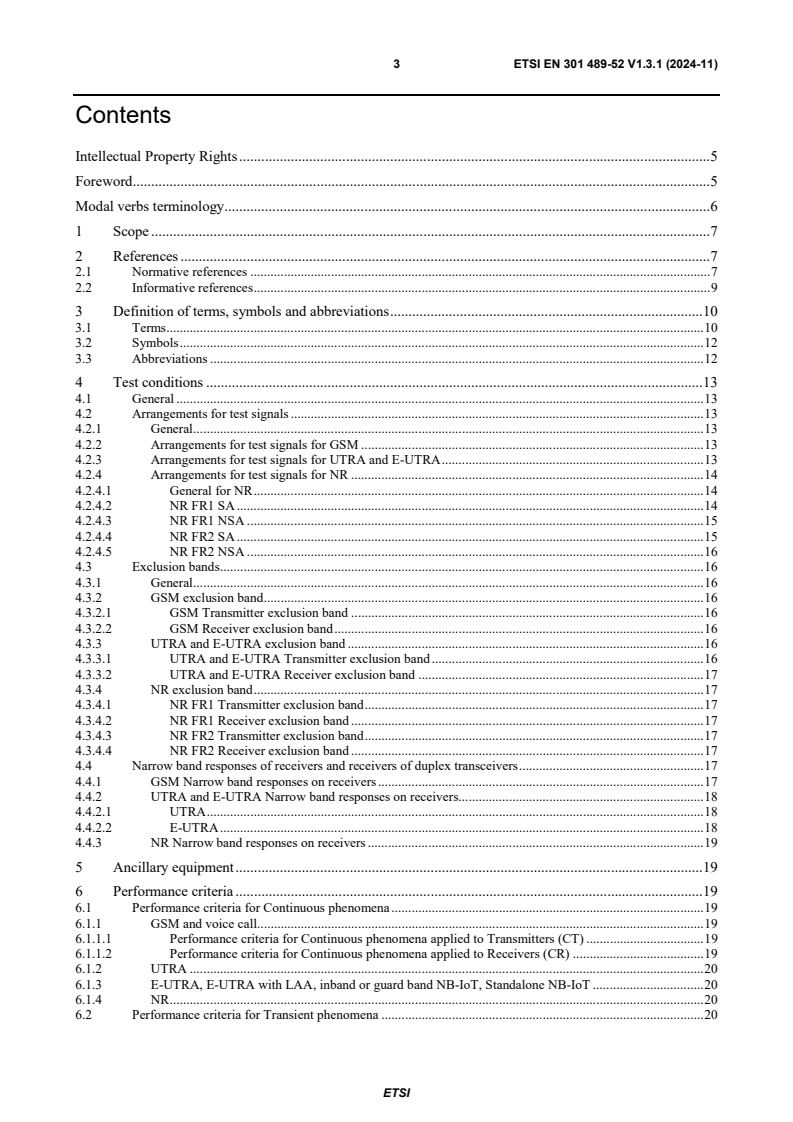
3 ETSI EN 301 489-52 V1.3.1 (2024-11)
Contents
Intellectual Property Rights . 5
Foreword . 5
Modal verbs terminology . 6
1 Scope . 7
2 References . 7
2.1 Normative references . 7
2.2 Informative references . 9
3 Definition of terms, symbols and abbreviations . 10
3.1 Terms . 10
3.2 Symbols . 12
3.3 Abbreviations . 12
4 Test conditions . 13
4.1 General . 13
4.2 Arrangements for test signals . 13
4.2.1 General . 13
4.2.2 Arrangements for test signals for GSM . 13
4.2.3 Arrangements for test signals for UTRA and E-UTRA . 13
4.2.4 Arrangements for test signals for NR . 14
4.2.4.1 General for NR . 14
4.2.4.2 NR FR1 SA . 14
4.2.4.3 NR FR1 NSA . 15
4.2.4.4 NR FR2 SA . 15
4.2.4.5 NR FR2 NSA . 16
4.3 Exclusion bands . 16
4.3.1 General . 16
4.3.2 GSM exclusion band . 16
4.3.2.1 GSM Transmitter exclusion band . 16
4.3.2.2 GSM Receiver exclusion band . 16
4.3.3 UTRA and E-UTRA exclusion band . 16
4.3.3.1 UTRA and E-UTRA Transmitter exclusion band . 16
4.3.3.2 UTRA and E-UTRA Receiver exclusion band . 17
4.3.4 NR exclusion band . 17
4.3.4.1 NR FR1 Transmitter exclusion band . 17
4.3.4.2 NR FR1 Receiver exclusion band . 17
4.3.4.3 NR FR2 Transmitter exclusion band . 17
4.3.4.4 NR FR2 Receiver exclusion band . 17
4.4 Narrow band responses of receivers and receivers of duplex transceivers . 17
4.4.1 GSM Narrow band responses on receivers . 17
4.4.2 UTRA and E-UTRA Narrow band responses on receivers. 18
4.4.2.1 UTRA . 18
4.4.2.2 E-UTRA . 18
4.4.3 NR Narrow band responses on receivers . 19
5 Ancillary equipment . 19
6 Performance criteria . 19
6.1 Performance criteria for Continuous phenomena . 19
6.1.1 GSM and voice call. 19
6.1.1.1 Performance criteria for Continuous phenomena applied to Transmitters (CT) . 19
6.1.1.2 Performance criteria for Continuous phenomena applied to Receivers (CR) . 19
6.1.2 UTRA . 20
6.1.3 E-UTRA, E-UTRA with LAA, inband or guard band NB-IoT, Standalone NB-IoT . 20
6.1.4 NR . 20
6.2 Performance criteria for Transient phenomena . 20
ETSI
4 ETSI EN 301 489-52 V1.3.1 (2024-11)
7 Requirements . 20
7.1 General . 20
7.2 Emission . 21
7.2.1 General . 21
7.2.2 Special conditions . 21
7.3 Immunity . 21
7.3.1 General . 21
7.3.2 Special conditions . 22
Annex A (informative): Relationship between the present document and the essential
requirements of Directive 2014/53/EU . 23
Annex B (normative): Performance assessment voice call, Audio breakthrough . 25
B.1 Calibration of audio levels . 25
B.2 Measurement of audio levels . 26
Annex C (normative): Performance assessment of data transfer call, Error Ratios . 27
C.1 Calibration of data transfer . 27
C.1.1 UTRA . 27
C.1.2 E-UTRA and NR . 27
C.2 Assessment of data transfer . 27
C.2.1 UTRA, Derivation of Error Ratios . 27
C.2.2 E-UTRA and NR, Derivation of Throughput Percentages . 27
C.3 EUT without data application ancillary . 28
C.4 EUT with data application ancillary . 28
Annex D (informative): Change history . 29
History . 30
ETSI
5 ETSI EN 301 489-52 V1.3.1 (2024-11)
Intellectual Property Rights
Essential patents
IPRs essential or potentially essential to normative deliverables may have been declared to ETSI. The declarations
pertaining to these essential IPRs, if any, are publicly available for ETSI members and non-members, and can be
found in ETSI SR 000 314: "Intellectual Property Rights (IPRs); Essential, or potentially Essential, IPRs notified to
ETSI in respect of ETSI standards", which is available from the ETSI Secretariat. Latest updates are available on the
ETSI IPR online database.
Pursuant to the ETSI Directives including the ETSI IPR Policy, no investigation regarding the essentiality of IPRs,
including IPR searches, has been carried out by ETSI. No guarantee can be given as to the existence of other IPRs not
referenced in ETSI SR 000 314 (or the updates on the ETSI Web server) which are, or may be, or may become,
essential to the present document.
Trademarks
The present document may include trademarks and/or tradenames which are asserted and/or registered by their owners.
ETSI claims no ownership of these except for any which are indicated as being the property of ETSI, and conveys no
right to use or reproduce any trademark and/or tradename. Mention of those trademarks in the present document does
not constitute an endorsement by ETSI of products, services or organizations associated with those trademarks.
DECT™, PLUGTESTS™, UMTS™ and the ETSI logo are trademarks of ETSI registered for the benefit of its
Members. 3GPP™, LTE™ and 5G logo are trademarks of ETSI registered for the benefit of its Members and of the
3GPP Organizational Partners. oneM2M™ logo is a trademark of ETSI registered for the benefit of its Members and of ®
the oneM2M Partners. GSM and the GSM logo are trademarks registered and owned by the GSM Association.
Foreword
This Harmonised European Standard (EN) has been produced by ETSI Technical Committee Electromagnetic
compatibility and Radio spectrum Matters (ERM).
The present document has been prepared under the Commission's standardisation request C(2015) 5376 final [i.4] to
provide one voluntary means of conforming to the essential requirements of Directive 2014/53/EU on the harmonisation
of the laws of the Member States relating to the making available on the market of radio equipment and repealing
Directive 1999/5/EC [i.2].
Once the present document is cited in the Official Journal of the European Union under that Directive, compliance with
the normative clauses of the present document given in table A.1 confers, within the limits of the scope of the present
document, a presumption of conformity with the corresponding essential requirements of that Directive and associated
EFTA regulations.
The present document is part 52 of a multi-part deliverable. Full details of the entire series can be found in part 1 [1].
National transposition dates
Date of adoption of this EN: 6 November 2024
Date of latest announcement of this EN (doa): 28 February 2025
Date of latest publication of new National Standard
or endorsement of this EN (dop/e): 31 August 2025
Date of withdrawal of any conflicting National Standard (dow): 31 August 2026
ETSI
6 ETSI EN 301 489-52 V1.3.1 (2024-11)
Modal verbs terminology
In the present document "shall", "shall not", "should", "should not", "may", "need not", "will", "will not", "can" and
"cannot" are to be interpreted as described in clause 3.2 of the ETSI Drafting Rules (Verbal forms for the expression of
provisions).
"must" and "must not" are NOT allowed in ETSI deliverables except when used in direct citation.
ETSI
7 ETSI EN 301 489-52 V1.3.1 (2024-11)
1 Scope
The present document specifies the applicable test conditions, performance assessment, and performance criteria for
Cellular Communication User Equipment (UE), including Customer Premise Equipment (CPE), Set Top Box (STB)
containing cellular communication technologies, and the associated ancillary equipment in respect of ElectroMagnetic
Compatibility (EMC) for equipment utilizing the technologies in table 1.
Table 1: Technologies User Equipment (UE) radio and ancillary equipment Cellular Communication
Cellular Mobile Communication Technology
Standard Set ETSI Deliverable
Technology Generation
Global System for Mobile 2G/3G IMT-2000 SC single carrier ETSI EN 301 511 [i.9]
communications (GSM)
CDMA Multi-Carrier (cdma2000) 2G/3G IS-95/CDMA2000 - IMT-MC ETSI EN 301 908-4 [i.10]
multi-carrier
CDMA Direct Spread (UTRA FDD) 3G IMT-2000 Direct Spread ETSI EN 301 908-2 [i.11]
Evolved Universal Terrestrial Radio 4G IMT-advanced ETSI EN 301 908-13 [i.12]
Access (E-UTRA)
New Radio (NR) 5G IMT-2020 ETSI TS 138 521-1 [15]
ETSI TS 138 521-2 [19]
ETSI TS 138 521-3 [16]
Technical specifications related to the antenna port of radio equipment, radiated emissions from the enclosure port of
radio equipment, and combinations of radio and associated ancillary equipment are not included in the present
document. Such technical specifications are normally found in the relevant product standards for the effective use of the
radio spectrum.
NOTE 1: The relationship between the present document and the essential requirements of article 3.1(b) of
Directive 2014/53/EU [i.2] is given in annex A.
NOTE 2: The present document does not cover the radio base stations as specified in ETSI EN 301 489-50 [i.13].
Technical specifications related to conducted emission EMC requirements below 9 kHz on the AC mains port of radio
equipment are not included in the present document.
NOTE 3: Such technical specifications are normally found in the relevant product family standards for AC mains
powered equipment (e.g. EN 61000-3-2 [i.14] and EN 61000-3-3 [i.15]).
2 References
2.1 Normative references
References are either specific (identified by date of publication and/or edition number or version number) or
non-specific. For specific references, only the cited version applies. For non-specific references, the latest version of the
referenced document (including any amendments) applies.
Referenced documents which are not found to be publicly available in the expected location might be found at
https://docbox.etsi.org/Reference/.
NOTE: While any hyperlinks included in this clause were valid at the time of publication, ETSI cannot guarantee
their long term validity.
The following referenced documents are necessary for the application of the present document.
[1] ETSI EN 301 489-1 (V2.2.3) (11-2019): "ElectroMagnetic Compatibility (EMC) standard for
radio equipment and services; Part 1: Common technical requirements; Harmonised Standard for
ElectroMagnetic Compatibility".
ETSI
8 ETSI EN 301 489-52 V1.3.1 (2024-11)
[2] ETSI TS 134 108 (V15.2.0) (10-2019): "Universal Mobile Telecommunications System (UMTS);
LTE; Common test environments for User Equipment (UE); Conformance testing (3GPP
TS 34.108 version 15.2.0 Release 15)".
[3] Void.
[4] ETSI TS 134 109 (V17.0.0) (05-2022): "Universal Mobile Telecommunications System (UMTS);
Terminal logical test interface; Special conformance testing functions (3GPP TS 34.109
version 17.0.0 Release 17)".
[5] ETSI EN 300 296-1 (V1.4.1) (08-2013): "Electromagnetic compatibility and Radio spectrum
Matters (ERM); Land Mobile Service; Radio equipment using integral antennas intended primarily
for analogue speech; Part 1: Technical characteristics and methods of measurement".
[6] Recommendation ITU-T P.64 (07/2022): "Determination of sensitivity/frequency characteristics of
local telephone systems".
[7] Void.
[8] Void.
[9] ETSI TS 136 101 (V17.11.0) (10-2023): "LTE; Evolved Universal Terrestrial Radio Access
(E-UTRA); User Equipment (UE) radio transmission and reception (3GPP TS 36.101
version 17.8.0 Release 17)".
[10] ETSI TS 136 508 (V17.5.0) (05-2023): "LTE; Evolved Universal Terrestrial Radio Access
(E-UTRA) and Evolved Packet Core (EPC); Common test environments for User Equipment (UE)
conformance testing (3GPP TS 36.508 version 17.4.0 Release 17)".
[11] ETSI TS 136 509 (V17.4.0) (10-2023): "LTE; Evolved Universal Terrestrial Radio Access
(E-UTRA) and Evolved Packet Core (EPC); Special conformance testing functions for User
Equipment (UE) (3GPP TS 36.509 version 17.2.0 Release 17)".
[12] ETSI TS 136 521-1 (V17.6.1) (07-2023): "LTE; Evolved Universal Terrestrial Radio Access
(E-UTRA); User Equipment (UE) conformance specification; Radio transmission and reception;
Part 1: Conformance testing (3GPP TS 36.521-1 version 17.5.0 Release 17)".
[13] ETSI TS 138 508-1 (V17.10.0) (10-2023): "5G; 5GS; User Equipment (UE) conformance
specification; Part 1: Common test environment (3GPP TS 38.508-1 version 17.7.0 Release 17)".
[14] ETSI TS 138 101-1 (V17.11.0) (01-2023): "5G; NR; User Equipment (UE) radio transmission and
reception; Part 1: Range 1 Standalone (3GPP TS 38.101-1 version 17.8.0 Release 17)".
[15] ETSI TS 138 521-1 (V17.10.0) (10-2023): "5G; NR; User Equipment (UE) conformance
specification; Radio transmission and reception; Part 1: Range 1 standalone (3GPP TS 38.521-1
version 17.7.0 Release 17)".
[16] ETSI TS 138 521-3 (V17.10.0) (10-2023): "5G; NR; User Equipment (UE) conformance
specification; Radio transmission and reception; Part 3: Range 1 and Range 2 Interworking
operation with other radios (3GPP TS 38.521-3 version 17.7.0 Release 17)".
[17] EN 55035:2017 + A11:2020: "Electromagnetic compatibility of multimedia equipment - Immunity
requirements" (produced by CENELEC).
[18] Void.
[19] ETSI TS 138 521-2 (V17.4.0) (10-2023): "5G; NR; User Equipment (UE) conformance
specification; Radio transmission and reception; Part 2: Range 2 standalone (3GPP TS 38.521-2
version 17.1.0 Release 17)".
[20] ETSI TS 138 101-2 (V17.11.0) (10-2023): "5G; NR; User Equipment (UE) radio transmission and
reception; Part 2: Range 2 Standalone (3GPP TS 38.101-2 version 17.8.0 Release 17)".
ETSI
9 ETSI EN 301 489-52 V1.3.1 (2024-11)
2.2 Informative references
References are either specific (identified by date of publication and/or edition number or version number) or
non-specific. For specific references, only the cited version applies. For non-specific references, the latest version of the
referenced document (including any amendments) applies.
NOTE: While any hyperlinks included in this clause were valid at the time of publication, ETSI cannot guarantee
their long term validity.
The following referenced documents are not necessary for the application of the present document but they assist the
user with regard to a particular subject area.
[i.1] ETSI TR 121 905 (V17.1.0) (05-2022): "Digital cellular telecommunications system (Phase 2+)
(GSM); Universal Mobile Telecommunications System (UMTS); LTE; 5G; Vocabulary for 3GPP
Specifications (3GPP TR 21.905 version 17.1.0 Release 17)".
[i.2] Directive 2014/53/EU of the European Parliament and of the Council of 16 April 2014 on the
harmonisation of the laws of the Member States relating to the making available on the market of
radio equipment and repealing Directive 1999/5/EC.
[i.3] ETSI TR 125 990 (V3.0.0): "Universal Mobile Telecommunications System (UMTS); Vocabulary
(3G TR 25.990 version 3.0.0 Release 1999)".
[i.4] Commission Implementing Decision C (2015) 5376 final of 4.8.2015 on a standardisation request
to the European Committee for Electrotechnical Standardisation and to the European
Telecommunications Standards Institute as regards radio equipment in support of Directive
2014/53/EU of the European Parliament and of the Council.
[i.5] ETSI GTS 05.08 (V3.8.0) (01-1995): "European digital cellular telecommunications system
(Phase 1); Radio Subsystem Link Control (GSM 05.08)".
NOTE: The technical content of ETSI I-ETS 300 034-1 has been transferred into ETSI GTS 05.08 (V3.8.0).
[i.6] ETSI GTS 05.08-DCS (V3.0.0) (01-1995): "European digital cellular telecommunications system
(Phase 1); Radio Subsystem Link Control; (GSM 05.08 - DCS-1800)".
NOTE: The technical content of ETSI I-ETS 300 034-2 has been transferred into ETSI GTS 05.08-DCS (V3.0.0).
[i.7] ETSI ETS 300 578 (Edition 13) (03-1999): "Digital cellular telecommunications system (Phase 2)
(GSM); Radio subsystem link control (GSM 05.08 version 4.22.1)".
[i.8] Void.
[i.9] ETSI EN 301 511 (V12.5.1) (03-2017): "Global System for Mobile communications (GSM);
Mobile Stations (MS) equipment; Harmonised Standard covering the essential requirements of
article 3.2 of Directive 2014/53/EU".
[i.10] ETSI EN 301 908-4 (V6.2.1) (06-2013): "IMT cellular networks; Harmonized EN covering the
essential requirements of article 3.2 of the R&TTE Directive; Part 4: CDMA Multi-Carrier
(cdma2000) User Equipment (UE)".
[i.11] ETSI EN 301 908-2 (V13.1.1) (06-2020): "IMT cellular networks; Harmonised Standard for
access to radio spectrum; Part 2: CDMA Direct Spread (UTRA FDD) User Equipment (UE)".
[i.12] ETSI EN 301 908-13 (V13.2.1) (02-2022): "IMT cellular networks; Harmonised Standard for
access to radio spectrum; Part 13: Evolved Universal Terrestrial Radio Access (E-UTRA) User
Equipment (UE)".
[i.13] ETSI EN 301 489-50 (V2.3.1) (03-2021): "ElectroMagnetic Compatibility (EMC) standard for
radio equipment and services; Part 50: Specific conditions for Cellular Communication Base
Station (BS), repeater and ancillary equipment; Harmonised Standard for ElectroMagnetic
Compatibility".
ETSI
10 ETSI EN 301 489-52 V1.3.1 (2024-11)
[i.14] EN 61000-3-2 (2019) + A1(2021): "ELECTROMAGNETIC COMPATIBILITY (EMC) -
Part 3-2: Limits - Limits for harmonic current emissions (equipment input current ≤ 16 A per
phase)".
[i.15] EN 61000-3-3 (2013) + A2 (2021): "Electromagnetic compatibility (EMC) - Part 3-3: Limits -
Limitation of voltage changes, voltage fluctuations and flicker in public low-voltage supply
systems, for equipment with rated current ≤ 16 A per phase and not subject to conditional
connection".
[i.16] ETSI TS 100 910 (V8.20.0) (11-2005): "Digital cellular telecommunications system (Phase 2+);
Radio Transmission and Reception (3GPP TS 05.05 version 8.20.0 Release 1999)".
[i.17] Recommendation ITU-T P.76 (11/1988): "Determination of loudness ratings; fundamental
principles".
3 Definition of terms, symbols and abbreviations
3.1 Terms
For the purposes of the present document, the terms given in ETSI EN 301 489-1 [1] and the following apply:
ancillary equipment: electrical or electronic equipment that is intended to be used with a receiver or transmitter
NOTE 1: It is considered as an ancillary equipment if:
the equipment is intended for use with a receiver or transmitter to provide additional operational
and/or control features to the radio equipment (e.g. to extend control to another position or
location);
the ancillary equipment cannot be used without being connected to radio equipment to provide user
functions independently of a receiver or transmitter; and
the receiver or transmitter, to which it is connected, is capable of providing some intended
operation such as transmitting and/or receiving without the ancillary equipment (i.e. it is not a
sub-unit of the main equipment essential to the main equipment basic functions).
NOTE 2: An example of ancillary equipment would be a docking station for radio equipment whose interface is
dedicated to a particular product or range of products.
bearer: information transmission path of defined characteristics for transfer of user data or predefined test data
camped on a cell: UE is in idle mode and has completed the cell selection/reselection process and has chosen a cell
NOTE 1: The UE monitors system information and (in most cases) paging information.
NOTE 2: The services may be limited, and the PLMN may not be aware of the existence of the UE within the
chosen cell.
channel bandwidth: RF bandwidth supporting a single E-UTRA RF carrier with the transmission bandwidth
configured in the uplink or downlink of a cell
NOTE: The channel bandwidth is measured in MHz and is used as a reference for transmitter and receiver RF
requirements.
critical stored data: data that is essential for an EUT to perform a primary function in accordance with that EUT's
specification
NOTE: This may include data previously stored by the user.
data application ancillary: ancillary which provides, sends and/or receives data access to UMTS services via UE
ETSI
11 ETSI EN 301 489-52 V1.3.1 (2024-11)
end-user data: manufacturer-defined data patterns for data transfer testing
NOTE: Represents EUT's typical user application data pattern (e.g. photo, video, text file, message) in its
characteristics.
fixed equipment: equipment intended for use in a fixed location and fitted with one or more antennas
NOTE: The equipment may be fitted with either antenna socket(s) or, integral antenna(s) or both.
idle mode:
• For UTRA/EUTRA equipment: state of User Equipment (UE) when switched on but with no Radio Resource
Control (RRC) connection.
• For GSM: mode of operation of a receiver or a transceiver, where the Equipment Under Test (EUT) is
powered, available for service and available to respond to a request to set up a call.
• For NR equipment: state of User Equipment (UE) when switched on but with no Radio Resource Control
(RRC) connection.
International Mobile Telecommunications 2000 (IMT-2000): third generation mobile systems which provide access,
by means of one or more radio links, to a wide range of telecommunications services supported by the fixed
telecommunication networks (e.g. PSTN, ISDN or IP) and to other services which are specific to mobile users
License Assisted Access (LAA): LTE based base station operating in unlicensed frequency spectrum
maximum average power: average transmitter output power obtained over any specified time interval, including
periods with no transmission, when the transmit time slots are at the maximum power setting
maximum throughput: maximum achievable throughput for a reference measurement channel
NB-IoT guard band operation: operation of NB-IoT guard band utilizing the unused resource block(s) within an
E-UTRA carrier's guard-band
NB-IoT In-band operation: operation of NB-IoT in-band utilizing the resource block(s) within a normal E-UTRA
carrier
NB-IoT standalone operation: operation of NB-IoT standalone utilizing its own spectrum, for example the spectrum
currently being used by GERAN systems as a replacement of one or more GSM carriers, as well as scattered spectrum
for potential IoT deployment
necessary bandwidth: for a given class of emission, width of the frequency band which is just sufficient to ensure the
transmission of information at the rate and with the quality required under specified conditions
portable equipment: radio equipment intended for portable use and powered by integral batteries or battery
NOTE: Devices will typically be handheld.
RXQUAL: measure of the received signal quality, which is generated by the mobile or portable equipment, for use as a
criterion in the Radio Frequency (RF) power control and handover processes
NOTE: For more information, see:
ETSI GTS 05.08 [i.5], clause 8.2 for Phase 1 GSM 900 equipment;
ETSI GTS 05.08-DCS [i.6], clause 8.2 for Phase 1 GSM 1800 equipment;
ETSI ETS 300 578 [i.7], clause 8.2 for Phase 2 GSM 900 or Phase 2 GSM 1800 equipment;
ETSI TS 100 910 [i.16], clause 8.2 for Phase 2+ GSM 900 or Phase 2+ GSM 1800 equipment.
throughput: number of payload bits successfully received per second for a reference measurement channel in a
specified reference condition
traffic mode: state of User Equipment (UE) when switched on and with Radio Resource Control (RRC) connection
established
ETSI
12 ETSI EN 301 489-52 V1.3.1 (2024-11)
Universal Terrestrial Radio Access (UTRA): radio access network of the telecommunications system, incorporating
mobile cellular and other functionality, which is the subject of specifications produced by 3GPP
User Equipment (UE): entity capable of accessing a set of cellular services via one or more radio interfaces
NOTE: This entity may be stationary or in motion within the cellular service area while accessing the Cellular
services, and may simultaneously serve one or more users.
vehicular equipment: radio equipment intended for installation and use in a vehicle, and powered by the main battery
of the vehicle
voice call function: establishment and use of a complete connection for voice communication
3.2 Symbols
For the purposes of the present document, the following symbols apply:
TR Transient phenomena applied to Receivers
TT Transient phenomena applied to Transmitters
3.3 Abbreviations
For the purposes of the present document, the abbreviations given in ETSI TR 121 905 [i.1], ETSI TR 125 990 [i.3] and
the following apply:
rd
3GPP 3 Generation Partnership Project
AC Alternating Current
BER Bit Error Ratio
BLER BLock Error Ratio
BS Base Station
BW BandWidth
CDMA Code Division Multiple Access
CPE Customer Premise Equipment
CR Continuous phenomena applied to Receivers
CRC Cyclic Redundancy Check
CT Continuous phenomena applied to Transmitters
DC Direct Current
DL Down Link (from BS to UE)
DRX Discontinuous Reception
DTX Discontinuous Transmission
EFTA European Free Trade Association
EMC ElectroMagnetic Compatibility
EN-DC E-UTRA-NR Dual Connectivity
EPS External Power Supply
EUT Equipment Under Test
E-UTRA Evolved Universal Terrestrial Radio Access
FDD Frequency Division Duplex
FR1 Frequency Range 1
FR2 Frequency Range 2
GERAN GSM EDGE Radio Access Network
GSM Global System for Mobile communication
IMT-2000 International Mobile Telecommunications 2000
IMT-MC International Mobile Telecommunication-Multi Carrier
IP Internet Protocol
ISDN Integrated Services Digital Network
LAA License Assisted Access
LTE 3GPP Long Term Evolution (4G)
LR Location Registration
MCG Master Cell Group
Mcps Megachips per second
MRP Mouth Reference Point (artificial head)
ETSI
13 ETSI EN 301 489-52 V1.3.1 (2024-11)
MS Mobile Station
NB-IoT Narrow Band Internet of Things
NR New Radio
NSA Non-StandAlone
PC Personal Computer
PLMN Public Land Mobile Network
PSTN Public Switched Telephone Network
RF Radio Frequency
RRC Radio Resource Control
RXQUAL Receiver QUALity
SA StandAlone
SC Single Carrier
SCG Secondary Cell Group
SPL Sound Pressure Level
SS System Simulator
STB Set Top Box
TDD Time Division Duplex
UARFCN UTRA Appropriate Radio Frequency Channel Number
UE User Equipment
UL Up Link (from UE to BS)
UTRA Universal Terrestrial Radio Access
4 Test conditions
4.1 General
The test conditions for user equipment are specified in the present document.
The test configuration and mode of operation shall represent the intended use and shall be recorded in the test report.
A communication link shall be set up with a suitable base station simulator (hereafter called "the test system").
4.2 Arrangements for test signals
4.2.1 General
The provisions of ETSI EN 301 489-1 [1], clause 4.2 shall apply.
Establish a communication link, then reduce the power until the monitored communication path is no longer stable (for
example, additional errors are occurring which are outside the limits defined in clause 6.1). Then, increase the transmit
power by 18 dB to establish a stable communication link.
• For radiated immunity tests, the level of the wanted signal at the input of the receiver or the enclosure port of
the EUT, shall be 18 dB above the reference sensitivity level for the EUT.
• For all other tests, the level of the wanted signal required to establish a communication link shall be
representative of the EUT intended use.
4.2.2 Arrangements for test signals for GSM
The provisions of ETSI EN 301 489-1 [1], clause 4.2 shall apply.
4.2.3 Arrangements for test signals for UTRA and E-UTRA
The provisions of ETSI EN 301 489-1 [1], clause 4.2 shall apply with the following additions.
ETSI
14 ETSI EN 301 489-52 V1.3.1 (2024-11)
The test of the transmitter section and receiver section of the EUT may be carried out simultaneously to reduce test
time.
When the EUT is required to be in the traffic mode, a call is set up according to the Generic call set-up procedure, and
the following conditions shall be met:
• for UTRA, see clause 7.2.3 of ETSI TS 134 108 [2] and annex A of ETSI TS 134 109 [4] Logical Test
Interface for details regarding generic call set-up procedure and BER, BLER test loop scenarios;
• for E-UTRA, see clause 4.5.1 of ETSI TS 136 508 [10] and clause 5.4 of ETSI TS 136 509 [11] for details
regarding generic call set-up procedure and throughput test loop scenarios:
- set and send continuously Up power control commands to the UE;
- the DTX shall be disabled;
- Inner Loop or Up Link Power Control shall be enabled;
• for UTRA, the transmitting and/or receiving (UL/DL) bit rate for reference test channel shall be 12,2 kbit/s;
• E-UTRA, the transmitting and/or receiving (UL/DL) bit rate for reference test channel shall be the reference
measurement channel as specified in annex C in ETSI TS 136 101 [9] with parameters specified in
tables 7.3.1-1 and 7.3.1-2 in ETSI TS 136 101 [9].
When the EUT is required to be in the idle mode the following conditions shall be met:
• UE shall be camped on a cell;
• UE shall perform Location Registration (LR) before the test, but not during the test;
• UE's neighbour cell list shall be empty;
• paging repetition period and DRX cycle shall be set to minimum.
4.2.4 Arrangements for test signals for NR
4.2.4.1 General for NR
The provisions of ETSI EN 301 489-1 [1], clause 4.2 shall apply with the following additions.
The test of the transmitter section and receiver section of the EUT may be carried out simultaneously to reduce test
time.
Where the EUT is to be tested in the idle mode, the following conditions shall be met:
• UE shall be camped on a cell;
• UE shall perform Location Registration (LR) before the test but not during the test;
• UE's neighbour cell list shall be empty;
• paging repetition period and DRX cycle shall be set to minimum.
4.2.4.2 NR FR1 SA
When the EUT is required to be in the traffic mode, a call is set up according to the Generic call set-up procedure, and
the following conditions shall be followed:
1) Connect the SS to the UE conducted or over the air interface.
2) The parameter settings for the cell are set up according to ETSI TS 138 508-1 [13], clause 4.4.3.
3) Downlink signals are initially set up according to ETSI TS 138 521-1 [15], clauses C.0, C.1, C.2 and C.3.1,
and uplink signals according to clauses G.0, G.1, G.2 and G.3.1.
ETSI
15 ETSI EN 301 489-52 V1.3.1 (2024-11)
4) The UL and Reference Measurement Channel is set according to ETSI TS 138 521-1 [15], tables 7.3.2.4.1-1,
7.3.2.4.1-2 and 7.3.2.4.1-3.
5) Propagation conditions are set according to ETSI TS 138 521-1 [15], clause B.0.
6) Ensure the UE is in State RRC_CONNECTED with generic procedure parameters Connectivity NR,
Connected without release On, Test Mode On and Test Loop Function On according to ETSI
TS 138 508-1 [13], clause 4.5. Message contents are defined in ETSI TS 138 521-1 [15], clause 7.3.2.4.3.
4.2.4.3 NR FR1 NSA
When the EUT is required to be in the traffic mode, a call is set up according to the Generic call set-up procedure and
the following conditions shall be followed:
1) Connect the SS to the UE conducted or over the air interface.
2) The parameter settings for NR cell are set up according to ETSI TS 138 508-1 [13], clause 4.4.3.
3) The parameter settings for E-UTRA cell are set up according to ETSI TS 136 508 [10], clause 4.4.3.
4) NR downlink signals are initially set up according to ETSI TS 138 521-1 [15], clauses C.0, C.1, C.2, C.3.1 and
uplink signals according to clauses G.0, G.1, G.2 and G.3.1.
5) E-UTRA downlink signals are initially set up according to ETSI TS 136 521-1 [12], clauses C0, C.1 and C.3.0
and uplink signals according to clauses H.1 and H.3.0.
6) The UL Reference Measurement channels for NR are set according to ETSI TS 138 521-1 [15],
tables 7.3.2.4.1-1, 7.3.2.4.1-2 and 7.3.2.4.1-3.
7) The UL Reference Measurement channels for E-UTRA are set according to ETSI TS 136 521-1 [12],
tables 7.3.4.1-1 and 7.3.4.1-2.
8) NR propagation conditions are set according to ETSI TS 138 521-1 [15], clause B.0.
9) E-UTRA propagation conditions are set according to ETSI TS 136 521-1 [12], clause B.0.
10) Ensure the UE is in state RRC_CONNECTED with generic procedure parameters Connectivity EN-DC,
DC bearer MCG and SCG, Connected without release On according to ETSI TS 138 508-1 [13], clause 4.5.
Message contents are defined in ETSI TS 138 521-3 [16], clause 7.3B.2.1.4.3.
11) Set the UL Reference Measurement channel configurations according to the exceptional cases from ETSI
TS 138 521-3 [16], table 7.3B.2.1.4.1-1.
4.2.4.4 NR FR2 SA
When the EUT is required to be in the traffic mode, a call is set up according to the Generic call set-up procedure and
the following conditions shall be followed:
1) Connect the SS to the UE conducted or ov
...
SLOVENSKI STANDARD
01-januar-2025
Standard elektromagnetne združljivosti (EMC) za radijsko opremo in storitve - 52.
del: Posebni pogoji za celično komunikacijsko uporabniško (UE) radijsko in
pomožno opremo - Harmonizirani standard za elektromagnetno združljivost
ElectroMagnetic Compatibility (EMC) standard for radio equipment and services - Part
52: Specific conditions for Cellular Communication User Equipment (UE) radio and
ancillary equipment - Harmonised Standard for ElectroMagnetic Compatibility
Ta slovenski standard je istoveten z: ETSI EN 301 489-52 V1.3.1 (2024-11)
ICS:
33.060.01 Radijske komunikacije na Radiocommunications in
splošno general
33.100.01 Elektromagnetna združljivost Electromagnetic compatibility
na splošno in general
2003-01.Slovenski inštitut za standardizacijo. Razmnoževanje celote ali delov tega standarda ni dovoljeno.
HARMONISED EUROPEAN STANDARD
ElectroMagnetic Compatibility (EMC)
standard for radio equipment and services;
Part 52: Specific conditions for Cellular Communication
User Equipment (UE) radio and ancillary equipment;
Harmonised Standard for ElectroMagnetic Compatibility
2 ETSI EN 301 489-52 V1.3.1 (2024-11)
Reference
REN/ERM-EMC-420
Keywords
EMC, GSM, harmonised standard, LTE, MSR, NR,
OFDMA, radio, WCDMA, WMAN
ETSI
650 Route des Lucioles
F-06921 Sophia Antipolis Cedex - FRANCE
Tel.: +33 4 92 94 42 00 Fax: +33 4 93 65 47 16
Siret N° 348 623 562 00017 - APE 7112B
Association à but non lucratif enregistrée à la
Sous-Préfecture de Grasse (06) N° w061004871
Important notice
The present document can be downloaded from the
ETSI Search & Browse Standards application.
The present document may be made available in electronic versions and/or in print. The content of any electronic and/or
print versions of the present document shall not be modified without the prior written authorization of ETSI. In case of any
existing or perceived difference in contents between such versions and/or in print, the prevailing version of an ETSI
deliverable is the one made publicly available in PDF format on ETSI deliver repository.
Users should be aware that the present document may be revised or have its status changed,
this information is available in the Milestones listing.
If you find errors in the present document, please send your comments to
the relevant service listed under Committee Support Staff.
If you find a security vulnerability in the present document, please report it through our
Coordinated Vulnerability Disclosure (CVD) program.
Notice of disclaimer & limitation of liability
The information provided in the present deliverable is directed solely to professionals who have the appropriate degree of
experience to understand and interpret its content in accordance with generally accepted engineering or
other professional standard and applicable regulations.
No recommendation as to products and services or vendors is made or should be implied.
In no event shall ETSI be held liable for loss of profits or any other incidental or consequential damages.
Any software contained in this deliverable is provided "AS IS" with no warranties, express or implied, including but not
limited to, the warranties of merchantability, fitness for a particular purpose and non-infringement of intellectual property
rights and ETSI shall not be held liable in any event for any damages whatsoever (including, without limitation, damages
for loss of profits, business interruption, loss of information, or any other pecuniary loss) arising out of or related to the use
of or inability to use the software.
Copyright Notification
No part may be reproduced or utilized in any form or by any means, electronic or mechanical, including photocopying and
microfilm except as authorized by written permission of ETSI.
The content of the PDF version shall not be modified without the written authorization of ETSI.
The copyright and the foregoing restriction extend to reproduction in all media.
© ETSI 2024.
All rights reserved.
ETSI
3 ETSI EN 301 489-52 V1.3.1 (2024-11)
Contents
Intellectual Property Rights . 5
Foreword . 5
Modal verbs terminology . 6
1 Scope . 7
2 References . 7
2.1 Normative references . 7
2.2 Informative references . 9
3 Definition of terms, symbols and abbreviations . 10
3.1 Terms . 10
3.2 Symbols . 12
3.3 Abbreviations . 12
4 Test conditions . 13
4.1 General . 13
4.2 Arrangements for test signals . 13
4.2.1 General . 13
4.2.2 Arrangements for test signals for GSM . 13
4.2.3 Arrangements for test signals for UTRA and E-UTRA . 13
4.2.4 Arrangements for test signals for NR . 14
4.2.4.1 General for NR . 14
4.2.4.2 NR FR1 SA . 14
4.2.4.3 NR FR1 NSA . 15
4.2.4.4 NR FR2 SA . 15
4.2.4.5 NR FR2 NSA . 16
4.3 Exclusion bands . 16
4.3.1 General . 16
4.3.2 GSM exclusion band . 16
4.3.2.1 GSM Transmitter exclusion band . 16
4.3.2.2 GSM Receiver exclusion band . 16
4.3.3 UTRA and E-UTRA exclusion band . 16
4.3.3.1 UTRA and E-UTRA Transmitter exclusion band . 16
4.3.3.2 UTRA and E-UTRA Receiver exclusion band . 17
4.3.4 NR exclusion band . 17
4.3.4.1 NR FR1 Transmitter exclusion band . 17
4.3.4.2 NR FR1 Receiver exclusion band . 17
4.3.4.3 NR FR2 Transmitter exclusion band . 17
4.3.4.4 NR FR2 Receiver exclusion band . 17
4.4 Narrow band responses of receivers and receivers of duplex transceivers . 17
4.4.1 GSM Narrow band responses on receivers . 17
4.4.2 UTRA and E-UTRA Narrow band responses on receivers. 18
4.4.2.1 UTRA . 18
4.4.2.2 E-UTRA . 18
4.4.3 NR Narrow band responses on receivers . 19
5 Ancillary equipment . 19
6 Performance criteria . 19
6.1 Performance criteria for Continuous phenomena . 19
6.1.1 GSM and voice call. 19
6.1.1.1 Performance criteria for Continuous phenomena applied to Transmitters (CT) . 19
6.1.1.2 Performance criteria for Continuous phenomena applied to Receivers (CR) . 19
6.1.2 UTRA . 20
6.1.3 E-UTRA, E-UTRA with LAA, inband or guard band NB-IoT, Standalone NB-IoT . 20
6.1.4 NR . 20
6.2 Performance criteria for Transient phenomena . 20
ETSI
4 ETSI EN 301 489-52 V1.3.1 (2024-11)
7 Requirements . 20
7.1 General . 20
7.2 Emission . 21
7.2.1 General . 21
7.2.2 Special conditions . 21
7.3 Immunity . 21
7.3.1 General . 21
7.3.2 Special conditions . 22
Annex A (informative): Relationship between the present document and the essential
requirements of Directive 2014/53/EU . 23
Annex B (normative): Performance assessment voice call, Audio breakthrough . 25
B.1 Calibration of audio levels . 25
B.2 Measurement of audio levels . 26
Annex C (normative): Performance assessment of data transfer call, Error Ratios . 27
C.1 Calibration of data transfer . 27
C.1.1 UTRA . 27
C.1.2 E-UTRA and NR . 27
C.2 Assessment of data transfer . 27
C.2.1 UTRA, Derivation of Error Ratios . 27
C.2.2 E-UTRA and NR, Derivation of Throughput Percentages . 27
C.3 EUT without data application ancillary . 28
C.4 EUT with data application ancillary . 28
Annex D (informative): Change history . 29
History . 30
ETSI
5 ETSI EN 301 489-52 V1.3.1 (2024-11)
Intellectual Property Rights
Essential patents
IPRs essential or potentially essential to normative deliverables may have been declared to ETSI. The declarations
pertaining to these essential IPRs, if any, are publicly available for ETSI members and non-members, and can be
found in ETSI SR 000 314: "Intellectual Property Rights (IPRs); Essential, or potentially Essential, IPRs notified to
ETSI in respect of ETSI standards", which is available from the ETSI Secretariat. Latest updates are available on the
ETSI IPR online database.
Pursuant to the ETSI Directives including the ETSI IPR Policy, no investigation regarding the essentiality of IPRs,
including IPR searches, has been carried out by ETSI. No guarantee can be given as to the existence of other IPRs not
referenced in ETSI SR 000 314 (or the updates on the ETSI Web server) which are, or may be, or may become,
essential to the present document.
Trademarks
The present document may include trademarks and/or tradenames which are asserted and/or registered by their owners.
ETSI claims no ownership of these except for any which are indicated as being the property of ETSI, and conveys no
right to use or reproduce any trademark and/or tradename. Mention of those trademarks in the present document does
not constitute an endorsement by ETSI of products, services or organizations associated with those trademarks.
DECT™, PLUGTESTS™, UMTS™ and the ETSI logo are trademarks of ETSI registered for the benefit of its
Members. 3GPP™, LTE™ and 5G logo are trademarks of ETSI registered for the benefit of its Members and of the
3GPP Organizational Partners. oneM2M™ logo is a trademark of ETSI registered for the benefit of its Members and of ®
the oneM2M Partners. GSM and the GSM logo are trademarks registered and owned by the GSM Association.
Foreword
This Harmonised European Standard (EN) has been produced by ETSI Technical Committee Electromagnetic
compatibility and Radio spectrum Matters (ERM).
The present document has been prepared under the Commission's standardisation request C(2015) 5376 final [i.4] to
provide one voluntary means of conforming to the essential requirements of Directive 2014/53/EU on the harmonisation
of the laws of the Member States relating to the making available on the market of radio equipment and repealing
Directive 1999/5/EC [i.2].
Once the present document is cited in the Official Journal of the European Union under that Directive, compliance with
the normative clauses of the present document given in table A.1 confers, within the limits of the scope of the present
document, a presumption of conformity with the corresponding essential requirements of that Directive and associated
EFTA regulations.
The present document is part 52 of a multi-part deliverable. Full details of the entire series can be found in part 1 [1].
National transposition dates
Date of adoption of this EN: 6 November 2024
Date of latest announcement of this EN (doa): 28 February 2025
Date of latest publication of new National Standard
or endorsement of this EN (dop/e): 31 August 2025
Date of withdrawal of any conflicting National Standard (dow): 31 August 2026
ETSI
6 ETSI EN 301 489-52 V1.3.1 (2024-11)
Modal verbs terminology
In the present document "shall", "shall not", "should", "should not", "may", "need not", "will", "will not", "can" and
"cannot" are to be interpreted as described in clause 3.2 of the ETSI Drafting Rules (Verbal forms for the expression of
provisions).
"must" and "must not" are NOT allowed in ETSI deliverables except when used in direct citation.
ETSI
7 ETSI EN 301 489-52 V1.3.1 (2024-11)
1 Scope
The present document specifies the applicable test conditions, performance assessment, and performance criteria for
Cellular Communication User Equipment (UE), including Customer Premise Equipment (CPE), Set Top Box (STB)
containing cellular communication technologies, and the associated ancillary equipment in respect of ElectroMagnetic
Compatibility (EMC) for equipment utilizing the technologies in table 1.
Table 1: Technologies User Equipment (UE) radio and ancillary equipment Cellular Communication
Cellular Mobile Communication Technology
Standard Set ETSI Deliverable
Technology Generation
Global System for Mobile 2G/3G IMT-2000 SC single carrier ETSI EN 301 511 [i.9]
communications (GSM)
CDMA Multi-Carrier (cdma2000) 2G/3G IS-95/CDMA2000 - IMT-MC ETSI EN 301 908-4 [i.10]
multi-carrier
CDMA Direct Spread (UTRA FDD) 3G IMT-2000 Direct Spread ETSI EN 301 908-2 [i.11]
Evolved Universal Terrestrial Radio 4G IMT-advanced ETSI EN 301 908-13 [i.12]
Access (E-UTRA)
New Radio (NR) 5G IMT-2020 ETSI TS 138 521-1 [15]
ETSI TS 138 521-2 [19]
ETSI TS 138 521-3 [16]
Technical specifications related to the antenna port of radio equipment, radiated emissions from the enclosure port of
radio equipment, and combinations of radio and associated ancillary equipment are not included in the present
document. Such technical specifications are normally found in the relevant product standards for the effective use of the
radio spectrum.
NOTE 1: The relationship between the present document and the essential requirements of article 3.1(b) of
Directive 2014/53/EU [i.2] is given in annex A.
NOTE 2: The present document does not cover the radio base stations as specified in ETSI EN 301 489-50 [i.13].
Technical specifications related to conducted emission EMC requirements below 9 kHz on the AC mains port of radio
equipment are not included in the present document.
NOTE 3: Such technical specifications are normally found in the relevant product family standards for AC mains
powered equipment (e.g. EN 61000-3-2 [i.14] and EN 61000-3-3 [i.15]).
2 References
2.1 Normative references
References are either specific (identified by date of publication and/or edition number or version number) or
non-specific. For specific references, only the cited version applies. For non-specific references, the latest version of the
referenced document (including any amendments) applies.
Referenced documents which are not found to be publicly available in the expected location might be found at
https://docbox.etsi.org/Reference/.
NOTE: While any hyperlinks included in this clause were valid at the time of publication, ETSI cannot guarantee
their long term validity.
The following referenced documents are necessary for the application of the present document.
[1] ETSI EN 301 489-1 (V2.2.3) (11-2019): "ElectroMagnetic Compatibility (EMC) standard for
radio equipment and services; Part 1: Common technical requirements; Harmonised Standard for
ElectroMagnetic Compatibility".
ETSI
8 ETSI EN 301 489-52 V1.3.1 (2024-11)
[2] ETSI TS 134 108 (V15.2.0) (10-2019): "Universal Mobile Telecommunications System (UMTS);
LTE; Common test environments for User Equipment (UE); Conformance testing (3GPP
TS 34.108 version 15.2.0 Release 15)".
[3] Void.
[4] ETSI TS 134 109 (V17.0.0) (05-2022): "Universal Mobile Telecommunications System (UMTS);
Terminal logical test interface; Special conformance testing functions (3GPP TS 34.109
version 17.0.0 Release 17)".
[5] ETSI EN 300 296-1 (V1.4.1) (08-2013): "Electromagnetic compatibility and Radio spectrum
Matters (ERM); Land Mobile Service; Radio equipment using integral antennas intended primarily
for analogue speech; Part 1: Technical characteristics and methods of measurement".
[6] Recommendation ITU-T P.64 (07/2022): "Determination of sensitivity/frequency characteristics of
local telephone systems".
[7] Void.
[8] Void.
[9] ETSI TS 136 101 (V17.11.0) (10-2023): "LTE; Evolved Universal Terrestrial Radio Access
(E-UTRA); User Equipment (UE) radio transmission and reception (3GPP TS 36.101
version 17.8.0 Release 17)".
[10] ETSI TS 136 508 (V17.5.0) (05-2023): "LTE; Evolved Universal Terrestrial Radio Access
(E-UTRA) and Evolved Packet Core (EPC); Common test environments for User Equipment (UE)
conformance testing (3GPP TS 36.508 version 17.4.0 Release 17)".
[11] ETSI TS 136 509 (V17.4.0) (10-2023): "LTE; Evolved Universal Terrestrial Radio Access
(E-UTRA) and Evolved Packet Core (EPC); Special conformance testing functions for User
Equipment (UE) (3GPP TS 36.509 version 17.2.0 Release 17)".
[12] ETSI TS 136 521-1 (V17.6.1) (07-2023): "LTE; Evolved Universal Terrestrial Radio Access
(E-UTRA); User Equipment (UE) conformance specification; Radio transmission and reception;
Part 1: Conformance testing (3GPP TS 36.521-1 version 17.5.0 Release 17)".
[13] ETSI TS 138 508-1 (V17.10.0) (10-2023): "5G; 5GS; User Equipment (UE) conformance
specification; Part 1: Common test environment (3GPP TS 38.508-1 version 17.7.0 Release 17)".
[14] ETSI TS 138 101-1 (V17.11.0) (01-2023): "5G; NR; User Equipment (UE) radio transmission and
reception; Part 1: Range 1 Standalone (3GPP TS 38.101-1 version 17.8.0 Release 17)".
[15] ETSI TS 138 521-1 (V17.10.0) (10-2023): "5G; NR; User Equipment (UE) conformance
specification; Radio transmission and reception; Part 1: Range 1 standalone (3GPP TS 38.521-1
version 17.7.0 Release 17)".
[16] ETSI TS 138 521-3 (V17.10.0) (10-2023): "5G; NR; User Equipment (UE) conformance
specification; Radio transmission and reception; Part 3: Range 1 and Range 2 Interworking
operation with other radios (3GPP TS 38.521-3 version 17.7.0 Release 17)".
[17] EN 55035:2017 + A11:2020: "Electromagnetic compatibility of multimedia equipment - Immunity
requirements" (produced by CENELEC).
[18] Void.
[19] ETSI TS 138 521-2 (V17.4.0) (10-2023): "5G; NR; User Equipment (UE) conformance
specification; Radio transmission and reception; Part 2: Range 2 standalone (3GPP TS 38.521-2
version 17.1.0 Release 17)".
[20] ETSI TS 138 101-2 (V17.11.0) (10-2023): "5G; NR; User Equipment (UE) radio transmission and
reception; Part 2: Range 2 Standalone (3GPP TS 38.101-2 version 17.8.0 Release 17)".
ETSI
9 ETSI EN 301 489-52 V1.3.1 (2024-11)
2.2 Informative references
References are either specific (identified by date of publication and/or edition number or version number) or
non-specific. For specific references, only the cited version applies. For non-specific references, the latest version of the
referenced document (including any amendments) applies.
NOTE: While any hyperlinks included in this clause were valid at the time of publication, ETSI cannot guarantee
their long term validity.
The following referenced documents are not necessary for the application of the present document but they assist the
user with regard to a particular subject area.
[i.1] ETSI TR 121 905 (V17.1.0) (05-2022): "Digital cellular telecommunications system (Phase 2+)
(GSM); Universal Mobile Telecommunications System (UMTS); LTE; 5G; Vocabulary for 3GPP
Specifications (3GPP TR 21.905 version 17.1.0 Release 17)".
[i.2] Directive 2014/53/EU of the European Parliament and of the Council of 16 April 2014 on the
harmonisation of the laws of the Member States relating to the making available on the market of
radio equipment and repealing Directive 1999/5/EC.
[i.3] ETSI TR 125 990 (V3.0.0): "Universal Mobile Telecommunications System (UMTS); Vocabulary
(3G TR 25.990 version 3.0.0 Release 1999)".
[i.4] Commission Implementing Decision C (2015) 5376 final of 4.8.2015 on a standardisation request
to the European Committee for Electrotechnical Standardisation and to the European
Telecommunications Standards Institute as regards radio equipment in support of Directive
2014/53/EU of the European Parliament and of the Council.
[i.5] ETSI GTS 05.08 (V3.8.0) (01-1995): "European digital cellular telecommunications system
(Phase 1); Radio Subsystem Link Control (GSM 05.08)".
NOTE: The technical content of ETSI I-ETS 300 034-1 has been transferred into ETSI GTS 05.08 (V3.8.0).
[i.6] ETSI GTS 05.08-DCS (V3.0.0) (01-1995): "European digital cellular telecommunications system
(Phase 1); Radio Subsystem Link Control; (GSM 05.08 - DCS-1800)".
NOTE: The technical content of ETSI I-ETS 300 034-2 has been transferred into ETSI GTS 05.08-DCS (V3.0.0).
[i.7] ETSI ETS 300 578 (Edition 13) (03-1999): "Digital cellular telecommunications system (Phase 2)
(GSM); Radio subsystem link control (GSM 05.08 version 4.22.1)".
[i.8] Void.
[i.9] ETSI EN 301 511 (V12.5.1) (03-2017): "Global System for Mobile communications (GSM);
Mobile Stations (MS) equipment; Harmonised Standard covering the essential requirements of
article 3.2 of Directive 2014/53/EU".
[i.10] ETSI EN 301 908-4 (V6.2.1) (06-2013): "IMT cellular networks; Harmonized EN covering the
essential requirements of article 3.2 of the R&TTE Directive; Part 4: CDMA Multi-Carrier
(cdma2000) User Equipment (UE)".
[i.11] ETSI EN 301 908-2 (V13.1.1) (06-2020): "IMT cellular networks; Harmonised Standard for
access to radio spectrum; Part 2: CDMA Direct Spread (UTRA FDD) User Equipment (UE)".
[i.12] ETSI EN 301 908-13 (V13.2.1) (02-2022): "IMT cellular networks; Harmonised Standard for
access to radio spectrum; Part 13: Evolved Universal Terrestrial Radio Access (E-UTRA) User
Equipment (UE)".
[i.13] ETSI EN 301 489-50 (V2.3.1) (03-2021): "ElectroMagnetic Compatibility (EMC) standard for
radio equipment and services; Part 50: Specific conditions for Cellular Communication Base
Station (BS), repeater and ancillary equipment; Harmonised Standard for ElectroMagnetic
Compatibility".
ETSI
10 ETSI EN 301 489-52 V1.3.1 (2024-11)
[i.14] EN 61000-3-2 (2019) + A1(2021): "ELECTROMAGNETIC COMPATIBILITY (EMC) -
Part 3-2: Limits - Limits for harmonic current emissions (equipment input current ≤ 16 A per
phase)".
[i.15] EN 61000-3-3 (2013) + A2 (2021): "Electromagnetic compatibility (EMC) - Part 3-3: Limits -
Limitation of voltage changes, voltage fluctuations and flicker in public low-voltage supply
systems, for equipment with rated current ≤ 16 A per phase and not subject to conditional
connection".
[i.16] ETSI TS 100 910 (V8.20.0) (11-2005): "Digital cellular telecommunications system (Phase 2+);
Radio Transmission and Reception (3GPP TS 05.05 version 8.20.0 Release 1999)".
[i.17] Recommendation ITU-T P.76 (11/1988): "Determination of loudness ratings; fundamental
principles".
3 Definition of terms, symbols and abbreviations
3.1 Terms
For the purposes of the present document, the terms given in ETSI EN 301 489-1 [1] and the following apply:
ancillary equipment: electrical or electronic equipment that is intended to be used with a receiver or transmitter
NOTE 1: It is considered as an ancillary equipment if:
the equipment is intended for use with a receiver or transmitter to provide additional operational
and/or control features to the radio equipment (e.g. to extend control to another position or
location);
the ancillary equipment cannot be used without being connected to radio equipment to provide user
functions independently of a receiver or transmitter; and
the receiver or transmitter, to which it is connected, is capable of providing some intended
operation such as transmitting and/or receiving without the ancillary equipment (i.e. it is not a
sub-unit of the main equipment essential to the main equipment basic functions).
NOTE 2: An example of ancillary equipment would be a docking station for radio equipment whose interface is
dedicated to a particular product or range of products.
bearer: information transmission path of defined characteristics for transfer of user data or predefined test data
camped on a cell: UE is in idle mode and has completed the cell selection/reselection process and has chosen a cell
NOTE 1: The UE monitors system information and (in most cases) paging information.
NOTE 2: The services may be limited, and the PLMN may not be aware of the existence of the UE within the
chosen cell.
channel bandwidth: RF bandwidth supporting a single E-UTRA RF carrier with the transmission bandwidth
configured in the uplink or downlink of a cell
NOTE: The channel bandwidth is measured in MHz and is used as a reference for transmitter and receiver RF
requirements.
critical stored data: data that is essential for an EUT to perform a primary function in accordance with that EUT's
specification
NOTE: This may include data previously stored by the user.
data application ancillary: ancillary which provides, sends and/or receives data access to UMTS services via UE
ETSI
11 ETSI EN 301 489-52 V1.3.1 (2024-11)
end-user data: manufacturer-defined data patterns for data transfer testing
NOTE: Represents EUT's typical user application data pattern (e.g. photo, video, text file, message) in its
characteristics.
fixed equipment: equipment intended for use in a fixed location and fitted with one or more antennas
NOTE: The equipment may be fitted with either antenna socket(s) or, integral antenna(s) or both.
idle mode:
• For UTRA/EUTRA equipment: state of User Equipment (UE) when switched on but with no Radio Resource
Control (RRC) connection.
• For GSM: mode of operation of a receiver or a transceiver, where the Equipment Under Test (EUT) is
powered, available for service and available to respond to a request to set up a call.
• For NR equipment: state of User Equipment (UE) when switched on but with no Radio Resource Control
(RRC) connection.
International Mobile Telecommunications 2000 (IMT-2000): third generation mobile systems which provide access,
by means of one or more radio links, to a wide range of telecommunications services supported by the fixed
telecommunication networks (e.g. PSTN, ISDN or IP) and to other services which are specific to mobile users
License Assisted Access (LAA): LTE based base station operating in unlicensed frequency spectrum
maximum average power: average transmitter output power obtained over any specified time interval, including
periods with no transmission, when the transmit time slots are at the maximum power setting
maximum throughput: maximum achievable throughput for a reference measurement channel
NB-IoT guard band operation: operation of NB-IoT guard band utilizing the unused resource block(s) within an
E-UTRA carrier's guard-band
NB-IoT In-band operation: operation of NB-IoT in-band utilizing the resource block(s) within a normal E-UTRA
carrier
NB-IoT standalone operation: operation of NB-IoT standalone utilizing its own spectrum, for example the spectrum
currently being used by GERAN systems as a replacement of one or more GSM carriers, as well as scattered spectrum
for potential IoT deployment
necessary bandwidth: for a given class of emission, width of the frequency band which is just sufficient to ensure the
transmission of information at the rate and with the quality required under specified conditions
portable equipment: radio equipment intended for portable use and powered by integral batteries or battery
NOTE: Devices will typically be handheld.
RXQUAL: measure of the received signal quality, which is generated by the mobile or portable equipment, for use as a
criterion in the Radio Frequency (RF) power control and handover processes
NOTE: For more information, see:
ETSI GTS 05.08 [i.5], clause 8.2 for Phase 1 GSM 900 equipment;
ETSI GTS 05.08-DCS [i.6], clause 8.2 for Phase 1 GSM 1800 equipment;
ETSI ETS 300 578 [i.7], clause 8.2 for Phase 2 GSM 900 or Phase 2 GSM 1800 equipment;
ETSI TS 100 910 [i.16], clause 8.2 for Phase 2+ GSM 900 or Phase 2+ GSM 1800 equipment.
throughput: number of payload bits successfully received per second for a reference measurement channel in a
specified reference condition
traffic mode: state of User Equipment (UE) when switched on and with Radio Resource Control (RRC) connection
established
ETSI
12 ETSI EN 301 489-52 V1.3.1 (2024-11)
Universal Terrestrial Radio Access (UTRA): radio access network of the telecommunications system, incorporating
mobile cellular and other functionality, which is the subject of specifications produced by 3GPP
User Equipment (UE): entity capable of accessing a set of cellular services via one or more radio interfaces
NOTE: This entity may be stationary or in motion within the cellular service area while accessing the Cellular
services, and may simultaneously serve one or more users.
vehicular equipment: radio equipment intended for installation and use in a vehicle, and powered by the main battery
of the vehicle
voice call function: establishment and use of a complete connection for voice communication
3.2 Symbols
For the purposes of the present document, the following symbols apply:
TR Transient phenomena applied to Receivers
TT Transient phenomena applied to Transmitters
3.3 Abbreviations
For the purposes of the present document, the abbreviations given in ETSI TR 121 905 [i.1], ETSI TR 125 990 [i.3] and
the following apply:
rd
3GPP 3 Generation Partnership Project
AC Alternating Current
BER Bit Error Ratio
BLER BLock Error Ratio
BS Base Station
BW BandWidth
CDMA Code Division Multiple Access
CPE Customer Premise Equipment
CR Continuous phenomena applied to Receivers
CRC Cyclic Redundancy Check
CT Continuous phenomena applied to Transmitters
DC Direct Current
DL Down Link (from BS to UE)
DRX Discontinuous Reception
DTX Discontinuous Transmission
EFTA European Free Trade Association
EMC ElectroMagnetic Compatibility
EN-DC E-UTRA-NR Dual Connectivity
EPS External Power Supply
EUT Equipment Under Test
E-UTRA Evolved Universal Terrestrial Radio Access
FDD Frequency Division Duplex
FR1 Frequency Range 1
FR2 Frequency Range 2
GERAN GSM EDGE Radio Access Network
GSM Global System for Mobile communication
IMT-2000 International Mobile Telecommunications 2000
IMT-MC International Mobile Telecommunication-Multi Carrier
IP Internet Protocol
ISDN Integrated Services Digital Network
LAA License Assisted Access
LTE 3GPP Long Term Evolution (4G)
LR Location Registration
MCG Master Cell Group
Mcps Megachips per second
MRP Mouth Reference Point (artificial head)
ETSI
13 ETSI EN 301 489-52 V1.3.1 (2024-11)
MS Mobile Station
NB-IoT Narrow Band Internet of Things
NR New Radio
NSA Non-StandAlone
PC Personal Computer
PLMN Public Land Mobile Network
PSTN Public Switched Telephone Network
RF Radio Frequency
RRC Radio Resource Control
RXQUAL Receiver QUALity
SA StandAlone
SC Single Carrier
SCG Secondary Cell Group
SPL Sound Pressure Level
SS System Simulator
STB Set Top Box
TDD Time Division Duplex
UARFCN UTRA Appropriate Radio Frequency Channel Number
UE User Equipment
UL Up Link (from UE to BS)
UTRA Universal Terrestrial Radio Access
4 Test conditions
4.1 General
The test conditions for user equipment are specified in the present document.
The test configuration and mode of operation shall represent the intended use and shall be recorded in the test report.
A communication link shall be set up with a suitable base station simulator (hereafter called "the test system").
4.2 Arrangements for test signals
4.2.1 General
The provisions of ETSI EN 301 489-1 [1], clause 4.2 shall apply.
Establish a communication link, then reduce the power until the monitored communication path is no longer stable (for
example, additional errors are occurring which are outside the limits defined in clause 6.1). Then, increase the transmit
power by 18 dB to establish a stable communication link.
• For radiated immunity tests, the level of the wanted signal at the input of the receiver or the enclosure port of
the EUT, shall be 18 dB above the reference sensitivity level for the EUT.
• For all other tests, the level of the wanted signal required to establish a communication link shall be
representative of the EUT intended use.
4.2.2 Arrangements for test signals for GSM
The provisions of ETSI EN 301 489-1 [1], clause 4.2 shall apply.
4.2.3 Arrangements for test signals for UTRA and E-UTRA
The provisions of ETSI EN 301 489-1 [1], clause 4.2 shall apply with the following additions.
ETSI
14 ETSI EN 301 489-52 V1.3.1 (2024-11)
The test of the transmitter section and receiver section of the EUT may be carried out simultaneously to reduce test
time.
When the EUT is required to be in the traffic mode, a call is set up according to the Generic call set-up procedure, and
the following conditions shall be met:
• for UTRA, see clause 7.2.3 of ETSI TS 134 108 [2] and annex A of ETSI TS 134 109 [4] Logical Test
Interface for details regarding generic call set-up procedure and BER, BLER test loop scenarios;
• for E-UTRA, see clause 4.5.1 of ETSI TS 136 508 [10] and clause 5.4 of ETSI TS 136 509 [11] for details
regarding generic call set-up procedure and throughput test loop scenarios:
- set and send continuously Up power control commands to the UE;
- the DTX shall be disabled;
- Inner Loop or Up Link Power Control shall be enabled;
• for UTRA, the transmitting and/or receiving (UL/DL) bit rate for reference test channel shall be 12,2 kbit/s;
• E-UTRA, the transmitting and/or receiving (UL/DL) bit rate for reference test channel shall be the reference
measurement channel as specified in annex C in ETSI TS 136 101 [9] with parameters specified in
tables 7.3.1-1 and 7.3.1-2 in ETSI TS 136 101 [9].
When the EUT is required to be in the idle mode the following conditions shall be met:
• UE shall be camped on a cell;
• UE shall perform Location Registration (LR) before the test, but not during the test;
• UE's neighbour cell list shall be empty;
• paging repetition period and DRX cycle shall be set to minimum.
4.2.4 Arrangements for test signals for NR
4.2.4.1 General for NR
The provisions of ETSI EN 301 489-1 [1], clause 4.2 shall apply with the following additions.
The test of the transmitter section and receiver section of the EUT may be carried out simultaneously to reduce test
time.
Where the EUT is to be tested in the idle mode, the following conditions shall be met:
• UE shall be camped on a cell;
• UE shall perform Location Registration (LR) before the test but not during the test;
• UE's neighbour cell list shall be empty;
• paging repetition period and DRX cycle shall be set to minimum.
4.2.4.2 NR FR1 SA
When the EUT is required to be in the traffic mode, a call is set up according to the Generic call set-up procedure, and
the following conditions shall be followed:
1) Connect the SS to the UE conducted or over the air interface.
2) The parameter settings for the cell are set up according to ETSI TS 138 508-1 [13], clause 4.4.3.
3) Downlink signals are initially set up according to ETSI TS 138 521-1 [15], clauses C.0, C.1, C.2 and C.3.1,
and uplink signals according to clauses G.0, G.1, G.2 and G.3.1.
ETSI
15 ETSI EN 301 489-52 V1.3.1 (2024-11)
4) The UL and Reference Measurement Channel is set according to ETSI TS 138 521-1 [15], tables 7.3.2.4.1-1,
7.3.2.4.1-2 and 7.3.2.4.1-3.
5) Propagation conditions are set according to ETSI TS 138 521-1 [15], clause B.0.
6) Ensure the UE is in State RRC_CONNECTED with generic procedure parameters Connectivity NR,
Connected without release On, Test Mode On and Test Loop Function On according to ETSI
TS 138 508-1 [13], clause 4.5. Message contents are defined in ETSI TS 138 521-1 [15], clause 7.3.2.4.3.
4.2.4.3 NR FR1 NSA
When the EUT is required to be in the traffic mode, a call is set up according to the Generic call set-up procedure and
the following conditions shall be followed:
1) Connect the SS to the UE conducted or over the air interface.
2) The parameter settings for NR cell are set up according to ETSI TS 138 508-1 [13],
...
Questions, Comments and Discussion
Ask us and Technical Secretary will try to provide an answer. You can facilitate discussion about the standard in here.
Loading comments...