


ETSI EN 301 893 V1.7.1 (2012-06)
Broadband Radio Access Networks (BRAN); 5 GHz high performance RLAN; Harmonized EN covering the essential requirements of article 3.2 of the R&TTE Directive
Broadband Radio Access Networks (BRAN); 5 GHz high performance RLAN; Harmonized EN covering the essential requirements of article 3.2 of the R&TTE Directive
REN/BRAN-60009
Širokopasovna radijska dostopovna omrežja (BRAN) - Zelo zmogljivo radijsko lokalno omrežje (RLAN) na 5 GHz - Harmonizirani EN, ki zajema bistvene zahteve člena 3.2 direktive R&TTE
Za odstranjevanje zahteve MAP v točki 4.8 in doseganje prilagodljivosti (točka 4.9) za vse pasovne širine; Za navajanje, da različica 1.6.1 standarda EN 301 893 preneha veljati 31. decembra 2014; Za usklajevanje neželenih emisij z različico 1.8.1 standarda EN 300 328 (zunajpasovne emisije in lažne emisije).
General Information
- Status
- Published
- Publication Date
- 22-Oct-2012
- Technical Committee
- BRAN - Broadband Radio Access Networks
- Current Stage
- 12 - Completion
- Due Date
- 13-Jun-2012
- Completion Date
- 01-Jun-2012
- Mandate
- M/284
Overview
ETSI EN 301 893 V1.7.1 (2012-06) (ETSI EN 301 893 V1.7.1) is the harmonized European standard for Broadband Radio Access Networks (BRAN) - specifically 5 GHz high performance RLAN (Radio Local Area Network). It is published as a Harmonized EN covering the essential requirements of Article 3.2 of the R&TTE Directive and defines technical requirements, test methods and conformance criteria for 5 GHz RLAN equipment intended for the European market.
This version removes the MAP requirement (clause 4.8 is void), makes Adaptivity (clause 4.9) applicable to all bandwidths, aligns unwanted emissions requirements with EN 300 328 v1.8.1, and sets the withdrawal date for EN 301 893 v1.6.1 as 31 December 2014.
Key topics and technical requirements
The standard addresses the full set of radio performance and compliance topics for 5 GHz RLAN devices, including:
- Centre frequencies, channel bandwidth and occupied bandwidth - definitions, limits and conformance methods.
- RF output power, Transmit Power Control (TPC) and power density - definitions, limits and conformance testing.
- Transmitter unwanted emissions and receiver spurious emissions - alignment with EN 300 328 for out-of-band and spurious emissions.
- Dynamic Frequency Selection (DFS) - mandatory procedures such as Channel Availability Check (CAC), Off-Channel CAC, In-Service Monitoring, Channel Shutdown, Non-Occupancy Period and Uniform Spreading.
- Adaptivity (Channel Access Mechanism) - requirements for frame-based and load-based equipment and short control signalling transmissions; now applicable across all channel bandwidths.
- User access restrictions and environmental/test conditions.
- Test suites and conformance testing - measurement methods, antenna considerations (integrated/dedicated, multiple-antenna modes including beamforming), and interpretation of measurement results.
Practical applications and users
This harmonized EN is essential for:
- Equipment manufacturers designing 5 GHz Wi‑Fi/RLAN devices (access points, client radios, integrated modules) to meet European regulatory requirements and achieve CE marking.
- Test laboratories and certification bodies performing compliance testing for RF output, DFS, TPC and unwanted emissions.
- Regulators and spectrum managers defining permitted use and interference mitigation measures in the 5 GHz bands.
- System integrators and network designers ensuring deployed hardware complies with DFS and adaptivity requirements for coexistence with radar and other services.
Related standards and references
- ETSI EN 301 893 (this document)
- EN 300 328 v1.8.1 (out-of-band and spurious emission alignment)
- R&TTE Directive (Article 3.2) - essential requirements covered by this harmonized EN
Keywords: ETSI EN 301 893 V1.7.1 (2012-06), 5 GHz RLAN, BRAN, harmonized EN, ETSI EN 301 893, DFS, Adaptivity, TPC, unwanted emissions, conformity testing, R&TTE Directive.
Buy Documents
en_301893v010700o - Broadband Radio Access Networks (BRAN); 5 GHz high performance RLAN; Harmonized EN covering the essential requirements of article 3.2 of the R&TTE Directive
en_301893v010701p - Broadband Radio Access Networks (BRAN); 5 GHz high performance RLAN; Harmonized EN covering the essential requirements of article 3.2 of the R&TTE Directive

Frequently Asked Questions
ETSI EN 301 893 V1.7.1 (2012-06) is a standard published by the European Telecommunications Standards Institute (ETSI). Its full title is "Broadband Radio Access Networks (BRAN); 5 GHz high performance RLAN; Harmonized EN covering the essential requirements of article 3.2 of the R&TTE Directive". This standard covers: REN/BRAN-60009
REN/BRAN-60009
ETSI EN 301 893 V1.7.1 (2012-06) is associated with the following European legislation: Standardization Mandates: M/284. When a standard is cited in the Official Journal of the European Union, products manufactured in conformity with it benefit from a presumption of conformity with the essential requirements of the corresponding EU directive or regulation.
ETSI EN 301 893 V1.7.1 (2012-06) is available in PDF format for immediate download after purchase. The document can be added to your cart and obtained through the secure checkout process. Digital delivery ensures instant access to the complete standard document.
Standards Content (Sample)
Final draft ETSI EN 301 893 V1.7.0 (2012-01)
Harmonized European Standard
Broadband Radio Access Networks (BRAN);
5 GHz high performance RLAN;
Harmonized EN covering the essential requirements
of article 3.2 of the R&TTE Directive
2 Final draft ETSI EN 301 893 V1.7.0 (2012-01)
Reference
REN/BRAN-0060009
Keywords
access, broadband, LAN, layer 1, radio,
regulation, testing
ETSI
650 Route des Lucioles
F-06921 Sophia Antipolis Cedex - FRANCE
Tel.: +33 4 92 94 42 00 Fax: +33 4 93 65 47 16
Siret N° 348 623 562 00017 - NAF 742 C
Association à but non lucratif enregistrée à la
Sous-Préfecture de Grasse (06) N° 7803/88
Important notice
Individual copies of the present document can be downloaded from:
http://www.etsi.org
The present document may be made available in more than one electronic version or in print. In any case of existing or
perceived difference in contents between such versions, the reference version is the Portable Document Format (PDF).
In case of dispute, the reference shall be the printing on ETSI printers of the PDF version kept on a specific network drive
within ETSI Secretariat.
Users of the present document should be aware that the document may be subject to revision or change of status.
Information on the current status of this and other ETSI documents is available at
http://portal.etsi.org/tb/status/status.asp
If you find errors in the present document, please send your comment to one of the following services:
http://portal.etsi.org/chaircor/ETSI_support.asp
Copyright Notification
No part may be reproduced except as authorized by written permission.
The copyright and the foregoing restriction extend to reproduction in all media.
© European Telecommunications Standards Institute 2012.
All rights reserved.
TM TM TM
DECT , PLUGTESTS , UMTS and the ETSI logo are Trade Marks of ETSI registered for the benefit of its Members.
TM
3GPP and LTE™ are Trade Marks of ETSI registered for the benefit of its Members and
of the 3GPP Organizational Partners.
GSM® and the GSM logo are Trade Marks registered and owned by the GSM Association.
ETSI
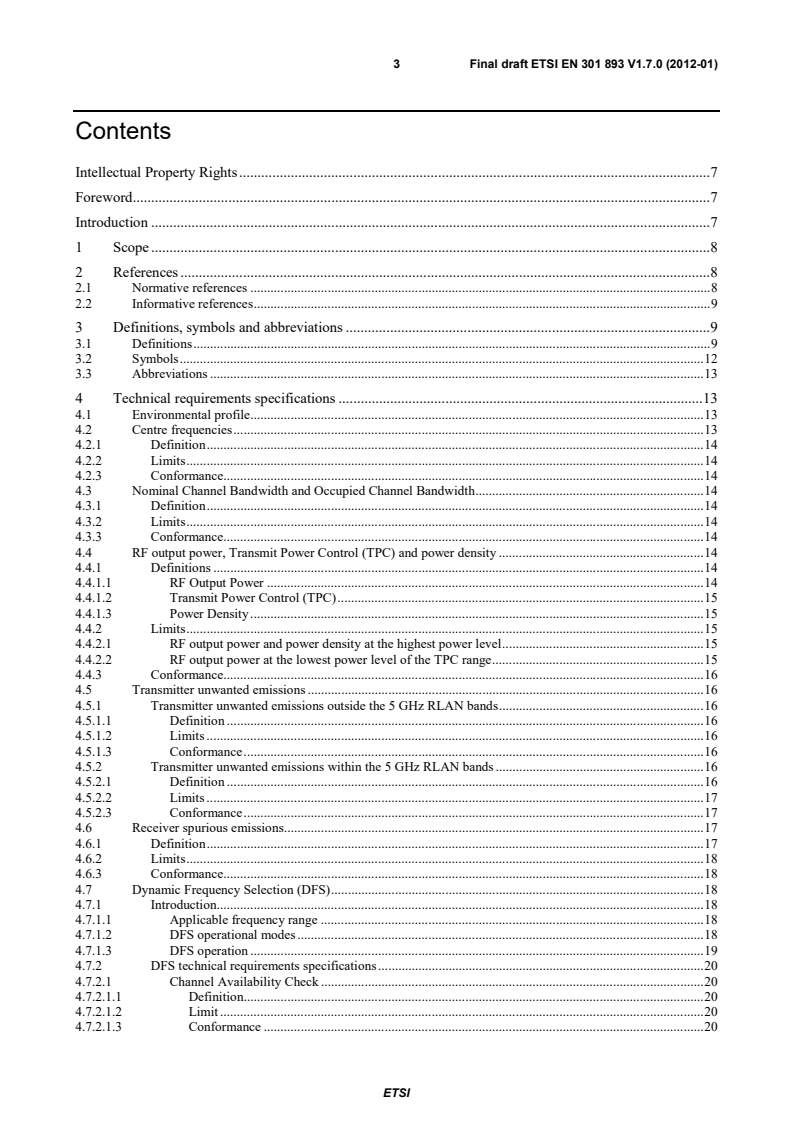
3 Final draft ETSI EN 301 893 V1.7.0 (2012-01)
Contents
Intellectual Property Rights . 7
Foreword . 7
Introduction . 7
1 Scope . 8
2 References . 8
2.1 Normative references . 8
2.2 Informative references . 9
3 Definitions, symbols and abbreviations . 9
3.1 Definitions . 9
3.2 Symbols . 12
3.3 Abbreviations . 13
4 Technical requirements specifications . 13
4.1 Environmental profile . 13
4.2 Centre frequencies . 13
4.2.1 Definition . 14
4.2.2 Limits . 14
4.2.3 Conformance. 14
4.3 Nominal Channel Bandwidth and Occupied Channel Bandwidth . 14
4.3.1 Definition . 14
4.3.2 Limits . 14
4.3.3 Conformance. 14
4.4 RF output power, Transmit Power Control (TPC) and power density . 14
4.4.1 Definitions . 14
4.4.1.1 RF Output Power . 14
4.4.1.2 Transmit Power Control (TPC) . 15
4.4.1.3 Power Density . 15
4.4.2 Limits . 15
4.4.2.1 RF output power and power density at the highest power level . 15
4.4.2.2 RF output power at the lowest power level of the TPC range . 15
4.4.3 Conformance. 16
4.5 Transmitter unwanted emissions . 16
4.5.1 Transmitter unwanted emissions outside the 5 GHz RLAN bands . 16
4.5.1.1 Definition . 16
4.5.1.2 Limits . 16
4.5.1.3 Conformance . 16
4.5.2 Transmitter unwanted emissions within the 5 GHz RLAN bands . 16
4.5.2.1 Definition . 16
4.5.2.2 Limits . 17
4.5.2.3 Conformance . 17
4.6 Receiver spurious emissions. 17
4.6.1 Definition . 17
4.6.2 Limits . 18
4.6.3 Conformance. 18
4.7 Dynamic Frequency Selection (DFS) . 18
4.7.1 Introduction. 18
4.7.1.1 Applicable frequency range . 18
4.7.1.2 DFS operational modes . 18
4.7.1.3 DFS operation . 19
4.7.2 DFS technical requirements specifications . 20
4.7.2.1 Channel Availability Check . 20
4.7.2.1.1 Definition. 20
4.7.2.1.2 Limit . 20
4.7.2.1.3 Conformance . 20
ETSI
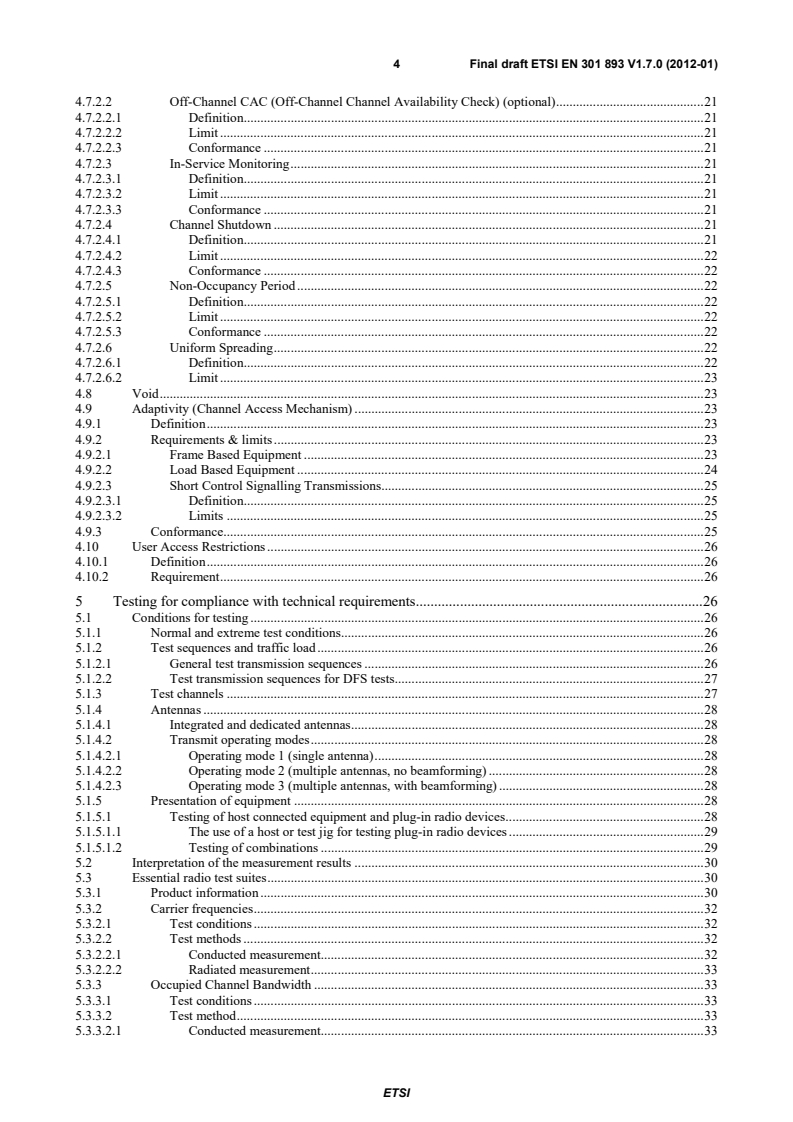
4 Final draft ETSI EN 301 893 V1.7.0 (2012-01)
4.7.2.2 Off-Channel CAC (Off-Channel Channel Availability Check) (optional) . 21
4.7.2.2.1 Definition. 21
4.7.2.2.2 Limit . 21
4.7.2.2.3 Conformance . 21
4.7.2.3 In-Service Monitoring . 21
4.7.2.3.1 Definition. 21
4.7.2.3.2 Limit . 21
4.7.2.3.3 Conformance . 21
4.7.2.4 Channel Shutdown . 21
4.7.2.4.1 Definition. 21
4.7.2.4.2 Limit . 22
4.7.2.4.3 Conformance . 22
4.7.2.5 Non-Occupancy Period . 22
4.7.2.5.1 Definition. 22
4.7.2.5.2 Limit . 22
4.7.2.5.3 Conformance . 22
4.7.2.6 Uniform Spreading . 22
4.7.2.6.1 Definition. 22
4.7.2.6.2 Limit . 23
4.8 Void . 23
4.9 Adaptivity (Channel Access Mechanism) . 23
4.9.1 Definition . 23
4.9.2 Requirements & limits . 23
4.9.2.1 Frame Based Equipment . 23
4.9.2.2 Load Based Equipment . 24
4.9.2.3 Short Control Signalling Transmissions. 25
4.9.2.3.1 Definition. 25
4.9.2.3.2 Limits . 25
4.9.3 Conformance. 25
4.10 User Access Restrictions . 26
4.10.1 Definition . 26
4.10.2 Requirement . 26
5 Testing for compliance with technical requirements . 26
5.1 Conditions for testing . 26
5.1.1 Normal and extreme test conditions. 26
5.1.2 Test sequences and traffic load . 26
5.1.2.1 General test transmission sequences . 26
5.1.2.2 Test transmission sequences for DFS tests . 27
5.1.3 Test channels . 27
5.1.4 Antennas . 28
5.1.4.1 Integrated and dedicated antennas . 28
5.1.4.2 Transmit operating modes . 28
5.1.4.2.1 Operating mode 1 (single antenna) . 28
5.1.4.2.2 Operating mode 2 (multiple antennas, no beamforming) . 28
5.1.4.2.3 Operating mode 3 (multiple antennas, with beamforming) . 28
5.1.5 Presentation of equipment . 28
5.1.5.1 Testing of host connected equipment and plug-in radio devices . 28
5.1.5.1.1 The use of a host or test jig for testing plug-in radio devices . 29
5.1.5.1.2 Testing of combinations . 29
5.2 Interpretation of the measurement results . 30
5.3 Essential radio test suites . 30
5.3.1 Product information . 30
5.3.2 Carrier frequencies . 32
5.3.2.1 Test conditions . 32
5.3.2.2 Test methods . 32
5.3.2.2.1 Conducted measurement. 32
5.3.2.2.2 Radiated measurement . 33
5.3.3 Occupied Channel Bandwidth . 33
5.3.3.1 Test conditions . 33
5.3.3.2 Test method . 33
5.3.3.2.1 Conducted measurement. 33
ETSI
5 Final draft ETSI EN 301 893 V1.7.0 (2012-01)
5.3.3.2.2 Radiated measurement . 34
5.3.4 RF output power, Transmit Power Control (TPC) and power density . 34
5.3.4.1 Test conditions . 34
5.3.4.2 Test method . 34
5.3.4.2.1 Conducted measurement. 34
5.3.4.2.2 Radiated measurement . 43
5.3.5 Transmitter unwanted emissions outside the 5 GHz RLAN bands . 44
5.3.5.1 Test conditions . 44
5.3.5.2 Test method . 44
5.3.5.2.1 Conducted measurement. 44
5.3.5.2.2 Radiated measurement . 47
5.3.6 Transmitter unwanted emissions within the 5 GHz RLAN bands . 47
5.3.6.1 Test conditions . 47
5.3.6.2 Test method . 47
5.3.6.2.1 Conducted measurement. 47
5.3.6.2.2 Radiated measurement . 48
5.3.7 Receiver spurious emissions . 48
5.3.7.1 Test conditions . 48
5.3.7.2 Test method . 49
5.3.7.2.1 Conducted measurement. 49
5.3.7.2.2 Radiated measurement . 50
5.3.8 Dynamic Frequency Selection (DFS) . 50
5.3.8.1 Test conditions . 50
5.3.8.1.1 Selection of radar test signals . 50
5.3.8.1.2 Test set-ups . 51
5.3.8.2 Test method . 52
5.3.8.2.1 Conducted measurement. 52
5.3.8.2.2 Radiated measurement . 60
5.3.9 Adaptivity (channel access mechanism) . 60
5.3.9.1 Test conditions . 60
5.3.9.2 Test method . 60
5.3.9.2.1 Conducted measurements . 60
5.3.9.2.2 Generic test procedure for measuring channel/frequency usage . 62
5.3.9.2.3 Radiated measurements . 63
Annex A (normative): HS Requirements and conformance Test specifications Table
(HS-RTT) . 64
Annex B (normative): Test sites and arrangements for radiated measurements . 66
B.1 Test sites . 66
B.1.1 Open air test sites . 66
B.1.2 Anechoic chamber . 67
B.1.2.1 General . 67
B.1.2.2 Description . 67
B.1.2.3 Influence of parasitic reflections . 67
B.1.2.4 Calibration and mode of use . 67
B.2 Test antenna . 69
B.3 Substitution antenna . 69
Annex C (normative): General description of measurement . 70
C.1 Conducted measurements . 70
C.2 Radiated measurements . 70
C.3 Substitution measurement . 71
Annex D (normative): DFS parameters . 72
Annex E (informative): Guidance for testing IEEE 802.11n™ Devices . 76
E.1 Introduction . 76
ETSI
6 Final draft ETSI EN 301 893 V1.7.0 (2012-01)
E.2 Possible Modulations . 76
E.2.1 Guidance for Testing . 76
E.2.1.1 Modulation Used for Conformance Testing . 76
E.3 Possible Operating Modes . 77
E.3.1 Guidance for Testing . 77
Annex F (informative): Application form for testing . 78
F.1 Information as required by EN 301 893 (V1.7.1), clause 5.3.1. 78
F.2 Additional information provided by the manufacturer . 86
F.2.1 Modulation: . 86
F.2.2 Duty Cycle. 86
F.2.3 About the UUT . 86
F.2.4 List of ancillary and/or support equipment provided by the manufacturer. 87
Annex G (informative): The EN title in the official languages . 88
Annex H (informative): Bibliography . 89
History . 90
ETSI
7 Final draft ETSI EN 301 893 V1.7.0 (2012-01)
Intellectual Property Rights
IPRs essential or potentially essential to the present document may have been declared to ETSI. The information
pertaining to these essential IPRs, if any, is publicly available for ETSI members and non-members, and can be found
in ETSI SR 000 314: "Intellectual Property Rights (IPRs); Essential, or potentially Essential, IPRs notified to ETSI in
respect of ETSI standards", which is available from the ETSI Secretariat. Latest updates are available on the ETSI Web
server (http://ipr.etsi.org).
Pursuant to the ETSI IPR Policy, no investigation, including IPR searches, has been carried out by ETSI. No guarantee
can be given as to the existence of other IPRs not referenced in ETSI SR 000 314 (or the updates on the ETSI Web
server) which are, or may be, or may become, essential to the present document.
Foreword
This final draft Harmonized European Standard (EN) has been produced by ETSI Technical Committee Broadband
Radio Access Networks (BRAN), and is now submitted for the ETSI standards One-step Approval Procedure.
The present document has been produced by ETSI in response to a mandate from the European Commission issued
under Directive 98/34/EC [i.1] as amended by Directive 98/48/EC [i.1].
The title and reference to the present document are intended to be included in the publication in the Official Journal of
the European Union of titles and references of Harmonized Standard under the Directive 1999/5/EC [1].
See article 5.1 of Directive 1999/5/EC [1] for information on presumption of conformity and Harmonised Standards or
parts thereof the references of which have been published in the Official Journal of the European Union.
The requirements relevant to Directive 1999/5/EC [1] are summarised in annex A.
Proposed national transposition dates
Date of latest announcement of this EN (doa): 3 months after ETSI publication
Date of latest publication of new National Standard
or endorsement of this EN (dop/e): 6 months after doa
Date of withdrawal of any conflicting National Standard (dow): 18 months after doa
Introduction
The present document is part of a set of standards developed by ETSI and is designed to fit in a modular structure to
cover all radio and telecommunications terminal equipment within the scope of the R&TTE Directive [1]. The modular
structure is shown in EG 201 399 [i.3].
ETSI
8 Final draft ETSI EN 301 893 V1.7.0 (2012-01)
1 Scope
The present document applies to 5 GHz high performance wireless access systems (WAS) including RLAN equipment
which is used in wireless local area networks. Such networks provide high speed data communications in between
devices connected to the wireless infrastructure. The present document also applies to ad-hoc networking where these
devices communicate directly with each other, without the use of a wireless infrastructure.
The present document also describes spectrum access requirements to facilitate spectrum sharing with other equipment.
5 GHz high performance wireless access systems (WAS) including RLAN equipment are further referred to as RLAN
equipment in the present document.
The spectrum usage conditions for this RLAN equipment are set in the ECC Decision (04)08 [5] and the Commission
Decision 2005/513/EC [6] as amended by the Commission Decision 2007/90/EC [7].
The equipment is intended to operate in the frequency ranges 5 150 MHz to 5 350 MHz and 5 470 MHz to 5 725 MHz
which have been allocated by WRC-03 to the mobile service on a primary basis for the implementation of
WAS/RLANs covered by the present document.
The present document is intended to cover the provisions of article 3.2 of R&TTE Directive [1], which states that:
"…radio equipment shall be so constructed that it effectively uses the spectrum allocated to terrestrial/space radio
communications and orbital resources so as to avoid harmful interference".
2 References
References are either specific (identified by date of publication and/or edition number or version number) or
non-specific. For specific references, only the cited version applies. For non-specific references, the latest version of the
referenced document (including any amendments) applies.
Referenced documents which are not found to be publicly available in the expected location might be found at
http://docbox.etsi.org/Reference.
NOTE: While any hyperlinks included in this clause were valid at the time of publication, ETSI cannot guarantee
their long term validity.
2.1 Normative references
The following referenced documents are necessary for the application of the present document.
[1] Directive 1999/5/EC of the European Parliament and of the Council of 9 March 1999 on radio
equipment and telecommunications terminal equipment and the mutual recognition of their
conformity (R&TTE Directive).
[2] ETSI TR 100 028-1 (V1.4.1): "Electromagnetic compatibility and Radio spectrum Matters (ERM);
Uncertainties in the measurement of mobile radio equipment characteristics; Part 1".
[3] ETSI TR 100 028-2 (V1.4.1): "Electromagnetic compatibility and Radio spectrum Matters (ERM);
Uncertainties in the measurement of mobile radio equipment characteristics; Part 2".
[4] CISPR 16-1-1 (2010-11 Ed. 3.1 Consolidated Edition with am1): "Specification for radio
disturbance and immunity measuring apparatus and methods - Part 1-1: Radio disturbance and
immunity measuring apparatus - Measuring apparatus".
[5] ECC/DEC/(04)08 ECC Decision of 9 July 2004 on the harmonised use of the 5 GHz frequency
bands for the implementation of Wireless Access Systems including Radio Local Area Networks
(WAS/RLANs) (30/10/2009).
[6] Commission Decision 2005/513/EC of 11 July 2005 on the harmonised use of radio spectrum in
the 5 GHz frequency band for the implementation of wireless access systems including radio local
area networks (WAS/RLANs).
ETSI
9 Final draft ETSI EN 301 893 V1.7.0 (2012-01)
[7] Commission Decision 2007/90/EC of 12 February 2007 amending Decision 2005/513/EC on the
harmonized use of radio spectrum in the 5 GHz frequency band for the implementation of Wireless
Access Systems including Radio Local Area Networks (WAS/RLANs).
[8] Void.
[9] IEEE Std. 802.11™-2007: "IEEE Standard for Information Technology - Telecommunications and
information exchange between systems - Local and metropolitan area networks - Specific
requirements - Part 11: Wireless LAN Medium Access Control (MAC) and Physical Layer (PHY)
Specifications".
[10] IEEE Std. 802.11n™-2009: "IEEE Standard for Information Technology - Telecommunications
and information exchange between systems - Local and Metropolitan networks - Specific
requirements-Part 11: Wireless LAN Medium Access Control (MAC) and Physical Layer (PHY)
Specifications. Amendment 5: Enhancements for Higher Throughput".
2.2 Informative references
The following referenced documents are not necessary for the application of the present document but they assist the
user with regard to a particular subject area.
[i.1] Directive 98/48/EC of the European Parliament and of the Council of 20 July 1998 amending
Directive 98/34/EC laying down a procedure for the provision of information in the field of
technical standards and regulations.
[i.2] IEEE Std. 802.11ac™: "Draft Standard for Information Technology - Telecommunications and
information exchange between systems - Local and Metropolitan networks - Specific requirements
- Part 11: Wireless LAN Medium Access Control (MAC) and Physical Layer (PHY)
specifications. Amendment 5: Enhancements for Higher Throughput for Operation in Bands below
6 GHz".
[i.3] ETSI EG 201 399 (V2.1.1): "Electromagnetic compatibility and Radio spectrum Matters (ERM);
A guide to the production of Harmonized Standards for application under the R&TTE Directive".
3 Definitions, symbols and abbreviations
3.1 Definitions
For the purposes of the present document, the terms and definitions given in the R&TTE Directive [1] and the following
apply:
5 GHz RLAN bands: total frequency range that consists of 2 sub-bands:
• 5 150 MHz to 5 350 MHz; and
• 5 470 MHz to 5 725 MHz
adaptive equipment: equipment operating in an adaptive mode
adaptive mode: mechanism by which equipment can adapt to its environment by identifying other transmissions
present in the band
ad-hoc mode: operating mode in which an RLAN device establishes a temporary wireless connection with other RLAN
devices without a controlling network infrastructure
antenna array: two or more antennas connected to a single device and operating simultaneously
antenna assembly: combination of the antenna (integral or dedicated), its coaxial cable and if applicable, its antenna
connector and associated switching components
NOTE 1: This term (antenna assembly) refers to an antenna connected to one transmit chain.
ETSI
10 Final draft ETSI EN 301 893 V1.7.0 (2012-01)
NOTE 2: The gain of an antenna assembly (G) in dBi, does not include the additional gain that may result out of
beamforming.
available channel: channel identified as available for immediate use as an Operating Channel
NOTE: Usable Channels whose nominal bandwidth falls completely within the band 5 150 MHz to 5 250 MHz
can be considered as Available Channels without further testing.
beamforming gain: additional (antenna) gain realized by using beamforming techniques in smart antenna systems
NOTE: Beamforming gain as used in the present document, does not include the gain of the antenna assembly.
burst: period during which radio waves are intentionally transmitted, preceded and succeeded by periods during which
no intentional transmission is made
channel: minimum amount of spectrum used by a single RLAN device
NOTE: An RLAN device is permitted to operate (transmit/receive) in one or more adjacent or non-adjacent
channels simultaneously.
EXAMPLE: For the purpose of the present document, an IEEE 802.11n™ [10] device operating in a 40 MHz
mode may be considered as operating in 2 adjacent 20 MHz channels simultaneously.
channel plan: combination of the centre frequencies and for each of the centre frequencies, the declared nominal
bandwidth(s)
clear channel assessment: mechanism used by an equipment to identify other transmissions in the channel
combined equipment: any combination of non-radio equipment that requires a plug-in radio device to offer full
functionality
dedicated antenna: antenna external to the equipment, using an antenna connector with a cable or a wave-guide and
which has been designed or developed for one or more specific types of equipment
NOTE: It is the combination of dedicated antenna and radio equipment that is expected to be compliant with the
regulations.
energy detect: mechanism used by an adaptive system to determine the presence of another device operating on the
channel based on detecting the signal level of that other device
environmental profile: range of environmental conditions under which equipment within the scope of the present
document is required to comply with the provisions of the present document
Frame Based Equipment (FBE): equipment where the transmit/receive structure is not directly demand-driven but has
fixed timing
NOTE: I.e. it may be altered by configuration changes but there is always a minimum Idle Period following a
transmit period
host equipment: any equipment which has complete user functionality when not connected to the radio equipment part
and to which the radio equipment part provides additional functionality and to which connection is necessary for the
radio equipment part to offer functionality
integral antenna: antenna designed as a fixed part of the equipment (without the use of an external connector) which
cannot be disconnected from the equipment by a user with the intent to connect another antenna
NOTE: An integral antenna may be fitted internally or externally. In the case where the antenna is external, a
non-detachable cable or wave-guide can be used.
Listen Before Talk (LBT): mechanism by which an equipment applies clear channel assessment (CCA) before using
the channel
Load Based Equipment (LBE): equipment where the transmit/receive structure is not fixed in time but demand-driven
manufacturer: company that has manufactured the equipment and who submits it for test
ETSI
11 Final draft ETSI EN 301 893 V1.7.0 (2012-01)
NOTE: Alternatively, the importer or any other person or entity that submits the equipment for test can be
considered as the manufacturer for the purpose of the present document.
master mode: mode which relates to the DFS functionality where the RLAN device uses a Radar Interference
Detection function and controls the transmissions of RLAN devices operating in slave mode
NOTE: In this mode it is able to select a channel and initiate a network by sending enabling signals to other
RLAN devices. An RLAN network always has at least one RLAN device operating in master mode when
operating in the bands 5 250 MHz to 5 350 MHz and 5 470 MHz to 5 725 MHz.
multi-radio equipment: radio, host or combined equipment using more than one radio transceiver
operating channel: Available Channel on which the RLAN has started transmissions
NOTE: An Operating Channel becomes again an Available Channel if the RLAN stopped all transmissions on
that channel and no radar signal was detected by the In-Service Monitoring.
plug-in radio device: radio equipment module intended to be used with or within host, combined or multi-radio
equipment, using their control functions and power supply
receive chain: receiver circuit with an associated anten
...
Harmonized European Standard
Broadband Radio Access Networks (BRAN);
5 GHz high performance RLAN;
Harmonized EN covering the essential requirements
of article 3.2 of the R&TTE Directive
2 ETSI EN 301 893 V1.7.1 (2012-06)
Reference
REN/BRAN-0060009
Keywords
access, broadband, LAN, layer 1, radio,
regulation, testing
ETSI
650 Route des Lucioles
F-06921 Sophia Antipolis Cedex - FRANCE
Tel.: +33 4 92 94 42 00 Fax: +33 4 93 65 47 16
Siret N° 348 623 562 00017 - NAF 742 C
Association à but non lucratif enregistrée à la
Sous-Préfecture de Grasse (06) N° 7803/88
Important notice
Individual copies of the present document can be downloaded from:
http://www.etsi.org
The present document may be made available in more than one electronic version or in print. In any case of existing or
perceived difference in contents between such versions, the reference version is the Portable Document Format (PDF).
In case of dispute, the reference shall be the printing on ETSI printers of the PDF version kept on a specific network drive
within ETSI Secretariat.
Users of the present document should be aware that the document may be subject to revision or change of status.
Information on the current status of this and other ETSI documents is available at
http://portal.etsi.org/tb/status/status.asp
If you find errors in the present document, please send your comment to one of the following services:
http://portal.etsi.org/chaircor/ETSI_support.asp
Copyright Notification
No part may be reproduced except as authorized by written permission.
The copyright and the foregoing restriction extend to reproduction in all media.
© European Telecommunications Standards Institute 2012.
All rights reserved.
TM TM TM
DECT , PLUGTESTS , UMTS and the ETSI logo are Trade Marks of ETSI registered for the benefit of its Members.
TM
3GPP and LTE™ are Trade Marks of ETSI registered for the benefit of its Members and
of the 3GPP Organizational Partners.
GSM® and the GSM logo are Trade Marks registered and owned by the GSM Association.
ETSI
3 ETSI EN 301 893 V1.7.1 (2012-06)
Contents
Intellectual Property Rights . 7
Foreword . 7
Introduction . 7
1 Scope . 8
2 References . 8
2.1 Normative references . 8
2.2 Informative references . 9
3 Definitions, symbols and abbreviations . 9
3.1 Definitions . 9
3.2 Symbols . 12
3.3 Abbreviations . 13
4 Technical requirements specifications . 13
4.1 Environmental profile . 13
4.2 Centre frequencies . 13
4.2.1 Definition . 14
4.2.2 Limits . 14
4.2.3 Conformance. 14
4.3 Nominal Channel Bandwidth and Occupied Channel Bandwidth . 14
4.3.1 Definition . 14
4.3.2 Limits . 14
4.3.3 Conformance. 14
4.4 RF output power, Transmit Power Control (TPC) and power density . 14
4.4.1 Definitions . 14
4.4.1.1 RF Output Power . 14
4.4.1.2 Transmit Power Control (TPC) . 15
4.4.1.3 Power Density . 15
4.4.2 Limits . 15
4.4.2.1 RF output power and power density at the highest power level . 15
4.4.2.2 RF output power at the lowest power level of the TPC range . 15
4.4.3 Conformance. 16
4.5 Transmitter unwanted emissions . 16
4.5.1 Transmitter unwanted emissions outside the 5 GHz RLAN bands . 16
4.5.1.1 Definition . 16
4.5.1.2 Limits . 16
4.5.1.3 Conformance . 16
4.5.2 Transmitter unwanted emissions within the 5 GHz RLAN bands . 16
4.5.2.1 Definition . 16
4.5.2.2 Limits . 17
4.5.2.3 Conformance . 17
4.6 Receiver spurious emissions. 17
4.6.1 Definition . 17
4.6.2 Limits . 18
4.6.3 Conformance. 18
4.7 Dynamic Frequency Selection (DFS) . 18
4.7.1 Introduction. 18
4.7.1.1 Applicable frequency range . 18
4.7.1.2 DFS operational modes . 18
4.7.1.3 DFS operation . 19
4.7.2 DFS technical requirements specifications . 20
4.7.2.1 Channel Availability Check . 20
4.7.2.1.1 Definition. 20
4.7.2.1.2 Limit . 20
4.7.2.1.3 Conformance . 20
ETSI
4 ETSI EN 301 893 V1.7.1 (2012-06)
4.7.2.2 Off-Channel CAC (Off-Channel Channel Availability Check) (optional) . 21
4.7.2.2.1 Definition. 21
4.7.2.2.2 Limit . 21
4.7.2.2.3 Conformance . 21
4.7.2.3 In-Service Monitoring . 21
4.7.2.3.1 Definition. 21
4.7.2.3.2 Limit . 21
4.7.2.3.3 Conformance . 21
4.7.2.4 Channel Shutdown . 21
4.7.2.4.1 Definition. 21
4.7.2.4.2 Limit . 22
4.7.2.4.3 Conformance . 22
4.7.2.5 Non-Occupancy Period . 22
4.7.2.5.1 Definition. 22
4.7.2.5.2 Limit . 22
4.7.2.5.3 Conformance . 22
4.7.2.6 Uniform Spreading . 22
4.7.2.6.1 Definition. 22
4.7.2.6.2 Limit . 23
4.8 Void . 23
4.9 Adaptivity (Channel Access Mechanism) . 23
4.9.1 Definition . 23
4.9.2 Requirements & limits . 23
4.9.2.1 Frame Based Equipment . 23
4.9.2.2 Load Based Equipment . 24
4.9.2.3 Short Control Signalling Transmissions. 25
4.9.2.3.1 Definition. 25
4.9.2.3.2 Limits . 25
4.9.3 Conformance. 25
4.10 User Access Restrictions . 26
4.10.1 Definition . 26
4.10.2 Requirement . 26
5 Testing for compliance with technical requirements . 26
5.1 Conditions for testing . 26
5.1.1 Normal and extreme test conditions. 26
5.1.2 Test sequences and traffic load . 26
5.1.2.1 General test transmission sequences . 26
5.1.2.2 Test transmission sequences for DFS tests . 27
5.1.3 Test channels . 27
5.1.4 Antennas . 28
5.1.4.1 Integrated and dedicated antennas . 28
5.1.4.2 Transmit operating modes . 28
5.1.4.2.1 Operating mode 1 (single antenna) . 28
5.1.4.2.2 Operating mode 2 (multiple antennas, no beamforming) . 28
5.1.4.2.3 Operating mode 3 (multiple antennas, with beamforming) . 28
5.1.5 Presentation of equipment . 28
5.1.5.1 Testing of host connected equipment and plug-in radio devices . 28
5.1.5.1.1 The use of a host or test jig for testing plug-in radio devices . 29
5.1.5.1.2 Testing of combinations . 29
5.2 Interpretation of the measurement results . 30
5.3 Essential radio test suites . 30
5.3.1 Product information . 30
5.3.2 Carrier frequencies . 32
5.3.2.1 Test conditions . 32
5.3.2.2 Test methods . 32
5.3.2.2.1 Conducted measurement. 32
5.3.2.2.2 Radiated measurement . 33
5.3.3 Occupied Channel Bandwidth . 33
5.3.3.1 Test conditions . 33
5.3.3.2 Test method . 33
5.3.3.2.1 Conducted measurement. 33
ETSI
5 ETSI EN 301 893 V1.7.1 (2012-06)
5.3.3.2.2 Radiated measurement . 34
5.3.4 RF output power, Transmit Power Control (TPC) and power density . 34
5.3.4.1 Test conditions . 34
5.3.4.2 Test method . 34
5.3.4.2.1 Conducted measurement. 34
5.3.4.2.2 Radiated measurement . 44
5.3.5 Transmitter unwanted emissions outside the 5 GHz RLAN bands . 44
5.3.5.1 Test conditions . 44
5.3.5.2 Test method . 44
5.3.5.2.1 Conducted measurement. 44
5.3.5.2.2 Radiated measurement . 47
5.3.6 Transmitter unwanted emissions within the 5 GHz RLAN bands . 47
5.3.6.1 Test conditions . 47
5.3.6.2 Test method . 47
5.3.6.2.1 Conducted measurement. 47
5.3.6.2.2 Radiated measurement . 48
5.3.7 Receiver spurious emissions . 48
5.3.7.1 Test conditions . 48
5.3.7.2 Test method . 49
5.3.7.2.1 Conducted measurement. 49
5.3.7.2.2 Radiated measurement . 50
5.3.8 Dynamic Frequency Selection (DFS) . 50
5.3.8.1 Test conditions . 50
5.3.8.1.1 Selection of radar test signals . 50
5.3.8.1.2 Test set-ups . 51
5.3.8.2 Test method . 52
5.3.8.2.1 Conducted measurement. 52
5.3.8.2.2 Radiated measurement . 60
5.3.9 Adaptivity (channel access mechanism) . 60
5.3.9.1 Test conditions . 60
5.3.9.2 Test method . 60
5.3.9.2.1 Conducted measurements . 60
5.3.9.2.2 Generic test procedure for measuring channel/frequency usage . 62
5.3.9.2.3 Radiated measurements . 63
Annex A (normative): HS Requirements and conformance Test specifications Table
(HS-RTT) . 64
Annex B (normative): Test sites and arrangements for radiated measurements . 66
B.1 Test sites . 66
B.1.1 Open air test sites . 66
B.1.2 Anechoic chamber . 67
B.1.2.1 General . 67
B.1.2.2 Description . 67
B.1.2.3 Influence of parasitic reflections . 67
B.1.2.4 Calibration and mode of use . 67
B.2 Test antenna . 69
B.3 Substitution antenna . 69
Annex C (normative): General description of measurement . 70
C.1 Conducted measurements . 70
C.2 Radiated measurements . 70
C.3 Substitution measurement . 71
Annex D (normative): DFS parameters . 72
Annex E (informative): Guidance for testing IEEE 802.11n™ Devices . 76
E.1 Introduction . 76
ETSI
6 ETSI EN 301 893 V1.7.1 (2012-06)
E.2 Possible Modulations . 76
E.2.1 Guidance for Testing . 76
E.2.1.1 Modulation Used for Conformance Testing . 76
E.3 Possible Operating Modes . 77
E.3.1 Guidance for Testing . 77
Annex F (informative): Application form for testing . 78
F.1 Information as required by EN 301 893 (V1.7.1), clause 5.3.1. 78
F.2 Additional information provided by the manufacturer . 86
F.2.1 Modulation: . 86
F.2.2 Duty Cycle. 86
F.2.3 About the UUT . 86
F.2.4 List of ancillary and/or support equipment provided by the manufacturer. 87
Annex G (informative): Void . 88
Annex H (informative): Bibliography . 89
History . 90
ETSI
7 ETSI EN 301 893 V1.7.1 (2012-06)
Intellectual Property Rights
IPRs essential or potentially essential to the present document may have been declared to ETSI. The information
pertaining to these essential IPRs, if any, is publicly available for ETSI members and non-members, and can be found
in ETSI SR 000 314: "Intellectual Property Rights (IPRs); Essential, or potentially Essential, IPRs notified to ETSI in
respect of ETSI standards", which is available from the ETSI Secretariat. Latest updates are available on the ETSI Web
server (http://ipr.etsi.org).
Pursuant to the ETSI IPR Policy, no investigation, including IPR searches, has been carried out by ETSI. No guarantee
can be given as to the existence of other IPRs not referenced in ETSI SR 000 314 (or the updates on the ETSI Web
server) which are, or may be, or may become, essential to the present document.
Foreword
This Harmonized European Standard (EN) has been produced by ETSI Technical Committee Broadband Radio Access
Networks (BRAN).
The present document has been produced by ETSI in response to a mandate from the European Commission issued
under Directive 98/34/EC [i.1] as amended by Directive 98/48/EC [i.1].
The title and reference to the present document are intended to be included in the publication in the Official Journal of
the European Union of titles and references of Harmonized Standard under the Directive 1999/5/EC [1].
See article 5.1 of Directive 1999/5/EC [1] for information on presumption of conformity and Harmonised Standards or
parts thereof the references of which have been published in the Official Journal of the European Union.
The requirements relevant to Directive 1999/5/EC [1] are summarised in annex A.
National transposition dates
Date of adoption of this EN: 30 May 2012
Date of latest announcement of this EN (doa): 31 August 2012
Date of latest publication of new National Standard
or endorsement of this EN (dop/e): 28 February 2013
Date of withdrawal of any conflicting National Standard (dow): 31 December 2014
Introduction
The present document is part of a set of standards developed by ETSI and is designed to fit in a modular structure to
cover all radio and telecommunications terminal equipment within the scope of the R&TTE Directive [1]. The modular
structure is shown in EG 201 399 [i.3].
ETSI
8 ETSI EN 301 893 V1.7.1 (2012-06)
1 Scope
The present document applies to 5 GHz high performance wireless access systems (WAS) including RLAN equipment
which is used in wireless local area networks. Such networks provide high speed data communications in between
devices connected to the wireless infrastructure. The present document also applies to ad-hoc networking where these
devices communicate directly with each other, without the use of a wireless infrastructure.
The present document also describes spectrum access requirements to facilitate spectrum sharing with other equipment.
5 GHz high performance wireless access systems (WAS) including RLAN equipment are further referred to as RLAN
equipment in the present document.
The spectrum usage conditions for this RLAN equipment are set in the ECC Decision (04)08 [5] and the Commission
Decision 2005/513/EC [6] as amended by the Commission Decision 2007/90/EC [7].
The equipment is intended to operate in the frequency ranges 5 150 MHz to 5 350 MHz and 5 470 MHz to 5 725 MHz
which have been allocated by WRC-03 to the mobile service on a primary basis for the implementation of
WAS/RLANs covered by the present document.
The present document is intended to cover the provisions of article 3.2 of R&TTE Directive [1], which states that:
"…radio equipment shall be so constructed that it effectively uses the spectrum allocated to terrestrial/space radio
communications and orbital resources so as to avoid harmful interference".
2 References
References are either specific (identified by date of publication and/or edition number or version number) or
non-specific. For specific references, only the cited version applies. For non-specific references, the latest version of the
referenced document (including any amendments) applies.
Referenced documents which are not found to be publicly available in the expected location might be found at
http://docbox.etsi.org/Reference.
NOTE: While any hyperlinks included in this clause were valid at the time of publication, ETSI cannot guarantee
their long term validity.
2.1 Normative references
The following referenced documents are necessary for the application of the present document.
[1] Directive 1999/5/EC of the European Parliament and of the Council of 9 March 1999 on radio
equipment and telecommunications terminal equipment and the mutual recognition of their
conformity (R&TTE Directive).
[2] ETSI TR 100 028-1 (V1.4.1): "Electromagnetic compatibility and Radio spectrum Matters (ERM);
Uncertainties in the measurement of mobile radio equipment characteristics; Part 1".
[3] ETSI TR 100 028-2 (V1.4.1): "Electromagnetic compatibility and Radio spectrum Matters (ERM);
Uncertainties in the measurement of mobile radio equipment characteristics; Part 2".
[4] CISPR 16-1-1 (2010-11 Ed. 3.1 Consolidated Edition with am1): "Specification for radio
disturbance and immunity measuring apparatus and methods - Part 1-1: Radio disturbance and
immunity measuring apparatus - Measuring apparatus".
[5] ECC/DEC/(04)08 ECC Decision of 9 July 2004 on the harmonised use of the 5 GHz frequency
bands for the implementation of Wireless Access Systems including Radio Local Area Networks
(WAS/RLANs) (30/10/2009).
[6] Commission Decision 2005/513/EC of 11 July 2005 on the harmonised use of radio spectrum in
the 5 GHz frequency band for the implementation of wireless access systems including radio local
area networks (WAS/RLANs).
ETSI
9 ETSI EN 301 893 V1.7.1 (2012-06)
[7] Commission Decision 2007/90/EC of 12 February 2007 amending Decision 2005/513/EC on the
harmonized use of radio spectrum in the 5 GHz frequency band for the implementation of Wireless
Access Systems including Radio Local Area Networks (WAS/RLANs).
[8] Void.
[9] IEEE Std. 802.11™-2007: "IEEE Standard for Information Technology - Telecommunications and
information exchange between systems - Local and metropolitan area networks - Specific
requirements - Part 11: Wireless LAN Medium Access Control (MAC) and Physical Layer (PHY)
Specifications".
[10] IEEE Std. 802.11n™-2009: "IEEE Standard for Information Technology - Telecommunications
and information exchange between systems - Local and Metropolitan networks - Specific
requirements-Part 11: Wireless LAN Medium Access Control (MAC) and Physical Layer (PHY)
Specifications. Amendment 5: Enhancements for Higher Throughput".
2.2 Informative references
The following referenced documents are not necessary for the application of the present document but they assist the
user with regard to a particular subject area.
[i.1] Directive 98/48/EC of the European Parliament and of the Council of 20 July 1998 amending
Directive 98/34/EC laying down a procedure for the provision of information in the field of
technical standards and regulations.
[i.2] IEEE Std. 802.11ac™: "Draft Standard for Information Technology - Telecommunications and
information exchange between systems - Local and Metropolitan networks - Specific requirements
- Part 11: Wireless LAN Medium Access Control (MAC) and Physical Layer (PHY)
specifications. Amendment 5: Enhancements for Higher Throughput for Operation in Bands below
6 GHz".
[i.3] ETSI EG 201 399 (V2.1.1): "Electromagnetic compatibility and Radio spectrum Matters (ERM);
A guide to the production of Harmonized Standards for application under the R&TTE Directive".
3 Definitions, symbols and abbreviations
3.1 Definitions
For the purposes of the present document, the terms and definitions given in the R&TTE Directive [1] and the following
apply:
5 GHz RLAN bands: total frequency range that consists of 2 sub-bands:
• 5 150 MHz to 5 350 MHz; and
• 5 470 MHz to 5 725 MHz
adaptive equipment: equipment operating in an adaptive mode
adaptive mode: mechanism by which equipment can adapt to its environment by identifying other transmissions
present in the band
ad-hoc mode: operating mode in which an RLAN device establishes a temporary wireless connection with other RLAN
devices without a controlling network infrastructure
antenna array: two or more antennas connected to a single device and operating simultaneously
antenna assembly: combination of the antenna (integral or dedicated), its coaxial cable and if applicable, its antenna
connector and associated switching components
NOTE 1: This term (antenna assembly) refers to an antenna connected to one transmit chain.
ETSI
10 ETSI EN 301 893 V1.7.1 (2012-06)
NOTE 2: The gain of an antenna assembly (G) in dBi, does not include the additional gain that may result out of
beamforming.
available channel: channel identified as available for immediate use as an Operating Channel
NOTE: Usable Channels whose nominal bandwidth falls completely within the band 5 150 MHz to 5 250 MHz
can be considered as Available Channels without further testing.
beamforming gain: additional (antenna) gain realized by using beamforming techniques in smart antenna systems
NOTE: Beamforming gain as used in the present document, does not include the gain of the antenna assembly.
burst: period during which radio waves are intentionally transmitted, preceded and succeeded by periods during which
no intentional transmission is made
channel: minimum amount of spectrum used by a single RLAN device
NOTE: An RLAN device is permitted to operate (transmit/receive) in one or more adjacent or non-adjacent
channels simultaneously.
EXAMPLE: For the purpose of the present document, an IEEE 802.11n™ [10] device operating in a 40 MHz
mode may be considered as operating in 2 adjacent 20 MHz channels simultaneously.
channel plan: combination of the centre frequencies and for each of the centre frequencies, the declared nominal
bandwidth(s)
clear channel assessment: mechanism used by an equipment to identify other transmissions in the channel
combined equipment: any combination of non-radio equipment that requires a plug-in radio device to offer full
functionality
dedicated antenna: antenna external to the equipment, using an antenna connector with a cable or a wave-guide and
which has been designed or developed for one or more specific types of equipment
NOTE: It is the combination of dedicated antenna and radio equipment that is expected to be compliant with the
regulations.
energy detect: mechanism used by an adaptive system to determine the presence of another device operating on the
channel based on detecting the signal level of that other device
environmental profile: range of environmental conditions under which equipment within the scope of the present
document is required to comply with the provisions of the present document
Frame Based Equipment (FBE): equipment where the transmit/receive structure is not directly demand-driven but has
fixed timing
NOTE: I.e. it may be altered by configuration changes but there is always a minimum Idle Period following a
transmit period
host equipment: any equipment which has complete user functionality when not connected to the radio equipment part
and to which the radio equipment part provides additional functionality and to which connection is necessary for the
radio equipment part to offer functionality
integral antenna: antenna designed as a fixed part of the equipment (without the use of an external connector) which
cannot be disconnected from the equipment by a user with the intent to connect another antenna
NOTE: An integral antenna may be fitted internally or externally. In the case where the antenna is external, a
non-detachable cable or wave-guide can be used.
Listen Before Talk (LBT): mechanism by which an equipment applies clear channel assessment (CCA) before using
the channel
Load Based Equipment (LBE): equipment where the transmit/receive structure is not fixed in time but demand-driven
ETSI
11 ETSI EN 301 893 V1.7.1 (2012-06)
manufacturer: company that has manufactured the equipment and who submits it for test
NOTE: Alternatively, the importer or any other person or entity that submits the equipment for test can be
considered as the manufacturer for the purpose of the present document.
master mode: mode which relates to the DFS functionality where the RLAN device uses a Radar Interference
Detection function and controls the transmissions of RLAN devices operating in slave mode
NOTE: In this mode it is able to select a channel and initiate a network by sending enabling signals to other
RLAN devices. An RLAN network always has at least one RLAN device operating in master mode when
operating in the bands 5 250 MHz to 5 350 MHz and 5 470 MHz to 5 725 MHz.
multi-radio equipment: radio, host or combined equipment using more than one radio transceiver
operating channel: Available Channel on which the RLAN has started transmissions
NOTE: An Operating Channel becomes again an Available Channel if the RLAN stopped all transmissions on
that channel and no radar signal was detected by the In-Service Monitoring.
plug-in radio device: radio equipment module intended to be used with or within host, combined or multi-radio
equipment, using their control functions and power supply
receive chain: receiver circuit with an associated antenna
NOTE: Two or more receive chains are combined in a smart antenna system.
RLAN devices: 5 GHz high performance wireless access systems (WAS) including RLAN equipment
si
...
2003-01.Slovenski inštitut za standardizacijo. Razmnoževanje celote ali delov tega standarda ni dovoljeno.Broadband Radio Access Networks (BRAN) - 5 GHz high performance RLAN - Harmonized EN covering the essential requirements of article 3.2 of the R&TTE Directive35.110OmreževanjeNetworking33.060.01Radijske komunikacije na splošnoRadiocommunications in generalICS:Ta slovenski standard je istoveten z:EN 301 893 Version 1.7.1SIST EN 301 893 V1.7.1:2012en01-julij-2012SIST EN 301 893 V1.7.1:2012SLOVENSKI
STANDARD
Harmonized European Standard SIST EN 301 893 V1.7.1:2012
ETSI ETSI EN 301 893 V1.7.1 (2012-06) 2
Reference REN/BRAN-0060009 Keywords access, broadband, LAN, layer 1, radio, regulation, testing ETSI 650 Route des Lucioles F-06921 Sophia Antipolis Cedex - FRANCE
Tel.: +33 4 92 94 42 00
Fax: +33 4 93 65 47 16
Siret N° 348 623 562 00017 - NAF 742 C Association à but non lucratif enregistrée à la Sous-Préfecture de Grasse (06) N° 7803/88
Important notice Individual copies of the present document can be downloaded from: http://www.etsi.org The present document may be made available in more than one electronic version or in print. In any case of existing or perceived difference in contents between such versions, the reference version is the Portable Document Format (PDF). In case of dispute, the reference shall be the printing on ETSI printers of the PDF version kept on a specific network drive within ETSI Secretariat. Users of the present document should be aware that the document may be subject to revision or change of status. Information on the current status of this and other ETSI documents is available at http://portal.etsi.org/tb/status/status.asp If you find errors in the present document, please send your comment to one of the following services: http://portal.etsi.org/chaircor/ETSI_support.asp Copyright Notification No part may be reproduced except as authorized by written permission. The copyright and the foregoing restriction extend to reproduction in all media.
© European Telecommunications Standards Institute 2012. All rights reserved.
DECTTM, PLUGTESTSTM, UMTSTM and the ETSI logo are Trade Marks of ETSI registered for the benefit of its Members. 3GPPTM and LTE™ are Trade Marks of ETSI registered for the benefit of its Members and of the 3GPP Organizational Partners. GSM® and the GSM logo are Trade Marks registered and owned by the GSM Association. SIST EN 301 893 V1.7.1:2012
ETSI ETSI EN 301 893 V1.7.1 (2012-06) 3 Contents Intellectual Property Rights . 7 Foreword . 7 Introduction . 7 1 Scope . 8 2 References . 8 2.1 Normative references . 8 2.2 Informative references . 9 3 Definitions, symbols and abbreviations . 9 3.1 Definitions . 9 3.2 Symbols . 12 3.3 Abbreviations . 13 4 Technical requirements specifications . 13 4.1 Environmental profile . 13 4.2 Centre frequencies . 13 4.2.1 Definition . 14 4.2.2 Limits . 14 4.2.3 Conformance. 14 4.3 Nominal Channel Bandwidth and Occupied Channel Bandwidth . 14 4.3.1 Definition . 14 4.3.2 Limits . 14 4.3.3 Conformance. 14 4.4 RF output power, Transmit Power Control (TPC) and power density . 14 4.4.1 Definitions . 14 4.4.1.1 RF Output Power . 14 4.4.1.2 Transmit Power Control (TPC) . 15 4.4.1.3 Power Density . 15 4.4.2 Limits . 15 4.4.2.1 RF output power and power density at the highest power level . 15 4.4.2.2 RF output power at the lowest power level of the TPC range . 15 4.4.3 Conformance. 16 4.5 Transmitter unwanted emissions . 16 4.5.1 Transmitter unwanted emissions outside the 5 GHz RLAN bands . 16 4.5.1.1 Definition . 16 4.5.1.2 Limits . 16 4.5.1.3 Conformance . 16 4.5.2 Transmitter unwanted emissions within the 5 GHz RLAN bands . 16 4.5.2.1 Definition . 16 4.5.2.2 Limits . 17 4.5.2.3 Conformance . 17 4.6 Receiver spurious emissions. 17 4.6.1 Definition . 17 4.6.2 Limits . 18 4.6.3 Conformance. 18 4.7 Dynamic Frequency Selection (DFS) . 18 4.7.1 Introduction. 18 4.7.1.1 Applicable frequency range . 18 4.7.1.2 DFS operational modes . 18 4.7.1.3 DFS operation . 19 4.7.2 DFS technical requirements specifications . 20 4.7.2.1 Channel Availability Check . 20 4.7.2.1.1 Definition. 20 4.7.2.1.2 Limit . 20 4.7.2.1.3 Conformance . 20 SIST EN 301 893 V1.7.1:2012
ETSI ETSI EN 301 893 V1.7.1 (2012-06) 4 4.7.2.2 Off-Channel CAC (Off-Channel Channel Availability Check) (optional) . 21 4.7.2.2.1 Definition. 21 4.7.2.2.2 Limit . 21 4.7.2.2.3 Conformance . 21 4.7.2.3 In-Service Monitoring . 21 4.7.2.3.1 Definition. 21 4.7.2.3.2 Limit . 21 4.7.2.3.3 Conformance . 21 4.7.2.4 Channel Shutdown . 21 4.7.2.4.1 Definition. 21 4.7.2.4.2 Limit . 22 4.7.2.4.3 Conformance . 22 4.7.2.5 Non-Occupancy Period . 22 4.7.2.5.1 Definition. 22 4.7.2.5.2 Limit . 22 4.7.2.5.3 Conformance . 22 4.7.2.6 Uniform Spreading . 22 4.7.2.6.1 Definition. 22 4.7.2.6.2 Limit . 23 4.8 Void . 23 4.9 Adaptivity (Channel Access Mechanism) . 23 4.9.1 Definition . 23 4.9.2 Requirements & limits . 23 4.9.2.1 Frame Based Equipment . 23 4.9.2.2 Load Based Equipment . 24 4.9.2.3 Short Control Signalling Transmissions. 25 4.9.2.3.1 Definition. 25 4.9.2.3.2 Limits . 25 4.9.3 Conformance. 25 4.10 User Access Restrictions . 26 4.10.1 Definition . 26 4.10.2 Requirement . 26 5 Testing for compliance with technical requirements . 26 5.1 Conditions for testing . 26 5.1.1 Normal and extreme test conditions. 26 5.1.2 Test sequences and traffic load . 26 5.1.2.1 General test transmission sequences . 26 5.1.2.2 Test transmission sequences for DFS tests . 27 5.1.3 Test channels . 27 5.1.4 Antennas . 28 5.1.4.1 Integrated and dedicated antennas . 28 5.1.4.2 Transmit operating modes . 28 5.1.4.2.1 Operating mode 1 (single antenna) . 28 5.1.4.2.2 Operating mode 2 (multiple antennas, no beamforming) . 28 5.1.4.2.3 Operating mode 3 (multiple antennas, with beamforming) . 28 5.1.5 Presentation of equipment . 28 5.1.5.1 Testing of host connected equipment and plug-in radio devices . 28 5.1.5.1.1 The use of a host or test jig for testing plug-in radio devices . 29 5.1.5.1.2 Testing of combinations . 29 5.2 Interpretation of the measurement results . 30 5.3 Essential radio test suites . 30 5.3.1 Product information . 30 5.3.2 Carrier frequencies . 32 5.3.2.1 Test conditions . 32 5.3.2.2 Test methods . 32 5.3.2.2.1 Conducted measurement. 32 5.3.2.2.2 Radiated measurement . 33 5.3.3 Occupied Channel Bandwidth . 33 5.3.3.1 Test conditions . 33 5.3.3.2 Test method . 33 5.3.3.2.1 Conducted measurement. 33 SIST EN 301 893 V1.7.1:2012
ETSI ETSI EN 301 893 V1.7.1 (2012-06) 5 5.3.3.2.2 Radiated measurement . 34 5.3.4 RF output power, Transmit Power Control (TPC) and power density . 34 5.3.4.1 Test conditions . 34 5.3.4.2 Test method . 34 5.3.4.2.1 Conducted measurement. 34 5.3.4.2.2 Radiated measurement . 44 5.3.5 Transmitter unwanted emissions outside the 5 GHz RLAN bands . 44 5.3.5.1 Test conditions . 44 5.3.5.2 Test method . 44 5.3.5.2.1 Conducted measurement. 44 5.3.5.2.2 Radiated measurement . 47 5.3.6 Transmitter unwanted emissions within the 5 GHz RLAN bands . 47 5.3.6.1 Test conditions . 47 5.3.6.2 Test method . 47 5.3.6.2.1 Conducted measurement. 47 5.3.6.2.2 Radiated measurement . 48 5.3.7 Receiver spurious emissions . 48 5.3.7.1 Test conditions . 48 5.3.7.2 Test method . 49 5.3.7.2.1 Conducted measurement. 49 5.3.7.2.2 Radiated measurement . 50 5.3.8 Dynamic Frequency Selection (DFS) . 50 5.3.8.1 Test conditions . 50 5.3.8.1.1 Selection of radar test signals . 50 5.3.8.1.2 Test set-ups . 51 5.3.8.2 Test method . 52 5.3.8.2.1 Conducted measurement. 52 5.3.8.2.2 Radiated measurement . 60 5.3.9 Adaptivity (channel access mechanism) . 60 5.3.9.1 Test conditions . 60 5.3.9.2 Test method . 60 5.3.9.2.1 Conducted measurements . 60 5.3.9.2.2 Generic test procedure for measuring channel/frequency usage . 62 5.3.9.2.3 Radiated measurements . 63 Annex A (normative): HS Requirements and conformance Test specifications Table (HS-RTT) . 64 Annex B (normative): Test sites and arrangements for radiated measurements . 66 B.1 Test sites . 66 B.1.1 Open air test sites . 66 B.1.2 Anechoic chamber . 67 B.1.2.1 General . 67 B.1.2.2 Description . 67 B.1.2.3 Influence of parasitic reflections . 67 B.1.2.4 Calibration and mode of use . 67 B.2 Test antenna . 69 B.3 Substitution antenna . 69 Annex C (normative): General description of measurement . 70 C.1 Conducted measurements . 70 C.2 Radiated measurements . 70 C.3 Substitution measurement . 71 Annex D (normative): DFS parameters . 72 Annex E (informative): Guidance for testing IEEE 802.11n™ Devices . 76 E.1 Introduction . 76 SIST EN 301 893 V1.7.1:2012
ETSI ETSI EN 301 893 V1.7.1 (2012-06) 6 E.2 Possible Modulations . 76 E.2.1 Guidance for Testing . 76 E.2.1.1 Modulation Used for Conformance Testing . 76 E.3 Possible Operating Modes . 77 E.3.1 Guidance for Testing . 77 Annex F (informative): Application form for testing . 78 F.1 Information as required by EN 301 893 (V1.7.1), clause 5.3.1. 78 F.2 Additional information provided by the manufacturer . 86 F.2.1 Modulation: . 86 F.2.2 Duty Cycle. 86 F.2.3 About the UUT . 86 F.2.4 List of ancillary and/or support equipment provided by the manufacturer. 87 Annex G (informative): Void . 88 Annex H (informative): Bibliography . 89 History . 90
ETSI ETSI EN 301 893 V1.7.1 (2012-06) 7 Intellectual Property Rights IPRs essential or potentially essential to the present document may have been declared to ETSI. The information pertaining to these essential IPRs, if any, is publicly available for ETSI members and non-members, and can be found in ETSI SR 000 314: "Intellectual Property Rights (IPRs); Essential, or potentially Essential, IPRs notified to ETSI in respect of ETSI standards", which is available from the ETSI Secretariat. Latest updates are available on the ETSI Web server (http://ipr.etsi.org). Pursuant to the ETSI IPR Policy, no investigation, including IPR searches, has been carried out by ETSI. No guarantee can be given as to the existence of other IPRs not referenced in ETSI SR 000 314 (or the updates on the ETSI Web server) which are, or may be, or may become, essential to the present document. Foreword This Harmonized European Standard (EN) has been produced by ETSI Technical Committee Broadband Radio Access Networks (BRAN). The present document has been produced by ETSI in response to a mandate from the European Commission issued under Directive 98/34/EC [i.1] as amended by Directive 98/48/EC [i.1]. The title and reference to the present document are intended to be included in the publication in the Official Journal of the European Union of titles and references of Harmonized Standard under the Directive 1999/5/EC [1]. See article 5.1 of Directive 1999/5/EC [1] for information on presumption of conformity and Harmonised Standards or parts thereof the references of which have been published in the Official Journal of the European Union. The requirements relevant to Directive 1999/5/EC [1] are summarised in annex A.
National transposition dates Date of adoption of this EN: 30 May 2012 Date of latest announcement of this EN (doa): 31 August 2012 Date of latest publication of new National Standard or endorsement of this EN (dop/e):
28 February 2013 Date of withdrawal of any conflicting National Standard (dow): 31 December 2014
Introduction The present document is part of a set of standards developed by ETSI and is designed to fit in a modular structure to cover all radio and telecommunications terminal equipment within the scope of the R&TTE Directive [1]. The modular structure is shown in EG 201 399 [i.3].
ETSI ETSI EN 301 893 V1.7.1 (2012-06) 8 1 Scope The present document applies to 5 GHz high performance wireless access systems (WAS) including RLAN equipment which is used in wireless local area networks. Such networks provide high speed data communications in between devices connected to the wireless infrastructure. The present document also applies to ad-hoc networking where these devices communicate directly with each other, without the use of a wireless infrastructure.
The present document also describes spectrum access requirements to facilitate spectrum sharing with other equipment. 5 GHz high performance wireless access systems (WAS) including RLAN equipment are further referred to as RLAN equipment in the present document.
The spectrum usage conditions for this RLAN equipment are set in the ECC Decision (04)08 [5] and the Commission Decision 2005/513/EC [6] as amended by the Commission Decision 2007/90/EC [7].
The equipment is intended to operate in the frequency ranges 5 150 MHz to 5 350 MHz and 5 470 MHz to 5 725 MHz which have been allocated by WRC-03 to the mobile service on a primary basis for the implementation of WAS/RLANs covered by the present document. The present document is intended to cover the provisions of article 3.2 of R&TTE Directive [1], which states that: "…radio equipment shall be so constructed that it effectively uses the spectrum allocated to terrestrial/space radio communications and orbital resources so as to avoid harmful interference". 2 References References are either specific (identified by date of publication and/or edition number or version number) or non-specific. For specific references, only the cited version applies. For non-specific references, the latest version of the referenced document (including any amendments) applies. Referenced documents which are not found to be publicly available in the expected location might be found at http://docbox.etsi.org/Reference. NOTE: While any hyperlinks included in this clause were valid at the time of publication, ETSI cannot guarantee their long term validity. 2.1 Normative references The following referenced documents are necessary for the application of the present document. [1] Directive 1999/5/EC of the European Parliament and of the Council of 9 March 1999 on radio equipment and telecommunications terminal equipment and the mutual recognition of their conformity (R&TTE Directive). [2] ETSI TR 100 028-1 (V1.4.1): "Electromagnetic compatibility and Radio spectrum Matters (ERM); Uncertainties in the measurement of mobile radio equipment characteristics; Part 1". [3] ETSI TR 100 028-2 (V1.4.1): "Electromagnetic compatibility and Radio spectrum Matters (ERM); Uncertainties in the measurement of mobile radio equipment characteristics; Part 2". [4] CISPR 16-1-1 (2010-11 Ed. 3.1 Consolidated Edition with am1): "Specification for radio disturbance and immunity measuring apparatus and methods - Part 1-1: Radio disturbance and immunity measuring apparatus - Measuring apparatus". [5] ECC/DEC/(04)08 ECC Decision of 9 July 2004 on the harmonised use of the 5 GHz frequency bands for the implementation of Wireless Access Systems including Radio Local Area Networks (WAS/RLANs) (30/10/2009). [6] Commission Decision 2005/513/EC of 11 July 2005 on the harmonised use of radio spectrum in the 5 GHz frequency band for the implementation of wireless access systems including radio local area networks (WAS/RLANs). SIST EN 301 893 V1.7.1:2012
ETSI ETSI EN 301 893 V1.7.1 (2012-06) 9 [7] Commission Decision 2007/90/EC of 12 February 2007 amending Decision 2005/513/EC on the harmonized use of radio spectrum in the 5 GHz frequency band for the implementation of Wireless Access Systems including Radio Local Area Networks (WAS/RLANs). [8] Void. [9] IEEE Std. 802.11™-2007: "IEEE Standard for Information Technology - Telecommunications and information exchange between systems - Local and metropolitan area networks - Specific requirements - Part 11: Wireless LAN Medium Access Control (MAC) and Physical Layer (PHY) Specifications". [10] IEEE Std. 802.11n™-2009: "IEEE Standard for Information Technology - Telecommunications and information exchange between systems - Local and Metropolitan networks - Specific requirements-Part 11: Wireless LAN Medium Access Control (MAC) and Physical Layer (PHY) Specifications. Amendment 5: Enhancements for Higher Throughput". 2.2 Informative references The following referenced documents are not necessary for the application of the present document but they assist the user with regard to a particular subject area. [i.1] Directive 98/48/EC of the European Parliament and of the Council of 20 July 1998 amending Directive 98/34/EC laying down a procedure for the provision of information in the field of technical standards and regulations. [i.2] IEEE Std. 802.11ac™: "Draft Standard for Information Technology - Telecommunications and information exchange between systems - Local and Metropolitan networks - Specific requirements - Part 11: Wireless LAN Medium Access Control (MAC) and Physical Layer (PHY) specifications. Amendment 5: Enhancements for Higher Throughput for Operation in Bands below 6 GHz". [i.3] ETSI EG 201 399 (V2.1.1): "Electromagnetic compatibility and Radio spectrum Matters (ERM); A guide to the production of Harmonized Standards for application under the R&TTE Directive". 3 Definitions, symbols and abbreviations 3.1 Definitions For the purposes of the present document, the terms and definitions given in the R&TTE Directive [1] and the following apply: 5 GHz RLAN bands: total frequency range that consists of 2 sub-bands:
• 5 150 MHz to 5 350 MHz; and
• 5 470 MHz to 5 725 MHz adaptive equipment: equipment operating in an adaptive mode adaptive mode: mechanism by which equipment can adapt to its environment by identifying other transmissions present in the band ad-hoc mode: operating mode in which an RLAN device establishes a temporary wireless connection with other RLAN devices without a controlling network infrastructure antenna array: two or more antennas connected to a single device and operating simultaneously antenna assembly: combination of the antenna (integral or dedicated), its coaxial cable and if applicable, its antenna connector and associated switching components NOTE 1: This term (antenna assembly) refers to an antenna connected to one transmit chain. SIST EN 301 893 V1.7.1:2012
ETSI ETSI EN 301 893 V1.7.1 (2012-06) 10 NOTE 2: The gain of an antenna assembly (G) in dBi, does not include the additional gain that may result out of beamforming. available channel: channel identified as available for immediate use as an Operating Channel NOTE: Usable Channels whose nominal bandwidth falls completely within the band 5 150 MHz to 5 250 MHz can be considered as Available Channels without further testing. beamforming gain: additional (antenna) gain realized by using beamforming techniques in smart antenna systems NOTE: Beamforming gain as used in the present document, does not include the gain of the antenna assembly. burst: period during which radio waves are intentionally transmitted, preceded and succeeded by periods during which no intentional transmission is made channel: minimum amount of spectrum used by a single RLAN device NOTE: An RLAN device is permitted to operate (transmit/receive) in one or more adjacent or non-adjacent channels simultaneously.
EXAMPLE: For the purpose of the present document, an IEEE 802.11n™ [10] device operating in a 40 MHz mode may be considered as operating in 2 adjacent 20 MHz channels simultaneously. channel plan: combination of the centre frequencies and for each of the centre frequencies, the declared nominal bandwidth(s) clear channel assessment: mechanism used by an equipment to identify other transmissions in the channel combined equipment: any combination of non-radio equipment that requires a plug-in radio device to offer full functionality dedicated antenna: antenna external to the equipment, using an antenna connector with a cable or a wave-guide and which has been designed or developed for one or more specific types of equipment NOTE: It is the combination of dedicated antenna and radio equipment that is expected to be compliant with the regulations. energy detect: mechanism used by an adaptive system to determine the presence of another device operating on the channel based on detecting the signal level of that other device environmental profile: range of environmental conditions under which equipment within the scope of the present document is required to comply with the provisions of the present document
Frame Based Equipment (FBE): equipment where the transmit/receive structure is not directly demand-driven but has fixed timing NOTE:
I.e. it may be altered by configuration changes but there is always a minimum Idle Period following a transmit period host equipment: any equipment which has complete user functionality when not connected to the radio equipment part and to which the radio equipment part provides additional functionality and to which connection is necessary for the radio equipment part to offer functionality integral antenna: antenna designed as a fixed part of the equipment (without the use of an external connector) which cannot be disconnected from the equipment by a user with the intent to connect another antenna NOTE: An integral antenna may be fitted internally or externally. In the case where the antenna is external, a non-detachable cable or wave-guide can be used. Listen Before Talk (LBT): mechanism by which an equipment applies clear channel assessment (CCA) before using the channel Load Based Equipment (LBE): equipment where the transmit/receive structure is not fixed in time but demand-driven SIST EN 301 893 V1.7.1:2012
ETSI ETSI EN 301 893 V1.7.1 (2012-06) 11 manufacturer: company that has manufactured the equipment and who submits it for test NOTE: Alternatively, the importer or any other person or entity that submits the equipment for test can be considered as the manufacturer for the purpose of the present document. master mode: mode which relates to the DFS functionality where the RLAN device uses a Radar Interference Detection function and controls the transmissions of RLAN devices operating in slave mode NOTE: In this mode it is able to select a channel and initiate a network by sending enabling signals to other RLAN devices. An RLAN network always has at least one RLAN device operating in master mode when operating in the bands 5 250 MHz to 5 350 MHz and 5 470 MHz to 5 725 MHz. multi-radio equipment: radio, host or combined equipment using more than one radio transceiver operating channel: Available Channel on which the RLAN has started transmissions NOTE: An Operating Channel becomes again an Available Channel if the RLAN stopped all transmissions on that channel and no radar signal was detected by the In-Service Monitoring. plug-in radio device: radio equipment module intended to be used with or within host, combined or multi-radio equipment, using their control functions and power supply receive chain: receiver circuit with an associated antenna
NOTE: Two or more receive chains are combined in a smart antenna system. RLAN devices: 5 GHz high performance wireless access systems (WAS) including RLAN equipment simulated radar burst: series of periodic radio wave pulses for test purposes
slave mode: mode which relates to the DFS functionality where the transmissions of the RLAN are u
...
Questions, Comments and Discussion
Ask us and Technical Secretary will try to provide an answer. You can facilitate discussion about the standard in here.
Loading comments...