

ETSI EN 300 392-12-4 V1.2.1 (2010-07)
Terrestrial Trunked Radio (TETRA); Voice plus Data (V+D); Part 12: Supplementary services stage 3; Sub-part 4: Call Forwarding (CF)
General Information
- Abstract
REN/TETRA-03199
- Status
- Published
- Publication Date
- 21-Jul-2010
- Technical Committee
- TCCE 3 - TCCE Air Interface and Network Protocols
- Current Stage
- 12 - Completion
- Due Date
- 29-Jul-2010
- Completion Date
- 22-Jul-2010
Buy Documents
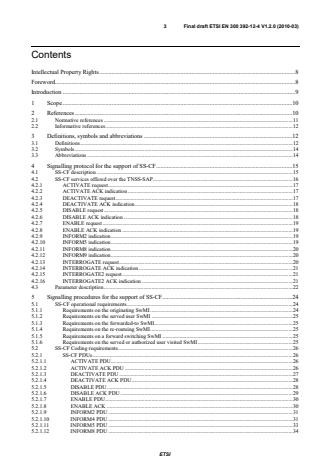
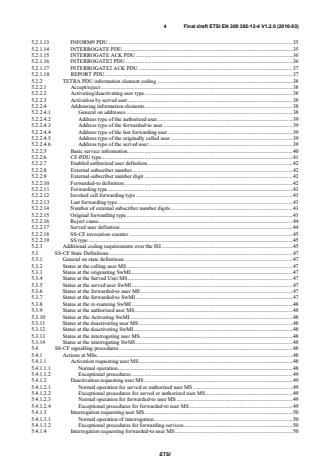
ETSI EN 300 392-12-4 V1.2.0 (2010-03) - Terrestrial Trunked Radio (TETRA); Voice plus Data (V+D); Part 12: Supplementary services stage 3; Sub-part 4: Call Forwarding (CF)
ETSI EN 300 392-12-4 V1.2.1 (2010-07) - Terrestrial Trunked Radio (TETRA); Voice plus Data (V+D); Part 12: Supplementary services stage 3; Sub-part 4: Call Forwarding (CF)

Overview
ETSI EN 300 392-12-4 V1.2.1 (2010-07) is the TETRA (Terrestrial Trunked Radio) stage‑3 specification for Call Forwarding (CF) as part of the Voice plus Data (V+D) system. It defines the signalling protocol and service behaviour for the four call‑forwarding supplementary services: SS‑CFU (Unconditional), SS‑CFB (On Busy), SS‑CFNRy (On No Reply) and SS‑CFNRc (Not Reachable). The document applies to individual and group calls (and partly to SDS - Short Data Service) and covers the interactions between mobile stations (MS) and various Switching and Management Infrastructure (SwMI) entities that form a TETRA network.
Key technical topics and requirements
- Service scope and definitions
- Formal definitions for SS‑CFU, SS‑CFB, SS‑CFNRy and SS‑CFNRc and their invocation in TETRA.
- Explicit separation of the No Reply and Not Reachable cases (unlike ECMA‑174).
- Signalling protocol (Stage 3)
- Message sets and PDUs for CF control: ACTIVATE / DEACTIVATE / ENABLE / DISABLE / INFORM / INTERROGATE and their ACKs.
- Parameter and information element coding for CF PDUs (addressing, forwarding type, reject causes, invocation counters, etc.).
- Entities and interfaces
- Applicable to MS of calling or called users, originating/terminating/interworking SwMIs, and group‑controlling SwMI for group calls.
- Additional signalling requirements for interactions at the ISI reference point and for interactions with other supplementary services and ANFs.
- Operational and state behaviour
- Requirements and state definitions for originating, served, forwarded‑to and re‑routing SwMIs and corresponding MSs.
- Support for group calls and mobility scenarios not covered in earlier ECMA recommendations.
- Scope exclusions
- Man‑Machine Interface (MMI) considerations and charging principles are explicitly out of scope.
Practical applications - who uses this standard
- TETRA equipment and core system vendors implementing SwMI features and MS firmware to ensure correct CF behaviour and interoperability.
- Network integrators and operators (public safety, transport, utilities) deploying TETRA systems that require reliable call forwarding for availability and redundancy.
- Conformance and test labs creating test cases for CF functionality, signalling, and ISI interactions.
- Standards engineers mapping service interactions across the EN 300 392 family and aligning implementations with ECMA‑174 differences.
Related standards
- ECMA‑174 (base reference used by this document) - note: this standard adapts and extends ECMA‑174 for TETRA specifics (group calls, mobility, No Reply vs Not Reachable).
- Other parts of the ETSI/EN 300 392 TETRA series (Voice plus Data) for complementary signalling and service definitions.
Keywords: TETRA, Call Forwarding, SS‑CFU, SS‑CFB, SS‑CFNRy, SS‑CFNRc, SwMI, ISI, Voice plus Data, supplementary services.
Buy Documents
ETSI EN 300 392-12-4 V1.2.0 (2010-03) - Terrestrial Trunked Radio (TETRA); Voice plus Data (V+D); Part 12: Supplementary services stage 3; Sub-part 4: Call Forwarding (CF)
ETSI EN 300 392-12-4 V1.2.1 (2010-07) - Terrestrial Trunked Radio (TETRA); Voice plus Data (V+D); Part 12: Supplementary services stage 3; Sub-part 4: Call Forwarding (CF)
Frequently Asked Questions
ETSI EN 300 392-12-4 V1.2.1 (2010-07) is a standard published by the European Telecommunications Standards Institute (ETSI). Its full title is "Terrestrial Trunked Radio (TETRA); Voice plus Data (V+D); Part 12: Supplementary services stage 3; Sub-part 4: Call Forwarding (CF)". This standard covers: REN/TETRA-03199
REN/TETRA-03199
ETSI EN 300 392-12-4 V1.2.1 (2010-07) is available in PDF format for immediate download after purchase. The document can be added to your cart and obtained through the secure checkout process. Digital delivery ensures instant access to the complete standard document.
Standards Content (Sample)
Final draft ETSI EN 300 392-12-4 V1.2.0 (2010-03)
European Standard (Telecommunications series)
Terrestrial Trunked Radio (TETRA);
Voice plus Data (V+D);
Part 12: Supplementary services stage 3;
Sub-part 4: Call Forwarding (CF)
2 Final draft ETSI EN 300 392-12-4 V1.2.0 (2010-03)
Reference
REN/TETRA-03199
Keywords
radio, TETRA
ETSI
650 Route des Lucioles
F-06921 Sophia Antipolis Cedex - FRANCE
Tel.: +33 4 92 94 42 00 Fax: +33 4 93 65 47 16
Siret N° 348 623 562 00017 - NAF 742 C
Association à but non lucratif enregistrée à la
Sous-Préfecture de Grasse (06) N° 7803/88
Important notice
Individual copies of the present document can be downloaded from:
http://www.etsi.org
The present document may be made available in more than one electronic version or in print. In any case of existing or
perceived difference in contents between such versions, the reference version is the Portable Document Format (PDF).
In case of dispute, the reference shall be the printing on ETSI printers of the PDF version kept on a specific network drive
within ETSI Secretariat.
Users of the present document should be aware that the document may be subject to revision or change of status.
Information on the current status of this and other ETSI documents is available at
http://portal.etsi.org/tb/status/status.asp
If you find errors in the present document, please send your comment to one of the following services:
http://portal.etsi.org/chaircor/ETSI_support.asp
Copyright Notification
No part may be reproduced except as authorized by written permission.
The copyright and the foregoing restriction extend to reproduction in all media.
© European Telecommunications Standards Institute 2010.
All rights reserved.
TM TM TM TM
DECT , PLUGTESTS , UMTS , TIPHON , the TIPHON logo and the ETSI logo are Trade Marks of ETSI registered
for the benefit of its Members.
TM
3GPP is a Trade Mark of ETSI registered for the benefit of its Members and of the 3GPP Organizational Partners.
LTE™ is a Trade Mark of ETSI currently being registered
for the benefit of its Members and of the 3GPP Organizational Partners.
GSM® and the GSM logo are Trade Marks registered and owned by the GSM Association.
ETSI
3 Final draft ETSI EN 300 392-12-4 V1.2.0 (2010-03)
Contents
Intellectual Property Rights . 8
Foreword . 8
Introduction . 9
1 Scope . 10
2 References . 10
2.1 Normative references . 11
2.2 Informative references . 12
3 Definitions, symbols and abbreviations . 12
3.1 Definitions . 12
3.2 Symbols . 14
3.3 Abbreviations . 14
4 Signalling protocol for the support of SS-CF . 15
4.1 SS-CF description . 15
4.2 SS-CF services offered over the TNSS-SAP . 16
4.2.1 ACTIVATE request . 17
4.2.2 ACTIVATE ACK indication . 17
4.2.3 DEACTIVATE request . 17
4.2.4 DEACTIVATE ACK indication . 18
4.2.5 DISABLE request . 18
4.2.6 DISABLE ACK indication . 18
4.2.7 ENABLE request . 19
4.2.8 ENABLE ACK indication . 19
4.2.9 INFORM2 indication . 19
4.2.10 INFORM5 indication . 19
4.2.11 INFORM8 indication . 20
4.2.12 INFORM9 indication . 20
4.2.13 INTERROGATE request . 20
4.2.14 INTERROGATE ACK indication . 21
4.2.15 INTERROGATE2 request . 21
4.2.16 INTERROGATE2 ACK indication . 21
4.3 Parameter description . 22
5 Signalling procedures for the support of SS-CF . 24
5.1 SS-CF operational requirements . 24
5.1.1 Requirements on the originating SwMI . 24
5.1.2 Requirements on the served user SwMI . 25
5.1.3 Requirements on the forwarded-to SwMI . 25
5.1.4 Requirements on the re-routeing SwMI . 25
5.1.5 Requirements on a forward switching SwMI . 25
5.1.6 Requirements on the served or authorized user visited SwMI . 25
5.2 SS-CF Coding requirements . 26
5.2.1 SS-CF PDUs . 26
5.2.1.1 ACTIVATE PDU . 26
5.2.1.2 ACTIVATE ACK PDU . 26
5.2.1.3 DEACTIVATE PDU . 27
5.2.1.4 DEACTIVATE ACK PDU . 28
5.2.1.5 DISABLE PDU . 28
5.2.1.6 DISABLE ACK PDU . 29
5.2.1.7 ENABLE PDU . 30
5.2.1.8 ENABLE ACK . 30
5.2.1.9 INFORM2 PDU . 31
5.2.1.10 INFORM4 PDU . 31
5.2.1.11 INFORM5 PDU . 33
5.2.1.12 INFORM8 PDU . 34
ETSI
4 Final draft ETSI EN 300 392-12-4 V1.2.0 (2010-03)
5.2.1.13 INFORM9 PDU . 35
5.2.1.14 INTERROGATE PDU . 35
5.2.1.15 INTERROGATE ACK PDU . 36
5.2.1.16 INTERROGATE2 PDU . 36
5.2.1.17 INTERROGATE2 ACK PDU . 37
5.2.1.18 REPORT PDU . 37
5.2.2 TETRA PDU information element coding . 38
5.2.2.1 Accept/reject . 38
5.2.2.2 Activating/deactivating user type . 38
5.2.2.3 Activation by served user . 38
5.2.2.4 Addressing information elements . 38
5.2.2.4.1 General on addresses . 38
5.2.2.4.2 Address type of the authorized user. 39
5.2.2.4.3 Address type of the forwarded-to user . 39
5.2.2.4.4 Address type of the last forwarding user . 39
5.2.2.4.5 Address type of the originally called user . 39
5.2.2.4.6 Address type of the served user . 39
5.2.2.5 Basic service information . 40
5.2.2.6 CF-PDU type. 41
5.2.2.7 Enabled authorized user definition . 42
5.2.2.8 External subscriber number . 42
5.2.2.9 External subscriber number digit . 42
5.2.2.10 Forwarded-to definition . 42
5.2.2.11 Forwarding type . 43
5.2.2.12 Invoked call forwarding type . 43
5.2.2.13 Last forwarding type . 43
5.2.2.14 Number of external subscriber number digits . 43
5.2.2.15 Original forwarding type . 43
5.2.2.16 Reject cause. 44
5.2.2.17 Served user definition . 44
5.2.2.18 SS-CF invocation counter . 45
5.2.2.19 SS type . 45
5.2.3 Additional coding requirements over the ISI . 45
5.3 SS-CF State Definitions . 47
5.3.1 General on state definitions . 47
5.3.2 States at the calling user MS . 47
5.3.3 States at the originating SwMI . 47
5.3.4 States at the Served User MS . 47
5.3.5 States at the served user SwMI . 47
5.3.6 States at the forwarded-to user MS . 47
5.3.7 States at the forwarded-to SwMI . 47
5.3.8 States at the re-routeing SwMI . 48
5.3.9 States at the authorized user MS . 48
5.3.10 States at the Activating SwMI . 48
5.3.11 States at the deactivating user MS . 48
5.3.12 States at the deactivating SwMI . 48
5.3.13 States at the interrogating user MS . 48
5.3.14 States at the interrogating SwMI . 48
5.4 SS-CF signalling procedures . 48
5.4.1 Actions at MSs . 48
5.4.1.1 Activation requesting user MS . 48
5.4.1.1.1 Normal operation . 48
5.4.1.1.2 Exceptional procedures. 49
5.4.1.2 Deactivation requesting user MS . 49
5.4.1.2.1 Normal operation for served or authorized user MS . 49
5.4.1.2.2 Exceptional procedures for served or authorized user MS . 49
5.4.1.2.3 Normal operation for forwarded-to user MS . 49
5.4.1.2.4 Exceptional procedures for forwarded-to user MS . 49
5.4.1.3 Interrogation requesting user MS . 50
5.4.1.3.1 Normal operation of interrogation . 50
5.4.1.3.2 Exceptional procedures for forwarding services. 50
5.4.1.4 Interrogation requesting forwarded-to user MS . 50
ETSI
5 Final draft ETSI EN 300 392-12-4 V1.2.0 (2010-03)
5.4.1.4.1 Normal operation of interrogation . 50
5.4.1.4.2 Exceptional procedures for forwarding services. 50
5.4.1.5 Unsolicited indication to the served user . 50
5.4.1.6 Invocation and operation at MS . 50
5.4.1.6.1 General on SS-CF invocation indications . 50
5.4.1.6.2 Notification to the calling user . 50
5.4.1.6.3 Additional indication to the calling user . 51
5.4.1.6.4 Notification to the forwarded-to user . 51
5.4.1.6.5 Additional indication to the forwarded-to user . 51
5.4.1.6.6 Identification of the forwarded-to user to the calling user . 51
5.4.1.7 Reminder notification to the served user . 51
5.4.1.7.1 Normal operation . 51
5.4.1.7.2 Exceptional procedures. 51
5.4.2 Actions at the originating SwMI . 51
5.4.2.1 General requirements . 51
5.4.2.2 Normal Procedure . 51
5.4.2.3 Exceptional Procedures . 52
5.4.3 Actions at the served user home SwMI . 52
5.4.3.1 Normal Procedure . 52
5.4.3.1.1 Activation . 52
5.4.3.1.2 Deactivation . 52
5.4.3.1.3 Interrogation . 52
5.4.3.1.4 Invocation and operation . 52
5.4.3.1.5 Reminder notification to the served user . 54
5.4.3.2 Exceptional Procedures . 54
5.4.3.2.1 Activation . 54
5.4.3.2.2 Deactivation . 54
5.4.3.2.3 Interrogation . 54
5.4.3.2.4 Invocation . 54
5.4.4 Actions at the Forwarding SwMI . 55
5.4.4.1 Functionalities in the case of call forwarding by re-routeing . 55
5.4.4.2 Functionalities in the case of call forwarding by forward switching . 55
5.4.4.3 Normal procedure . 55
5.4.4.4 Exceptional procedures . 55
5.4.5 Procedures at the forwarded-to SwMI . 55
5.4.5.1 Normal procedure on invocation . 55
5.4.5.2 Exceptional Procedures . 55
5.4.6 Procedures at the served or authorized user visited SwMI . 56
5.4.6.1 Normal Procedure . 56
5.4.6.2 Exceptional Procedures . 56
5.4.7 Protocol for SS-CF invocation counter . 56
5.5 Interworking . 56
5.6 Protocol Interactions between SS-CF and other SSs and ANFs . 56
5.6.1 Interactions with Ambience Listening (SS-AL) . 56
5.6.2 Interactions with Call Authorized by Dispatcher (SS-CAD) . 57
5.6.3 Other protocol interactions of SS-CFU . 57
5.6.3.1 Interaction with Completion of Call to Busy Subscriber (SS-CCBS) . 57
5.6.3.1.1 Originating SwMI procedures for invoking CCBS at a CFU forwarded-to user . 57
5.6.3.1.2 Originating SwMI procedures if CFU is activated by SS-CCBS user A . 57
5.6.3.1.3 Terminating SwMI procedures if CFU is activated by user B after CCBS has been invoked . 57
5.6.3.2 Interaction with Completion of Calls on No Reply (SS-CCNR) . 57
5.6.3.2.1 Originating SwMI procedures for invoking CCNR at a CFU diverted-to user . 58
5.6.3.2.2 Originating SwMI procedures if CFU is activated by SS-CCNR user A . 58
5.6.3.2.3 Terminating PINX procedures if CFU is activated by user B after CCNR has been invoked . 58
5.6.3.3 Interaction with Call Forwarding Busy (SS-CFB) . 58
5.6.3.4 Interaction with Call Forwarding No Reply (SS-CFNR) . 58
5.6.4 Protocol interactions of SS-CFB . 58
5.6.4.1 Interaction with Completion of Calls to Busy Subscriber (SS-CCBS) . 58
5.6.4.1.1 Originating SwMI procedures for invoking CCBS at a CFB diverted-to user . 58
5.6.4.1.2 Originating SwMI procedures if CFB is activated by SS-CCBS user A . 58
5.6.4.1.3 Terminating SwMI procedures if CFB is activated by user B after CCBS has been invoked . 59
5.6.4.2 Interaction with Completion of Calls on No Reply (SS-CCNR) . 59
ETSI
6 Final draft ETSI EN 300 392-12-4 V1.2.0 (2010-03)
5.6.4.2.1 Originating SwMI procedures for invoking CCNR at a CFB diverted-to user . 59
5.6.4.2.2 Originating SwMI procedures if CFB is activated by SS-CCNR user A . 59
5.6.4.2.3 Terminating SwMI procedures if CFB is activated by user B after CCNR has been invoked . 59
5.6.4.3 Interaction with Call Forwarding Unconditional (SS-CFU) . 59
5.6.4.4 Interaction with Call Forwarding No Reply (SS-CFNRy) . 59
5.6.4.5 Interaction with Call Waiting (SS-CW) . 59
5.6.5 Protocol interactions of SS-CFNRy . 59
5.6.5.1 Interaction with Completion of Calls to Busy Subscriber (SS-CCBS) . 59
5.6.5.2 Interaction with Completion of Calls on No Reply (SS-CCNR) . 59
5.6.5.2.1 Originating SwMI procedures for invoking CCNR at a CFNR diverted-to user . 59
5.6.5.2.2 Originating SwMI procedures if CFNR is activated by SS-CCNR user A. 59
5.6.5.2.3 Terminating SwMI procedures if CFNR is activated by user B after CCNR has been invoked . 60
5.6.5.3 Interaction with Call Forwarding Unconditional (SS-CFU) . 60
5.6.5.4 Interaction with Call Forwarding Busy (SS-CFB) . 60
5.6.6 Other protocol interactions of SS-CFNRc . 60
5.6.6.1 Protocol interactions of SS-CFNRc in the case of early CFNRc . 60
5.6.6.2 Protocol interactions of SS-CFNRc in the case of late CFNRc . 60
5.6.7 Protocol interactions of SS-CF with ANF-Inter-System-Interface Individual Call (ANF-ISIIC) . 60
5.6.7.1 General on interactions . 60
5.6.7.2 Interactions of SS-CFU with ANF-ISIIC . 60
5.6.7.3 Interactions of SS-CFNRc with ANF-ISIIC . 61
5.6.7.4 Interactions of SS-CFB and SS-CFNRy with ANF-ISIIC . 61
5.6.8 Protocol Interactions of SS-CF with ANF Group Call . 61
5.6.8.1 Protocol interactions of SS-CFU with ANF-ISIGC . 61
5.6.8.2 Protocol interactions of SS-CFB with ANF-ISIGC . 61
5.6.9 Protocol Interactions of SS-CF with ANF-SDS . 62
5.6.10 Protocol interactions of SS-CF with ANF Mobility Management . 62
5.6.10.1 Protocol interactions of SS-CFU, early SS-CFB and early SS-CFNRc with ANF-MM . 65
5.6.10.2 Protocol interactions of late SS-CFB, SS-CFNRy and SS-CFNRc with ANF-MM . 65
5.6.10.2.1 Protocol interactions affecting the calling user . 65
5.6.10.2.2 Protocol interactions affecting the called/served user . 65
5.6.10.2.3 Protocol interactions affecting the forwarded-to user . 66
5.6.10.3 Interaction with SS-CF at call restoration . 66
5.7 SS-CF parameter values (timers) . 67
5.8 Support of SDS . 67
Annex A (informative): Interactions of SS-CFB and SS-CFNRy with ANF-ISIIC . 68
A.1 Interactions of SS-CFB and SS-CFNRy with ANF-ISIIC . 68
A.2 Interactions . 68
A.2.1 Interactions of late SS-CFB and SS-CFNRy with ANF-ISIIC . 68
A.2.2 Protocol interactions in cases 1, 10 and 11 . 71
A.2.2.1 General on cases 1, 10 and 11 . 71
A.2.2.2 Case 1 . 71
A.2.2.3 Case 10 . 72
A.2.2.4 Case 11 . 73
A.2.3 Protocol interactions affecting the called/served user . 75
A.2.3.1 General . 75
A.2.3.2 Case 2 . 75
A.2.3.3 Case 4 . 77
A.2.3.4 Case 5 . 77
A.2.3.5 Case 7 . 80
A.2.4 Protocol interactions affecting the forwarded-to user. 81
A.2.4.1 General . 81
A.2.4.2 Case 3 . 82
A.2.4.3 Case 6 . 83
A.2.4.4 Case 8 . 85
A.2.4.5 Case 9 . 87
A.2.4.6 Case 12 . 89
Annex B (normative): Interworking with other networks . 90
ETSI
7 Final draft ETSI EN 300 392-12-4 V1.2.0 (2010-03)
B.1 Procedures for interworking with public ISDNs . 90
B.1.1 Actions at an incoming gateway SwMI . 90
B.1.2 Actions at an outgoing gateway SwMI. 90
B.1.3 Procedures where a call from the public ISDN is forwarded within or beyond TETRA . 90
B.1.3.1 Normal operation . 90
B.1.3.2 Exceptional procedures . 91
B.1.3.3 Presentation of a forwarded call from a public ISDN to the TETRA network . 91
B.1.3.3.1 Normal operation . 91
B.1.3.3.2 Exceptional procedures . 91
B.1.4 Procedures where a call from the TETRA network is forwarded within or beyond the public ISDN . 92
B.1.5 Presentation of a forwarded call from a TETRA network to the public ISDN . 92
B.1.5.1 Normal operation . 92
B.1.5.2 Exceptional procedures . 92
B.1.6 Procedures where a call from the public ISDN is forwarded within or beyond the TETRA network and
partial re-routeing takes place in the public ISDN . 93
B.1.6.1 Normal operation . 93
B.1.6.2 Exceptional procedures . 95
B.1.7 Procedures where a call from the public ISDN to the TETRA network is forwarded by the public ISDN . 95
B.2 SS-CF Impact of interworking with non-ISDNs . 96
B.2.1 Impact of interworking on incoming calls . 96
B.2.2 Impact of interworking on outgoing calls . 96
Annex C (normative): SS-CF profile for mobility management . 97
C.1 Profile exchange . 97
C.2 Profile definitions . 97
C.2.1 General on SS-CF profiles . 97
C.2.2 PDU definitions . 97
C.2.2.1 SS-PROFILE REJECT PDU . 97
C.2.2.2 SS-PROFILE UPDATE PDU . 98
C.2.2.3 SS-PROFILE UPDATE RESPONSE PDU . 98
C.2.3 Information element definitions . 99
C.2.3.1 Basic migration profile info . 99
C.2.3.2 Individual basic migration profile (original and temporary) . 100
C.2.3.3 Profile type. 100
C.2.3.4 Profile status . 101
C.2.3.5 SS-information . 101
C.2.3.6 SS-information response . 101
C.2.3.7 SS-migration profile (original) . 102
C.2.3.8 SS-migration profile response (temporary) . 102
C.2.3.9 SS-profile response status . 102
C.2.3.10 SS-profile update indicator . 103
C.2.3.11 SS-response status . 103
C.2.3.12 SS-status . 103
C.2.3.13 SS-type . 103
C.2.3.14 SS-CF profiles . 104
C.2.3.14.1 SS-CF migration original profile .
...
European Standard (Telecommunications series)
Terrestrial Trunked Radio (TETRA);
Voice plus Data (V+D);
Part 12: Supplementary services stage 3;
Sub-part 4: Call Forwarding (CF)
2 ETSI EN 300 392-12-4 V1.2.1 (2010-07)
Reference
REN/TETRA-03199
Keywords
radio, TETRA
ETSI
650 Route des Lucioles
F-06921 Sophia Antipolis Cedex - FRANCE
Tel.: +33 4 92 94 42 00 Fax: +33 4 93 65 47 16
Siret N° 348 623 562 00017 - NAF 742 C
Association à but non lucratif enregistrée à la
Sous-Préfecture de Grasse (06) N° 7803/88
Important notice
Individual copies of the present document can be downloaded from:
http://www.etsi.org
The present document may be made available in more than one electronic version or in print. In any case of existing or
perceived difference in contents between such versions, the reference version is the Portable Document Format (PDF).
In case of dispute, the reference shall be the printing on ETSI printers of the PDF version kept on a specific network drive
within ETSI Secretariat.
Users of the present document should be aware that the document may be subject to revision or change of status.
Information on the current status of this and other ETSI documents is available at
http://portal.etsi.org/tb/status/status.asp
If you find errors in the present document, please send your comment to one of the following services:
http://portal.etsi.org/chaircor/ETSI_support.asp
Copyright Notification
No part may be reproduced except as authorized by written permission.
The copyright and the foregoing restriction extend to reproduction in all media.
© European Telecommunications Standards Institute 2010.
All rights reserved.
TM TM TM TM
DECT , PLUGTESTS , UMTS , TIPHON , the TIPHON logo and the ETSI logo are Trade Marks of ETSI registered
for the benefit of its Members.
TM
3GPP is a Trade Mark of ETSI registered for the benefit of its Members and of the 3GPP Organizational Partners.
LTE™ is a Trade Mark of ETSI currently being registered
for the benefit of its Members and of the 3GPP Organizational Partners.
GSM® and the GSM logo are Trade Marks registered and owned by the GSM Association.
ETSI
3 ETSI EN 300 392-12-4 V1.2.1 (2010-07)
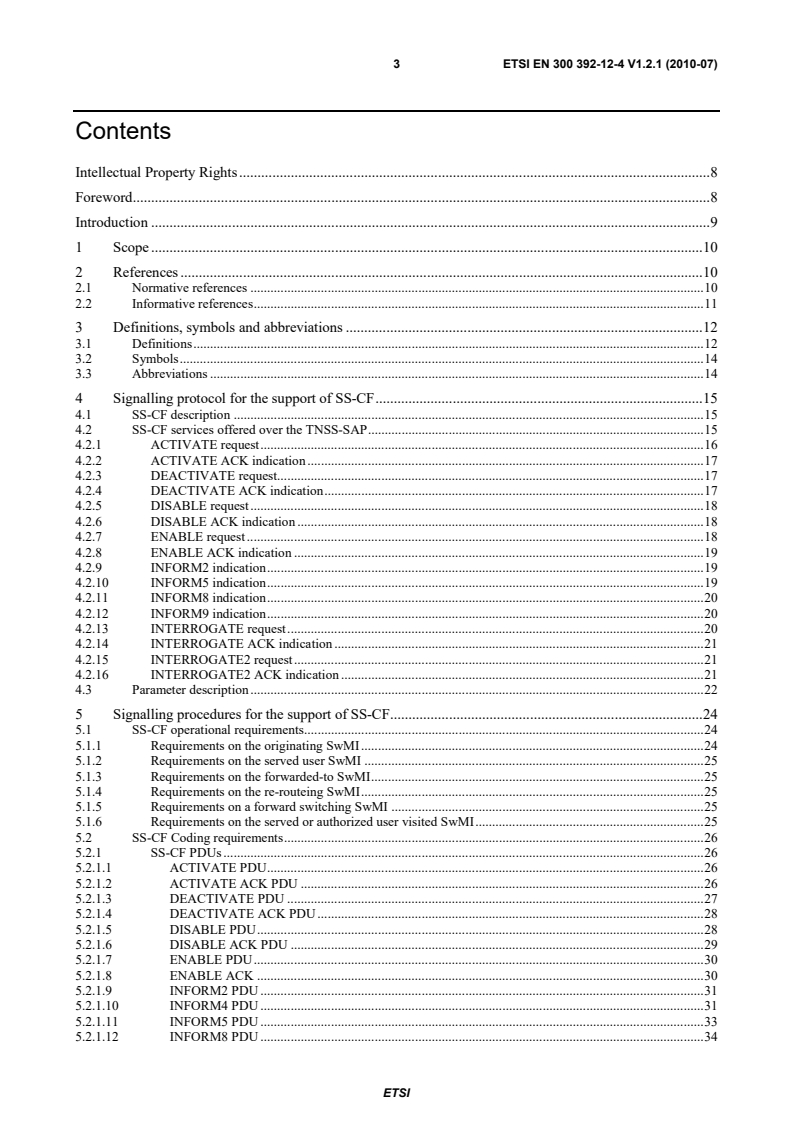
Contents
Intellectual Property Rights . 8
Foreword . 8
Introduction . 9
1 Scope . 10
2 References . 10
2.1 Normative references . 10
2.2 Informative references . 11
3 Definitions, symbols and abbreviations . 12
3.1 Definitions . 12
3.2 Symbols . 14
3.3 Abbreviations . 14
4 Signalling protocol for the support of SS-CF . 15
4.1 SS-CF description . 15
4.2 SS-CF services offered over the TNSS-SAP . 15
4.2.1 ACTIVATE request . 16
4.2.2 ACTIVATE ACK indication . 17
4.2.3 DEACTIVATE request . 17
4.2.4 DEACTIVATE ACK indication . 17
4.2.5 DISABLE request . 18
4.2.6 DISABLE ACK indication . 18
4.2.7 ENABLE request . 18
4.2.8 ENABLE ACK indication . 19
4.2.9 INFORM2 indication . 19
4.2.10 INFORM5 indication . 19
4.2.11 INFORM8 indication . 20
4.2.12 INFORM9 indication . 20
4.2.13 INTERROGATE request . 20
4.2.14 INTERROGATE ACK indication . 21
4.2.15 INTERROGATE2 request . 21
4.2.16 INTERROGATE2 ACK indication . 21
4.3 Parameter description . 22
5 Signalling procedures for the support of SS-CF . 24
5.1 SS-CF operational requirements . 24
5.1.1 Requirements on the originating SwMI . 24
5.1.2 Requirements on the served user SwMI . 25
5.1.3 Requirements on the forwarded-to SwMI . 25
5.1.4 Requirements on the re-routeing SwMI . 25
5.1.5 Requirements on a forward switching SwMI . 25
5.1.6 Requirements on the served or authorized user visited SwMI . 25
5.2 SS-CF Coding requirements . 26
5.2.1 SS-CF PDUs . 26
5.2.1.1 ACTIVATE PDU . 26
5.2.1.2 ACTIVATE ACK PDU . 26
5.2.1.3 DEACTIVATE PDU . 27
5.2.1.4 DEACTIVATE ACK PDU . 28
5.2.1.5 DISABLE PDU . 28
5.2.1.6 DISABLE ACK PDU . 29
5.2.1.7 ENABLE PDU . 30
5.2.1.8 ENABLE ACK . 30
5.2.1.9 INFORM2 PDU . 31
5.2.1.10 INFORM4 PDU . 31
5.2.1.11 INFORM5 PDU . 33
5.2.1.12 INFORM8 PDU . 34
ETSI
4 ETSI EN 300 392-12-4 V1.2.1 (2010-07)
5.2.1.13 INFORM9 PDU . 35
5.2.1.14 INTERROGATE PDU . 35
5.2.1.15 INTERROGATE ACK PDU . 36
5.2.1.16 INTERROGATE2 PDU . 36
5.2.1.17 INTERROGATE2 ACK PDU . 37
5.2.1.18 REPORT PDU . 37
5.2.2 TETRA PDU information element coding . 38
5.2.2.1 Accept/reject . 38
5.2.2.2 Activating/deactivating user type . 38
5.2.2.3 Activation by served user . 38
5.2.2.4 Addressing information elements . 38
5.2.2.4.1 General on addresses . 38
5.2.2.4.2 Address type of the authorized user. 39
5.2.2.4.3 Address type of the forwarded-to user . 39
5.2.2.4.4 Address type of the last forwarding user . 39
5.2.2.4.5 Address type of the originally called user . 39
5.2.2.4.6 Address type of the served user . 39
5.2.2.5 Basic service information . 40
5.2.2.6 CF-PDU type. 41
5.2.2.7 Enabled authorized user definition . 42
5.2.2.8 External subscriber number . 42
5.2.2.9 External subscriber number digit . 42
5.2.2.10 Forwarded-to definition . 42
5.2.2.11 Forwarding type . 43
5.2.2.12 Invoked call forwarding type . 43
5.2.2.13 Last forwarding type . 43
5.2.2.14 Number of external subscriber number digits . 43
5.2.2.15 Original forwarding type . 43
5.2.2.16 Reject cause. 44
5.2.2.17 Served user definition . 44
5.2.2.18 SS-CF invocation counter . 45
5.2.2.19 SS type . 45
5.2.3 Additional coding requirements over the ISI . 45
5.3 SS-CF State Definitions . 47
5.3.1 General on state definitions . 47
5.3.2 States at the calling user MS . 47
5.3.3 States at the originating SwMI . 47
5.3.4 States at the Served User MS . 47
5.3.5 States at the served user SwMI . 47
5.3.6 States at the forwarded-to user MS . 47
5.3.7 States at the forwarded-to SwMI . 47
5.3.8 States at the re-routeing SwMI . 48
5.3.9 States at the authorized user MS . 48
5.3.10 States at the Activating SwMI . 48
5.3.11 States at the deactivating user MS . 48
5.3.12 States at the deactivating SwMI . 48
5.3.13 States at the interrogating user MS . 48
5.3.14 States at the interrogating SwMI . 48
5.4 SS-CF signalling procedures . 48
5.4.1 Actions at MSs . 48
5.4.1.1 Activation requesting user MS . 48
5.4.1.1.1 Normal operation . 48
5.4.1.1.2 Exceptional procedures. 49
5.4.1.2 Deactivation requesting user MS . 49
5.4.1.2.1 Normal operation for served or authorized user MS . 49
5.4.1.2.2 Exceptional procedures for served or authorized user MS . 49
5.4.1.2.3 Normal operation for forwarded-to user MS . 49
5.4.1.2.4 Exceptional procedures for forwarded-to user MS . 49
5.4.1.3 Interrogation requesting user MS . 50
5.4.1.3.1 Normal operation of interrogation . 50
5.4.1.3.2 Exceptional procedures for forwarding services. 50
5.4.1.4 Interrogation requesting forwarded-to user MS . 50
ETSI
5 ETSI EN 300 392-12-4 V1.2.1 (2010-07)
5.4.1.4.1 Normal operation of interrogation . 50
5.4.1.4.2 Exceptional procedures for forwarding services. 50
5.4.1.5 Unsolicited indication to the served user . 50
5.4.1.6 Invocation and operation at MS . 50
5.4.1.6.1 General on SS-CF invocation indications . 50
5.4.1.6.2 Notification to the calling user . 50
5.4.1.6.3 Additional indication to the calling user . 51
5.4.1.6.4 Notification to the forwarded-to user . 51
5.4.1.6.5 Additional indication to the forwarded-to user . 51
5.4.1.6.6 Identification of the forwarded-to user to the calling user . 51
5.4.1.7 Reminder notification to the served user . 51
5.4.1.7.1 Normal operation . 51
5.4.1.7.2 Exceptional procedures. 51
5.4.2 Actions at the originating SwMI . 51
5.4.2.1 General requirements . 51
5.4.2.2 Normal Procedure . 51
5.4.2.3 Exceptional Procedures . 52
5.4.3 Actions at the served user home SwMI . 52
5.4.3.1 Normal Procedure . 52
5.4.3.1.1 Activation . 52
5.4.3.1.2 Deactivation . 52
5.4.3.1.3 Interrogation . 52
5.4.3.1.4 Invocation and operation . 52
5.4.3.1.5 Reminder notification to the served user . 54
5.4.3.2 Exceptional Procedures . 54
5.4.3.2.1 Activation . 54
5.4.3.2.2 Deactivation . 54
5.4.3.2.3 Interrogation . 54
5.4.3.2.4 Invocation . 54
5.4.4 Actions at the Forwarding SwMI . 55
5.4.4.1 Functionalities in the case of call forwarding by re-routeing . 55
5.4.4.2 Functionalities in the case of call forwarding by forward switching . 55
5.4.4.3 Normal procedure . 55
5.4.4.4 Exceptional procedures . 55
5.4.5 Procedures at the forwarded-to SwMI . 55
5.4.5.1 Normal procedure on invocation . 55
5.4.5.2 Exceptional Procedures . 55
5.4.6 Procedures at the served or authorized user visited SwMI . 56
5.4.6.1 Normal Procedure . 56
5.4.6.2 Exceptional Procedures . 56
5.4.7 Protocol for SS-CF invocation counter . 56
5.5 Interworking . 56
5.6 Protocol Interactions between SS-CF and other SSs and ANFs . 56
5.6.1 Interactions with Ambience Listening (SS-AL) . 56
5.6.2 Interactions with Call Authorized by Dispatcher (SS-CAD) . 57
5.6.3 Other protocol interactions of SS-CFU . 57
5.6.3.1 Interaction with Completion of Call to Busy Subscriber (SS-CCBS) . 57
5.6.3.1.1 Originating SwMI procedures for invoking CCBS at a CFU forwarded-to user . 57
5.6.3.1.2 Originating SwMI procedures if CFU is activated by SS-CCBS user A . 57
5.6.3.1.3 Terminating SwMI procedures if CFU is activated by user B after CCBS has been invoked . 57
5.6.3.2 Interaction with Completion of Calls on No Reply (SS-CCNR) . 57
5.6.3.2.1 Originating SwMI procedures for invoking CCNR at a CFU diverted-to user . 58
5.6.3.2.2 Originating SwMI procedures if CFU is activated by SS-CCNR user A . 58
5.6.3.2.3 Terminating PINX procedures if CFU is activated by user B after CCNR has been invoked . 58
5.6.3.3 Interaction with Call Forwarding Busy (SS-CFB) . 58
5.6.3.4 Interaction with Call Forwarding No Reply (SS-CFNR) . 58
5.6.4 Protocol interactions of SS-CFB . 58
5.6.4.1 Interaction with Completion of Calls to Busy Subscriber (SS-CCBS) . 58
5.6.4.1.1 Originating SwMI procedures for invoking CCBS at a CFB diverted-to user . 58
5.6.4.1.2 Originating SwMI procedures if CFB is activated by SS-CCBS user A . 58
5.6.4.1.3 Terminating SwMI procedures if CFB is activated by user B after CCBS has been invoked . 59
5.6.4.2 Interaction with Completion of Calls on No Reply (SS-CCNR) . 59
ETSI
6 ETSI EN 300 392-12-4 V1.2.1 (2010-07)
5.6.4.2.1 Originating SwMI procedures for invoking CCNR at a CFB diverted-to user . 59
5.6.4.2.2 Originating SwMI procedures if CFB is activated by SS-CCNR user A . 59
5.6.4.2.3 Terminating SwMI procedures if CFB is activated by user B after CCNR has been invoked . 59
5.6.4.3 Interaction with Call Forwarding Unconditional (SS-CFU) . 59
5.6.4.4 Interaction with Call Forwarding No Reply (SS-CFNRy) . 59
5.6.4.5 Interaction with Call Waiting (SS-CW) . 59
5.6.5 Protocol interactions of SS-CFNRy . 59
5.6.5.1 Interaction with Completion of Calls to Busy Subscriber (SS-CCBS) . 59
5.6.5.2 Interaction with Completion of Calls on No Reply (SS-CCNR) . 59
5.6.5.2.1 Originating SwMI procedures for invoking CCNR at a CFNR diverted-to user . 59
5.6.5.2.2 Originating SwMI procedures if CFNR is activated by SS-CCNR user A. 59
5.6.5.2.3 Terminating SwMI procedures if CFNR is activated by user B after CCNR has been invoked . 60
5.6.5.3 Interaction with Call Forwarding Unconditional (SS-CFU) . 60
5.6.5.4 Interaction with Call Forwarding Busy (SS-CFB) . 60
5.6.6 Other protocol interactions of SS-CFNRc . 60
5.6.6.1 Protocol interactions of SS-CFNRc in the case of early CFNRc . 60
5.6.6.2 Protocol interactions of SS-CFNRc in the case of late CFNRc . 60
5.6.7 Protocol interactions of SS-CF with ANF-Inter-System-Interface Individual Call (ANF-ISIIC) . 60
5.6.7.1 General on interactions . 60
5.6.7.2 Interactions of SS-CFU with ANF-ISIIC . 60
5.6.7.3 Interactions of SS-CFNRc with ANF-ISIIC . 61
5.6.7.4 Interactions of SS-CFB and SS-CFNRy with ANF-ISIIC . 61
5.6.8 Protocol Interactions of SS-CF with ANF Group Call . 61
5.6.8.1 Protocol interactions of SS-CFU with ANF-ISIGC . 61
5.6.8.2 Protocol interactions of SS-CFB with ANF-ISIGC . 61
5.6.9 Protocol Interactions of SS-CF with ANF-SDS . 62
5.6.10 Protocol interactions of SS-CF with ANF Mobility Management . 62
5.6.10.1 Protocol interactions of SS-CFU, early SS-CFB and early SS-CFNRc with ANF-MM . 65
5.6.10.2 Protocol interactions of late SS-CFB, SS-CFNRy and SS-CFNRc with ANF-MM . 65
5.6.10.2.1 Protocol interactions affecting the calling user . 65
5.6.10.2.2 Protocol interactions affecting the called/served user . 65
5.6.10.2.3 Protocol interactions affecting the forwarded-to user . 66
5.6.10.3 Interaction with SS-CF at call restoration . 66
5.7 SS-CF parameter values (timers) . 67
5.8 Support of SDS . 67
Annex A (informative): Interactions of SS-CFB and SS-CFNRy with ANF-ISIIC . 68
A.1 Interactions of SS-CFB and SS-CFNRy with ANF-ISIIC . 68
A.2 Interactions . 68
A.2.1 Interactions of late SS-CFB and SS-CFNRy with ANF-ISIIC . 68
A.2.2 Protocol interactions in cases 1, 10 and 11 . 71
A.2.2.1 General on cases 1, 10 and 11 . 71
A.2.2.2 Case 1 . 71
A.2.2.3 Case 10 . 72
A.2.2.4 Case 11 . 73
A.2.3 Protocol interactions affecting the called/served user . 75
A.2.3.1 General . 75
A.2.3.2 Case 2 . 75
A.2.3.3 Case 4 . 77
A.2.3.4 Case 5 . 78
A.2.3.5 Case 7 . 80
A.2.4 Protocol interactions affecting the forwarded-to user. 82
A.2.4.1 General . 82
A.2.4.2 Case 3 . 82
A.2.4.3 Case 6 . 83
A.2.4.4 Case 8 . 85
A.2.4.5 Case 9 . 87
A.2.4.6 Case 12 . 89
Annex B (normative): Interworking with other networks . 90
ETSI
7 ETSI EN 300 392-12-4 V1.2.1 (2010-07)
B.1 Procedures for interworking with public ISDNs . 90
B.1.1 Actions at an incoming gateway SwMI . 90
B.1.2 Actions at an outgoing gateway SwMI. 90
B.1.3 Procedures where a call from the public ISDN is forwarded within or beyond TETRA . 90
B.1.3.1 Normal operation . 90
B.1.3.2 Exceptional procedures . 91
B.1.3.3 Presentation of a forwarded call from a public ISDN to the TETRA network . 91
B.1.3.3.1 Normal operation . 91
B.1.3.3.2 Exceptional procedures . 91
B.1.4 Procedures where a call from the TETRA network is forwarded within or beyond the public ISDN . 92
B.1.5 Presentation of a forwarded call from a TETRA network to the public ISDN . 92
B.1.5.1 Normal operation . 92
B.1.5.2 Exceptional procedures . 92
B.1.6 Procedures where a call from the public ISDN is forwarded within or beyond the TETRA network and
partial re-routeing takes place in the public ISDN . 93
B.1.6.1 Normal operation . 93
B.1.6.2 Exceptional procedures . 95
B.1.7 Procedures where a call from the public ISDN to the TETRA network is forwarded by the public ISDN . 95
B.2 SS-CF Impact of interworking with non-ISDNs . 96
B.2.1 Impact of interworking on incoming calls . 96
B.2.2 Impact of interworking on outgoing calls . 96
Annex C (normative): SS-CF profile for mobility management . 97
C.1 Profile exchange . 97
C.2 Profile definitions . 97
C.2.1 General on SS-CF profiles . 97
C.2.2 PDU definitions . 97
C.2.2.1 SS-PROFILE REJECT PDU . 97
C.2.2.2 SS-PROFILE UPDATE PDU . 98
C.2.2.3 SS-PROFILE UPDATE RESPONSE PDU . 98
C.2.3 Information element definitions . 99
C.2.3.1 Basic migration profile info . 99
C.2.3.2 Individual basic migration profile (original and temporary) . 100
C.2.3.3 Profile type. 100
C.2.3.4 Profile status . 101
C.2.3.5 SS-information . 101
C.2.3.6 SS-information response . 101
C.2.3.7 SS-migration profile (original) . 102
C.2.3.8 SS-migration profile response (temporary) . 102
C.2.3.9 SS-profile response status . 102
C.2.3.10 SS-profile update indicator . 103
C.2.3.11 SS-response status . 103
C.2.3.12 SS-status . 103
C.2.3.13 SS-type . 103
C.2.3.14 SS-CF profiles . 104
C.2.3.14.1 SS-CF migration original profile . 104
C.2.3.14.2 SS-CF served user migration information PDU
...
2003-01.Slovenski inštitut za standardizacijo. Razmnoževanje celote ali delov tega standarda ni dovoljeno.Prizemni snopovni radio (TETRA) - Govor in podatki (V+D) - 12. del: Dopolnilne storitve stopnje 3 - 4. poddel: Predaja klica (CF)Terrestrial Trunked Radio (TETRA) - Voice plus Data (V+D) - Part 12: Supplementary services stage 3 - Sub-part 4: Call Forwarding (CF)33.070.10Prizemni snopovni radio (TETRA)Terrestrial Trunked Radio (TETRA)ICS:Ta slovenski standard je istoveten z:EN 300 392-12-4 Version 1.2.1SIST EN 300 392-12-4 V1.2.1:2010en01-oktober-2010SIST EN 300 392-12-4 V1.2.1:2010SLOVENSKI
STANDARD
ETSI ETSI EN 300 392-12-4 V1.2.1 (2010-07) 2
Reference REN/TETRA-03199 Keywords radio, TETRA ETSI 650 Route des Lucioles F-06921 Sophia Antipolis Cedex - FRANCE
Tel.: +33 4 92 94 42 00
Fax: +33 4 93 65 47 16
Siret N° 348 623 562 00017 - NAF 742 C Association à but non lucratif enregistrée à la Sous-Préfecture de Grasse (06) N° 7803/88
Important notice Individual copies of the present document can be downloaded from: http://www.etsi.org The present document may be made available in more than one electronic version or in print. In any case of existing or perceived difference in contents between such versions, the reference version is the Portable Document Format (PDF). In case of dispute, the reference shall be the printing on ETSI printers of the PDF version kept on a specific network drive within ETSI Secretariat. Users of the present document should be aware that the document may be subject to revision or change of status. Information on the current status of this and other ETSI documents is available at http://portal.etsi.org/tb/status/status.asp If you find errors in the present document, please send your comment to one of the following services: http://portal.etsi.org/chaircor/ETSI_support.asp Copyright Notification No part may be reproduced except as authorized by written permission. The copyright and the foregoing restriction extend to reproduction in all media.
© European Telecommunications Standards Institute 2010. All rights reserved.
DECTTM, PLUGTESTSTM, UMTSTM, TIPHONTM, the TIPHON logo and the ETSI logo are Trade Marks of ETSI registered for the benefit of its Members. 3GPPTM is a Trade Mark of ETSI registered for the benefit of its Members and of the 3GPP Organizational Partners. LTE™ is a Trade Mark of ETSI currently being registered for the benefit of its Members and of the 3GPP Organizational Partners. GSM® and the GSM logo are Trade Marks registered and owned by the GSM Association. SIST EN 300 392-12-4 V1.2.1:2010
ETSI ETSI EN 300 392-12-4 V1.2.1 (2010-07) 3 Contents Intellectual Property Rights . 8 Foreword . 8 Introduction . 9 1 Scope . 10 2 References . 10 2.1 Normative references . 10 2.2 Informative references . 11 3 Definitions, symbols and abbreviations . 12 3.1 Definitions . 12 3.2 Symbols . 14 3.3 Abbreviations . 14 4 Signalling protocol for the support of SS-CF . 15 4.1 SS-CF description . 15 4.2 SS-CF services offered over the TNSS-SAP . 15 4.2.1 ACTIVATE request . 16 4.2.2 ACTIVATE ACK indication . 17 4.2.3 DEACTIVATE request . 17 4.2.4 DEACTIVATE ACK indication . 17 4.2.5 DISABLE request . 18 4.2.6 DISABLE ACK indication . 18 4.2.7 ENABLE request . 18 4.2.8 ENABLE ACK indication . 19 4.2.9 INFORM2 indication . 19 4.2.10 INFORM5 indication . 19 4.2.11 INFORM8 indication . 20 4.2.12 INFORM9 indication . 20 4.2.13 INTERROGATE request . 20 4.2.14 INTERROGATE ACK indication . 21 4.2.15 INTERROGATE2 request . 21 4.2.16 INTERROGATE2 ACK indication . 21 4.3 Parameter description . 22 5 Signalling procedures for the support of SS-CF . 24 5.1 SS-CF operational requirements . 24 5.1.1 Requirements on the originating SwMI . 24 5.1.2 Requirements on the served user SwMI . 25 5.1.3 Requirements on the forwarded-to SwMI . 25 5.1.4 Requirements on the re-routeing SwMI . 25 5.1.5 Requirements on a forward switching SwMI . 25 5.1.6 Requirements on the served or authorized user visited SwMI . 25 5.2 SS-CF Coding requirements . 26 5.2.1 SS-CF PDUs . 26 5.2.1.1 ACTIVATE PDU . 26 5.2.1.2 ACTIVATE ACK PDU . 26 5.2.1.3 DEACTIVATE PDU . 27 5.2.1.4 DEACTIVATE ACK PDU . 28 5.2.1.5 DISABLE PDU . 28 5.2.1.6 DISABLE ACK PDU . 29 5.2.1.7 ENABLE PDU . 30 5.2.1.8 ENABLE ACK . 30 5.2.1.9 INFORM2 PDU . 31 5.2.1.10 INFORM4 PDU . 31 5.2.1.11 INFORM5 PDU . 33 5.2.1.12 INFORM8 PDU . 34 SIST EN 300 392-12-4 V1.2.1:2010
ETSI ETSI EN 300 392-12-4 V1.2.1 (2010-07) 4 5.2.1.13 INFORM9 PDU . 35 5.2.1.14 INTERROGATE PDU . 35 5.2.1.15 INTERROGATE ACK PDU . 36 5.2.1.16 INTERROGATE2 PDU . 36 5.2.1.17 INTERROGATE2 ACK PDU . 37 5.2.1.18 REPORT PDU . 37 5.2.2 TETRA PDU information element coding . 38 5.2.2.1 Accept/reject . 38 5.2.2.2 Activating/deactivating user type . 38 5.2.2.3 Activation by served user . 38 5.2.2.4 Addressing information elements . 38 5.2.2.4.1 General on addresses . 38 5.2.2.4.2 Address type of the authorized user. 39 5.2.2.4.3 Address type of the forwarded-to user . 39 5.2.2.4.4 Address type of the last forwarding user . 39 5.2.2.4.5 Address type of the originally called user . 39 5.2.2.4.6 Address type of the served user . 39 5.2.2.5 Basic service information . 40 5.2.2.6 CF-PDU type. 41 5.2.2.7 Enabled authorized user definition . 42 5.2.2.8 External subscriber number . 42 5.2.2.9 External subscriber number digit . 42 5.2.2.10 Forwarded-to definition . 42 5.2.2.11 Forwarding type . 43 5.2.2.12 Invoked call forwarding type . 43 5.2.2.13 Last forwarding type . 43 5.2.2.14 Number of external subscriber number digits . 43 5.2.2.15 Original forwarding type . 43 5.2.2.16 Reject cause. 44 5.2.2.17 Served user definition . 44 5.2.2.18 SS-CF invocation counter . 45 5.2.2.19 SS type . 45 5.2.3 Additional coding requirements over the ISI . 45 5.3 SS-CF State Definitions . 47 5.3.1 General on state definitions . 47 5.3.2 States at the calling user MS . 47 5.3.3 States at the originating SwMI . 47 5.3.4 States at the Served User MS . 47 5.3.5 States at the served user SwMI . 47 5.3.6 States at the forwarded-to user MS . 47 5.3.7 States at the forwarded-to SwMI . 47 5.3.8 States at the re-routeing SwMI . 48 5.3.9 States at the authorized user MS . 48 5.3.10 States at the Activating SwMI . 48 5.3.11 States at the deactivating user MS . 48 5.3.12 States at the deactivating SwMI . 48 5.3.13 States at the interrogating user MS . 48 5.3.14 States at the interrogating SwMI . 48 5.4 SS-CF signalling procedures . 48 5.4.1 Actions at MSs . 48 5.4.1.1 Activation requesting user MS . 48 5.4.1.1.1 Normal operation . 48 5.4.1.1.2 Exceptional procedures. 49 5.4.1.2 Deactivation requesting user MS . 49 5.4.1.2.1 Normal operation for served or authorized user MS . 49 5.4.1.2.2 Exceptional procedures for served or authorized user MS . 49 5.4.1.2.3 Normal operation for forwarded-to user MS . 49 5.4.1.2.4 Exceptional procedures for forwarded-to user MS . 49 5.4.1.3 Interrogation requesting user MS . 50 5.4.1.3.1 Normal operation of interrogation . 50 5.4.1.3.2 Exceptional procedures for forwarding services. 50 5.4.1.4 Interrogation requesting forwarded-to user MS . 50 SIST EN 300 392-12-4 V1.2.1:2010
ETSI ETSI EN 300 392-12-4 V1.2.1 (2010-07) 5 5.4.1.4.1 Normal operation of interrogation . 50 5.4.1.4.2 Exceptional procedures for forwarding services. 50 5.4.1.5 Unsolicited indication to the served user . 50 5.4.1.6 Invocation and operation at MS . 50 5.4.1.6.1 General on SS-CF invocation indications . 50 5.4.1.6.2 Notification to the calling user . 50 5.4.1.6.3 Additional indication to the calling user . 51 5.4.1.6.4 Notification to the forwarded-to user . 51 5.4.1.6.5 Additional indication to the forwarded-to user . 51 5.4.1.6.6 Identification of the forwarded-to user to the calling user . 51 5.4.1.7 Reminder notification to the served user . 51 5.4.1.7.1 Normal operation . 51 5.4.1.7.2 Exceptional procedures. 51 5.4.2 Actions at the originating SwMI . 51 5.4.2.1 General requirements . 51 5.4.2.2 Normal Procedure . 51 5.4.2.3 Exceptional Procedures . 52 5.4.3 Actions at the served user home SwMI . 52 5.4.3.1 Normal Procedure . 52 5.4.3.1.1 Activation . 52 5.4.3.1.2 Deactivation . 52 5.4.3.1.3 Interrogation . 52 5.4.3.1.4 Invocation and operation . 52 5.4.3.1.5 Reminder notification to the served user . 54 5.4.3.2 Exceptional Procedures . 54 5.4.3.2.1 Activation . 54 5.4.3.2.2 Deactivation . 54 5.4.3.2.3 Interrogation . 54 5.4.3.2.4 Invocation . 54 5.4.4 Actions at the Forwarding SwMI . 55 5.4.4.1 Functionalities in the case of call forwarding by re-routeing . 55 5.4.4.2 Functionalities in the case of call forwarding by forward switching . 55 5.4.4.3 Normal procedure . 55 5.4.4.4 Exceptional procedures . 55 5.4.5 Procedures at the forwarded-to SwMI . 55 5.4.5.1 Normal procedure on invocation . 55 5.4.5.2 Exceptional Procedures . 55 5.4.6 Procedures at the served or authorized user visited SwMI . 56 5.4.6.1 Normal Procedure . 56 5.4.6.2 Exceptional Procedures . 56 5.4.7 Protocol for SS-CF invocation counter . 56 5.5 Interworking . 56 5.6 Protocol Interactions between SS-CF and other SSs and ANFs . 56 5.6.1 Interactions with Ambience Listening (SS-AL) . 56 5.6.2 Interactions with Call Authorized by Dispatcher (SS-CAD) . 57 5.6.3 Other protocol interactions of SS-CFU . 57 5.6.3.1 Interaction with Completion of Call to Busy Subscriber (SS-CCBS) . 57 5.6.3.1.1 Originating SwMI procedures for invoking CCBS at a CFU forwarded-to user . 57 5.6.3.1.2 Originating SwMI procedures if CFU is activated by SS-CCBS user A . 57 5.6.3.1.3 Terminating SwMI procedures if CFU is activated by user B after CCBS has been invoked . 57 5.6.3.2 Interaction with Completion of Calls on No Reply (SS-CCNR) . 57 5.6.3.2.1 Originating SwMI procedures for invoking CCNR at a CFU diverted-to user . 58 5.6.3.2.2 Originating SwMI procedures if CFU is activated by SS-CCNR user A . 58 5.6.3.2.3 Terminating PINX procedures if CFU is activated by user B after CCNR has been invoked . 58 5.6.3.3 Interaction with Call Forwarding Busy (SS-CFB) . 58 5.6.3.4 Interaction with Call Forwarding No Reply (SS-CFNR) . 58 5.6.4 Protocol interactions of SS-CFB . 58 5.6.4.1 Interaction with Completion of Calls to Busy Subscriber (SS-CCBS) . 58 5.6.4.1.1 Originating SwMI procedures for invoking CCBS at a CFB diverted-to user . 58 5.6.4.1.2 Originating SwMI procedures if CFB is activated by SS-CCBS user A . 58 5.6.4.1.3 Terminating SwMI procedures if CFB is activated by user B after CCBS has been invoked . 59 5.6.4.2 Interaction with Completion of Calls on No Reply (SS-CCNR) . 59 SIST EN 300 392-12-4 V1.2.1:2010
ETSI ETSI EN 300 392-12-4 V1.2.1 (2010-07) 6 5.6.4.2.1 Originating SwMI procedures for invoking CCNR at a CFB diverted-to user . 59 5.6.4.2.2 Originating SwMI procedures if CFB is activated by SS-CCNR user A . 59 5.6.4.2.3 Terminating SwMI procedures if CFB is activated by user B after CCNR has been invoked . 59 5.6.4.3 Interaction with Call Forwarding Unconditional (SS-CFU) . 59 5.6.4.4 Interaction with Call Forwarding No Reply (SS-CFNRy) . 59 5.6.4.5 Interaction with Call Waiting (SS-CW) . 59 5.6.5 Protocol interactions of SS-CFNRy . 59 5.6.5.1 Interaction with Completion of Calls to Busy Subscriber (SS-CCBS) . 59 5.6.5.2 Interaction with Completion of Calls on No Reply (SS-CCNR) . 59 5.6.5.2.1 Originating SwMI procedures for invoking CCNR at a CFNR diverted-to user . 59 5.6.5.2.2 Originating SwMI procedures if CFNR is activated by SS-CCNR user A. 59 5.6.5.2.3 Terminating SwMI procedures if CFNR is activated by user B after CCNR has been invoked . 60 5.6.5.3 Interaction with Call Forwarding Unconditional (SS-CFU) . 60 5.6.5.4 Interaction with Call Forwarding Busy (SS-CFB) . 60 5.6.6 Other protocol interactions of SS-CFNRc . 60 5.6.6.1 Protocol interactions of SS-CFNRc in the case of early CFNRc . 60 5.6.6.2 Protocol interactions of SS-CFNRc in the case of late CFNRc . 60 5.6.7 Protocol interactions of SS-CF with ANF-Inter-System-Interface Individual Call (ANF-ISIIC) . 60 5.6.7.1 General on interactions . 60 5.6.7.2 Interactions of SS-CFU with ANF-ISIIC . 60 5.6.7.3 Interactions of SS-CFNRc with ANF-ISIIC . 61 5.6.7.4 Interactions of SS-CFB and SS-CFNRy with ANF-ISIIC . 61 5.6.8 Protocol Interactions of SS-CF with ANF Group Call . 61 5.6.8.1 Protocol interactions of SS-CFU with ANF-ISIGC . 61 5.6.8.2 Protocol interactions of SS-CFB with ANF-ISIGC . 61 5.6.9 Protocol Interactions of SS-CF with ANF-SDS . 62 5.6.10 Protocol interactions of SS-CF with ANF Mobility Management . 62 5.6.10.1 Protocol interactions of SS-CFU, early SS-CFB and early SS-CFNRc with ANF-MM . 65 5.6.10.2 Protocol interactions of late SS-CFB, SS-CFNRy and SS-CFNRc with ANF-MM . 65 5.6.10.2.1 Protocol interactions affecting the calling user . 65 5.6.10.2.2 Protocol interactions affecting the called/served user . 65 5.6.10.2.3 Protocol interactions affecting the forwarded-to user . 66 5.6.10.3 Interaction with SS-CF at call restoration . 66 5.7 SS-CF parameter values (timers) . 67 5.8 Support of SDS . 67 Annex A (informative): Interactions of SS-CFB and SS-CFNRy with ANF-ISIIC . 68 A.1 Interactions of SS-CFB and SS-CFNRy with ANF-ISIIC . 68 A.2 Interactions . 68 A.2.1 Interactions of late SS-CFB and SS-CFNRy with ANF-ISIIC . 68 A.2.2 Protocol interactions in cases 1, 10 and 11 . 71 A.2.2.1 General on cases 1, 10 and 11 . 71 A.2.2.2 Case 1 . 71 A.2.2.3 Case 10 . 72 A.2.2.4 Case 11 . 73 A.2.3 Protocol interactions affecting the called/served user . 75 A.2.3.1 General . 75 A.2.3.2 Case 2 . 75 A.2.3.3 Case 4 . 77 A.2.3.4 Case 5 . 78 A.2.3.5 Case 7 . 80 A.2.4 Protocol interactions affecting the forwarded-to user. 82 A.2.4.1 General . 82 A.2.4.2 Case 3 . 82 A.2.4.3 Case 6 . 83 A.2.4.4 Case 8 . 85 A.2.4.5 Case 9 . 87 A.2.4.6 Case 12 . 89 Annex B (normative): Interworking with other networks . 90 SIST EN 300 392-12-4 V1.2.1:2010
ETSI ETSI EN 300 392-12-4 V1.2.1 (2010-07) 7 B.1 Procedures for interworking with public ISDNs . 90 B.1.1 Actions at an incoming gateway SwMI . 90 B.1.2 Actions at an outgoing gateway SwMI. 90 B.1.3 Procedures where a call from the public ISDN is forwarded within or beyond TETRA . 90 B.1.3.1 Normal operation . 90 B.1.3.2 Exceptional procedures . 91 B.1.3.3 Presentation of a forwarded call from a public ISDN to the TETRA network . 91 B.1.3.3.1 Normal operation . 91 B.1.3.3.2 Exceptional procedures . 91 B.1.4 Procedures where a call from the TETRA network is forwarded within or beyond the public ISDN . 92 B.1.5 Presentation of a forwarded call from a TETRA network to the public ISDN . 92 B.1.5.1 Normal operation . 92 B.1.5.2 Exceptional procedures . 92 B.1.6 Procedures where a call from the public ISDN is forwarded within or beyond the TETRA network and partial re-routeing takes place in the public ISDN . 93 B.1.6.1 Normal operation . 93 B.1.6.2 Exceptional procedures . 95 B.1.7 Procedures where a call from the public ISDN to the TETRA network is forwarded by the public ISDN . 95 B.2 SS-CF Impact of interworking with non-ISDNs . 96 B.2.1 Impact of interworking on incoming calls . 96 B.2.2 Impact of interworking on outgoing calls . 96 Annex C (normative): SS-CF profile for mobility management . 97 C.1 Profile exchange . 97 C.2 Profile definitions . 97 C.2.1 General on SS-CF profiles . 97 C.2.2 PDU definitions . 97 C.2.2.1 SS-PROFILE REJECT PDU . 97 C.2.2.2 SS-PROFILE UPDATE PDU . 98 C.2.2.3 SS-PROFILE UPDATE RESPONSE PDU . 98 C.2.3 Information element definitions . 99 C.2.3.1 Basic migration profile info . 99 C.2.3.2 Individual basic migration profile (original and temporary) . 100 C.2.3.3 Profile type. 100 C.2.3.4 Profile status . 101 C.2.3.5 SS-information . 101 C.2.3.6 SS-information response . 101 C.2.3.7 SS-migration profile (original) . 102 C.2.3.8 SS-migration profile response (temporary) . 102 C.2.3.9 SS-profile response status . 102 C.2.3.10 SS-profile update indicator . 103 C.2.3.11 SS-response status . 103 C.2.3.12 SS-status . 103 C.2.3.13 SS-type . 103 C.2.3.14 SS-CF profiles . 104 C.2.3.14.1 SS-CF migration original profil
...