


ETSI TS 118 113 V1.0.0 (2016-03)
oneM2M; Interoperability Testing (oneM2M TS-0013 version 1.0.0 Release 1)
oneM2M; Interoperability Testing (oneM2M TS-0013 version 1.0.0 Release 1)
DTS/oneM2M-000013
General Information
Standards Content (Sample)
TECHNICAL SPECIFICATION
oneM2M;
Interoperability Testing
(oneM2M TS-0013 version 1.0.0 Release 1)
oneM2M TS-0013 version 1.0.0 Release 1 2 ETSI TS 118 113 V1.0.0 (2016-03)
Reference
DTS/oneM2M-000013
Keywords
interoperability, IoT, M2M, protocol
ETSI
650 Route des Lucioles
F-06921 Sophia Antipolis Cedex - FRANCE
Tel.: +33 4 92 94 42 00 Fax: +33 4 93 65 47 16
Siret N° 348 623 562 00017 - NAF 742 C
Association à but non lucratif enregistrée à la
Sous-Préfecture de Grasse (06) N° 7803/88
Important notice
The present document can be downloaded from:
http://www.etsi.org/standards-search
The present document may be made available in electronic versions and/or in print. The content of any electronic and/or
print versions of the present document shall not be modified without the prior written authorization of ETSI. In case of any
existing or perceived difference in contents between such versions and/or in print, the only prevailing document is the
print of the Portable Document Format (PDF) version kept on a specific network drive within ETSI Secretariat.
Users of the present document should be aware that the document may be subject to revision or change of status.
Information on the current status of this and other ETSI documents is available at
https://portal.etsi.org/TB/ETSIDeliverableStatus.aspx
If you find errors in the present document, please send your comment to one of the following services:
https://portal.etsi.org/People/CommiteeSupportStaff.aspx
Copyright Notification
No part may be reproduced or utilized in any form or by any means, electronic or mechanical, including photocopying
and microfilm except as authorized by written permission of ETSI.
The content of the PDF version shall not be modified without the written authorization of ETSI.
The copyright and the foregoing restriction extend to reproduction in all media.
© European Telecommunications Standards Institute 2016.
All rights reserved.
TM TM TM
DECT , PLUGTESTS , UMTS and the ETSI logo are Trade Marks of ETSI registered for the benefit of its Members.
TM
3GPP and LTE™ are Trade Marks of ETSI registered for the benefit of its Members and
of the 3GPP Organizational Partners.
GSM® and the GSM logo are Trade Marks registered and owned by the GSM Association.
ETSI
oneM2M TS-0013 version 1.0.0 Release 1 3 ETSI TS 118 113 V1.0.0 (2016-03)
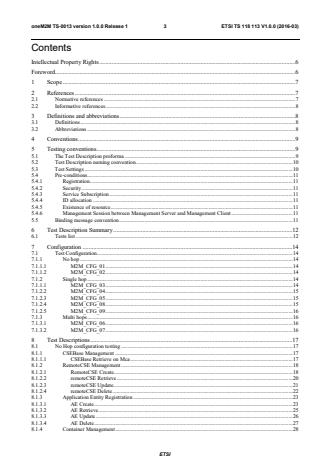
Contents
Intellectual Property Rights . 6
Foreword . 6
1 Scope . 7
2 References . 7
2.1 Normative references . 7
2.2 Informative references . 8
3 Definitions and abbreviations . 8
3.1 Definitions . 8
3.2 Abbreviations . 8
4 Conventions . 9
5 Testing conventions . 9
5.1 The Test Description proforma . 9
5.2 Test Description naming convention . 10
5.3 Test Settings . 10
5.4 Pre-conditions . 11
5.4.1 Registration . 11
5.4.2 Security . 11
5.4.3 Service Subscription . 11
5.4.4 ID allocation . 11
5.4.5 Existence of resource . 11
5.4.6 Management Session between Management Server and Management Client . 11
5.5 Binding message convention . 11
6 Test Description Summary . 12
6.1 Tests list . 12
7 Configuration . 14
7.1 Test Configuration . 14
7.1.1 No hop . 14
7.1.1.1 M2M_CFG_01 . 14
7.1.1.2 M2M_CFG_02 . 14
7.1.2 Single hop . 14
7.1.1.1 M2M_CFG_03 . 14
7.1.2.2 M2M_CFG_04 . 15
7.1.2.3 M2M_CFG_05 . 15
7.1.2.4 M2M_CFG_08 . 15
7.1.2.5 M2M_CFG_09 . 16
7.1.3 Multi hops . 16
7.1.3.1 M2M_CFG_06 . 16
7.1.3.2 M2M_CFG_07 . 16
8 Test Descriptions . 17
8.1 No Hop configuration testing . 17
8.1.1 CSEBase Management . 17
8.1.1.1 CSEBase Retrieve on Mca . 17
8.1.2 RemoteCSE Management . 18
8.1.2.1 RemoteCSE Create. 18
8.1.2.2 remoteCSE Retrieve . 20
8.1.2.3 remoteCSE Update . 21
8.1.2.4 remoteCSE Delete . 22
8.1.3 Application Entity Registration . 23
8.1.3.1 AE Create . 23
8.1.3.2 AE Retrieve . 25
8.1.3.3 AE Update . 26
8.1.3.4 AE Delete . 27
8.1.4 Container Management . 28
ETSI
oneM2M TS-0013 version 1.0.0 Release 1 4 ETSI TS 118 113 V1.0.0 (2016-03)
8.1.4.1 Container Create . 28
8.1.4.2 Container Retrieve . 30
8.1.4.3 Container Update . 31
8.1.4.4 Container Delete . 32
8.1.5 ContentInstance Management . 33
8.1.5.1 ContentInstance Create . 33
8.1.5.2 ContentInstance Retrieve . 34
8.1.5.3 ContentInstance Delete . 35
8.1.6 Discovery . 37
8.1.6.1 Discovery of all resources . 37
8.1.6.2 Discovery with label filter criteria . 38
8.1.6.3 Discovery with limit filter criteria . 39
8.1.6.4 Discovery with multiple filter criteria . 41
8.1.7 Subscription Management . 42
8.1.7.1 Subscription Create . 42
8.1.7.2 Subscription Retrieve . 43
8.1.7.3 Subscription Update . 45
8.1.7.4 Subscription Delete . 46
8.1.8 accessControlPolicy Management . 47
8.1.8.1 accessControlPolicy Create . 47
8.1.8.2 accessControlPolicy Retrieve . 48
8.1.8.3 accessControlPolicy Update . 50
8.1.8.4 accessControlPolicy Delete . 51
8.1.8.5 Unauthorized operation (Insufficient Access Rights) . 52
8.1.9 Group Management . 53
8.1.9.1 . 53
8.1.9.2 Group Create . 55
8.1.9.3 Group Update . 56
8.1.9.4 Group Delete . 57
8.1.10 Node Management . 58
8.1.10.1 Node Create. 58
8.1.10.2 Node Retrieve . 59
8.1.10.3 Node Update . 60
8.1.10.4 Node Delete. 62
8.1.11 PollingChannel Management . 63
8.1.11.1 PollingChannel Create . 63
8.1.11.2 PollingChannel Retrieve . 64
8.1.11.3 pollingChannel Update . 65
8.1.11.4 pollingChannel Delete . 66
8.1.11.5 Long Polling on a PollingChannel Retrieve . 67
8.1.12 FanoutPoint Management . 68
8.1.12.1 FanoutPoint Create . 68
8.1.12.2 FanoutPoint Retrieve . 70
8.1.12.3 FanoutPoint Update . 71
8.1.12.4 FanoutPoint Delete . 72
8.1.13 Notifcation Management . 73
8.1.13.1 Notification Create . 73
8.2 Non blocking configuration testing . 74
8.2.1 Synchronous request . 74
8.2.1.1 Container management . 74
8.2.1.1.1 Container Create . 74
8.2.1.1.2 Container Retrieve . 77
8.2.1.1.3 Container Update . 79
8.2.1.1.4 Container Delete . 81
8.2.2 Asynchronous request . 83
8.2.2.1 Container management . 83
8.2.2.1.1 Container Create . 83
8.2.2.1.2 Container Retrieve . 86
8.2.2.1.3 Container Update . 88
8.2.2.1.4 Container Delete . 90
8.3 Single hop configuration testing . 92
8.3.1 Retargeting . 92
ETSI
oneM2M TS-0013 version 1.0.0 Release 1 5 ETSI TS 118 113 V1.0.0 (2016-03)
8.3.1.1 RetargetingResource Create (Generic Test Description) . 92
8.3.1.2 Create . 94
8.3.1.3 Resource Retrieve (Generic Test Description) . 95
8.3.1.4 retrieve . 97
8.3.1.5 Resource Update (Generic Test Description) . 99
8.3.1.6 update . 101
8.3.1.7 Resource Delete (Generic Test Description) . 101
8.3.1.8 delete . 103
8.3.1.9 Discovery with multiple filter criteria . 104
8.3.1.10 Unauthorized operation (Insufficient Access Rights) . 106
8.3.1.11 Notification . 108
8.3.2 Test Description . 110
8.3.2.1 Create . 110
8.3.10.2 Update . 112
8.3.10.3 Retrieve . 114
8.3.10.4 Delete . 115
History . 117
ETSI
oneM2M TS-0013 version 1.0.0 Release 1 6 ETSI TS 118 113 V1.0.0 (2016-03)
Intellectual Property Rights
IPRs essential or potentially essential to the present document may have been declared to ETSI. The information
pertaining to these essential IPRs, if any, is publicly available for ETSI members and non-members, and can be found
in ETSI SR 000 314: "Intellectual Property Rights (IPRs); Essential, or potentially Essential, IPRs notified to ETSI in
respect of ETSI standards", which is available from the ETSI Secretariat. Latest updates are available on the ETSI Web
server (https://ipr.etsi.org/).
Pursuant to the ETSI IPR Policy, no investigation, including IPR searches, has been carried out by ETSI. No guarantee
can be given as to the existence of other IPRs not referenced in ETSI SR 000 314 (or the updates on the ETSI Web
server) which are, or may be, or may become, essential to the present document.
Foreword
This Technical Specification (TS) has been produced by ETSI Partnership Project oneM2M (oneM2M).
ETSI
oneM2M TS-0013 version 1.0.0 Release 1 7 ETSI TS 118 113 V1.0.0 (2016-03)
1 Scope
The present document specifies Interoperability Test Descriptions (TDs) for the oneM2M Primitives as specified in
ETSI TS 118 101 [1], ETSI TS 118 104 [2], the bindings ETSI TS 118 108 [3], ETSI TS 118 109 [4] and ETSI
TS 118 110 [5].
2 References
2.1 Normative references
References are either specific (identified by date of publication and/or edition number or version number) or
non-specific. For specific references, only the cited version applies. For non-specific references, the latest version of the
referenced document (including any amendments) applies.
Referenced documents which are not found to be publicly available in the expected location might be found at
https://docbox.etsi.org/Reference/.
NOTE: While any hyperlinks included in this clause were valid at the time of publication, ETSI cannot guarantee
their long term validity.
The following referenced documents are necessary for the application of the present document.
[1] ETSI TS 118 101: "oneM2M; Functional Architecture (oneM2M TS-0001 version 1.6.1
Release 1)".
[2] ETSI TS 118 104: "oneM2M; Service Layer Core protocol Specification (oneM2M TS-0004
version 1.3.0 Release 1).
[3] ETSI TS 118 108: "oneM2M; CoAP Protocol Binding (oneM2M TS-0008 version 1.1.0
Release 1).
[4] ETSI TS 118 109: "oneM2M; HTTP Protocol Binding (oneM2M TS-0009 version 1.2.0 Release
1).
[5] ETSI TS 118 110: "oneM2M; MQTT Protocol Binding (oneM2M ETSI TS 118 110 version 1.2.0
Release 1).
[6] oneM2M TS-0015: "Testing Framework".
[7] ETSI TS 118 111: "oneM2M; Common Terminology (oneM2M TS-0011)".
[8] IETF RFC 3986: "Uniform Resource Identifier (URI): Generic Syntax".
[9] IETF RFC 7230: "Hypertext Transfer Protocol (HTTP/1.1): Message Syntax and Routing".
[10] ETSI TS 118 105: "oneM2M; Management Enablement (OMA) (oneM2M TS-0005)".
[11] ETSI TS 118 106: "oneM2M; Management Enablement (BBF) (oneM2M TS-0006)".
ETSI
oneM2M TS-0013 version 1.0.0 Release 1 8 ETSI TS 118 113 V1.0.0 (2016-03)
2.2 Informative references
References are either specific (identified by date of publication and/or edition number or version number) or
non-specific. For specific references, only the cited version applies. For non-specific references, the latest version of the
referenced document (including any amendments) applies.
NOTE: While any hyperlinks included in this clause were valid at the time of publication, ETSI cannot guarantee
their long term validity.
The following referenced documents are not necessary for the application of the present document but they assist the
user with regard to a particular subject area.
[i.1] oneM2M Drafting Rules
NOTE: Available at http://www.onem2m.org/images/files/oneM2M-Drafting-Rules.pdf.
3 Definitions and abbreviations
3.1 Definitions
For the purposes of the present document, the terms and definitions given in ETSI TS 118 111 [7] and the following
apply.
NOTE: A term defined in the present document takes precedence over the definition of the same term, if any, in
ETSI TS 118 111 [7].
hosting CSE: CSE where the addressed resource is hosted
M2M service provider domain: part of the M2M System that is associated with a specific M2M Service Provider
mc: interface between the management server and the management client
NOTE: This interface can be realized by the existing device management technologies such as BBF TR-069,
OMA DM, etc.
receiver CSE: any CSE that receives a request
registree: AE or CSE that registers with another CSE
registrar CSE: CSE where an Application or another CSE has registered
resource: uniquely addressable entity in oneM2M architecture
transit CSE: any receiver CSE that is not a Hosting CSE
3.2 Abbreviations
For the purposes of the present document, the following abbreviations apply:
ACP Access Control Policy
AE Application Entity
AE-ID Application Entity Identifier
BBF BroadBand Forum
CoAP Constrained Application Protocol
CSE Common Services Entity
CSE-ID Common Service Entity Identifier
DM Device Management
DUT Device Under Test
FQDN Fully Qualified Domain Name
HTTP HyperText Transfer Protocol
IN Infrastructure Node
IN-CSE CSE which resides in the Infrastructure Node
JSON JavaScript Object Notation
ETSI
oneM2M TS-0013 version 1.0.0 Release 1 9 ETSI TS 118 113 V1.0.0 (2016-03)
LWM2M Lightweight M2M
M2M Machine to Machine
Mca Reference Point for M2M Communication with AE
Mcc Reference Point for M2M Communication with CSE
MQTT Message Queuing Telemetry Transport
OMA Open Mobile Alliance
SP Service Provider
SUT System Under Test
TD Test Description
URI Uniform Resource Identifier
XML eXtensible Markup Language
4 Conventions
The key words "Shall", "Shall not", "May", "Need not", "Should", "Should not" in this document are to be interpreted as
described in the oneM2M Drafting Rules [i.1].
5 Testing conventions
5.1 The Test Description proforma
The testing methodogy used in the present document is specified in the oneM2M TS-0015: Testing framework [6].
A Test Description (TD) is a well detailed description of a process that aims to test one or more functionalities of an
implementation. Applying to interoperability testing, these testing objectives address the interoperable functionalities
between two or more vendor implementations.
In order to ensure the correct execution of an interoperability test, the following information should be provided by the
test description:
• The proper configuration of the vendor implementations.
• The availability of additional equipment (protocol monitors, functional equipment, …) required to achieve the
correct behaviour of the vendor implementations.
• The correct initial conditions.
• The correct sequence of the test events and test results.
In order to facilitate the specification of test cases an interoperability test description should include, at a minimum, the
following fields as indicated table 1.
Table 1: Interoperability test description
Identifier A unique test description ID.
Objective A concise summary of the test which should reflect the purpose of the test and enable
readers to easily distinguish this test from any other test in the document.
References A list of references to the base specification section(s), use case(s), requirement(s) and
TP(s) which are either used in the test or define the functionality being tested.
Applicability
A list of features and capabilities which are required to be supported by the SUT in order to
execute this test (e.g. if this list contains an optional feature to be supported, then the test is
optional).
Configuration or A list of all required equipment for testing and possibly also including a reference to an
Architecture
illustration of a test architecture or test configuration.
Pre-Test Conditions A list of test specific pre-conditions that need to be met by the SUT including information
about equipment configuration, i.e. precise description of the initial state of the SUT
required to start executing the test sequence.
Test Sequence An ordered list of equipment operation and observations. The test sequence may also
contain the conformance checks as part of the observations.
ETSI
oneM2M TS-0013 version 1.0.0 Release 1 10 ETSI TS 118 113 V1.0.0 (2016-03)
The test descriptions are provided in proforma tables. In order to ensure the correct execution of an interoperability test,
the following information is provided in the test description:
• The configuration applied for the test.
• The need of additional equipment (protocol monitors, functional equipment, etc.) required to achieve the
correct behaviour of the implementations.
• The initial conditions.
• The sequence of the test events and test results.
The following different types of test operator actions are considered during the test execution:
• A stimulus corresponds to an event that enforces a DUT to proceed with a specific protocol action, such as
sending a message.
• A configure corresponds to an action to modify the DUT configuration.
• An IOP check consists of observing that one DUT behaves as described in the standard: i.e. resource creation,
update, deletion, etc. For each IOP check in the Test Sequence, a result can be recorded. The overall IOP
Verdict will be considered OK if all the IOP checks in the sequence are OK.
• In the context of Interoperability Testing with Conformance Checks, an additional step type, PRO checks can
be used to verify the appropriate sequence and contents of protocol messages, this is helpful for debugging
purposes. PRO Verdict will be PASS if all the PRO checks are PASS.
5.2 Test Description naming convention
TD///
= root M2M oneM2M
= group NH No Hop : Testing on Mca reference point
NB Non Blocking scenario
Single Hop: management of remote ressources
SH
on Mca + Mcc
MH Multi Hop
= sequential number 01 to 99
5.3 Test Settings
This clause contains some test requirements applied to the testing, some constraints, restrictions for executions or some
recommendations.
In order to ease test setup and execution, the CSE and AE are requested to support the following settings:
• Security shall be disable as it is out of scope of this interoperability testing.
• Resource names are pre-provisioned, except for content instance resources that are automatically assigned by
the hosting CSE.
• After each "Delete" primitive on a resource, the user shall check the resource is effectively deleted.
• Unless it is indicated in the test cases prequisites, by default, all the applications shall have the required access
rights to manage resources on the CSE.
In order to address the TBDs in the oneM2M CoAP binding specification (ETSI TS 118 108 [3]), basic XML and JSON
media-type numbers shall be used in the contentFormat option.
ETSI
oneM2M TS-0013 version 1.0.0 Release 1 11 ETSI TS 118 113 V1.0.0 (2016-03)
In the test descriptions specified below, the following definitions of terms used for short-hand notation apply:
Serialized Representation : refers to either an XML or a JSON representation of data in text-string format as
defined in clauses 8.3 and 8.4 of ETSI TS 118 104 [2].
Host Address: refers to the authority part of a target URI as defined in RFC 3986 [8] and RFC 7230 [9]
which can be represented as an IP literal encapsulated within square brackets, an IPv4
address in dotted decimal form, or a registered name, and optionally extended by a port
identifier.
5.4 Pre-conditions
5.4.1 Registration
The AE or CSE that originates the request has been successfully registered to its corresponding CSE. The registration of
the AE includes the creation of resource under the of its registrar CSE. The registration of the CSE
includes the creation of resource representing itself under the of its registrar CSE as well as
the creation of resource representing the registrar CSE under its own resource. The creation
of resource representing the registrar CSE can be achieved by remotely retrieving the
resource of the registrar CSE.
5.4.2 Security
The Originator and the receiver have successfully established security association between each other. This may involve
the exchange of key and the establishment of a security connection.
The security pre-condition also assumes that the originator has the appropriate access control privilege towards the
reqeusted resource.
5.4.3 Service Subscription
Service subscription means that the orginator is allowed to be connected with the oneM2M system by contract between
the owner of the application and the service provider of the oneM2M system. This may require a corresponding
information record in the resource.
5.4.4 ID allocation
ID allocation means that the Originator has already aquired usable identity, either from its registrar CSE or the IN-CSE
of the oneM2M system. The ID may be CSE relative or SP relative. The ID is then further used as the identity of the
Originator to perform access control, charging, etc.
5.4.5 Existence of resource
Existence of resource means the resource been addressed and has already been created.
5.4.6 Management Session between Management Server and
Management Client
Before the device management using external technologies is executed, it is required that a management session has
already been established between the Management Server and Management Client. If there is no existing management
session, the IN-CSE shall request the establishment of a management session between the Management Server and
Management Client.
5.5 Binding message convention
In HTTP/CoAP/MQTT binding messages, the present document defines the convention for :
• represesents a resource name (i.e., resourceName attribute) of a resource instance in that
resourceType. For example, / can represent "CSE1base/AE1" in structured resource ID
format.
ETSI
oneM2M TS-0013 version 1.0.0 Release 1 12 ETSI TS 118 113 V1.0.0 (2016-03)
• represents a value of a oneM2M request/response parameter. For example, can
represent "0001" value of the Request ID parameter. Parameter names are case sensitive and in long names as
specified in ETSI TS 118 104 [2].
• represents an AE-ID or CSE-ID in MQTT Topic names.
The value will be given at an interoperability test event.
In ETSI TS 118 110 [5], all oneM2M request/response parameters are carried in the MQTT message payload since it
has no message header concept. Therefore, the MQTT message payload needs to be described more than HTTP and
CoAP messages to describe those parameters in clause 8. In HTTP and CoAP binding messages, payloads are described
as "empty" or " resource to be created" in a very abstract way.
Since the representation can be XML or JSON, payload should be abstract to support XML and JSON. The following
example is an XML representation and its abstraction for creating a resource.
XML payload
example for
xmlns:xsi="http://www.w3.org/2001/XMLSchema-instance"
MQTT binding
xsi:schemaLocation="http://www.onem2m.org/xml/protocols CDT-requestPrimitive-
v1_0_0.xsd">
1
CSE1Base
/CSE1/C_AE1
2001
3
cont1
SmartMeter
20141003T112033
op = 1
Abstracted
to = CSE1Base
payload
fr = /CSE1/C_AE01
example for
rqi = 3001
MQTT binding
ty = 3
name = cont1
rti.rt = 3
pc.cnt.lbl = SmartMeter
pc.cnt.et = 20141003T112033
op = 1
Abstracted
to =
payload
fr =
example for
rqi =
MQTT binding
ty = 3
adopting the
name =
payload
rti.rt = 3
convention pc =
6 Test Description Summary
6.1 Tests list
Nb Procedure/Resource TD ID TD Description
1 CSEBase Management TD_M2M_NH_01 AE retrieves the CSEBase resource
2 RemoteCSE TD_M2M_NH_02 Registree CSE registers to Registrar CSE
3 TD_M2M_NH_03 Registree CSE retrieves RemoteCSE from Registrar CSE
4 TD_M2M_NH_04 Registree CSE updates RemoteCSE from Registrar CSE
5 TD_M2M_NH_05 Registree CSE deletes RemoteCSE from Registrar CSE
6 Application Entity TD_M2M_NH_06 AE registers to its registrar CSE via an AE Create Request
7 TD_M2M_NH_07 AE retrieves resource via an AE Retrieve Request
8 TD_M2M_NH_08 AE updates attribute in resource via an AE Update Request
ETSI
oneM2M TS-0013 version 1.0.0 Release 1 13 ETSI TS 118 113 V1.0.0 (2016-03)
Nb Procedure/Resource TD ID TD Description
9 TD_M2M_NH_09 AE de-registers by deleting resource via an AE Delete
Request
10 Container TD_M2M_NH_10 AE creates a container resource in registrar CSE via a container
Create Request
11 TD_M2M_NH_11 AE retrieves information of a container resource via a container
Retrieve Request
12 TD_M2M_NH_12 AE updates attribute in application resource via a container Update
Request
13 TD_M2M_NH_13 AE deletes a specific container resource via a container Delete
Request
14 ContentInstance TD_M2M_NH_14 AE adds a contentInstance resource to a
specific container in Registrar CSE via a contentInstance Create
Request
15 TD_M2M_NH_15 AE retrieves information of a contentInstance resource via a
container Retrieve Request
17 TD_M2M_NH_17 AE deletes contentInstance resource via a container Delete
Request
18 Discovery TD_M2M_NH_18 AE discovers resources residing in Registrar CSE
19 TD_M2M_NH_19 AE discovers accessible resources residing in Registrar CSE using
the label filter criteria
20 TD_M2M_NH_20 AE discovers accessible resources residing in Registrar CSE
limiting the number of matching resources to the specified value.
21 TD_M2M_NH_21 AE discovers accessible resources residing in Registrar CSE using
multiple Filter Criteria
22 Subscription TD_M2M_NH_22 AE creates a subscription to Application Entity resource via
subscription Create Request
23 TD_M2M_NH_23 AE retrieves information about a subscription via subscription
Retrieve Request such as expirationTime, labels, etc.
24 TD_M2M_NH_24 AE updates information about a subscription via subscription
Retrieve Request
25 TD_M2M_NH_25 AE cancels subscription via an subscription Delete Request
26 AccessControlPolicy TD_M2M_NH_26 AE creates an accessControlPolicy resource
27 TD_M2M_NH_27 AE retrieves accessControlPolicy resource
28 TD_M2M_NH_28 AE updates attribute in accessControlPolicy resource
29 TD_M2M_NH_29 AE deletes accessControlPolicy resource
30 TD_M2M_NH_30 AE delete request is rejected due to accessControlPolicy
31 Group TD_M2M_NH_31 AE creates a group resource
32 TD_M2M_NH_32 AE retrieves group resource
33 TD_M2M_NH_33 AE updates attribute in group resource
34 TD_M2M_NH_34 AE deletes group resource
35 Node TD_M2M_NH_35 AE creates a node resource
36 TD_M2M_NH_36 AE retrieves node resource
37 TD_M2M_NH_37 AE updates attribute in node resource
38 TD_M2M_NH_38 AE deletes node resource
39 PollingChannel TD_M2M_NH_39 AE creates a resource in registrar CSE via a
Create Request
40 TD_M2M_NH_40 AE retrieves information of a pollingChannel resource via a Retrieve
Request
41 TD_M2M_NH_41 AE updates attribute in pollingChannel resource via a Update
Request
42 TD_M2M_NH_42 AE deletes a pollingChannel resource via a Delete Request
43 TD_M2M_NH_43 AE retrieves information of a pollingChannel resource via a Retrieve
Request
44 FanoutPoint TD_M2M_NH_44 AE creates a resource in each group member
45 TD_M2M_NH_45 AE retrieves the resource from in each group member
46 TD_M2M_NH_46 AE updates an resource of each member resource
47 TD_M2M_NH_47 AE deletes a ofeach member
48 Notification TD_M2M_NH_48 AE receives a notification request from the HOST CSE
49 Synchronous request TD_M2M_NB_01 AE creates a container resource using non blocking synchronous
request in registrar CSE
50 TD_M2M_NB_02 AE retrieves a Container resource using non blocking synchronous
request in registrar CSE
51 TD_M2M_NB_03 AE updates a Container resource using non blocking synchronous
request in registrar CSE
ETSI
oneM2M TS-0013 version 1.0.0 Release 1 14 ETSI TS 118 113 V1.0.0 (2016-03)
Nb Procedure/Resource
...
Questions, Comments and Discussion
Ask us and Technical Secretary will try to provide an answer. You can facilitate discussion about the standard in here.
Loading comments...