


ETSI EN 301 091-3 V1.1.1 (2017-02)
Short Range Devices; Transport and Traffic Telematics (TTT); Radar equipment operating in the 76 GHz to 77 GHz range; Harmonised Standard covering the essential requirements of article 3.2 of Directive 2014/53/EU; Part 3: Railway/Road Crossings obstacle detection system applications
Short Range Devices; Transport and Traffic Telematics (TTT); Radar equipment operating in the 76 GHz to 77 GHz range; Harmonised Standard covering the essential requirements of article 3.2 of Directive 2014/53/EU; Part 3: Railway/Road Crossings obstacle detection system applications
DEN/ERM-TGSRR-73
Naprave kratkega dosega - Transportna in prometna telematika (TTT) - Radarska oprema, ki deluje v frekvenčnem območju od 76 GHz do 77 GHz - Harmonizirani standard, ki zajema bistvene zahteve člena 3.2 direktive 2014/53/EU - 3. del: Sistemi za odkrivanje ovir na cestno-železniških prehodih
Ta dokument določa tehnične lastnosti in merilne metode za naslednje vrste opreme:
• radarsko opremo za odkrivanje ovir na cestnih prehodih čez železniško progo, ki deluje v frekvenčnem območju od 76 GHz do 77 GHz, pri čemer vključuje sklice na dodatek 4 priporočila CEPT/ECC ERC 70-03 [i.1];
• naprave kratkega dosega (SRD), ki so namenjene uporabi na cestnih prehodih čez železniško progo.
Zajema vgrajene oddajno-sprejemne naprave ter ločene oddajne/sprejemne module.
Ta dokument ne vključuje nujno vseh lastnosti, ki bi jih lahko potreboval uporabnik, in ne predstavlja nujno najboljšega mogočega delovanja.
Če se ta dokument in standard ETSI EN 303 396 [1] razlikujeta (na primer glede posebnih pogojev, opredelitev, kratic), imajo prednost določbe tega dokumenta.
General Information




Standards Content (Sample)
Draft ETSI EN 301 091-3 V1.1.0 (2016-06)
HARMONISED EUROPEAN STANDARD
Short Range Devices;
Transport and Traffic Telematics (TTT);
Radar equipment operating in the 76 GHz to 77 GHz range;
Harmonised Standard covering the essential requirements
of article 3.2 of the Directive 2014/53/EU;
Part 3: Railway/Road Crossings obstacle detection
system applications
2 Draft ETSI EN 301 091-3 V1.1.0 (2016-06)
Reference
DEN/ERM-TGSRR-73
Keywords
Harmonised standard, measurement, radar, SRD
ETSI
650 Route des Lucioles
F-06921 Sophia Antipolis Cedex - FRANCE
Tel.: +33 4 92 94 42 00 Fax: +33 4 93 65 47 16
Siret N° 348 623 562 00017 - NAF 742 C
Association à but non lucratif enregistrée à la
Sous-Préfecture de Grasse (06) N° 7803/88
Important notice
The present document can be downloaded from:
http://www.etsi.org/standards-search
The present document may be made available in electronic versions and/or in print. The content of any electronic and/or
print versions of the present document shall not be modified without the prior written authorization of ETSI. In case of any
existing or perceived difference in contents between such versions and/or in print, the only prevailing document is the
print of the Portable Document Format (PDF) version kept on a specific network drive within ETSI Secretariat.
Users of the present document should be aware that the document may be subject to revision or change of status.
Information on the current status of this and other ETSI documents is available at
https://portal.etsi.org/TB/ETSIDeliverableStatus.aspx
If you find errors in the present document, please send your comment to one of the following services:
https://portal.etsi.org/People/CommiteeSupportStaff.aspx
Copyright Notification
No part may be reproduced or utilized in any form or by any means, electronic or mechanical, including photocopying
and microfilm except as authorized by written permission of ETSI.
The content of the PDF version shall not be modified without the written authorization of ETSI.
The copyright and the foregoing restriction extend to reproduction in all media.
© European Telecommunications Standards Institute 2016.
All rights reserved.
TM TM TM
DECT , PLUGTESTS , UMTS and the ETSI logo are Trade Marks of ETSI registered for the benefit of its Members.
TM
3GPP and LTE™ are Trade Marks of ETSI registered for the benefit of its Members and
of the 3GPP Organizational Partners.
GSM® and the GSM logo are Trade Marks registered and owned by the GSM Association.
ETSI
3 Draft ETSI EN 301 091-3 V1.1.0 (2016-06)
Contents
Intellectual Property Rights . 5
Foreword . 5
Modal verbs terminology . 5
Introduction . 6
1 Scope . 7
2 References . 7
2.1 Normative references . 7
2.2 Informative references . 8
3 Definitions, symbols and abbreviations . 8
3.1 Definitions . 8
3.2 Symbols . 8
3.3 Abbreviations . 8
4 Technical requirements specifications . 8
4.1 Environmental conditions . 8
4.2 General . 9
4.2.1 Background information . 9
4.2.2 Wanted performance criteria. 9
4.2.3 Fixed and scanning antennas . 9
4.3 Transmitter Conformance Requirements . 9
4.3.1 Operating Frequency Range . 9
4.3.1.1 Applicability. 9
4.3.1.2 Description . 9
4.3.1.3 Limits . 10
4.3.1.4 Conformance . 10
4.3.2 Mean Power . 10
4.3.2.1 Applicability. 10
4.3.2.2 Description . 10
4.3.2.3 Limits . 10
4.3.2.4 Conformance . 10
4.3.3 Peak Power . 11
4.3.3.1 Applicability. 11
4.3.3.2 Description . 11
4.3.3.3 Limits . 11
4.3.3.4 Conformance . 11
4.3.4 Unwanted emissions in the out-of-band domain . 11
4.3.4.1 Applicability. 11
4.3.4.2 Description . 11
4.3.4.3 Limits . 11
4.3.4.4 Conformance . 11
4.3.5 Unwanted emissions in the spurious domain . 12
4.3.5.1 Applicability. 12
4.3.5.2 Description . 12
4.3.5.3 Limits . 12
4.3.5.4 Conformance . 12
4.4 Receiver Conformance Requirements . 12
4.4.1 Introduction. 12
4.4.2 Receiver spurious emissions . 12
4.4.2.1 Applicability. 12
4.4.2.2 Description . 13
4.4.2.3 Limits . 13
4.4.2.4 Conformance . 13
4.4.3 Receiver in-band, out-of-band and remote-band signals handling. 13
4.4.3.1 Applicability. 13
4.4.3.2 Description . 13
ETSI
4 Draft ETSI EN 301 091-3 V1.1.0 (2016-06)
4.4.3.3 Limits . 13
4.4.3.4 Conformance . 13
4.4.4 Receiver sensitivity . 14
4.5 Other Requirements and Mitigation techniques . 14
4.5.1 Installation requirements . 14
4.5.1.1 Applicability. 14
4.5.1.2 Description . 14
4.5.1.3 Requirements . 14
4.5.1.4 Conformance . 14
4.5.2 Operational requirements . 14
4.5.2.1 Applicability. 14
4.5.2.2 Description . 14
4.5.2.3 Requirements . 14
4.5.2.4 Conformance . 16
4.5.3 Emission limits of the installation . 16
4.5.3.1 Applicability. 16
4.5.3.2 Description . 16
4.5.3.3 Requirements . 16
4.5.3.4 Conformance . 16
5 General considerations for performing the tests . 16
6 Test setup and procedures . 16
7 Conformance methods of measurement for transmitter and receiver . 16
7.1 General . 16
7.2 Conformance method for installation requirements . 17
Annex A (normative): Relationship between the present document and the essential
requirements of Directive 2014/53/EU . 18
Annex B (normative): Supervision Area and Protection Zone . 19
B.1 Definition of supervision area in the horizontal plane . 19
B.2 Protection zone in a vertical plane with the related emission levels . 19
Annex C (informative): Example: How to convert Power Flux Density (PFD) to e.i.r.p. . 21
C.1 Description . 21
C.2 Notes. 21
C.3 Calculation Example . 21
Annex D (informative): Bibliography . 22
Annex E (informative): Change History . 23
History . 24
ETSI
5 Draft ETSI EN 301 091-3 V1.1.0 (2016-06)
Intellectual Property Rights
IPRs essential or potentially essential to the present document may have been declared to ETSI. The information
pertaining to these essential IPRs, if any, is publicly available for ETSI members and non-members, and can be found
in ETSI SR 000 314: "Intellectual Property Rights (IPRs); Essential, or potentially Essential, IPRs notified to ETSI in
respect of ETSI standards", which is available from the ETSI Secretariat. Latest updates are available on the ETSI Web
server (https://ipr.etsi.org/).
Pursuant to the ETSI IPR Policy, no investigation, including IPR searches, has been carried out by ETSI. No guarantee
can be given as to the existence of other IPRs not referenced in ETSI SR 000 314 (or the updates on the ETSI Web
server) which are, or may be, or may become, essential to the present document.
Foreword
This draft Harmonised European Standard (EN) has been produced by ETSI Technical Committee Electromagnetic
compatibility and Radio spectrum Matters (ERM), and is now submitted for the combined Public Enquiry and Vote
phase of the ETSI standards EN Approval Procedure.
The present document has been prepared under the Commission's standardisation request C(2015) 5376 final [i.5] to
provide one voluntary means of conforming to the essential requirements of Directive 2014/53/EU on the harmonisation
of the laws of the Member States relating to the making available on the market of radio equipment and repealing
Directive 1999/5/EC [i.2].
Once the present document is cited in the Official Journal of the European Union under that Directive, compliance with
the normative clauses of the present document given in table A.1 confers, within the limits of the scope of the present
document, a presumption of conformity with the corresponding essential requirements of that Directive, and associated
EFTA regulations.
The present document is part 3 of a multi-part deliverable. Full details of the entire series can be found in part 1 [i.6].
The present document covers the essential requirements of article 3.2 of Directive 2014/53/EU [i.2].
Proposed national transposition dates
Date of latest announcement of this EN (doa): 3 months after ETSI publication
Date of latest publication of new National Standard
or endorsement of this EN (dop/e): 6 months after doa
Date of withdrawal of any conflicting National Standard (dow): 18 months after doa
Modal verbs terminology
In the present document "shall", "shall not", "should", "should not", "may", "need not", "will", "will not", "can" and
"cannot" are to be interpreted as described in clause 3.2 of the ETSI Drafting Rules (Verbal forms for the expression of
provisions).
"must" and "must not" are NOT allowed in ETSI deliverables except when used in direct citation.
ETSI
6 Draft ETSI EN 301 091-3 V1.1.0 (2016-06)
Introduction
The present document, together with ETSI EN 303 396 [1], covers the assessment of certain types of equipment as
defined herein.
In case of differences (for instance concerning special conditions, definitions, abbreviations) between the present
document and ETSI EN 303 396 [1], the provisions of the present document take precedence.
ETSI
7 Draft ETSI EN 301 091-3 V1.1.0 (2016-06)
1 Scope
The present document applies to radar equipment for obstacle detection applications in the frequency range from
76 GHz to 77 GHz at the road crossing of a railway track. It covers integrated transceivers and separate transmit/receive
modules.
Also the present document specifies the requirements for Short Range Devices (SRD) intended for the use at road
crossing of a railway track.
The present document applies to:
• equipment with an integral antenna;
• fixed devices;
• operating in the frequency range from 76 GHz to 77 GHz.
The present document contains the technical characteristics and test methods for obstacle detection radar equipment
fitted with integral antennas operating in the frequency range from 76 GHz to 77 GHz and references CEPT/ECC ERC
Recommendation 70-03 [i.1] Annex 4.
The present document does not necessarily include all the characteristics which may be required by a user, nor does it
necessarily represent the optimum performance achievable.
These radio equipment types are capable of operating in all or part of the frequency bands given in table 1.
Table 1: Permitted range of operation [i.1]
Permitted range of operation
Transmit 76 to 77 GHz
Receive 76 to 77 GHz
The present document contains requirements to demonstrate that radio equipment both effectively uses and supports the
efficient use of radio spectrum in order to avoid harmful interference.
2 References
2.1 Normative references
References are either specific (identified by date of publication and/or edition number or version number) or
non-specific. For specific references, only the cited version applies. For non-specific references, the latest version of the
referenced document (including any amendments) applies.
Referenced documents which are not found to be publicly available in the expected location might be found at
https://docbox.etsi.org/Reference/.
NOTE: While any hyperlinks included in this clause were valid at the time of publication, ETSI cannot guarantee
their long term validity.
The following referenced documents are necessary for the application of the present document.
[1] ETSI EN 303 396 (V1.1.1) (02-2016): " Short Range Devices; Measurement Techniques for
automotive and surveillance radar equipment".
ETSI
8 Draft ETSI EN 301 091-3 V1.1.0 (2016-06)
2.2 Informative references
The following referenced documents are not necessary for the application of the present document but they assist the
user with regard to a particular subject area.
[i.1] CEPT/ERC Recommendation 70-03: "Relating to the use of Short Range Devices (SRD)".
[i.2] Directive 2014/53/EU of the European Parliament and of the Council of 16 April 2014 on the
harmonisation of the laws of the Member States relating to the making available on the market of
radio equipment and repealing Directive 1999/5/EC.
[i.3] CEPT/ERC/REC 74-01: "Unwanted emissions in the spurious domain".
[i.4] ETSI EG 203 336: "Electromagnetic compatibility and Radio spectrum Matters (ERM); Guide for
the selection of technical parameters for the production of Harmonised Standards covering
article 3.1(b) and article 3.2 of Directive 2014/53/EU".
[i.5] Commission Implementing Decision C(2015) 5376 final of 4.8.2015 on a standardisation request
to the European Committee for Electrotechnical Standardisation and to the European
Telecommunications Standards Institute as regards radio equipment in support of Directive
2014/53/EU of the European Parliament and of the Council.
[i.6] ETSI EN 301 091-1: "Short Range Devices; Transport and Traffic Telematics (TTT); Radar
equipment operating in the 76 GHz to 77 GHz range; Harmonised Standard covering the essential
requirements of article 3.2 of the Directive 2014/53/EU; Part 1: Ground based vehicular radar".
3 Definitions, symbols and abbreviations
3.1 Definitions
For the purposes of the present documen
...
Final draft ETSI EN 301 091-3 V1.1.1 (2016-12)
HARMONISED EUROPEAN STANDARD
Short Range Devices;
Transport and Traffic Telematics (TTT);
Radar equipment operating in the 76 GHz to 77 GHz range;
Harmonised Standard covering the essential requirements
of article 3.2 of Directive 2014/53/EU;
Part 3: Railway/Road Crossings obstacle detection
system applications
2 Final draft ETSI EN 301 091-3 V1.1.1 (2016-12)
Reference
DEN/ERM-TGSRR-73
Keywords
harmonised standard, measurement, radar, SRD
ETSI
650 Route des Lucioles
F-06921 Sophia Antipolis Cedex - FRANCE
Tel.: +33 4 92 94 42 00 Fax: +33 4 93 65 47 16
Siret N° 348 623 562 00017 - NAF 742 C
Association à but non lucratif enregistrée à la
Sous-Préfecture de Grasse (06) N° 7803/88
Important notice
The present document can be downloaded from:
http://www.etsi.org/standards-search
The present document may be made available in electronic versions and/or in print. The content of any electronic and/or
print versions of the present document shall not be modified without the prior written authorization of ETSI. In case of any
existing or perceived difference in contents between such versions and/or in print, the only prevailing document is the
print of the Portable Document Format (PDF) version kept on a specific network drive within ETSI Secretariat.
Users of the present document should be aware that the document may be subject to revision or change of status.
Information on the current status of this and other ETSI documents is available at
https://portal.etsi.org/TB/ETSIDeliverableStatus.aspx
If you find errors in the present document, please send your comment to one of the following services:
https://portal.etsi.org/People/CommiteeSupportStaff.aspx
Copyright Notification
No part may be reproduced or utilized in any form or by any means, electronic or mechanical, including photocopying
and microfilm except as authorized by written permission of ETSI.
The content of the PDF version shall not be modified without the written authorization of ETSI.
The copyright and the foregoing restriction extend to reproduction in all media.
© European Telecommunications Standards Institute 2016.
All rights reserved.
TM TM TM
DECT , PLUGTESTS , UMTS and the ETSI logo are Trade Marks of ETSI registered for the benefit of its Members.
TM
3GPP and LTE™ are Trade Marks of ETSI registered for the benefit of its Members and
of the 3GPP Organizational Partners.
GSM® and the GSM logo are Trade Marks registered and owned by the GSM Association.
ETSI
3 Final draft ETSI EN 301 091-3 V1.1.1 (2016-12)
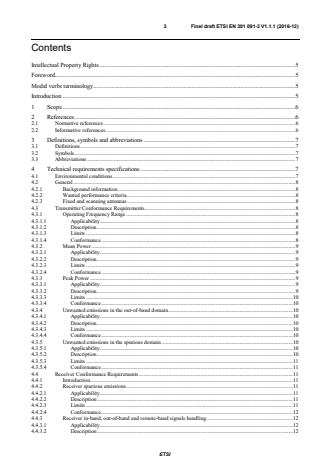
Contents
Intellectual Property Rights . 5
Foreword . 5
Modal verbs terminology . 5
Introduction . 5
1 Scope . 6
2 References . 6
2.1 Normative references . 6
2.2 Informative references . 6
3 Definitions, symbols and abbreviations . 7
3.1 Definitions . 7
3.2 Symbols . 7
3.3 Abbreviations . 7
4 Technical requirements specifications . 7
4.1 Environmental conditions . 7
4.2 General . 8
4.2.1 Background information . 8
4.2.2 Wanted performance criteria. 8
4.2.3 Fixed and scanning antennas . 8
4.3 Transmitter Conformance Requirements . 8
4.3.1 Operating Frequency Range . 8
4.3.1.1 Applicability. 8
4.3.1.2 Description . 8
4.3.1.3 Limits . 8
4.3.1.4 Conformance . 8
4.3.2 Mean Power . 9
4.3.2.1 Applicability. 9
4.3.2.2 Description . 9
4.3.2.3 Limits . 9
4.3.2.4 Conformance . 9
4.3.3 Peak Power . 9
4.3.3.1 Applicability. 9
4.3.3.2 Description . 9
4.3.3.3 Limits . 10
4.3.3.4 Conformance . 10
4.3.4 Unwanted emissions in the out-of-band domain . 10
4.3.4.1 Applicability. 10
4.3.4.2 Description . 10
4.3.4.3 Limits . 10
4.3.4.4 Conformance . 10
4.3.5 Unwanted emissions in the spurious domain . 10
4.3.5.1 Applicability. 10
4.3.5.2 Description . 10
4.3.5.3 Limits . 11
4.3.5.4 Conformance . 11
4.4 Receiver Conformance Requirements . 11
4.4.1 Introduction. 11
4.4.2 Receiver spurious emissions . 11
4.4.2.1 Applicability. 11
4.4.2.2 Description . 11
4.4.2.3 Limits . 11
4.4.2.4 Conformance . 12
4.4.3 Receiver in-band, out-of-band and remote-band signals handling. 12
4.4.3.1 Applicability. 12
4.4.3.2 Description . 12
ETSI
4 Final draft ETSI EN 301 091-3 V1.1.1 (2016-12)
4.4.3.3 Limits . 12
4.4.3.4 Conformance . 13
4.4.4 Receiver sensitivity . 13
4.5 Other Requirements and Mitigation techniques . 13
4.5.1 Installation requirements . 13
4.5.1.1 Applicability. 13
4.5.1.2 Description . 13
4.5.1.3 Requirements . 13
4.5.1.4 Conformance . 13
4.5.2 Operational requirements . 13
4.5.2.1 Applicability. 13
4.5.2.2 Description . 13
4.5.2.3 Requirements . 14
4.5.2.4 Conformance . 16
4.5.3 Emission limits of the installation . 16
4.5.3.1 Applicability. 16
4.5.3.2 Description . 16
4.5.3.3 Requirements . 16
4.5.3.4 Conformance . 16
5 General considerations for performing the tests . 16
6 Test setup and procedures . 16
7 Conformance methods of measurement for transmitter and receiver . 16
7.1 General . 16
7.2 Conformance method for installation requirements . 17
Annex A (informative): Relationship between the present document and the essential
requirements of Directive 2014/53/EU . 18
Annex B (normative): Supervision Area and Protection Zone . 19
B.1 Definition of supervision area in the horizontal plane . 19
B.2 Protection zone in a vertical plane with the related emission levels . 19
Annex C (informative): Example: How to convert Power Flux Density (PFD) to e.i.r.p. . 21
C.1 Description . 21
C.2 Notes. 21
C.3 Calculation Example . 21
Annex D (informative): Change History . 22
History . 23
ETSI
5 Final draft ETSI EN 301 091-3 V1.1.1 (2016-12)
Intellectual Property Rights
IPRs essential or potentially essential to the present document may have been declared to ETSI. The information
pertaining to these essential IPRs, if any, is publicly available for ETSI members and non-members, and can be found
in ETSI SR 000 314: "Intellectual Property Rights (IPRs); Essential, or potentially Essential, IPRs notified to ETSI in
respect of ETSI standards", which is available from the ETSI Secretariat. Latest updates are available on the ETSI Web
server (https://ipr.etsi.org/).
Pursuant to the ETSI IPR Policy, no investigation, including IPR searches, has been carried out by ETSI. No guarantee
can be given as to the existence of other IPRs not referenced in ETSI SR 000 314 (or the updates on the ETSI Web
server) which are, or may be, or may become, essential to the present document.
Foreword
This final draft Harmonised European Standard (EN) has been produced by ETSI Technical Committee
Electromagnetic compatibility and Radio spectrum Matters (ERM), and is now submitted for the Vote phase of the
ETSI standards EN Approval Procedure.
The present document has been prepared under the Commission's standardisation request C(2015) 5376 final [i.5] to
provide one voluntary means of conforming to the essential requirements of Directive 2014/53/EU on the harmonisation
of the laws of the Member States relating to the making available on the market of radio equipment and repealing
Directive 1999/5/EC [i.2].
Once the present document is cited in the Official Journal of the European Union under that Directive, compliance with
the normative clauses of the present document given in table A.1 confers, within the limits of the scope of the present
document, a presumption of conformity with the corresponding essential requirements of that Directive, and associated
EFTA regulations.
The present document is part 3 of a multi-part deliverable. Full details of the entire series can be found in part 1 [i.6].
Proposed national transposition dates
Date of latest announcement of this EN (doa): 3 months after ETSI publication
Date of latest publication of new National Standard
or endorsement of this EN (dop/e): 6 months after doa
Date of withdrawal of any conflicting National Standard (dow): 18 months after doa
Modal verbs terminology
In the present document "shall", "shall not", "should", "should not", "may", "need not", "will", "will not", "can" and
"cannot" are to be interpreted as described in clause 3.2 of the ETSI Drafting Rules (Verbal forms for the expression of
provisions).
"must" and "must not" are NOT allowed in ETSI deliverables except when used in direct citation.
Introduction
The present document, together with ETSI EN 303 396 [1], covers the assessment of certain types of equipment as
defined herein.
ETSI
6 Final draft ETSI EN 301 091-3 V1.1.1 (2016-12)
1 Scope
The present document specifies technical characteristics and methods of measurements for the following types of
equipment:
• radar equipment for obstacle detection applications in the frequency range from 76 GHz to 77 GHz at the road
crossing of a railway track and references CEPT/ECC ERC Recommendation 70-03 [i.1] Annex 4;
• Short Range Devices (SRD) intended for the use at road crossing of a railway track.
It covers integrated transceivers and separate transmit/receive modules.
The present document does not necessarily include all the characteristics which may be required by a user, nor does it
necessarily represent the optimum performance achievable.
In case of differences (for instance concerning special conditions, definitions, abbreviations) between the present
document and ETSI EN 303 396 [1], the provisions of the present document take precedence.
These radio equipment types are capable of operating in all or part of the frequency bands given in table 1.
Table 1: Permitted range of operation [i.1]
Permitted range of operation
Transmit 76 GHz to 77 GHz
Receive 76 GHz to 77 GHz
The present document covers the essential requirements of article 3.2 of Directive 2014/53/EU [i.2] under the
conditions identified in annex A.
2 References
2.1 Normative references
References are specific, identified by date of publication and/or edition number or version number. Only the cited
version applies.
Referenced documents which are not found to be publicly available in the expected location might be found at
https://docbox.etsi.org/Reference/.
NOTE: While any hyperlinks included in this clause were valid at the time of publication, ETSI cannot guarantee
their long term validity.
The following referenced documents are necessary for the application of the present document.
[1] ETSI EN 303 396 (V1.1.1) (12-2016): " Short Range Devices; Measurement Techniques for
automotive and surveillance radar equipment".
2.2 Informative references
References are either specific (identified by date of publication and/or edition number or version number) or
non-specific. For specific references, only the cited version applies. For non-specific references, the latest version of the
referenced document (including any amendments) applies.
NOTE: While any hyperlinks included in this clause were valid at the time of publication, ETSI cannot guarantee
their long term validity.
ETSI
7 Final draft ETSI EN 301 091-3 V1.1.1 (2016-12)
The following referenced documents are not necessary for the application of the present document but they assist the
user with regard to a particular subject area.
[i.1] CEPT/ERC Recommendation 70-03: "Relating to the use of Short Range Devices (SRD)".
[i.2] Directive 2014/53/EU of the European Parliament and of the Council of 16 April 2014 on the
harmonisation of the laws of the Member States relating to the making available on the market of
radio equipment and repealing Directive 1999/5/EC.
[i.3] CEPT/ERC/REC 74-01: "Unwanted emissions in the spurious domain".
[i.4] ETSI EG 203 336: "Electromagnetic compatibility and Radio spectrum Matters (ERM); Guide for
the selection of technical parameters for the production of Harmonised Standards covering
article 3.1(b) and article 3.2 of Directive 2014/53/EU".
[i.5] Commission Implementing Decision C(2015) 5376 final of 4.8.2015 on a standardisation request
to the European Committee for Electrotechnical Standardisation and to the European
Telecommunications Standards Institute as regards radio equipment in support of Directive
2014/53/EU of the European Parliament and of the Council.
[i.6] ETSI EN 301 091-1: "Short Range Devices; Transport and Traffic Telematics (TTT); Radar
equipment operating in the 76 GHz to 77 GHz range; Harmonised Standard covering the essential
requirements of article 3.2 of Directive 2014/53/EU; Part 1: Ground based vehicular radar".
3 Definitions, symbols and abbreviations
3.1 Definitions
For the purposes of the present document, the terms and definitions given in ETSI EN 303 396 [1] and the following
apply:
supervision area: intersection of the railway track(s) and road with an additional safety zone of 2 m
NOTE: The intersection is restricted by elements to halt/stop the road traffic (e.g. "signal, acoustic and/or barrier
...
HARMONISED EUROPEAN STANDARD
Short Range Devices;
Transport and Traffic Telematics (TTT);
Radar equipment operating in the 76 GHz to 77 GHz range;
Harmonised Standard covering the essential requirements
of article 3.2 of Directive 2014/53/EU;
Part 3: Railway/Road Crossings obstacle detection
system applications
2 ETSI EN 301 091-3 V1.1.1 (2017-02)
Reference
DEN/ERM-TGSRR-73
Keywords
harmonised standard, measurement, radar, SRD
ETSI
650 Route des Lucioles
F-06921 Sophia Antipolis Cedex - FRANCE
Tel.: +33 4 92 94 42 00 Fax: +33 4 93 65 47 16
Siret N° 348 623 562 00017 - NAF 742 C
Association à but non lucratif enregistrée à la
Sous-Préfecture de Grasse (06) N° 7803/88
Important notice
The present document can be downloaded from:
http://www.etsi.org/standards-search
The present document may be made available in electronic versions and/or in print. The content of any electronic and/or
print versions of the present document shall not be modified without the prior written authorization of ETSI. In case of any
existing or perceived difference in contents between such versions and/or in print, the only prevailing document is the
print of the Portable Document Format (PDF) version kept on a specific network drive within ETSI Secretariat.
Users of the present document should be aware that the document may be subject to revision or change of status.
Information on the current status of this and other ETSI documents is available at
https://portal.etsi.org/TB/ETSIDeliverableStatus.aspx
If you find errors in the present document, please send your comment to one of the following services:
https://portal.etsi.org/People/CommiteeSupportStaff.aspx
Copyright Notification
No part may be reproduced or utilized in any form or by any means, electronic or mechanical, including photocopying
and microfilm except as authorized by written permission of ETSI.
The content of the PDF version shall not be modified without the written authorization of ETSI.
The copyright and the foregoing restriction extend to reproduction in all media.
© European Telecommunications Standards Institute 2017.
All rights reserved.
TM TM TM
DECT , PLUGTESTS , UMTS and the ETSI logo are Trade Marks of ETSI registered for the benefit of its Members.
TM
3GPP and LTE™ are Trade Marks of ETSI registered for the benefit of its Members and
of the 3GPP Organizational Partners.
GSM® and the GSM logo are Trade Marks registered and owned by the GSM Association.
ETSI
3 ETSI EN 301 091-3 V1.1.1 (2017-02)
Contents
Intellectual Property Rights . 5
Foreword . 5
Modal verbs terminology . 5
Introduction . 5
1 Scope . 6
2 References . 6
2.1 Normative references . 6
2.2 Informative references . 6
3 Definitions, symbols and abbreviations . 7
3.1 Definitions . 7
3.2 Symbols . 7
3.3 Abbreviations . 7
4 Technical requirements specifications . 7
4.1 Environmental conditions . 7
4.2 General . 8
4.2.1 Background information . 8
4.2.2 Wanted performance criteria. 8
4.2.3 Fixed and scanning antennas . 8
4.3 Transmitter Conformance Requirements . 8
4.3.1 Operating Frequency Range . 8
4.3.1.1 Applicability. 8
4.3.1.2 Description . 8
4.3.1.3 Limits . 8
4.3.1.4 Conformance . 9
4.3.2 Mean Power . 9
4.3.2.1 Applicability. 9
4.3.2.2 Description . 9
4.3.2.3 Limits . 9
4.3.2.4 Conformance . 9
4.3.3 Peak Power . 9
4.3.3.1 Applicability. 9
4.3.3.2 Description . 10
4.3.3.3 Limits . 10
4.3.3.4 Conformance . 10
4.3.4 Unwanted emissions in the out-of-band domain . 10
4.3.4.1 Applicability. 10
4.3.4.2 Description . 10
4.3.4.3 Limits . 10
4.3.4.4 Conformance . 10
4.3.5 Unwanted emissions in the spurious domain . 10
4.3.5.1 Applicability. 10
4.3.5.2 Description . 11
4.3.5.3 Limits . 11
4.3.5.4 Conformance . 11
4.4 Receiver Conformance Requirements . 11
4.4.1 Introduction. 11
4.4.2 Receiver spurious emissions . 11
4.4.2.1 Applicability. 11
4.4.2.2 Description . 11
4.4.2.3 Limits . 12
4.4.2.4 Conformance . 12
4.4.3 Receiver in-band, out-of-band and remote-band signals handling. 12
4.4.3.1 Applicability. 12
4.4.3.2 Description . 12
ETSI
4 ETSI EN 301 091-3 V1.1.1 (2017-02)
4.4.3.3 Limits . 12
4.4.3.4 Conformance . 13
4.4.4 Receiver sensitivity . 13
4.5 Other Requirements and Mitigation techniques . 13
4.5.1 Installation requirements . 13
4.5.1.1 Applicability. 13
4.5.1.2 Description . 13
4.5.1.3 Requirements . 13
4.5.1.4 Conformance . 13
4.5.2 Operational requirements . 14
4.5.2.1 Applicability. 14
4.5.2.2 Description . 14
4.5.2.3 Requirements . 14
4.5.2.4 Conformance . 16
4.5.3 Emission limits of the installation . 16
4.5.3.1 Applicability. 16
4.5.3.2 Description . 16
4.5.3.3 Requirements . 16
4.5.3.4 Conformance . 16
5 General considerations for performing the tests . 16
6 Test setup and procedures . 16
7 Conformance methods of measurement for transmitter and receiver . 16
7.1 General . 16
7.2 Conformance method for installation requirements . 17
Annex A (informative): Relationship between the present document and the essential
requirements of Directive 2014/53/EU . 18
Annex B (normative): Supervision Area and Protection Zone . 19
B.1 Definition of supervision area in the horizontal plane . 19
B.2 Protection zone in a vertical plane with the related emission levels . 19
Annex C (informative): Example: How to convert Power Flux Density (PFD) to e.i.r.p. . 21
C.1 Description . 21
C.2 Notes. 21
C.3 Calculation Example . 21
Annex D (informative): Change History . 22
History . 23
ETSI
5 ETSI EN 301 091-3 V1.1.1 (2017-02)
Intellectual Property Rights
IPRs essential or potentially essential to the present document may have been declared to ETSI. The information
pertaining to these essential IPRs, if any, is publicly available for ETSI members and non-members, and can be found
in ETSI SR 000 314: "Intellectual Property Rights (IPRs); Essential, or potentially Essential, IPRs notified to ETSI in
respect of ETSI standards", which is available from the ETSI Secretariat. Latest updates are available on the ETSI Web
server (https://ipr.etsi.org/).
Pursuant to the ETSI IPR Policy, no investigation, including IPR searches, has been carried out by ETSI. No guarantee
can be given as to the existence of other IPRs not referenced in ETSI SR 000 314 (or the updates on the ETSI Web
server) which are, or may be, or may become, essential to the present document.
Foreword
This Harmonised European Standard (EN) has been produced by ETSI Technical Committee Electromagnetic
compatibility and Radio spectrum Matters (ERM).
The present document has been prepared under the Commission's standardisation request C(2015) 5376 final [i.5] to
provide one voluntary means of conforming to the essential requirements of Directive 2014/53/EU on the harmonisation
of the laws of the Member States relating to the making available on the market of radio equipment and repealing
Directive 1999/5/EC [i.2].
Once the present document is cited in the Official Journal of the European Union under that Directive, compliance with
the normative clauses of the present document given in table A.1 confers, within the limits of the scope of the present
document, a presumption of conformity with the corresponding essential requirements of that Directive, and associated
EFTA regulations.
The present document is part 3 of a multi-part deliverable. Full details of the entire series can be found in part 1 [i.6].
National transposition dates
Date of adoption of this EN: 20 February 2017
Date of latest announcement of this EN (doa): 31 May 2017
Date of latest publication of new National Standard
or endorsement of this EN (dop/e): 30 November 2017
Date of withdrawal of any conflicting National Standard (dow): 30 November 2018
Modal verbs terminology
In the present document "shall", "shall not", "should", "should not", "may", "need not", "will", "will not", "can" and
"cannot" are to be interpreted as described in clause 3.2 of the ETSI Drafting Rules (Verbal forms for the expression of
provisions).
"must" and "must not" are NOT allowed in ETSI deliverables except when used in direct citation.
Introduction
The present document, together with ETSI EN 303 396 [1], covers the assessment of certain types of equipment as
defined herein.
ETSI
6 ETSI EN 301 091-3 V1.1.1 (2017-02)
1 Scope
The present document specifies technical characteristics and methods of measurements for the following types of
equipment:
• radar equipment for obstacle detection applications in the frequency range from 76 GHz to 77 GHz at the road
crossing of a railway track and references CEPT/ECC ERC Recommendation 70-03 [i.1] Annex 4;
• Short Range Devices (SRD) intended for the use at road crossing of a railway track.
It covers integrated transceivers and separate transmit/receive modules.
The present document does not necessarily include all the characteristics which may be required by a user, nor does it
necessarily represent the optimum performance achievable.
In case of differences (for instance concerning special conditions, definitions, abbreviations) between the present
document and ETSI EN 303 396 [1], the provisions of the present document take precedence.
These radio equipment types are capable of operating in all or part of the frequency bands given in table 1.
Table 1: Permitted range of operation [i.1]
Permitted range of operation
Transmit 76 GHz to 77 GHz
Receive 76 GHz to 77 GHz
The present document covers the essential requirements of article 3.2 of Directive 2014/53/EU [i.2] under the
conditions identified in annex A.
2 References
2.1 Normative references
References are specific, identified by date of publication and/or edition number or version number. Only the cited
version applies.
Referenced documents which are not found to be publicly available in the expected location might be found at
https://docbox.etsi.org/Reference/.
NOTE: While any hyperlinks included in this clause were valid at the time of publication, ETSI cannot guarantee
their long term validity.
The following referenced documents are necessary for the application of the present document.
[1] ETSI EN 303 396 (V1.1.1) (12-2016): " Short Range Devices; Measurement Techniques for
automotive and surveillance radar equipment".
2.2 Informative references
References are either specific (identified by date of publication and/or edition number or version number) or
non-specific. For specific references, only the cited version applies. For non-specific references, the latest version of the
referenced document (including any amendments) applies.
NOTE: While any hyperlinks included in this clause were valid at the time of publication, ETSI cannot guarantee
their long term validity.
The following referenced documents are not necessary for the application of the present document but they assist the
user with regard to a particular subject area.
ETSI
7 ETSI EN 301 091-3 V1.1.1 (2017-02)
[i.1] CEPT/ERC Recommendation 70-03: "Relating to the use of Short Range Devices (SRD)".
[i.2] Directive 2014/53/EU of the European Parliament and of the Council of 16 April 2014 on the
harmonisation of the laws of the Member States relating to the making available on the market of
radio equipment and repealing Directive 1999/5/EC.
[i.3] CEPT/ERC/REC 74-01: "Unwanted emissions in the spurious domain".
[i.4] ETSI EG 203 336: "Electromagnetic compatibility and Radio spectrum Matters (ERM); Guide for
the selection of technical parameters for the production of Harmonised Standards covering
article 3.1(b) and article 3.2 of Directive 2014/53/EU".
[i.5] Commission Implementing Decision C(2015) 5376 final of 4.8.2015 on a standardisation request
to the European Committee for Electrotechnical Standardisation and to the European
Telecommunications Standards Institute as regards radio equipment in support of Directive
2014/53/EU of the European Parliament and of the Council.
[i.6] ETSI EN 301 091-1: "Short Range Devices; Transport and Traffic Telematics (TTT); Radar
equipment operating in the 76 GHz to 77 GHz range; Harmonised Standard covering the essential
requirements of article 3.2 of Directive 2014/53/EU; Part 1: Ground based vehicular radar".
3 Definitions, symbols and abbreviations
3.1 Definitions
For the purposes of the present document, the terms and definitions given in ETSI EN 303 396 [1] and the following
apply:
supervision area: intersection of the railway track(s) and road with an additional safety zone of 2 m
NOTE: The intersection is restricted by elements to halt/stop the road traffic (e.g. "signal, acoustic and/or b
...
2003-01.Slovenski inštitut za standardizacijo. Razmnoževanje celote ali delov tega standarda ni dovoljeno.PRQL]LUDQLShort Range Devices - Transport and Traffic Telematics (TTT) - Radar equipment operating in the 76 GHz to 77 GHz range - Harmonised Standard covering the essential requirements of article 3.2 of the Directive 2014/53/EU - Part 3: Railway/Road Crossings obstacle detection system applications35.240.60Uporabniške rešitve IT v prometuIT applications in transport33.060.99Druga oprema za radijske komunikacijeOther equipment for radiocommunicationsICS:Ta slovenski standard je istoveten z:ETSI EN 301 091-3 V1.1.1 (2017-02)SIST EN 301 091-3 V1.1.1:2017en01-maj-2017SIST EN 301 091-3 V1.1.1:2017SLOVENSKI
STANDARD
HARMONISED EUROPEAN STANDARD SIST EN 301 091-3 V1.1.1:2017
ETSI ETSI EN 301 091-3 V1.1.1 (2017-02) 2
Reference DEN/ERM-TGSRR-73 Keywords harmonised standard, measurement, radar, SRD ETSI 650 Route des Lucioles F-06921 Sophia Antipolis Cedex - FRANCE
Tel.: +33 4 92 94 42 00
Fax: +33 4 93 65 47 16
Siret N° 348 623 562 00017 - NAF 742 C Association à but non lucratif enregistrée à la Sous-Préfecture de Grasse (06) N° 7803/88
Important notice The present document can be downloaded from: http://www.etsi.org/standards-search The present document may be made available in electronic versions and/or in print. The content of any electronic and/or print versions of the present document shall not be modified without the prior written authorization of ETSI. In case of any existing or perceived difference in contents between such versions and/or in print, the only prevailing document is the print of the Portable Document Format (PDF) version kept on a specific network drive within ETSI Secretariat. Users of the present document should be aware that the document may be subject to revision or change of status. Information on the current status of this and other ETSI documents is available at https://portal.etsi.org/TB/ETSIDeliverableStatus.aspx If you find errors in the present document, please send your comment to one of the following services: https://portal.etsi.org/People/CommiteeSupportStaff.aspx Copyright Notification No part may be reproduced or utilized in any form or by any means, electronic or mechanical, including photocopying and microfilm except as authorized by written permission of ETSI. The content of the PDF version shall not be modified without the written authorization of ETSI. The copyright and the foregoing restriction extend to reproduction in all media.
© European Telecommunications Standards Institute 2017. All rights reserved.
DECTTM, PLUGTESTSTM, UMTSTM and the ETSI logo are Trade Marks of ETSI registered for the benefit of its Members. 3GPPTM and LTE™ are Trade Marks of ETSI registered for the benefit of its Members and of the 3GPP Organizational Partners. GSM® and the GSM logo are Trade Marks registered and owned by the GSM Association. SIST EN 301 091-3 V1.1.1:2017
ETSI ETSI EN 301 091-3 V1.1.1 (2017-02) 3 Contents Intellectual Property Rights . 5 Foreword . 5 Modal verbs terminology . 5 Introduction . 5 1 Scope . 6 2 References . 6 2.1 Normative references . 6 2.2 Informative references . 6 3 Definitions, symbols and abbreviations . 7 3.1 Definitions . 7 3.2 Symbols . 7 3.3 Abbreviations . 7 4 Technical requirements specifications . 7 4.1 Environmental conditions . 7 4.2 General . 8 4.2.1 Background information . 8 4.2.2 Wanted performance criteria. 8 4.2.3 Fixed and scanning antennas . 8 4.3 Transmitter Conformance Requirements . 8 4.3.1 Operating Frequency Range . 8 4.3.1.1 Applicability. 8 4.3.1.2 Description . 8 4.3.1.3 Limits . 8 4.3.1.4 Conformance . 9 4.3.2 Mean Power . 9 4.3.2.1 Applicability. 9 4.3.2.2 Description . 9 4.3.2.3 Limits . 9 4.3.2.4 Conformance . 9 4.3.3 Peak Power . 9 4.3.3.1 Applicability. 9 4.3.3.2 Description . 10 4.3.3.3 Limits . 10 4.3.3.4 Conformance . 10 4.3.4 Unwanted emissions in the out-of-band domain . 10 4.3.4.1 Applicability. 10 4.3.4.2 Description . 10 4.3.4.3 Limits . 10 4.3.4.4 Conformance . 10 4.3.5 Unwanted emissions in the spurious domain . 10 4.3.5.1 Applicability. 10 4.3.5.2 Description . 11 4.3.5.3 Limits . 11 4.3.5.4 Conformance . 11 4.4 Receiver Conformance Requirements . 11 4.4.1 Introduction. 11 4.4.2 Receiver spurious emissions . 11 4.4.2.1 Applicability. 11 4.4.2.2 Description . 11 4.4.2.3 Limits . 12 4.4.2.4 Conformance . 12 4.4.3 Receiver in-band, out-of-band and remote-band signals handling. 12 4.4.3.1 Applicability. 12 4.4.3.2 Description . 12 SIST EN 301 091-3 V1.1.1:2017
ETSI ETSI EN 301 091-3 V1.1.1 (2017-02) 4 4.4.3.3 Limits . 12 4.4.3.4 Conformance . 13 4.4.4 Receiver sensitivity . 13 4.5 Other Requirements and Mitigation techniques . 13 4.5.1 Installation requirements . 13 4.5.1.1 Applicability. 13 4.5.1.2 Description . 13 4.5.1.3 Requirements . 13 4.5.1.4 Conformance . 13 4.5.2 Operational requirements . 14 4.5.2.1 Applicability. 14 4.5.2.2 Description . 14 4.5.2.3 Requirements . 14 4.5.2.4 Conformance . 16 4.5.3 Emission limits of the installation . 16 4.5.3.1 Applicability. 16 4.5.3.2 Description . 16 4.5.3.3 Requirements . 16 4.5.3.4 Conformance . 16 5 General considerations for performing the tests . 16 6 Test setup and procedures . 16 7 Conformance methods of measurement for transmitter and receiver . 16 7.1 General . 16 7.2 Conformance method for installation requirements . 17 Annex A (informative): Relationship between the present document and the essential requirements of Directive 2014/53/EU . 18 Annex B (normative): Supervision Area and Protection Zone . 19 B.1 Definition of supervision area in the horizontal plane . 19 B.2 Protection zone in a vertical plane with the related emission levels . 19 Annex C (informative): Example: How to convert Power Flux Density (PFD) to e.i.r.p. . 21 C.1 Description . 21 C.2 Notes. 21 C.3 Calculation Example . 21 Annex D (informative): Change History . 22 History . 23
ETSI ETSI EN 301 091-3 V1.1.1 (2017-02) 5 Intellectual Property Rights IPRs essential or potentially essential to the present document may have been declared to ETSI. The information pertaining to these essential IPRs, if any, is publicly available for ETSI members and non-members, and can be found in ETSI SR 000 314: "Intellectual Property Rights (IPRs); Essential, or potentially Essential, IPRs notified to ETSI in respect of ETSI standards", which is available from the ETSI Secretariat. Latest updates are available on the ETSI Web server (https://ipr.etsi.org/). Pursuant to the ETSI IPR Policy, no investigation, including IPR searches, has been carried out by ETSI. No guarantee can be given as to the existence of other IPRs not referenced in ETSI SR 000 314 (or the updates on the ETSI Web server) which are, or may be, or may become, essential to the present document. Foreword This Harmonised European Standard (EN) has been produced by ETSI Technical Committee Electromagnetic compatibility and Radio spectrum Matters (ERM). The present document has been prepared under the Commission's standardisation request C(2015) 5376 final [i.5] to provide one voluntary means of conforming to the essential requirements of Directive 2014/53/EU on the harmonisation of the laws of the Member States relating to the making available on the market of radio equipment and repealing Directive 1999/5/EC [i.2]. Once the present document is cited in the Official Journal of the European Union under that Directive, compliance with the normative clauses of the present document given in table A.1 confers, within the limits of the scope of the present document, a presumption of conformity with the corresponding essential requirements of that Directive, and associated EFTA regulations. The present document is part 3 of a multi-part deliverable. Full details of the entire series can be found in part 1 [i.6].
National transposition dates Date of adoption of this EN: 20 February 2017 Date of latest announcement of this EN (doa): 31 May 2017 Date of latest publication of new National Standard or endorsement of this EN (dop/e):
30 November 2017 Date of withdrawal of any conflicting National Standard (dow): 30 November 2018
Modal verbs terminology In the present document "shall", "shall not", "should", "should not", "may", "need not", "will", "will not", "can" and "cannot" are to be interpreted as described in clause 3.2 of the ETSI Drafting Rules (Verbal forms for the expression of provisions). "must" and "must not" are NOT allowed in ETSI deliverables except when used in direct citation. Introduction The present document, together with ETSI EN 303 396 [1], covers the assessment of certain types of equipment as defined herein.
ETSI ETSI EN 301 091-3 V1.1.1 (2017-02) 6 1 Scope The present document specifies technical characteristics and methods of measurements for the following types of equipment: • radar equipment for obstacle detection applications in the frequency range from 76 GHz to 77 GHz at the road crossing of a railway track and references CEPT/ECC ERC Recommendation 70-03 [i.1] Annex 4; • Short Range Devices (SRD) intended for the use at road crossing of a railway track. It covers integrated transceivers and separate transmit/receive modules. The present document does not necessarily include all the characteristics which may be required by a user, nor does it necessarily represent the optimum performance achievable. In case of differences (for instance concerning special conditions, definitions, abbreviations) between the present document and ETSI EN 303 396 [1], the provisions of the present document take precedence. These radio equipment types are capable of operating in all or part of the frequency bands given in table 1. Table 1: Permitted range of operation [i.1] Permitted range of operation Transmit 76 GHz to 77 GHz Receive 76 GHz to 77 GHz
The present document covers the essential requirements of article 3.2 of Directive 2014/53/EU [i.2] under the conditions identified in annex A. 2 References 2.1 Normative references References are specific, identified by date of publication and/or edition number or version number. Only the cited version applies.
Referenced documents which are not found to be publicly available in the expected location might be found at https://docbox.etsi.org/Reference/. NOTE: While any hyperlinks included in this clause were valid at the time of publication, ETSI cannot guarantee their long term validity. The following referenced documents are necessary for the application of the present document. [1] ETSI EN 303 396 (V1.1.1) (12-2016): " Short Range Devices; Measurement Techniques for automotive and surveillance radar equipment". 2.2 Informative references References are either specific (identified by date of publication and/or edition number or version number) or non-specific. For specific references, only the cited version applies. For non-specific references, the latest version of the referenced document (including any amendments) applies. NOTE: While any hyperlinks included in this clause were valid at the time of publication, ETSI cannot guarantee their long term validity. The following referenced documents are not necessary for the application of the present document but they assist the user with regard to a particular subject area. SIST EN 301 091-3 V1.1.1:2017
ETSI ETSI EN 301 091-3 V1.1.1 (2017-02) 7 [i.1] CEPT/ERC Recommendation 70-03: "Relating to the use of Short Range Devices (SRD)". [i.2] Directive 2014/53/EU of the European Parliament and of the Council of 16 April 2014 on the harmonisation of the laws of the Member States relating to the making available on the market of radio equipment and repealing Directive 1999/5/EC. [i.3] CEPT/ERC/REC 74-01: "Unwanted emissions in the spurious domain". [i.4] ETSI EG 203 336: "Electromagnetic compatibility and Radio spectrum Matters (ERM); Guide for the selection of technical parameters for the production of Harmonised Standards covering article 3.1(b) and article 3.2 of Directive 2014/53/EU". [i.5] Commission Implementing Decision C(2015) 5376 final of 4.8.2015 on a standardisation request to the European Committee for Electrotechnical Standardisation and to the European Telecommunications Standards Institute as regards radio equipment in support of Directive 2014/53/EU of the European Parliament and of the Council. [i.6]
...
Questions, Comments and Discussion
Ask us and Technical Secretary will try to provide an answer. You can facilitate discussion about the standard in here.
Loading comments...