


ETSI TR 104 225 V1.1.1 (2024-04)
Securing Artificial Intelligence TC (SAI); Privacy aspects of AI/ML systems
Securing Artificial Intelligence TC (SAI); Privacy aspects of AI/ML systems
DTR/SAI-0018
General Information
Standards Content (Sample)
TECHNICAL REPORT
Securing Artificial Intelligence TC (SAI);
Privacy aspects of AI/ML systems
2 ETSI TR 104 225 V1.1.1 (2024-04)
Reference
DTR/SAI-0018
Keywords
artificial intelligence, privacy
ETSI
650 Route des Lucioles
F-06921 Sophia Antipolis Cedex - FRANCE
Tel.: +33 4 92 94 42 00 Fax: +33 4 93 65 47 16
Siret N° 348 623 562 00017 - APE 7112B
Association à but non lucratif enregistrée à la
Sous-Préfecture de Grasse (06) N° w061004871
Important notice
The present document can be downloaded from:
https://www.etsi.org/standards-search
The present document may be made available in electronic versions and/or in print. The content of any electronic and/or
print versions of the present document shall not be modified without the prior written authorization of ETSI. In case of any
existing or perceived difference in contents between such versions and/or in print, the prevailing version of an ETSI
deliverable is the one made publicly available in PDF format at www.etsi.org/deliver.
Users of the present document should be aware that the document may be subject to revision or change of status.
Information on the current status of this and other ETSI documents is available at
https://portal.etsi.org/TB/ETSIDeliverableStatus.aspx
If you find errors in the present document, please send your comment to one of the following services:
https://portal.etsi.org/People/CommiteeSupportStaff.aspx
If you find a security vulnerability in the present document, please report it through our
Coordinated Vulnerability Disclosure Program:
https://www.etsi.org/standards/coordinated-vulnerability-disclosure
Notice of disclaimer & limitation of liability
The information provided in the present deliverable is directed solely to professionals who have the appropriate degree of
experience to understand and interpret its content in accordance with generally accepted engineering or
other professional standard and applicable regulations.
No recommendation as to products and services or vendors is made or should be implied.
No representation or warranty is made that this deliverable is technically accurate or sufficient or conforms to any law
and/or governmental rule and/or regulation and further, no representation or warranty is made of merchantability or fitness
for any particular purpose or against infringement of intellectual property rights.
In no event shall ETSI be held liable for loss of profits or any other incidental or consequential damages.
Any software contained in this deliverable is provided "AS IS" with no warranties, express or implied, including but not
limited to, the warranties of merchantability, fitness for a particular purpose and non-infringement of intellectual property
rights and ETSI shall not be held liable in any event for any damages whatsoever (including, without limitation, damages
for loss of profits, business interruption, loss of information, or any other pecuniary loss) arising out of or related to the use
of or inability to use the software.
Copyright Notification
No part may be reproduced or utilized in any form or by any means, electronic or mechanical, including photocopying and
microfilm except as authorized by written permission of ETSI.
The content of the PDF version shall not be modified without the written authorization of ETSI.
The copyright and the foregoing restriction extend to reproduction in all media.
© ETSI 2024.
All rights reserved.
ETSI
3 ETSI TR 104 225 V1.1.1 (2024-04)
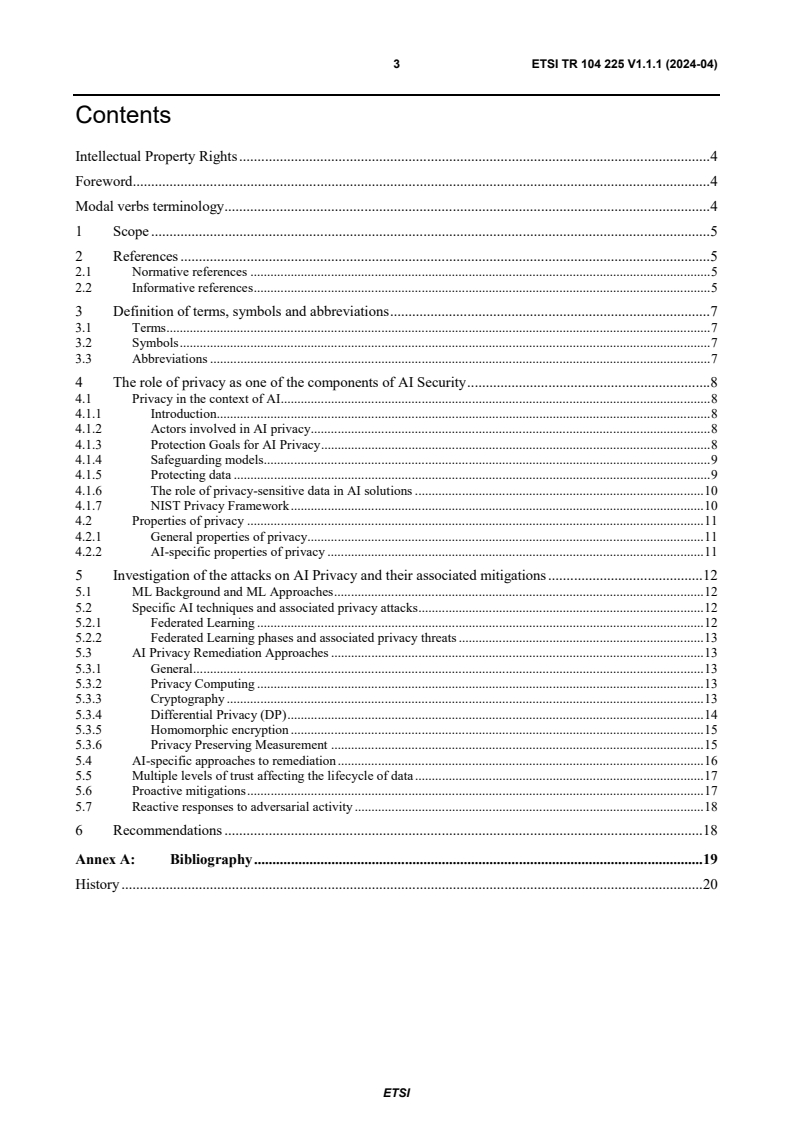
Contents
Intellectual Property Rights . 4
Foreword . 4
Modal verbs terminology . 4
1 Scope . 5
2 References . 5
2.1 Normative references . 5
2.2 Informative references . 5
3 Definition of terms, symbols and abbreviations . 7
3.1 Terms . 7
3.2 Symbols . 7
3.3 Abbreviations . 7
4 The role of privacy as one of the components of AI Security . 8
4.1 Privacy in the context of AI. 8
4.1.1 Introduction. 8
4.1.2 Actors involved in AI privacy. 8
4.1.3 Protection Goals for AI Privacy . 8
4.1.4 Safeguarding models. 9
4.1.5 Protecting data . 9
4.1.6 The role of privacy-sensitive data in AI solutions . 10
4.1.7 NIST Privacy Framework . 10
4.2 Properties of privacy . 11
4.2.1 General properties of privacy. 11
4.2.2 AI-specific properties of privacy . 11
5 Investigation of the attacks on AI Privacy and their associated mitigations . 12
5.1 ML Background and ML Approaches . 12
5.2 Specific AI techniques and associated privacy attacks . 12
5.2.1 Federated Learning . 12
5.2.2 Federated Learning phases and associated privacy threats . 13
5.3 AI Privacy Remediation Approaches . 13
5.3.1 General . 13
5.3.2 Privacy Computing . 13
5.3.3 Cryptography . 13
5.3.4 Differential Privacy (DP) . 14
5.3.5 Homomorphic encryption . 15
5.3.6 Privacy Preserving Measurement . 15
5.4 AI-specific approaches to remediation . 16
5.5 Multiple levels of trust affecting the lifecycle of data . 17
5.6 Proactive mitigations . 17
5.7 Reactive responses to adversarial activity . 18
6 Recommendations . 18
Annex A: Bibliography . 19
History . 20
ETSI
4 ETSI TR 104 225 V1.1.1 (2024-04)
Intellectual Property Rights
Essential patents
IPRs essential or potentially essential to normative deliverables may have been declared to ETSI. The declarations
pertaining to these essential IPRs, if any, are publicly available for ETSI members and non-members, and can be
found in ETSI SR 000 314: "Intellectual Property Rights (IPRs); Essential, or potentially Essential, IPRs notified to
ETSI in respect of ETSI standards", which is available from the ETSI Secretariat. Latest updates are available on the
ETSI Web server (https://ipr.etsi.org/).
Pursuant to the ETSI Directives including the ETSI IPR Policy, no investigation regarding the essentiality of IPRs,
including IPR searches, has been carried out by ETSI. No guarantee can be given as to the existence of other IPRs not
referenced in ETSI SR 000 314 (or the updates on the ETSI Web server) which are, or may be, or may become,
essential to the present document.
Trademarks
The present document may include trademarks and/or tradenames which are asserted and/or registered by their owners.
ETSI claims no ownership of these except for any which are indicated as being the property of ETSI, and conveys no
right to use or reproduce any trademark and/or tradename. Mention of those trademarks in the present document does
not constitute an endorsement by ETSI of products, services or organizations associated with those trademarks.
DECT™, PLUGTESTS™, UMTS™ and the ETSI logo are trademarks of ETSI registered for the benefit of its
Members. 3GPP™ and LTE™ are trademarks of ETSI registered for the benefit of its Members and of the 3GPP
Organizational Partners. oneM2M™ logo is a trademark of ETSI registered for the benefit of its Members and of the ®
oneM2M Partners. GSM and the GSM logo are trademarks registered and owned by the GSM Association.
Foreword
This Technical Report (TR) has been produced by ETSI Technical Committee Securing Artificial Intelligence (SAI).
Modal verbs terminology
In the present document "should", "should not", "may", "need not", "will", "will not", "can" and "cannot" are to be
interpreted as described in clause 3.2 of the ETSI Drafting Rules (Verbal forms for the expression of provisions).
"must" and "must not" are NOT allowed in ETSI deliverables except when used in direct citation.
ETSI
5 ETSI TR 104 225 V1.1.1 (2024-04)
1 Scope
The present document identifies the role of privacy as one of the components of the Security of AI, and defines
measures to protect and preserve privacy in the context of AI that covers both, safeguarding models and protecting data,
as well as the role of privacy-sensitive data in AI solutions. It documents and addresses the attacks and their associated
remediations where applicable, considering the existence of multiple levels of trust affecting the lifecycle of data.
The investigated attack mitigations include Non-AI-Specific (traditional Security/Privacy redresses), AI/ML-specific
remedies, proactive remediations ("left of the boom"), and reactive responses to an adversarial activity ("right of the
boom").
2 References
2.1 Normative references
Normative references are not applicable in the present document.
2.2 Informative references
References are either specific (identified by date of publication and/or edition number or version number) or
non-specific. For specific references, only the cited version applies. For non-specific references, the latest version of the
referenced document (including any amendments) applies.
NOTE: While any hyperlinks included in this clause were valid at the time of publication, ETSI cannot guarantee
their long term validity.
The following referenced documents are not necessary for the application of the present document but they assist the
user with regard to a particular subject area.
[i.1] ETSI GR SAI 004: "Securing Artificial Intelligence (SAI); Problem Statement".
NOTE: ETSI GR SAI 004 is in the process of conversion to ETSI TC SAI deliverable as ETSI TR 104 221.
TM
[i.2] L. Melis et al.: "Exploiting unintended feature leakage in collaborative learning", in Proc. IEEE
Symp. Security Privacy, 2019.
[i.3] M. Abadi et al.: "Deep learning with differential privacy", in Proc. ACM Conf. Computer and
Communications Security, 2016.
[i.4] B. Jayaraman and D. Evans: "Evaluating differentially private machine learning in practice", in
Proc. USENIX Security, 2019.
[i.5] Emiliano De Cristofaro: "A Critical Overview of Privacy in Machine Learning", UCL and Alan
Turing Institute.
[i.6] Lyu L. et al.: "Privacy and Robustness in Federated Learning: Attacks and Defenses". CoRR.
nd TM
[i.7] Cheu et al.: "Manipulation attacks in local differential privacy". In: 42 IEEE symposium on
security and privacy.
[i.8] ISO/IEC 29100: "Information technology -- Security techniques -- Privacy framework".
[i.9] ISO/IEC 27550: "Information technology -- Security techniques -- Privacy engineering for system
life cycle processes".
[i.10] ISO/IEC 24760-1: "IT Security and Privacy -- A framework for identity management -- Part 1:
Terminology and concepts".
[i.11] ISO/IEC 20009-4: "Information technology -- Security techniques -- Anonymous entity
authentication -- Part 4: Mechanisms based on weak secrets".
ETSI
6 ETSI TR 104 225 V1.1.1 (2024-04)
TM
[i.12] Hansen M. et al.: "Protection Goals for Privacy Engineering", 2015 IEEE CS Security and
Privacy Workshops.
[i.13] Henry Corrigan-Gibbs and Dan Boneh, Prio: "Private, Robust, and Scalable Computation of
Aggregate Statistics".
[i.14] Chen at al.: "Poplar optimization algorithm: A new meta-heuristic optimization technique for
numerical optimization and image segmentation".
[i.15] Mia Chiquier at al.: "Real-Time Neural Voice Camouflage", ICLR 2022.
[i.16] Nicolas Papernot et al.: "Scalable Private Learning with PATE", 2018.
[i.17] Liyang Xie et al.: "Differentially Private Generative Adversarial Network", 2018.
[i.18] Yunhui Long et al.: "G-PATE: Scalable Differentially Private Data Generator via Private
Aggregation of Teacher Discriminators", 2019.
[i.19] Jia-Wei Chen et al.: "DPGEN: Differentially Private Generative Energy-Guided Network for
TM
Natural Image Synthesis". In Proceedings of the IEEE /CVF Conference on Computer Vision
and Pattern Recognition (CVPR), pages 8387-8396, June 2022.
[i.20] Maria Rigaki and Sebastian Garcia: "A Survey of Privacy Attacks in Machine Learning". CoRR,
2020.
[i.21] Ahmed Salem, Yang Zhang, Mathias Humbert, Pascal Berrang, Mario Fritz, and Michael Backes:
"ML-Leaks: Model and Data Independent Membership Inference Attacks and Defenses on
Machine Learning Models", 2018.
[i.22] Giuseppe Ateniese, Giovanni Felici, Luigi V. Mancini, Angelo Spognardi, Antonio Villani, and
Domenico Vitali: "Hacking Smart Machines with Smarter Ones: How to Extract Meaningful Data
from Machine Learning Classifiers", 2013.
[i.23] Yuheng Zhang, Ruoxi Jia, Hengzhi Pei, Wenxiao Wang, Bo Li, and Dawn Song. 2020: "The
Secret Revealer: Generative Model-Inversion Attacks Against Deep Neural Networks". In
TM
Proceedings of the IEEE/CVF Conference on Computer Vision and Pattern Recognition. IEEE ,
253-261.
[i.24] Matthew Jagielski, Nicholas Carlini, David Berthelot, Alex Kurakin, and Nicolas Papernot. 2020:
th
"High Accuracy and High Fidelity Extraction of Neural Networks". In 29 USENIX Security
Symposium (USENIX Security 20). USENIX Association, Boston, MA.
[i.25] David Elliott and Eldon Soifer, 2014: "Social Theory and Practice".
[i.26] Kevin Macnish and Jeroen van der Ham, 2020: "Ethics in cybersecurity research and practice". In
Technology in Society, 2020.
TM
[i.27] Y. Liu, Y. Xie, and A. Srivastava: "Neural trojans", in Proc. IEEE Int. Conf. Comput. Design
(ICCD), 2017.
[i.28] B. Tran, J. Li, and A. Madry: "Spectral signatures in backdoor attacks", in Proc. NIPS, 2018.
[i.29] B. Chen et al.: "Detecting Backdoor Attacks on Deep Neural Networks by Activation Clustering",
2018.
[i.30] X. Chen, C. Liu, B. Li, K. Lu, and D. Song: "Targeted Backdoor Attacks on Deep Learning
Systems Using Data Poisoning", 2017.
[i.31] B. Wang et al.: "Neural cleanse: Identifying and mitigating backdoor attacks in neural networks",
TM
in Proc. IEEE Symp. Secur. Privacy (SP), 2019.
[i.32] H. Chen, C. Fu, J. Zhao, and F. Koushanfar: "Deepinspect: A black-box trojan detection and
mitigation framework for deep neural networks", in IJCAI, 2019.
[i.33] K. Liu, B. Dolan-Gavitt, and S. Garg: "Fine-pruning: Defending against backdooring attacks on
deep neural networks", in Proc. Int. Symp. Res. Attacks, Intrusions, Defenses, 2018.
ETSI
7 ETSI TR 104 225 V1.1.1 (2024-04)
[i.34] T. J. L. Tan and R. Shokri: "Bypassing backdoor detection algorithms in deep learning", in Proc.
TM
IEEE Eur. Symp. Secur. Privacy (EuroS&P), 2020.
3 Definition of terms, symbols and abbreviations
3.1 Terms
For the purposes of the present document, the following terms apply:
homomorphic encryption: symmetric or an asymmetric encryption that allows third parties to perform operations on
data while keeping them in encrypted form (see ISO/IEC 20009-4 [i.11])
3.2 Symbols
Void.
3.3 Abbreviations
For the purposes of the present document, the following abbreviations apply:
AI Artificial Intelligence
CCPA California Consumer Privacy Act
DP Differential Privacy
FL Federated Learning
GDPR General Data Protection Regulation (EU)
ICT Information and Communications Technology
IEC International Electrotechnical Commission
IETF Internet Engineering Task Force
ISO International Organization for Standardization
IT Information Technology
MIA [group] Membership Inference Attack
ML Machine Learning
MPC Multi-Party Computing
NIST National Institute of Standards and Technology
PII Personally Identifiable Information
PPM Privacy Preserving Measurement
SAI Securing Artificial Intelligence
SGD Stochastic Gradient Descent
TEE Trusted Execution Environment
UE User Equipment
VDAF Verifiable Distributed Aggregation Function
WG Working Group
ETSI
8 ETSI TR 104 225 V1.1.1 (2024-04)
4 The role of privacy as one of the components of AI
Security
4.1 Privacy in the context of AI
4.1.1 Introduction
[i.5] attempts to define privacy in ML while focusing on different types of attacks. The present document adopts an
attack-central approach to the measurement of AI Privacy as part of the overall security of the AI/ML system. Such an
approach considers adversarial goals and capabilities that the adversary would employ, and the security remedies for AI
privacy protection.
4.1.2 Actors involved in AI privacy
AI privacy involves a complex web of actors with different roles and responsibilities, including:
• Data subjects: These are individuals whose personal data is processed by AI systems. Data subjects have the
right to control their personal data and have it processed in accordance with privacy laws and regulations.
• Data controllers: These are entities that determine the purposes and means of processing personal data, such as
organizations that develop or deploy AI systems. Data controllers have a legal responsibility to ensure that
personal data is processed in compliance with privacy laws and regulations.
• Data processors: These are entities that process personal data on behalf of data controllers, such as third-party
service providers that provide cloud computing or data storage services. Data processors are also required to
comply with privacy laws and regulations.
• Regulators: These are government agencies or other bodies responsible for enforcing privacy laws and
regulations, such as the General Data Protection Regulation (GDPR) in the European Union or the California
Consumer Privacy Act (CCPA) in the United States.
• Ethicists and privacy experts: These are individuals or groups that provide guidance on ethical and privacy
considerations related to the development and deployment of AI systems.
• Hackers and malicious actors: These are individuals or groups who may attempt to compromise AI systems or
access personal data without authorization, potentially leading to privacy violations.
Effective AI privacy requires collaboration and cooperation among these actors to ensure that personal data is processed
in a transparent, secure, and responsible manner.
4.1.3 Protection Goals for AI Privacy
[i.12] provides six protection goals assuring a common scheme for addressing the legal, technical, economic, and
societal dimensions of privacy and data protection in complex telecommunications, information, and communication
technologies (ICT) systems. The present document maps the IT privacy protection goals from [i.12] into the specific
field of AI privacy.
The following six protection goals are common for most ICTs and not much different when applied to the AI privacy
field. Nevertheless, while not specific to AI privacy, these protection goals are rather important for AI privacy:
• Confidentiality, i.e. the non-disclosure of certain information to certain entities within the AI system.
• Integrity expresses the need for reliability and non-repudiation for given information, i.e. the need for
processing unmodified, authentic, and correct AI data (e.g. training data, ML model).
• Availability represents the need for data (e.g. training data, intermediate model, final model) to be accessible,
comprehensible, and processable in a timely fashion.
ETSI
9 ETSI TR 104 225 V1.1.1 (2024-04)
• Unlinkability is one of the AI privacy protection goals and it can be defined as the property of AI systems
assuring that privacy-relevant data cannot be linked across domains that are constituted by a common purpose
and context. This implies that AI processes have to be operated in such a manner that assures privacy-relevant
data is not linkable to any privacy-relevant information outside of the that (AI or not AI) domain. Unlinkability
may refer to the property of anonymity, and is close to the concept of pseudonymity, with the main distinction
being the fact that anonymous handling does not allow the re-identification of a user at any stage or by any
entity. For pseudonymization, an (e.g. trusted) entity has the information about the link between a pseudonym
and the related real identity.
• Transparency is one of the AI privacy protection goals that can be defined as the property that all
privacy-relevant data processing - including the legal, technical, and organizational setting - can be understood
and reconstructed. The common techniques for supporting the protection goal of transparency are centered
around the storage and delivery of information.
• Intervenability is the property in which intervention is possible concerning all ongoing or planned
privacy-relevant data processing. In particular, it applies to the individuals whose data are processed. The goal
of intervenability can be expressed as the enablement of direct actions by entitled entities, such as the data-
processing organization itself, a supervisory authority, or the affected human individual whose personal data is
processed.
As can be seen from the list above, it is mostly unlinkability that is a rather specific AI privacy goal and the goal that
can be reached by technical means.
4.1.4 Safeguarding models
This clause is focusing on AI models' protection that aims to preserve privacy and as such is different from
confidentiality protection of the AI models for e.g. preserving Intellectual Property.
Safeguarding AI models is a critical component of protecting privacy in AI. AI models are often trained on large
datasets containing personal or sensitive information, and if these models are compromised, it could lead to significant
privacy risks. In addition, attackers could use stolen or manipulated AI models to carry out malicious activities, such as
impersonation or identity theft.
To safeguard AI models, organizations should implement a range of technical and organizational measures. This
includes encrypting AI models to protect them from unauthorized access or theft, as well as implementing access
controls to limit who can access the models. Organizations should also monitor the use of AI models and regularly audit
access logs to detect any suspicious activity. Such measures should be implemented where it is possible while taking
into account connectivity features of the target system. For example, systems designed to never be connected to the
Internet should be accessible to audit.
NOTE: The form factor and implementation does not exclude any AI resident component from audit.
Another important aspect of safeguarding AI models is ensuring that they are trained on privacy-preserving data. This
includes using data anonymization techniques such as differential privacy or federated learning to protect the privacy of
individuals in the training dataset. Organizations should also ensure that data used to train AI models is ethically
sourced and properly consented.
Additionally, organizations should implement robust security measures to protect the underlying infrastructure and
systems that support AI models. This includes regular security assessments and vulnerability testing, as well as
implementing appropriate cybersecurity controls such as firewalls and intrusion detection systems.
In summary, safeguarding AI models is critical to protecting privacy in AI. Organizations have to take a comprehensive
approach to security and privacy risk management, implementing technical and organizational measures to protect AI
models and the data used to train them. By prioritizing privacy and security in AI development, organizations can build
trust with individuals and ensure that these powerful technologies are used responsibly.
4.1.5 Protecting data
Protecting data is essential in the context of AI privacy. AI systems rely on vast amounts of data to train algorithms and
make inferences or decisions. This data can include personal information such as names, addresses, and other
identifiable information, as well as sensitive information such as health records, financial information, and even
biometric data.
ETSI
10 ETSI TR 104 225 V1.1.1 (2024-04)
To protect data in the context of AI privacy, organizations should implement a range of technical and organizational
measures. This includes implementing confidentiality protection and access controls to protect data at rest and in transit,
as well as implementing data minimization techniques to limit the amount of data collected and processed.
Organizations should also be transparent about their data collection and use practices, obtaining informed consent when
necessary and providing individuals with meaningful choices about how their data is used. This includes providing clear
and concise privacy notices and ensuring that individuals understand the risks and benefits associated with data sharing.
In addition to protecting data from external threats, organizations need to also be aware of the potential for internal
threats such as insider threats and data leakage. This requires implementing robust access controls and monitoring
systems to detect and respond to suspicious activity.
Overall, protecting data as training, testing, validation, or resulting inference datasets is essential to protecting privacy
in the context of AI. By implementing technical and organizational measures to protect data, organizations can build
trust with individuals and ensure that AI systems are developed and deployed in a way that respects privacy.
4.1.6 The role of privacy-sensitive data in AI solutions
Privacy-sensitive data plays a critical role in the development and deployment of AI solutions. AI systems rely on vast
amounts of data to train algorithms and make inferences or decisions. This data can include personal information such
as names, addresses, and other identifiable information, as well as sensitive information such as health records, financial
information, and even biometric data.
To ensure that AI solutions respect individual privacy, organizations have to take steps to protect privacy-sensitive data.
This includes implementing technical and organizational measures to secure the data, such as encryption, access
controls, and data anonymization. Additionally, organizations ought to be transparent about their data collection and use
practices, obtaining informed consent when necessary and providing individuals with meaningful choices about how
their data is used.
Privacy-sensitive data also plays a crucial role in the ongoing monitoring and evaluation of AI solutions. Organizations
have to be able to track how data is used throughout the AI lifecycle and assess potential privacy risks. This requires
careful consideration of factors such as data quality, bias, and fairness, as well as the potential for unintended
consequences such as discrimination or profiling.
By and large, privacy-sensitive data is an essential component of AI solutions, and organizations need to take steps to
ensure that this data is protected and used responsibly. This requires a holistic approach to privacy risk management that
considers the entire AI lifecycle, from data collection to model deployment and ongoing monitoring. By prioritizing
privacy in AI development, organizations can build trust with individuals and promote the responsible use of these
powerful technologies.
4.1.7 NIST Privacy Framework
The National Institute of Standards and Technology (NIST) is a federal agency in the United States that is responsible
for developing and promoting technology standards. In early 2020, NIST released its first-ever AI Privacy Framework,
which is a set of guidelines and best practices for organizations to manage privacy risks associated with the use of
Artificial Intelligence (AI) technologies.
The NIST Privacy Framework [i.34] is a voluntary tool developed in collaboration with stakeholders intended to help
organizations identify and manage privacy risks to build innovative products and services while protecting individuals'
privacy.
The NIST AI Privacy Framework is based on five core principles: transparency, respect for individual privacy,
beneficence, non-maleficence, and justice. These principles provide a foundation for the development of policies,
procedures, and technical controls to ensure that AI systems are designed and operated in a way that respects privacy.
The framework consists of three parts: the Core, Profiles, and Implementation Tiers. The Core outlines a set of privacy
principles and practices that all organizations should consider when developing and deploying AI systems. The Profiles
provide guidance on tailoring the Core to specific use cases or sectors, such as healthcare or financial services. The
Implementation Tiers provide a way for org
...
Questions, Comments and Discussion
Ask us and Technical Secretary will try to provide an answer. You can facilitate discussion about the standard in here.
Loading comments...