


ETSI EN 302 217-4 V2.2.1 (2025-07)
Fixed Radio Systems; Characteristics and requirements for point-to-point equipment and antennas; Part 4: Antennas
Fixed Radio Systems; Characteristics and requirements for point-to-point equipment and antennas; Part 4: Antennas
REN/ATTM-0456
Fiksni radijski sistemi - Karakteristike in zahteve za opremo tipa točka-točka in antene - 4. del: Antene
Ta dokument določa karakteristike in zahteve za antene za radijsko opremo tipa točka-točka, ki deluje v frekvenčnem območju od 1 GHz do 174,8 GHz ter spada na področje uporabe (glej opombo) standarda ETSI EN 302 217-2 [i.2]. Glede na skupne tehnične značilnosti je to območje v tem dokumentu razdeljeno na naslednja podobmočja: Območje 0: od 1 GHz do 3 GHz; območje 1: od 3 GHz do 14 GHz; območje 2: od 14 GHz do 20 GHz; območje 3: od 20 GHz do 24 GHz; območje 4: od 24 GHz do 30 GHz; območje 5: od 30 GHz do 47 GHz; območje 6: od 47 GHz do 71 GHz; območje 7: od 71 GHz do 86 GHz; območje 8: od 92 GHz do 114,25 GHz; območje 9: 130 GHz do 174,8 GHz. Ta dokument se uporablja za fiksno radijsko opremo z vgrajenimi (glej opombo) ali namenskimi antenami. OPOMBA: Področje uporabe standarda ETSI EN 302 217-2 [i.2] v informativne namene vključuje le uporabo snemljivih vgrajenih anten; nesnemljive vgrajene antene zaradi pomanjkanja preskusnih postopkov za sevalne motnje v okviru parametrov radijske opreme niso upoštevane. Ta dokument se uporablja tudi za samostojne antene, ki so dane na trg ločeno. V tem primeru morajo proizvajalci radijske opreme s pomočjo tega dokumenta uporabniku zagotoviti informacije (v skladu z 8. odstavkom člena 10 Direktive 2014/53/EU [i.1]) o karakteristikah antene, ki so potrebne, da lahko radijska oprema, dobavljena brez antene, deluje, kot je predvideno v tehnični dokumentaciji. Ta dokument se uporablja tako za antene s fiksnim žarkom kot antene s »samouravnalnim sledenjem«, z omejenim dosegom sledenja, tako da so vse zahteve v tem dokumentu upoštevane v celotnem kotu sledenja, navedenem v tehnični dokumentaciji. Glavni del tega dokumenta določa karakteristike, ki opredeljujejo različne razrede anten, medtem ko dodatki vsebujejo koristne dodatne informacije za proizvajalce in uporabnike/monterje anten.
General Information
Standards Content (Sample)
Draft ETSI EN 302 217-4 V2.2.0 (2025-04)
EUROPEAN STANDARD
Fixed Radio Systems;
Characteristics and requirements
for point-to-point equipment and antennas;
Part 4: Antennas
2 Draft ETSI EN 302 217-4 V2.2.0 (2025-04)
Reference
REN/ATTM-0456
Keywords
antenna, DFRS, DRRS, FWA, point-to-point, radio,
regulation, transmission
ETSI
650 Route des Lucioles
F-06921 Sophia Antipolis Cedex - FRANCE
Tel.: +33 4 92 94 42 00 Fax: +33 4 93 65 47 16
Siret N° 348 623 562 00017 - APE 7112B
Association à but non lucratif enregistrée à la
Sous-Préfecture de Grasse (06) N° w061004871
Important notice
The present document can be downloaded from the
ETSI Search & Browse Standards application.
The present document may be made available in electronic versions and/or in print. The content of any electronic and/or
print versions of the present document shall not be modified without the prior written authorization of ETSI. In case of any
existing or perceived difference in contents between such versions and/or in print, the prevailing version of an ETSI
deliverable is the one made publicly available in PDF format on ETSI deliver repository.
Users should be aware that the present document may be revised or have its status changed,
this information is available in the Milestones listing.
If you find errors in the present document, please send your comments to
the relevant service listed under Committee Support Staff.
If you find a security vulnerability in the present document, please report it through our
Coordinated Vulnerability Disclosure (CVD) program.
Notice of disclaimer & limitation of liability
The information provided in the present deliverable is directed solely to professionals who have the appropriate degree of
experience to understand and interpret its content in accordance with generally accepted engineering or
other professional standard and applicable regulations.
No recommendation as to products and services or vendors is made or should be implied.
In no event shall ETSI be held liable for loss of profits or any other incidental or consequential damages.
Any software contained in this deliverable is provided "AS IS" with no warranties, express or implied, including but not
limited to, the warranties of merchantability, fitness for a particular purpose and non-infringement of intellectual property
rights and ETSI shall not be held liable in any event for any damages whatsoever (including, without limitation, damages
for loss of profits, business interruption, loss of information, or any other pecuniary loss) arising out of or related to the use
of or inability to use the software.
Copyright Notification
No part may be reproduced or utilized in any form or by any means, electronic or mechanical, including photocopying and
microfilm except as authorized by written permission of ETSI.
The content of the PDF version shall not be modified without the written authorization of ETSI.
The copyright and the foregoing restriction extend to reproduction in all media.
© ETSI 2025.
All rights reserved.
ETSI
3 Draft ETSI EN 302 217-4 V2.2.0 (2025-04)
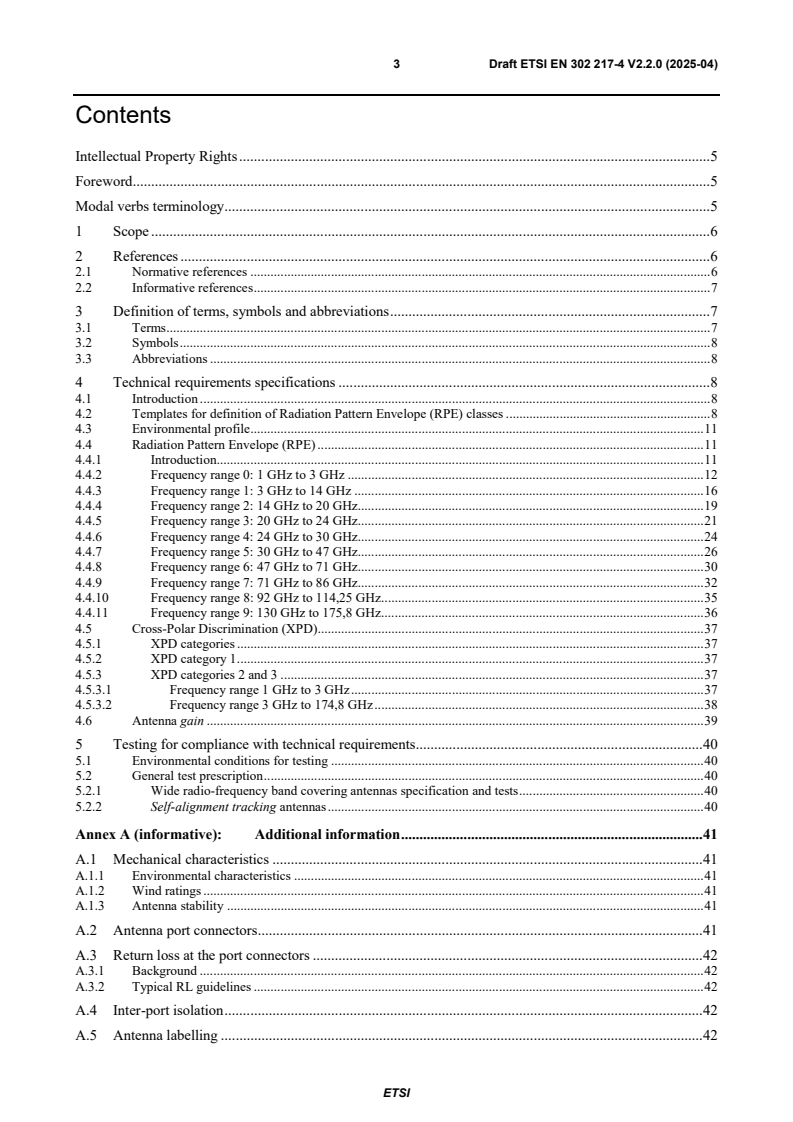
Contents
Intellectual Property Rights . 5
Foreword . 5
Modal verbs terminology . 5
1 Scope . 6
2 References . 6
2.1 Normative references . 6
2.2 Informative references . 7
3 Definition of terms, symbols and abbreviations . 7
3.1 Terms . 7
3.2 Symbols . 8
3.3 Abbreviations . 8
4 Technical requirements specifications . 8
4.1 Introduction . 8
4.2 Templates for definition of Radiation Pattern Envelope (RPE) classes . 8
4.3 Environmental profile . 11
4.4 Radiation Pattern Envelope (RPE) . 11
4.4.1 Introduction. 11
4.4.2 Frequency range 0: 1 GHz to 3 GHz . 12
4.4.3 Frequency range 1: 3 GHz to 14 GHz . 16
4.4.4 Frequency range 2: 14 GHz to 20 GHz . 19
4.4.5 Frequency range 3: 20 GHz to 24 GHz . 21
4.4.6 Frequency range 4: 24 GHz to 30 GHz . 24
4.4.7 Frequency range 5: 30 GHz to 47 GHz . 26
4.4.8 Frequency range 6: 47 GHz to 71 GHz . 30
4.4.9 Frequency range 7: 71 GHz to 86 GHz . 32
4.4.10 Frequency range 8: 92 GHz to 114,25 GHz . 35
4.4.11 Frequency range 9: 130 GHz to 175,8 GHz . 36
4.5 Cross-Polar Discrimination (XPD) . 37
4.5.1 XPD categories . 37
4.5.2 XPD category 1 . 37
4.5.3 XPD categories 2 and 3 . 37
4.5.3.1 Frequency range 1 GHz to 3 GHz . 37
4.5.3.2 Frequency range 3 GHz to 174,8 GHz . 38
4.6 Antenna gain . 39
5 Testing for compliance with technical requirements . 40
5.1 Environmental conditions for testing . 40
5.2 General test prescription . 40
5.2.1 Wide radio-frequency band covering antennas specification and tests . 40
5.2.2 Self-alignment tracking antennas . 40
Annex A (informative): Additional information . 41
A.1 Mechanical characteristics . 41
A.1.1 Environmental characteristics . 41
A.1.2 Wind ratings . 41
A.1.3 Antenna stability . 41
A.2 Antenna port connectors . 41
A.3 Return loss at the port connectors . 42
A.3.1 Background . 42
A.3.2 Typical RL guidelines . 42
A.4 Inter-port isolation . 42
A.5 Antenna labelling . 42
ETSI
4 Draft ETSI EN 302 217-4 V2.2.0 (2025-04)
Annex B (informative): Antenna gain and radiation pattern information . 43
B.1 Impact of antenna gain on the frequency planning . 43
B.2 Typical Gain and Radiation Pattern for circular-symmetric antennas . 43
B.2.1 Introduction . 43
B.2.2 Gain . 44
B.2.3 Radiation pattern . 44
Annex C (informative): Change history . 45
History . 46
ETSI
5 Draft ETSI EN 302 217-4 V2.2.0 (2025-04)
Intellectual Property Rights
Essential patents
IPRs essential or potentially essential to normative deliverables may have been declared to ETSI. The declarations
pertaining to these essential IPRs, if any, are publicly available for ETSI members and non-members, and can be
found in ETSI SR 000 314: "Intellectual Property Rights (IPRs); Essential, or potentially Essential, IPRs notified to
ETSI in respect of ETSI standards", which is available from the ETSI Secretariat. Latest updates are available on the
ETSI IPR online database.
Pursuant to the ETSI Directives including the ETSI IPR Policy, no investigation regarding the essentiality of IPRs,
including IPR searches, has been carried out by ETSI. No guarantee can be given as to the existence of other IPRs not
referenced in ETSI SR 000 314 (or the updates on the ETSI Web server) which are, or may be, or may become,
essential to the present document.
Trademarks
The present document may include trademarks and/or tradenames which are asserted and/or registered by their owners.
ETSI claims no ownership of these except for any which are indicated as being the property of ETSI, and conveys no
right to use or reproduce any trademark and/or tradename. Mention of those trademarks in the present document does
not constitute an endorsement by ETSI of products, services or organizations associated with those trademarks.
DECT™, PLUGTESTS™, UMTS™ and the ETSI logo are trademarks of ETSI registered for the benefit of its
Members. 3GPP™, LTE™ and 5G™ logo are trademarks of ETSI registered for the benefit of its Members and of the
3GPP Organizational Partners. oneM2M™ logo is a trademark of ETSI registered for the benefit of its Members and of ®
the oneM2M Partners. GSM and the GSM logo are trademarks registered and owned by the GSM Association.
Foreword
This draft European Standard (EN) has been produced by ETSI Technical Committee Access, Terminals, Transmission
and Multiplexing (ATTM), and is now submitted for the combined Public Enquiry and Vote phase of the ETSI EN
Approval Procedure.
The present document is part 4 of a multi-part deliverable covering the Fixed Radio Systems; Characteristics and
requirements for point-to-point equipment and antennas. Full details of the entire series can be found in ETSI
EN 302 217-1 [2].
Proposed national transposition dates
Date of latest announcement of this EN (doa): 3 months after ETSI publication
Date of latest publication of new National Standard
or endorsement of this EN (dop/e): 6 months after doa
Date of withdrawal of any conflicting National Standard (dow): 6 months after doa
Modal verbs terminology
In the present document "shall", "shall not", "should", "should not", "may", "need not", "will", "will not", "can" and
"cannot" are to be interpreted as described in clause 3.2 of the ETSI Drafting Rules (Verbal forms for the expression of
provisions).
"must" and "must not" are NOT allowed in ETSI deliverables except when used in direct citation.
ETSI
6 Draft ETSI EN 302 217-4 V2.2.0 (2025-04)
1 Scope
The present document defines the characteristics and requirements of antennas for point-to-point radio equipment
operating in the frequency range from 1 GHz to 174,8 GHz falling within the scope (see note) of ETSI
EN 302 217-2 [i.2].
For technical commonalities that range is here divided into sub-ranges as follows:
Range 0: 1 GHz to 3 GHz;
Range 1: 3 GHz to 14 GHz;
Range 2: 14 GHz to 20 GHz;
Range 3: 20 GHz to 24 GHz;
Range 4: 24 GHz to 30 GHz;
Range 5: 30 GHz to 47 GHz;
Range 6: 47 GHz to 71 GHz;
Range 7: 71 GHz to 86 GHz;
Range 8: 92 GHz to 114,25 GHz;
Range 9: 130 GHz to 174,8 GHz.
The present document is applicable to fixed radio equipment with integral (see note) or dedicated antennas.
NOTE: For information, ETSI EN 302 217-2 [i.2] includes in its scope only the use of detachable integral
antennas; undetachable integral antennas are not considered due to the present lack of radiated test
procedures for the radio equipment parameters.
The present document also applies to stand-alone antennas, placed separately on the market. In this case the present
document is to be used by radio equipment manufacturers to provide guidance as to the information for the user, as
required by article 10 paragraph 8 of Directive 2014/53/EU [i.1], regarding the antenna characteristics required so as the
radio equipment, supplied without antenna, can operate as intended in its technical documentation.
The present document is applicable to fixed beam antennas, as well as to "self-alignment tracking" antenna, with limited
tracking range, so that all requirements in the present document are respected throughout the tracking angle indicated in
the technical documentation.
The main body of the present document specifies the characteristics that define the various antenna classes, whilst the
annexes provide additional information that is useful to both antenna manufacturers and user/installers.
2 References
2.1 Normative references
References are either specific (identified by date of publication and/or edition number or version number) or
non-specific. For specific references, only the cited version applies. For non-specific references, the latest version of the
referenced document (including any amendments) applies.
Referenced documents which are not found to be publicly available in the expected location might be found in the
ETSI docbox.
NOTE: While any hyperlinks included in this clause were valid at the time of publication, ETSI cannot guarantee
their long term validity.
ETSI
7 Draft ETSI EN 302 217-4 V2.2.0 (2025-04)
The following referenced documents are necessary for the application of the present document.
[1] ETSI EN 301 126-3-1 (V1.1.2): "Fixed Radio Systems; Conformance testing; Part 3-1:
Point-to-Point antennas; Definitions, general requirements and test procedures".
[2] ETSI EN 302 217-1 (V3.4.0): "Fixed Radio Systems; Characteristics and requirements for
point-to-point equipment and antennas; Part 1: Overview, common characteristics and
requirements not related to access to radio spectrum".
[3] IEC 60154-1: "Flanges for waveguides - Part 1: General requirements".
[4] IEC 60154-2: "Flanges for waveguides - Part 2: Relevant specifications for flanges for ordinary
rectangular waveguides".
[5] IEC 60169-1: "Radio-frequency connectors - Part 1: General requirements and measuring
methods".
2.2 Informative references
References are either specific (identified by date of publication and/or edition number or version number) or
non-specific. For specific references, only the cited version applies. For non-specific references, the latest version of the
referenced document (including any amendments) applies.
NOTE: While any hyperlinks included in this clause were valid at the time of publication, ETSI cannot guarantee
their long term validity.
The following referenced documents are not necessary for the application of the present document but they assist the
user with regard to a particular subject area.
[i.1] Directive 2014/53/EU of the European Parliament and of the Council of 16 April 2014 on the
harmonisation of the laws of the Member States relating to the making available on the market of
radio equipment and repealing Directive 1999/5/EC.
[i.2] ETSI EN 302 217-2 (V3.4.1): "Fixed Radio Systems; Characteristics and requirements for
point-to-point equipment and antennas; Part 2: Digital systems operating in frequency bands from
1 GHz to 174,8 GHz; Harmonised Standard for access to radio spectrum".
[i.3] Recommendation ITU-R F.699: "Reference radiation patterns for fixed wireless system antennas
for use in coordination studies and interference assessment in the frequency range from 100 MHz
to about 86 GHz".
[i.4] Recommendation ITU-R F.1245: "Mathematical model of average and related radiation patterns
for point-to-point fixed wireless system antennas for use in interference assessment in the
frequency range from 1 GHz to 86 GHz".
3 Definition of terms, symbols and abbreviations
3.1 Terms
For the purposes of the present document, the terms given in ETSI EN 302 217-1 [2] apply.
In the present document those "terms", when used, are given in "italic" font.
3.2 Symbols
For the purposes of the present document, the symbols given in ETSI EN 302 217-1 [2] apply.
ETSI
8 Draft ETSI EN 302 217-4 V2.2.0 (2025-04)
3.3 Abbreviations
For the purposes of the present document, the abbreviations given in ETSI EN 302 217-1 [2] apply.
4 Technical requirements specifications
4.1 Introduction
The electrical characteristics are given as function of specific classification of the antennas according to the principles
referred to in clause 4.2.
The antenna manufacturer shall indicate (e.g. in the technical documentation or other public documentation), for each
antenna type, the operating frequency band, the antenna nominal gain and its maximum deviation over the operating
frequency band (alternatively, at least the gain at the frequency band edges and at mid-band).
An antenna, which employs a radome, shall meet the requirements of the present document with the radome in place.
Self-alignment tracking antennas, shall meet all requirements in the present document throughout their tracking angle
indicated in the technical documentation.
The antenna system shall radiate a linear (single or dual) polarized wave.
4.2 Templates for definition of Radiation Pattern Envelope
(RPE) classes
The RPE directional characteristic (co-polar and cross-polar) impacts the interference situation in the network planning
and a trade-off between a highly demanding RPE and the cost/size/weight of the antennas, compatible with the
constraints given by present and future networks is then advisable.
With respect to the Radiation Pattern Envelope (RPE), four classes (RPE classes 1 to 4) have been identified according
to the "limit templates"; a "limit template" is intended as the maximum co-polar gain that any actual RPE mask of that
class (referred in clauses 4.4.2 to 4.4.11) should not exceed, in the significant range of off-axis azimuth angles, for
being considered within a class. The templates for subdivision in those classes are also depending on given frequency
ranges of operation according to figures 1 to 4 and table 1.
When more than one actual standardized RPE falls within the same class template, a sub-class indicative (A, B, C, etc.)
shall be used according to their more demanding RPE limit in angles closer to the intended direction.
NOTE: Figures 1 to 4 report limit templates for any actual RPE mask of classes 2, 3 and 4 antennas; class 1
antennas are defined as those which actual RPE mask exceeds class 2 limit template.
ETSI
9 Draft ETSI EN 302 217-4 V2.2.0 (2025-04)
5 Class 2
Class 3
Class 4
-5
-10
-15
-20
-25
-30
-35
0 1020304050 60708090 100 110 120 130 140 150 160 170 180
Angle of azimuth relative to main beam axis (degrees)
Figure 1: Co-polar limit templates for actual RPE masks of antenna classes
in the range 1 GHz to 3 GHz (see table 1)
5 Class 2
0 Class 3
-5 Class 4
-10
-15
-20
-25
-30
-35
0 10 20 30 40 50 60 70 80 90 100 110 120 130 140 150 160 170 180
Angle of azimuth relative to main beam axis (degrees)
Figure 2: Co-polar limit templates for actual RPE masks of antenna classes
in the range 3 GHz to 30 GHz (see table 1)
ETSI
Maximum Gain (dBi) Maximum Gain (dBi)
10 Draft ETSI EN 302 217-4 V2.2.0 (2025-04)
5 Class 2
Class 3
Class 4
-5
-10
-15
-20
-25
-30
-35
0 10 203040 5060708090 100 110 120 130 140 150 160 170 180
Angle of azimuth relative to main beam axis (degrees)
Figure 3: Co-polar limit templates for actual RPE masks of antenna classes
in the range 30 GHz to 71 GHz (see table 1)
5 Class 2
0 Class 3
Class 4
-5
-10
-15
-20
-25
-30
-35
0 10 203040 5060708090 100 110 120 130 140 150 160 170 180
Angle of azimuth relative to main beam axis (degrees)
Figure 4: Co-polar limit templates for actual RPE masks of antenna classes
in the range 71 GHz to 174,8 GHz (see table 1)
ETSI
Maximum Gain (dBi) Maximum Gain (dBi)
11 Draft ETSI EN 302 217-4 V2.2.0 (2025-04)
Table 1: Corner points of co-polar limits for actual RPE templates (see figures 1, 2, 3 and 4)
RPE Co-polar maximum limit templates for actual RPEs
classes
Range 1 GHz to 3 GHz Range 30 GHz to 71 GHz Range 71 GHz to
Range 3 GHz to 30 GHz
(see (see note 2) (see note 3) 174,8 GHz
note 1)
Azimuth Maximum Azimuth Maximum Azimuth Maximum Azimuth Maximum
angle (°) gain (dBi) angle (°) gain (dBi) angle (°) gain (dBi) angle (°) gain (dBi)
40 5 20 12 20 12 20 7
90 5 80 2 70 0 40 2
120 -10 105 -18 90 -17 70 -2
2 180 -10 180 -18 180 -17 88,75 -7
100 -7
100 -10
180 -10
30 3 20 8 20 1 20 1
80 2 65 -2 50 -1 50 -1
3 110 -15 100 -22 70 -4 70 -4
180 -15 180 -22 90 -17 90 -17
180 -17 180 -17
25 0 20 -4 20 -4 20 -4
75 -5 105 -30 90 -21 90 -21
105 -20 180 -30 180 -21 180 -21
180 -20
NOTE 1: Class 1 antennas are defined as those which actual RPE exceeds class 2 template limit.
NOTE 2: No specific class 4 antenna RPE is defined for this frequency range; the corresponding limit template in table 1 is
set for possible future use.
NOTE 3: No specific class 4 antenna RPE is defined for the frequency range 47 GHz to 71 GHz; the corresponding limit
template in table 1 is set for possible future use.
4.3 Environmental profile
For stand-alone antennas, the required environmental profile for operation of the antenna shall be indicated by the
manufacturer in its technical characteristics; in all cases, including integral or dedicated antennas the environmental
profile shall be equal or more demanding than that of the outdoor part of associated equipment, as required by
clause 5.1.1.3 of ETSI EN 302 217-2 [i.2]. The antenna shall comply with all the technical requirements of the present
document at all times when operating within the boundary limits of the declared operational environmental profile. For
testing the compliance to technical requirements refer also to clause 5 in the present document.
4.4 Radiation Pattern Envelope (RPE)
4.4.1 Introduction
The present document defines all currently available Antenna RPE classes; both co-polar and cross-polar RPE are
described (see note). An overview of which is given in table 2.
Table 2: Summary of RPE classes represented in the present document
Frequency range Antenna Radiation Pattern
(GHz) Envelope (RPE) classes
1 to 3 1A, 1B, 1C, 2, 3
3 to 14 1, 2, 3, 4
14 to 20 1, 2, 3, 4
20 to 24 1, 2, 3, 4
24 to 30 1, 2, 3, 4
30 to 47 1, 2, 3A, 3B, 3C, 4
47 to 71 1, 2, 3A, 3B
71 to 86 1, 2, 3, 4
92 to 114,25 2, 3, 4
130 to 174,8 2, 3, 4
ETSI
12 Draft ETSI EN 302 217-4 V2.2.0 (2025-04)
NOTE: For information, antenna matching certain co-polar RPE class, may offer a cross-polar RPE of higher
class (e.g. co-polar class 3 with cross-polar class 4).
4.4.2 Frequency range 0: 1 GHz to 3 GHz
The choice of antenna depends on the application planned for this band, requirements of the operators and the
responsible administration. Figures 5 to 10 give the RPEs for antenna classes 1, 2 and 3.
-10
-20
-30
0 20 40 60 80 100 120 140 160 180
Angle of azimuth relative to main beam axis (degrees)
Co-polar (dBi) Cross-polar (dBi)
Angle (°) Co-polar (dBi) Angle (°) Cross-polar (dBi)
20 16 20 0
50 6 30 0
100 6 50 -6
140 -5 180 -6
180 -5
Figure 5: Class 1A antenna RPE (1 GHz to 3 GHz)
ETSI
Maximum Gain (dBi)
13 Draft ETSI EN 302 217-4 V2.2.0 (2025-04)
-10
-10
-20
-20
-30
-30
0 20 40 60 80 100 120 140 160 180
0 20 40 60 80 100 120 140 160 180
Angle of azimuth relative to main beam axis (degrees)
Angle of azimuth relative to main beam axis (degrees)
Co-polar (dBi) Cross-polar (dBi)
Co-polar (dBi) Cross-polar (dBi)
Azimuth angle (°) Co-polar (dBi) Azimuth angle (°) Cross-polar (dBi)
Angle (°) Co-polar (dBi) Angle (°) Cross-polar (dBi)
20 12 20 0
15 20 20 0
40 4 30 0
40 6 30 0
110 -7 100 -10
100 6 50 -6
180 -7 180 -10
140 -5 180 -6
180 -5
Figure 7: Class 1C antenna RPE (1 GHz to 3 GHz, azimuth plane)
Figure 6: Class 1B antenna RPE (1 GHz to 3 GHz)
ETSI
Maximum Gain (dBi)
Maximum Gain (dBi)
14 Draft ETSI EN 302 217-4 V2.2.0 (2025-04)
30 30
20 20
0 0
-10 -10
-20
-20
-30
-30
0 10 2030 405060 708090 0 20 40 60 80 100 120 140 160 180
Angle of azimuth relative to main beam axis (degrees)
Angle of azimuth relative to main beam axis (degrees)
Co-polar (dBi) Cross-polar (dBi)
Elevation angle (°) dBi
20 15
Angle (°) Co-polar (dBi) Angle (°) Cross-polar (dBi)
60 1
20 12 20 0
90 -4
40 4 30 0
90 4 100 -15
Figure 8: Class 1C antennas RPE (1 GHz to 3 GHz, elevation plane)
120 -12 180 -15
180 -12
Figure 9: Class 2 antenna RPE (1 GHz to 3 GHz)
ETSI
Maximum Gain (dBi)
Maximum Gain (dBi)
15 Draft ETSI EN 302 217-4 V2.2.0 (2025-04)
-10
-20
-30
0 20 40 60 80 100 120 140 160 180
Angle of azimuth relative to main beam axis (degrees)
Co-polar (dBi) Cross-polar (dBi)
Angle (°) Co-polar (dBi) Angle (°) Cross-polar (dBi)
10 18 20 0
30 3 30 0
80 2 100 -20
110 -18 180 -20
180 -18
Figure 10: Class 3 antenna RPE (1 GHz to 3 GHz)
ETSI
Maximum Gain (dBi)
16 Draft ETSI EN 302 217-4 V2.2.0 (2025-04)
4.4.3 Frequency range 1: 3 GHz to 14 GHz
The choice of antenna depends on the application planned for this band, requirements of the operators and the
responsible administration. Figures 11 to 14 give the RPEs for antenna classes 1, 2, 3 and 4.
-10
-20
0 20 40 60 80 100 120 140 160 180
Angle of azimuth relative to main beam axis (degrees)
Co‑ polar (dBi) Cross‑ polar (dBi)
Angle (°) Co-polar (dBi) Angle (°) Cross-polar (dBi)
5 26 5 10
10 20 8 7
20 12 15 5
50 5 30 -2
110 5 70 -2
140 -8 100 -5
170 -8 120 -8
170 -6 180 -8
180 -6
Figure 11: Class 1 antennas RPE (3 GHz to 14 GHz)
ETSI
Maximum Gain (dBi)
17 Draft ETSI EN 302 217-4 V2.2.0 (2025-04)
-10
-20
-30
0 20 40 60 80 100 120 140 160 180
Angle of azimuth relative to main beam axis (degrees)
Co polar (dBi) Cross polar (dBi)
‑ ‑
Angle (°) Co-polar (dBi) Angle (°) Cross-polar (dBi)
5 26 5 10
10 20 10 5
20 12 15 5
50 5 30 -3
65 2 70 -3
80 2 100 -20
105 -20 180 -20
180 -20
Figure 12: Class 2 antennas RPE (3 GHz to 14 GHz)
ETSI
Gain (dBi)
18 Draft ETSI EN 302 217-4 V2.2.0 (2025-04)
-10
-10
-20
-20
-30
-30
-40
-40
0 20406080 100 120 140 160 180
0 20406080 100 120 140 160 180
Angle of azimuth relative to main beam axis (degrees)
Angle of azimuth relative to main beam axis (degrees)
Co polar (dBi) Cross polar (dBi)
Co polar (dBi) Cross polar (dBi) ‑ ‑
‑ ‑
Angle (°) Co-polar (dBi) Angle (°) Cross-polar (dBi)
Angle (°) Co-polar (dBi) Angle (°) Cross-polar (dBi)
5 16 5 5
5 20 5 5
10 5 10 0
20 8 10 0
20 -7 13 -5
70 -5 13 -5
50 -18 20 -15
100 -25 20 -5
70 -20 30 -20
180 -25 40 -6
85 -24 40 -24
50 -10
105 -30 45 -24
75 -15
180 -30 70 -25
95 -25
85 -25
180 -25
105 -33
180 -33
Figure 13: Class 3 antennas RPE (3 GHz to 14 GHz)
Figure 14: Class 4 antennas RPE (3 GHz to 14 GHz)
ETSI
Gain (dBi)
Gain (dBi)
19 Draft ETSI EN 302 217-4 V2.2.0 (2025-04)
4.4.4 Frequency range 2: 14 GHz to 20 GHz
The choice of antenna depends on the application planned for this band, requirements of the operators and the
responsible administration. Figures 15 to 18 give the RPEs for antenna classes 1, 2, 3 and 4.
-10
-20
0 20 40 60 80 100 120 140 160 180
Angle of azimuth relative to main beam axis (degrees)
Co‑ polar (dBi) Cross‑ polar (dBi)
Angle Co-polar Angle Cross-polar
(°) (dBi) (°) (dBi)
5 25 5 10
15 15 15 3
25 10 20 3
110 4 30
...
EUROPEAN STANDARD
Fixed Radio Systems;
Characteristics and requirements
for point-to-point equipment and antennas;
Part 4: Antennas
2 ETSI EN 302 217-4 V2.2.1 (2025-07)
Reference
REN/ATTM-0456
Keywords
antenna, DFRS, DRRS, FWS, point-to-point, radio,
regulation, transmission
ETSI
650 Route des Lucioles
F-06921 Sophia Antipolis Cedex - FRANCE
Tel.: +33 4 92 94 42 00 Fax: +33 4 93 65 47 16
Siret N° 348 623 562 00017 - APE 7112B
Association à but non lucratif enregistrée à la
Sous-Préfecture de Grasse (06) N° w061004871
Important notice
The present document can be downloaded from the
ETSI Search & Browse Standards application.
The present document may be made available in electronic versions and/or in print. The content of any electronic and/or
print versions of the present document shall not be modified without the prior written authorization of ETSI. In case of any
existing or perceived difference in contents between such versions and/or in print, the prevailing version of an ETSI
deliverable is the one made publicly available in PDF format on ETSI deliver repository.
Users should be aware that the present document may be revised or have its status changed,
this information is available in the Milestones listing.
If you find errors in the present document, please send your comments to
the relevant service listed under Committee Support Staff.
If you find a security vulnerability in the present document, please report it through our
Coordinated Vulnerability Disclosure (CVD) program.
Notice of disclaimer & limitation of liability
The information provided in the present deliverable is directed solely to professionals who have the appropriate degree of
experience to understand and interpret its content in accordance with generally accepted engineering or
other professional standard and applicable regulations.
No recommendation as to products and services or vendors is made or should be implied.
In no event shall ETSI be held liable for loss of profits or any other incidental or consequential damages.
Any software contained in this deliverable is provided "AS IS" with no warranties, express or implied, including but not
limited to, the warranties of merchantability, fitness for a particular purpose and non-infringement of intellectual property
rights and ETSI shall not be held liable in any event for any damages whatsoever (including, without limitation, damages
for loss of profits, business interruption, loss of information, or any other pecuniary loss) arising out of or related to the use
of or inability to use the software.
Copyright Notification
No part may be reproduced or utilized in any form or by any means, electronic or mechanical, including photocopying and
microfilm except as authorized by written permission of ETSI.
The content of the PDF version shall not be modified without the written authorization of ETSI.
The copyright and the foregoing restriction extend to reproduction in all media.
© ETSI 2025.
All rights reserved.
ETSI
3 ETSI EN 302 217-4 V2.2.1 (2025-07)
Contents
Intellectual Property Rights . 5
Foreword . 5
Modal verbs terminology . 5
1 Scope . 6
2 References . 6
2.1 Normative references . 6
2.2 Informative references . 7
3 Definition of terms, symbols and abbreviations . 7
3.1 Terms . 7
3.2 Symbols . 7
3.3 Abbreviations . 8
4 Technical requirements specifications . 8
4.1 Introduction . 8
4.2 Templates for definition of Radiation Pattern Envelope (RPE) classes . 8
4.3 Environmental profile . 11
4.4 Radiation Pattern Envelope (RPE) . 11
4.4.1 Introduction. 11
4.4.2 Frequency range 0: 1 GHz to 3 GHz . 12
4.4.3 Frequency range 1: 3 GHz to 14 GHz . 16
4.4.4 Frequency range 2: 14 GHz to 20 GHz . 19
4.4.5 Frequency range 3: 20 GHz to 24 GHz . 21
4.4.6 Frequency range 4: 24 GHz to 30 GHz . 24
4.4.7 Frequency range 5: 30 GHz to 47 GHz . 26
4.4.8 Frequency range 6: 47 GHz to 71 GHz . 30
4.4.9 Frequency range 7: 71 GHz to 86 GHz . 32
4.4.10 Frequency range 8: 92 GHz to 114,25 GHz . 35
4.4.11 Frequency range 9: 130 GHz to 175,8 GHz . 36
4.5 Cross-Polar Discrimination (XPD) . 37
4.5.1 XPD categories . 37
4.5.2 XPD category 1 . 37
4.5.3 XPD categories 2 and 3 . 37
4.5.3.1 Frequency range 1 GHz to 3 GHz . 37
4.5.3.2 Frequency range 3 GHz to 174,8 GHz . 38
4.6 Antenna gain . 39
5 Testing for compliance with technical requirements . 40
5.1 Environmental conditions for testing . 40
5.2 General test prescription . 40
5.2.1 Wide radio-frequency band covering antennas specification and tests . 40
5.2.2 Self-alignment tracking antennas . 40
Annex A (informative): Additional information . 41
A.1 Mechanical characteristics . 41
A.1.1 Environmental characteristics . 41
A.1.2 Wind ratings . 41
A.1.3 Antenna stability . 41
A.2 Antenna port connectors . 41
A.3 Return loss at the port connectors . 42
A.3.1 Background . 42
A.3.2 Typical RL guidelines . 42
A.4 Inter-port isolation . 42
A.5 Antenna labelling . 42
ETSI
4 ETSI EN 302 217-4 V2.2.1 (2025-07)
Annex B (informative): Antenna gain and radiation pattern information . 43
B.1 Impact of antenna gain on the frequency planning . 43
B.2 Typical Gain and Radiation Pattern for circular-symmetric antennas . 43
B.2.1 Introduction . 43
B.2.2 Gain . 44
B.2.3 Radiation pattern . 44
Annex C (informative): Change history . 45
History . 46
ETSI
5 ETSI EN 302 217-4 V2.2.1 (2025-07)
Intellectual Property Rights
Essential patents
IPRs essential or potentially essential to normative deliverables may have been declared to ETSI. The declarations
pertaining to these essential IPRs, if any, are publicly available for ETSI members and non-members, and can be
found in ETSI SR 000 314: "Intellectual Property Rights (IPRs); Essential, or potentially Essential, IPRs notified to
ETSI in respect of ETSI standards", which is available from the ETSI Secretariat. Latest updates are available on the
ETSI IPR online database.
Pursuant to the ETSI Directives including the ETSI IPR Policy, no investigation regarding the essentiality of IPRs,
including IPR searches, has been carried out by ETSI. No guarantee can be given as to the existence of other IPRs not
referenced in ETSI SR 000 314 (or the updates on the ETSI Web server) which are, or may be, or may become,
essential to the present document.
Trademarks
The present document may include trademarks and/or tradenames which are asserted and/or registered by their owners.
ETSI claims no ownership of these except for any which are indicated as being the property of ETSI, and conveys no
right to use or reproduce any trademark and/or tradename. Mention of those trademarks in the present document does
not constitute an endorsement by ETSI of products, services or organizations associated with those trademarks.
DECT™, PLUGTESTS™, UMTS™ and the ETSI logo are trademarks of ETSI registered for the benefit of its
Members. 3GPP™, LTE™ and 5G™ logo are trademarks of ETSI registered for the benefit of its Members and of the
3GPP Organizational Partners. oneM2M™ logo is a trademark of ETSI registered for the benefit of its Members and of ®
the oneM2M Partners. GSM and the GSM logo are trademarks registered and owned by the GSM Association.
Foreword
This European Standard (EN) has been produced by ETSI Technical Committee Access, Terminals, Transmission and
Multiplexing (ATTM).
The present document is part 4 of a multi-part deliverable covering the Fixed Radio Systems; Characteristics and
requirements for point-to-point equipment and antennas. Full details of the entire series can be found in part 1 [2].
National transposition dates
Date of adoption of this EN: 2 July 2025
Date of latest announcement of this EN (doa): 31 October 2025
Date of latest publication of new National Standard
or endorsement of this EN (dop/e): 30 April 2026
Date of withdrawal of any conflicting National Standard (dow): 30 April 2026
Modal verbs terminology
In the present document "shall", "shall not", "should", "should not", "may", "need not", "will", "will not", "can" and
"cannot" are to be interpreted as described in clause 3.2 of the ETSI Drafting Rules (Verbal forms for the expression of
provisions).
"must" and "must not" are NOT allowed in ETSI deliverables except when used in direct citation.
ETSI
6 ETSI EN 302 217-4 V2.2.1 (2025-07)
1 Scope
The present document defines the characteristics and requirements of antennas for point-to-point radio equipment
operating in the frequency range from 1 GHz to 174,8 GHz falling within the scope (see note) of ETSI
EN 302 217-2 [i.2].
For technical commonalities that range is here divided into sub-ranges as follows:
Range 0: 1 GHz to 3 GHz;
Range 1: 3 GHz to 14 GHz;
Range 2: 14 GHz to 20 GHz;
Range 3: 20 GHz to 24 GHz;
Range 4: 24 GHz to 30 GHz;
Range 5: 30 GHz to 47 GHz;
Range 6: 47 GHz to 71 GHz;
Range 7: 71 GHz to 86 GHz;
Range 8: 92 GHz to 114,25 GHz;
Range 9: 130 GHz to 174,8 GHz.
The present document is applicable to fixed radio equipment with integral (see note) or dedicated antennas.
NOTE: For information, ETSI EN 302 217-2 [i.2] includes in its scope only the use of detachable integral
antennas; undetachable integral antennas are not considered due to the present lack of radiated test
procedures for the radio equipment parameters.
The present document also applies to stand-alone antennas, placed separately on the market. In this case the present
document is to be used by radio equipment manufacturers to provide guidance as to the information for the user, as
required by article 10 paragraph 8 of Directive 2014/53/EU [i.1], regarding the antenna characteristics required so as the
radio equipment, supplied without antenna, can operate as intended in its technical documentation.
The present document is applicable to fixed beam antennas, as well as to "self-alignment tracking" antenna, with limited
tracking range, so that all requirements in the present document are respected throughout the tracking angle indicated in
the technical documentation.
The main body of the present document specifies the characteristics that define the various antenna classes, whilst the
annexes provide additional information that is useful to both antenna manufacturers and user/installers.
2 References
2.1 Normative references
References are either specific (identified by date of publication and/or edition number or version number) or
non-specific. For specific references, only the cited version applies. For non-specific references, the latest version of the
referenced document (including any amendments) applies.
Referenced documents which are not found to be publicly available in the expected location might be found in the
ETSI docbox.
NOTE: While any hyperlinks included in this clause were valid at the time of publication, ETSI cannot guarantee
their long-term validity.
ETSI
7 ETSI EN 302 217-4 V2.2.1 (2025-07)
The following referenced documents are necessary for the application of the present document.
[1] ETSI EN 301 126-3-1 (V1.1.2): "Fixed Radio Systems; Conformance testing; Part 3-1:
Point-to-Point antennas; Definitions, general requirements and test procedures".
[2] ETSI EN 302 217-1 (V3.4.1): "Fixed Radio Systems; Characteristics and requirements for
point-to-point equipment and antennas; Part 1: Overview, common characteristics and
requirements not related to access to radio spectrum".
[3] IEC 60154-1: "Flanges for waveguides - Part 1: General requirements".
[4] IEC 60154-2: "Flanges for waveguides - Part 2: Relevant specifications for flanges for ordinary
rectangular waveguides".
[5] IEC 60169-1: "Radio-frequency connectors - Part 1: General requirements and measuring
methods".
2.2 Informative references
References are either specific (identified by date of publication and/or edition number or version number) or
non-specific. For specific references, only the cited version applies. For non-specific references, the latest version of the
referenced document (including any amendments) applies.
NOTE: While any hyperlinks included in this clause were valid at the time of publication, ETSI cannot guarantee
their long-term validity.
The following referenced documents may be useful in implementing an ETSI deliverable or add to the reader's
understanding, but are not required for conformance to the present document.
[i.1] Directive 2014/53/EU of the European Parliament and of the Council of 16 April 2014 on the
harmonisation of the laws of the Member States relating to the making available on the market of
radio equipment and repealing Directive 1999/5/EC.
[i.2] ETSI EN 302 217-2 (V3.4.1): "Fixed Radio Systems; Characteristics and requirements for
point-to-point equipment and antennas; Part 2: Digital systems operating in frequency bands from
1 GHz to 174,8 GHz; Harmonised Standard for access to radio spectrum".
[i.3] Recommendation ITU-R F.699: "Reference radiation patterns for fixed wireless system antennas
for use in coordination studies and interference assessment in the frequency range from 100 MHz
to about 86 GHz".
[i.4] Recommendation ITU-R F.1245: "Mathematical model of average and related radiation patterns
for point-to-point fixed wireless system antennas for use in interference assessment in the
frequency range from 1 GHz to 86 GHz".
3 Definition of terms, symbols and abbreviations
3.1 Terms
For the purposes of the present document, the terms given in ETSI EN 302 217-1 [2] apply.
In the present document those "terms", when used, are given in "italic" font.
3.2 Symbols
For the purposes of the present document, the symbols given in ETSI EN 302 217-1 [2] apply.
ETSI
8 ETSI EN 302 217-4 V2.2.1 (2025-07)
3.3 Abbreviations
For the purposes of the present document, the abbreviations given in ETSI EN 302 217-1 [2] apply.
4 Technical requirements specifications
4.1 Introduction
The electrical characteristics are given as function of specific classification of the antennas according to the principles
referred to in clause 4.2.
The antenna manufacturer shall indicate (e.g. in the technical documentation or other public documentation), for each
antenna type, the operating frequency band, the antenna nominal gain and its maximum deviation over the operating
frequency band (alternatively, at least the gain at the frequency band edges and at mid-band).
An antenna, which employs a radome, shall meet the requirements of the present document with the radome in place.
Self-alignment tracking antennas, shall meet all requirements in the present document throughout their tracking angle
indicated in the technical documentation.
The antenna system shall radiate a linear (single or dual) polarized wave.
4.2 Templates for definition of Radiation Pattern Envelope
(RPE) classes
The RPE directional characteristic (co-polar and cross-polar) impacts the interference situation in the network planning
and a trade-off between a highly demanding RPE and the cost/size/weight of the antennas, compatible with the
constraints given by present and future networks is then advisable.
With respect to the Radiation Pattern Envelope (RPE), four classes (RPE classes 1 to 4) have been identified according
to the "limit templates"; a "limit template" is intended as the maximum co-polar gain that any actual RPE mask of that
class (referred in clauses 4.4.2 to 4.4.11) should not exceed, in the significant range of off-axis azimuth angles, for
being considered within a class. The templates for subdivision in those classes are also depending on given frequency
ranges of operation according to figures 1 to 4 and table 1.
When more than one actual standardized RPE falls within the same class template, a sub-class indicative (A, B, C, etc.)
shall be used according to their more demanding RPE limit in angles closer to the intended direction.
NOTE: Figures 1 to 4 report limit templates for any actual RPE mask of classes 2, 3 and 4 antennas; class 1
antennas are defined as those which actual RPE mask exceeds class 2 limit template.
ETSI
9 ETSI EN 302 217-4 V2.2.1 (2025-07)
5 Class 2
Class 3
Class 4
-5
-10
-15
-20
-25
-30
-35
0 1020304050 60708090 100 110 120 130 140 150 160 170 180
Angle of azimuth relative to main beam axis (degrees)
Figure 1: Co-polar limit templates for actual RPE masks of antenna classes
in the range 1 GHz to 3 GHz (see table 1)
5 Class 2
0 Class 3
-5 Class 4
-10
-15
-20
-25
-30
-35
0 10 20 30 40 50 60 70 80 90 100 110 120 130 140 150 160 170 180
Angle of azimuth relative to main beam axis (degrees)
Figure 2: Co-polar limit templates for actual RPE masks of antenna classes
in the range 3 GHz to 30 GHz (see table 1)
ETSI
Maximum Gain (dBi) Maximum Gain (dBi)
10 ETSI EN 302 217-4 V2.2.1 (2025-07)
5 Class 2
Class 3
Class 4
-5
-10
-15
-20
-25
-30
-35
0 10 203040 5060708090 100 110 120 130 140 150 160 170 180
Angle of azimuth relative to main beam axis (degrees)
Figure 3: Co-polar limit templates for actual RPE masks of antenna classes
in the range 30 GHz to 71 GHz (see table 1)
5 Class 2
0 Class 3
Class 4
-5
-10
-15
-20
-25
-30
-35
0 10 203040 5060708090 100 110 120 130 140 150 160 170 180
Angle of azimuth relative to main beam axis (degrees)
Figure 4: Co-polar limit templates for actual RPE masks of antenna classes
in the range 71 GHz to 174,8 GHz (see table 1)
ETSI
Maximum Gain (dBi) Maximum Gain (dBi)
11 ETSI EN 302 217-4 V2.2.1 (2025-07)
Table 1: Corner points of co-polar limits for actual RPE templates (see figures 1, 2, 3 and 4)
RPE Co-polar maximum limit templates for actual RPEs
classes
Range 1 GHz to 3 GHz Range 30 GHz to 71 GHz Range 71 GHz to
Range 3 GHz to 30 GHz
(see (see note 2) (see note 3) 174,8 GHz
note 1)
Azimuth Maximum Azimuth Maximum Azimuth Maximum Azimuth Maximum
angle (°) gain (dBi) angle (°) gain (dBi) angle (°) gain (dBi) angle (°) gain (dBi)
40 5 20 12 20 12 20 7
90 5 80 2 70 0 40 2
120 -10 105 -18 90 -17 70 -2
2 180 -10 180 -18 180 -17 88,75 -7
100 -7
100 -10
180 -10
30 3 20 8 20 1 20 1
80 2 65 -2 50 -1 50 -1
3 110 -15 100 -22 70 -4 70 -4
180 -15 180 -22 90 -17 90 -17
180 -17 180 -17
25 0 20 -4 20 -4 20 -4
75 -5 105 -30 90 -21 90 -21
105 -20 180 -30 180 -21 180 -21
180 -20
NOTE 1: Class 1 antennas are defined as those which actual RPE exceeds class 2 template limit.
NOTE 2: No specific class 4 antenna RPE is defined for this frequency range; the corresponding limit template in table 1 is
set for possible future use.
NOTE 3: No specific class 4 antenna RPE is defined for the frequency range 47 GHz to 71 GHz; the corresponding limit
template in table 1 is set for possible future use.
4.3 Environmental profile
For stand-alone antennas, the required environmental profile for operation of the antenna shall be indicated by the
manufacturer in its technical characteristics; in all cases, including integral or dedicated antennas the environmental
profile shall be equal or more demanding than that of the outdoor part of associated equipment, as required by
clause 5.1.1.3 of ETSI EN 302 217-2 [i.2]. The antenna shall comply with all the technical requirements of the present
document at all times when operating within the boundary limits of the declared operational environmental profile. For
testing the compliance to technical requirements refer also to clause 5 in the present document.
4.4 Radiation Pattern Envelope (RPE)
4.4.1 Introduction
The present document defines all currently available Antenna RPE classes; both co-polar and cross-polar RPE are
described (see note). An overview of which is given in table 2.
Table 2: Summary of RPE classes represented in the present document
Frequency range Antenna Radiation Pattern
(GHz) Envelope (RPE) classes
1 to 3 1A, 1B, 1C, 2, 3
3 to 14 1, 2, 3, 4
14 to 20 1, 2, 3, 4
20 to 24 1, 2, 3, 4
24 to 30 1, 2, 3, 4
30 to 47 1, 2, 3A, 3B, 3C, 4
47 to 71 1, 2, 3A, 3B
71 to 86 1, 2, 3, 4
92 to 114,25 2, 3, 4
130 to 174,8 2, 3, 4
ETSI
12 ETSI EN 302 217-4 V2.2.1 (2025-07)
NOTE: For information, antenna matching certain co-polar RPE class, may offer a cross-polar RPE of higher
class (e.g. co-polar class 3 with cross-polar class 4).
4.4.2 Frequency range 0: 1 GHz to 3 GHz
The choice of antenna depends on the application planned for this band, requirements of the operators and the
responsible administration. Figures 5 to 10 give the RPEs for antenna classes 1, 2 and 3.
-10
-20
-30
0 20 40 60 80 100 120 140 160 180
Angle of azimuth relative to main beam axis (degrees)
Co-polar (dBi) Cross-polar (dBi)
Angle (°) Co-polar (dBi) Angle (°) Cross-polar (dBi)
20 16 20 0
50 6 30 0
100 6 50 -6
140 -5 180 -6
180 -5
Figure 5: Class 1A antenna RPE (1 GHz to 3 GHz)
ETSI
Maximum Gain (dBi)
13 ETSI EN 302 217-4 V2.2.1 (2025-07)
-10
-10
-20
-20
-30
-30
0 20 40 60 80 100 120 140 160 180
0 20 40 60 80 100 120 140 160 180
Angle of azimuth relative to main beam axis (degrees)
Angle of azimuth relative to main beam axis (degrees)
Co-polar (dBi) Cross-polar (dBi)
Co-polar (dBi) Cross-polar (dBi)
Azimuth angle (°) Co-polar (dBi) Azimuth angle (°) Cross-polar (dBi)
Angle (°) Co-polar (dBi) Angle (°) Cross-polar (dBi)
20 12 20 0
15 20 20 0
40 4 30 0
40 6 30 0
110 -7 100 -10
100 6 50 -6
180 -7 180 -10
140 -5 180 -6
180 -5
Figure 7: Class 1C antenna RPE (1 GHz to 3 GHz, azimuth plane)
Figure 6: Class 1B antenna RPE (1 GHz to 3 GHz)
ETSI
Maximum Gain (dBi)
Maximum Gain (dBi)
14 ETSI EN 302 217-4 V2.2.1 (2025-07)
30 30
20 20
0 0
-10 -10
-20
-20
-30
-30
0 10 2030 405060 708090 0 20 40 60 80 100 120 140 160 180
Angle of azimuth relative to main beam axis (degrees)
Angle of azimuth relative to main beam axis (degrees)
Co-polar (dBi) Cross-polar (dBi)
Elevation angle (°) dBi
20 15
Angle (°) Co-polar (dBi) Angle (°) Cross-polar (dBi)
60 1
20 12 20 0
90 -4
40 4 30 0
90 4 100 -15
Figure 8: Class 1C antennas RPE (1 GHz to 3 GHz, elevation plane)
120 -12 180 -15
180 -12
Figure 9: Class 2 antenna RPE (1 GHz to 3 GHz)
ETSI
Maximum Gain (dBi)
Maximum Gain (dBi)
15 ETSI EN 302 217-4 V2.2.1 (2025-07)
-10
-20
-30
0 20 40 60 80 100 120 140 160 180
Angle of azimuth relative to main beam axis (degrees)
Co-polar (dBi) Cross-polar (dBi)
Angle (°) Co-polar (dBi) Angle (°) Cross-polar (dBi)
10 18 20 0
30 3 30 0
80 2 100 -20
110 -18 180 -20
180 -18
Figure 10: Class 3 antenna RPE (1 GHz to 3 GHz)
ETSI
Maximum Gain (dBi)
16 ETSI EN 302 217-4 V2.2.1 (2025-07)
4.4.3 Frequency range 1: 3 GHz to 14 GHz
The choice of antenna depends on the application planned for this band, requirements of the operators and the
responsible administration. Figures 11 to 14 give the RPEs for antenna classes 1, 2, 3 and 4.
-10
-20
0 20 40 60 80 100 120 140 160 180
Angle of azimuth relative to main beam axis (degrees)
Co‑ polar (dBi) Cross‑ polar (dBi)
Angle (°) Co-polar (dBi) Angle (°) Cross-polar (dBi)
5 26 5 10
10 20 8 7
20 12 15 5
50 5 30 -2
110 5 70 -2
140 -8 100 -5
170 -8 120 -8
170 -6 180 -8
180 -6
Figure 11: Class 1 antennas RPE (3 GHz to 14 GHz)
ETSI
Maximum Gain (dBi)
17 ETSI EN 302 217-4 V2.2.1 (2025-07)
-10
-20
-30
0 20 40 60 80 100 120 140 160 180
Angle of azimuth relative to main beam axis (degrees)
Co polar (dBi) Cross polar (dBi)
‑ ‑
Angle (°) Co-polar (dBi) Angle (°) Cross-polar (dBi)
5 26 5 10
10 20 10 5
20 12 15 5
50 5 30 -3
65 2 70 -3
80 2 100 -20
105 -20 180 -20
180 -20
Figure 12: Class 2 antennas RPE (3 GHz to 14 GHz)
ETSI
Gain (dBi)
18 ETSI EN 302 217-4 V2.2.1 (2025-07)
-10
-10
-20
-20
-30
-30
-40
-40
0 20406080 100 120 140 160 180
0 20406080 100 120 140 160 180
Angle of azimuth relative to main beam axis (degrees)
Angle of azimuth relative to main beam axis (degrees)
Co polar (dBi) Cross polar (dBi)
Co polar (dBi) Cross polar (dBi) ‑ ‑
‑ ‑
Angle (°) Co-polar (dBi) Angle (°) Cross-polar (dBi)
Angle (°) Co-polar (dBi) Angle (°) Cross-polar (dBi)
5 16 5 5
5 20 5 5
10 5 10 0
20 8 10 0
20 -7 13 -5
70 -5 13 -5
50 -18 20 -15
100 -25 20 -5
70 -20 30 -20
180 -25 40 -6
85 -24 40 -24
50 -10
105 -30 45 -24
75 -15
180 -30 70 -25
95 -25
85 -25
180 -25
105 -33
180 -33
Figure 13: Class 3 antennas RPE (3 GHz to 14 GHz)
Figure 14: Class 4 antennas RPE (3 GHz to 14 GHz)
ETSI
Gain (dBi)
Gain (dBi)
19 ETSI EN 302 217-4 V2.2.1 (2025-07)
4.4.4 Frequency range 2: 14 GHz to 20 GHz
The choice of antenna depends on the application planned for this band, requirements of the operators and the
responsible administration. Figures 15 to 18 give the RPEs for antenna classes 1, 2, 3 and 4.
-10
-20
0 20 40 60 80 100 120 140 160 180
Angle of azimuth relative to main beam axis (degrees)
Co‑ polar (dBi) Cross‑ polar (dBi)
Angle Co-polar Angle Cross-polar
(°) (dBi) (°) (dBi)
5 25 5 10
15 15 15 3
25 10 20 3
110 4 30 0
140 -8 45 0
170 -8 55 -3
170 -6 90 -3
...
SLOVENSKI STANDARD
01-september-2025
Fiksni radijski sistemi - Karakteristike in zahteve za opremo in antene tipa točka-
točka - 4. del: Antene
Fixed Radio Systems - Characteristics and requirements for point-to-point equipment
and antennas - Part 4: Antennas
Ta slovenski standard je istoveten z: ETSI EN 302 217-4 V2.2.1 (2025-07)
ICS:
33.060.30 Radiorelejni in fiksni satelitski Radio relay and fixed satellite
komunikacijski sistemi communications systems
33.120.40 Antene Aerials
2003-01.Slovenski inštitut za standardizacijo. Razmnoževanje celote ali delov tega standarda ni dovoljeno.
EUROPEAN STANDARD
Fixed Radio Systems;
Characteristics and requirements
for point-to-point equipment and antennas;
Part 4: Antennas
2 ETSI EN 302 217-4 V2.2.1 (2025-07)
Reference
REN/ATTM-0456
Keywords
antenna, DFRS, DRRS, FWS, point-to-point, radio,
regulation, transmission
ETSI
650 Route des Lucioles
F-06921 Sophia Antipolis Cedex - FRANCE
Tel.: +33 4 92 94 42 00 Fax: +33 4 93 65 47 16
Siret N° 348 623 562 00017 - APE 7112B
Association à but non lucratif enregistrée à la
Sous-Préfecture de Grasse (06) N° w061004871
Important notice
The present document can be downloaded from the
ETSI Search & Browse Standards application.
The present document may be made available in electronic versions and/or in print. The content of any electronic and/or
print versions of the present document shall not be modified without the prior written authorization of ETSI. In case of any
existing or perceived difference in contents between such versions and/or in print, the prevailing version of an ETSI
deliverable is the one made publicly available in PDF format on ETSI deliver repository.
Users should be aware that the present document may be revised or have its status changed,
this information is available in the Milestones listing.
If you find errors in the present document, please send your comments to
the relevant service listed under Committee Support Staff.
If you find a security vulnerability in the present document, please report it through our
Coordinated Vulnerability Disclosure (CVD) program.
Notice of disclaimer & limitation of liability
The information provided in the present deliverable is directed solely to professionals who have the appropriate degree of
experience to understand and interpret its content in accordance with generally accepted engineering or
other professional standard and applicable regulations.
No recommendation as to products and services or vendors is made or should be implied.
In no event shall ETSI be held liable for loss of profits or any other incidental or consequential damages.
Any software contained in this deliverable is provided "AS IS" with no warranties, express or implied, including but not
limited to, the warranties of merchantability, fitness for a particular purpose and non-infringement of intellectual property
rights and ETSI shall not be held liable in any event for any damages whatsoever (including, without limitation, damages
for loss of profits, business interruption, loss of information, or any other pecuniary loss) arising out of or related to the use
of or inability to use the software.
Copyright Notification
No part may be reproduced or utilized in any form or by any means, electronic or mechanical, including photocopying and
microfilm except as authorized by written permission of ETSI.
The content of the PDF version shall not be modified without the written authorization of ETSI.
The copyright and the foregoing restriction extend to reproduction in all media.
© ETSI 2025.
All rights reserved.
ETSI
3 ETSI EN 302 217-4 V2.2.1 (2025-07)
Contents
Intellectual Property Rights . 5
Foreword . 5
Modal verbs terminology . 5
1 Scope . 6
2 References . 6
2.1 Normative references . 6
2.2 Informative references . 7
3 Definition of terms, symbols and abbreviations . 7
3.1 Terms . 7
3.2 Symbols . 7
3.3 Abbreviations . 8
4 Technical requirements specifications . 8
4.1 Introduction . 8
4.2 Templates for definition of Radiation Pattern Envelope (RPE) classes . 8
4.3 Environmental profile . 11
4.4 Radiation Pattern Envelope (RPE) . 11
4.4.1 Introduction. 11
4.4.2 Frequency range 0: 1 GHz to 3 GHz . 12
4.4.3 Frequency range 1: 3 GHz to 14 GHz . 16
4.4.4 Frequency range 2: 14 GHz to 20 GHz . 19
4.4.5 Frequency range 3: 20 GHz to 24 GHz . 21
4.4.6 Frequency range 4: 24 GHz to 30 GHz . 24
4.4.7 Frequency range 5: 30 GHz to 47 GHz . 26
4.4.8 Frequency range 6: 47 GHz to 71 GHz . 30
4.4.9 Frequency range 7: 71 GHz to 86 GHz . 32
4.4.10 Frequency range 8: 92 GHz to 114,25 GHz . 35
4.4.11 Frequency range 9: 130 GHz to 175,8 GHz . 36
4.5 Cross-Polar Discrimination (XPD) . 37
4.5.1 XPD categories . 37
4.5.2 XPD category 1 . 37
4.5.3 XPD categories 2 and 3 . 37
4.5.3.1 Frequency range 1 GHz to 3 GHz . 37
4.5.3.2 Frequency range 3 GHz to 174,8 GHz . 38
4.6 Antenna gain . 39
5 Testing for compliance with technical requirements . 40
5.1 Environmental conditions for testing . 40
5.2 General test prescription . 40
5.2.1 Wide radio-frequency band covering antennas specification and tests . 40
5.2.2 Self-alignment tracking antennas . 40
Annex A (informative): Additional information . 41
A.1 Mechanical characteristics . 41
A.1.1 Environmental characteristics . 41
A.1.2 Wind ratings . 41
A.1.3 Antenna stability . 41
A.2 Antenna port connectors . 41
A.3 Return loss at the port connectors . 42
A.3.1 Background . 42
A.3.2 Typical RL guidelines . 42
A.4 Inter-port isolation . 42
A.5 Antenna labelling . 42
ETSI
4 ETSI EN 302 217-4 V2.2.1 (2025-07)
Annex B (informative): Antenna gain and radiation pattern information . 43
B.1 Impact of antenna gain on the frequency planning . 43
B.2 Typical Gain and Radiation Pattern for circular-symmetric antennas . 43
B.2.1 Introduction . 43
B.2.2 Gain . 44
B.2.3 Radiation pattern . 44
Annex C (informative): Change history . 45
History . 46
ETSI
5 ETSI EN 302 217-4 V2.2.1 (2025-07)
Intellectual Property Rights
Essential patents
IPRs essential or potentially essential to normative deliverables may have been declared to ETSI. The declarations
pertaining to these essential IPRs, if any, are publicly available for ETSI members and non-members, and can be
found in ETSI SR 000 314: "Intellectual Property Rights (IPRs); Essential, or potentially Essential, IPRs notified to
ETSI in respect of ETSI standards", which is available from the ETSI Secretariat. Latest updates are available on the
ETSI IPR online database.
Pursuant to the ETSI Directives including the ETSI IPR Policy, no investigation regarding the essentiality of IPRs,
including IPR searches, has been carried out by ETSI. No guarantee can be given as to the existence of other IPRs not
referenced in ETSI SR 000 314 (or the updates on the ETSI Web server) which are, or may be, or may become,
essential to the present document.
Trademarks
The present document may include trademarks and/or tradenames which are asserted and/or registered by their owners.
ETSI claims no ownership of these except for any which are indicated as being the property of ETSI, and conveys no
right to use or reproduce any trademark and/or tradename. Mention of those trademarks in the present document does
not constitute an endorsement by ETSI of products, services or organizations associated with those trademarks.
DECT™, PLUGTESTS™, UMTS™ and the ETSI logo are trademarks of ETSI registered for the benefit of its
Members. 3GPP™, LTE™ and 5G™ logo are trademarks of ETSI registered for the benefit of its Members and of the
3GPP Organizational Partners. oneM2M™ logo is a trademark of ETSI registered for the benefit of its Members and of ®
the oneM2M Partners. GSM and the GSM logo are trademarks registered and owned by the GSM Association.
Foreword
This European Standard (EN) has been produced by ETSI Technical Committee Access, Terminals, Transmission and
Multiplexing (ATTM).
The present document is part 4 of a multi-part deliverable covering the Fixed Radio Systems; Characteristics and
requirements for point-to-point equipment and antennas. Full details of the entire series can be found in part 1 [2].
National transposition dates
Date of adoption of this EN: 2 July 2025
Date of latest announcement of this EN (doa): 31 October 2025
Date of latest publication of new National Standard
or endorsement of this EN (dop/e): 30 April 2026
Date of withdrawal of any conflicting National Standard (dow): 30 April 2026
Modal verbs terminology
In the present document "shall", "shall not", "should", "should not", "may", "need not", "will", "will not", "can" and
"cannot" are to be interpreted as described in clause 3.2 of the ETSI Drafting Rules (Verbal forms for the expression of
provisions).
"must" and "must not" are NOT allowed in ETSI deliverables except when used in direct citation.
ETSI
6 ETSI EN 302 217-4 V2.2.1 (2025-07)
1 Scope
The present document defines the characteristics and requirements of antennas for point-to-point radio equipment
operating in the frequency range from 1 GHz to 174,8 GHz falling within the scope (see note) of ETSI
EN 302 217-2 [i.2].
For technical commonalities that range is here divided into sub-ranges as follows:
Range 0: 1 GHz to 3 GHz;
Range 1: 3 GHz to 14 GHz;
Range 2: 14 GHz to 20 GHz;
Range 3: 20 GHz to 24 GHz;
Range 4: 24 GHz to 30 GHz;
Range 5: 30 GHz to 47 GHz;
Range 6: 47 GHz to 71 GHz;
Range 7: 71 GHz to 86 GHz;
Range 8: 92 GHz to 114,25 GHz;
Range 9: 130 GHz to 174,8 GHz.
The present document is applicable to fixed radio equipment with integral (see note) or dedicated antennas.
NOTE: For information, ETSI EN 302 217-2 [i.2] includes in its scope only the use of detachable integral
antennas; undetachable integral antennas are not considered due to the present lack of radiated test
procedures for the radio equipment parameters.
The present document also applies to stand-alone antennas, placed separately on the market. In this case the present
document is to be used by radio equipment manufacturers to provide guidance as to the information for the user, as
required by article 10 paragraph 8 of Directive 2014/53/EU [i.1], regarding the antenna characteristics required so as the
radio equipment, supplied without antenna, can operate as intended in its technical documentation.
The present document is applicable to fixed beam antennas, as well as to "self-alignment tracking" antenna, with limited
tracking range, so that all requirements in the present document are respected throughout the tracking angle indicated in
the technical documentation.
The main body of the present document specifies the characteristics that define the various antenna classes, whilst the
annexes provide additional information that is useful to both antenna manufacturers and user/installers.
2 References
2.1 Normative references
References are either specific (identified by date of publication and/or edition number or version number) or
non-specific. For specific references, only the cited version applies. For non-specific references, the latest version of the
referenced document (including any amendments) applies.
Referenced documents which are not found to be publicly available in the expected location might be found in the
ETSI docbox.
NOTE: While any hyperlinks included in this clause were valid at the time of publication, ETSI cannot guarantee
their long-term validity.
ETSI
7 ETSI EN 302 217-4 V2.2.1 (2025-07)
The following referenced documents are necessary for the application of the present document.
[1] ETSI EN 301 126-3-1 (V1.1.2): "Fixed Radio Systems; Conformance testing; Part 3-1:
Point-to-Point antennas; Definitions, general requirements and test procedures".
[2] ETSI EN 302 217-1 (V3.4.1): "Fixed Radio Systems; Characteristics and requirements for
point-to-point equipment and antennas; Part 1: Overview, common characteristics and
requirements not related to access to radio spectrum".
[3] IEC 60154-1: "Flanges for waveguides - Part 1: General requirements".
[4] IEC 60154-2: "Flanges for waveguides - Part 2: Relevant specifications for flanges for ordinary
rectangular waveguides".
[5] IEC 60169-1: "Radio-frequency connectors - Part 1: General requirements and measuring
methods".
2.2 Informative references
References are either specific (identified by date of publication and/or edition number or version number) or
non-specific. For specific references, only the cited version applies. For non-specific references, the latest version of the
referenced document (including any amendments) applies.
NOTE: While any hyperlinks included in this clause were valid at the time of publication, ETSI cannot guarantee
their long-term validity.
The following referenced documents may be useful in implementing an ETSI deliverable or add to the reader's
understanding, but are not required for conformance to the present document.
[i.1] Directive 2014/53/EU of the European Parliament and of the Council of 16 April 2014 on the
harmonisation of the laws of the Member States relating to the making available on the market of
radio equipment and repealing Directive 1999/5/EC.
[i.2] ETSI EN 302 217-2 (V3.4.1): "Fixed Radio Systems; Characteristics and requirements for
point-to-point equipment and antennas; Part 2: Digital systems operating in frequency bands from
1 GHz to 174,8 GHz; Harmonised Standard for access to radio spectrum".
[i.3] Recommendation ITU-R F.699: "Reference radiation patterns for fixed wireless system antennas
for use in coordination studies and interference assessment in the frequency range from 100 MHz
to about 86 GHz".
[i.4] Recommendation ITU-R F.1245: "Mathematical model of average and related radiation patterns
for point-to-point fixed wireless system antennas for use in interference assessment in the
frequency range from 1 GHz to 86 GHz".
3 Definition of terms, symbols and abbreviations
3.1 Terms
For the purposes of the present document, the terms given in ETSI EN 302 217-1 [2] apply.
In the present document those "terms", when used, are given in "italic" font.
3.2 Symbols
For the purposes of the present document, the symbols given in ETSI EN 302 217-1 [2] apply.
ETSI
8 ETSI EN 302 217-4 V2.2.1 (2025-07)
3.3 Abbreviations
For the purposes of the present document, the abbreviations given in ETSI EN 302 217-1 [2] apply.
4 Technical requirements specifications
4.1 Introduction
The electrical characteristics are given as function of specific classification of the antennas according to the principles
referred to in clause 4.2.
The antenna manufacturer shall indicate (e.g. in the technical documentation or other public documentation), for each
antenna type, the operating frequency band, the antenna nominal gain and its maximum deviation over the operating
frequency band (alternatively, at least the gain at the frequency band edges and at mid-band).
An antenna, which employs a radome, shall meet the requirements of the present document with the radome in place.
Self-alignment tracking antennas, shall meet all requirements in the present document throughout their tracking angle
indicated in the technical documentation.
The antenna system shall radiate a linear (single or dual) polarized wave.
4.2 Templates for definition of Radiation Pattern Envelope
(RPE) classes
The RPE directional characteristic (co-polar and cross-polar) impacts the interference situation in the network planning
and a trade-off between a highly demanding RPE and the cost/size/weight of the antennas, compatible with the
constraints given by present and future networks is then advisable.
With respect to the Radiation Pattern Envelope (RPE), four classes (RPE classes 1 to 4) have been identified according
to the "limit templates"; a "limit template" is intended as the maximum co-polar gain that any actual RPE mask of that
class (referred in clauses 4.4.2 to 4.4.11) should not exceed, in the significant range of off-axis azimuth angles, for
being considered within a class. The templates for subdivision in those classes are also depending on given frequency
ranges of operation according to figures 1 to 4 and table 1.
When more than one actual standardized RPE falls within the same class template, a sub-class indicative (A, B, C, etc.)
shall be used according to their more demanding RPE limit in angles closer to the intended direction.
NOTE: Figures 1 to 4 report limit templates for any actual RPE mask of classes 2, 3 and 4 antennas; class 1
antennas are defined as those which actual RPE mask exceeds class 2 limit template.
ETSI
9 ETSI EN 302 217-4 V2.2.1 (2025-07)
5 Class 2
Class 3
Class 4
-5
-10
-15
-20
-25
-30
-35
0 1020304050 60708090 100 110 120 130 140 150 160 170 180
Angle of azimuth relative to main beam axis (degrees)
Figure 1: Co-polar limit templates for actual RPE masks of antenna classes
in the range 1 GHz to 3 GHz (see table 1)
5 Class 2
0 Class 3
-5 Class 4
-10
-15
-20
-25
-30
-35
0 10 20 30 40 50 60 70 80 90 100 110 120 130 140 150 160 170 180
Angle of azimuth relative to main beam axis (degrees)
Figure 2: Co-polar limit templates for actual RPE masks of antenna classes
in the range 3 GHz to 30 GHz (see table 1)
ETSI
Maximum Gain (dBi) Maximum Gain (dBi)
10 ETSI EN 302 217-4 V2.2.1 (2025-07)
5 Class 2
Class 3
Class 4
-5
-10
-15
-20
-25
-30
-35
0 10 203040 5060708090 100 110 120 130 140 150 160 170 180
Angle of azimuth relative to main beam axis (degrees)
Figure 3: Co-polar limit templates for actual RPE masks of antenna classes
in the range 30 GHz to 71 GHz (see table 1)
5 Class 2
0 Class 3
Class 4
-5
-10
-15
-20
-25
-30
-35
0 10 203040 5060708090 100 110 120 130 140 150 160 170 180
Angle of azimuth relative to main beam axis (degrees)
Figure 4: Co-polar limit templates for actual RPE masks of antenna classes
in the range 71 GHz to 174,8 GHz (see table 1)
ETSI
Maximum Gain (dBi) Maximum Gain (dBi)
11 ETSI EN 302 217-4 V2.2.1 (2025-07)
Table 1: Corner points of co-polar limits for actual RPE templates (see figures 1, 2, 3 and 4)
RPE Co-polar maximum limit templates for actual RPEs
classes
Range 1 GHz to 3 GHz Range 30 GHz to 71 GHz Range 71 GHz to
Range 3 GHz to 30 GHz
(see (see note 2) (see note 3) 174,8 GHz
note 1)
Azimuth Maximum Azimuth Maximum Azimuth Maximum Azimuth Maximum
angle (°) gain (dBi) angle (°) gain (dBi) angle (°) gain (dBi) angle (°) gain (dBi)
40 5 20 12 20 12 20 7
90 5 80 2 70 0 40 2
120 -10 105 -18 90 -17 70 -2
2 180 -10 180 -18 180 -17 88,75 -7
100 -7
100 -10
180 -10
30 3 20 8 20 1 20 1
80 2 65 -2 50 -1 50 -1
3 110 -15 100 -22 70 -4 70 -4
180 -15 180 -22 90 -17 90 -17
180 -17 180 -17
25 0 20 -4 20 -4 20 -4
75 -5 105 -30 90 -21 90 -21
105 -20 180 -30 180 -21 180 -21
180 -20
NOTE 1: Class 1 antennas are defined as those which actual RPE exceeds class 2 template limit.
NOTE 2: No specific class 4 antenna RPE is defined for this frequency range; the corresponding limit template in table 1 is
set for possible future use.
NOTE 3: No specific class 4 antenna RPE is defined for the frequency range 47 GHz to 71 GHz; the corresponding limit
template in table 1 is set for possible future use.
4.3 Environmental profile
For stand-alone antennas, the required environmental profile for operation of the antenna shall be indicated by the
manufacturer in its technical characteristics; in all cases, including integral or dedicated antennas the environmental
profile shall be equal or more demanding than that of the outdoor part of associated equipment, as required by
clause 5.1.1.3 of ETSI EN 302 217-2 [i.2]. The antenna shall comply with all the technical requirements of the present
document at all times when operating within the boundary limits of the declared operational environmental profile. For
testing the compliance to technical requirements refer also to clause 5 in the present document.
4.4 Radiation Pattern Envelope (RPE)
4.4.1 Introduction
The present document defines all currently available Antenna RPE classes; both co-polar and cross-polar RPE are
described (see note). An overview of which is given in table 2.
Table 2: Summary of RPE classes represented in the present document
Frequency range Antenna Radiation Pattern
(GHz) Envelope (RPE) classes
1 to 3 1A, 1B, 1C, 2, 3
3 to 14 1, 2, 3, 4
14 to 20 1, 2, 3, 4
20 to 24 1, 2, 3, 4
24 to 30 1, 2, 3, 4
30 to 47 1, 2, 3A, 3B, 3C, 4
47 to 71 1, 2, 3A, 3B
71 to 86 1, 2, 3, 4
92 to 114,25 2, 3, 4
130 to 174,8 2, 3, 4
ETSI
12 ETSI EN 302 217-4 V2.2.1 (2025-07)
NOTE: For information, antenna matching certain co-polar RPE class, may offer a cross-polar RPE of higher
class (e.g. co-polar class 3 with cross-polar class 4).
4.4.2 Frequency range 0: 1 GHz to 3 GHz
The choice of antenna depends on the application planned for this band, requirements of the operators and the
responsible administration. Figures 5 to 10 give the RPEs for antenna classes 1, 2 and 3.
-10
-20
-30
0 20 40 60 80 100 120 140 160 180
Angle of azimuth relative to main beam axis (degrees)
Co-polar (dBi) Cross-polar (dBi)
Angle (°) Co-polar (dBi) Angle (°) Cross-polar (dBi)
20 16 20 0
50 6 30 0
100 6 50 -6
140 -5 180 -6
180 -5
Figure 5: Class 1A antenna RPE (1 GHz to 3 GHz)
ETSI
Maximum Gain (dBi)
13 ETSI EN 302 217-4 V2.2.1 (2025-07)
-10
-10
-20
-20
-30
-30
0 20 40 60 80 100 120 140 160 180
0 20 40 60 80 100 120 140 160 180
Angle of azimuth relative to main beam axis (degrees)
Angle of azimuth relative to main beam axis (degrees)
Co-polar (dBi) Cross-polar (dBi)
Co-polar (dBi) Cross-polar (dBi)
Azimuth angle (°) Co-polar (dBi) Azimuth angle (°) Cross-polar (dBi)
Angle (°) Co-polar (dBi) Angle (°) Cross-polar (dBi)
20 12 20 0
15 20 20 0
40 4 30 0
40 6 30 0
110 -7 100 -10
100 6 50 -6
180 -7 180 -10
140 -5 180 -6
180 -5
Figure 7: Class 1C antenna RPE (1 GHz to 3 GHz, azimuth plane)
Figure 6: Class 1B antenna RPE (1 GHz to 3 GHz)
ETSI
Maximum Gain (dBi)
Maximum Gain (dBi)
14 ETSI EN 302 217-4 V2.2.1 (2025-07)
30 30
20 20
0 0
-10 -10
-20
-20
-30
-30
0 10 2030 405060 708090 0 20 40 60 80 100 120 140 160 180
Angle of azimuth relative to main beam axis (degrees)
Angle of azimuth relative to main beam axis (degrees)
Co-polar (dBi) Cross-polar (dBi)
Elevation angle (°) dBi
20 15
Angle (°) Co-polar (dBi) Angle (°) Cross-polar (dBi)
60 1
20 12 20 0
90 -4
40 4 30 0
90 4 100 -15
Figure 8: Class 1C antennas RPE (1 GHz to 3 GHz, elevation plane)
120 -12 180 -15
180 -12
Figure 9: Class 2 antenna RPE (1 GHz to 3 GHz)
ETSI
Maximum Gain (dBi)
Maximum Gain (dBi)
15 ETSI EN 302 217-4 V2.2.1 (2025-07)
-10
-20
-30
0 20 40 60 80 100 120 140 160 180
Angle of azimuth relative to main beam axis (degrees)
Co-polar (dBi) Cross-polar (dBi)
Angle (°) Co-polar (dBi) Angle (°) Cross-polar (dBi)
10 18 20 0
30 3 30 0
80 2 100 -20
110 -18 180 -20
180 -18
Figure 10: Class 3 antenna RPE (1 GHz to 3 GHz)
ETSI
Maximum Gain (dBi)
16 ETSI EN 302 217-4 V2.2.1 (2025-07)
4.4.3 Frequency range 1: 3 GHz to 14 GHz
The choice of antenna depends on the application planned for this band, requirements of the operators and the
responsible administration. Figures 11 to 14 give the RPEs for antenna classes 1, 2, 3 and 4.
-10
-20
0 20 40 60 80 100 120 140 160 180
Angle of azimuth relative to main beam axis (degrees)
Co‑ polar (dBi) Cross‑ polar (dBi)
Angle (°) Co-polar (dBi) Angle (°) Cross-polar (dBi)
5 26 5 10
10 20 8 7
20 12 15 5
50 5 30 -2
110 5 70 -2
140 -8 100 -5
170 -8 120 -8
170 -6 180 -8
180 -6
Figure 11: Class 1 antennas RPE (3 GHz to 14 GHz)
ETSI
Maximum Gain (dBi)
17 ETSI EN 302 217-4 V2.2.1 (2025-07)
-10
-20
-30
0 20 40 60 80 100 120 140 160 180
Angle of azimuth relative to main beam axis (degrees)
Co polar (dBi) Cross polar (dBi)
‑ ‑
Angle (°) Co-polar (dBi) Angle (°) Cross-polar (dBi)
5 26 5 10
10 20 10 5
20 12 15 5
50 5 30 -3
65 2 70 -3
80 2 100 -20
105 -20 180 -20
180 -20
Figure 12: Class 2 antennas RPE (3 GHz to 14 GHz)
ETSI
Gain (dBi)
18 ETSI EN 302 217-4 V2.2.1 (2025-07)
-10
-10
-20
-20
-30
-30
-40
-40
0 20406080 100 120 140 160 180
0 20406080 100 120 140 160 180
Angle of azimuth relative to main beam axis (degrees)
Angle of azimuth relative to main beam axis (degrees)
Co polar (dBi) Cross polar (dBi)
Co polar (dBi) Cross polar (dBi) ‑ ‑
‑ ‑
Angle (°) Co-polar (dBi) Angle (°) Cross-polar (dBi)
Angle (°) Co-polar (dBi) Angle (°) Cross-polar (dBi)
5 16 5 5
5 20 5 5
10 5 10 0
20 8 10 0
20 -7 13 -5
70 -5 13 -5
50 -18 20 -15
100 -25 20 -5
70 -20 30 -20
180 -25 40 -6
85 -24 40 -24
50 -10
105 -30 45 -24
75 -15
180 -30 70 -25
95 -25
85 -25
180 -25
105 -33
180 -33
Figure 13: Class 3 antennas RPE (3 GHz to 14 GHz)
Figure 14: Class 4 antennas RPE (3 GHz to 14 GHz)
ETSI
Gain (dBi)
Gain (dBi)
19 ETSI EN 302 217-4 V2.2.1 (2025-07)
4.4.4 Frequency range 2: 14 GHz to 20 GHz
The choice of antenna depends on the application planned for this band, requirements of the operators and the
responsible administration. Figures 15 to 18 give the RPEs for antenna classes 1, 2, 3 and 4.
-10
-20
0 20 40 60 80 100 120 140 160 180
Angle of azimuth relative to main beam axis (degrees)
Co‑ polar (dBi) Cross‑ polar (dBi)
Angle Co-polar Angle Cross-polar
(°) (dBi) (°) (dBi)
5 25 5 10
15 15 15 3
25 10 20 3
110 4 30 0
140 -8 45 0
170 -8 55 -3
170 -6 90 -3
180 -6 120 -8
180 -8
Figure 15: Class 1 antennas RPE (14 GHz to 20 GHz)
ETSI
Maximum Gain (dBi)
20 ETSI EN 302 217-4 V2.2.1 (2025-07)
-10
-10
-20
-20
-30
-40
-30
0 20406080 100 120 140 160 180
0 20406080 100 120 140 160 180
Angle of azimuth relative to main beam axis (degrees)
Angle of azimuth relative to main beam axis (degrees)
Co polar (dBi) Cross polar (dBi)
‑ ‑
Co polar (dBi) Cross polar (dBi)
‑ ‑
Angle (°) Co-polar (dBi) Angle (°) Cross-polar (dBi)
Angle (°) Co-polar (dBi) Angle (°) Cross-polar (dBi)
5 18 5 5
5 25 5 10
10 9 10 1
15 13 7 7
25 2 30 -13
20 10 15 2
60 -4 50 -15
70 0 20 2
95 -27 85 -25
80 -8 25 -1
180 -27 95 -31
100 -18 45 -1
180 -31
160 -20 70 -10
180 -20 90 -20
Figure 17: Class 3 antennas RPE (14 GHz to 20 GHz)
180 -20
Figure 16: Class 2 antennas RPE (14 GHz to 20 GHz)
ETSI
Gain (dBi)
Gain (dBi)
21 ETSI EN 302 217-4 V2.2.1 (2025-07)
-10
-20
-30
-40
0 20 40 60 80 100 120 140 160 180
Angle of azimuth relative to main beam axis (degrees)
Co polar (dBi) Cross polar (dBi)
‑ ‑
Angle (°) Co-polar (dBi) Angle (°) Cross-polar (dBi)
5 18 5 -3
10 9 13 -7
20 -4 20 -15
40 -13 30 -20
80 -25 65 -22
100 -30 95 -31
180 -30 180 -31
Figure 18: Class 4 antennas RPE (14 GHz to 20 GHz)
4.4.5 Frequency range 3: 20 GHz to 24 GHz
The choice of antenna depends on the application planned for this band, requirements of the operators and the
responsible administration. Figures 19 to 22 give the RPEs for antenna classes 1, 2, 3 and 4.
ETSI
Gain (dBi)
22 ETSI EN 302 217-4 V2.2.1 (2025-07)
-10
-20
-10
-30
-40
-20
0 20 40 60 80 100 120 140 160 180
0 20 40 60 80 100 120 140 160 180
Angle of azimuth relative to main beam axis (degrees)
Angle of azimuth relative to main beam axis (degrees)
Co-polar (dBi) Cross-polar (dBi)
Co-polar (dBi) Cross-polar (dBi)
Angle (°) Co-polar (dBi) Angle (°) Cross-polar (dBi)
Angle (°) Co-polar (dBi) Angle (°) Cross-polar (dBi)
5 20 5 0
5 20 5 -5
10 12 10 -5
10 12 20 -5
20 12 20 -5
20 10 35 -7
80 2 100 -7
50 2 100 -25
100 -7 180 -10
70 0 180 -25
180 -10
100 -20
180 -20
Figure 19: Class 1 antennas RPE (20 GHz to 24 GHz)
Figure 20: Class 2 antennas RPE (20 GHz to 24 GHz)
ETSI
Maximum Gain (dBi)
Gain (dBi)
23 ETSI EN 302 217-4 V2.2.1 (2025-07)
30 30
10 10
0 0
-10
-10
-20
-20
-30
-30
-40
-40
0 20 40 60 80 100 120 140 160 180
0 20406080 100 120 140 160 180
Angle of azimuth relative to main beam axis (degrees)
Angle of azimuth relative to main beam axis (degrees)
Co-polar (dBi) Cross-polar (dBi)
Co-polar (dBi) Cross-polar (dBi)
Angle (°) Co-polar (dBi) Angle (°) Cross-polar (dBi)
Angle (°) Co-polar (dBi) Angle (°) Cross-polar (dBi)
5 20 5 -5
5 18 5 -5
10 12 10 -5
10 9 13 -7
20 7 15 -8
20 -4 20 -15
40 3 35 -8
40 -13 30 -20
50 0 100 -30
80 -25 65 -22
100 -23 180 -30
100 -30 95 -31
180 -23
180 -30 180 -31
Figure 21: Class 3 antennas RPE (20 GHz to 24 GHz)
Figure 22: Class 4 antennas RPE (20 GHz to 24 GHz)
ETSI
Gain (dBi)
Gain (dBi)
24 ETSI EN 302 217-4 V2.2.1 (2025-07)
4.4.6 Frequency range 4: 24 GHz to 30 GHz
The choice of antenna depends on the application planned for this band, requirements of the operators and the
responsible administration. Figures 23 to 26 give the RPEs for antenna classes 1, 2, 3 and 4.
-10
-20
0 20 406080 100 120 140 160 180
Angle of azimuth relative to main beam axis (degrees)
Co-polar (dBi) Cross-polar (dBi)
Angle (°) Co-polar (dBi) Angle (°) Cross-polar (dBi)
5 20 5 0
10 15 20 0
50 5 100 -7
80 2 180 -10
100 -7
180 -10
Figure 23: Class 1 antennas RPE (24 GHz to 30 GHz)
ETSI
Maximum Gain (dBi)
25 ETSI EN 302 217-4 V2.2.1 (2025-07)
-10
-10
-20
-20
-30
-30
0 20 40 60 80 100 120 140 160 180
0 20 40 60 80 100 120 140 160 180
Angle of azimuth relative to main beam axis (degrees)
Angle of azimuth relative to main beam axis (degrees)
Co polar (dBi) Cross polar (dBi)
‑ ‑
Co-polar (dBi) Cross-polar (dBi)
Angle (°) Co-polar (dBi) Angle (°) Cross-polar (dBi)
Angle (°) Co-polar (dBi) Angle (°) Cross-polar (dBi)
5 20 5 -3
5 23 5 2
20 5 20 -3
12 13 15 2
55 0 80 -25
30 4 25 -4
100 -23 180 -25
70 -1 80 -20
180 -25
100 -18 180 -20
180 -18
Figure 25: Class 3 antennas RPE (24 GHz to 30 GHz)
Figure 24: Class 2 antenna RPE (24 GHz to 30 GHz)
ETSI
Gain (dBi)
Gain (dBi)
26 ETSI EN 302 217-4 V2.2.1 (2025-07)
-10
-20
-30
-40
0 20 40 60 80 100 120 140 160 180
Angle of azimuth relative to main beam axis (degrees)
Co polar (dBi) Cross polar (dBi)
‑ ‑
Angle (°) Co-polar (dBi) Angle (°) Cross-polar (dBi)
5 18 5 -3
10 9 13 -7
20 -4 20 -15
40 -13 30 -20
80 -25 65 -22
100 -30 95 -31
180 -30 180 -31
Figure 26: Class 4 antennas RPE (24 GHz to 30 GHz)
4.4.7 Frequency range 5: 30 GHz to 47 GHz
The choice of antenna depends on the application planned for this band, requirements of the operators and the
responsible administration. Figures 27 to 32 give the RPEs for antenna classes 1, 2, 3 and 4.
ETSI
Gain (dBi)
27 ETSI EN 302 217-4 V2.2.1 (2025-07)
-10
-20
-10
-30
0 20 40 60 80 100 120 140 160 180
Angle of azimuth relative to main beam axis (degrees)
-20
0 20 40 60 80 100 120 140 160 180
Angle of azimuth relative to main beam axis (degrees)
Co-polar (dBi) Cross-polar (dBi)
Co-polar (dBi) Cross-polar (dBi)
Angle (°) Co-polar (dBi) Angle (°) Cross-polar (dBi)
5 25 5 5
Angle (°) Co-polar (dBi) Angle (°) Cross-polar (dBi)
10 17 15 5
5 25 5 5
15 13 20 0
10 17 15 5
25 8 25 -4
15 14 20 0
30 4 55 -6
40 8 80 -5
70 -4 75 -18
110 2 95 -10
90 -17 180 -18
125 -10 180 -10
180 -17
175 -10
180 -7
Figure 28: Class 2 antennas RPE (30 GHz to 47 GHz)
Figure 27: Class 1 antennas RPE (30 GHz to 47 GHz)
ETSI
Maximum Gain (dBi)
Gain (dBi)
28 ETSI EN 302 217-4 V2.2.1 (2025-07)
30 30
20 20
10 10
0 0
-10 -10
-20 -20
-30 -30
0 20406080 100 120 140 160 180 0 20 40 60 80 100 120 140 160 180
Angle of azimuth relative to main beam axis (degrees) Angle of azimuth relative to main beam axis (degrees)
Co-polar (dBi) Cross-polar (dBi) Co-polar H (dBi) Co-polar V (dBi) Cross-polar (dBi)
Angle (°) Co-polar (dBi) Angle (°) Cross-polar (dBi) Angle (°) Co-polar H Angle (°) Co-polar V Angle (°) Cross-polar
(dBi) (dBi) (dBi)
5 16 5 5
5 20 5 16 5 -2
10 9 15 5
15 5 20 0 10 11 10 9 8 -5
20 0 40 -7 15 6 15 5 12 -10
40 -7 50 -8 20 0 20 0 20 -10
50 -1 40 -7 30 -12
50 -8 65 -10
70 -4 50 -8 50 -15
65 -10 75 -10
90 -17 65 -10 70 -17
75 -10 90 -17
90 -17 180 -17 180 -17 75 -10 180 -17
180 -17 90 -17
180 -17
Figure 29: Class 3 A antennas RPE
Figure 30: Class 3B antennas RPE (30 GHz to 47 GHz)
(30 GHz to 47 GHz, applicable to single vertical polarized antennas only)
ETSI
Gain (dBi)
Gain (dBi)
29 ETSI EN 302 217-4 V2.2.1 (2025-07)
30 20
-10
-10
-20
-20
-30 -30
0 20406080 100 120 140 160 180 0 20 40 60 80 100 120 140 160 180
Angle of azimuth relative to main beam axis (degrees) Angle of azimuth relative to main beam axis (degrees)
Co-polar H (dBi) Co-polar V (dBi) Cross-polar (dBi) Co polar (dBi) Cross polar (dBi)
‑ ‑
Angle Co-polar H Angle Co-polar V Angle Cross-polar Angle (°) Co-polar (dBi) Angle (°) Cross-polar (dBi)
(°) (dBi) (°) (dBi) (°) (dBi)
5 12 5 -4
5 20 5 12 5 -4
10 5 10 -10
10 11 9 9 9 -8 20 -4 30 -20
15 6 10 6 10 -10 40 -13 70 -22
20 0 15 2 15 -10 90 -24 100 -27
50 -1 20 0 20 -10
180 -24 180 -27
70 -4 30 -4 30 -10
90 -17 40 -7 40 -10
Figure 32: Class 4 antennas RPE (30 GHz to 47 GHz)
180 -17 45 -9 45 -13
60 -14 55 -13
70 -18 70 -18
180 -18 180 -18
Figure 31: Class 3C antennas RPE (30 GHz to 47 GHz)
ETSI
Gain (dBi)
Gain (dBi)
30 ETSI EN 302 217-4 V2.2.1 (2025-07)
4.4.8 Frequency range 6: 47 GHz to 71 GHz
The choice of antenna depends on the application planned for this band, requirements of the operators and the
responsible administration. Figures 33 to 36 give the RPEs for antenna classes 1, 2 and 3.
-10
-20
0 20 406080 100 120 140 160 180
Angle of azimuth relative to main beam axis (degrees)
Co-polar (dBi) Cross-polar (dBi)
Angle (°) Co-polar (dBi) Angle (°) Cross-polar (dBi)
5 25 5 5
10 17 15 5
15 14 20 0
40 8 80 -5
110 2 95 -10
125 -10 180 -10
175 -10
180 -7
Figure 33: Class 1 antennas RPE (47 GHz to 71 GHz)
ETSI
Maximum Gain (dBi)
31 ETSI EN 302 217-4 V2.2.1 (2025-07)
-10
-10
-20
-20
-30
-30
0 20 40 60 80 100 120 140 160 180
0 20 40 60 80 100 120 140 160 180
Angle of azimuth relative to main beam axis (degrees)
Angle of azimuth relative to main beam axis (degrees)
Co-polar (dBi) Cross-polar (dBi)
Co-polar (dBi) Cross-polar (dBi)
Angle (°) Co-polar (dBi) Angle (°) Cross-polar (dBi)
Angle (°) Co-polar (dBi) Angle (°) Cross-polar (dBi)
5 16 5 5
5 25 5 5
10 9 15 5
10 17 15 5
15 5 20 0
15 14 20 0
20 0 40 -7
40 2 60 -8
40 -7 50 -8
70 -2 75 -18
50 -8 65 -10
90 -18 180 -18
65 -10 75 -10
180 -18
75 -10 90 -17
90 -17 180 -17
Figure 34: Class 2 antennas RPE (47 GHz to 71 GHz)
180 -17
Figure 35: Class 3A antennas RPE
(47 GHz to 71 GHz, vertically polarized only)
ETSI
Gain (dBi)
Gain (dBi)
32 ETSI EN 302 217-4 V2.2.1 (2025-07)
-10
-20
-30
0 20 40 60 80 100 120 140 160 180
Angle of azimuth relative
...
SLOVENSKI STANDARD
01-september-2025
Fiksni radijski sistemi - Karakteristike in zahteve za opremo tipa točka-točka in
antene - 4. del: Antene
Fixed Radio Systems - Characteristics and requirements for point-to-point equipment
and antennas - Part 4: Antennas
Ta slovenski standard je istoveten z: ETSI EN 302 217-4 V2.2.1 (2025-07)
ICS:
33.060.30 Radiorelejni in fiksni satelitski Radio relay and fixed satellite
komunikacijski sistemi communications systems
33.120.40 Antene Aerials
2003-01.Slovenski inštitut za standardizacijo. Razmnoževanje celote ali delov tega standarda ni dovoljeno.
EUROPEAN STANDARD
Fixed Radio Systems;
Characteristics and requirements
for point-to-point equipment and antennas;
Part 4: Antennas
2 ETSI EN 302 217-4 V2.2.1 (2025-07)
Reference
REN/ATTM-0456
Keywords
antenna, DFRS, DRRS, FWS, point-to-point, radio,
regulation, transmission
ETSI
650 Route des Lucioles
F-06921 Sophia Antipolis Cedex - FRANCE
Tel.: +33 4 92 94 42 00 Fax: +33 4 93 65 47 16
Siret N° 348 623 562 00017 - APE 7112B
Association à but non lucratif enregistrée à la
Sous-Préfecture de Grasse (06) N° w061004871
Important notice
The present document can be downloaded from the
ETSI Search & Browse Standards application.
The present document may be made available in electronic versions and/or in print. The content of any electronic and/or
print versions of the present document shall not be modified without the prior written authorization of ETSI. In case of any
existing or perceived difference in contents between such versions and/or in print, the prevailing version of an ETSI
deliverable is the one made publicly available in PDF format on ETSI deliver repository.
Users should be aware that the present document may be revised or have its status changed,
this information is available in the Milestones listing.
If you find errors in the present document, please send your comments to
the relevant service listed under Committee Support Staff.
If you find a security vulnerability in the present document, please report it through our
Coordinated Vulnerability Disclosure (CVD) program.
Notice of disclaimer & limitation of liability
The information provided in the present deliverable is directed solely to professionals who have the appropriate degree of
experience to understand and interpret its content in accordance with generally accepted engineering or
other professional standard and applicable regulations.
No recommendation as to products and services or vendors is made or should be implied.
In no event shall ETSI be held liable for loss of profits or any other incidental or consequential damages.
Any software contained in this deliverable is provided "AS IS" with no warranties, express or implied, including but not
limited to, the warranties of merchantability, fitness for a particular purpose and non-infringement of intellectual property
rights and ETSI shall not be held liable in any event for any damages whatsoever (including, without limitation, damages
for loss of profits, business interruption, loss of information, or any other pecuniary loss) arising out of or related to the use
of or inability to use the software.
Copyright Notification
No part may be reproduced or utilized in any form or by any means, electronic or mechanical, including photocopying and
microfilm except as authorized by written permission of ETSI.
The content of the PDF version shall not be modified without the written authorization of ETSI.
The copyright and the foregoing restriction extend to reproduction in all media.
© ETSI 2025.
All rights reserved.
ETSI
3 ETSI EN 302 217-4 V2.2.1 (2025-07)
Contents
Intellectual Property Rights . 5
Foreword . 5
Modal verbs terminology . 5
1 Scope . 6
2 References . 6
2.1 Normative references . 6
2.2 Informative references . 7
3 Definition of terms, symbols and abbreviations . 7
3.1 Terms . 7
3.2 Symbols . 7
3.3 Abbreviations . 8
4 Technical requirements specifications . 8
4.1 Introduction . 8
4.2 Templates for definition of Radiation Pattern Envelope (RPE) classes . 8
4.3 Environmental profile . 11
4.4 Radiation Pattern Envelope (RPE) . 11
4.4.1 Introduction. 11
4.4.2 Frequency range 0: 1 GHz to 3 GHz . 12
4.4.3 Frequency range 1: 3 GHz to 14 GHz . 16
4.4.4 Frequency range 2: 14 GHz to 20 GHz . 19
4.4.5 Frequency range 3: 20 GHz to 24 GHz . 21
4.4.6 Frequency range 4: 24 GHz to 30 GHz . 24
4.4.7 Frequency range 5: 30 GHz to 47 GHz . 26
4.4.8 Frequency range 6: 47 GHz to 71 GHz . 30
4.4.9 Frequency range 7: 71 GHz to 86 GHz . 32
4.4.10 Frequency range 8: 92 GHz to 114,25 GHz . 35
4.4.11 Frequency range 9: 130 GHz to 175,8 GHz . 36
4.5 Cross-Polar Discrimination (XPD) . 37
4.5.1 XPD categories . 37
4.5.2 XPD category 1 . 37
4.5.3 XPD categories 2 and 3 . 37
4.5.3.1 Frequency range 1 GHz to 3 GHz . 37
4.5.3.2 Frequency range 3 GHz to 174,8 GHz . 38
4.6 Antenna gain . 39
5 Testing for compliance with technical requirements . 40
5.1 Environmental conditions for testing . 40
5.2 General test prescription . 40
5.2.1 Wide radio-frequency band covering antennas specification and tests . 40
5.2.2 Self-alignment tracking antennas . 40
Annex A (informative): Additional information . 41
A.1 Mechanical characteristics . 41
A.1.1 Environmental characteristics . 41
A.1.2 Wind ratings . 41
A.1.3 Antenna stability . 41
A.2 Antenna port connectors . 41
A.3 Return loss at the port connectors . 42
A.3.1 Background . 42
A.3.2 Typical RL guidelines . 42
A.4 Inter-port isolation . 42
A.5 Antenna labelling . 42
ETSI
4 ETSI EN 302 217-4 V2.2.1 (2025-07)
Annex B (informative): Antenna gain and radiation pattern information . 43
B.1 Impact of antenna gain on the frequency planning . 43
B.2 Typical Gain and Radiation Pattern for circular-symmetric antennas . 43
B.2.1 Introduction . 43
B.2.2 Gain . 44
B.2.3 Radiation pattern . 44
Annex C (informative): Change history . 45
History . 46
ETSI
5 ETSI EN 302 217-4 V2.2.1 (2025-07)
Intellectual Property Rights
Essential patents
IPRs essential or potentially essential to normative deliverables may have been declared to ETSI. The declarations
pertaining to these essential IPRs, if any, are publicly available for ETSI members and non-members, and can be
found in ETSI SR 000 314: "Intellectual Property Rights (IPRs); Essential, or potentially Essential, IPRs notified to
ETSI in respect of ETSI standards", which is available from the ETSI Secretariat. Latest updates are available on the
ETSI IPR online database.
Pursuant to the ETSI Directives including the ETSI IPR Policy, no investigation regarding the essentiality of IPRs,
including IPR searches, has been carried out by ETSI. No guarantee can be given as to the existence of other IPRs not
referenced in ETSI SR 000 314 (or the updates on the ETSI Web server) which are, or may be, or may become,
essential to the present document.
Trademarks
The present document may include trademarks and/or tradenames which are asserted and/or registered by their owners.
ETSI claims no ownership of these except for any which are indicated as being the property of ETSI, and conveys no
right to use or reproduce any trademark and/or tradename. Mention of those trademarks in the present document does
not constitute an endorsement by ETSI of products, services or organizations associated with those trademarks.
DECT™, PLUGTESTS™, UMTS™ and the ETSI logo are trademarks of ETSI registered for the benefit of its
Members. 3GPP™, LTE™ and 5G™ logo are trademarks of ETSI registered for the benefit of its Members and of the
3GPP Organizational Partners. oneM2M™ logo is a trademark of ETSI registered for the benefit of its Members and of ®
the oneM2M Partners. GSM and the GSM logo are trademarks registered and owned by the GSM Association.
Foreword
This European Standard (EN) has been produced by ETSI Technical Committee Access, Terminals, Transmission and
Multiplexing (ATTM).
The present document is part 4 of a multi-part deliverable covering the Fixed Radio Systems; Characteristics and
requirements for point-to-point equipment and antennas. Full details of the entire series can be found in part 1 [2].
National transposition dates
Date of adoption of this EN: 2 July 2025
Date of latest announcement of this EN (doa): 31 October 2025
Date of latest publication of new National Standard
or endorsement of this EN (dop/e): 30 April 2026
Date of withdrawal of any conflicting National Standard (dow): 30 April 2026
Modal verbs terminology
In the present document "shall", "shall not", "should", "should not", "may", "need not", "will", "will not", "can" and
"cannot" are to be interpreted as described in clause 3.2 of the ETSI Drafting Rules (Verbal forms for the expression of
provisions).
"must" and "must not" are NOT allowed in ETSI deliverables except when used in direct citation.
ETSI
6 ETSI EN 302 217-4 V2.2.1 (2025-07)
1 Scope
The present document defines the characteristics and requirements of antennas for point-to-point radio equipment
operating in the frequency range from 1 GHz to 174,8 GHz falling within the scope (see note) of ETSI
EN 302 217-2 [i.2].
For technical commonalities that range is here divided into sub-ranges as follows:
Range 0: 1 GHz to 3 GHz;
Range 1: 3 GHz to 14 GHz;
Range 2: 14 GHz to 20 GHz;
Range 3: 20 GHz to 24 GHz;
Range 4: 24 GHz to 30 GHz;
Range 5: 30 GHz to 47 GHz;
Range 6: 47 GHz to 71 GHz;
Range 7: 71 GHz to 86 GHz;
Range 8: 92 GHz to 114,25 GHz;
Range 9: 130 GHz to 174,8 GHz.
The present document is applicable to fixed radio equipment with integral (see note) or dedicated antennas.
NOTE: For information, ETSI EN 302 217-2 [i.2] includes in its scope only the use of detachable integral
antennas; undetachable integral antennas are not considered due to the present lack of radiated test
procedures for the radio equipment parameters.
The present document also applies to stand-alone antennas, placed separately on the market. In this case the present
document is to be used by radio equipment manufacturers to provide guidance as to the information for the user, as
required by article 10 paragraph 8 of Directive 2014/53/EU [i.1], regarding the antenna characteristics required so as the
radio equipment, supplied without antenna, can operate as intended in its technical documentation.
The present document is applicable to fixed beam antennas, as well as to "self-alignment tracking" antenna, with limited
tracking range, so that all requirements in the present document are respected throughout the tracking angle indicated in
the technical documentation.
The main body of the present document specifies the characteristics that define the various antenna classes, whilst the
annexes provide additional information that is useful to both antenna manufacturers and user/installers.
2 References
2.1 Normative references
References are either specific (identified by date of publication and/or edition number or version number) or
non-specific. For specific references, only the cited version applies. For non-specific references, the latest version of the
referenced document (including any amendments) applies.
Referenced documents which are not found to be publicly available in the expected location might be found in the
ETSI docbox.
NOTE: While any hyperlinks included in this clause were valid at the time of publication, ETSI cannot guarantee
their long-term validity.
ETSI
7 ETSI EN 302 217-4 V2.2.1 (2025-07)
The following referenced documents are necessary for the application of the present document.
[1] ETSI EN 301 126-3-1 (V1.1.2): "Fixed Radio Systems; Conformance testing; Part 3-1:
Point-to-Point antennas; Definitions, general requirements and test procedures".
[2] ETSI EN 302 217-1 (V3.4.1): "Fixed Radio Systems; Characteristics and requirements for
point-to-point equipment and antennas; Part 1: Overview, common characteristics and
requirements not related to access to radio spectrum".
[3] IEC 60154-1: "Flanges for waveguides - Part 1: General requirements".
[4] IEC 60154-2: "Flanges for waveguides - Part 2: Relevant specifications for flanges for ordinary
rectangular waveguides".
[5] IEC 60169-1: "Radio-frequency connectors - Part 1: General requirements and measuring
methods".
2.2 Informative references
References are either specific (identified by date of publication and/or edition number or version number) or
non-specific. For specific references, only the cited version applies. For non-specific references, the latest version of the
referenced document (including any amendments) applies.
NOTE: While any hyperlinks included in this clause were valid at the time of publication, ETSI cannot guarantee
their long-term validity.
The following referenced documents may be useful in implementing an ETSI deliverable or add to the reader's
understanding, but are not required for conformance to the present document.
[i.1] Directive 2014/53/EU of the European Parliament and of the Council of 16 April 2014 on the
harmonisation of the laws of the Member States relating to the making available on the market of
radio equipment and repealing Directive 1999/5/EC.
[i.2] ETSI EN 302 217-2 (V3.4.1): "Fixed Radio Systems; Characteristics and requirements for
point-to-point equipment and antennas; Part 2: Digital systems operating in frequency bands from
1 GHz to 174,8 GHz; Harmonised Standard for access to radio spectrum".
[i.3] Recommendation ITU-R F.699: "Reference radiation patterns for fixed wireless system antennas
for use in coordination studies and interference assessment in the frequency range from 100 MHz
to about 86 GHz".
[i.4] Recommendation ITU-R F.1245: "Mathematical model of average and related radiation patterns
for point-to-point fixed wireless system antennas for use in interference assessment in the
frequency range from 1 GHz to 86 GHz".
3 Definition of terms, symbols and abbreviations
3.1 Terms
For the purposes of the present document, the terms given in ETSI EN 302 217-1 [2] apply.
In the present document those "terms", when used, are given in "italic" font.
3.2 Symbols
For the purposes of the present document, the symbols given in ETSI EN 302 217-1 [2] apply.
ETSI
8 ETSI EN 302 217-4 V2.2.1 (2025-07)
3.3 Abbreviations
For the purposes of the present document, the abbreviations given in ETSI EN 302 217-1 [2] apply.
4 Technical requirements specifications
4.1 Introduction
The electrical characteristics are given as function of specific classification of the antennas according to the principles
referred to in clause 4.2.
The antenna manufacturer shall indicate (e.g. in the technical documentation or other public documentation), for each
antenna type, the operating frequency band, the antenna nominal gain and its maximum deviation over the operating
frequency band (alternatively, at least the gain at the frequency band edges and at mid-band).
An antenna, which employs a radome, shall meet the requirements of the present document with the radome in place.
Self-alignment tracking antennas, shall meet all requirements in the present document throughout their tracking angle
indicated in the technical documentation.
The antenna system shall radiate a linear (single or dual) polarized wave.
4.2 Templates for definition of Radiation Pattern Envelope
(RPE) classes
The RPE directional characteristic (co-polar and cross-polar) impacts the interference situation in the network planning
and a trade-off between a highly demanding RPE and the cost/size/weight of the antennas, compatible with the
constraints given by present and future networks is then advisable.
With respect to the Radiation Pattern Envelope (RPE), four classes (RPE classes 1 to 4) have been identified according
to the "limit templates"; a "limit template" is intended as the maximum co-polar gain that any actual RPE mask of that
class (referred in clauses 4.4.2 to 4.4.11) should not exceed, in the significant range of off-axis azimuth angles, for
being considered within a class. The templates for subdivision in those classes are also depending on given frequency
ranges of operation according to figures 1 to 4 and table 1.
When more than one actual standardized RPE falls within the same class template, a sub-class indicative (A, B, C, etc.)
shall be used according to their more demanding RPE limit in angles closer to the intended direction.
NOTE: Figures 1 to 4 report limit templates for any actual RPE mask of classes 2, 3 and 4 antennas; class 1
antennas are defined as those which actual RPE mask exceeds class 2 limit template.
ETSI
9 ETSI EN 302 217-4 V2.2.1 (2025-07)
5 Class 2
Class 3
Class 4
-5
-10
-15
-20
-25
-30
-35
0 1020304050 60708090 100 110 120 130 140 150 160 170 180
Angle of azimuth relative to main beam axis (degrees)
Figure 1: Co-polar limit templates for actual RPE masks of antenna classes
in the range 1 GHz to 3 GHz (see table 1)
5 Class 2
0 Class 3
-5 Class 4
-10
-15
-20
-25
-30
-35
0 10 20 30 40 50 60 70 80 90 100 110 120 130 140 150 160 170 180
Angle of azimuth relative to main beam axis (degrees)
Figure 2: Co-polar limit templates for actual RPE masks of antenna classes
in the range 3 GHz to 30 GHz (see table 1)
ETSI
Maximum Gain (dBi) Maximum Gain (dBi)
10 ETSI EN 302 217-4 V2.2.1 (2025-07)
5 Class 2
Class 3
Class 4
-5
-10
-15
-20
-25
-30
-35
0 10 203040 5060708090 100 110 120 130 140 150 160 170 180
Angle of azimuth relative to main beam axis (degrees)
Figure 3: Co-polar limit templates for actual RPE masks of antenna classes
in the range 30 GHz to 71 GHz (see table 1)
5 Class 2
0 Class 3
Class 4
-5
-10
-15
-20
-25
-30
-35
0 10 203040 5060708090 100 110 120 130 140 150 160 170 180
Angle of azimuth relative to main beam axis (degrees)
Figure 4: Co-polar limit templates for actual RPE masks of antenna classes
in the range 71 GHz to 174,8 GHz (see table 1)
ETSI
Maximum Gain (dBi) Maximum Gain (dBi)
11 ETSI EN 302 217-4 V2.2.1 (2025-07)
Table 1: Corner points of co-polar limits for actual RPE templates (see figures 1, 2, 3 and 4)
RPE Co-polar maximum limit templates for actual RPEs
classes
Range 1 GHz to 3 GHz Range 30 GHz to 71 GHz Range 71 GHz to
Range 3 GHz to 30 GHz
(see (see note 2) (see note 3) 174,8 GHz
note 1)
Azimuth Maximum Azimuth Maximum Azimuth Maximum Azimuth Maximum
angle (°) gain (dBi) angle (°) gain (dBi) angle (°) gain (dBi) angle (°) gain (dBi)
40 5 20 12 20 12 20 7
90 5 80 2 70 0 40 2
120 -10 105 -18 90 -17 70 -2
2 180 -10 180 -18 180 -17 88,75 -7
100 -7
100 -10
180 -10
30 3 20 8 20 1 20 1
80 2 65 -2 50 -1 50 -1
3 110 -15 100 -22 70 -4 70 -4
180 -15 180 -22 90 -17 90 -17
180 -17 180 -17
25 0 20 -4 20 -4 20 -4
75 -5 105 -30 90 -21 90 -21
105 -20 180 -30 180 -21 180 -21
180 -20
NOTE 1: Class 1 antennas are defined as those which actual RPE exceeds class 2 template limit.
NOTE 2: No specific class 4 antenna RPE is defined for this frequency range; the corresponding limit template in table 1 is
set for possible future use.
NOTE 3: No specific class 4 antenna RPE is defined for the frequency range 47 GHz to 71 GHz; the corresponding limit
template in table 1 is set for possible future use.
4.3 Environmental profile
For stand-alone antennas, the required environmental profile for operation of the antenna shall be indicated by the
manufacturer in its technical characteristics; in all cases, including integral or dedicated antennas the environmental
profile shall be equal or more demanding than that of the outdoor part of associated equipment, as required by
clause 5.1.1.3 of ETSI EN 302 217-2 [i.2]. The antenna shall comply with all the technical requirements of the present
document at all times when operating within the boundary limits of the declared operational environmental profile. For
testing the compliance to technical requirements refer also to clause 5 in the present document.
4.4 Radiation Pattern Envelope (RPE)
4.4.1 Introduction
The present document defines all currently available Antenna RPE classes; both co-polar and cross-polar RPE are
described (see note). An overview of which is given in table 2.
Table 2: Summary of RPE classes represented in the present document
Frequency range Antenna Radiation Pattern
(GHz) Envelope (RPE) classes
1 to 3 1A, 1B, 1C, 2, 3
3 to 14 1, 2, 3, 4
14 to 20 1, 2, 3, 4
20 to 24 1, 2, 3, 4
24 to 30 1, 2, 3, 4
30 to 47 1, 2, 3A, 3B, 3C, 4
47 to 71 1, 2, 3A, 3B
71 to 86 1, 2, 3, 4
92 to 114,25 2, 3, 4
130 to 174,8 2, 3, 4
ETSI
12 ETSI EN 302 217-4 V2.2.1 (2025-07)
NOTE: For information, antenna matching certain co-polar RPE class, may offer a cross-polar RPE of higher
class (e.g. co-polar class 3 with cross-polar class 4).
4.4.2 Frequency range 0: 1 GHz to 3 GHz
The choice of antenna depends on the application planned for this band, requirements of the operators and the
responsible administration. Figures 5 to 10 give the RPEs for antenna classes 1, 2 and 3.
-10
-20
-30
0 20 40 60 80 100 120 140 160 180
Angle of azimuth relative to main beam axis (degrees)
Co-polar (dBi) Cross-polar (dBi)
Angle (°) Co-polar (dBi) Angle (°) Cross-polar (dBi)
20 16 20 0
50 6 30 0
100 6 50 -6
140 -5 180 -6
180 -5
Figure 5: Class 1A antenna RPE (1 GHz to 3 GHz)
ETSI
Maximum Gain (dBi)
13 ETSI EN 302 217-4 V2.2.1 (2025-07)
-10
-10
-20
-20
-30
-30
0 20 40 60 80 100 120 140 160 180
0 20 40 60 80 100 120 140 160 180
Angle of azimuth relative to main beam axis (degrees)
Angle of azimuth relative to main beam axis (degrees)
Co-polar (dBi) Cross-polar (dBi)
Co-polar (dBi) Cross-polar (dBi)
Azimuth angle (°) Co-polar (dBi) Azimuth angle (°) Cross-polar (dBi)
Angle (°) Co-polar (dBi) Angle (°) Cross-polar (dBi)
20 12 20 0
15 20 20 0
40 4 30 0
40 6 30 0
110 -7 100 -10
100 6 50 -6
180 -7 180 -10
140 -5 180 -6
180 -5
Figure 7: Class 1C antenna RPE (1 GHz to 3 GHz, azimuth plane)
Figure 6: Class 1B antenna RPE (1 GHz to 3 GHz)
ETSI
Maximum Gain (dBi)
Maximum Gain (dBi)
14 ETSI EN 302 217-4 V2.2.1 (2025-07)
30 30
20 20
0 0
-10 -10
-20
-20
-30
-30
0 10 2030 405060 708090 0 20 40 60 80 100 120 140 160 180
Angle of azimuth relative to main beam axis (degrees)
Angle of azimuth relative to main beam axis (degrees)
Co-polar (dBi) Cross-polar (dBi)
Elevation angle (°) dBi
20 15
Angle (°) Co-polar (dBi) Angle (°) Cross-polar (dBi)
60 1
20 12 20 0
90 -4
40 4 30 0
90 4 100 -15
Figure 8: Class 1C antennas RPE (1 GHz to 3 GHz, elevation plane)
120 -12 180 -15
180 -12
Figure 9: Class 2 antenna RPE (1 GHz to 3 GHz)
ETSI
Maximum Gain (dBi)
Maximum Gain (dBi)
15 ETSI EN 302 217-4 V2.2.1 (2025-07)
-10
-20
-30
0 20 40 60 80 100 120 140 160 180
Angle of azimuth relative to main beam axis (degrees)
Co-polar (dBi) Cross-polar (dBi)
Angle (°) Co-polar (dBi) Angle (°) Cross-polar (dBi)
10 18 20 0
30 3 30 0
80 2 100 -20
110 -18 180 -20
180 -18
Figure 10: Class 3 antenna RPE (1 GHz to 3 GHz)
ETSI
Maximum Gain (dBi)
16 ETSI EN 302 217-4 V2.2.1 (2025-07)
4.4.3 Frequency range 1: 3 GHz to 14 GHz
The choice of antenna depends on the application planned for this band, requirements of the operators and the
responsible administration. Figures 11 to 14 give the RPEs for antenna classes 1, 2, 3 and 4.
-10
-20
0 20 40 60 80 100 120 140 160 180
Angle of azimuth relative to main beam axis (degrees)
Co‑ polar (dBi) Cross‑ polar (dBi)
Angle (°) Co-polar (dBi) Angle (°) Cross-polar (dBi)
5 26 5 10
10 20 8 7
20 12 15 5
50 5 30 -2
110 5 70 -2
140 -8 100 -5
170 -8 120 -8
170 -6 180 -8
180 -6
Figure 11: Class 1 antennas RPE (3 GHz to 14 GHz)
ETSI
Maximum Gain (dBi)
17 ETSI EN 302 217-4 V2.2.1 (2025-07)
-10
-20
-30
0 20 40 60 80 100 120 140 160 180
Angle of azimuth relative to main beam axis (degrees)
Co polar (dBi) Cross polar (dBi)
‑ ‑
Angle (°) Co-polar (dBi) Angle (°) Cross-polar (dBi)
5 26 5 10
10 20 10 5
20 12 15 5
50 5 30 -3
65 2 70 -3
80 2 100 -20
105 -20 180 -20
180 -20
Figure 12: Class 2 antennas RPE (3 GHz to 14 GHz)
ETSI
Gain (dBi)
18 ETSI EN 302 217-4 V2.2.1 (2025-07)
-10
-10
-20
-20
-30
-30
-40
-40
0 20406080 100 120 140 160 180
0 20406080 100 120 140 160 180
Angle of azimuth relative to main beam axis (degrees)
Angle of azimuth relative to main beam axis (degrees)
Co polar (dBi) Cross polar (dBi)
Co polar (dBi) Cross polar (dBi) ‑ ‑
‑ ‑
Angle (°) Co-polar (dBi) Angle (°) Cross-polar (dBi)
Angle (°) Co-polar (dBi) Angle (°) Cross-polar (dBi)
5 16 5 5
5 20 5 5
10 5 10 0
20 8 10 0
20 -7 13 -5
70 -5 13 -5
50 -18 20 -15
100 -25 20 -5
70 -20 30 -20
180 -25 40 -6
85 -24 40 -24
50 -10
105 -30 45 -24
75 -15
180 -30 70 -25
95 -25
85 -25
180 -25
105 -33
180 -33
Figure 13: Class 3 antennas RPE (3 GHz to 14 GHz)
Figure 14: Class 4 antennas RPE (3 GHz to 14 GHz)
ETSI
Gain (dBi)
Gain (dBi)
19 ETSI EN 302 217-4 V2.2.1 (2025-07)
4.4.4 Frequency range 2: 14 GHz to 20 GHz
The choice of antenna depends on the application planned for this band, requirements of the operators and the
responsible administration. Figures 15 to 18 give the RPEs for antenna classes 1, 2, 3 and 4.
-10
-20
0 20 40 60 80 100 120 140 160 180
Angle of azimuth relative to main beam axis (degrees)
Co‑ polar (dBi) Cross‑ polar (dBi)
Angle Co-polar Angle Cross-polar
(°) (dBi) (°) (dBi)
5 25 5 10
15 15 15 3
25 10 20 3
110 4 30 0
140 -8 45 0
170 -8 55 -3
170 -6 90 -3
180 -6 120 -8
180 -8
Figure 15: Class 1 antennas RPE (14 GHz to 20 GHz)
ETSI
Maximum Gain (dBi)
20 ETSI EN 302 217-4 V2.2.1 (2025-07)
-10
-10
-20
-20
-30
-40
-30
0 20406080 100 120 140 160 180
0 20406080 100 120 140 160 180
Angle of azimuth relative to main beam axis (degrees)
Angle of azimuth relative to main beam axis (degrees)
Co polar (dBi) Cross polar (dBi)
‑ ‑
Co polar (dBi) Cross polar (dBi)
‑ ‑
Angle (°) Co-polar (dBi) Angle (°) Cross-polar (dBi)
Angle (°) Co-polar (dBi) Angle (°) Cross-polar (dBi)
5 18 5 5
5 25 5 10
10 9 10 1
15 13 7 7
25 2 30 -13
20 10 15 2
60 -4 50 -15
70 0 20 2
95 -27 85 -25
80 -8 25 -1
180 -27 95 -31
100 -18 45 -1
180 -31
160 -20 70 -10
180 -20 90 -20
Figure 17: Class 3 antennas RPE (14 GHz to 20 GHz)
180 -20
Figure 16: Class 2 antennas RPE (14 GHz to 20 GHz)
ETSI
Gain (dBi)
Gain (dBi)
21 ETSI EN 302 217-4 V2.2.1 (2025-07)
-10
-20
-30
-40
0 20 40 60 80 100 120 140 160 180
Angle of azimuth relative to main beam axis (degrees)
Co polar (dBi) Cross polar (dBi)
‑ ‑
Angle (°) Co-polar (dBi) Angle (°) Cross-polar (dBi)
5 18 5 -3
10 9 13 -7
20 -4 20 -15
40 -13 30 -20
80 -25 65 -22
100 -30 95 -31
180 -30 180 -31
Figure 18: Class 4 antennas RPE (14 GHz to 20 GHz)
4.4.5 Frequency range 3: 20 GHz to 24 GHz
The choice of antenna depends on the application planned for this band, requirements of the operators and the
responsible administration. Figures 19 to 22 give the RPEs for antenna classes 1, 2, 3 and 4.
ETSI
Gain (dBi)
22 ETSI EN 302 217-4 V2.2.1 (2025-07)
-10
-20
-10
-30
-40
-20
0 20 40 60 80 100 120 140 160 180
0 20 40 60 80 100 120 140 160 180
Angle of azimuth relative to main beam axis (degrees)
Angle of azimuth relative to main beam axis (degrees)
Co-polar (dBi) Cross-polar (dBi)
Co-polar (dBi) Cross-polar (dBi)
Angle (°) Co-polar (dBi) Angle (°) Cross-polar (dBi)
Angle (°) Co-polar (dBi) Angle (°) Cross-polar (dBi)
5 20 5 0
5 20 5 -5
10 12 10 -5
10 12 20 -5
20 12 20 -5
20 10 35 -7
80 2 100 -7
50 2 100 -25
100 -7 180 -10
70 0 180 -25
180 -10
100 -20
180 -20
Figure 19: Class 1 antennas RPE (20 GHz to 24 GHz)
Figure 20: Class 2 antennas RPE (20 GHz to 24 GHz)
ETSI
Maximum Gain (dBi)
Gain (dBi)
23 ETSI EN 302 217-4 V2.2.1 (2025-07)
30 30
10 10
0 0
-10
-10
-20
-20
-30
-30
-40
-40
0 20 40 60 80 100 120 140 160 180
0 20406080 100 120 140 160 180
Angle of azimuth relative to main beam axis (degrees)
Angle of azimuth relative to main beam axis (degrees)
Co-polar (dBi) Cross-polar (dBi)
Co-polar (dBi) Cross-polar (dBi)
Angle (°) Co-polar (dBi) Angle (°) Cross-polar (dBi)
Angle (°) Co-polar (dBi) Angle (°) Cross-polar (dBi)
5 20 5 -5
5 18 5 -5
10 12 10 -5
10 9 13 -7
20 7 15 -8
20 -4 20 -15
40 3 35 -8
40 -13 30 -20
50 0 100 -30
80 -25 65 -22
100 -23 180 -30
100 -30 95 -31
180 -23
180 -30 180 -31
Figure 21: Class 3 antennas RPE (20 GHz to 24 GHz)
Figure 22: Class 4 antennas RPE (20 GHz to 24 GHz)
ETSI
Gain (dBi)
Gain (dBi)
24 ETSI EN 302 217-4 V2.2.1 (2025-07)
4.4.6 Frequency range 4: 24 GHz to 30 GHz
The choice of antenna depends on the application planned for this band, requirements of the operators and the
responsible administration. Figures 23 to 26 give the RPEs for antenna classes 1, 2, 3 and 4.
-10
-20
0 20 406080 100 120 140 160 180
Angle of azimuth relative to main beam axis (degrees)
Co-polar (dBi) Cross-polar (dBi)
Angle (°) Co-polar (dBi) Angle (°) Cross-polar (dBi)
5 20 5 0
10 15 20 0
50 5 100 -7
80 2 180 -10
100 -7
180 -10
Figure 23: Class 1 antennas RPE (24 GHz to 30 GHz)
ETSI
Maximum Gain (dBi)
25 ETSI EN 302 217-4 V2.2.1 (2025-07)
-10
-10
-20
-20
-30
-30
0 20 40 60 80 100 120 140 160 180
0 20 40 60 80 100 120 140 160 180
Angle of azimuth relative to main beam axis (degrees)
Angle of azimuth relative to main beam axis (degrees)
Co polar (dBi) Cross polar (dBi)
‑ ‑
Co-polar (dBi) Cross-polar (dBi)
Angle (°) Co-polar (dBi) Angle (°) Cross-polar (dBi)
Angle (°) Co-polar (dBi) Angle (°) Cross-polar (dBi)
5 20 5 -3
5 23 5 2
20 5 20 -3
12 13 15 2
55 0 80 -25
30 4 25 -4
100 -23 180 -25
70 -1 80 -20
180 -25
100 -18 180 -20
180 -18
Figure 25: Class 3 antennas RPE (24 GHz to 30 GHz)
Figure 24: Class 2 antenna RPE (24 GHz to 30 GHz)
ETSI
Gain (dBi)
Gain (dBi)
26 ETSI EN 302 217-4 V2.2.1 (2025-07)
-10
-20
-30
-40
0 20 40 60 80 100 120 140 160 180
Angle of azimuth relative to main beam axis (degrees)
Co polar (dBi) Cross polar (dBi)
‑ ‑
Angle (°) Co-polar (dBi) Angle (°) Cross-polar (dBi)
5 18 5 -3
10 9 13 -7
20 -4 20 -15
40 -13 30 -20
80 -25 65 -22
100 -30 95 -31
180 -30 180 -31
Figure 26: Class 4 antennas RPE (24 GHz to 30 GHz)
4.4.7 Frequency range 5: 30 GHz to 47 GHz
The choice of antenna depends on the application planned for this band, requirements of the operators and the
responsible administration. Figures 27 to 32 give the RPEs for antenna classes 1, 2, 3 and 4.
ETSI
Gain (dBi)
27 ETSI EN 302 217-4 V2.2.1 (2025-07)
-10
-20
-10
-30
0 20 40 60 80 100 120 140 160 180
Angle of azimuth relative to main beam axis (degrees)
-20
0 20 40 60 80 100 120 140 160 180
Angle of azimuth relative to main beam axis (degrees)
Co-polar (dBi) Cross-polar (dBi)
Co-polar (dBi) Cross-polar (dBi)
Angle (°) Co-polar (dBi) Angle (°) Cross-polar (dBi)
5 25 5 5
Angle (°) Co-polar (dBi) Angle (°) Cross-polar (dBi)
10 17 15 5
5 25 5 5
15 13 20 0
10 17 15 5
25 8 25 -4
15 14 20 0
30 4 55 -6
40 8 80 -5
70 -4 75 -18
110 2 95 -10
90 -17 180 -18
125 -10 180 -10
180 -17
175 -10
180 -7
Figure 28: Class 2 antennas RPE (30 GHz to 47 GHz)
Figure 27: Class 1 antennas RPE (30 GHz to 47 GHz)
ETSI
Maximum Gain (dBi)
Gain (dBi)
28 ETSI EN 302 217-4 V2.2.1 (2025-07)
30 30
20 20
10 10
0 0
-10 -10
-20 -20
-30 -30
0 20406080 100 120 140 160 180 0 20 40 60 80 100 120 140 160 180
Angle of azimuth relative to main beam axis (degrees) Angle of azimuth relative to main beam axis (degrees)
Co-polar (dBi) Cross-polar (dBi) Co-polar H (dBi) Co-polar V (dBi) Cross-polar (dBi)
Angle (°) Co-polar (dBi) Angle (°) Cross-polar (dBi) Angle (°) Co-polar H Angle (°) Co-polar V Angle (°) Cross-polar
(dBi) (dBi) (dBi)
5 16 5 5
5 20 5 16 5 -2
10 9 15 5
15 5 20 0 10 11 10 9 8 -5
20 0 40 -7 15 6 15 5 12 -10
40 -7 50 -8 20 0 20 0 20 -10
50 -1 40 -7 30 -12
50 -8 65 -10
70 -4 50 -8 50 -15
65 -10 75 -10
90 -17 65 -10 70 -17
75 -10 90 -17
90 -17 180 -17 180 -17 75 -10 180 -17
180 -17 90 -17
180 -17
Figure 29: Class 3 A antennas RPE
Figure 30: Class 3B antennas RPE (30 GHz to 47 GHz)
(30 GHz to 47 GHz, applicable to single vertical polarized antennas only)
ETSI
Gain (dBi)
Gain (dBi)
29 ETSI EN 302 217-4 V2.2.1 (2025-07)
30 20
-10
-10
-20
-20
-30 -30
0 20406080 100 120 140 160 180 0 20 40 60 80 100 120 140 160 180
Angle of azimuth relative to main beam axis (degrees) Angle of azimuth relative to main beam axis (degrees)
Co-polar H (dBi) Co-polar V (dBi) Cross-polar (dBi) Co polar (dBi) Cross polar (dBi)
‑ ‑
Angle Co-polar H Angle Co-polar V Angle Cross-polar Angle (°) Co-polar (dBi) Angle (°) Cross-polar (dBi)
(°) (dBi) (°) (dBi) (°) (dBi)
5 12 5 -4
5 20 5 12 5 -4
10 5 10 -10
10 11 9 9 9 -8 20 -4 30 -20
15 6 10 6 10 -10 40 -13 70 -22
20 0 15 2 15 -10 90 -24 100 -27
50 -1 20 0 20 -10
180 -24 180 -27
70 -4 30 -4 30 -10
90 -17 40 -7 40 -10
Figure 32: Class 4 antennas RPE (30 GHz to 47 GHz)
180 -17 45 -9 45 -13
60 -14 55 -13
70 -18 70 -18
180 -18 180 -18
Figure 31: Class 3C antennas RPE (30 GHz to 47 GHz)
ETSI
Gain (dBi)
Gain (dBi)
30 ETSI EN 302 217-4 V2.2.1 (2025-07)
4.4.8 Frequency range 6: 47 GHz to 71 GHz
The choice of antenna depends on the application planned for this band, requirements of the operators and the
responsible administration. Figures 33 to 36 give the RPEs for antenna classes 1, 2 and 3.
-10
-20
0 20 406080 100 120 140 160 180
Angle of azimuth relative to main beam axis (degrees)
Co-polar (dBi) Cross-polar (dBi)
Angle (°) Co-polar (dBi) Angle (°) Cross-polar (dBi)
5 25 5 5
10 17 15 5
15 14 20 0
40 8 80 -5
110 2 95 -10
125 -10 180 -10
175 -10
180 -7
Figure 33: Class 1 antennas RPE (47 GHz to 71 GHz)
ETSI
Maximum Gain (dBi)
31 ETSI EN 302 217-4 V2.2.1 (2025-07)
-10
-10
-20
-20
-30
-30
0 20 40 60 80 100 120 140 160 180
0 20 40 60 80 100 120 140 160 180
Angle of azimuth relative to main beam axis (degrees)
Angle of azimuth relative to main beam axis (degrees)
Co-polar (dBi) Cross-polar (dBi)
Co-polar (dBi) Cross-polar (dBi)
Angle (°) Co-polar (dBi) Angle (°) Cross-polar (dBi)
Angle (°) Co-polar (dBi) Angle (°) Cross-polar (dBi)
5 16 5 5
5 25 5 5
10 9 15 5
10 17 15 5
15 5 20 0
15 14 20 0
20 0 40 -7
40 2 60 -8
40 -7 50 -8
70 -2 75 -18
50 -8 65 -10
90 -18 180 -18
65 -10 75 -10
180 -18
75 -10 90 -17
90 -17 180 -17
Figure 34: Class 2 antennas RPE (47 GHz to 71 GHz)
180 -17
Figure 35: Class 3A antennas RPE
(47 GHz to 71 GHz, vertically polarized only)
ETSI
Gain (dBi)
Gain (dBi)
32 ETSI EN 302 217-4 V2.2.1 (2025-07)
-10
-20
-30
0 20 40 60 80 100 120 140 160 180
Angle of azimuth relative
...
Questions, Comments and Discussion
Ask us and Technical Secretary will try to provide an answer. You can facilitate discussion about the standard in here.
Loading comments...