


ETSI TS 104 022 V1.1.1 (2024-06)
Transport and Traffic Telematics (TTT); Dedicated Short Range Communication (DSRC) transmission equipment (500 kbit/s / 250 kbit/s) operating in the 5 795 MHz to 5 815 MHz frequency band; performance tests
Transport and Traffic Telematics (TTT); Dedicated Short Range Communication (DSRC) transmission equipment (500 kbit/s / 250 kbit/s) operating in the 5 795 MHz to 5 815 MHz frequency band; performance tests
DTS/ERM-TG37-278
General Information
Standards Content (Sample)
TECHNICAL SPECIFICATION
Transport and Traffic Telematics (TTT);
Dedicated Short Range Communication (DSRC)
transmission equipment (500 kbit/s / 250 kbit/s)
operating in the 5 795 MHz to 5 815 MHz frequency band;
performance tests
2 ETSI TS 104 022 V1.1.1 (2024-06)
Reference
DTS/ERM-TG37-278
Keywords
DSRC, performance, radio, test
ETSI
650 Route des Lucioles
F-06921 Sophia Antipolis Cedex - FRANCE
Tel.: +33 4 92 94 42 00 Fax: +33 4 93 65 47 16
Siret N° 348 623 562 00017 - APE 7112B
Association à but non lucratif enregistrée à la
Sous-Préfecture de Grasse (06) N° w061004871
Important notice
The present document can be downloaded from:
https://www.etsi.org/standards-search
The present document may be made available in electronic versions and/or in print. The content of any electronic and/or
print versions of the present document shall not be modified without the prior written authorization of ETSI. In case of any
existing or perceived difference in contents between such versions and/or in print, the prevailing version of an ETSI
deliverable is the one made publicly available in PDF format at www.etsi.org/deliver.
Users of the present document should be aware that the document may be subject to revision or change of status.
Information on the current status of this and other ETSI documents is available at
https://portal.etsi.org/TB/ETSIDeliverableStatus.aspx
If you find errors in the present document, please send your comment to one of the following services:
https://portal.etsi.org/People/CommiteeSupportStaff.aspx
If you find a security vulnerability in the present document, please report it through our
Coordinated Vulnerability Disclosure Program:
https://www.etsi.org/standards/coordinated-vulnerability-disclosure
Notice of disclaimer & limitation of liability
The information provided in the present deliverable is directed solely to professionals who have the appropriate degree of
experience to understand and interpret its content in accordance with generally accepted engineering or
other professional standard and applicable regulations.
No recommendation as to products and services or vendors is made or should be implied.
No representation or warranty is made that this deliverable is technically accurate or sufficient or conforms to any law
her, no representation or warranty is made of merchantability or fitness
and/or governmental rule and/or regulation and furt
for any particular purpose or against infringement of intellectual property rights.
In no event shall ETSI be held liable for loss of profits or any other incidental or consequential damages.
Any software contained in this deliverable is provided "AS IS" with no warranties, express or implied, including but not
limited to, the warranties of merchantability, fitness for a particular purpose and non-infringement of intellectual property
rights and ETSI shall not be held liable in any event for any damages whatsoever (including, without limitation, damages
for loss of profits, business interruption, loss of information, or any other pecuniary loss) arising out of or related to the use
of or inability to use the software.
Copyright Notification
No part may be reproduced or utilized in any form or by any means, electronic or mechanical, including photocopying and
microfilm except as authorized by written permission of ETSI.
The content of the PDF version shall not be modified without the written authorization of ETSI.
The copyright and the foregoing restriction extend to reproduction in all media.
© ETSI 2024.
All rights reserved.
ETSI
3 ETSI TS 104 022 V1.1.1 (2024-06)
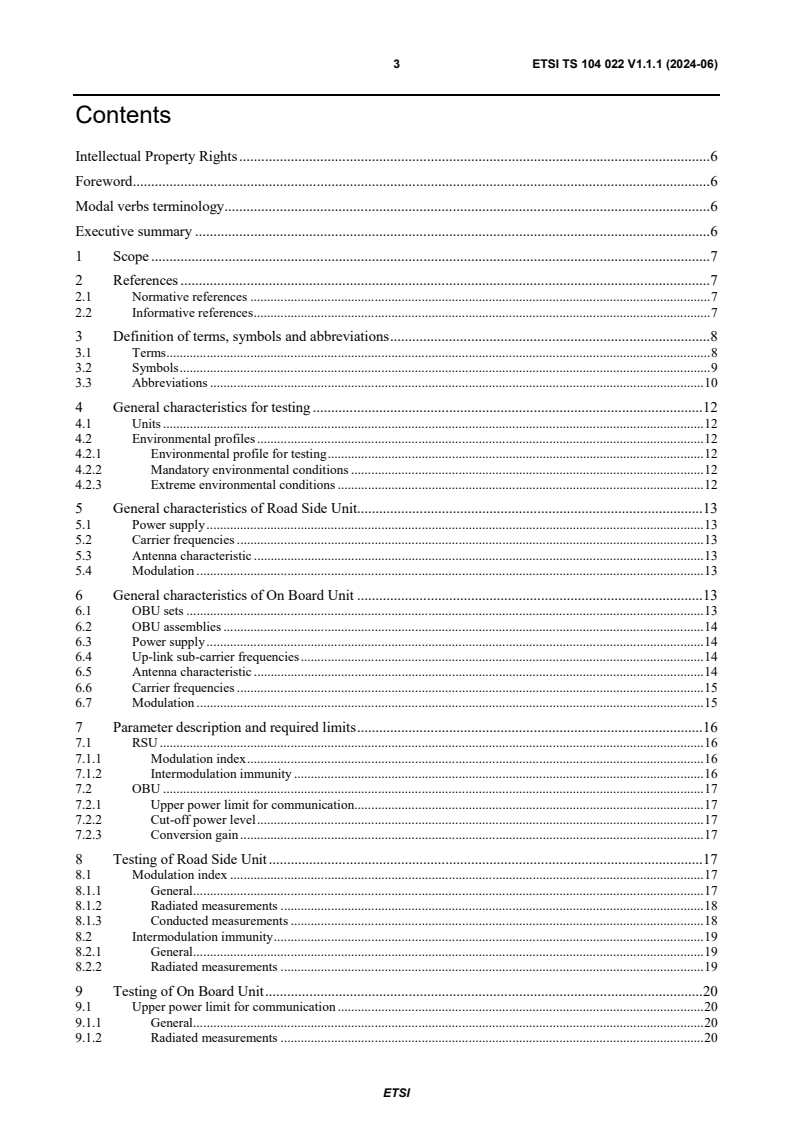
Contents
Intellectual Property Rights . 6
Foreword . 6
Modal verbs terminology . 6
Executive summary . 6
1 Scope . 7
2 References . 7
2.1 Normative references . 7
2.2 Informative references . 7
3 Definition of terms, symbols and abbreviations . 8
3.1 Terms . 8
3.2 Symbols . 9
3.3 Abbreviations . 10
4 General characteristics for testing . 12
4.1 Units . 12
4.2 Environmental profiles . 12
4.2.1 Environmental profile for testing . 12
4.2.2 Mandatory environmental conditions . 12
4.2.3 Extreme environmental conditions . 12
5 General characteristics of Road Side Unit. 13
5.1 Power supply . 13
5.2 Carrier frequencies . 13
5.3 Antenna characteristic . 13
5.4 Modulation . 13
6 General characteristics of On Board Unit . 13
6.1 OBU sets . 13
6.2 OBU assemblies . 14
6.3 Power supply . 14
6.4 Up-link sub-carrier frequencies . 14
6.5 Antenna characteristic . 14
6.6 Carrier frequencies . 15
6.7 Modulation . 15
7 Parameter description and required limits . 16
7.1 RSU . 16
7.1.1 Modulation index . 16
7.1.2 Intermodulation immunity . 16
7.2 OBU . 17
7.2.1 Upper power limit for communication . 17
7.2.2 Cut-off power level . 17
7.2.3 Conversion gain . 17
8 Testing of Road Side Unit . 17
8.1 Modulation index . 17
8.1.1 General . 17
8.1.2 Radiated measurements . 18
8.1.3 Conducted measurements . 18
8.2 Intermodulation immunity . 19
8.2.1 General . 19
8.2.2 Radiated measurements . 19
9 Testing of On Board Unit . 20
9.1 Upper power limit for communication . 20
9.1.1 General . 20
9.1.2 Radiated measurements . 20
ETSI
4 ETSI TS 104 022 V1.1.1 (2024-06)
9.1.3 Conducted measurements . 21
9.2 Cut-off power level . 21
9.2.1 General . 21
9.2.2 Radiated measurements . 21
9.2.3 Conducted measurements . 22
9.3 Conversion gain . 22
9.3.1 General . 22
9.3.2 Radiated measurement . 23
9.3.3 Conducted measurement . 24
Annex A (normative): Basics of testing . 25
A.1 General conditions . 25
A.1.1 Environment . 25
A.1.2 Power source . 25
A.1.3 Thermal balance . 25
A.2 Test signals . 26
A.3 Test sites . 26
A.3.1 Test sites overview . 26
A.3.2 Shielded anechoic chamber . 27
A.3.3 Open area test site. 28
A.3.4 Test fixture . 29
A.4 General requirements for RF cables . 30
A.5 Conducted measurements . 30
A.5.1 One antenna connector arrangement . 30
A.5.2 Two antenna connectors arrangement . 31
A.5.3 Test site requirements . 31
A.5.4 Site preparation . 31
A.5.4.1 Monochromatic signals . 31
A.5.4.2 Modulated signals . 32
A.6 Radiated measurements . 32
A.6.1 One antenna arrangement . 32
A.6.2 Two antennas arrangement . 33
A.6.3 Test site requirements . 34
A.6.3.1 Measurement distances . 34
A.6.3.2 Free-space wave propagation . 34
A.6.4 Test and substitution antennas . 35
A.6.5 Site preparation for OBU measurements . 35
A.6.5.1 Monochromatic signals . 35
A.6.5.2 Modulated signals . 37
A.6.6 Site preparation for RSU measurements . 38
A.6.6.1 Arrangement for transmit parameters . 38
A.6.6.2 Arrangement for receive parameters . 39
A.7 Instruments . 40
A.7.1 Receiving device . 40
A.7.2 RF power sensor . 41
A.7.3 Combiner . 41
A.8 Power level of modulated RSU carrier . 41
A.9 Bit error ratio measurements . 42
A.9.1 Basics . 42
A.9.2 BER measurement . 43
A.9.3 FER measurement . 43
A.9.3.1 Mathematical expressions . 43
A.9.3.2 Equipment . 43
A.9.3.3 Procedure . 44
Annex B (normative): Interpretation of results and measurement uncertainty . 45
ETSI
5 ETSI TS 104 022 V1.1.1 (2024-06)
B.1 Interpretation of results . 45
B.2 Measurement uncertainty . 45
History . 46
ETSI
6 ETSI TS 104 022 V1.1.1 (2024-06)
Intellectual Property Rights
Essential patents
IPRs essential or potentially essential to normative deliverables may have been declared to ETSI. The declarations
pertaining to these essential IPRs, if any, are publicly available for ETSI members and non-members, and can be
found in ETSI SR 000 314: "Intellectual Property Rights (IPRs); Essential, or potentially Essential, IPRs notified to
ETSI in respect of ETSI standards", which is available from the ETSI Secretariat. Latest updates are available on the
ETSI Web server (https://ipr.etsi.org/).
Pursuant to the ETSI Directives including the ETSI IPR Policy, no investigation regarding the essentiality of IPRs,
including IPR searches, has been carried out by ETSI. No guarantee can be given as to the existence of other IPRs not
referenced in ETSI SR 000 314 (or the updates on the ETSI Web server) which are, or may be, or may become,
essential to the present document.
Trademarks
The present document may include trademarks and/or tradenames which are asserted and/or registered by their owners.
ETSI claims no ownership of these except for any which are indicated as being the property of ETSI, and conveys no
right to use or reproduce any trademark and/or tradename. Mention of those trademarks in the present document does
not constitute an endorsement by ETSI of products, services or organizations associated with those trademarks.
DECT™, PLUGTESTS™, UMTS™ and the ETSI logo are trademarks of ETSI registered for the benefit of its
Members. 3GPP™ and LTE™ are trademarks of ETSI registered for the benefit of its Members and of the 3GPP
Organizational Partners. oneM2M™ logo is a trademark of ETSI registered for the benefit of its Members and of the ®
oneM2M Partners. GSM and the GSM logo are trademarks registered and owned by the GSM Association.
Foreword
This Technical Specification (TS) has been produced by ETSI Technical Committee Electromagnetic compatibility and
Radio spectrum Matters (ERM).
Modal verbs terminology
In the present document "shall", "shall not", "should", "should not", "may", "need not", "will", "will not", "can" and
"cannot" are to be interpreted as described in clause 3.2 of the ETSI Drafting Rules (Verbal forms for the expression of
provisions).
"must" and "must not" are NOT allowed in ETSI deliverables except when used in direct citation.
Executive summary
The present document comprises performance test specifications for Transport and Traffic Telematics (TTT) Dedicated
Short Range Communication (DSRC) transmission equipment operating in the 5 795 MHz to 5 815 MHz frequency
band.
ETSI
7 ETSI TS 104 022 V1.1.1 (2024-06)
1 Scope
The present document defines the performance test cases for Dedicated Short Range Communication (DSRC)
transmission equipment (500 kbit/s / 250 kbit/s) operating in the 5 795 MHz to 5 815 MHz frequency band.
NOTE: Technical requirements for conformance against article 3.2 of the Radio Equipment Directive [i.1] and
related test procedures are defined in in ETSI EN 300 674-2-1 [i.2] and ETSI EN 300 674-2-2 [i.3].
2 References
2.1 Normative references
References are either specific (identified by date of publication and/or edition number or version number) or
non-specific. For specific references, only the cited version applies. For non-specific references, the latest version of the
referenced document (including any amendments) applies.
Referenced documents which are not found to be publicly available in the expected location might be found at
https://docbox.etsi.org/Reference.
NOTE: While any hyperlinks included in this clause were valid at the time of publication, ETSI cannot guarantee
their long term validity.
The following referenced documents are necessary for the application of the present document.
[1] EN 12253 (2004): "Road transport and traffic telematics. Dedicated short-range communication.
Physical layer using microwave at 5,8 GHz", (produced by CEN).
2.2 Informative references
References are either specific (identified by date of publication and/or edition number or version number) or
non-specific. For specific references, only the cited version applies. For non-specific references, the latest version of the
referenced document (including any amendments) applies.
NOTE: While any hyperlinks included in this clause were valid at the time of publication, ETSI cannot guarantee
their long term validity.
The following referenced documents are not necessary for the application of the present document but they assist the
user with regard to a particular subject area.
[i.1] Directive 2014/53/EU of the European Parliament and of the Council of 16 April 2014 on the
harmonisation of the laws of the Member States relating to the making available on the market of
radio equipment and repealing Directive 1999/5/EC.
[i.2] ETSI EN 300 674-2-1 (2022): "Transport and Traffic Telematics (TTT); Dedicated Short Range
Communication (DSRC) transmission equipment (500 kbit/s / 250 kbit/s) operating in the
5 795 MHz to 5 815 MHz frequency band; Part 2: Harmonised Standard for access to radio
spectrum; Sub-part 1: Road Side Units (RSU)".
[i.3] ETSI EN 300 674-2-2 (2019): "Transport and Traffic Telematics (TTT); Dedicated Short Range
Communication (DSRC) transmission equipment (500 kbit/s / 250 kbit/s) operating in the
5 795 MHz to 5 815 MHz frequency band; Part 2: Harmonised Standard for access to radio
spectrum; Sub-part 2: On-Board Units (OBU)".
[i.4] ISO 14906 (2022): "Electronic fee collection -- Application interface definition for dedicated
short-range communication".
[i.5] EN 13372 (2003): "Road transport and traffic telematics (RTTT). Dedicated short-range
communication. Profiles for RTTT applications", (produced by CEN).
ETSI
8 ETSI TS 104 022 V1.1.1 (2024-06)
[i.6] EN 12795 (2003): "Road transport and traffic telematics. Dedicated short range communication
(DSRC). DSRC data link layer. Medium access and logical link control", (produced by CEN).
[i.7] EN 12834 (2003): "Road transport and traffic telematics. Dedicated Short Range Communication
(DSRC). DSRC application layer", (produced by CEN).
[i.8] IEC 60721-3-4 (2019):"Classification of environmental conditions - Part 3: Classification of
groups of environmental parameters and their severities - Section 4: Stationary use at non-weather
protected locations".
[i.9] IEC 60721-3-5 (1997): "Classification of environmental conditions - Part 3: Classification of
groups of environmental parameters and their severities - Section 5: Ground vehicle installations".
[i.10] ETSI TS 103 052: "Electromagnetic compatibility and Radio spectrum Matters (ERM); Radiated
measurement methods and general arrangements for test sites up to 100 GHz".
3 Definition of terms, symbols and abbreviations
3.1 Terms
For the purposes of the present document, the following terms apply:
bit: binary digit
NOTE: It can have one out of two possible values, e.g. 0/1 or +1/-1 or low/high.
bit rate: number of bits, in a bit stream, occurring per unit time, usually expressed in bits per second
bore sight: direction of maximum radiation of a directional antenna
NOTE: If bore sight cannot be determined unambiguously, then bore sight may be declared by the provider.
carrier frequency: frequency f to which the RSU transmitter is tuned
Tx
NOTE: In DSRC, the carrier frequency is in the centre of a channel, see table 2 of the present document.
carrier signal or carrier: harmonic signal whose nominal single frequency f can vary within a range specified by the
Tx
carrier frequency tolerance and which is capable of being modulated by a second, symbol-carrying signal
channel: continuous part of the radio-frequency spectrum to be used for a specified emission or transmission
NOTE: A radio-frequency channel may be defined by two specified limits, or by its centre frequency and its
bandwidth, or any equivalent indication. It is often designated by a sequential number. A radio-frequency
channel may be time-shared in order to allow radiocommunication in both directions by simplex
operation. The term "channel" is sometimes used to denote two associated radio-frequency channels, each
of which is used for one of two directions of transmission.
cross-polar discrimination, ellipticity of polarization: antenna designed to transmit left hand circular waves may
transmit some right hand circular waves in addition
NOTE: Cross-Polar Discrimination (XPD) is defined as the ratio PLHCP/PRHCP of power PLHCP of the left
hand circular polarized wave to the power PRHCP of the right-hand circular wave when the total power
of the transmitted wave is PLHCP + PRHCP.
environmental profile: range of environmental conditions under which equipment within the scope of the present
document is required to comply with the provisions of the present document
equivalent isotropic radiated power: signal power fed into an ideal loss-less antenna radiating equally in all directions
that generates the same power flux at a reference distance as the one generated by a signal fed into the antenna under
consideration in a predefined direction within its far field region
integral antenna: antenna, with or without a connector, designed as an indispensable part of the equipment
ETSI
9 ETSI TS 104 022 V1.1.1 (2024-06)
OBU sleep mode: mode where the OBU can only detect the presence of DSRC down-link signal
NOTE: An OBU may be either in sleep mode, the stand-by mode, or the transmit mode. The sleep mode is an
optional mode for battery powered OBUs that allows to save battery power. In this mode, the OBU can
only detect the presence of a DSRC down-link signal which under certain defined conditions, see
EN 12253 [1], a transition to the stand-by mode is trigger by a wake-up event (detection of a DSRC
down-link).
OBU stand-by mode: mode in which the OBU is capable of receiving DSRC down-link signals
NOTE: In stand-by mode the OBU is never transmitting.
operating frequency: nominal frequency at which equipment is operated; also referred to as the operating centre
frequency
NOTE: Equipment may be able to operate at more than one operating frequency.
polarization: locus of the tip of the electrical field vector in a plane perpendicular to the direction of transmission
EXAMPLE: The polarization can be horizontal or vertical linear polarized, or left or right-hand circular
polarized.
provider: manufacturer, supplier, or person responsible for placing the apparatus on the market
radiated measurements: measurements which involve the measurement of a radiated electromagnetic field
3.2 Symbols
For the purposes of the present document, the following symbols apply:
A Amplitude of CW signal
CW
A Amplitude of modulated signal
mod
Attenuation of attenuator AT2
ATN
AT2
ATN Attenuation of balun BLN
BLN
ATN Attenuation of calibrated coaxial cable 1
CA1
BER Bit Error Ratio
C Number of frames transmitted
F
C Number of erroneous frames received
E
d Distance between phase centres of transmitting and receiving antenna
d Horizontal displacement of TTA and RTA antenna phase centres
displace
d Distance from transmitting antenna to first Fresnel ellipse
F1
d Distance from first Fresnel ellipse to receiving antenna
F2
D Distance between neighbouring ferrite beads
fb
D Directivity relative to an isotropic radiator
i
D Largest linear dimension of test antenna
0,TA
D Largest linear dimension of EUT antenna
0,EUT
EIRP e.i.r.p. generated by the OBU within a single side band
ObuTx
f Frequency
FER Frame error ratio
f Nominal OBU sub-carrier frequency
s
Nominal RSU carrier frequency
f
Tx
f Nominal centre frequency of unwanted signal
u
f , f Centre frequencies of unwanted signal
u1 u2
G Conversion gain
c
G Gain of OBU receiving antenna
OBU,Rx
G Gain of OBU transmitting antenna
OBU,Tx
G Gain of receiving substitution antenna
RSA
ETSI
10 ETSI TS 104 022 V1.1.1 (2024-06)
G Gain of test antenna
TA
G Gain of transmitting substitution antenna
TSA
lg(.) Logarithm to the base ten
m Modulation index
N Total number of transmitted bits within a single frame
P Power of CW signal
CW
P Power limit for communication (upper)
D11a
P Power limit for communication (lower)
D11b
P Incident signal power as received by an ideal isotropic receiving antenna
inc
P P in dBm
inc,dBm inc
P Signal power of left hand circular polarized wave
LHCP
P Power of modulated signal
mod
P Output signal power of MSS2
MMS2
P Incident signal power to OBU, referred to an ideal isotropic receiving antenna
ObuRx
P Retransmitted signal power
reTx
P Signal power obtained from receiving substitution antenna
RSA
P Signal power of right hand circular polarized wave
RHCP
P Signal power within single side band
ssb
P Power of unwanted signal
u
RBW Resolution bandwidth
T Duration of CW signal
CW
T Duration of modulated signal
mod
V , V Maximal amplitude of modulated output signal of RSU caused by data bit 1, or 0
max min
α Tilt angle of test antenna
α Displacement angle between TTA and RTA
displace
θ Angle relative to OBU bore sight indicating worst case direction
Wavelength
λ
ρ Reflection coefficient at antenna connector of the receiving substitution antenna
RSA
ρ Reflection coefficient at antenna connector of the transmitting substitution antenna
TSA
3.3 Abbreviations
For the purposes of the present document, the following abbreviations apply:
General abbreviations:
AT1 Attenuator 1
AT2 Attenuator 2
BER Bit Error Ratio
BLN Balun
BST Beacon Service table
CA Corresponding Antenna
CC Coaxial Circulator
CEN Comité Européen de Normalisation
CRC Cyclic Redundancy Checking
CW Continuous Wave
DC Direct Current
DSRC Dedicated Short Range Communication
e.i.r.p. Equivalent Isotropic Radiated Power
EFC Electronic Fee Collection
EU European Union
EUT Equipment Under Test
FCCA Ferrited Coaxial CAble
FCCA1 Ferrited Coaxial CAble 1
FER Frame Error Ratio
IEC International Electrotechnical Commission
ETSI
11 ETSI TS 104 022 V1.1.1 (2024-06)
ISO International Organization for Standardization
LHCP Left Hand Circular Polarized
LOS Line-Of-Sight
LP Linear Polarized
Mc Location of the OBU antenna phase centre
M Centre point between phase centres of TTA and RTA
centre
MSS1 Monochromatic Signal Source 1
MSS2 Monochromatic Signal Source 2
n.a. not applicable
OBU On Board Unit
PM1 Power Meter 1
RBW Resolution BandWidth
RD Receiving Device
RF Radio Frequency
RRxA RSU Receiving Antenna
RSA Receiving Substitution Antenna
RSU Road Side Unit
RTA Receiving Test Antenna
RTTT Road Transport and Traffic Telematics
RTxA RSU Transmitting Antenna
Rx Receiver
SMS1 Signal or Message Source 1
SR Special Report
SSB Single Side Band
TA Test Antenna
TM1 Test Message 1
TS1 Test Signal 1
TS2 Test Signal 2
TSA Transmitting Substitution Antenna
TTA Transmitting Test Antenna
TTT Transport and Traffic Telematics
Tx Transmitter
VBW Video BandWidth
VST Vehicle Service table
VSWR Voltage Standing Wave Ratio
XP Cross Polarized
XPD Cross-Polar Discrimination
EN 12253 [1] list of down-link parameter abbreviations:
D1 Carrier frequencies
D3 OBU minimum frequency range
D5 Polarization
D5a Cross polarization
D6 Modulation
D6a Modulation index
D6b Eye pattern
D7 Data coding
D8 Bit rate
D8a Tolerance of bit clock
D9a BER for communication
D11a Power limit for communication (upper)
D11b Power limit for communication (lower)
D12 Cut-off power level of OBU
EN 12253 [1] list of up-link parameter abbreviations:
U1 Sub-carrier frequencies
U1b Use of side bands
U4a Maximum single side band e.i.r.p. (bore sight)
U4b Maximum single side band e.i.r.p. (35°)
U5 Up-link polarization
ETSI
12 ETSI TS 104 022 V1.1.1 (2024-06)
U5a Cross polarization
U6 Sub-carrier modulation
U6b Eye pattern/duty cycle
U6c Modulation on carrier
U7 Data coding
U8 Bit rate
U8a Tolerance of symbol clock
U9a BER for communication
U12 Conversion gain
4 General characteristics for testing
4.1 Units
Units can be either Road Side Units or On Board Units.
Transmitters and receivers may be individual or combination units; some units may be transmitter only, some units may
be receiver only and some units may combine transmitter and receiver functionalities.
4.2 Environmental profiles
4.2.1 Environmental profile for testing
The technical requirements of the present document shall apply under the mandatory environmental profile for intended
operation of the equipment as specified in clause 4.2.2. The equipment shall always comply with all the technical
requirements of the present document when operating within the boundary limits of the mandatory environmental
profile.
The provider may additionally select environmental profiles as specified in clause 4.2.3 for testing.
An environmental profile shall include at least the minimum and maximum value of the operational temperature range.
The environmental conditions for tests shall be any convenient selection of environmental parameter values within the
selected ranges from clause 4.2.2 and optionally from clause 4.2.3.
4.2.2 Mandatory environmental conditions
The normal temperature and humidity conditions for tests shall be any convenient combination of temperature and
relative humidity within the following ranges:
• temperature: +15 ºC to +35 ºC;
• relative humidity: 20 % to 75 %.
4.2.3 Extreme environmental conditions
Extreme environmental conditions are classified in categories according to table 1.
Table 1: Extreme environmental conditions
Temperature category RSU OBU
Category I (General): temperature: -20 °C to +55 °C temperature: -20 °C to +55 °C
Category ll: IEC 60721-3-4 [i.8] / 4K2 IEC 60721-3-5 [i.9] / 5K2
Category III IEC 60721-3-4 [i.8] / 4K3 IEC 60721-3-5 [i.9] / 5K3
Category IV: IEC 60721-3-4 [i.8] / 4K4 IEC 60721-3-5 [i.9] / 5K4
ETSI
13 ETSI TS 104 022 V1.1.1 (2024-06)
The extreme environmental conditions for tests shall be any convenient selection of environmental parameter values,
except temperature, of a single category. For tests at extreme temperature, measurements shall be made at both, the
upper and lower bound of the temperature range of the selected category.
5 General characteristics of Road Side Unit
5.1 Power supply
The power supply shall meet the requirements given in clause A.1.2 for the selected operational conditions of the EUT.
The power can be supplied by a built-in battery, an external battery or a stabilized power supply.
5.2 Carrier frequencies
The present document applies to RSUs operating in some or all of the following channels detailed in table 2.
The centre frequencies f indicated in table 2 are referred to as parameter D1 in EN 12253 [1].
Tx
Table 2: Frequency bands and centre frequencies f allocated for DSRC
Tx
Pan European Service Frequencies National Service Frequencies
Channel 1 5,795 GHz to 5,800 GHz, f = 5,7975 GHz
Tx
Channel 2 5,800 GHz to 5,805 GHz, f = 5,8025 GHz
Tx
Channel 3 5,805 GHz to 5,810 GHz, f = 5,8075 GHz
Tx
Channel 4 5,810 GHz to 5,815 GHz, f = 5,8125 GHz
Tx
Where equipment can be adjusted to operate at different operating frequencies other than channels 1 and 2, a minimum
of two operating frequencies shall be chosen for the tests described in the present document such that the lower and
higher limits of the provider's declared operating ranges of the equipment are covered.
5.3 Antenna characteristic
All RSU antennas shall be LHCP in accordance with parameters D5 and D5a in EN 12253 [1].
5.4 Modulation
The carrier of frequency f , see table 2, shall be modulated in accordance with parameters D6, D6a and D6b in
Tx
EN 12253 [1].
6 General characteristics of On Board Unit
6.1 OBU sets
There exist two sets of OBUs called Set A and Set B which differ by the following parameters listed in table 3 either in
terms of value or applicability, and which are defined in EN 13372 [i.5].
ETSI
14 ETSI TS 104 022 V1.1.1 (2024-06)
Table 3: Differences in OBU Sets
EN 12253 [1] parameter Set A Set B
abbreviation
D11a Power limit for communication (upper)
D12 n.a. Cut off power level of OBU
U4a Maximum SSB e.i.r.p. (bore sight)
U4b n.a.
Maximum SSB e.i.r.p. (35°)
U12b n.a. Conversion gain (upper limit)
The provider shall declare which Set the unit complies with.
6.2 OBU assemblies
The OBU as identically supplied for testing and usage by the end-user is a physical assembly which is located and
operated in or on the vehicle to transmit and receive DSRC signals. The OBU may be assembled such that it is:
• mountable in or on any part of the vehicle structure by the end-user according to guidelines in the user-manual,
and optionally removable after proper installation; or
• bonded to a part of the vehicle by a service station being authorized by the provider; or
• an integral part of a vehicle component, such as a windscreen, bumper, or licence plate.
In case the OBU is removable from its mounting device by the end-user, tests shall be performed with the OBU
properly attached to its mounting device.
The provider shall declare the physical assembly of the OBU.
6.3 Power supply
The power supply shall meet the requirements given in clause A.1.2 for the selected operational conditions of the EUT.
The power supply may be a built-in battery, an external battery, or a stabilized power supply, etc.
6.4 Up-link sub-carrier frequencies
The sub-carrier signal or also called sub-carrier is a signal whose nominal single frequency f can vary within a range
s
specified by the sub-carrier frequency tolerance. It shall be capable of being modulated by a second, symbol-carrying
signal, see clause 6.7.
The up-link sub-carrier frequency is referred to as parameter U1 of EN 12253 [1].
Every DSRC OBU shall support the two sub-carrier frequencies f of 1,5 MHz and 2,0 MHz.
s
6.5 Antenna characteristic
All equipment antennas shall be LHCP according to parameters U5 and U5a in EN 12253 [1].
An OBU may provide either none, one, or two antenna connectors.
In case an OBU does not provide an antenna connector, then either one antenna for receiving and transmitting, or one
antenna for receiving and one antenna for transmitting are implemented. For a single antenna solution the phase centre
of the OBU antenna is entitled Mc, see figure 1. For separated receive and transmit antennas it is assumed that they are
close to each other and point approximately to the same direction. The centre between these two antennas then is
entitled Mc. For easy reading of the present document Mc is referred to as "phase centre of the OBU antenna".
ETSI
boresight
15 ETSI TS 104 022 V1.1.1 (2024-06)
The minimum operational direction of the OBU receive and transmit antenna is characterized by a cone with opening
angle θ around bore sight as depicted in fi
...
Questions, Comments and Discussion
Ask us and Technical Secretary will try to provide an answer. You can facilitate discussion about the standard in here.
Loading comments...