

ETSI EN 300 392-12-20 V1.2.1 (2012-04)
Terrestrial Trunked Radio (TETRA); Voice plus Data (V+D); Part 12: Supplementary services stage 3; Sub-part 20: Discreet Listening (DL)
General Information
- Abstract
REN/TETRA-03219
- Status
- Published
- Publication Date
- 04-Apr-2012
- Technical Committee
- TCCE 3 - TCCE Air Interface and Network Protocols
- Current Stage
- 12 - Completion
- Due Date
- 04-Apr-2012
- Completion Date
- 05-Apr-2012
Buy Documents
en_3003921220v010200o - Terrestrial Trunked Radio (TETRA); Voice plus Data (V+D); Part 12: Supplementary services stage 3; Sub-part 20: Discreet Listening (DL)
en_3003921220v010201p - Terrestrial Trunked Radio (TETRA); Voice plus Data (V+D); Part 12: Supplementary services stage 3; Sub-part 20: Discreet Listening (DL)

Overview
ETSI EN 300 392-12-20 V1.2.1 (2012-04) (ETSI EN 300 392-12-20 V1.2.1) is the stage‑3 European telecommunication standard that defines the Supplementary Service Discreet Listening (SS‑DL) for TETRA Voice plus Data (V+D). It specifies the protocol and signalling details at the air interface and at the Inter‑System Interfaces (ISI) required to support authorized covert monitoring of individual and group calls. The document follows the ITU‑T I.130 stage 1/2/3 service description method: stage 3 focuses on network implementation (protocols and reference point behaviour).
Key technical topics and requirements
- Scope: applies to V+D individual calls and group calls and to specific entities such as the monitoring user Mobile Station (MS), the monitoring user SwMI, group controlling and participating SwMIs, the monitored user’s present SwMI, and optionally the home SwMI.
- Service capabilities:
- Allow an authorized user to listen to one or more communications without indication to monitored users.
- Optional features include call intrusion (monitoring user may join an active call) and forced clear (forcefully clear a monitored group call).
- Protocol and signalling elements:
- Detailed PDU definitions (ACTIVATE, ACTIVATE ACK, INTERROGATE, MONITOR, FORCED‑REL, etc.).
- Information element coding for SS‑DL parameters (call references, addresses, SS‑DL profiles, intrusion/forced‑release flags).
- State definitions and signalling procedures for monitoring, monitored and controlling entities.
- Operational requirements: behaviour expected from monitoring MS, authorized user MS, group controlling SwMI, visited/home SwMIs and participating SwMIs.
- Out of scope: Man–Machine Interface (MMI) and charging principles are explicitly excluded.
Practical applications - who uses this standard
- Network equipment vendors and TETRA terminal manufacturers implement SS‑DL PDUs and signalling to ensure interoperable covert monitoring functions.
- System integrators and operators (public safety, utilities, transport and critical‑infrastructure networks) deploy authorized monitoring features for operational security, incident response and internal investigations.
- SwMI/software developers use the stage‑3 protocol definitions to implement SwMI behaviour at the ISI and air interface.
- Organizations requiring standardized, interoperable covert monitoring capabilities rely on this standard to ensure legal, secure and technically consistent implementations.
Related standards
- ITU‑T Recommendation I.130 (service description stages 1–3) - methodological reference for stage descriptions.
- Other parts of the EN 300 392 series covering TETRA V+D signalling, stage‑1 and stage‑2 descriptions and related supplementary services.
Keywords: ETSI EN 300 392-12-20 V1.2.1 (2012-04), ETSI EN 300 392-12-20, TETRA, Voice plus Data, V+D, SS-DL, Discreet Listening, stage 3, SwMI, PDU, air interface, ISI, call intrusion, forced release, monitoring user.
Buy Documents
en_3003921220v010200o - Terrestrial Trunked Radio (TETRA); Voice plus Data (V+D); Part 12: Supplementary services stage 3; Sub-part 20: Discreet Listening (DL)
en_3003921220v010201p - Terrestrial Trunked Radio (TETRA); Voice plus Data (V+D); Part 12: Supplementary services stage 3; Sub-part 20: Discreet Listening (DL)
Frequently Asked Questions
ETSI EN 300 392-12-20 V1.2.1 (2012-04) is a standard published by the European Telecommunications Standards Institute (ETSI). Its full title is "Terrestrial Trunked Radio (TETRA); Voice plus Data (V+D); Part 12: Supplementary services stage 3; Sub-part 20: Discreet Listening (DL)". This standard covers: REN/TETRA-03219
REN/TETRA-03219
ETSI EN 300 392-12-20 V1.2.1 (2012-04) is available in PDF format for immediate download after purchase. The document can be added to your cart and obtained through the secure checkout process. Digital delivery ensures instant access to the complete standard document.
Standards Content (Sample)
Final draft ETSI EN 300 392-12-20 V1.2.0 (2011-11)
European Standard
Terrestrial Trunked Radio (TETRA);
Voice plus Data (V+D);
Part 12: Supplementary services stage 3;
Sub-part 20: Discreet Listening (DL)
2 Final draft ETSI EN 300 392-12-20 V1.2.0 (2011-11)
Reference
REN/TETRA-03219
Keywords
radio, supplementary service, TETRA, V+D
ETSI
650 Route des Lucioles
F-06921 Sophia Antipolis Cedex - FRANCE
Tel.: +33 4 92 94 42 00 Fax: +33 4 93 65 47 16
Siret N° 348 623 562 00017 - NAF 742 C
Association à but non lucratif enregistrée à la
Sous-Préfecture de Grasse (06) N° 7803/88
Important notice
Individual copies of the present document can be downloaded from:
http://www.etsi.org
The present document may be made available in more than one electronic version or in print. In any case of existing or
perceived difference in contents between such versions, the reference version is the Portable Document Format (PDF).
In case of dispute, the reference shall be the printing on ETSI printers of the PDF version kept on a specific network drive
within ETSI Secretariat.
Users of the present document should be aware that the document may be subject to revision or change of status.
Information on the current status of this and other ETSI documents is available at
http://portal.etsi.org/tb/status/status.asp
If you find errors in the present document, please send your comment to one of the following services:
http://portal.etsi.org/chaircor/ETSI_support.asp
Copyright Notification
No part may be reproduced except as authorized by written permission.
The copyright and the foregoing restriction extend to reproduction in all media.
© European Telecommunications Standards Institute 2011.
All rights reserved.
TM TM TM
DECT , PLUGTESTS , UMTS and the ETSI logo are Trade Marks of ETSI registered for the benefit of its Members.
TM
3GPP and LTE™ are Trade Marks of ETSI registered for the benefit of its Members and
of the 3GPP Organizational Partners.
GSM® and the GSM logo are Trade Marks registered and owned by the GSM Association.
ETSI
3 Final draft ETSI EN 300 392-12-20 V1.2.0 (2011-11)
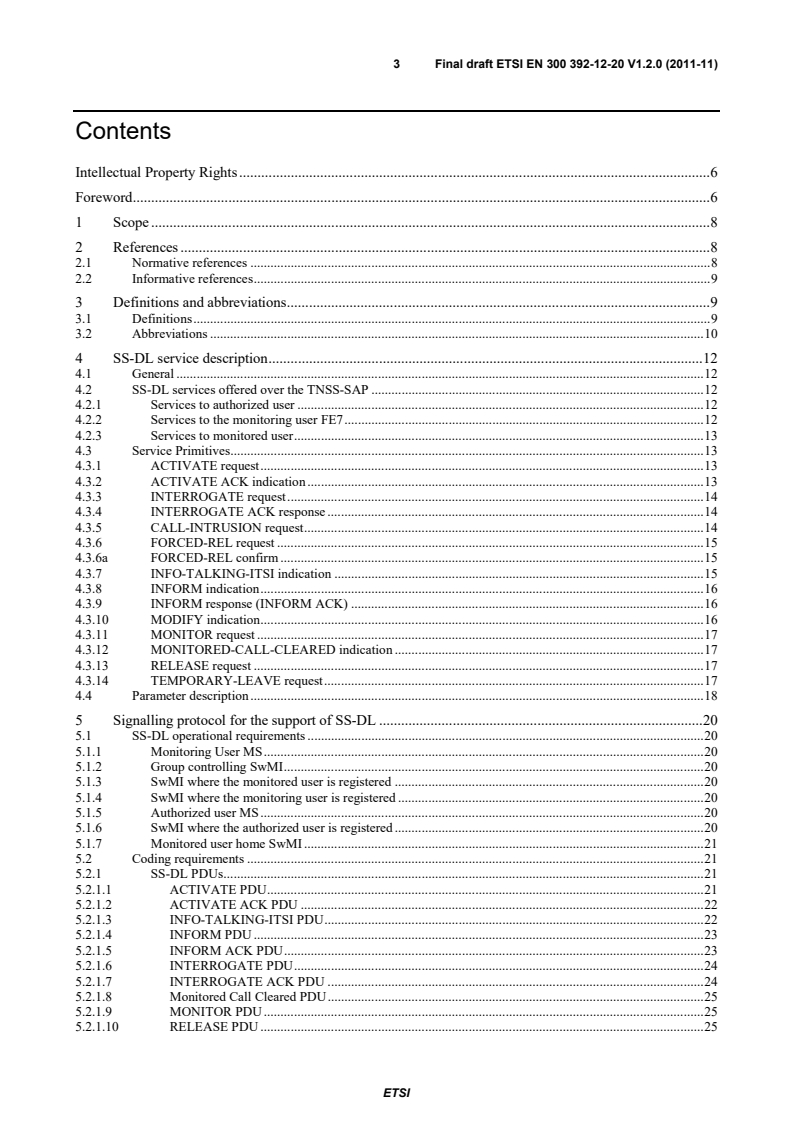
Contents
Intellectual Property Rights . 6
Foreword . 6
1 Scope . 8
2 References . 8
2.1 Normative references . 8
2.2 Informative references . 9
3 Definitions and abbreviations . 9
3.1 Definitions . 9
3.2 Abbreviations . 10
4 SS-DL service description . 12
4.1 General . 12
4.2 SS-DL services offered over the TNSS-SAP . 12
4.2.1 Services to authorized user . 12
4.2.2 Services to the monitoring user FE7 . 12
4.2.3 Services to monitored user . 13
4.3 Service Primitives. 13
4.3.1 ACTIVATE request . 13
4.3.2 ACTIVATE ACK indication . 13
4.3.3 INTERROGATE request . 14
4.3.4 INTERROGATE ACK response . 14
4.3.5 CALL-INTRUSION request . 14
4.3.6 FORCED-REL request . 15
4.3.6a FORCED-REL confirm . 15
4.3.7 INFO-TALKING-ITSI indication . 15
4.3.8 INFORM indication . 16
4.3.9 INFORM response (INFORM ACK) . 16
4.3.10 MODIFY indication . 16
4.3.11 MONITOR request . 17
4.3.12 MONITORED-CALL-CLEARED indication . 17
4.3.13 RELEASE request . 17
4.3.14 TEMPORARY-LEAVE request . 17
4.4 Parameter description . 18
5 Signalling protocol for the support of SS-DL . 20
5.1 SS-DL operational requirements . 20
5.1.1 Monitoring User MS . 20
5.1.2 Group controlling SwMI . 20
5.1.3 SwMI where the monitored user is registered . 20
5.1.4 SwMI where the monitoring user is registered . 20
5.1.5 Authorized user MS . 20
5.1.6 SwMI where the authorized user is registered . 20
5.1.7 Monitored user home SwMI . 21
5.2 Coding requirements . 21
5.2.1 SS-DL PDUs . 21
5.2.1.1 ACTIVATE PDU . 21
5.2.1.2 ACTIVATE ACK PDU . 22
5.2.1.3 INFO-TALKING-ITSI PDU . 22
5.2.1.4 INFORM PDU . 23
5.2.1.5 INFORM ACK PDU . 23
5.2.1.6 INTERROGATE PDU . 24
5.2.1.7 INTERROGATE ACK PDU . 24
5.2.1.8 Monitored Call Cleared PDU . 25
5.2.1.9 MONITOR PDU . 25
5.2.1.10 RELEASE PDU . 25
ETSI
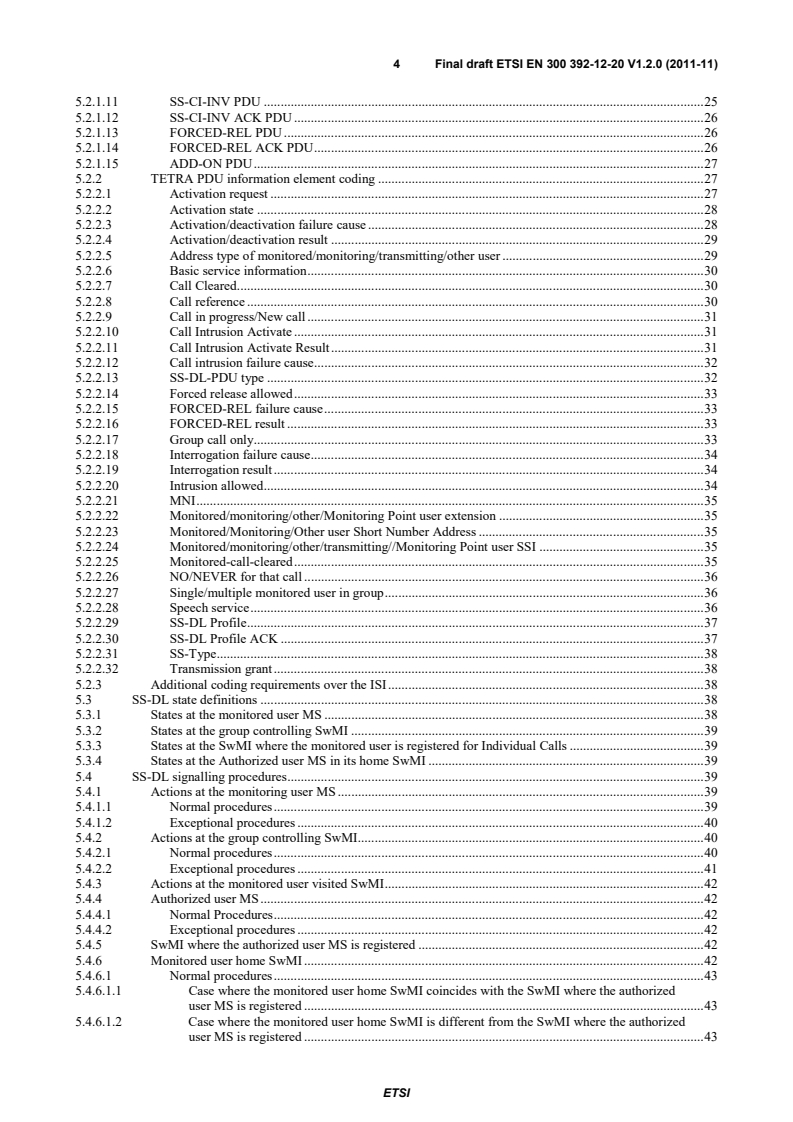
4 Final draft ETSI EN 300 392-12-20 V1.2.0 (2011-11)
5.2.1.11 SS-CI-INV PDU . 25
5.2.1.12 SS-CI-INV ACK PDU . 26
5.2.1.13 FORCED-REL PDU . 26
5.2.1.14 FORCED-REL ACK PDU . 26
5.2.1.15 ADD-ON PDU . 27
5.2.2 TETRA PDU information element coding . 27
5.2.2.1 Activation request . 27
5.2.2.2 Activation state . 28
5.2.2.3 Activation/deactivation failure cause . 28
5.2.2.4 Activation/deactivation result . 29
5.2.2.5 Address type of monitored/monitoring/transmitting/other user . 29
5.2.2.6 Basic service information . 30
5.2.2.7 Call Cleared. 30
5.2.2.8 Call reference . 30
5.2.2.9 Call in progress/New call . 31
5.2.2.10 Call Intrusion Activate . 31
5.2.2.11 Call Intrusion Activate Result . 31
5.2.2.12 Call intrusion failure cause . 32
5.2.2.13 SS-DL-PDU type . 32
5.2.2.14 Forced release allowed . 33
5.2.2.15 FORCED-REL failure cause . 33
5.2.2.16 FORCED-REL result . 33
5.2.2.17 Group call only . 33
5.2.2.18 Interrogation failure cause . 34
5.2.2.19 Interrogation result . 34
5.2.2.20 Intrusion allowed . 34
5.2.2.21 MNI . 35
5.2.2.22 Monitored/monitoring/other/Monitoring Point user extension . 35
5.2.2.23 Monitored/Monitoring/Other user Short Number Address . 35
5.2.2.24 Monitored/monitoring/other/transmitting//Monitoring Point user SSI . 35
5.2.2.25 Monitored-call-cleared . 35
5.2.2.26 NO/NEVER for that call . 36
5.2.2.27 Single/multiple monitored user in group . 36
5.2.2.28 Speech service . 36
5.2.2.29 SS-DL Profile . 37
5.2.2.30 SS-DL Profile ACK . 37
5.2.2.31 SS-Type . 38
5.2.2.32 Transmission grant . 38
5.2.3 Additional coding requirements over the ISI . 38
5.3 SS-DL state definitions . 38
5.3.1 States at the monitored user MS . 38
5.3.2 States at the group controlling SwMI . 39
5.3.3 States at the SwMI where the monitored user is registered for Individual Calls . 39
5.3.4 States at the Authorized user MS in its home SwMI . 39
5.4 SS-DL signalling procedures . 39
5.4.1 Actions at the monitoring user MS . 39
5.4.1.1 Normal procedures . 39
5.4.1.2 Exceptional procedures . 40
5.4.2 Actions at the group controlling SwMI. 40
5.4.2.1 Normal procedures . 40
5.4.2.2 Exceptional procedures . 41
5.4.3 Actions at the monitored user visited SwMI . 42
5.4.4 Authorized user MS . 42
5.4.4.1 Normal Procedures . 42
5.4.4.2 Exceptional procedures . 42
5.4.5 SwMI where the authorized user MS is registered . 42
5.4.6 Monitored user home SwMI . 42
5.4.6.1 Normal procedures . 43
5.4.6.1.1 Case where the monitored user home SwMI coincides with the SwMI where the authorized
user MS is registered . 43
5.4.6.1.2 Case where the monitored user home SwMI is different from the SwMI where the authorized
user MS is registered . 43
ETSI
5 Final draft ETSI EN 300 392-12-20 V1.2.0 (2011-11)
5.4.6.2 Exceptional procedures . 43
5.5 SS-DL impact of inter working with other networks . 43
5.6 Protocol interactions between SS-DL and other supplementary services and ANFs . 44
5.6.1 Interaction with Access Priority. 44
5.6.2 Interaction with Ambience Listening . 44
5.6.3 Interaction with Barring of Incoming Call . 44
5.6.4 Interaction with Barring of Outgoing Call . 44
5.6.5 Interaction with Call Authorized by Dispatcher . 44
5.6.6 Interaction with Discreet Listening . 44
5.6.7 Interaction with Dynamic Group Number Assignment . 44
5.6.8 Interaction with Late Entry . 44
5.6.9 Interaction with Pre-emptive Priority Call . 44
5.6.10 Interaction with Priority Call . 45
5.6.11 Interaction with Talking Party Identification . 45
5.6.12 Interactions with ISI Mobility Management (ANF-ISIMM) . 45
5.7 SS-DL parameter values (timers) . 45
Annex A (informative): Specification and Description Language (SDL) representation of
procedures . 46
A.1 SDL representation of SS-DL at the monitoring user MS. 46
A.2 SDL representation of SS-DL at the group controlling SwMI . 49
A.3 SDL representation of SS-DL at the SwMI where the monitored user is registered . 54
A.4 SDL representation of SS-DL at the authorized user MS . 59
A.5 SDL representation of SS-DL at the authorized user SwMI . 60
A.6 SDL representation of SS-DL at the monitored user home SwMI . 61
Annex B (informative): Bibliography . 62
Annex C (informative): Change Requests . . 63
History . 64
ETSI
6 Final draft ETSI EN 300 392-12-20 V1.2.0 (2011-11)
Intellectual Property Rights
IPRs essential or potentially essential to the present document may have been declared to ETSI. The information
pertaining to these essential IPRs, if any, is publicly available for ETSI members and non-members, and can be found
in ETSI SR 000 314: "Intellectual Property Rights (IPRs); Essential, or potentially Essential, IPRs notified to ETSI in
respect of ETSI standards", which is available from the ETSI Secretariat. Latest updates are available on the ETSI Web
server (http://ipr.etsi.org).
Pursuant to the ETSI IPR Policy, no investigation, including IPR searches, has been carried out by ETSI. No guarantee
can be given as to the existence of other IPRs not referenced in ETSI SR 000 314 (or the updates on the ETSI Web
server) which are, or may be, or may become, essential to the present document.
Foreword
This final draft European Standard (EN) has been produced by ETSI Technical Committee Terrestrial Trunked Radio
(TETRA), and is now submitted for the ETSI standards One-step Approval Procedure.
The present document is part 12, sub-part 20 of a multi-part deliverable covering Voice plus Data (V+D), as identified
below:
EN 300 392-1: "General network design";
EN 300 392-2: "Air Interface (AI)";
EN 300 392-3: "Interworking at the Inter-System Interface (ISI)";
ETS 300 392-4: "Gateways basic operation";
EN 300 392-5: "Peripheral Equipment Interface (PEI)";
EN 300 392-7: "Security";
EN 300 392-9: "General requirements for supplementary services";
EN 300 392-10: "Supplementary services stage 1";
EN 300 392-11: "Supplementary services stage 2";
EN 300 392-12: "Supplementary services stage 3";
EN 300 392-12-1: "Call Identification (CI)";
ETS 300 392-12-2: "Call Report (CR)";
EN 300 392-12-3: "Talking Party Identification (TPI)";
EN 300 392-12-4: "Call Forwarding (CF)";
ETS 300 392-12-5: "List Search Call (LSC)";
EN 300 392-12-6: "Call Authorized by Dispatcher (CAD)";
ETS 300 392-12-7: "Short Number Addressing (SNA)";
EN 300 392-12-8: "Area Selection (AS)";
ETS 300 392-12-9: "Access Priority (AP)";
EN 300 392-12-10: "Priority Call (PC)";
ETS 300 392-12-11: "Call Waiting (CW)";
EN 300 392-12-12: "Call Hold (HOLD)";
ETSI
7 Final draft ETSI EN 300 392-12-20 V1.2.0 (2011-11)
EN 300 392-12-13: "Call Completion to Busy Subscriber (CCBS)";
EN 300 392-12-14: "Late Entry (LE)";
EN 300 392-12-16: "Pre-emptive Priority Call (PPC)";
EN 300 392-12-17: "Include Call (IC)";
EN 300 392-12-18: "Barring of Outgoing Calls (BOC)";
EN 300 392-12-19: "Barring of Incoming Calls (BIC)";
EN 300 392-12-20: "Discreet Listening (DL)";
EN 300 392-12-21: "Ambience Listening (AL)";
EN 300 392-12-22: "Dynamic Group Number Assignment (DGNA)";
EN 300 392-12-23: "Call Completion on No Reply (CCNR)";
ETS 300 392-12-24: "Call Retention (CRT)";
ETS 300 392-13: "SDL model of the Air Interface (AI)";
ETS 300 392-14: "Protocol Implementation Conformance Statement (PICS) proforma specification";
TS 100 392-15: "TETRA frequency bands, duplex spacings and channel numbering";
TS 100 392-16: "Network Performance Metrics";
TR 100 392-17: "TETRA V+D and DMO specifications";
TS 100 392-18: "Air interface optimized applications".
NOTE: Part 3, sub-parts 6 and 7 (Speech format implementation), part 4, sub-part 3 (Data networks gateway),
part 10, sub-part 15 (Transfer of control), part 13 (SDL) and part 14 (PICS) of this multi-part deliverable
are in status "historical" and are not maintained.
Proposed national transposition dates
Date of latest announcement of this EN (doa): 3 months after ETSI publication
Date of latest publication of new National Standard
or endorsement of this EN (dop/e): 6 months after doa
Date of withdrawal of any conflicting National Standard (dow): 6 months after doa
ETSI
8 Final draft ETSI EN 300 392-12-20 V1.2.0 (2011-11)
1 Scope
This European Telecommunication Standard (EN) specifies the stage 3 description of the Supplementary Service
Discreet Listening (SS-DL) for the Terrestrial Trunked Radio (TETRA).
The DL supplementary service enables an authorized user to listen to one or more communications between TETRA
subscribers Mobile Station (MS) without any indication to any user that the communication is being monitored.
As options, the authorized user is able to intrude into the existing call and is able to forcefully clear the monitored call
without call owner consent (in the case of a group call).
Man-Machine Interface (MMI) and charging principles are outside the scope of the present document.
The supplementary service stage 3 description is preceded by the stage 1 and the stage 2 description of the service,
according to the method described in ITU-T Recommendation I.130 [i.2]. The stage 1 description specifies the service
from the user's point of view. The stage 2 description identifies the functional capabilities of SS-DL and the information
flows needed to support the supplementary service as specified in its stage 1 description. And the present stage 3
description specifies the protocols at the air interface and at the various Inter-System Interfaces (ISI) to support SS-DL.
NOTE: According to ITU-T Recommendation I.130 [i.2], the stage 3 description of any telecommunication
service addresses the network implementation aspects. Consequently it comprises two steps: the
specifications of all protocols at the various reference points involved in any of the service procedures
(notably the service operation) are the first step of the stage 3 description, and the specifications of the
functions of the corresponding network entities are its second step.
The latter have not been provided since they can be derived from the specification of the functional entity
actions in the stage 2 description.
The present document is applicable to Voice plus Data individual call or group call; more specifically to the following
entities:
• the MS of the monitoring user during an individual call or a group call;
• the monitoring user Switching and Management Infrastructure (SwMI) in an individual call or a group call;
• the group controlling SwMI and the participating SwMI for a group call;
• the monitored user present SwMI for an individual call;
• and, optionally, the home SwMI of the monitoring/authorized MS, for managing the supplementary service
DL.
2 References
References are either specific (identified by date of publication and/or edition number or version number) or
non-specific. For specific references, only the cited version applies. For non-specific references, the latest version of the
referenced document (including any amendments) applies.
Referenced documents which are not found to be publicly available in the expected location might be found at
http://docbox.etsi.org/Reference.
NOTE: While any hyperlinks included in this clause were valid at the time of publication, ETSI cannot guarantee
their long term validity.
2.1 Normative references
The following referenced documents are necessary for the application of the present document.
[1] ETSI EN 300 392-2: "Terrestrial Trunked Radio (TETRA); Voice plus Data (V+D); Part 2: Air
Interface (AI)".
ETSI
9 Final draft ETSI EN 300 392-12-20 V1.2.0 (2011-11)
[2] ETSI EN 300 392-3-1: "Terrestrial Trunked Radio (TETRA); Voice plus Data (V+D); Part 3:
Interworking at the Inter-System Interface (ISI); Sub-part 1: General design".
[3] ETSI EN 300 392-3-2: "Terrestrial Trunked Radio (TETRA); Voice plus Data (V+D); Part 3:
Interworking at the Inter-System Interface (ISI); Sub-part 2: Additional Network Feature
Individual Call (ANF-ISIIC)".
[4] ETSI EN 300 392-3-3: "Terrestrial Trunked Radio (TETRA); Voice plus Data (V+D); Part 3:
Interworking at the Inter-System Interface (ISI); Sub-part 3: Additional Network Feature Group
Call (ANF-ISIGC)".
[5] ETSI EN 300 392-3-5: "Terrestrial Trunked Radio (TETRA); Voice plus Data (V+D); Part 3:
Interworking at the Inter-System Interface (ISI); Sub-part 5: Additional Network Feature for
Mobility Management (ANF-ISIMM)".
[6] ETSI EN 300 392-9: "Terrestrial Trunked Radio (TETRA); Voice plus Data (V+D); Part 9:
General requirements for supplementary services".
[7] ETSI EN 300 392-1: "Terrestrial Trunked Radio (TETRA); Voice plus Data (V+D); Part 1:
General network design".
2.2 Informative references
The following referenced documents are not necessary for the application of the present document but they assist the
user with regard to a particular subject area.
[i.1] ITU-T Recommendation I.112: "Vocabulary of terms for ISDNs".
[i.2] ITU-T Recommendation I.130 (1988): "Method for the characterization of telecommunication
services supported by an ISDN and network capabilities of an ISDN".
[i.3] ITU-T Recommendation I.210 (1993): "Principles of telecommunication services supported by an
ISDN and the means to describe them".
[i.4] ITU-T Recommendation Q.9: "Vocabulary of switching and signalling terms".
[i.5] ITU-T Recommendation Z.100: "Specification and Description Language (SDL)".
3 Definitions and abbreviations
3.1 Definitions
For the purposes of the present document, the following terms and definitions apply:
authorized user: identified user who is allowed to activate, deactivate and/or interrogate the SS-DL parameters
basic (…) service: any stand alone bearer service or teleservice
NOTE: Derived from ITU-T Recommendation I.210 [i.3].
bearer service: type of telecommunication service that provides the capability for the transmission of signals between
user-network interfaces
NOTE: Defined in ITU-T Recommendation I.112 [i.1].
Mobile Station (MS): physical grouping that contains all of the mobile equipment that is used to obtain TETRA
services
NOTE: By definition, a mobile station contains at least one Mobile Radio Stack (MRS).
monitored user: user who is discretely listened to
ETSI
10 Final draft ETSI EN 300 392-12-20 V1.2.0 (2011-11)
monitoring user: authorized user who may be discretely listening to a call
served user: authorised user
supplementary service: any service provided by a network in addition to its basic service or services
NOTE 1: Defined in ITU-T Recommendation Q.9 [i.4], a supplementary service modifies or supplements a bearer
service or a basic telecommunication service.
NOTE 2: Consequently, it cannot be offered to a customer as a stand alone service. It is be offered together with or
in combination with a bearer service or a basic telecommunication service (excerpt from ITU-T
Recommendation I.210 [i.3]).
Switching and Management Infrastructure (SwMI): all of the TETRA equipment for a Voice plus Data (V+D)
network except for subscriber terminals
NOTE: The SwMI enables subscriber terminals to communicate with each other via the SwMI.
teleservice: type of telecommunications service that provides the complete capability, including terminal equipment
functions, for communication between users according to agreed protocols
NOTE: Defined in ITU-T Recommendation I.112 [i.1] except for a minor change at the end.
3.2 Abbreviations
For the purposes of the present document, the following abbreviations apply:
ACK Acknowledgement
AI Air Interface
ANF Additional Network Feature
ANF-ISIGC Additional Network Feature - Inter-System Interface Group Call
ANF-ISIIC Additional Network Feature - Inter-System Interface Individual Call
ANF-ISIMM Additional Network Feature - Inter-System Interface Mobility Management
ANF-ISISS Additional Network Feature - Inter-System Interface Supplementary Service
APDU Application Packet Data Unit
CI Call Intrusion
CMCE Cicuit Mode Control Entity
CR Change Request
DL-PDU Discreet Listening Protocol Data Unit
DMO Direct Mode Operation
DOTAM Direct mode Over The Air Management protocol
FE Functional Entity
GTSI Group TETRA Subscriber Identity
ISDN Integrated Services Digital Network
ISI Inter-System Interface
ISI PDU Inter-System Interface Protocol Data Unit
ITSI Individual TETRA Subscriber Identity
MCC Mobile Country Code
MLE Mobile Link Entity
MMI Man Machine Interface
MNC Mobile Network Code
MNI Mobile Network Identity
MS Mobile Station
PDU Protocol Data Unit
PEI Peripheral Equipment Interface
PICS Protocol Implementation Conformance Statement
PSTN Public Services Telephone Network
ROSE Remote Operation Service Element
SDL Specification Design Language
SS Supplementary Service
NOTE: The abbreviation SS is only used when referring to a specific supplementary service.
ETSI
11 Final draft ETSI EN 300 392-12-20 V1.2.0 (2011-11)
SSI Short Subscriber Identity
SwMI Switching and Management Infrastructure
TAU Timer unit after Greek letter Tau
TCH Traffic CHannel
TCH/S Traffic CHannel Speech
TNSS TETRA Network layer Supplementary Service (service acces point)
TSI TETRA Subscriber Identity
XX generic name of an information element
Supplementary Service abbreviations
For the purposes of the present document, the following abbreviations also apply:
SS-AL Ambience Listening
SS-AP Access Priority
SS-AS Area Selection
SS-BIC Barring of Incoming Calls
SS-BOC Barring of Outgoing Calls
SS-CAD Call Authorized by Dispatcher
SS-CCBS Call Completion on Busy Subscriber
SS-CCNR Call Completion on No Reply
SS-CF Call Forwarding
SS-CFB Call Forwarding on Busy
SS-CFNR Call Forwarding on No Reply (generic for both CFNRy and CFNRc)
SS-CFNRc Call Forwarding on Mobile Subscriber Not Reachable
SS-CFNRy Call Forwarding on No Reply
SS-CFU Call Forwarding Unconditional
SS-CI Call Identification
SS-CLIP Calling Line Identification Presentation
SS-CLIR Calling Line Identification Restriction
SS-COLP COnnected Line identification Presentation
SS-COLR COnnected Line identification Restriction
SS-CR Call Report
SS-CRT Call Retention
SS-CW Call Waiting
SS-DGNA Dynamic Group Number Assignment
SS-DL Discreet Listening
SS-HOLD call HOLD
SS-IC Include Call
SS-LE Late Entry
SS-LSC List Search Call
SS-PC Priority Call
SS-PPC Pre-emptive Priority Call
SS-SNA Short Number Addressing
SS-TPI Talking Party Identification
NOTE 1: Supplementary service abbreviations are also used without "SS-" preamble e.g. "SS-AL" and "AL" are
used as appropriate.
NOTE 2: The supplementary services list contains also abbreviations that are not used in the present document.
Those are expanding "SS-CF" and "SS-CI" and are provided for information.
ETSI
12 Final draft ETSI EN 300 392-12-20 V1.2.0 (2011-11)
4 SS-DL service description
4.1 General
This clause describes SS-DL specific services offered by the Circuit Mode Control Entity (CMCE) at the
Supplementary Services service access point (TNSS-SAP) of the TETRA voice plus data layer 3 service boundary. The
SS-DL service access point is used in conformance testing as a normative boundary in TETRA Mobile Stations (MSs).
NOTE: As the present document only deals with the SS-DL, all the service primitives have been shown without a
TNSS-DL-prefix e.g. the TNSS-DL-ACTIVATE request is shorten into an ACTIVATE request.
4.2 SS-DL services offered over the TNSS-SAP
The service offered to users of SS-DL are defined as service primitives containing service parameters. The service
primitives are defined in clause 4.3 and the service parameter are defined in clause 4.4.
In addition to the defined service primitives a SwMI may response by a service not supported or a process not supported
primitives as appropriate, refer EN 300 392-3-1 [2].
NOTE: As man-machine interface or user applications are outside the scope of the present document service
primitives are used to define information exchange to and from the standardized part of the MS. Those
primitives may be only indirectly accessible.
4.2.1 Services to authorized user
The SS-DL service primitives for the authorized user (FE3) at the MS TNSS-SAP shall be:
• ACTIVATE/DESACTIVATE request;
• ACTIVATE/DEACTIVATE ACK indication;
• INTERROGATE request;
• INTERROGATE ACK indication;
Authorized user (FE3) shall be able to make SS-DL activations, deactivations and interrogations. The activation can be
on one or more individual or group identity. The interrogation can be made to one or more identity. FE2 shall
acknowledge the request. FE2 shall save the SS-DL and activation state in the home SwMI of the monitored user, if the
request was accepted. Upon migration of the monitored user, SS-DL profile will be transported to the visited SwMI.
4.2.2 Services to the monitoring user FE7
The SS-DL service primitives for the monitoring user (FE7) at the MS TNSS-SAP shall be:
• CALL INTRUSION request;
• FORCED-REL request;
• INFO-TALKING-ITSI indication;
• INFORM indication;
• INFORM response (INFORM ACK);
• MODIFY indication;
• MONITOR request;
• MONITORED-CALL-CLEARED indication;
ETSI
13 Final draft ETSI EN 300 392-12-20 V1.2.0 (2011-11)
• RELEASE request;
• TEMPORARY LEAVE request.
4.2.3 Services to monitored user
There are no SS-DL service primitives for the monitored user (FE1) at the MS TNSS-SAP (monitored user).
4.3 Service Primitives
4.3.1 ACTIVATE request
The ACTIVATE request primitive shall be sent to the MS CMCE by the authorized user application over TNSS-SAP to
activate SS-DL.
The activation process shall support one TETRA identity in a request. Optionally it may support a list and/or range of
identities. Such identity/identities may be those of either individual users or of groups.
The ACTIVATE request primitive shall contain the SS-DL parameters listed in table 1.
Table 1: Parameters for the primitive ACTIVATE request
Parameter Request
Basic service information M
TETRA identity/identities M (note 1)
Access priority M
Delay timer O
Access priority O
Activation request M (note 2)
NOTE 1: It is optional to support more than one identity.
NOTE 2: There shall be only one activation request per request primitive.
4.3.2 ACTIVATE ACK indication
The ACTIVATE ACK indication primitive shall be sent to the authorized user application by the MS CMCE over
TNSS-SAP to inform it of the result of a previous ACTIVATE request.
If the previous ACTIVATE request has been addressed to a SwMI for more than one identity, that SwMI may send its
corresponding response either in one single indication which applies to all those identities or in multiple indications.
The ACTIVATE ACK indication primitive shall contain the SS-DL parameters listed in table 2.
Table 2: Parameters for the primitive ACTIVATE ACK indication
Parameter Indication
Activation result M (note 1)
TETRA identity/identities M (note 2)
Basic service information M
Access priority O
Activation state C (notes 1 and 3)
NOTE 1: There shall be only one activation result and one activation state per request
primitive.
NOTE 2: It is optional to support more than one identity.
NOTE 3: Conditional on the activation result.
ETSI
14 Final draft ETSI EN 300 392-12-20 V1.2.0 (2011-11)
4.3.3 INTERROGATE request
The INTERROGATE request primitive shall be sent to the MS CMCE by the authorized user application by over
TNSS-SAP to know the SS-DL activation status of a user.
The interrogation process shall support one TETRA identity in a request. Optionally it may support a list and/or range
of identities. Such identity/identities may be those of either individual users or of groups.
The INTERROGATE request primitive shall contain the SS-DL parameters listed in table 3.
Table 3: Parameters for the primitive INTERROGATE request
Parameter Request
Activate status M
Basic service information M
Access priority O
TETRA monitored user identity/identities M (note)
NOTE: It is optional to support more than one identity.
4.3.4 INTERROGATE ACK response
The INTERROGATE ACK response primitive shall be sent to the authorized user application by the MS CMCE over
TNSS-SAP to inform it of the result of a previous INTERROGATE request.
If the previous request has been addressed to a SwMI for more than one identity, that SwMI may send its corresponding
response either in one single request which applies to all those identities or in multiple requests.
The INTERROGATE ACK indication primitive shall contain the SS-DL parameters listed in table 4.
Table 4: Parameters for the primitive INTERROGATE ACK indication
Parameter Indication
Interrogati
...
European Standard
Terrestrial Trunked Radio (TETRA);
Voice plus Data (V+D);
Part 12: Supplementary services stage 3;
Sub-part 20: Discreet Listening (DL)
2 ETSI EN 300 392-12-20 V1.2.1 (2012-04)
Reference
REN/TETRA-03219
Keywords
radio, supplementary service, TETRA, V+D
ETSI
650 Route des Lucioles
F-06921 Sophia Antipolis Cedex - FRANCE
Tel.: +33 4 92 94 42 00 Fax: +33 4 93 65 47 16
Siret N° 348 623 562 00017 - NAF 742 C
Association à but non lucratif enregistrée à la
Sous-Préfecture de Grasse (06) N° 7803/88
Important notice
Individual copies of the present document can be downloaded from:
http://www.etsi.org
The present document may be made available in more than one electronic version or in print. In any case of existing or
perceived difference in contents between such versions, the reference version is the Portable Document Format (PDF).
In case of dispute, the reference shall be the printing on ETSI printers of the PDF version kept on a specific network drive
within ETSI Secretariat.
Users of the present document should be aware that the document may be subject to revision or change of status.
Information on the current status of this and other ETSI documents is available at
http://portal.etsi.org/tb/status/status.asp
If you find errors in the present document, please send your comment to one of the following services:
http://portal.etsi.org/chaircor/ETSI_support.asp
Copyright Notification
No part may be reproduced except as authorized by written permission.
The copyright and the foregoing restriction extend to reproduction in all media.
© European Telecommunications Standards Institute 2012.
All rights reserved.
TM TM TM
DECT , PLUGTESTS , UMTS and the ETSI logo are Trade Marks of ETSI registered for the benefit of its Members.
TM
3GPP and LTE™ are Trade Marks of ETSI registered for the benefit of its Members and
of the 3GPP Organizational Partners.
GSM® and the GSM logo are Trade Marks registered and owned by the GSM Association.
ETSI
3 ETSI EN 300 392-12-20 V1.2.1 (2012-04)
Contents
Intellectual Property Rights . 6
Foreword . 6
1 Scope . 8
2 References . 8
2.1 Normative references . 8
2.2 Informative references . 9
3 Definitions and abbreviations . 9
3.1 Definitions . 9
3.2 Abbreviations . 10
4 SS-DL service description . 11
4.1 General . 11
4.2 SS-DL services offered over the TNSS-SAP . 12
4.2.1 Services to authorized user . 12
4.2.2 Services to the monitoring user FE7 . 12
4.2.3 Services to monitored user . 12
4.3 Service Primitives. 13
4.3.1 ACTIVATE request . 13
4.3.2 ACTIVATE ACK indication . 13
4.3.3 INTERROGATE request . 14
4.3.4 INTERROGATE ACK response . 14
4.3.5 CALL-INTRUSION request . 14
4.3.6 FORCED-REL request . 15
4.3.6a FORCED-REL confirm . 15
4.3.7 INFO-TALKING-ITSI indication . 15
4.3.8 INFORM indication . 16
4.3.9 INFORM response (INFORM ACK) . 16
4.3.10 MODIFY indication . 16
4.3.11 MONITOR request . 17
4.3.12 MONITORED-CALL-CLEARED indication . 17
4.3.13 RELEASE request . 17
4.3.14 TEMPORARY-LEAVE request . 17
4.4 Parameter description . 18
5 Signalling protocol for the support of SS-DL . 20
5.1 SS-DL operational requirements . 20
5.1.1 Monitoring User MS . 20
5.1.2 Group controlling SwMI . 20
5.1.3 SwMI where the monitored user is registered . 20
5.1.4 SwMI where the monitoring user is registered . 20
5.1.5 Authorized user MS . 20
5.1.6 SwMI where the authorized user is registered . 21
5.1.7 Monitored user home SwMI . 21
5.2 Coding requirements . 21
5.2.1 SS-DL PDUs . 21
5.2.1.1 ACTIVATE PDU . 21
5.2.1.2 ACTIVATE ACK PDU . 22
5.2.1.3 INFO-TALKING-ITSI PDU . 22
5.2.1.4 INFORM PDU . 23
5.2.1.5 INFORM ACK PDU . 23
5.2.1.6 INTERROGATE PDU . 24
5.2.1.7 INTERROGATE ACK PDU . 24
5.2.1.8 Monitored Call Cleared PDU . 25
5.2.1.9 MONITOR PDU . 25
5.2.1.10 RELEASE PDU . 25
ETSI
4 ETSI EN 300 392-12-20 V1.2.1 (2012-04)
5.2.1.11 SS-CI-INV PDU . 25
5.2.1.12 SS-CI-INV ACK PDU . 26
5.2.1.13 FORCED-REL PDU . 26
5.2.1.14 FORCED-REL ACK PDU . 26
5.2.1.15 ADD-ON PDU . 27
5.2.2 TETRA PDU information element coding . 27
5.2.2.1 Activation request . 27
5.2.2.2 Activation state . 28
5.2.2.3 Activation/deactivation failure cause . 28
5.2.2.4 Activation/deactivation result . 29
5.2.2.5 Address type of monitored/monitoring/transmitting/other user . 29
5.2.2.6 Basic service information . 30
5.2.2.7 Call Cleared. 30
5.2.2.8 Call reference . 30
5.2.2.9 Call in progress/New call . 31
5.2.2.10 Call Intrusion Activate . 31
5.2.2.11 Call Intrusion Activate Result . 31
5.2.2.12 Call intrusion failure cause . 32
5.2.2.13 SS-DL-PDU type . 32
5.2.2.14 Forced release allowed . 33
5.2.2.15 FORCED-REL failure cause . 33
5.2.2.16 FORCED-REL result . 33
5.2.2.17 Group call only . 33
5.2.2.18 Interrogation failure cause . 34
5.2.2.19 Interrogation result . 34
5.2.2.20 Intrusion allowed . 34
5.2.2.21 MNI . 35
5.2.2.22 Monitored/monitoring/other/Monitoring Point user extension . 35
5.2.2.23 Monitored/Monitoring/Other user Short Number Address . 35
5.2.2.24 Monitored/monitoring/other/transmitting//Monitoring Point user SSI . 35
5.2.2.25 Monitored-call-cleared . 35
5.2.2.26 NO/NEVER for that call . 36
5.2.2.27 Single/multiple monitored user in group . 36
5.2.2.28 Speech service . 36
5.2.2.29 SS-DL Profile . 37
5.2.2.30 SS-DL Profile ACK . 37
5.2.2.31 SS-Type . 38
5.2.2.32 Transmission grant . 38
5.2.3 Additional coding requirements over the ISI . 38
5.3 SS-DL state definitions . 38
5.3.1 States at the monitored user MS . 38
5.3.2 States at the group controlling SwMI . 39
5.3.3 States at the SwMI where the monitored user is registered for Individual Calls . 39
5.3.4 States at the Authorized user MS in its home SwMI . 39
5.4 SS-DL signalling procedures . 39
5.4.1 Actions at the monitoring user MS . 39
5.4.1.1 Normal procedures . 39
5.4.1.2 Exceptional procedures . 40
5.4.2 Actions at the group controlling SwMI. 40
5.4.2.1 Normal procedures . 40
5.4.2.2 Exceptional procedures . 41
5.4.3 Actions at the monitored user visited SwMI . 42
5.4.4 Authorized user MS . 42
5.4.4.1 Normal Procedures . 42
5.4.4.2 Exceptional procedures . 42
5.4.5 SwMI where the authorized user MS is registered . 42
5.4.6 Monitored user home SwMI . 42
5.4.6.1 Normal procedures . 43
5.4.6.1.1 Case where the monitored user home SwMI coincides with the SwMI where the authorized
user MS is registered . 43
5.4.6.1.2 Case where the monitored user home SwMI is different from the SwMI where the authorized
user MS is registered . 43
ETSI
5 ETSI EN 300 392-12-20 V1.2.1 (2012-04)
5.4.6.2 Exceptional procedures . 43
5.5 SS-DL impact of inter working with other networks . 43
5.6 Protocol interactions between SS-DL and other supplementary services and ANFs . 44
5.6.1 Interaction with Access Priority. 44
5.6.2 Interaction with Ambience Listening . 44
5.6.3 Interaction with Barring of Incoming Call . 44
5.6.4 Interaction with Barring of Outgoing Call . 44
5.6.5 Interaction with Call Authorized by Dispatcher . 44
5.6.6 Interaction with Discreet Listening . 44
5.6.7 Interaction with Dynamic Group Number Assignment . 44
5.6.8 Interaction with Late Entry . 44
5.6.9 Interaction with Pre-emptive Priority Call . 44
5.6.10 Interaction with Priority Call . 45
5.6.11 Interaction with Talking Party Identification . 45
5.6.12 Interactions with ISI Mobility Management (ANF-ISIMM) . 45
5.7 SS-DL parameter values (timers) . 45
Annex A (informative): Specification and Description Language (SDL) representation of
procedures . 46
A.1 SDL representation of SS-DL at the monitoring user MS. 46
A.2 SDL representation of SS-DL at the group controlling SwMI . 49
A.3 SDL representation of SS-DL at the SwMI where the monitored user is registered . 54
A.4 SDL representation of SS-DL at the authorized user MS . 59
A.5 SDL representation of SS-DL at the authorized user SwMI . 60
A.6 SDL representation of SS-DL at the monitored user home SwMI . 61
Annex B (informative): Bibliography . 62
Annex C (informative): Change Requests . . 63
History . 64
ETSI
6 ETSI EN 300 392-12-20 V1.2.1 (2012-04)
Intellectual Property Rights
IPRs essential or potentially essential to the present document may have been declared to ETSI. The information
pertaining to these essential IPRs, if any, is publicly available for ETSI members and non-members, and can be found
in ETSI SR 000 314: "Intellectual Property Rights (IPRs); Essential, or potentially Essential, IPRs notified to ETSI in
respect of ETSI standards", which is available from the ETSI Secretariat. Latest updates are available on the ETSI Web
server (http://ipr.etsi.org).
Pursuant to the ETSI IPR Policy, no investigation, including IPR searches, has been carried out by ETSI. No guarantee
can be given as to the existence of other IPRs not referenced in ETSI SR 000 314 (or the updates on the ETSI Web
server) which are, or may be, or may become, essential to the present document.
Foreword
This European Standard (EN) has been produced by ETSI Technical Committee Terrestrial Trunked Radio (TETRA).
The present document is part 12, sub-part 20 of a multi-part deliverable covering Voice plus Data (V+D), as identified
below:
EN 300 392-1: "General network design";
EN 300 392-2: "Air Interface (AI)";
EN 300 392-3: "Interworking at the Inter-System Interface (ISI)";
ETS 300 392-4: "Gateways basic operation";
EN 300 392-5: "Peripheral Equipment Interface (PEI)";
EN 300 392-7: "Security";
EN 300 392-9: "General requirements for supplementary services";
EN 300 392-10: "Supplementary services stage 1";
EN 300 392-11: "Supplementary services stage 2";
EN 300 392-12: "Supplementary services stage 3";
EN 300 392-12-1: "Call Identification (CI)";
ETS 300 392-12-2: "Call Report (CR)";
EN 300 392-12-3: "Talking Party Identification (TPI)";
EN 300 392-12-4: "Call Forwarding (CF)";
ETS 300 392-12-5: "List Search Call (LSC)";
EN 300 392-12-6: "Call Authorized by Dispatcher (CAD)";
ETS 300 392-12-7: "Short Number Addressing (SNA)";
EN 300 392-12-8: "Area Selection (AS)";
ETS 300 392-12-9: "Access Priority (AP)";
EN 300 392-12-10: "Priority Call (PC)";
ETS 300 392-12-11: "Call Waiting (CW)";
EN 300 392-12-12: "Call Hold (HOLD)";
ETSI
7 ETSI EN 300 392-12-20 V1.2.1 (2012-04)
EN 300 392-12-13: "Call Completion to Busy Subscriber (CCBS)";
EN 300 392-12-14: "Late Entry (LE)";
EN 300 392-12-16: "Pre-emptive Priority Call (PPC)";
EN 300 392-12-17: "Include Call (IC)";
EN 300 392-12-18: "Barring of Outgoing Calls (BOC)";
EN 300 392-12-19: "Barring of Incoming Calls (BIC)";
EN 300 392-12-20: "Discreet Listening (DL)";
EN 300 392-12-21: "Ambience Listening (AL)";
EN 300 392-12-22: "Dynamic Group Number Assignment (DGNA)";
EN 300 392-12-23: "Call Completion on No Reply (CCNR)";
ETS 300 392-12-24: "Call Retention (CRT)";
ETS 300 392-13: "SDL model of the Air Interface (AI)";
ETS 300 392-14: "Protocol Implementation Conformance Statement (PICS) proforma specification";
TS 100 392-15: "TETRA frequency bands, duplex spacings and channel numbering";
TS 100 392-16: "Network Performance Metrics";
TR 100 392-17: "TETRA V+D and DMO specifications";
TS 100 392-18: "Air interface optimized applications".
NOTE: Part 3, sub-parts 6 and 7 (Speech format implementation), part 4, sub-part 3 (Data networks gateway),
part 10, sub-part 15 (Transfer of control), part 13 (SDL) and part 14 (PICS) of this multi-part deliverable
are in status "historical" and are not maintained.
National transposition dates
Date of adoption of this EN: 21 March 2012
Date of latest announcement of this EN (doa): 30 June 2012
Date of latest publication of new National Standard
or endorsement of this EN (dop/e): 31 December 2012
Date of withdrawal of any conflicting National Standard (dow): 31 December 2012
ETSI
8 ETSI EN 300 392-12-20 V1.2.1 (2012-04)
1 Scope
This European Telecommunication Standard (EN) specifies the stage 3 description of the Supplementary Service
Discreet Listening (SS-DL) for the Terrestrial Trunked Radio (TETRA).
The DL supplementary service enables an authorized user to listen to one or more communications between TETRA
subscribers Mobile Station (MS) without any indication to any user that the communication is being monitored.
As options, the authorized user is able to intrude into the existing call and is able to forcefully clear the monitored call
without call owner consent (in the case of a group call).
Man-Machine Interface (MMI) and charging principles are outside the scope of the present document.
The supplementary service stage 3 description is preceded by the stage 1 and the stage 2 description of the service,
according to the method described in ITU-T Recommendation I.130 [i.2]. The stage 1 description specifies the service
from the user's point of view. The stage 2 description identifies the functional capabilities of SS-DL and the information
flows needed to support the supplementary service as specified in its stage 1 description. And the present stage 3
description specifies the protocols at the air interface and at the various Inter-System Interfaces (ISI) to support SS-DL.
NOTE: According to ITU-T Recommendation I.130 [i.2], the stage 3 description of any telecommunication
service addresses the network implementation aspects. Consequently it comprises two steps: the
specifications of all protocols at the various reference points involved in any of the service procedures
(notably the service operation) are the first step of the stage 3 description, and the specifications of the
functions of the corresponding network entities are its second step.
The latter have not been provided since they can be derived from the specification of the functional entity
actions in the stage 2 description.
The present document is applicable to Voice plus Data individual call or group call; more specifically to the following
entities:
• the MS of the monitoring user during an individual call or a group call;
• the monitoring user Switching and Management Infrastructure (SwMI) in an individual call or a group call;
• the group controlling SwMI and the participating SwMI for a group call;
• the monitored user present SwMI for an individual call;
• and, optionally, the home SwMI of the monitoring/authorized MS, for managing the supplementary service
DL.
2 References
References are either specific (identified by date of publication and/or edition number or version number) or
non-specific. For specific references, only the cited version applies. For non-specific references, the latest version of the
referenced document (including any amendments) applies.
Referenced documents which are not found to be publicly available in the expected location might be found at
http://docbox.etsi.org/Reference.
NOTE: While any hyperlinks included in this clause were valid at the time of publication, ETSI cannot guarantee
their long term validity.
2.1 Normative references
The following referenced documents are necessary for the application of the present document.
[1] ETSI EN 300 392-2: "Terrestrial Trunked Radio (TETRA); Voice plus Data (V+D); Part 2: Air
Interface (AI)".
ETSI
9 ETSI EN 300 392-12-20 V1.2.1 (2012-04)
[2] ETSI EN 300 392-3-1: "Terrestrial Trunked Radio (TETRA); Voice plus Data (V+D); Part 3:
Interworking at the Inter-System Interface (ISI); Sub-part 1: General design".
[3] ETSI EN 300 392-3-2: "Terrestrial Trunked Radio (TETRA); Voice plus Data (V+D); Part 3:
Interworking at the Inter-System Interface (ISI); Sub-part 2: Additional Network Feature
Individual Call (ANF-ISIIC)".
[4] ETSI EN 300 392-3-3: "Terrestrial Trunked Radio (TETRA); Voice plus Data (V+D); Part 3:
Interworking at the Inter-System Interface (ISI); Sub-part 3: Additional Network Feature Group
Call (ANF-ISIGC)".
[5] ETSI EN 300 392-3-5: "Terrestrial Trunked Radio (TETRA); Voice plus Data (V+D); Part 3:
Interworking at the Inter-System Interface (ISI); Sub-part 5: Additional Network Feature for
Mobility Management (ANF-ISIMM)".
[6] ETSI EN 300 392-9: "Terrestrial Trunked Radio (TETRA); Voice plus Data (V+D); Part 9:
General requirements for supplementary services".
[7] ETSI EN 300 392-1: "Terrestrial Trunked Radio (TETRA); Voice plus Data (V+D); Part 1:
General network design".
2.2 Informative references
The following referenced documents are not necessary for the application of the present document but they assist the
user with regard to a particular subject area.
[i.1] ITU-T Recommendation I.112: "Vocabulary of terms for ISDNs".
[i.2] ITU-T Recommendation I.130 (1988): "Method for the characterization of telecommunication
services supported by an ISDN and network capabilities of an ISDN".
[i.3] ITU-T Recommendation I.210 (1993): "Principles of telecommunication services supported by an
ISDN and the means to describe them".
[i.4] ITU-T Recommendation Q.9: "Vocabulary of switching and signalling terms".
[i.5] ITU-T Recommendation Z.100: "Specification and Description Language (SDL)".
3 Definitions and abbreviations
3.1 Definitions
For the purposes of the present document, the following terms and definitions apply:
authorized user: identified user who is allowed to activate, deactivate and/or interrogate the SS-DL parameters
basic (…) service: any stand alone bearer service or teleservice
NOTE: Derived from ITU-T Recommendation I.210 [i.3].
bearer service: type of telecommunication service that provides the capability for the transmission of signals between
user-network interfaces
NOTE: Defined in ITU-T Recommendation I.112 [i.1].
Mobile Station (MS): physical grouping that contains all of the mobile equipment that is used to obtain TETRA
services
NOTE: By definition, a mobile station contains at least one Mobile Radio Stack (MRS).
monitored user: user who is discretely listened to
ETSI
10 ETSI EN 300 392-12-20 V1.2.1 (2012-04)
monitoring user: authorized user who may be discretely listening to a call
served user: authorised user
supplementary service: any service provided by a network in addition to its basic service or services
NOTE 1: Defined in ITU-T Recommendation Q.9 [i.4], a supplementary service modifies or supplements a bearer
service or a basic telecommunication service.
NOTE 2: Consequently, it cannot be offered to a customer as a stand alone service. It is be offered together with or
in combination with a bearer service or a basic telecommunication service (excerpt from ITU-T
Recommendation I.210 [i.3]).
Switching and Management Infrastructure (SwMI): all of the TETRA equipment for a Voice plus Data (V+D)
network except for subscriber terminals
NOTE: The SwMI enables subscriber terminals to communicate with each other via the SwMI.
teleservice: type of telecommunications service that provides the complete capability, including terminal equipment
functions, for communication between users according to agreed protocols
NOTE: Defined in ITU-T Recommendation I.112 [i.1] except for a minor change at the end.
3.2 Abbreviations
For the purposes of the present document, the following abbreviations apply:
ACK Acknowledgement
AI Air Interface
ANF Additional Network Feature
ANF-ISIGC Additional Network Feature - Inter-System Interface Group Call
ANF-ISIIC Additional Network Feature - Inter-System Interface Individual Call
ANF-ISIMM Additional Network Feature - Inter-System Interface Mobility Management
ANF-ISISS Additional Network Feature - Inter-System Interface Supplementary Service
APDU Application Packet Data Unit
CI Call Intrusion
CMCE Cicuit Mode Control Entity
CR Change Request
DL-PDU Discreet Listening Protocol Data Unit
DMO Direct Mode Operation
FE Functional Entity
GTSI Group TETRA Subscriber Identity
ISDN Integrated Services Digital Network
ISI Inter-System Interface
ISI PDU Inter-System Interface Protocol Data Unit
ITSI Individual TETRA Subscriber Identity
MMI Man Machine Interface
MNI Mobile Network Identity
MS Mobile Station
PDU Protocol Data Unit
PEI Peripheral Equipment Interface
PICS Protocol Implementation Conformance Statement
PSTN Public Services Telephone Network
ROSE Remote Operation Service Element
SDL Specification Design Language
SS Supplementary Service
NOTE 1: The abbreviation SS is only used when referring to a specific supplementary service.
SSI Short Subscriber Identity
SwMI Switching and Management Infrastructure
TAU Timer unit after Greek letter Tau
TCH Traffic CHannel
ETSI
11 ETSI EN 300 392-12-20 V1.2.1 (2012-04)
TCH/S Traffic CHannel Speech
TNSS TETRA Network layer Supplementary Service (service acces point)
TSI TETRA Subscriber Identity
XX generic name of an information element
Supplementary Service abbreviations
For the purposes of the present document, the following abbreviations also apply:
SS-AL Ambience Listening
SS-AP Access Priority
SS-AS Area Selection
SS-BIC Barring of Incoming Calls
SS-BOC Barring of Outgoing Calls
SS-CAD Call Authorized by Dispatcher
SS-CCBS Call Completion on Busy Subscriber
SS-CCNR Call Completion on No Reply
SS-CF Call Forwarding
SS-CFB Call Forwarding on Busy
SS-CFNR Call Forwarding on No Reply (generic for both CFNRy and CFNRc)
SS-CFNRc Call Forwarding on Mobile Subscriber Not Reachable
SS-CFNRy Call Forwarding on No Reply
SS-CFU Call Forwarding Unconditional
SS-CI Call Identification
SS-CLIP Calling Line Identification Presentation
SS-CLIR Calling Line Identification Restriction
SS-COLP COnnected Line identification Presentation
SS-COLR COnnected Line identification Restriction
SS-CR Call Report
SS-CRT Call Retention
SS-CW Call Waiting
SS-DGNA Dynamic Group Number Assignment
SS-DL Discreet Listening
SS-HOLD call HOLD
SS-IC Include Call
SS-LE Late Entry
SS-LSC List Search Call
SS-PC Priority Call
SS-PPC Pre-emptive Priority Call
SS-SNA Short Number Addressing
SS-TPI Talking Party Identification
NOTE 2: Supplementary service abbreviations are also used without "SS-" preamble e.g. "SS-AL" and "AL" are
used as appropriate.
NOTE 3: The supplementary services list contains also abbreviations that are not used in the present document.
4 SS-DL service description
4.1 General
This clause describes SS-DL specific services offered by the Circuit Mode Control Entity (CMCE) at the
Supplementary Services service access point (TNSS-SAP) of the TETRA voice plus data layer 3 service boundary. The
SS-DL service access point is used in conformance testing as a normative boundary in TETRA Mobile Stations (MSs).
NOTE: As the present document only deals with the SS-DL, all the service primitives have been shown without a
TNSS-DL-prefix e.g. the TNSS-DL-ACTIVATE request is shorten into an ACTIVATE request.
ETSI
12 ETSI EN 300 392-12-20 V1.2.1 (2012-04)
4.2 SS-DL services offered over the TNSS-SAP
The service offered to users of SS-DL are defined as service primitives containing service parameters. The service
primitives are defined in clause 4.3 and the service parameter are defined in clause 4.4.
In addition to the defined service primitives a SwMI may response by a service not supported or a process not supported
primitives as appropriate, refer EN 300 392-3-1 [2].
NOTE: As man-machine interface or user applications are outside the scope of the present document service
primitives are used to define information exchange to and from the standardized part of the MS. Those
primitives may be only indirectly accessible.
4.2.1 Services to authorized user
The SS-DL service primitives for the authorized user (FE3) at the MS TNSS-SAP shall be:
• ACTIVATE/DESACTIVATE request;
• ACTIVATE/DEACTIVATE ACK indication;
• INTERROGATE request;
• INTERROGATE ACK indication.
Authorized user (FE3) shall be able to make SS-DL activations, deactivations and interrogations. The activation can be
on one or more individual or group identity. The interrogation can be made to one or more identity. FE2 shall
acknowledge the request. FE2 shall save the SS-DL and activation state in the home SwMI of the monitored user, if the
request was accepted. Upon migration of the monitored user, SS-DL profile will be transported to the visited SwMI.
4.2.2 Services to the monitoring user FE7
The SS-DL service primitives for the monitoring user (FE7) at the MS TNSS-SAP shall be:
• CALL INTRUSION request;
• FORCED-REL request;
• INFO-TALKING-ITSI indication;
• INFORM indication;
• INFORM response (INFORM ACK);
• MODIFY indication;
• MONITOR request;
• MONITORED-CALL-CLEARED indication;
• RELEASE request;
• TEMPORARY LEAVE request.
4.2.3 Services to monitored user
There are no SS-DL service primitives for the monitored user (FE1) at the MS TNSS-SAP (monitored user).
ETSI
13 ETSI EN 300 392-12-20 V1.2.1 (2012-04)
4.3 Service Primitives
4.3.1 ACTIVATE request
The ACTIVATE request primitive shall be sent to the MS CMCE by the authorized user application over TNSS-SAP to
activate SS-DL.
The activation process shall support one TETRA identity in a request. Optionally it may support a list and/or range of
identities. Such identity/identities may be those of either individual users or of groups.
The ACTIVATE request primitive shall contain the SS-DL parameters listed in table 1.
Table 1: Parameters for the primitive ACTIVATE request
Parameter Request
Basic service information M
TETRA identity/identities M (note 1)
Access priority M
Delay timer O
Access priority O
Activation request M (note 2)
NOTE 1: It is optional to support more than one identity.
NOTE 2: There shall be only one activation request per request primitive.
4.3.2 ACTIVATE ACK indication
The ACTIVATE ACK indication primitive shall be sent to the authorized user application by the MS CMCE over
TNSS-SAP to inform it of the result of a previous ACTIVATE request.
If the previous ACTIVATE request has been addressed to a SwMI for more than one identity, that SwMI may send its
corresponding response either in one single indication which applies to all those identities or in multiple indications.
The ACTIVATE ACK indication primitive shall contain the SS-DL parameters listed in table 2.
Table 2: Parameters for the primitive ACTIVATE ACK indication
Parameter Indication
Activation result M (note 1)
TETRA identity/identities M (note 2)
Basic service information M
Access priority O
Activation state C (notes 1 and 3)
NOTE 1: There shall be only one activation result and one activation state per request
primitive.
NOTE 2: It is optional to support more than one identity.
NOTE 3: Conditional on the activation result.
ETSI
14 ETSI EN 300 392-12-20 V1.2.1 (2012-04)
4.3.3 INTERROGATE request
The INTERROGATE request primitive shall be sent to the MS CMCE by the authorized user application by over
TNSS-SAP to know the SS-DL activation status of a user.
The interrogation process shall support one TETRA identity in a request. Optionally it may support a list and/or range
of identities. Such identity/identities may be those of either individual users or of groups.
The INTERROGATE request primitive shall contain the SS-DL parameters listed in table 3.
Table 3: Parameters for the primitive INTERROGATE request
Parameter Request
Activate status M
Basic service information M
Access priority O
TETRA monitored user identity/identities M (note)
NOTE: It is optional to support more than one identity.
4.3.4 INTERROGATE ACK response
The INTERROGATE ACK response primitive shall be sent to the authorized user application by the MS CMCE over
TNSS-SAP to inform it of the result of a previous INTERROGATE request.
If the previous request has been addressed to a SwMI for more than one identity, that SwMI may send its corresponding
response either in one single request which applies to all those identities or in multiple requests.
The INTERROGATE ACK indication primitive shall contain the SS-DL parameters listed in table 4.
Table 4: Parameters for the primitive INTERROGATE ACK indication
Parameter Indication
Interrogation result M (note 1)
TETRA monitored user identity/identities C (notes 2 and 3)
TETRA monitoring user identity/identities C (note 3)
Access priority C (note 3)
Basic service information C (notes 1 and 3)
Activation state C (notes 1 and 3)
NOTE 1: There shall be only one interrogation result and one activation state per indication
primitive.
NOTE 2: It is optional to support more than one identity.
NOTE 3: Conditional on the inte
...
2003-01.Slovenski inštitut za standardizacijo. Razmnoževanje celote ali delov tega standarda ni dovoljeno.Prizemni snopovni radio (TETRA) - Govor in podatki (V+D) - 12. del: Dopolnilne storitve stopnje 3 - 20. poddel: Neopazno poslušanje (DL)Terrestrial Trunked Radio (TETRA) - Voice plus Data (V+D) - Part 12: Supplementary services stage 3 - Sub-part 20: Discreet Listening (DL)33.070.10Prizemni snopovni radio (TETRA)Terrestrial Trunked Radio (TETRA)ICS:Ta slovenski standard je istoveten z:EN 300 392-12-20SIST EN 300 392-12-20:2012en01-maj-2012SIST EN 300 392-12-20:2012SLOVENSKI
STANDARD
European Standard SIST EN 300 392-12-20:2012
ETSI ETSI EN 300 392-12-20 V1.2.1 (2012-04)2
Reference REN/TETRA-03219 Keywords radio, supplementary service, TETRA, V+D ETSI 650 Route des Lucioles F-06921 Sophia Antipolis Cedex - FRANCE
Tel.: +33 4 92 94 42 00
Fax: +33 4 93 65 47 16
Siret N° 348 623 562 00017 - NAF 742 C Association à but non lucratif enregistrée à la Sous-Préfecture de Grasse (06) N° 7803/88
Important notice Individual copies of the present document can be downloaded from: http://www.etsi.org The present document may be made available in more than one electronic version or in print. In any case of existing or perceived difference in contents between such versions, the reference version is the Portable Document Format (PDF). In case of dispute, the reference shall be the printing on ETSI printers of the PDF version kept on a specific network drive within ETSI Secretariat. Users of the present document should be aware that the document may be subject to revision or change of status. Information on the current status of this and other ETSI documents is available at http://portal.etsi.org/tb/status/status.asp If you find errors in the present document, please send your comment to one of the following services: http://portal.etsi.org/chaircor/ETSI_support.asp Copyright Notification No part may be reproduced except as authorized by written permission. The copyright and the foregoing restriction extend to reproduction in all media.
© European Telecommunications Standards Institute 2012. All rights reserved.
DECTTM, PLUGTESTSTM, UMTSTM and the ETSI logo are Trade Marks of ETSI registered for the benefit of its Members. 3GPPTM and LTE™ are Trade Marks of ETSI registered for the benefit of its Members and of the 3GPP Organizational Partners. GSM® and the GSM logo are Trade Marks registered and owned by the GSM Association. SIST EN 300 392-12-20:2012
ETSI ETSI EN 300 392-12-20 V1.2.1 (2012-04)3 Contents Intellectual Property Rights . 6 Foreword . 6 1 Scope . 8 2 References . 8 2.1 Normative references . 8 2.2 Informative references . 9 3 Definitions and abbreviations . 9 3.1 Definitions . 9 3.2 Abbreviations . 10 4 SS-DL service description . 11 4.1 General . 11 4.2 SS-DL services offered over the TNSS-SAP . 12 4.2.1 Services to authorized user . 12 4.2.2 Services to the monitoring user FE7 . 12 4.2.3 Services to monitored user . 12 4.3 Service Primitives. 13 4.3.1 ACTIVATE request . 13 4.3.2 ACTIVATE ACK indication . 13 4.3.3 INTERROGATE request . 14 4.3.4 INTERROGATE ACK response . 14 4.3.5 CALL-INTRUSION request . 14 4.3.6 FORCED-REL request . 15 4.3.6a FORCED-REL confirm . 15 4.3.7 INFO-TALKING-ITSI indication . 15 4.3.8 INFORM indication . 16 4.3.9 INFORM response (INFORM ACK) . 16 4.3.10 MODIFY indication . 16 4.3.11 MONITOR request . 17 4.3.12 MONITORED-CALL-CLEARED indication . 17 4.3.13 RELEASE request . 17 4.3.14 TEMPORARY-LEAVE request . 17 4.4 Parameter description . 18 5 Signalling protocol for the support of SS-DL . 20 5.1 SS-DL operational requirements . 20 5.1.1 Monitoring User MS . 20 5.1.2 Group controlling SwMI . 20 5.1.3 SwMI where the monitored user is registered . 20 5.1.4 SwMI where the monitoring user is registered . 20 5.1.5 Authorized user MS . 20 5.1.6 SwMI where the authorized user is registered . 21 5.1.7 Monitored user home SwMI . 21 5.2 Coding requirements . 21 5.2.1 SS-DL PDUs . 21 5.2.1.1 ACTIVATE PDU . 21 5.2.1.2 ACTIVATE ACK PDU . 22 5.2.1.3 INFO-TALKING-ITSI PDU . 22 5.2.1.4 INFORM PDU . 23 5.2.1.5 INFORM ACK PDU . 23 5.2.1.6 INTERROGATE PDU . 24 5.2.1.7 INTERROGATE ACK PDU . 24 5.2.1.8 Monitored Call Cleared PDU . 25 5.2.1.9 MONITOR PDU . 25 5.2.1.10 RELEASE PDU . 25 SIST EN 300 392-12-20:2012
ETSI ETSI EN 300 392-12-20 V1.2.1 (2012-04)4 5.2.1.11 SS-CI-INV PDU . 25 5.2.1.12 SS-CI-INV ACK PDU . 26 5.2.1.13 FORCED-REL PDU . 26 5.2.1.14 FORCED-REL ACK PDU . 26 5.2.1.15 ADD-ON PDU . 27 5.2.2 TETRA PDU information element coding . 27 5.2.2.1 Activation request . 27 5.2.2.2 Activation state . 28 5.2.2.3 Activation/deactivation failure cause . 28 5.2.2.4 Activation/deactivation result . 29 5.2.2.5 Address type of monitored/monitoring/transmitting/other user . 29 5.2.2.6 Basic service information . 30 5.2.2.7 Call Cleared. 30 5.2.2.8 Call reference . 30 5.2.2.9 Call in progress/New call . 31 5.2.2.10 Call Intrusion Activate . 31 5.2.2.11 Call Intrusion Activate Result . 31 5.2.2.12 Call intrusion failure cause . 32 5.2.2.13 SS-DL-PDU type . 32 5.2.2.14 Forced release allowed . 33 5.2.2.15 FORCED-REL failure cause . 33 5.2.2.16 FORCED-REL result . 33 5.2.2.17 Group call only . 33 5.2.2.18 Interrogation failure cause . 34 5.2.2.19 Interrogation result . 34 5.2.2.20 Intrusion allowed . 34 5.2.2.21 MNI . 35 5.2.2.22 Monitored/monitoring/other/Monitoring Point user extension . 35 5.2.2.23 Monitored/Monitoring/Other user Short Number Address . 35 5.2.2.24 Monitored/monitoring/other/transmitting//Monitoring Point user SSI . 35 5.2.2.25 Monitored-call-cleared . 35 5.2.2.26 NO/NEVER for that call . 36 5.2.2.27 Single/multiple monitored user in group . 36 5.2.2.28 Speech service . 36 5.2.2.29 SS-DL Profile . 37 5.2.2.30 SS-DL Profile ACK . 37 5.2.2.31 SS-Type . 38 5.2.2.32 Transmission grant . 38 5.2.3 Additional coding requirements over the ISI . 38 5.3 SS-DL state definitions . 38 5.3.1 States at the monitored user MS . 38 5.3.2 States at the group controlling SwMI . 39 5.3.3 States at the SwMI where the monitored user is registered for Individual Calls . 39 5.3.4 States at the Authorized user MS in its home SwMI . 39 5.4 SS-DL signalling procedures . 39 5.4.1 Actions at the monitoring user MS . 39 5.4.1.1 Normal procedures . 39 5.4.1.2 Exceptional procedures . 40 5.4.2 Actions at the group controlling SwMI. 40 5.4.2.1 Normal procedures . 40 5.4.2.2 Exceptional procedures . 41 5.4.3 Actions at the monitored user visited SwMI . 42 5.4.4 Authorized user MS . 42 5.4.4.1 Normal Procedures . 42 5.4.4.2 Exceptional procedures . 42 5.4.5 SwMI where the authorized user MS is registered . 42 5.4.6 Monitored user home SwMI . 42 5.4.6.1 Normal procedures . 43 5.4.6.1.1 Case where the monitored user home SwMI coincides with the SwMI where the authorized user MS is registered . 43 5.4.6.1.2 Case where the monitored user home SwMI is different from the SwMI where the authorized user MS is registered . 43 SIST EN 300 392-12-20:2012
ETSI ETSI EN 300 392-12-20 V1.2.1 (2012-04)5 5.4.6.2 Exceptional procedures . 43 5.5 SS-DL impact of inter working with other networks . 43 5.6 Protocol interactions between SS-DL and other supplementary services and ANFs . 44 5.6.1 Interaction with Access Priority. 44 5.6.2 Interaction with Ambience Listening . 44 5.6.3 Interaction with Barring of Incoming Call . 44 5.6.4 Interaction with Barring of Outgoing Call . 44 5.6.5 Interaction with Call Authorized by Dispatcher . 44 5.6.6 Interaction with Discreet Listening . 44 5.6.7 Interaction with Dynamic Group Number Assignment . 44 5.6.8 Interaction with Late Entry . 44 5.6.9 Interaction with Pre-emptive Priority Call . 44 5.6.10 Interaction with Priority Call . 45 5.6.11 Interaction with Talking Party Identification . 45 5.6.12 Interactions with ISI Mobility Management (ANF-ISIMM) . 45 5.7 SS-DL parameter values (timers) . 45 Annex A (informative): Specification and Description Language (SDL) representation of procedures . 46 A.1 SDL representation of SS-DL at the monitoring user MS. 46 A.2 SDL representation of SS-DL at the group controlling SwMI . 49 A.3 SDL representation of SS-DL at the SwMI where the monitored user is registered . 54 A.4 SDL representation of SS-DL at the authorized user MS . 59 A.5 SDL representation of SS-DL at the authorized user SwMI . 60 A.6 SDL representation of SS-DL at the monitored user home SwMI . 61 Annex B (informative): Bibliography . 62 Annex C (informative): Change Requests . 63 History . 64
ETSI ETSI EN 300 392-12-20 V1.2.1 (2012-04)6 Intellectual Property Rights IPRs essential or potentially essential to the present document may have been declared to ETSI. The information pertaining to these essential IPRs, if any, is publicly available for ETSI members and non-members, and can be found in ETSI SR 000 314: "Intellectual Property Rights (IPRs); Essential, or potentially Essential, IPRs notified to ETSI in respect of ETSI standards", which is available from the ETSI Secretariat. Latest updates are available on the ETSI Web server (http://ipr.etsi.org). Pursuant to the ETSI IPR Policy, no investigation, including IPR searches, has been carried out by ETSI. No guarantee can be given as to the existence of other IPRs not referenced in ETSI SR 000 314 (or the updates on the ETSI Web server) which are, or may be, or may become, essential to the present document. Foreword This European Standard (EN) has been produced by ETSI Technical Committee Terrestrial Trunked Radio (TETRA). The present document is part 12, sub-part 20 of a multi-part deliverable covering Voice plus Data (V+D), as identified below: EN 300 392-1: "General network design"; EN 300 392-2: "Air Interface (AI)"; EN 300 392-3: "Interworking at the Inter-System Interface (ISI)"; ETS 300 392-4: "Gateways basic operation"; EN 300 392-5: "Peripheral Equipment Interface (PEI)"; EN 300 392-7: "Security"; EN 300 392-9: "General requirements for supplementary services"; EN 300 392-10: "Supplementary services stage 1"; EN 300 392-11: "Supplementary services stage 2"; EN 300 392-12: "Supplementary services stage 3"; EN 300 392-12-1: "Call Identification (CI)"; ETS 300 392-12-2: "Call Report (CR)"; EN 300 392-12-3: "Talking Party Identification (TPI)"; EN 300 392-12-4: "Call Forwarding (CF)"; ETS 300 392-12-5: "List Search Call (LSC)"; EN 300 392-12-6: "Call Authorized by Dispatcher (CAD)"; ETS 300 392-12-7: "Short Number Addressing (SNA)"; EN 300 392-12-8: "Area Selection (AS)"; ETS 300 392-12-9: "Access Priority (AP)"; EN 300 392-12-10: "Priority Call (PC)"; ETS 300 392-12-11: "Call Waiting (CW)"; EN 300 392-12-12: "Call Hold (HOLD)"; SIST EN 300 392-12-20:2012
ETSI ETSI EN 300 392-12-20 V1.2.1 (2012-04)7 EN 300 392-12-13: "Call Completion to Busy Subscriber (CCBS)"; EN 300 392-12-14: "Late Entry (LE)"; EN 300 392-12-16: "Pre-emptive Priority Call (PPC)"; EN 300 392-12-17: "Include Call (IC)"; EN 300 392-12-18: "Barring of Outgoing Calls (BOC)"; EN 300 392-12-19: "Barring of Incoming Calls (BIC)"; EN 300 392-12-20: "Discreet Listening (DL)"; EN 300 392-12-21: "Ambience Listening (AL)"; EN 300 392-12-22: "Dynamic Group Number Assignment (DGNA)"; EN 300 392-12-23: "Call Completion on No Reply (CCNR)"; ETS 300 392-12-24: "Call Retention (CRT)"; ETS 300 392-13: "SDL model of the Air Interface (AI)"; ETS 300 392-14: "Protocol Implementation Conformance Statement (PICS) proforma specification"; TS 100 392-15: "TETRA frequency bands, duplex spacings and channel numbering"; TS 100 392-16: "Network Performance Metrics"; TR 100 392-17: "TETRA V+D and DMO specifications"; TS 100 392-18: "Air interface optimized applications". NOTE: Part 3, sub-parts 6 and 7 (Speech format implementation), part 4, sub-part 3 (Data networks gateway), part 10, sub-part 15 (Transfer of control), part 13 (SDL) and part 14 (PICS) of this multi-part deliverable are in status "historical" and are not maintained.
National transposition dates Date of adoption of this EN: 21 March 2012 Date of latest announcement of this EN (doa): 30 June 2012 Date of latest publication of new National Standard or endorsement of this EN (dop/e):
31 December 2012 Date of withdrawal of any conflicting National Standard (dow): 31 December 2012
ETSI ETSI EN 300 392-12-20 V1.2.1 (2012-04)8 1 Scope This European Telecommunication Standard (EN) specifies the stage 3 description of the Supplementary Service Discreet Listening (SS-DL) for the Terrestrial Trunked Radio (TETRA). The DL supplementary service enables an authorized user to listen to one or more communications between TETRA subscribers Mobile Station (MS) without any indication to any user that the communication is being monitored. As options, the authorized user is able to intrude into the existing call and is able to forcefully clear the monitored call without call owner consent (in the case of a group call). Man-Machine Interface (MMI) and charging principles are outside the scope of the present document. The supplementary service stage 3 description is preceded by the stage 1 and the stage 2 description of the service, according to the method described in ITU-T Recommendation I.130 [i.2]. The stage 1 description specifies the service from the user's point of view. The stage 2 description identifies the functional capabilities of SS-DL and the information flows needed to support the supplementary service as specified in its stage 1 description. And the present stage 3 description specifies the protocols at the air interface and at the various Inter-System Interfaces (ISI) to support SS-DL. NOTE: According to ITU-T Recommendation I.130 [i.2], the stage 3 description of any telecommunication service addresses the network implementation aspects. Consequently it comprises two steps: the specifications of all protocols at the various reference points involved in any of the service procedures (notably the service operation) are the first step of the stage 3 description, and the specifications of the functions of the corresponding network entities are its second step.
The latter have not been provided since they can be derived from the specification of the functional entity actions in the stage 2 description. The present document is applicable to Voice plus Data individual call or group call; more specifically to the following entities: • the MS of the monitoring user during an individual call or a group call; • the monitoring user Switching and Management Infrastructure (SwMI) in an individual call or a group call; • the group controlling SwMI and the participating SwMI for a group call; • the monitored user present SwMI for an individual call; • and, optionally, the home SwMI of the monitoring/authorized MS, for managing the supplementary service DL. 2 References References are either specific (identified by date of publication and/or edition number or version number) or non-specific. For specific references, only the cited version applies. For non-specific references, the latest version of the referenced document (including any amendments) applies. Referenced documents which are not found to be publicly available in the expected location might be found at http://docbox.etsi.org/Reference. NOTE: While any hyperlinks included in this clause were valid at the time of publication, ETSI cannot guarantee their long term validity. 2.1 Normative references The following referenced documents are necessary for the application of the present document. [1] ETSI EN 300 392-2: "Terrestrial Trunked Radio (TETRA); Voice plus Data (V+D); Part 2: Air Interface (AI)". SIST EN 300 392-12-20:2012
ETSI ETSI EN 300 392-12-20 V1.2.1 (2012-04)9 [2] ETSI EN 300 392-3-1: "Terrestrial Trunked Radio (TETRA); Voice plus Data (V+D); Part 3: Interworking at the Inter-System Interface (ISI); Sub-part 1: General design". [3] ETSI EN 300 392-3-2: "Terrestrial Trunked Radio (TETRA); Voice plus Data (V+D); Part 3: Interworking at the Inter-System Interface (ISI); Sub-part 2: Additional Network Feature Individual Call (ANF-ISIIC)". [4] ETSI EN 300 392-3-3: "Terrestrial Trunked Radio (TETRA); Voice plus Data (V+D); Part 3: Interworking at the Inter-System Interface (ISI); Sub-part 3: Additional Network Feature Group Call (ANF-ISIGC)". [5] ETSI EN 300 392-3-5: "Terrestrial Trunked Radio (TETRA); Voice plus Data (V+D); Part 3: Interworking at the Inter-System Interface (ISI); Sub-part 5: Additional Network Feature for Mobility Management (ANF-ISIMM)". [6] ETSI EN 300 392-9: "Terrestrial Trunked Radio (TETRA); Voice plus Data (V+D); Part 9: General requirements for supplementary services". [7] ETSI EN 300 392-1: "Terrestrial Trunked Radio (TETRA); Voice plus Data (V+D); Part 1: General network design". 2.2 Informative references The following referenced documents are not necessary for the application of the present document but they assist the user with regard to a particular subject area. [i.1] ITU-T Recommendation I.112: "Vocabulary of terms for ISDNs". [i.2] ITU-T Recommendation I.130 (1988): "Method for the characterization of telecommunication services supported by an ISDN and network capabilities of an ISDN". [i.3] ITU-T Recommendation I.210 (1993): "Principles of telecommunication services supported by an ISDN and the means to describe them". [i.4] ITU-T Recommendation Q.9: "Vocabulary of switching and signalling terms". [i.5] ITU-T Recommendation Z.100: "Specification and Description Language (SDL)". 3 Definitions and abbreviations 3.1 Definitions For the purposes of the present document, the following terms and definitions apply: authorized user: identified user who is allowed to activate, deactivate and/or interrogate the SS-DL parameters basic (…) service: any stand alone bearer service or teleservice NOTE: Derived from ITU-T Recommendation I.210 [i.3]. bearer service: type of telecommunication service that provides the capability for the transmission of signals between user-network interfaces NOTE: Defined in ITU-T Recommendation I.112 [i.1]. Mobile Station (MS): physical grouping that contains all of the mobile equipment that is used to obtain TETRA services NOTE: By definition, a mobile station contains at least one Mobile Radio Stack (MRS). monitored user: user who is discretely listened to SIST EN 300 392-12-20:2012
ETSI ETSI EN 300 392-12-20 V1.2.1 (2012-04)10 monitoring user: authorized user who may be discretely listening to a call served user: authorised user supplementary service: any service provided by a network in addition to its basic service or services NOTE 1: Defined in ITU-T Recommendation Q.9 [i.4], a supplementary service modifies or supplements a bearer service or a basic telecommunication service. NOTE 2: Consequently, it cannot be offered to a customer as a stand alone service. It is be offered together with or in combination with a bearer service or a basic telecommunication service (excerpt from ITU-T Recommendation I.210 [i.3]). Switching and Management Infrastructure (SwMI): all of the TETRA equipment for a Voice plus Data (V+D) network except for subscriber terminals NOTE: The SwMI enables subscriber terminals to communicate with each other via the SwMI. teleservice: type of telecommunications service that provides the complete capability, including terminal equipment functions, for communication between users according to agreed protocols NOTE: Defined in ITU-T Recommendation I.112 [i.1] except for a minor change at the end. 3.2 Abbreviations For the purposes of the present document, the following abbreviations apply: ACK Acknowledgement AI Air Interface ANF Additional Network Feature ANF-ISIGC Additional Network Feature - Inter-System Interface Group Call ANF-ISIIC Additional Network Feature - Inter-System Interface Individual Call ANF-ISIMM Additional Network Feature - Inter-System Interface Mobility Management ANF-ISISS Additional Network Feature - Inter-System Interface Supplementary Service APDU Application Packet Data Unit CI Call Intrusion CMCE Cicuit Mode Control Entity CR Change Request DL-PDU Discreet Listening Protocol Data Unit DMO Direct Mode Operation FE Functional Entity GTSI Group TETRA Subscriber Identity ISDN Integrated Services Digital Network ISI Inter-System Interface ISI PDU Inter-System Interface Protocol Data Unit ITSI Individual TETRA Subscriber Identity MMI Man Machine Interface MNI Mobile Network Identity MS Mobile Station PDU Protocol Data Unit PEI Peripheral Equipment Interface PICS Protocol Implementation Conformance Statement PSTN Public Services Telephone Network ROSE Remote Operation Service Element SDL Specification Design Language SS Supplementary Service NOTE 1: The abbreviation SS is only used when referring to a specific supplementary service. SSI Short Subscriber Identity SwMI Switching and Management Infrastructure TAU Timer unit after Greek letter Tau TCH Traffic CHannel SIST EN 300 392-12-20:2012
ETSI ETSI EN 300 392-12-20 V1.2.1 (2012-04)11 TCH/S Traffic CHannel Speech TNSS TETRA Network layer Supplementary Service (service acces point) TSI TETRA Subscriber Identity XX generic name of an information element Supplementary Service abbreviations For the purposes of the present document, the following abbreviations also apply: SS-AL Ambience Listening SS-AP Access Priority SS-AS Area Selection SS-BIC Barring of Incoming Calls SS-BOC Barring of Outgoing Calls SS-CAD Call Authorized by Dispatcher SS-CCBS Call Completion on Busy Subscriber SS-CCNR Call Completion on No Reply SS-CF Call Forwarding SS-CFB Call Forwarding on Busy SS-CFNR Call Forwarding on No Reply (generic for both CFNRy and CFNRc) SS-CFNRc Call Forwarding on Mobile Subscriber Not Reachable SS-CFNRy Call Forwarding on No Reply SS-CFU Call Forwarding Unconditional SS-CI Call Identification SS-CLIP Calling Line Identification Presentation SS-CLIR Calling Line Identification Restriction SS-COLP COnnected Line identification Presentation SS-COLR COnnected Line identification Restriction SS-CR Call Report SS-CRT Call Retention SS-CW Call Waiting SS-DGNA Dynamic Group Number Assignment SS-DL Discreet Listening SS-HOLD call HOLD SS-IC Include Call SS-LE Late Entry SS-LSC List Search Call SS-PC Priority Call SS-PPC Pre-emptive Priority Call SS-SNA Short Number Addressing SS-TPI Talking Party Identification NOTE 2: Supplementary service abbreviations are also used without "SS-" preamble e.g. "SS-AL" and "AL" are used as appropriate. NOTE 3: The supplementary services list contains also abbreviations that are not used in the present document. 4 SS-DL service description 4.1 General This clause describes SS-DL specific services offered by the Circuit Mode Control Entity (CMCE) at the Supplementary Services service access point (TNSS-SAP) of the TETRA voice plus data layer 3 service boundary. The SS-DL service access point is used in conformance testing as a normative boundary in TETRA Mobile Stations (MSs). NOTE: As the present document only deals with the SS-DL, all the service primitives have been shown without a TNSS-DL-prefix e.g. the TNSS-DL-ACTIVATE request is shorten into an ACTIVATE request.
ETSI ETSI EN 300 392-12-20 V1.2.1 (2012-04)12 4.2 SS-DL services offered over the TNSS-SAP The service offered to users of SS-DL are defined as service primitives containing service parameters. The service primitives are defined in clause 4.3 and the service parameter are defined in clause 4.4. In addition to the defined service primitives a SwMI may response by a service not supported or a process not supported primitives as appropriate, refer EN 300 392-3-1 [2]. NOTE: As man-machine interface or user applications are outside the scope of the present document service primitives are used to define information exchange to and from the standardized part of the MS. Those primitives may be only indirectly accessible. 4.2.1 Services to authorized user
The SS-DL service primitives for the authorized user (FE3) at the MS TNSS-SAP shall be: • ACTIVATE/DESACTIVATE request; • ACTIVATE/DEACTIVATE ACK indication; • INTERROGATE request; • INTERROGATE ACK indication. Authorized user (FE3) shall be able to make SS-DL activations, deactivations and interrogations. The activation can be on one or more individual or group identity. The interrogation can be made to one or more identity. FE2 shall acknowledge the request. FE2 shall save the SS-DL and activation state in the home SwMI of the monitored user, if the request was accepted. Upon migration of the monitored user, SS-DL profile will be transported to the visited SwMI. 4.2.2 Services to the monitoring user FE7 The SS-DL service primitives for the monitoring user (FE7) at the MS TNSS-SAP shall be: • CALL INTRUSION request; • FORCED-REL request; • INFO-TALKING-ITSI indication; • INFORM indication; • INFORM response (INFORM ACK); • MODIFY indication; • MONITOR request; • MONITORED-CALL-CLEARED indication; • RELEASE request; • TEMPORARY LEAVE request. 4.2.3 Services to monitored user There are no SS-DL service primitives for the monitored user (FE1) at the MS TNSS-SAP (monitored user). SIST EN 300 392-12-20:2012
ETSI ETSI EN 300 392-12-20 V1.2.1 (2012-04)13 4.3 Service Primitives 4.3.1 ACTIVATE request The ACTIVATE request primitive shall be sent to the MS CMCE by the authorized user application over TNSS-SAP to activate SS-DL. The activation process shall support one TETRA identity in a request. Optionally it may support a list and/or range of identities. Such identity/identities may be those of either individual users or of groups. The ACTIVATE request primitive shall contain the SS-DL parameters listed in table 1. Table 1: Parameters for the primitive ACTIVATE request Parameter Request Basic service information M TETRA identity/identities M (note 1) Access priority M Delay timer
O Access priority O Activation request M (note 2) NOTE 1: It is optional to support more than one identity. NOTE 2: There shall be only one activation request per request primitive.
4.3.2 ACTIVATE ACK indication The ACTIVATE ACK indication primitive shall be sent to the authorized user application by the MS CMCE over TNSS-SAP to inform it of the result of a previous ACTIVATE request. If the previous ACTIVATE request has been addressed to a SwMI for more than one identity, that SwMI may send its corresponding response either in one single indication which applies to all those identities or in multiple indications. The ACTIVATE ACK indication primitive shall contain the SS-DL parameters listed in table 2. Table 2: Parameters for the primitive ACTIVATE ACK indication Parameter Indication Activation result M (note 1) TETRA identity/identities M (note 2) Basic service information M Access priority O Activation state C (notes 1 and 3) NOTE 1: There shall be only one activation result and one activation state per request primitive. NOTE 2: It is optional to support more than one identity. NOTE 3: Conditional on the activation result.
ETSI ETSI EN 300 392-12-20 V1.2.1 (2012-04)14 4.3.3 INTERROGATE request The INTERROGATE request primitive shall be sent to the MS CMCE by the authorized user application by over TNSS-SAP to know the SS-DL activation status of a user. The interrogation process shall support one TETRA identity in a request. Optionally it may support a list and/or range of identities. Such identity/identities may be those of either individual users or of groups. The INTERROGATE request primitive shall contain the SS-DL parameters listed in table 3. Table 3: Parameters for the primitive INTERROGATE request Parameter Request Activate status M Basic service information M Access priority O TETRA monitored user identity/identities M (note) NOTE: It is optional to support more than one identity.
4.3.4 INTERROGATE ACK response The INTERROGATE ACK response primitive shall be sent to the authorized user application by the MS CMCE over TNSS-SAP to inform it of the result of a previous INTERROGATE request.
If the previous request has been addressed to a SwMI for more than one identity, that SwMI may send its corresponding response either in one single request which applies to all those identities or in multiple requests. The INTERROGATE ACK indication primitive shall contain the SS-DL parameters listed in table 4. Table 4: Parameters for the primitive INTERROGATE ACK indication Parameter Indication Interrogation result M (note 1) TETRA monitored user identity/identities C (notes 2 and 3) TETRA monitoring user identity/identities C (note 3) Access priority C (note 3) Basic service information C (notes 1 and 3) Activation state C (notes 1 and 3) NOTE 1: There shall be only one interrogation result and one activation state per indication primitive. NOTE 2: It is optional to support more than one identity. NOTE 3: Conditional on the interrogation result.
4.3.5 CALL-INTRUSION request The CALL-INTRUSION request primitive shall be sent from the monitoring user application by the MS CMCE over the TNSS-SAP to request intrusion into the call just monitored discretely. There shall be no confirmation of this request primitive since the monitoring user applic
...