


ETSI TS 103 564 V1.1.1 (2017-10)
TETRA and Critical Communications Evolution (TCCE); Testing; PlugtestTM scenarios for Mission Critical Push To Talk (MCPTT)
TETRA and Critical Communications Evolution (TCCE); Testing; PlugtestTM scenarios for Mission Critical Push To Talk (MCPTT)
DTS/TCCE-00085
General Information
Standards Content (Sample)
TECHNICAL SPECIFICATION
TETRA and Critical Communications Evolution (TCCE);
Testing;
Plugtest™ scenarios
for Mission Critical Push To Talk (MCPTT)
2 ETSI TS 103 564 V1.1.1 (2017-10)
Reference
DTS/TCCE-00085
Keywords
interoperability, testing
ETSI
650 Route des Lucioles
F-06921 Sophia Antipolis Cedex - FRANCE
Tel.: +33 4 92 94 42 00 Fax: +33 4 93 65 47 16
Siret N° 348 623 562 00017 - NAF 742 C
Association à but non lucratif enregistrée à la
Sous-Préfecture de Grasse (06) N° 7803/88
Important notice
The present document can be downloaded from:
http://www.etsi.org/standards-search
The present document may be made available in electronic versions and/or in print. The content of any electronic and/or
print versions of the present document shall not be modified without the prior written authorization of ETSI. In case of any
existing or perceived difference in contents between such versions and/or in print, the only prevailing document is the
print of the Portable Document Format (PDF) version kept on a specific network drive within ETSI Secretariat.
Users of the present document should be aware that the document may be subject to revision or change of status.
Information on the current status of this and other ETSI documents is available at
https://portal.etsi.org/TB/ETSIDeliverableStatus.aspx
If you find errors in the present document, please send your comment to one of the following services:
https://portal.etsi.org/People/CommiteeSupportStaff.aspx
Copyright Notification
No part may be reproduced or utilized in any form or by any means, electronic or mechanical, including photocopying
and microfilm except as authorized by written permission of ETSI.
The content of the PDF version shall not be modified without the written authorization of ETSI.
The copyright and the foregoing restriction extend to reproduction in all media.
© ETSI 2017.
All rights reserved.
TM TM TM
DECT , PLUGTESTS , UMTS and the ETSI logo are trademarks of ETSI registered for the benefit of its Members.
TM
3GPP and LTE™ are trademarks of ETSI registered for the benefit of its Members and
of the 3GPP Organizational Partners.
oneM2M logo is protected for the benefit of its Members.
GSM® and the GSM logo are trademarks registered and owned by the GSM Association.
ETSI
3 ETSI TS 103 564 V1.1.1 (2017-10)
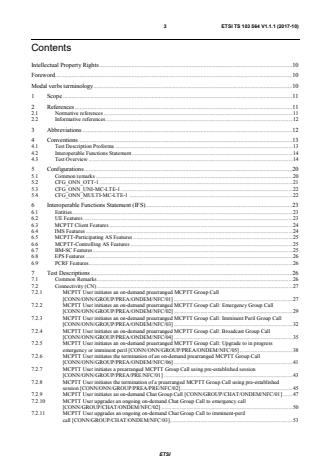
Contents
Intellectual Property Rights . 10
Foreword . 10
Modal verbs terminology . 10
1 Scope . 11
2 References . 11
2.1 Normative references . 11
2.2 Informative references . 12
3 Abbreviations . 12
4 Conventions . 13
4.1 Test Description Proforma . 13
4.2 Interoperable Functions Statement . 14
4.3 Test Overview . 14
5 Configurations . 20
5.1 Common remarks . 20
5.2 CFG_ONN_OTT-1 . 21
5.3 CFG_ONN_UNI-MC-LTE-1 . 22
5.4 CFG_ONN_MULTI-MC-LTE-1 . 22
6 Interoperable Functions Statement (IFS). 23
6.1 Entities . 23
6.2 UE Features . 23
6.3 MCPTT Client Features . 24
6.4 IMS Features . 24
6.5 MCPTT-Participating AS Features . 25
6.6 MCPTT-Controlling AS Features . 25
6.7 BM-SC Features . 25
6.8 EPS Features . 26
6.9 PCRF Features . 26
7 Test Descriptions . 26
7.1 Common Remarks . 26
7.2 Connectivity (CN) . 27
7.2.1 MCPTT User initiates an on-demand prearranged MCPTT Group Call
[CONN/ONN/GROUP/PREA/ONDEM/NFC/01] . 27
7.2.2 MCPTT User initiates an on-demand prearranged MCPTT Group Call: Emergency Group Call
[CONN/ONN/GROUP/PREA/ONDEM/NFC/02] . 29
7.2.3 MCPTT User initiates an on-demand prearranged MCPTT Group Call: Imminent Peril Group Call
[CONN/ONN/GROUP/PREA/ONDEM/NFC/03] . 32
7.2.4 MCPTT User initiates an on-demand prearranged MCPTT Group Call: Broadcast Group Call
[CONN/ONN/GROUP/PREA/ONDEM/NFC/04] . 35
7.2.5 MCPTT User initiates an on-demand prearranged MCPTT Group Call: Upgrade to in progress
emergency or imminent peril [CONN/ONN/GROUP/PREA/ONDEM/NFC/05] . 38
7.2.6 MCPTT User initiates the termination of an on-demand prearranged MCPTT Group Call
[CONN/ONN/GROUP/PREA/ONDEM/NFC/06] . 41
7.2.7 MCPTT User initiates a prearranged MCPTT Group Call using pre-established session
[CONN/ONN/GROUP/PREA/PRE/NFC/01] . 43
7.2.8 MCPTT User initiates the termination of a prearranged MCPTT Group Call using pre-established
session [CONN/ONN/GROUP/PREA/PRE/NFC/02] . 45
7.2.9 MCPTT User initiates an on-demand Chat Group Call [CONN/GROUP/CHAT/ONDEM/NFC/01] . 47
7.2.10 MCPTT User upgrades an ongoing on-demand Chat Group Call to emergency call
[CONN/GROUP/CHAT/ONDEM/NFC/02] . 50
7.2.11 MCPTT User upgrades an ongoing on-demand Chat Group Call to imminent-peril
call [CONN/GROUP/CHAT/ONDEM/NFC/03]. 53
ETSI
4 ETSI TS 103 564 V1.1.1 (2017-10)
7.2.12 MCPTT User cancels the emergency condition of an on-demand Chat Group Call
[CONN/GROUP/CHAT/ONDEM/NFC/04] . 56
7.2.13 MCPTT User cancels the imminent-peril condition of an on-demand Chat Group Call
[CONN/GROUP/CHAT/ONDEM/NFC/05] . 59
7.2.14 MCPTT User initiates a Chat group Call using pre-established session
[CONN/GROUP/CHAT/PRE/NFC/01]. 62
7.2.15 MCPTT User initiates an on-demand private MCPTT call in automatic commencement model with
floor control [CONN/PRIV/AUTO/ONDEM/WFC/NFC/01] . 65
7.2.16 MCPTT User initiates an on-demand private MCPTT call in manual commencement model with
floor control [CONN/PRIV/MANUAL/ONDEM/WFC/NFC/01] . 67
7.2.17 MCPTT User initiates a pre-established private MCPTT call in automatic commencement model
with floor control [CONN/PRIV/AUTO/PRE/WFC/NFC/01] . 68
7.2.18 MCPTT User initiates a pre-established private MCPTT call in manual commencement model with
floor control [CONN/ONN/PRIV/MANUAL/ONDEM/WFC/NFC/01] . 71
7.2.19 MCPTT User initiates an on-demand private MCPTT call in automatic commencement model
without floor control [CONN/PRIV/AUTO/ONDEM/WOFC/01] . 73
7.2.20 MCPTT User initiates an on-demand private MCPTT call in manual commencement model without
floor control [CONN/PRIV/MANUAL/ONDEM/WOFC/01] . 75
7.2.21 MCPTT User initiates a pre-established private MCPTT call in automatic commencement model
without floor control [CONN/PRIV/AUTO/PRE/WOFC/01] . 76
7.2.22 MCPTT User initiates a pre-established private MCPTT call in manual commencement model
without floor control [CONN/ONN/PRIV/M ANU AL/OND EM/W OFC/01] . 77
7.3 Floor Controlling (FC) . 78
7.3.1 Basic FC functionality [FC/BASIC/01] . 78
7.3.2 Basic FC functionality. Effect of Priorities. [FC/BASIC/02] . 81
7.4 Registration and Service Authorization (RegAuth) . 84
7.4.1 MCPTT User authenticates to the IdMS [REGAUTH/IDMSAUTH/01] . 84
7.4.2 MCPTT User gets registered and authorized using third-party registration
[REGAUTH/3PRTYREG/REGISTER/01] . 86
7.4.3 MCPTT User gets authorized using PUBLISH mechanism [REGAUTH/PUBLISH/REGISTER/01] . 88
7.5 Policing (PCC) . 90
7.5.1 Setup of an Unicast MC Bearer by SIP Core/IMS [PCC/BEARERSETUP/01] . 90
7.5.2 Setup of an Unicast MC Bearer by MCPTT Participating AS [PCC/BEARERSETUP/02] . 93
7.5.3 Update of an Unicast MC Bearer by SIP Core/IMS [PCC/BEARERUPDATE/01] . 96
7.5.4 Update of an Unicast MC Bearer by MCPTT Participating AS [PCC/BEARERUPDATE/02] . 98
7.6 eMBMS (EMBMS) . 99
7.6.1 void . 99
7.6.2 Use of dynamically established MBMS bearers in prearranged MCPTT group calls with pre-
allocated TMGIs [EMBMS/ACTIVATEBEARER/WPRETMGI/01] . 99
7.6.3 Use of dynamically established MBMS bearers in prearranged MCPTT group calls without pre-
allocated TMGIs [EMBMS/ACTIVATEBEARER/WOPRETMGI/01] . 105
7.6.4 Use of pre-established MBMS bearers in prearranged group calls with pre-allocated TMGIs
[EMBMS/PREBEARER/WPRETMGI/01] . 108
7.6.5 Use of pre-established MBMS bearers in prearranged group calls without pre-allocated TMGIs
[EMBMS/PREBEARER/WOPRETMGI/01] . 112
7.6.6 Modification of MBMS bearers upon reception of emergency upgrade request
[EMBMS/MODIFYBEARER/01] . 116
7.6.7 Deactivation of MBMS bearers after termination of a prearranged MCPTT group call with TMGI
deallocation [EMBMS/DEACTBEARE R/WT MGIDEA/01] . 118
7.6.8 Deactivation of MBMS bearers after termination of a prearranged MCPTT group call without TMGI
deallocation [EMBMS/DEACTBEARER/WOTMGIDEA/01] . 122
7.6.9 Switching to unicast bearer after TMGI expiration [EMBMS/SWITCHTOUNITMGIEXP/01] . 124
7.7 Affiliation (AFFIL) . 126
7.7.1 MCPTT User subscribes to its own affiliation [AFFIL/DET/01] . 126
7.7.2 MCPTT User subscribes to the affiliation of another user [AFFIL/DET/02] . 128
7.7.3 MCPTT User requests its affiliation to a set of groups [AFFIL/CHANGE/01] . 131
7.7.4 MCPTT User requests the affiliation of other User to a set of groups in mandatory
mode[AFFIL/CHANGE/02] . 135
7.7.5 MCPTT User requests the affiliation of other User to a set of groups in negotiated mode
[AFFIL/CHANGE/03] . 140
7.8 Location (LOC) . 146
rd
7.8.1 MCPTT Client Configuration upon 3 party register [LOC/3PRTYREG/CONFIG/01] . 146
ETSI
5 ETSI TS 103 564 V1.1.1 (2017-10)
7.8.2 Explicit Location reporting request sent to the MCPTT Client [LOC/REQUEST/01] . 148
7.8.3 MCPTT Client Location submitted upon some trigger[LOC/SUBMISSION/01] . 150
Annex A (informative): Bibliography . 153
History . 154
ETSI
6 ETSI TS 103 564 V1.1.1 (2017-10)
List of figures
Figure 1: Basic Test Infrastructure .15
Figure 2: MCPTT call types .15
Figure 3: Functional connectivity modes (figures 5.3.2.1 to 5.3.2.3 of ETSI TS 124 379 [4]) .20
Figure 4: Functional connectivity modes (figures 5.3.2.4 to 5.3.2.6 of ETSI TS 124 379 [4]) .21
Figure 5: CFG_ONN_OTT-1 Scheme .21
Figure 6: CFG_ONN_OTT-1 Interfaces for the unicast case .22
Figure 7: CFG_ONN_OTT-1 Interfaces for the multicast case .22
Figure 8: CFG_ONN_UNI-MC-LTE-1 Application plane interfaces .22
Figure 9: CFG_ONN_MULTI-MC-LTE-1 Application plane interfaces .23
Figure 10: CONN/ONN/GROUP/PREA/ONDEM/NFC/01 Message Sequence .27
Figure 11: CONN/ONN/GROUP/PREA/ONDEM/NFC/02 Message Sequence .30
Figure 12: CONN/ONN/GROUP/PREA/ONDEM/NFC/03 Message Sequence .33
Figure 13: CONN/ONN/GROUP/PREA/ONDEM/NFC/04 Message Sequence .36
Figure 14: CONN/ONN/GROUP/PREA/ONDEM/NFC/05 Message Sequence .39
Figure 15: CONN/ONN/GROUP/PREA/ONDEM/NFC/06 Message Sequence .42
Figure 16: CONN/ONN/GROUP/PREA/PRE/NFC/01 Message Sequence .44
Figure 17: CONN/ONN/GROUP/PREA/PRE/NFC/02 Message Sequence .46
Figure 18: CONN/GROUP/CHAT/ONDEM/NFC/01 Message Sequence .48
Figure 19: CONN/GROUP/CHAT/ONDEM/NFC/02 Message Sequence .51
Figure 20: CONN/GROUP/CHAT/ONDEM/NFC/03 Message Sequence .54
Figure 21: CONN/GROUP/CHAT/ONDEM/NFC/04 Message Sequence .57
Figure 22: CONN/GROUP/CHAT/ONDEM/NFC/05 Message Sequence .60
Figure 23: CONN/GROUP/CHAT/PRE/NFC/01 Message Sequence .63
Figure 24: CONN/PRIV/AUTO/ONDEM/WFC/NFC/01 Message Sequence .65
Figure 25: CONN/PRIV/MANUAL/ONDEM/WFC/NFC/01 Message Sequence .67
Figure 26: CONN/PRIV/AUTO/PRE/WFC/NFC/01 Message Sequence .69
Figure 27: CONN/ONN/PRIV/MANUAL/ONDEM/WFC/NFC/01 Message Sequence .72
Figure 28: CONN/PRIV/AUTO/ONDEM/WOFC/01 Message Sequence .74
Figure 29: FC/BASIC/01 Message Sequence .79
Figure 30: FC/BASIC/02 Message Sequence .82
Figure 31: REGAUTH/IDMSAUTH/01 Message Sequence .84
Figure 32: REGAUTH/3PRTYREG/REGISTER/01 Message Sequence .86
Figure 33: REGAUTH/PUBLISH/REGISTER/01 Message Sequence .88
ETSI
7 ETSI TS 103 564 V1.1.1 (2017-10)
Figure 34: PCC/BEARERSETUP/01 Message Sequence .91
Figure 35: PCC/BEARERSETUP/02 Message Sequence .94
Figure 36: PCC/BEARERUPDATE/01 Message Sequence .96
Figure 37: PCC/BEARERUPDATE/02 Message Sequence .98
Figure 38: EMBMS/ACTIVATEBEARER/WPRETMGI/01 Message Sequence .101
Figure 39: EMBMS/ACTIVATEBEARER/WOPRETMGI/01 Message Sequence .106
Figure 40: EMBMS/PREBEARER/WPRETMGI/01 Message Sequence .109
Figure 41: EMBMS/PREBEARER/WOPRETMGI/01 Message Sequence .113
Figure 42: EMBMS/MODIFYBEARER/01 Message Sequence .117
Figure 43: EMBMS/DEACTBEARER/WTMGIDEA/01 Message Sequence .119
Figure 44: EMBMS/DEACTBEARER/WOTMGIDEA/01 Message Sequence .122
Figure 45: EMBMS/SWITCHTOUNITMGIEXP/01 Message Sequence .124
Figure 46: AFFIL/DET/01 Message Sequence .126
Figure 47: AFFIL/DET/02 Message Sequence .129
Figure 48: AFFIL/CHANGE/01 Message Sequence .132
Figure 49: AFFIL/CHANGE/02 Message Sequence .136
Figure 50: AFFIL/CHANGE/03 Message Sequence .141
Figure 51: LOC/3PRTYREG/CONFIG/01 Message Sequence .147
Figure 52: LOC/REQUEST/01 Message Sequence .149
Figure 53: LOC/SUBMISSION/01 Message Sequence .151
ETSI
8 ETSI TS 103 564 V1.1.1 (2017-10)
List of tables
Table 1: Entities .23
Table 2: UE features .23
Table 3: MCPTT Client features .24
Table 4: IMS features .24
Table 5: MCPTT-Participating AS features .25
Table 6: MCPTT-Controlling AS features .25
Table 7: BM-SC features .25
Table 8: EPS (LTE eUTRAN + EPC) features .26
Table 9: PCRF features .26
Table 10: CONN/ONN/GROUP/PREA/ONDEM/NFC/01 .29
Table 11: CONN/ONN/GROUP/PREA/ONDEM/NFC/02 .32
Table 12: CONN/ONN/GROUP/PREA/ONDEM/NFC/03 .35
Table 13: CONN/ONN/GROUP/PREA/ONDEM/NFC/04 .38
Table 14: CONN/ONN/GROUP/PREA/ONDEM/NFC/05 .41
Table 15: CONN/ONN/GROUP/PREA/ONDEM/NFC/06 .43
Table 16: CONN/ONN/GROUP/PREA/PRE/NFC/01.45
Table 17: CONN/ONN/GROUP/PREA/PRE/NFC/02.47
Table 18: CONN/GROUP/CHAT/ONDEM/NFC/01 .50
Table 19: CONN/GROUP/CHAT/ONDEM/NFC/02 .53
Table 20: CONN/GROUP/CHAT/ONDEM/NFC/03 .56
Table 21: CONN/GROUP/CHAT/ONDEM/NFC/04 .59
Table 22: CONN/GROUP/CHAT/ONDEM/NFC/05 .62
Table 23: CONN/GROUP/CHAT/PRE/NFC/01.64
Table 24: CONN/PRIV/AUTO/ONDEM/WFC/NFC/01 .66
Table 25: CONN/PRIV/MANUAL/ONDEM/WFC/NFC/01 .68
Table 26: CONN/PRIV/AUTO/PRE/WFC/NFC/01 .71
Table 27: CONN/ONN/PRIV/MANUAL/ONDEM/WFC/NFC/01 .73
Table 28: CONN/PRIV/AUTO/ONDEM/WOFC/01 .75
Table 29: CONN/PRIV/MANUAL/ONDEM/WOFC/01 .76
Table 30: CONN/PRIV/AUTO/PRE/WOFC/01 .77
Table 31: CONN/ONN/PRIV/MAN U AL/ONDEM /WOFC/01 .78
Table 32: FC/BASIC/01 .81
Table 33: FC/BASIC/02 .83
ETSI
9 ETSI TS 103 564 V1.1.1 (2017-10)
Table 34: REGAUTH/IDMSAUTH/01 .85
Table 35: REGAUTH/3PRTYREG/REGISTER/01 .87
Table 36: REGAUTH/PUBLISH/REGISTER/01 .90
Table 37: PCC/BEARERSETUP/01 .93
Table 38: PCC/BEARERSETUP/02 .95
Table 39: PCC/BEARERUPDATE/01 .97
Table 40: PCC/BEARERUPDATE/02 .99
Table 41: EMBMS/ACTIVATEBEARER/WPRETMGI/01 .105
Table 42: EMBMS/ACTIVATEBEARER/WOPRETMGI/01 .108
Table 43: EMBMS/PREBEARER/WPRETMGI/01 .112
Table 44: EMBMS/PREBEARER/WOPRETMGI/01 .116
Table 45: EMBMS/MODIFYBEARER/01 .118
Table 46: EMBMS/DEACTBEARER/WTMGIDEA/01 .121
Table 47: EMBMS/DEACTBEARER/WOTMGIDEA/01 .123
Table 48: EMBMS/SWITCHTOUNITMGIEXP/01 .125
Table 49: AFFIL/DET/01 .128
Table 50: AFFIL/DET/02 .131
Table 51: AFFIL/CHANGE/01 .135
Table 52: AFFIL/CHANGE/02 .140
Table 53: AFFIL/CHANGE/03 .146
Table 54: LOC/3PRTYREG/CONFIG/01 .148
Table 55: LOC/REQUEST/01 .150
Table 56: LOC/SUBMISSION/01 .152
ETSI
10 ETSI TS 103 564 V1.1.1 (2017-10)
Intellectual Property Rights
Essential patents
IPRs essential or potentially essential to the present document may have been declared to ETSI. The information
pertaining to these essential IPRs, if any, is publicly available for ETSI members and non-members, and can be found
in ETSI SR 000 314: "Intellectual Property Rights (IPRs); Essential, or potentially Essential, IPRs notified to ETSI in
respect of ETSI standards", which is available from the ETSI Secretariat. Latest updates are available on the ETSI Web
server (https://ipr.etsi.org/).
Pursuant to the ETSI IPR Policy, no investigation, including IPR searches, has been carried out by ETSI. No guarantee
can be given as to the existence of other IPRs not referenced in ETSI SR 000 314 (or the updates on the ETSI Web
server) which are, or may be, or may become, essential to the present document.
Trademarks
The present document may include trademarks and/or tradenames which are asserted and/or registered by their owners.
ETSI claims no ownership of these except for any which are indicated as being the property of ETSI, and conveys no
right to use or reproduce any trademark and/or tradename. Mention of those trademarks in the present document does
not constitute an endorsement by ETSI of products, services or organizations associated with those trademarks.
Foreword
This Technical Specification (TS) has been produced by ETSI Technical Committee TETRA and Critical
Communications Evolution (TCCE).
Modal verbs terminology
In the present document "shall", "shall not", "should", "should not", "may", "need not", "will", "will not", "can" and
"cannot" are to be interpreted as described in clause 3.2 of the ETSI Drafting Rules (Verbal forms for the expression of
provisions).
"must" and "must not" are NOT allowed in ETSI deliverables except when used in direct citation.
ETSI
11 ETSI TS 103 564 V1.1.1 (2017-10)
1 Scope
The present document specifies interoperability tests with the purpose of supporting the Mission Critical Push To Talk
TM
(MCPTT) Plugtests events.
2 References
2.1 Normative references
References are either specific (identified by date of publication and/or edition number or version number) or
non-specific. For specific references, only the cited version applies. For non-specific references, the latest version of the
referenced document (including any amendments) applies.
Referenced documents which are not found to be publicly available in the expected location might be found at
https://docbox.etsi.org/Reference/.
NOTE: While any hyperlinks included in this clause were valid at the time of publication, ETSI cannot guarantee
their long term validity.
The following referenced documents are necessary for the application of the present document.
[1] ETSI TS 122 179 (V13.3.0): "Universal Mobile Telecommunications System (UMTS); LTE;
Mission Critical Push to Talk (MCPTT) over LTE; Stage 1 (3GPP TS 22.179 version 13.3.0
Release 13)".
[2] ETSI TS 123 179 (V13.4.0): "LTE; Functional architecture and information flows to support
mission critical communication services; Stage 2 (3GPP TS 23.179 version 13.4.0 Release 13)".
[3] ETSI TS 124 229 (V13.8.0): "Digital cellular telecommunications system (Phase 2+) (GSM);
Universal Mobile Telecommunications System (UMTS); LTE; IP multimedia call control protocol
based on Session Initiation Protocol (SIP) and Session Description Protocol (SDP); Stage 3
(3GPP TS 24.229 version 13.8.0 Release 13)".
[4] ETSI TS 124 379 (V13.3.0): "LTE; Mission Critical Push To Talk (MCPTT) call control; Protocol
specification (3GPP TS 24.379 version 13.3.0 Release 13)".
[5] ETSI TS 124 380 (V13.3.0): "LTE; Mission Critical Push To Talk (MCPTT) media plane control;
Protocol specification (3GPP TS 24.380 version 13.3.0 Release 13)".
[6] ETSI TS 124 481 (V13.3.0): "LTE; Mission Critical Services (MCS) group management; Protocol
specification (3GPP TS 24.481 version 13.3.0 Release 13)".
[7] ETSI TS 124 482 (V13.2.0): "LTE; Mission Critical Services (MCS) identity management;
Protocol specification (3GPP TS 24.482 version 13.2.0 Release 13)".
[8] ETSI TS 124 484 (V13.3.0): "LTE; Mission Critical Services (MCS) configuration management;
Protocol specification (3GPP TS 24.484 version 13.3.0 Release 13)".
[9] ETSI TS 126 179 (V13.2.0): "LTE; Mission Critical Push To Talk (MCPTT); Codecs and media
handling (3GPP TS 26.179 version 13.2.0 Release 13)".
[10] ETSI TS 126 346 (V13.6.0): "Universal Mobile Telecommunications System (UMTS); LTE;
Multimedia Broadcast/Multicast Service (MBMS); Protocols and codecs (3GPP TS 26.346
version 13.6.0 Release 13)".
[11] ETSI TS 129 212 (V13.8.0): "Universal Mobile Telecommunications System (UMTS); LTE;
Policy and Charging Control (PCC); Reference points (3GPP TS 29.212 version 13.8.0
Release 13)".
[12] ETSI TS 129 214 (V13.8.0): "Universal Mobile Telecommunications System (UMTS); LTE;
Policy and charging control over Rx reference point (3GPP TS 29.214 version 13.8.0 Release 13)".
ETSI
12 ETSI TS 103 564 V1.1.1 (2017-10)
[13] ETSI TS 129 468 (V13.2.0): "Universal Mobile Telecommunications System (UMTS); LTE;
Group Communication System Enablers for LTE (GCSE_LTE); MB2 reference point; Stage 3
(3GPP TS 29.468 version 13.2.0 Release 13)".
[14] ETSI TS 133 179 (V13.3.0): "LTE; Security of Mission Critical Push To Talk (MCPTT) over LTE
(3GPP TS 33.179 version 13.3.0 Release 13)".
[15] IETF RFC 3515: "The Session Initiation Protocol (SIP) Refer Method", April 2003.
[16] IETF RFC 3856: "A Presence Event Package for the Session Initiation Protocol (SIP)",
August 2004.
[17] IETF RFC 3903: "Session Initiation Protocol (SIP) Extension for Event State Publication",
October 2004.
[18] IETF RFC 5373: "Requesting Answering Modes for the Session Initiation Protocol (SIP)",
November 2008.
[19] IETF RFC 6665: "SIP-Specific Event Notification", July 2012.
[20] IETF RFC 7647: "Clarifications for the use of REFER with RFC6665", September 2015.
2.2 Informative references
References are either specific (identified by date of publication and/or edition number or version number) or
non-specific. For specific references, only the cited version applies. For non-specific references, the latest version of the
referenced document (including any amendments) applies.
NOTE: While any hyperlinks included in this clause were valid at the time of publication, ETSI cannot guarantee
their long term validity.
The following referenced documents are not necessary for the application of the present document but they assist the
user with regard to a particular subject area.
Not applicable.
3 Abbreviations
For the purposes of the present document, the following abbreviations apply:
AFFIL AFFILiation
AMR Adaptative Multi-Rate audio codec
AMR-WB Adaptative Multi-Rate audio codec Wideband
APN Access Point Name
APP Application
AS Application Server
AVP Attribute-Value Pairs
BM-SC Broadcast Multicast Service Centre
CMS Configuration Management Server
CN CoNnectivity
CONN CONNectivity
CSC Common Services Core
CSCF Call Session Control Function
DUT Device Under Test
EMBMS evolved Multimedia Broadcast Multicast Service
EPC Evolved Packet Core
EPS Evolved Packet System
EPS_GX Policy and charging control over Gx reference point
EUT Equipment Under Test
EUTRAN Evolved Universal Terrestrial Radio Access Network
EVS Enhanced Voice Services
ETSI
13 ETSI TS 103 564 V1.1.1 (2017-10)
FC Floor Control
GCSE Group Communication Service Enabler
GMS Group Management Server
IdMS Identity Management Server
IFS Interoperable Functions Statement
IMPU IP Multimedia PUblic identity
IMS IP Multimedia Subsystem
IMS_RX Policy and charging control over Rx reference point
IP Internet Protocol
KMS Key Management Server
LOC Location
LTE-A LTE-Advanced
MBMS Multimedia Broadcast and Multicast Service
MC Multicast
MCC Mission Critical Communication
MCMC Mission Critical MBMS subchannel Control Protocol
MCPC Mission Critical MBMS subchannel Control Protocol
MCPTT ID MCPTT user identity
MCPTT Mission Critical Push-To-Talk
MNC Mobile Network Code
NFC No Floor Control
OAM Operation And Maintenance
ONN ON Network calls
OTT Over The Top
PCC Policy and Charging Control
PCRF Policy and Charging Rules Function
PCSCF Proxy Call Session Control Function
PSAP Public Safety Answering Point
PSI Public Service Identity
PTT Push-To-Talk
QCI QoS Class Identifier
RTP Real-time Transport Protocol
RX Rx Reference Point
SIP Session Initiation Protocol
SUT System Under Test
TD Test Description
TMGI Temporary Mobile Group Identity
TR Technical Report
TS Technical Specification
UE User Equipment
UMTS Universal Mobile Telecommunications System
URI Uniform Resource Identifier
WFC With Floor Control
4 Conventions
4.1 Test Description Proforma
A Test Description (TD) is a detailed description of the process that needs to be followed to test one or more inter
operable functionalities between two or more vendor implementations. A TD should include as a minimum the
following elements: The following different types are defined.
ETSI
14 ETSI TS 103 564 V1.1.1 (2017-10)
Interoperability Test Description
Identifier a unique test description identifier should follow a well-defined naming convention,
e.g.: TD/AB/XX/00
Test Objective a concise summary of the test, which should reflect its purpose and allow readers to
easily distinguish this test from any other test in the present document
Configuration(s) • list of all the required equipment for running this test, possibly also including a
(reference to) an illustration of a test architecture or test configuration
References
• list of references to the base specification section(s), use case(s),
requirement(s), etc. which are either used in the test or define the functionality
being tested
Applicability
• list of features and capabilities in the IFS which are required to be supported by
the SUT in order to execute this test (e.g. if this list contains an optional feature
to be supported, then the test is optional)
• list of test specific pre-conditions that need to be met by the SUT including
Pre-test conditions
information about equipment configuration, i.e. precise description of the initial
state of the SUT prior to start executing the test sequence
Step Type Description
Test Sequence
1 step description
Notes
• optional list of explanatory notes
• A stimulus corresponds to an event that triggers an EUT t
...
Questions, Comments and Discussion
Ask us and Technical Secretary will try to provide an answer. You can facilitate discussion about the standard in here.
Loading comments...