


EN 62014-1:2002
(Main)Electronic design automation libraries - Part 1: Input/Output buffer information specifications (IBIS version 3.2)
General Information
- Abstract
Gives specifications for electronic behavioral of digital integrated circuit input/ output analog characteristics. It specifies a consistent software-parsable format for essential behavioral information. The goal of this standard is to support all simulators of all degrees of sophistication.
- Status
- Withdrawn
- Publication Date
- 10-Jan-2002
- Technical Committee
- CLC/SR 91 - Electronics assembly technology
- Drafting Committee
- IEC/TC 93 - IEC_TC_93
- Parallel Committee
- IEC/TC 93 - IEC_TC_93
- Current Stage
- 9960 - Withdrawal effective - Withdrawal
- Start Date
- 13-Nov-2019
- Completion Date
- 25-Aug-2026

Get Certified
Connect with accredited certification bodies for this standard

DVS-ZERT GmbH
German welding certification society.
CARES (UK Certification Authority for Reinforcing Steels)
UK certification for reinforcing steels and construction.
EWF/IIW (European/International Welding Federation)
International welding personnel certification.
Sponsored listings
Frequently Asked Questions
EN 62014-1:2002 is a standard published by CLC. Its full title is "Electronic design automation libraries - Part 1: Input/Output buffer information specifications (IBIS version 3.2)". This standard covers: Gives specifications for electronic behavioral of digital integrated circuit input/ output analog characteristics. It specifies a consistent software-parsable format for essential behavioral information. The goal of this standard is to support all simulators of all degrees of sophistication.
Gives specifications for electronic behavioral of digital integrated circuit input/ output analog characteristics. It specifies a consistent software-parsable format for essential behavioral information. The goal of this standard is to support all simulators of all degrees of sophistication.
EN 62014-1:2002 is classified under the following ICS (International Classification for Standards) categories: 25.040 - Industrial automation systems. The ICS classification helps identify the subject area and facilitates finding related standards.
EN 62014-1:2002 is available in PDF format for immediate download after purchase. The document can be added to your cart and obtained through the secure checkout process. Digital delivery ensures instant access to the complete standard document.
Standards Content (Sample)
SLOVENSKI STANDARD
01-september-2002
Electronic design automation libraries - Part 1: Input/Output buffer information
specifications (IBIS version 3.2) (IEC 62014-1:2001)
Electronic design automation libraries -- Part 1: Input/Output buffer information
specifications (IBIS version 3.2)
Bibliotheken für die Entwurfsautomatisierung -- Teil 1: Spezifikation von Eigenschaften
von I/O Buffern (IBIS Version 3.2)
Automatisation de la conception - Bibliothèques -- Partie 1: Spécifications des
informations en entrée/sortie des circuits tampon (IBIS version 3.2)
Ta slovenski standard je istoveten z: EN 62014-1:2002
ICS:
31.200 Integrirana vezja, Integrated circuits.
mikroelektronika Microelectronics
35.240.50 Uporabniške rešitve IT v IT applications in industry
industriji
2003-01.Slovenski inštitut za standardizacijo. Razmnoževanje celote ali delov tega standarda ni dovoljeno.
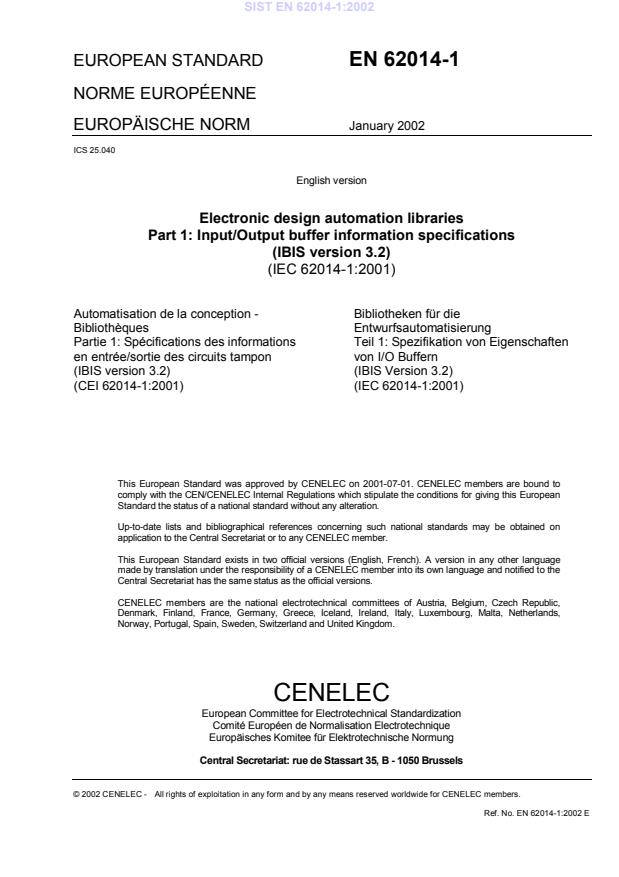
EUROPEAN STANDARD EN 62014-1
NORME EUROPÉENNE
EUROPÄISCHE NORM January 2002
ICS 25.040
English version
Electronic design automation libraries
Part 1: Input/Output buffer information specifications
(IBIS version 3.2)
(IEC 62014-1:2001)
Automatisation de la conception - Bibliotheken für die
Bibliothèques Entwurfsautomatisierung
Partie 1: Spécifications des informations Teil 1: Spezifikation von Eigenschaften
en entrée/sortie des circuits tampon von I/O Buffern
(IBIS version 3.2) (IBIS Version 3.2)
(CEI 62014-1:2001) (IEC 62014-1:2001)
This European Standard was approved by CENELEC on 2001-07-01. CENELEC members are bound to
comply with the CEN/CENELEC Internal Regulations which stipulate the conditions for giving this European
Standard the status of a national standard without any alteration.
Up-to-date lists and bibliographical references concerning such national standards may be obtained on
application to the Central Secretariat or to any CENELEC member.
This European Standard exists in two official versions (English, French). A version in any other language
made by translation under the responsibility of a CENELEC member into its own language and notified to the
Central Secretariat has the same status as the official versions.
CENELEC members are the national electrotechnical committees of Austria, Belgium, Czech Republic,
Denmark, Finland, France, Germany, Greece, Iceland, Ireland, Italy, Luxembourg, Malta, Netherlands,
Norway, Portugal, Spain, Sweden, Switzerland and United Kingdom.
CENELEC
European Committee for Electrotechnical Standardization
Comité Européen de Normalisation Electrotechnique
Europäisches Komitee für Elektrotechnische Normung
Central Secretariat: rue de Stassart 35, B - 1050 Brussels
© 2002 CENELEC - All rights of exploitation in any form and by any means reserved worldwide for CENELEC members.
Ref. No. EN 62014-1:2002 E
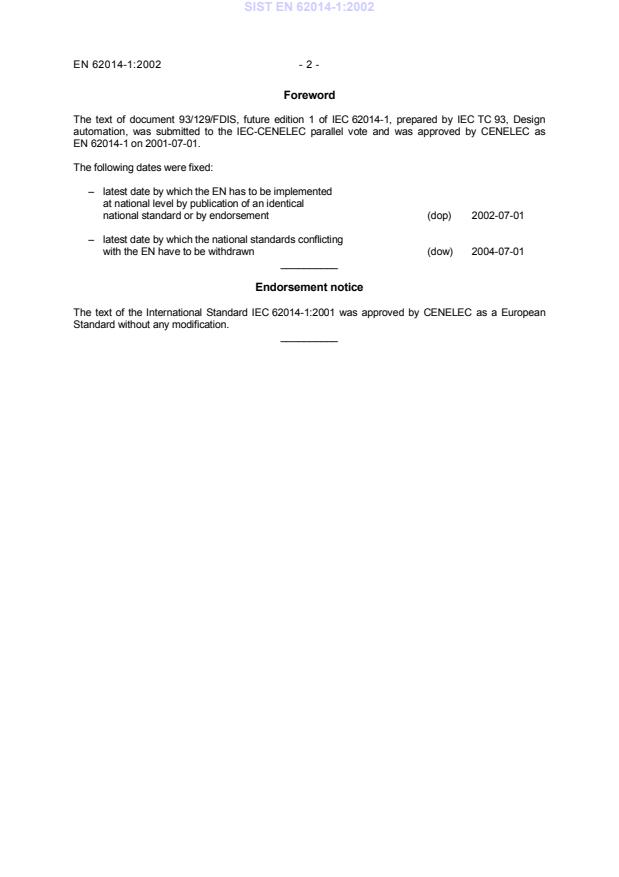
Foreword
The text of document 93/129/FDIS, future edition 1 of IEC 62014-1, prepared by IEC TC 93, Design
automation, was submitted to the IEC-CENELEC parallel vote and was approved by CENELEC as
EN 62014-1 on 2001-07-01.
The following dates were fixed:
– latest date by which the EN has to be implemented
at national level by publication of an identical
national standard or by endorsement (dop) 2002-07-01
– latest date by which the national standards conflicting
with the EN have to be withdrawn (dow) 2004-07-01
__________
Endorsement notice
The text of the International Standard IEC 62014-1:2001 was approved by CENELEC as a European
Standard without any modification.
__________
INTERNATIONAL IEC
STANDARD
62014-1
First edition
2001-05
Electronic design automation libraries –
Part 1:
Input/output buffer information specifications
(IBIS version 3.2)
IEC 2001 Copyright - all rights reserved
No part of this publication may be reproduced or utilized in any form or by any means, electronic or
mechanical, including photocopying and microfilm, without permission in writing from the publisher.
International Electrotechnical Commission 3, rue de Varembé Geneva, Switzerland
Telefax: +41 22 919 0300 e-mail: inmail@iec.ch IEC web site http://www.iec.ch
Commission Electrotechnique Internationale
PRICE CODE
XC
International Electrotechnical Commission
For price, see current catalogue
− 2 − 62014-1 IEC:2001(E)
CONTENTS
Page
FOREWORD . 3
INTRODUCTION . 5
Scope and object . 7
Section 1: General introduction . 8
Section 2: Statement of intent . 9
Section 3: General syntax rules and guidelines. 11
Section 4: File header information . 13
Section 5: Component description. 15
Section 6: Model statement. 24
Section 6a: Add submodel description . 50
Section 7: Package modeling . 60
Section 8: Electrical board description. 72
Section 9: Notes on data derivation method . 80
62014-1 © IEC:2001 – 3 –
INTERNATIONAL ELECTROTECHNICAL COMMISSION
____________
ELECTRONIC DESIGN AUTOMATION LIBRARIES-
Part 1: Input/output buffer information specifications
( IBIS version 3.2 )
FOREWORD
1) The IEC (International Electrotechnical Commission) is a worldwide organization for standardization comprising all
national electrotechnical committees (IEC National Committees). The object of the IEC is to promote international co-
operation on all questions concerning standardization in the electrical and electronic fields. To this end and in addition to
other activities, the IEC publishes International Standards. Their preparation is entrusted to technical committees; any IEC
National Committee interested in the subject dealt with may participate in this preparatory work. International,
governmental and non-governmental organizations liaising with the IEC also participate in this preparation. The IEC
collaborates closely with the International Organization for Standardization (ISO) in accordance with conditions
determined by agreement between the two organizations.
2) The formal decisions or agreements of the IEC on technical matters express, as nearly as possible, an international
consensus of opinion on the relevant subjects since each technical committee has representation from all interested
National Committees.
3) The documents produced have the form of recommendations for international use and are published in the form of
standards, technical specifications, technical reports or guides and they are accepted by the National Committees in that
sense.
4) In order to promote international unification, IEC National Committees undertake to apply IEC International Standards
transparently to the maximum extent possible in their national and regional standards. Any divergence between the IEC
Standard and the corresponding national or regional standard shall be clearly indicated in the latter.
5) The IEC provides no marking procedure to indicate its approval and cannot be rendered responsible for any equipment
declared to be in conformity with one of its standards.
6) Attention is drawn to the possibility that some of the elements of this International Standard may be the subject of patent
rights. The IEC shall not be held responsible for identifying any or all such patent rights.
International Standard IEC 62014-1 has been prepared by IEC technical committee 93: Design
Automation
This standard is based on ANSI-EIA-656-A (September 1999): I/O buffer information specifications
(IBIS) version 3.2
The text of this standard is based on the following documents:
FDIS Report on voting
93/129/FDIS 93/136/RVD
Full information on the voting for the approval of this standard can be found in the report on voting
indicated in the above table.
This standard does not follow the rules for the structure of international standards given in Part 3 of
the ISO/IEC Directives.
IEC 62014 consists of the following parts:
IEC 62014-1, Electronic design automation libraries – Part 1: Input/Output buffer information
specifications (IBIS version 3.2)
IEC 62014-2, Electronic design automation libraries – Part 2: Library standard architectures
(TR)(under consideration)
Electronic design automation libraries – Part 3: Modules of integrated circuits for EMI
IEC 62014-3,
Behavioural simulation (under consideration )
− 4 − 62014-1 IEC:2001(E)
The committee has decided that the contents of this publication will remain unchanged until 2004. At
this date, the publication will be
reconfirmed;
withdrawn;
replaced by a revised edition, or
amended.
62014-1 © IEC:2001 – 5 –
INTRODUCTION
Background of IBIS
IBIS was first developed at Intel Corporation and has been expanded to its current form (Version 3.2)
through the cooperative efforts of additional analog simulator vendors, computer manufacturers, IC
vendors, commercial users, and universities. In May 1993, the group formed itself into the IBIS Open
Forum, an open, voluntary, cooperative association. In March 1995, the group affiliated with the EIA
(now the Electronic Industries Alliance) as the EIA IBIS Open Forum.
The Forum has been and continues to meet via teleconference approximately every third week to
propose updates to the IBIS standard, to help new participants, and to advance the standard. The Forum
also meets in person about four times a year to exchange ideas and conduct official business.
Most of the Forum activities are handled through e-mail discussions using a reflector "ibis@eda.org." A
users group reflector "ibis-users@eda.org" is also supported for users of IBIS. One can get more
information on subscribing to the reflectors and to other ongoing Forum activities through the official
web page: "http://www.eigroup.org/ibis/ibis.htm". The process of making changes and improvements to
IBIS is through a "BIRD" (Buffer Issue Resolution
Document) process involving approval by the Forum voting members. Over the years the Forum has
grown to over thirty voting members (requiring a modest yearly fee for administrative support), but the
Forum also maintains an open, public communications policy and welcomes all interested participants
regardless of membership status.
Through official EIA and ANSI (American National Standards Institution) public letter ballot
processes, IBIS Version 2.1 was ratified as ANSI/EIA-656 in December 13, 1995. Version 1.1 of IBIS
focused on TTL and CMOS logic components. Although never officially ratified as a national standard,
IBIS Version 1.1 served as a basis for advances in Version 2.1 to increase its accuracy and number of
device types that are supported.
Version 2.1 contains the following advances:
– Controlled slew rate devices
– ECL and PECL technologies
– Independent control over power rails so RS232 and other types of devices with multiple rails can be
modeled
– Differential drivers and devices
– Open-drain I/O devices such as open drain and open collector devices
– Expanded package model definitions to include coupling between pins.
The Forum also voluntarily funded a parser development activity through the sale of source code
licenses of "ibischk2" and has made executables of the parser code freely and publicly available to
enable IBIS model checking.
Industrial advances associated with new semiconductor topologies, package design and measurement
needs kept the Forum busy proposing new capabilities, eventually leading to IBIS Version 3.2. Again
through official EIA and ANSI public letter ballot processes, IBIS Version 3.2 was ratified as
ANSI/EIA-656-A on September 21, 1999.
Its advances include the following:
– Series and series switch models
– Multi-stage driver capability for phased stages
− 6 − 62014-1 IEC:2001(E)
– Submodel capability supporting dynamic clamps and bus hold functions for active and dynamic
terminations
– More specification values for overshoot and pulse immunity
– Uncoupled packages with sections and forks
– Uncoupled advanced packages known as electrical board descriptions with sections, forks and on-
board components.
IBIS Version 3.2 has complied with an original Forum objective that all subsequent versions of IBIS be
backward compatible with previous versions.
The Forum funded through voluntary source code license purchases the corresponding "ibischk3" parser
and has made its executables freely available.
The IBIS Standard has achieved wide spread national and international support and recognition as
indicated by over 40 semiconductor vendors providing IBIS models freely from their web sites. Many
more IBIS models and libraries are available from commercial vendors and directly through IC vendor
sales organizations. While IBIS models can be of value in all phases of a design and analysis process,
they are particularly suitable for printed circuit board design tools used in conjunction with the
corresponding physical and mechanical data bases describing the boards.
Future IBIS Directions
Technology continues to advance, forcing more stringent electrical requirements and newer ways of
doing things. The Forum is keeping up with such advances. However, its strategy has shifted. Up to now
the Forum has been adding to the existing fixed-format IBIS document. Such a process is slow and
subject to unexpected interactions with existing capability. The newer approach is to create a
compatible macro-language that allows more rapid reconfiguration and response to changing needs.
While the Forum has not yet ratified any of these approaches, it is pursuing these projects:
– A macro-language that fully supports IBIS Version 3.2 but can also support more advanced features
and nodal component structures
– A separate Connector Specification with advanced coupled stages to support key component used to
connect printed circuit boards (and possibly be used for more advanced package models)
– Some further advances in specification details beyond IBIS Version 3.2.
These projects advance the capability of IBIS in a manner that supports the existing IBIS Version 3.2
functionality, but also allows for much more rapid implementation of new requirements.
References
ANSI/EIA-656: IBIS Version 2.1 released December 13, 1995
ANSI/EIA-656-A: IBIS Version 3.2 released September 21, 1999
62014-1 © IEC:2001 – 7 –
ELECTRONIC DESIGN AUTOMATION LIBRARIES –
Part 1: Input/output buffer information specifications
( IBIS version 3.2 )
Scope and object
This standard gives specifications for electronic behavioral of digital integrated circuit input/ output
analog characteristics. It specifies a consistent software-parsable format for essential behavioral
information.
The goal of this standard is to support all simulators of all degrees of sophistication.
- 8 - 62014-1 © IEC:2001(E)
|
Section 1
|
| G E N E R A L I N T R O D U C T I O N
|
|=============================================================================
|=============================================================================
|
| This section gives a general overview of the remainder of this document.
|
| Sections 2 and 3 contain general information about the IBIS versions and
| the general rules and guidelines. Several progressions of IBIS documents
| are referenced in Section 2 and in the discussion below. They are IBIS
| Version 1.1 (ratified August, 1993), IBIS Version 2.1 (ratified as
| ANSI/EIA-656 in December, 1995), and IBIS Version 3.2 (this document
| ratified in August, 1999).
|
| The functionality of IBIS follows in Sections 4 through 8. Sections 4
| through 6 describe the format of the core functionality of IBIS Version 1.1
| and the extensions in later versions. The data in these sections are
| contained in .ibs files. Section 7 describes the package model format of
| IBIS Version 2.1 and a subsequent extension. Package models can be
| formatted within .ibs files or can be formatted (along with the Section 4
| file header keywords) as .pkg files. Section 8 contains the Electrical
| Board Description format of IBIS Version 3.2. Along with Section 4 header
| information, electrical board descriptions must be described in separate
| .ebd files.
|
| Section 9 contains some notes regarding the extraction conditions and data
| requirements for IBIS files. This section focuses on implementation
| conditions based on measurement or simulation for gathering the IBIS
| compliant data.
|
|=============================================================================
62014-1 © IEC:2001(E) – 9 –
|=============================================================================
|
Section 2
|
| S T A T E M E N T O F I N T E N T
|
|=============================================================================
|=============================================================================
|
| In order to enable an industry standard method to electronically transport
| IBIS Modeling Data between semiconductor vendors, simulation vendors, and
| end customers, this template is proposed. The intention of this template is
| to specify a consistent format that can be parsed by software, allowing
| simulation vendors to derive models compatible with their own products.
|
| One goal of this template is to represent the current state of IBIS data,
| while allowing a growth path to more complex models / methods (when deemed
| appropriate). This would be accomplished by a revision of the base
| template, and possibly the addition of new keywords or categories.
|
| Another goal of this template is to ensure that it is simple enough for
| semiconductor vendors and customers to use and modify, while ensuring that
| it is rigid enough for simulation vendors to write reliable parsers.
|
| Finally, this template is meant to contain a complete description of the I/O
| elements on an entire component. Consequently, several models will need to
| be defined in each file, as well as a table that equates the appropriate
| buffer to the correct pin and signal name.
|
| Version 3.2 of this electronic template was finalized by an industry-wide
| group of experts representing various companies and interests. Regular
| "EIA IBIS Open Forum" meetings were held to accomplish this task.
|
| Commitment to Backward Compatibility. Version 1.0 is the first valid IBIS
| ASCII file format. It represents the minimum amount of I/O buffer
| information required to create an accurate IBIS model of common CMOS and
| bipolar I/O structures. Future revisions of the ASCII file will add items
| considered to be "enhancements" to Version 1.0 to allow accurate modeling
| of new, or other I/O buffer structures. Consequently, all future revisions
| will be considered supersets of Version 1.0, allowing backward
| compatibility. In addition, as modeling platforms develop support for
| revisions of the IBIS ASCII template, all previous revisions of the template
| must also be supported.
|
| Version 1.1 update. The file "ver1_1.ibs" is conceptually the same as the
| 1.0 version of the IBIS ASCII format (ver1_0.ibs). However, various
| comments have been added for further clarification.
|
| Version 2.0 update. The file "ver2_0.ibs" maintains backward compatibility
| with Versions 1.0 and 1.1. All new keywords and elements added in Version
| 2.0 are optional. A complete list of changes to the specification is in the
| IBIS Version 2.0 Release Notes document ("ver2_0.rn").
|
| Version 2.1 update. The file "ver2_1.ibs" contains clarification text
| changes, corrections, and two additional waveform parameters beyond
| Version 2.0.
1:
|
| Version 3.0 update. The file "ver3_0.ibs" adds a number of new keywords
| and functionality. A complete list of functions can be found on eda.org
| under /pub/ibis/birds/birddir.txt showing the approved Buffer Issue
| Resolution Documents (BIRDs) that have been approved for Version 3.0.
|
| Version 3.1 update. The file "ver3_1.ibs" contains a major reformatting of
| the document and a simplification of the wording. It also contains some
| new technical enhancements that were unresolved when Version 3.0 was
| approved.
|
| Version 3.2 update. The file "ver3_2.ibs" adds more technical advances and
| also a number of editorial changes documented in 12 BIRDs and also in
| responses to public letter ballot comments.
|
|=============================================================================
- 10 - 62014-1 © IEC 200 (E)
111:
|=============================================================================
|
Section 3
|
| G E N E R A L S Y N T A X R U L E S A N D G U I D E L I N E S
|
|=============================================================================
|=============================================================================
|
| This section contains general syntax rules and guidelines for ASCII IBIS
| files:
|
| 1) The content of the files is case sensitive, except for reserved
| words and keywords.
|
| 2) The following words are reserved words and must not be used for
| any other purposes in the document:
| POWER - reserved model name, used with power supply pins,
| GND - reserved model name, used with ground pins,
| NC - reserved model name, used with no-connect pins,
| NA - used where data not available.
|
| 3) To facilitate portability between operating systems, file names used in
| the IBIS file must only have lower case characters. File names should
| have a basename of no more than twenty characters followed by a period
| ('.') , followed by a file name extension of no more than three
| characters. The file name and extension must use characters from the
| set (space, ' ', 0x20 is not included):
|
| a b c d e f g h i j k l m n o p q r s t u v w x y z
| 0 1 2 3 4 5 6 7 8 9 _ ^ $ ~ ! # % & - { } ) ( @ ' `
|
| The file name and extension are recommended to be lower case on
| systems that support such names.
|
| 4) A line of the file may have at most 80 characters, followed by a line
| termination sequence. The line termination sequence must be one of the
| following two sequences: a linefeed character, or a carriage return
| followed by linefeed character.
|
| 5) Anything following the comment character is ignored and considered a
| comment on that line. The default "|" (pipe) character can be changed
| by the keyword [Comment Char] to any other character. The [Comment Char]
| keyword can be used throughout the file as desired.
|
| 6) Keywords must be enclosed in square brackets, [], and must start in
| column 1 of the line. No space or tab is allowed immediately after the
| opening bracket '[' or immediately before the closing bracket ']'. If
| used, only one space (' ') or underscore ('_') character separates the
| parts of a multi-word keyword.
|
| 7) Underscores and spaces are equivalent in keywords. Spaces are not
| allowed in subparameter names.
|
62014-1 © IEC 200 (E) - -
| 8) Valid scaling factors are:
| T = tera k = kilo n = nano
| G = giga m = milli p = pico
| M = mega u = micro f = femto
| When no scaling factors are specified, the appropriate base units are
| assumed. (These are volts, amperes, ohms, farads, henries, and
| seconds.) The parser looks at only one alphabetic character after a
| numerical entry, therefore it is enough to use only the prefixes to
| scale the parameters. However, for clarity, it is allowed to use full
| abbreviations for the units, (e.g., pF, nH, mA, mOhm). In addition,
| scientific notation IS allowed (e.g., 1.2345e-12).
|
| 9) The I-V data tables should use enough data points around sharply curved
| areas of the I-V curves to describe the curvature accurately. In linear
| regions there is no need to define unnecessary data points.
|
| 10) The use of tab characters is legal, but they should be avoided as much
| as possible. This is to eliminate possible complications that might
| arise in situations when tab characters are automatically converted to
| multiple spaces by text editing, file transferring and similar software.
| In cases like that, lines might become longer than 80 characters, which
| is illegal in IBIS files.
|
| 11) Currents are considered positive when their direction is into the
| component.
|
| 12) All temperatures are represented in degrees Celsius.
|
| 13) Important supplemental information is contained in the last section,
| "NOTES ON DATA DERIVATION METHOD", concerning how data values are
| derived.
|
| 14) Only ASCII characters, as defined in ANSI Standard X3.4-1986, may be
| used in an IBIS file. The use of characters with codes greater than
| hexadecimal 07E is not allowed. Also, ASCII control characters
| (those numerically less than hexadecimal 20) are not allowed, except
| for tabs or in a line termination sequence. As mentioned in item 10
| above, the use of tab characters is discouraged.
|
|=============================================================================
- 12 - 62014-1 © IEC :2 001 (E)
31 :
|=============================================================================
|
Section 4
|
| F I L E H E A D E R I N F O R M A T I O N
|
|=============================================================================
|=============================================================================
| Keyword: [IBIS Ver]
| Required: Yes
| Description: Specifies the IBIS template version. This keyword informs
| electronic parsers of the kinds of data types that are
| present in the file.
| Usage Rules: [IBIS Ver] must be the first keyword in any IBIS file. It is
| normally on the first line of the file, but can be preceded
| by comment lines that must begin with a "|".
|-----------------------------------------------------------------------------
[IBIS Ver] 3.2 | Used for template variations
|
|=============================================================================
| Keyword: [Comment Char]
| Required: No
| Description: Defines a new comment character to replace the default
| "|" (pipe) character, if desired.
| Usage Rules: The new comment character to be defined must be followed by
| the underscore character and the letters "char". For example:
| "|_char" redundantly redefines the comment character to be
| the pipe character. The new comment character is in effect
| only following the [Comment Char] keyword. The following
| characters MAY be used:
|
| ! " # $ % & ' ( ) * , : ; < > ? @ \ ^ ` { | } ~
|
| Other Notes: The [Comment Char] keyword can be used throughout the file, as
| desired.
|-----------------------------------------------------------------------------
[Comment Char] |_char
|
|=============================================================================
| Keyword: [File Name]
| Required: Yes
| Description: Specifies the name of the IBIS file.
| Usage Rules: The file name must conform to the rules in paragraph 3 of
| Section 3, "GENERAL SYNTAX RULES AND GUIDELINES". In
| addition, the file name must use the extension ".ibs", ".pkg",
| or ".ebd". The file name must be the actual name of the file.
|-----------------------------------------------------------------------------
[File Name] ver3_2.ibs
|
|=============================================================================
| Keyword: [File Rev]
| Required: Yes
| Description: Tracks the revision level of a particular .ibs file.
| Usage Rules: Revision level is set at the discretion of the engineer
| defining the file. The following guidelines are recommended:
62014-1 © IEC 20 01 (E) - -
)1--
| 0.x silicon and file in development
| 1.x pre-silicon file data from silicon model only
| 2.x file correlated to actual silicon measurements
| 3.x mature product, no more changes likely
|-----------------------------------------------------------------------------
[File Rev] 1.0 | Used for .ibs file variations
|
|=============================================================================
| Keywords: [Date], [Source], [Notes], [Disclaimer], [Copyright]
| Required: No
| Description: Optionally clarifies the file.
| Usage Rules: The keyword arguments can contain blanks, and be of any
| format. The [Date] keyword argument is limited to a maximum
| of 40 characters, and the month should be spelled out for
| clarity.
|
| Because IBIS model writers may consider the information in
| these keywords essential to users, and sometimes legally
| required, design automation tools should make this information
| available. Derivative models should include this text
| verbatim. Any text following the [Copyright] keyword must be
| included in any derivative models verbatim.
|-----------------------------------------------------------------------------
[Date] August 20, 1999 | The latest file revision date
|
[Source] Put originator and the source of information here. For
example:
From silicon level SPICE model at Intel.
From lab measurement at IEI.
Compiled from manufacturer's data book at Quad Design, etc.
|
[Notes] Use this section for any special notes related to the file.
|
[Disclaimer] This information is for modeling purposes only, and is not
guaranteed. | May vary by component
|
[Copyright] Copyright 1999, XYZ Corp., All Rights Reserved
|
|=============================================================================
1 4 62014-1 © IEC :2 00 (E
5 1
|=============================================================================
|
Section 5
|
| C O M P O N E N T D E S C R I P T I O N
|
|=============================================================================
|=============================================================================
| Keyword: [Component]
| Required: Yes
| Description: Marks the beginning of the IBIS description of the integrated
| circuit named after the keyword.
| Sub-Params: Si_location, Timing_location
| Usage Rules: If the .ibs file contains data for more than one component,
| each section must begin with a new [Component] keyword. The
| length of the component name must not exceed 40 characters,
| and blank characters are allowed.
|
| NOTE: Blank characters are not recommended due to usability
| issues.
|
| Si_location and Timing_location are optional and specify where
| the Signal Integrity and Timing measurements are made for the
| component. Allowed values for either subparameter are 'Die'
| or 'Pin'. The default location is at the 'Pin'.
|-----------------------------------------------------------------------------
[Component] 7403398 MC452
|
Si_location Pin | Optional subparameters to give measurement
Timing_location Die | location positions
|
|=============================================================================
| Keyword: [Manufacturer]
| Required: Yes
| Description: Specifies the manufacturer's name of the component.
| Usage Rules: The length of the manufacturer's name must not exceed 40
| characters (blank characters are allowed, e.g., Texas
| Instruments). In addition, each manufacturer must use a
| consistent name in all .ibs files.
|-----------------------------------------------------------------------------
[Manufacturer] Intel Corp.
|
|=============================================================================
| Keyword: [Package]
| Required: Yes
| Description: Defines a range of values for the default packaging
| resistance, inductance, and capacitance of the component pins.
| Sub-Params: R_pkg, L_pkg, C_pkg
| Usage Rules: The typical (typ) column must be specified. If data for the
| other columns are not available, they must be noted with "NA".
| Other Notes: If RLC parameters are available for individual pins, they can
| be listed in columns 4-6 under keyword [Pin]. The values
| listed in the [Pin] description section override the default
| values defined here. Use the [Package Model] keyword for more
| complex package descriptions. If defined, the [Package Model]
| data overrides the values in the [Package] keyword.
62014-1 © IEC :2 00 (E) - 1 -
1: 61
| Regardless, the data listed under the [Package] keyword must
| still contain valid data.
|-----------------------------------------------------------------------------
[Package]
| variable typ min max
R_pkg 250.0m 225.0m 275.0m
L_pkg 15.0nH 12.0nH 18.0nH
C_pkg 18.0pF 15.0pF 20.0pF
|
|=============================================================================
| Keyword: [Pin]
| Required: Yes
| Description: Associates the component's I/O models to its various external
| pin names and signal names.
| Sub-Params: signal_name, model_name, R_pin, L_pin, C_pin
| Usage Rules: All pins on a component must be specified. The first column
| must contain the pin name. The second column, signal_name,
| gives the data book name for the signal on that pin. The
| third column, model_name, maps a pin to a specific I/O buffer
| model or model selector name. Each model_name must have a
| corresponding model or model selector name listed in a [Model]
| or [Model Selector] keyword below, unless it is a reserved
| model name (POWER, GND, or NC).
|
| Each line must contain either three or six columns. A pin
| line with three columns only associates the pin's signal and
| model. Six columns can be used to override the default
| package values (specified under [Package]) FOR THAT PIN ONLY.
| When using six columns, the headers R_pin, L_pin, and C_pin
| must be listed. If "NA" is in columns 4 through 6, the
| default packaging values must be used. The headers R_pin,
| L_pin, and C_pin may be listed in any order.
|
| Column length limits are:
| [Pin] 5 characters max
| model_name 20 characters max
| signal_name 20 characters max
| R_pin 9 characters max
| L_pin 9 characters max
| C_pin 9 characters max
|-----------------------------------------------------------------------------
[Pin] signal_name model_name R_pin L_pin C_pin
|
1 RAS0# Buffer1 200.0m 5.0nH 2.0pF
2 RAS1# Buffer2 209.0m NA 2.5pF
3 EN1# Input1 NA 6.3nH NA
4 A0 3-state
5 D0 I/O1
6 RD# Input2 310.0m 3.0nH 2.0pF
7 WR# Input2
8 A1 I/O2
9 D1 I/O2
10 GND GND 297.0m 6.7nH 3.4pF
11 RDY# Input2
12 GND GND 270.0m 5.3nH 4.0pF
| .
| .
- - 62014-1 © IEC 200 (E)
| .
18 Vcc3 POWER
19 NC NC
20 Vcc5 POWER 226.0m NA 1.0pF
|
|=============================================================================
| Keyword: [Package Model]
| Required: No
| Description: Indicates the name of the package model to be used for the
| component
| Usage Rules: The package model name is limited to 40 characters. Spaces
| are allowed in the name. The name should include the company
| name or initials to help ensure uniqueness. The simulator
| will search for a matching package model name as an argument
| to a [Define Package Model] keyword in the current IBIS file
| first. If a match is not found, the simulator will next look
| for a match in an external .pkg file. If the matching package
| model is in an external .pkg file, it must be located in the
| same directory as the .ibs file. The file names of .pkg files
| must follow the rules for file names given in section 3,
| General Syntax Rules and Guidelines.
| Other Notes: Use the [Package Model] keyword within a [Component] to
| indicate which package model should be used for that
| component. The specification permits .ibs files to contain
| [Define Package Model] keywords as well. These are described
| in the "Package Modeling" section near the end of this
| specification. When package model definitions occur within a
| .ibs file, their scope is "local"--they are known only within
| that .ibs file and no other. In addition, within that .ibs
| file, they override any globally defined package models that
| have the same name.
|-----------------------------------------------------------------------------
[Package Model] QS-SMT-cer-8-pin-pkgs
|
|=============================================================================
| Keyword: [Pin Mapping]
| Required: No
| Description: Used to indicate which power and ground buses a given driver,
| receiver, or terminator is connected to.
| Sub-Params: pulldown_ref, pullup_ref, gnd_clamp_ref, power_clamp_ref
| Usage Rules: Each power and ground bus is given a unique name that must
| not exceed 15 characters. The first column contains a pin
| name. Each pin name must match one of the pin names declared
| previously in the [Pin] section of the IBIS file. The second
| column, pulldown_ref, designates the ground bus connections
| for that pin. Here the term ground bus can also mean another
| power bus. The third column pullup_ref designates the power
| bus connection. The fourth and fifth columns gnd_clamp_ref
| and power_clamp_ref contain entries, if needed, to specify
| different ground bus and power bus connections than those
| previously specified.
|
| If the [Pin Mapping] keyword is present, then the bus
| connections for EVERY pin listed in the [Pin] section must
| be given.
|
| Each line must contain either three or five columns. Use the
62014-1 © IEC :2 001 (E) - 1 -
1:8
| NC reserved word for entries that are not needed or that
| follow the conditions below:
|
| All entries with identical labels are assumed to be connected.
| Each unique entry label must connect to at least one pin whose
| model_name is POWER or GND.
|
| If a pin has no connection, then both the pulldown_ref and
| pullup_ref subparameters for it will be NC.
|
| GND and POWER pin entries and buses are designated by entries
| in either the pulldown_ref or pullup_ref columns. There is no
| implied association to any column other than through explicit
| designations in other pins.
|
| For any other type of pin, the pulldown_ref column contains
| the power connection for the [Pulldown] table for non-ECL type
| [Model]s. This is also the power connection for the [GND
| Clamp] table and the [Rgnd] model unless overridden by a
| specification in the gnd_clamp_ref column.
|
| Also, the pullup_ref column contains the power connection for
| the [Pullup] table and, for ECL type models, the [Pulldown]
| table. This is also the power connection for the [POWER
| Clamp] table and the [Rpower] model unless overridden by a
| specification in the power_clamp_ref column.
|
| The column length limits are:
| [Pin Mapping] 5 characters max
| pulldown_ref 15 characters max
| pullup_ref 15 characters max
| gnd_clamp_ref 15 characters max
| power_clam
...