


prEN IEC/IEEE 62582-2:2025
(Main)Nuclear power plants - Instrumentation and control important to safety - Electrical equipment condition monitoring methods - Part 2: Indenter measurements
Nuclear power plants - Instrumentation and control important to safety - Electrical equipment condition monitoring methods - Part 2: Indenter measurements
See the scope of IEC/IEEE 62582-2:2022. Adoption is to be implemented without modification.
Kernkraftwerke - Leittechnik mit sicherheitstechnischer Bedeutung - Zustandsüberwachung elektrischer Geräte - Teil 2: Messungen mit Eindringmodul
Centrales nucléaires de puissance - Instrumentation et contrôle-commande importants pour la sûreté - Méthodes de surveillance de l’état des matériels électriques - Partie 2: Mesurages indenter
Jedrske elektrarne - Merilna in nadzorna oprema za zagotavljanje varnosti - Metode za spremljanje stanja električne opreme - 2. del: Meritve vdolbine
General Information
- Status
- Not Published
- Publication Date
- 28-May-2026
- Technical Committee
- CLC/TC 45AX - Nuclear power plants
- Drafting Committee
- CLC/TC 45AX - Nuclear power plants
- Current Stage
- 6055 - Ratification Completed (DOR) - Publishing
- Start Date
- 09-Feb-2026
- Due Date
- 06-Nov-2027
- Completion Date
- 09-Feb-2026
Overview
prEN IEC/IEEE 62582-2:2025 is a draft European Standard adopted identically from IEC/IEEE 62582-2:2022 by the European Committee for Electrotechnical Standardization (CLC). This standard defines methods for the condition monitoring of electrical equipment important to safety in nuclear power plants, focusing on indenter measurement techniques. Indenter measurements are crucial for monitoring the aging and degradation of organic and polymeric materials, especially in instrumentation and control (I&C) systems, to maintain the reliability and safety of nuclear facilities.
The document details requirements for selecting samples, configuring measurement systems and conditions, conducting measurements, and reporting results. It is widely applicable to maintenance and qualification activities concerning electrical equipment used in high-stakes safety environments, such as nuclear energy plants.
Key Topics
Purpose of Indenter Measurements
- Indenter modulus techniques evaluate the physical condition of materials like cable jackets, insulation, and O-rings.
- These measurements help monitor the aging of materials by detecting changes in hardness or flexibility that occur due to thermal, radiation, or environmental stresses.
Scope of Application
- Intended for non-energized equipment in I&C systems within nuclear power plants.
- Provides guidance for both initial qualification and ongoing field assessment.
Methods and Procedures
- Specifies how to stabilize material samples prior to testing.
- Includes the selection of sampling sites based on environmental exposure and plant history.
- Outlines proper cleaning methods for accurate measurements – strictly dry wiping, without solvents.
- Details the required configuration for the indenter probe and its operation to avoid damaging sensitive components.
Measurement Parameters
- Careful control of temperature and humidity during laboratory measurements (typically 20 ± 5 °C, 45–75% humidity).
- Field measurements require records of environmental conditions for accurate interpretation.
- Requires multiple measurement points to compensate for local variability in equipment geometry and construction.
Quality and Reporting
- Emphasizes reproducibility by considering equipment design, cable accessibility, and environmental factors.
- Documentation of measurement locations and histories is mandatory for traceability.
- Recommends calculating and reporting indenter modulus at a standardized temperature for comparison.
Applications
The standard is essential for a variety of stakeholders in the nuclear energy sector:
Plant Operators and Maintenance Teams
- Enables ongoing monitoring of critical I&C equipment and cables without disrupting power operations or compromising safety.
- Provides data to inform predictive maintenance strategies and aging management.
Test Laboratories and System Evaluators
- Offers a reproducible, non-destructive assessment method for verifying qualified life and validating the ongoing suitability of equipment.
- Supports rigorous equipment qualification programs as required by nuclear safety directives.
Licensing and Regulatory Compliance
- Aligns with international regulatory frameworks, including IAEA recommendations and European safety directives.
- Mitigates risks related to equipment failure by providing actionable diagnostic insight before design basis events.
Related Standards
- IEC/IEEE 62582-1: General background and guidelines for all condition monitoring methods used in nuclear power plant electrical equipment.
- IEC/IEEE 60780-323: Covers the concept and applications of condition-based qualification in equipment management.
- IEC 61513: General requirements for I&C systems in nuclear power plants.
- IEC 63046: General requirements for electrical power systems in nuclear facilities.
- IEC 62342: Addresses aging management for electrical equipment.
- Relevant IAEA Documentation: SSR-2/1 (safety requirements for plant design), SSG series (guides on safety classification and I&C system design).
prEN IEC/IEEE 62582-2:2025 forms a critical part of a comprehensive framework for nuclear equipment qualification, safety assurance, and lifecycle management, ensuring European harmonization with global best practices in the nuclear industry.

Get Certified
Connect with accredited certification bodies for this standard

DNV
DNV is an independent assurance and risk management provider.

Lloyd's Register
Lloyd's Register is a global professional services organisation specialising in engineering and technology.
DNV Energy Systems
Energy and renewable energy certification.
Sponsored listings
Frequently Asked Questions
prEN IEC/IEEE 62582-2:2025 is a draft published by CLC. Its full title is "Nuclear power plants - Instrumentation and control important to safety - Electrical equipment condition monitoring methods - Part 2: Indenter measurements". This standard covers: See the scope of IEC/IEEE 62582-2:2022. Adoption is to be implemented without modification.
See the scope of IEC/IEEE 62582-2:2022. Adoption is to be implemented without modification.
prEN IEC/IEEE 62582-2:2025 is classified under the following ICS (International Classification for Standards) categories: 27.120.20 - Nuclear power plants. Safety. The ICS classification helps identify the subject area and facilitates finding related standards.
prEN IEC/IEEE 62582-2:2025 is available in PDF format for immediate download after purchase. The document can be added to your cart and obtained through the secure checkout process. Digital delivery ensures instant access to the complete standard document.
Standards Content (Sample)
SLOVENSKI STANDARD
01-december-2025
Jedrske elektrarne - Merilna in nadzorna oprema za zagotavljanje varnosti -
Metode za spremljanje stanja električne opreme - 2. del: Meritve vdolbine
Nuclear power plants - Instrumentation and control important to safety - Electrical
equipment condition monitoring methods - Part 2: Indenter measurements
Kernkraftwerke - Leittechnik mit sicherheitstechnischer Bedeutung -
Zustandsüberwachung elektrischer Geräte - Teil 2: Messungen mit Eindringmodul
Centrales nucléaires de puissance - Instrumentation et contrôle-commande importants
pour la sûreté - Méthodes de surveillance de l’état des matériels électriques - Partie 2:
Mesurages indenter
Ta slovenski standard je istoveten z: prEN IEC/IEEE 62582-2:2025
ICS:
27.120.20 Jedrske elektrarne. Varnost Nuclear power plants. Safety
2003-01.Slovenski inštitut za standardizacijo. Razmnoževanje celote ali delov tega standarda ni dovoljeno.
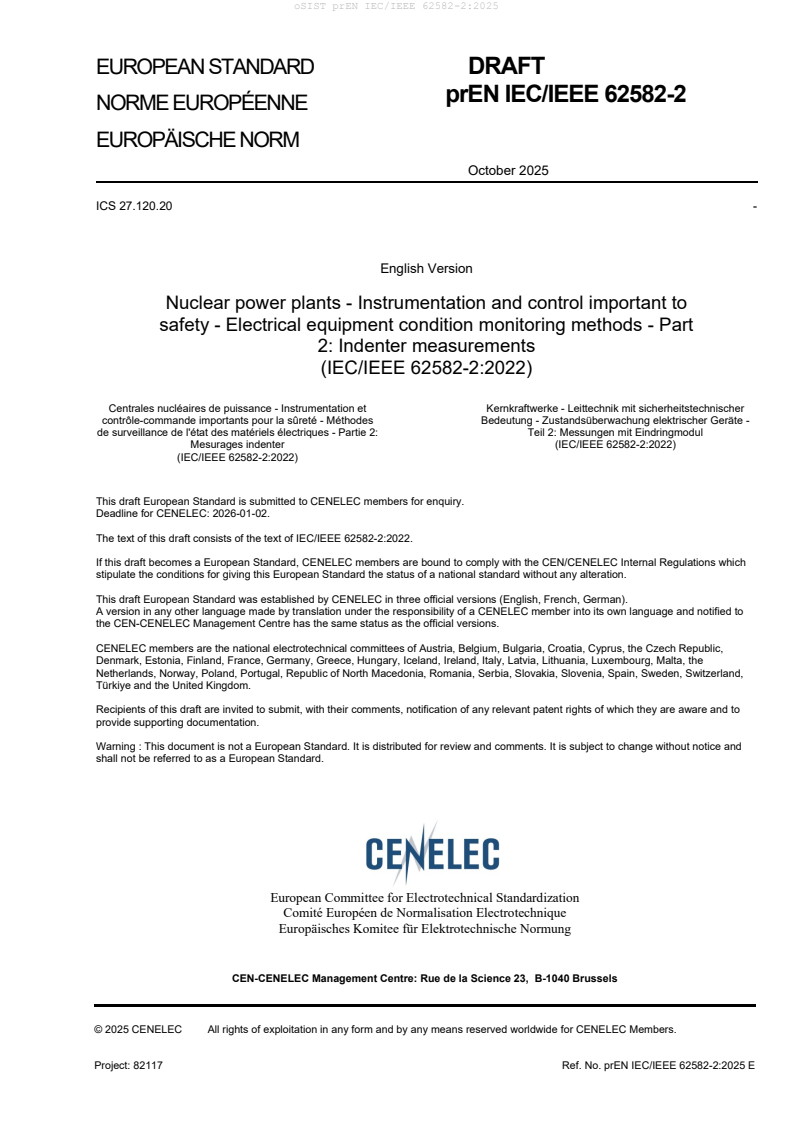
EUROPEAN STANDARD DRAFT
prEN IEC/IEEE 62582-2
NORME EUROPÉENNE
EUROPÄISCHE NORM
October 2025
ICS 27.120.20 -
English Version
Nuclear power plants - Instrumentation and control important to
safety - Electrical equipment condition monitoring methods - Part
2: Indenter measurements
(IEC/IEEE 62582-2:2022)
Centrales nucléaires de puissance - Instrumentation et Kernkraftwerke - Leittechnik mit sicherheitstechnischer
contrôle-commande importants pour la sûreté - Méthodes Bedeutung - Zustandsüberwachung elektrischer Geräte -
de surveillance de l'état des matériels électriques - Partie 2: Teil 2: Messungen mit Eindringmodul
Mesurages indenter (IEC/IEEE 62582-2:2022)
(IEC/IEEE 62582-2:2022)
This draft European Standard is submitted to CENELEC members for enquiry.
Deadline for CENELEC: 2026-01-02.
The text of this draft consists of the text of IEC/IEEE 62582-2:2022.
If this draft becomes a European Standard, CENELEC members are bound to comply with the CEN/CENELEC Internal Regulations which
stipulate the conditions for giving this European Standard the status of a national standard without any alteration.
This draft European Standard was established by CENELEC in three official versions (English, French, German).
A version in any other language made by translation under the responsibility of a CENELEC member into its own language and notified to
the CEN-CENELEC Management Centre has the same status as the official versions.
CENELEC members are the national electrotechnical committees of Austria, Belgium, Bulgaria, Croatia, Cyprus, the Czech Republic,
Denmark, Estonia, Finland, France, Germany, Greece, Hungary, Iceland, Ireland, Italy, Latvia, Lithuania, Luxembourg, Malta, the
Netherlands, Norway, Poland, Portugal, Republic of North Macedonia, Romania, Serbia, Slovakia, Slovenia, Spain, Sweden, Switzerland,
Türkiye and the United Kingdom.
Recipients of this draft are invited to submit, with their comments, notification of any relevant patent rights of which they are aware and to
provide supporting documentation.
Warning : This document is not a European Standard. It is distributed for review and comments. It is subject to change without notice and
shall not be referred to as a European Standard.
European Committee for Electrotechnical Standardization
Comité Européen de Normalisation Electrotechnique
Europäisches Komitee für Elektrotechnische Normung
CEN-CENELEC Management Centre: Rue de la Science 23, B-1040 Brussels
© 2025 CENELEC All rights of exploitation in any form and by any means reserved worldwide for CENELEC Members.
Project: 82117 Ref. No. prEN IEC/IEEE 62582-2:2025 E
European foreword
This document (prEN IEC/IEEE 62582-2:2025) consists of the text of document IEC/IEEE 62582-
2:2022, prepared by IEC/SC 45A “Instrumentation, control and electrical power systems of nuclear
facilities” of IEC/TC 45 "Nuclear instrumentation".
This document is currently submitted to the Enquiry.
The following dates are proposed:
• latest date by which the existence of this document (doa) dav + 6 months
has to be announced at national level
• latest date by which this document has to be (dop) dav + 12 months
implemented at national level by publication of an
identical national standard or by endorsement
• latest date by which the national standards (dow) dav + 36 months
conflicting with this document have to be withdrawn (to be confirmed or
modified when voting)
As stated in the nuclear safety directive 2009/71/EURATOM, Chapter 1, Article 2, item 2, Member States
are not prevented from taking more stringent safety measures in the subject-matter covered by the
Directive, in compliance with Community law.
In a similar manner, this document does not prevent Member States from taking more stringent nuclear
safety and/or security measures in the subject-matter covered by this document.
IEC/IEEE 62582-2 ®
Edition 2.0 2022-11
INTERNATIONAL
STANDARD
NORME
INTERNATIONALE
Nuclear power plants – Instrumentation and control important to safety –
Electrical equipment condition monitoring methods –
Part 2: Indenter measurements
Centrales nucléaires de puissance – Instrumentation et contrôle-commande
importants pour la sûreté – Méthodes de surveillance de l’état des matériels
électriques –
Partie 2: Mesurages indenter
INTERNATIONAL
ELECTROTECHNICAL
COMMISSION
COMMISSION
ELECTROTECHNIQUE
INTERNATIONALE
ICS 27.120.20 ISBN 978-2-8322-5840-8
– 2 – IEC/IEEE 62582-2:2022 © IEC/IEEE 2022
CONTENTS
FOREWORD . 4
INTRODUCTION . 6
1 Scope . 8
2 Normative references . 8
3 Terms and definitions . 8
4 Abbreviated terms and acronyms . 9
5 General description . 9
6 Applicability, reproducibility and complexity . 9
6.1 General . 9
6.2 Applicability . 9
6.3 Reproducibility . 10
6.4 Complexity . 10
7 Measurement procedure . 10
7.1 Stabilisation of the polymeric materials . 10
7.2 Sampling and measurement locations . 10
7.3 Conditions for measurement . 11
7.4 Instrumentation . 11
7.5 Calibration and tolerances . 12
7.6 Selection of measurement points . 13
7.7 Selection of probe velocity and maximum force . 13
7.8 Clamping . 13
7.9 Determination of the value of the indenter modulus . 13
7.10 Reporting . 14
Annex A (informative) Examples illustrating factors affecting the variation of the
indenter modulus value . 16
A.1 Example of influence of variability in equipment dimensions and construction . 16
A.2 Examples of temperature dependence . 16
A.3 Examples of effects on the indenter modulus from drying out after high
temperature ageing . 18
Annex B (informative) Example of a measurement report for indenter measurements in
laboratory . 20
Bibliography . 22
Figure 1 – Geometry and dimensions of the profile of the probe tip (truncated cone)
used in the indenter . 12
Figure 2 – Penetration depth for full contact on the tip of the anvil . 12
Figure 3 – Calculation of indenter modulus . 14
Figure A.1 – Example of local variation of indenter modulus due to variation in
equipment dimensions and construction . 16
Figure A.2 – Indenter values measured at different temperatures. 17
Figure A.3 – Normalised indenter mean values . 18
Figure A.4 – Example of change of indenter modulus value in laboratory conditions of
a hygroscopic sample after removal from long-term exposure in a heat chamber . 19
Figure A.5 – Adaptation of a decay curve to the measured indenter modulus values in
Figure A.4 . 19
IEC/IEEE 62582-2:2022 © IEC/IEEE 2022 – 3 –
Figure B.1 – Example of measured force versus time . 21
Table B.1 – Example of a measurement report for indenter measurements in laboratory . 20
– 4 – IEC/IEEE 62582-2:2022 © IEC/IEEE 2022
INTERNATIONAL ELECTROTECHNICAL COMMISSION
____________
NUCLEAR POWER PLANTS – INSTRUMENTATION AND CONTROL
IMPORTANT TO SAFETY – ELECTRICAL EQUIPMENT
CONDITION MONITORING METHODS –
Part 2: Indenter measurements
FOREWORD
1) The International Electrotechnical Commission (IEC) is a worldwide organization for standardization comprising
all national electrotechnical committees (IEC National Committees). The object of IEC is to promote international
co-operation on all questions concerning standardization in the electrical and electronic fields. To this end and
in addition to other activities, IEC publishes International Standards, Technical Specifications, Technical Reports,
Publicly Available Specifications (PAS) and Guides (hereafter referred to as "IEC document(s)"). Their
preparation is entrusted to technical committees; any IEC National Committee interested in the subject dealt with
may participate in this preparatory work. International, governmental and non-governmental organizations liaising
with the IEC also participate in this preparation.
IEEE Standards documents are developed within IEEE Societies and Standards Coordinating Committees of the
IEEE Standards Association (IEEE SA) Standards Board. IEEE develops its standards through a consensus
development process, approved by the American National Standards Institute, which brings together volunteers
representing varied viewpoints and interests to achieve the final product. Volunteers are not necessarily members
of IEEE and serve without compensation. While IEEE administers the process and establishes rules to promote
fairness in the consensus development process, IEEE does not independently evaluate, test, or verify the
accuracy of any of the information contained in its standards. Use of IEEE Standards documents is wholly
voluntary. IEEE documents are made available for use subject to important notices and legal disclaimers (see
http://standards.ieee.org/ipr/disclaimers.html for more information).
IEC collaborates closely with IEEE in accordance with conditions determined by agreement between the two
organizations. This Dual Logo International Standard was jointly developed by the IEC and IEEE under the terms
of that agreement.
2) The formal decisions of IEC on technical matters express, as nearly as possible, an international consensus of
opinion on the relevant subjects since each technical committee has representation from all interested IEC
National Committees. The formal decisions of IEEE on technical matters, once consensus within IEEE Societies
and Standards Coordinating Committees has been reached, is determined by a balanced ballot of materially
interested parties who indicate interest in reviewing the proposed standard. Final approval of the IEEE standards
document is given by the IEEE Standards Association (IEEE SA) Standards Board.
3) IEC/IEEE Publications have the form of recommendations for international use and are accepted by IEC National
Committees/IEEE Societies in that sense. While all reasonable efforts are made to ensure that the technical
content of IEC/IEEE Publications is accurate, IEC or IEEE cannot be held responsible for the way in which they
are used or for any misinterpretation by any end user.
4) In order to promote international uniformity, IEC National Committees undertake to apply IEC Publications
(including IEC/IEEE Publications) transparently to the maximum extent possible in their national and regional
publications. Any divergence between any IEC/IEEE Publication and the corresponding national or regional
publication shall be clearly indicated in the latter.
5) IEC and IEEE do not provide any attestation of conformity. Independent certification bodies provide conformity
assessment services and, in some areas, access to IEC marks of conformity. IEC and IEEE are not responsible
for any services carried out by independent certification bodies.
6) All users should ensure that they have the latest edition of this publication.
7) No liability shall attach to IEC or IEEE or their directors, employees, servants or agents including individual
experts and members of technical committees and IEC National Committees, or volunteers of IEEE Societies and
the Standards Coordinating Committees of the IEEE Standards Association (IEEE SA) Standards Board, for any
personal injury, property damage or other damage of any nature whatsoever, whether direct or indirect, or for
costs (including legal fees) and expenses arising out of the publication, use of, or reliance upon, this IEC/IEEE
Publication or any other IEC or IEEE Publications.
8) Attention is drawn to the normative references cited in this publication. Use of the referenced publications is
indispensable for the correct application of this publication.
IEC/IEEE 62582-2:2022 © IEC/IEEE 2022 – 5 –
9) Attention is drawn to the possibility that implementation of this IEC/IEEE Publication may require use of material
covered by patent rights. By publication of this standard, no position is taken with respect to the existence or
validity of any patent rights in connection therewith. IEC or IEEE shall not be held responsible for identifying
Essential Patent Claims for which a license may be required, for conducting inquiries into the legal validity or
scope of Patent Claims or determining whether any licensing terms or conditions provided in connection with
submission of a Letter of Assurance, if any, or in any licensing agreements are reasonable or non-discriminatory.
Users of this standard are expressly advised that determination of the validity of any patent rights, and the risk
of infringement of such rights, is entirely their own responsibility.
IEC/IEEE 62582-2 was prepared by subcommittee 45A: Instrumentation, control and electrical
power systems of nuclear facilities, of IEC technical committee 45: Nuclear instrumentation, in
cooperation with Nuclear Power Engineering Committee of the IEEE, under the IEC/IEEE Dual
Logo Agreement between IEC and IEEE. It is an International Standard.
This document is published as an IEC/IEEE Dual Logo standard.
This second edition cancels and replaces the first edition published in 2011, and its
Amendment 1:2016. This edition constitutes a technical revision.
This edition includes the following significant technical changes with respect to the previous
edition:
a) Modification of the title;
b) Consideration of publication of IEC/IEEE 60780-323.
The text of this International Standard is based on the following IEC documents:
FDIS Report on voting
45A/1434/FDIS 45A/1444/RVD
Full information on the voting for its approval can be found in the report on voting indicated in
the above table.
The language used for the development of this International Standard is English.
This document was drafted in accordance with the rules given in the ISO/IEC Directives, Part 2,
available at www.iec.ch/members_experts/refdocs. The main document types developed by IEC
are described in greater detail at www.iec.ch/standardsdev/publications.
A list of all parts of IEC/IEEE 62582 series, under the general title Nuclear power plants –
Instrumentation and control important to safety – Electrical equipment condition monitoring
methods, can be found on the IEC website.
The IEC Technical Committee and IEEE Technical Committee have decided that the contents
of this document will remain unchanged until the stability date indicated on the IEC website
under webstore.iec.ch in the data related to the specific document. At this date, the document
will be
• reconfirmed,
• withdrawn,
• replaced by a revised edition, or
• amended.
– 6 – IEC/IEEE 62582-2:2022 © IEC/IEEE 2022
INTRODUCTION
a) Technical background, main issues and organisation of this standard
This part of IEC/IEEE 62582 specifically focuses on indenter modulus methods for condition
monitoring for the management of ageing of electrical equipment installed in nuclear power
plants. The indenter method is commonly used to carry out measurements on cables (jackets,
insulation) and O-rings.
This part 2 of IEC/IEEE 62582 contains detailed descriptions of condition monitoring based on
indenter modulus measurements.
The IEC/IEEE 62582 series is issued with a joint logo which makes it applicable to the
management of ageing of electrical equipment qualified to IEEE as well as IEC Standards.
IEC/IEEE 60780-323 includes the concept and role that condition based qualification could be
used in equipment qualification as an adjunct to qualified life. In equipment qualification, the
condition of the equipment for which acceptable performance was demonstrated is the qualified
condition. The qualified condition is the condition of equipment, prior to the start of a design
basis event, for which the equipment was demonstrated to meet the design requirements for
the specified service conditions.
Significant research has been performed on condition monitoring techniques and the use of
these techniques in equipment qualification as noted in NUREG/CR-6704, Vol. 2
(BNL-NUREG-52610) and JNES-SS-0903, 2009 and IAEA-TECDOC-1825:2017.
It is intended that this IEC/IEEE document be used by test laboratories, operators of nuclear
power plants, systems evaluators, and licensors.
b) Situation of the current standard in the structure of the IEC SC 45A standard series
IEC/IEEE 62582-2 is the third level IEC SC 45A document tackling the specific issue of
application and performance of indenter modulus measurements in management of ageing of
electrical instrument and control equipment in nuclear power plants.
IEC/IEEE 62582-2 is to be read in association with IEC/IEEE 62582-1, which provides
background and guidelines for the application of methods for condition monitoring of electrical
equipment important to safety of nuclear power plants.
For more details on the structure of the IEC SC 45A standard series, see item d) of this
introduction.
c) Recommendations and limitations regarding the application of this standard
It is important to note that this document establishes no additional functional requirements for
safety systems.
d) Description of the structure of the IEC SC 45A standard series and relationships with
other IEC documents and other bodies documents (IAEA, ISO)
The IEC SC 45A standard series comprises a hierarchy of four levels. The top-level documents
of the IEC SC 45A standard series are IEC 61513 and IEC 63046.
IEC 61513 provides general requirements for instrumentation and control (I&C) systems and
equipment that are used to perform functions important to safety in nuclear power plants
(NPPs). IEC 63046 provides general requirements for electrical power systems of NPPs; it
covers power supply systems including the supply systems of the I&C systems.
IEC/IEEE 62582-2:2022 © IEC/IEEE 2022 – 7 –
IEC 61513 and IEC 63046 are to be considered in conjunction and at the same level. IEC 61513
and IEC 63046 structure the IEC SC 45A standard series and shape a complete framework
establishing general requirements for instrumentation, control and electrical power systems for
nuclear power plants.
IEC 61513 and IEC 63046 refer directly to other IEC SC 45A standards for general
requirements for specific topics, such as categorization of functions and classification of
systems, qualification, separation, defence against common cause failure, control room design,
electromagnetic compatibility, human factors engineering, cybersecurity, software and
hardware aspects for programmable digital systems, coordination of safety and security
requirements and management of ageing. The standards referenced directly at this second level
should be considered together with IEC 61513 and IEC 63046 as a consistent document set.
At a third level, IEC SC 45A standards not directly referenced by IEC 61513 or by IEC 63046
are standards related to specific requirements for specific equipment, technical methods, or
activities. Usually these documents, which make reference to second-level documents for
general requirements, can be used on their own.
A fourth level extending the IEC SC 45 standard series, corresponds to the Technical Reports
which are not normative.
The IEC SC 45A standards series consistently implements and details the safety and security
principles and basic aspects provided in the relevant IAEA safety standards and in the relevant
documents of the IAEA nuclear security series (NSS). In particular this includes the IAEA
requirements SSR-2/1 , establishing safety requirements related to the design of nuclear power
plants (NPPs), the IAEA safety guide SSG-30 dealing with the safety classification of structures,
systems and components in NPPs, the IAEA safety guide SSG-39 dealing with the design of
instrumentation and control systems for NPPs, the IAEA safety guide SSG-34 dealing with the
design of electrical power systems for NPPs, the IAEA safety guide SSG-51 dealing with human
factors engineering in the design of NPPs and the implementing guide NSS17 for computer
security at nuclear facilities. The safety and security terminology and definitions used by the
SC 45A standards are consistent with those used by the IAEA.
IEC 61513 and IEC 63046 have adopted a presentation format similar to the basic safety
publication IEC 61508 with an overall life-cycle framework and a system life-cycle framework.
Regarding nuclear safety, IEC 61513 and IEC 63046 provide the interpretation of the general
requirements of IEC 61508-1, IEC 61508-2 and IEC 61508-4, for the nuclear application sector.
In this framework, IEC 60880, IEC 62138 and IEC 62566 correspond to IEC 61508-3 for the
nuclear application sector.
IEC 61513 and IEC 63046 refer to ISO 9001 as well as to IAEA GSR part 2 and IAEA GS-G-3.1
and IAEA GS-G-3.5 for topics related to quality assurance (QA).
At level 2, regarding nuclear security, IEC 62645 is the entry document for the IEC/SC 45A
security standards. It builds upon the valid high level principles and main concepts of the
generic security standards, in particular ISO/IEC 27001 and ISO/IEC 27002; it adapts them and
completes them to fit the nuclear context and coordinates with the IEC 62443 series. At level 2,
IEC 60964 is the entry document for the IEC/SC 45A control rooms standards, IEC 63351 is the
entry document for the human factors engineering standards and IEC 62342 is the entry
document for the ageing management standards.
NOTE 1 It is assumed that for the design of I&C systems in NPPs that implement conventional safety functions (e.g.
to address worker safety, asset protection, chemical hazards, process energy hazards) international or national
standards would be applied.
NOTE 2 IEC TR 64000 provides a more comprehensive description of the overall structure of the IEC SC 45A
standards series and of its relationship with other standards bodies and standards.
– 8 – IEC/IEEE 62582-2:2022 © IEC/IEEE 2022
NUCLEAR POWER PLANTS – INSTRUMENTATION AND CONTROL
IMPORTANT TO SAFETY – ELECTRICAL EQUIPMENT
CONDITION MONITORING METHODS –
Part 2: Indenter measurements
1 Scope
This part of IEC/IEEE 62582 contains methods for condition monitoring of organic and polymeric
materials in instrumentation and control systems using the indenter measurement technique in
the detail necessary to produce accurate and reproducible measurements. It includes the
requirements for the selection of samples, the measurement system and measurement
conditions, and the reporting of the measurement results.
The different parts of IEC/IEEE 62582 are measurement standards, primarily for use in the
management of ageing in initial qualification and after installation. IEC/IEEE 62582-1 includes
requirements for the application of the other parts of the IEC/IEEE 62582 series and some
elements which are common to all methods. Information on the role of condition monitoring in
the qualification of equipment important to safety is found in IEC/IEEE 60780-323.
This document is intended for application to non-energised equipment.
2 Normative references
There are no normative references in this document.
3 Terms and definitions
For the purposes of this document, the following terms and definitions apply.
ISO, IEC and IEEE maintain terminological databases for use in standardization at the following
addresses:
• IEC Electropedia: available at http://www.electropedia.org/
• ISO Online browsing platform: available at http://www.iso.org/obp
• IEEE Standards Dictionary Online: available at http://dictionary.ieee.org
3.1
indenter modulus
ratio between the chang
...
Questions, Comments and Discussion
Ask us and Technical Secretary will try to provide an answer. You can facilitate discussion about the standard in here.
Loading comments...