


EN 50342-5:2010/AC:2011
(Corrigendum)Lead-acid starter batteries - Part 5: Properties of battery housings and handles
General Information
- Abstract
This European Standard covers multicell battery housings produced of polypropylene as the preferred material for lead-acid batteries as an energy storage device for cranking combustion engines, for lighting and for additional equipment used in road vehicles. These batteries are all referred to as starter batteries. This European Standard describes battery housings for batteries usable within the engine compartment and for installation under conditions where they are protected from light. Batteries of this European Standard do not provide additional features for special protection from light. Therefore, batteries with limited protection from light are to be treated as a special case. The purpose of this European Standard is to describe the properties of battery housings for its use in combustion vehicles by means of uniform examination procedures and by defining the requirements for the raw material and the complete part. The test procedure and requirements for the complete housing are described in the main part. Test procedures for the raw material are determined in Annex A. Annex B recommends possible test procedures for the material properties taken out of the complete housings, without being normative.
- Status
- Published
- Publication Date
- 13-Oct-2011
- Technical Committee
- CLC/TC 21X - Secondary cells and batteries
- Drafting Committee
- CLC/TC 21X - Secondary cells and batteries
- Current Stage
- 6060 - Document made available - Publishing
- Start Date
- 14-Oct-2011
- Completion Date
- 14-Oct-2011


Relations
- Effective Date
- 18-Apr-2023
- Corrects
EN 50342-5:2010 - Lead-acid starter batteries - Part 5: Properties of battery housings and handles - Effective Date
- 28-Jan-2023
Get Certified
Connect with accredited certification bodies for this standard

IMQ S.p.A. (Certification)
Italian electrical product certification.

SLG Prüf- und Zertifizierungs GmbH
German testing and certification body.

UL Solutions
Global safety science company with testing, inspection and certification.
Sponsored listings
Frequently Asked Questions
EN 50342-5:2010/AC:2011 is a corrigendum published by CLC. Its full title is "Lead-acid starter batteries - Part 5: Properties of battery housings and handles". This standard covers: This European Standard covers multicell battery housings produced of polypropylene as the preferred material for lead-acid batteries as an energy storage device for cranking combustion engines, for lighting and for additional equipment used in road vehicles. These batteries are all referred to as starter batteries. This European Standard describes battery housings for batteries usable within the engine compartment and for installation under conditions where they are protected from light. Batteries of this European Standard do not provide additional features for special protection from light. Therefore, batteries with limited protection from light are to be treated as a special case. The purpose of this European Standard is to describe the properties of battery housings for its use in combustion vehicles by means of uniform examination procedures and by defining the requirements for the raw material and the complete part. The test procedure and requirements for the complete housing are described in the main part. Test procedures for the raw material are determined in Annex A. Annex B recommends possible test procedures for the material properties taken out of the complete housings, without being normative.
This European Standard covers multicell battery housings produced of polypropylene as the preferred material for lead-acid batteries as an energy storage device for cranking combustion engines, for lighting and for additional equipment used in road vehicles. These batteries are all referred to as starter batteries. This European Standard describes battery housings for batteries usable within the engine compartment and for installation under conditions where they are protected from light. Batteries of this European Standard do not provide additional features for special protection from light. Therefore, batteries with limited protection from light are to be treated as a special case. The purpose of this European Standard is to describe the properties of battery housings for its use in combustion vehicles by means of uniform examination procedures and by defining the requirements for the raw material and the complete part. The test procedure and requirements for the complete housing are described in the main part. Test procedures for the raw material are determined in Annex A. Annex B recommends possible test procedures for the material properties taken out of the complete housings, without being normative.
EN 50342-5:2010/AC:2011 is classified under the following ICS (International Classification for Standards) categories: 29.220.20 - Acid secondary cells and batteries. The ICS classification helps identify the subject area and facilitates finding related standards.
EN 50342-5:2010/AC:2011 has the following relationships with other standards: It is inter standard links to EN 50342-5:2025, EN 50342-5:2010. Understanding these relationships helps ensure you are using the most current and applicable version of the standard.
EN 50342-5:2010/AC:2011 is available in PDF format for immediate download after purchase. The document can be added to your cart and obtained through the secure checkout process. Digital delivery ensures instant access to the complete standard document.
Standards Content (Sample)
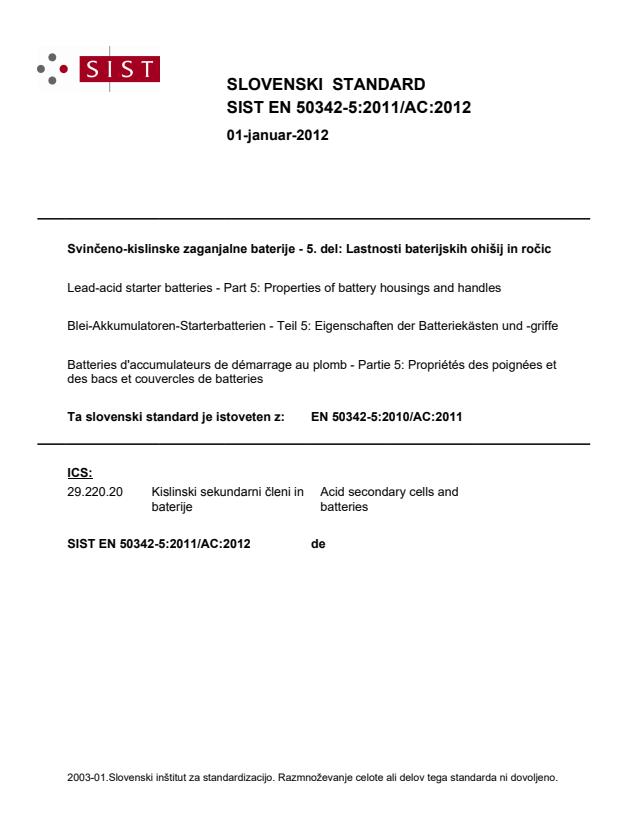
2003-01.Slovenski inštitut za standardizacijo. Razmnoževanje celote ali delov tega standarda ni dovoljeno.Blei-Akkumulatoren-Starterbatterien - Teil 5: Eigenschaften der Batteriekästen und -griffeBatteries d'accumulateurs de démarrage au plomb - Partie 5: Propriétés des poignées et des bacs et couvercles de batteriesLead-acid starter batteries - Part 5: Properties of battery housings and handles29.220.20EDWHULMHAcid secondary cells and batteriesICS:Ta slovenski standard je istoveten z:EN 50342-5:2010/AC:2011SIST EN 50342-5:2011/AC:2012de01-januar-2012SIST EN 50342-5:2011/AC:2012SLOVENSKI
STANDARD
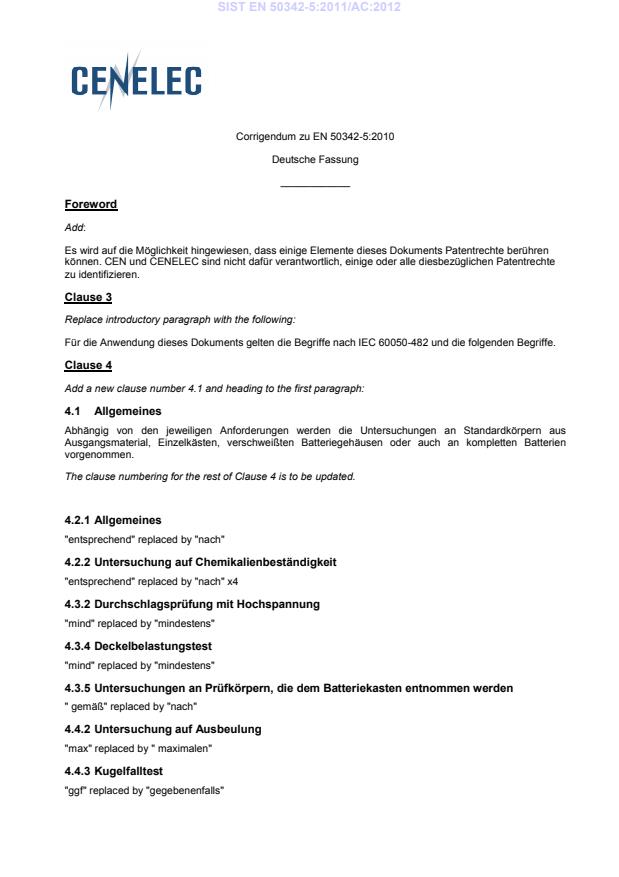
Corrigendum zu EN 50342-5:2010 Deutsche Fassung ____________ Foreword Add: Es wird auf die Möglichkeit hingewiesen, dass einige Elemente dieses Dokuments Patentrechte berühren können. CEN und CENELEC sind nicht dafür verantwortlich, einige oder alle diesbezüglichen Patentrechte zu identifizieren. Clause 3 Replace introductory paragraph with the following: Für die Anwendung dieses Dokuments gelten die Begriffe nach IEC 60050-482 und die folgenden Begriffe. Clause 4 Add a
...