


FprEN IEC 62133-1:2025
(Main)Secondary cells and batteries containing alkaline or other non-acid electrolytes - Safety requirements for portable sealed secondary cells, and for batteries made from them, for use in portable applications - Part 1: Nickel systems
Secondary cells and batteries containing alkaline or other non-acid electrolytes - Safety requirements for portable sealed secondary cells, and for batteries made from them, for use in portable applications - Part 1: Nickel systems
IEC 62133-1:2026 specifies requirements and tests for the safe operation of portable sealed secondary nickel cells and batteries containing alkaline electrolyte, under intended use and reasonably foreseeable misuse. This second edition cancels and replaces the first edition of IEC 62133-1 published in 2017. It constitutes a technical revision. This edition includes the following significant technical changes with respect to IEC 62133 1:2017: a) removal of the definition "secondary battery"; b) removal of the definition "portable battery"; c) "removal of the definition "portable cell"; d) replacement of the single term "room temperature" with 20 °C ± 5 °C in 7.2.3; e) modification of Figure 1.
Sekundärzellen und -batterien mit alkalischen oder anderen nicht säurehaltigen Elektrolyten - Sicherheitsanforderungen für tragbare gasdichte Sekundärzellen und daraus hergestellte Batterien für die Verwendung in tragbaren Geräten - Teil 1: Nickel-Systeme
Accumulateurs alcalins et autres accumulateurs à électrolyte non acide - Exigences de sécurité pour les accumulateurs portables étanches, et pour les batteries qui en sont constituées, destinés à l’utilisation dans des applications portables - Partie 1: Systèmes au nickel
L'IEC 62133-1:2026 spécifie les exigences et les essais pour le fonctionnement en toute sécurité des accumulateurs portables étanches au nickel contenant un électrolyte alcalin dans des conditions d’utilisations prévues et dans des conditions d’utilisation abusive raisonnablement prévisible. Cette deuxième édition annule et remplace la première édition de l’IEC 62133-1 parue en 2017. Cette édition constitue une révision technique. Cette édition inclut les modifications techniques majeures suivantes par rapport à l’IEC 62133 1:2017: a) suppression de la définition "batterie d’accumulateurs"; b) suppression de la définition "batterie portable"; c) suppression de la définition "élément portable"; d) remplacement du terme unique "température ambiante" par 20 °C ± 5 °C au 7.2.3; e) modification de la Figure 1.
Sekundarni členi in baterije z alkalnimi ali drugimi nekislinskimi elektroliti - Varnostne zahteve za prenosne zatesnjene sekundarne člene in za baterije, narejene iz njih, za uporabo v prenosnih napravah - 1. del: Nikljevi sistemi
General Information
- Status
- Not Published
- Publication Date
- 16-Apr-2026
- Technical Committee
- CLC/TC 21X - Secondary cells and batteries
- Current Stage
- 5060 - Voting results sent to TC, SR - Formal Approval
- Start Date
- 22-Aug-2025
- Completion Date
- 22-Aug-2025
Relations
- Effective Date
- 14-Feb-2023
Overview
The FprEN IEC 62133-1:2025 standard, issued by the CLC organization, establishes safety requirements for portable sealed secondary cells and batteries containing alkaline or other non-acid electrolytes. This first part specifically addresses nickel systems used in single and multi-phase portable applications. The standard focuses on safety, ensuring these nickel-based rechargeable batteries and cells meet strict performance and risk management criteria under both normal and foreseeable misuse conditions.
This standard updates and revises the previous edition IEC 62133:2012 by separating lithium systems into a distinct part and adding button cell requirements, aimed at harmonizing international safety practices for secondary nickel batteries in consumer and industrial portable devices.
Key Topics
Scope and Application
Defines requirements and tests for sealed nickel-based secondary cells and batteries used in portable equipment, including both single and multi-cell assemblies.Safety Considerations
Emphasizes risk management relating to electrical, mechanical, thermal, and chemical hazards including:- Insulation and wiring integrity
- Venting to relieve internal pressure safely
- Temperature, voltage, and current control
- Terminal contact safety and secure cell assembly
- Quality assurance procedures throughout manufacturing
Test Procedures
Includes type tests under intended use and foreseeable misuse such as:- Continuous low-rate charging
- Vibration and mechanical shock resistance
- Temperature cycling to simulate environmental conditions
- Protection against short circuit, free fall, crushing, overcharge, and forced discharge
Marking and Information
Specifies clear marking requirements for cells and batteries, including safety warnings, ingestion cautions for small batteries, and packaging information for safe handling and transport.Supporting Guidance
Informative annexes provide recommendations for manufacturers, battery assemblers, and end-users to ensure compliance and enhance safety.
Applications
This standard applies to portable applications requiring reliable nickel-based rechargeable batteries, including but not limited to:
- Consumer electronics (e.g., cameras, handheld devices, cordless phones)
- Medical equipment with portable power needs
- Industrial tools requiring sealed nickel-cadmium or nickel-metal hydride batteries
- Emergency and safety devices powered by secondary nickel cells
By adhering to the FprEN IEC 62133-1:2025 requirements, manufacturers ensure the safety, reliability, and durability of their nickel battery-powered products, reducing risks related to electrical faults, thermal incidents, or mechanical damage.
Related Standards
- IEC 61951-1 & IEC 61951-2: Standards covering portable sealed rechargeable single nickel-cadmium and nickel-metal hydride cells respectively, which complement the requirements in IEC 62133-1.
- IEC 60050-482: International Electrotechnical Vocabulary for cells and batteries terms, providing definitions essential for standard application.
- ISO/IEC Guide 51: Guidelines for incorporating safety aspects into standards, supporting risk management principles in IEC 62133-1.
- FprEN IEC 62133-2: The second part of the IEC 62133 series, covering lithium-based systems, allowing distinct safety treatments for different battery chemistries.
By implementing the FprEN IEC 62133-1:2025 standard, industries enhance user safety, product quality, and regulatory compliance for nickel-based secondary cells and batteries in portable devices. This contributes to the global harmonization of battery safety standards and promotes confidence in rechargeable energy storage technologies.

Get Certified
Connect with accredited certification bodies for this standard

Intertek Testing Services NA Inc.
Intertek certification services in North America.

UL Solutions
Global safety science company with testing, inspection and certification.

ANCE
Mexican certification and testing association.
Sponsored listings
Frequently Asked Questions
FprEN IEC 62133-1:2025 is a draft published by CLC. Its full title is "Secondary cells and batteries containing alkaline or other non-acid electrolytes - Safety requirements for portable sealed secondary cells, and for batteries made from them, for use in portable applications - Part 1: Nickel systems". This standard covers: IEC 62133-1:2026 specifies requirements and tests for the safe operation of portable sealed secondary nickel cells and batteries containing alkaline electrolyte, under intended use and reasonably foreseeable misuse. This second edition cancels and replaces the first edition of IEC 62133-1 published in 2017. It constitutes a technical revision. This edition includes the following significant technical changes with respect to IEC 62133 1:2017: a) removal of the definition "secondary battery"; b) removal of the definition "portable battery"; c) "removal of the definition "portable cell"; d) replacement of the single term "room temperature" with 20 °C ± 5 °C in 7.2.3; e) modification of Figure 1.
IEC 62133-1:2026 specifies requirements and tests for the safe operation of portable sealed secondary nickel cells and batteries containing alkaline electrolyte, under intended use and reasonably foreseeable misuse. This second edition cancels and replaces the first edition of IEC 62133-1 published in 2017. It constitutes a technical revision. This edition includes the following significant technical changes with respect to IEC 62133 1:2017: a) removal of the definition "secondary battery"; b) removal of the definition "portable battery"; c) "removal of the definition "portable cell"; d) replacement of the single term "room temperature" with 20 °C ± 5 °C in 7.2.3; e) modification of Figure 1.
FprEN IEC 62133-1:2025 is classified under the following ICS (International Classification for Standards) categories: 29.220.30 - Alkaline secondary cells and batteries. The ICS classification helps identify the subject area and facilitates finding related standards.
FprEN IEC 62133-1:2025 has the following relationships with other standards: It is inter standard links to EN 62133-1:2017. Understanding these relationships helps ensure you are using the most current and applicable version of the standard.
FprEN IEC 62133-1:2025 is available in PDF format for immediate download after purchase. The document can be added to your cart and obtained through the secure checkout process. Digital delivery ensures instant access to the complete standard document.
Standards Content (Sample)
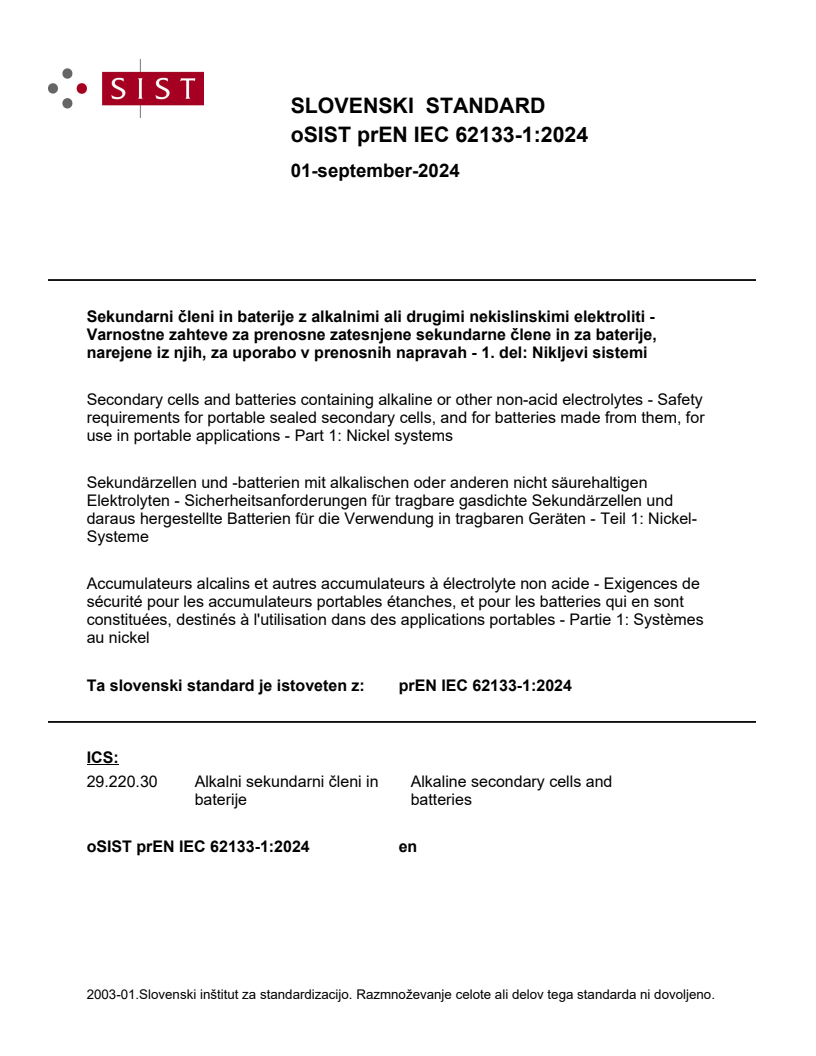
SLOVENSKI STANDARD
oSIST prEN IEC 62133-1:2024
01-september-2024
Sekundarni členi in baterije z alkalnimi ali drugimi nekislinskimi elektroliti -
Varnostne zahteve za prenosne zatesnjene sekundarne člene in za baterije,
narejene iz njih, za uporabo v prenosnih napravah - 1. del: Nikljevi sistemi
Secondary cells and batteries containing alkaline or other non-acid electrolytes - Safety
requirements for portable sealed secondary cells, and for batteries made from them, for
use in portable applications - Part 1: Nickel systems
Sekundärzellen und -batterien mit alkalischen oder anderen nicht säurehaltigen
Elektrolyten - Sicherheitsanforderungen für tragbare gasdichte Sekundärzellen und
daraus hergestellte Batterien für die Verwendung in tragbaren Geräten - Teil 1: Nickel-
Systeme
Accumulateurs alcalins et autres accumulateurs à électrolyte non acide - Exigences de
sécurité pour les accumulateurs portables étanches, et pour les batteries qui en sont
constituées, destinés à l'utilisation dans des applications portables - Partie 1: Systèmes
au nickel
Ta slovenski standard je istoveten z: prEN IEC 62133-1:2024
ICS:
29.220.30 Alkalni sekundarni členi in Alkaline secondary cells and
baterije batteries
oSIST prEN IEC 62133-1:2024 en
2003-01.Slovenski inštitut za standardizacijo. Razmnoževanje celote ali delov tega standarda ni dovoljeno.
oSIST prEN IEC 62133-1:2024
oSIST prEN IEC 62133-1:2024
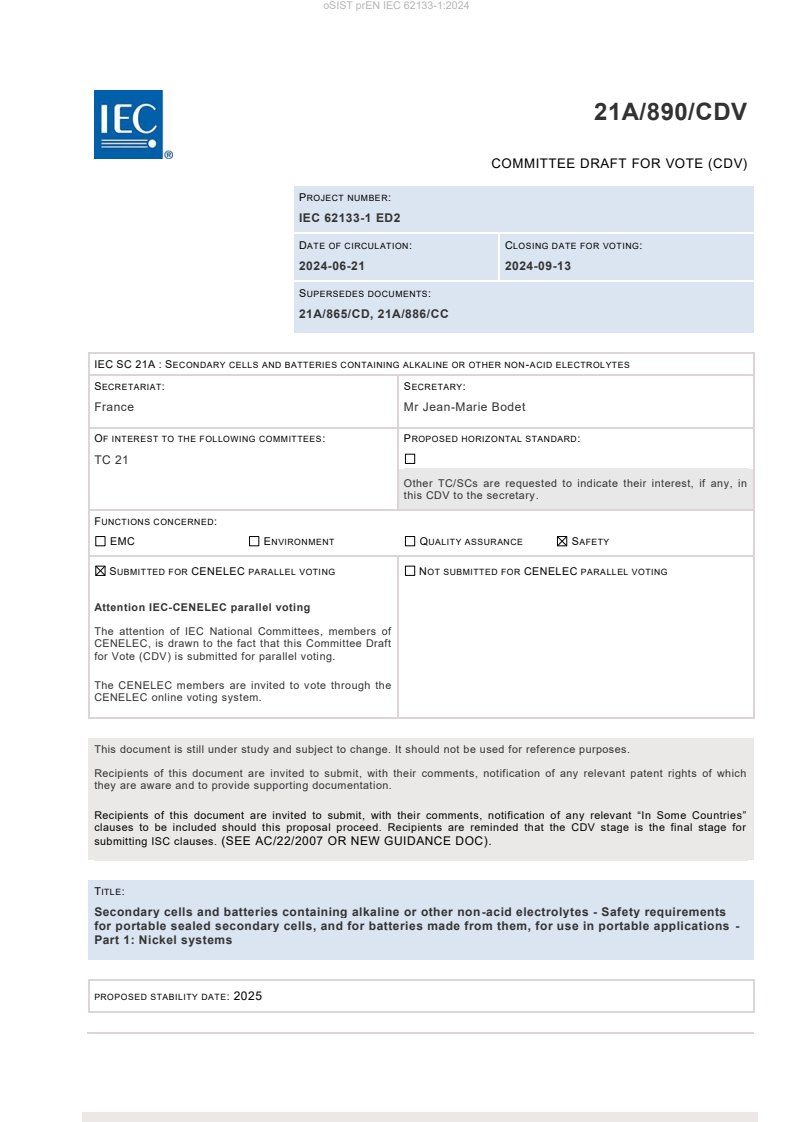
21A/890/CDV
COMMITTEE DRAFT FOR VOTE (CDV)
PROJECT NUMBER:
IEC 62133-1 ED2
DATE OF CIRCULATION: CLOSING DATE FOR VOTING:
2024-06-21 2024-09-13
SUPERSEDES DOCUMENTS:
21A/865/CD, 21A/886/CC
IEC SC 21A : SECONDARY CELLS AND BATTERIES CONTAINING ALKALINE OR OTHER NON-ACID ELECTROLYTES
SECRETARIAT: SECRETARY:
France Mr Jean-Marie Bodet
OF INTEREST TO THE FOLLOWING COMMITTEES: PROPOSED HORIZONTAL STANDARD:
TC 21
Other TC/SCs are requested to indicate their interest, if any, in
this CDV to the secretary.
FUNCTIONS CONCERNED:
EMC ENVIRONMENT QUALITY ASSURANCE SAFETY
SUBMITTED FOR CENELEC PARALLEL VOTING NOT SUBMITTED FOR CENELEC PARALLEL VOTING
Attention IEC-CENELEC parallel voting
The attention of IEC National Committees, members of
CENELEC, is drawn to the fact that this Committee Draft
for Vote (CDV) is submitted for parallel voting.
The CENELEC members are invited to vote through the
CENELEC online voting system.
This document is still under study and subject to change. It should not be used for reference purposes.
Recipients of this document are invited to submit, with their comments, notification of any relevant patent rights of which
they are aware and to provide supporting documentation.
Recipients of this document are invited to submit, with their comments, notification of any relevant “In Some Countries”
clauses to be included should this proposal proceed. Recipients are reminded that the CDV stage is the final stage for
submitting ISC clauses. (SEE AC/22/2007 OR NEW GUIDANCE DOC).
TITLE:
Secondary cells and batteries containing alkaline or other non-acid electrolytes - Safety requirements
for portable sealed secondary cells, and for batteries made from them, for use in portable applications -
Part 1: Nickel systems
PROPOSED STABILITY DATE: 2025
oSIST prEN IEC 62133-1:2024
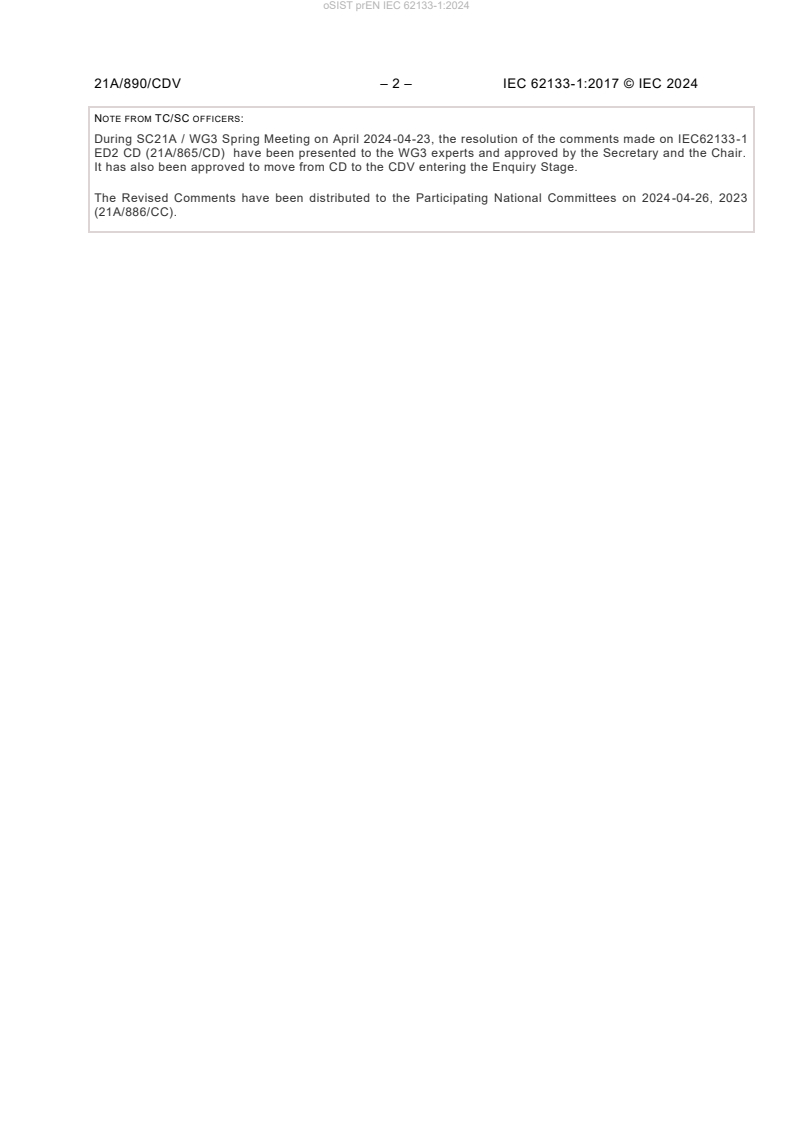
21A/890/CDV – 2 – IEC 62133-1:2017 © IEC 2024
NOTE FROM TC/SC OFFICERS:
During SC21A / WG3 Spring Meeting on April 2024-04-23, the resolution of the comments made on IEC62133-1
ED2 CD (21A/865/CD) have been presented to the WG3 experts and approved by the Secretary and the Chair.
It has also been approved to move from CD to the CDV entering the Enquiry Stage.
The Revised Comments have been distributed to the Participating National Committees on 2024 -04-26, 2023
(21A/886/CC).
oSIST prEN IEC 62133-1:2024
IEC 62133-1:2017 © IEC 2024 – 3 – 21A/890/CDV
1 CONTENTS
2 FOREWORD . 5
3 1 Scope . 7
4 2 Normative references . 7
5 3 Terms and definitions . 7
6 4 Parameter measurement tolerances . 9
7 5 General safety considerations . 10
8 5.1 General . 10
9 5.2 Insulation and wiring . 10
10 5.3 Venting . 10
11 5.4 Temperature, voltage and current management . 11
12 5.5 Terminal contacts . 11
13 5.6 Assembly of cells into batteries . 11
14 5.7 Quality plan . 11
15 6 Type test and sample size . 11
16 7 Specific requirements and tests . 12
17 7.1 Charging procedure for test purposes . 12
18 7.2 Intended use . 12
19 7.2.1 Continuous low-rate charging (cells) . 12
20 7.2.2 Vibration . 12
21 7.2.3 Case stress at high ambient temperature (batteries) . 13
22 7.2.4 Temperature cycling . 13
23 7.3 Reasonably foreseeable misuse . 14
24 7.3.1 Incorrect installation (cells) . 14
25 7.3.2 External short circuit . 14
26 7.3.3 Free fall . 15
27 7.3.4 Mechanical shock (crash hazard) . 15
28 7.3.5 Thermal abuse (cells) . 15
29 7.3.6 Crushing of cells . 16
30 7.3.7 Low pressure (cells) . 16
31 7.3.8 Overcharge . 16
32 7.3.9 Forced discharge (cells) . 16
33 8 Information for safety . 17
34 8.1 General . 17
35 8.2 Small cell and battery safety information . 17
36 9 Marking . 18
37 9.1 Cell marking . 18
38 9.2 Battery marking. 18
39 9.3 Caution for ingestion of small cells and batteries . 18
40 9.4 Other information . 19
41 10 Packaging . 19
42 Annex A (informative) Recommendations to equipment manufacturers and battery
43 assemblers . 20
44 Annex B (informative) Recommendations to the end-users . 21
45 Annex C (informative) Packaging . 22
46 Bibliography . 23
oSIST prEN IEC 62133-1:2024
21A/890/CDV – 4 – IEC 62133-1:2017 © IEC 2024
48 Figure 1 – Temperature profile for 7.2.4 – Temperature cycling test . 14
49 Figure 2 – Ingestion gauge . 18
51 Table 1 – Sample size for type tests . 12
52 Table 2 – Conditions for vibration test . 13
oSIST prEN IEC 62133-1:2024
IEC 62133-1:2017 © IEC 2024 – 5 – 21A/890/CDV
55 INTERNATIONAL ELECTROTECHNICAL COMMISSION
56 ____________
58 SECONDARY CELLS AND BATTERIES CONTAINING
59 ALKALINE OR OTHER NON-ACID ELECTROLYTES –
60 SAFETY REQUIREMENTS FOR PORTABLE SEALED
61 SECONDARY CELLS, AND FOR BATTERIES MADE FROM
62 THEM, FOR USE IN PORTABLE APPLICATIONS –
64 Part 1: Nickel systems
66 FOREWORD
67 1) The International Electrotechnical Commission (IEC) is a worldwide organization for standardization comprising
68 all national electrotechnical committees (IEC National Committees). The object of IEC is to promote
69 international co-operation on all questions concerning standardization in the electrical and electronic fields. To
70 this end and in addition to other activities, IEC publishes International Standards, Technical Specifications,
71 Technical Reports, Publicly Available Specifications (PAS) and Guides (hereafter referred to as “IEC
72 Publication(s)”). Their preparation is entrusted to technical committees; any IEC National Committee interested
73 in the subject dealt with may participate in this preparatory work. International, governmental and non -
74 governmental organizations liaising with the IEC also participate in this preparation. IEC collaborates closely
75 with the International Organization for Standardization (ISO) in accordance with conditions determined by
76 agreement between the two organizations.
77 2) The formal decisions or agreements of IEC on technical matters express, as nearly as possible, an international
78 consensus of opinion on the relevant subjects since each technical committee has representation from all
79 interested IEC National Committees.
80 3) IEC Publications have the form of recommendations for international use and are accepted by IEC National
81 Committees in that sense. While all reasonable efforts are made to ensure that the technical content of IEC
82 Publications is accurate, IEC cannot be held responsible for the way in which they are used or for any
83 misinterpretation by any end user.
84 4) In order to promote international uniformity, IEC National Committees undertake to apply IEC Publications
85 transparently to the maximum extent possible in their national and regional publications. Any divergence
86 between any IEC Publication and the corresponding national or regional publication shall be clearly indicated in
87 the latter.
88 5) IEC itself does not provide any attestation of conformity. Independent certification bodies provide conformity
89 assessment services and, in some areas, access to IEC marks of conformity. IEC is not responsible for any
90 services carried out by independent certification bodies.
91 6) All users should ensure that they have the latest edition of this publication.
92 7) No liability shall attach to IEC or its directors, employees, servants or agents including individual experts and
93 members of its technical committees and IEC National Committees for any personal injury, property damage or
94 other damage of any nature whatsoever, whether direct or indirect, or for costs (including legal fees) and
95 expenses arising out of the publication, use of, or reliance upon, this IEC Publication or any other IEC
96 Publications.
97 8) Attention is drawn to the Normative references cited in this publication. Use of the referenced publications is
98 indispensable for the correct application of this publication.
99 9) Attention is drawn to the possibility that some of the elements of this IEC Publication may be the subject of
100 patent rights. IEC shall not be held responsible for identifying any or all such patent rights.
101 International Standard IEC 62133-1 has been prepared by subcommittee 21A: Secondary
102 cells and batteries containing alkaline or other non-acid electrolytes, of IEC technical
103 committee 21: Secondary cells and batteries.
104 This first edition cancels and replaces the second edition of IEC 62133 published in 2012. It
105 constitutes a technical revision.
106 This edition includes the following significant technical changes with respect to
107 IEC 62133:2012:
108 – separation of lithium systems into a separate Part 2;
oSIST prEN IEC 62133-1:2024
21A/890/CDV – 6 – IEC 62133-1:2017 © IEC 2024
109 – inclusion of button cell requirements.
110 The text of this standard is based on the following documents:
FDIS Report on voting
21A/619/FDIS 21A/627/RVD
112 Full information on the voting for the approval of this standard can be found in the report on
113 voting indicated in the above table.
114 This publication has been drafted in accordance with the ISO/IEC Directives, Part 2.
115 A list of all parts of the IEC 62133 series, published under the general title Secondary cells
116 and batteries containing alkaline or other non-acid electrolytes – Safety requirements for
117 portable sealed secondary cells, and for batteries made from them, for use in portable
118 applications, can be found on the IEC website.
119 The committee has decided that the contents of this publication will remain unchanged until
120 the stability date indicated on the IEC website under "http://webstore.iec.ch" in the data
121 related to the specific publication. At this date, the publication will be
122 • reconfirmed,
123 • withdrawn,
124 • replaced by a revised edition, or
125 • amended.
IMPORTANT – The 'colour inside' logo on the cover page of this publication indicates
that it contains colours which are considered to be useful for the correct
understanding of its contents. Users should therefore print this document using a
colour printer.
oSIST prEN IEC 62133-1:2024
IEC 62133-1:2017 © IEC 2024 – 7 – 21A/890/CDV
129 SECONDARY CELLS AND BATTERIES CONTAINING
130 ALKALINE OR OTHER NON-ACID ELECTROLYTES –
131 SAFETY REQUIREMENTS FOR PORTABLE SEALED
132 SECONDARY CELLS, AND FOR BATTERIES MADE FROM
133 THEM, FOR USE IN PORTABLE APPLICATIONS –
135 Part 1: Nickel systems
139 1 Scope
140 This part of IEC 62133 specifies requirements and tests for the safe operation of portable
141 sealed secondary nickel cells and batteries containing alkaline electrolyte, under intended use
142 and reasonably foreseeable misuse.
143 2 Normative references
144 The following documents are referred to in the text in such a way that some or all of their
145 content constitutes requirements of this document. For dated references, only the edition
146 cited applies. For undated references, the latest edition of the referenced document (including
147 any amendments) applies.
148 IEC 60050-482:2004, International Electrotechnical Vocabulary – Part 482: Primary and
149 secondary cells and batteries (available at http://www.electropedia.org)
150 IEC 61951-1, Secondary cells and batteries containing alkaline or other non-acid
151 electrolytes – Portable sealed rechargeable single cells – Part 1: Nickel-cadmium
152 IEC 61951-2, Secondary cells and batteries containing alkaline or other non-acid
153 electrolytes – Portable sealed rechargeable single cells – Part 2: Nickel-metal hydride
154 ISO/IEC Guide 51, Safety aspects – Guidelines for their inclusion in standards
155 3 Terms and definitions
156 For the purposes of this document, the terms and definitions given in IEC 60050-482,
157 ISO/IEC Guide 51 and the following apply.
158 ISO and IEC maintain terminological databases for use in standardization at the following
159 addresses:
160 • IEC Electropedia: available at http://www.electropedia.org/
161 • ISO Online browsing platform: available at http://www.iso.org/obp
162 3.1
163 safety
164 freedom from unacceptable risk
165 3.2
166 risk
167 combination of the probability of occurrence of harm and the severity of that harm
oSIST prEN IEC 62133-1:2024
21A/890/CDV – 8 – IEC 62133-1:2017 © IEC 2024
168 3.3
169 harm
170 physical injury or damage to the health of people or damage to property or to the environment
171 3.4
172 hazard
173 potential source of harm
174 3.5
175 intended use
176 use of a product, process or service in accordance with specifications, instructions and
177 information provided by the supplier
178 3.6
179 reasonably foreseeable misuse
180 use of a product, process or service in a way which is not intended by the supplier, but which
181 may result from readily predictable human behaviour
182 3.7
183 secondary cell
184 basic manufactured unit providing a source of electrical energy by direct conversion of
185 chemical energy, that consists of electrodes, separators, electrolyte, container and terminals,
186 and that is designed to be charged electrically
187 3.8
188 secondary battery
189 assembly of secondary cell(s) ready for use as a source of electrical energy characterized by
190 its voltage, size, terminal arrangement, capacity and rate capability
191 Note 1 to entry: Includes single cell batteries.
192 3.9
193 leakage
194 unplanned, visible escape of liquid electrolyte
195 3.10
196 venting
197 release of excessive internal pressure from a cell or battery in a manner intended by design to
198 preclude rupture or explosion
199 3.11
200 rupture
201 mechanical failure of a cell container or battery case induced by an internal or external cause,
202 resulting in exposure or spillage but not ejection of materials
203 3.12
204 explosion
205 failure that occurs when a cell container or battery case opens violently and major
206 components are forcibly expelled
207 3.13
208 fire
209 emission of flames from a cell or battery
210 3.14
211 portable battery
212 battery for use in a device or appliance which is conveniently hand-carried
oSIST prEN IEC 62133-1:2024
IEC 62133-1:2017 © IEC 2024 – 9 – 21A/890/CDV
213 3.15
214 portable cell
215 cell intended for assembly in a portable battery
216 3.16
217 rated capacity
218 capacity value of a cell or battery determined under specified conditions and declared by the
219 manufacturer
220 Note 1 to entry: The rated capacity is the quantity of electricity C Ah (ampere-hours) declared by the
221 manufacturer which a single cell can deliver when discharged at the reference test current of 0,2 I A to a specified
t
222 final voltage, after charging, storing and discharging under specified conditions .
223 [SOURCE: IEC 60050-482:2004, 482-03-15, modified – In the definition, "battery" has been
224 replaced with "cell or battery". Note 1 to entry has been added.]
225 3.17
226 reference test current
227 I
t
228 charge or discharge current, expressed as a multiple of I A, where I A = C Ah/1 h, as
t t 5
229 defined in IEC 61434, and based on the rated capacity (C Ah) of the cell or battery
230 3.18
231 button cell
232 coin cell
233 cell with a cylindrical shape in which the overall height is less than the diameter, e.g. in the
234 shape of a button or a coin
235 Note 1 to entry: In practice, the term coin is used exclusively for non-aqueous lithium cells.
236 [SOURCE: IEC 60050-482:2004, 482-02-40]
237 3.19
238 cylindrical cell
239 cell with a cylindrical shape in which the overall height is equal to or greater than the diameter
240 [SOURCE: IEC 60050-482:2004, 482-02-39]
241 3.20
242 prismatic cell
243 cell having the shape of a parallelepiped whose faces are rectangular
244 [SOURCE: IEC 60050-482:2004, 482-02-38, modified – The source term is "prismatic" (adj.).
245 In the definition, "qualifies a cell or a battery" has been replaced with "cell". ]
246 4 Parameter measurement tolerances
247 The overall accuracy of controlled or measured values, relative to the specified or actual
248 parameters, shall be within these tolerances:
249 a) 1 % for voltage;
250 b) 1 % for current;
251 c) 2 °C for temperature;
252 d) 0,1 % for time;
253 e) 1 % for dimension;
254 f) 1 % for capacity.
oSIST prEN IEC 62133-1:2024
21A/890/CDV – 10 – IEC 62133-1:2017 © IEC 2024
255 These tolerances comprise the combined accuracy of the measuring instruments, the
256 measurement techniques used, and all other sources of error in the test procedure.
257 The details of the instrumentation used shall be provided in any report of results.
258 5 General safety considerations
259 5.1 General
260 The safety of secondary cells and batteries requires the consideration of two sets of applied
261 conditions:
262 1) intended use;
263 2) reasonably foreseeable misuse.
264 Cells and batteries shall be so designed and constructed that they are safe under conditions
265 of both intended use and reasonably foreseeable misuse. It is expected that cells or batteries
266 subjected to misuse may fail to function following such experience. They shall not however
267 present significant hazards. It may also be expected that cells and batteries subjected to
268 intended use shall not only be safe but shall continue to be functional in all respects.
269 Potential hazards which are the subject of this document are:
270 • fire,
271 • burst/explosion,
272 • leakage of cell electrolyte,
273 • venting with continuous emission of flammable and/or toxic gas, and/or smoke,
274 • burns from excessively high external temperatures,
275 • rupture of battery case with exposure of internal components.
276 Conformity with 5.2 to 5.7 for cells and batteries other than button cells is checked by
277 inspection, by the tests of Clauses 7, and in accordance with the appropriate standard (see
278 Clause 2 and Table 1).
279 5.2 Insulation and wiring
280 The insulation resistance between the positive terminal and externally exposed metal surfaces
281 of the battery excluding electrical contact surfaces shall be not less than 5 M at 500 V DC
282 when measured 60 s after applying the voltage.
283 Internal wiring and insulation should be sufficient to withstand the maximum anticipated
284 current, voltage and temperature requirements. The orientation of wiring should be such that
285 adequate clearances and creepage distances are maintained between conductors. The
286 mechanical integrity of internal connections should be sufficient to accommodate conditions of
287 reasonably foreseeable misuse (i.e. solder alone is not considered a reliable means of
288 connection).
289 5.3 Venting
290 Battery cases and cells shall incorporate a pressure relief mechanism or shall be so
291 constructed that they will relieve excessive internal pressure at a value and rate that will
292 preclude rupture, explosion and self-ignition. If encapsulation is used to support cells within
293 an outer case, the type of encapsulant and the method of encapsulation shall neither cause
294 the battery to overheat during normal operation nor inhibit pressure relief.
oSIST prEN IEC 62133-1:2024
IEC 62133-1:2017 © IEC 2024 – 11 – 21A/890/CDV
295 5.4 Temperature, voltage and current management
296 The design of batteries shall be such that abnormal temperature-rise conditions are
297 prevented. Batteries shall be designed to be within temperature, voltage and current limits
298 specified by the cell manufacturer. Batteries shall be provided with specifications and
299 charging instructions for equipment manufacturers so that associated chargers are designed
300 to maintain charging within the temperature, voltage and current limits specified.
301 Where necessary, applicable means can be provided to limit current to safe levels during
302 charge and discharge.
303 5.5 Terminal contacts
304 The size and shape of the terminal contacts shall ensure that they can carry the maximum
305 anticipated current. External terminal contact surfaces shall be formed from conductive
306 materials with good mechanical strength and corrosion resistance. Terminal contacts shall be
307 arranged so as to minimize the risk of short circuits.
308 5.6 Assembly of cells into batteries
309 If there is more than one battery housed in a single battery case, cells used in the assembly
310 of each battery shall have closely matched capacities, be of the same design, be of the same
311 chemistry and be
...
Questions, Comments and Discussion
Ask us and Technical Secretary will try to provide an answer. You can facilitate discussion about the standard in here.
Loading comments...