


prEN IEC 61300-3-30:2025
(Main)Fibre optic interconnecting devices and passive components - Basic test and measurement procedures - Part 3-30: Examinations and measurements - Endface geometry of rectangular ferrule
Fibre optic interconnecting devices and passive components - Basic test and measurement procedures - Part 3-30: Examinations and measurements - Endface geometry of rectangular ferrule
Lichtwellenleiter - Verbindungselemente und passive Bauteile - Grundlegende Prüf- und Messverfahren - Teil 3-30: Untersuchungen und Messungen - Endflächen-Geometrie einer rechteckigen Ferrule
Dispositifs d'interconnexion et composants passifs fibroniques - Procédures fondamentales d'essais et de mesures - Partie 3-30: Examens et mesures - Géométrie de la surface de terminaison de la ferrule rectangulaire
Optični spojni elementi in pasivne komponente - Osnovni preskusni in merilni postopki - 3-30. del: Preiskave in meritve - Geometrija čela (končne površine) pravokotnih tulcev
General Information
- Status
- Not Published
- Publication Date
- 10-Aug-2026
- Current Stage
- 4060 - Enquiry results established and sent to TC, SR, BTTF - Enquiry
- Start Date
- 11-Apr-2025
- Completion Date
- 11-Apr-2025
Relations
- Effective Date
- 09-Apr-2024
Overview
prEN IEC 61300-3-30:2025 is an upcoming international standard developed by the International Electrotechnical Commission (IEC) under Technical Committee 86, Subcommittee 86B. It defines basic test and measurement procedures for evaluating the endface geometry of rectangular fibre optic ferrules, which are critical components in fibre optic interconnecting devices and passive components. This part 3-30 of IEC 61300 focuses on the examinations and measurements of the endface geometry for multi-fibre rectangular ferrules with IEC-defined optical interfaces. Proper measurement of ferrule endface geometry ensures optimum fibre alignment and physical contact for high-performance optical connectivity.
The standard describes detailed methodologies using three-dimensional interferometry analyzers to measure multiple attributes such as fibre position relative to the ferrule endface, endface angles, fibre tip radii, and core dip-particularly relevant for multimode fibres.
Key Topics
Endface Geometry Measurement
This includes the measurement of the flatness and angles of the ferrule's rectangular endface, essential for ensuring proper physical contact between fibers during connector mating.Measurement Regions
Defines specific areas on the ferrule endface for measurement:- Region of Interest (ROI): Rectangular area aligned to the fibre array encompassing the mating zone.
- Extracting Region: Circular regions centered on fibres including endface and adhesive surroundings.
- Averaging Region: Circular zones used for calculating fibre height.
- Core Dip Region: Circular zones for measuring depression in the fibre core surface, calculated through a paraboloid fitting technique.
Endface Angles and Plane Orientation
Measures SX and SY angles that represent the endface tilt relative to the guide holes along the ferrule’s long (X) and short (Y) axes. The angles influence fibre alignment and insertion loss.Protrusion and Core Dip
Height measurement of fibre tips relative to the ferrule endface plane indicates protrusion or recess. Core dip measurement is critical for multimode fibres where the core can polish differently than cladding.Measurement Equipment and Procedure
Utilizes a combination of a ferrule holder, precision positioning stages, and 3D interferometric surface analyzers for repeatable, highly-accurate measurements.Normative Annexes
Include formulae for approximating the ferrule surface and fibre tip radii, sign conventions, fibre counting protocols, coplanarity calculations, paraboloid core dip methods, and GL parameter calculation relevant to different fibre counts.
Applications
Quality Control in Fibre Optic Connector Manufacturing
Ensuring ferrule endfaces conform to geometrical standards to minimize optical losses and mechanical wear in multifibre connectors.Connector Performance Verification
Measuring endface geometry to verify physical contact quality, which directly impacts signal attenuation and connection reliability.Component Qualification and Certification
Standardized test procedures support manufacturers in qualifying rectangular ferrules against IEC requirements for global interoperability.Research and Development
Facilitates the design and improvement of ferrule polishing and manufacturing processes through precise geometry characterization.
Related Standards
IEC 61300 Series
- IEC 61300-3-1: Visual inspection procedures for fibre optic connectors.
- IEC 61300-3-4: Tests for insertion and return loss on connectors.
- IEC 61300-3-6: Tests for mechanical performance of fibre optic connectors.
IEC 61754 Series
Defines fibre optic connector interfaces, supporting the geometrical assessment outlined in IEC 61300-3-30.ISO/IEC Online Terminological Databases
Provide essential definitions and terminologies relevant to fibre optic testing and measurement.
Keywords: IEC 61300-3-30, fibre optic ferrule endface geometry, rectangular ferrules, fibre optic connector testing, interferometry measurement, fibre tip protrusion, endface angles, core dip measurement, multimode fibre assessment, optical connector standards, ferrule polishing quality, fibre optic interconnecting devices, passive components, 3D surface analysis.

Get Certified
Connect with accredited certification bodies for this standard

TL 9000 QuEST Forum
Telecommunications quality management system.

ANCE
Mexican certification and testing association.

Intertek Slovenia
Intertek testing, inspection, and certification services in Slovenia.
Sponsored listings
Frequently Asked Questions
prEN IEC 61300-3-30:2025 is a draft published by CLC. Its full title is "Fibre optic interconnecting devices and passive components - Basic test and measurement procedures - Part 3-30: Examinations and measurements - Endface geometry of rectangular ferrule". This standard covers: Fibre optic interconnecting devices and passive components - Basic test and measurement procedures - Part 3-30: Examinations and measurements - Endface geometry of rectangular ferrule
Fibre optic interconnecting devices and passive components - Basic test and measurement procedures - Part 3-30: Examinations and measurements - Endface geometry of rectangular ferrule
prEN IEC 61300-3-30:2025 is classified under the following ICS (International Classification for Standards) categories: 33.180.20 - Fibre optic interconnecting devices. The ICS classification helps identify the subject area and facilitates finding related standards.
prEN IEC 61300-3-30:2025 has the following relationships with other standards: It is inter standard links to EN IEC 61300-3-30:2021. Understanding these relationships helps ensure you are using the most current and applicable version of the standard.
prEN IEC 61300-3-30:2025 is available in PDF format for immediate download after purchase. The document can be added to your cart and obtained through the secure checkout process. Digital delivery ensures instant access to the complete standard document.
Standards Content (Sample)
SLOVENSKI STANDARD
01-marec-2025
Optični spojni elementi in pasivne komponente - Postopki osnovnega preskušanja
in meritev- 3-30. del: Preiskave in meritve - Geometrija čela za pravokotne tulce
Fibre optic interconnecting devices and passive components - Basic test and
measurement procedures - Part 3-30: Examinations and measurements - Endface
geometry of rectangular ferrule
Lichtwellenleiter - Verbindungselemente und passive Bauteile - Grundlegende Prüf- und
Messverfahren - Teil 3-30: Untersuchungen und Messungen - Endflächen-Geometrie
einer rechteckigen Ferrule
Dispositifs d'interconnexion et composants passifs fibroniques - Procédures
fondamentales d'essais et de mesures - Partie 3-30: Examens et mesures - Géométrie
de la surface de terminaison de la ferrule rectangulaire
Ta slovenski standard je istoveten z: prEN IEC 61300-3-30:2025
ICS:
33.180.20 Povezovalne naprave za Fibre optic interconnecting
optična vlakna devices
2003-01.Slovenski inštitut za standardizacijo. Razmnoževanje celote ali delov tega standarda ni dovoljeno.
86B/4981/CDV
COMMITTEE DRAFT FOR VOTE (CDV)
PROJECT NUMBER:
IEC 61300-3-30 ED3
DATE OF CIRCULATION: CLOSING DATE FOR VOTING:
2025-01-17 2025-04-11
SUPERSEDES DOCUMENTS:
86B/4909/CD, 86B/4933A/CC
IEC SC 86B : FIBRE OPTIC INTERCONNECTING DEVICES AND PASSIVE COMPONENTS
SECRETARIAT: SECRETARY:
Japan Mr Ryo Koyama
OF INTEREST TO THE FOLLOWING COMMITTEES: HORIZONTAL FUNCTION(S):
ASPECTS CONCERNED:
SUBMITTED FOR CENELEC PARALLEL VOTING NOT SUBMITTED FOR CENELEC PARALLEL VOTING
Attention IEC-CENELEC parallel voting
The attention of IEC National Committees, members of
CENELEC, is drawn to the fact that this Committee Draft
for Vote (CDV) is submitted for parallel voting.
The CENELEC members are invited to vote through the
CENELEC online voting system.
This document is still under study and subject to change. It should not be used for reference purposes.
Recipients of this document are invited to submit, with their comments, notification of any relevant patent rights of which
they are aware and to provide supporting documentation.
Recipients of this document are invited to submit, with their comments, notification of any relevant “In Some Countries”
clauses to be included should this proposal proceed. Recipients are reminded that the CDV stage is the final stage for
submitting ISC clauses. (SEE AC/22/2007 OR NEW GUIDANCE DOC).
TITLE:
Fibre optic interconnecting devices and passive components - Basic test and measurement
procedures - Part 3-30: Examinations and measurements - Endface geometry of rectangular ferrule
PROPOSED STABILITY DATE: 2032
NOTE FROM TC/SC OFFICERS:
this electronic file, to make a copy and to print out the content for the sole purpose of preparing National Committee
positions. You may not copy or "mirror" the file or printed version of the document, or any part of it, for any other purpose
without permission in writing from IEC.
IEC CDV 61300-3-30 ED3 © IEC 2025 2 86B/4981/CDV
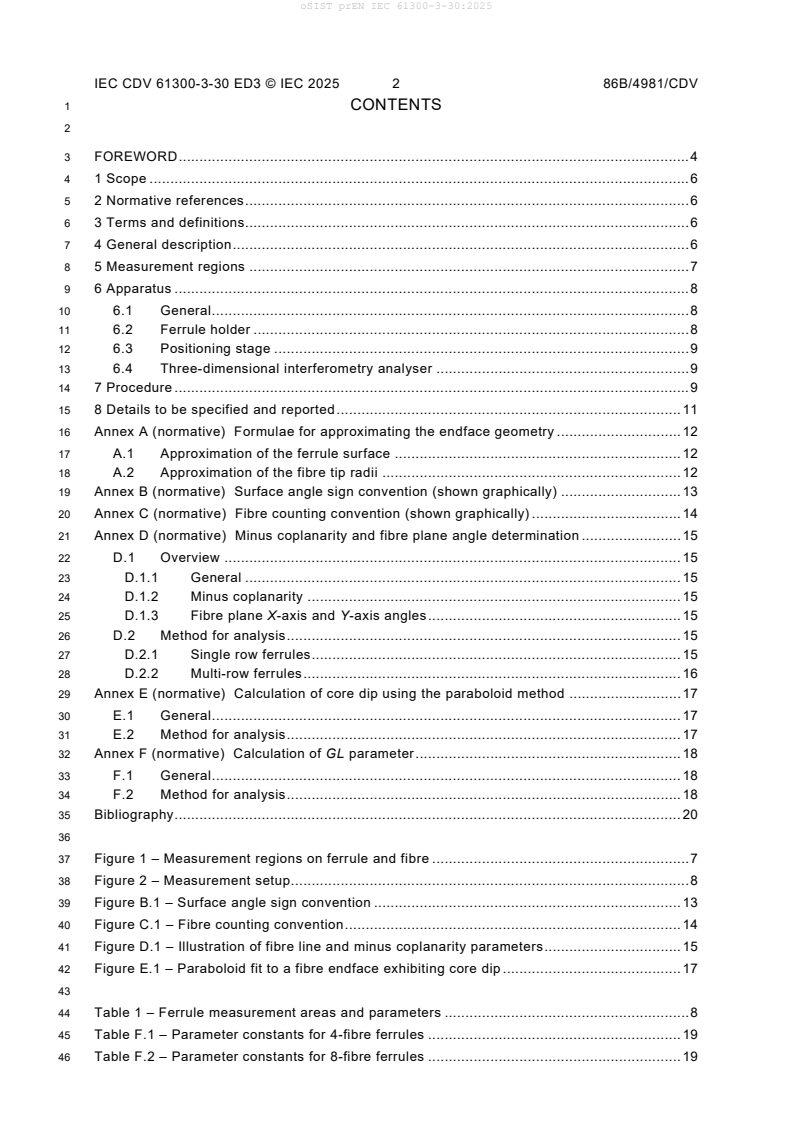
1 CONTENTS
3 FOREWORD . 4
4 1 Scope . 6
5 2 Normative references . 6
6 3 Terms and definitions. 6
7 4 General description . 6
8 5 Measurement regions . 7
9 6 Apparatus . 8
10 6.1 General . 8
11 6.2 Ferrule holder . 8
12 6.3 Positioning stage . 9
13 6.4 Three-dimensional interferometry analyser . 9
14 7 Procedure . 9
15 8 Details to be specified and reported . 11
16 Annex A (normative) Formulae for approximating the endface geometry . 12
17 A.1 Approximation of the ferrule surface . 12
18 A.2 Approximation of the fibre tip radii . 12
19 Annex B (normative) Surface angle sign convention (shown graphically) . 13
20 Annex C (normative) Fibre counting convention (shown graphically) . 14
21 Annex D (normative) Minus coplanarity and fibre plane angle determination . 15
22 D.1 Overview . 15
23 D.1.1 General . 15
24 D.1.2 Minus coplanarity . 15
25 D.1.3 Fibre plane X-axis and Y-axis angles . 15
26 D.2 Method for analysis . 15
27 D.2.1 Single row ferrules . 15
28 D.2.2 Multi-row ferrules . 16
29 Annex E (normative) Calculation of core dip using the paraboloid method . 17
30 E.1 General . 17
31 E.2 Method for analysis . 17
32 Annex F (normative) Calculation of GL parameter . 18
33 F.1 General . 18
34 F.2 Method for analysis . 18
35 Bibliography . 20
37 Figure 1 – Measurement regions on ferrule and fibre . 7
38 Figure 2 – Measurement setup. 8
39 Figure B.1 – Surface angle sign convention . 13
40 Figure C.1 – Fibre counting convention . 14
41 Figure D.1 – Illustration of fibre line and minus coplanarity parameters . 15
42 Figure E.1 – Paraboloid fit to a fibre endface exhibiting core dip . 17
44 Table 1 – Ferrule measurement areas and parameters . 8
45 Table F.1 – Parameter constants for 4-fibre ferrules . 19
46 Table F.2 – Parameter constants for 8-fibre ferrules . 19
IEC CDV 61300-3-30 ED3 © IEC 2025 3 86B/4981/CDV
47 Table F.3 – Parameter constants for 12-fibre ferrules . 19
48 Table F.4 – Parameter constants for 16-fibre ferrules . 19
49 Table F.5 – Parameter constants for 24-fibre ferrules . 19
50 Table F.6 – Parameter constants for 36-fibre ferrules . 19
IEC CDV 61300-3-30 ED3 © IEC 2025 4 86B/4981/CDV
54 INTERNATIONAL ELECTROTECHNICAL COMMISSION
55 ____________
57 FIBRE OPTIC INTERCONNECTING DEVICES AND PASSIVE
58 COMPONENTS – BASIC TEST AND MEASUREMENT PROCEDURES
60 Part 3-30: Examinations and measurements –
61 Endface geometry of rectangular ferrule
63 FOREWORD
64 1) The International Electrotechnical Commission (IEC) is a worldwide organization for standardization comprising
65 all national electrotechnical committees (IEC National Committees). The object of IEC is to promote international
66 co-operation on all questions concerning standardization in the electrical and electronic fields. To this end and
67 in addition to other activities, IEC publishes International Standards, Technical Specifications, Technical Reports,
68 Publicly Available Specifications (PAS) and Guides (hereafter referred to as "IEC Publication(s)"). Their
69 preparation is entrusted to technical committees; any IEC National Committee interested in the subject dealt with
70 may participate in this preparatory work. International, governmental and non-governmental organizations liaising
71 with the IEC also participate in this preparation. IEC collaborates closely with the International Organization for
72 Standardization (ISO) in accordance with conditions determined by agreement between the two organizations.
73 2) The formal decisions or agreements of IEC on technical matters express, as nearly as possible, an international
74 consensus of opinion on the relevant subjects since each technical committee has representation from all
75 interested IEC National Committees.
76 3) IEC Publications have the form of recommendations for international use and are accepted by IEC National
77 Committees in that sense. While all reasonable efforts are made to ensure that the technical content of IEC
78 Publications is accurate, IEC cannot be held responsible for the way in which they are used or for any
79 misinterpretation by any end user.
80 4) In order to promote international uniformity, IEC National Committees undertake to apply IEC Publications
81 transparently to the maximum extent possible in their national and regional publications. Any divergence between
82 any IEC Publication and the corresponding national or regional publication shall be clearly indicated in the latter.
83 5) IEC itself does not provide any attestation of conformity. Independent certification bodies provide conformity
84 assessment services and, in some areas, access to IEC marks of conformity. IEC is not responsible for any
85 services carried out by independent certification bodies.
86 6) All users should ensure that they have the latest edition of this publication.
87 7) No liability shall attach to IEC or its directors, employees, servants or agents including individual experts and
88 members of its technical committees and IEC National Committees for any personal injury, property damage or
89 other damage of any nature whatsoever, whether direct or indirect, or for costs (including legal fees) and
90 expenses arising out of the publication, use of, or reliance upon, this IEC Publication or any other IEC Publications.
91 8) Attention is drawn to the Normative references cited in this publication. Use of the referenced publications is
92 indispensable for the correct application of this publication.
93 9) Attention is drawn to the possibility that some of the elements of this IEC Publication may be the subject of patent
94 rights. IEC shall not be held responsible for identifying any or all such patent rights.
95 International Standard IEC 61300-3-30 has been prepared by subcommittee 86B: Fibre optic
96 interconnecting devices and passive components, of IEC technical committee 86: Fibre optics.
97 This third edition cancels and replaces the second edition published in 2020. This edition
98 constitutes a technical revision.
99 This edition includes the following significant technical changes with respect to the previous
100 edition:
101 a) clarification of region diameter symbols;
102 b) introduction of x116 and x132 ROI to support MT-16 and MT-32 ferrule types;
103 c) preparation of GL parameters tables for 16, 24 and 32-fibre ferrules;
104 d) clarification of the neighbouring fibres definition when computing adjacent height;
IEC CDV 61300-3-30 ED3 © IEC 2025 5 86B/4981/CDV
105 e) improvement of figures in Annexes.
106 The text of this International Standard is based on the following documents:
FDIS Report on voting
86B/XX/FDIS 86B/XX/RVD
108 Full information on the voting for the approval of this International Standard can be found in the
109 report on voting indicated in the above table.
110 This document has been drafted in accordance with the ISO/IEC Directives, Part 2.
111 A list of all parts in the IEC 61300 series, published under the general title Fibre optic
112 interconnecting devices and passive components, can be found on the IEC website.
113 The committee has decided that the contents of this document will remain unchanged until the
114 stability date indicated on the IEC website under "http://webstore.iec.ch" in the data related to
115 the specific document. At this date, the document will be
116 • reconfirmed,
117 • withdrawn,
118 • replaced by a revised edition, or
119 • amended.
121 A bilingual version of this publication may be issued at a later date.
123 The National Committees are requested to note that for this document the stability date
124 is 2024.
125 THIS TEXT IS INCLUDED FOR THE INFORMATION OF THE NATIONAL COMMITTEES AND WILL BE DELETED
126 AT THE PUBLICATION STAGE.
IEC CDV 61300-3-30 ED3 © IEC 2025 6 86B/4981/CDV
129 FIBRE OPTIC INTERCONNECTING DEVICES AND PASSIVE
130 COMPONENTS – BASIC TEST AND MEASUREMENT PROCEDURES
132 Part 3-30: Examinations and measurements –
133 Endface geometry of rectangular ferrule
135 1 Scope
136 This part of IEC 61300 describes a method for measuring the endface geometry of rectangular
137 multifibre ferrules having an IEC defined optical interface. The primary attributes are fibre
138 position relative to the endface, endface angle relative to the guide holes, fibre tip radii and
139 core dip for multimode fibres.
140 2 Normative references
141 There are no normative references in this document.
142 3 Terms and definitions
143 No terms and definitions are listed in this document.
144 ISO and IEC maintain terminological databases for use in standardization at the following
145 addresses:
146 • IEC Electropedia: available at https://www.electropedia.org/
147 • ISO Online browsing platform: available at https://www.iso.org/obp
148 4 General description
149 Guide pin based multifibre connector plugs typically have a rectangular endface with a long axis
150 and a short axis. Ideally a flat polish is desired on the endface with the fibres protruding slightly
151 and all in the same plane to assure physical contact of the fibre cores when two connectors are
152 intermated. In practice, the endface typically has two different curvatures across the surface
153 along the long and short axis. Since mated ferrules are aligned by pins in the guide holes, the
154 endface of the ferrule shall be properly oriented (SX and SY angles) with respect to the guide
155 holes to achieve positive contact. The endface angle SX in the long axis (X-axis) and the endface
156 angle SY in the short axis (Y-axis) (as defined in Annex B) are measured by finding the best fit
157 plane (P ), based on a percentage of the highest points in a specified region of interest. The
J
158 highest points typically show the greatest modulation from an interferometric standpoint. This
159 allows for more robust measurements and greater repeatability between different
160 interferometers.
161 The angle of the best fit plane P is calculated by comparing it to the reference plane P which
J
162 is perpendicular to the averaged axis of the guide holes. The height H (positive is a protrusion)
163 of the fibres is a planar height defined as the distance between the fibre endface and the best
164 fit plane. Core dip is of more relevance to multimode fibres because the large core is softer
165 than the cladding of the fibre and tends to polish away faster. Core dip is calculated using the
166 paraboloid method described in Annex E.
167 One method is described for measuring the polish angle and fibre position for a single ferrule
168 multifibre connector by analysing the endface with a three-dimensional interferometry type
169 surface analyser.
IEC CDV 61300-3-30 ED3 © IEC 2025 7 86B/4981/CDV
170 5 Measurement regions
171 The following regions shall be defined on the ferrule endface.
172 a) Region of interest (ROI): the ROI is set on the ferrule surface and defined by a rectangular
173 region having a long axis (X-axis) and a short axis (Y-axis). The region of interest is chosen
174 to cover the intended contact zone of the ferrule endface when the ferrules are mated. The
175 region of interest shall be centred on the fibre array. See Figure 1. Refer to Table 1 for
176 measurement areas to be used for different connectors.
177 b) Extracting region: the extracting region, which includes the fibre endface regions and the
178 associated adhesive regions, is defined by circles having a diameter ØE, centred on each
179 fibre.
180 c) Averaging region: the averaging region is set on the fibre surfaces to be used to calculate
181 the fibre height, and is defined by a circle having a diameter Ø . The averaging region is
F
182 the same for single-mode (SM) fibres and multimode (MM) fibres.
183 d) Core dip region: the core dip region is set on the fibre surfaces to be used to calculate the
184 fibre core dip using the paraboloid method, and is defined by circles having a diameter Ø ,
CD
185 centred on each fibre.
186 Additionally, core dip adjustment constant: the calculated core dip amplitude following the fit of
187 a paraboloid function to the fibre endface is adjusted by means of constant R .
Y Region of interest ROI
X
Extracting region Ø
E
Fibre
Averaging region Ø
F
Core dip region Ø
CD
IEC
189 Figure 1 – Measurement regions on ferrule and fibre
IEC CDV 61300-3-30 ED3 © IEC 2025 8 86B/4981/CDV
190 Table 1 – Ferrule measurement areas and parameters
Averaging
Core dip
Region of Core dip
Extracting
Ferrule Next %
region-
fitting region
interest-ROI % top adjustment
region
type Descrip- top
SM+MM
(diameter
pixels constant
(X × Y)
(variant tion pixels (diameter ØE)
(diameter Ø )
F
Ø )
CD
excluded R (see
number) used
mm × mm mm
Annex E)
m
...
Questions, Comments and Discussion
Ask us and Technical Secretary will try to provide an answer. You can facilitate discussion about the standard in here.
Loading comments...