

EN 61169-32:1999/prA1:2026
(Amendment)Radio-frequency connectors - Part 32: RF coaxial connectors with inner diameter of outer conductor 1,85 mm (0,072 in) with screw coupling - Characteristic impedance 50 ohms (type 1,85)
- Status
- Not Published
- Publication Date
- 23-Mar-2028
- Technical Committee
- CLC/SR 46F - RF and microwave passive components
- Current Stage
- 4020 - Enquiry circulated - Enquiry
- Start Date
- 04-Sep-2026
- Due Date
- 31-Oct-2025
- Completion Date
- 04-Sep-2026

EN 61169-32:1999/prA1:2026 is a European Committee for Electrotechnical Standardization (CENELEC) amendment to the radio-frequency (RF) connector standard for type 1,85 coaxial interfaces. It updates the requirements for 50-ohm RF coaxial connectors with a 1.85 mm inner diameter of the outer conductor and screw coupling. Engineers, manufacturers, and test laboratories use it when designing, qualifying, or checking this connector family, especially for higher-frequency use.
What does EN 61169-32:1999/prA1:2026 specify?
EN 61169-32:1999/prA1:2026 amends IEC 61169-32, Part 32 of the RF connector series. It does not redefine the whole connector family - it updates the current edition by replacing the ratings and characteristics table in clause 3.2 and by adding Grade 0 connectors.
In practice, the amendment keeps the standard focused on the type 1,85 connector interface while extending its technical coverage for high-frequency applications. The reasoning note links the change to the fifth-generation mobile communication (5G) band between 66 GHz and 71 GHz, so users can see why the higher-frequency range matters.
What are the key requirements of EN 61169-32:1999/prA1:2026?
EN 61169-32:1999/prA1:2026 centers on the updated table in clause 3.2. That table sets the electrical, mechanical, environmental, endurance, and chemical-contamination characteristics that the connector family has to meet.
Electrical performance
- The amendment adds Grade 0 connectors and extends the usable upper frequency range so the connector family can cover the 66 GHz to 71 GHz 5G band. For users, this is the key design change: the connector interface is no longer limited to the previous upper-frequency boundary.
- The table keeps separate performance levels for Grade 0 and Grade 1 connectors, including reflection factor limits by frequency band. In practice, this lets a designer or buyer match the connector grade to the intended RF performance.
- Clause 3.2 also covers nominal impedance, centre contact resistance, outer conductor continuity, insulation resistance, voltage proof, environmental test voltage, screening effectiveness, and discharge behavior. These are the checks that show whether the connector will carry signals cleanly and stay electrically safe.
Mechanical performance
- The table retains requirements for soldering, gauge retention of resilient contacts, contact captivation, engagement and separation, coupling torque, tensile strength of the coupling mechanism, and cable fixing. These items matter because they show whether the connector can be assembled, mated, and secured without damage.
- It also includes vibration, shock, bump, bending moment, and cable movement tests. In practice, these checks tell you whether the connector will stay stable under handling, installation, and service loads.
Environmental and endurance performance
- EN 61169-32:1999/prA1:2026 keeps the environmental ratings for climatic categories, sealing of panel and barrier connectors, and hermetically sealed connectors. This tells users what environmental protection the connector family is intended to provide.
- The table also points to endurance, salt mist, resistance to solvents and contaminating fluids, and sulphur dioxide exposure. These are the qualification items that matter for industrial, outdoor, and contaminated environments.
What terms does EN 61169-32:1999/prA1:2026 define?
- Grade 0 connectors - the added higher-performance class intended for the wider high-frequency range.
- Grade 1 connectors - the existing performance class retained in the revised ratings table.
- Reflection factor - a measure of RF mismatch used to set the frequency-dependent performance limits.
- Screening effectiveness - the ability of the fully mated connector to limit electromagnetic leakage.
- Characteristic impedance - the nominal impedance of the connector interface, given here as 50 ohms.
- Screw coupling - a threaded mating method that locks the connector halves together.
- Outer conductor - the coaxial outer conductor whose inner diameter defines the type 1,85 interface.
Who uses EN 61169-32:1999/prA1:2026?
EN 61169-32:1999/prA1:2026 is used by RF connector designers, cable assembly manufacturers, test laboratories, telecom equipment engineers, and quality managers. It is relevant wherever type 1,85 connectors are specified, built, tested, or purchased.
In practice, these users rely on it for product design, qualification testing, production verification, supplier approval, and performance comparison between Grade 0 and Grade 1 connectors. It is especially relevant for high-frequency measurement systems and 5G-related development work.
What changed in EN 61169-32:1999/prA1:2026 from the previous edition?
EN 61169-32:1999/prA1:2026 amends IEC 61169-32 First Edition 1999-07. The amendment adds Grade 0 connectors, updates the title and introduction to reflect that new grade, and replaces the clause 3.2 ratings table.
The stated technical purpose is to extend the upper frequency limit so the connector family can support the 66 GHz to 71 GHz 5G band. The reasoning note says this is intended to improve measurement coverage for that band and support further 5G development and deployment.
Which standards are used with EN 61169-32:1999/prA1:2026?
IEC 61169-1 is the main companion standard named in the ratings table. It supplies the test methods used for the electrical, mechanical, and environmental characteristics.
IEC 61169-32 First Edition 1999-07 is the base document that this amendment modifies. Users need both the amendment and the base part when they want the full current requirement set.
What does the EN 61169-32:1999/prA1:2026 document contain?
The document contains front matter, the amendment purpose, the revised clause 3.2 table, and a reasoning section. The table groups the connector requirements into electrical, mechanical, environmental, endurance, and chemical-contamination characteristics, and it links many of them to IEC 61169-1 test methods.
For engineers and test labs, this is the section to use when planning qualification work or checking whether a connector meets the Grade 0 or Grade 1 requirements. The reasoning text explains why the higher-frequency update was proposed.
Relations
- Effective Date
- 23-Sep-2025
Get Certified
Connect with accredited certification bodies for this standard

ANCE
Mexican certification and testing association.

Intertek Slovenia
Intertek testing, inspection, and certification services in Slovenia.

LNE (Laboratoire National de Métrologie et d'Essais)
French national laboratory for metrology and testing.
Sponsored listings
Frequently Asked Questions
EN 61169-32:1999/prA1:2026 is a draft published by CLC. Its full title is "Radio-frequency connectors - Part 32: RF coaxial connectors with inner diameter of outer conductor 1,85 mm (0,072 in) with screw coupling - Characteristic impedance 50 ohms (type 1,85)". This standard covers: Radio-frequency connectors - Part 32: RF coaxial connectors with inner diameter of outer conductor 1,85 mm (0,072 in) with screw coupling - Characteristic impedance 50 ohms (type 1,85)
Radio-frequency connectors - Part 32: RF coaxial connectors with inner diameter of outer conductor 1,85 mm (0,072 in) with screw coupling - Characteristic impedance 50 ohms (type 1,85)
EN 61169-32:1999/prA1:2026 is classified under the following ICS (International Classification for Standards) categories: 33.120.30 - RF connectors. The ICS classification helps identify the subject area and facilitates finding related standards.
EN 61169-32:1999/prA1:2026 has the following relationships with other standards: It is inter standard links to EN 61169-32:1999. Understanding these relationships helps ensure you are using the most current and applicable version of the standard.
EN 61169-32:1999/prA1:2026 is available in PDF format for immediate download after purchase. The document can be added to your cart and obtained through the secure checkout process. Digital delivery ensures instant access to the complete standard document.
Standards Content (Sample)
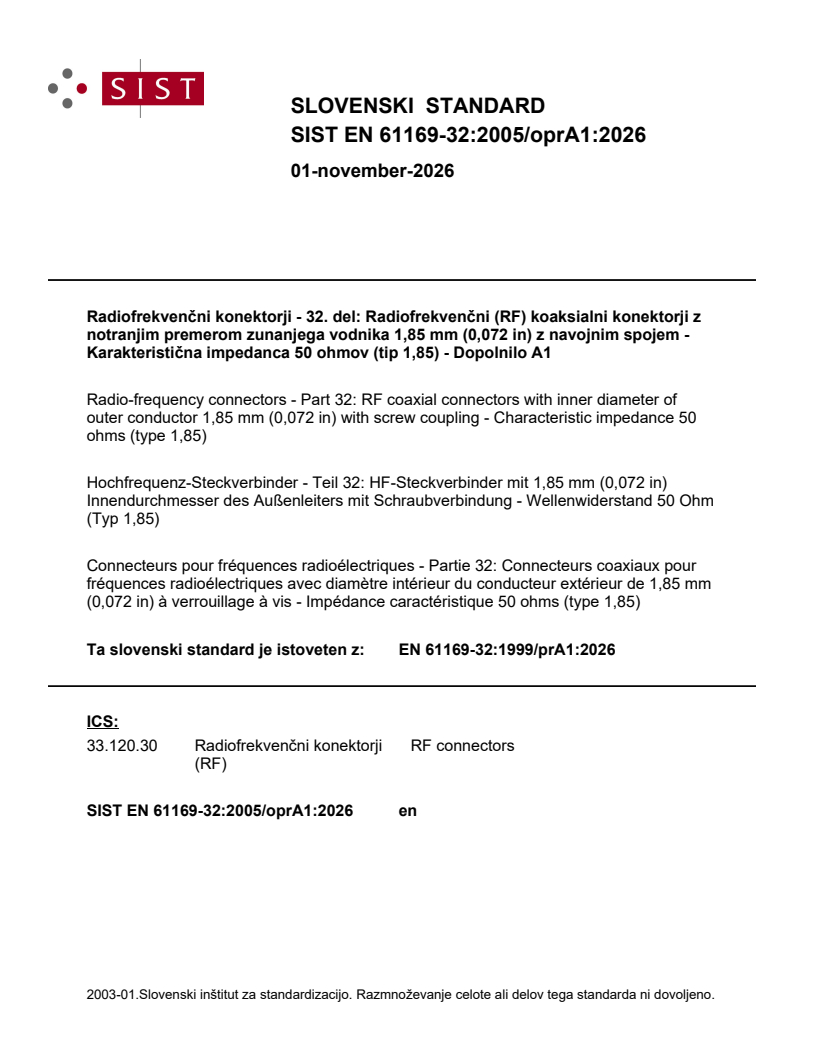
SLOVENSKI STANDARD
01-november-2026
Radiofrekvenčni konektorji - 32. del: Radiofrekvenčni (RF) koaksialni konektorji z
notranjim premerom zunanjega vodnika 1,85 mm (0,072 in) z navojnim spojem -
Karakteristična impedanca 50 ohmov (tip 1,85) - Dopolnilo A1
Radio-frequency connectors - Part 32: RF coaxial connectors with inner diameter of
outer conductor 1,85 mm (0,072 in) with screw coupling - Characteristic impedance 50
ohms (type 1,85)
Hochfrequenz-Steckverbinder - Teil 32: HF-Steckverbinder mit 1,85 mm (0,072 in)
Innendurchmesser des Außenleiters mit Schraubverbindung - Wellenwiderstand 50 Ohm
(Typ 1,85)
Connecteurs pour fréquences radioélectriques - Partie 32: Connecteurs coaxiaux pour
fréquences radioélectriques avec diamètre intérieur du conducteur extérieur de 1,85 mm
(0,072 in) à verrouillage à vis - Impédance caractéristique 50 ohms (type 1,85)
Ta slovenski standard je istoveten z: EN 61169-32:1999/prA1:2026
ICS:
33.120.30 Radiofrekvenčni konektorji RF connectors
(RF)
2003-01.Slovenski inštitut za standardizacijo. Razmnoževanje celote ali delov tega standarda ni dovoljeno.
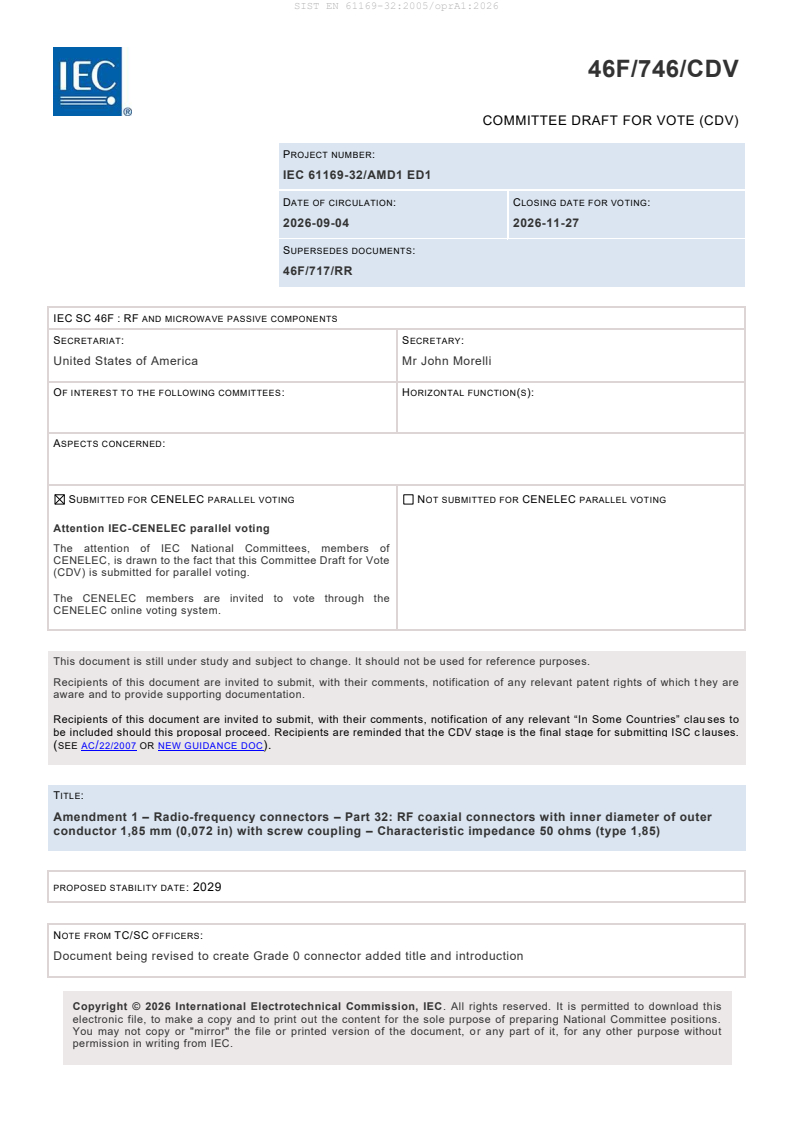
46F/746/CDV
COMMITTEE DRAFT FOR VOTE (CDV)
PROJECT NUMBER:
IEC 61169-32/AMD1 ED1
DATE OF CIRCULATION: CLOSING DATE FOR VOTING:
2026-09-04 2026-11-27
SUPERSEDES DOCUMENTS:
46F/717/RR
IEC SC 46F : RF AND MICROWAVE PASSIVE COMPONENTS
SECRETARIAT: SECRETARY:
United States of America Mr John Morelli
OF INTEREST TO THE FOLLOWING COMMITTEES: HORIZONTAL FUNCTION(S):
ASPECTS CONCERNED:
SUBMITTED FOR CENELEC PARALLEL VOTING NOT SUBMITTED FOR CENELEC PARALLEL VOTING
Attention IEC-CENELEC parallel voting
The attention of IEC National Committees, members of
CENELEC, is drawn to the fact that this Committee Draft for Vote
(CDV) is submitted for parallel voting.
The CENELEC members are invited to vote through the
CENELEC online voting system.
This document is still under study and subject to change. It should not be used for reference purposes.
Recipients of this document are invited to submit, with their comments, notification of any relevant patent rights of which t hey are
aware and to provide supporting documentation.
Recipients of this document are invited to submit, with their comments, notification of any relevant “In Some Countries” clau ses to
be included should this proposal proceed. Recipients are reminded that the CDV stage is the final stage for submitting ISC c lauses.
(SEE AC/22/2007 OR NEW GUIDANCE DOC).
TITLE:
Amendment 1 – Radio-frequency connectors – Part 32: RF coaxial connectors with inner diameter of outer
conductor 1,85 mm (0,072 in) with screw coupling – Characteristic impedance 50 ohms (type 1,85)
PROPOSED STABILITY DATE: 2029
NOTE FROM TC/SC OFFICERS:
Document being revised to create Grade 0 connector added title and introduction
electronic file, to make a copy and to print out the content for the sole purpose of preparing National Committee positions.
You may not copy or "mirror" the file or printed version of the document, or any part of it, for any other purpose without
permission in writing from IEC.
IEC CDV 61169-32:1999/AMD1 © IEC 2026
1 INTERNATIONAL ELECTROTECHNICAL COMMISSION
2 ___________
3 IEC 61169-32
4 First Edition 1999-07
6 RADIO-FREQUENCY CONNECTORS –
7 Part 32: RF coaxial connectors with inner diameter of outer conductor 1,85 mm (0,072
8 in) with screw coupling – Characteristic impedance 50 ohms (type 1,85)
12 AMENDMENT 1
15 Purpose of this amanedment:
17 Addition of grade 0 connectors
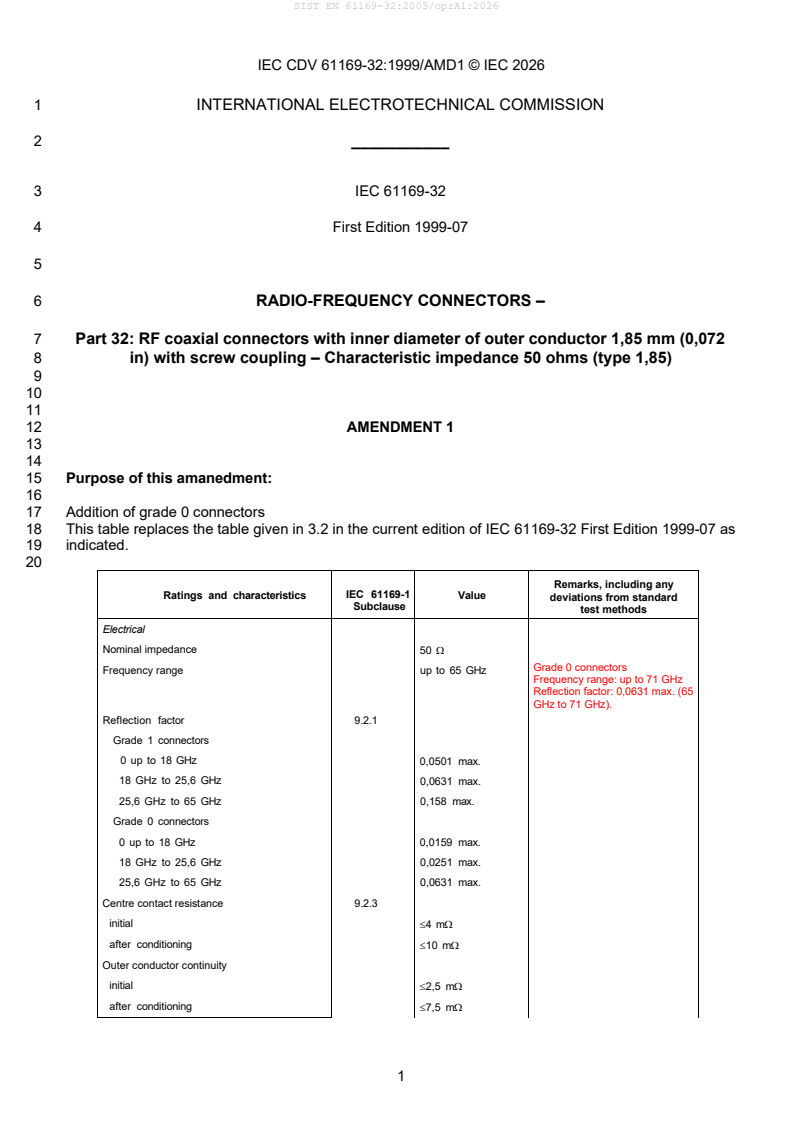
18 This table replaces the table given in 3.2 in the current edition of IEC 61169-32 First Edition 1999-07 as
19 indicated.
Remarks, including any
IEC 61169-1
Ratings and characteristics Value
deviations from standard
Subclause
test methods
Electrical
Nominal impedance 50
Grade 0 connectors
Frequency range up to 65 GHz
Frequency range: up to 71 GHz
Reflection factor: 0,0631 max. (65
GHz to 71 GHz).
Reflection factor 9.2.1
Grade 1 connectors
0 up to 18 GHz 0,0501 max.
18 GHz to 25,6 GHz
...