


EN IEC 63305:2024
(Main)Underwater acoustics - Calibration of acoustic wave vector receivers in the frequency range 5 Hz to 10 kHz
Underwater acoustics - Calibration of acoustic wave vector receivers in the frequency range 5 Hz to 10 kHz
IEC 63305:2024 specifies methods and procedures for calibration of vector receivers in the frequency range 5 Hz to 10 kHz, which are applicable to vector receivers based on the two different principles. In addition, it describes an absolute method of inertial vector receiver calibration in air using optical interferometry. Usually, acoustic wave vector receivers are designed and constructed based on one of two principles. One is the sound pressure difference (gradient) principle. When measuring with this sensor, the vector receiver is rigidly fixed on a mount and supported in water. The other is the co-vibrating (inertial) principle. When measuring with this sensor, the vector receiver is suspended on a mount and supported in water in a non-rigid manner, which allows the vector receiver co-vibrate in the same direction as the sound particle in the sound wave field. Many methods have been used to calibrate vector receivers, such as free-field calibration, calibration in standing wave tube and calibration in a travelling wave tube.
Unterwasserakustik - Kalibrierung von Schallwellenvektorempfängern im Frequenzbereich 5 Hz bis 10 kHz
Acoustique sous-marine - Étalonnage des récepteurs vectoriels d’ondes acoustiques dans la plage de fréquences de 5 Hz à 10 kHz
L'IEC 63305:2024 spécifie les méthodes et procédures d’étalonnage des récepteurs vectoriels dans la plage de fréquences de 5 Hz à 10 kHz, qui sont applicables aux récepteurs vectoriels sur la base de deux principes différents. En outre, il décrit une méthode absolue d’étalonnage des récepteurs vectoriels inertiels dans l’air à l’aide de l’interférométrie optique. En général, les récepteurs vectoriels d’ondes acoustiques sont conçus et construits sur la base de l’un des deux principes suivants. L’un réside sur le principe de la différence de pression acoustique (gradient). Lors du mesurage avec ce capteur, le récepteur vectoriel est fixé de manière rigide sur un support et soutenu dans l'eau. L’autre principe repose sur la co-vibration (inertie). Lors du mesurage avec ce capteur, le récepteur vectoriel est suspendu à un support et soutenu dans l'eau de manière non rigide, ce qui permet une co-vibration de ce dernier dans la même direction que la particule acoustique dans le champ d'ondes acoustiques. De nombreuses méthodes ont été appliquées pour étalonner les récepteurs vectoriels, telles que l’étalonnage en champ libre, l’étalonnage dans un tube à ondes stationnaires et l’étalonnage dans un tube à ondes progressives
Podvodna akustika - Kalibracija zvočnega vala vektorskih sprejemnikov v frekvenčnem območju od 5 Hz do 10 kHz (IEC 63305:2024)
Standard IEC 63305:2024 določa metode in postopke za kalibracijo vektorskih sprejemnikov v frekvenčnem območju od 5 Hz do 10 kHz, ki se uporabljajo za vektorske sprejemnike na podlagi dveh načel. Poleg tega opisuje absolutno metodo kalibracije inercijskega vektorskega sprejemnika v zraku z optično interferometrijo.
Vektorski sprejemniki zvočnih valov so običajno zasnovani in izdelani na podlagi enega od dveh načel. Prvo je načelo razlike v zvočnem tlaku (gradientno načelo) – pri merjenju s tem senzorjem je vektorski sprejemnik trdno pritrjen na nosilec in podprt v vodi. Drugo je kovibracijsko (inertno) načelo – pri merjenju s tem senzorjem vektorski sprejemnik visi na nosilcu in je podprt v vodi, vendar ni pritrjen, zaradi česar lahko sočasno vibrira v isti smeri kot zvočni delec v polju zvočnega vala.
Za kalibracijo vektorskih sprejemnikov so bile uporabljene številne metode, npr. kalibracija v prostem polju, kalibracija v cevi na stoječe valove in kalibracija v cevi na potujoče valove.
General Information
- Status
- Published
- Publication Date
- 04-Apr-2024
- Technical Committee
- CLC/SR 87 - CLC/SR 87
- Drafting Committee
- IEC/TC 87 - IEC_TC_87
- Current Stage
- 6060 - Document made available - Publishing
- Start Date
- 05-Apr-2024
- Completion Date
- 05-Apr-2024
Overview
EN IEC 63305:2024 - Underwater acoustics: Calibration of acoustic wave vector receivers (5 Hz to 10 kHz) defines standardized methods and procedures for calibrating acoustic vector receivers operating between 5 Hz and 10 kHz. The document covers both principal sensor types - sound pressure difference (gradient) and co‑vibrating (inertial) vector receivers - and specifies laboratory techniques including free‑field calibration, standing wave tube, travelling wave tube, and an absolute inertial calibration in air using optical interferometry.
Key topics and technical requirements
- Scope and frequency range: Applicable to vector receivers for low‑frequency underwater acoustics (5 Hz–10 kHz).
- Sensor principles: Distinguishes calibration approaches for gradient (rigidly mounted) and co‑vibrating/inertial (suspended, non‑rigid) receivers.
- Calibration methods:
- Free‑field reciprocity and free‑field methods using reference hydrophones or optical interferometry.
- Standing wave tube calibrations (including horizontal configurations) and comparison/accelerometer-based procedures.
- Travelling wave tube procedures to establish unidirectional, plane progressive wave fields.
- Absolute optical interferometry method: Describes an optical interferometric approach for inertial vector receiver calibration in air.
- Instrumentation & facility requirements: Defines calibration facility, instrumentation, projector drive/current measurement, electrical loading, preamplifier considerations, positioning and alignment, and immersed depth requirements.
- Measurement quality: Guidance on signal types, noise and cross‑talk management, uncertainty estimation (GUM principles), environmental conditions (temperature, depth), and reporting formats (sensitivity, sensitivity level, metadata).
- Procedural elements: Preparation of transducers (soaking/wetting), checks for acoustic interference, frequency limitations, and recommended recalibration periods.
Practical applications and users
This standard is essential for organizations that design, manufacture, test, or deploy underwater acoustic vector sensors and related systems, including:
- Calibration laboratories and test houses performing hydrophone/vector receiver calibration
- Marine research institutes and oceanography labs conducting acoustic measurements
- Defence and naval sonar system integrators
- Offshore energy, subsea monitoring, and environmental acoustic monitoring projects
- Manufacturers of vector receivers, hydrophones, and acoustic positioning systems
Using IEC 63305:2024 ensures traceable, repeatable calibration results and harmonized reporting of sensitivity and uncertainty for low‑frequency underwater acoustic vector measurements.
Related standards
Normative references include:
- IEC 60500 (hydrophone properties), IEC 60565‑1/2 (hydrophone calibration procedures), ISO 18405 (terminology), ISO 80000‑8 (acoustics quantities and units), and the GUM (Guide to the expression of uncertainty in measurement). These support consistent measurement practice and uncertainty evaluation.

Frequently Asked Questions
EN IEC 63305:2024 is a standard published by CLC. Its full title is "Underwater acoustics - Calibration of acoustic wave vector receivers in the frequency range 5 Hz to 10 kHz". This standard covers: IEC 63305:2024 specifies methods and procedures for calibration of vector receivers in the frequency range 5 Hz to 10 kHz, which are applicable to vector receivers based on the two different principles. In addition, it describes an absolute method of inertial vector receiver calibration in air using optical interferometry. Usually, acoustic wave vector receivers are designed and constructed based on one of two principles. One is the sound pressure difference (gradient) principle. When measuring with this sensor, the vector receiver is rigidly fixed on a mount and supported in water. The other is the co-vibrating (inertial) principle. When measuring with this sensor, the vector receiver is suspended on a mount and supported in water in a non-rigid manner, which allows the vector receiver co-vibrate in the same direction as the sound particle in the sound wave field. Many methods have been used to calibrate vector receivers, such as free-field calibration, calibration in standing wave tube and calibration in a travelling wave tube.
IEC 63305:2024 specifies methods and procedures for calibration of vector receivers in the frequency range 5 Hz to 10 kHz, which are applicable to vector receivers based on the two different principles. In addition, it describes an absolute method of inertial vector receiver calibration in air using optical interferometry. Usually, acoustic wave vector receivers are designed and constructed based on one of two principles. One is the sound pressure difference (gradient) principle. When measuring with this sensor, the vector receiver is rigidly fixed on a mount and supported in water. The other is the co-vibrating (inertial) principle. When measuring with this sensor, the vector receiver is suspended on a mount and supported in water in a non-rigid manner, which allows the vector receiver co-vibrate in the same direction as the sound particle in the sound wave field. Many methods have been used to calibrate vector receivers, such as free-field calibration, calibration in standing wave tube and calibration in a travelling wave tube.
EN IEC 63305:2024 is classified under the following ICS (International Classification for Standards) categories: 17.140.50 - Electroacoustics. The ICS classification helps identify the subject area and facilitates finding related standards.
You can purchase EN IEC 63305:2024 directly from iTeh Standards. The document is available in PDF format and is delivered instantly after payment. Add the standard to your cart and complete the secure checkout process. iTeh Standards is an authorized distributor of CLC standards.
Standards Content (Sample)
SLOVENSKI STANDARD
01-junij-2024
Podvodna akustika - Kalibracija zvočnega vala vektorskih sprejemnikov v
frekvenčnem območju od 5 Hz do 10 kHz (IEC 63305:2024)
Underwater Acoustics - Calibration of acoustic wave vector receivers in the frequency
range 5 Hz to 10 kHz (IEC 63305:2024)
Unterwasserakustik - Kalibrierung von Schallwellenvektorempfängern im
Frequenzbereich 5 Hz bis 10 kHz (IEC 63305:2024)
Acoustique sous-marine - Étalonnage des récepteurs vectoriels d’ondes acoustiques
dans la plage de fréquences de 5 Hz à 10 kHz (IEC 63305:2024)
Ta slovenski standard je istoveten z: EN IEC 63305:2024
ICS:
17.140.50 Elektroakustika Electroacoustics
2003-01.Slovenski inštitut za standardizacijo. Razmnoževanje celote ali delov tega standarda ni dovoljeno.
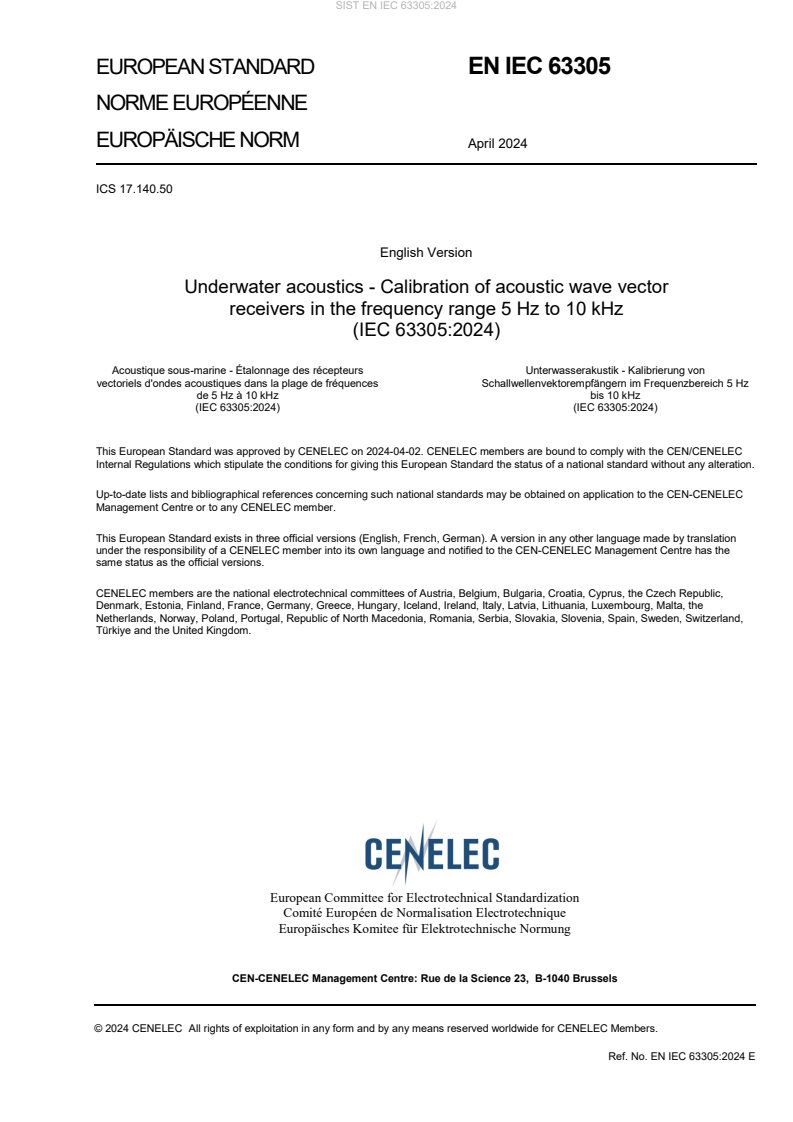
EUROPEAN STANDARD EN IEC 63305
NORME EUROPÉENNE
EUROPÄISCHE NORM April 2024
ICS 17.140.50
English Version
Underwater acoustics - Calibration of acoustic wave vector
receivers in the frequency range 5 Hz to 10 kHz
(IEC 63305:2024)
Acoustique sous-marine - Étalonnage des récepteurs Unterwasserakustik - Kalibrierung von
vectoriels d'ondes acoustiques dans la plage de fréquences Schallwellenvektorempfängern im Frequenzbereich 5 Hz
de 5 Hz à 10 kHz bis 10 kHz
(IEC 63305:2024) (IEC 63305:2024)
This European Standard was approved by CENELEC on 2024-04-02. CENELEC members are bound to comply with the CEN/CENELEC
Internal Regulations which stipulate the conditions for giving this European Standard the status of a national standard without any alteration.
Up-to-date lists and bibliographical references concerning such national standards may be obtained on application to the CEN-CENELEC
Management Centre or to any CENELEC member.
This European Standard exists in three official versions (English, French, German). A version in any other language made by translation
under the responsibility of a CENELEC member into its own language and notified to the CEN-CENELEC Management Centre has the
same status as the official versions.
CENELEC members are the national electrotechnical committees of Austria, Belgium, Bulgaria, Croatia, Cyprus, the Czech Republic,
Denmark, Estonia, Finland, France, Germany, Greece, Hungary, Iceland, Ireland, Italy, Latvia, Lithuania, Luxembourg, Malta, the
Netherlands, Norway, Poland, Portugal, Republic of North Macedonia, Romania, Serbia, Slovakia, Slovenia, Spain, Sweden, Switzerland,
Türkiye and the United Kingdom.
European Committee for Electrotechnical Standardization
Comité Européen de Normalisation Electrotechnique
Europäisches Komitee für Elektrotechnische Normung
CEN-CENELEC Management Centre: Rue de la Science 23, B-1040 Brussels
© 2024 CENELEC All rights of exploitation in any form and by any means reserved worldwide for CENELEC Members.
Ref. No. EN IEC 63305:2024 E
European foreword
The text of document 87/839/FDIS, future edition 1 of IEC 63305, prepared by IEC/TC 87 "Ultrasonics"
was submitted to the IEC-CENELEC parallel vote and approved by CENELEC as
The following dates are fixed:
• latest date by which the document has to be implemented at national (dop) 2025-01-02
level by publication of an identical national standard or by endorsement
• latest date by which the national standards conflicting with the (dow) 2027-04-02
document have to be withdrawn
Attention is drawn to the possibility that some of the elements of this document may be the subject of
patent rights. CENELEC shall not be held responsible for identifying any or all such patent rights.
Any feedback and questions on this document should be directed to the users’ national committee. A
complete listing of these bodies can be found on the CENELEC website.
Endorsement notice
The text of the International Standard IEC 63305:2024 was approved by CENELEC as a European
Standard without any modification.
In the official version, for Bibliography, the following notes have to be added for the standard indicated:
IEC 60565-1:2020 NOTE Approved as EN IEC 60565-1:2020 (not modified)
IEC 60565-2:2019 NOTE Approved as EN IEC 60565-2:2019 (not modified)
Annex ZA
(normative)
Normative references to international publications
with their corresponding European publications
The following documents are referred to in the text in such a way that some or all of their content
constitutes requirements of this document. For dated references, only the edition cited applies. For
undated references, the latest edition of the referenced document (including any amendments)
applies.
NOTE 1 Where an International Publication has been modified by common modifications, indicated by (mod), the
relevant EN/HD applies.
NOTE 2 Up-to-date information on the latest versions of the European Standards listed in this annex is available
here: www.cencenelec.eu.
Publication Year Title EN/HD Year
IEC 60500 2017 Underwater acoustics - Hydrophones - EN 60500 2017
Properties of hydrophones in the frequency
range 1 Hz to 500 kHz
IEC 60565-1 2020 Underwater acoustics - Hydrophones - EN IEC 60565-1 2020
Calibration of hydrophones - Part 1:
Procedures for free-field calibration of
hydrophones
ISO 18405 2017 Underwater acoustics - Terminology - -
ISO 80000-8 2020 Quantities and units - Part 8: Acoustics EN ISO 80000-8 2020
ISO/IEC Guide 98-3 - Uncertainty of measurement - Part 3: - -
Guide to the expression of uncertainty in
measurement (GUM:1995)
IEC 63305 ®
Edition 1.0 2024-02
INTERNATIONAL
STANDARD
NORME
INTERNATIONALE
Underwater acoustics – Calibration of acoustic wave vector receivers in the
frequency range 5 Hz to 10 kHz
Acoustique sous-marine – Étalonnage des récepteurs vectoriels d’ondes
acoustiques dans la plage de fréquences de 5 Hz à 10 kHz
INTERNATIONAL
ELECTROTECHNICAL
COMMISSION
COMMISSION
ELECTROTECHNIQUE
INTERNATIONALE
ICS 17.140.50 ISBN 978-2-8322-8123-9
– 2 – IEC 63305:2024 © IEC 2024
CONTENTS
FOREWORD . 5
INTRODUCTION . 7
1 Scope . 8
2 Normative references . 8
3 Terms and definitions . 8
4 List of symbols . 14
5 Relationship of vector quantities in sound field . 16
6 General procedures for calibration . 17
6.1 General calibration requirements . 17
6.1.1 Types of calibration . 17
6.1.2 Acoustic field requirements . 17
6.2 Acoustic standing wave tube requirements . 18
6.2.1 Requirements for standing wave tube [8] . 18
6.2.2 Requirements for immersed depth of transducers . 19
6.3 Acoustic travelling wave tube requirements . 20
6.3.1 Requirements for driving signal . 20
6.3.2 Requirements for the travelling wave tube . 20
6.4 Equipment requirements . 20
6.4.1 Calibration facility . 20
6.4.2 Instrumentation . 21
6.5 Positioning and alignment . 23
6.5.1 Coordinate system . 23
6.5.2 Reference direction . 23
6.5.3 Transducer mounting and support . 23
6.5.4 Alignment . 24
6.6 Representation of the frequency response . 25
6.7 Frequency limitations . 25
6.7.1 High-frequency limit . 25
6.7.2 Low frequency limit . 25
6.8 Checks for acoustic interference . 26
7 Electrical measurements. 26
7.1 Signal type . 26
7.2 Electrical earthing . 26
7.3 Measurement of transducer output voltage. 26
7.3.1 General . 26
7.3.2 Signal analysis . 27
7.3.3 Electrical loading by measuring instrument . 27
7.3.4 Electrical loading by extension cables . 27
7.3.5 Electrical noise . 27
7.3.6 Cross-talk . 28
7.3.7 Integral preamplifiers . 28
7.4 Measurement of projector drive current . 28
7.4.1 Instrumentation . 28
7.4.2 Signal analysis . 28
8 Preparation of measurement . 28
8.1 Preparation of transducers . 28
IEC 63305:2024 © IEC 2024 – 3 –
8.1.1 Soaking . 28
8.1.2 Wetting . 29
8.2 Environmental conditions (temperature and depth) . 29
9 Free-field calibration . 29
9.1 Free-field reciprocity calibration . 29
9.1.1 General . 29
9.1.2 Principle . 30
9.1.3 Measurement . 32
9.1.4 Uncertainty . 32
9.2 Free-field calibration using optical interferometry . 32
9.2.1 General . 32
9.2.2 Principle . 32
9.2.3 Measurement . 33
9.2.4 Uncertainty . 34
9.3 Free-field calibration using a reference hydrophone . 34
9.3.1 General . 34
9.3.2 Principle . 34
9.3.3 Measurement . 35
9.3.4 Uncertainty . 35
10 Calibration in standing wave tube . 35
10.1 Calibration using reference accelerometer . 35
10.1.1 General . 35
10.1.2 Principle . 35
10.1.3 Measurement . 37
10.1.4 Uncertainty . 37
10.2 Comparison calibration using reference hydrophone in standing wave tube . 37
10.2.1 General . 37
10.2.2 Principle . 37
10.2.3 Measurement . 39
10.2.4 Uncertainty . 39
10.3 Horizontal standing wave tube calibration . 39
10.3.1 General . 39
10.3.2 Principle . 39
10.3.3 Measurement . 41
10.3.4 Uncertainty . 41
10.4 Calibration using optical interferometry in standing wave tube . 41
10.4.1 General . 41
10.4.2 Principle . 41
10.4.3 Measurement . 43
10.4.4 Uncertainty . 43
11 Calibration in a travelling wave tube . 43
11.1 General . 43
11.2 Principle . 44
11.2.1 General . 44
11.2.2 Establishment of a unidirectional, plane progressive wave field . 45
11.2.3 Sensitivity calculations . 48
11.2.4 Uncertainty . 48
12 Reporting of results . 48
– 4 – IEC 63305:2024 © IEC 2024
12.1 Sensitivity . 48
12.2 Sensitivity level . 49
12.3 Environmental considerations for calibration . 49
12.4 Calibration uncertainties . 49
12.5 Auxiliary metadata . 49
13 Recalibration periods . 50
Annex A (informative) Directional response of a vector receiver . 51
A.1 General principle . 51
A.2 Types of measurement implementation . 51
A.3 Coordinate system . 51
A.4 Measurement of vector receiver directional response . 51
A.5 Calculation of angular deviation loss . 52
A.6 Uncertainty . 52
Annex B (informative) Inertial vector receiver calibration using optical interferometry in
air . 53
B.1 General . 53
B.2 Principle . 53
B.3 Procedure . 53
B.4 Discussion . 55
Annex C (informative) Assessment of uncertainty of vector receiver calibration . 56
C.1 General . 56
C.2 Type A evaluation of uncertainty . 56
C.3 Type B evaluation of uncertainty . 56
C.4 Reported uncertainty . 56
C.5 Common sources of uncertainty . 57
Bibliography . 60
Figure 1 – The structure of the calibration chamber . 19
Figure 2 – Co-vibrating vector receiver suspended on a mounting ring . 24
Figure 3 – Measurement framework for free-field reciprocity calibration of the vector
receiver . 30
Figure 4 – Schematic diagram of free-field calibration for vector receiver using an
optical interferometer . 33
Figure 5 – Schematic diagram of free-field comparison calibration for vector receiver
using reference hydrophone . 34
Figure 6 – Schematic diagram of vertical standing wave tube calibration using
reference accelerometer . 36
Figure 7 – Schematic diagram of vertical standing wave tube calibration using
reference hydrophone . 38
Figure 8 – Schematic diagram of calibration principle and horizontal standing wave
tube calibration . 40
Figure 9 – Schematic diagram of calibration for vector receiver using optical
interferometer in standing wave tube . 42
Figure 10 – Schematic diagram of calibration for vector receiver in a
travelling wave tube . 44
Figure B.1 – Schematic diagram of calibration using optical interferometer in air for
inertial vector receiver . 54
IEC 63305:2024 © IEC 2024 – 5 –
INTERNATIONAL ELECTROTECHNICAL COMMISSION
____________
UNDERWATER ACOUSTICS – CALIBRATION OF ACOUSTIC WAVE
VECTOR RECEIVERS IN THE FREQUENCY RANGE 5 Hz TO 10 kHz
FOREWORD
1) The International Electrotechnical Commission (IEC) is a worldwide organization for standardization comprising
all national electrotechnical committees (IEC National Committees). The object of IEC is to promote international
co-operation on all questions concerning standardization in the electrical and electronic fields. To this end and
in addition to other activities, IEC publishes International Standards, Technical Specifications, Technical Reports,
Publicly Available Specifications (PAS) and Guides (hereafter referred to as "IEC Publication(s)"). Their
preparation is entrusted to technical committees; any IEC National Committee interested in the subject dealt with
may participate in this preparatory work. International, governmental and non-governmental organizations liaising
with the IEC also participate in this preparation. IEC collaborates closely with the International Organization for
Standardization (ISO) in accordance with conditions determined by agreement between the two organizations.
2) The formal decisions or agreements of IEC on technical matters express, as nearly as possible, an international
consensus of opinion on the relevant subjects since each technical committee has representation from all
interested IEC National Committees.
3) IEC Publications have the form of recommendations for international use and are accepted by IEC National
Committees in that sense. While all reasonable efforts are made to ensure that the technical content of IEC
Publications is accurate, IEC cannot be held responsible for the way in which they are used or for any
misinterpretation by any end user.
4) In order to promote international uniformity, IEC National Committees undertake to apply IEC Publications
transparently to the maximum extent possible in their national and regional publications. Any divergence between
any IEC Publication and the corresponding national or regional publication shall be clearly indicated in the latter.
5) IEC itself does not provide any attestation of conformity. Independent certification bodies provide conformity
assessment services and, in some areas, access to IEC marks of conformity. IEC is not responsible for any
services carried out by independent certification bodies.
6) All users should ensure that they have the latest edition of this publication.
7) No liability shall attach to IEC or its directors, employees, servants or agents including individual experts and
members of its technical committees and IEC National Committees for any personal injury, property damage or
other damage of any nature whatsoever, whether direct or indirect, or for costs (including legal fees) and
expenses arising out of the publication, use of, or reliance upon, this IEC Publication or any other IEC
Publications.
8) Attention is drawn to the Normative references cited in this publication. Use of the referenced publications is
indispensable for the correct application of this publication.
9) IEC draws attention to the possibility that the implementation of this document may involve the use of
(a) patent(s). IEC takes no position concerning the evidence, validity or applicability of any claimed patent rights
in respect thereof. As of the date of publication of this document, IEC had received notice of (a) patent(s), which
may be required to implement this document. However, implementers are cautioned that this may not represent
the latest information, which may be obtained from the patent database available at https://patents.iec.ch. IEC
shall not be held responsible for identifying any or all such patent rights.
IEC 63305 has been prepared by IEC technical committee 87: Ultrasonics. It is an International
Standard.
The text of this International Standard is based on the following documents:
Draft Report on voting
87/839/FDIS 87/843/RVD
Full information on the voting for its approval can be found in the report on voting indicated in
the above table.
The language used for the development of this International Standard is English.
– 6 – IEC 63305:2024 © IEC 2024
This document was drafted in accordance with ISO/IEC Directives, Part 2, and developed in
accordance with ISO/IEC Directives, Part 1 and ISO/IEC Directives, IEC Supplement, available
at www.iec.ch/members_experts/refdocs. The main document types developed by IEC are
described in greater detail at www.iec.ch/publications.
NOTE Words in bold in the text are defined in Clause 3.
The committee has decided that the contents of this document will remain unchanged until the
stability date indicated on the IEC website under webstore.iec.ch in the data related to the
specific document. At this date, the document will be
• reconfirmed,
• withdrawn, or
• revised.
IMPORTANT – The "colour inside" logo on the cover page of this document indicates
that it contains colours which are considered to be useful for the correct understanding
of its contents. Users should therefore print this document using a colour printer.
IEC 63305:2024 © IEC 2024 – 7 –
INTRODUCTION
Unlike traditional piezoelectric hydrophones which are sensitive to sound pressure, vector
receivers measure sound particle motion (velocity, acceleration or displacement) or sound
pressure gradient, and have strongly directional response in their working frequency range.
The calibration of these vector receivers which measure sound particle motion or sound
pressure gradient is considered in this document.
The output voltage of a vector receiver channel to be calibrated is proportional to the sound
particle motion or sound pressure gradient at the reference centre of the receiver. The
directivity of the vector receiver channel is independent of acoustical frequency, and the ratio
of the output voltage of the receiver channel at angle θ to the maximum output voltage on the
axial direction is equal to cosθ [1] .
Recent developments of acoustic wave vector receivers for ocean acoustics, such as those
that measure sound particle velocity, have led to a number of commercial systems being
made available on the market. In addition to providing sensors which possess some useful
directivity for low-frequency applications, they are increasingly used for measurement of
underwater noise exposure for marine fauna that are sensitive to sound particle motion rather
than sound pressure (for example, fish and invertebrates). However, calibration of such sensors
poses technical challenges, and is not covered by the existing international standards such as
IEC 60565 [2], [3]. Building on work begun in China and Russia [4], where a successful bilateral
comparison has recently been concluded, this work establishes an International Standard on
calibration of vector receivers in the frequency range 5 Hz to 10 kHz.
___________
Numbers in square brackets refer to the Bibliography.
– 8 – IEC 63305:2024 © IEC 2024
UNDERWATER ACOUSTICS – CALIBRATION OF ACOUSTIC WAVE
VECTOR RECEIVERS IN THE FREQUENCY RANGE 5 Hz TO 10 kHz
1 Scope
Usually, acoustic wave vector receivers are designed and constructed based on one of two
principles. One is the sound pressure difference (gradient) principle. When measuring with this
sensor, the vector receiver is rigidly fixed on a mount and supported in water. The other is the
co-vibrating (inertial) principle. When measuring with this sensor, the vector receiver is
suspended on a mount and supported in water in a non-rigid manner, which allows the vector
receiver co-vibrate in the same direction as the sound particle in the sound wave field.
Many methods have been used to calibrate vector receivers, such as free-field calibration,
calibration in standing wave tube and calibration in a travelling wave tube. This document
specifies methods and procedures for calibration of vector receivers in the frequency range
5 Hz to 10 kHz, which are applicable to vector receivers based on the two different principles.
In addition, it describes an absolute method of inertial vector receiver calibration in air using
optical interferometry.
2 Normative references
The following documents are referred to in the text in such a way that some or all of their content
constitutes requirements of this document. For dated references, only the edition cited applies.
For undated references, the latest edition of the referenced document (including any
amendments) applies.
IEC 60500:2017, Underwater acoustics – Hydrophones – Properties of hydrophones in the
frequency range 1 Hz to 500 kHz
IEC 60565-1:2020, Underwater acoustics – Hydrophones – Calibration of hydrophones, Part 1:
Procedures for free-field calibration of hydrophones
ISO 80000-8:2020, Quantities and units – Part 8: Acoustics
ISO 18405:2017, Underwater acoustics – Terminology
ISO/IEC Guide 98-3, Uncertainty of measurement – Part 3: Guide to the expression of
uncertainty in measurement
3 Terms and definitions
For the purposes of this document, the terms and definitions given in IEC 60500:2017,
IEC 60565-1:2020, ISO 80000-8:2020, ISO 18405:2017 and the following apply.
ISO and IEC maintain terminology databases for use in standardization at the following
addresses:
• IEC Electropedia: available at https://www.electropedia.org/
• ISO Online browsing platform: available at https://www.iso.org/obp
IEC 63305:2024 © IEC 2024 – 9 –
3.1
sound particle
material element
smallest element of the medium that represents the medium’s mean density
[SOURCE: ISO 80000-8:2020, 3.1]
3.2
sound particle displacement
δ
displacement of a sound particle caused by the action of sound
Note 1 to entry: Sound particle displacement is a function of time, t, which is indicated by means of an argument
t, as in δ(t).
Note 2 to entry: Sound particle displacement is expressed in metres, m.
Note 3 to entry: Sound particle displacement is a vector quantity. Spatial components of the sound particle
displacement can be indicated by assigning subscripts to the symbol. For example, in Cartesian coordinates,
δ = (δ ,δ ,δ ). By convention in underwater acoustics, the z axis is usually chosen to point vertically down from the
x y z
sea surface, with x and y axes in the horizontal plane. If the sound particle displacement is in the same direction
in which the sound wave propagates, its symbol can be simply δ.
[SOURCE: ISO 18405:2017, 3.1.2.9, modified – In the definition, "material element" has been
replaced by "sound particle".]
3.3
sound particle velocity
u
contribution to velocity of a sound particle caused by the action of sound
Note 1 to entry: Sound particle velocity is a function of time, t, which is indicated by means of an argument t, as
in u(t).
Note 2 to entry: For small-amplitude sound waves in an otherwise stationary medium, the sound particle velocity
and sound particle displacement are related by
∂δ()t
u()t =
(1)
∂t
where δ(t) is the sound particle displacement at time, t, and the partial derivative is evaluated at a fixed position.
−1
Note 3 to entry: Sound particle velocity is expressed in units of metre per second, m·s .
Note 4 to entry: Sound particle velocity is a vector quantity. Spatial components of the sound particle velocity
can be indicated by assigning subscripts to the symbol. For example, in Cartesian coordinates, u = (u ,u ,u ). By
x y z
convention in underwater acoustics, the z axis is usually chosen to point vertically down from the sea surface, with x
and y axes in the horizontal plane. If the sound particle velocity is in the same direction in which the sound wave
propagates, its symbol can be simply u.
[SOURCE: ISO 18405:2017, 3.1.2.10, modified – In the definition, "material element" has been
replaced by "sound particle".]
3.4
sound particle acceleration
a
contribution to acceleration of a sound particle caused by the action of sound
Note 1 to entry: Sound particle acceleration is a function of time, t, which is indicated by means of an argument
t, as in a(t).
– 10 – IEC 63305:2024 © IEC 2024
Note 2 to entry: For small-amplitude sound waves in an otherwise stationary medium, the sound particle
acceleration and sound particle velocity are related by
∂u()t
a()t =
(2)
∂t
where u(t) is the sound particle velocity at time, t, and the partial derivative is evaluated at a fixed position.
−2
Note 3 to entry: Sound particle acceleration is expressed in units of metre per second squared, m·s .
Note 4 to entry: Sound particle acceleration is a vector quantity. Spatial components of the sound particle
acceleration can be indicated by assigning subscripts to the symbol. For example, in Cartesian coordinates,
a = (a ,a ,a ). By convention in underwater acoustics, the z axis is usually chosen to point vertically down from the
x y z
sea surface, with x and y axes in the horizontal plane. If the sound particle acceleration is in the same direction in
which the sound wave propagates, its symbol can be simply a.
[SOURCE: ISO 18405:2017, 3.1.2.11, modified – In the definition, "material element" has been
replaced by "sound particle".]
3.5
sound pressure gradient
∇p
spatial derivative of sound pressure with respect to distance caused by the action of sound
−1
Note 1 to entry: Sound pressure gradient is expressed in units of pascal per metre, Pa·m .
Note 2 to entry: Sound pressure gradient is a vector quantity. In Cartesian coordinates, spatial components of the
sound pressure gradient can be indicated as ∇p=(∂∂p / x,∂∂p / y,∂p /∂z) . By convention in underwater acoustics, the
z axis is usually chosen to point vertically down from the sea surface, with x and y axes in the horizontal plane.
3.6
vector receiver
acoustic wave vector receiver
receiving transducer whose output voltage of its receiving channel is proportional to the sound
particle motion (displacement, velocity or acceleration) or sound pressure gradient on the
position of the reference centre of it in water
Note 1 to entry: Due to the different constructions, the vector receiver can be one-dimensional vector receiver,
two-dimensional orthogonal vector receiver or three-dimensional orthogonal vector receiver, and it has different
receiving channels. For a three-dimensional orthogonal vector receiver, the channels are usually named as
x-channel, y-channel and z-channel.
Note 2 to entry: The receiving channel of the vector receiver has very strong directional response, which is
independent of the frequency.
Note 3 to entry: According to the vector values which are perceived, there are different vector receivers, including
inertial vector receiver and sound pressure gradient receiver.
Note 4 to entry: Sometimes, the vector receiver has a sound pressure (scalar) receiving channel, and open-circuit
voltage of the sound pressure channel is proportional to the sound pressure on the position of the reference centre
of the vector receiver.
Note 5 to entry: The phase of the output signal of the vector receiving channel changes by 180 degrees when the
direction of sound wave incidence changes to the opposite direction, which can be found using the output signal of
a sound pressure receiving channel as a reference signal when the vector receiver has a sound pressure receiving
channel in it.
3.7
inertial vector receiver
receiving transducer that senses sound particle motion by measuring the reaction of a proof
mass in response to motion of the sensor body (e.g. accelerometer, geophone)
IEC 63305:2024 © IEC 2024 – 11 –
3.8
hydrophone
electroacoustic transducer that produces electrical voltages in response to water borne sound
pressure signals
[SOURCE: IEC 60500:2017, 3.17, modified – In the definition, "electrical signals" has been
replaced with "electrical voltages", and "pressure signals" with "sound pressure signals".]
3.9
sound pressure gradient receiver
receiving transducer that senses the gradient of sound pressure using two or more
hydrophones separated by distances that are small relative to the wavelength
3.10
directional response
description of the response of a vector receiver channel, as a
function of the direction of propagation of the incident plane sound wave, in a given channel
direction through the reference centre, at a specified frequency
Note 1 to entry: The directional response pattern is usually presented in the form of a two-dimensional polar
graph. The scale of the polar can be in terms of sensitivity level or in angular deviation loss (see Annex A).
Note 2 to entry: The directional response pattern of the vector receiver channel is a cosine function, that is the
ratio of the output voltage of the vector receiver channel in the direction of angle θ to the maximum output voltage
in the axial direction is equal to .
cosθ
[SOURCE: IEC 60500:2017, 3.4, modified – In the definition, "hydrophone" has been replaced
with "vector receiver channel", "a specified plane" has been replaced with "a given channel
direction", and ", generally presented graphically," has been deleted.]
3.11
axial angular deviation loss
larger value of directional response of a vector receiver channel on the principal axis minus
another value of directional response on the symmetrical direction
Note 1 to entry: The axial angular deviation loss is expressed as a level in decibels, dB (see Annex A).
Note 2 to entry: Sometimes, the axial angular deviation loss is named as asymmetry or maximum heterogeneity
of directional response on the principal axis of a vector receiver channel.
3.12
lateral angular deviation loss
larger value of directional response of a vector receiver channel on the principal axis minus
the smaller value of directional response on the lateral axis
Note 1 to entry: The lateral angular deviation loss is expressed as a level in decibels, dB (see Annex A).
3.13
sound particle displacement sensitivity
M
δ
quotient of the Fourier transform of the output voltage signal
of a vector receiver channel to the Fourier transform of the sound particle
Ut
( ())
VR
displacement signal δ t , for specified frequency and specified direction of plane wave
( ())
sound incidence on the position of the reference centre of the vector receiver in the
undisturbed free field if the vector receiver was removed
– 12 – IEC 63305:2024 © IEC 2024
Ut
( ())
VR
M =
(3)
δ
δ t
( ())
Note 1 to entry: The sound particle displacement sensitivity of a vector receiver is a complex-valued parameter.
The sound particle displacement sensitivity calculated by this equation is in the direction of the sound wave
propagation. This calibration procedure can be performed for only one aligned channel, and each channel of the
vector receiver is calibrated independently.
Note 2 to entry: The modulus of the sound particle displacement sensitivity is expressed in units of volt per
−1
metre, V·m .
Note 3 to entry: The phase angle of the sound particle displacement sensitivity is expressed in radians and
represents the phase difference between the output voltage of a vector receiver and the sound particle
displacement (see IEC 60500).
3.14
sound particle displacement sensitivity level
L
M,δ
twenty times the logarithm to the base 10 of the ratio of the modulus of the sound particle
displacement sensitivity M of a vector receiver channel to a reference value of
δ
sensitivity, M , in decibels
δ,ref
M
δ
L = 20log dB
(4)
M,δ 10
M
δ,ref
Note 1 to entry: The unit of sound particle displacement sensitivity level is expressed as a level in decibels, dB.
−1
Note 2 to entry: The reference value of sensitivity, M , is 1 V·pm .
δ,ref
3.15
sound particle velocity sensitivity
M
u
quotient of the Fourier transform of the output voltage signal
of a vector receiver channel to the Fourier transform of the sound particle
Ut()
( )
VR
velocity signal ut , for specified frequency and specified direction of plane wave sound
( ())
incidence on the position of the reference centre of the vector receiver in the undisturbed free
field if the vector receiver was
...
SIST EN IEC 63305:2024 표준은 주파수 범위 5 Hz에서 10 kHz까지의 수중 음향 벡터 수신기 보정 방법과 절차를 상세히 규정하고 있습니다. 이 표준은 두 가지 다른 원리에 기반한 벡터 수신기에 적용될 수 있으며, 특히 절대적인 관성 벡터 수신기 보정 방법을 공기 중에서 광 간섭계를 사용하여 설명하고 있습니다. 주요 장점 중 하나는 이 표준이 음향 벡터 수신기의 보정에 있어 보편적으로 인정받는 방법론을 제공한다는 점입니다. 두 가지 원리인 음압 차이 원리와 공진 원리를 기반으로 한 센서들이 포함되어 있어, 사용자는 자신의 장비에 적합한 보정 방법을 선택할 수 있습니다. 이와 같은 유연성은 다양한 수중 음향 환경에서의 정확한 측정을 가능하게 합니다. 또한, SIST EN IEC 63305:2024는 자유장 보정, 고정파 튜브에서의 보정, 이동파 튜브에서의 보정 등 다양한 보정 기법을 제시하고 있어, 사용자들이 특정 요구 사항에 따라 적합한 방법을 쉽게 찾아 적용할 수 있습니다. 이러한 다양한 접근은 연구자와 엔지니어가 유효하고 신뢰할 수 있는 데이터를 확보하는 데 중요한 역할을 합니다. 결론적으로, SIST EN IEC 63305:2024 표준은 수중 음향 연구 및 어플리케이션에서 필수적인 가이드라인을 제공하며, 이로 인해 센서 보정의 정확성과 신뢰성을 높이는 데 기여하고 있습니다. 수중 음향 관련 장비의 발전과 표준화에 중요한 기초 자료가 될 것입니다.
The EN IEC 63305:2024 standard provides comprehensive guidelines for the calibration of acoustic wave vector receivers specifically within the frequency range of 5 Hz to 10 kHz. This standard is crucial for ensuring the accuracy and reliability of measurements taken by vector receivers, which are integral to underwater acoustics applications. One of the primary strengths of this standard is its inclusive approach, detailing methods applicable to two foundational principles of vector receivers: the sound pressure difference (gradient) principle and the co-vibrating (inertial) principle. This breadth allows for a diverse range of calibration scenarios, accommodating various designs and configurations of vector receivers commonly used in acoustic measurements. The incorporation of absolute calibration methods, such as the use of optical interferometry for inertial vector receiver calibration in air, marks a significant advancement in calibration techniques. This method enhances the accuracy of the calibration process and assures users of the measurement reliability, as it mitigates potential confounding variables that might affect results in aquatic environments. Furthermore, the standard thoroughly discusses multiple calibration methods, including free-field calibration, calibration within a standing wave tube, and calibration in a travelling wave tube. This variety enables practitioners to select the most appropriate calibration technique based on their specific operational conditions and equipment, thereby enhancing versatility and applicability in different underwater acoustic settings. In terms of relevance, the EN IEC 63305:2024 standard is particularly significant in research and applied acoustics, contributing to improved accuracy in data collection, which is essential for marine and underwater studies. As environmental concerns and underwater acoustic technology continue to evolve, this standard serves as a critical tool for professionals striving to maintain high standards of measurement precision. Overall, the EN IEC 63305:2024 standard's emphasis on robust calibration methods, detailed procedural instructions, and its adaptability to various acoustic measuring devices solidifies its position as an indispensable resource in the field of underwater acoustics.
Le document SIST EN IEC 63305:2024 se concentre sur la calibration des récepteurs de vecteur acoustique dans la plage de fréquence de 5 Hz à 10 kHz. Cette norme offre une approche complète et systématique pour la calibration de ces dispositifs essentiels en acoustique sous-marine, ce qui est d'une grande pertinence pour les chercheurs et les professionnels du domaine. L'un des points forts de cette norme réside dans la description de procédures de calibration adaptées à deux principes différents de récepteurs vectoriels. Le premier principe, celui de la différence de pression acoustique, est crucial pour les dispositifs fixés de manière rigide, tandis que le second, basé sur le principe d'inertie avec des récepteurs suspendus, permet une flexibilité dans la mesure et offre des résultats plus précis dans des champs d'ondes sonores variables. Cette diversité de méthodes garantit que la norme peut s'appliquer à une large gamme de technologies existantes, rendant son utilisation encore plus pertinente. L’inclusion d'une méthode de calibration absolue pour les récepteurs vectoriels inertiels dans l'air, utilisant une interférométrie optique, ajoute une dimension supplémentaire à l’utilité de cette norme. Cela permet aux utilisateurs de bénéficier d'une approche plus directe et fiable pour obtenir des mesures de calibration précises, renforçant la crédibilité des données recueillies dans les applications acoustiques sous-marines. Enfin, la variété des méthodes de calibration énoncées, telles que la calibration en champ libre, dans un tube à onde stationnaire et dans un tube à onde progressive, enrichit le cadre méthodologique proposé par la norme. Cela permet une flexibilité dans les recherches et applications pratiques, s'adaptant à divers scénarios et équipements disponibles sur le terrain. En somme, la norme EN IEC 63305:2024 constitue un outil indispensable pour les professionnels de l'acoustique sous-marine, offrant des directives claires et des approches variées pour la calibration de récepteurs vectoriels, tout en s'assurant que les méthodes sont adaptées aux exigences de précision et de fidélité dans les mesures acoustiques.
Die Norm EN IEC 63305:2024 bietet eine umfangreiche Spezifikation für die Kalibrierung von akustischen Wellenvektorempfängern im Frequenzbereich von 5 Hz bis 10 kHz. Diese Norm beschreibt präzise die Verfahren und Methoden zur Kalibrierung von Vektorempfängern, die auf den zwei grundlegenden Prinzipien basieren: dem Schallpressedifferenzprinzip und dem ko-vibrierenden Prinzip. Eine der herausragenden Stärken dieser Norm ist die detaillierte Beschreibung der Kalibrierungsmethoden, einschließlich der Verwendung von Freifeldkalibrierung, der Kalibrierung in stehenden Wellenrohren sowie der Kalibrierung in laufenden Wellenrohren. Dies ermöglicht es Fachleuten, die für ihre spezifischen Anwendungen geeignetsten Methoden auszuwählen, was die Vielseitigkeit und Anwendungsmöglichkeiten der Norm unterstreicht. Ein besonderes Merkmal der EN IEC 63305:2024 ist die detaillierte Erläuterung der absoluten Kalibrierungsmethode für inertiale Vektorempfänger in Luft unter Verwendung der optischen Interferometrie. Diese innovative Methode trägt zur Genauigkeit und Zuverlässigkeit der Ergebnisse bei und stellt sicher, dass die kalibrierten Messungen bei verschiedenen Anwendungen im Bereich der Unterwasserakustik von höchster Qualität sind. Die Relevanz dieser Norm liegt in ihrer Fähigkeit, die Grundlagen für die Kalibrierung technischer Geräte im Bereich der Unterwasserakustik zu schaffen, was für die Forschung und Entwicklung sowie für praktische Anwendungen von großer Bedeutung ist. Angesichts des zunehmenden Interesses an akustischen Messungen in maritimen Umgebungen betont die Norm die Notwendigkeit präziser Kalibrierungsverfahren, um die Qualität und Verlässlichkeit von akustischen Messungen zu gewährleisten. Insgesamt stellt die EN IEC 63305:2024 eine wertvolle Ressource für Fachleute im Bereich der Akustik dar, die die Genauigkeit und Zuverlässigkeit ihrer Messungen verbessern möchten. Durch die klare Definition der Kalibrierungsmethoden und die Berücksichtigung modernster Technologien wird die Norm sowohl der Industrie als auch der wissenschaftlichen Gemeinschaft einen bedeutenden Fortschritt bieten.
SIST EN IEC 63305:2024は、5 Hzから10 kHzの周波数範囲における音響波ベクターレシーバーのキャリブレーションに関する標準規格であり、その内容は非常に専門的でありながらも実用的です。この標準は、音響技術における重要な要素であるベクターレシーバーを、二つの異なる原理に基づいてキャリブレーションするための方法と手順を規定しています。 この標準の強みは、音圧差(勾配)原理に基づくベクターレシーバーと、共振動(慣性)原理に基づくベクターレシーバーの両方に対応している点です。これにより、異なる構造と特性を持つ受信機のキャリブレーションが可能となり、幅広い用途に対応することができます。また、光干渉法を使用して空気中の慣性ベクターレシーバーを絶対的にキャリブレーションする方法も記述されており、実験環境の多様性を考慮した点でも評価されます。 加えて、自由場キャリブレーション、定常波チューブ内でのキャリブレーション、及び移動波チューブ内でのキャリブレーションなど、複数のキャリブレーション手法が紹介されていることも、この標準の重要な特徴です。これにより、研究者や技術者は、特定の環境条件下で最適なキャリブレーション方法を選択することができ、精度の高い結果を得ることが可能です。 また、SIST EN IEC 63305:2024は、音響技術分野の研究者や実務者にとって、その実用性や信頼性の点で非常に重要な資料となるでしょう。この標準は、音響波ベクターレシーバーに関する知識を深め、技術の進歩に寄与するための基盤を提供します。したがって、音響分野における最新の技術や手法を学ぶ上で欠かせないリファレンス資料として位置付けられています。
Questions, Comments and Discussion
Ask us and Technical Secretary will try to provide an answer. You can facilitate discussion about the standard in here.
Loading comments...