

prEN IEC 61284:2025
(Main)Overhead lines - Requirements and tests for fittings
General Information
- Abstract
- Status
- Not Published
- Publication Date
- 13-Jun-2027
- Technical Committee
- CLC/TC 11 - Overhead electrical lines exceeding 1 kV a.c. (1,5 kV d.c.)
- Drafting Committee
- IEC/TC 11 - IEC_TC_11
- Current Stage
- 4060 - Enquiry results established and sent to TC, SR, BTTF - Enquiry
- Start Date
- 13-Feb-2026
- Completion Date
- 13-Feb-2026


Overview
prEN IEC 61284:2025: Overhead Lines – Requirements and Tests for Fittings is an international standard developed by CLC in collaboration with IEC. This document specifies key requirements and rigorous test methods for fittings (also known as "hardware" or "accessories") used on overhead power transmission and distribution lines. The standard is essential for manufacturers, utility companies, and engineering professionals responsible for ensuring the safety, reliability, and efficiency of overhead line infrastructure, particularly for lines with nominal voltages above 45 kV. It also provides guidelines for fittings used on lines of lower voltage and substations, and covers fittings designed for use with High Temperature (HT) conductors.
Key Topics
prEN IEC 61284:2025 addresses several crucial aspects of overhead line fittings, focusing on performance, safety, and quality assurance:
- Design and Materials: General design principles, material specifications for both metallic and non-metallic parts, dimensions, tolerances, and protection against corrosion.
- Marking and Assembly Instructions: Requirements for traceability and proper installation guidance to ensure correct application in the field.
- Type, Sample, and Routine Tests: Detailed test regimes for validating mechanical strength, electrical performance, and durability of fittings, including:
- Mechanical tests (e.g., tensile, failure load, clamp bolt tightening, turning angle tests)
- Corrosion protection (e.g., hot dip galvanizing, non-metallic component resistance)
- Non-destructive and visual examinations
- Heat cycle and thermal preconditioning tests for HT conductor fittings
- Tests for corona discharge, radio interference voltage (RIV), and magnetic losses
- Quality Assurance and Sampling: Inspection procedures, classification of tests (type, sample, routine), and acceptance criteria aligned with globally recognized quality management systems (ISO 9000/9001).
The standard also emphasizes the importance of agreement between purchaser and supplier regarding specific test parameters and conditions tailored to the intended application.
Applications
The requirements and tests outlined in prEN IEC 61284:2025 ensure that overhead line fittings:
- Support Reliable Power Transmission: By verifying the strength and stability of fittings under various mechanical and thermal conditions, the standard helps maintain uninterrupted power flow.
- Enhance Safety: Comprehensive test protocols reduce the risk of hardware failure, protecting personnel, the public, and infrastructure from potential hazards.
- Boost Service Life and Performance: Corrosion protection, materials verification, and specific tests for HT conductors improve the durability and operational efficiency of fittings, reducing maintenance costs.
- Facilitate Regulatory Compliance: Adherence to this standard demonstrates conformity with international requirements, simplifying project approvals and cross-border equipment supply.
The practical scope of prEN IEC 61284:2025 covers a wide range of overhead line applications, including transmission towers, distribution poles, substations, and specialized installations such as optical fiber aerial cables.
Related Standards
prEN IEC 61284:2025 is closely linked with several international standards that address various components and test methods for overhead lines, including:
- IEC 61854: Requirements and tests for overhead line spacers
- IEC 61897: Requirements and tests for Aeolian vibration dampers
- IEC 61466-1: Composite string insulator units for overhead lines
- IEC 60060-1: High-voltage test techniques
- IEC 60826: Loading and strength of overhead transmission lines
- IEC 61089: Stranded conductors for overhead lines
- ISO 1461: Hot dip galvanized coatings for corrosion protection
- ISO 9001: Quality management systems
- CISPR 16-1, CISPR TR 18-2: Radio interference and immunity measurements
By harmonizing requirements across these standards, prEN IEC 61284:2025 ensures comprehensive coverage and interoperability for overhead line fittings within international power systems.
Relations
- Effective Date
- 30-Mar-2021
Get Certified
Connect with accredited certification bodies for this standard

IMQ S.p.A. (Certification)
Italian electrical product certification.

SLG Prüf- und Zertifizierungs GmbH
German testing and certification body.

UL Solutions
Global safety science company with testing, inspection and certification.
Sponsored listings
Frequently Asked Questions
prEN IEC 61284:2025 is a draft published by CLC. Its full title is "Overhead lines - Requirements and tests for fittings". This standard covers: Overhead lines - Requirements and tests for fittings
Overhead lines - Requirements and tests for fittings
prEN IEC 61284:2025 is classified under the following ICS (International Classification for Standards) categories: 29.240.20 - Power transmission and distribution lines. The ICS classification helps identify the subject area and facilitates finding related standards.
prEN IEC 61284:2025 has the following relationships with other standards: It is inter standard links to EN 61284:1997. Understanding these relationships helps ensure you are using the most current and applicable version of the standard.
prEN IEC 61284:2025 is available in PDF format for immediate download after purchase. The document can be added to your cart and obtained through the secure checkout process. Digital delivery ensures instant access to the complete standard document.
Standards Content (Sample)
SLOVENSKI STANDARD
01-februar-2026
Nadzemni vodi - Zahteve in preskusi za obesno opremo
Overhead lines - Requirements and tests for fittings
Freileitungen - Anforderungen und Prüfungen für Armaturen
Lignes aériennes - Exigences et essais pour le matériel d'équipement
Ta slovenski standard je istoveten z: prEN IEC 61284:2025
ICS:
29.240.20 Daljnovodi Power transmission and
distribution lines
2003-01.Slovenski inštitut za standardizacijo. Razmnoževanje celote ali delov tega standarda ni dovoljeno.
11/321/CDV
COMMITTEE DRAFT FOR VOTE (CDV)
PROJECT NUMBER:
IEC 61284 ED3
DATE OF CIRCULATION: CLOSING DATE FOR VOTING:
2025-11-21 2026-02-13
SUPERSEDES DOCUMENTS:
11/315/CD, 11/318A/CC
IEC TC 11 : OVERHEAD LINES
SECRETARIAT: SECRETARY:
South Africa Mr John Dlamini
OF INTEREST TO THE FOLLOWING COMMITTEES: HORIZONTAL FUNCTION(S):
TC 7,TC 36,TC 42,TC 78,TC 99,TC 115,TC 122
ASPECTS CONCERNED:
Safety
SUBMITTED FOR CENELEC PARALLEL VOTING NOT SUBMITTED FOR CENELEC PARALLEL VOTING
Attention IEC-CENELEC parallel voting
The attention of IEC National Committees, members of
CENELEC, is drawn to the fact that this Committee Draft for
Vote (CDV) is submitted for parallel voting.
The CENELEC members are invited to vote through the
CENELEC online voting system.
This document is still under study and subject to change. It should not be used for reference purposes.
Recipients of this document are invited to submit, with their comments, notification of any relevant patent rights of which t hey
are aware and to provide supporting documentation.
Recipients of this document are invited to submit, with their comments, notification of any relevant “In Some Countries”
clauses to be included should this proposal proceed. Recipients are reminded that the CDV stage is the final stage for
submitting ISC clauses. (SEE AC/22/2007 OR NEW GUIDANCE DOC).
TITLE:
Overhead lines - Requirements and tests for fittings
PROPOSED STABILITY DATE: 2026
NOTE FROM TC/SC OFFICERS:
electronic file, to make a copy and to print out the content for the sole purpose of preparing National Committee positions.
You may not copy or "mirror" the file or printed version of the document, or any part of it, for any other purpose without
permission in writing from IEC.
IEC CDV 61284 © IEC 2025
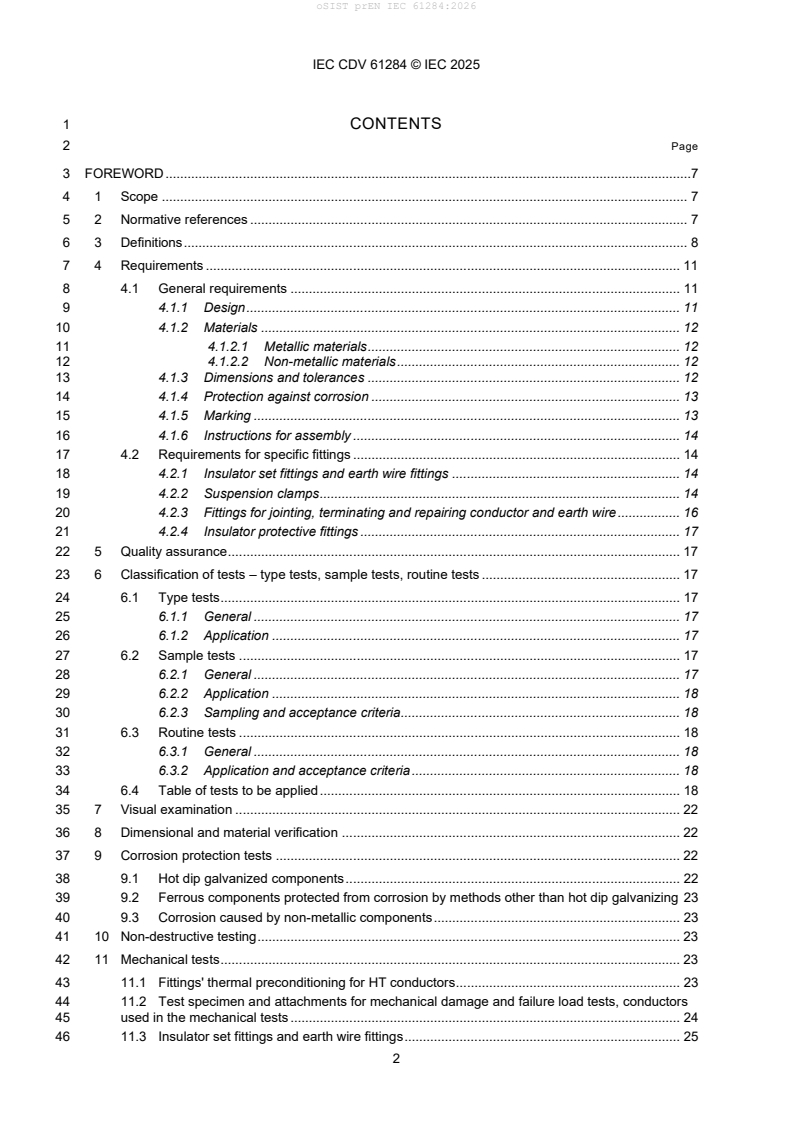
1 CONTENTS
2 Page
3 FOREWORD .7
4 1 Scope . 7
5 2 Normative references . 7
6 3 Definitions . 8
7 4 Requirements . 11
8 4.1 General requirements . 11
9 4.1.1 Design . 11
10 4.1.2 Materials . 12
11 4.1.2.1 Metallic materials . 12
12 4.1.2.2 Non-metallic materials . 12
13 4.1.3 Dimensions and tolerances . 12
14 4.1.4 Protection against corrosion . 13
15 4.1.5 Marking . 13
16 4.1.6 Instructions for assembly . 14
17 4.2 Requirements for specific fittings . 14
18 4.2.1 Insulator set fittings and earth wire fittings . 14
19 4.2.2 Suspension clamps . 14
20 4.2.3 Fittings for jointing, terminating and repairing conductor and earth wire . 16
21 4.2.4 Insulator protective fittings . 17
22 5 Quality assurance . 17
23 6 Classification of tests – type tests, sample tests, routine tests . 17
24 6.1 Type tests . 17
25 6.1.1 General . 17
26 6.1.2 Application . 17
27 6.2 Sample tests . 17
28 6.2.1 General . 17
29 6.2.2 Application . 18
30 6.2.3 Sampling and acceptance criteria. 18
31 6.3 Routine tests . 18
32 6.3.1 General . 18
33 6.3.2 Application and acceptance criteria . 18
34 6.4 Table of tests to be applied . 18
35 7 Visual examination . 22
36 8 Dimensional and material verification . 22
37 9 Corrosion protection tests . 22
38 9.1 Hot dip galvanized components . 22
39 9.2 Ferrous components protected from corrosion by methods other than hot dip galvanizing 23
40 9.3 Corrosion caused by non-metallic components . 23
41 10 Non-destructive testing . 23
42 11 Mechanical tests . 23
43 11.1 Fittings' thermal preconditioning for HT conductors . 23
44 11.2 Test specimen and attachments for mechanical damage and failure load tests, conductors
45 used in the mechanical tests . 24
46 11.3 Insulator set fittings and earth wire fittings . 25
IEC CDV 61284 © IEC 2025
47 11.3.1 Mechanical damage and failure load test . 25
48 11.3.2 Mechanical damage and failure load test of the attachment point used during
49 erection. 25
50 11.4 Suspension clamps . 27
51 11.4.1 Vertical damage load and failure load test . 27
52 11.4.2 Slip test on standard clamps with a specified minimum and maximum slip load . 27
53 11.4.2.1 Slip test after thermal cycles preconditioning . 29
54 11.4.3 Slip test on standard clamps with only specified minimum slip load . 29
55 11.4.3.1 Slip test after thermal cycles preconditioning . 30
56 11.4.4 Slip test on controlled slippage clamps . 30
57 11.4.4.1 Slip test after thermal cycles preconditioning . 31
58 11.4.5 Clamp bolt tightening test . 31
59 11.4.5.1 Clamp bolt tightening test after thermal cycles preconditioning . 32
60 11.4.6 Turning angle test . 32
61 11.5 Tension clamps, dead-end tension joints and mid-span tension joints . 33
62 11.5.1 Tensile test . 33
63 11.5.1.1 Tensile test after thermal cycles preconditioning . 35
64 11.5.2 Mechanical damage and failure load test (except compressed clamps) . 35
65 11.5.3 Mechanical damage and failure load test of the attachment point used during
66 erection. 36
67 11.5.4 Clamp bolt tightening test . 36
68 11.5.4.1 Clamp bolt tightening test after thermal cycles preconditioning . 36
69 11.6 Partial tension fittings . 36
70 11.6.1 Partial tension fittings other than T joints . 36
71 11.6.1.1 Tensile test . 36
72 11.6.1.1.1 Tensile test after thermal cycles preconditioning . 36
73 11.6.2 T joints . 37
74 11.6.2.1 Tensile test with mechanical tension between main conductor and branch
75 conductor 37
76 11.6.2.1.1 Tensile test after thermal cycles preconditioning . 37
77 11.6.2.2 Tensile test with mechanical tension on the main conductor . 37
78 11.6.2.2.1 Tensile test after thermal cycles preconditioning . 37
79 11.6.3 Clamp bolt tightening test . 37
80 11.6.3.1 Clamp bolt tightening test after thermal cycles preconditioning . 37
81 11.7 Repair sleeves . 37
82 11.7.1 Tensile test . 37
83 11.7.1.1 Tensile test after thermal cycles preconditioning . 38
84 11.8 Mechanical damage and failure load test for insulator protective fittings . 38
85 12 Magnetic losses test . 38
86 12.1 General. 38
87 12.2 Test procedure . 38
88 13 Heat cycle tests . 40
89 13.1 Purpose . 40
90 13.2 Joints . 40
91 13.2.1 General . 40
92 13.2.2 Classification for test purposes . 40
93 13.3 Test specimens . 40
94 13.3.1 General . 40
95 13.3.2 Multi-conductor joints . 40
96 13.3.3 Preparation . 41
97 13.3.4 Data on test specimens . 41
98 13.4 Test arrangements . 41
IEC CDV 61284 © IEC 2025
99 13.4.1 Test conditions . 41
100 13.4.2 Reference conductor . 41
101 13.4.3 Potential points . 41
102 13.4.4 Installation of test loop . 41
103 13.4.5 Measurements . 42
104 13.4.5.1 Resistance measurement . 42
105 13.4.5.2 Temperature measurements . 42
106 13.4.5.3 Measurement of short-time overcurrent (class B joints) . 43
107 13.5 Procedure for type 0 conductors . 43
108 13.5.1 General . 43
109 13.5.2 Joints of class A . 43
110 13.5.2.1 Test procedure . 43
111 13.5.2.2 Acceptance criteria (class A joints) . 44
112 13.5.3 Joints of class B . 44
113 13.5.3.1 Test procedure . 44
114 13.5.3.2 Acceptance criteria (class B) . 45
115 13.6 Procedure for HT conductors . 45
116 13.6.1 Method 1 . 45
117 13.6.1.1 Joints of class A . 45
118 13.6.1.1.1 Test procedure . 45
119 13.6.1.1.2 Acceptance criteria (Method 1 - class A joints) . 45
120 13.6.1.2 Joints of class B . 45
121 13.6.1.2.1 Test procedure . 45
122 13.6.1.2.2 Acceptance criteria (Method 1 - class B joints) . 46
123 13.6.2 Method 2 (only joints of class A) . 46
124 13.6.2.1 Test procedure . 46
125 13.6.2.2 Acceptance criteria (Method 2 - class A joints) . 46
126 13.6.3 Method 3 (only joints of class A) . 46
127 13.6.3.1 Test procedure . 46
128 13.6.3.2 Acceptance criteria (Method 3 - class A joints) . 47
129 13.7 Test report . 47
130 14 Corona and radio interference voltage (RIV) tests . 48
131 14.1 Purpose . 48
132 14.2 Description of test methods . 48
133 14.3 General. 48
134 14.4 Test circuit and instruments . 49
135 14.5 Corona and RIV test procedures . 50
136 14.6 Acceptance criteria . 50
137 14.7 Test report . 50
138 14.8 Voltage method . 51
139 14.8.1 Adjacent conductors in a three-phase system . 51
140 14.8.1.1 Test set-up and dimensions (see from Figure 22 to Figure 27) . 51
141 14.8.1.2 Critical variant . 54
142 14.8.1.3 Distance from wall (reflection plane) W . 54
143 14.8.1.4 Minimum clearance from adjacent live components . 55
144 14.8.1.5 Metallic wall . 55
145 14.9 Voltage gradient method . 55
146 14.9.1 Conductor voltage on three-phase system . 55
147 14.9.2 Test set-up and dimensions . 55
148 14.9.3 Test method . 56
149 15 Fittings’ thermal profile . 57
150 16 Characterization of elastomers . 57
151 Annexes
IEC CDV 61284 © IEC 2025
152 Annex A (normative) Minimum technical details to be agreed between purchaser and supplier . 59
153 Annex B (informative) Alternative fittings' thermal preconditioning . 61
154 Annex C (normative) Typical joint types . 62
155 Annex D (informative) Temperature sensing devices . 64
156 Annex E (informative) Potential points . 65
157 Annex F (normative) Typical test circuit – Class A joints . 66
158 Annex G (normative) Typical test circuit – Class B joints . 67
159 Annex H (normative) Diagrammatic representation of heat cycle test sequence . 68
160 Annex I (normative) Mathematical acceptance criterion . 69
161 Annex J (normative) Heat cycles test for HT conductors - Method 3 . 71
162 Annex K (informative) Aeolian vibration test . 76
163 Annex L (informative) Examples of international standards and recommendations for fitting materials
164 . 79
165 Annex M (informative) Test voltage calibration device . 81
166 Annex N (informative) Example of sampling with inspection by attributes . 84
167 Annex O (informative) Example of sampling with inspection by variables . 85
168 Annex P (informative) Practical inspection method by attributes . 86
170 Figures
171 Figure 1 – Tolerance on holes subjected to mechanical stress . 15
172 Figure 2 – Different articulation of suspension clamps . 15
173 Figure 3 – Different types of metal-to-metal suspension clamps . 16
174 Figure 4 – Different types of rubber/elastomer-lined (ES) clamps . 16
175 Figure 5 – Different types of HAES clamps . 17
176 Figure 6 – Thermal cycles preconditioning . 25
177 Figure 7 – Insulator set fittings and earth wire fittings – damage load and failure load test: diagrams
178 showing the typical application of load . 27
179 Figure 8 – Insulator set fittings and earth wire fittings – mechanical damage and failure load test: rate
180 of increase of load . 27
181 Figure 9 – Suspension clamp – vertical damage load and failure load test: diagram showing the typical
182 application of load . 28
183 Figure 10 – Suspension clamp – slip test: Check points for slippage of the different types of
184 suspension clamps . 30
185 Figure 11 – Suspension clamp (standard type) – slip test: diagram showing the typical application of
186 load . 31
187 Figure 12 – Suspension clamp (controlled slippage type) – slip test: diagram showing the typical
188 application of load . 32
189 Figure 13 – Suspension clamp – Turning angle test: diagram showing the typical application of load 33
190 Figure 14 – Tension clamps, dead-end tension joints and tension joints – tensile test: diagram
191 showing the typical application of load . 35
192 Figure 15 – Tension clamps, dead-end tension joints and tension joints – tensile test: Recommended
193 Check points for slippage of the different types of tension clamps . 35
194 Figure 16 – Tension clamps, dead-end tension joints and tension joints – tensile test: rate of increase
195 of load . 36
196 Figure 17 – Tension clamps and tension joints – mechanical damage and failure load test: diagram
197 showing the typical application of load . 36
198 Figure 18 – Tension clamp and tension joints – mechanical damage and failure load test of the
199 attachment point used during erection: diagram showing the typical application of load . 37
200 Figure 19 – Magnetic losses test . 40
201 Figure 20 – Heat cycles test for HT conductors - Method 3 - Typical test circuit . 48
202 Figure 21 – Typical relationship between observed corona and RIV . 49
203 Figure 22 – Suspension test arrangement, critical variant b) . 52
204 Figure 23 – Tension test arrangement, critical variant b) . 53
205 Figure 24 – Tension test arrangement, critical variant b), hanging vertically from the ceiling . 53
206 Figure 25 – Tension test arrangement, critical variant c) . 54
207 Figure 26 – Tension test arrangement, critical variant c), hanging vertically from the ceiling . 54
208 Figure 27 – Test arrangement for in-span fittings, critical variant b) or c) . 55
209 Figure 28 – Typical test arrangement – suspension assembly . 57
210 Figure 29 – Typical test arrangement – tension assembly . 57
IEC CDV 61284 © IEC 2025
212 Tables
213 Table 1 – Tests on fittings . 20
214 Table 2 – Current magnitudes for magnetic losses test . 40
215 Table 3 – Conditions for heat cycle test . 44
216 Table 4 – Test voltages and dimensions for Corona and RIV tests . 56
IEC CDV 61284 © IEC 2025
219 INTERNATIONAL ELECTROTECHNICAL COMMISSION
220 –––––––––
221 OVERHEAD LINES –
222 REQUIREMENTS AND TESTS FOR FITTINGS
224 FOREWORD
225 1) The IEC (International Electrotechnical Commission) is a worldwide organization for standardization comprising
226 all national electrotechnical committees (IEC National Committees). The object of the IEC is to promote
227 international co-operation on all questions concerning standardization in the electrical and electronic fields. To
228 this end and in addition to other activities, the IEC publishes International Standards. Their preparation is
229 entrusted to technical committees; any IEC National Committee interested in the subject dealt with may
230 participate in this preparatory work. International, governmental and non-governmental organizations liaising with
231 the IEC also participate in this preparation. The IEC collaborates closely with the International Organization for
232 Standardization (ISO) in accordance with conditions determined by agreement between the two organizations.
233 2) The formal decisions or agreements of the IEC on technical matters express, as nearly as possible, an
234 international consensus of opinion on the relevant subjects since each technical committee has representation
235 from all interested National Committees.
236 3) The documents produced have the form of recommendations for international use and are published in the form
237 of standards, technical reports or guides and they are accepted by the National Committees in that sense.
238 4) In order to promote international unification, IEC National Committees undertake to apply IEC International
239 Standards transparently to the maximum extent possible in their national and regional standards. Any divergence
240 between the IEC Standard and the corresponding national or regional standard shall be clearly indicated in the
241 latter.
242 5) The IEC provides no marking procedure to indicate its approval and cannot be rendered responsible for any
243 equipment declared to be in conformity with one of its standards.
244 6) Attention is drawn to the possibility that some of the elements of this International Standard may be the subject
245 of patent rights. The IEC shall not be held responsible for identifying any or all such patent rights.
246 International Standard IEC 61284 has been prepared by IEC technical committee 11: Overhead
247 lines.
248 This third edition cancels and replaces the second edition published in 1997 and constitutes a
249 technical revision.
250 The text of this standard is based on the following documents:
FDIS Report on voting
251 Full information on the voting for the approval of this standard can be found in the report on
252 voting indicated in the above table.
253 Annexes A, C, F, G, H, I and J form an integral part of this standard.
254 Annexes B, D, E, K, L, M, N, O and P are for information only.
255 The contents of the corrigenda of September 1998 have been included in this copy.
256 OVERHEAD LINES –
257 REQUIREMENTS AND TESTS FOR FITTINGS
259 1 Scope
260 This International Standard applies to fittings for overhead lines of nominal voltage above 45
261 kV. Fittings concerned particularly are all fittings except those that have a specific standard
262 dedicated like spacers (IEC 61854), dampers (IEC 61897) and end fittings for insulators (IEC
263 61466-1). It may also be applied to fittings for overhead lines of lower nominal voltage and to
264 similar fittings for substations. Moreover, fittings designed for use with High Temperature (HT)
265 conductors are included.
IEC CDV 61284 © IEC 2025
266 In some cases, test procedures and test values are left to agreement between purchaser and
267 supplier and are stated in the procurement contract. The purchaser is best able to evaluate the
268 intended service conditions, which should be the basis for establishing the test severity.
269 In Annex A, the minimum technical details to be agreed between purchaser and supplier are
270 listed.
271 2 Normative references
272 The following documents are referred to in the text in such a way that some or all of their content
273 constitutes requirements of this document. For dated references, only the edition cited applies.
274 For undated references, the latest edition of the referenced document (including any
275 amendments) applies.
276 IEC 60050, International Electrotechnical Vocabulary (IEV) – Chapter 466: Overhead lines
277 (available at www.electropedia.org))
278 IEC 60060-1, High-voltage test techniques – Part 1: General definitions and test requirements
279 IEC 60120, Dimensions of ball and socket couplings of string insulator units - Dimensions
280 IEC 60372, Locking devices for ball and socket couplings of string insulator units – Dimensions
281 and tests
282 IEC 60437, Radio interference test on high-voltage insulators
283 IEC 60471, Clevis and tongue couplings of string insulator units - Dimensions
284 IEC 60794-1-2, Optical fibre cables - Part 1-2: Generic specification - Basic optical cable test
285 procedures - General guidance
286 IEC 60794-4, Optical fibre cables - Part 4: Sectional specification - Aerial optical cables along
287 electrical power lines
288 IEC 60826, Loading and strength of overhead transmission lines
289 IEC 61089, Round wire concentric lay overhead electrical stranded conductors
290 IEC 61466-1, Composite string insulator units for overhead lines with a nominal voltage greater
291 than 1000 V - Part 1: Standard strength and end fittings
292 IEC 61467, Insulators for overhead lines - Insulator strings and sets for lines with a nominal
293 voltage greater than 1000 V - AC power arc tests
294 IEC 61854, Overhead lines – Requirements and tests for spacers
295 IEC 61897, Overhead lines – Requirements and tests for Aeolian vibration dampers
296 IEC 62641:2022, Conductors for overhead lines - Aluminium and aluminium alloy wires for
297 concentric lay stranded conductors
298 IEC 63248, Conductors for overhead lines - Coated or cladded metallic wire for concentric lay
299 stranded conductors
300 CISPR 16-1, Specification for radio disturbance and immunity measuring apparatus and
301 methods – Part 1: Radio disturbance and immunity measuring apparatus
302 CISPR TR 18-2, Radio interference characteristics of overhead power lines and high-voltage
303 equipment – Part 2: Methods of measurement and procedure for determining limits
304 ISO 1461:2022, Hot dip galvanized coatings on fabricated ferrous products – Specifications
305 ISO 9000, Quality management systems – Fundamentals and vocabularies
306 ISO 9001, Quality management systems – Requirements
IEC CDV 61284 © IEC 2025
307 ISO 9004, Managing for the sustained success of an organization – A quality management
308 approach
309 ISO 2859-1, Sampling procedures for inspection by attributes – Part 1: Sampling schemes
310 indexed by acceptable quality limit (AQL) for lot-by-lot inspection
311 ISO 2859-2, Sampling procedures for inspection by attributes – Part 2: Sampling plans indexed
312 by limiting quality (LQ) for isolated lot inspection
313 ISO 3951-1, Sampling procedures for inspection by variables – Part 1: Specification for single
314 sampling plans indexed by acceptance quality limit (AQL) for lot-by-lot inspection for a single
315 quality characteristic and a single AQL
316 ISO 3951-2, Sampling procedures for inspection by variables – Part 2: General specification for
317 single sampling plans indexed by acceptance quality limit (AQL) for lot-by-lot inspection of
318 independent quality characteristics
319 3 Definitions
320 For the purpose of this document, the following terms and definitions apply. The term and the
321 definitions listed here are those which differ or do not appear in IEC 60050-466.
322 ISO and IEC maintain terminological databases for use in standardization at the following
323 addresses:
324 • IEC Electropedia: available at http://www.electropedia.org
325 • ISO Online browsing platform: available at http://www.iso.org/obp
326 3.1
327 characteristic dimension
328 Dimension of a component of the test circuit or of a fitting which characterizes its effect on the
329 electric field. In the case of a bundle, this dimension is approximately the diameter of an
330 enclosing circle; in the case of a corona ring or sphere, it is its largest dimension, etc.
331 3.2
332 conductor classification
333 The following last four types are generally called High Temperature (HT) conductors, being able
334 to withstand operating temperatures above the limits of conventional aluminium alloy or hard -
335 drawn aluminium wires without significant reduction of mechanical strength during its expected
336 lifetime. These conductors are usually designed to achieve an higher ampacity than
337 conventional conductors (Type 0) of the same size or to reduce size keeping the same ampacity.
338 Type 0
339 Conductors made up of hard-drawn aluminium or aluminium alloy wires (Ax or ALx as per IEC
340 62641, except A0 or AL0) with or without an inner core made up of steel wires (as per IEC
341 63248); conductors made up of only steel wires (as per IEC 63248).
342 NOTE – In case of optical fibre conductors, the maximum operating temperature shall be agreed between
343 purchaser and supplier.
344 Type 1
345 Conductors made up of thermal resistant aluminium alloy wires (ATx as per IEC 62641) with
346 or without an inner core made up of steel wires (as per IEC 63248).
347 Type 2
348 Conductors made up of annealed aluminium wires (A0 or AL0 as per IEC 62641) supported
349 by an inner core made up of steel wires (as per IEC 63248).
350 Type 3
351 Conductors made up of thermal resistant aluminium alloy wires (ATx as per IEC 62641)
352 supported by an inner core made up of metal-matrix composite (MMC).
IEC CDV 61284 © IEC 2025
353 Type 4
354 Conductors made up of annealed aluminium wires (A0 or AL0 as per IEC 62641) or thermal
355 resistant aluminium alloy wires (ATx as per IEC 62641) supported by an inner core made up
356 of polymer-matrix composite (PMC).
357 3.3
358 corona discharge
359 Electric discharge that only partially breaks down the gas insulation around the fittings under
360 test.
361 3.4
362 corona extinction
363 Voltage or conductor voltage gradient at which corona discharges cease during a decreasing
364 test voltage sequence.
365 3.5
366 corona inception
367 Voltage or conductor voltage gradient at which corona discharges initiate during an increasing
368 test voltage sequence.
369 3.6
370 earth wire fitting
371 Any component of an assembly for attaching an earth wire to a supporting structure other than
372 a suspension clamp, a tension fitting or a mechanical protective fitting.
373 3.7
374 factory-formed helical conductor fitting
375 Fitting consisting of helically formed rods which provide the force necessary to grip the
376 conductor by self-tightening.
377 3.8
378 insulator set fitting
379 Any component of a suspension or tension insulator set other than a string insulator unit, a
380 suspension clamp, a conductor tension fitting, an insulator protective fitting or a mechanical
381 protective fitting.
382 3.9
383 non-tension joint / partial tension fitting
384 A fitting for the connection of two consecutive pieces of conductor which are to be held, but not
385 at the full line tension. Typical non-tension joints are the T joint [IEV 461-11-06], the lug
386 terminal [IEV 442-06-16], the branch-joint [IEV 461-11-17] and the fittings installed on slack
387 spans.
388 NOTE – In branch joints, the connection is not subjected to line tension although the conductor to which the fitting
389 is applied on its length may be at the line tension.
390 3.10
391 tension joint
392 A fitting for the connection of two consecutive pieces of conductor which are to be held at the
393 full line tension. Typical tension joints are the dead-end tension joint [IEV 466-11-04] and the
394 mid-span tension joint [IEV 466-11-03].
395 3.11
396 mechanical damage load
397 Maximum load which can be applied to a fitting without an unacceptable permanent deformation
398 when the fitting is tested under specified test conditions.
IEC CDV 61284 © IEC 2025
399 NOTE – The unacceptable permanent deformation should be agreed upon between purchaser and supplier.
400 3.12
401 mechanical failure load
402 Maximum load which can be applied to a fitting under specified test conditions.
403 3.13
404 mechanical protective fitting
405 Any device attached to a conductor or to an earth wire for their mechanical protection.
406 3.14
407 operating temperatures
408 The operating temperatures are the temperatures, as below detailed, at which the conductor
409 can be operated satisfying the conditions agreed between purchaser and conductor
410 manufacturer.
411 NOTE - The following definitions will be in accordance with the similar ones introduced in the relevant IEC
412 standards and which take precedence over this standard. In fact, these temperatures (as well as the RTS below
413 defined) are peculiar characteristics of conductors and it is not the task of this standard to verify them; instead,
414 they must be seen as parameters required to make the test protocols described here applicable.
415 maximum conductor continuous operating temperature (T )
c
416 Maximum continuous temperature at which the conductor can be operated without significant
417 reduction of its rated tensile strength during its expected lifetime.
418 maximum conductor peak load (emergency operating) temperature (T )
p
419 Maximum temperature at which the conductor can be exposed without significant reduction of
420 its rated tensile strength during a cumulative period of time (peak loads).
421 3.15
422 radio-interference voltage (RIV)
423 Voltage in the radio frequency range produced by an electromagnetic disturbance and which
424 can be measured in accordance with CISPR 16 on the test circuit equipped with the fitting.
425 3.16
426 rated tensile strength (RTS)
427 Using the specified tensile properties of its elementary components, the calculated maximum
428 load value at which a conductor or earth wire may be subjected before one or more of its
429 elementary components break.
430 NOTE – The value is indicated in the manufacturer’s datasheet and/or calculated according to the applicable IE
...