

EN 50341-2-1:2022
(Main)Overhead electrical lines exceeding AC 1 kV - Part 2-1: National Normative Aspects (NNAs) for Austria (based on EN 50341-1:2012)
General Information
- Abstract
1.1 General (A-dev) AT.1: A new overhead line is defined as the new construction of the totality of all conductors, their supports together with foundations, earthing grid, insulators, accessories and fittings used for the overground transport of electrical energy between two points A and B. 1.2 Field of application (A-dev) AT.1: Stranded-conductors or cable structures with telecommunications components carried on the line that do not simultaneously function as earth wires or stranded conductors are subject to the provisions of Annex U.
- Status
- Published
- Publication Date
- 27-Oct-2022
- Technical Committee
- CLC/TC 11 - Overhead electrical lines exceeding 1 kV a.c. (1,5 kV d.c.)
- Drafting Committee
- CLC/TC 11 - Overhead electrical lines exceeding 1 kV a.c. (1,5 kV d.c.)
- Current Stage
- 6060 - Document made available - Publishing
- Start Date
- 28-Oct-2022
- Due Date
- 06-Nov-2024
- Completion Date
- 28-Oct-2022

Overview
EN 50341-2-1:2022 - Overhead electrical lines exceeding AC 1 kV: National Normative Aspects (NNAs) for Austria (based on EN 50341-1:2012) - provides Austria-specific requirements that complement the European EN 50341 series. It applies to the design, construction, operation and maintenance of overhead electrical lines exceeding AC 1 kV, covering new overhead line projects (full conductor systems, supports, foundations, earthing, insulators, fittings) and specific provisions for lines carrying telecommunications components.
This national annex aligns with EN 50341-1:2012 (as adopted in EN 50341-2-1:2022) and was approved by CENELEC. It replaces the previous national edition and contains Austria’s prescriptive parameters and normative interpretations where national variation is allowed.
Key topics and technical requirements
The standard expands on the EN 50341 framework with Austrian NNAs and addresses technical topics including:
- Scope and definitions - clear definition of a “new overhead line” (full system from conductors to fittings) and field of application notes for telecommunication components (Annex U).
- Basis of design and reliability - national expectations for performance and reliability of transmission and distribution lines.
- Actions on lines - guidance on environmental loads: wind, ice, combined wind-and-ice effects, turbulence, and temperature effects.
- Load cases and partial factors - prescribed load cases for structural and electrical calculations.
- Electrical requirements - currents, voltage classifications, overvoltages and methods to determine minimum air clearances to prevent flashover.
- Clearances - internal span clearances, external clearances to ground, buildings, traffic routes, other lines and recreational areas.
- Earthing systems - earthing design with human safety limits (touch voltages), including calculation methods (Annex G).
- Supports and foundations - design, materials, serviceability and ultimate limit state criteria for lattice towers, steel/wood/concrete poles, guying and foundation-soil interaction.
- Conductors, earth-wires and accessories - conductor types (aluminium/steel), optical fibre ground wires, minimum cross-sections, insulator and hardware requirements.
- Quality assurance - checks, testing, and taking-over procedures for new lines.
Practical applications and users
This NNA is intended for professionals involved in high-voltage overhead line infrastructure in Austria:
- Transmission and distribution engineers and designers
- Civil and geotechnical engineers (foundations, soil interaction)
- Manufacturers and suppliers of conductors, insulators, poles and fittings
- Utilities, system planners and asset managers
- Regulatory bodies, safety assessors and certification bodies
- Consultants for line routing, clearance and earthing design
Use cases include design and approval of new overhead lines, safety and clearance verification, selection of conductor and support systems, earthing design for public safety, and contracting/acceptance of construction works.
Related standards
- EN 50341-1 (general rules for overhead lines >1 kV)
- Relevant Eurocodes (EN 1990–1999 series) for structural and geotechnical design
- National regulations for electrical safety and land-use in Austria
Keywords: overhead electrical lines, AC 1 kV, NNAs Austria, EN 50341-2-1, clearances, earthing, wind and ice loads, supports, foundations, conductors, insulators, CENELEC, SIST.
Relations
- Effective Date
- 01-Nov-2022
Get Certified
Connect with accredited certification bodies for this standard

IMQ S.p.A. (Certification)
Italian electrical product certification.

SLG Prüf- und Zertifizierungs GmbH
German testing and certification body.

UL Solutions
Global safety science company with testing, inspection and certification.
Sponsored listings
Frequently Asked Questions
EN 50341-2-1:2022 is a standard published by CLC. Its full title is "Overhead electrical lines exceeding AC 1 kV - Part 2-1: National Normative Aspects (NNAs) for Austria (based on EN 50341-1:2012)". This standard covers: 1.1 General (A-dev) AT.1: A new overhead line is defined as the new construction of the totality of all conductors, their supports together with foundations, earthing grid, insulators, accessories and fittings used for the overground transport of electrical energy between two points A and B. 1.2 Field of application (A-dev) AT.1: Stranded-conductors or cable structures with telecommunications components carried on the line that do not simultaneously function as earth wires or stranded conductors are subject to the provisions of Annex U.
1.1 General (A-dev) AT.1: A new overhead line is defined as the new construction of the totality of all conductors, their supports together with foundations, earthing grid, insulators, accessories and fittings used for the overground transport of electrical energy between two points A and B. 1.2 Field of application (A-dev) AT.1: Stranded-conductors or cable structures with telecommunications components carried on the line that do not simultaneously function as earth wires or stranded conductors are subject to the provisions of Annex U.
EN 50341-2-1:2022 is classified under the following ICS (International Classification for Standards) categories: 29.240.20 - Power transmission and distribution lines. The ICS classification helps identify the subject area and facilitates finding related standards.
EN 50341-2-1:2022 has the following relationships with other standards: It is inter standard links to EN 50341-2-1:2020. Understanding these relationships helps ensure you are using the most current and applicable version of the standard.
EN 50341-2-1:2022 is available in PDF format for immediate download after purchase. The document can be added to your cart and obtained through the secure checkout process. Digital delivery ensures instant access to the complete standard document.
Standards Content (Sample)
SLOVENSKI STANDARD
01-december-2023
Nadomešča:
SIST EN 50341-2-1:2021
Nadzemni električni vodi za izmenične napetosti nad 1 kV - 2-1. del: Nacionalna
normativna določila (NNA) za Austrijo (na podlagi EN 50341-1:2012)
Overhead electrical lines exceeding AC 1 kV - Part 2-1: National Normative Aspects
(NNAs) for Austria (based on EN 50341-1:2012)
Ta slovenski standard je istoveten z: EN 50341-2-1:2022
ICS:
29.240.20 Daljnovodi Power transmission and
distribution lines
2003-01.Slovenski inštitut za standardizacijo. Razmnoževanje celote ali delov tega standarda ni dovoljeno.
EUROPEAN STANDARD EN 50341-2-1
NORME EUROPÉENNE
EUROPÄISCHE NORM October 2022
ICS 29.240.20 Supersedes EN 50341-2-1:2020
English Version
Overhead electrical lines exceeding AC 1 kV - Part 2-1: National
Normative Aspects (NNAs) for Austria (based on
EN 50341-1:2012)
This European Standard was approved by CENELEC on 2022-06-22. CENELEC members are bound to comply with the CEN/CENELEC
Internal Regulations which stipulate the conditions for giving this European Standard the status of a national standard without any alteration.
Up-to-date lists and bibliographical references concerning such national standards may be obtained on application to the CEN-CENELEC
Management Centre or to any CENELEC member.
This European Standard exists in three official versions (English, French, German). A version in any other language made by translation
under the responsibility of a CENELEC member into its own language and notified to the CEN-CENELEC Management Centre has the
same status as the official versions.
CENELEC members are the national electrotechnical committees of Austria, Belgium, Bulgaria, Croatia, Cyprus, the Czech Republic,
Denmark, Estonia, Finland, France, Germany, Greece, Hungary, Iceland, Ireland, Italy, Latvia, Lithuania, Luxembourg, Malta, the
Netherlands, Norway, Poland, Portugal, Republic of North Macedonia, Romania, Serbia, Slovakia, Slovenia, Spain, Sweden, Switzerland,
Türkiye and the United Kingdom.
European Committee for Electrotechnical Standardization
Comité Européen de Normalisation Electrotechnique
Europäisches Komitee für Elektrotechnische Normung
CEN-CENELEC Management Centre: Rue de la Science 23, B-1040 Brussels
© 2022 CENELEC All rights of exploitation in any form and by any means reserved worldwide for CENELEC Members.
Ref. No. EN 50341-2-1:2022 E
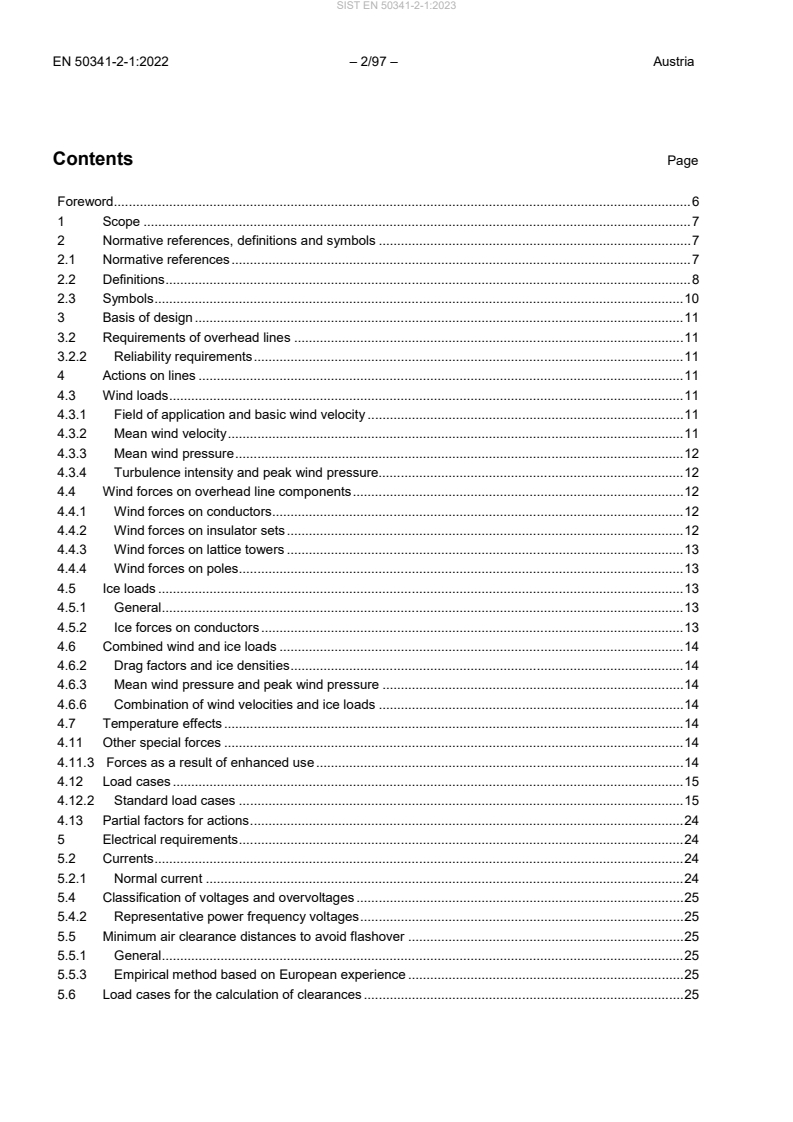
Contents Page
Foreword . 6
1 Scope . 7
2 Normative references, definitions and symbols . 7
2.1 Normative references . 7
2.2 Definitions . 8
2.3 Symbols . 10
3 Basis of design . 11
3.2 Requirements of overhead lines . 11
3.2.2 Reliability requirements . 11
4 Actions on lines . 11
4.3 Wind loads . 11
4.3.1 Field of application and basic wind velocity . 11
4.3.2 Mean wind velocity . 11
4.3.3 Mean wind pressure . 12
4.3.4 Turbulence intensity and peak wind pressure. 12
4.4 Wind forces on overhead line components . 12
4.4.1 Wind forces on conductors. 12
4.4.2 Wind forces on insulator sets . 12
4.4.3 Wind forces on lattice towers . 13
4.4.4 Wind forces on poles . 13
4.5 Ice loads . 13
4.5.1 General . 13
4.5.2 Ice forces on conductors . 13
4.6 Combined wind and ice loads . 14
4.6.2 Drag factors and ice densities . 14
4.6.3 Mean wind pressure and peak wind pressure . 14
4.6.6 Combination of wind velocities and ice loads . 14
4.7 Temperature effects . 14
4.11 Other special forces . 14
4.11.3 Forces as a result of enhanced use . 14
4.12 Load cases . 15
4.12.2 Standard load cases . 15
4.13 Partial factors for actions . 24
5 Electrical requirements . 24
5.2 Currents . 24
5.2.1 Normal current . 24
5.4 Classification of voltages and overvoltages . 25
5.4.2 Representative power frequency voltages . 25
5.5 Minimum air clearance distances to avoid flashover . 25
5.5.1 General . 25
5.5.3 Empirical method based on European experience . 25
5.6 Load cases for the calculation of clearances . 25
Austria – 3/97 – EN 50341-2-1:2022
5.6.1 Load conditions . 25
5.6.2 Maximum conductor temperature . 25
5.6.3 Wind loads for determination of electric clearances . 26
5.6.4 Ice loads for determination of electric clearances . 26
5.6.5 Combined wind and ice loads . 26
5.8 Internal clearances within the span and at the top of support . 27
5.9 External clearances . 28
5.9.1 General . 28
5.9.2 External clearances to ground in areas remote from buildings, roads, etc. . 32
5.9.3 External clearances to residential and other buildings . 35
5.9.4 External clearances to crossing traffic routes . 50
5.9.6 External clearances to other power lines or overhead telecommunication lines . 62
5.9.7 External clearances to recreational areas (playgrounds, sports areas, etc.) . 69
5.11 Electric and magnetic fields . 71
5.11.1 Electric and magnetic fields under a line . 71
6 Earthing systems . 71
6.4 Dimensioning with regard to human safety . 71
6.4.1 Permissible values for touch voltages . 71
6.4.2 Touch voltage limits at different locations . 71
6.4.3 Basic design of earthing systems with regard to permissible touch voltag . 72
7 Supports . 72
7.1 Initial design considerations . 72
7.1.1 Introduction . 72
7.3 Lattice steel towers . 72
7.4 Steel poles . 73
7.4.7 Serviceability limit states (EN 1993-1-1:2005 – chapter 7). 73
7.4.8 Resistance of connections . 73
7.5 Wood poles . 73
7.5.3 Materials . 73
7.5.4 Durability . 73
7.5.5 Ultimate limit states . 73
7.5.6 Serviceability limit states . 74
7.5.7 Resistance of connections . 74
7.6 Concrete poles . 75
7.6.4 Ultimate limit states . 75
7.6.5 Serviceability limit states . 75
7.6.6 Design assisted by testing . 75
7.7 Guyed structures . 75
7.7.6 Design details for guys . 75
7.8 Other structures . 76
7.10 Maintenance facilities . 76
7.10.3 Safety requirements . 76
8 Foundations . 76
8.1 Introduction . 76
8.2 Basis of geotechnical design (EN 1997-1:2004 – Section 2) . 76
8.2.2 Geotechnical design by calculation . 76
8.2.3 Design by prescriptive measures . 77
8.6 Interactions between support foundations and soil. 77
9 Conductors and earth-wires . 77
9.1 Introduction . 77
9.2 Aluminium based conductors . 77
9.3 Steel based conductors . 77
9.3.1 Characteristics and dimensions . 77
9.3.6 Test requirements . 77
9.5 Conductors and ground wires containing optical fibre telecommunication circuits . 77
9.6 General requirements. 78
9.6.3 Minimum cross-sections . 80
9.8 Selection, delivery and installation of conductors . 81
10 Insulators . 81
10.2 Standard electrical requirements . 81
10.7 Mechanical requirements . 81
10.10 Characteristics and dimensions of insulators . 81
10.13 Routine test requirements . 81
11 Hardware . 82
11.2 Electrical requirements . 82
11.2.1 Requirements applicable to all fittings . 82
11.6 Mechanical requirements . 82
11.9 Characteristics and dimensions of fittings . 82
12 Quality assurance, checks and taking-over . 82
Annex G (normative) Calculation methods for earthing systems . 84
G.4 Touch voltage and body current . 84
G.4.1 Equivalence between touch voltage and body current . 84
G.4.2 Calculation taking into account additional resistances . 85
Annex H (informative) Installation and measurements of earthing systems . 86
H.1 Definition of symbols used in this annex . 86
H.2 Basis for the verification . 86
H.2.1 Soil resistivity . 86
H.3 Installation of earth electrodes and earthing conductors . 86
H.3.2 Installation of earthing conductors . 86
H.3.2.1 General . 86
H.3.2.2 Installing the earthing conductors . 87
H.3.2.3 Jointing the earthing conductors . 87
H.4 Measurements for and on earthing systems . 87
H.4.3 Measurement of resistances to earth and impedances to earth . 87
H.4.4 Determination of the earth potential rise . 87
Annex J (normative) Angles in lattice steel towers . 88
J.4 Buckling resistance of angles in compression (see 7.3.6.3) . 88
J.4.1 Flexural buckling resistance . 88
J.5 Design resistance of bolted connections (see 7.3.8) . 88
J.5.1 General . 88
Annex M (informative) Geotechnical and structural design of foundations . 89
M.3 Sample semi-empirical models for resistance estimation . 89
M.3.1 Geotechnical design by calculation . 89
M.3.1.9 Pile foundations . 89
Annex S (normative) Geotechnical foundation design according to practically proved methods
based on characteristic loads . 90
Austria – 5/97 – EN 50341-2-1:2022
S.1 General conditions . 90
S.2 Soil characteristic values . 91
S.3 Monoblock foundations . 93
S.4 Separate footing foundations . 93
S.5 Piles and pile-type foundations . 93
S.6 Fixation of tower legs in concrete foundations. 93
S.7 Foundations of wooden poles . 94
Annex T (normative) Supplementary provisions for the design and realisation of concrete and
reinforced concrete foundations . 95
Annex U (normative) Stranded-conductors and cables with telecommunication components carried
along on supports of overhead lines . 96
European foreword
1 The Austrian National Committee is identified by the following address:
Austrian Electrotechnical Association
Standardization
Eschenbachgasse, 9
A - 1010 Vienna
Austria
phone +43 1 587 63 73-0
Name of the relevant technical body: TK-L Starkstromfreileitungen und Verlegung von Energiekabeln
(Overhead power lines)
2 The Austrian NC and its technical body TK-L “Overhead power lines” of Austrian Electrotechnical
Association (OVE) prepared this Part 2-1 of EN 50341, listing the Austrian National Normative Aspects
(NNA) under its sole responsibility, and duly passed it through the CENELEC and CLC/TC 11
procedures.
NOTE The Austrian NC also takes sole responsibility for the technically correct co-ordination of this
EN 50341-2-1:2020 with EN 50341-1:2012. It performed the necessary checks in the frame of quality
assurance/control. However, it is noted that this quality control was made in the framework of the general
responsibility of a standards committee under the national laws/regulations.
3 This EN 50431-2-1, hereafter referred to as Part 2-1, is normative in Austria and informative in other
countries.
4 This Part 2-1 shall be read in conjunction with EN 50341-1, hereafter referred to as Part 1. All clause
numbers used in this NNA correspond to those of Part 1. Specific subclauses, which are prefixed “AT”,
shall be read as amendments to the relevant text in Part 1. Any necessary clarification regarding the
application of this NNA in conjunction with Part 1 shall be referred to the Austrian NC who will, in co-
operation with CLC/TC 11, clarify the requirements.
When no reference is made in this NNA to a specific subclause, then Part 1 applies.
5 In case of “boxed values” defined in Part 1, amended values, (if any) which are defined in Part 2-1
shall be taken into account in Austria.
However, any “boxed value”, whether in Part 1 or in this Part 2-1, shall not be amended in the direction
of greater risk in a Project Specification.
6 The National Austrian standards/regulations related to overhead electrical lines exceeding 1 kV AC are
listed in 2.1 of this Part 2-1.
NOTE All national standards referred to in this Part 2-1 will be replaced by the relevant European Standards as
soon as they become available and are declared by the austrian NC to be applicable and thus reported to the
secretary of CLC/TC 11.
Austria – 7/97 – EN 50341-2-1:2022
1 Scope
1.1 General
(A-dev) AT.1: A new overhead line is defined as the new construction of the totality of all conductors, their
supports together with foundations, earthing grid, insulators, accessories and fittings used for the
overground transport of electrical energy between two points A and B.
1.2 Field of application
(A-dev) AT.1: Stranded-conductors or cable structures with telecommunications components carried on the
line that do not simultaneously function as earth wires or stranded conductors are subject to the
provisions of Annex U.
2 Normative references, definitions and symbols
2.1 Normative references
(A-dev) AT.1: Normative references and other publications
Reference Title
ÖNORM B 1990-1 Eurocode - Basis of structural design - Part 1: Building construction - National
specifications concerning ÖNORM EN 1990 and national supplements
ÖNORM B 1991-1-4 Eurocode 1: Actions on structures - Part 1-4: General actions - Wind actions -
National specifications concerning ÖNORM EN 1991-1-4 and national
supplements
ÖNORM B 1992-1-1 Eurocode 2 - Design of concrete structures - Part 1-1: General rules and rules
for buildings - National specifications concerning ÖNORM EN 1992-1-1,
national comments and national supplements
ÖNORM B 1997-1-1 Eurocode 7: Geotechnical design - Part 1: General rules - National
specifications concerning ÖNORM EN 1997-1 and national supplements
ÖNORM B 1997-1-3 Eurocode 7 - Geotechnical design - Part 1-3: Pile foundations
ÖNORM E 4007 Electrical overhead lines; galvanized steel stranded conductors
ÖNORM E 4101 Electrical overhead lines; pin insulators type VHD and type VHD-G
ÖNORM E 4102 Electrical overhead lines; solid core line post insulators VKSt and VKS
ÖNORM E 4104 Electrical overhead lines; ball and socket; coupling dimensions
ÖNORM E 4125 Electrical overhead lines; ball and socket; IEC-coupling dimensions
ÖNORM EN 1090-1 Execution of steel structures and aluminium structures - Part 1: Assessment
and verification of constancy of performance of steel components and
aluminium components for structural use
ÖNORM EN 1090-2 Execution of steel structures and aluminium structures - Part 2: Technical
requirements for steel structures
ÖNORM EN 12929-1 Safety requirements for cableway installations designed to carry persons -
General requirements - Part 1: Requirements for all installations
ÖNORM EN 1991-1-4 Eurocode 1: Actions on structures - Part 1-4: General actions - Wind actions
ÖNORM EN 1992-1-1 Eurocode 2: Design of concrete structures - Part 1-1: General rules and rules
for buildings
ÖNORM EN 1993-1-1 Eurocode 3: Design of steel structures - Part 1-1: General rules and rules for
buildings
ÖNORM EN 1997-1 Eurocode 7: Geotechnical design - Part 1: General rules
ÖNORM EN 1997-2 Eurocode 7 - Geotechnical design - Part 2: Ground investigation and testing
ÖNORM EN 61232 Aluminium-clad steel wires for electrical purposes
ÖVE EN 60383-1 Insulators for overhead lines with a nominal voltage above 1 kV - Part 1:
Ceramic or glass insulator units for AC systems - Definitions, test methods
and acceptance criteria
ÖVE EN 60383-2 Insulators for overhead lines with a nominal voltage above 1000 V - Part 2:
Insulator strings and insulator sets for a.c. systems - Definitions, test methods
and acceptance criteria
ÖVE/ÖNORM EN 60071-1 Isulation co-ordination, Part 1: Definitions, principles and rules
ÖVE ÖNORM EN 61109 Insulators for overhead lines - Composite suspension and tension insulators
for a.c. systems with a nominal voltage greater than 1 000 V - Definitions, test
methods and acceptance criteria
ÖVE ÖNORM EN 61952 Insulators for overhead lines - Composite line post insulators for A.C. systems
with a nominal voltage greater than 1 000 V - Definitions, test methods and
acceptance criteria
ÖVE/ÖNORM E 8383 Power installations exceeding 1 kV AC
ÖVE/ÖNORM EN 50110-1 Operation of electrical installations - Part 1: General requirements (Part 2-
100: National annexes)
ÖVE/ÖNORM EN 50182 Conductors for overhead lines - Round wire concentric lay stranded
conductors
ÖVE/ÖNORM EN 50189 Conductors for overhead lines - Zinc coated steel wires
ÖVE/ÖNORM EN 50522 Earthing of power installations exceeding 1 kV a.c.
ÖVE/ÖNORM EN 60865-1 Short-circuit currents - Calculation of effects - Part 1: Definitions and
calculation methods
ÖVE/ÖNORM EN 61936-1 Power installations exceeding 1 kV a.c. - Part 1: Common rules
ÖVE-L 1 Construction of overhead lines up to 1000 V
OVE Directive R23-1 Electrical, magnetic and electromagnetic fields in the frequency range from 0
Hz to 300 GHz Part 1: Limiting exposure of members of the public
VbF Federal Decree on flammable liquids
VEMF Federal Decree on electromagnetic fields
DIN 48207 Stranded conductors; laying of stranded conductors for overhead lines
2.2 Definitions
2.2.5
box values
(A-dev) AT.1: Unless otherwise specified in an NNA, boxed values are to be applied as minimum
requirements.
2.2.109
(ncpt) AT.1:
conductor pull
is the product of the rated cross section of the conductor and the tensile stress acting in this cross section in
the tangential direction of the sag curve.
(ncpt) AT.2:
tensile strength
is the value derived from the conductor pull divided by the rated cross section of the conductor.
Austria – 9/97 – EN 50341-2-1:2022
(ncpt) AT.3:
Mean tensile strength
is the horizontal component of the tensile stress in the conductor that occurs at the mean annual temperature,
generally +10 °C, excluding wind load.
(ncpt) AT.4:
upward or downward pull
is the product of horizontal conductor pull and the tangent of the angle of inclination of the straight line
connecting the two suspension points against the horizontal.
(ncpt) AT.5:
rated cross section
of a conductor is the metallic cross section calculated from the data sheets. The rated cross section of an aerial
cables is defined as the mechanical load-carrying section of the cable only.
(ncpt) AT.6:
span
is the sector of a line between two consecutive supports of that line.
(ncpt) AT.7:
span length
is the horizontal distance between two consecutive supports of that line.
(ncpt) AT.8:
section
is the sector of an overhead line having one or more spans between two consecutive tension towers.
(ncpt) AT.9:
A conductor crosses an object
when, as a result of being deflected by wind acting in the direction of that facility, the outline of the conductor
intersects the outline of the object.
(ncpt) AT.10:
crossing span
The span to which the condition according to AT.9 applies.
(ncpt) AT.11:
sag
of a conductor is the vertically measured distance between a point of the conductor axis and the straight line
connecting the conductor‘s two points of suspension.
(ncpt) AT.12:
fittings
are constructional elements which are installed either individually or in combination on or between conductors,
insulators as well as between conductors or insulators and supports.
2.3 Symbols
(A-dev) AT.1: Symbols
a Horizontal minimum clearance to a wind energy converter (WEC), depending 5.9.3/AT.5
LTG
on the line voltage
a Horizontal clearance for adaptions, extensions and replacements of an 5.9.3/AT.5
RaumLTG
overhead line near a wind energy converter, depending on the line voltage
Horizontal area for work, turning and manipulation during erection, operation 5.9.3/AT.5
aRaumWEA
and maintenance of a wind energy converter
a Horizontal minimum clearance between the outermost not deviated conductor 5.9.3/AT.5
WEA
of the overhead line and the vertical axis of the tower of the wind energy
converter
DWEA Diameter of the rotor of a wind energy converter 5.9.3/AT.5
E Total design value of the effect of actions 4.12.2/AT.5
d
G Characteristic value of a permanent action 4.12.2/AT.5
K
I (h) Turbulence intensity at a reference height h above ground 4.3.4/AT.1
v
k Earth resistance coefficient S.7/AT.2
p
k Coefficient for a return period of 25 years for ice loads in an overhead line 4.5.2/AT.1
I25
network with nominal voltages exceeding AC 1 kV up to and including
AC 45 kV
k Coefficient for a return period of 25 years for reference wind pressures in an 4.5.2/AT.1
w25
overhead line network with nominal voltages exceeding AC 1 kV up to and
including AC 45 kV
M Moment caused by frequent loading 7.6.5/AT.2
freq
M Moment caused by conductor type at -5 °C excluding wind and ice 7.6.5/AT.2
cont
M Moment caused by characteristic load cases 7.6.5/AT.2
char
q Basic velocity pressure 4.3/AT.1
b,0
q Basic velocity pressure with return period of 50 years 4.12.2/AT.5
b,0,50
q (h) Mean wind pressure associated with icing at reference height h above ground 4.6.3/AT.1
Ih
q (h) Peak wind pressure associated with icing at reference height h above ground 4.6.3/AT.1
Ip
q (h) Peak wind pressure at reference height h above ground 4.3.4/AT.1
p
q (h) Peak wind pressure with return period of 50 years at reference height h above 4.12.2/AT.5
p,50
ground
V (h) Mean wind velocity at reference height h above ground 4.3.2/AT.2
h
W Wind action with return period of 50 years 4.12.2/AT.5
W Wind action on ice-covered conductors with return period of 50 years, taking 4.12.2/AT.5
C,IT,50
into account the enlarged diameter of the ice-covered conductor due to the ice
load I .
W Wind action on ice-free supporting structure with a return period of 50 years 4.12.2/AT.5
M,50
Austria – 11/97 – EN 50341-2-1:2022
W Wind action on ice-free conductor with a return period of 50 years 4.12.2/AT.5
C,50
W Wind action on ice-free conductor with a return period of 50 years 4.12.2/AT.5
C,Ψ,50
z Roughness length of ground 4.3.2/AT.1
𝑓𝑓 Mean value of the centrical tensile stress of concrete S.6
𝑐𝑐𝑐𝑐𝑐𝑐
𝛾𝛾 Partial load factor of concrete S.6
𝑐𝑐
τ𝑑𝑑 Design value of the adhesive tensile stress S.6
3 Basis of design
3.2 Requirements of overhead lines
3.2.2 Reliability requirements
(snc) AT.1: Taking into account the local topographical and climatic conditions, load cases 2, 3, 4, 5 in
4.12.2 do not need to be taken into consideration for temporary lines with a duration of up to 6 months
in seasons during which no ice loads are to be expected.
(ncpt) AT.2: Reliability level 1 is to be applied with a return period of 50 years. A higher reliability level can
be applied for specific projects.
4 Actions on lines
4.3 Wind loads
4.3.1 Field of application and basic wind velocity
(A-dev) AT.1: The basic wind velocity V and the basic wind velocity pressure q must be selected for a
b,0 b,0
line or a line section in accordance with ÖNORM B 1991-1-4.
However, the basic wind velocity V is at least 20.0 m/sec and the basic wind velocity pressure q
b,0 b,0
is at least 0.25 kN/m², terrain category II must be used. For overhead lines exceeding AC 1 kV up to
and including AC 45 kV, terrain categories III and IV can be assumed in accordance with ÖNORM B
1991-1-4.
NOTE AT: If the altitude above sea level at the location is more than 250 metres above that of the nearest location
specified in ÖNORM B 1991-1-4 Table A.1, the basic values of the basic speed pressure q according to Table A.2 shall
b,0
be assumed, in the absence of a site-specific wind analysis (e.g. from the Zentralanstalt für Metereologie und
Geodynamik, Vienna).
(A-dev) AT.2: If a return period different from 50 years has been chosen for the dsign of an overhead line,
the windspeeds shall be derived based on formula 4.2 of ÖNORM EN 1991-1-4, appying a
conversion factor C respectively c
T prob.
4.3.2 Mean wind velocity
(A-dev) AT.1: The following applies for terrain category II:
ℎ
𝑧𝑧𝑧𝑧 =
𝐼𝐼𝐼𝐼(ℎ)
𝑒𝑒
(A-dev) AT.2: The mean wind velocity V (h) must be determined according to ÖNORM B 1991-1-4 and is
h
calculated for terrain category II as follows:
0.15
ℎ
𝑉𝑉 (ℎ) = V � �
b,0
h
The factor for taking into account the terrain structure c is 1.0 according to ÖNORM B 1991-1-4.
o
4.3.3 Mean wind pressure
(A-dev) AT.1: The specified values in ÖNORM B 1991-1-4 Table A.1 and A.2 for the basic wind velocity
pressures are based on an air density of 1.25 kg/m³. Depending on the altitude above sea level, the
specified basic wind velocity pressures can only be reduced according to ÖNORM B 1991-1-4 Table
2.
4.3.4 Turbulence intensity and peak wind pressure
(A-dev) AT.1: The turbulence intensity I (h) and peak wind pressure q (h) must be determined according to
v p
ÖNORM B 1991-1-4 for terrain category II as follows:
−0.15
h
I (ℎ) = 0.18 � �
v
0.24
ℎ
𝑞𝑞 (ℎ) = q 2.1 � �
p b,0
4.4 Wind forces on overhead line components
4.4.1 Wind forces on conductors
4.4.1.1 General
(ncpt) AT.1: The designations of the coordinate axes u and v comply in Austria to x (for u) and y (for v).
This affects the following formulae and the figures 4.1.a and 4.1.b.
(ncpt) AT.2: The increase in tensile forces in the conductors resulting from the wind loads can be ignored.
(ncpt) AT.3: These designations apply for 0 ≤ φ ≤ 90°.
The upper sign applies for (φ + θ /2) ≤ 90°, the lower sign for (φ + θ /2) > 90°.
1 1
(ncpt) AT.4: To determine the reference height of the conductors above ground, method 4 or 6 must be
applied and applies both for the determination at the tower and for the determination within the span.
Crossings of valleys and similar situations must be examined separately.
4.4.1.2 Structural factor
(A-dev) AT.1: The structural factor for conductors G must be determined according to ÖNORM B 1991-1-4
c
as follows:
𝑞𝑞 (ℎ)
h
2 2
�
G = �1 + 2k I (ℎ) 𝐵𝐵 +𝑅𝑅�∙
c p v
( )
q ℎ
p
The peak factor k of 3.00 must be taken into account; the resonance response factor R of 0.00 can
p
be applied.
ncpt) AT.2: The stipulation of the reference height of insulator strings above ground h may simplified be
considered like the reference height of conductors above ground.
4.4.1.3 Drag factor
(ncpt) AT.1: Method 1, 2 or 3 can be considered.
4.4.2 Wind forces on insulator sets
(ncpt) AT.1: The wind loads on insulator sets must be taken into account in the design of the supports.
G = 1.00 and C = 1.20.
ins ins
Austria – 13/97 – EN 50341-2-1:2022
4.4.3 Wind forces on lattice towers
4.4.3.1 General
(ncpt) AT.1: To determine the wind forces acting on the tower, method 1 must be used.
The drag factors C , and C depend on the solidity ratio panel face 1 or panel face 2, see Section
t1 t2
4.4.3.2, Figure 4.3. Drag factors on standard lattice tower designs can be set to the value 2.8
uniformly for the whole tower.
NOTE AT: The value 2.8 already takes into account the overall wind load on the front and rear tower panel face.
4.4.4 Wind forces on poles
(ncpt) AT.1: For poles with a height of ≤ 15 m (for concrete poles 20 m), the above-mentioned drag
factors can be used irrespective of their slenderness ratio.
(A-dev) AT.2: For poles with a height of more than 15 m (for concrete poles more than 20 m) above the
terrain, the wind loads on the structure must be determined according to ÖNORM EN 1991-1-4.
towers(ncpt) AT.3: For wooden poles with a circular cross section, the drag factor is 0.7.
4.5 Ice loads
4.5.1 General
(ncpt) AT.1: As a general rule, icing is not to be taken into account for towers. In exposed locations,
special provisions may be required for specific projects.
Ice loads must be taken into account for the following components:
− Earth wires and conductors
− Insulator sets
− Warning spheres, radar markers, etc.
4.5.2 Ice forces on conductors
(snc) AT.1: The extreme value of the ice load I is determined as defined below.
(1) Earth wires and conductors:
I = 20 + 0.4 x d
For overhead lines exceeding AC 1 kV up to and including AC 45 kV, the ice loads can be
multiplied by the factor k = 0.5 if the heights above ground of the suspension points of the
I25
conductors do not exceed 20 m and no “additional measures for enhanced safety” according to
5.9.1/AT.5 are required.
The following applies in this case:
I extreme ice load in N/m
d conductor diameter in mm
k Coefficient for a return period of 25 years for ice loads in an overhead line network with
I25
nominal voltages exceeding AC 1 kV up to and including AC 45 kV
(2) Additional components:
Insulator sets: At least 30% of the dead weight
Higher percentage rates may be necessary for composite insulators.
Warning spheres, radar markers, etc.: At least 190 N/m² on the entire surface.
For overhead lines exceeding AC 1 kV up
...