

EN 50604-1:2016
(Main)Secondary lithium batteries for light EV (electric vehicle) applications - Part 1: General safety requirements and test methods
General Information
- Abstract
This European Standard specifies test procedures and provides acceptable safety requirements for voltage class A and voltage class B removable lithium-ion battery (packs and) systems, to be used as traction batteries of or for electrically propelled road vehicles. This European Standard is related to the testing of safety performance of battery packs and systems for their intended use for a vehicle. This European Standard is not intended to be applied for the evaluation of the safety of battery packs/systems storage, vehicle production, repair and maintenance services. Light EV includes all electrically propelled two, three and four wheeled vehicles of category L1 up to Category L7 according to the definition of ECE/TR ANS-WP29-78r2e and all electrically propelled or assisted cycles including plug-in hybrid road vehicles (PHEV), that derive all or part of their energy from on-board rechargeable energy storage systems (RESS). This European Standard enables setting up a dedicated test plan for an individual battery pack/system subject to an agreement between customer and supplier. If required, the relevant test procedures and/or test conditions of lithium-ion battery packs and systems may be selected from the standard tests provided in this standard to configure a dedicated test plan. This European Standard applies to all battery systems intended to be used in conjunction with products or systems described in the IEC/TS 61851 3 series. NOTE Testing on cell level is specified in the IEC 62660 series. This European Standard does not apply to: - lithium cells; - batteries other than lithium ion types; - primary Batteries(including lithium types); - batteries covered by the ISO 12405 series.
- Status
- Published
- Publication Date
- 04-Aug-2016
- Technical Committee
- CLC/TC 21X - Secondary cells and batteries
- Drafting Committee
- CLC/TC 21X - Secondary cells and batteries
- Current Stage
- 9093 - Decision to confirm - Review Enquiry
- Start Date
- 28-Apr-2021
- Completion Date
- 08-Sep-2026


Overview
EN 50604-1:2016 is a CENELEC/CLC European standard that defines general safety requirements and test methods for removable lithium‑ion secondary batteries used as traction batteries in light electric vehicles (Light EVs). It targets voltage class A and class B battery packs and systems intended for electrically propelled two-, three- and four‑wheeled vehicles (categories L1–L7) and electrically assisted cycles, including plug‑in hybrids using on‑board rechargeable energy storage systems (RESS).
This standard focuses on assessing battery pack/system safety and behaviour under normal, abusive and accident‑like conditions. It does not cover cell‑level test requirements (see IEC 62660) or other battery chemistries and is not intended for storage, general vehicle production, repair or maintenance evaluation.
Key Topics and Requirements
- Scope & definitions: Removable lithium‑ion pack/system configurations and terminology (pack, system, BMS/BCU).
- General requirements: Test sequence planning, sample preparation, pre‑conditioning and general safety criteria for battery systems.
- Mechanical tests: Impact, crush and structural integrity to simulate handling and crash loads.
- Climatic tests: Dewing/temperature change, thermal shock cycling to assess performance in varied environments.
- Simulated vehicle accidents: Inertial loads, contact forces, water immersion, exposure to fire and related abuse scenarios.
- Electrical tests: Overcharge, external short, insulation and electrical safety verifications for system safety and BMS protections.
- System functionality: Behaviour of pack/system and BMS/BCU during failures and after abuse.
- Marking, instructions and documentation: Labelling, user/safety instructions, packaging and transport information.
- Annexes & test tooling: Typical pack/system configurations, test probe designs, crush test stamps, UN transport test references and required sample counts.
Practical Applications and Who Uses It
EN 50604-1:2016 is used to:
- Develop and validate battery pack designs for Light EVs.
- Define supplier–customer test plans for type approval and safety verification.
- Guide battery/system integration into vehicles (interaction with BMS/VCU).
- Support testing laboratories and certification bodies performing conformity testing.
- Help regulators and manufacturers demonstrate compliance with vehicle safety directives and LVD safety objectives.
Typical users:
- Battery pack and system manufacturers
- Light EV OEMs and integrators
- Independent test labs and certification bodies
- Component suppliers (BMS/BCU vendors)
- Regulatory authorities and standards teams
Related Standards
- IEC 62660 (cell‑level testing)
- ISO 12405 series (battery testing for traction applications) - EN 50604-1 is used alongside relevant ISO 12405 parts
- IEC/TS 61851‑3 series (charging systems)
- UN Manual of Tests and Criteria Section 38.3 (transport tests)
Keywords: EN 50604-1:2016, lithium‑ion battery safety, light EV, battery pack test methods, removable battery systems, RESS, BMS, battery system requirements, CENELEC.
Relations
- Effective Date
- 09-Feb-2026
- Effective Date
- 09-Feb-2026
- Effective Date
- 23-Jan-2023
- Effective Date
- 11-Oct-2022
Get Certified
Connect with accredited certification bodies for this standard

IMQ S.p.A. (Certification)
Italian electrical product certification.

SLG Prüf- und Zertifizierungs GmbH
German testing and certification body.

UL Solutions
Global safety science company with testing, inspection and certification.
Sponsored listings
Frequently Asked Questions
EN 50604-1:2016 is a standard published by CLC. Its full title is "Secondary lithium batteries for light EV (electric vehicle) applications - Part 1: General safety requirements and test methods". This standard covers: This European Standard specifies test procedures and provides acceptable safety requirements for voltage class A and voltage class B removable lithium-ion battery (packs and) systems, to be used as traction batteries of or for electrically propelled road vehicles. This European Standard is related to the testing of safety performance of battery packs and systems for their intended use for a vehicle. This European Standard is not intended to be applied for the evaluation of the safety of battery packs/systems storage, vehicle production, repair and maintenance services. Light EV includes all electrically propelled two, three and four wheeled vehicles of category L1 up to Category L7 according to the definition of ECE/TR ANS-WP29-78r2e and all electrically propelled or assisted cycles including plug-in hybrid road vehicles (PHEV), that derive all or part of their energy from on-board rechargeable energy storage systems (RESS). This European Standard enables setting up a dedicated test plan for an individual battery pack/system subject to an agreement between customer and supplier. If required, the relevant test procedures and/or test conditions of lithium-ion battery packs and systems may be selected from the standard tests provided in this standard to configure a dedicated test plan. This European Standard applies to all battery systems intended to be used in conjunction with products or systems described in the IEC/TS 61851 3 series. NOTE Testing on cell level is specified in the IEC 62660 series. This European Standard does not apply to: - lithium cells; - batteries other than lithium ion types; - primary Batteries(including lithium types); - batteries covered by the ISO 12405 series.
This European Standard specifies test procedures and provides acceptable safety requirements for voltage class A and voltage class B removable lithium-ion battery (packs and) systems, to be used as traction batteries of or for electrically propelled road vehicles. This European Standard is related to the testing of safety performance of battery packs and systems for their intended use for a vehicle. This European Standard is not intended to be applied for the evaluation of the safety of battery packs/systems storage, vehicle production, repair and maintenance services. Light EV includes all electrically propelled two, three and four wheeled vehicles of category L1 up to Category L7 according to the definition of ECE/TR ANS-WP29-78r2e and all electrically propelled or assisted cycles including plug-in hybrid road vehicles (PHEV), that derive all or part of their energy from on-board rechargeable energy storage systems (RESS). This European Standard enables setting up a dedicated test plan for an individual battery pack/system subject to an agreement between customer and supplier. If required, the relevant test procedures and/or test conditions of lithium-ion battery packs and systems may be selected from the standard tests provided in this standard to configure a dedicated test plan. This European Standard applies to all battery systems intended to be used in conjunction with products or systems described in the IEC/TS 61851 3 series. NOTE Testing on cell level is specified in the IEC 62660 series. This European Standard does not apply to: - lithium cells; - batteries other than lithium ion types; - primary Batteries(including lithium types); - batteries covered by the ISO 12405 series.
EN 50604-1:2016 is classified under the following ICS (International Classification for Standards) categories: 29.220.30 - Alkaline secondary cells and batteries. The ICS classification helps identify the subject area and facilitates finding related standards.
EN 50604-1:2016 has the following relationships with other standards: It is inter standard links to EN 17860-5:2024, EN 15194:2017+A1:2023, EN 50604-1:2016/A1:2021, EN 50604-1:2016/A2:2025. Understanding these relationships helps ensure you are using the most current and applicable version of the standard.
EN 50604-1:2016 is available in PDF format for immediate download after purchase. The document can be added to your cart and obtained through the secure checkout process. Digital delivery ensures instant access to the complete standard document.
Standards Content (Sample)
2003-01.Slovenski inštitut za standardizacijo. Razmnoževanje celote ali delov tega standarda ni dovoljeno.Sekundärbatterien für LEV - Anwendungen (Light Electric Vehicle) - Teil 1: Allgemeine Sicherheitsanforderungen und PrüfverfahrenBatteries d'accumulateurs au lithium pour applications liées aux véhicules électriques légers (VEL) - Partie 1: Exigences générales de sécurité et méthodes d'essaiSecondary lithium batteries for LEV (Light Electric Vehicle) applications - Part 1: General safety requirements and test methods43.120Electric road vehicles29.220.30EDWHULMHAlkaline secondary cells and batteriesICS:Ta slovenski standard je istoveten z:EN 50604-1:2016SIST EN 50604-1:2016en01-september-2016SIST EN 50604-1:2016SLOVENSKI
STANDARD
EUROPEAN STANDARD NORME EUROPÉENNE EUROPÄISCHE NORM
EN 50604-1
August 2016 ICS 29.220.30 English Version
Secondary lithium batteries for light EV (electric vehicle) applications - Part 1: General safety requirements and test methods
Batteries d'accumulateurs au lithium pour applications liées aux véhicules électriques légers - Partie 1 : Exigences générales de sécurité et méthodes d'essai
Lithium-Sekundärbatterien für Anwendungen in leichten Elektrofahrzeugen - Teil 1: Allgemeine Sicherheitsanforderungen und Prüfverfahren This European Standard was approved by CENELEC on 2016-07-04. CENELEC members are bound to comply with the CEN/CENELEC Internal Regulations which stipulate the conditions for giving this European Standard the status of a national standard without any alteration.Up-to-date lists and bibliographical references concerning such national standards may be obtained on application to the CEN-CENELEC Management Centre or to any CENELEC member.
This European Standard exists in three official versions (English, French, German). A version in any other language made by translation under the responsibility of a CENELEC member into its own language and notified to the CEN-CENELEC Management Centre has the same status as the official versions. CENELEC members are the national electrotechnical committees of Austria, Belgium, Bulgaria, Croatia, Cyprus, the Czech Republic, Denmark, Estonia, Finland, Former Yugoslav Republic of Macedonia, France, Germany, Greece, Hungary, Iceland, Ireland, Italy, Latvia, Lithuania, Luxembourg, Malta, the Netherlands, Norway, Poland, Portugal, Romania, Slovakia, Slovenia, Spain, Sweden, Switzerland, Turkey and the United Kingdom. European Committee for Electrotechnical Standardization
Comité Européen de Normalisation Electrotechnique Europäisches Komitee für Elektrotechnische Normung CEN-CENELEC Management Centre: Avenue Marnix 17,
B-1000 Brussels © 2016 CENELEC All rights of exploitation in any form and by any means reserved worldwide for CENELEC Members.
Ref. No. EN 50604-1:2016 ESIST EN 50604-1:2016
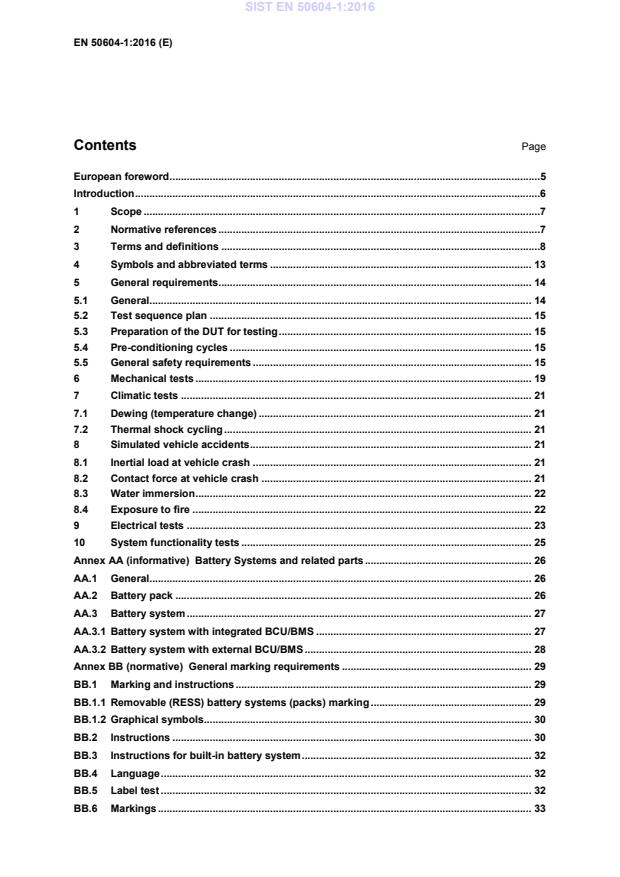
Battery Systems and related parts . 26 AA.1 General. 26 AA.2 Battery pack . 26 AA.3 Battery system . 27 AA.3.1 Battery system with integrated BCU/BMS . 27 AA.3.2 Battery system with external BCU/BMS . 28 Annex BB (normative)
General marking requirements . 29 BB.1 Marking and instructions . 29 BB.1.1 Removable (RESS) battery systems (packs) marking . 29 BB.1.2 Graphical symbols . 30 BB.2 Instructions . 30 BB.3 Instructions for built-in battery system . 32 BB.4 Language . 32 BB.5 Label test . 32 BB.6 Markings . 33 SIST EN 50604-1:2016
Test stamp for crush test . 34 Annex DD (normative)
Test probe . 35 Annex EE (informative)
Packaging and transportation for not tested battery samples . 36 EE.1 Information regarding packaging and transportation . 36 EE.1.1 Sample classification . 36 EE.1.2 Labelling . 36 EE.1.3 Packaging . 36 EE.1.4 Transport or shipper’s declaration . 36 EE.1.5 List of content of package . 36 EE.2 Documents . 36 EE.2.1 Form with data regarding the properties of substances of cells. 36 EE.2.2 Handling instructions and guidelines for cells and battery packs . 36 EE.2.3 Operation manual of battery packs, chargers (VCUs), PCB or BMS . 37 EE.2.4 Certificates for components and subsystems . 37 EE.2.5 Quality examination report of samples . 37 EE.2.6 Overview about provided samples and their respective cycle history . 37 EE.3 Additional information . 37 EE.3.1 Instructions on bypassing protective devices . 37 EE.3.2 Other information . 37 Annex FF (informative)
Transport regulations . 38 FF.1 Regulatory information . 38 FF.2 UN-Numbers . 38 FF.3 Transport information . 38 FF.4 UN Recommendations on the Transport of Dangerous Goods . 39 FF.5 UN Recommendations on the Transport of Dangerous Goods – Manual of Test and Criteria . 40 FF.6 Overview about UN-T Tests T.1 - T.8 lithium, lithium ion and lithium polymer cells and batteries . 40 FF.6.1 Test T.1: Altitude simulation . 40 FF.6.2 Test T.2: Thermal test . 40 FF.6.3 Test T.3: Vibration . 41 FF.6.4 Test T.4: Shock . 41 FF.6.5 Test T.5: External Short Circuit . 41 FF.6.6 Test T.6: Impact . 41 FF.6.7 Test T.7: Overcharge . 42 FF.6.8 Test T.8: Forced Discharge. 42 Annex GG (normative)
Test sequences and number of samples . 43 Bibliography . 44
Table 1 — Battery system requirements . 16 Table BB.1 — Graphical symbols . 30 Table FF.1 — Comparison of test items . 40 Table GG.1 — Number of samples required . 43
Testing on cell level is specified in the IEC 62660 series. This European Standard does not apply to: – lithium cells; – batteries other than lithium ion types; – primary Batteries(including lithium types); – batteries covered by the ISO 12405- series. 2 Normative references The following documents, in whole or in part, are normatively referenced in this document and are indispensable for its application. For dated references, only the edition cited applies. For undated references, the latest edition of the referenced document (including any amendments) applies. ISO 12405-3:2014, Electrically propelled road vehicles — Test specification for lithium-ion traction battery packs and systems — Part 3: Safety performance requirements This clause of ISO 12405-3:2014 is applicable except as follows: Additions: EN 60068-2-47, Environmental testing — Part 2-47: Test — Mounting of specimens for vibration, impact and similar dynamic tests (IEC 60068-2-47) EN 60335-2-29, Household and similar electrical appliances — Safety — Part 2-29: Particular requirements for battery chargers (IEC 60335-2-29) EN ISO 14021, Environmental labels and declarations — Self-declared environmental claims (Type II environmental labelling) (ISO 14021) EN ISO 4892-2, Plastics — Methods of exposure to laboratory light sources — Part 2: Xenon-arc lamps (ISO 4892-2) SIST EN 50604-1:2016
Under consideration. SIST EN 50604-1:2016
Sparks and arcing are not considered as flames. Note 2 to entry:
Smoke is not considered as fire. [SOURCE: ISO 12405-3:2014, 3.11, modified — Note 2 to entry was added.] 3.12 high-energy application characteristic of device or application, for which the numerical ratio between maximum allowed electric power output (power in W) and electric energy output (energy in Wh) at a 1 C discharge rate at RT for a battery pack or system is typically less than 10 C Note 1 to entry: Typically high-energy battery packs and systems are designed for applications in BEVs. [SOURCE: ISO 12405-3:2014, 3.13, modified — “Typically lower than 10” was replaced with “typically less than 10 C” in the present definition.] 3.13 high-power application characteristic of device or application, for which the numerical ratio between maximum allowed electric power output (power in W) and electric energy output (energy in Wh) at a 1 C discharge rate at RT for a battery pack or system is typically equal or greater than 10 C Note 1 to entry: Typically high-power battery packs and systems are designed for application in HEVs and FCVs. [SOURCE: ISO 12405-3:2014, 3.14, modified — “Or higher than 10” was replaced with “or greater than 10 C” in the present definition.] SIST EN 50604-1:2016
efficiency 5 General requirements This clause of ISO 12405-3:2014 is applicable except as follows: 5.1 General Replacement: 5.1.101 General conditions A battery pack/system to be tested according to this standard shall fulfil the following requirements: – Electrical safety design shall be approved according the requirements given in ISO 6469-1 and ISO 6469-3, – The necessary documentation for operation and needed interface parts for connection to the test equipment (i.e. connectors, plugs including cooling) shall be delivered together with the DUT; – A battery system shall enable the specified tests, e.g. by specified test modes implemented in the BCU/BMS, and shall be able to communicate with the test bench via e.g. common communication buses; – The DUT may also be equipped with additional sensors, wires, support which are necessary to conduct the specific test or to obtain the required data for such test. Such additional devices shall not influence the result with respect to the intended purpose of the test. If not otherwise specified, the tests described apply to battery packs/ systems. The status of the DUT, e.g. new product, tested or used, shall be agreed upon between customer and supplier before testing. The history of the DUT shall be documented. When reference to ISO 12405-1 and ISO 12405-2 is made only the test procedure in the corresponding clause shall apply. In this case the test procedures and pre-conditions (e.g. temperatures, SOC) shall be selected according to the battery packs or systems application. For high-power applications refer to ISO 12405-1 and for high-energy applications refer to ISO 12405-2. If not otherwise specified, the following conditions shall apply: SIST EN 50604-1:2016
...