


prEN IEC 62541-23:2024
(Main)OPC unified architecture - Part 23: Common ReferenceTypes
OPC unified architecture - Part 23: Common ReferenceTypes
IEC 62541-23:2025 defines ReferenceTypes commonly used in industrial Information Models. They are more specific than the ReferenceTypes in IEC 62541‑3 which are an inherent part of the OPC UA Address Space Model.
OPC Unified Architecture – Teil 23: Gemeinsame Referenztypen
Architecture unifiée OPC - Partie 23: ReferenceTypes communs
IEC 62541-23: 2025 définit les ReferenceTypes communément utilisés dans les Modèles d'information industriels. Ces ReferenceTypes sont plus spécifiques que ceux de l'IEC 62541‑3 qui font partie intégrante du Modèle d'espace d'adressage OPC UA.
Enotna arhitektura OPC - 23. del: Skupni tipi zvez
General Information
- Status
- Not Published
- Publication Date
- 19-Feb-2026
- Technical Committee
- CLC/TC 65X - Industrial-process measurement, control and automation
- Current Stage
- 4060 - Enquiry results established and sent to TC, SR, BTTF - Enquiry
- Start Date
- 19-Apr-2024
- Completion Date
- 19-Apr-2024
Overview
prEN IEC 62541-23:2024 (OPC Unified Architecture - Part 23: Common ReferenceTypes) is a technical specification defining a common set of reference types, reference description structures and refinements used in OPC UA information models. Published as a Committee Draft for Vote (CDV) in 2024 with a proposed stability date of 2026, this part standardizes how relationships between OPC UA nodes are named, described and represented programmatically to improve consistency across servers, clients and integration solutions.
Key Topics
- Common ReferenceTypes - Formal definitions and semantics for relationships such as IsExecutableOn, IsExecutingOn, Controls, Utilizes, Requires, IsPhysicallyConnectedTo, RepresentsSameEntityAs, RepresentsSameHardwareAs, RepresentsSameFunctionalityAs, IsHostedBy, HasPhysicalComponent, HasContainedComponent, HasAttachedComponent.
- Reference Description and Refinement - Models and patterns to describe references (ReferenceDescription), to refine or resolve multi-hop relationships (Reference Refinement) and to represent alternative navigation paths.
- VariableTypes and DataTypes - Definitions for ReferenceDescriptionVariableType, HasReferenceDescription reference, ReferenceDescriptionDataType and ReferenceListEntryDataType to represent reference metadata in the address space and service payloads.
- Design considerations - Informative annex material explaining design decisions and alternative modeling approaches (e.g., proxy objects for refinements) to support implementers.
Practical Applications
- Ensures consistent semantics for node-to-node relationships in OPC UA information models used across industrial automation, process control and IT/OT integration.
- Supports reliable navigation and discovery of assets and services for:
- Digital twins and asset models
- Device and machine integration
- System-level modelling (equipment hierarchies, connectivity, hosting)
- Application logic that requires unambiguous relationship metadata (e.g., diagnostics, engineering tools)
- Enables clients to interpret multi-hop relationships and alternative navigation paths programmatically, improving interoperability and maintainability of OPC UA-based solutions.
Who Should Use This Standard
- OPC UA server and client implementers
- Device vendors and system integrators creating OPC UA information models
- Solution architects building digital twin, MES, SCADA or IIoT applications
- Standards and interoperability teams seeking consistent reference semantics across projects
Related Standards
- IEC 62541-1 (OPC UA general structure and series overview) - consult for terms, address space conventions and the broader OPC UA series.
- Other IEC 62541 parts covering information modelling, services and profiles for complementary guidance.
Keywords: OPC UA, OPC Unified Architecture, ReferenceTypes, ReferenceDescription, Reference Refinement, IEC 62541-23, industrial automation, digital twin, device integration.

Get Certified
Connect with accredited certification bodies for this standard

National Aerospace and Defense Contractors Accreditation Program (NADCAP)
Global cooperative program for special process quality in aerospace.
CARES (UK Certification Authority for Reinforcing Steels)
UK certification for reinforcing steels and construction.
DVS-ZERT GmbH
German welding certification society.
Sponsored listings
Frequently Asked Questions
prEN IEC 62541-23:2024 is a draft published by CLC. Its full title is "OPC unified architecture - Part 23: Common ReferenceTypes". This standard covers: IEC 62541-23:2025 defines ReferenceTypes commonly used in industrial Information Models. They are more specific than the ReferenceTypes in IEC 62541‑3 which are an inherent part of the OPC UA Address Space Model.
IEC 62541-23:2025 defines ReferenceTypes commonly used in industrial Information Models. They are more specific than the ReferenceTypes in IEC 62541‑3 which are an inherent part of the OPC UA Address Space Model.
prEN IEC 62541-23:2024 is classified under the following ICS (International Classification for Standards) categories: 25.040 - Industrial automation systems. The ICS classification helps identify the subject area and facilitates finding related standards.
prEN IEC 62541-23:2024 is available in PDF format for immediate download after purchase. The document can be added to your cart and obtained through the secure checkout process. Digital delivery ensures instant access to the complete standard document.
Standards Content (Sample)
SLOVENSKI STANDARD
01-marec-2024
Enotna arhitektura OPC - 23. del: Skupni tipi zvez
OPC unified architecture - Part 23: Common reference types
Ta slovenski standard je istoveten z: prEN IEC 62541-23:2024
ICS:
25.040.40 Merjenje in krmiljenje Industrial process
industrijskih postopkov measurement and control
35.240.50 Uporabniške rešitve IT v IT applications in industry
industriji
2003-01.Slovenski inštitut za standardizacijo. Razmnoževanje celote ali delov tega standarda ni dovoljeno.
65E/1048/CDV
COMMITTEE DRAFT FOR VOTE (CDV)
PROJECT NUMBER:
IEC 62541-23 ED1
DATE OF CIRCULATION: CLOSING DATE FOR VOTING:
2024-01-26 2024-04-19
SUPERSEDES DOCUMENTS:
65E/958/NP, 65E/1018/RVN
IEC SC 65E : DEVICES AND INTEGRATION IN ENTERPRISE SYSTEMS
SECRETARIAT: SECRETARY:
United States of America Mr Donald (Bob) Lattimer
OF INTEREST TO THE FOLLOWING COMMITTEES: PROPOSED HORIZONTAL STANDARD:
Other TC/SCs are requested to indicate their interest, if any,
in this CDV to the secretary.
FUNCTIONS CONCERNED:
EMC ENVIRONMENT QUALITY ASSURANCE SAFETY
SUBMITTED FOR CENELEC PARALLEL VOTING NOT SUBMITTED FOR CENELEC PARALLEL VOTING
Attention IEC-CENELEC parallel voting
The attention of IEC National Committees, members of
CENELEC, is drawn to the fact that this Committee Draft for
Vote (CDV) is submitted for parallel voting.
The CENELEC members are invited to vote through the
CENELEC online voting system.
This document is still under study and subject to change. It should not be used for reference purposes.
Recipients of this document are invited to submit, with their comments, notification of any relevant patent rights of which
they are aware and to provide supporting documentation.
Recipients of this document are invited to submit, with their comments, notification of any relevant “In Some Countries”
clauses to be included should this proposal proceed. Recipients are reminded that the CDV stage is the final stage for
submitting ISC clauses. (SEE AC/22/2007 OR NEW GUIDANCE DOC).
TITLE:
OPC Unified Architecture – Part 23: Common ReferenceTypes
PROPOSED STABILITY DATE: 2026
NOTE FROM TC/SC OFFICERS:
electronic file, to make a copy and to print out the content for the sole purpose of preparing National Committee positions.
You may not copy or "mirror" the file or printed version of the document, or any part of it, for any other purpose without
permission in writing from IEC.
1 IEC CDV 62541-23 © IEC 2023
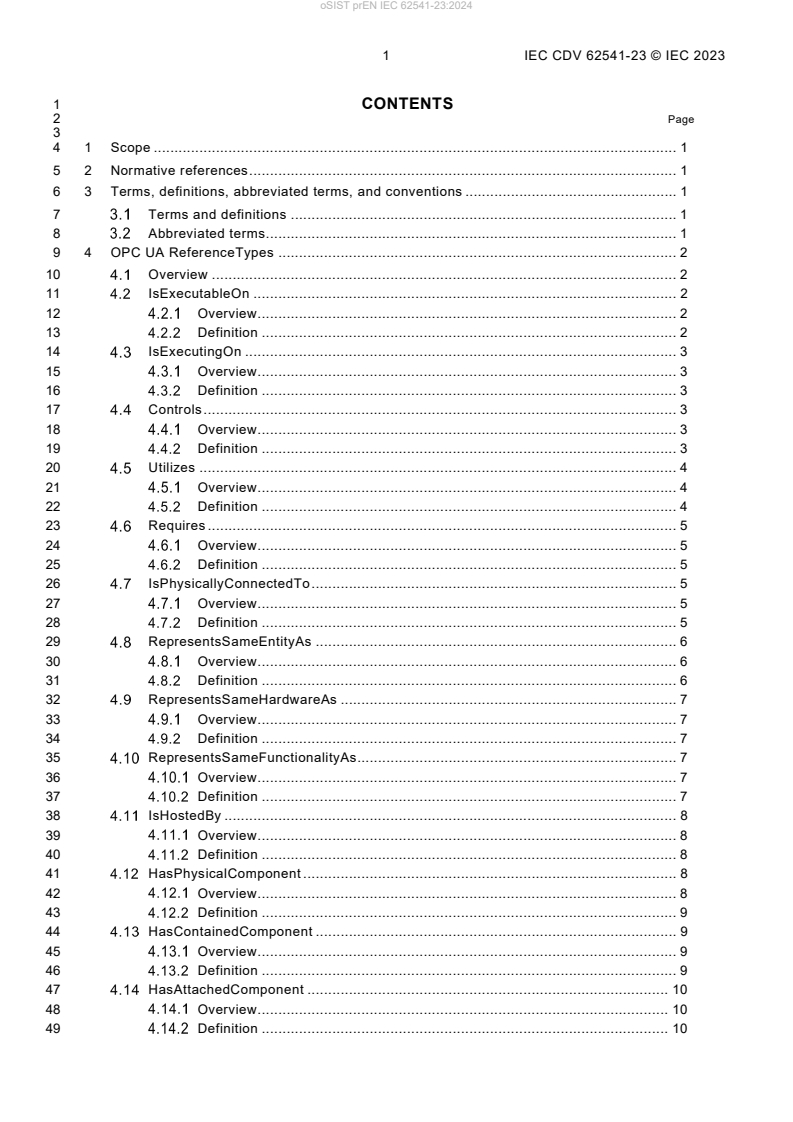
1 CONTENTS
2 Page
4 1 Scope . 1
5 2 Normative references . 1
6 3 Terms, definitions, abbreviated terms, and conventions . 1
7 Terms and definitions . 1
8 Abbreviated terms . 1
9 4 OPC UA ReferenceTypes . 2
10 Overview . 2
11 IsExecutableOn . 2
12 Overview . 2
13 Definition . 2
14 IsExecutingOn . 3
15 Overview . 3
16 Definition . 3
17 Controls . 3
18 Overview . 3
19 Definition . 3
20 Utilizes . 4
21 Overview . 4
22 Definition . 4
23 Requires . 5
24 Overview . 5
25 Definition . 5
26 IsPhysicallyConnectedTo . 5
27 Overview . 5
28 Definition . 5
29 RepresentsSameEntityAs . 6
30 Overview . 6
31 Definition . 6
32 RepresentsSameHardwareAs . 7
33 Overview . 7
34 Definition . 7
35 RepresentsSameFunctionalityAs . 7
36 Overview . 7
37 Definition . 7
38 IsHostedBy . 8
39 Overview . 8
40 Definition . 8
41 HasPhysicalComponent . 8
42 Overview . 8
43 Definition . 9
44 HasContainedComponent . 9
45 Overview . 9
46 Definition . 9
47 HasAttachedComponent . 10
48 Overview . 10
49 Definition . 10
2 IEC CDV 62541-23 © IEC 2023
50 5 Reference Description . 10
51 Overview . 10
52 Reference Refinement . 12
53 OPC UA VariableTypes. 14
54 ReferenceDescriptionVariableType . 14
55 OPC UA ReferenceTypes . 14
56 HasReferenceDescription . 14
57 OPC UA DataTypes . 15
58 ReferenceDescriptionDataType . 15
59 ReferenceListEntryDataType . 15
60 Annex A (Informative) ReferenceDescription Design Decisions . 16
61 A.1 Overview . 16
62 A.2 Alternative Approach: Intermediate Object . 16
63 Bibliography . 17
3 IEC CDV 62541-23 © IEC 2023
66 Figures
68 Figure 1 – Overview of ReferenceTypes . 2
Figure 2 – Example of ReferenceDescriptions . 11
70 Figure 3 – Examples of Reference Refinements . 12
Figure 4 – Example of Reference Refinements with multiple path options . 12
72 Figure 5 – Example of how to use Reference Refinements . 13
Figure 6 – Example of how to use Reference Refinements with two Levels and Multiple Hops13
74 Figure A.1 – Refinement of References by Proxy Object . 16
4 IEC CDV 62541-23 © IEC 2023
77 Tables
78 Table 1 – IsExecutableOn Definition . 3
79 Table 2 – IsExecutingOn Definition . 3
80 Table 3 – Controls Definition . 4
81 Table 4 – Utilizes Definition . 4
82 Table 5 – Requires Definition . 5
83 Table 6 – IsPhysicallyConnectedTo Definition . 6
84 Table 7 – RepresentsSameEntityAs Definition . 6
85 Table 8 – RepresentsSameHardwareAs Definition. 7
86 Table 9 – RepresentsSameFunctionalityAs Definition . 8
87 Table 10 – IsHostedBy Definition . 8
88 Table 11 – HasPhysicalComponent Definition . 9
89 Table 12 – HasContainedComponent Definition. 10
90 Table 13 – HasAttachedComponent Definition . 10
91 Table 14 – ReferenceDescriptionVariableType Definition . 14
92 Table 15 – HasReferenceDescription Definition . 14
93 Table 16 – ReferenceDescriptionDataType Structure . 15
94 Table 17 – ReferenceDescriptionDataType Definition . 15
95 Table 18 – ReferenceListEntryDataType Structure . 15
96 Table 19 – ReferenceListEntryDataType Definition . 15
5 IEC CDV 62541-23 © IEC 2023
99 INTERNATIONAL ELECTROTECHNICAL COMMISSION
100 ____________
102 OPC UNIFIED ARCHITECTURE –
104 Part 23: Common ReferenceTypes
106 FOREWORD
107 1) The International Electrotechnical Commission (IEC) is a worldwide organization for standardization comprising all
108 national electrotechnical committees (IEC National Committees). The object of IEC is to promote international co-
109 operation on all questions concerning standardization in the electrical and electronic fields. To this end and in addition to
110 other activities, IEC publishes International Standards, Technical Specifications, Technical Reports, Publicly Available
111 Specifications (PAS) and Guides (hereafter referred to as “IEC Publication(s)”). Their preparation is entrusted to technical
112 committees; any IEC National Committee interested in the subject dealt with may participate in this preparatory work.
113 International, governmental and non-governmental organizations liaising with the IEC also participate in this preparation.
114 IEC collaborates closely with the International Organization for Standardization (ISO) in accordance with conditions
115 determined by agreement between the two organizations.
116 2) The formal decisions or agreements of IEC on technical matters express, as nearly as possible, an international
117 consensus of opinion on the relevant subjects since each technical committee has representation from all interested IEC
118 National Committees.
119 3) IEC Publications have the form of recommendations for international use and are accepted by IEC National Committees
120 in that sense. While all reasonable efforts are made to ensure that the technical content of IEC Publications is accurate,
121 IEC cannot be held responsible for the way in which they are used or for any misinterpretation by any end user.
122 4) In order to promote international uniformity, IEC National Committees undertake to apply IEC Publications transparently
123 to the maximum extent possible in their national and regional publications. Any divergence between any IEC Publication
124 and the corresponding national or regional publication shall be clearly indicated in the latter.
125 5) IEC itself does not provide any attestation of conformity. Independent certification bodies provide conformity assessment
126 services and, in some areas, access to IEC marks of conformity. IEC is not responsible for any services carried out by
127 independent certification bodies.
128 6) All users should ensure that they have the latest edition of this publication.
129 7) No liability shall attach to IEC or its directors, employees, servants or agents including individual experts and members
130 of its technical committees and IEC National Committees for any personal injury, property damage or other damage of
131 any nature whatsoever, whether direct or indirect, or for costs (including legal fees) and expenses arising out of the
132 publication, use of, or reliance upon, this IEC Publication or any other IEC Publications.
133 8) Attention is drawn to the Normative references cited in this publication. Use of the referenced publications is indispensable
134 for the correct application of this publication.
135 9) Attention is drawn to the possibility that some of the elements of this IEC Publication may be the subject of patent rights.
136 IEC shall not be held responsible for identifying any or all such patent rights.
137 The main task of IEC technical committees is to prepare International Standards. However, a technical
138 committee may propose the publication of a technical report when it has collected data of a different
139 kind from that which is normally published as an International Standard, for example "state of the art".
140 International Standard IEC 62541-23 has been prepared by subcommittee 65E: Devices and
141 integration in enterprise systems, of IEC technical committee 65: Industrial-process measurement,
142 control, and automation.
143 The text of this international standard is based on the following documents:
CDV Report on voting
65E/XX/CDV 65E/XX/RVC
145 Full information on the voting for the approval of this international standard can be found in the report
146 on voting indicated in the above table.
147 This publication has been drafted in accordance with the ISO/IEC Directives, Part 2.
148 Throughout this document and the other Parts of the series, certain document conventions are used:
6 IEC CDV 62541-23 © IEC 2023
149 Italics are used to denote a defined term or definition that appears in the “Terms and definition” clause
150 in one of the parts of the series.
151 Italics are also used to denote the name of a service input or output parameter or the name of a
152 structure or element of a structure that are usually defined in tables.
153 The italicized terms and names are also often written in camel-case (the practice of writing compound
154 words or phrases in which the elements are joined without spaces, with each element's initial letter
155 capitalized within the compound). For example, the defined term is AddressSpace instead of Address
156 Space. This makes it easier to understand that there is a single definition for AddressSpace, not
157 separate definitions for Address and Space.
158 A list of all parts of the IEC 62541 series is included in IEC 62541-1 clause 4 Structure of the OPC UA
159 series and published under the general title OPC Unified Architecture, can be found on the IEC
160 website.
161 The committee has decided that the contents of this publication will remain unchanged until the stability
162 date indicated on the IEC web site under "http://webstore.iec.ch" in the data related to the specific
163 publication. At this date, the publication will be
164 • reconfirmed,
165 • withdrawn,
166 • replaced by a revised edition, or
167 • amended.
169 A bilingual version of this publication may be issued at a later date.
IMPORTANT – The 'colour inside' logo on the cover page of this publication indicates
that it contains colours which are considered to be useful for the correct understanding
of its contents. Users should therefore print this document using a colour printer.
1 IEC CDV 62541-23 © IEC 2023
172 OPC Unified Architecture Specification
174 Part 23: Common ReferenceTypes
178 1 Scope
179 This part of the OPC Unified Architecture defines an Information Model. The Information Model defines
180 common ReferenceTypes.
181 2 Normative references
182 The following referenced documents are indispensable for the application of this OPC UA part. For
183 dated references, only the edition cited applies. For undated references, the latest edition of the
184 referenced document (including any amendments and errata) applies.
185 IEC 62541-1, OPC Unified Architecture – Part 1: Overview and Concepts
186 IEC 62541-3, OPC Unified Architecture – Part 3: Address Space Model
187 IEC 62541-5, OPC Unified Architecture – Part 5: Information Model
189 3 Terms, definitions, abbreviated terms, and conventions
190 Terms and definitions
191 For the purposes of this document, the terms and definitions given in IEC 62541-1, IEC 62541-3, and
192 IEC 62541-5 apply.
193 All used terms are italicized in this document.
194 Abbreviated terms
195 CPU Central Processing Unit
196 IO Input/Output
197 IP Internet Protocol
198 PC Personal Computer
199 PCI Peripheral Component Interconnect
200 PHY Physical Layer
201 PLC Programmable Logic Controller
202 RFID Radio Frequency Identification
2 IEC CDV 62541-23 © IEC 2023
203 4 OPC UA ReferenceTypes
204 Overview
205 The following Figure 1 gives an overview of the ReferenceTypes defined in the following subsections.
References
HierarchicalReferences NonHierarchicalReferences
IsExecutableOn IsPhysicallyConnectedTo Utilizes
HasChild Controls
(asymmetric) (symmetric) (asymmetric)
RepresentsSameEntityAs
Aggregates
(symmetric)
Requires
IsExecutingOn
IsHostedBy
(asymmetric) (asymmetric)
HasComponent
RepresentsSameHardwareAs RepresentsSameFunctionalityAs
(symmetric) (symmetric)
HasPhysicalComponent
HasContainedComponent HasAttachedComponent
207 Figure 1 – Overview of ReferenceTypes
208 IsExecutableOn
209 Overview
210 This ReferenceType can be used to expose the relation between a software component and its
211 execution environment. For example, it can be used to expose which firmware (including its version)
212 is available on a field device.
213 Definition
214 The IsExecutableOn is a concrete ReferenceType and can be used directly. It is a subtype of
215 NonHierarchicalReferences.
216 The semantic of this ReferenceType is to relate a software component to its execution environment
217 that the software needs to run (e.g. Hardware component, Task or Thread). The relationship shows
218 that the execution environment the reference points to, is able to execute the software component.
219 This does not imply that the software component is currently being executed or running. To show that
220 the software is running in an environment, IsExecutingOn should be used.
221 The SourceNode of References of this ReferenceType shall be an Object or ObjectType representing
222 a software component.
223 The TargetNode of References of this ReferenceType shall be an Object or ObjectType representing
224 an execution environment for a software component, which might be a piece of hardware (e.g. Device)
225 or some other environment like a task, thread or software execution framework.
226 IsExecutableOn is formally defined in Table 1.
3 IEC CDV 62541-23 © IEC 2023
227 Table 1 – IsExecutableOn Definition
Attributes Value
BrowseName IsExecutableOn
InverseName CanExecute
Symmetric FALSE
IsAbstract FALSE
References NodeClass BrowseName Comment
Subtype of NonHierarchicalReferences defined in IEC 62541-5
Conformance Units
Base Info IsExecutableOn
229 IsExecutingOn
230 Overview
231 This ReferenceType can be used to expose the relation between a software component and its
232 execution environment it is currently executing on. References of this ReferenceType might be very
233 dynamic and need to disappear as soon, as the software component is not being executed anymore.
234 For example, it can be used to expose that a PLC program is currently running on a specific task of a
235 PLC.
236 Definition
237 The IsExecutingOn is a concrete ReferenceType and can be used directly. It is a subtype of Utilizes.
238 The semantic of this ReferenceType is to relate a software component to its execution environment it
239 is currently executing on (e.g. Hardware component, Task or Thread). References of this
240 ReferenceType shall only be used when the software component is currently executed / running.
241 The SourceNode of References of this ReferenceType shall be an Object or ObjectType representing
242 a software component.
243 The TargetNode of References of this ReferenceType shall be an Object or ObjectType representing
244 an execution environment for a software component, which might be a piece of hardware (e.g. Device)
245 or some other environment like a task, thread or software execution framework.
246 IsExecutingOn is formally defined in Table 2.
247 Table 2 – IsExecutingOn Definition
Attributes Value
BrowseName IsExecutingOn
InverseName Executes
Symmetric FALSE
IsAbstract FALSE
References NodeClass BrowseName Comment
Subtype of Utilizes defined in 4.5
Conformance Units
Base Info IsExecutingOn
250 Controls
251 Overview
252 This ReferenceType can be used to expose the relation between an object controlling other objects
253 and the controlled objects. For example, it can be used to relate a PLC to the field devices or machine-
254 modules controlled by the PLC or a software component to the hardware components controlled by
255 the software component.
256 Definition
257 The Controls is a concrete ReferenceType and can be used directly. It is a subtype of
258 HierarchicalReferences.
4 IEC CDV 62541-23 © IEC 2023
259 The semantic of this ReferenceType is to relate the controlling component to the components
260 controlled by the controlling component.
261 The SourceNode of References of this ReferenceType shall be an Object or ObjectType representing
262 the controlling component, as for example a PLC or a software component.
263 The TargetNode of References of this ReferenceType shall be an Object representing a component
264 that is controlled by the TargetNode.
265 Controls is formally defined in Table 3.
266 Table 3 – Controls Definition
Attributes Value
BrowseName Controls
InverseName IsControlledBy
Symmetric FALSE
IsAbstract FALSE
References NodeClass BrowseName Comment
Subtype of HierarchicalReferences defined in IEC 62541-5
Conformance Units
Base Info Controls
268 Utilizes
269 Overview
270 This ReferenceType can be used to expose the relation between a component to other components,
271 that the component needs in order to work. In contrast to the Requires ReferenceType, this non-
272 hierarchical ReferenceType allows loops, e.g. both components need each other in order to work. In
273 that case, there would be two References, the first one pointing from one component to the other, and
274 the second one vice versa. For example, a fan in a PC needs the power supply in order to work and
275 the power supply needs the cooling from the fan, that it is not overheating. An example of a non-
276 looping usage is that a robot utilizes a vision system in order to get the position where to grab
277 something.
278 Definition
279 The Utilizes is a concrete ReferenceType and can be used directly. It is a subtype of
280 NonHierarchicalReferences.
281 The semantic of this ReferenceType is to relate a component to other components that are needed by
282 the component in order to work.
283 The SourceNode of References of this ReferenceType shall be an Object or ObjectType representing
284 a component that utilizes the TargetNode in order to work.
285 The TargetNode of References of this ReferenceType shall be an Object or ObjectType representing
286 the required component.
287 Requires is formally defined in Table 4.
288 Table 4 – Utilizes Definition
Attributes Value
BrowseName Utilizes
InverseName IsUtilizedBy
Symmetric FALSE
IsAbstract FALSE
References NodeClass BrowseName Comment
Subtype of NonHierarchicalReferences defined in IEC 62541-5
Conformance Units
Base Info Utilizes
5 IEC CDV 62541-23 © IEC 2023
290 Requires
291 Overview
292 This ReferenceType can be used to expose the relation between a component to other components,
293 that the component requires in order to work. In contrast to the HasComponent ReferenceType, the
294 related components are not considered to be subcomponents of the component. In contrast to the
295 Utilizes ReferenceType, this hierarchical ReferenceType exposes a non-looping hierarchy of
296 dependencies.
297 For example, it can be used to relate an axis of a motion device to its required powertrains or a
298 software component to other software components required to execute the software component, like
299 for example libraries.
300 Definition
301 The Requires is a concrete ReferenceType and can be used directly. It is a subtype of
302 HierarchicalReferences.
303 The semantic of this ReferenceType is to relate a component to other components it requires in order
304 to work.
305 The SourceNode of References of this ReferenceType shall be an Object or ObjectType representing
306 a component that requires the TargetNode in order to work.
307 The TargetNode of References of this ReferenceType shall be an Object representing the required
308 component used by the SourceNode.
309 Requires References shall not lead to loops, that is, starting from Node “A” and only following
310 References of ReferenceType Requires or subtypes it shall never be possible to return to “A”. But it is
311 allowed that following the References there may be more than one path leading to another Node “B”.
312 Requires is formally defined in Table 5.
313 Table 5 – Requires Definition
Attributes Value
BrowseName Req
...
Questions, Comments and Discussion
Ask us and Technical Secretary will try to provide an answer. You can facilitate discussion about the standard in here.
Loading comments...