Information technology - Generic cabling systems - Part 2: Office spaces

This standard specifies generic cabling within and between the buildings of office premises, or office spaces within other types of building. It covers balanced cabling and optical fibre cabling. This standard specifies directly or via reference to EN 50173-1 the: - structure and minimum configuration for generic cabling within office spaces; - interfaces at the telecommunications outlet (TO); - performance requirements for cabling links and channels; - implementation requirements and options; - performance requirements for cabling components; - conformance requirements and verification procedures. This standard has taken into account requirements specified in application standards listed in EN 50173-1. Safety and electromagnetic compatibility (EMC) requirements are outside the scope of this standard and are covered by other standards and regulations. However, information given in this standard can be of assistance in meeting these standards and regulations.

Informationstechnik - Anwendungsneutrale Kommunikationskabelanlagen - Teil 2: Bürobereiche

Anwendungsbeginn für die von CENELEC am 2018-03-19 angenommene Europäische Norm als DIN-Norm ist 2018-10-01. Für DIN EN 50173-2:2011-09 besteht eine Übergangsfrist bis 2021-03-19.

Technologies de l'information - Systèmes de câblage générique - Partie 2: Espaces de bureau

La présente norme spécifie le câblage générique dans et entre des bâtiments de locaux du secteur tertiaire, ou des espaces de bureaux à l’intérieur d’autres types de bâtiments. Elle couvre les câblages à paires symétriques et les câblages à fibres optiques. La présente norme spécifie, de manière directe ou en faisant référence à l’EN 50173-1: - une topologie et une configuration minimale de câblage générique dans les espaces de bureaux; - les interfaces au niveau de la prise de télécommunication (TO - telecommunications outlet); - les exigences de performances pour les liaisons et canaux de câblage; - l les exigences et options de mise en oeuvre; - les exigences de performances pour les composants de câblage; - les exigences de conformité et les procédures de vérification. La présente norme prend en compte les exigences spécifiées dans les normes d’application énumérées dans l’EN 50173-1. Les exigences de sécurité et de compatibilité électromagnétique (CEM) ne font pas partie du domaine d'application de la présente norme et sont couvertes par d'autres normes et réglementations. Cependant, les informations données dans la présente norme peuvent aider à satisfaire à ces normes et réglementations.

Informacijska tehnologija - Generični kabelski sistemi - 2. del: Pisarne

Ta standard določa univerzalne kable, napeljane v stavbah s pisarniškimi prostori ali med njimi oziroma v pisarnah znotraj drugih vrst stavb.
Obravnava simetrične kable in kable z optičnimi vlakni.
Ta standard neposredno ali s sklicem na standard EN 50173-1 določa:
– strukturo in minimalno konfiguracijo univerzalnih kablov v pisarnah;
– vmesnike na telekomunikacijski vtičnici (TO);
– zahteve za zmogljivost kabelskih povezav in kanalov;
– zahteve in možnosti za izvedbo;
– zahteve za zmogljivost kabelskih komponent;
– zahteve za skladnost in postopke preverjanja.
Ta standard upošteva zahteve, določene v standardih za uporabo, navedenih v standardu EN 50173-1.
Varnostne zahteve in zahteve za elektromagnetno združljivost (EMC) ne spadajo na področje uporabe tega standarda ter so obravnavane v drugih standardih in predpisih. Vendar so lahko informacije iz tega standarda v pomoč pri izpolnjevanju teh standardov in predpisov.

General Information

Status
Published
Publication Date
14-Jun-2018
Current Stage
9093 - Decision to confirm - Review Enquiry
Start Date
09-Nov-2022
Completion Date
23-Sep-2025

Relations

Standard
EN 50173-2:2018
English language
35 pages
sale 10% off
Preview
sale 10% off
Preview
e-Library read for
1 day
Standard
EN 50173-2:2018
English language
35 pages
sale 10% off
Preview
sale 10% off
Preview
e-Library read for
1 day
Standard
EN 50173-2:2018
English language
35 pages
sale 10% off
Preview
sale 10% off
Preview
e-Library read for
1 day

Standards Content (Sample)


SLOVENSKI STANDARD
01-oktober-2018
Nadomešča:
SIST EN 50173-2:2008
SIST EN 50173-2:2008/A1:2011
SIST EN 50173-2:2008/A1:2011/AC:2011
Informacijska tehnologija - Osnovni kabelski sistemi - 2. del: Pisarne
Information technology - Generic cabling systems - Part 2: Office spaces
Informationstechnik - Anwendungsneutrale Kommunikationskabelanlagen - Teil 2:
Bürobereiche
Technologies de l'information - Systèmes de câblage générique - Partie 2: Espaces de
bureau
Ta slovenski standard je istoveten z: EN 50173-2:2018
ICS:
33.040.50 Vodi, zveze in tokokrogi Lines, connections and
circuits
35.110 Omreževanje Networking
2003-01.Slovenski inštitut za standardizacijo. Razmnoževanje celote ali delov tega standarda ni dovoljeno.

EUROPEAN STANDARD EN 50173-2
NORME EUROPÉENNE
EUROPÄISCHE NORM
June 2018
ICS 33.040.50 Supersedes EN 50173-2:2007
English Version
Information technology - Generic cabling systems - Part 2: Office
spaces
Technologies de l'information - Systèmes de câblage Informationstechnik - Anwendungsneutrale
générique - Partie 2: Espaces de bureau Kommunikationskabelanlagen - Teil 2: Bürobereiche
This European Standard was approved by CENELEC on 2018-03-19. CENELEC members are bound to comply with the CEN/CENELEC
Internal Regulations which stipulate the conditions for giving this European Standard the status of a national standard without any alteration.
Up-to-date lists and bibliographical references concerning such national standards may be obtained on application to the CEN-CENELEC
Management Centre or to any CENELEC member.
This European Standard exists in three official versions (English, French, German). A version in any other language made by translation
under the responsibility of a CENELEC member into its own language and notified to the CEN-CENELEC Management Centre has the
same status as the official versions.
CENELEC members are the national electrotechnical committees of Austria, Belgium, Bulgaria, Croatia, Cyprus, the Czech Republic,
Denmark, Estonia, Finland, Former Yugoslav Republic of Macedonia, France, Germany, Greece, Hungary, Iceland, Ireland, Italy, Latvia,
Lithuania, Luxembourg, Malta, the Netherlands, Norway, Poland, Portugal, Romania, Serbia, Slovakia, Slovenia, Spain, Sweden,
Switzerland, Turkey and the United Kingdom.

European Committee for Electrotechnical Standardization
Comité Européen de Normalisation Electrotechnique
Europäisches Komitee für Elektrotechnische Normung
CEN-CENELEC Management Centre: Rue de la Science 23, B-1040 Brussels
© 2018 CENELEC All rights of exploitation in any form and by any means reserved worldwide for CENELEC Members.
Ref. No. EN 50173-2:2018 E
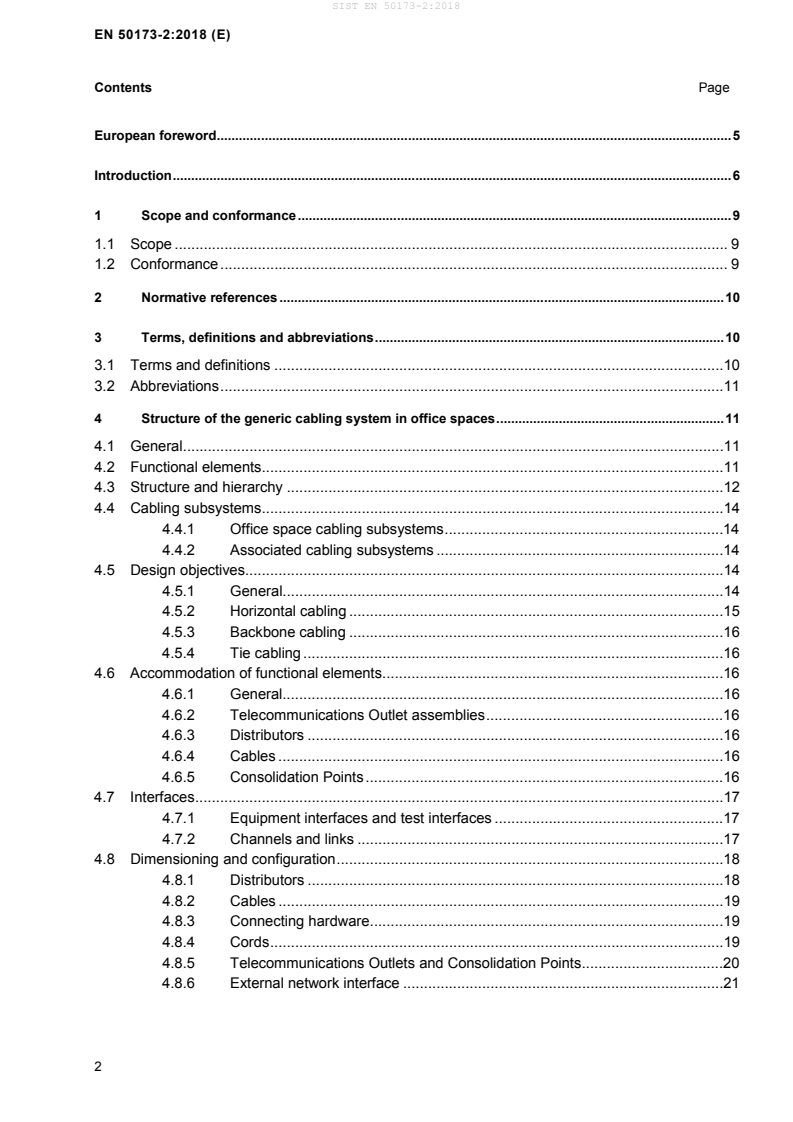
Contents Page
European foreword . 5
Introduction . 6
1 Scope and conformance . 9
1.1 Scope . 9
1.2 Conformance . 9
2 Normative references . 10
3 Terms, definitions and abbreviations . 10
3.1 Terms and definitions .10
3.2 Abbreviations .11
4 Structure of the generic cabling system in office spaces . 11
4.1 General .11
4.2 Functional elements .11
4.3 Structure and hierarchy .12
4.4 Cabling subsystems .14
4.4.1 Office space cabling subsystems .14
4.4.2 Associated cabling subsystems .14
4.5 Design objectives.14
4.5.1 General .14
4.5.2 Horizontal cabling .15
4.5.3 Backbone cabling .16
4.5.4 Tie cabling .16
4.6 Accommodation of functional elements .16
4.6.1 General .16
4.6.2 Telecommunications Outlet assemblies .16
4.6.3 Distributors .16
4.6.4 Cables .16
4.6.5 Consolidation Points .16
4.7 Interfaces .17
4.7.1 Equipment interfaces and test interfaces .17
4.7.2 Channels and links .17
4.8 Dimensioning and configuration .18
4.8.1 Distributors .18
4.8.2 Cables .19
4.8.3 Connecting hardware .19
4.8.4 Cords .19
4.8.5 Telecommunications Outlets and Consolidation Points .20
4.8.6 External network interface .21
5 Requirements for channels in office spaces . 21
5.1 General .21
5.2 Environmental performance .22
5.3 Transmission performance .23
5.3.1 General .23
5.3.2 Balanced cabling .23
5.3.3 Optical fibre cabling .23
6 Reference implementations in office spaces . 23
6.1 General .23
6.2 Balanced cabling .24
6.2.1 General .24
6.2.2 Horizontal cabling .24
6.2.3 Backbone cabling .27
6.3 Optical fibre cabling .27
6.3.1 Horizontal cabling .27
6.3.2 Backbone cabling .29
7 Requirements for cables in office spaces. 30
7.1 General .30
7.2 Balanced cables of Category 6, 6 7, 7 , 8.1 and 8.2 .30
A, A
7.3 Optical fibre cables of Category OM3, OM4, OM5, OS1a and OS2 .30
8 Requirements for connecting hardware in office spaces . 30
8.1 General requirements .30
8.2 Balanced connecting hardware .30
8.2.1 General requirements .30
8.2.2 Electrical, mechanical and environmental performance .31
8.3 Optical fibre connecting hardware .31
8.3.1 General requirements .31
8.3.2 Optical, mechanical and environmental performance .31
8.3.2.1 Connecting hardware at the Telecommunications Outlet . 31
9 Requirements for cords and jumpers in office spaces . 31
9.1 Jumpers .31
9.2 Balanced cords of Category 6, 6A, 7, 7A, 8.1 and 8.2 .31
9.2.1 General .31
9.2.2 Additional requirements for certain cords .32
9.3 Optical fibre cords of Category OM3, OM4, OM5, OS1a and OS2 .32
Annex A (normative) Link performance limits. 33
A.1 General. 33
A.2 Balanced cabling . 33
A.3 Optical fibre cabling . 34
Bibliography . 35

Figures
Figure 1 — Schematic relationship between the EN 50173 series and other relevant standards . 7
Figure 2 — Structure of generic cabling . 12
Figure 3 — Hierarchical topology of generic cabling . 13
Figure 4 — Structures for centralized generic cabling . 13
Figure 5 — Examples of cabling implementation to improve reliability . 15
Figure 6 — Accommodation of functional elements . 17
Figure 7 — Test and equipment interfaces . 17
Figure 8 — Example of a generic cabling system with combined BD and FD . 19
Figure 9 — Example of a horizontal cabling channel . 22
Figure 10 — Example of a system showing the location of cabling interfaces . 22
Figure 11 — Horizontal cabling models . 26
Figure 12 — Combined optical fibre backbone/horizontal channels . 29
Figure A.1 — Link options . 33

Tables
Table 1 — Contextual relationship between EN 50173 series and other standards relevant for information
technology cabling systems . 7
Table 2 — Maximum channel lengths for reference implementations . 18
Table 3 — Horizontal channel equations . 27

European foreword
This document (EN 50173-2:2018) was prepared by the Technical Committee CENELEC TC 215,
Electrotechnical aspects of telecommunication equipment.
The following dates are fixed:
— latest date by which this document has to be (dop) 2019-03-19
implemented at national level by publication of
an identical national standard or by
endorsement
— latest date by which the national standards (dow) 2021-03-19
conflicting with this document have to be
withdrawn
This document supersedes EN 50173-2:2007 + A1:2010 + AC:2011.
The previous editions of European Standards EN 50173:1995 and EN 50173-1:2002 have been developed to
enable the application-independent cabling to support ICT applications in office premises. Their basic
principles, however, are applicable to other types of applications and in other types of premises.
This edition of EN 50173-2:
a) introduces new balanced cabling component Categories 8.1 and 8.2 to support new channel Classes I
and II as well as optical fibre categories OM5 and OS1a;
b) amends various other subclauses, tables and figures;
c) aligns the document structure across all parts of the series.
TC 215 has decided to establish relevant European Standards which address the specific requirements of
these premises. In order to point out the commonalities of these cabling design standards, these EN are
published as individual parts of the series EN 50173, thus also acknowledging that standards users recognize
the designation “EN 50173” as a synonym for generic cabling design.
At the time of publication of this European Standard, series EN 50173 comprises the following standards:
EN 50173-1 Information technology – Generic cabling systems – Part 1: General requirements
EN 50173-2 Information technology – Generic cabling systems – Part 2: Office spaces
EN 50173-3 Information technology – Generic cabling systems – Part 3: Industrial spaces
EN 50173-4 Information technology – Generic cabling systems – Part 4: Homes
EN 50173-5 Information technology – Generic cabling systems – Part 5: Data centre spaces
EN 50173-6 Information technology – Generic cabling systems – Part 6: Distributed building
services
Attention is drawn to the possibility that some of the elements of this document may be the subject of patent
rights. CENELEC shall not be held responsible for identifying any or all such patent rights.
Introduction
The importance of cabling infrastructure is similar to that of other fundamental utilities such as water and
energy supply and interruptions to the services provided over that infrastructure can have a serious impact. A
lack of design foresight, the use of inappropriate components, incorrect installation, poor administration or
inadequate support can threaten quality of service and have commercial consequences for all types of users.
This standard specifies generic cabling within and between the buildings of office premises, or office spaces
within other types of building.
Additionally those premises can include:
— industrial spaces for which generic cabling is specified in EN 50173-3;
— data centre spaces for which generic cabling is specified in EN 50173-5.
Generic cabling for distributed building services in office spaces is specified in EN 50173-6 which addresses
all of the above premises and spaces within them.
Figure 1 and Table 1 show the schematic and contextual relationships between the standards produced by
TC 215 for information technology cabling, namely:
1) this and other parts of the EN 50173 series;
2) installation (EN 50174 series);
3) bonding (EN 50310).
Figure 1 — Schematic relationship between the EN 50173 series and other relevant standards
Table 1 — Contextual relationship between EN 50173 series and other standards relevant for
information technology cabling systems
Building design Generic cabling Specification Installation Operation phase
phase design phase phase phase
EN 50173-2 EN 50174-1
EN 50173-3
Planning phase
EN 50173-4
EN 50174-2
EN 50173-5
EN 50310 EN 50174-3 EN 50174-1
EN 50173-6 EN 50174-2
EN 50310
EN 50174-3
(these ENs
EN 50310
reference general
requirements of
EN 50173-1)
In addition, a number of Technical Reports have been developed to support or extend the application of these
standards, including:
— CLC/TR 50173-99-1, Cabling guidelines in support of 10 GBASE-T;
— CLC/TR 50173-99-2, Information technology – Implementation of BCT applications using cabling in
accordance with EN 50173-4;
— CLC/TR 50173-99-3, Information technology – Generic cabling system – Part 99-3: Home cabling
infrastructures up to 50 m in length to support simultaneous and non simultaneous provision of
applications.
In addition, a number of cabling design standards have been developed using components of EN 50173-1
(e.g. EN 50098 series and EN 50700).
The generic cabling specified by this standard provides users with:
— an application independent system capable of supporting a wide range of applications including, but not
restricted to, those in EN 50173-1:2018, Annex F in a range of installation and operating environments;
— a flexible scheme such that modifications are both easy and economical;
— a multi-vendor supply chain within an open market for cabling components.
In addition this standard provides:
a) relevant industry professionals with guidance allowing the accommodation of cabling before specific
requirements are known; i.e. in the initial planning either for construction or refurbishment and for further
deployment as the requirements of areas are defined;
b) industry and standardization bodies with a cabling system which supports current products and provides
a basis for future product development and applications standardization.
Applications addressed in this standard include those developed by the Technical Committees of IEC
(including the subcommittees of ISO/IEC JTC 1) and study groups of ITU-T.
Physical layer requirements for the applications listed in EN 50173-1:2018, Annex F, have been analysed to
determine their compatibility with the cabling performance specified in this standard and, together with
statistics concerning premises geography from different countries and the models described in Clause 4,
have been used to develop the requirements for cabling components and to stipulate their arrangement into
cabling systems.
As a result, this standard:
a) specifies a structure for generic cabling supporting a wide variety of applications including, but not
restricted to, those in EN 50173-1:2018, Annex F;
b) adopts balanced cabling channel and link Classes E, EA, F and FA, specified in EN 50173-1;
c) adopts optical fibre cabling channel and link requirements specified in EN 50173-1;
d) adopts component requirements, specified in EN 50173-1, and specifies cabling implementations that
ensures performance of links and of channels meeting the requirements of a specified group (e.g. Class)
of applications.
Life expectancy of generic cabling systems can vary depending on environmental conditions, supported
applications, aging of materials used in cables, and other factors such as access to pathways (campus
pathways are more difficult to access than building pathways).
With appropriate choice of components, generic cabling systems meeting the requirements of this standard
are expected to have a life expectancy of at least ten years.
1 Scope and conformance
1.1 Scope
This standard specifies generic cabling within and between the buildings of office premises, or office spaces
within other types of building.
It covers balanced cabling and optical fibre cabling.
This standard specifies directly or via reference to EN 50173-1 the:
— structure and minimum configuration for generic cabling within office spaces;
— interfaces at the telecommunications outlet (TO);
— performance requirements for cabling links and channels;
— implementation requirements and options;
— performance requirements for cabling components;
— conformance requirements and verification procedures.
This standard has taken into account requirements specified in application standards listed in EN 50173-1.
Safety and electromagnetic compatibility (EMC) requirements are outside the scope of this standard and are
covered by other standards and regulations. However, information given in this standard can be of assistance
in meeting these standards and regulations.
1.2 Conformance
For a cabling installation to conform to this standard the following applies.
a) The configuration and structure shall conform to the requirements of Clause 4.
b) Channels shall meet the requirements of Clause 5.
This shall be achieved by one of the following:
1) a channel design and implementation ensuring that the prescribed channel performance of Clause 5
is met;
2) attachment of appropriate components to a permanent link or CP link design meeting the prescribed
performance class of Annex A. Channel performance shall be ensured where a channel is created
by adding more than one cord to either end of a link meeting the requirements of Annex A;
3) for E environments, using the reference implementations of Clause 6 and compatible cabling
components conforming to the requirements of Clauses 7, 8 and 9 based upon a statistical
approach of performance modelling.
c) The interfaces to the cabling at the TO shall conform to the requirements of Clause 8 with respect to
mating interfaces and performance.
d) Connecting hardware at other places in the cabling structure shall meet the performance requirements
specified in Clause 8 independent of the interface used.
e) The requirements of EN 50174 series standards and EN 50310 shall be met.
f) Local regulations, including those concerning safety and EMC, shall be met.
This standard does not specify which tests and sampling levels should be adopted. Test methods to assess
conformance with the channel and link requirements of Clause 5 and Annex A respectively are specified in
EN 50173-1. The test parameters to be measured, the sampling levels and the treatment of measured results
to be applied for a particular installation shall be defined in the installation specification and quality plans for
that installation prepared in accordance with EN 50174-1.
In the absence of the channel, the conformance of the link shall be used to verify conformance with the
standard.
2 Normative references
The following documents are referred to in the text in such a way that some or all of their content constitutes
requirements of this document. For dated references, only the edition cited applies. For undated references,
the latest edition of the referenced document (including any amendments) applies.
EN 50173-1:2018, Information technology — Generic cabling systems — Part 1: General requirements
EN 50174-1, Information technology - Cabling installation - Part 1: Installation specification and quality
assurance
EN 50174-2, Information technology - Cabling installation - Part 2: Installation planning and practices inside
buildings
EN 50174-3, Information technology - Cabling installation - Part 3: Installation planning and practices outside
buildings
EN 61076-3-106:2006, Connectors for electronic equipment - Product requirements - Part 3-106: Rectangular
connectors - Detail specification for protective housings for use with 8-way shielded and unshielded
connectors for industrial environments incorporating the IEC 60603-7 series interface
EN 61076-3-110, Connectors for electronic equipment — Part 3-110: Detail specification for shielded, free
and fixed connectors for data transmission with frequencies up to 1 000 MHz (IEC 61076-3-110)
EN 61754-20:2012, Fibre optic interconnecting devices and passive components - Fibre optic connector
interfaces - Part 20: Type LC connector family
3 Terms, definitions and abbreviations
3.1 Terms and definitions
For the purposes of this document, the terms and definitions of EN 50173-1 and EN 50174-1 and the
following apply.
3.1.1
consolidation point
connection point in the horizontal cabling subsystem between a floor distributor and a telecommunications
outlet
3.1.2
consolidation point cable
CP cable
cable connecting a consolidation point to a telecommunications outlet
3.1.3
consolidation point link
CP link
transmission path between a consolidation point and the interface at the other end of the horizontal cable
including the connecting hardware at each end
3.1.4
floor distributor
distributor used to connect between the horizontal cable and other cabling subsystems or equipment
3.1.5
horizontal cable
cable connecting the floor distributor to the telecommunications outlet(s) or consolidation point(s)
3.1.6
individual work area
minimum building space which would be reserved for an occupant
3.1.7
multi-user telecommunications outlet (MUTO) assembly
an assembly of TOs serving more than one work area
3.1.8
telecommunications outlet
fixed connector providing connection to terminal equipment
3.1.9
work area
building space where the occupants interact with terminal equipment
3.1.10
work area cord
cord connecting the telecommunications outlet to the terminal equipment
3.2 Abbreviations
For the purposes of this document, the abbreviations of EN 50173-1 and the following apply.
BEF Building Entrance Facility
CP Consolidation Point
MUTO Multi-User Telecommunications Outlet
OE EQP Opto-electronic equipment
Splice
S
TO Telecommunications Outlet
4 Structure of the generic cabling system in office spaces
4.1 General
This clause identifies the functional elements of generic cabling, describes how they are connected together
to form subsystems and identifies the interfaces at which application-specific components are connected to
the generic cabling infrastructure. Applications listed in EN 50173-1:2018, Annex F, are supported by
connecting active equipment at the TOs and the distributors.
In general, all functional elements, subsystems and interfaces from the campus distributor to the floor
distributor as described in EN 50173-1 are applicable.
4.2 Functional elements
In addition to the functional elements specified in EN 50173-1 this standard specifies the following functional
elements and interfaces of generic cabling:
a) floor distributor (FD);
b) horizontal cable;
c) consolidation point (CP);
d) CP cable;
e) telecommunications outlet (TO).
Groups of these functional elements and those of EN 50173-1 are connected together to form cabling
subsystems (see 4.3).
4.3 Structure and hierarchy
Generic cabling systems contain up to three types of cabling subsystems: campus backbone, building
backbone and horizontal cabling. The cabling subsystems are connected together to create a generic cabling
system with a structure as shown in Figure 2. The composition of the cabling subsystems is described in
4.4.1.1, 4.4.2.1 and 4.4.2.2. The functional elements of the cabling subsystems are interconnected to form a
basic hierarchical topology as shown in Figure 3.
Where the functions of distributors are combined (see 4.8.1) the cabling subsystem(s) linking them are not
required.
Connections between cabling subsystems are either active, requiring application-specific equipment, or
passive. Connection to application-specific equipment adopts either an interconnect or a cross-connect
approach (see EN 50173-1). Passive connections between cabling subsystems adopt either a cross-connect
approach, by way of either patch cords or jumpers, or an interconnect approach.

Figure 2 — Structure of generic cabling
Figure 3 — Hierarchical topology of generic cabling
Centralized cabling structures as shown in Figure 4 combine backbone and horizontal channels. The
channels are provided by passive connections in the distributors. The connections are achieved by using
either cross-connections or interconnections. In addition, for centralized optical fibre cabling, it is possible to
create connections at the distributors using splices although this reduces the ability of the cabling to support
re-configuration.
Figure 4 — Structures for centralized generic cabling
4.4 Cabling subsystems
4.4.1 Office space cabling subsystems
4.4.1.1 Horizontal cabling
The horizontal cabling subsystem extends from a floor distributor to the TO(s) connected to it. The subsystem
includes:
a) the horizontal cables;
b) the mechanical termination of the horizontal cables at the TO and the floor distributor together with
associated patch cords and/or jumpers at the FD;
c) CP(s) (optional);
d) CP cables (optional);
e) the TO(s).
Although work area and equipment cords are used to connect terminal and transmission equipment,
respectively, to the cabling subsystem, they are not considered part of the cabling subsystem because they
can be application-specific.
Horizontal cables shall be continuous from the floor distributor to the TO(s) unless a CP is installed (see
4.8.5.2).
4.4.2 Associated cabling subsystems
4.4.2.1 Building backbone cabling
See EN 50173-1.
4.4.2.2 Campus backbone cabling
See EN 50173-1.
4.5 Design objectives
4.5.1 General
The design objectives should address the performance and capacity aspects described in 4.5.2 and 4.5.3.
In addition, the design should support objectives of reliability (by means of design choices addressing
resilience, redundancy and disaster recovery) and any requirements for localized security. Measures that can
be considered (see Figure 5) include:
a) multiple and physically separated building entrances;
b) facilities served by multiple service providers;
c) multiple and physically separated distributors;
d) diversely routed cabling between distributors;
e) tie cabling providing connection between distributors at the same hierarchical level as described in 4.5.4.
See EN 50174-1 for identification and administration of diverse routed and tie cabling.
Figure 5 — Examples of cabling implementation to improve reliability
4.5.2 Horizontal cabling
Horizontal cabling should be designed to support the broadest set of existing and emerging applications
within the environmental conditions defined in Clause 5 and therefore provide the longest operational life.
This will minimize disruption and the associated cost of re-cabling to the work area.
This standard allows the use of cable sharing in the horizontal cabling subsystem terminating 4-pair cables as
2-pair interfaces at the TO and FD. However, 4 pairs per TO is recommended to support common
applications (see EN 50173-1:2018, Annex F) and where 2-pair interfaces should only be considered where a
design assessment has confirmed that there is adequate provision of capacity in terms of cables, their
accommodation and resulting application provision should it be necessary to re-terminate the 4 pair balanced
cable in a 4-pair configuration.
This standard allows the use of optical fibre cabling in the horizontal cabling subsystem. Such an
implementation should only be considered where a design assessment has confirmed that there is adequate
provision for applications, that do not have optical fibre equivalents (e.g. remote powering), see
EN 50173-1:2018, Annex F for further information.
This standard allows the implementation of balanced cabling of Class E in the horizontal cabling subsystem.
Such an implementation should only be considered where a design assessment has confirmed that
applications with data rates exceeding 1 Gbit/s are not required during the intended lifetime of the cabling
(see EN 50173-1:2018, Annex F).
4.5.3 Backbone cabling
See EN 50173-1.
4.5.4 Tie cabling
Tie cabling, although not considered as a part of the hierarchical structure within this European Standard,
connects distributors of the same hierarchical level and can be implemented for purposes of localized security
or for reliability. Where present, it contains:
a) the tie cables;
b) the mechanical termination of the tie cables at the connected distributors;
c) equipment cords, patch cords or jumpers used to connect the tie cables to the generic cabling at, or to
transmission equipment associated with, those distributors.
In the absence of specific design requirements, the tie cabling should be designed to meet the highest data
rate supported by the most demanding cabling subsystem solution.
4.6 Accommodation of functional elements
4.6.1 General
Figure 6 shows an example of how the functional elements are accommodated in a building.
4.6.2 Telecommunications Outlet assemblies
A single-user TO assembly (see 4.8.5.1.2) shall be mounted in the work area that it serves.
A multi-user telecommunications outlet (MUTO) assembly (see 4.8.5.1.3) shall be mounted in one of the work
areas that it serves.
4.6.3 Distributors
Requirements for spaces accommodating distributors are contained in EN 50174-2.
4.6.4 Cables
The requirements for pathways and pathway systems accommodating cables are provided in EN 50174-2
and EN 50174-3.
4.6.5 Consolidation Points
CPs should be located in accessible permanent locations such as ceiling voids and under floors.
Figure 6 — Accommodation of functional elements
4.7 Interfaces
4.7.1 Equipment interfaces and test interfaces
In addition to the equipment interfaces (EIs) specified in EN 50173-1, potential EIs are located at the ends of
the horizontal cabling subsystem (as shown in Figure 7). A CP does not provide an EI to the generic cabling
system.
In addition to the test interfaces (TIs) specified in EN 50173-1, potential TIs are located at the ends of the
horizontal cabling subsystem (as shown in Figure 7).

Figure 7 — Test and equipment interfaces
4.7.2 Channels and links
4.7.2.1 Channels
The transmission performance requirements of channels are detailed in Clause 5.
The channel is the transmission path between transmission equipment (EQP in Figure 7) and the terminal
equipment (TE in Figure 7). A typical channel would consist of the horizontal subsystem together with work
area and equipment cords. For longer reach services the channel would be formed by the connection of two
or more subsystems (including work area cords and/or equipment cords). It is important that the generic
cabling channel is designed to meet the required performance for the applications that are to be run.
For the purposes of testing, the channel excludes the connections at the application-specific equipment.
4.7.2.2 Links
The transmission performance requirements and relevant configurations of links are specified in Annex A.
For the purposes of testing, the link includes the connections at the ends of the cabling link under test.
4.8 Dimensioning and configuration
4.8.1 Distributors
The number and type of subsystems that are included in a generic cabling implementation depends upon the
geography and size of the campus or building, and upon the strategy of the user. Usually there would be one
campus distributor per campus, one building distributor per building, and one floor distributor per floor. If the
premises comprise only a single building that is small enough to be served by a single building distributor,
there is no need for a campus backbone cabling subsystem. In contrast, larger buildings can be served by
multiple building distributors interconnected via a campus distributor.
The design of distributors should ensure that the lengths of patch cords, jumpers and equipment cords are
minimized. The design lengths of the cords should be maintained during operation.
Distributors shall be located such that the resulting cable lengths are consistent with the channel performance
requirements of Clause 5.
For the implementations described in Clause 6, using the components of Clauses 7, 8 and 9, the maximum
channel lengths in Table 2 shall be observed. In the case of the reference implementations described in
Clause 6, distributors shall be located to ensure that the channel lengths in Table 2 are not exceeded.
Table 2 — Maximum channel lengths for reference implementations
Channel Length
m
Horizontal 100
Horizontal + building backbone + campus backbone 2 000
NOTE In some implementations of the horizontal cabling subsystem in Clause 5, the FD may not support
TOs up to the maximum distance shown.

There should be a minimum of one floor distributor for every 1 000 m of office space. A minimum of one floor
distributor should be provided for every floor. If a floor is sparsely populated (e.g. a lobby), it is permissible to
serve this floor from the floor distributor located on an adjacent floor.
If a floor area extends beyond 1 000 m , additional floor distributors can be installed to more effectively
service the work area.
The functions of multiple distributors can be combined. Figure 8 shows an example of generic cabling. The
building in the foreground shows each distributor housed separately. The building in the background shows
that the functions of an FD and the BD have been combined into a single distributor.
Figure 8 — Example of a generic cabling system with combined BD and FD
4.8.2 Cables
In the case of cable sharing, additional requirements shall be taken into account for balanced cabling. The
additional crosstalk requirements are specified in EN 50173-1:2018, 7.3.3.
4.8.3 Connecting hardware
Connecting hardware for connecting cables shall only provide direct onward attachment for each conductor
and shall not provide any contact between more than one incoming or outgoing conductor (e.g. bridge taps
shall not be used).
4.8.4 Cords
The work area cord connects the TO to the terminal equipment. Equipment cords connect transmission
equipment to the generic cabling at distributors. Both are non-permanent and can be application-specific. The
performance contribution of these cords shall be taken into account in the design of the channel. Clause 6
provides guidance on cord lengths for reference implementations of generic cabling.
Patch cords and jumpers are used within cross-connect implementations at distributors. The performance
contribution of these cords shall be taken into account in the design of the channel. Clause 6 provides
guidance on cord/jumper lengths for reference implementations of generic cabling.
4.8.5 Telecommunications Outlets and Consolidation Points
4.8.5.1 Telecommunications Outlets
4.8.5.1.1 General requirements
The design of generic cabling should ensure that telecommunications outlets are installed throughout the
usable floor space. A high density of telecommunications outlets will enhance the ability of the cabling to
accommodate changes.
Telecommunications outlets may be presented individually or in groups. The number of TOs in a given work
area should take into account any provision for connections to TE using overlay cabling in accordance with
EN 50173-6.
Each work area shall be served by a minimum of one TO. Within a work area:
a) the first TO shall terminate:
1) all pairs of a 4 pair balanced cable in accordance with 8.2.2.1
or
2) optical fibres in accordance with 8.3.2.1 provided the solution is supported by the design objectives of
4.5.2;
b) additional TOs shall terminate a 4 pair balanced cable in accordance with 8.2.2.1 or optical fibres in
accordance with 8.3.2.1 (provided the solution is supported by the design objectives of 4.5.2). For
balanced cables, 4 pairs should be terminated in accordance with 8.2.2.1. 2 pairs per TO may be
terminated provided that:
1) the solution is supported by the design objectives of 4.5.2;
2) initial pair assignment, and all subsequent changes, are recorded (see EN 50174-1 for details of
administration requirements);
c) each TO shall have a permanent,
...


SLOVENSKI STANDARD
01-oktober-2018
Nadomešča:
SIST EN 50173-2:2008
SIST EN 50173-2:2008/A1:2011
SIST EN 50173-2:2008/A1:2011/AC:2011
Informacijska tehnologija - Generični kabelski sistemi - 2. del: Pisarne
Information technology - Generic cabling systems - Part 2: Office spaces
Informationstechnik - Anwendungsneutrale Kommunikationskabelanlagen - Teil 2:
Bürobereiche
Technologies de l'information - Systèmes de câblage générique - Partie 2: Espaces de
bureau
Ta slovenski standard je istoveten z: EN 50173-2:2018
ICS:
33.040.50 Vodi, zveze in tokokrogi Lines, connections and
circuits
35.110 Omreževanje Networking
2003-01.Slovenski inštitut za standardizacijo. Razmnoževanje celote ali delov tega standarda ni dovoljeno.

EUROPEAN STANDARD EN 50173-2
NORME EUROPÉENNE
EUROPÄISCHE NORM
June 2018
ICS 33.040.50 Supersedes EN 50173-2:2007
English Version
Information technology - Generic cabling systems - Part 2: Office
spaces
Technologies de l'information - Systèmes de câblage Informationstechnik - Anwendungsneutrale
générique - Partie 2: Espaces de bureau Kommunikationskabelanlagen - Teil 2: Bürobereiche
This European Standard was approved by CENELEC on 2018-03-19. CENELEC members are bound to comply with the CEN/CENELEC
Internal Regulations which stipulate the conditions for giving this European Standard the status of a national standard without any alteration.
Up-to-date lists and bibliographical references concerning such national standards may be obtained on application to the CEN-CENELEC
Management Centre or to any CENELEC member.
This European Standard exists in three official versions (English, French, German). A version in any other language made by translation
under the responsibility of a CENELEC member into its own language and notified to the CEN-CENELEC Management Centre has the
same status as the official versions.
CENELEC members are the national electrotechnical committees of Austria, Belgium, Bulgaria, Croatia, Cyprus, the Czech Republic,
Denmark, Estonia, Finland, Former Yugoslav Republic of Macedonia, France, Germany, Greece, Hungary, Iceland, Ireland, Italy, Latvia,
Lithuania, Luxembourg, Malta, the Netherlands, Norway, Poland, Portugal, Romania, Serbia, Slovakia, Slovenia, Spain, Sweden,
Switzerland, Turkey and the United Kingdom.

European Committee for Electrotechnical Standardization
Comité Européen de Normalisation Electrotechnique
Europäisches Komitee für Elektrotechnische Normung
CEN-CENELEC Management Centre: Rue de la Science 23, B-1040 Brussels
© 2018 CENELEC All rights of exploitation in any form and by any means reserved worldwide for CENELEC Members.
Ref. No. EN 50173-2:2018 E
Contents Page
European foreword . 5
Introduction . 6
1 Scope and conformance . 9
1.1 Scope . 9
1.2 Conformance . 9
2 Normative references . 10
3 Terms, definitions and abbreviations . 10
3.1 Terms and definitions .10
3.2 Abbreviations .11
4 Structure of the generic cabling system in office spaces . 11
4.1 General .11
4.2 Functional elements .11
4.3 Structure and hierarchy .12
4.4 Cabling subsystems .14
4.4.1 Office space cabling subsystems .14
4.4.2 Associated cabling subsystems .14
4.5 Design objectives.14
4.5.1 General .14
4.5.2 Horizontal cabling .15
4.5.3 Backbone cabling .16
4.5.4 Tie cabling .16
4.6 Accommodation of functional elements .16
4.6.1 General .16
4.6.2 Telecommunications Outlet assemblies .16
4.6.3 Distributors .16
4.6.4 Cables .16
4.6.5 Consolidation Points .16
4.7 Interfaces .17
4.7.1 Equipment interfaces and test interfaces .17
4.7.2 Channels and links .17
4.8 Dimensioning and configuration .18
4.8.1 Distributors .18
4.8.2 Cables .19
4.8.3 Connecting hardware .19
4.8.4 Cords .19
4.8.5 Telecommunications Outlets and Consolidation Points .20
4.8.6 External network interface .21
5 Requirements for channels in office spaces . 21
5.1 General .21
5.2 Environmental performance .22
5.3 Transmission performance .23
5.3.1 General .23
5.3.2 Balanced cabling .23
5.3.3 Optical fibre cabling .23
6 Reference implementations in office spaces . 23
6.1 General .23
6.2 Balanced cabling .24
6.2.1 General .24
6.2.2 Horizontal cabling .24
6.2.3 Backbone cabling .27
6.3 Optical fibre cabling .27
6.3.1 Horizontal cabling .27
6.3.2 Backbone cabling .29
7 Requirements for cables in office spaces. 30
7.1 General .30
7.2 Balanced cables of Category 6, 6 7, 7 , 8.1 and 8.2 .30
A, A
7.3 Optical fibre cables of Category OM3, OM4, OM5, OS1a and OS2 .30
8 Requirements for connecting hardware in office spaces . 30
8.1 General requirements .30
8.2 Balanced connecting hardware .30
8.2.1 General requirements .30
8.2.2 Electrical, mechanical and environmental performance .31
8.3 Optical fibre connecting hardware .31
8.3.1 General requirements .31
8.3.2 Optical, mechanical and environmental performance .31
8.3.2.1 Connecting hardware at the Telecommunications Outlet . 31
9 Requirements for cords and jumpers in office spaces . 31
9.1 Jumpers .31
9.2 Balanced cords of Category 6, 6A, 7, 7A, 8.1 and 8.2 .31
9.2.1 General .31
9.2.2 Additional requirements for certain cords .32
9.3 Optical fibre cords of Category OM3, OM4, OM5, OS1a and OS2 .32
Annex A (normative) Link performance limits. 33
A.1 General. 33
A.2 Balanced cabling . 33
A.3 Optical fibre cabling . 34
Bibliography . 35

Figures
Figure 1 — Schematic relationship between the EN 50173 series and other relevant standards . 7
Figure 2 — Structure of generic cabling . 12
Figure 3 — Hierarchical topology of generic cabling . 13
Figure 4 — Structures for centralized generic cabling . 13
Figure 5 — Examples of cabling implementation to improve reliability . 15
Figure 6 — Accommodation of functional elements . 17
Figure 7 — Test and equipment interfaces . 17
Figure 8 — Example of a generic cabling system with combined BD and FD . 19
Figure 9 — Example of a horizontal cabling channel . 22
Figure 10 — Example of a system showing the location of cabling interfaces . 22
Figure 11 — Horizontal cabling models . 26
Figure 12 — Combined optical fibre backbone/horizontal channels . 29
Figure A.1 — Link options . 33

Tables
Table 1 — Contextual relationship between EN 50173 series and other standards relevant for information
technology cabling systems . 7
Table 2 — Maximum channel lengths for reference implementations . 18
Table 3 — Horizontal channel equations . 27

European foreword
This document (EN 50173-2:2018) was prepared by the Technical Committee CENELEC TC 215,
Electrotechnical aspects of telecommunication equipment.
The following dates are fixed:
— latest date by which this document has to be (dop) 2019-03-19
implemented at national level by publication of
an identical national standard or by
endorsement
— latest date by which the national standards (dow) 2021-03-19
conflicting with this document have to be
withdrawn
This document supersedes EN 50173-2:2007 + A1:2010 + AC:2011.
The previous editions of European Standards EN 50173:1995 and EN 50173-1:2002 have been developed to
enable the application-independent cabling to support ICT applications in office premises. Their basic
principles, however, are applicable to other types of applications and in other types of premises.
This edition of EN 50173-2:
a) introduces new balanced cabling component Categories 8.1 and 8.2 to support new channel Classes I
and II as well as optical fibre categories OM5 and OS1a;
b) amends various other subclauses, tables and figures;
c) aligns the document structure across all parts of the series.
TC 215 has decided to establish relevant European Standards which address the specific requirements of
these premises. In order to point out the commonalities of these cabling design standards, these EN are
published as individual parts of the series EN 50173, thus also acknowledging that standards users recognize
the designation “EN 50173” as a synonym for generic cabling design.
At the time of publication of this European Standard, series EN 50173 comprises the following standards:
EN 50173-1 Information technology – Generic cabling systems – Part 1: General requirements
EN 50173-2 Information technology – Generic cabling systems – Part 2: Office spaces
EN 50173-3 Information technology – Generic cabling systems – Part 3: Industrial spaces
EN 50173-4 Information technology – Generic cabling systems – Part 4: Homes
EN 50173-5 Information technology – Generic cabling systems – Part 5: Data centre spaces
EN 50173-6 Information technology – Generic cabling systems – Part 6: Distributed building
services
Attention is drawn to the possibility that some of the elements of this document may be the subject of patent
rights. CENELEC shall not be held responsible for identifying any or all such patent rights.
Introduction
The importance of cabling infrastructure is similar to that of other fundamental utilities such as water and
energy supply and interruptions to the services provided over that infrastructure can have a serious impact. A
lack of design foresight, the use of inappropriate components, incorrect installation, poor administration or
inadequate support can threaten quality of service and have commercial consequences for all types of users.
This standard specifies generic cabling within and between the buildings of office premises, or office spaces
within other types of building.
Additionally those premises can include:
— industrial spaces for which generic cabling is specified in EN 50173-3;
— data centre spaces for which generic cabling is specified in EN 50173-5.
Generic cabling for distributed building services in office spaces is specified in EN 50173-6 which addresses
all of the above premises and spaces within them.
Figure 1 and Table 1 show the schematic and contextual relationships between the standards produced by
TC 215 for information technology cabling, namely:
1) this and other parts of the EN 50173 series;
2) installation (EN 50174 series);
3) bonding (EN 50310).
Figure 1 — Schematic relationship between the EN 50173 series and other relevant standards
Table 1 — Contextual relationship between EN 50173 series and other standards relevant for
information technology cabling systems
Building design Generic cabling Specification Installation Operation phase
phase design phase phase phase
EN 50173-2 EN 50174-1
EN 50173-3
Planning phase
EN 50173-4
EN 50174-2
EN 50173-5
EN 50310 EN 50174-3 EN 50174-1
EN 50173-6 EN 50174-2
EN 50310
EN 50174-3
(these ENs
EN 50310
reference general
requirements of
EN 50173-1)
In addition, a number of Technical Reports have been developed to support or extend the application of these
standards, including:
— CLC/TR 50173-99-1, Cabling guidelines in support of 10 GBASE-T;
— CLC/TR 50173-99-2, Information technology – Implementation of BCT applications using cabling in
accordance with EN 50173-4;
— CLC/TR 50173-99-3, Information technology – Generic cabling system – Part 99-3: Home cabling
infrastructures up to 50 m in length to support simultaneous and non simultaneous provision of
applications.
In addition, a number of cabling design standards have been developed using components of EN 50173-1
(e.g. EN 50098 series and EN 50700).
The generic cabling specified by this standard provides users with:
— an application independent system capable of supporting a wide range of applications including, but not
restricted to, those in EN 50173-1:2018, Annex F in a range of installation and operating environments;
— a flexible scheme such that modifications are both easy and economical;
— a multi-vendor supply chain within an open market for cabling components.
In addition this standard provides:
a) relevant industry professionals with guidance allowing the accommodation of cabling before specific
requirements are known; i.e. in the initial planning either for construction or refurbishment and for further
deployment as the requirements of areas are defined;
b) industry and standardization bodies with a cabling system which supports current products and provides
a basis for future product development and applications standardization.
Applications addressed in this standard include those developed by the Technical Committees of IEC
(including the subcommittees of ISO/IEC JTC 1) and study groups of ITU-T.
Physical layer requirements for the applications listed in EN 50173-1:2018, Annex F, have been analysed to
determine their compatibility with the cabling performance specified in this standard and, together with
statistics concerning premises geography from different countries and the models described in Clause 4,
have been used to develop the requirements for cabling components and to stipulate their arrangement into
cabling systems.
As a result, this standard:
a) specifies a structure for generic cabling supporting a wide variety of applications including, but not
restricted to, those in EN 50173-1:2018, Annex F;
b) adopts balanced cabling channel and link Classes E, EA, F and FA, specified in EN 50173-1;
c) adopts optical fibre cabling channel and link requirements specified in EN 50173-1;
d) adopts component requirements, specified in EN 50173-1, and specifies cabling implementations that
ensures performance of links and of channels meeting the requirements of a specified group (e.g. Class)
of applications.
Life expectancy of generic cabling systems can vary depending on environmental conditions, supported
applications, aging of materials used in cables, and other factors such as access to pathways (campus
pathways are more difficult to access than building pathways).
With appropriate choice of components, generic cabling systems meeting the requirements of this standard
are expected to have a life expectancy of at least ten years.
1 Scope and conformance
1.1 Scope
This standard specifies generic cabling within and between the buildings of office premises, or office spaces
within other types of building.
It covers balanced cabling and optical fibre cabling.
This standard specifies directly or via reference to EN 50173-1 the:
— structure and minimum configuration for generic cabling within office spaces;
— interfaces at the telecommunications outlet (TO);
— performance requirements for cabling links and channels;
— implementation requirements and options;
— performance requirements for cabling components;
— conformance requirements and verification procedures.
This standard has taken into account requirements specified in application standards listed in EN 50173-1.
Safety and electromagnetic compatibility (EMC) requirements are outside the scope of this standard and are
covered by other standards and regulations. However, information given in this standard can be of assistance
in meeting these standards and regulations.
1.2 Conformance
For a cabling installation to conform to this standard the following applies.
a) The configuration and structure shall conform to the requirements of Clause 4.
b) Channels shall meet the requirements of Clause 5.
This shall be achieved by one of the following:
1) a channel design and implementation ensuring that the prescribed channel performance of Clause 5
is met;
2) attachment of appropriate components to a permanent link or CP link design meeting the prescribed
performance class of Annex A. Channel performance shall be ensured where a channel is created
by adding more than one cord to either end of a link meeting the requirements of Annex A;
3) for E environments, using the reference implementations of Clause 6 and compatible cabling
components conforming to the requirements of Clauses 7, 8 and 9 based upon a statistical
approach of performance modelling.
c) The interfaces to the cabling at the TO shall conform to the requirements of Clause 8 with respect to
mating interfaces and performance.
d) Connecting hardware at other places in the cabling structure shall meet the performance requirements
specified in Clause 8 independent of the interface used.
e) The requirements of EN 50174 series standards and EN 50310 shall be met.
f) Local regulations, including those concerning safety and EMC, shall be met.
This standard does not specify which tests and sampling levels should be adopted. Test methods to assess
conformance with the channel and link requirements of Clause 5 and Annex A respectively are specified in
EN 50173-1. The test parameters to be measured, the sampling levels and the treatment of measured results
to be applied for a particular installation shall be defined in the installation specification and quality plans for
that installation prepared in accordance with EN 50174-1.
In the absence of the channel, the conformance of the link shall be used to verify conformance with the
standard.
2 Normative references
The following documents are referred to in the text in such a way that some or all of their content constitutes
requirements of this document. For dated references, only the edition cited applies. For undated references,
the latest edition of the referenced document (including any amendments) applies.
EN 50173-1:2018, Information technology — Generic cabling systems — Part 1: General requirements
EN 50174-1, Information technology - Cabling installation - Part 1: Installation specification and quality
assurance
EN 50174-2, Information technology - Cabling installation - Part 2: Installation planning and practices inside
buildings
EN 50174-3, Information technology - Cabling installation - Part 3: Installation planning and practices outside
buildings
EN 61076-3-106:2006, Connectors for electronic equipment - Product requirements - Part 3-106: Rectangular
connectors - Detail specification for protective housings for use with 8-way shielded and unshielded
connectors for industrial environments incorporating the IEC 60603-7 series interface
EN 61076-3-110, Connectors for electronic equipment — Part 3-110: Detail specification for shielded, free
and fixed connectors for data transmission with frequencies up to 1 000 MHz (IEC 61076-3-110)
EN 61754-20:2012, Fibre optic interconnecting devices and passive components - Fibre optic connector
interfaces - Part 20: Type LC connector family
3 Terms, definitions and abbreviations
3.1 Terms and definitions
For the purposes of this document, the terms and definitions of EN 50173-1 and EN 50174-1 and the
following apply.
3.1.1
consolidation point
connection point in the horizontal cabling subsystem between a floor distributor and a telecommunications
outlet
3.1.2
consolidation point cable
CP cable
cable connecting a consolidation point to a telecommunications outlet
3.1.3
consolidation point link
CP link
transmission path between a consolidation point and the interface at the other end of the horizontal cable
including the connecting hardware at each end
3.1.4
floor distributor
distributor used to connect between the horizontal cable and other cabling subsystems or equipment
3.1.5
horizontal cable
cable connecting the floor distributor to the telecommunications outlet(s) or consolidation point(s)
3.1.6
individual work area
minimum building space which would be reserved for an occupant
3.1.7
multi-user telecommunications outlet (MUTO) assembly
an assembly of TOs serving more than one work area
3.1.8
telecommunications outlet
fixed connector providing connection to terminal equipment
3.1.9
work area
building space where the occupants interact with terminal equipment
3.1.10
work area cord
cord connecting the telecommunications outlet to the terminal equipment
3.2 Abbreviations
For the purposes of this document, the abbreviations of EN 50173-1 and the following apply.
BEF Building Entrance Facility
CP Consolidation Point
MUTO Multi-User Telecommunications Outlet
OE EQP Opto-electronic equipment
Splice
S
TO Telecommunications Outlet
4 Structure of the generic cabling system in office spaces
4.1 General
This clause identifies the functional elements of generic cabling, describes how they are connected together
to form subsystems and identifies the interfaces at which application-specific components are connected to
the generic cabling infrastructure. Applications listed in EN 50173-1:2018, Annex F, are supported by
connecting active equipment at the TOs and the distributors.
In general, all functional elements, subsystems and interfaces from the campus distributor to the floor
distributor as described in EN 50173-1 are applicable.
4.2 Functional elements
In addition to the functional elements specified in EN 50173-1 this standard specifies the following functional
elements and interfaces of generic cabling:
a) floor distributor (FD);
b) horizontal cable;
c) consolidation point (CP);
d) CP cable;
e) telecommunications outlet (TO).
Groups of these functional elements and those of EN 50173-1 are connected together to form cabling
subsystems (see 4.3).
4.3 Structure and hierarchy
Generic cabling systems contain up to three types of cabling subsystems: campus backbone, building
backbone and horizontal cabling. The cabling subsystems are connected together to create a generic cabling
system with a structure as shown in Figure 2. The composition of the cabling subsystems is described in
4.4.1.1, 4.4.2.1 and 4.4.2.2. The functional elements of the cabling subsystems are interconnected to form a
basic hierarchical topology as shown in Figure 3.
Where the functions of distributors are combined (see 4.8.1) the cabling subsystem(s) linking them are not
required.
Connections between cabling subsystems are either active, requiring application-specific equipment, or
passive. Connection to application-specific equipment adopts either an interconnect or a cross-connect
approach (see EN 50173-1). Passive connections between cabling subsystems adopt either a cross-connect
approach, by way of either patch cords or jumpers, or an interconnect approach.

Figure 2 — Structure of generic cabling
Figure 3 — Hierarchical topology of generic cabling
Centralized cabling structures as shown in Figure 4 combine backbone and horizontal channels. The
channels are provided by passive connections in the distributors. The connections are achieved by using
either cross-connections or interconnections. In addition, for centralized optical fibre cabling, it is possible to
create connections at the distributors using splices although this reduces the ability of the cabling to support
re-configuration.
Figure 4 — Structures for centralized generic cabling
4.4 Cabling subsystems
4.4.1 Office space cabling subsystems
4.4.1.1 Horizontal cabling
The horizontal cabling subsystem extends from a floor distributor to the TO(s) connected to it. The subsystem
includes:
a) the horizontal cables;
b) the mechanical termination of the horizontal cables at the TO and the floor distributor together with
associated patch cords and/or jumpers at the FD;
c) CP(s) (optional);
d) CP cables (optional);
e) the TO(s).
Although work area and equipment cords are used to connect terminal and transmission equipment,
respectively, to the cabling subsystem, they are not considered part of the cabling subsystem because they
can be application-specific.
Horizontal cables shall be continuous from the floor distributor to the TO(s) unless a CP is installed (see
4.8.5.2).
4.4.2 Associated cabling subsystems
4.4.2.1 Building backbone cabling
See EN 50173-1.
4.4.2.2 Campus backbone cabling
See EN 50173-1.
4.5 Design objectives
4.5.1 General
The design objectives should address the performance and capacity aspects described in 4.5.2 and 4.5.3.
In addition, the design should support objectives of reliability (by means of design choices addressing
resilience, redundancy and disaster recovery) and any requirements for localized security. Measures that can
be considered (see Figure 5) include:
a) multiple and physically separated building entrances;
b) facilities served by multiple service providers;
c) multiple and physically separated distributors;
d) diversely routed cabling between distributors;
e) tie cabling providing connection between distributors at the same hierarchical level as described in 4.5.4.
See EN 50174-1 for identification and administration of diverse routed and tie cabling.
Figure 5 — Examples of cabling implementation to improve reliability
4.5.2 Horizontal cabling
Horizontal cabling should be designed to support the broadest set of existing and emerging applications
within the environmental conditions defined in Clause 5 and therefore provide the longest operational life.
This will minimize disruption and the associated cost of re-cabling to the work area.
This standard allows the use of cable sharing in the horizontal cabling subsystem terminating 4-pair cables as
2-pair interfaces at the TO and FD. However, 4 pairs per TO is recommended to support common
applications (see EN 50173-1:2018, Annex F) and where 2-pair interfaces should only be considered where a
design assessment has confirmed that there is adequate provision of capacity in terms of cables, their
accommodation and resulting application provision should it be necessary to re-terminate the 4 pair balanced
cable in a 4-pair configuration.
This standard allows the use of optical fibre cabling in the horizontal cabling subsystem. Such an
implementation should only be considered where a design assessment has confirmed that there is adequate
provision for applications, that do not have optical fibre equivalents (e.g. remote powering), see
EN 50173-1:2018, Annex F for further information.
This standard allows the implementation of balanced cabling of Class E in the horizontal cabling subsystem.
Such an implementation should only be considered where a design assessment has confirmed that
applications with data rates exceeding 1 Gbit/s are not required during the intended lifetime of the cabling
(see EN 50173-1:2018, Annex F).
4.5.3 Backbone cabling
See EN 50173-1.
4.5.4 Tie cabling
Tie cabling, although not considered as a part of the hierarchical structure within this European Standard,
connects distributors of the same hierarchical level and can be implemented for purposes of localized security
or for reliability. Where present, it contains:
a) the tie cables;
b) the mechanical termination of the tie cables at the connected distributors;
c) equipment cords, patch cords or jumpers used to connect the tie cables to the generic cabling at, or to
transmission equipment associated with, those distributors.
In the absence of specific design requirements, the tie cabling should be designed to meet the highest data
rate supported by the most demanding cabling subsystem solution.
4.6 Accommodation of functional elements
4.6.1 General
Figure 6 shows an example of how the functional elements are accommodated in a building.
4.6.2 Telecommunications Outlet assemblies
A single-user TO assembly (see 4.8.5.1.2) shall be mounted in the work area that it serves.
A multi-user telecommunications outlet (MUTO) assembly (see 4.8.5.1.3) shall be mounted in one of the work
areas that it serves.
4.6.3 Distributors
Requirements for spaces accommodating distributors are contained in EN 50174-2.
4.6.4 Cables
The requirements for pathways and pathway systems accommodating cables are provided in EN 50174-2
and EN 50174-3.
4.6.5 Consolidation Points
CPs should be located in accessible permanent locations such as ceiling voids and under floors.
Figure 6 — Accommodation of functional elements
4.7 Interfaces
4.7.1 Equipment interfaces and test interfaces
In addition to the equipment interfaces (EIs) specified in EN 50173-1, potential EIs are located at the ends of
the horizontal cabling subsystem (as shown in Figure 7). A CP does not provide an EI to the generic cabling
system.
In addition to the test interfaces (TIs) specified in EN 50173-1, potential TIs are located at the ends of the
horizontal cabling subsystem (as shown in Figure 7).

Figure 7 — Test and equipment interfaces
4.7.2 Channels and links
4.7.2.1 Channels
The transmission performance requirements of channels are detailed in Clause 5.
The channel is the transmission path between transmission equipment (EQP in Figure 7) and the terminal
equipment (TE in Figure 7). A typical channel would consist of the horizontal subsystem together with work
area and equipment cords. For longer reach services the channel would be formed by the connection of two
or more subsystems (including work area cords and/or equipment cords). It is important that the generic
cabling channel is designed to meet the required performance for the applications that are to be run.
For the purposes of testing, the channel excludes the connections at the application-specific equipment.
4.7.2.2 Links
The transmission performance requirements and relevant configurations of links are specified in Annex A.
For the purposes of testing, the link includes the connections at the ends of the cabling link under test.
4.8 Dimensioning and configuration
4.8.1 Distributors
The number and type of subsystems that are included in a generic cabling implementation depends upon the
geography and size of the campus or building, and upon the strategy of the user. Usually there would be one
campus distributor per campus, one building distributor per building, and one floor distributor per floor. If the
premises comprise only a single building that is small enough to be served by a single building distributor,
there is no need for a campus backbone cabling subsystem. In contrast, larger buildings can be served by
multiple building distributors interconnected via a campus distributor.
The design of distributors should ensure that the lengths of patch cords, jumpers and equipment cords are
minimized. The design lengths of the cords should be maintained during operation.
Distributors shall be located such that the resulting cable lengths are consistent with the channel performance
requirements of Clause 5.
For the implementations described in Clause 6, using the components of Clauses 7, 8 and 9, the maximum
channel lengths in Table 2 shall be observed. In the case of the reference implementations described in
Clause 6, distributors shall be located to ensure that the channel lengths in Table 2 are not exceeded.
Table 2 — Maximum channel lengths for reference implementations
Channel Length
m
Horizontal 100
Horizontal + building backbone + campus backbone 2 000
NOTE In some implementations of the horizontal cabling subsystem in Clause 5, the FD may not support
TOs up to the maximum distance shown.

There should be a minimum of one floor distributor for every 1 000 m of office space. A minimum of one floor
distributor should be provided for every floor. If a floor is sparsely populated (e.g. a lobby), it is permissible to
serve this floor from the floor distributor located on an adjacent floor.
If a floor area extends beyond 1 000 m , additional floor distributors can be installed to more effectively
service the work area.
The functions of multiple distributors can be combined. Figure 8 shows an example of generic cabling. The
building in the foreground shows each distributor housed separately. The building in the background shows
that the functions of an FD and the BD have been combined into a single distributor.
Figure 8 — Example of a generic cabling system with combined BD and FD
4.8.2 Cables
In the case of cable sharing, additional requirements shall be taken into account for balanced cabling. The
additional crosstalk requirements are specified in EN 50173-1:2018, 7.3.3.
4.8.3 Connecting hardware
Connecting hardware for connecting cables shall only provide direct onward attachment for each conductor
and shall not provide any contact between more than one incoming or outgoing conductor (e.g. bridge taps
shall not be used).
4.8.4 Cords
The work area cord connects the TO to the terminal equipment. Equipment cords connect transmission
equipment to the generic cabling at distributors. Both are non-permanent and can be application-specific. The
performance contribution of these cords shall be taken into account in the design of the channel. Clause 6
provides guidance on cord lengths for reference implementations of generic cabling.
Patch cords and jumpers are used within cross-connect implementations at distributors. The performance
contribution of these cords shall be taken into account in the design of the channel. Clause 6 provides
guidance on cord/jumper lengths for reference implementations of generic cabling.
4.8.5 Telecommunications Outlets and Consolidation Points
4.8.5.1 Telecommunications Outlets
4.8.5.1.1 General requirements
The design of generic cabling should ensure that telecommunications outlets are installed throughout the
usable floor space. A high density of telecommunications outlets will enhance the ability of the cabling to
accommodate changes.
Telecommunications outlets may be presented individually or in groups. The number of TOs in a given work
area should take into account any provision for connections to TE using overlay cabling in accordance with
EN 50173-6.
Each work area shall be served by a minimum of one TO. Within a work area:
a) the first TO shall terminate:
1) all pairs of a 4 pair balanced cable in accordance with 8.2.2.1
or
2) optical fibres in accordance with 8.3.2.1 provided the solution is supported by the design objectives of
4.5.2;
b) additional TOs shall terminate a 4 pair balanced cable in accordance with 8.2.2.1 or optical fibres in
accordance with 8.3.2.1 (provided the solution is supported by the design objectives of 4.5.2). For
balanced cables, 4 pairs should be terminated in accordance with 8.2.2.1. 2 pairs per TO may be
terminated provided that:
1) the solution is supported by the design objectives of 4.5.2;
2) initial pair assignment, and all subsequent changes, are recorded (see EN 50174-1 for details of
administration requirements);
c) each TO shall have a permanent
...


SLOVENSKI STANDARD
01-oktober-2018
1DGRPHãþD
SIST EN 50173-2:2008
SIST EN 50173-2:2008/A1:2011
SIST EN 50173-2:2008/A1:2011/AC:2011
Informacijska tehnologija - Univerzalni sistemi polaganja kablov - 2. del: Pisarne
Information technology - Generic cabling systems - Part 2: Office spaces
Informationstechnik - Anwendungsneutrale Kommunikationskabelanlagen - Teil 2:
Bürobereiche
Technologies de l'information - Systèmes de câblage générique - Partie 2: Espaces de
bureau
Ta slovenski standard je istoveten z: EN 50173-2:2018
ICS:
33.040.50 Vodi, zveze in tokokrogi Lines, connections and
circuits
35.110 Omreževanje Networking
2003-01.Slovenski inštitut za standardizacijo. Razmnoževanje celote ali delov tega standarda ni dovoljeno.

EUROPEAN STANDARD EN 50173-2
NORME EUROPÉENNE
EUROPÄISCHE NORM
June 2018
ICS 33.040.50 Supersedes EN 50173-2:2007
English Version
Information technology - Generic cabling systems - Part 2: Office
spaces
Technologies de l'information - Systèmes de câblage Informationstechnik - Anwendungsneutrale
générique - Partie 2: Espaces de bureau Kommunikationskabelanlagen - Teil 2: Bürobereiche
This European Standard was approved by CENELEC on 2018-03-19. CENELEC members are bound to comply with the CEN/CENELEC
Internal Regulations which stipulate the conditions for giving this European Standard the status of a national standard without any alteration.
Up-to-date lists and bibliographical references concerning such national standards may be obtained on application to the CEN-CENELEC
Management Centre or to any CENELEC member.
This European Standard exists in three official versions (English, French, German). A version in any other language made by translation
under the responsibility of a CENELEC member into its own language and notified to the CEN-CENELEC Management Centre has the
same status as the official versions.
CENELEC members are the national electrotechnical committees of Austria, Belgium, Bulgaria, Croatia, Cyprus, the Czech Republic,
Denmark, Estonia, Finland, Former Yugoslav Republic of Macedonia, France, Germany, Greece, Hungary, Iceland, Ireland, Italy, Latvia,
Lithuania, Luxembourg, Malta, the Netherlands, Norway, Poland, Portugal, Romania, Serbia, Slovakia, Slovenia, Spain, Sweden,
Switzerland, Turkey and the United Kingdom.

European Committee for Electrotechnical Standardization
Comité Européen de Normalisation Electrotechnique
Europäisches Komitee für Elektrotechnische Normung
CEN-CENELEC Management Centre: Rue de la Science 23, B-1040 Brussels
© 2018 CENELEC All rights of exploitation in any form and by any means reserved worldwide for CENELEC Members.
Ref. No. EN 50173-2:2018 E
Contents Page
European foreword . 5
Introduction . 6
1 Scope and conformance . 9
1.1 Scope . 9
1.2 Conformance . 9
2 Normative references . 10
3 Terms, definitions and abbreviations . 10
3.1 Terms and definitions .10
3.2 Abbreviations .11
4 Structure of the generic cabling system in office spaces . 11
4.1 General .11
4.2 Functional elements .11
4.3 Structure and hierarchy .12
4.4 Cabling subsystems .14
4.4.1 Office space cabling subsystems .14
4.4.2 Associated cabling subsystems .14
4.5 Design objectives.14
4.5.1 General .14
4.5.2 Horizontal cabling .15
4.5.3 Backbone cabling .16
4.5.4 Tie cabling .16
4.6 Accommodation of functional elements .16
4.6.1 General .16
4.6.2 Telecommunications Outlet assemblies .16
4.6.3 Distributors .16
4.6.4 Cables .16
4.6.5 Consolidation Points .16
4.7 Interfaces .17
4.7.1 Equipment interfaces and test interfaces .17
4.7.2 Channels and links .17
4.8 Dimensioning and configuration .18
4.8.1 Distributors .18
4.8.2 Cables .19
4.8.3 Connecting hardware .19
4.8.4 Cords .19
4.8.5 Telecommunications Outlets and Consolidation Points .20
4.8.6 External network interface .21
5 Requirements for channels in office spaces . 21
5.1 General .21
5.2 Environmental performance .22
5.3 Transmission performance .23
5.3.1 General .23
5.3.2 Balanced cabling .23
5.3.3 Optical fibre cabling .23
6 Reference implementations in office spaces . 23
6.1 General .23
6.2 Balanced cabling .24
6.2.1 General .24
6.2.2 Horizontal cabling .24
6.2.3 Backbone cabling .27
6.3 Optical fibre cabling .27
6.3.1 Horizontal cabling .27
6.3.2 Backbone cabling .29
7 Requirements for cables in office spaces. 30
7.1 General .30
7.2 Balanced cables of Category 6, 6 7, 7 , 8.1 and 8.2 .30
A, A
7.3 Optical fibre cables of Category OM3, OM4, OM5, OS1a and OS2 .30
8 Requirements for connecting hardware in office spaces . 30
8.1 General requirements .30
8.2 Balanced connecting hardware .30
8.2.1 General requirements .30
8.2.2 Electrical, mechanical and environmental performance .31
8.3 Optical fibre connecting hardware .31
8.3.1 General requirements .31
8.3.2 Optical, mechanical and environmental performance .31
8.3.2.1 Connecting hardware at the Telecommunications Outlet . 31
9 Requirements for cords and jumpers in office spaces . 31
9.1 Jumpers .31
9.2 Balanced cords of Category 6, 6A, 7, 7A, 8.1 and 8.2 .31
9.2.1 General .31
9.2.2 Additional requirements for certain cords .32
9.3 Optical fibre cords of Category OM3, OM4, OM5, OS1a and OS2 .32
Annex A (normative) Link performance limits. 33
A.1 General. 33
A.2 Balanced cabling . 33
A.3 Optical fibre cabling . 34
Bibliography . 35

Figures
Figure 1 — Schematic relationship between the EN 50173 series and other relevant standards . 7
Figure 2 — Structure of generic cabling . 12
Figure 3 — Hierarchical topology of generic cabling . 13
Figure 4 — Structures for centralized generic cabling . 13
Figure 5 — Examples of cabling implementation to improve reliability . 15
Figure 6 — Accommodation of functional elements . 17
Figure 7 — Test and equipment interfaces . 17
Figure 8 — Example of a generic cabling system with combined BD and FD . 19
Figure 9 — Example of a horizontal cabling channel . 22
Figure 10 — Example of a system showing the location of cabling interfaces . 22
Figure 11 — Horizontal cabling models . 26
Figure 12 — Combined optical fibre backbone/horizontal channels . 29
Figure A.1 — Link options . 33

Tables
Table 1 — Contextual relationship between EN 50173 series and other standards relevant for information
technology cabling systems . 7
Table 2 — Maximum channel lengths for reference implementations . 18
Table 3 — Horizontal channel equations . 27

European foreword
This document (EN 50173-2:2018) was prepared by the Technical Committee CENELEC TC 215,
Electrotechnical aspects of telecommunication equipment.
The following dates are fixed:
— latest date by which this document has to be (dop) 2019-03-19
implemented at national level by publication of
an identical national standard or by
endorsement
— latest date by which the national standards (dow) 2021-03-19
conflicting with this document have to be
withdrawn
This document supersedes EN 50173-2:2007 + A1:2010 + AC:2011.
The previous editions of European Standards EN 50173:1995 and EN 50173-1:2002 have been developed to
enable the application-independent cabling to support ICT applications in office premises. Their basic
principles, however, are applicable to other types of applications and in other types of premises.
This edition of EN 50173-2:
a) introduces new balanced cabling component Categories 8.1 and 8.2 to support new channel Classes I
and II as well as optical fibre categories OM5 and OS1a;
b) amends various other subclauses, tables and figures;
c) aligns the document structure across all parts of the series.
TC 215 has decided to establish relevant European Standards which address the specific requirements of
these premises. In order to point out the commonalities of these cabling design standards, these EN are
published as individual parts of the series EN 50173, thus also acknowledging that standards users recognize
the designation “EN 50173” as a synonym for generic cabling design.
At the time of publication of this European Standard, series EN 50173 comprises the following standards:
EN 50173-1 Information technology – Generic cabling systems – Part 1: General requirements
EN 50173-2 Information technology – Generic cabling systems – Part 2: Office spaces
EN 50173-3 Information technology – Generic cabling systems – Part 3: Industrial spaces
EN 50173-4 Information technology – Generic cabling systems – Part 4: Homes
EN 50173-5 Information technology – Generic cabling systems – Part 5: Data centre spaces
EN 50173-6 Information technology – Generic cabling systems – Part 6: Distributed building
services
Attention is drawn to the possibility that some of the elements of this document may be the subject of patent
rights. CENELEC shall not be held responsible for identifying any or all such patent rights.
Introduction
The importance of cabling infrastructure is similar to that of other fundamental utilities such as water and
energy supply and interruptions to the services provided over that infrastructure can have a serious impact. A
lack of design foresight, the use of inappropriate components, incorrect installation, poor administration or
inadequate support can threaten quality of service and have commercial consequences for all types of users.
This standard specifies generic cabling within and between the buildings of office premises, or office spaces
within other types of building.
Additionally those premises can include:
— industrial spaces for which generic cabling is specified in EN 50173-3;
— data centre spaces for which generic cabling is specified in EN 50173-5.
Generic cabling for distributed building services in office spaces is specified in EN 50173-6 which addresses
all of the above premises and spaces within them.
Figure 1 and Table 1 show the schematic and contextual relationships between the standards produced by
TC 215 for information technology cabling, namely:
1) this and other parts of the EN 50173 series;
2) installation (EN 50174 series);
3) bonding (EN 50310).
Figure 1 — Schematic relationship between the EN 50173 series and other relevant standards
Table 1 — Contextual relationship between EN 50173 series and other standards relevant for
information technology cabling systems
Building design Generic cabling Specification Installation Operation phase
phase design phase phase phase
EN 50173-2 EN 50174-1
EN 50173-3
Planning phase
EN 50173-4
EN 50174-2
EN 50173-5
EN 50310 EN 50174-3 EN 50174-1
EN 50173-6 EN 50174-2
EN 50310
EN 50174-3
(these ENs
EN 50310
reference general
requirements of
EN 50173-1)
In addition, a number of Technical Reports have been developed to support or extend the application of these
standards, including:
— CLC/TR 50173-99-1, Cabling guidelines in support of 10 GBASE-T;
— CLC/TR 50173-99-2, Information technology – Implementation of BCT applications using cabling in
accordance with EN 50173-4;
— CLC/TR 50173-99-3, Information technology – Generic cabling system – Part 99-3: Home cabling
infrastructures up to 50 m in length to support simultaneous and non simultaneous provision of
applications.
In addition, a number of cabling design standards have been developed using components of EN 50173-1
(e.g. EN 50098 series and EN 50700).
The generic cabling specified by this standard provides users with:
— an application independent system capable of supporting a wide range of applications including, but not
restricted to, those in EN 50173-1:2018, Annex F in a range of installation and operating environments;
— a flexible scheme such that modifications are both easy and economical;
— a multi-vendor supply chain within an open market for cabling components.
In addition this standard provides:
a) relevant industry professionals with guidance allowing the accommodation of cabling before specific
requirements are known; i.e. in the initial planning either for construction or refurbishment and for further
deployment as the requirements of areas are defined;
b) industry and standardization bodies with a cabling system which supports current products and provides
a basis for future product development and applications standardization.
Applications addressed in this standard include those developed by the Technical Committees of IEC
(including the subcommittees of ISO/IEC JTC 1) and study groups of ITU-T.
Physical layer requirements for the applications listed in EN 50173-1:2018, Annex F, have been analysed to
determine their compatibility with the cabling performance specified in this standard and, together with
statistics concerning premises geography from different countries and the models described in Clause 4,
have been used to develop the requirements for cabling components and to stipulate their arrangement into
cabling systems.
As a result, this standard:
a) specifies a structure for generic cabling supporting a wide variety of applications including, but not
restricted to, those in EN 50173-1:2018, Annex F;
b) adopts balanced cabling channel and link Classes E, EA, F and FA, specified in EN 50173-1;
c) adopts optical fibre cabling channel and link requirements specified in EN 50173-1;
d) adopts component requirements, specified in EN 50173-1, and specifies cabling implementations that
ensures performance of links and of channels meeting the requirements of a specified group (e.g. Class)
of applications.
Life expectancy of generic cabling systems can vary depending on environmental conditions, supported
applications, aging of materials used in cables, and other factors such as access to pathways (campus
pathways are more difficult to access than building pathways).
With appropriate choice of components, generic cabling systems meeting the requirements of this standard
are expected to have a life expectancy of at least ten years.
1 Scope and conformance
1.1 Scope
This standard specifies generic cabling within and between the buildings of office premises, or office spaces
within other types of building.
It covers balanced cabling and optical fibre cabling.
This standard specifies directly or via reference to EN 50173-1 the:
— structure and minimum configuration for generic cabling within office spaces;
— interfaces at the telecommunications outlet (TO);
— performance requirements for cabling links and channels;
— implementation requirements and options;
— performance requirements for cabling components;
— conformance requirements and verification procedures.
This standard has taken into account requirements specified in application standards listed in EN 50173-1.
Safety and electromagnetic compatibility (EMC) requirements are outside the scope of this standard and are
covered by other standards and regulations. However, information given in this standard can be of assistance
in meeting these standards and regulations.
1.2 Conformance
For a cabling installation to conform to this standard the following applies.
a) The configuration and structure shall conform to the requirements of Clause 4.
b) Channels shall meet the requirements of Clause 5.
This shall be achieved by one of the following:
1) a channel design and implementation ensuring that the prescribed channel performance of Clause 5
is met;
2) attachment of appropriate components to a permanent link or CP link design meeting the prescribed
performance class of Annex A. Channel performance shall be ensured where a channel is created
by adding more than one cord to either end of a link meeting the requirements of Annex A;
3) for E environments, using the reference implementations of Clause 6 and compatible cabling
components conforming to the requirements of Clauses 7, 8 and 9 based upon a statistical
approach of performance modelling.
c) The interfaces to the cabling at the TO shall conform to the requirements of Clause 8 with respect to
mating interfaces and performance.
d) Connecting hardware at other places in the cabling structure shall meet the performance requirements
specified in Clause 8 independent of the interface used.
e) The requirements of EN 50174 series standards and EN 50310 shall be met.
f) Local regulations, including those concerning safety and EMC, shall be met.
This standard does not specify which tests and sampling levels should be adopted. Test methods to assess
conformance with the channel and link requirements of Clause 5 and Annex A respectively are specified in
EN 50173-1. The test parameters to be measured, the sampling levels and the treatment of measured results
to be applied for a particular installation shall be defined in the installation specification and quality plans for
that installation prepared in accordance with EN 50174-1.
In the absence of the channel, the conformance of the link shall be used to verify conformance with the
standard.
2 Normative references
The following documents are referred to in the text in such a way that some or all of their content constitutes
requirements of this document. For dated references, only the edition cited applies. For undated references,
the latest edition of the referenced document (including any amendments) applies.
EN 50173-1:2018, Information technology — Generic cabling systems — Part 1: General requirements
EN 50174-1, Information technology - Cabling installation - Part 1: Installation specification and quality
assurance
EN 50174-2, Information technology - Cabling installation - Part 2: Installation planning and practices inside
buildings
EN 50174-3, Information technology - Cabling installation - Part 3: Installation planning and practices outside
buildings
EN 61076-3-106:2006, Connectors for electronic equipment - Product requirements - Part 3-106: Rectangular
connectors - Detail specification for protective housings for use with 8-way shielded and unshielded
connectors for industrial environments incorporating the IEC 60603-7 series interface
EN 61076-3-110, Connectors for electronic equipment — Part 3-110: Detail specification for shielded, free
and fixed connectors for data transmission with frequencies up to 1 000 MHz (IEC 61076-3-110)
EN 61754-20:2012, Fibre optic interconnecting devices and passive components - Fibre optic connector
interfaces - Part 20: Type LC connector family
3 Terms, definitions and abbreviations
3.1 Terms and definitions
For the purposes of this document, the terms and definitions of EN 50173-1 and EN 50174-1 and the
following apply.
3.1.1
consolidation point
connection point in the horizontal cabling subsystem between a floor distributor and a telecommunications
outlet
3.1.2
consolidation point cable
CP cable
cable connecting a consolidation point to a telecommunications outlet
3.1.3
consolidation point link
CP link
transmission path between a consolidation point and the interface at the other end of the horizontal cable
including the connecting hardware at each end
3.1.4
floor distributor
distributor used to connect between the horizontal cable and other cabling subsystems or equipment
3.1.5
horizontal cable
cable connecting the floor distributor to the telecommunications outlet(s) or consolidation point(s)
3.1.6
individual work area
minimum building space which would be reserved for an occupant
3.1.7
multi-user telecommunications outlet (MUTO) assembly
an assembly of TOs serving more than one work area
3.1.8
telecommunications outlet
fixed connector providing connection to terminal equipment
3.1.9
work area
building space where the occupants interact with terminal equipment
3.1.10
work area cord
cord connecting the telecommunications outlet to the terminal equipment
3.2 Abbreviations
For the purposes of this document, the abbreviations of EN 50173-1 and the following apply.
BEF Building Entrance Facility
CP Consolidation Point
MUTO Multi-User Telecommunications Outlet
OE EQP Opto-electronic equipment
Splice
S
TO Telecommunications Outlet
4 Structure of the generic cabling system in office spaces
4.1 General
This clause identifies the functional elements of generic cabling, describes how they are connected together
to form subsystems and identifies the interfaces at which application-specific components are connected to
the generic cabling infrastructure. Applications listed in EN 50173-1:2018, Annex F, are supported by
connecting active equipment at the TOs and the distributors.
In general, all functional elements, subsystems and interfaces from the campus distributor to the floor
distributor as described in EN 50173-1 are applicable.
4.2 Functional elements
In addition to the functional elements specified in EN 50173-1 this standard specifies the following functional
elements and interfaces of generic cabling:
a) floor distributor (FD);
b) horizontal cable;
c) consolidation point (CP);
d) CP cable;
e) telecommunications outlet (TO).
Groups of these functional elements and those of EN 50173-1 are connected together to form cabling
subsystems (see 4.3).
4.3 Structure and hierarchy
Generic cabling systems contain up to three types of cabling subsystems: campus backbone, building
backbone and horizontal cabling. The cabling subsystems are connected together to create a generic cabling
system with a structure as shown in Figure 2. The composition of the cabling subsystems is described in
4.4.1.1, 4.4.2.1 and 4.4.2.2. The functional elements of the cabling subsystems are interconnected to form a
basic hierarchical topology as shown in Figure 3.
Where the functions of distributors are combined (see 4.8.1) the cabling subsystem(s) linking them are not
required.
Connections between cabling subsystems are either active, requiring application-specific equipment, or
passive. Connection to application-specific equipment adopts either an interconnect or a cross-connect
approach (see EN 50173-1). Passive connections between cabling subsystems adopt either a cross-connect
approach, by way of either patch cords or jumpers, or an interconnect approach.

Figure 2 — Structure of generic cabling
Figure 3 — Hierarchical topology of generic cabling
Centralized cabling structures as shown in Figure 4 combine backbone and horizontal channels. The
channels are provided by passive connections in the distributors. The connections are achieved by using
either cross-connections or interconnections. In addition, for centralized optical fibre cabling, it is possible to
create connections at the distributors using splices although this reduces the ability of the cabling to support
re-configuration.
Figure 4 — Structures for centralized generic cabling
4.4 Cabling subsystems
4.4.1 Office space cabling subsystems
4.4.1.1 Horizontal cabling
The horizontal cabling subsystem extends from a floor distributor to the TO(s) connected to it. The subsystem
includes:
a) the horizontal cables;
b) the mechanical termination of the horizontal cables at the TO and the floor distributor together with
associated patch cords and/or jumpers at the FD;
c) CP(s) (optional);
d) CP cables (optional);
e) the TO(s).
Although work area and equipment cords are used to connect terminal and transmission equipment,
respectively, to the cabling subsystem, they are not considered part of the cabling subsystem because they
can be application-specific.
Horizontal cables shall be continuous from the floor distributor to the TO(s) unless a CP is installed (see
4.8.5.2).
4.4.2 Associated cabling subsystems
4.4.2.1 Building backbone cabling
See EN 50173-1.
4.4.2.2 Campus backbone cabling
See EN 50173-1.
4.5 Design objectives
4.5.1 General
The design objectives should address the performance and capacity aspects described in 4.5.2 and 4.5.3.
In addition, the design should support objectives of reliability (by means of design choices addressing
resilience, redundancy and disaster recovery) and any requirements for localized security. Measures that can
be considered (see Figure 5) include:
a) multiple and physically separated building entrances;
b) facilities served by multiple service providers;
c) multiple and physically separated distributors;
d) diversely routed cabling between distributors;
e) tie cabling providing connection between distributors at the same hierarchical level as described in 4.5.4.
See EN 50174-1 for identification and administration of diverse routed and tie cabling.
Figure 5 — Examples of cabling implementation to improve reliability
4.5.2 Horizontal cabling
Horizontal cabling should be designed to support the broadest set of existing and emerging applications
within the environmental conditions defined in Clause 5 and therefore provide the longest operational life.
This will minimize disruption and the associated cost of re-cabling to the work area.
This standard allows the use of cable sharing in the horizontal cabling subsystem terminating 4-pair cables as
2-pair interfaces at the TO and FD. However, 4 pairs per TO is recommended to support common
applications (see EN 50173-1:2018, Annex F) and where 2-pair interfaces should only be considered where a
design assessment has confirmed that there is adequate provision of capacity in terms of cables, their
accommodation and resulting application provision should it be necessary to re-terminate the 4 pair balanced
cable in a 4-pair configuration.
This standard allows the use of optical fibre cabling in the horizontal cabling subsystem. Such an
implementation should only be considered where a design assessment has confirmed that there is adequate
provision for applications, that do not have optical fibre equivalents (e.g. remote powering), see
EN 50173-1:2018, Annex F for further information.
This standard allows the implementation of balanced cabling of Class E in the horizontal cabling subsystem.
Such an implementation should only be considered where a design assessment has confirmed that
applications with data rates exceeding 1 Gbit/s are not required during the intended lifetime of the cabling
(see EN 50173-1:2018, Annex F).
4.5.3 Backbone cabling
See EN 50173-1.
4.5.4 Tie cabling
Tie cabling, although not considered as a part of the hierarchical structure within this European Standard,
connects distributors of the same hierarchical level and can be implemented for purposes of localized security
or for reliability. Where present, it contains:
a) the tie cables;
b) the mechanical termination of the tie cables at the connected distributors;
c) equipment cords, patch cords or jumpers used to connect the tie cables to the generic cabling at, or to
transmission equipment associated with, those distributors.
In the absence of specific design requirements, the tie cabling should be designed to meet the highest data
rate supported by the most demanding cabling subsystem solution.
4.6 Accommodation of functional elements
4.6.1 General
Figure 6 shows an example of how the functional elements are accommodated in a building.
4.6.2 Telecommunications Outlet assemblies
A single-user TO assembly (see 4.8.5.1.2) shall be mounted in the work area that it serves.
A multi-user telecommunications outlet (MUTO) assembly (see 4.8.5.1.3) shall be mounted in one of the work
areas that it serves.
4.6.3 Distributors
Requirements for spaces accommodating distributors are contained in EN 50174-2.
4.6.4 Cables
The requirements for pathways and pathway systems accommodating cables are provided in EN 50174-2
and EN 50174-3.
4.6.5 Consolidation Points
CPs should be located in accessible permanent locations such as ceiling voids and under floors.
Figure 6 — Accommodation of functional elements
4.7 Interfaces
4.7.1 Equipment interfaces and test interfaces
In addition to the equipment interfaces (EIs) specified in EN 50173-1, potential EIs are located at the ends of
the horizontal cabling subsystem (as shown in Figure 7). A CP does not provide an EI to the generic cabling
system.
In addition to the test interfaces (TIs) specified in EN 50173-1, potential TIs are located at the ends of the
horizontal cabling subsystem (as shown in Figure 7).

Figure 7 — Test and equipment interfaces
4.7.2 Channels and links
4.7.2.1 Channels
The transmission performance requirements of channels are detailed in Clause 5.
The channel is the transmission path between transmission equipment (EQP in Figure 7) and the terminal
equipment (TE in Figure 7). A typical channel would consist of the horizontal subsystem together with work
area and equipment cords. For longer reach services the channel would be formed by the connection of two
or more subsystems (including work area cords and/or equipment cords). It is important that the generic
cabling channel is designed to meet the required performance for the applications that are to be run.
For the purposes of testing, the channel excludes the connections at the application-specific equipment.
4.7.2.2 Links
The transmission performance requirements and relevant configurations of links are specified in Annex A.
For the purposes of testing, the link includes the connections at the ends of the cabling link under test.
4.8 Dimensioning and configuration
4.8.1 Distributors
The number and type of subsystems that are included in a generic cabling implementation depends upon the
geography and size of the campus or building, and upon the strategy of the user. Usually there would be one
campus distributor per campus, one building distributor per building, and one floor distributor per floor. If the
premises comprise only a single building that is small enough to be served by a single building distributor,
there is no need for a campus backbone cabling subsystem. In contrast, larger buildings can be served by
multiple building distributors interconnected via a campus distributor.
The design of distributors should ensure that the lengths of patch cords, jumpers and equipment cords are
minimized. The design lengths of the cords should be maintained during operation.
Distributors shall be located such that the resulting cable lengths are consistent with the channel performance
requirements of Clause 5.
For the implementations described in Clause 6, using the components of Clauses 7, 8 and 9, the maximum
channel lengths in Table 2 shall be observed. In the case of the reference implementations described in
Clause 6, distributors shall be located to ensure that the channel lengths in Table 2 are not exceeded.
Table 2 — Maximum channel lengths for reference implementations
Channel Length
m
Horizontal 100
Horizontal + building backbone + campus backbone 2 000
NOTE In some implementations of the horizontal cabling subsystem in Clause 5, the FD may not support
TOs up to the maximum distance shown.

There should be a minimum of one floor distributor for every 1 000 m of office space. A minimum of one floor
distributor should be provided for every floor. If a floor is sparsely populated (e.g. a lobby), it is permissible to
serve this floor from the floor distributor located on an adjacent floor.
If a floor area extends beyond 1 000 m , additional floor distributors can be installed to more effectively
service the work area.
The functions of multiple distributors can be combined. Figure 8 shows an example of generic cabling. The
building in the foreground shows each distributor housed separately. The building in the background shows
that the functions of an FD and the BD have been combined into a single distributor.
Figure 8 — Example of a generic cabling system with combined BD and FD
4.8.2 Cables
In the case of cable sharing, additional requirements shall be taken into account for balanced cabling. The
additional crosstalk requirements are specified in EN 50173-1:2018, 7.3.3.
4.8.3 Connecting hardware
Connecting hardware for connecting cables shall only provide direct onward attachment for each conductor
and shall not provide any contact between more than one incoming or outgoing conductor (e.g. bridge taps
shall not be used).
4.8.4 Cords
The work area cord connects the TO to the terminal equipment. Equipment cords connect transmission
equipment to the generic cabling at distributors. Both are non-permanent and can be application-specific. The
performance contribution of these cords shall be taken into account in the design of the channel. Clause 6
provides guidance on cord lengths for reference implementations of generic cabling.
Patch cords and jumpers are used within cross-connect implementations at distributors. The performance
contribution of these cords shall be taken into account in the design of the channel. Clause 6 provides
guidance on cord/jumper lengths for reference implementations of generic cabling.
4.8.5 Telecommunications Outlets and Consolidation Points
4.8.5.1 Telecommunications Outlets
4.8.5.1.1 General requirements
The design of generic cabling should ensure that telecommunications outlets are installed throughout the
usable floor space. A high density of telecommunications outlets will enhance the ability of the cabling to
accommodate changes.
Telecommunications outlets may be presented individually or in groups. The number of TOs in a given work
area should take into account any provision for connections to TE using overlay cabling in accordance with
EN 50173-6.
Each work area shall be served by a minimum of one TO. Within a work area:
a) the first TO shall terminate:
1) all pairs of a 4 pair balanced cable in accordance with 8.2.2.1
or
2) optical fibres in accordance with 8.3.2.1 provided the solution is supported by the design objectives of
4.5.2;
b) additional TOs shall terminate a 4 pair balanced cable in accordance with 8.2.2.1 or optical fibres in
accordance with 8.3.2.1 (provided the solution is supported by the design objectives of 4.5.2). For
balanced cables, 4 pairs should be terminated in accordance with 8.2.2.1. 2 pairs per TO may be
terminated provided that:
1) the solution is supported by the design objectives of 4.5.2;
2) initial pair assignment, and all subsequent changes, are recorded (see EN 50174-1 for details of
administration
...

Questions, Comments and Discussion

Ask us and Technical Secretary will try to provide an answer. You can facilitate discussion about the standard in here.

Loading comments...