


prEN IEC 62397:2025
(Main)Nuclear power plants - Instrumentation and control important to safety - Resistance temperature detectors
Nuclear power plants - Instrumentation and control important to safety - Resistance temperature detectors
IEC 62397:2022 describes the requirements for resistance temperature detectors (RTDs) suitable for applications in I&C systems important to safety of nuclear power plants. The requirements of RTDs include design, materials, manufacturing, testing, calibration, procurement, and inspection. RTDs used for safety applications in Nuclear Power Plants can be categorized into direct-immersed and thermowell-mounted RTDs. This standard describes the requirements for the design, material selection, procurement, construction, and testing of resistance temperature detectors (RTDs) used in nuclear power plants (NPPs). These RTDs may be used in both the nuclear safety I&C systems and/or in the non-safety-related instrumentation systems. This second edition cancels and replaces the first edition, published in 2007; it also cancels and replaces the first edition of IEC 61224:1993. This edition includes the following significant technical changes with respect to the previous edition.
Kernkraftwerke - Leittechnik mit sicherheitstechnischer Bedeutung - Widerstands-Temperaturfühler
Centrales nucléaires de puissance - Instrumentation et contrôle-commande importants pour la sûreté - Sondes à résistance
IEC 62397:2022 describes the requirements for resistance temperature detectors (RTDs) suitable for applications in I&C systems important to safety of nuclear power plants. The requirements of RTDs include design, materials, manufacturing, testing, calibration, procurement, and inspection. RTDs used for safety applications in Nuclear Power Plants can be categorized into direct-immersed and thermowell-mounted RTDs. La présente norme décrit les exigences pour la conception, le choix des matériaux, l'approvisionnement, la fabrication et les essais des sondes à résistance (SR) utilisées dans les centrales nucléaires de puissance (CNP). Ces SR peuvent être utilisées dans les systèmes d'instrumentation et de contrôle-commande (systèmes d'I&C) liés à la sûreté nucléaire et/ou dans les systèmes d'instrumentation non liés à la sûreté. Cette deuxième édition annule et remplace la première édition parue en 2007. Elle annule et remplace également la première édition de l'IEC 61224:1993. Cette édition inclut les modifications techniques majeures suivantes par rapport à l'édition précédente.
Jedrske elektrarne - Merilna in nadzorna oprema za zagotavljanje varnosti - Detektorji upora temperature
General Information
- Status
- Not Published
- Publication Date
- 28-May-2026
- Technical Committee
- CLC/TC 45AX - Nuclear power plants
- Drafting Committee
- CLC/TC 45AX - Nuclear power plants
- Current Stage
- 6055 - Ratification Completed (DOR) - Publishing
- Start Date
- 09-Feb-2026
- Due Date
- 06-Nov-2027
- Completion Date
- 09-Feb-2026
Relations
- Effective Date
- 03-Feb-2026
- Refers
EN IEC 60751:2022 - Industrial platinum resistance thermometers and platinum temperature sensors - Effective Date
- 03-Feb-2026
- Refers
EN 60780-323:2017 - Nuclear facilities - Electrical equipment important to safety - Qualification - Effective Date
- 03-Feb-2026
- Effective Date
- 03-Feb-2026
- Effective Date
- 03-Feb-2026
Overview
prEN IEC 62397:2025 (based on IEC 62397:2022) defines requirements for resistance temperature detectors (RTDs) used in nuclear power plants (NPPs) for instrumentation and control (I&C) important to safety. It covers RTDs used in both safety-related and non-safety-related systems and applies to direct-immersed and thermowell‑mounted RTD types. The standard addresses design, materials, manufacturing, testing, calibration, procurement, inspection, identification and documentation, and replaces earlier editions (including IEC 62397:2007 and IEC 61224:1993).
Key topics and technical requirements
- Design & construction: form, dimensional requirements and structural types for rigid and long/short insertion RTDs.
- Materials & radiation considerations: material selection, resistance element material, seals and adhesives suitable for NPP environments.
- Performance requirements: accuracy, resistance‑temperature calibration, self‑heating error, thermal response time, interchangeability and repeatability.
- Environmental & mechanical robustness: vibration, steam exposure, thermal cycling, hydraulic strength and dielectric/insulation resistance tests.
- Qualification & production testing: defined qualification tests and routine production tests with pass/fail criteria and reporting.
- Inspection & documentation: assembly and appearance inspection, calibration procedures, test reports, identification, and traceability.
- Failure analysis & safety assessment: requirement for failure mode and effects analysis (FMEA) for safety-important I&C RTDs.
- In situ response time methods: Annex A describes practical test methods including Loop Current Step Response (LCSR), temperature‑noise (passive) analysis and self‑heating (active) methods for on‑system response verification.
Applications
- Use for procurement specifications, design and acceptance testing of RTDs in nuclear power plant instrumentation (reactor coolant, steam systems, containment monitoring, balance‑of‑plant) where safety‑important temperature measurement is required.
- Guidance for RTD vendors, QA/quality control teams, test laboratories, and engineering organizations developing or qualifying sensors for nuclear applications.
- Reference for plant licensing, regulatory compliance and equipment qualification programs (environmental, seismic, radiation exposure).
Who should use this standard
- NPP instrumentation & control engineers
- Procurement and specification authors for nuclear-grade sensors
- Manufacturers of RTDs and thermowells
- Test laboratories and qualification teams
- Regulatory bodies and safety assessors
Related standards
Relevant normative references include:
- IEC 60751 (platinum resistance thermometers)
- IEC/IEEE 60780-323 (qualification of electrical equipment important to safety)
- IEC/IEEE 60980-344 (seismic qualification)
- Environmental test standards (IEC 60068 series)
This standard is essential for ensuring RTD reliability, traceability and compliance in nuclear safety‑critical temperature measurement applications.

Get Certified
Connect with accredited certification bodies for this standard

DNV
DNV is an independent assurance and risk management provider.

Lloyd's Register
Lloyd's Register is a global professional services organisation specialising in engineering and technology.
DNV Energy Systems
Energy and renewable energy certification.
Sponsored listings
Frequently Asked Questions
prEN IEC 62397:2025 is a draft published by CLC. Its full title is "Nuclear power plants - Instrumentation and control important to safety - Resistance temperature detectors". This standard covers: IEC 62397:2022 describes the requirements for resistance temperature detectors (RTDs) suitable for applications in I&C systems important to safety of nuclear power plants. The requirements of RTDs include design, materials, manufacturing, testing, calibration, procurement, and inspection. RTDs used for safety applications in Nuclear Power Plants can be categorized into direct-immersed and thermowell-mounted RTDs. This standard describes the requirements for the design, material selection, procurement, construction, and testing of resistance temperature detectors (RTDs) used in nuclear power plants (NPPs). These RTDs may be used in both the nuclear safety I&C systems and/or in the non-safety-related instrumentation systems. This second edition cancels and replaces the first edition, published in 2007; it also cancels and replaces the first edition of IEC 61224:1993. This edition includes the following significant technical changes with respect to the previous edition.
IEC 62397:2022 describes the requirements for resistance temperature detectors (RTDs) suitable for applications in I&C systems important to safety of nuclear power plants. The requirements of RTDs include design, materials, manufacturing, testing, calibration, procurement, and inspection. RTDs used for safety applications in Nuclear Power Plants can be categorized into direct-immersed and thermowell-mounted RTDs. This standard describes the requirements for the design, material selection, procurement, construction, and testing of resistance temperature detectors (RTDs) used in nuclear power plants (NPPs). These RTDs may be used in both the nuclear safety I&C systems and/or in the non-safety-related instrumentation systems. This second edition cancels and replaces the first edition, published in 2007; it also cancels and replaces the first edition of IEC 61224:1993. This edition includes the following significant technical changes with respect to the previous edition.
prEN IEC 62397:2025 is classified under the following ICS (International Classification for Standards) categories: 27.120.20 - Nuclear power plants. Safety. The ICS classification helps identify the subject area and facilitates finding related standards.
prEN IEC 62397:2025 has the following relationships with other standards: It is inter standard links to EN 60068-2-30:2005, EN IEC 60751:2022, EN 60780-323:2017, EN IEC/IEEE 60980-344:2021, EN 60068-2-6:2008. Understanding these relationships helps ensure you are using the most current and applicable version of the standard.
prEN IEC 62397:2025 is available in PDF format for immediate download after purchase. The document can be added to your cart and obtained through the secure checkout process. Digital delivery ensures instant access to the complete standard document.
Standards Content (Sample)
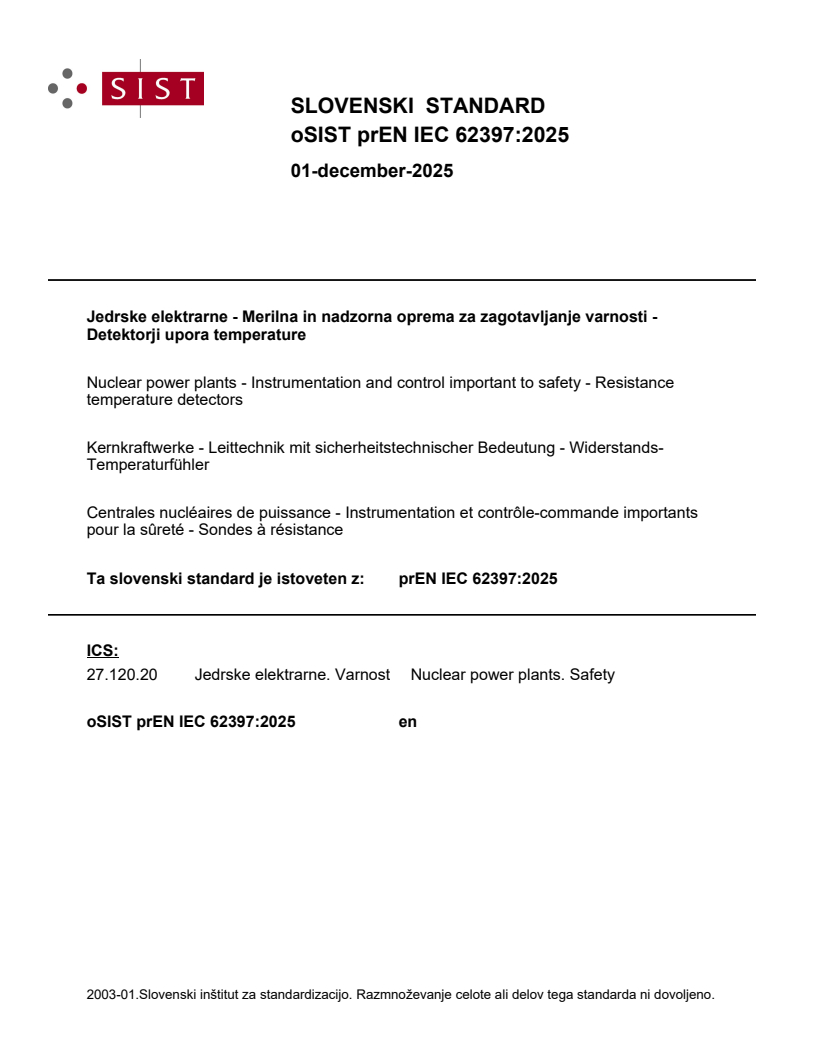
SLOVENSKI STANDARD
01-december-2025
Jedrske elektrarne - Merilna in nadzorna oprema za zagotavljanje varnosti -
Detektorji upora temperature
Nuclear power plants - Instrumentation and control important to safety - Resistance
temperature detectors
Kernkraftwerke - Leittechnik mit sicherheitstechnischer Bedeutung - Widerstands-
Temperaturfühler
Centrales nucléaires de puissance - Instrumentation et contrôle-commande importants
pour la sûreté - Sondes à résistance
Ta slovenski standard je istoveten z: prEN IEC 62397:2025
ICS:
27.120.20 Jedrske elektrarne. Varnost Nuclear power plants. Safety
2003-01.Slovenski inštitut za standardizacijo. Razmnoževanje celote ali delov tega standarda ni dovoljeno.
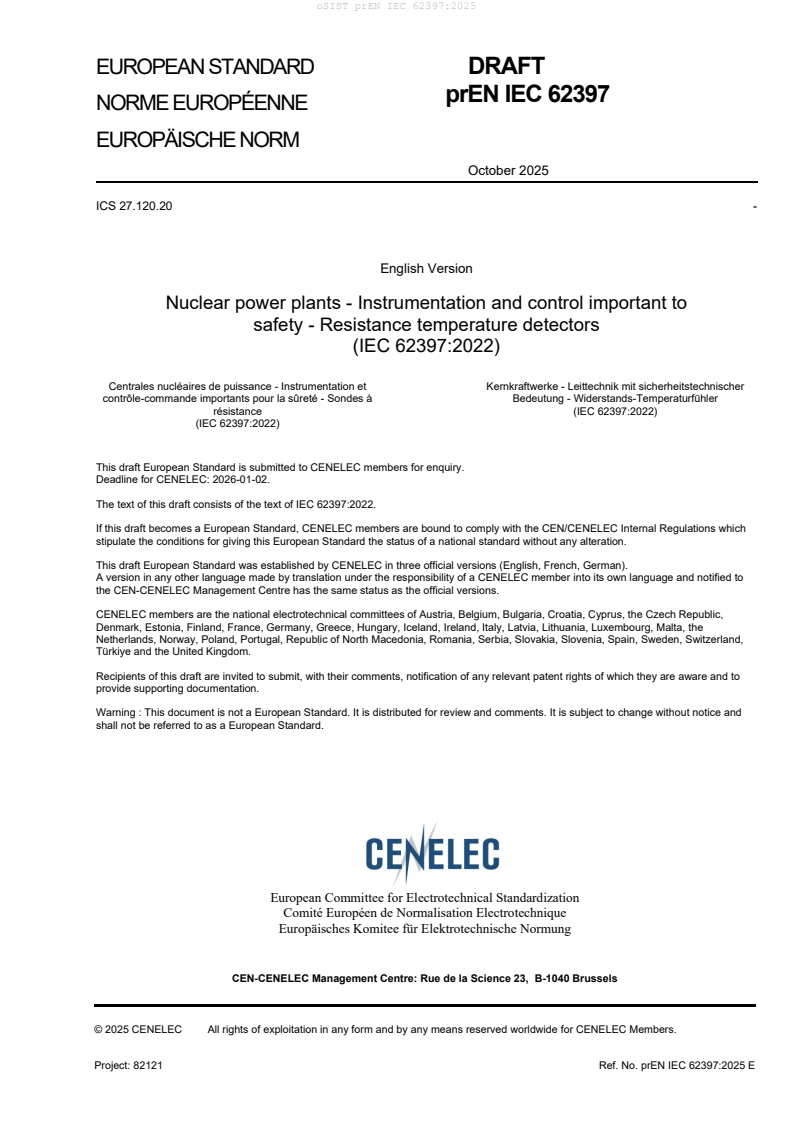
EUROPEAN STANDARD DRAFT
prEN IEC 62397
NORME EUROPÉENNE
EUROPÄISCHE NORM
October 2025
ICS 27.120.20 -
English Version
Nuclear power plants - Instrumentation and control important to
safety - Resistance temperature detectors
(IEC 62397:2022)
Centrales nucléaires de puissance - Instrumentation et Kernkraftwerke - Leittechnik mit sicherheitstechnischer
contrôle-commande importants pour la sûreté - Sondes à Bedeutung - Widerstands-Temperaturfühler
résistance (IEC 62397:2022)
(IEC 62397:2022)
This draft European Standard is submitted to CENELEC members for enquiry.
Deadline for CENELEC: 2026-01-02.
The text of this draft consists of the text of IEC 62397:2022.
If this draft becomes a European Standard, CENELEC members are bound to comply with the CEN/CENELEC Internal Regulations which
stipulate the conditions for giving this European Standard the status of a national standard without any alteration.
This draft European Standard was established by CENELEC in three official versions (English, French, German).
A version in any other language made by translation under the responsibility of a CENELEC member into its own language and notified to
the CEN-CENELEC Management Centre has the same status as the official versions.
CENELEC members are the national electrotechnical committees of Austria, Belgium, Bulgaria, Croatia, Cyprus, the Czech Republic,
Denmark, Estonia, Finland, France, Germany, Greece, Hungary, Iceland, Ireland, Italy, Latvia, Lithuania, Luxembourg, Malta, the
Netherlands, Norway, Poland, Portugal, Republic of North Macedonia, Romania, Serbia, Slovakia, Slovenia, Spain, Sweden, Switzerland,
Türkiye and the United Kingdom.
Recipients of this draft are invited to submit, with their comments, notification of any relevant patent rights of which they are aware and to
provide supporting documentation.
Warning : This document is not a European Standard. It is distributed for review and comments. It is subject to change without notice and
shall not be referred to as a European Standard.
European Committee for Electrotechnical Standardization
Comité Européen de Normalisation Electrotechnique
Europäisches Komitee für Elektrotechnische Normung
CEN-CENELEC Management Centre: Rue de la Science 23, B-1040 Brussels
© 2025 CENELEC All rights of exploitation in any form and by any means reserved worldwide for CENELEC Members.
Project: 82121 Ref. No. prEN IEC 62397:2025 E
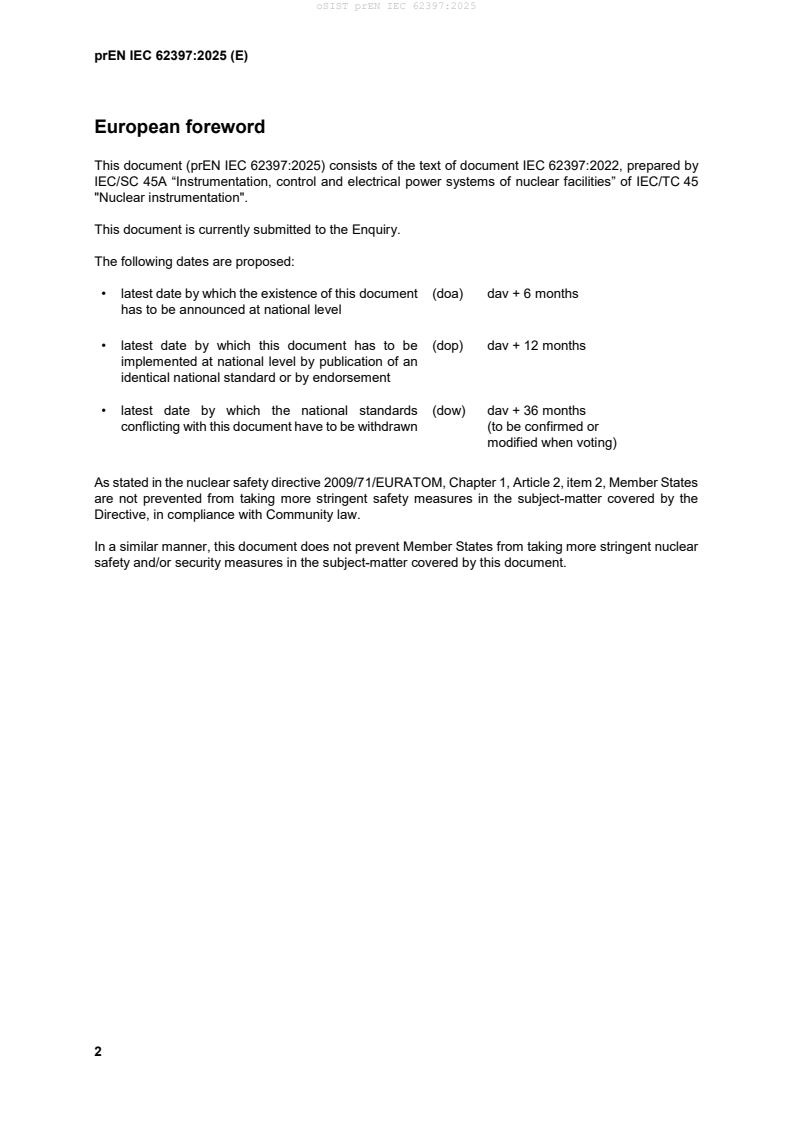
European foreword
This document (prEN IEC 62397:2025) consists of the text of document IEC 62397:2022, prepared by
IEC/SC 45A “Instrumentation, control and electrical power systems of nuclear facilities” of IEC/TC 45
"Nuclear instrumentation".
This document is currently submitted to the Enquiry.
The following dates are proposed:
• latest date by which the existence of this document (doa) dav + 6 months
has to be announced at national level
• latest date by which this document has to be (dop) dav + 12 months
implemented at national level by publication of an
identical national standard or by endorsement
• latest date by which the national standards (dow) dav + 36 months
conflicting with this document have to be withdrawn (to be confirmed or
modified when voting)
As stated in the nuclear safety directive 2009/71/EURATOM, Chapter 1, Article 2, item 2, Member States
are not prevented from taking more stringent safety measures in the subject-matter covered by the
Directive, in compliance with Community law.
In a similar manner, this document does not prevent Member States from taking more stringent nuclear
safety and/or security measures in the subject-matter covered by this document.
Annex ZA
(normative)
Normative references to international publications
with their corresponding European publications
The following documents are referred to in the text in such a way that some or all of their content
constitutes requirements of this document. For dated references, only the edition cited applies. For
undated references, the latest edition of the referenced document (including any amendments) applies.
NOTE 1 Where an International Publication has been modified by common modifications, indicated by (mod),
the relevant EN/HD applies.
NOTE 2 Up-to-date information on the latest versions of the European Standards listed in this annex is available
here: www.cencenelec.eu.
Publication Year Title EN/HD Year
IEC 60068-2-6 2007 Environmental testing - Part 2-6: Tests - EN 60068-2-6 2008
Test Fc: Vibration (sinusoidal)
IEC 60068-2-30 2005 Environmental testing - Part 2-30: Tests EN 60068-2-30 2005
- Test Db: Damp heat, cyclic (12 h + 12
h cycle)
IEC 60751 2022 Industrial platinum resistance EN IEC 60751 2022
thermometers and platinum temperature
sensors
IEC/IEEE 60780- 2016 Nuclear facilities - Electrical equipment EN 60780-323 2017
323 important to safety - Qualification
IEC/IEEE 60980- 2020 Nuclear facilities - Equipment important EN IEC/IEEE 60980-344 2021
344 to safety - Seismic qualification
IEC 62397 ®
Edition 2.0 2022-11
INTERNATIONAL
STANDARD
NORME
INTERNATIONALE
Nuclear power plants – Instrumentation and control important to safety –
Resistance temperature detectors
Centrales nucléaires de puissance – Instrumentation et contrôle-commande
importants pour la sûreté – Sondes à résistance
INTERNATIONAL
ELECTROTECHNICAL
COMMISSION
COMMISSION
ELECTROTECHNIQUE
INTERNATIONALE
ICS 27.120.20 ISBN 978-2-8322-6045-6
– 2 – IEC 62397:2022 © IEC 2022
CONTENTS
FOREWORD . 4
INTRODUCTION . 7
1 Scope . 9
2 Normative references . 9
3 Terms, definitions and abbreviated terms . 9
3.1 Terms and definitions . 10
3.2 Abbreviated terms . 11
4 Design and construction requirements . 12
4.1 General . 12
4.2 Reliability . 12
4.3 Materials . 12
4.3.1 General . 12
4.3.2 Radiation dose to materials . 12
4.3.3 Resistance element material . 12
4.3.4 Seals and adhesives . 13
4.4 Connections . 13
4.4.1 Structural type . 13
4.4.2 Electrical connection . 14
4.4.3 Mechanical connection . 16
4.5 Manufacturing quality . 17
4.6 Ambient conditions (normal and accident operations) and qualification . 17
4.7 RTD performance. 18
4.7.1 General . 18
4.7.2 Accuracy . 18
4.7.3 Resistance temperature calibration . 18
4.7.4 Self-heating error . 19
4.7.5 Thermal response time . 19
4.7.6 Interchangeability . 20
4.7.7 Electrical insulation resistance . 20
4.7.8 Repeatability (thermal shock) . 20
4.7.9 Vibration . 20
4.7.10 Steam test . 21
4.7.11 Thermal cycling . 21
4.7.12 Dielectric inspection . 21
4.7.13 Hydraulic strength . 21
4.7.14 In situ response time testing . 21
4.8 Identification . 22
4.9 Failure mode and effects analysis . 22
5 Inspection and tests . 22
5.1 General . 22
5.2 Inspection and test failure . 23
5.3 Inspection and test reports . 23
5.4 Test method . 23
5.4.1 Assembly and appearance inspection . 23
5.4.2 Calibration procedure . 23
5.4.3 Self-heating test . 24
IEC 62397:2022 © IEC 2022 – 3 –
5.4.4 Thermal response time . 24
5.4.5 Insulation resistance test . 24
5.4.6 Repeatability test (thermal shock) . 24
5.4.7 Vibration test . 24
5.4.8 Steam test . 25
5.4.9 Thermal cycling . 25
5.4.10 Dielectric inspection test . 25
5.4.11 Hydraulic test . 25
5.4.12 In situ response time test . 26
5.4.13 Cross-calibration testing . 26
5.5 Production test . 27
5.6 Qualification test . 28
6 Documentation . 29
Annex A (informative) In situ response time test methods . 31
A.1 Loop current step response test (LCSR) . 31
A.2 Calculation of the response time by temperature noise (passive method) . 34
A.3 Self-heating method (active method) . 36
A.4 Instructions for the application of test . 38
Bibliography . 39
Figure 1 – Form and dimensions of an RTD . 13
Figure 2 – Installation of a rigid RTD (Type I) . 14
Figure 3 – Installation of a rigid RTD (Type II) long insertion . 14
Figure 4 – Installation of a rigid RTD (Type II) short insertion . 14
Figure 5 – Type A of RTD connection . 16
Figure 6 – Type B of RTD connection . 16
Figure A.1 – LCSR and plunge transients . 33
Figure A.2 – Power spectrum density (PSD) plot of a sensor (smoothing of the power
spectrum) . 35
Figure A.3 – Power spectrum density (PSD) plot of a sensor (associated modal
response) . 36
– 4 – IEC 62397:2022 © IEC 2022
INTERNATIONAL ELECTROTECHNICAL COMMISSION
____________
NUCLEAR POWER PLANTS –
INSTRUMENTATION AND CONTROL IMPORTANT TO SAFETY –
RESISTANCE TEMPERATURE DETECTORS
FOREWORD
1) The International Electrotechnical Commission (IEC) is a worldwide organization for standardization comprising
all national electrotechnical committees (IEC National Committees). The object of IEC is to promote international
co-operation on all questions concerning standardization in the electrical and electronic fields. To this end and
in addition to other activities, IEC publishes International Standards, Technical Specifications, Technical Reports,
Publicly Available Specifications (PAS) and Guides (hereafter referred to as "IEC Publication(s)"). Their
preparation is entrusted to technical committees; any IEC National Committee interested in the subject dealt with
may participate in this preparatory work. International, governmental and non-governmental organizations liaising
with the IEC also participate in this preparation. IEC collaborates closely with the International Organization for
Standardization (ISO) in accordance with conditions determined by agreement between the two organizations.
2) The formal decisions or agreements of IEC on technical matters express, as nearly as possible, an international
consensus of opinion on the relevant subjects since each technical committee has representation from all
interested IEC National Committees.
3) IEC Publications have the form of recommendations for international use and are accepted by IEC National
Committees in that sense. While all reasonable efforts are made to ensure that the technical content of IEC
Publications is accurate, IEC cannot be held responsible for the way in which they are used or for any
misinterpretation by any end user.
4) In order to promote international uniformity, IEC National Committees undertake to apply IEC Publications
transparently to the maximum extent possible in their national and regional publications. Any divergence between
any IEC Publication and the corresponding national or regional publication shall be clearly indicated in the latter.
5) IEC itself does not provide any attestation of conformity. Independent certification bodies provide conformity
assessment services and, in some areas, access to IEC marks of conformity. IEC is not responsible for any
services carried out by independent certification bodies.
6) All users should ensure that they have the latest edition of this publication.
7) No liability shall attach to IEC or its directors, employees, servants or agents including individual experts and
members of its technical committees and IEC National Committees for any personal injury, property damage or
other damage of any nature whatsoever, whether direct or indirect, or for costs (including legal fees) and
expenses arising out of the publication, use of, or reliance upon, this IEC Publication or any other IEC
Publications.
8) Attention is drawn to the Normative references cited in this publication. Use of the referenced publications is
indispensable for the correct application of this publication.
9) Attention is drawn to the possibility that some of the elements of this IEC Publication may be the subject of patent
rights. IEC shall not be held responsible for identifying any or all such patent rights.
IEC 62397 has been prepared by subcommittee 45A: Instrumentation, control and electrical
power systems of nuclear facilities, of IEC technical committee 45: Nuclear instrumentation.
It is an International Standard.
This second edition cancels and replaces the first edition, published in 2007; it also cancels
and replaces the first edition of IEC 61224:1993. This edition constitutes a technical revision.
This edition includes the following significant technical changes with respect to the previous
edition:
1) The definitions, terms, references, test methods, test requirements and other contents in
IEC 61224 are incorporated into the corresponding clauses of IEC 62397, including the situ
response time test methods;
2) Move the second paragraph of Scope to 4.1 and add "certain design extension conditions"
in the text;
3) Add the definition of temperature units of ITS-90;
IEC 62397:2022 © IEC 2022 – 5 –
4) Add reference standards, including IEC 60737:2010, IEC 60751:2022, IEC 62765-2:2019,
IEC 62342:2007, IEC 62385:2007, IEC 61298-2, IEC 60068-2;
5) Update the reference IEC 60780 to IEC/IEEE 60780-323:2016; update the reference
IEC 60980 to IEC/IEEE 60980-344:2020;
6) Delete the outdated definition of "accuracy (measurement)" and modify the definition of
"calibration", "drift" and "response time";
7) Add the terms and definitions of "cross-calibration (cross-validation)", "self-heating index",
"tolerance of RTD", "sheath", "in situ measurement", and some abbreviated terms (e.g.,
NPP);
8) Delete the reference values of failure rate, radiation dose, contact resistance and leak rate,
environmental conditions and test conditions in 4.2, 4.3.2, 4.4.2.2, 4.6, 5.4.7;
9) Clarify 4.3.1;
10) Add "fast neutron damage" and "β irradiation" in 4.3.2 and correct the requirement for
material change to be "shall not";
11) Replace platinum description with general material requirement in 4.3.3;
12) Delete the statement on sealant elements and flat sealants;
13) Add labels of dust cover, spring and extension tube in Figure 3 and Figure 4 and correct a
typo in Figure 6;
14) Add electrical connector configuration requirement referring to IEC 60751 in 4.4.2.1;
15) Modify the temperature rating requirement of type I connector in 4.4.2.2 and add the
definition of manufacturer in the footnote;
16) Add the type of connection for RTD mounted in pipe and relax the statement on spring
force in 4.4.3.1;
17) Modify the type I and type II statement in 4.4;
18) Change the subtitle to "Manufacturing Quality" and add detailed requirements in 4.5;
19) Considering the application for difference types of nuclear power plants, in 4.6 and 4.7
introduce the concept that the user shall specify the requirements, test method and
acceptance criteria for tests depending on the application of the subject RTD;
20) Delete the last three paragraphs in 4.6;
4.7 and move the test requirements to a new
21) Add detailed performance requirements in
subclause 5.4 "Test method";
22) Replace "330 °C" in the standard with the (highest) operating temperature;
23) Add a new subclause "4.7.1 General" to describe the general requirements and restate in
situ response time measurement requirement;
24) Add the Callendar formula for temperature range of -200 °C to 0 °C and delete the
temperature tolerance values and refer to IEC 60751 in 4.7.3;
25) Supplement detailed requirements of "self-heating error" in 4.7.4;
26) Change the subtitle to "thermal response time" in 4.7.5 and delete the definition of thermal
response time;
27) Relax the performance requirements to "should" in 4.7.8, 4.7.9, 4.7.10, 4.7.11 and 4.7.13,
and relax the steam test requirement to only RTDs used in steam environment;
28) Merge "Insulation resistance test after storage" into "Electrical insulation resistance",
reduce the requirement and change insulation resistance under 200 °C to be 10 MΩ in
4.7.7;
29) Add "Dielectric inspection" and "Hydraulic strength" as 4.7.12 and 4.7.13;
30) Revise description on in situ response time testing in 4.7.14;
31) Add identifications in 4.8;
32) Delete the insulation breakdown test;
33) Refer to IEC 60751 for self-heating test in 5.4.3;
– 6 – IEC 62397:2022 © IEC 2022
34) Delete the vibration spectrum for vibration test, and refer to IEC 60068-2-6 in 5.4.7;
35) Revise thermal cycling test requirement to be more general and refer to IEC 60068-2-30 in
5.4.9;
36) Add 5.4.13 "Cross-calibration testing";
37) Add dielectric inspection test and hydraulic test as product tests in 5.5 and note that the
user can specify the test requirement;
38) Add dielectric inspection test and hydraulic test as qualification tests in 5.6, note that the
user can specify the test requirement, and refer to IEC/IEEE 60780-323 and
IEC/IEEE 60980-344 or pertinent national guides and regulations;
39) Change title from "Technical information required" to "Documentation" of Clause 6 and add
"the regular maintenance strategy" in performance specification;
40) Add an informative annex "Annex A In situ response time test methods" to include the
related information from IEC 61224, update figures and cross-references, and cite it in
4.7.13 and 5.4.12;
41) Add the IAEA documents in bibliography.
The text of this International Standard is based on the following documents:
Draft Report on voting
45A/1447/FDIS 45A/1454/RVD
Full information on the voting for its approval can be found in the report on voting indicated in
the above table.
The language used for the development of this International Standard is English.
This document was drafted in accordance with ISO/IEC Directives, Part 2, and developed in
accordance with ISO/IEC Directives, Part 1 and ISO/IEC Directives, IEC Supplement, available
at www.iec.ch/members_experts/refdocs. The main document types developed by IEC are
described in greater detail at www.iec.ch/publications.
The committee has decided that the contents of this document will remain unchanged until the
stability date indicated on the IEC website under webstore.iec.ch in the data related to the
specific document. At this date, the document will be
• reconfirmed,
• withdrawn,
• replaced by a revised edition, or
• amended.
IEC 62397:2022 © IEC 2022 – 7 –
INTRODUCTION
a) Technical background, main issues and organisation of the standard
This standard describes the requirements for the design, material selection, procurement,
construction, and testing of resistance temperature detectors (RTDs) used in nuclear power
plants (NPPs). These RTDs may be used in both the nuclear safety I&C systems and/or in the
non-safety-related instrumentation systems.
This standard is a revision merger of IEC 62397 and IEC 61224 and was initiated in November
2019.
b) Situation of the current standard in the structure of the SC 45A standard series
IEC 62397 is not directly referenced by IEC 61513 and is a third-level SC 45A document
tackling the issue of RTDs.
For more details on the structure of the SC 45A series of standards, see item d) of this
introduction.
c) Recommendations and limitations regarding the application of this standard
There is no particular recommendation or limitation regarding the application of this standard.
d) Description of the structure of the IEC SC45A standard series and relationships with
other IEC documents and other bodies documents (IAEA, ISO)
The IEC SC 45A standard series comprises a hierarchy of four levels. The top-level documents
of the IEC SC 45A standard series are IEC 61513 and IEC 63046.
IEC 61513 provides general requirements for instrumentation and control (I&C) systems and
equipment that are used to perform functions important to safety in nuclear power plants
(NPPs). IEC 63046 provides general requirements for electrical power systems of NPPs; it
covers power supply systems including the supply systems of the I&C systems.
IEC 61513 and IEC 63046 are to be considered in conjunction and at the same level. IEC 61513
and IEC 63046 structure the IEC SC 45A standard series and shape a complete framework
establishing general requirements for instrumentation, control and electrical power systems for
nuclear power plants.
IEC 61513 and IEC 63046 refer directly to other IEC SC 45A standards for general
requirements for specific topics, such as categorization of functions and classification of
systems, qualification, separation, defence against common cause failure, control room design,
electromagnetic compatibility, human factors engineering, cybersecurity, software and
hardware aspects for programmable digital systems, coordination of safety and security
requirements and management of ageing. The standards referenced directly at this second level
should be considered together with IEC 61513 and IEC 63046 as a consistent document set.
At a third level, IEC SC 45A standards not directly referenced by IEC 61513 or by IEC 63046
are standards related to specific requirements for specific equipment, technical methods, or
activities. Usually these documents, which make reference to second-level documents for
general requirements, can be used on their own.
A fourth level extending the IEC SC 45 standard series, corresponds to the Technical Reports
which are not normative.
– 8 – IEC 62397:2022 © IEC 2022
The IEC SC 45A standards series consistently implements and details the safety and security
principles and basic aspects provided in the relevant IAEA safety standards and in the relevant
documents of the IAEA nuclear security series (NSS). In particular this includes the IAEA
requirements SSR-2/1 , establishing safety requirements related to the design of nuclear power
plants (NPPs), the IAEA safety guide SSG-30 dealing with the safety classification of structures,
systems and components in NPPs, the IAEA safety guide SSG-39 dealing with the design of
instrumentation and control systems for NPPs, the IAEA safety guide SSG-34 dealing with the
design of electrical power systems for NPPs, the IAEA safety guide SSG-51 dealing with human
factors engineering in the design of NPPs and the implementing guide NSS17 for computer
security at nuclear facilities. The safety and security terminology and definitions used by the
SC 45A standards are consistent with those used by the IAEA.
IEC 61513 and IEC 63046 have adopted a presentation format similar to the basic safety
publication IEC 61508 with an overall life-cycle framework and a system life-cycle framework.
Regarding nuclear safety, IEC 61513 and IEC 63046 provide the interpretation of the general
requirements of IEC 61508-1, IEC 61508-2 and IEC 61508-4, for the nuclear application sector.
In this framework, IEC 60880, IEC 62138 and IEC 62566 correspond to IEC 61508-3 for the
nuclear application sector.
IEC 61513 and IEC 63046 refer to ISO 9001 as well as to IAEA GSR part 2 and IAEA GS-G-3.1
and IAEA GS-G-3.5 for topics related to quality assurance (QA).
At level 2, regarding nuclear security, IEC 62645 is the entry document for the IEC/SC 45A
security standards. It builds upon the valid high level principles and main concepts of the
generic security standards, in particular ISO/IEC 27001 and ISO/IEC 27002; it adapts them and
completes them to fit the nuclear context and coordinates with the IEC 62443 series. At level
2, IEC 60964 is the entry document for the IEC/SC 45A control rooms standards, IEC 63351 is
the entry document for the human factors engineering standards and IEC 62342 is the entry
document for the ageing management standards.
NOTE 1 It is assumed that for the design of I&C systems in NPPs that implement conventional safety functions (e.g.
to address worker safety, asset protection, chemical hazards, process energy hazards) international or national
standards would be applied.
NOTE 2 IEC TR 64000 provides a more comprehensive description of the overall structure of the IEC SC 45A
standards series and of its relationship with other standards bodies and standards.
IEC 62397:2022 © IEC 2022 – 9 –
NUCLEAR POWER PLANTS –
INSTRUMENTATION AND CONTROL IMPORTANT TO SAFETY –
RESISTANCE TEMPERATURE DETECTORS
1 Scope
This document describes the requirements for resistance temperature detectors (RTDs)
suitable for applications in I&C systems important to safety of nuclear power plants. The
requirements of RTDs include design, materials, manufacturing, testing, calibration,
procurement, and inspection. RTDs used for safety applications in Nuclear Power Plants can
be categorized into direct-immersed and thermowell-mounted RTDs. Furthermore, there are
RTDs with specific design which cannot be assigned to the categories mentioned above.
However, they are also covered by the requirements stated in this document.
This document does not cover the design, material selection, and construction of the
thermowell, the guide tube, the extension cable, and the temperature transmitter or resistance
bridge which may be associated with the RTD.
2 Normative references
The following documents are referred to in the text in such a way that some or all of their content
constitutes requirements of this document. For dated references, only the edition cited applies.
For undated references, the latest edition of the referenced document (including any
amendments) applies.
IEC 60068-2-6:2007, Environmental testing – Part 2-6: Tests – Test Fc: Vibration (sinusoidal)
IEC 60068-2-30:2005, Environmental testing – Part 2-30: Tests – Test Db: Damp heat, cyclic
(12 h + 12 h cycle)
IEC 60751:2022, Industrial platinum resistance thermometers and platinum temperature
sensors
IEC/IEEE 60780-323:2016, Nuclear facilities – Electrical equipment important to safety –
Qualification
IEC/IEEE 60980-344:2020, Nuclear facilities – Equipment important to safety – Seismic
qualification
3 Terms, definitions and abbreviated terms
For the purposes of this document, the following terms and definitions apply.
ISO and IEC maintain terminology databases for use in standardization at the following
addresses:
• IEC Electropedia: available at https://www.electropedia.org/
• ISO Online browsing platform: available at https://www.iso.org/obp
– 10 – IEC 62397:2022 © IEC 2022
3.1 Terms and definitions
3.1.1
calibration
set of operations that establishes, by referring to standards, the relationship which exists under
specified conditions between an indication and a result of a measurement
Note 1 to entry: This term is based on the "uncertainty" approach.
Note 2 to entry: The relationship between the indications and measurement results can be expressed, in principle,
using a calibration diagram.
3.1.2
cross-calibration
cross-validation
procedure of intercomparing the indications of redundant instruments (e.g., temperature
sensors) to identify outlier sensors as a means of verifying calibration or identifying calibration
changes. A more appropriate term for this definition is "cross-validation," but, cross-calibration
is more commonly used
Note 1 to entry: A calibration test of temperature sensors in some NPPs can be different from this definition mainly
because an adjustment of the temperature channel during cross calibration may be allowed within a predetermined
allowable value.
[SOURCE: IEC 62385:2007, 3.6]
3.1.3
drift
change in the indication of a measuring instrument, generally slow, continuous, not necessarily
in the same direction and not related to a change in the measurand
[SOURCE: IEC 60050-311:2001, 311-06-13]
3.1.4
in situ measurement
measurement of RTD performance (calibration or response time) while the RTD remains
installed in normal configuration for service
3.1.5
protective tube
tubular material used to protect one or more sensing resistors and inner leads assembly from
environmental impact
3.1.6
resistance temperature detector
RTD
detector generally made up of a stainless steel cylindrical barrel protecting a platinum resistor
whose resistance varies with temperature. This detector is placed in the piping containing the
fluid whose temperature is measured in this way. It can be directly immersed in the fluid or
protected by an intermediate casing called the thermowell
Note 1 to entry: Mounting means or connection heads may be included. The temperature-sensing resistor can be
made of platinum, nickel tungsten, copper, or other metals. However, a platinum sensor is commonly used in the
RTD in an NPP; therefore, a platinum resistance thermometer is referred to in this document.
Note 2 to entry: In this document, the term "sensor" describes the RTD unit with all its associated protection, for
example, barrel or thermowell. For most applications of measuring process fluid temperature in an NPP, the platinum
resistor sensor is installed inside a stainless steel thermowell, and the thermowell is mounted on a pipe or container
by means of external threads or welding. For air temperature measurement, a direct sensor may be used.
IEC 62397:2022 © IEC 2022 – 11 –
3.1.7
response time
period of time necessary for a component to achieve a specified output state from the time that
it receives a signal requiring it to assume that output state
Note 1 to entry: Thermal response time used in this document is the time required for the temperature detector to
reach 63,2 % of the total change in resistance for a step change in temperature.
[SOURCE: IAEA Safety Glossary, 2018]
3.1.8
self-heating error
rise in the indicated temperature due to the power dissipated in the sensor by the measurement
3.1.9
self-heating index
self-heating coefficient
SHI
coefficient with the dimension °C/mW is characteristic for a resistor/thermometer and describes
the temperature increase of the resistor per unit power dissipated. This coefficient is evaluated
under specified operating conditions of the resistor or thermometer. The medium, its flow
conditions and temperature should be specified
[SOURCE: IEC 60751:2008, 3.9]
3.1.10
thermowell
protective jacket for RTDs, thermocouples, and other temperature sensors. The thermowell is
also used to facilitate replacement of the temperature sensor
[SOURCE: IEC 62385:2007, 3.19]
3.1.11
tolerance of RTD
initial maximum allowable deviation expressed as temperature in °C from nominal
temperature/resistance relationship in RTD
[SOURCE: IEC 62765-2:2019, 3.19]
3.2 Abbreviated terms
HELB High-energy Line Break
ITS-90 The International Temperature Scale of 1990
(Temperature units in this document are in terms of International Temperature
Scale-1990)
LCSR Loop Current Step Response
LOCA Loss of Coolant Accident
M&TE Measurement and Test Equipment
NPP Nuclear Power Plant
PRT Platinum Resistance Thermometer
RTD Resistance Temperature Detector
SHI Self-heating index of RTD
QA Quality Assurance
– 12 – IEC 62397:2022 © IEC 2022
4 Design and construction requirements
4.1 General
RTDs can be supplied with different internal constructions, which depend on the manufacture,
qualifications, and applications. For RTD being used in an NPP, the design and structure of the
RTD should consider the environmental conditions in which the detector is being used under
normal operating and under design basis accident conditions and certain design extension
conditions, as well as the qualification tests specified by the user .
The RTD shall meet or exceed the requirements specified in this document.
4.2 Reliability
The design philosophy for RTDs that are used in NPPs requires a device which is capable of
continuous successful operation at rated service conditions throughout its specified design life.
The required reliability of the RTD shall be derived from the overall reliability specified for the
temperature measurement function.
RTDs that operate as part of a safety system should have their design lives defined. The
features of the RTD that are necessary to fulfill safety functions shall be ensured for the
complete service life of the equipment, except for parts which have a short design life and can
be replaced periodically. The preservation of these features should be ensured by appropriate
maintenance and testing strategies. Arrangements shall be made for the RTD to be replaced or
re-assessed before its design life is reached.
4.3 Materials
4.3.1 General
With the exception of parts which have a lower design life, all materials within the construction
of the RTD shall retain their required features, attributes and design parameters for the required
service life of the RTD.
4.3.2 Radiation dose to materials
The total integrated radiation dose shall be derived from postulated environmental conditions
during normal operation and postulated accidents.
If neutron radiation is expected at the installation position of the RTD, the neutron fluence shall
be taken into consideration when selecting the design and materials of the RTD. Material
changes due to activation or fast neutron damage shall not affect adversely the safety function
of the equipment. Some devices may be exposed to beta radiation in a severe accident. Beta
and gamma radiation cause different types of damage.
4.3.3 Resistance element material
In addition to meeting the required temperature characteristics (including accuracy,
repeatability, response time and reliability) the resistance element material shall be selected to
meet the following material property requirements:
– high resistance to corrosion and chemical attack;
– high resistance to radiation damage;
___________
1 The user corresponds to the party or the company that uses the RTD in an NPP for measuring the temperature
in a safety or a non-safety system. The term user may also refer to the purchaser or the buyer, or the operator
of the RTD.
IEC 62397:2022 © IEC 2022 – 13 –
– suitable strength and mechanical stability throughout the required temperature range and
design life.
Because of its outstanding properties, the resistance element may consist of platinum. Other
materials may be used if these requirements are met.
The sensing wire shall be mounted so as to be almost free of strains to avoid the strain gauge
effect from causing extraneous changes in resistance. Furthermore, the thermometer shall be
manufactured with the resistance element free of contaminants.
4.3.4 Seals and adhesives
The RTD shall be hermetically sealed. RTDs used in a harsh environment, such as under high-
temperature and/or radiation areas, may be designed without organic material. The tightness
of the insulating termination shall be tested according to an adequate and proven procedure.
All cements, adhesives, or seals used internally in the device shall be capable of withstanding
the service conditions without functional deterioration and without emitting gases. All non-
metallic materials, when used for seals, protective finishes, and so forth, shall be moisture- and
flame-resistant. These non-metallic materials shall not support fungus growth and shall not be
adversely affected by the ambient environments specified in the performance requirements of
this standard.
4.4 Connections
4.4.1 Structural type
RTDs shall have lead wires terminated through a qualified hermetic seal.
There are two common types of electrical connections used in an NPP. Figure 1 provides the
general form and dimensions of an RTD without any thermowell. Figure 2 is a rigid RTD with a
quick disconnector and is referred to as Type I (quick disconnect). Figure 3 and Figure 4 are
rigid RTDs without quick disconnectors, and are referred to as Type II (standard) with long
insertion and short insertion, respectively. A user may specify any other form of RTD and
construction, depending on its particular applications.
For resistance thermometer with connector, the spring gap, as part of the dust cover, should
completely cover the end of the extension tube.
Dimensions in millimetres
Figure 1 – Form and dimensions of an RTD
----
...
Questions, Comments and Discussion
Ask us and Technical Secretary will try to provide an answer. You can facilitate discussion about the standard in here.
Loading comments...