

prEN 17072
(Main)Child care articles - Bath tubs, stands and bathing aid accessories - Safety requirements and test methods
- Abstract
This document specifies safety requirements and test methods for children’s bath tubs and stands and for bathing aid accessories that are designed and intended to be used only in conjunction with a children’s bath tub.
This document does not cover children’s bath tubs and stands and bathing aid accessories designed for children with special needs.
NOTE 1 Bathing aids are covered in EN 17022.
NOTE 2 Where the product has several functions or can be converted into another function it is due to comply with relevant standard(s).
- Status
- Not Published
- Publication Date
- 27-Feb-2028
- Technical Committee
- CEN/TC 252 - Child care articles
- Drafting Committee
- CEN/TC 252/WG 1 - Seating and body care
- Current Stage
- 4060 - Closure of enquiry - Enquiry
- Start Date
- 22-Oct-2026
- Due Date
- 08-Feb-2027
- Completion Date
- 08-Feb-2027
- Directive
- 2001/95/EC - General product safety

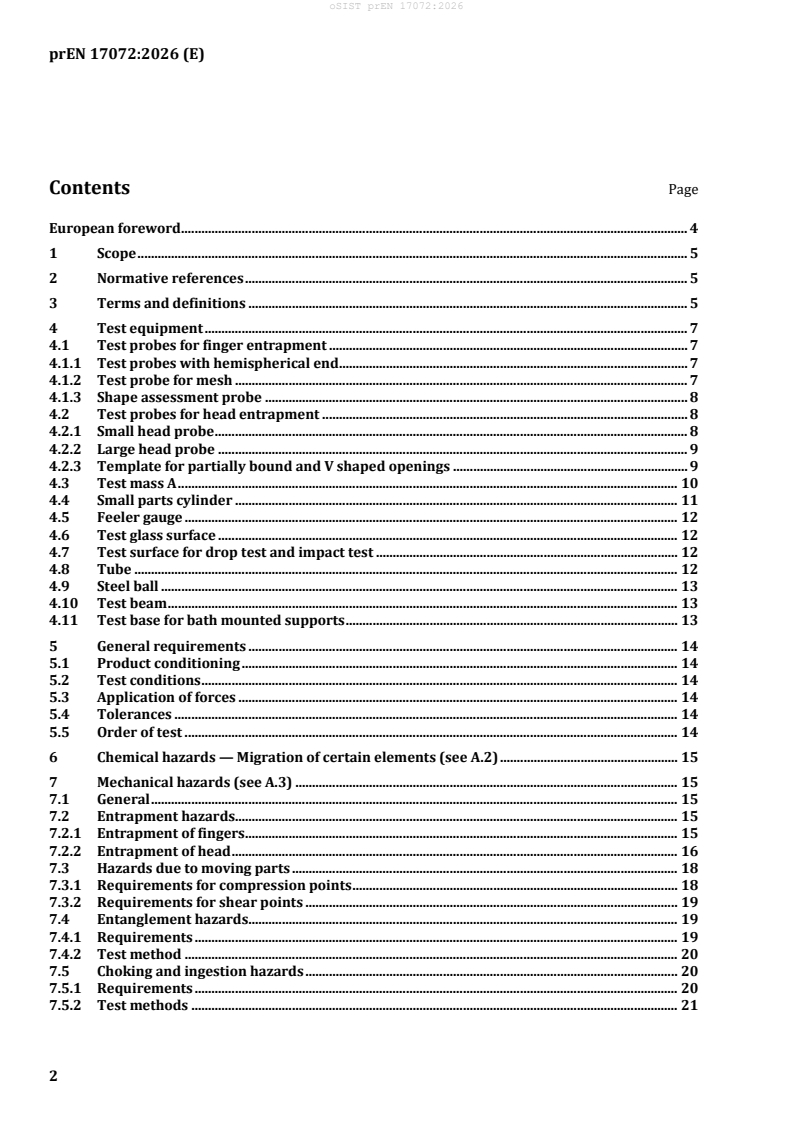
prEN 17072 is a draft European Standard from the European Committee for Standardization (CEN). It specifies safety requirements and test methods for children’s bath tubs, stands, and bathing aid accessories that are used only with a children’s bath tub, so manufacturers, test laboratories, quality teams, and buyers can check whether a product design and its information meet the same safety framework.
What does prEN 17072 specify?
prEN 17072 specifies the safety requirements and test methods for children’s bath tubs and stands, plus bathing aid accessories that are intended only for use with a children’s bath tub. It also sets out how those products are conditioned, tested, marked, and supplied with instructions so the evaluation is repeatable and the user information is consistent.
The scope excludes products designed for children with special needs. The document also notes that bathing aids are covered in EN 17022, and that products with several functions or convertible functions must comply with the relevant standard(s).
The document is organized into these main parts:
- Clause 1 - Scope
- Clause 2 - Normative references
- Clause 3 - Terms and definitions
- Clause 4 - Test equipment
- Clause 5 - General requirements
- Clause 6 - Chemical hazards
- Clause 7 - Mechanical hazards
- Clause 8 - Product information
- Annex A - Rationales
- Annex ZA - Relationship with EU legislation
- Bibliography
What are the key requirements of prEN 17072?
prEN 17072 focuses on hazard prevention, structural strength, stability, and clear product information. In practice, the document asks you to design the product so that a child cannot get trapped, strangled, choked, suffocated, injured by moving parts, or misled by unclear warnings.
Chemical and material safety
Clause 6 requires migration of certain elements from materials on exterior surfaces to comply with EN 17826:2025. Textile parts intended to be in prolonged skin contact must also meet the aniline and formaldehyde requirements referenced there.
For manufacturers, this means the choice of materials is part of conformity, not just appearance or durability. For testing, it means material samples may need separate chemical assessment.
Entrapment, strangulation, choking, and ingestion
Clause 7.2 sets finger- and head-entrapment limits using specific test probes. Openings in rigid materials and mesh are checked in the inner and upper surfaces of the tub and accessories, and also on the exterior side up to 100 mm from the rim.
Clause 7.4 limits the free length of cords, ribbons, similar parts, and loops to reduce strangulation risk. Clause 7.5 then deals with choking and ingestion by using the small parts cylinder and grip assessment methods. Together, these clauses mean small detachable items, long cords, and hazardous openings need to be controlled early in design.
Moving parts, folding parts, and attachment devices
Clause 7.3 controls compression and shear points created by movement of the product, the child’s weight, or external force. Folding systems are handled in Clause 7.9 instead, so designers need to treat foldable products as a separate risk area.
Clause 7.9 requires bathing aid accessories to resist inadvertent detachment and sets conditions for foldable bath tubs and stands, including locking mechanisms and repeated operation of folding systems. In practical terms, if the product folds, adjusts, or attaches, those functions must stay safe after repeated use and after strength testing.
Structural integrity and stability
Clause 7.8 covers thermal shock, static strength, suction cups, impact, and retention of suction cups. The bath tub, bathing aid accessory, and stand each have different strength tests, reflecting how they are used in practice.
Clause 7.12 covers stability. Bath tubs are tested on an incline with added water, while stands are tested with the bath tub installed and loaded. This matters because the standard checks tip-over risk under conditions that simulate a child leaning or the unit being used on a stand.
Product information and warnings
Clause 8 requires product information in the official language(s) of the country of sale and warns against implying that the child can be left unattended. Marking must include the drowning warning, product identification, responsible business name and addresses, and the pictorial warning figure.
Clause 8.3 covers purchase information, and Clause 8.4 covers instructions for use, including assembly, safe use, supervision, water level, stability checks, maintenance, and compatibility limits. For users, this is the part that translates the safety design into correct everyday use.
What terms does prEN 17072 define?
- children's bath tub - A product that contains water by itself and is designed for bathing children, either as a stand-alone product or combined with stands.
- stand - A static structure, not integrated into the bath tub, that supports and elevates a children’s bath tub.
- bathing aid accessory - A product that does not contain water by itself and needs a child’s bath tub to stand.
- bath cradle accessory - A bathing aid accessory designed to keep a child in a reclined position during bathing, intended from birth until the child can sit upright unaided.
- bath seat accessory - A bathing aid accessory designed to keep a child seated during bathing, intended for use only once the child can sit upright unaided and until the child begins to pull up to standing.
- integrated bath cradle - A non-removable part of a children’s bath tub designed to keep a child in a reclined position during bathing.
Who uses prEN 17072?
prEN 17072 is used by manufacturers and product designers of children’s bath tubs, stands, bath cradle accessories, and bath seat accessories. It is also used by test laboratories, conformity assessment teams, quality managers, importers, and buyers who need to check whether a product is safe, compatible, and correctly documented.
In practice, the standard helps teams decide what to test, what to mark on the product, what to include in instructions, and which product combinations must be assessed together.
What changed in prEN 17072 from the previous edition?
prEN 17072:2026 will supersede EN 17072:2018.
Which standards are used with prEN 17072?
- EN 17826:2025 - Provides the chemical hazard requirements used in Clause 6 for migration of certain elements, plus the textile requirements for aniline and formaldehyde.
- EN ISO 291:2008 - Specifies the standard atmosphere used to condition products before testing.
- ISO 48-4:2018 - Provides the Shore A hardness reference used for the rubber mat in the drop and impact test.
- EN 17022 - Identified in the scope note as the standard covering bathing aids.
What does the prEN 17072 document contain?
prEN 17072 contains detailed test equipment requirements, including probes for finger and head entrapment, a test mass, a small parts cylinder, a feeler gauge, a glass surface, a drop-test surface, a tube, a steel ball, a test beam, and a test base for bath mounted supports. These items make the test methods repeatable across laboratories.
The document also includes specific procedures for conditioning, test temperature, force application, tolerances, and test order. That matters because the same product can behave differently if it is not assembled, aged, or loaded in the same way each time.
Clause 7 then gives the core mechanical tests for entrapment, moving parts, cords and loops, choking and ingestion, packaging suffocation, edges and protrusions, strength, folding, decals, wheels, and stability. Clause 8 covers the marking, purchase information, and instructions that users must receive.
Annex A explains the safety rationale behind the requirements, and Annex ZA links the standard to the relevant EU safety requirements. Figures throughout the document show the probes, openings, warning symbol, and test arrangements used in the methods.
Relations
- Effective Date
- 28-Aug-2024
Frequently Asked Questions
prEN 17072 is a draft published by the European Committee for Standardization (CEN). Its full title is "Child care articles - Bath tubs, stands and bathing aid accessories - Safety requirements and test methods". This standard covers: This document specifies safety requirements and test methods for children’s bath tubs and stands and for bathing aid accessories that are designed and intended to be used only in conjunction with a children’s bath tub. This document does not cover children’s bath tubs and stands and bathing aid accessories designed for children with special needs. NOTE 1 Bathing aids are covered in EN 17022. NOTE 2 Where the product has several functions or can be converted into another function it is due to comply with relevant standard(s).
This document specifies safety requirements and test methods for children’s bath tubs and stands and for bathing aid accessories that are designed and intended to be used only in conjunction with a children’s bath tub. This document does not cover children’s bath tubs and stands and bathing aid accessories designed for children with special needs. NOTE 1 Bathing aids are covered in EN 17022. NOTE 2 Where the product has several functions or can be converted into another function it is due to comply with relevant standard(s).
prEN 17072 is classified under the following ICS (International Classification for Standards) categories: 97.190 - Equipment for children. The ICS classification helps identify the subject area and facilitates finding related standards.
prEN 17072 has the following relationships with other standards: It is inter standard links to EN 17072:2018. Understanding these relationships helps ensure you are using the most current and applicable version of the standard.
prEN 17072 is associated with the following European legislation: EU Directives/Regulations: 2001/95/EC, 2023/988/EU; Standardization Mandates: M/464. When a standard is cited in the Official Journal of the European Union, products manufactured in conformity with it benefit from a presumption of conformity with the essential requirements of the corresponding EU directive or regulation.
prEN 17072 is available in PDF format for immediate download after purchase. The document can be added to your cart and obtained through the secure checkout process. Digital delivery ensures instant access to the complete standard document.
Standards Content (Sample)
Contents
- 1 Scope
- 2 Normative references
- 3 Terms and definitions
- 3.1 children's bath tub
- 3.2 stand
- 3.3 bathing aid accessory
- 3.3.1 bath cradle accessory
- 3.3.2 bath seat accessory
- 3.4 integrated bath cradle
- 4 Test equipment
- 4.1 Test probes for finger entrapment
- 1 Line scribed around circumference showing depth of penetration
- 4.2 Test probes for head entrapment
- 4.3 Test mass A
- 4.4 Small parts cylinder
- 4.5 Feeler gauge
- 4.6 Test glass surface
- 4.7 Test surface for drop test and impact test
- 4.8 Tube
- 4.9 Steel ball
- 4.10 Test beam
- 4.11 Test base for bath mounted supports
- 5 General requirements
- 5.1 Product conditioning
- 5.2 Test conditions
- 5.3 Application of forces
- 5.4 Tolerances
- 5.5 Order of test
- 6 Chemical hazards — Migration of certain elements (see A.2)
- 7 Mechanical hazards (see A.3)
- 7.1 General
- 7.2 Entrapment hazards
- 1 PASS
- 2 PASS
- 1 PASS
- 1 PASS
- 2 FAIL
- 7.3 Hazards due to moving parts
- 7.4 Entanglement hazards
- 7.5 Choking and ingestion hazards
- 7.6 Suffocation hazards — Plastic packaging
- 7.7 Hazardous edges, corners and protruding parts
- 7.8 Hazards from inadequate structural integrity
- 7.9 Hazards due to folding or adjusting of the product
- 7.10 Hazards due to plastic decals
- 7.11 Castors/wheels
- 7.12 Hazards due to inadequate stability
- 8 Product information
- 8.1 General
- 8.2 Marking of the product
- 8.3 Purchase information
- 8.4 Instructions for use
- Annex A
- Annex ZA
- 2. Specific Safety Requirements ---
- Bibliography
1 Scope
This document specifies safety requirements and test methods for children’s bath tubs and stands and for bathing aid accessories that are designed and intended to be used only in conjunction with a children’s bath tub.
This document does not cover children’s bath tubs and stands and bathing aid accessories designed for children with special needs.
NOTE 1 Bathing aids are covered in EN 17022.
NOTE 2 Where the product has several functions or can be converted into another function it is due to comply with relevant standard(s).
2 Normative references
The following documents are referred to in the text in such a way that some or all of their content constitutes requirements of this document. For dated references, only the edition cited applies. For undated references, the latest edition of the referenced document (including any amendments) applies. EN 17826:2025, Child care articles — Chemical hazards — Requirements EN ISO 291:2008, Plastics — Standard atmospheres for conditioning and testing (ISO 291:2008) ISO 48-4:2018, Rubber, vulcanized or thermoplastic — Determination of hardness — Part 4: Indentation hardness by durometer method (Shore hardness)
3 Terms and definitions
For the purposes of this document, the following terms and definitions apply. ISO and IEC maintain terminology databases for use in standardization at the following addresses:
- ISO Online browsing platform: available at https://www.iso.org/obp
- IEC Electropedia: available at https://www.electropedia.org/
3.1 children's bath tub
product providing containment of water by itself, designed for bathing children, which can be used as stand-alone product or combined with stands Note 1 to entry: A bath tub can also be foldable or can comprise integral parts that can be folded or adjusted (e.g. foldable legs).
Note 2 to entry: When the wording “bath tub” is used in the standard, it refers to children’s bath tubs unless otherwise stated.
3.2 stand
static structure, not integrated into the children’s bath tub, designed to accommodate, support and elevate a children’s bath tub Note 1 to entry: A stand can either be standalone or be designed to be fitted over an adult bath tub.
oSIST prEN 17072:2026 prEN 17072:2026 (E)
3.3 bathing aid accessory
product, that does not provide containment of water by itself and requires a child’s bath tub to stand Example: Figure 1 shows an example of a bathing aid accessory
Key A bathing aid accessory B child’s bath tub Figure 1 — Example of bathing aid accessory
3.3.1 bath cradle accessory
bathing aid accessory designed to keep a child in a reclined position during bathing Note 1 to entry: These products are intended for use from birth and until the child is able to sit upright unassisted.
3.3.2 bath seat accessory
bathing aid accessory designed to keep a child in a seated position during bathing Note 1 to entry: These products are intended for use with a child who is able to sit upright unassisted and until the child begins pulling up to a standing position.
3.4 integrated bath cradle
non-removable part of a children’s bath tub designed to keep a child in a reclined position during bathing. See Figure 2 Note 1 to entry: These products are intended for use from birth and until the child is able to sit upright unassisted.
oSIST prEN 17072:2026 prEN 17072:2026 (E)
Figure 2 — Example of integrated bath cradle
4 Test equipment
4.1 Test probes for finger entrapment
4.1.1 Test probes with hemispherical end
+01,
Probes made from plastic or other hard, smooth material of diameters 7 mm and 12 mm
−01, 0 with a full hemispherical end that can be mounted on a force-measuring device, see Figure 3. Dimensions in millimetres
Key Probe type 7 mm probe 12 mm probe Diameter A 0 +01,
−01, Radius RB half of diameter A half of diameter A
1 Line scribed around circumference showing depth of penetration
Figure 3 — Test probes with hemispherical end
4.1.2 Test probe for mesh
Mesh probe made from plastic or other hard, smooth material as shown in Figure 4.
oSIST prEN 17072:2026 prEN 17072:2026 (E) Dimensions in millimetres
Key Probe type mesh probe Diameter A 0
−01, Diameter B 0 5,6 −01, Radius RB half of diameter B Figure 4 — Test probe for mesh
4.1.3 Shape assessment probe
Probe made from plastics or other hard, smooth material with the dimensions shown in Figure 5. Dimensions in millimetres
Key A front view B top view C side view D 3D view Figure 5 — Shape assessment probe
4.2 Test probes for head entrapment
4.2.1 Small head probe
Probe made of hard and smooth material with dimensions as shown in Figure 6.
oSIST prEN 17072:2026 prEN 17072:2026 (E) Dimensions in millimetres
Key 1 handle Figure 6 — Small head probe
4.2.2 Large head probe
Probe made of hard and smooth material with dimensions as shown in Figure 7. Dimensions in millimetres
Key 1 handle Figure 7 — Large head probe
4.2.3 Template for partially bound and V shaped openings
Probe made of hard and smooth material with dimensions as shown in Figure 8.
oSIST prEN 17072:2026 prEN 17072:2026 (E) Dimensions in millimetres
a) Front view b) Side view Key A “A” portion of the probe B “B” portion of the probe B1 Shoulder section, either 25 mm or 45 mm dimension is acceptable Figure 8 — Template for partially bound and V shaped openings
4.3 Test mass A
A rigid cylinder (160 ± 5) mm in diameter and (300 ± 5) mm in height, having a mass of 9 kg and with its centre of gravity in the centre of the cylinder. All edges shall have a radius of (5 ± 1) mm. Two anchorage points shall be provided. These shall be positioned (150 ± 2,5) mm from the base and at 180° to each other around the circumference (see Figure 9).
oSIST prEN 17072:2026 prEN 17072:2026 (E) Dimensions in millimetres
Key 1 radius: (5 ± 1) mm 2 two anchorage points Figure 9 — Test mass A
4.4 Small parts cylinder
Small parts cylinder for the assessment of small components, having dimensions in accordance with Figure 10.
oSIST prEN 17072:2026 prEN 17072:2026 (E) Dimension in millimetres
Figure 10 — Small parts cylinder
4.5 Feeler gauge
Gauge with a thickness of (0,4 ± 0,02) mm and an insertion edge radius of (3 ± 0,5) mm (Figure 11). Dimensions in millimetres
Figure 11 — Feeler gauge
4.6 Test glass surface
A rigid plane covered with uncoated tempered float glass that has a smooth surface and thickness of 6 mm.
4.7 Test surface for drop test and impact test
A 2 mm thick rubber mat, with hardness (75 ± 10) Shore A according to ISO 48-4:2018, and which is placed on a horizontal concrete surface.
4.8 Tube
Tube with an inner diameter of 60 mm.
oSIST prEN 17072:2026 prEN 17072:2026 (E)
4.9 Steel ball
Solid steel sphere with a diameter of 50 mm and a mass of (510 ± 10) g.
4.10 Test beam
Test beam with a width of 80 mm, a length of 1 100 mm and a mass of (1,75 ± 0,01) kg. The test beam shall have holes with a diameter of 8 (+ 0,2/0) mm, drilled through its 80 mm wide face and symmetrically placed about its centre point.
There shall be pairs of holes with distances between the centre points of the two holes equal to:
372 mm, 542 mm, 642 mm, 742 mm. An additional hole is required at the centre point of the test beam.
4.11 Test base for bath mounted supports
Test base for bath mounted supports representing the upper bath wall section made of hard and smooth material with dimensions in accordance with Figure 12.
Dimensions in millimetres
Key 1 inside 2 outside 3 bath mounted support 4 bath test base Figure 12 — Test base for bath mounted supports
oSIST prEN 17072:2026 prEN 17072:2026 (E) The profiles shall be fixed parallel to the distance equal to the minimum bath dimension recommended by the manufacturer of the bath mounted supports.
5 General requirements
5.1 Product conditioning
Products containing vulcanized rubber and thermoplastic elastomer parts (but not silicone parts) shall be artificially aged for seven days in an aerated drying cabinet at a temperature of (70 ± 2) °C. In case the elastomeric parts are the suction cups, contact of the suction cups with the surface of the cabinet shall be avoided during the ageing treatment. The product shall be placed in a position in which suction cups are unloaded.
All products shall be conditioned for at least 24 h, in a standard atmosphere (as specified in EN ISO 291:2008) at a temperature of (23 ± 2) °C and relative humidity of (50 ± 5) %.
5.2 Test conditions
The tests shall be carried out at a temperature of (21 ± 6) °C. The tests are designed to be applied to a product that is fully assembled according to manufacturer’s instructions and in the normal position of use.
If the instructions allow for different adjustments or configurations of components, the most onerous combination shall be used for each test, unless otherwise specified in the test method. When steel shots are used as a test mass, they can be put in bags that due to their dimensions and/or design do not affect the evenly distribution of the weight.
5.3 Application of forces
The forces in the static load tests shall be applied sufficiently slowly to ensure that negligible dynamic force is applied.
5.4 Tolerances
Unless otherwise stated, the following tolerances apply:
- Forces: ±5 % of the nominal force;
- Masses: ±0,5 % of the nominal mass;
- Dimensions: ±1,0 mm;
- Angles: ±0,5°;
- Positioning of loading pads: ±5 mm;
- Time: ±1 s.
The tests are described in terms of the application of forces. Masses can however be used: 1 kg mass may be used for 10 N force.
Unless otherwise specified, the test forces may be applied by any suitable device which does not adversely affect the results.
5.5 Order of test
Unless otherwise stated, the requirements of Clause 7 shall be assessed on the same product in the order listed in this standard.
oSIST prEN 17072:2026 prEN 17072:2026 (E)
6 Chemical hazards — Migration of certain elements (see A.2)
The migration of elements from materials on exterior surfaces shall comply with EN 17826:2025, cl. 4.2 (migration of certain elements).
Parts made of textile materials intended to be in prolonged contact with the skin of the child shall comply with EN 17826:2025, cl. 4.4 (aniline) and cl. 4.6 (formaldehyde). NOTE EN 17826:2025 cl. 4.1 gives a definition of prolonged skin contact. A separate sample may be used for these tests.
7 Mechanical hazards (see A.3)
7.1 General
No harness shall be provided as a child restraint system.
Inflatable and/or floating bath cradles accessories and bath seats accessories are not allowed.
7.2 Entrapment hazards
7.2.1 Entrapment of fingers
7.2.1.1 Requirement
There shall be no accessible completely bounded openings in rigid materials, in the inner and upper surface of the bath tub and any bath cradle / bath seat accessory, nor outside the bath tub up to 100 mm from the bath tub rim, that let the 7 mm probe (see 4.1.1) go through unless the depth of penetration is less than 10 mm or unless the shape assessment probe (see 4.1.3) enters, when tested in accordance with 7.2.1.2. The above requirement only applies to components made of materials with a Shore A hardness greater than 60.
There shall be no accessible openings in mesh, in the inner and upper surface of the bath tub and any bath cradle / bath seat accessory, nor outside the bath tub up to 100 mm from the bath tub rim, that allow the test probe for mesh, 4.1.2, to penetrate up to the 7 mm diameter section, when tested in accordance with 7.2.1.2.
NOTE A mesh is generally intended as a textile product composed of interlaced threads; a perforated sheet (e.g. of plastic or elastomeric materials) is therefore not considered as a mesh The test shall be carried out with the product in any intended position of use without any test mass and with test mass A (see 4.3).
7.2.1.2 Test method
Check whether the 7 mm probe, 4.1.1, with an applied force of up to 30 N, enters 10 mm or more into any accessible completely bounded opening in any possible orientation. If the 7 mm probe enters 10 mm or more, then the shape assessment probe (see 4.1.3) shall also enter 10 mm or more with an applied force of up to 5 N.
Check whether the test probe for mesh, 4.1.2, with an applied force of up to 30 N, penetrates accessible openings in mesh up to the 7 mm diameter section.
oSIST prEN 17072:2026 prEN 17072:2026 (E)
7.2.2 Entrapment of head
7.2.2.1 Requirement
Stands shall be tested with the bathtub installed on them.
When tested in accordance with 7.2.2.2.1, openings with the lowest point higher than 600 mm above the floor that allow the passage of the small head probe (4.2.1), shall also allow the passage of the large head probe (4.2.2).
Partially bound, V and irregular shaped openings with the lowest point higher than 200 mm above the floor that allow the passage of small head probe shall be constructed so that:
a) portion B of the template does not enter the opening when tested in accordance with 7.2.2.2.2, see Figure 13 and Figure 14; or b) the apex of portion A of the template contacts the base of the opening when tested in accordance with 7.2.2.2.2, see Figure 15.
7.2.2.2 Test methods
7.2.2.2.1 Head first openings Push the small head probe, Figure 6, with the highest force possible up to 30 N into the opening. If the small head probe passes completely through the opening, then the large head probe, Figure 7, should pass completely through the opening with a force of up to 5 N. The probes shall be inserted along the longitudinal axis of the probe. If openings contain V or irregular shaped openings, these should be assessed in accordance with 7.2.2.2.2.
7.2.2.2.2 Partially bound, V and irregular shaped openings Position the ‘B’ portion of the test template, Figure 8, between and perpendicular to the boundaries of the opening, as shown in Figure 13 or Figure 14, as appropriate. If the full thickness of the template cannot be inserted there is no hazard (Key 1 and 2 of Figure 13 and Key 1 of Figure 14). If the test template can be inserted to a depth greater than the thickness of the template (45 mm) (Key 3 and 4 of Figure 13 and Key 2 of Figure 14), apply the ‘A’ portion of the test template, so that its centre line is in line with the centre line of the opening. Ensure that the plane of the test template is parallel and applied in line with the opening, as shown in Figure 15. Insert the test template along the centre line of the opening until its motion is arrested by contact with the boundaries of the opening. If the template touches the bottom of the opening there is no hazard (Key 1 of Figure 15), but if the sides of the template touch the side of the opening there is a hazard (Key 2 of Figure 15).
oSIST prEN 17072:2026 prEN 17072:2026 (E) Dimensions in millimetres
Key
1 PASS
2 PASS
3 continue with the test 4 continue with the test Figure 13 — Method of insertion of portion B
Key
1 PASS
2 continue with the test Figure 14 — Method of insertion of portion B
oSIST prEN 17072:2026 prEN 17072:2026 (E)
Key
1 PASS
2 FAIL
Figure 15 — Method of insertion of portion A
7.3 Hazards due to moving parts
7.3.1 Requirements for compression points
After the product has been set up for use in accordance with the manufacturer’s instructions, there shall be no accessible compression points, in the inner and upper surface that supports the child, nor on the exterior side of the bath tub up to 100 mm from the bath tub rim, which can close to less than 12 mm unless they are always less than 5 mm, as the result of:
a) the movement of the product; or b) the movement of body weight by the child using the product; or c) the application of an external force (either unintentionally by the carer, or by a powered mechanism).
Movement due to elasticity of materials shall not be considered as compression hazard. The folding system and the area of contact between the product and the surface on which the product is fixed are excluded from this requirement.
oSIST prEN 17072:2026 prEN 17072:2026 (E)
7.3.2 Requirements for shear points
After the product has been set up for use in accordance with the manufacturer’s instructions, there shall be no accessible shear points, in the inner and upper surface that supports the child, nor on the exterior side of the bath tub up to 100 mm from the bath tub rim, which can close to less than 12 mm, as the result of:
a) the movement of the product; or b) the movement of body weight by the child using the product; or c) the application of an external force (either unintentionally by the carer, or by a powered mechanism).
Movement due to elasticity of materials or play in mechanical parts shall not be considered as a shearing hazard.
The folding system is excluded from this requirement.
7.4 Entanglement hazards
7.4.1 Requirements
Cords, ribbons and similar parts shall have a maximum free length of 220 mm when tested in accordance with 7.4.2.
Where cords, ribbons and similar parts are attached to the product together or within 80 mm of each other, any single cord shall have a maximum free length of 220 mm and the combined length from one loose end to the end of another loose end shall be a maximum of 360 mm (see Figure 16). Loops shall have a maximum peripheral dimension of 360 mm, when tested in accordance with 7.4.2. Monofilament threads shall not be used.
Water draining hoses are excluded from these requirements.
oSIST prEN 17072:2026 prEN 17072:2026 (E) Dimensions in millimetres
Key D distance between attachment points L length of cords, ribbons and parts used as ties Figure 16 — Examples of measuring cords, ribbons or similar parts
7.4.2 Test method
The length of a cord, ribbon or similar part is measured from the fixing point on the product to the free end of the cord, ribbon or similar part while a 25 N tensile force is applied. The peripheral dimension of a loop shall be measured while a 25 N tensile force is applied.
7.5 Choking and ingestion hazards
7.5.1 Requirements
Any component or filling material, in the inner and upper surface that supports the child and on the exterior side of the bath tub up to 100 mm from the bath tub rim, that is considered able to be gripped by a child in accordance with 7.5.2.1 shall be tested in accordance with 7.5.2.2 and 7.5.2.3. Any component or part of a component or filling material that is removed shall not fit wholly in any orientation, without compressing or manipulating it, within the small parts cylinder specified in 4.4. Paper, fabric (including elastic fabric), yarn, string and fuzz are excluded from these requirements. However, felt and tightly packed stuffed components made of fabric and/or yarn are not excluded from these requirements.
oSIST prEN 17072:2026 prEN 17072:2026 (E)
7.5.2 Test methods
7.5.2.1 Assessment of child’s ability to grip components
A component is considered to be able to be gripped if the child can grip the component between its thumb and forefinger or between its teeth.
Where it is difficult to assess whether a child can grip a component, establish whether it can be gripped by inserting the feeler gauge specified in 4.5 between the component and the underlying layer or body of the product at an angle between 0° and 10° from the surface of the underlying layer or product, using a force of (10 ± 1) N. If the gauge can be inserted more than 2 mm, the component is considered to be able to be gripped by the child.
7.5.2.2 Torque test
Apply a torque gradually to the component within a period of 5 s in a clockwise direction until either:
a) a rotation of 180° from the original position has been attained; or b) a torque of 0,34 Nm is reached.
...