


EN 1519-1:2019
(Main)Plastics piping systems for soil and waste discharge (low and high temperature) within the building structure - Polyethylene (PE) - Part 1: Requirements for pipes, fittings and the system
Plastics piping systems for soil and waste discharge (low and high temperature) within the building structure - Polyethylene (PE) - Part 1: Requirements for pipes, fittings and the system
This document specifies the requirements for solid-wall polyethylene (PE) pipes with smooth internal and external surfaces extruded from the same compound/formulation throughout the wall, fittings and the system for:
- soil and waste discharge applications (low and high temperature) inside buildings (application area code "B");
- soil and waste discharge applications (low and high temperature) for both inside buildings and buried in the ground within the building structure (application area code "BD").
NOTE 1 The intended use is reflected in the marking of products by "B" or "BD".
NOTE 2 For use buried in the ground within the building structure are intended only those components marked with "BD", with a nominal ring stiffness of at least SN4 for dimensions equal to or greater than 75 mm.
This document is also applicable to PE pipes and fittings and the system intended for the following purposes:
- ventilating part of the pipework in association with discharge applications;
- rainwater pipework within the building structure.
It also specifies the test parameters for the test methods referred to in this standard.
This document covers a range of nominal sizes, a range of pipes and fittings series and gives recommendations concerning colours.
NOTE 3 It is the responsibility of the purchaser or specifier to make the appropriate selections from these aspects, taking into account their particular requirements and any relevant national regulations and installation practices or codes, e.g. CEN/TR 13801 [1].
NOTE 4 Pipes, fittings and other components conforming to any of the plastics product standards listed in Annex B can be used with pipes and fittings conforming to this European Standard, if applicable.
It applies to pipes and fittings, marked with “B”, which are intended to be used inside buildings and outside buildings fixed onto the wall.
It applies to pipes and fittings, marked with “BD”, which are intended to be used for both inside buildings and buried in the ground within the building structure.
This standard is applicable to PE pipes and fittings of the following types:
- plain-ended;
- with integral elastomeric ring seal socket;
- for butt fusion joints;
- for electrofusion joints;
- for mechanical joints
where the fittings can be manufactured by injection-moulding or can be fabricated from pipes and/or mouldings.
NOTE 5 EN 476[2] specifies the general requirements for components used in discharge pipes, drains and sewers for gravity systems. Pipes and fittings conforming to this standard fully meet these requirements.
NOTE 6 For information about the chemical resistance of PE, guidance is given in ISO/TR 10358[3] and for rubber materials in ISO/TR 7620[4].
Kunststoff-Rohrleitungssysteme zum Ableiten von Abwasser (niedriger und hoher Temperatur) innerhalb der Gebäudestruktur - Polyethylen (PE) - Teil 1: Anforderungen an Rohre, Formstücke und das Rohrleitungssystem
Dieses Dokument legt die Anforderungen an Vollwandrohre aus Polyethylen (PE) mit glatter Innen und Außenfläche, durchgängig aus der gleichen Formmasse/Zusammensetzung extrudiert, Formstücke und das Rohrleitungssystem fest für:
— Anwendungen zum Ableiten von Abwasser (niedriger und hoher Temperatur) innerhalb von Gebäuden (Anwendungskennzeichen „B“);
— Anwendungen zum Ableiten von Abwasser (niedriger und hoher Temperatur) innerhalb von Gebäuden und erdverlegt innerhalb der Gebäudestruktur (Anwendungskennzeichen „BD“).
ANMERKUNG 1 Die Kennzeichnung der Erzeugnisse mit „B“ oder „BD“ gibt die vorgesehene Anwendung an.
ANMERKUNG 2 Für die Anwendung erdverlegt innerhalb der Gebäudestruktur werden nur die mit „BD“ gekenn-zeichneten Rohrleitungsteile mit einer Nenn-Ringsteifigkeit von mindestens SN 4 und einem Nenn-Außendurchmesser von mindestens 75 mm eingesetzt.
Dieses Dokument gilt außerdem für Rohre und Formstücke aus PE und Rohrleitungssysteme, die für folgende Anwendungen vorgesehen sind:
— Lüftungsleitungen in Verbindung mit Abwasseranwendungen;
— Regenfallleitungen innerhalb der Gebäudestruktur.
Es legt auch die Prüfparameter für die Prüfverfahren fest, auf die in dieser Norm verwiesen wird.
Dieses Dokument enthält Festlegungen für Nennweiten bzw. Rohr und Formstückreihen und gibt Empfehlungen für die Auswahl der Einfärbung von Rohrleitungsteilen.
ANMERKUNG 3 Die geeignete Auswahl aus diesen Aspekten unter Berücksichtigung der jeweils geltenden Anforderungen sowie aller maßgebenden nationalen Bestimmungen und Verlegeverfahren oder vorschriften, z. B. CEN/TR 13801 [1], liegt in der Verantwortung des Kunden bzw. Auftraggebers.
ANMERKUNG 4 Rohre, Formstücke und andere Rohrleitungsteile, die einer der in Anhang B aufgeführten Kunststoff-Produktnormen entsprechen, können mit Rohren und Formstücken nach der vorliegenden Europäischen Norm verwendet werden, sofern sie zutrifft.
Dieses Dokument gilt für mit „B“ gekennzeichnete Rohre und Formstücke, die für die Verwendung innerhalb von Gebäuden und außerhalb, an Gebäuden befestigt, vorgesehen sind.
Es gilt für mit „BD“ gekennzeichnete Rohre und Formstücke, die für die Verwendung sowohl innerhalb von Gebäuden als auch erdverlegt innerhalb der Gebäudestruktur vorgesehen sind.
Diese Norm gilt für Rohre und Formstücke aus PE der folgenden Typen:
— mit glatten Enden,
— mit angeformter Steckmuffe mit elastomeren Dichtringen,
— für Heizelement-Stumpfschweißverbindungen,
Systèmes de canalisations en plastique pour l'évacuation des eaux-vannes et des eaux usées (à basse et à haute température) à l'intérieur de la structure des bâtiments - Polyéthylène (PE) - Partie 1 : Exigences pour tubes, raccords et le système
Le présent document spécifie les exigences pour les tubes (PE) à paroi compacte avec des surfaces interne et externe lisses extrudés à partir de la même composition/formulation dans toute l’épaisseur de la paroi, les raccords et le système pour :
- les applications d’évacuation des eaux-vannes et des eaux usées (à basse et à haute température) à l’intérieur des bâtiments (code de zone d'application « B ») ;
- les applications d’évacuation des eaux-vannes et des eaux usées (à basse et à haute température) aussi bien à l'intérieur des bâtiments qu'enterré à l’intérieur de la structure du bâtiment (code de zone d'application « BD »).
NOTE 1 L’utilisation prévue se traduit dans le marquage des produits par « B » ou « BD ».
NOTE 2 Pour l’utilisation en enterré dans le sol à l'intérieur de la structure du bâtiment, seuls sont destinés les composants marqués « BD », avec une rigidité annulaire nominale d’au moins SN4 pour des dimensions égales ou supérieures à 75 mm.
Le présent document s’applique également aux tubes et raccords en PE et le système destinés aux usages suivants :
- élément de ventilation des canalisations associées à des applications d’évacuation ;
- canalisations pour les eaux pluviales à l’intérieur de la structure du bâtiment.
Il spécifie également les paramètres d’essai pour les méthodes d’essai référencées dans la présente norme.
Le présent document couvre une gamme de dimensions nominales, une gamme de séries de tubes et de raccords et donne des recommandations concernant les couleurs.
NOTE 3 Il est de la responsabilité de l'acheteur ou du concepteur du réseau d’effectuer les sélections appropriées à partir de ces données en tenant compte des exigences particulières et des éventuelles règles nationales et pratiques ou codes pour la pose appropriés, par ex. CEN/TR 13801[1].
NOTE 4 Les tubes, raccords et autres composants conformes à l'une des normes relatives aux produits en matière plastique, listées dans l'Annexe B, peuvent être utilisés avec les tubes et les raccords conformes à la présente norme européenne, le cas échéant.
Il s'applique aux tubes et aux raccords marqués « B » destinés à être utilisés à l'intérieur des bâtiments et fixés sur les murs à l'extérieur des bâtiments.
Il s'applique aux tubes et aux raccords marqués « BD » destinés à être utilisés à l'intérieur des bâtiments, ainsi qu'enterrés dans le sol à l’intérieur de la structure des bâtiments.
La présente norme s'applique aux tubes et aux raccords en PE des types suivants :
- à extrémité lisse ;
- avec emboîture intégrée avec bague d'étanchéité en élastomère ;
- pour assemblage par soudage bout-à-bout ;
- pour assemblage par électrosoudage ;
- pour assemblage mécanique,
où les raccords peuvent être fabriqués par moulage par injection ou être façonnés à partir de tubes et/ou de pièces moulées.
NOTE 5 L’EN 476[2] spécifie des exigences générales pour les composants utilisés dans les canalisations d’évacuation, les branchements et les collecteurs pour des réseaux à écoulement libre. Les tubes et raccords conformes à cette norme satisfont pleinement à ces exigences.
NOTE 6 Pour toute information concernant la résistance chimique du PE, des lignes directives sont données dans l’ISO/TR 10358[3] et dans l’ISO/TR 7620[4] pour les matières caoutchouc.
Cevni sistemi iz polimernih materialov za nizko- in visokotemperaturne odvodne sisteme v stavbah - Polietilen (PE) - 1. del: Specifikacije za cevi, fitinge in sistem
Ta standard določa zahteve za cevi, fitinge in sistem polietilenskih (PE) trdih cevnih odvodnih sistemov – v stavbah (označenih z oznako »B«) in – vgrajeni ali vkopani v zgradbo (označeni z »BD«). Določa tudi preskusne parametre za preskusne metode iz tega standarda.
General Information
- Status
- Published
- Publication Date
- 23-Apr-2019
- Withdrawal Date
- 30-Oct-2019
- Technical Committee
- CEN/TC 155 - Plastics piping systems and ducting systems
- Current Stage
- 9092 - Decision on results of review/2YR ENQ - revise - Review Enquiry
- Start Date
- 15-May-2025
- Completion Date
- 23-Sep-2025
Relations
- Effective Date
- 08-Jun-2022
- Effective Date
- 27-Jan-2021
Overview
EN 1519-1:2019 is the CEN (European) standard specifying requirements for solid‑wall polyethylene (PE) pipes, fittings and systems used for soil and waste discharge (low and high temperature) within the building structure. It covers components intended for internal building drainage (application code B) and for combined internal and buried‑within‑building‑structure use (code BD). The standard also addresses ventilating parts of the pipework and rainwater pipework within buildings and defines test parameters for referenced methods.
Key topics and technical requirements
- Material and construction: Solid‑wall PE pipes extruded from the same compound throughout the wall with smooth internal and external surfaces. Provisions for use of non‑virgin PE materials are given (Annex A).
- Application marking: Products must be marked “B” or “BD” to indicate intended use. Components marked BD intended for burial require a nominal ring stiffness of at least SN4 for dimensions ≥ 75 mm.
- Jointing types: Standard applies to plain‑ended pipes, sockets with integral elastomeric ring seals, and components for butt fusion, electrofusion, and mechanical joints. Fittings may be injection‑moulded or fabricated from pipes/mouldings.
- Performance & testing: Specifies mechanical, physical and performance characteristics and the test parameters for referenced methods (e.g., MFR, OIT/thermal stability, ring stiffness, watertightness). Thermal stability (OIT) requirement is included.
- Geometrical and marking requirements: Dimensions, wall thickness, socket/spigot geometry, effective lengths, chamfering, colour recommendations and mandatory marking (pipe/fitting identification) are defined.
- Compatibility: Pipes and fittings conforming to plastics product standards listed in Annex B can be used with EN 1519‑1 components where applicable.
Practical applications
- Building soil and waste discharge systems (sanitary drainage) operating at low and high temperatures
- Stack and ventilating pipework associated with discharge systems
- Internal rainwater drainage within the building structure
- Drainage lines that are fixed to walls or buried within the building structure when BD components are used
Who uses this standard
- Manufacturers of PE pipes and fittings for building drainage systems
- Product designers and system engineers specifying sanitary and rainwater drainage
- Specifiers, architects, consultants and contractors ensuring compliance with European product/system requirements
- Test laboratories and conformity assessment bodies performing required evaluations
Related standards (selection)
- EN 476 (general requirements for discharge components)
- EN ISO series referenced for test methods (e.g., MFR, OIT, ring stiffness, watertightness)
- CEN/TR 13801 for installation/practice guidance
Keywords: EN 1519-1, polyethylene PE pipes, soil and waste discharge, building drainage, ring stiffness SN4, butt fusion, electrofusion, sealing ring sockets, thermal stability (OIT), PE fittings.


Frequently Asked Questions
EN 1519-1:2019 is a standard published by the European Committee for Standardization (CEN). Its full title is "Plastics piping systems for soil and waste discharge (low and high temperature) within the building structure - Polyethylene (PE) - Part 1: Requirements for pipes, fittings and the system". This standard covers: This document specifies the requirements for solid-wall polyethylene (PE) pipes with smooth internal and external surfaces extruded from the same compound/formulation throughout the wall, fittings and the system for: - soil and waste discharge applications (low and high temperature) inside buildings (application area code "B"); - soil and waste discharge applications (low and high temperature) for both inside buildings and buried in the ground within the building structure (application area code "BD"). NOTE 1 The intended use is reflected in the marking of products by "B" or "BD". NOTE 2 For use buried in the ground within the building structure are intended only those components marked with "BD", with a nominal ring stiffness of at least SN4 for dimensions equal to or greater than 75 mm. This document is also applicable to PE pipes and fittings and the system intended for the following purposes: - ventilating part of the pipework in association with discharge applications; - rainwater pipework within the building structure. It also specifies the test parameters for the test methods referred to in this standard. This document covers a range of nominal sizes, a range of pipes and fittings series and gives recommendations concerning colours. NOTE 3 It is the responsibility of the purchaser or specifier to make the appropriate selections from these aspects, taking into account their particular requirements and any relevant national regulations and installation practices or codes, e.g. CEN/TR 13801 [1]. NOTE 4 Pipes, fittings and other components conforming to any of the plastics product standards listed in Annex B can be used with pipes and fittings conforming to this European Standard, if applicable. It applies to pipes and fittings, marked with “B”, which are intended to be used inside buildings and outside buildings fixed onto the wall. It applies to pipes and fittings, marked with “BD”, which are intended to be used for both inside buildings and buried in the ground within the building structure. This standard is applicable to PE pipes and fittings of the following types: - plain-ended; - with integral elastomeric ring seal socket; - for butt fusion joints; - for electrofusion joints; - for mechanical joints where the fittings can be manufactured by injection-moulding or can be fabricated from pipes and/or mouldings. NOTE 5 EN 476[2] specifies the general requirements for components used in discharge pipes, drains and sewers for gravity systems. Pipes and fittings conforming to this standard fully meet these requirements. NOTE 6 For information about the chemical resistance of PE, guidance is given in ISO/TR 10358[3] and for rubber materials in ISO/TR 7620[4].
This document specifies the requirements for solid-wall polyethylene (PE) pipes with smooth internal and external surfaces extruded from the same compound/formulation throughout the wall, fittings and the system for: - soil and waste discharge applications (low and high temperature) inside buildings (application area code "B"); - soil and waste discharge applications (low and high temperature) for both inside buildings and buried in the ground within the building structure (application area code "BD"). NOTE 1 The intended use is reflected in the marking of products by "B" or "BD". NOTE 2 For use buried in the ground within the building structure are intended only those components marked with "BD", with a nominal ring stiffness of at least SN4 for dimensions equal to or greater than 75 mm. This document is also applicable to PE pipes and fittings and the system intended for the following purposes: - ventilating part of the pipework in association with discharge applications; - rainwater pipework within the building structure. It also specifies the test parameters for the test methods referred to in this standard. This document covers a range of nominal sizes, a range of pipes and fittings series and gives recommendations concerning colours. NOTE 3 It is the responsibility of the purchaser or specifier to make the appropriate selections from these aspects, taking into account their particular requirements and any relevant national regulations and installation practices or codes, e.g. CEN/TR 13801 [1]. NOTE 4 Pipes, fittings and other components conforming to any of the plastics product standards listed in Annex B can be used with pipes and fittings conforming to this European Standard, if applicable. It applies to pipes and fittings, marked with “B”, which are intended to be used inside buildings and outside buildings fixed onto the wall. It applies to pipes and fittings, marked with “BD”, which are intended to be used for both inside buildings and buried in the ground within the building structure. This standard is applicable to PE pipes and fittings of the following types: - plain-ended; - with integral elastomeric ring seal socket; - for butt fusion joints; - for electrofusion joints; - for mechanical joints where the fittings can be manufactured by injection-moulding or can be fabricated from pipes and/or mouldings. NOTE 5 EN 476[2] specifies the general requirements for components used in discharge pipes, drains and sewers for gravity systems. Pipes and fittings conforming to this standard fully meet these requirements. NOTE 6 For information about the chemical resistance of PE, guidance is given in ISO/TR 10358[3] and for rubber materials in ISO/TR 7620[4].
EN 1519-1:2019 is classified under the following ICS (International Classification for Standards) categories: 23.040.01 - Pipeline components and pipelines in general; 91.140.80 - Drainage systems. The ICS classification helps identify the subject area and facilitates finding related standards.
EN 1519-1:2019 has the following relationships with other standards: It is inter standard links to EN 1519-1:1999, EN 1519-1:2019/AC:2021. Understanding these relationships helps ensure you are using the most current and applicable version of the standard.
EN 1519-1:2019 is associated with the following European legislation: EU Directives/Regulations: 305/2011. When a standard is cited in the Official Journal of the European Union, products manufactured in conformity with it benefit from a presumption of conformity with the essential requirements of the corresponding EU directive or regulation.
You can purchase EN 1519-1:2019 directly from iTeh Standards. The document is available in PDF format and is delivered instantly after payment. Add the standard to your cart and complete the secure checkout process. iTeh Standards is an authorized distributor of CEN standards.
Standards Content (Sample)
SLOVENSKI STANDARD
01-julij-2019
Nadomešča:
SIST EN 1519-1:2000
Cevni sistemi iz polimernih materialov za nizko- in visokotemperaturne odvodne
sisteme v stavbah - Polietilen (PE) - 1. del: Specifikacije za cevi, fitinge in sistem
Plastics piping systems for soil and waste discharge (low and high temperature) within
the building structure - Polyethylene (PE) - Part 1: Requirements for pipes, fittings and
the system
Kunststoff-Rohrleitungssysteme zum Ableiten von Abwasser (niedriger und hoher
Temperatur) innerhalb der Gebäudestruktur - Polyethylen (PE) - Teil 1: Anforderungen
an Rohre, Formstücke und das Rohrleitungssystem
Systèmes de canalisations en plastique pour l'évacuation des eaux-vannes et des eaux
usées (à basse et à haute température) à l'intérieur de la structure des bâtiments -
Polyéthylène (PE) - Partie 1 : Exigences pour tubes, raccords et le système
Ta slovenski standard je istoveten z: EN 1519-1:2019
ICS:
23.040.01 Deli cevovodov in cevovodi Pipeline components and
na splošno pipelines in general
91.140.80 Drenažni sistemi Drainage systems
2003-01.Slovenski inštitut za standardizacijo. Razmnoževanje celote ali delov tega standarda ni dovoljeno.
EN 1519-1
EUROPEAN STANDARD
NORME EUROPÉENNE
April 2019
EUROPÄISCHE NORM
ICS 23.040.01; 91.140.80 Supersedes EN 1519-1:1999
English Version
Plastics piping systems for soil and waste discharge (low
and high temperature) within the building structure -
Polyethylene (PE) - Part 1: Requirements for pipes, fittings
and the system
Systèmes de canalisations en plastique pour Kunststoff-Rohrleitungssysteme zum Ableiten von
l'évacuation des eaux-vannes et des eaux usées (à Abwasser (niedriger und hoher Temperatur) innerhalb
basse et à haute température) à l'intérieur de la der Gebäudestruktur - Polyethylen (PE) - Teil 1:
structure des bâtiments - Polyéthylène (PE) - Partie 1 : Anforderungen an Rohre, Formstücke und das
Exigences pour tubes, raccords et le système Rohrleitungssystem
This European Standard was approved by CEN on 26 November 2018.
CEN members are bound to comply with the CEN/CENELEC Internal Regulations which stipulate the conditions for giving this
European Standard the status of a national standard without any alteration. Up-to-date lists and bibliographical references
concerning such national standards may be obtained on application to the CEN-CENELEC Management Centre or to any CEN
member.
This European Standard exists in three official versions (English, French, German). A version in any other language made by
translation under the responsibility of a CEN member into its own language and notified to the CEN-CENELEC Management
Centre has the same status as the official versions.
CEN members are the national standards bodies of Austria, Belgium, Bulgaria, Croatia, Cyprus, Czech Republic, Denmark, Estonia,
Finland, Former Yugoslav Republic of Macedonia, France, Germany, Greece, Hungary, Iceland, Ireland, Italy, Latvia, Lithuania,
Luxembourg, Malta, Netherlands, Norway, Poland, Portugal, Romania, Serbia, Slovakia, Slovenia, Spain, Sweden, Switzerland,
Turkey and United Kingdom.
EUROPEAN COMMITTEE FOR STANDARDIZATION
COMITÉ EUROPÉEN DE NORMALISATION
EUROPÄISCHES KOMITEE FÜR NORMUNG
CEN-CENELEC Management Centre: Rue de la Science 23, B-1040 Brussels
© 2019 CEN All rights of exploitation in any form and by any means reserved Ref. No. EN 1519-1:2019 E
worldwide for CEN national Members.
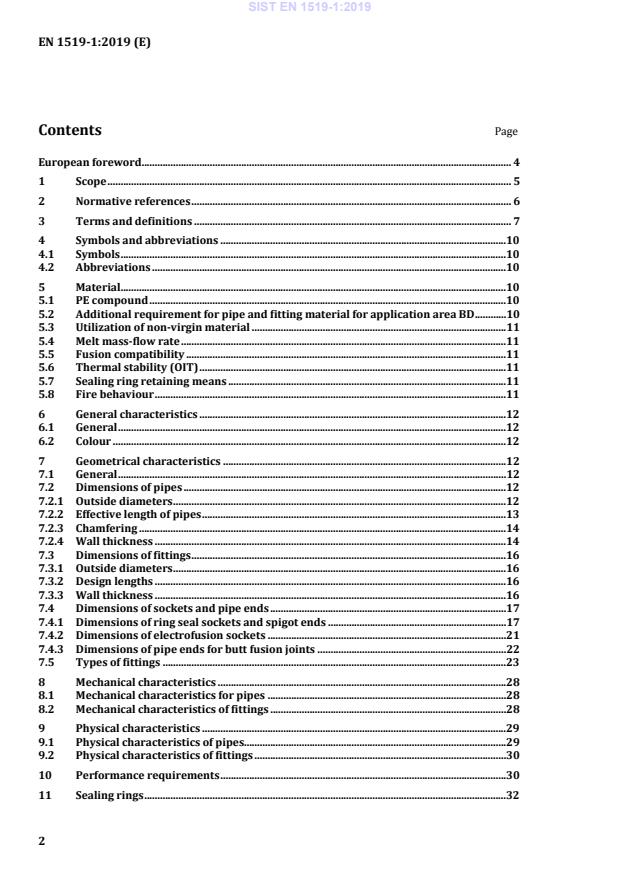
Contents Page
European foreword . 4
1 Scope . 5
2 Normative references . 6
3 Terms and definitions . 7
4 Symbols and abbreviations .10
4.1 Symbols .10
4.2 Abbreviations .10
5 Material .10
5.1 PE compound .10
5.2 Additional requirement for pipe and fitting material for application area BD .10
5.3 Utilization of non-virgin material .11
5.4 Melt mass-flow rate .11
5.5 Fusion compatibility .11
5.6 Thermal stability (OIT) .11
5.7 Sealing ring retaining means .11
5.8 Fire behaviour .11
6 General characteristics .12
6.1 General .12
6.2 Colour .12
7 Geometrical characteristics .12
7.1 General .12
7.2 Dimensions of pipes .12
7.2.1 Outside diameters .12
7.2.2 Effective length of pipes .13
7.2.3 Chamfering .14
7.2.4 Wall thickness .14
7.3 Dimensions of fittings .16
7.3.1 Outside diameters .16
7.3.2 Design lengths .16
7.3.3 Wall thickness .16
7.4 Dimensions of sockets and pipe ends .17
7.4.1 Dimensions of ring seal sockets and spigot ends .17
7.4.2 Dimensions of electrofusion sockets .21
7.4.3 Dimensions of pipe ends for butt fusion joints .22
7.5 Types of fittings .23
8 Mechanical characteristics .28
8.1 Mechanical characteristics for pipes .28
8.2 Mechanical characteristics of fittings .28
9 Physical characteristics .29
9.1 Physical characteristics of pipes.29
9.2 Physical characteristics of fittings .30
10 Performance requirements .30
11 Sealing rings .32
12 Marking . 32
12.1 General . 32
12.2 Minimum required marking of pipes . 32
12.3 Minimum required marking of fittings . 33
12.4 Additional marking . 33
Annex A (normative) Utilization of non-virgin PE material . 34
A.1 Own reprocessed material from pipes and fittings . 34
A.2 External non-virgin materials with an agreed specification . 34
A.2.1 Material from PE pipes and fittings. 34
A.2.2 Material from PE products other than pipes and fittings . 35
Annex B (informative) Product standards. 36
Bibliography . 37
European foreword
This document (EN 1519-1:2019) has been prepared by Technical Committee CEN/TC 155 “Plastics
piping systems and ducting systems”, the secretariat of which is held by NEN.
This European Standard shall be given the status of a national standard, either by publication of an
identical text or by endorsement, at the latest by October 2019, and conflicting national standards shall
be withdrawn at the latest by October 2019.
Attention is drawn to the possibility that some of the elements of this document may be the subject of
patent rights. CEN shall not be held responsible for identifying any or all such patent rights.
This document supersedes EN 1519-1:1999.
EN 1519, Plastics piping systems for soil and waste discharge (low and high temperature) within the
building structure - Polyethylene (PE) consists of the following parts:
— Part 1: Specifications for pipes, fittings and the system
— Part 2: Guidance for the assessment of conformity (Technical Specification)
The main changes in comparison with the previous edition are:
— updating in accordance with the new template;
— updating of normative references;
— thermal stability (OIT) requirement is made valid in general;
— utilization of non-virgin PE materials are described in the new Annex A;
— Annex B has been deleted and the relevant text has been moved to the main standard;
— a new Annex B “Product standards” has been added.
System Standards are based on the results of the work undertaken in ISO/TC 138 “Plastics pipes, fittings
and valves for the transport of fluids”, which is a Technical Committee of the International Organization
for Standardization (ISO).
They are supported by separate standards on test methods to which references are made throughout the
System Standard.
The System Standards are consistent with general standards on functional requirements and on
recommended practice for installation.
According to the CEN-CENELEC Internal Regulations, the national standards organisations of the
following countries are bound to implement this European Standard: Austria, Belgium, Bulgaria, Croatia,
Cyprus, Czech Republic, Denmark, Estonia, Finland, Former Yugoslav Republic of Macedonia, France,
Germany, Greece, Hungary, Iceland, Ireland, Italy, Latvia, Lithuania, Luxembourg, Malta, Netherlands,
Norway, Poland, Portugal, Romania, Serbia, Slovakia, Slovenia, Spain, Sweden, Switzerland, Turkey and
the United Kingdom.
1 Scope
This document specifies the requirements for solid-wall polyethylene (PE) pipes with smooth internal
and external surfaces extruded from the same compound/formulation throughout the wall, fittings and
the system for:
— soil and waste discharge applications (low and high temperature) inside buildings (application area
code “B”);
— soil and waste discharge applications (low and high temperature) for both inside buildings and
buried in the ground within the building structure (application area code “BD”).
NOTE 1 The intended use is reflected in the marking of products by “B” or “BD”.
NOTE 2 For use buried in the ground within the building structure are intended only those components marked
with “BD”, with a nominal ring stiffness of at least SN4 for dimensions equal to or greater than 75 mm.
This document is also applicable to PE pipes and fittings and the system intended for the following
purposes:
— ventilating part of the pipework in association with discharge applications;
— rainwater pipework within the building structure.
It also specifies the test parameters for the test methods referred to in this standard.
This document covers a range of nominal sizes, a range of pipes and fittings series and gives
recommendations concerning colours.
NOTE 3 It is the responsibility of the purchaser or specifier to make the appropriate selections from these
aspects, taking into account their particular requirements and any relevant national regulations and installation
practices or codes, e.g. CEN/TR 13801 [1].
NOTE 4 Pipes, fittings and other components conforming to any of the plastics product standards listed in
Annex B can be used with pipes and fittings conforming to this European Standard, if applicable.
It applies to pipes and fittings, marked with “B”, which are intended to be used inside buildings and
outside buildings fixed onto the wall.
It applies to pipes and fittings, marked with “BD”, which are intended to be used for both inside buildings
and buried in the ground within the building structure.
This standard is applicable to PE pipes and fittings of the following types:
— plain-ended;
— with integral elastomeric ring seal socket;
— for butt fusion joints;
— for electrofusion joints;
— for mechanical joints
where the fittings can be manufactured by injection-moulding or can be fabricated from pipes and/or
mouldings.
NOTE 5 EN 476[2] specifies the general requirements for components used in discharge pipes, drains and
sewers for gravity systems. Pipes and fittings conforming to this standard fully meet these requirements.
NOTE 6 For information about the chemical resistance of PE, guidance is given in ISO/TR 10358[3] and for
rubber materials in ISO/TR 7620[4].
2 Normative references
The following documents are referred to in the text in such a way that some or all of their content
constitutes requirements of this document. For dated references, only the edition cited applies. For
undated references, the latest edition of the referenced document (including any amendments) applies.
EN 681-1, Elastomeric seals - Materials requirements for pipe joint seals used in water and drainage
applications - Part 1: Vulcanized rubber
EN 681-2, Elastomeric Seals - Materials requirements for pipe joint seals used in water and drainage
applications - Part 2: Thermoplastic elastomers
EN 12099, Plastics piping systems - Polyethylene piping materials and components - Determination of
volatile content
EN ISO 472, Plastics - Vocabulary (ISO 472)
EN ISO 580, Plastics piping and ducting systems - Injection-moulded thermoplastics fittings - Methods for
visually assessing the effects of heating (ISO 580)
EN ISO 1043-1, Plastics - Symbols and abbreviated terms - Part 1: Basic polymers and their special
characteristics (ISO 1043-1)
EN ISO 1133-1, Plastics - Determination of the melt mass-flow rate (MFR) and melt volume-flow rate (MVR)
of thermoplastics - Part 1: Standard method (ISO 1133-1)
EN ISO 1167-1, Thermoplastics pipes, fittings and assemblies for the conveyance of fluids - Determination
of the resistance to internal pressure - Part 1: General method (ISO 1167-1)
EN ISO 1167-2, Thermoplastics pipes, fittings and assemblies for the conveyance of fluids - Determination
of the resistance to internal pressure - Part 2: Preparation of pipe test pieces (ISO 1167-2)
EN ISO 1183-2, Plastics - Methods for determining the density of non-cellular plastics - Part 2: Density
gradient column method (ISO 1183-2)
EN ISO 2505, Thermoplastics pipes - Longitudinal reversion - Test method and parameters (ISO 2505)
EN ISO 3126, Plastics piping systems - Plastics components - Determination of dimensions (ISO 3126)
EN ISO 3451-1, Plastics - Determination of ash - Part 1: General methods (ISO 3451-1)
EN ISO 11357-6, Plastics - Differential scanning calorimetry (DSC) - Part 6: Determination of oxidation
induction time (isothermal OIT) and oxidation induction temperature (dynamic OIT) (ISO 11357-6)
EN ISO 9969, Thermoplastics pipes - Determination of ring stiffness (ISO 9969)
EN ISO 13254, Thermoplastics piping systems for non-pressure applications - Test method for
watertightness (ISO 13254)
EN ISO 13255, Thermoplastics piping systems for soil and waste discharge inside buildings - Test method
for airtightness of joints (ISO 13255)
EN ISO 13257:2018, Thermoplastics piping systems for non-pressure applications - Test method for
resistance to elevated temperature cycling (ISO 13257:2018)
EN ISO 13259, Thermoplastics piping systems for underground non-pressure applications - Test method for
leaktightness of elastomeric sealing ring type joints (ISO 13259)
EN ISO 13264, Thermoplastics piping systems for non-pressure underground drainage and sewerage -
Thermoplastics fittings - Test method for mechanical strength or flexibility of fabricated fittings (ISO 13264)
ISO 4065, Thermoplastics pipes - Universal wall thickness table
3 Terms and definitions
For the purposes of this document, the terms and definitions given in EN ISO 472, EN ISO 1043-1 and the
following apply.
ISO and IEC maintain terminological databases for use in standardization at the following addresses:
• IEC Electropedia: available at http://www.electropedia.org/
• ISO Online browsing platform: available at http://www.iso.org/obp
3.1
application area code
code used in the marking of pipes and fittings to indicate the permitted application area(s) for which they
are intended as follows:
— B: application area code for components intended for use above ground inside the building, or for
components outside buildings fixed onto the wall;
— D: application code for the area under and within 1 m from the building where the pipes and fittings
are buried in ground and are connected to the underground drainage and sewerage system;
— BD: application area code for components intended for use for both code B and code D application
areas
Note 1 to entry: In D application areas, the existence of external forces from the surroundings in addition to the
hot water discharge is usual.
Note 2 to entry: Other application area codes U and UD not covered by this standard are defined elsewhere, e.g.
in EN 12666-1 [5].
3.2
nominal size
3.2.1
nominal size
DN
numerical designation of the size of a component, other than a component designated by thread size,
which is approximately equal to the manufacturing dimension, in millimetres
3.2.2
nominal size
DN/OD
nominal size, related to the outside diameter
3.3
nominal outside diameter
d
n
specified outside diameter, in millimetres, assigned to a nominal size DN/OD
3.4
outside diameter
d
e
value of the measurement of the outside diameter through its cross section at any point of a pipe or spigot
of a fitting, rounded to the next greater 0,1 mm
3.5
mean outside diameter
d
em
value of the measurement of the outer circumference of a pipe or spigot of a fitting in any cross section,
divided by π (≈ 3,142), rounded to the next greater 0,1
3.6
inside diameter
d
s
value of the measurement of the inside diameter through its cross section at any point of a socket,
rounded to the next greater 0,1 mm
3.7
mean inside diameter of a socket
d
sm
arithmetical mean of a number of measurements of the inside diameter of a socket in the same cross
section
3.8
wall thickness
e
value of measurement of the wall thickness at any point around the circumference of a component
3.9
mean wall thickness
e
m
arithmetical mean of a number of measurements of the wall thickness, regularly spaced around the
circumference and in the same cross section of a component, including the measured minimum and the
measured maximum values of the wall thickness in that cross section
3.10
pipe series
S
dimensionless number for pipe designation
Note 1 to entry: See ISO 4065.
3.11
standard dimension ratio
SDR
nominal ratio of the outside diameter, d , to the minimum wall thickness, e
n min
3.12
nominal ring stiffness
SN
numerical designation of the ring stiffness of a pipe or fitting which is a convenient round number relative
to the determined stiffness
3.13
fabricated fitting
fitting produced from pipe and/or from injection-moulded fittings by thermoforming or welding
3.14
solid wall pipe and fitting
pipe or fitting with smooth internal and external surface with the same compound through the wall
3.15
material definitions
3.15.1
virgin material
material in the form such as granules or powder that has not been subjected to use or processing other
than that required for its manufacture and to which no reprocessed or recycled material has been added
Note 1 to entry: It is understood that the addition of additives such as stabilizers and pigments is still resulting
into a virgin material.
3.15.2
own reprocessed material
material prepared from rejected unused pipes, gutters or fittings and ancillaries, including trimmings
from the production of pipes or fittings, that has been reprocessed in a manufacturer's plant after having
been previously processed by the same manufacturer by a process such as moulding or extrusion, and
for which the complete formulation is known
3.15.3
external reprocessed material
material prepared from unused thermoplastics products regardless of where those products were
manufactured
3.15.4
recycled material
material from used thermoplastic products which have been cleaned and crushed or ground
3.15.5
agreed specification
specification of the relevant material characteristics agreed between the supplier of the non-virgin
material and the pipe, fitting and/or ancillary manufacturer
4 Symbols and abbreviations
4.1 Symbols
A length of engagement
B length of lead-in
C depth of sealing zone
e wall thickness of a socket
e wall thickness in the groove area
l effective length of a pipe
l total depth electro fusion socket
l width of the copper wires
l length of engagement of electro fusion socket
L length of spigot
R radius of swept fittings
Z design length of a fitting
Z design length of a fitting
Z design length of a fitting
X stop width
α nominal angle of a fitting
4.2 Abbreviations
MFR melt mass-flow rate
OIT oxidation induction time
PE Polyethylene
5 Material
5.1 PE compound
The compound for pipes and fittings shall be PE-base material to which are added those additives that
are needed to facilitate the manufacture of components conforming to the requirements given in this
standard.
5.2 Additional requirement for pipe and fitting material for application area BD
The material of pipes and fittings intended to be used in application area BD shall comply with the
additional requirements given in Table 1, when tested in accordance with the methods and the
parameters indicated in Table 1.
The pipe and fitting material shall be tested in form of a pipe.
Table 1 — Material characteristics of pipes and fittings intended for BD applications
Characteristics Requirement Test parameters Test method
Resistance to No failure End caps Types A or B EN ISO 1167-1 and
internal during the EN ISO 1167-2
pressure test period
Test temperature (80 ± 1) °C
Orientation Free
Number of test pieces 3
Circumferential (hoop) 4,0 MPa
stress
Conditioning period 1 h
Type of test Water-in-water
Test period 165 h
5.3 Utilization of non-virgin material
Non-virgin PE materials may be used if the conditions and requirements described in Annex A are
fulfilled.
5.4 Melt mass-flow rate
The MFR of the base material shall be tested in accordance with EN ISO 1133-1 using the test parameters:
temperature 190 °C and loading mass 5 kg.
Pipes and fittings shall be made from materials with an MFR as follows:
0,20 g/10 min ≤ MFR (190/5) ≤ 1,1 g/10 min
5.5 Fusion compatibility
Compounds designated as PE 63, PE 80 and PE 100 having an MFR (190/5) as defined in 5.4 shall be
considered to be compatible for fusion to each other. The designations PE 63, PE 80 and PE 100 are a
classification of the materials based on the Minimum Required Strength (MRS) value at 50 years.
5.6 Thermal stability (OIT)
When tested in accordance with EN ISO 11357-6 using a test temperature of 200 °C, the oxidation
induction time (OIT) of the material shall not be less than 20 min.
5.7 Sealing ring retaining means
Sealing rings may be retained using means made from plastics other than PE.
5.8 Fire behaviour
Pipes and fittings conforming to this standard shall conform to any relevant national requirements on
fire regulations.
6 General characteristics
6.1 General
When viewed without magnification the following requirements apply:
— the internal and external surfaces of pipes and fittings shall be smooth, clean and free from grooving,
blistering, impurities, pores or other surface irregularity likely to prevent performance of pipes and
fittings with this standard;
— each end of a pipe or a fitting shall be cleanly cut, if applicable, and shall be square to its axis.
6.2 Colour
The pipes and fittings shall be coloured through the wall. The colours of pipes and fittings should be
preferably black. Other colours may be used.
7 Geometrical characteristics
7.1 General
Dimensions shall be measured in accordance with EN ISO 3126.
NOTE The figures given in this standard are only schematic sketches intended to indicate the relevant
dimensions. They do not necessarily represent the manufactured components.
7.2 Dimensions of pipes
7.2.1 Outside diameters
The mean outside diameter, d , sh
...
EN 1519-1:2019は、建物内での低温および高温の排水および廃棄物の排出に使用されるポリエチレン(PE)パイプ、フィッティング、システムの要件を規定したドキュメントです。この文書は、内部および外部に滑らかな内外面を持つ固体壁のPEパイプ、フィッティング、およびシステムについて取り扱います。建物内("B"アプリケーションエリアコード)および建物構造内の地中に埋め込まれた場所("BD"アプリケーションエリアコード)での低温および高温の排水および廃棄物の排出用としての用途を指定しています。また、通気パイプや建物内の雨水パイプに関する要件も含まれます。この文書では、この規格で参照される試験方法のパラメータも指定しています。この文書は、一連の名目サイズ、パイプおよびフィッティングのシリーズの範囲についても推奨事項を示しています。購入者や指定者は、特定の要件や関連する国の規制、設置慣行やコードなどを考慮して、これらの側面から適切な選択を行う責任があります(たとえば、CEN/TR 13801 [1]など)。適用範囲には、「B」とマークされた、建物内および建物外の壁面に取り付けられるパイプやフィッティングも含まれます。また、「BD」とマークされた、建物内および建物構造内の地中に埋め込まれるための用途に使用されるパイプやフィッティングも含まれます。この規格は、以下のタイプのPEパイプおよびフィッティングに適用されます:平端、一体型エラストマリングリングシールソケット、バットフュージョンジョイント用、エレクトロフュージョンジョイント用、機械ジョイント用。フィッティングは射出成形で製造されるか、パイプや成形品から製造できます。EN 476 [2]は、重力システム用の排水パイプ、排水管、下水道の部品に関する一般的な要件を指定しており、この規格に準拠したパイプとフィッティングはこれらの要件を完全に満たします。PEおよびゴム材料の化学耐性についての情報は、ISO/TR 10358 [3]およびISO/TR 7620 [4]で提供されています。
기사 제목 : EN 1519-1:2019 - 건물 구조 내 폐수 및 배출용 저/고온도용 플라스틱 배관 시스템 - 폴리에틸렌 (PE) - 파트 1: 관, 부속품 및 시스템의 요구 사항 기사 내용 : 이 문서는 내부/외부 평활한 표면으로 동일한 복합체/조성으로 벽체, 부속품 및 배관 시스템에서 추출된 폴리에틸렌 (PE) 고형벽 관에 대한 요구 사항을 명시합니다. - 건물 내 폐수 및 배출용 (저/고온도)용도 (응용 분야 코드 "B")에 대한 요구 사항 - 건물 구조 내 묻힌 상태로 이용 가능한 (저/고온도)용도 (응용 분야 코드 "BD")에 대한 요구 사항 참고 1) 의도된 사용은 제품의 "B" 또는 "BD"로 표시됩니다. 참고 2) 건물 구조 내 묻힌 상태로 사용하기 위해 약어 "BD"로 표시된 요소 중, 75mm 이상의 치수에 대해 적어도 SN4의 명시적인 링 강성을 갖는 요소만 해당됩니다. 이 문서는 다음 목적으로 설계된 PE 관, 부속품 및 시스템에도 적용됩니다. - 토출 응용과 관련하여 배관의 환기 부분 - 건물 구조 내의 우수 배관 또한, 이 표준에 정의된 시험 방법의 테스트 매개변수를 확인합니다. 이 문서는 다양한 명목 크기, 관 및 부속품 시리즈의 범위를 다루고 있으며 색상에 대한 권장 사항을 제공합니다. 참고 3) 특정 요구 사항과 관련 국가 규정 및 설치 관행 또는 코드 (예: CEN/TR 13801 [1])을 고려하여 구매자 또는 명세자가 적절한 선택을 해야합니다. 참고 4) 부속품 및 기타 구성 요소는 필요한 경우 이 유럽 표준과 일치하는 관 및 부속품과 함께 사용할 수 있습니다. 이 표준은 벽에 고정되는 건물 내외부 사용을 목적으로 "B"로 표시된 관 및 부속품에 적용됩니다. 이 표준은 건물 내부 및 건물 구조 내 묻혀 사용하기 위해 "BD"로 표시된 관 및 부속품에 적용됩니다. 이 표준은 다음 유형의 PE 관 및 부속품에 적용됩니다. - 평평한 끝 - 내포된 탄성 고리 씰 스트링조인트 - 버튼 융합 조인트 - 전기 융합 조인트 - 기계 조인트 부속품은 사출 성형으로 제조되거나 관 및/또는 성형품에서 제작될 수 있습니다. 참고 5) EN 476[2]은 중력 시스템에 대한 토출 관, 배수관 및 하수구에 사용되는 구성 요소에 대한 일반 요구 사항을 명시합니다. 이 표준을 준수하는 관 및 부속품은 이러한 요구 사항을 완전히 충족시킵니다. 참고 6) PE의 화학 저항성에 대한 정보는 ISO/TR 10358[3]에서, 고무 재료에 대한 정보는 ISO/TR 7620[4]에서 확인할 수 있습니다.
EN 1519-1:2019 is a document that specifies the requirements for polyethylene (PE) pipes, fittings, and systems used for soil and waste discharge within buildings, both at low and high temperatures. The document covers pipes with smooth internal and external surfaces, fittings, and systems for applications inside buildings (marked with "B") and for applications inside buildings and buried in the ground within the building structure (marked with "BD"). It also includes requirements for ventilating pipework and rainwater pipework within the building structure. The document provides test parameters and recommendations for nominal sizes, pipes, fittings, and colors. It is important for purchasers and specifiers to consider their specific requirements and relevant national regulations when making selections. Pipes, fittings, and components that conform to related plastics product standards can be used in conjunction with this standard. The standard applies to PE pipes and fittings that are plain-ended, have integral elastomeric ring seal sockets, are used for butt fusion or electrofusion joints, or for mechanical joints. The document also refers to other standards for information on the chemical resistance of PE and rubber materials.
記事のタイトル:EN 1519-1:2019 - 建築構造内での排水および排出のためのプラスチック配管システム(低温および高温)- ポリエチレン(PE)- パート1:管、継手、およびシステムの要件 記事の内容:この文書は、同じ化合物/製剤から押出された内部および外部の滑らかな表面を持つ実壁ポリエチレン(PE)パイプ、継手、およびシステムに対する要件を規定しています。 - 建物内の排水および排出用途(低温および高温)に対する要件(応用領域コード「B」) - 建物構造内および地中埋設で使用される排水および排出用途(低温および高温)に対する要件(応用領域コード「BD」) 注1)意図された使用は、製品の「B」または「BD」で表示されます。 注2)建物構造内で地中埋設されるための使用には、「BD」でマークされ、最小75mm以上の寸法に対して少なくともSN4の名目リング剛性を持つコンポーネントのみが対象です。 この文書は、次の目的にも適用されます。 - 排水アプリケーションと関連して通気配管の一部 - 建物構造内の雨水配管 また、この標準に言及される試験方法のテストパラメータも規定しています。 この文書は、さまざまな名目サイズ、パイプおよび継手シリーズの範囲をカバーし、色に関する推奨事項も提供します。 注3)特定の要件と関連する国の規制およびインストールの慣行または規格(たとえば、CEN/TR 13801 [1]など)を考慮して、購入者または仕様者が適切な選択を行う責任があります。 注4)付録Bでリストされたプラスチック製品規格に準拠するパイプ、継手、およびその他のコンポーネントは、このヨーロッパ標準に準拠するパイプおよび継手と併用できます(該当する場合)。 この標準は、「B」とマークされた建物の内部および外部で使用されるパイプおよび継手に適用されます。 この標準は、「BD」とマークされた建物の内部および建物構造内で地中埋設されるためのパイプおよび継手にも適用されます。 この標準は、以下のタイプのPEパイプおよび継手に適用されます。 - 平らな端 - 統合型弾性リングシールソケット - バットフュージョンジョイント - 電気結合ジョイント - 機械ジョイント 継手は射出成形によって製造されるか、パイプおよび/または成形から製作されることができます。 注5)EN 476[2]は、重力システムの排水パイプ、排水管および下水道で使用される部品の一般的な要件を規定しています。この標準に準拠するパイプおよび継手は、これらの要件を完全に満たします。 注6)PEの化学抵抗性の情報は、ISO/TR 10358[3]で、ゴム材料の情報はISO/TR 7620[4]で提供されています。
EN 1519-1:2019는 건물 내부에서의 저온 및 고온 하수 및 폐기물 배출을 위한 폴리에틸렌(PE) 파이프, 피팅, 시스템 요구 사항을 명시하는 문서입니다. 이 문서는 내외부 표면이 매끄러운 단단한 벽 구조의 PE 파이프, 피팅 및 시스템을 다룹니다. "B" 애플리케이션 영역 코드로 표시된 건물 내부의 저온 및 고온 하수 및 폐기물 배출용과 건물 구조 내 땅에埋ま은 저온 및 고온 하수 및 폐기물 배출용인 "BD" 애플리케이션 영역 코드로 표시된 용도를 위한 것입니다. 또한 이 문서는 배출용 파이프와 관련하여 환기 파이프 및 건물 내부의 우수배수 파이프에 대한 테스트 매개변수도 명시합니다. 이 문서에서는 일련의 명목 크기 및 파이프 및 피팅 시리즈 범위를 다루며 색상에 대한 권장사항도 제공합니다. 구매자나 명시자는 특정 요구사항과 관련 국가 규정, 설치 관행 또는 규칙, 예를 들어 CEN/TR 13801 [1]을 고려하여 이러한 측면에서 적절한 선택을 해야 합니다. 적용 가능한 기준에는 본문에 "B"로 표시된 건물 내부 및 벽에 고정된 건물 외부에서 사용되는 파이프와 피팅이 포함됩니다. 또한 "BD"로 표시된 건물 내부와 건물 구조 내 땅에埋ま은 용도에 사용되는 파이프 및 피팅도 포함됩니다. 본 기준은 다음 유형의 PE 파이프 및 피팅에 적용됩니다: 평면 종결, 통합된 탄성 고무 링 씰 소켓, 용접 용 부위, 전선 용 접합, 기계적 접합. 피팅은 사출 성형으로 제조되거나 파이프 또는 성형품에 의해 제조될 수 있습니다. 파이프와 피팅이 EN 476[2]에 맞추어 중력 시스템용 배출 파이프, 배수관 및 하수용 조립품에 대한 일반 요구 사항을 충족시킨다는 점을 참고해야 합니다. PE의 화학적 저항성에 대한 정보는 ISO/TR 10358[3] 및 고무 소재에 대한 정보는 ISO/TR 7620[4]에서 제공됩니다.
The article discusses the requirements for polyethylene (PE) pipes, fittings, and systems used for soil and waste discharge applications inside and outside buildings. It covers the specifications for pipes with smooth surfaces, fittings, and the overall system. The document also includes guidelines for ventilation and rainwater pipework within the building structure. It provides recommendations for test parameters and gives options for different sizes, series, and colors. The responsibility lies with the purchaser or specifier to select the appropriate options based on their specific requirements and national regulations. The standard is applicable for different types of PE pipes and fittings, including plain-ended, socket with elastomeric ring seal, butt fusion, electrofusion, and mechanical joints. It also clarifies that pipes and fittings conforming to other plastics product standards can be used with this standard if applicable. Chemical resistance information for PE and rubber materials is also referenced.
Questions, Comments and Discussion
Ask us and Technical Secretary will try to provide an answer. You can facilitate discussion about the standard in here.
Loading comments...