


EN 16931-1:2017+A1:2019/AC:2020
(Corrigendum)Electronic invoicing - Part 1: Semantic data model of the core elements of an electronic invoice
Electronic invoicing - Part 1: Semantic data model of the core elements of an electronic invoice
This European Standard establishes a semantic data model of the core elements of an electronic invoice. The semantic model includes only the essential information elements that an electronic invoice needs to ensure legal (including fiscal) compliance and to enable interoperability for cross-border, cross sector and for domestic trade. The semantic model may be used by organizations in the private and the public sector for public procurement invoicing. It may also be used for invoicing between private sector enterprises. It has not been specifically designed for invoicing consumers.
This European Standard complies at least with the following criteria:
- it is technologically neutral;
- it is compatible with relevant international standards on electronic invoicing;
- the application of this standard should comply with the requirements for the protection of personal data of Directive 95/46/EC, having due regard to the principles of privacy and data protection by-design, data minimization, purpose limitation, necessity and proportionality;
- it is consistent with the relevant provisions of Directive 2006/112/EC [2];
- it allows for the establishment of practical, user-friendly, flexible and cost-efficient electronic invoicing systems;
- it takes into account the special needs of small and medium-sized enterprises as well as of sub-central contracting authorities and contracting entities;
- it is suitable for use in commercial transactions between enterprises.
Elektronische Rechnungsstellung - Teil 1: Semantisches Datenmodell der Kernelemente einer elektronischen Rechnung
Diese Europäische Norm führt ein semantisches Datenmodell der Kernelemente einer elektronischen Rechnung ein. Das semantische Modell umfasst nur die wesentlichen Informationselemente, die eine elektronische Rechnung enthalten muss, um die rechtliche (einschließlich steuerrechtliche) Richtigkeit sicherzustellen und die Interoperabilität für den grenzüberschreitenden Handel, den branchenüber-greifenden Handel und den Binnenhandel zu ermöglichen. Das semantische Modell darf von Organisationen des privaten und öffentlichen Sektors bei der Rechnungsstellung für öffentliche Aufträge angewendet werden. Es darf auch bei der Rechnungsstellung zwischen Unternehmen des Privatsektors angewendet werden. Es ist nicht speziell für die Rechnungsstellung an Konsumenten ausgelegt.
Diese Europäische Norm erfüllt mindestens die folgenden Kriterien:
— sie ist technologieneutral;
— sie ist mit den einschlägigen internationalen Normen für die elektronische Rechnungsstellung vereinbar;
— die Anwendung dieser Norm sollte die Anforderungen an den Schutz von personenbezogenen Daten nach Richtlinie 95/46/EG erfüllen, unter Berücksichtigung der Grundsätze für Privatsphäre und Daten¬schutz durch Technik („data protection by design“), Zweckbegrenzung, Notwendigkeit und Verhältnis¬mäßigkeit;
— sie steht mit den einschlägigen Bestimmungen der Richtlinie 2006/112/EG [2] in Einklang;
— sie ermöglicht die Einrichtung zweckmäßiger, benutzerfreundlicher, flexibler und kosteneffizienter Systeme zur elektronischen Rechnungs¬stellung;
— sie berücksichtigt die speziellen Bedürfnisse von kleinen und mittleren Unternehmen sowie von subzentralen öffentlichen Auftraggebern und anderen Auftraggebern;
— sie eignet sich für die Verwendung bei kaufmännischen Transaktionen zwischen Unternehmen.
Facturation électronique - Partie 1 : Modèle sémantique de données des éléments essentiels d'une facture électronique
La présente Norme européenne définit un modèle sémantique de données pour les éléments essentiels d'une facture électronique. Ce modèle sémantique comporte uniquement les éléments d'information essentiels qu'une facture électronique doit contenir pour assurer le respect de la législation (y compris fiscale) et permettre l'interopérabilité du commerce transfrontalier, intersectoriel et national. Le modèle sémantique peut être utilisé par des organisations des secteurs public et privé pour la facturation des marchés publics. Il peut également être utilisé pour la facturation entre entreprises du secteur privé. Il n'a pas été spécifiquement conçu pour la facturation des consommateurs.
La présente Norme européenne remplit au moins les critères suivants :
— elle est technologiquement neutre ;
— elle est compatible avec les normes internationales applicables en matière de facturation électronique ;
— il convient que l'application de la présente norme soit conforme aux exigences de protection des données personnelles de la Directive 95/46/CE, dans le respect des principes de confidentialité et de protection des données dès la conception, par la minimisation des données, la limitation de l'objet du traitement, le caractère nécessaire et proportionné du traitement des données ;
— elle est compatible avec les dispositions pertinentes de la Directive 2006/112/CE [2] ;
— elle permet l'établissement de systèmes de facturation électronique pratiques, conviviaux, flexibles et efficaces en termes de coûts ;
— elle tient compte des besoins particuliers des petites et moyennes entreprises ainsi que des pouvoirs adjudicateurs sous-centraux et des entités contractantes ;
— elle peut être appliquée dans le cadre de transactions commerciales entre entreprises.
Elektronsko izdajanje računov - 1. del: Semantični podatkovni model osrednjih elementov za elektronski račun
General Information
- Status
- Published
- Publication Date
- 28-Jul-2020
- Technical Committee
- CEN/TC 434 - Project Committee - Electronic Invoicing
- Drafting Committee
- CEN/TC 434 - Project Committee - Electronic Invoicing
- Current Stage
- 6060 - Definitive text made available (DAV) - Publishing
- Start Date
- 29-Jul-2020
- Completion Date
- 29-Jul-2020
Relations
- Effective Date
- 11-May-2020



Frequently Asked Questions
EN 16931-1:2017+A1:2019/AC:2020 is a corrigendum published by the European Committee for Standardization (CEN). Its full title is "Electronic invoicing - Part 1: Semantic data model of the core elements of an electronic invoice". This standard covers: This European Standard establishes a semantic data model of the core elements of an electronic invoice. The semantic model includes only the essential information elements that an electronic invoice needs to ensure legal (including fiscal) compliance and to enable interoperability for cross-border, cross sector and for domestic trade. The semantic model may be used by organizations in the private and the public sector for public procurement invoicing. It may also be used for invoicing between private sector enterprises. It has not been specifically designed for invoicing consumers. This European Standard complies at least with the following criteria: - it is technologically neutral; - it is compatible with relevant international standards on electronic invoicing; - the application of this standard should comply with the requirements for the protection of personal data of Directive 95/46/EC, having due regard to the principles of privacy and data protection by-design, data minimization, purpose limitation, necessity and proportionality; - it is consistent with the relevant provisions of Directive 2006/112/EC [2]; - it allows for the establishment of practical, user-friendly, flexible and cost-efficient electronic invoicing systems; - it takes into account the special needs of small and medium-sized enterprises as well as of sub-central contracting authorities and contracting entities; - it is suitable for use in commercial transactions between enterprises.
This European Standard establishes a semantic data model of the core elements of an electronic invoice. The semantic model includes only the essential information elements that an electronic invoice needs to ensure legal (including fiscal) compliance and to enable interoperability for cross-border, cross sector and for domestic trade. The semantic model may be used by organizations in the private and the public sector for public procurement invoicing. It may also be used for invoicing between private sector enterprises. It has not been specifically designed for invoicing consumers. This European Standard complies at least with the following criteria: - it is technologically neutral; - it is compatible with relevant international standards on electronic invoicing; - the application of this standard should comply with the requirements for the protection of personal data of Directive 95/46/EC, having due regard to the principles of privacy and data protection by-design, data minimization, purpose limitation, necessity and proportionality; - it is consistent with the relevant provisions of Directive 2006/112/EC [2]; - it allows for the establishment of practical, user-friendly, flexible and cost-efficient electronic invoicing systems; - it takes into account the special needs of small and medium-sized enterprises as well as of sub-central contracting authorities and contracting entities; - it is suitable for use in commercial transactions between enterprises.
EN 16931-1:2017+A1:2019/AC:2020 is classified under the following ICS (International Classification for Standards) categories: 35.240.20 - IT applications in office work; 35.240.63 - IT applications in trade. The ICS classification helps identify the subject area and facilitates finding related standards.
EN 16931-1:2017+A1:2019/AC:2020 has the following relationships with other standards: It is inter standard links to EN 16931-1:2017+A1:2019. Understanding these relationships helps ensure you are using the most current and applicable version of the standard.
EN 16931-1:2017+A1:2019/AC:2020 is associated with the following European legislation: EU Directives/Regulations: 2014/55/EU; Standardization Mandates: M/528. When a standard is cited in the Official Journal of the European Union, products manufactured in conformity with it benefit from a presumption of conformity with the essential requirements of the corresponding EU directive or regulation.
You can purchase EN 16931-1:2017+A1:2019/AC:2020 directly from iTeh Standards. The document is available in PDF format and is delivered instantly after payment. Add the standard to your cart and complete the secure checkout process. iTeh Standards is an authorized distributor of CEN standards.
Standards Content (Sample)
SLOVENSKI STANDARD
01-oktober-2020
Elektronsko izdajanje računov - 1. del: Semantični podatkovni model osrednjih
elementov za elektronski račun
Electronic invoicing - Part 1: Semantic data model of the core elements of an electronic
invoice
Elektronische Rechnungsstellung - Teil 1: Semantisches Datenmodell der Kernelemente
einer elektronischen Rechnung
Facturation électronique - Partie 1 : Modèle sémantique de données des éléments
essentiels d'une facture électronique
Ta slovenski standard je istoveten z: EN 16931-1:2017+A1:2019/AC:2020
ICS:
03.120.20 Certificiranje proizvodov in Product and company
podjetij. Ugotavljanje certification. Conformity
skladnosti assessment
35.240.63 Uporabniške rešitve IT v IT applications in trade
trgovini
2003-01.Slovenski inštitut za standardizacijo. Razmnoževanje celote ali delov tega standarda ni dovoljeno.
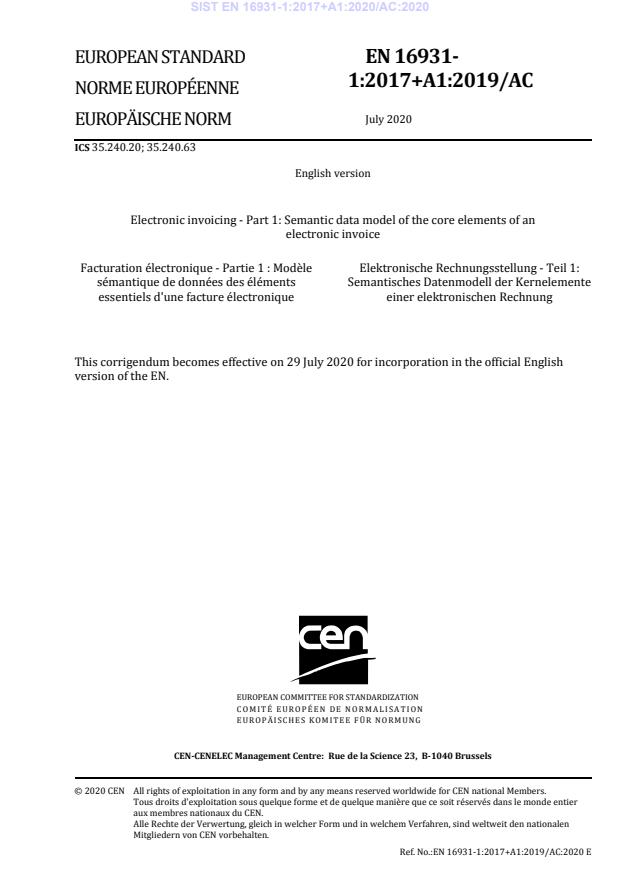
EUROPEAN STANDARD EN 16931-
1:2017+A1:2019/AC
NORME EUROPÉENNE
July 2020
EUROPÄISCHE NORM
ICS 35.240.20; 35.240.63
English version
Electronic invoicing - Part 1: Semantic data model of the core elements of an
electronic invoice
Facturation électronique - Partie 1 : Modèle Elektronische Rechnungsstellung - Teil 1:
sémantique de données des éléments Semantisches Datenmodell der Kernelemente
essentiels d'une facture électronique einer elektronischen Rechnung
This corrigendum becomes effective on 29 July 2020 for incorporation in the official English
version of the EN.
EUROPEAN COMMITTEE FOR STANDARDIZATION
COMITÉ EUROPÉEN DE NORMALISATIO N
EUROPÄISCHES KOMITEE FÜR NORMUN G
CEN-CENELEC Management Centre: Rue de la Science 23, B-1040 Brussels
© 2020 CEN All rights of exploitation in any form and by any means reserved worldwide for CEN national Members.
Tous droits d'exploitation sous quelque forme et de quelque manière que ce soit réservés dans le monde entier
aux membres nationaux du CEN.
Alle Rechte der Verwertung, gleich in welcher Form und in welchem Verfahren, sind weltweit den nationalen
Mitgliedern von CEN vorbehalten.
Ref. No.:EN 16931-1:2017+A1:2019/AC:2020 E
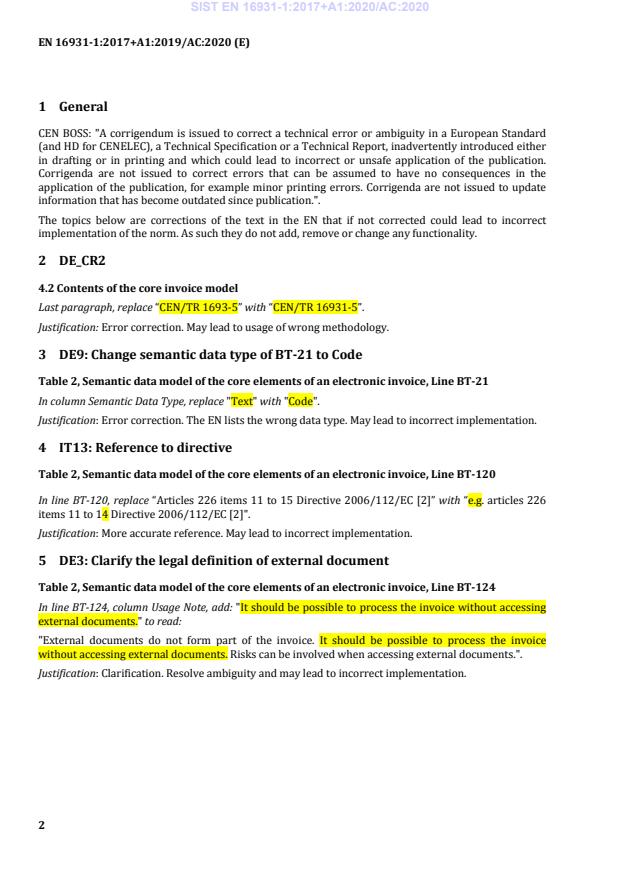
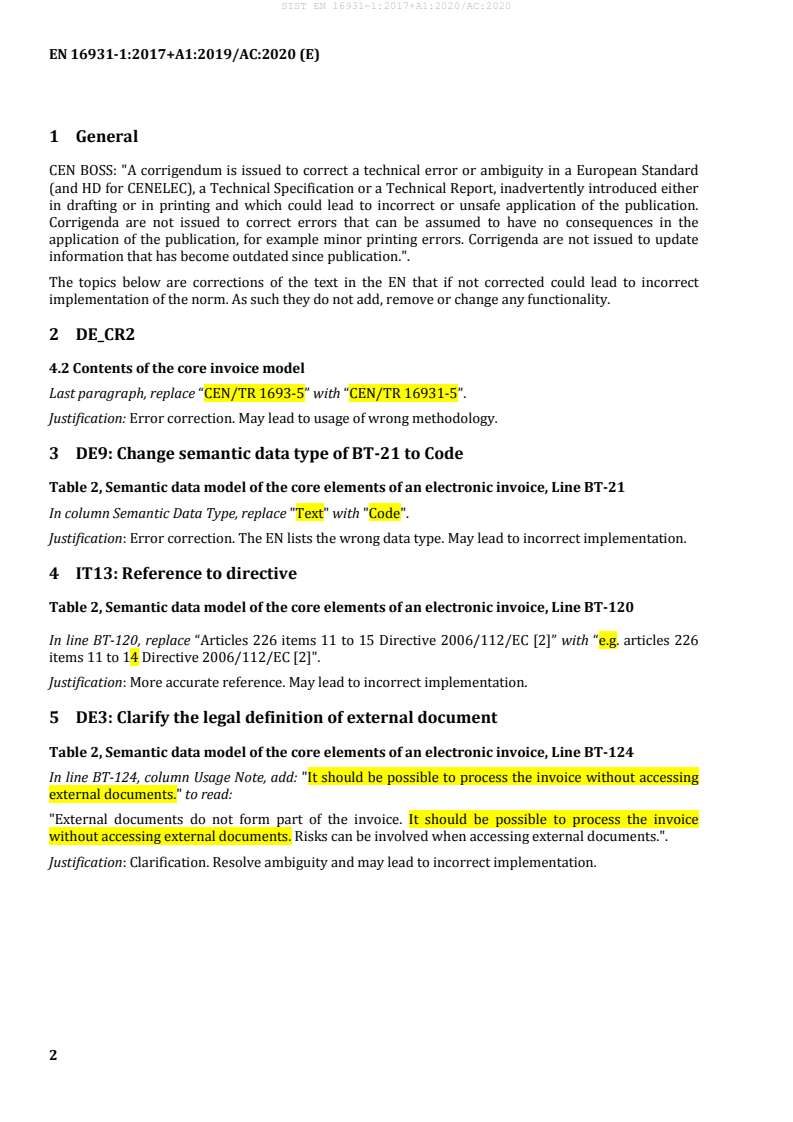
1 General
CEN BOSS: "A corrigendum is issued to correct a technical error or ambiguity in a European Standard
(and HD for CENELEC), a Technical Specification or a Technical Report, inadvertently introduced either
in drafting or in printing and which could lead to incorrect or unsafe application of the publication.
Corrigenda are not issued to correct errors that can be assumed to have no consequences in the
application of the publication, for example minor printing errors. Corrigenda are not issued to update
information that has become outdated since publication.".
The topics below are corrections of the text in the EN that if not corrected could lead to incorrect
implementation of the norm. As such they do not add, remove or change any functionality.
2 DE_CR2
4.2 Contents of the core invoice model
Last paragraph, replace “CEN/TR 1693-5” with “CEN/TR 16931-5”.
Justification: Error correction. May lead to usage of wrong methodology
...
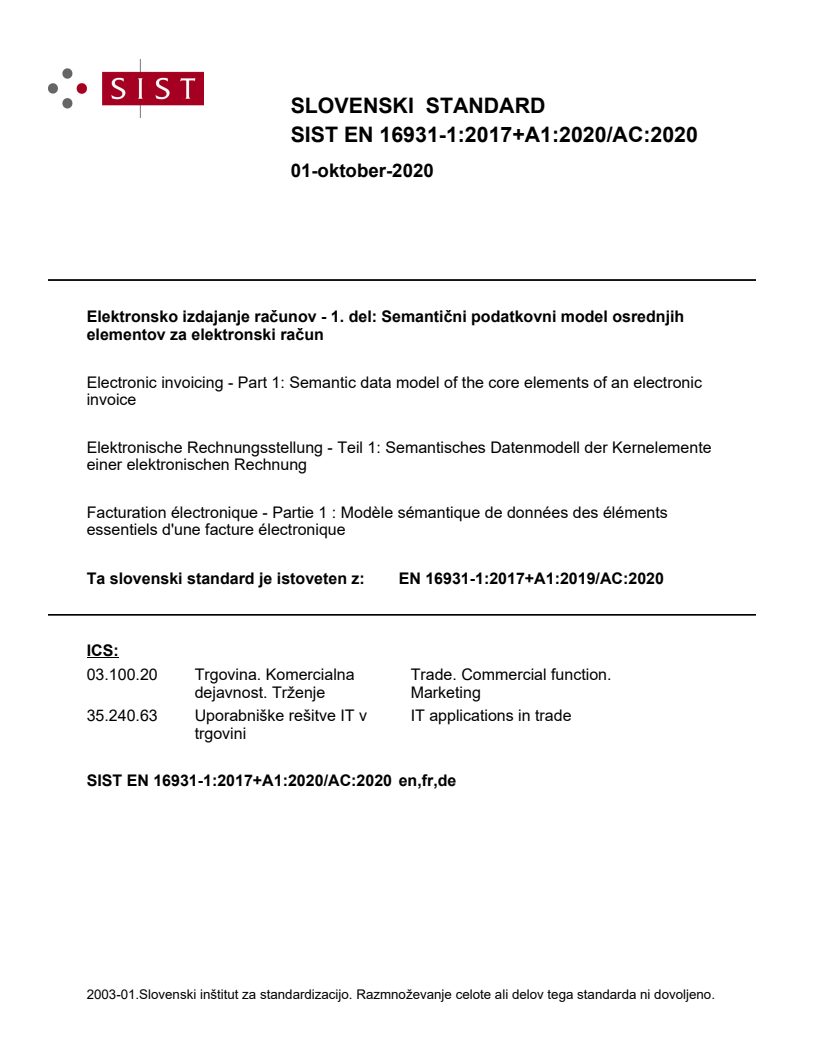
SLOVENSKI STANDARD
01-oktober-2020
Elektronsko izdajanje računov - 1. del: Semantični podatkovni model osrednjih
elementov za elektronski račun
Electronic invoicing - Part 1: Semantic data model of the core elements of an electronic
invoice
Elektronische Rechnungsstellung - Teil 1: Semantisches Datenmodell der Kernelemente
einer elektronischen Rechnung
Facturation électronique - Partie 1 : Modèle sémantique de données des éléments
essentiels d'une facture électronique
Ta slovenski standard je istoveten z: EN 16931-1:2017+A1:2019/AC:2020
ICS:
03.100.20 Trgovina. Komercialna Trade. Commercial function.
dejavnost. Trženje Marketing
35.240.63 Uporabniške rešitve IT v IT applications in trade
trgovini
2003-01.Slovenski inštitut za standardizacijo. Razmnoževanje celote ali delov tega standarda ni dovoljeno.
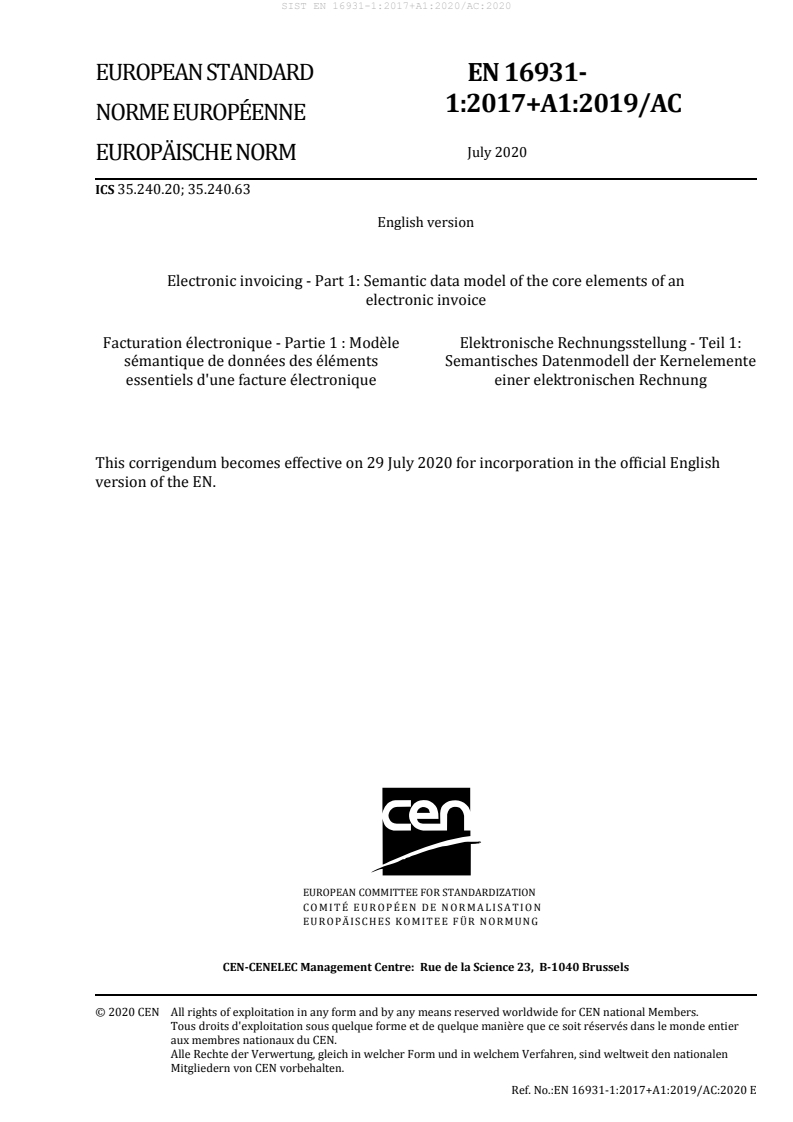
EUROPEAN STANDARD EN 16931-
1:2017+A1:2019/AC
NORME EUROPÉENNE
July 2020
EUROPÄISCHE NORM
ICS 35.240.20; 35.240.63
English version
Electronic invoicing - Part 1: Semantic data model of the core elements of an
electronic invoice
Facturation électronique - Partie 1 : Modèle Elektronische Rechnungsstellung - Teil 1:
sémantique de données des éléments Semantisches Datenmodell der Kernelemente
essentiels d'une facture électronique einer elektronischen Rechnung
This corrigendum becomes effective on 29 July 2020 for incorporation in the official English
version of the EN.
EUROPEAN COMMITTEE FOR STANDARDIZATION
COMITÉ EUROPÉEN DE NORMALISATIO N
EUROPÄISCHES KOMITEE FÜR NORMUN G
CEN-CENELEC Management Centre: Rue de la Science 23, B-1040 Brussels
© 2020 CEN All rights of exploitation in any form and by any means reserved worldwide for CEN national Members.
Tous droits d'exploitation sous quelque forme et de quelque manière que ce soit réservés dans le monde entier
aux membres nationaux du CEN.
Alle Rechte der Verwertung, gleich in welcher Form und in welchem Verfahren, sind weltweit den nationalen
Mitgliedern von CEN vorbehalten.
Ref. No.:EN 16931-1:2017+A1:2019/AC:2020 E
1 General
CEN BOSS: "A corrigendum is issued to correct a technical error or ambiguity in a European Standard
(and HD for CENELEC), a Technical Specification or a Technical Report, inadvertently introduced either
in drafting or in printing and which could lead to incorrect or unsafe application of the publication.
Corrigenda are not issued to correct errors that can be assumed to have no consequences in the
application of the publication, for example minor printing errors. Corrigenda are not issued to update
information that has become outdated since publication.".
The topics below are corrections of the text in the EN that if not corrected could lead to incorrect
implementation of the norm. As such they do not add, remove or change any functionality.
2 DE_CR2
4.2 Contents of the core invoice model
Last paragraph, replace “CEN/TR 1693-5” with “CEN/TR 16931-5”.
Justification: Error correction. May lead to usage of wrong methodology.
3 DE9: Change sema
...
Der Standard EN 16931-1:2017+A1:2019/AC:2020 ist ein wegweisendes Dokument im Bereich der elektronischen Rechnungsstellung. Sein Umfang erstreckt sich über die Etablierung eines semantischen Datenmodells, welches die Kernbestandteile einer elektronischen Rechnung definiert. Dieses Modell umfasst ausschließlich die wesentlichen Informationen, die zur rechtlichen (einschließlich steuerlichen) Einhaltung benötigt werden, und gewährleistet gleichzeitig die Interoperabilität für grenzüberschreitende sowie inländische Handelsbeziehungen. Zu den Stärken des Standards gehört seine technologische Neutralität, die es Organisationen aus verschiedenen Sektoren - sowohl dem privaten als auch dem öffentlichen Bereich - ermöglicht, das semantische Modell flexibel anzuwenden. Darüber hinaus ist der Standard mit relevanten internationalen Standards zur elektronischen Rechnungsstellung kompatibel, was ihm zusätzliche Relevanz verleiht. Dies fördert nicht nur ein einheitliches Verfahren für die elektronische Rechnungsstellung, sondern unterstützt auch die Integration in bestehende Systeme. Ein weiterer wesentlicher Aspekt des Standards ist die Berücksichtigung des Datenschutzes, der den Anforderungen der Richtlinie 95/46/EG gerecht wird. Diese Verpflichtung zur Datensicherheit ist besonders wichtig in einem Zeitalter, in dem Datenschutz und Privatsphäre höchste Priorität genießen. Die Prinzipien von Datenminimierung, Zweckbindung, Notwendigkeit und Verhältnismäßigkeit werden beachtet, um einen verantwortungsvollen Umgang mit sensiblen Daten sicherzustellen. Zudem fördert der Standard die Schaffung praktischer, benutzerfreundlicher, flexibler und kosteneffizienter Systeme für die elektronische Rechnungsstellung. Dies ist besonders vorteilhaft für kleine und mittelständische Unternehmen sowie für subzentrale Auftraggeber, die oft über limitierte Ressourcen verfügen. Der Standard bietet Lösungen, die auf die speziellen Bedürfnisse dieser Gruppen zugeschnitten sind und erleichtert ihnen den Zugang zu modernen Rechnungsstellungssystemen. Die Eignung des Standards für kommerzielle Transaktionen zwischen Unternehmen stellt sicher, dass er einen breiten Anwendungsbereich und Nutzen bietet. Unternehmen können durch die Anwendung des Modells nicht nur effizienter arbeiten, sondern auch die Compliance mit den relevanten Vorschriften des EU-Rechts, insbesondere der Richtlinie 2006/112/EG, gewährleisten. Insgesamt ist der Standard EN 16931-1:2017+A1:2019/AC:2020 von entscheidender Bedeutung für die Harmonisierung und Modernisierung der elektronischen Rechnungsstellung in Europa und stellt ressortübergreifend sicher, dass elektronische Rechnungen normgerecht und interoperabel verarbeitet werden können.
SIST EN 16931-1:2017+A1:2020/AC:2020は、電子請求書のコア要素に関するセマンティックデータモデルを確立することで、電子請求書の標準化を図る重要な文書です。この標準は、法的および財政的なコンプライアンスを確保し、国境を越えた取引や国内取引において相互運用性を促進するために必要な基本情報要素のみを含んでいます。 この基準の強みは、以下の要素にあります。まず、技術的に中立であるため、さまざまな電子請求書のシステムに適用できる柔軟性があります。また、国際的な電子請求書に関する基準と互換性があるため、国際取引においても有効です。さらに、個人データ保護指令95/46/ECに基づくプライバシーとデータ保護の原則を考慮している点が強調されます。 加えて、この標準は、実用的で使いやすく、柔軟性があり、コスト効率の高い電子請求書システムの構築を可能にします。特に、中小企業や地方契約機関の特別なニーズを考慮していることも、非常に重要な特徴です。商業取引の中で企業間での請求書発行にも適しており、さまざまな業種での利用が期待できます。 以上の要素から、SIST EN 16931-1:2017+A1:2020/AC:2020は、電子請求書のセマンティックデータモデルとして、法律遵守と国際的な互換性を確保するための優れた標準であり、企業や公共機関に広く利用されるべきです。
SIST EN 16931-1:2017+A1:2020/AC:2020 표준은 전자 인보이스의 핵심 요소에 대한 세맨틱 데이터 모델을 설정하여 전자 인보이싱의 중요한 기준을 제시합니다. 이 표준은 법적 준수(재정적 준수를 포함)와 국경 간, 산업 간, 국내 거래의 상호 운영성을 보장하기 위해 필요한 필수 정보 요소만을 포함하고 있습니다. 따라서 이 표준의 범위는 공공 조달 인보이싱뿐만 아니라 민간 부문 기업 간의 인보이싱에서도 활용될 수 있습니다. 이 표준의 강점 중 하나는 기술적으로 중립적이라는 점입니다. 이는 다양한 기술 환경에서도 적용 가능성을 높여주며, 관련 국제 전자 인보이싱 표준과 호환성을 유지하고 있습니다. 또한, 개인정보 보호를 위한 지침인 95/46/EC 지침을 준수하도록 설계되어 있으며, 개인 정보 보호의 원칙을 고려합니다. SIST EN 16931-1 표준은 소규모 및 중규모 기업, 그리고 지방 계약 당국과 계약 기관의 특별한 요구를 반영하여 실제적이고 사용자 친화적이며 비용 효율적인 전자 인보이싱 시스템을 구축할 수 있도록 돕습니다. 이와 같은 특성은 이 표준이 기업 간 상업 거래에 적합하다는 것을 의미합니다. 결국, SIST EN 16931-1:2017+A1:2020/AC:2020 표준은 전자 인보이싱 분야에서의 필수적인 기준을 형성하며, 모든 이해 관계자가 효과적으로 활용할 수 있는 방안을 제시하고 있습니다.
La norme EN 16931-1:2017+A1:2019/AC:2020 représente une avancée significative dans le domaine de la facturation électronique grâce à son modèle de données sémantiques des éléments essentiels d'une facture électronique. Ce modèle sémantique est conçu pour inclure uniquement les éléments d'information nécessaires pour garantir la conformité légale, y compris fiscale, et favoriser l'interopérabilité dans le cadre des échanges transfrontaliers, intersectoriels ainsi qu'au niveau national. La portée de cette norme européenne est vaste, car elle s'applique tant au secteur public qu'au secteur privé, facilitant ainsi la facturation dans le cadre des marchés publics et entre entreprises privées. Ce caractère polyvalent et adaptable est l'une de ses grandes forces. De plus, sa conception technologique neutre lui permet de s'intégrer facilement avec des systèmes existants, maximisant ainsi son adoption par divers acteurs économiques. Un autre point fort de cette norme est sa compatibilité avec les normes internationales en matière de facturation électronique, ce qui lui confère une importance particulière dans un contexte commercial globalisé. En conformité avec les exigences de protection des données personnelles définies par la Directive 95/46/EC, cette norme respecte également les principes de confidentialité et de protection des données dès la conception. L'EN 16931-1 s'inscrit parfaitement dans les dispositions pertinentes de la Directive 2006/112/EC, renforçant son autorité et sa pertinence dans le cadre juridique européen. Elle propose des solutions pratiques pour établir des systèmes de facturation électroniques conviviaux, flexibles et rentables, prenant notamment en compte les besoins spécifiques des petites et moyennes entreprises ainsi que ceux des autorités de passation de marchés publiques subcentrales. En résumé, cette norme constitue une référence précieuse pour la mise en place de transactions commerciales fluides et efficaces entre entreprises, favorisant ainsi le développement des pratiques de facturation électronique sur le marché européen.
The standard EN 16931-1:2017+A1:2019/AC:2020 establishes a comprehensive semantic data model covering the core elements of electronic invoicing. This European Standard plays a critical role in promoting legal and fiscal compliance across domestic, cross-border, and cross-sector trade. One of the key strengths of this standard is its technological neutrality, ensuring that it can be applied across various technological frameworks without restriction. Furthermore, it aligns with pertinent international standards in electronic invoicing, facilitating wider adoption and compatibility on a global scale. The inclusion of provisions that adhere to the requirements of data protection, as outlined in Directive 95/46/EC, demonstrates a significant commitment to privacy and data security, emphasizing principles such as data minimization and purpose limitation. The standard is particularly relevant for both the public and private sectors, enabling organizations to engage in seamless public procurement invoicing and transactions between private enterprises. Its user-centric approach ensures the development of practical, flexible, and cost-efficient electronic invoicing systems, catering to the unique needs of small and medium-sized enterprises as well as sub-central contracting authorities. Moreover, EN 16931-1:2017+A1:2019/AC:2020 is designed to be consistent with the provisions of Directive 2006/112/EC, enhancing its applicability and usefulness in commercial transactions. Overall, it provides a solid framework that addresses the growing demand for efficient and compliant electronic invoicing solutions in an increasingly digital economy.
EN 16931-1:2017+A1:2019/AC:2020 표준은 전자 인보이스의 핵심 요소에 대한 의미 데이터 모델을 정립하는 유럽 표준으로, 전자 인보이스가 법적 준수(재정 관련 포함)를 보장하고, 국경을 초월한 상업 거래 및 국내 거래의 상호 운용성을 지원하는 데 필요한 필수 정보 요소만을 포함합니다. 이 표준은 사적 및 공적 부문 모두에서 공공 조달 인보이스에 활용될 수 있으며, 민간 기업 간의 인보이스 처리에도 적합합니다. 이 표준의 강점은 다음과 같습니다. 첫째, 기술적으로 중립성을 유지하여 다양한 기술 환경에서도 적용 가능하다는 점입니다. 둘째, 전자 인보이스와 관련된 국제 표준과의 호환성을 확보하여 글로벌 거래에도 저촉되지 않도록 하고 있습니다. 셋째, 데이터 보호 관련 지침(95/46/EC)에 따라 개인 데이터 보호 요구사항을 준수하며, 프라이버시와 데이터 보호 원칙을 염두에 두고 설계되었습니다. 넷째, 상업 거래에서 기업 간의 유연하고 비용 효율적인 전자 인보이스 시스템 구축을 가능하게 합니다. 다섯째, 중소기업 및 하위 중앙 계약 당사자의 특별한 요구를 고려하여 내용이 구성되어 있습니다. 이 표준은 전자 인보이스에 대한 명확한 지침을 제공하여 관련 이해 관계자들이 전자 인보이스 시스템을 효과적으로 구현하고 관리할 수 있도록 도와줍니다. 전반적으로 EN 16931-1:2017+A1:2019/AC:2020 표준은 전자 인보이스의 필수적 요소를 철저하게 규명하고 있으며, 상호 운용성 및 법적 준수 측면에서도 중요한 역할을 하고 있습니다.
La norme EN 16931-1:2017+A1:2019/AC:2020 constitue une avancée essentielle dans le domaine de la facturation électronique. Son objectif principal est d'établir un modèle de données sémantique pour les éléments centraux d'une facture électronique, garantissant ainsi une conformité légale et fiscale. Cette norme se révèle pertinente non seulement pour les échanges commerciaux au sein de l'Union européenne, mais également pour les transactions transfrontalières, rendant le commerce plus fluide et interopérable dans divers secteurs. Parmi ses forces, cette norme repose sur des critères de neutralité technologique, permettant son application dans différents environnements sans privilégier une solution technique particulière. De plus, elle est conçue en compatibilité avec d'autres normes internationales relatives à la facturation électronique, ce qui en facilite l'adoption à l'échelle mondiale. La norme prend également en compte la protection des données personnelles, alignée sur la Directive 95/46/EC, favorisant ainsi la confidentialité et la protection des informations sensibles, ce qui est crucial dans le contexte actuel où la sécurité des données est primordiale. En outre, elle est conforme aux dispositions de la Directive 2006/112/EC, renforçant sa légitimité dans le cadre réglementaire européen. Un autre point fort est sa flexibilité, car elle permet la création de systèmes de facturation électronique pratiques, conviviaux et rentables, adaptés tant aux petites et moyennes entreprises qu'aux autorités contractantes subcentrales. Cela démontre une sensibilité aux besoins variés des différents acteurs du marché, facilitant ainsi l'intégration des processus de facturation. En somme, la norme EN 16931-1:2017+A1:2019/AC:2020 joue un rôle crucial dans l'harmonisation des pratiques de facturation électronique, tout en répondant aux exigences de conformité et en soutenant le développement de solutions adaptées aux exigences du marché moderne.
標準EN 16931-1:2017+A1:2019/AC:2020は、電子請求書の重要な要素に関するセマンティックデータモデルを確立することを目的としたヨーロッパ規格です。この標準の主な範囲は、法的(財政的)コンプライアンスを確保し、国内および国際的な貿易における相互運用性を可能にするために必要な情報要素のみに特化しています。 この標準の強みは、その技術的中立性にあります。つまり、特定の技術プラットフォームに依存せず、さまざまな技術環境で適用可能です。また、国際的な電子請求書に関する標準と互換性があるため、グローバルなビジネス環境においても有効性を発揮します。個人データ保護に関する95/46/EC指令に基づき、プライバシーとデータ保護の原則を考慮した設計がなされている点も評価できます。 さらに、この標準は実用的でユーザーフレンドリー、かつ柔軟なコスト効率の良い電子請求書システムの構築を促進します。特に中小企業や地方自治体の特別なニーズを考慮しているため、幅広い組織に役立つものとなっています。また、商業取引における企業間の請求書発行にも適しており、商業活動の円滑な運営を支えます。 この標準は、電子請求書のセマンティックデータモデルに関するガイドラインを提供し、様々なセクター間での統一された取引を促進するために非常に重要です。全体として、EN 16931-1:2017+A1:2019/AC:2020は、電子請求書の発行における信頼性と効率性を向上させるための理想的な枠組みを提供しています。
Die Norm EN 16931-1:2017+A1:2019/AC:2020 bietet ein umfassendes semantisches Datenmodell für die wesentlichen Elemente einer elektronischen Rechnung und spielt eine bedeutende Rolle im Bereich der elektronischen Rechnungsstellung. Der Geltungsbereich dieser Norm umfasst die Festlegung der notwendigen Informationen, die für die rechtliche und steuerliche Konformität einer elektronischen Rechnung erforderlich sind, und trägt zur Interoperabilität im grenzüberschreitenden sowie im nationalen Handel bei. Eine der größten Stärken der Norm ist ihre technologische Neutralität, die es verschiedenen Organisationen sowohl im privaten als auch im öffentlichen Sektor ermöglicht, die Norm flexibel anzuwenden. Durch die Kompatibilität mit relevanten internationalen Standards wird sichergestellt, dass die Norm nicht isoliert betrachtet wird, sondern in Einklang mit globalen Best Practices steht. Darüber hinaus berücksichtigt die Norm die Datenschutzanforderungen gemäß der Datenschutzrichtlinie 95/46/EG und legt dabei besonders Wert auf die Prinzipien des Datenschutzes durch Design sowie der Datenminimierung. Dies ist besonders relevant in der heutigen Zeit, in der der Schutz personenbezogener Daten von entscheidender Bedeutung ist. Ein weiterer positiver Aspekt ist die Eignung dieser Norm für kleine und mittelständische Unternehmen sowie für Auftragsvergeber auf subzentraler Ebene. Dies zeigt, dass die Norm nicht nur auf große Unternehmen ausgerichtet ist, sondern auch die Bedürfnisse kleinerer Akteure im Rahmen von Vertragsverhältnissen berücksichtigt. Die Norm ermöglicht die Schaffung praktischer, benutzerfreundlicher und kosteneffizienter Systeme für die elektronische Rechnungsstellung, was für Unternehmen von entscheidender Bedeutung ist, um effiziente Geschäftsprozesse zu gestalten. Zusammenfassend lässt sich sagen, dass die EN 16931-1:2017+A1:2019/AC:2020 durch ihren klaren Fokus auf die Kernbestandteile der elektronischen Rechnungsstellung, ihre Einhaltung relevanter rechtlicher Rahmenbedingungen und ihre Ausrichtung an den Bedürfnissen verschiedener Nutzergruppen eine zentrale Bedeutung für die Modernisierung und Standardisierung der elektronischen Rechnungsstellung in Europa hat.
The standard EN 16931-1:2017+A1:2019/AC:2020 outlines a comprehensive semantic data model for the core elements of electronic invoicing, establishing a critical framework for achieving legal compliance and interoperability in invoicing practices. Its scope is specifically tailored for both the public and private sectors, facilitating public procurement invoicing and transactions among private sector enterprises, while importantly noting that it is not designed for consumer invoicing. One of the standard's significant strengths is its technological neutrality, ensuring it remains relevant across various technological platforms and developments. Additionally, the standard aligns with pertinent international standards on electronic invoicing, reinforcing its credibility and usability on a global scale. This compatibility makes it easier for organizations to integrate and adopt electronic invoicing systems that meet international best practices. Moreover, the EN 16931-1:2017+A1:2019/AC:2020 standard emphasizes compliance with the protection of personal data, adhering to the requirements set forth by Directive 95/46/EC. This focus on privacy and data protection is crucial in today’s digital economy, as organizations must prioritize data security and the ethical handling of personal information. The standard is also designed to promote the establishment of user-friendly, flexible, and cost-efficient electronic invoicing systems. This feature is particularly beneficial for small and medium-sized enterprises (SMEs) and sub-central contracting authorities, as it supports their unique needs while simplifying the invoicing process. Furthermore, consistency with Directive 2006/112/EC ensures that users of this standard have a reliable foundation for implementing electronic invoicing systems that are aligned with EU VAT rules and regulations. Overall, the relevance of the EN 16931-1:2017+A1:2019/AC:2020 standard is further solidified by its practical approach, which not only facilitates commerce between enterprises but also enhances the efficiency and transparency of invoicing practices across various sectors. Its comprehensive framework and adherence to data protection principles make it a vital reference point for organizations looking to adopt electronic invoicing solutions in compliance with legal and regulatory requirements.
Questions, Comments and Discussion
Ask us and Technical Secretary will try to provide an answer. You can facilitate discussion about the standard in here.
Loading comments...