

EN 14970:2006
(Main)Textiles - Knitted fabrics - Determination of stitch length and yarn linear density in weft knitted fabrics
- Abstract
This European Standard specifies test methods for the determination of stitch length and yarn linear density of a weft knitted fabric. They can be applied to warp knitted fabrics, if it is possible to de-knit the fabric.
The measurements will be applied to yarns from each knitting machine feeder and/or different patterning courses.
The results can be used for the analysis of fabric fault, e.g. barré analysis.
- Status
- Published
- Publication Date
- 17-Jan-2006
- Withdrawal Date
- 30-Jul-2006
- Technical Committee
- CEN/TC 248 - Textiles and textile products
- Drafting Committee
- CEN/TC 248/WG 12 - Physical testing of knitted fabrics and garments
- Current Stage
- 9020 - Submission to 2 Year Review Enquiry - Review Enquiry
- Start Date
- 15-Jul-2026
- Completion Date
- 15-Jul-2026

Overview
EN 14970:2006 is a CEN European Standard that specifies validated test methods for determining stitch length and yarn linear density in weft knitted fabrics (and in warp-knitted fabrics when de-knitting is possible). The standard defines sampling, apparatus, test atmospheres, measurement procedures (Method A - stitch length; Method B - linear density), calculation, and reporting requirements. Results can support fabric characterization and fault analysis such as barré analysis (course-wise striping).
Key topics and technical requirements
- Scope: Applies to yarns from each knitting machine feeder and different patterning courses; useful for multi-feeder fabrics and defect zones.
- Conditioning: Tests performed in the standard atmosphere per EN ISO 139.
- Apparatus:
- clamps and a graduated scale (1 mm divisions) for length measurement,
- means to apply defined tension,
- precision balance (accuracy 1 mg or better).
- Method A - Stitch length:
- Remove yarn over a defined number of stitch loops, measure under specified tension and calculate stitch length = mean yarn length / number of loops.
- Minimum: 10 yarns per course type; each specimen must permit at least 250 mm yarn from the shortest course.
- Tension guidance: 0.5 cN/tex ±0.1 for staple fibre yarns (excluding bare elastane), 2.0 cN/tex ±0.5 for filament yarns. Bare elastane is measured untensioned. If crimp remains, increase tension and report it.
- Results expressed in millimetres per stitch (or alternatives such as length per 100 stitches).
- Method B - Linear density:
- Collect straightened yarns (minimum total 10 m per course), weigh and calculate linear density using the Tex system or agreed units.
- Reporting: Reports must reference EN 14970, method used, sample reference, measurement tension, repeat numbers, mean stitch lengths per course, linear density (Method B), individual values (if required), and any deviations.
Applications and users
- Quality control teams in knitting mills and textile finishing plants
- Textile testing laboratories performing standardized characterisation
- R&D and product development for knit structure optimization
- Fault analysis / troubleshooting, e.g., detecting causes of barré or stripe defects
- Raw material procurement to verify yarn consumption and consistency
Practical benefits include improved defect diagnosis, accurate yarn consumption estimation, and standardized data for process control and supplier communication.
Related standards
- EN ISO 139 - Standard atmospheres for conditioning and testing
- EN ISO 2060 - Linear density by skein method
- EN ISO 4921 / EN ISO 8388 - Knitting vocabulary and types
- ISO 1144 - Tex system (linear density)
- ISO 5725-2 - Precision (repeatability & reproducibility)
- ISO 8499 - Knitted fabrics defect vocabulary
Keywords: EN 14970, stitch length, linear density, weft knitted fabrics, knitted fabrics test method, barré analysis, Tex system.
Relations
- Effective Date
- 28-Jan-2026
Get Certified
Connect with accredited certification bodies for this standard

Control Union Certifications
Global certification for agriculture and sustainability.

Hohenstein Institut
Textile testing and certification.

Bureau Veritas Bangladesh
Bureau Veritas certification services in Bangladesh.
Sponsored listings
Frequently Asked Questions
EN 14970:2006 is a standard published by the European Committee for Standardization (CEN). Its full title is "Textiles - Knitted fabrics - Determination of stitch length and yarn linear density in weft knitted fabrics". This standard covers: This European Standard specifies test methods for the determination of stitch length and yarn linear density of a weft knitted fabric. They can be applied to warp knitted fabrics, if it is possible to de-knit the fabric. The measurements will be applied to yarns from each knitting machine feeder and/or different patterning courses. The results can be used for the analysis of fabric fault, e.g. barré analysis.
This European Standard specifies test methods for the determination of stitch length and yarn linear density of a weft knitted fabric. They can be applied to warp knitted fabrics, if it is possible to de-knit the fabric. The measurements will be applied to yarns from each knitting machine feeder and/or different patterning courses. The results can be used for the analysis of fabric fault, e.g. barré analysis.
EN 14970:2006 is classified under the following ICS (International Classification for Standards) categories: 59.080.30 - Textile fabrics. The ICS classification helps identify the subject area and facilitates finding related standards.
EN 14970:2006 has the following relationships with other standards: It is inter standard links to EN ISO 139:2005. Understanding these relationships helps ensure you are using the most current and applicable version of the standard.
EN 14970:2006 is available in PDF format for immediate download after purchase. The document can be added to your cart and obtained through the secure checkout process. Digital delivery ensures instant access to the complete standard document.
Standards Content (Sample)
SLOVENSKI STANDARD
01-maj-2006
Tekstilije - Pletiva - Ugotavljanje dolžine petlje in dolžinske mase preje v kulirnih
pletivih
Textiles - Knitted fabrics - Determination of stitch length and yarn linear density in weft
knitted fabrics
Textilien - Maschenwaren - Bestimmung der Maschenlänge und der längenbezogenen
Garnfeinheit bei Gestricken
Textiles - Étoffes a mailles - Détermination de la longueur de fil absorbée et de la masse
linéique du fil dans les tricots a mailles cueillies
Ta slovenski standard je istoveten z: EN 14970:2006
ICS:
59.080.30 Tkanine Textile fabrics
2003-01.Slovenski inštitut za standardizacijo. Razmnoževanje celote ali delov tega standarda ni dovoljeno.
EUROPEAN STANDARD
EN 14970
NORME EUROPÉENNE
EUROPÄISCHE NORM
January 2006
ICS 59.080.30
English Version
Textiles - Knitted fabrics - Determination of stitch length and
yarn linear density in weft knitted fabrics
Textiles - Étoffes à mailles - Détermination de la longueur Textilien - Maschenwaren - Bestimmung der Maschenlänge
de fil absorbée et de la masse linéique du fil dans les und der längenbezogenen Garnfeinheit bei Gestricken
tricots à mailles cueillies
This European Standard was approved by CEN on 9 December 2005.
CEN members are bound to comply with the CEN/CENELEC Internal Regulations which stipulate the conditions for giving this European
Standard the status of a national standard without any alteration. Up-to-date lists and bibliographical references concerning such national
standards may be obtained on application to the Central Secretariat or to any CEN member.
This European Standard exists in three official versions (English, French, German). A version in any other language made by translation
under the responsibility of a CEN member into its own language and notified to the Central Secretariat has the same status as the official
versions.
CEN members are the national standards bodies of Austria, Belgium, Cyprus, Czech Republic, Denmark, Estonia, Finland, France,
Germany, Greece, Hungary, Iceland, Ireland, Italy, Latvia, Lithuania, Luxembourg, Malta, Netherlands, Norway, Poland, Portugal, Romania,
Slovakia, Slovenia, Spain, Sweden, Switzerland and United Kingdom.
EUROPEAN COMMITTEE FOR STANDARDIZATION
COMITÉ EUROPÉEN DE NORMALISATION
EUROPÄISCHES KOMITEE FÜR NORMUNG
Management Centre: rue de Stassart, 36 B-1050 Brussels
© 2006 CEN All rights of exploitation in any form and by any means reserved Ref. No. EN 14970:2006: E
worldwide for CEN national Members.
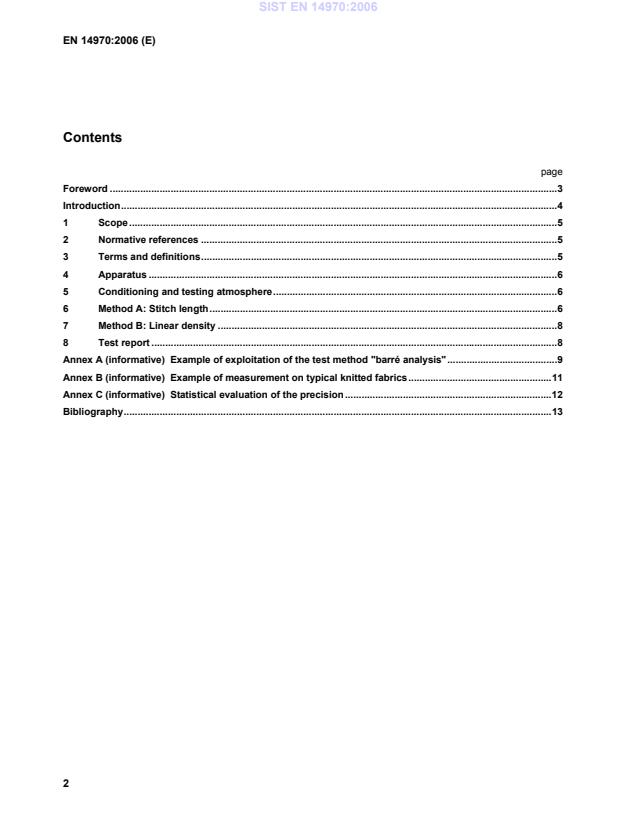
Contents
page
Foreword .3
Introduction.4
1 Scope .5
2 Normative references .5
3 Terms and definitions.5
4 Apparatus .6
5 Conditioning and testing atmosphere.6
6 Method A: Stitch length.6
7 Method B: Linear density .8
8 Test report .8
Annex A (informative) Example of exploitation of the test method "barré analysis".9
Annex B (informative) Example of measurement on typical knitted fabrics.11
Annex C (informative) Statistical evaluation of the precision.12
Bibliography.13
Foreword
This European Standard (EN 14970:2006) has been prepared by Technical Committee CEN/TC 248 “Textiles and
textile products”, the secretariat of which is held by BSI.
This European Standard shall be given the status of a national standard, either by publication of an identical text or
by endorsement, at the latest by July 2006, and conflicting national standards shall be withdrawn at the latest by
July 2006.
According to the CEN/CENELEC Internal Regulations, the national standards organizations of the following
countries are bound to implement this European Standard: Austria, Belgium, Cyprus, Czech Republic, Denmark,
Estonia, Finland, France, Germany, Greece, Hungary, Iceland, Ireland, Italy, Latvia, Lithuania, Luxembourg, Malta,
Netherlands, Norway, Poland, Portugal, Romania, Slovakia, Slovenia, Spain, Sweden, Switzerland and United
Kingdom.
Introduction
The stitch length and yarn linear density, as defined and determined within this European Standard is part of the
characterisation of a knitted fabric’s structure.
1 Scope
This European Standard specifies test methods for the determination of stitch length and yarn linear density of a
weft knitted fabric. They can be applied to warp knitted fabrics, if it is possible to de-knit the fabric.
The measurements will be applied to yarns from each knitting machine feeder and/or different patterning courses.
The results can be used for the analysis of fabric fault, e.g. barré analysis.
2 Normative references
The following referenced documents are indispensable for the application of this European Standard. For dated
references, only the edition cited applies. For undated references, the latest edition of the referenced document
(including any amendments) applies.
EN ISO 139, Textiles — Standard atmospheres for conditioning and testing (ISO 139:2005)
3 Terms and definitions
For the purposes of this European Standard, the following terms and definitions apply.
3.1
weft-knitted fabrics
generic name applied to knitted fabrics in which the stitches made by each weft thread are formed substantially
across the width of the fabric
NOTE Weft-knitted fabrics are characterised by the fact that each weft thread is fed at right angles to the direction in which
the fabric is produced.
3.2
warp-knitted fabrics
generic name applied to knitted fabrics in which the stitches made from each warp thread are formed substantially
along the length of the fabric
NOTE Warp knitted fabrics are characterised by the fact that each warp thread is fed more or less in line with the direction
in which the fabric is produced.
3.3
stitch loop
basic unit of most knitted fabrics consisting of a loop meshed at its base with a previously formed loop
3.4
stitch length
length of yarn knitted into one stitch in a weft-knitted or in a warp-knitted fabric
3.5
linear density
mass per unit length of linear textile materials
3.6
course
row of stitches across the width of a weft-knitted or of a warp-knitted fabric
3.7
wale
column of stitches along the length of a weft-knitted or of a warp-knitted fabric
3.8
rack length
480 courses of warp knitted fabric
3.9
barré
stripiness (weft knitting)
fault in weft-knitted fabric (usually knitted on multi-feeder machine) appearing as light or dark course-wise stripe(s).
In warp-knitted fabric the same fault may occur in the vertical direction
4 Apparatus
4.1 Length measurement apparatus
The apparatus for the length measurement of the yarn shall contain the following:
clamps for firmly securing the yarn ends;
the means of application of tension to the yarn being measured by the moving of one of the clamps;
a graduated measuring scale having 1 mm division positioned such that the length of yarn secured within the
clamps is included in the total length measurement.
4.2 Balance, accurate to 1 mg or better.
5 Conditioning and testing atmosphere
The standard temperate atmosphere for preconditioning, conditioning and testing textiles as specified in
EN ISO 139 shall be used.
6 Method A: Stitch lengt
...