


CEN/TR 15868:2009
(Main)Survey of national requirements used in conjunction with EN 206-1:2000
General Information
- Abstract
This CEN Report provides a summary of national requirements used with EN 206-1:2000. The aims of this
CEN Report are to:
a) provide a picture of how EN 206-1 is being applied in practice;
b) identify areas where EN 206-1 is being interpreted in different ways;
c) identify areas where CEN Member Countries have found simplification to be necessary;
d) identify additional national requirements;
e) show areas where CEN Member Countries have found it necessary to override the requirements of
EN 206-1.
EN 206-1 uses the phrase ‘national provisions’. However, recent CEN Guidance wishes to retain this term for
regulatory requirements only. This survey uses the term ‘national requirements’ to include regulations,
standards and other documents that form the basis of local practice.
As a summary of national requirements, the information in this CEN Report is incomplete and may have been
subject to later revisons. It is insufficient and not intended to provide the basis for design and specification: for
this the national requirements (see Table 1.1) should be studied.
Table 1.1 identifies CEN Member Countries who did not respond to the questionnaire. The other tables in this
CEN Report only include information from CEN Member Countries who responded and CEN Member
Countries who did not respond are not identified.
- Status
- Withdrawn
- Publication Date
- 09-Jun-2009
- Withdrawal Date
- 16-Sep-2026
- Technical Committee
- CEN/TC 104 - Concrete ( performance, production, placing and compliance criteria )
- Drafting Committee
- CEN/TC 104/SC 1 - Revision of ENV 206
- Current Stage
- 9960 - Withdrawal effective - Withdrawal
- Start Date
- 19-Dec-2018
- Completion Date
- 17-Sep-2026

Relations
- Effective Date
- 28-Feb-2018
- Effective Date
- 28-Jan-2026
Get Certified
Connect with accredited certification bodies for this standard

DIBt (Deutsches Institut für Bautechnik)
German Institute for Building Technology.
DIN CERTCO
DIN Group product certification.

Aboma Certification B.V.
Specialized in construction, metal, and transport sectors.
Sponsored listings
Frequently Asked Questions
CEN/TR 15868:2009 is a technical report published by the European Committee for Standardization (CEN). Its full title is "Survey of national requirements used in conjunction with EN 206-1:2000". This standard covers: This CEN Report provides a summary of national requirements used with EN 206-1:2000. The aims of this CEN Report are to: a) provide a picture of how EN 206-1 is being applied in practice; b) identify areas where EN 206-1 is being interpreted in different ways; c) identify areas where CEN Member Countries have found simplification to be necessary; d) identify additional national requirements; e) show areas where CEN Member Countries have found it necessary to override the requirements of EN 206-1. EN 206-1 uses the phrase ‘national provisions’. However, recent CEN Guidance wishes to retain this term for regulatory requirements only. This survey uses the term ‘national requirements’ to include regulations, standards and other documents that form the basis of local practice. As a summary of national requirements, the information in this CEN Report is incomplete and may have been subject to later revisons. It is insufficient and not intended to provide the basis for design and specification: for this the national requirements (see Table 1.1) should be studied. Table 1.1 identifies CEN Member Countries who did not respond to the questionnaire. The other tables in this CEN Report only include information from CEN Member Countries who responded and CEN Member Countries who did not respond are not identified.
This CEN Report provides a summary of national requirements used with EN 206-1:2000. The aims of this CEN Report are to: a) provide a picture of how EN 206-1 is being applied in practice; b) identify areas where EN 206-1 is being interpreted in different ways; c) identify areas where CEN Member Countries have found simplification to be necessary; d) identify additional national requirements; e) show areas where CEN Member Countries have found it necessary to override the requirements of EN 206-1. EN 206-1 uses the phrase ‘national provisions’. However, recent CEN Guidance wishes to retain this term for regulatory requirements only. This survey uses the term ‘national requirements’ to include regulations, standards and other documents that form the basis of local practice. As a summary of national requirements, the information in this CEN Report is incomplete and may have been subject to later revisons. It is insufficient and not intended to provide the basis for design and specification: for this the national requirements (see Table 1.1) should be studied. Table 1.1 identifies CEN Member Countries who did not respond to the questionnaire. The other tables in this CEN Report only include information from CEN Member Countries who responded and CEN Member Countries who did not respond are not identified.
CEN/TR 15868:2009 is classified under the following ICS (International Classification for Standards) categories: 91.100.30 - Concrete and concrete products. The ICS classification helps identify the subject area and facilitates finding related standards.
CEN/TR 15868:2009 has the following relationships with other standards: It is inter standard links to CEN/TR 15868:2018, EN 206-1:2000. Understanding these relationships helps ensure you are using the most current and applicable version of the standard.
CEN/TR 15868:2009 is available in PDF format for immediate download after purchase. The document can be added to your cart and obtained through the secure checkout process. Digital delivery ensures instant access to the complete standard document.
Standards Content (Sample)
SLOVENSKI STANDARD
01-september-2009
Pregled nacionalnih zahtev, ki se uporabljajo skupaj z EN 206-1:2000
Survey of national requirements used in conjunction with EN 206-1:2000
Überblick nationaler Anforderungen, die im Zusammenhang mit EN 206-1:2000
verwendet werden
État des prescriptions nationales utilisées avec l'EN 206-1:2000
Ta slovenski standard je istoveten z: CEN/TR 15868:2009
ICS:
91.100.30 Beton in betonski izdelki Concrete and concrete
products
2003-01.Slovenski inštitut za standardizacijo. Razmnoževanje celote ali delov tega standarda ni dovoljeno.
TECHNICAL REPORT
CEN/TR 15868
RAPPORT TECHNIQUE
TECHNISCHER BERICHT
June 2009
ICS 91.100.30
English Version
Survey of national requirements used in conjunction with EN
206-1:2000
État des prescriptions nationales utilisées avec l'EN 206- Überblick nationaler Anforderungen, die im
1:2000 Zusammenhang mit EN 206-1:2000 verwendet werden
This Technical Report was approved by CEN on 3 February 2009. It has been drawn up by the Technical Committee CEN/TC 104.
CEN members are the national standards bodies of Austria, Belgium, Bulgaria, Cyprus, Czech Republic, Denmark, Estonia, Finland,
France, Germany, Greece, Hungary, Iceland, Ireland, Italy, Latvia, Lithuania, Luxembourg, Malta, Netherlands, Norway, Poland, Portugal,
Romania, Slovakia, Slovenia, Spain, Sweden, Switzerland and United Kingdom.
EUROPEAN COMMITTEE FOR STANDARDIZATION
COMITÉ EUROPÉEN DE NORMALISATION
EUROPÄISCHES KOMITEE FÜR NORMUNG
Management Centre: Avenue Marnix 17, B-1000 Brussels
© 2009 CEN All rights of exploitation in any form and by any means reserved Ref. No. CEN/TR 15868:2009: E
worldwide for CEN national Members.
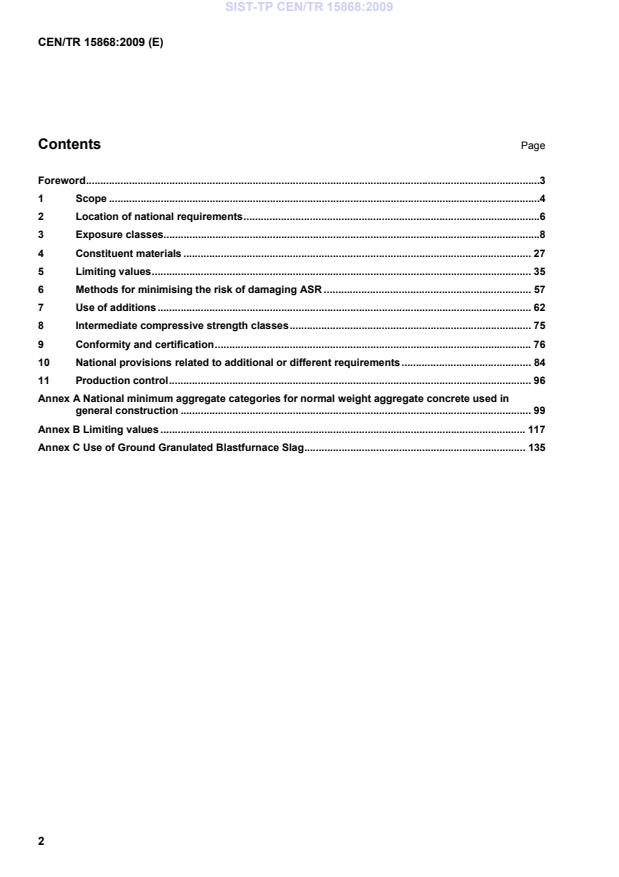
Contents Page
Foreword .3
1 Scope .4
2 Location of national requirements .6
3 Exposure classes.8
4 Constituent materials . 27
5 Limiting values . 35
6 Methods for minimising the risk of damaging ASR . 57
7 Use of additions . 62
8 Intermediate compressive strength classes . 75
9 Conformity and certification . 76
10 National provisions related to additional or different requirements . 84
11 Production control . 96
Annex A National minimum aggregate categories for normal weight aggregate concrete used in
general construction . 99
Annex B Limiting values . 117
Annex C Use of Ground Granulated Blastfurnace Slag . 135
Foreword
This document (CEN/TR 15868:2009) has been prepared by Technical Committee CEN/TC 104 “Concrete
and related products”, the secretariat of which is held by DIN.
Attention is drawn to the possibility that some of the elements of this document may be the subject of patent
rights. CEN [and/or CENELEC] shall not be held responsible for identifying any or all such patent rights.
1 Scope
This CEN Report provides a summary of national requirements used with EN 206-1:2000. The aims of this
CEN Report are to:
a) provide a picture of how EN 206-1 is being applied in practice;
b) identify areas where EN 206-1 is being interpreted in different ways;
c) identify areas where CEN Member Countries have found simplification to be necessary;
d) identify additional national requirements;
e) show areas where CEN Member Countries have found it necessary to override the requirements of
EN 206-1.
EN 206-1 uses the phrase ‘national provisions’. However, recent CEN Guidance wishes to retain this term for
regulatory requirements only. This survey uses the term ‘national requirements’ to include regulations,
standards and other documents that form the basis of local practice.
As a summary of national requirements, the information in this CEN Report is incomplete and may have been
subject to later revisons. It is insufficient and not intended to provide the basis for design and specification: for
this the national requirements (see Table 1.1) should be studied.
Table 1.1 identifies CEN Member Countries who did not respond to the questionnaire. The other tables in this
CEN Report only include information from CEN Member Countries who responded and CEN Member
Countries who did not respond are not identified.
Members of Ad Hoc Group
Professor Tom Harrison, Convenor Dr. Ir. Hans Cornelissen
Dipl.-Ing. Anette Berrig Dr. Michel Delort
Dr. Ir. Claude Bleiman Dr. John Moore
Dr. Manuel Burόn Dipl.-Ing. Udo Wiens
CEN Member Countries CEN Member Countries
Austria AT Latvia LV
Belgium BE Lithuania LT
Cyprus CY Luxembourg LU
Czech Republic CZ Malta MT
Denmark DK Netherlands NL
Estonia EE Norway NO
Finland FI Poland PL
France FR Portugal PT
Germany DE Slovakia (Slovak Republic) SK
Greece GR Slovenia SI
Hungary HU Spain ES
Iceland IS Sweden SE
Ireland IE Switzerland CH
Italy IT United Kingdom UK
Affiliates
Albania AL
Bulgaria BG
Croatia (Hrvatska) HR
Romania RO
Turkey TR
2 Location of national requirements
Table 1.1 gives the title of the documents that contain the national requirements, together with an English
translation of the title. Any person wishing to design and specify concrete in another CEN Member Country
should consult the documents cited in Table 1.1. Please note that the documents will be written in the national
language(s) of the CEN Member Country. It should also be noted that the survey was conducted during 2005
to 2006 and the answers reflect practice at that time, which may not be the same as current practice.
Table 1.1 — Location of national requirements
CEN Member
Location of national requirements
a
Countries
Austria ÖNORM B 4710-1: Beton — Teil 1: Festlegung, Herstellung, Verwendung und
Konformitätsnachweis (Regeln zur Umsetzung der ÖNORM EN 206-1)
(Concrete — Part 1: Specification, production, use and verification of conformity (Rules for
the implementation of ÖNORM EN 206-1))
Belgium NBN B 15-001: Supplément à la NBN EN 206-1 — Béton — Spécification, performances,
production et conformité
NBN B 15-001: Aanvulling op NBN EN 206-1 — Beton — Eisen, gedraging, vervaardiging
en conformiteit (Supplement to NBN EN 206-1: Concrete — Specification, performance,
production and conformity)
Cyprus No response received
Czech Republic CSN EN 206-1 Zmena Z2
Denmark DS 2426: Beton — Materialer — Regler for anvendelse af EN 206-1 i Danmark
(Concrete — Materials — Rules for the use of EN 206-1 in Denmark)
Estonia No response received
Finland Suomen rakentamismääräyskokoelma, B4 Betonirakenteet, Liite 3: Kansallinen liite
standardiin SFS-EN 206-1 (National Building Code of Finland, B4 Concrete structures,
Annex 3: national Annex to standard SFS-EN 206-1)
Informative Guidance document: Betoninormit 2004, Suomen Betoniyhdistys
(Concrete Code, Finnish Concrete Association)
France National annex included in the NF EN 206-1 standard
Germany DIN 1045-2: Tragwerke aus Beton, Stahlbeton und Spannbeton — Teil 2: Beton —
Festlegung, Eigenschaften, Herstellung und Konformität — Anwendungsregeln zu
DIN EN 206-1
(DIN 1045-2: Concrete, reinforced and prestressed concrete structures — Part 2:
Concrete — Specification, properties, production and conformity — Application rules for
DIN EN 206-1)
Greece No response received
Hungary No response received
Iceland No response received
Ireland National Annex; published with I.S. EN 206-1 as a single document.
Italy UNI 11104: Calcestruzzo — Specificazione, prestazione produzione e conformità Istruzioni
complementari per l’applicazione della EN 206-1
(Concrete — Specification, performance, production and conformity, Additional provisions
for the application of EN 206-1)
Table 1.1 (continued)
CEN Member
Location of national requirements
a
Countries
Latvia No response received
Lithuania No response received
Luxembourg DNA EN 206: Document National d’Application luxembourgeois de l’EN 206-1: Béton —
Partie 1: Spécification, performances, production et conformité
(DNA EN 206: Luxemburgish national application document of the EN 206-1: Concrete —
Part 1: specification, performance, production and conformity)
Malta There are no national provisions, but in the past, local industry has used recommendations
in European, British or German standards
Netherlands NEN 8005:2004: Nederlandse invulling van NEN-EN 206-1: Beton — Deel 1: Specificatie,
eigenschappen, vervaardiging en conformiteit
(Dutch supplement to NEN-EN 206-1: Concrete — Part 1: Specification, performance,
production and conformity)
Norway NS-EN 206-1 National Annex
Poland No response received
Portugal The Portuguese requirements are in the National Annex to NP EN 206-1 and to
NP ENV 13670-1 and in the following National Civil Engineering Laboratory (LNEC)
specifications, referenced in the NA of NP EN 206-1
LNEC E 461:2004: Metodologia para prevenir reacções expansivas internas (Methodology
for avoiding internal expansive reactions)
LNEC E 464:2005: Metodologia prescritiva para uma vida útil de 50 e 100 anos face às
acções ambientais
(Prescritive methodology for a 50 and 100 years design working life under the
environmental exposures)
LNEC E 465:2005: Metodologia para estimar as propriedades de desempenho do betão
que permitam satisfazer a vida útil de projecto de estruturas de betão armado ou
pré-esforçado sob as exposições ambientais XC e XS (Methodology for estimating the
concrete performance properties allowing to comply with the design working life of the
reinforced or prestressed concrete structures under the environmental exposures XC and
XS)
Slovakia STN EN 206-1: Zmena 1 Concrete — Part 1: Specification, performance, production and
conformity supplements EN 206-1 with the national provisions
STN 731210: Water-proof concrete and concrete types of the specific characteristics
(Resistance to abrasion, Concrete for the massive constructions — Low hydrating warmth)
Slovenia SIST 1026: Beton — 1.del: Specifikacija, lastnosti, proizvodnja in skladnost — Pravila za
uporabo SIST EN 206-1
(SIST 1026: Concrete — Part 1: Specification, performance, production and conformity—
Rules for the implementation of SIST EN 206-1)
Spain Spain has not adopted EN 206-1
Sweden SS 13 70 03: Betong – Användning av EN 206-1 I Sverige
(Concrete — Application of EN 206-1 in Sweden)
Vägledning för val av exponeringsklass enligt SS-EN 206-1, Betongrapport nr 11, Svenska
Betongföreningen (Guidance for selection of exposure class according to SS-EN 206-1,
Concrete report No 11, Swedish Concrete Association)
Table 1.1 (continued)
CEN Member
Location of national requirements
a
Countries
Switzerland SN EN 206-1:2000: Beton — Teil 1: Festlegung, Eigenschaften, Herstellung und
Konformität (mit Nationalem Vorwort und Nationalem Anhang)
(SN-EN 206-1:2000: Concrete — Part 1: Specification, performance, production and
conformity (with National Preface and National Annex))
SN EN 206-1:2000/A1:2004: Beton — Teil 1: Festlegung, Eigenschaften, Herstellung und
Konformität
(SN EN 206-1:2000/A2:2005: Concrete — Part 1: Specification, performance, production
and conformity)
Ergänzung zum Nationalen Anhang NB der Norm SN EN 206-1:2000: Teil 1: Verwendung
von Zementen und Zusatzstoffen gemäss dem Prinzip der gleichwertigen
Betonleistungsfähigkeit (in Arbeit)
(Amendments to the National Annex of the SN EN 206-1: Part 1: Use of cements and
mineral additions according to the equivalent performance concept of concrete properties
(in preparation))
Ergänzung zum Nationalen Anhang der Norm SN EN 206-1:2000: Teil 1: Anwendung des
k-Wert Konzeptes gemäss dem Prinzip der gleichwertigen Betonleistungsfähigkeit (in
Arbeit); der Anhang wird Nationaler Anhang NC genannt (Application of the k-value
concept according to the principle of the equivalent concrete performance)
United Kingdom BS 8500: Concrete — Complementary British Standard to BS EN 206-1
— Part 1: Method of specifying and guidance for the specifier
— Part 2: Specification for constituent materials and concrete
a
None of the CEN affiliates chose to respond to this survey.
3 Exposure classes
In Table 2.1 exposure classes that have been grouped together are given. A significant number of
CEN Member Countries have found the need to simplify the system. In its simplest form this reduces to
interior, outside, severe and (chemically) aggressive. A significant number of CEN Member Countries have
grouped classes (not always in the same way). For example, XC3 and XC4 are grouped together and often
the XF1 is combined with XC4 and XF2 with XD3 or the concrete quality is the same. However, not all
CEN Member Countries have to consider freeze-thaw action and so it may not be possible to group the
carbonation-induced corrosion exposure classes (XC) and freeze-thaw exposure classes (XF) at a CEN level.
The reasons for grouping them together vary and include:
a) simplifying the system to meet local needs;
b) one exposure class cannot exist without the other exposure class in the local environment;
c) not easy for engineers to select one exposure from another;
d) the resulting concrete specification is the same.
Some CEN Member Countries have not grouped the exposure classes, but have the same quality of concrete
for several exposure classes. If they are following EC2, this may lead to different minimum covers to
reinforcement, but the same concrete quality.
As the examples in EN 206-1:2000, Table 1 are informative, Table 2.2 shows the extent to which the
informative examples have been adopted in CEN Member Countries and gives the additional national
examples of these exposure classes. There is a clear message in the responses showing that the informative
examples for the XC1 and XC2 exposures should clearly identify that the water is non-aggressive.
The responses to Table 2.3 show that EN 206-1, Table 2 is applied to the majority of situations in
CEN Member Countries including mobile groundwater. As such the limitation in Table 2 to static groundwater
should be reviewed.
The principle of classification by deterioration process has been widely accepted. However, there seems to be
a need to review the sub-divisions of the exposure classes as part of the review of durability to see if
simplification is possible. Any changes to exposure classes should be co-ordinated with changes to the design
codes.
The fib model code on service life design may lead to a better way of sub-dividing the exposure classes, but it
is premature to take this path until the models have been thoroughly checked for robustness, reality,
sensitivity, reliability and economy.
NOTE 1 It may be appropriate to review EN 206-1, annexes E and J.
NOTE 2 In future reviews of EN 206-1, it may be possible to use the fib model code to define the exposures in terms of
relative humidity, temperature and days of rainfall, the performance requirements in terms of carbonation resistance and
‘deemed to satisfy’ limiting values, but in the view of the ad hoc group this is not achievable for the 2010 revision of
EN 206-1.
If it is decided to keep the exposure class as a designation for a concrete, an alternative approach to exposure
sub-classes would be to create sets of concretes for each main exposure class. CEN Member Countries
would then be free to select the appropriate designations for their ‘indoor’ and ‘outdoor’ exposures.
Table 2.4 assesses the extent to which CEN Member Countries select the same exposure classes for the
same elements. There is a clear difference in view over whether indoor reinforced concrete should be classed
as X0 or XC1. This is sometimes reinforced by defining the relative humidity for the X0 exposure at low values
that are unlikely to exist in normal buildings. The need to allow the designer some flexibility to select the
appropriate class is also a common feature of this table. The inclusion of a freeze-thaw exposure class
reflects local conditions.
Table 2.1 — Exposure classes that have been grouped together
CEN Member
Grouped exposure classes
Countries
Austria (XC1) = XC1 (A)
(XC2, XC3, XC4) = XC2 (A)
Belgium In Belgium exposure classes are recommended in an indirect way. They are linked to
“environmental classes”. “Environmental classes” are defined as environments which are
very relevant to the Belgian concrete practice. They are indicated by the letter E (for
Environment), followed by a letter (I for Interior, E for Exterior, S for Seawater, A for
Aggressive) and a numeral for a more detailed description. For each environmental class
the relevant exposure classes are identified for unreinforced and reinforced concrete.
Czech Republic -
Denmark (X0, XC1) = Interior
(XC2, XC3, XC4, XF1, XA1) = Exterior without risk of water saturation
(XD1, XS1, XS2, XF2) = Exterior with risk of water saturation and additional
chlorides/alkalis to the surface
(XD2, XD3, XS3, XF4, XA3) = Severe exterior with risk of accumulation of
chlorides/alkalis
Finland None
Table 2.1 (continued)
CEN Member
Grouped exposure classes
Countries
France (XC1, XC2)
(for in-situ (XC3 XC4, XD1, XF1)
concrete) (XS1, XS2)
Germany (XD1, XS1); (XD2, XS2); (XD3, XS3) – grouped with respect to limiting values of concrete
composition
Ireland None
Italy (XC1, XC2), (XS2, XS3), (XF2, XF3) in table ‘Limiting values for composition and
properties of concrete’ (UNI 11104)
Luxembourg No grouping for the specification!
Following exposure classes shows equal values for the limits of composition:
(XC1, XC2)
(XC3, XC4)
(XD1, XD2)
(XF2, XF3)
The exposure classes must be considered and documented separately for the
specification
Netherlands None
Norway This depends on the matter under consideration. Groups might be different with respect
to different matters such as, concrete composition, concrete cover, crack width
requirements etc.
With respect to concrete composition the following can be considered a grouping:
(X0)
(XC1,XC2, XC3, XC4, XF1)
(XD1, XS1, XA1, XA2, XA4*)
*XA4 is a special class for manure in agricultural buildings
(XF2, XF3, XF4)
(XD2, XD3, XS2, XS3, XA3)
(XSA*)
*XSA is a special class for particularly aggressive environments, other environments than
those above
Portugal (XS, XD); (XC4, XF1)
Slovakia None so far, but we suggest (XC3, XC4) and (XD1, XD2) to be merged together
Slovenia None
Sweden No classes have been grouped
Switzerland None
United Kingdom (XC3, XC4)
and
In 2006 revision of BS 8500-1, the recommendations for resisting the XD and XS
Northern Ireland
exposures are adequate for resisting the associated XC exposure
Table 2.2 — Examples of exposure classes
Class
Examples where exposure classes may occur
designation
Adopted locally
X0 Examples from EN 206-1, Table 1
Yes No
a
Concrete inside buildings with very low air humidity CH CZ BE FI AT DE
b
FR IE IT LU DK
c
NL NO PT UK
SI SE SK
Other local examples
Humidity below 35 % AT
A very dry environment is not (or rarely) found in Belgium BE
Unreinforced concrete basements in environment without frost CZ
Unreinforced concrete inside buildings
Concrete inside buildings with low air humidity
Foundations below ground for low and normal safety classes
Information guidance: dry, heated indoor spaces FI
DE
Foundations without reinforcement or without embedded metal and
not subjected to freeze/thaw attack; interior components without
reinforcement or without embedded metal
House strip foundations, unreinfoced or nominally reinforced; in IE
non-aggressive soils
Unreinforced concrete inside buildings. Unreinforced concrete IT
either placed below grade or submerged in non-aggressive water.
Unreinforced concrete undergoing cycles of drying and wetting but
not subjected to abrasion, frost or chemical attacks
Unreinforced concrete. Concrete permanently submerged in NL SE
non-aggressive water
Certain soil-covered foundations (non-aggressive soil/water) UK PT
Unreinforced concrete surfaces inside structures. Unreinforced
concrete completely buried in non-aggressive soil. Unreinforced
concrete permanently submerged in non-aggressive water
Unreinforced concrete in cyclic wet and dry conditions not subject
to abrasion, freezing or chemical attack
Reinforced concrete in structures with very low air humidity PT
Permanent relative air humidity of less than 30 %. Concrete of the SK
foundations without reinforcement and without freeze/thaw
Adopted locally
XC1 Examples from EN 206-1, Table 1
Yes No
d
Concrete inside buildings with low air humidity CH CZ BE AT DE
DK FR IE IT
LU NL SI NO
PT SE SK UK
Concrete permanently submerged in (non-aggressive) water BE DE SI PT DK
Other local examples
d
Parts of structures inside buildings with low air humidity (inc CZ
kitchens, bathrooms & laundries) in residential buildings
Unsplashy bridges elements in contact with air
Foundations below ground for low and normal safety classes DK
Table 2.2 (continued)
Class
Examples where exposure classes may occur
designation
Bathrooms, stairways, structures below the water level. Inner FI
surface of a layered wall surface. Underwater parts of bridges
Components in rooms with normal air humidity (inc kitchens, DE
bathrooms, laundries in residential buildings); concrete
permanently submerged in water
Ordinary reinforced concrete or prestressed concrete with surfaces IT
inside structures, excepting parts exposed to condensation or
submerged in water
Permanent relative air humidity between 30 % to 60 % SK
Adopted locally
XC2 Examples from EN 206-1, Table 1
Yes No
Concrete surfaces subject to long-term (non-aggressive) water CH BE FR DE
contact IT LU NL NO
UK SI SE PT
e
AT SK
Many foundations BE FI PT
SI DE IE
Other local examples
Parts of water tanks CZ
Foundations partly above ground DK
Foundations below ground for high safety class
External walls, columns and facades
External beams with sheltered top surface
Structural parts in contact with slightly aggressive chemical water
Bridge foundations, transition slabs FI
Parts of water tanks; foundation members DE
Portions of structures devised for containing liquids, foundations. IT
Ordinary reinforced or prestressed concrete mainly submerged in
water or below non-aggressive grade
Reinforced and prestressed concrete completely buried in UK
non-aggressive soil
Reinforced concrete into non-aggressive soil PT
Permanent relative air humidity of over 85 %. Parts of the water SK
tanks, inside areas like canteens, bathrooms, laundries, areas of
the sheltered pools and stables
Table 2.2 (continued)
Class
Examples where exposure classes may occur
designation
Adopted locally
XC3 Examples from EN 206-1, Table 1
Yes No
f
Concrete inside buildings with moderate or high air humidity CH CZ BE DK PT
FR DE IT LU
NL NO UK SI
SE SK
External concrete sheltered from rain BE DE IE UK PT
SI IT
Other local example
Parts of structures in contact with outside air e.g. halls, interiors CZ DE PT
with high air humidity (kitchens of community feeding, bath,
laundries, swimming-pools, stables
Foundations partly above ground DK
Foundations below ground for high safety class
External walls, columns and facades
External beams with sheltered top surface
Structural parts in contact with slightly aggressive chemical water
Facades and other vertical outdoor surfaces sheltered from rain. FI PT
Car park slabs swimming baths, saunas, industrial kitchens, many
industrial buildings. Bridge superstructures sheltered from rain such
as lower surfaces of decking slabs and beams, beams, columns,
retaining walls and abutments and intermediate supports
Either ordinary reinforced or prestressed concrete placed outdoors IT
with external surfaces protected from rain or placed inside buildings
with moderate to high air humidity
Permanent relative air humidity between 60 % to 85 %. Parts of SK
buildings that are in permanent or temporary contact with the
outside air, e.g. open space halls
None given as grouped with XC4 UK
Adopted locally
XC4 Examples from EN 206-1, Table 1
Yes No
Concrete surfaces subject to water contact, not within exposure CH BE FI FR DE DK
class XC2 IE IT LU NL
NO PT UK SI
SE SK
Other local examples
Outside buildings parts from concrete exposed to rain CZ DE
Foundations partly above ground DK
Foundations below ground for high safety class
External walls, columns and facades
External beams with sheltered top surface
Structural parts in contact with slightly aggressive chemical water
Balcony slabs, facades exposed to rain, footings. Bridge structures FI
exposed to rain such as edge beams, lateral sides of abutments,
retaining walls, columns
Either ordinary reinforced or prestressed concrete place outdoors IT
with surfaces undergoing alternatively dry and wet cycles.
Architectural concrete in urban settings. Surfaces in contact with
water not included in the XC2 class
Reinforced concrete under dry-wet cycles PT
Reinforced and prestressed concrete surfaces exposed to alternate UK
wetting and drying
Table 2.2 (continued)
Class
Examples where exposure classes may occur
designation
Adopted locally
XD1 Examples from EN 206-1, Table 1
Yes No
Concrete surfaces exposed to airborne chlorides CH BE FI FR AT
DE IE IT LU DK
NL NO PT UK
SI SE SK
Other local examples
Parts of traffic areas, individual garage CZ DE
External deck slabs, staircases and retaining walls DK
External beams without sheltered top surface
Light shafts
External basement walls partly above ground
Canals and other structural parts in contact with moderately
aggressive chemical water
Noise barriers on road sides. Indoor spaces of swimming baths FI
Either ordinary reinforced or prestressed concrete used for portions IT
of bridges and viaducts exposed to chloride-containing water sprays
Garages SK
Reinforced and prestressed concrete surfaces in parts of bridges UK
away from direct spray containing de-icing agents. Parts of
structures exposed to occasional or slight chloride conditions
Adopted locally
XD2 Examples from EN 206-1, Table 1
Yes No
Swimming pools CH BE FI FR AT
g
(DE) IT LU NL UK
NO PT SI SE
SK
g
Concrete exposed to industrial waters containing chlorides BE DE IE PT UK
SI
Other local examples
Salt water baths; components exposed to industrial waters DE
containing chlorides (Note: special requirements for concrete
bridges and tunnels)
External parking decks, balconies, balcony accesses and staircases DK
Swimming pools
Bridge column and edge beams
Marine structures
Structural parts in contact with highly aggressive chemical water
Either ordinary reinforced or prestressed concrete used for IT
structural elements that are totally submerged in water, including
also chloride-containing industrial water (swimming pools)
Table 2.2 (continued)
Class
Examples where exposure classes may occur
designation
Adopted locally
XD3 Examples from EN 206-1, Table 1
Yes No
Parts of bridges exposed to spray containing chlorides CH BE FI FR AT DE
IT LU NL NO
PT SE SK
Pavements BE DE IE PT
Car park slabs BE (DE) PT
Other local examples
Parts of bridges & engineering structures exposed to water with CZ
chlorides
External parking decks, balconies, balcony accesses and DK
staircases
Swimming pools
Bridge column and edge beams
Marine structures
Structural parts in contact with highly aggressive chemical water
Heated garages, bridge parts exposed to de-icing agents, such as FI
edge beams, transition slabs, concrete railings, bridge piers and
abutments and intermediate supports exposed to salty fog
Parts of bridges frequently exposed to splashing; pavements; car DE
park slabs (only with additional measures, i.e. crack-covering
coating).
(NOTE Special requirements for concrete bridges and tunnels).
Either ordinary reinforced or prestressed concrete; structural IT
elements directly subjected to de-icing agents or sprays containing
de-icing agents. Either ordinary reinforced or prestressed concrete:
element with one side submerged in chloride-containing water and
the other one exposed to air. Portions of bridges, pavements and
parking lots
Reinforced and prestressed concrete surfaces directly affected by UK SE
de-icing salts or spray containing de-icing salts (e.g. walls,
abutments and columns within 10 m of the carriageway, parapet
edge beams and buried structures less than 1 m below
carriageway level)
All bridges SK
In Portugal, these examples shall generally be considered to PT
belong to the exposure class XD1
Table 2.2 (continued)
Class
Examples where exposure classes may occur
designation
Adopted locally
XS1 Examples from EN 206-1, Table 1
Yes No
h
Structures near to or on the coast BE FI FR CH LU
DE IE IT NL PT SK
NO UK SE
Other local examples
External components near to the coast DE
External deck slabs, staircases and retaining walls DK
External beams without sheltered top surface
Light shafts
External basement walls partly above ground
Canals and other structural parts in contact with moderately
aggressive chemical water
Reinforced concrete in salt saturated maritime ambient. Reinforced PT
concrete in coastal areas less than 200 m from the sea, directly
exposed to air salts. This distance may be increased to 1 km in
plane coastal areas and in the mouth of rivers
Adopted locally
XS2 Examples from EN 206-1, Table 1
Yes No
Parts of marine structures FI FR (DE) CH LU
IE IT NL NO PT SK
i
UK SE
Other local examples
Permanently submerged components in harbours DE
External deck slabs, staircases and retaining walls DK
External beams without sheltered top surface
Light shafts
External basement walls partly above ground
Canals and other structural parts in contact with moderately
aggressive chemical water
Either ordinary reinforced or prestressed concrete of marine IT
structures totally under water
Reinforced and prestressed concrete completely submerged and UK PT
remaining saturated, e.g. concrete below mid-tide level
Table 2.2 (continued)
Class
Examples where exposure classes may occur
designation
Adopted locally
XS3 Examples from EN 206-1, Table 1
Yes No
Parts of marine structures BE FR (DE) CH LU
IE IT NL NO PT SK
i
UK SE
Other local examples
External parking decks, balconies, balcony accesses and staircases DK
Swimming pools
Bridge column and edge beams
Marine structures
Structural parts in contact with highly aggressive chemical water
Parts of marine and bridge structures exposed to fluctuation and FI
splashing of sea water such as intermediate supports
Quay walls DE
Either ordinary reinforced or prestressed concrete with structural IT
elements at the water’s edge or exposed to sea water sprays and
waves
Reinforced and prestressed concrete surfaces in the upper tidal UK
zones and the splash and spray zones
Reinforced concrete in tidal, splash and spray zones, from 1 m below PT
the minimum tidal to 10 m above maximum tidal, namely on the west
coast of Portugal and on the Azores and Madeira islands. Reinforced
concrete in which one of the surfaces is immersed in sea water and
the other is air exposed (e.g. submerged tunnels). This exposure will
require eventually supplementary protection measures
Adopted locally
XF1 Examples from EN 206-1, Table 1
Yes No
Vertical concrete surfaces exposed to rain and freezing AT CH BE FI
k
FR (DE) IE
IT LU NL NO
PT UK SE SK
Other local examples
Facades, footings. Parts of bridge on roads outside the de-icing route FI
such as decking slab, beams abutments and intermediate supports
External components DE
Foundations partly above ground DK
Foundations below ground for high safety class
External walls, columns and facades
External beams with sheltered top surface
Structural parts in contact with slightly aggressive chemical water
Vertical concrete elements, e.g. façades and columns, exposed to IT
rain and freezing. Non-vertical surfaces not subjected to complete
saturation but exposed to freezing, rain or water
Non-vertical concrete surfaces not highly saturated, but exposed to NL UK PT
freezing and to rain or water
Facades of buildings and columns, parts of buildings not too wet
Inner parts of unheated industrial buildings, inside of silos, tunnels SE
and other structures not exposed to rain but in humid conditions and
exposed to freezing
Table 2.2 (continued)
Class
Examples where exposure classes may occur
designation
Adopted locally
XF2 Examples from EN 206-1, Table 1
Yes No
Vertical concrete surfaces of road structures exposed to freezing and AT CH BE FI PT
k
airborne de-icing agents FR IE IT LU (DE)
NL NO UK SE
SK
Other local examples
External deck slabs, staircases and retaining walls DK
External beams without sheltered top surface
Light shafts
External basement walls partly above ground
Canals and other structural parts in contact with moderately
aggressive chemical water
Noise barriers and footings on road sides. Parts of bridges on roads FI
on the de-icing route, for example surface structure beams and
decking slabs, abutments and intermediate supports
Concrete members in spray and splash zones of traffic areas, with DE
de-icing agent (mainly vertical concrete members) (other than XF4);
sea water spray zone
Elements like bridge portions, otherwise classified as XF1 that are IT
exposed, either directly or indirectly, to de-icing agents
Concrete surfaces not highly saturated, but exposed to freezing and NL
to rain or water including de-icing agents
De-icing agents are not directly in contact with the concrete surface. SK
E.g. parts of the anti-noise walls, supporting walls, and those not
included in XF4
Non-vertical concrete surfaces exposed to rain or freezing PT
Adopted locally
XF3 Examples from EN 206-1, Table 1
Yes No
Horizontal concrete surfaces exposed to rain and freezing AT CH BE FI DE
k
FR IE IT LU NL PT
NO UK SE SK
Other local examples
Opened water tanks. Structure parts in zone with variation of fresh CZ
water, spillway blocks of hydraulic structures
External deck slabs, staircases and retaining walls DK
External beams without sheltered top surface
Light shafts
External basement walls partly above ground
Canals and other structural parts in contact with moderately
aggressive chemical water
Balconies, bridge columns and other structures at the water level of FI
inland water, dam structures, fresh water basins. Bridge parts on
roads outside the de-icing route, for example edge beams transition
slabs, column-like intermediate supports, base plates of frame bridges
and unprotected structures in water fluctuation area of waterway
bridges
Open water tanks; components in fresh water tidal zone DE
Horizontal building surfaces where water can accumulate and that IT
may be exposed to freezing; elements exposed to frequent wetting
and freezing
All concrete surfaces NL
Table 2.2 (continued)
Class
Examples where exposure classes may occur
designation
(XF3) External parts of buildings that are often subject to water and freezing, SK
e.g. open-space water tanks, parts of buildings with variable surfaces
of sweet-water level. Overflow parts of water buildings
Horizontal concrete surfaces, such as parts of buildings, where water UK
accumulates and which are exposed to freezing. Elements subjected to
frequent splashing with water and exposed to freezing
Adopted locally
XF4 Examples from EN 206-1, Table 1
Yes No
Road and bridge decks exposed to de-icing agents AT CH BE DE PT
k
FI FR IT
LU NL NO
UK SI SE
SK
Concrete surfaces exposed to direct spray containing de-icing agents BE IE UK UK
and freezing
Splash zones of marine structures exposed to freezing BE
Other local examples
Water tanks at the roads, concrete crash barriers CZ
External parking decks, balconies, balcony accesses and staircases DK
Swimming pools
Bridge column and edge beams
Marine structures
Structural parts in contact with highly aggressive chemical water
Parking levels, surface layers, garages. Edge beams, transition slabs, FI
concrete railings of de-icing roads, base plates of frame bridges
intermediate supports, when the road travelling beneath the bridge is
de-iced. Unprotected structures of bridges in sea water from the level
NW-1upwards
Traffic areas treated with de-icing agents; predominantly horizontal DE
components exposed to spray form traffic areas treated with de-icing
agents; scraper raceways in sewage treatment plant; components in
sea tidal zone
Horizontal surfaces, e.g. roads and pavements, exposed to freezing IT
and to the direct/indirect action of de-icing salts, elements exposed to
freezing and to frequent wetting in the presence of de-icing salts or sea
water
For road and bridge decks a special standard is used in Slovakia. SK
Similar to EN 13877. Local examples: constructions near the roads that
are exposed to direct spray containing de-icing agents, e.g. pavement
kerbs, leaders and gadroons, safety barriers, tanks near roads
Outdoor swimming pools SE
a
Very low defined as a relative humidity less than 30 %
b
Not applicable to pre-stressed concrete
c
Only if unreinforced
d
Low defined as a relative humidity of 30 % to 60 %
e
Grouped with XC3 and XC4
f
Moderate defined as a relative humidity of 60 % to 85 %, or high, more than 85 %
g
The answer would be ‘yes’ for elements that are totally immersed in water containing chlorides
h
Up to 1 km from the sea shore
I
This example considered to be too vague to be of any practical use
k
When the destination of the concrete in a structure is not precisely defined, selection of exposure class is made in accordance with
its location following guidance given in the national annex to EN 206-1
Additional examples for XA exposures from the Czech Republic and Slovakia
Other local examples for XA exposures
XA1
Tanks of sewage clarification plants, cesspools, septic tanks, buildings basements CZ
Slightly aggressive chemical environment according to table 2. Tanks of water purifying SK
plants, sumps, septic tanks and foundations
XA2
Building parts in corrosive foundation soil, buildings basements CZ
Moderately aggressive chemical environment according to table 2. Foundations on SK
buildings in aggressive soils
XA3
Manufacturing tanks of sewage clarification plants with chemical corrosive water, CZ
basements of buildings, stores for chemical de-icing substances and soil conditioners.
d f
Bunkers in farm sector. Cooling towers with industrial smoke. (See and )
Highly aggressive chemical environment according to table 2. Industrial water purifying SK
plants with chemically aggressive water, silage holes, feeding canals, cooling towers,
etc.
Slovakian specifications: at the level of exposure class XA3 if:
— there are aggressive chemicals not listed in EN 206-1, Table 2
or
— there is chemical pollution
or
— the groundwater is mobile and contains chemicals listed in EN 206-1, Table 2,
secondary protection of the concrete is required and/or a special investigation is required
Slovakian specifications to table EN 206-1: with exposure classes XC, XD, XS, it is possible to substitute
each lower level with the higher one. Considering XA, it is possible only if it has the same chemical
characteristics as shown in EN 206-1, Table 2. Considering XF, it is possible to substitute exposure class
XF1 by XF3, and exposure class XF2 by XF4. For constructions exposed to exposure classes X0, it is
possible to use concrete of any exposure class.
Additional exposure classes from Austria and Germany ‘concrete exposed to wear’
a
XM1 Industrial floor slabs with a load-bearing or stiffening function, subjected to traffic from vehicles
with pneumatic tyres
a
XM2 Industrial floor slabs subjected to traffic from forklift trucks with pneumatic tyres or solid rubber
wheels
a
XM3 Industrial floor slabs subjected to traffic from forklift trucks with elastomer or steel wheels; surfaces
subjected to frequent traffic from tracklaying vehicles; hydraulic structures in agitated waters (e.g.
settling basins)
a
Exposure of concrete to wear (XM1 = moderate wear; XM2 = considerable wear; XM3 = extreme wear)
Table 2.3 — Chemical attack outside the scope of EN 206 1, Table 2
CEN Member
Exposure classification/national guidance
Countries
Austria No additional provisions
Belgium No provisions
Czech No provisions
Republic
Denmark No provisions
Finland No provisions
France Provisions are given in FD P18-011 which is called up in NF EN 206-1
Germany NOTE in table 1 of DIN 1045-2: In exposure class XA3 or under environmental actions outside the
limits of table 2 of DIN EN 206-1: if other aggressive chemicals are present, ground water or soil is
chemically polluted, or there is a combination of high water velocity and chemicals from table 2 of
DIN EN 206-1: the requiremen
...