


FprCEN/TS 18269
(Main)Nanotechnologies - Guidance on the determination of the aggregation and agglomeration state of nano-objects
Nanotechnologies - Guidance on the determination of the aggregation and agglomeration state of nano-objects
This document provides guidance for users in the correct selection and usage of routinely available techniques for the determination of the aggregation and agglomeration state of nano-objects in powders, aerosols and suspensions. It provides guidance on measurands and measurement methods to use along with guidance on sample preparation.
Nanotechnologien - Leitfaden zur Bestimmung des Aggregations- und Agglomerationszustands von Nanoobjekten
Dieses Dokument stellt für Anwender einen Leitfaden zur korrekten Auswahl und Anwendung von routinemäßig verfügbaren Techniken zur Bestimmung des Aggregations- und Agglomerationszustands von Nanobjekten in Pulvern, Aerosolen und Suspensionen bereit. Es bietet eine Anleitung zu Messgrößen und anzuwendenden Messverfahren und stellt einen Leitfaden für die Probenvorbereitung bereit.
Nanotechnologies - Recommandations sur la détermination de l’état d’agrégation et d’agglomération de nano-objets
Nanotehnologije - Navodilo za določanje agregacijskega in aglomeracijskega stanja nanoobjektov
General Information
- Status
- Not Published
- Publication Date
- 28-Apr-2026
- Technical Committee
- CEN/TC 352 - Nanotechnologies
- Current Stage
- 5060 - Closure of Vote - Formal Approval
- Start Date
- 19-Feb-2026
- Due Date
- 25-Aug-2026
- Completion Date
- 19-Feb-2026
Overview
The FprCEN/TS 18269:2025 standard by CEN provides comprehensive guidance on determining the aggregation and agglomeration state of nano-objects. This technical specification is essential for users seeking to correctly select and apply routine measurement techniques for nano-objects in different media such as powders, aerosols, and suspensions. It aims to clarify terminology, describe key measurands, and advise on measurement methods and sample preparation to accurately characterize nano-object clusters.
This document helps nanotechnology scientists, industries, risk assessors, and regulators understand how to measure and interpret the agglomeration and aggregation phenomena that influence nano-object behavior and properties. The standard emphasizes practical use of commercially available techniques while noting important terminology distinctions across standardization organizations.
Key Topics
Agglomeration and Aggregation Defined
- Agglomerates: Collections of particles held together by weak forces (e.g., van der Waals, physical entanglement) with a surface area roughly equal to the sum of individual particles.
- Aggregates: Particles bonded strongly (e.g., covalent, ionic bonds, sintering), resulting in a lower total external surface area than the sum of components.
- Distinguishing between these two states is crucial for understanding particle interactions and effects on material behavior.
Measurands and Measurement
- Important measurands include:
- Particle size and size distribution
- Number concentration
- Shape
- Specific surface area
- Apparent particle density
- The standard links each measurand to suitable measurement techniques, explaining their advantages and limitations.
Measurement Techniques and Sample Preparation
- Guidance on microscopy methods, suspension-based techniques, and aerosol sampling approaches.
- Emphasis on sample preparation’s critical role in accurate AgAg state determination:
- Sonication for liquid dispersions
- Shear flow application for aerosols
- Discusses the need to apply force to separate agglomerates when required for measurement accuracy.
Stability and Temporal Factors
- The document highlights time-dependency of the agglomeration state influenced by particle chemistry, environment, and energy inputs.
- Aggregation state is generally more stable but can shift under extreme conditions like changes in pH or temperature.
Terminology Clarifications
- Clarifies terms aligned with ISO, CEN, IEC, and European Commission standards.
- Important for harmonizing technical language in research and regulatory contexts related to nanotechnologies.
Applications
This standard supports a broad spectrum of nanotechnology-related activities including:
- Nanomaterial characterization where understanding agglomeration impacts performance in catalysis, coatings, or drug delivery.
- Quality control in manufacturing processes involving powders, aerosols, or suspensions of nano-objects to ensure consistency and safety.
- Risk assessment and regulatory compliance by providing standardized methods to quantify particle states relevant to inhalation hazards, toxicity, and environmental impact.
- Research and development environments designing new nanomaterials with controlled aggregation behavior for enhanced functionality.
- Aerosol science in industries addressing particle transport, stability, and inhalability for occupational health.
The insights delivered by this technical specification optimize procedure selection and enhance reproducibility in nanomaterial measurements, fostering innovation and safe use.
Related Standards
- EN ISO 80004 series - Terminology for nanotechnologies, defining nano-objects, particles, and related terms.
- ISO/IEC Guide 99:2007 - Vocabulary for metrology supporting measurands and measurement practices.
- ISO/TS 22107:2021 - Guidance on dispersibility of particulate materials.
- Additional CEN and ISO standards on specific nanoparticle measurement methods and workplace safety regulations regarding nanomaterials.
By harmonizing with these international standards, FprCEN/TS 18269 ensures comprehensive and consistent approaches to nano-object aggregation analysis crucial for scientific, industrial, and regulatory application domains.

Frequently Asked Questions
FprCEN/TS 18269 is a draft published by the European Committee for Standardization (CEN). Its full title is "Nanotechnologies - Guidance on the determination of the aggregation and agglomeration state of nano-objects". This standard covers: This document provides guidance for users in the correct selection and usage of routinely available techniques for the determination of the aggregation and agglomeration state of nano-objects in powders, aerosols and suspensions. It provides guidance on measurands and measurement methods to use along with guidance on sample preparation.
This document provides guidance for users in the correct selection and usage of routinely available techniques for the determination of the aggregation and agglomeration state of nano-objects in powders, aerosols and suspensions. It provides guidance on measurands and measurement methods to use along with guidance on sample preparation.
FprCEN/TS 18269 is classified under the following ICS (International Classification for Standards) categories: 07.120 - Nanotechnologies. The ICS classification helps identify the subject area and facilitates finding related standards.
FprCEN/TS 18269 is associated with the following European legislation: Standardization Mandates: M/461. When a standard is cited in the Official Journal of the European Union, products manufactured in conformity with it benefit from a presumption of conformity with the essential requirements of the corresponding EU directive or regulation.
FprCEN/TS 18269 is available in PDF format for immediate download after purchase. The document can be added to your cart and obtained through the secure checkout process. Digital delivery ensures instant access to the complete standard document.
Standards Content (Sample)
SLOVENSKI STANDARD
01-februar-2026
Nanotehnologije - Navodilo za določanje agregacijskega in aglomeracijskega
stanja nanoobjektov
Nanotechnologies - Guidance on the determination of the aggregation and
agglomeration state of nano-objects
Nanotechnologien - Leitfaden zur Bestimmung des Aggregations- und
Agglomerationszustands von Nanoobjekten
Nanotechnologies - Guide pour la détermination de l'état d'agrégation et d'agglomération
des nano-objets
Ta slovenski standard je istoveten z: FprCEN/TS 18269
ICS:
07.120 Nanotehnologije Nanotechnologies
2003-01.Slovenski inštitut za standardizacijo. Razmnoževanje celote ali delov tega standarda ni dovoljeno.
FINAL DRAFT
TECHNICAL SPECIFICATION
SPÉCIFICATION TECHNIQUE
TECHNISCHE SPEZIFIKATION
November 2025
ICS 07.120
English Version
Nanotechnologies - Guidance on the determination of the
aggregation and agglomeration state of nano-objects
Nanotechnologies - Guide pour la détermination de Nanotechnologien - Leitfaden zur Bestimmung des
l'état d'agrégation et d'agglomération des nano-objets Aggregations- und Agglomerationszustands von
Nanoobjekten
This draft Technical Specification is submitted to CEN members for Vote. It has been drawn up by the Technical Committee
CEN/TC 352.
CEN members are the national standards bodies of Austria, Belgium, Bulgaria, Croatia, Cyprus, Czech Republic, Denmark, Estonia,
Finland, France, Germany, Greece, Hungary, Iceland, Ireland, Italy, Latvia, Lithuania, Luxembourg, Malta, Netherlands, Norway,
Poland, Portugal, Republic of North Macedonia, Romania, Serbia, Slovakia, Slovenia, Spain, Sweden, Switzerland, Türkiye and
United Kingdom.
Recipients of this draft are invited to submit, with their comments, notification of any relevant patent rights of which they are
aware and to provide supporting documentation.
Warning : This document is not a Technical Specification. It is distributed for review and comments. It is subject to change
without notice and shall not be referred to as a Technical Specification.
EUROPEAN COMMITTEE FOR STANDARDIZATION
COMITÉ EUROPÉEN DE NORMALISATION
EUROPÄISCHES KOMITEE FÜR NORMUNG
CEN-CENELEC Management Centre: Rue de la Science 23, B-1040 Brussels
© 2025 CEN All rights of exploitation in any form and by any means reserved Ref. No. FprCEN/TS 18269:2025 E
worldwide for CEN national Members.
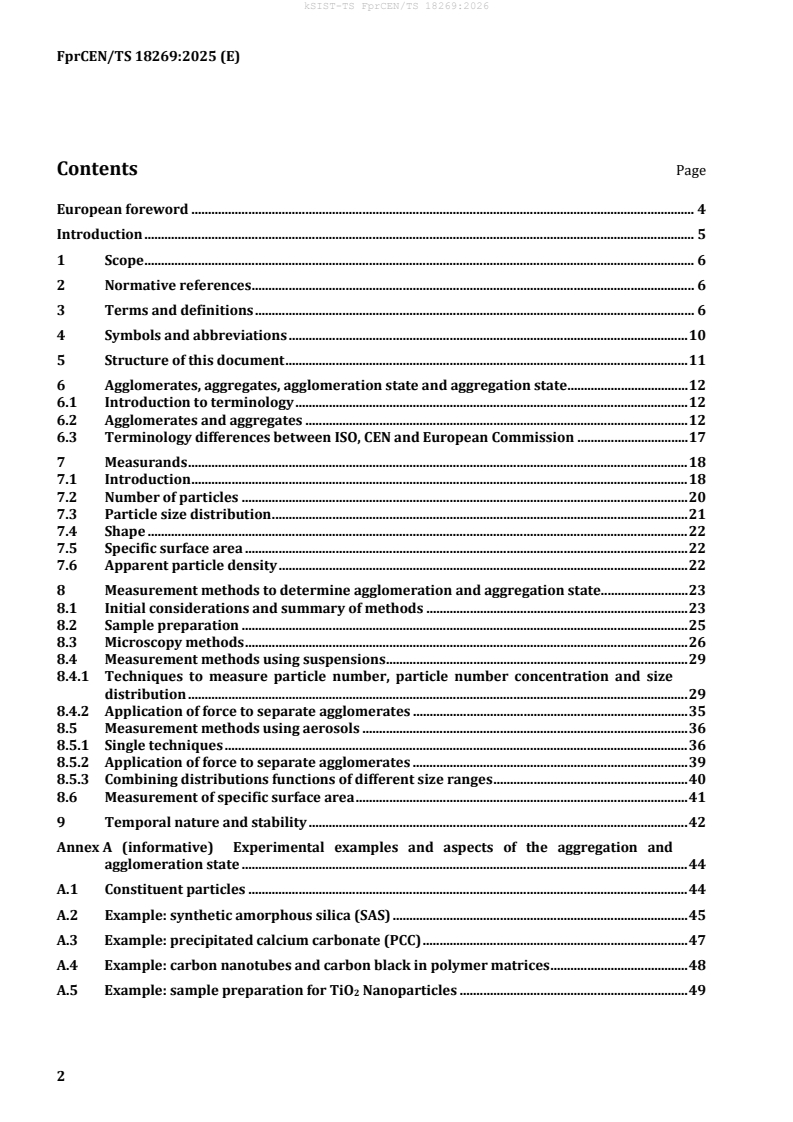
Contents Page
European foreword . 4
Introduction . 5
1 Scope . 6
2 Normative references . 6
3 Terms and definitions . 6
4 Symbols and abbreviations . 10
5 Structure of this document . 11
6 Agglomerates, aggregates, agglomeration state and aggregation state . 12
6.1 Introduction to terminology . 12
6.2 Agglomerates and aggregates . 12
6.3 Terminology differences between ISO, CEN and European Commission . 17
7 Measurands . 18
7.1 Introduction . 18
7.2 Number of particles . 20
7.3 Particle size distribution . 21
7.4 Shape . 22
7.5 Specific surface area . 22
7.6 Apparent particle density . 22
8 Measurement methods to determine agglomeration and aggregation state . 23
8.1 Initial considerations and summary of methods . 23
8.2 Sample preparation . 25
8.3 Microscopy methods . 26
8.4 Measurement methods using suspensions . 29
8.4.1 Techniques to measure particle number, particle number concentration and size
distribution . 29
8.4.2 Application of force to separate agglomerates . 35
8.5 Measurement methods using aerosols . 36
8.5.1 Single techniques . 36
8.5.2 Application of force to separate agglomerates . 39
8.5.3 Combining distributions functions of different size ranges . 40
8.6 Measurement of specific surface area . 41
9 Temporal nature and stability . 42
Annex A (informative) Experimental examples and aspects of the aggregation and
agglomeration state . 44
A.1 Constituent particles . 44
A.2 Example: synthetic amorphous silica (SAS) . 45
A.3 Example: precipitated calcium carbonate (PCC) . 47
A.4 Example: carbon nanotubes and carbon black in polymer matrices . 48
A.5 Example: sample preparation for TiO Nanoparticles . 49
Annex B (informative) An example of measuring the agglomeration state in nano-object
suspensions . 52
Annex C (informative) Factors influencing agglomeration and/or aggregation . 55
C.1 Introduction . 55
C.2 Binding/adhesion energy and deagglomeration . 55
C.3 Surface chemistry and particle environment . 57
C.4 Number concentration . 57
Bibliography . 58
European foreword
This document (FprCEN/TS 18269:2025) has been prepared by Technical Committee CEN/TC 352
“Nanotechnologies”, the secretariat of which is held by AFNOR.
This document is currently submitted to the Vote on TS.
This document has been prepared under a standardization request addressed to CEN by the European
Commission. The Standing Committee of the EFTA States subsequently approves these requests for its
Member States.
Introduction
This document guides users in the appropriate selection and use of commercially available techniques
for determination of the measurands associated with the agglomeration state and aggregation state of
nano-objects in powders, in aerosols and in suspensions (liquid dispersions). Many materials consist of
agglomerates and aggregates composed of constituent particles (CP) and also isolated, individual (IIP)
(not bound) particles. The agglomeration state and aggregation state can explain macroscopic
properties of particulate systems, for example stability, transport in air and liquids, dustiness and
inhalability for aerosols. The situation is further complicated by a variety of synthesis and dispersing
mechanisms used.
Guidance is provided on key terminology, for example what is meant by agglomerate, aggregate,
agglomeration state and aggregation state. Additionally, the differences between terminology used by
standardization organizations and some regulatory bodies are noted.
The document describes measurands that can be used to determine the agglomeration state and
aggregation state (AgAg state) of nano-objects and connects them with corresponding measurement
techniques. They are briefly explained along with their advantages and limitations. The document also
describes methods for the determination of the AgAg state, which generally includes both a
well-specified preparation and the measurement of samples. Sample preparation can majorly affect the
AgAg state and therefore constitutes a crucial part within methodology. This document advises on the
proper use of measurement techniques and provides general rules on sample preparation including
sonication in liquids and shear flow in aerosols for AgAg state determination. However, specific
protocols on sample preparation are not described. This document also discusses aspects of stability,
i.e. the time dependency of AgAg state which depends on factors such as the chemistry of particles,
solvent and additives.
This document will be a useful tool for nanotechnology scientists, companies, risk assessors and
regulators to identify relevant information for measuring measurands of aggregates and agglomerates
and the state of agglomeration and aggregation.
1 Scope
This document provides guidance for users in the correct selection and usage of routinely available
techniques for the determination of the aggregation and agglomeration state of nano-objects in
powders, aerosols and suspensions. It provides guidance on measurands and measurement methods to
use along with guidance on sample preparation.
2 Normative references
There are no normative references in this document.
3 Terms and definitions
For the purposes of this document, the following terms and definitions apply.
ISO and IEC maintain terminology databases for use in standardization at the following addresses:
— ISO Online browsing platform: available at https://www.iso.org/obp/
— IEC Electropedia: available at https://www.electropedia.org/
3.1
nanoscale
length range approximately from 1 nm to 100 nm
[SOURCE: EN ISO 80004-1:2023, 3.1.1]
3.2
nano-object
discrete piece of material with one, two or three external dimensions in the nanoscale
[SOURCE: EN ISO 80004-1:2023, 3.1.5]
3.3
particule
minute piece of matter with defined physical boundaries
Note 1 to entry: A physical boundary can also be described as an interface.
Note 2 to entry: This general particle definition applies to nano-objects (3.2).
[SOURCE: EN ISO 80004-1:2023, 3.2.1]
3.4
agglomerate
collection of weakly or medium strongly bound particles where the resulting external surface area is
similar to the sum of the surface areas of the individual components
Note 1 to entry: The forces holding an agglomerate together are weak forces, for example van der Waals forces or
simple physical entanglement.
Note 2 to entry: Agglomerates are also termed secondary particles and the original source particles are termed
primary particles.
[SOURCE: EN ISO 80004-1:2023, 3.2.4]
3.5
aggregate
particle comprising strongly bonded or fused particles where the resulting external surface area is
significantly smaller than the sum of surface areas of the individual components
Note 1 to entry: The forces holding an aggregate together are strong forces, for example covalent or ionic bonds,
or those resulting from sintering or complex physical entanglement.
Note 2 to entry: Aggregates are also termed secondary particles and the original source particles are termed
primary particles.
[SOURCE: EN ISO 80004-1:2023, 3.2.5]
3.6
constituent particle
identifiable, integral component of a larger particle
Note 1 to entry: The constituent particle structures can be primary particles or aggregates.
[SOURCE: EN ISO 80004-1:2023, 3.2.3]
3.7
primary particle
original source particle of agglomerates or aggregates or mixtures of the two
Note 1 to entry: Constituent particles of agglomerates or aggregates at a certain actual state can be primary
particles, but often the constituents are aggregates.
Note 2 to entry: Agglomerates and aggregates are also termed secondary particles.
[SOURCE: ISO 26824:2022, 3.1.4]
3.8
dispersion
multi-phase system in which discontinuities of any state (solid, liquid or gas: discontinuous phase) are
distributed in a continuous phase of a different composition or state
Note 1 to entry: This term also refers to the act or process of producing a dispersion; in this context the term
“dispersion process” should be used.
Note 2 to entry: If solid particles are distributed in a liquid, the dispersion is referred to as a suspension. If the
dispersion consists of two or more immiscible liquid phases, it is termed an “emulsion”. A suspoemulsion consists
of both solid and liquid phases distributed in a continuous liquid phase.
[SOURCE: CEN ISO/TS 80004-6:2021, 3.14]
3.9
aerosol
system of solid and/or liquid particles suspended in gas
[SOURCE: CEN ISO/TS 80004-6:2021, 3.12]
3.10
suspension
heterogeneous mixture of materials comprising a liquid and finely dispersed solid material
[SOURCE: CEN ISO/TS 80004-6:2021, 3.13]
3.11
dispersibility
qualitative or quantitative characteristic or property of a particulate source material assessing the ease
with which said material can be dispersed within a continuous phase
Note 1 to entry: Spatially uniform distribution (homogeneity) of the dispersed phase is considered an integral part
of the desired end point.
Note 2 to entry: Particle size or particle size distribution is often used as an end point relative to defined criteria
specific to the application.
Note 3 to entry: Dispersibility refers to a specific dispersion process and specific process time.
Note 4 to entry: Dispersion stability, though a related phenomenon, should not be confused with dispersibility.
[SOURCE: ISO/TS 22107:2021, 3.6]
3.12
measurand
quantity intended to be measured
[SOURCE: ISO/IEC Guide 99:2007, 2.3]
3.13
agglomeration state
degree to which constituent particles are bound together as agglomerates (3.4) and are spatially
arranged
Note 1 to entry: Agglomeration state is time dependent and is likely to depend on the environmental and
thermodynamic conditions such as chemistry, concentration, pH, turbulence and temperature and the
hydrodynamic forces acting on the agglomerates. Sonication and other energy sources inputted in the system can
change the agglomeration state.
Note 2 to entry: Agglomeration state is difficult to measure in practice, as it is difficult to separate agglomeration
state and aggregation state. An indication of the combined agglomeration and aggregation state can be determined
by measuring the ratio by number/volume/mass of agglomerated particles to constituent particles.
Note 3 to entry: The constituent particles can be bound as dimers, trimers or higher numbers. The number of
constituent particles per agglomerate affects the agglomeration state as does the shape and structure of each
agglomerate.
Note 4 to entry: Over a period of time, the binding forces between agglomerates can change to stronger forces and
hence agglomerates can change to aggregates. A system can have both an agglomeration state and an aggregation
state.
3.14
aggregation state
degree to which constituent particles are bound together as aggregates (3.5) and are spatially arranged
Note 1 to entry: Aggregation state is likely to be less time dependent than the agglomeration state and is only
likely to change on extreme changes in environmental conditions especially the chemistry, pH and temperature.
Note 2 to entry: Aggregation state is difficult to quantitatively measure in practice as it is difficult to separate
agglomeration state and aggregation state. An indication of the combined agglomeration and aggregation state can
be determined by measuring the ratio by number/volume/mass of aggregated particles to constituent particles.
Note 3 to entry: The constituent particles can be bound as dimers, trimers or higher numbers. The number of
constituent particles per aggregate effects the aggregation state as does the size and shape of each aggregate.
3.15
agglomeration
action leading to the formation of agglomerates (3.4)
[SOURCE: EN ISO 29464:2024, 3.2.12]
3.16
aggregation
action leading to the formation of aggregates (3.5)
3.17
dispersion stability
ability to resist change or variation in the initial properties (state) of a dispersion over time, in other
words, the quality of a dispersion in being free from alterations over a given time scale
Note 1 to entry: In this context, for instance agglomeration or segregation represents a loss of dispersion stability.
[SOURCE: ISO/TS 22107:2021, 3.8]
3.18
isolated, individual particle
IIP
single, individual piece of matter that is physically separate, with identifiable boundary and
independent from other particles
Note 1 to entry: IIP can vary in size in a given system but should not be composed of other such particles.
Note 2 to entry: The independent behaviour refers to no significant interaction force with other particles.
Note 3 to entry: IIP cannot be part of a larger structure such as an agglomerate or an aggregate.
4 Symbols and abbreviations
AFM atomic force microscope or atomic force microscopy
AF4 asymmetric-flow field-flow fractionation
AgAg state agglomeration state and aggregation state
ALS angular light scattering
AC analytical centrifugation
BET Brunauer Emmett and Teller
CLS centrifugal liquid sedimentation
CP constituent particle
CR counting rule
DCS differential centrifugal sedimentation
DEMA differential electric mobility analysis
DEMC differential electrical mobility classifier
DLS dynamic light scattering
DMAS differential mobility analysing system
ELPI electrical low-pressure impactor
HR high resolution
IIP isolated, individual particle
MD-AF4 multi-detector asymmetric-flow field-flow fractionation
OPC optical particle counter
PDWS photon density wave spectroscopy
PSD particle size distribution
PTA particle tracking analysis
RPS resistive pulse sensing
SAXS small-angle X-ray scattering
SEM scanning electron microscope or scanning electron microscopy
SMLS static multiple light scattering
spICP-MS single particle inductively coupled plasma mass spectrometry
RPS resistive pulse sensing
TEM transmission electron microscope or transmission electron microscopy
UV-Vis ultra-violet-visible
5 Structure of this document
This document provides guidance for users in the selection and usage of routinely available techniques
for the determination of the agglomeration state and aggregation state (AgAg state) of nano-objects in
powders, aerosols and suspensions. These characteristics are complex to assess, as no single measured
and measurement can fully define the agglomeration and aggregation state. The AgAg state
determination can for example comprise: the quantity of non-agglomerated/non-aggregated particles,
the size and mass (distributions) of agglomerates and aggregates, the morphology of the agglomerates
and aggregates or the quantity ratio between aggregates and agglomerates. It depends on the purpose
of the analysis as to which of these aspects should be addressed by the characterization method. Hence,
it is up to the user, depending on the type of material to be analysed, to choose which measurands and
techniques to use to determine AgAg state based on the guidance given in this document. Follow the
flow chart given in Figure 1 and Clauses 6 to 9 in order to help determine AgAg state.
Clause 6 provides general information on what is meant by agglomerate, aggregate, agglomeration state
and aggregation state. It also highlights differences in terminology used by ISO, CEN and in the
regulatory framework addressing nanomaterials in the European Union.
Clause 7 details the measurands to use to determine AgAg state.
Clause 8 details guidance on the measurement methods that are used to determine AgAg state.
Clause 9 provides information on the temporal nature and stability of AgAg state.
Annex A provides examples of AgAg states.
Annex B gives examples of measuring the agglomeration state in nano-object suspensions.
Annex C briefly lists the factors influencing the agglomeration and aggregation state.
Figure 1 — Chart summarizing the step-wise approach to help determine AgAg state
6 Agglomerates, aggregates, agglomeration state and aggregation state
6.1 Introduction to terminology
This section provides descriptive information on the terms used to describe agglomerates, aggregates,
agglomeration state and aggregation state and other key terms. These are discussed in 6.2. The
European Commission uses different terminology and these differences are discussed in 6.3.
6.2 Agglomerates and aggregates
Agglomerates and aggregates are collections of bound particles that themselves can be considered as
individual particles in many aspects. They are frequently observed in dispersed material like powders,
aerosols and suspensions (liquid dispersions). In such materials, agglomerates and aggregates can be
the dominating form of dispersed matter or they can comprise only a minor fraction of all the particles
present. In general, they constitute only one part of the dispersed matter and are accompanied by
non-agglomerated and non-aggregated particles, called here isolated, individual particles (IIP). The
state of disperse material is characterized by a) the degree to which the particles are bound in
aggregates and agglomerates (or reversely: the fraction of IIPs), the size and size distribution of the
particles including aggregates and agglomerates, b) their shape and internal structure, and c) also the
spatial distribution of the particles within the material.
The distinction between agglomerates and aggregates relies on the notion of the strength of the binding
energies between the constituent particles (CPs) which is also dependent on the particles contact
surface areas. However, the definitions across different ISO Technical Committees, European Union [1]
regulatory frameworks and scientific peer-reviewed publications provide a much less harmonized
landscape. Some definitions only refer to both agglomerates and aggregates being made of particles
adhering to each other. Some mention relative stability of the resulting physical structure. Here, the
definitions of agglomerate and aggregate from ISO 80004-1 from ISO/TC 229 (Nanotechnologies) are
used [2]. These are based on the strength of the constituent particle binding. Both agglomerates and
aggregates are termed secondary particles comprised of loosely or tightly bound constituent particles
based on their binding strength and typically having relatively small or large common adhesion surface
areas respectively, as shown in Figure 2.
a) b)
Red contour indicates the external surface area of the secondary particles; dashed lines indicate the
(apparent) boundaries between constituent particles.
Figure 2 — Simplified 2D illustration demonstrating the difference between a) agglomerates and
b) aggregates
Aggregates are formed when constituent particles’ binding energy is high, and much work must be done
to break down such a structure into smaller objects. Agglomerates are formed by weaker bonds
between constituent particles and have in general smaller contact surface areas, giving more porous
structures of lower density and higher surface area. Binding energy distinction is covered in Annex C.
The red surrounding trace in Figure 2 indicates schematically the external surface area for each
agglomerate and aggregate. It should be noted that Figure 2 is merely a very simple 2D schematic of
very complex 3D structures and other structures are possible.
A material is likely to contain both agglomerates and/or aggregates as well as isolated, individual
particles. These IIPs, as shown in Figure 3 a) and Figure 4, are particles that do not adhere to other
particles and that are neither agglomerates nor aggregates. They are so termed as they are isolated
from other particles, i.e. separated from other particles. They are also individual, i.e. they are the
smallest possible single entity that still fulfils the definition of particle.
In addition to this, some smaller aggregates could form hierarchically bound agglomerates as shown in
Figure 3 d).
a) b) c) d)
Figure 3 — Various species in a simplified 2D diagram: a) isolated, individual particle,
b) agglomerate, c) aggregate, d) agglomerate of three aggregates shown with different colours
The complexity is increased further when both agglomerates and aggregates can have virtually any
number of those constituent particles arranged in many possible ways. An example is shown in
Figure 4, which consists of two samples both with the same number of constituent particles. In
Figure 4 a), the sample consists of 4 IIPs and 2 large agglomerates whereas Figure 4 b) consists of 4 IIPs
but with 16 smaller agglomerates or aggregates each consisting of between 2 and 7 constituent
particles. These two samples are likely to have very different properties. In addition, Figure 4 a) shows
two different agglomerates both with the same number of constituent particles but of very different
size, shape and structure.
a) b)
Each of a) and b) contain the same number of constituent particles (including IIPs) as do the structures
labelled X, Y in a).
Figure 4 — Simplified diagram showing that aggregation state and agglomeration state depends
on the structure of the agglomerates and aggregates
The size of the constituent particles in agglomerates or aggregates can vary, as shown in Figure 5.
Hence the IIPs, the agglomerates and the aggregates will have their own particle size distributions.
Key
1 IIPs
2 agglomerates
3 aggregates
Agglomerates and aggregates can vary in size and shape based on variations in, amongst other things,
the number as well as the size and shape of the constituent particles.
Figure 5 — Simplified 2D sketch showing IIPsag, glomerates and aggregates
Figure 6 shows a schematic of possible transformation between IIPs, agglomerates and aggregates in a
material.
Key
a) isolated, individual particles and/or small agglomerates, where the brackets indicate repetition, i.e. that to
generate the structures in b) and c) several IIPs and/or small agglomerates are needed
b) constituent particles in agglomerates
c) aggregates
Figure 6 — Schematic of possible transformations between IIPs, agglomerates and aggregates
The formation of agglomerates and aggregates as shown in Figure 6, requires both the prevalence of
attractive forces and processes that bring individual and small groups of particles together. Such
processes can be the Brownian motion or sedimentation of mobile particles, their convective transport
in turbulent and laminar flow or their deposition in sediments, at walls or in silos. The most important
attractive forces between two initially separated particles are van-der-Waals forces, yet other types of
interaction can also be highly relevant for specific materials (e.g. electrostatic forces between charged
aerosol particles, capillary binding between hydrophilic particles in humid atmosphere, hydrophobic
forces between surface-treated materials in polar media, depletion forces for particles in polymer
solutions). All types of particle interactions are affected by the physico-chemical properties of the
particles, the continuous phase and their interface, such as the solubility, surface functional group, pH
and ionic strength of polar liquids, wettability, soluble additives, air humidity of gas phases or
temperature.
EXAMPLE The pH of aqueous solutions affects the surface charge of most inorganic solids; similar surface
charges result in a repulsive interaction of neighbouring particles, which is opposed to van-der-Waals attraction.
Air humidity, even at a moderate level, leads to the adsorption of a water layer on hydrophilic aerosol particles,
which promotes the cohesion between particles due to capillary forces. Hydrophobic particles tend to
agglomerate in aqueous solution, whereas they remain isolated in an appropriated organic solvent (similar
Hansen parameters provided). Polymeric additives can be used to induce agglomeration via depletion forces
(if not being adsorbed to the particle surface) or via bridging flocculation (after partial adsorption on the particles
surface), but they can also increase the stability the colloidal suspensions via steric interaction (after having
completely covered the particle surface).
Once particles adhere to each other, their bonding can be reinforced by chemical reactions
(e.g. condensation of OH-groups), sintering processes (e.g. for pyrolytic particle synthesis) or Ostwald
ripening. The resulting secondary particles are aggregates, which are hardly dispersible (e.g. pyrogenic
silica). Their partial disintegration is only possible by applying high stress intensities over a sufficiently
long period. This is different to secondary particles of agglomerate type, which are solely held together
by physical attraction (e.g. flocs of colloidal silica generated by lowering pH or increasing ionic
strength). Their deagglomeration can be achieved by relatively low fluid-dynamic including aero- or
hydrodynamic forces (e.g. prevalent at pumping, stirring, pneumatic conveying) and be promoted by
altering relevant physico-chemical properties (e.g. pH, humidity). Sometimes, one can observe an
equilibrium between the formation and dissociation of agglomerates, which makes sample preparation
in the context of this document more difficult. This can be a dynamic process of constantly forming and
breaking apart which leads to the notion of a time-dependent system or it could be a static system. The
energy barrier as to when agglomeration or deagglomeration occurs varies depending on the system.
Deagglomeration is part of the dispersion process with energy required to break up agglomerates.
Agglomerates can be broken up with relatively low amounts of energy, for which reason a complete
dispersion into IIPs and smaller agglomerates can be achievable. A further consequence is that
agglomeration state (incl. size and concentration of agglomerates) is largely affected by material
processing, which also applies to sample preparation when characterizing materials. In contrast, full
disintegration of aggregates is not possible, as the bonding forces within the aggregates are typically
larger than the stresses which aggregates are exposed to in technical processes.
Deaggregatation does not typically occur in a dispersive process but requires much higher energy.
Deaggregation can lead to fragmentation into aggregated substructures or to a release of constituent
particles, or parts thereof, from the aggregates.
Agglomeration state and aggregation state are defined in Clause 3 and relate to a) the degree to which
constituent particles are bound together as agglomerates or aggregates and b) the spatial arrangement
of the particles. The agglomeration state (and to a lesser extent the aggregation state) will depend on
sample processing. This can be used to help measure agglomeration and aggregation state. Figure 7
shows a schematic of the effects of moderate and strong (intense) dispersive forces on a material.
Moderate dispersive forces cause agglomerates to break up leading to a higher number of smaller
agglomerates and IIPs. Moderate to low forces will not break up aggregates. The amount of force
(or energy) required to break up the agglomerates depends on each material. Strong, intense dispersive
forces break up agglomerates and aggregates (often not completely) leaving IIPs, smaller aggregates
fragments
Key
1 moderate dispersion
2 intense dispersion
3 dispersion by software
Figure 7 — Separation of agglomerates and aggregates either through different amounts of
dispersive forces or alternatively counting of constituent particles through image analysis after
microscopy
An alternative option shown in Figure 7 is the virtual separation and counting of constituent particles in
agglomerates and aggregates through the use of microscopy and image analysis. This enables the
counting of constituent particles and is generally required for regulatory purposes.
There are also cases in which the image-based identification of constituent particles in aggregates is
misleading and the clear distinction between aggregate and IIP is not possible.
a) Pyrogenic aggregates, generated from primary particles which coalesce and sinter during the
pyrogenic process thereby forming chain/fractal-like structures. The apparent constituent
particles, however did not exist as isolated particles before the sintering process. The internal
boundaries between the original primary particles have vanished, hence such pyrogenic particles
can be considered as nanostructured IIPs of non-spherical shape. An example of this is shown in
A.2.
b) Crystallite structures of polycrystalline solid materials; they consist of separate crystallites with
defined phase boundaries. The structures resemble aggregates, yet their formation does not result
from aggregation but growth in crystallization. The crystallites (sometimes known as grains) are
formed from recrystallization of an already solidified material or form during solidification process
when something is cooled down below its melting temperature. The presence of grains alone does
not make these materials aggregates. The distinction of polycrystalline constituent particles from
aggregates based on image analysis is rather difficult without further information on the material
but can be accomplished if the production process is known.
In practice, the determination of AgAg state is not straight-forward therefore a number of different
measurands should be considered.
6.3 Terminology differences between ISO, CEN and European Commission
The terminology in this document follows those of documentary standards developed in CEN/TC 352
and ISO/TC 229. However, it is crucial to realize that the terminology between CEN standards and
European Union [1] legislation is not fully aligned as they serve different purposes. This is of paramount
importance here, as key terms have different meanings depending on the context in which they are
used, see Table 1. Bresch et al. [3] explain in more detail the consequences of the different definitions of
‘constituent particle’ in terms of which particles are identified and counted.
Table 1 — Comparison of the essential elements of the ISO and EC definitions for the term
“constituent particle” (Adapted from Bresch et al. [3]) and “primary particle”
Term ISO European Commission (EC)
primary original source particle of agglomerates or There is no definition and use of primary
particle aggregates or mixtures of the two particle by EC in its nanomaterial
definition [1] but the EC Joint Research
Note 1 to entry: Constituent particles of
Centre (JRC) view is that a primary
agglomerates or aggregates at a certain actual
state can be primary particles, but often the particle is the original “seed” from which
constituents are aggregates.
a particle grows [4].
Note 2 to entry: Agglomerates and aggregates
are also termed secondary particles.
[SOURCE:ISO 26824:2022, 3.1.4]
In most nanomaterial characterization
communities, ISO terminology is used
since the growth of particles is often either
not known or has very little relevance to
final particle size distribution.
NOTE Some confusion can occur with the
word “source” as to whether this means a
constituent particle or whether a source
particle can change as a function of time.
constituent identifiable, integral component of a larger The point of reference for “constituent”
particle particle is the “whole” material. The EC definition
of nanomaterial in 2022 [1] explains
Note 1 to entry: The constituent particle
that: “… nanomaterial … materials
structures can be primary particles or
aggregates.
consisting of particles in solid state,
present on their own or bound as
[SOURCE: ISO 80004-1:2023, 3.2.3]
constituent parts of aggregates or
agglomerates. …the particles are the
NOTE In the ISO definition, the Note 1 to
entry can be clarified further. For constituent principal component of the material.”
particles being aggregates, this refers to
leading to the definition:
agglomerates of aggregates and does not
Nanomaterial’ means a … material
exclude an aggregate having constituent
consisting of solid particles that are
particles of its own.
present, either on their own or as
identifiable constituent particles (i.e.
smallest indivisible units) in aggregates
or agglomerates, and ….
Term ISO European Commission (EC)
The term “constituent particle” refers to
the entire material, i.e. individual
particles as well as the constituents of
agglomerates and aggregates are
considered constituent particles of a
material.
Unbound particles are considered
constituent particles, as are each bound
particle in aggregates and agglomerates.
In addition, constituent particles have
also been referred to as the
(morphologically) identifiable particles
inside an aggregate or agglomerate:
• In agglomerates the constituent
particles are only weakly bound.
Constituent particles are usually not
deformed during an agglomeration
process.
• In aggregates the constituent
particles are strongly bound. This is
often the result of a high-
temperature process during which
constituent particles fuse together.
This fusion process results, to a
varying extent, in a deformation of
the constituent particles, to the
point of their disappearance as
distinguishable structures [1] [4].
In the particle characterization community, there is a distinction between a primary particle and a
constituent particle. Both of those particles can be part of agglomerates and aggregates. However, there
is a distinct difference in terms of knowledge about a suspension or powder regarding the
smallest/simplest building block of the agglomerate or aggregate structures. If it is known that the
particle inside an agglomerate or aggregate that is observed is the smallest unit (for example from
quantum dot process) then it can safely be said that they are primary particles. In all other cases it
cannot be guaranteed that a particle in an agglomerate or aggregate that is observed with SEM or TEM
is not composed of smaller units itself due to the resolution limit of the instrument. Thus, the term
“constituent particle” is used to describe these particles. Therefore, the difference can be in our own
knowledge of the material itself.
In this document, the terms IIP and constituent particle are used as defined in Clause 3.
7 Measurands
7.1 Introduction
A measurand is the quantity intended to be measured. Some instruments measure the measurand
directly and other instruments measure a different characteristic that is related to the measurand.
Additional information on measurands related to nano-objects can be found in ISO/TS 23302 [5].
Many different measurands can be used to determine the agglomeration and/or aggregation state,
which one to use depends on the purpose and context of the measurement. The measurands required
will depend on the material system and what type of assessment is required, i.e. on a case-by-case basis.
Examples include a) the evaluation of product quality (e.g. of paints), b) assessing the release of isolated
NPs from a material (e.g. when processing powders), c) predicting performance in application (e.g. of
fillers in polymers), d) characterization of well-stabilized suspensions or workplace aerosol.
Withi
...
Questions, Comments and Discussion
Ask us and Technical Secretary will try to provide an answer. You can facilitate discussion about the standard in here.
Loading comments...