


EN ISO 15189:2003
(Main)Medical laboratories - Particular requirements for quality and competence (ISO 15189:2003)
Medical laboratories - Particular requirements for quality and competence (ISO 15189:2003)
It is suggested that it is stated in the Scope that the Standard can be used for accreditation of medical laboratories specialised in the aspects mentioned. It should be clarified whether fulfilment of the requirements put forward in the present Standard will be valid also in a 9000 certification of the organisation to which the laboratory belongs, e.g. a hospital.
Medizinische Laboratorien - Besondere Anforderungen an die Qualität und Kompetenz (ISO 15189:2003)
Diese Internationale Norm legt Anforderungen an die Qualität und Kompetenz im besonderen Fall medizinischer Laboratorien fest.
Laboratoires d'analyses de biologie médicale - Exigences particulières concernant la qualité et la compétence (ISO 15189:2003)
Medicinski laboratoriji – Posebne zahteve za kakovost in usposobljenost (ISO 15189:2003)
General Information
- Status
- Withdrawn
- Publication Date
- 14-Feb-2003
- Withdrawal Date
- 14-Apr-2007
- Technical Committee
- CEN/TC 140 - In vitro diagnostic systems
- Drafting Committee
- CEN/TC 140/WG 3 - Quality management in the medical laboratory
- Current Stage
- 9960 - Withdrawal effective - Withdrawal
- Start Date
- 15-Apr-2007
- Completion Date
- 15-Apr-2007
Relations
- Effective Date
- 22-Dec-2008
- Effective Date
- 22-Dec-2008



Get Certified
Connect with accredited certification bodies for this standard

BSI Group
BSI (British Standards Institution) is the business standards company that helps organizations make excellence a habit.

TÜV Rheinland
TÜV Rheinland is a leading international provider of technical services.

TÜV SÜD
TÜV SÜD is a trusted partner of choice for safety, security and sustainability solutions.
Sponsored listings
Frequently Asked Questions
EN ISO 15189:2003 is a standard published by the European Committee for Standardization (CEN). Its full title is "Medical laboratories - Particular requirements for quality and competence (ISO 15189:2003)". This standard covers: It is suggested that it is stated in the Scope that the Standard can be used for accreditation of medical laboratories specialised in the aspects mentioned. It should be clarified whether fulfilment of the requirements put forward in the present Standard will be valid also in a 9000 certification of the organisation to which the laboratory belongs, e.g. a hospital.
It is suggested that it is stated in the Scope that the Standard can be used for accreditation of medical laboratories specialised in the aspects mentioned. It should be clarified whether fulfilment of the requirements put forward in the present Standard will be valid also in a 9000 certification of the organisation to which the laboratory belongs, e.g. a hospital.
EN ISO 15189:2003 is classified under the following ICS (International Classification for Standards) categories: 11.100 - Laboratory medicine. The ICS classification helps identify the subject area and facilitates finding related standards.
EN ISO 15189:2003 has the following relationships with other standards: It is inter standard links to EN ISO 15189:2007, EN ISO 15189:2003/prA1. Understanding these relationships helps ensure you are using the most current and applicable version of the standard.
EN ISO 15189:2003 is available in PDF format for immediate download after purchase. The document can be added to your cart and obtained through the secure checkout process. Digital delivery ensures instant access to the complete standard document.
Standards Content (Sample)
SLOVENSKI STANDARD
01-september-2003
Medicinski laboratoriji – Posebne zahteve za kakovost in usposobljenost (ISO
15189:2003)
Medical laboratories - Particular requirements for quality and competence (ISO
15189:2003)
Medizinische Laboratorien - Besondere Anforderungen an die Qualität und Kompetenz
(ISO 15189:2003)
Laboratoires d'analyses de biologie médicale - Exigences particulieres concernant la
qualité et la compétence (ISO 15189:2003)
Ta slovenski standard je istoveten z: EN ISO 15189:2003
ICS:
03.120.10 Vodenje in zagotavljanje Quality management and
kakovosti quality assurance
11.100.01 Laboratorijska medicina na Laboratory medicine in
splošno general
2003-01.Slovenski inštitut za standardizacijo. Razmnoževanje celote ali delov tega standarda ni dovoljeno.
EUROPEAN STANDARD
EN ISO 15189
NORME EUROPÉENNE
EUROPÄISCHE NORM
February 2003
ICS 11.100
English version
Medical laboratories - Particular requirements for quality and
competence (ISO 15189:2003)
Laboratoires d'analyses de biologie médicale - Exigences Medizinische Laboratorien - Besondere Anforderungen an
particulières concernant la qualité et la compétence (ISO die Qualität und Kompetenz (ISO 15189:2003)
15189:2003)
This European Standard was approved by CEN on 17 January 2003.
CEN members are bound to comply with the CEN/CENELEC Internal Regulations which stipulate the conditions for giving this European
Standard the status of a national standard without any alteration. Up-to-date lists and bibliographical references concerning such national
standards may be obtained on application to the Management Centre or to any CEN member.
This European Standard exists in three official versions (English, French, German). A version in any other language made by translation
under the responsibility of a CEN member into its own language and notified to the Management Centre has the same status as the official
versions.
CEN members are the national standards bodies of Austria, Belgium, Czech Republic, Denmark, Finland, France, Germany, Greece,
Hungary, Iceland, Ireland, Italy, Luxembourg, Malta, Netherlands, Norway, Portugal, Slovak Republic, Spain, Sweden, Switzerland and
United Kingdom.
EUROPEAN COMMITTEE FOR STANDARDIZATION
COMITÉ EUROPÉEN DE NORMALISATION
EUROPÄISCHES KOMITEE FÜR NORMUNG
Management Centre: rue de Stassart, 36 B-1050 Brussels
© 2003 CEN All rights of exploitation in any form and by any means reserved Ref. No. EN ISO 15189:2003 E
worldwide for CEN national Members.
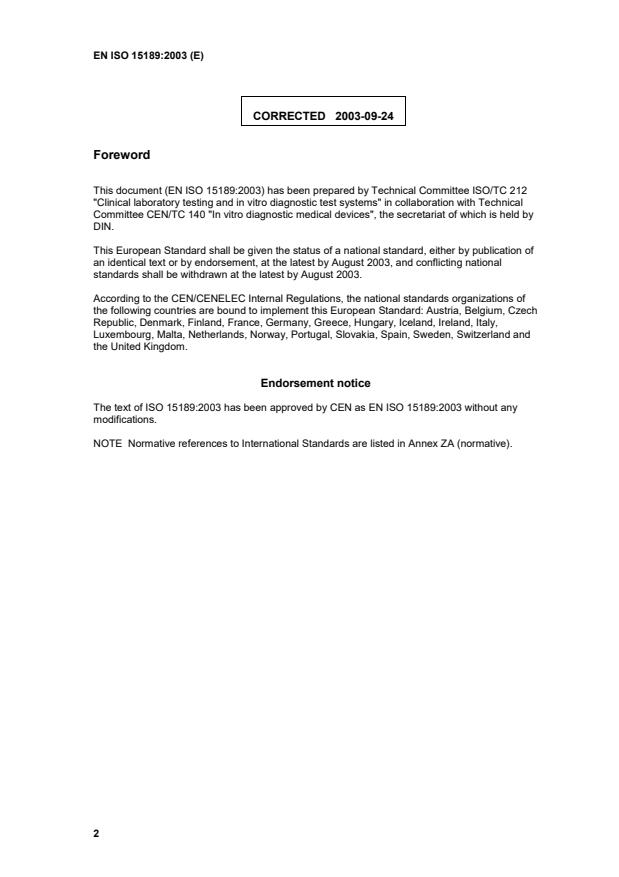
CORRECTED 2003-09-24
Foreword
This document (EN ISO 15189:2003) has been prepared by Technical Committee ISO/TC 212
"Clinical laboratory testing and in vitro diagnostic test systems" in collaboration with Technical
Committee CEN/TC 140 "In vitro diagnostic medical devices", the secretariat of which is held by
DIN.
This European Standard shall be given the status of a national standard, either by publication of
an identical text or by endorsement, at the latest by August 2003, and conflicting national
standards shall be withdrawn at the latest by August 2003.
According to the CEN/CENELEC Internal Regulations, the national standards organizations of
the following countries are bound to implement this European Standard: Austria, Belgium, Czech
Republic, Denmark, Finland, France, Germany, Greece, Hungary, Iceland, Ireland, Italy,
Luxembourg, Malta, Netherlands, Norway, Portugal, Slovakia, Spain, Sweden, Switzerland and
the United Kingdom.
Endorsement notice
The text of ISO 15189:2003 has been approved by CEN as EN ISO 15189:2003 without any
modifications.
NOTE Normative references to International Standards are listed in Annex ZA (normative).
Annex ZA
(normative)
Normative references to international publications
with their relevant European publications
This European Standard incorporates by dated or undated reference, provisions from other
publications. These normative references are cited at the appropriate places in the text and the
publications are listed hereafter. For dated references, subsequent amendments to or revisions of
any of these publications apply to this European Standard only when incorporated in it by
amendment or revision. For undated references the latest edition of the publication referred to
applies (including amendments).
NOTE Where an International Publication has been modified by common modifications, indicated
by (mod.), the relevant EN/HD applies.
Publication Year Title EN Year
ISO 9000 2000 Quality management systems - EN ISO 9000 2000
Fundamentals and vocabulary
ISO 9001 2000 Quality management systems - EN ISO 9001 2000
Requirements
ISO/IEC 17025 1999 General requirements for the EN ISO/IEC 17025 2000
competence of testing and
calibration laboratories
INTERNATIONAL ISO
STANDARD 15189
First edition
2003-02-15
Corrected version
2003-07-15
Medical laboratories — Particular
requirements for quality and competence
Laboratoires d'analyses de biologie médicale — Exigences particulières
concernant la qualité et la compétence
Reference number
ISO 15189:2003(E)
©
ISO 2003
ISO 15189:2003(E)
PDF disclaimer
This PDF file may contain embedded typefaces. In accordance with Adobe's licensing policy, this file may be printed or viewed but
shall not be edited unless the typefaces which are embedded are licensed to and installed on the computer performing the editing. In
downloading this file, parties accept therein the responsibility of not infringing Adobe's licensing policy. The ISO Central Secretariat
accepts no liability in this area.
Adobe is a trademark of Adobe Systems Incorporated.
Details of the software products used to create this PDF file can be found in the General Info relative to the file; the PDF-creation
parameters were optimized for printing. Every care has been taken to ensure that the file is suitable for use by ISO member bodies. In
the unlikely event that a problem relating to it is found, please inform the Central Secretariat at the address given below.
© ISO 2003
All rights reserved. Unless otherwise specified, no part of this publication may be reproduced or utilized in any form or by any means,
electronic or mechanical, including photocopying and microfilm, without permission in writing from either ISO at the address below or
ISO's member body in the country of the requester.
ISO copyright office
Case postale 56 • CH-1211 Geneva 20
Tel. + 41 22 749 01 11
Fax + 41 22 749 09 47
E-mail copyright@iso.org
Web www.iso.org
Published in Switzerland
ii © ISO 2003 — All rights reserved
ISO 15189:2003(E)
Contents Page
Foreword. iv
Introduction . v
1 Scope. 1
2 Normative references . 1
3 Terms and definitions. 1
4 Management requirements . 4
4.1 Organization and management . 4
4.2 Quality management system . 4
4.3 Document control . 6
4.4 Review of contracts . 7
4.5 Examination by referral laboratories . 7
4.6 External services and supplies . 8
4.7 Advisory services . 8
4.8 Resolution of complaints . 9
4.9 Identification and control of nonconformities .9
4.10 Corrective action. 9
4.11 Preventive action . 10
4.12 Continual improvement. 10
4.13 Quality and technical records. 10
4.14 Internal audits. 11
4.15 Management review. 11
5 Technical requirements. 12
5.1 Personnel. 12
5.2 Accommodation and environmental conditions. 14
5.3 Laboratory equipment . 15
5.4 Pre-examination procedures. 17
5.5 Examination procedures . 19
5.6 Assuring quality of examination procedures. 21
5.7 Post-examination procedures . 22
5.8 Reporting of results . 22
Annex A (normative) Correlation with ISO 9001:2000 and ISO/IEC 17025:1999 . 25
Annex B (informative) Recommendations for protection of laboratory information systems (LIS) . 29
Annex C (informative) Ethics in laboratory medicine . 33
Bibliography . 36
ISO 15189:2003(E)
Foreword
ISO (the International Organization for Standardization) is a worldwide federation of national standards bodies
(ISO member bodies). The work of preparing International Standards is normally carried out through ISO
technical committees. Each member body interested in a subject for which a technical committee has been
established has the right to be represented on that committee. International organizations, governmental and
non-governmental, in liaison with ISO, also take part in the work. ISO collaborates closely with the
International Electrotechnical Commission (IEC) on all matters of electrotechnical standardization.
International Standards are drafted in accordance with the rules given in the ISO/IEC Directives, Part 2.
The main task of technical committees is to prepare International Standards. Draft International Standards
adopted by the technical committees are circulated to the member bodies for voting. Publication as an
International Standard requires approval by at least 75 % of the member bodies casting a vote.
Attention is drawn to the possibility that some of the elements of this document may be the subject of patent
rights. ISO shall not be held responsible for identifying any or all such patent rights.
ISO 15189 was prepared by Technical Committee ISO/TC 212, Clinical laboratory testing and in vitro
diagnostic test systems.
This corrected version of ISO 15189:2003 incorporates the following corrections:
in Clause 2, the normative reference ISO/IEC Guide 2 has been added;
in 3.2, the bibliographic reference in Note 2 has been changed;
to the definition of 3.12;
to 5.4.1 b), 5.4.13 and 5.5.3;
to 5.8.3, whose note is joined by a second note transposed from 5.8.4, becoming Notes 1 and 2 to 5.8.3,
respectively;
the bibliographic references in C.1 and C.9;
correction of minor typographical errors.
iv © ISO 2003 — All rights reserved
ISO 15189:2003(E)
Introduction
This International Standard, based upon ISO/IEC 17025 and ISO 9001, provides requirements for
1)
competence and quality that are particular to medical laboratories . It is acknowledged that a country could
have its own specific regulations or requirements applicable to some or all its professional personnel and their
activities and responsibilities in this domain.
Medical laboratory services are essential to patient care and therefore have to be available to meet the needs
of all patients and the clinical personnel responsible for the care of those patients. Such services include
arrangements for requisition, patient preparation, patient identification, collection of samples, transportation,
storage, processing and examination of clinical samples, together with subsequent validation, interpretation,
reporting and advice, in addition to the considerations of safety and ethics in medical laboratory work.
Whenever allowed by national regulations, it is desirable that medical laboratory services include the
examination of patients in consultation cases, and that those services actively participate in the prevention of
disease in addition to diagnosis and patient management. Each laboratory ought also to provide suitable
educational and scientific opportunities for professional staff working with it.
While this International Standard is intended for use throughout the currently recognized disciplines of medical
laboratory services, those working in other services and disciplines could also find it useful and appropriate. In
addition, bodies engaged in the recognition of the competence of medical laboratories will be able to use this
International Standard as the basis for their activities. For it is surely preferable that a laboratory seeking
accreditation select an accrediting body which operates to appropriate international standards and which
takes into account the particular requirements of medical laboratories.
During the preparation of this International Standard, ISO 9001 and ISO/IEC 17025 were under revision, and it
was therefore impossible to present this International Standard in a format and style which corresponded
precisely to those of either of the aforementioned documents. The correlation that nevertheless does exist
between the clauses and subclauses of this first edition of ISO 15189 and those of ISO 9001:2000 and of
ISO/IEC 17025:1999 is detailed in Annex A of this International Standard.
A second edition of this International Standard, aimed at more closely aligning it with a second edition of
ISO/IEC 17025 and with ISO 9001:2000, is anticipated. Moreover, terminology has changed within the
disciplines concerned and this has created differences of expression such that certain terms (e.g. “sensitivity”)
now have entirely different meanings between disciplines. Furthermore, it is planned to replace yet another
document related to this International Standard, ISO/IEC Guide 58, by ISO/IEC 17011. The second edition of
ISO 15189 is to take all this into account.
1) In the French language, these laboratories are termed “laboratoires d’analyses de biologie médicale”, while in other
languages they might be referred to using a term equivalent to the English “clinical laboratories”.
INTERNATIONAL STANDARD ISO 15189:2003(E)
Medical laboratories — Particular requirements for quality and
competence
1 Scope
This International Standard specifies requirements for quality and competence particular to medical
laboratories.
2 Normative references
The following referenced documents are indispensable for the application of this document. For dated
references, only the edition cited applies. For undated references, the latest edition of the referenced
document (including any amendments) applies.
ISO/IEC Guide 2, Standardization and related activities — General vocabulary
ISO 31 (all parts), Quantities and units
ISO/IEC Guide 43-1, Proficiency testing by interlaboratory comparisons — Part 1: Development and operation
of proficiency testing schemes
ISO 9000, Quality management systems — Fundamentals and vocabulary
ISO 9001:2000, Quality management systems — Requirements
ISO/IEC 17025:1999, General requirements for the competence of testing and calibration laboratories
International vocabulary of basic and general terms in metrology (VIM). BIPM, IEC, IFCC, ISO, IUPAC, IUPAP,
OIML
3 Terms and definitions
For the purposes of this document, the terms and definitions given in ISO 9000, ISO/IEC Guide 2, VIM and
the following apply.
3.1
accuracy of measurement
closeness of the agreement between the result of a measurement and a true value of the measurand
[VIM: 1993, definition 3.5]
3.2
biological reference interval
reference interval
central 95 % interval of the distribution of reference values
NOTE 1 This supersedes such incorrectly used terms as “normal range”.
ISO 15189:2003(E)
NOTE 2 It is an arbitrary but common convention to define the reference interval as the central 95 % interval. Another
size or an asymmetrical location of the reference interval could be more appropriate in particular cases. See [11].
3.3
examination
set of operations having the object of determining the value or characteristics of a property
NOTE In some disciplines (e.g. microbiology) an examination is the total activity of a number of tests, observations or
measurements.
3.4
laboratory capability
physical, environmental and information resources, personnel, skills and expertise available for the
examinations in question
NOTE A review of laboratory capability could include results of earlier participation in interlaboratory comparisons or
external quality assessment schemes or the running of trial examination programmes, or all these, in order to demonstrate
uncertainties of measurement, limits of detection, etc.
3.5
laboratory director
competent person(s) with responsibility for, and authority over, a laboratory
NOTE 1 For the purposes of this International Standard, the person or persons referred to are designated collectively
as laboratory director.
NOTE 2 National, regional and local regulations may apply with regard to qualifications and training.
3.6
laboratory management
person(s) who manage the activities of a laboratory headed by a laboratory director
3.7
measurement
set of operations having the object of determining a value of a quantity
[VIM:1993, definition 2.1]
3.8
medical laboratory
clinical laboratory
laboratory for the biological, microbiological, immunological, chemical, immunohaematological, haematological,
biophysical, cytological, pathological or other examination of materials derived from the human body for the
purpose of providing information for the diagnosis, prevention and treatment of disease in, or assessment of
the health of, human beings, and which may provide a consultant advisory service covering all aspects of
laboratory investigation including the interpretation of results and advice on further appropriate investigation
NOTE These examinations also include procedures for determining, measuring or otherwise describing the presence
or absence of various substances or micro-organisms. Facilities which only collect or prepare specimens, or act as a
mailing or distribution centre, are not considered to be medical or clinical laboratories, although they may be part of a
larger laboratory network or system.
3.9
post-examination procedures
postanalytical phase
processes following the examination including systematic review, formatting and interpretation, authorization
for release, reporting and transmission of the results, and storage of samples of the examinations
2 © ISO 2003 — All rights reserved
ISO 15189:2003(E)
3.10
pre-examination procedures
preanalytical phase
steps starting, in chronological order, from the clinician’s request and including the examination requisition,
preparation of the patient, collection of the primary sample, and transportation to and within the laboratory,
and ending when the analytical examination procedure begins
3.11
primary sample
specimen
set of one or more parts initially taken from a system
NOTE In some countries, the term “specimen” is used instead of primary sample (or a subsample of it), which is the
sample prepared for sending to, or as received by, the laboratory and which is intended for examination.
3.12
quantity
attribute of a phenomenon, body or substance that may be distinguished qualitatively and determined
quantitatively
[VIM:1993, definition 1.1]
3.13
referral laboratory
external laboratory to which a sample is submitted for a supplementary or confirmatory examination procedure
and report
3.14
sample
one or more parts taken from a system and intended to provide information on the system, often to serve as a
basis for decision on the system or its production
EXAMPLE A volume of serum taken from a larger volume of serum.
3.15
traceability
property of the result of a measurement or the value of a standard whereby it can be related to stated
references, usually national or international standards, through an unbroken chain of comparisons all having
stated uncertainties
[VIM:1993, definition 6.10]
3.16
trueness of measurement
closeness of agreement between the average value obtained from a large series of results of measurements
and a true value
NOTE Adapted from ISO 3534-1:1993, definition 3.12
3.17
uncertainty of measurement
parameter, associated with the result of a measurement, that characterizes the dispersion of the values that
could reasonably be attributed to the measurand
[VIM:1993, definition 3.9]
ISO 15189:2003(E)
4 Management requirements
4.1 Organization and management
4.1.1 The medical laboratory or the organization of which the laboratory is a part shall be legally identifiable.
4.1.2 Medical laboratory services, including appropriate interpretation and advisory services, shall be
designed to meet the needs of patients and all clinical personnel responsible for patient care.
4.1.3 The medical laboratory (hereafter referred to as “the laboratory”) shall meet the relevant requirements
of this International Standard when carrying out work in its permanent facilities, or at sites other than the
permanent facilities for which it is responsible.
4.1.4 The responsibilities of personnel in the laboratory with an involvement or influence on the examination
of primary samples shall be defined in order to identify conflicts of interest. Financial or political considerations
(e.g. inducements) should not influence testing.
4.1.5 Laboratory management shall have responsibility for the design, implementation, maintenance and
improvement of the quality management system. This shall include the following:
a) management support of all laboratory personnel by providing them with the appropriate authority and
resources to carry out their duties;
b) arrangements to ensure that management and personnel are free from any undue internal and external
commercial, financial or other pressures and influences that may adversely affect the quality of their work;
c) policies and procedures for ensuring the protection of confidential information (see Annex C);
d) policies and procedures for avoiding involvement in any activities that would diminish confidence in its
competence, impartiality, judgement, or operational integrity;
e) the organizational and management structure of the laboratory and its relationship to any other
organization with which it may be associated;
f) specified responsibilities, authority, and interrelationships of all personnel;
g) adequate training of all staff and supervision appropriate to their experience and level of responsibility by
competent persons conversant with the purpose, procedures and assessment of results of the relevant
examination procedures;
h) technical management which has overall responsibility for the technical operations and the provision of
resources needed to ensure the required quality of laboratory procedures;
i) appointment of a quality manager (however named) with delegated responsibility and authority to oversee
compliance with the requirements of the quality management system, who shall report directly to the level
of laboratory management at which decisions are made on laboratory policy and resources;
j) appointment of deputies for all key functions, while recognizing that in smaller laboratories individuals can
have more than one function and that it could be impractical to appoint deputies for every function.
4.2 Quality management system
4.2.1 Policies, processes, programmes, procedures and instructions shall be documented and
communicated to all relevant personnel. The management shall ensure that the documents are understood
and implemented.
4.2.2 The quality management system shall include, but not be limited to, internal quality control and
participation in organized interlaboratory comparisons such as external quality assessment schemes.
4 © ISO 2003 — All rights reserved
ISO 15189:2003(E)
4.2.3 Policies and objectives of the quality management system shall be defined in a quality policy
statement under the authority of the laboratory director and documented in a quality manual. This policy shall
be readily available to appropriate personnel, shall be concise and shall include the following:
a) the scope of service the laboratory intends to provide;
b) the laboratory management’s statement of the laboratory’s standard of service;
c) the objectives of the quality management system;
d) a requirement that all personnel concerned with examination activities familiarize themselves with the
quality documentation and implement the policies and procedures at all times;
e) the laboratory’s commitment to good professional practice, the quality of its examinations, and
compliance with the quality management system;
f) the laboratory management’s commitment to compliance with this International Standard.
4.2.4 A quality manual shall describe the quality management system and the structure of the
documentation used in the quality management system. The quality manual shall include or make reference to
the supporting procedures including technical procedures. It shall outline the structure of the documentation in
the quality management system. The roles and responsibilities of technical management and the quality
manager, including their responsibility for ensuring compliance with this International Standard, shall be
defined in the quality manual.
All personnel shall be instructed on the use and application of the quality manual and all referenced
documents, and of the requirements for their implementation. The quality manual shall be kept up to date
under the authority and responsibility of [see 4.1.5 i)] an individual appointed to be responsible for quality by
the laboratory management.
The table of contents of a quality manual for a medical laboratory might be as follows.
a) Introduction.
b) Description of the medical laboratory, its legal identity, resources, and main duties.
c) Quality policy.
d) Staff education and training.
e) Quality assurance.
f) Document control.
g) Records, maintenance and archiving.
h) Accommodation and environment.
i) Instruments, reagents and/or relevant consumables management.
j) Validation of examination procedures.
k) Safety.
l) Environmental aspects. [For example, transportation, consumables and waste disposal, in addition to,
and different from, h) and i).]
m) Research and development. (If appropriate.)
ISO 15189:2003(E)
n) List of examination procedures.
o) Request protocols, primary sample, collection and handling of laboratory samples.
p) Validation of results.
q) Quality control (including interlaboratory comparisons).
r) Laboratory information system. (See Annex B.)
s) Reporting of results.
t) Remedial actions and handling of complaints.
u) Communications and other interactions with patients, health professionals, referral laboratories and
suppliers.
v) Internal audits.
w) Ethics. (See Annex C.)
4.2.5 Laboratory management shall establish and implement a programme which regularly monitors and
demonstrates proper calibration and function of instruments, reagents and analytical systems. It shall also
have a documented and recorded programme of preventive maintenance and calibration (see 5.3.2), which, at
a minimum, follows manufacturer’s recommendations.
4.3 Document control
4.3.1 The laboratory shall define, document and maintain procedures to control all documents and
information (from internal and external sources) that form its quality documentation. A copy of each of these
controlled documents shall be archived for later reference and the laboratory director shall define the retention
period. These controlled documents may be maintained on any appropriate medium — including, or not,
paper. National, regional and local regulations concerning document retention could apply.
NOTE In this context, “document” is any information or instructions, including policy statements, text books,
procedures, specifications, calibration tables, biological reference intervals and their origins, charts, posters, notices,
memoranda, software, drawings, plans, and documents of external origin such as regulations, standards or examination
procedures.
4.3.2 Procedures shall be adopted to ensure that
a) all documents issued to laboratory personnel as part of the quality management system are reviewed and
approved by authorized personnel prior to issue,
b) a list, also referred to as a document control log, identifying the current valid revisions and their
distribution is maintained,
c) only currently authorized versions of appropriate documents are available for active use at relevant
locations,
d) documents are periodically reviewed, revised when necessary, and approved by authorized personnel,
e) invalid or obsolete documents are promptly removed from all points of use, or otherwise assured against
inadvertent use,
f) retained or archived superseded documents are appropriately identified to prevent their inadvertent use,
g) if the laboratory’s documentation control system allows for the amendment of documents by hand
pending the re-issue of documents, the procedures and authorities for such amendments are defined,
6 © ISO 2003 — All rights reserved
ISO 15189:2003(E)
while amendments are clearly marked, initialled and dated, and a revised document is formally re-issued
as soon as practicable, and
h) procedures are established to describe how changes to documents maintained in computerized systems
are to be made and controlled.
4.3.3 All documents relevant to the quality management system shall be uniquely identified, to include
a) title,
b) edition or current revision date, or revision number, or all these,
c) number of pages (where applicable),
d) authority for issue, and
e) source identification.
4.4 Review of contracts
4.4.1 Where a laboratory enters into a contract to provide medical laboratory services, it shall establish and
maintain procedures for review of contracts. The policies and procedures for these reviews leading to a
change in the arrangements for examinations or contracts shall ensure that
a) requirements, including the methods to be used, are adequately defined, documented and understood
(see 5.5);
b) the laboratory has the capability and resources to meet the requirements, and
c) appropriate procedures selected are able to meet the contract requirements and clinical needs (see 5.5).
In reference to b), the review of capability should establish that the laboratory possesses the necessary
physical, personnel and information resources, and that the laboratory’s personnel have the skills and
expertise necessary, for the performance of the examinations in question. The review may also encompass
results of earlier participation in external quality assurance schemes using samples of known value in order to
determine uncertainties of measurement, limits of detection, confidence limits, etc.
4.4.2 Records of reviews, including any significant changes and pertinent discussions, shall be maintained
(see 4.13.3).
4.4.3 The review shall also cover any work referred by the laboratory (see 4.5).
4.4.4 Clients (e.g. clinicians, health care bodies, health insurance companies, pharmaceutical companies)
shall be informed of any deviation from the contract.
4.4.5 If a contract needs to be amended after work has commenced, the same contract review process
shall be repeated and any amendments shall be communicated to all affected parties.
4.5 Examination by referral laboratories
4.5.1 The laboratory shall have an effective documented procedure for evaluating and selecting referral
laboratories as well as consultants who are to provide second opinions for histopathology, cytology and
related disciplines. Laboratory management, with the advice of users of laboratory services where appropriate,
shall be responsible for selecting and monitoring the quality of referral laboratories and consultants and shall
ensure that the referral laboratory or referral consultant is competent to perform the requested examinations.
ISO 15189:2003(E)
4.5.2 Arrangements with referral laboratories shall be reviewed periodically to ensure that
a) requirements, including the pre-examination and post-examination procedures, are adequately defined,
documented, and understood,
b) the referral laboratory is able to meet the requirements and that there are no conflicts of interest,
c) selection of examination procedures is appropriate for the intended use, and
d) respective responsibilities for the interpretation of examination results are clearly defined.
Records of such reviews shall be maintained in accordance with national, regional or local requirements.
4.5.3 The laboratory shall maintain a register of all referral laboratories that it uses. A register shall be kept
of all samples that have been referred to another laboratory. The name and address of the laboratory
responsible for the examination result shall be provided to the user of laboratory services. A duplicate of the
laboratory report shall be retained in both the patient record and in the permanent file of the laboratory.
4.5.4 The referring laboratory and not the referral laboratory shall be responsible for ensuring that referral
laboratory examination results and findings are provided to the person making the request. If the referring
laboratory prepares the report, it shall include all essential elements of the results reported by the referral
laboratory, without alterations that could affect clinical interpretation.
NOTE National, regional and local regulations may apply.
However, this does not require that the referring laboratory report include every word and have the exact
format of the referral laboratory report, unless national/local laws or regulations require it. The referring
laboratory director may elect to provide additional interpretative remarks to those, if any, of the referral
laboratory, in the context of the patient and the local medical environment. The author of such added remarks
should be clearly identified.
4.6 External services and supplies
4.6.1 Laboratory management shall define and document its policies and procedures for the selection and
use of purchased external services, equipment and consumable supplies that affect the quality of its service.
Purchased items shall consistently meet the laboratory’s quality requirements. National, regional or local
regulations may require records of purchased items. There shall be procedures and criteria for inspection,
acceptance/rejection, and storage of consumable materials.
4.6.2 Purchased equipment and consumable supplies that affect the quality of the service shall not be used
until they have been verified as complying with standard specifications or requirements defined for the
procedures concerned. This may be accomplished by examining quality control samples and verifying that
results are acceptable. Documentation of the supplier’s conformance with its quality management system may
also be used for verification.
4.6.3 There shall be an inventory control system for supplies. Appropriate quality records of external
services, supplies and purchased products shall be established and maintained for a period of time, as
defined in the quality management system. This system should include the recording of lot numbers of all
relevant reagents, control materials and calibrators, the date of receipt in the laboratory and the date the
material is placed in service. All of these quality records shall be available for laboratory management review.
4.6.4 The laboratory shall evaluate suppliers of critical reagents, supplies and services that affect the quality
of examinations and shall maintain records of these evaluations and list those approved.
4.7 Advisory services
Appropriate laboratory professional staff shall provide advice on choice of examinations and use of the
services, including repeat frequency and required type of sample. Where appropriate, interpretation of the
results of examinations shall be provided.
8 © ISO 2003 — All rights reserved
ISO 15189:2003(E)
There should be regular documented meetings of professional staff with the clinical staff regarding the use of
the laboratory services and for the purpose of consultation on scientific matters. The professional staff should
participate in clinical rounds, enabling advice on effectiveness in general as well as in individual cases.
4.8 Resolution of complaints
The laboratory shall have a policy and procedures for the resolution of complaints or other feedback received
from clinicians, patients or other parties. Records of complaints and of investigations and corrective actions
taken by the laboratory shall be maintained, as required (see 4.13.3).
NOTE Laboratories are encouraged to obtain both positive and negative feedback from the users of their services,
preferably in a systematic way (e.g. surveys).
4.9 Identification and control of nonconformities
4.9.1 Laboratory management shall have a policy and procedure to be implemented when it detects that
any aspect of its examinations does not conform with its own procedures or the agreed upon requirements of
its quality management system or the requesting clinician. These shall ensure that
a) personnel responsible for problem resolution are designated,
b) the actions to be taken are defined,
c) the medical significance of the nonconforming examinations is considered and where appropriate, the
requesting clinician informed,
d) examinations are halted and reports withheld as necessary,
e) corrective action is taken immediately,
f) the results of nonconforming examinations already released are recalled or appropriately identified, if
necessary,
g) the responsibility for authorization of the resumption of examinations is defined, and
h) each episode of nonconformity is documented and recorded, with these records being reviewed at regular
specified intervals by laboratory management to detect trends and initiate preventive action.
NOTE Nonconforming examinations or activities occur in many different areas and can be identified in many different
ways, including clinician complaints, quality control indications, instrument calibrations, checking of consumable materials,
staff comments, reporting and certificate checking, laboratory management reviews, and internal and external audits.
4.9.2 If it is determined that nonconforming examinations could recur or that there is doubt about the
laboratory’s compliance with its own policies or procedures as given in the quality manual, procedures to
identify, document and eliminate the root cause(s) shall be promptly implemented (see 4.11).
4.9.3 The laboratory shall define and implement procedures for the release of results in the case of
nonconformities, including the review of such results. These events shall be recorded.
4.10 Corrective action
4.10.1 Procedures for corrective action shall include an investigative process to determine the underlying
cause or causes of the problem. These shall, where appropriate, lead to preventive actions. Corrective action
shall be appropriate to the magnitude of the problem and commensurate with the risks encountered.
4.10.2 Laboratory management shall document and implement any changes required to its operational
procedures resulting from corrective action investigations.
ISO 15189:2003(E)
4.10.3 Laboratory management shall monitor the results of any corrective action taken, in order to ensure
that they have been effective in overcoming the identified problems.
4.10.4 When the identification of non-conformance or the corrective action investigation casts doubt on
compliance with policies and procedures or the quality management system, laboratory management shall
ensure that appropriate areas of activity are audited in accordance with 4.14. The results of corrective action
shall be submitted for laboratory management review.
4.11 Preventive action
4.11.1 Needed improvements and potential sources of nonconformities, either technical or concerning the
quality system, shall be identified. If preventive action is required, action plans shall be developed,
implemented and monitored to reduce the likelihood of the occurrence of such nonconformities and to take
advantage of the opportunities for improvement.
4.11.2 Procedures for preventive action shall include the initiation of such actions and application of controls
to ensure that they are effective. Apart from the review of the operational procedures, preventive action might
involve analysis of data, including trend- and risk-analyses and external qua
...
Questions, Comments and Discussion
Ask us and Technical Secretary will try to provide an answer. You can facilitate discussion about the standard in here.
Loading comments...