

EN 15643-2:2011
(Main)Sustainability of construction works - Assessment of buildings - Part 2: Framework for the assessment of environmental performance
- Abstract
This European Standard forms one part of a series of European Standards and provides the specific principles and requirements for the assessment of environmental performance of buildings taking into account technical characteristics and functionality of a building. Assessment of environmental performance is one aspect of sustainability assessment of buildings under the general framework of EN 15643-1.
The framework applies to all types of buildings and it is relevant for the assessment of the environmental performance of new buildings over their entire life cycle, and of existing buildings over their remaining service life and end of life stage.
In this series of standards, the environmental dimension of sustainability is limited to the assessment of environmental aspects and impacts of a building on the local, regional and global environment. The assessment is on Life Cycle Assessment and additional quantifiable environmental information expressed with quantified indicators. It excludes the assessment of a building’s influence on the environmental aspects and impacts of the local infrastructure beyond the area of the building site, and environmental aspects and impacts resulting from transportation of the users of the building. It also excludes environmental risk assessment.
The standards developed under this framework do not set the rules for how different building assessment schemes may provide valuation methods. Nor do they prescribe levels, classes or benchmarks for measuring performance.
NOTE Valuation methods, levels, classes or benchmarks may be prescribed in the requirements for environmental, social and economic performance in the client’s brief, building regulations, national standards, national codes of practice, building assessment and certification schemes, etc.
(...)
- Status
- Withdrawn
- Publication Date
- 01-Mar-2011
- Withdrawal Date
- 06-Oct-2026
- Technical Committee
- CEN/TC 350 - Sustainability of construction works
- Drafting Committee
- CEN/TC 350 - Sustainability of construction works
- Current Stage
- 9960 - Withdrawal effective - Withdrawal
- Start Date
- 30-Jun-2021
- Completion Date
- 07-Oct-2026



Relations
- Effective Date
- 08-Jun-2022
- Effective Date
- 25-Aug-2026
- Effective Date
- 25-Aug-2026
- Effective Date
- 25-Aug-2026
- Effective Date
- 25-Aug-2026
- Effective Date
- 25-Aug-2026
- Effective Date
- 25-Aug-2026
- Effective Date
- 01-Apr-2026
- Effective Date
- 28-Jan-2026
- Effective Date
- 28-Jan-2026
- Effective Date
- 28-Jan-2026
- Effective Date
- 28-Jan-2026
- Refers
CEN/TR 16788:2014 - Characterization of sludges - Guideline of good practice for thermal processes - Effective Date
- 28-Jan-2026
- Effective Date
- 28-Jan-2026
Get Certified
Connect with accredited certification bodies for this standard

DIBt (Deutsches Institut für Bautechnik)
German Institute for Building Technology.
DIN CERTCO
DIN Group product certification.

Aboma Certification B.V.
Specialized in construction, metal, and transport sectors.
Sponsored listings
Frequently Asked Questions
EN 15643-2:2011 is a standard published by the European Committee for Standardization (CEN). Its full title is "Sustainability of construction works - Assessment of buildings - Part 2: Framework for the assessment of environmental performance". This standard covers: This European Standard forms one part of a series of European Standards and provides the specific principles and requirements for the assessment of environmental performance of buildings taking into account technical characteristics and functionality of a building. Assessment of environmental performance is one aspect of sustainability assessment of buildings under the general framework of EN 15643-1. The framework applies to all types of buildings and it is relevant for the assessment of the environmental performance of new buildings over their entire life cycle, and of existing buildings over their remaining service life and end of life stage. In this series of standards, the environmental dimension of sustainability is limited to the assessment of environmental aspects and impacts of a building on the local, regional and global environment. The assessment is on Life Cycle Assessment and additional quantifiable environmental information expressed with quantified indicators. It excludes the assessment of a building’s influence on the environmental aspects and impacts of the local infrastructure beyond the area of the building site, and environmental aspects and impacts resulting from transportation of the users of the building. It also excludes environmental risk assessment. The standards developed under this framework do not set the rules for how different building assessment schemes may provide valuation methods. Nor do they prescribe levels, classes or benchmarks for measuring performance. NOTE Valuation methods, levels, classes or benchmarks may be prescribed in the requirements for environmental, social and economic performance in the client’s brief, building regulations, national standards, national codes of practice, building assessment and certification schemes, etc. (...)
This European Standard forms one part of a series of European Standards and provides the specific principles and requirements for the assessment of environmental performance of buildings taking into account technical characteristics and functionality of a building. Assessment of environmental performance is one aspect of sustainability assessment of buildings under the general framework of EN 15643-1. The framework applies to all types of buildings and it is relevant for the assessment of the environmental performance of new buildings over their entire life cycle, and of existing buildings over their remaining service life and end of life stage. In this series of standards, the environmental dimension of sustainability is limited to the assessment of environmental aspects and impacts of a building on the local, regional and global environment. The assessment is on Life Cycle Assessment and additional quantifiable environmental information expressed with quantified indicators. It excludes the assessment of a building’s influence on the environmental aspects and impacts of the local infrastructure beyond the area of the building site, and environmental aspects and impacts resulting from transportation of the users of the building. It also excludes environmental risk assessment. The standards developed under this framework do not set the rules for how different building assessment schemes may provide valuation methods. Nor do they prescribe levels, classes or benchmarks for measuring performance. NOTE Valuation methods, levels, classes or benchmarks may be prescribed in the requirements for environmental, social and economic performance in the client’s brief, building regulations, national standards, national codes of practice, building assessment and certification schemes, etc. (...)
EN 15643-2:2011 is classified under the following ICS (International Classification for Standards) categories: 91.040.01 - Buildings in general. The ICS classification helps identify the subject area and facilitates finding related standards.
EN 15643-2:2011 has the following relationships with other standards: It is inter standard links to EN 15643:2021, ISO 15686-1:2000, ISO 15686-8:2008, ISO 15686-7:2006, ISO 15392:2008, ISO 21930:2007, ISO 15686-2:2001, EN 15978:2026, EN ISO 14044:2006, EN 15978:2011, EN 12697-35:2004+A1:2007, prEN 15804, CEN/TR 16788:2014, EN 16627:2015. Understanding these relationships helps ensure you are using the most current and applicable version of the standard.
EN 15643-2:2011 is associated with the following European legislation: EU Directives/Regulations: 305/2011, 89/106/EEC; Standardization Mandates: M/350. When a standard is cited in the Official Journal of the European Union, products manufactured in conformity with it benefit from a presumption of conformity with the essential requirements of the corresponding EU directive or regulation.
EN 15643-2:2011 is available in PDF format for immediate download after purchase. The document can be added to your cart and obtained through the secure checkout process. Digital delivery ensures instant access to the complete standard document.
Standards Content (Sample)
2003-01.Slovenski inštitut za standardizacijo. Razmnoževanje celote ali delov tega standarda ni dovoljeno.Nachhaltigkeit von Bauwerken - Bewertung der Nachhaltigkeit von Gebäuden - Teil 2: Rahmenbedingungen für die Bewertung der umweltbezogenen QualitätContribution des ouvrages de construction au développement durable - Évaluation des bâtiments - Partie 2: Cadre pour l’évaluation des performances environnementalesSustainability of construction works - Assessment of buildings - Part 2: Framework for the assessment of environmental performance91.040.01Stavbe na splošnoBuildings in general13.020.20Okoljevarstvena ekonomikaEnvironmental economicsICS:Ta slovenski standard je istoveten z:EN 15643-2:2011SIST EN 15643-2:2011en,fr,de01-maj-2011SIST EN 15643-2:2011SLOVENSKI
STANDARD
EUROPEAN STANDARD NORME EUROPÉENNE EUROPÄISCHE NORM
EN 15643-2
March 2011 ICS 91.040.01 English Version
Sustainability of construction works - Assessment of buildings - Part 2: Framework for the assessment of environmental performance
Contribution des ouvrages de construction au développement durable - Évaluation des bâtiments -Partie 2: Cadre pour l'évaluation des performances environnementales
Nachhaltigkeit von Bauwerken - Bewertung der Nachhaltigkeit von Gebäuden - Teil 2: Rahmenbedingungen für die Bewertung der umweltbezogenen Qualität This European Standard was approved by CEN on 15 January 2011.
CEN members are bound to comply with the CEN/CENELEC Internal Regulations which stipulate the conditions for giving this European Standard the status of a national standard without any alteration. Up-to-date lists and bibliographical references concerning such national standards may be obtained on application to the CEN-CENELEC Management Centre or to any CEN member.
This European Standard exists in three official versions (English, French, German). A version in any other language made by translation under the responsibility of a CEN member into its own language and notified to the CEN-CENELEC Management Centre has the same status as the official versions.
CEN members are the national standards bodies of Austria, Belgium, Bulgaria, Croatia, Cyprus, Czech Republic, Denmark, Estonia, Finland, France, Germany, Greece, Hungary, Iceland, Ireland, Italy, Latvia, Lithuania, Luxembourg, Malta, Netherlands, Norway, Poland, Portugal, Romania, Slovakia, Slovenia, Spain, Sweden, Switzerland and United Kingdom.
EUROPEAN COMMITTEE FOR STANDARDIZATION
COMITÉ EUROPÉEN DE NORMALISATION EUROPÄISCHES KOMITEE FÜR NORMUNG
Management Centre:
Avenue Marnix 17,
B-1000 Brussels © 2011 CEN All rights of exploitation in any form and by any means reserved worldwide for CEN national Members. Ref. No. EN 15643-2:2011: ESIST EN 15643-2:2011
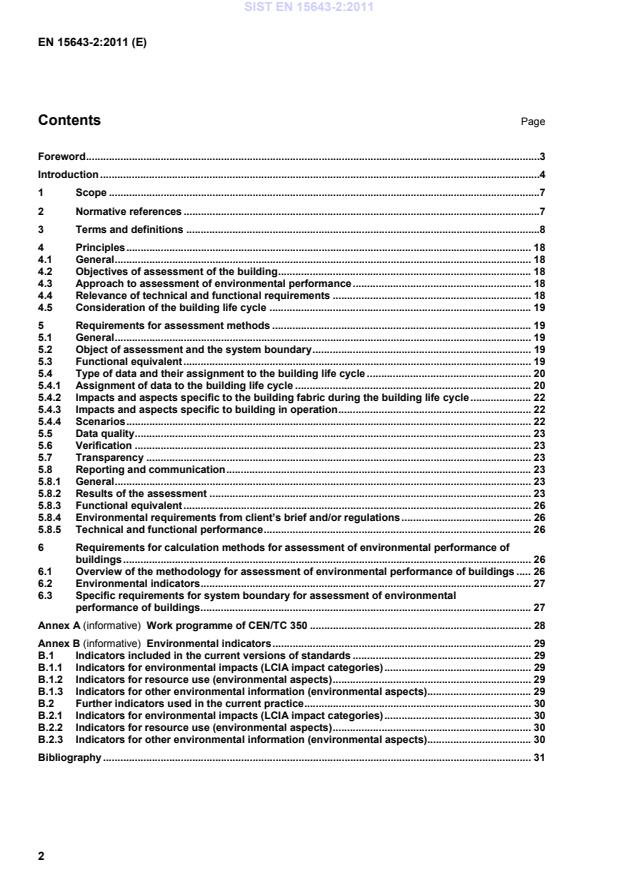
Work programme of CEN/TC 350 . 28Annex B (informative)
Environmental indicators . 29B.1 Indicators included in the current versions of standards . 29B.1.1 Indicators for environmental impacts (LCIA impact categories) . 29B.1.2 Indicators for resource use (environmental aspects) . 29B.1.3 Indicators for other environmental information (environmental aspects). 29B.2 Further indicators used in the current practice . 30B.2.1 Indicators for environmental impacts (LCIA impact categories) . 30B.2.2 Indicators for resource use (environmental aspects) . 30B.2.3 Indicators for other environmental information (environmental aspects). 30Bibliography . 31 SIST EN 15643-2:2011
NOTE The outer box with the dotted line represents the area to be standardised by CEN/TC 350. Figure 1 – The concept of sustainability assessment of buildings SIST EN 15643-2:2011
NOTE The darkened boxes represent the work programme of CEN/TC 350. Figure 2 – The work programme of CEN/TC 350 This European Standard EN 15643-2 is Part 2 of the framework standards for sustainability assessment of buildings. The purpose of EN 15643-2 is to provide a framework with principles, requirements and guidelines to assess the environmental performance of buildings. It focuses on the principles and requirements for the assessment of the environmental performance of a building as described at the "framework level" in Figure 2. In the drafting of this European Standard, ISO 21930 and ISO 21931-1 have been taken into consideration. SIST EN 15643-2:2011
(ISO 14044:2006) ISO 15392, Sustainability in building construction — General principles ISO 15686-1, Buildings and constructed assets — Service life planning — Part 1: General principles ISO 15686-2, Buildings and constructed assets — Service life planning — Part 2: Service life prediction procedures ISO 15686-7, Buildings and constructed assets — Service life planning — Part 7: Performance evaluation for feedback of service life data from practice SIST EN 15643-2:2011
[EN 15603:2008] 3.16 design life service life (3.62) intended by the designer [ISO 15686-1] 3.17 disposal waste (3.75) treatment operation other than recovery (3.50) NOTE Adapted from the definition in Directive 2008/98. 3.18 durability ability to maintain required technical performance (3.71) throughout the service life (3.62), subject to specified maintenance (3.41) under the influence of the foreseeable actions NOTE 1 Foreseeable actions are actions related to “normal” agents that could be expected to act on the works or parts thereof. Potential degradation agents include, for example, temperature, humidity, water, UV radiation, abrasion, chemical attack, biological attack, corrosion, weathering, frost, freeze-thaw and fatigue. NOTE 2 Adapted from the definition in CPD Guidance Paper F and in ISO 6707-1. 3.19 economic aspect aspect of construction works (3.13), part of works (3.1), processes or services related to their life cycle (3.35) that can cause change to economic conditions [ISO 15392:2008] 3.20 economic impact any change to the economic conditions, whether adverse or beneficial, wholly or partially resulting from economic aspects (3.19) NOTE Derived from the definitions of impact and economic impact in ISO 15392. 3.21 economic performance performance (3.47) related to economic impacts (3.20) and economic aspects (3.19) [ISO 15392:2008] 3.22 energy carrier substance or phenomenon that can be used to produce mechanical work or heat or to operate chemical or physical processes NOTE Adapted from the definition in EN 15603:2008. 3.23 environmental aspect aspect of construction works (3.13), part of works (3.1), processes or services related to their life cycle (3.35) that can cause change to the environment SIST EN 15643-2:2011
3.29 functional equivalent quantified functional requirements (3.31) and/or technical requirements (3.72) for a building (3.3) or an assembled system (part of works) (3.1) for use as a basis for comparison NOTE Adapted from the definition in ISO 21931-1. 3.30 functional performance performance (3.47) related to the functionality (3.32) of a construction works (3.11) or an assembled system (part of works) (3.1), which is required by the client (3.9), users (3.74) and/or by regulations NOTE Adapted from the definition in ISO/DIS 15686-10. SIST EN 15643-2:2011
Recycling of organic substances which are not used as solvents (including composting and other biological transformation processes), Recycling of metals and metal compounds, and
Recycling of other inorganic materials as defined in Directive 2008/98 Annex II. NOTE 2 Recycling does not include energy recovery and the reprocessing into materials that are to be used as fuels or for backfilling operations or other recovery operations as defined in Directive 2008/98 Annex II. NOTE 3 Adapted from the definition in Directive 2008/98. 3.52 reference in-use conditions in-use condition (3.34) under which the RSL data (3.54) are valid NOTE The reference in-use conditions can be based upon information gathered through testing or from recorded performance and actual service life data of a component. [ISO 15686-8] SIST EN 15643-2:2011
NOTE 1 Secondary material is measured at the point where the secondary material enters the system from another system. NOTE 2 Materials recovered from previous use or from waste from one product system and used as an input in another product system are secondary materials. NOTE 3 Examples for secondary materials (to be measured at the system boundary) are recycled scrap metal, crushed concrete, glass cullet, recycled wood chips, recycled plastic. 3.62 service life working life period of time after installation during which a building (3.3) or an assembled system (part of works) (3.1) meets or exceeds the technical requirements (3.72) and functional requirements (3.31) NOTE Adapted from the definition in ISO/DIS 15686-1:2008. 3.63 sketch plan stage stage at which alternative outline proposals are evaluated and a preferred solution produced sufficiently to obtain client’s (3.9) approval [ISO 6707-2:1993] 3.64 social aspect aspect of construction works (3.13), part of works (3.1), processes or services related to their life cycle (3.35) that can cause change to society or quality of life [ISO 15392:2008] 3.65 social impact any change to society or quality of life, whether adverse or beneficial, wholly or partially resulting from social aspects (3.64) NOTE Derived from the definitions of impact and social impact in ISO 15392. 3.66 social performance performance (3.47) related to social impacts (3.65) and social aspects (3.64) [ISO 15392:2008] 3.67 sustainability ability of a system to be maintained for the present and future generations NOTE In this context "system" comprises environmental, social and economic aspects. 3.68 sustainability assessment of buildings
combination of the assessments of environmental performance (3.25), social performance (3.66) and economic performance (3.21) taking into account the technical requirements (3.72) and functional SIST EN 15643-2:2011
to determine the impacts and aspects of the building and its site;
to enable the client, user and designer to make decisions and choices that will help to address the need for sustainability of buildings. 4.3 Approach to assessment of environmental performance According to the general principles of sustainability in building construction described in ISO 15392, all three dimensions of sustainability of buildings (environmental, social and economic) are necessary elements in a systemic approach to a sustainable assessment. Statements on the sustainability performance of a building shall address all three dimensions. This implies that when dealing with the sustainability assessment of a building, all three dimensions of sustainability shall be included in an assessment of the building's performance, and communication shall be made accordingly. However, assessment of the individual dimensions of sustainability may also be undertaken separately, depending on the scope of assessment, in which case statements shall only be made for the separate assessment(s) - environmental, social, economic - actually carried out. To link the results from the environmental, social and economic performance assessments requires that their functional equivalent (see 5.3) is the same. By reference to the functional equivalent, the results of assessments can be presented in a systematic way. The functional equivalency (see 5.3) forms the basis for comparison at the building level. 4.4 Relevance of technical and functional requirements The technical and functional requirements become fixed when they are prescribed in the client's brief or in the project specification. These requirements influence the results of the assessment and, therefore need to be SIST EN 15643-2:2011
The impacts and aspects of a building that relate to its environmental performance are influenced by actions taken throughout the entire life cycle of the building. These actions begin with the acquisition of raw materials and continue beyond the de-construction of the building (see 5.4.1). 5 Requirements for assessment methods 5.1 General The assessment methods within this framework shall (as far as possible) ensure that double counting of performance aspects and impacts is avoided. 5.2 Object of assessment and the system boundary The object of assessment shall be the building, its foundations and external works within the area of the building’s site (curtilage) and temporary works associated with the building’s construction.
If the assessment is restricted to a part of the object of assessment or to a part of the life cycle, or if any relevant impacts are not addressed, this shall be documented, reported and justified.
NOTE 1 Regulatory requirements relating to the infrastructure (energy and water supply, sewage systems and other utilities) within the curtilage may allow exclusion from the assessment. The system boundary for the assessment shall be defined in the scope of the assessment and shall take into account the requirements defined in this clause. The assessment shall include impacts and aspects of the building-integrated technical system and building-related furniture, fixtures and fittings. The system boundary for the assessment shall exclude impacts and aspects of the appliances and furniture, fixtures and fittings that are not building-related. NOTE 2 The impacts and aspects of appliances and furniture, fixtures and fittings that are not building-related may be assessed separately. Where this is the case, the impacts and aspects of the appliances and furniture, fixtures and fittings that are not building-related are recorded and reported separately. NOTE 3 Appliances that are not building-related are domestic, commercial and industrial appliances and other non-building related goods e.g. entertainment electronics, washing machines, refrigerators, cooking appliances, office electronics and appliances of industrial processes.
NOTE 4 Building related furniture, fixtures and fittings are products that are fixed to the building, so that the dismantling of the product decreases the performance of the building and the dismantling or replacement of the product constitutes construction operations. 5.3 Functional equivalent
Comparisons between the results of assessments of buildings or assembled systems (part of works) – at design stage or whenever the results are used – shall only be made on the basis of their functional SIST EN 15643-2:2011
...