


EN 16839:2022
(Main)Railway applications - Rolling stock - Head stock layout
Railway applications - Rolling stock - Head stock layout
This document is applicable to vehicles equipped with buffers and screw coupling systems.
In order to allow operation and coupling of trainsets or vehicles, this document specifies the
defined free space for the shunter called the "Berne rectangle" and the necessary free space for
the installation of the rescue coupler.
This document specifies the location, fixing and free spaces on the headstock of:
- buffers;
- screw coupling systems;
- end cocks;
- pneumatic half couplings;
- connections for electric cables.
It also specifies the calculation of the width of the buffer heads.
Unless otherwise displayed, all dimensions given in this document are nominal values.
Bahnanwendungen - Schienenfahrzeuge - Anordnung der Bauteile am Kopfstück
Dieses Dokument gilt für mit Puffern und Schraubenkupplungssystemen ausgestattete Schienenfahrzeuge.
Um den Betrieb und das Kuppeln von Triebzügen oder Fahrzeugen zu ermöglichen, legt dieses Dokument den definierten freizuhaltenden Raum für den Rangierer, bezeichnet als „Berner Raum“, sowie den erforderlichen freizuhaltenden Raum für die Befestigung der Abschleppkupplung fest.
Dieses Dokument legt die Position, die Befestigung und die freizuhaltenden Räume am Kopfstück fest von:
- Puffern;
- Schraubenkupplungssystemen;
- Luftabsperrhähnen;
- Bremskupplungen;
- Anschlüssen für elektrische Kabel.
Sie legt auch die Berechnung der Breite der Pufferteller fest.
Sofern nicht anderweitig angegeben, sind alle in diesem Dokument Norm angegebenen Maße Nennwerte.
Applications ferroviaires - Matériel roulant ferroviaires - Agencement de la traverse de tête
Le présent document est applicable aux véhicules ferroviaires équipés de tampons et de systèmes d'attelage.
Afin de permettre l'utilisation et l'attelage des rames automotrices ou des véhicules, le présent document spécifie l'espace libre défini pour l'agent de manœuvre, appelé « rectangle de Berne », et l'espace libre nécessaire pour l'installation de l'attelage de secours.
Le présent document spécifie l'emplacement, la fixation et les espaces libres des éléments suivants sur la traverse de tête :
— tampons ;
— systèmes d'attelage ;
— robinets d'extrémité ;
— demi-accouplements pneumatiques ;
— raccordements des câbles électriques.
Il spécifie également les calculs de largeur des plateaux de tampons.
Sauf indication contraire, toutes les dimensions figurant dans le présent document sont des valeurs nominales.
Železniške naprave - Vozna sredstva - Postavitev glavnega parka
Ta evropski standard se uporablja za vozila, opremljena z odbojniki in sistemi vijačnih spenjač.
Da bi omogočili delovanje in spenjanje vlakovnih kompozicij ali vozil, ta evropski standard določa zahtevani razmik za preklopnik, imenovan »bernski pravokotnik«, in potreben razmik za namestitev vlečne spenjače.
Ta evropski standard določa lokacijo, pritrditev in potreben razmik naslednjih elementov glavnega parka:
– odbojnikov;
– sistemov vijačnih spenjač;
– zapornih pip;
– pnevmatskih polspenjač;
– priključkov za električne kable.
Določa tudi izračun širine glav odbojnikov.
Če ni drugače navedeno, so vse dimenzije, navedene v tem evropskem standardu, nominalne vrednosti.
General Information
- Status
- Withdrawn
- Publication Date
- 30-Aug-2022
- Withdrawal Date
- 07-Oct-2025
- Technical Committee
- CEN/TC 256 - Railway applications
- Drafting Committee
- CEN/TC 256/WG 33 - Coupling devices
- Current Stage
- 6060 - Definitive text made available (DAV) - Publishing
- Start Date
- 31-Aug-2022
- Due Date
- 13-Mar-2022
- Completion Date
- 31-Aug-2022
Relations
- Effective Date
- 07-Sep-2022
- Effective Date
- 02-Jul-2025
- Effective Date
- 07-Jun-2023



Frequently Asked Questions
EN 16839:2022 is a standard published by the European Committee for Standardization (CEN). Its full title is "Railway applications - Rolling stock - Head stock layout". This standard covers: This document is applicable to vehicles equipped with buffers and screw coupling systems. In order to allow operation and coupling of trainsets or vehicles, this document specifies the defined free space for the shunter called the "Berne rectangle" and the necessary free space for the installation of the rescue coupler. This document specifies the location, fixing and free spaces on the headstock of: - buffers; - screw coupling systems; - end cocks; - pneumatic half couplings; - connections for electric cables. It also specifies the calculation of the width of the buffer heads. Unless otherwise displayed, all dimensions given in this document are nominal values.
This document is applicable to vehicles equipped with buffers and screw coupling systems. In order to allow operation and coupling of trainsets or vehicles, this document specifies the defined free space for the shunter called the "Berne rectangle" and the necessary free space for the installation of the rescue coupler. This document specifies the location, fixing and free spaces on the headstock of: - buffers; - screw coupling systems; - end cocks; - pneumatic half couplings; - connections for electric cables. It also specifies the calculation of the width of the buffer heads. Unless otherwise displayed, all dimensions given in this document are nominal values.
EN 16839:2022 is classified under the following ICS (International Classification for Standards) categories: 45.040 - Materials and components for railway engineering. The ICS classification helps identify the subject area and facilitates finding related standards.
EN 16839:2022 has the following relationships with other standards: It is inter standard links to EN 16839:2017, EN 16839:2022+A1:2025, EN 16839:2022/FprA1. Understanding these relationships helps ensure you are using the most current and applicable version of the standard.
EN 16839:2022 is associated with the following European legislation: EU Directives/Regulations: 2008/57/EC, 2016/797/EU; Standardization Mandates: M/483, M/591. When a standard is cited in the Official Journal of the European Union, products manufactured in conformity with it benefit from a presumption of conformity with the essential requirements of the corresponding EU directive or regulation.
You can purchase EN 16839:2022 directly from iTeh Standards. The document is available in PDF format and is delivered instantly after payment. Add the standard to your cart and complete the secure checkout process. iTeh Standards is an authorized distributor of CEN standards.
Standards Content (Sample)
SLOVENSKI STANDARD
01-november-2022
Nadomešča:
SIST EN 16839:2017
Železniške naprave - Vozna sredstva - Postavitev glavnega parka
Railway applications - Rolling stock - Head stock layout
Bahnanwendungen - Schienenfahrzeuge - Anordnung der Bauteile am Kopfstück
Applications ferroviaires - Matériel roulant ferroviaires - Agencement de la traverse de
tête
Ta slovenski standard je istoveten z: EN 16839:2022
ICS:
45.040 Materiali in deli za železniško Materials and components
tehniko for railway engineering
2003-01.Slovenski inštitut za standardizacijo. Razmnoževanje celote ali delov tega standarda ni dovoljeno.
EN 16839
EUROPEAN STANDARD
NORME EUROPÉENNE
August 2022
EUROPÄISCHE NORM
ICS 45.040 Supersedes EN 16839:2017
English Version
Railway applications - Rolling stock - Head stock layout
Applications ferroviaires - Matériel roulant ferroviaires Bahnanwendungen - Schienenfahrzeuge - Anordnung
- Agencement de la traverse de tête der Bauteile am Kopfstück
This European Standard was approved by CEN on 10 July 2022.
CEN members are bound to comply with the CEN/CENELEC Internal Regulations which stipulate the conditions for giving this
European Standard the status of a national standard without any alteration. Up-to-date lists and bibliographical references
concerning such national standards may be obtained on application to the CEN-CENELEC Management Centre or to any CEN
member.
This European Standard exists in three official versions (English, French, German). A version in any other language made by
translation under the responsibility of a CEN member into its own language and notified to the CEN-CENELEC Management
Centre has the same status as the official versions.
CEN members are the national standards bodies of Austria, Belgium, Bulgaria, Croatia, Cyprus, Czech Republic, Denmark, Estonia,
Finland, France, Germany, Greece, Hungary, Iceland, Ireland, Italy, Latvia, Lithuania, Luxembourg, Malta, Netherlands, Norway,
Poland, Portugal, Republic of North Macedonia, Romania, Serbia, Slovakia, Slovenia, Spain, Sweden, Switzerland, Turkey and
United Kingdom.
EUROPEAN COMMITTEE FOR STANDARDIZATION
COMITÉ EUROPÉEN DE NORMALISATION
EUROPÄISCHES KOMITEE FÜR NORMUNG
CEN-CENELEC Management Centre: Rue de la Science 23, B-1040 Brussels
© 2022 CEN All rights of exploitation in any form and by any means reserved Ref. No. EN 16839:2022 E
worldwide for CEN national Members.
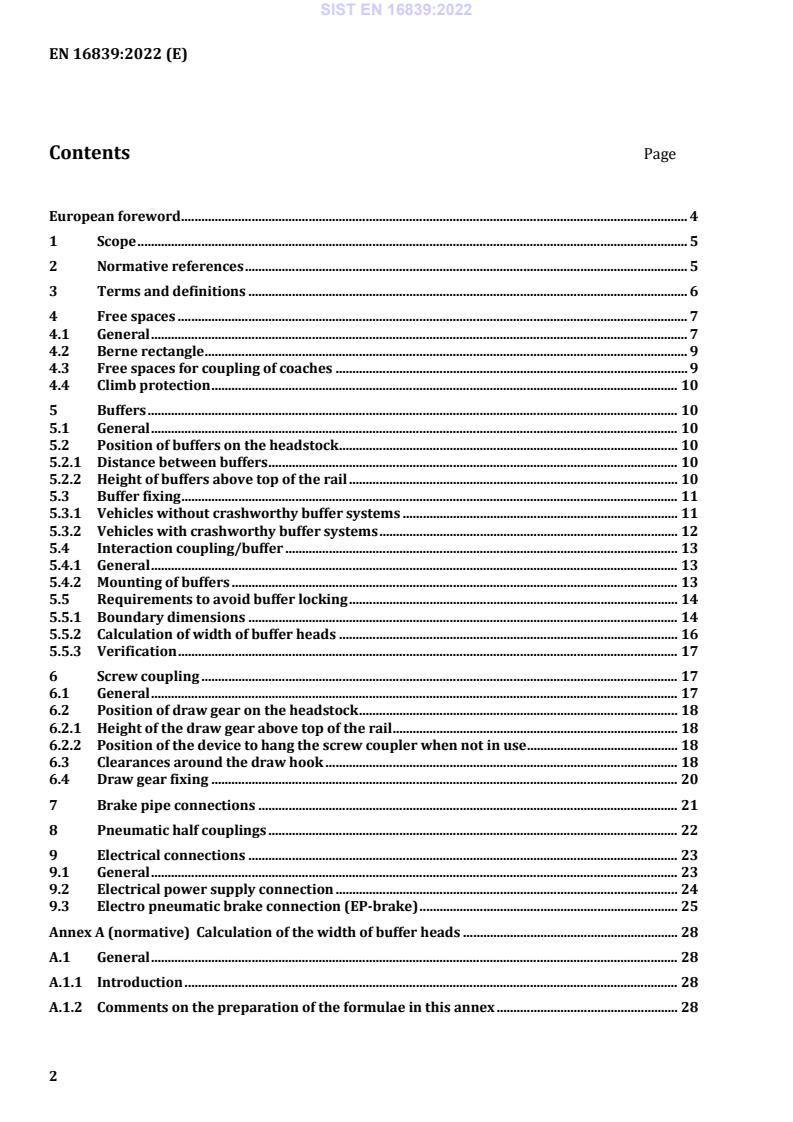
Contents Page
European foreword . 4
1 Scope . 5
2 Normative references . 5
3 Terms and definitions . 6
4 Free spaces . 7
4.1 General . 7
4.2 Berne rectangle . 9
4.3 Free spaces for coupling of coaches . 9
4.4 Climb protection . 10
5 Buffers . 10
5.1 General . 10
5.2 Position of buffers on the headstock . 10
5.2.1 Distance between buffers . 10
5.2.2 Height of buffers above top of the rail . 10
5.3 Buffer fixing . 11
5.3.1 Vehicles without crashworthy buffer systems . 11
5.3.2 Vehicles with crashworthy buffer systems . 12
5.4 Interaction coupling/buffer . 13
5.4.1 General . 13
5.4.2 Mounting of buffers . 13
5.5 Requirements to avoid buffer locking . 14
5.5.1 Boundary dimensions . 14
5.5.2 Calculation of width of buffer heads . 16
5.5.3 Verification . 17
6 Screw coupling . 17
6.1 General . 17
6.2 Position of draw gear on the headstock . 18
6.2.1 Height of the draw gear above top of the rail . 18
6.2.2 Position of the device to hang the screw coupler when not in use . 18
6.3 Clearances around the draw hook . 18
6.4 Draw gear fixing . 20
7 Brake pipe connections . 21
8 Pneumatic half couplings . 22
9 Electrical connections . 23
9.1 General . 23
9.2 Electrical power supply connection . 24
9.3 Electro pneumatic brake connection (EP-brake) . 25
Annex A (normative) Calculation of the width of buffer heads . 28
A.1 General . 28
A.1.1 Introduction . 28
A.1.2 Comments on the preparation of the formulae in this annex . 28
A.1.3 Track . 28
A.1.4 Vehicle . 29
A.2 Data used in the calculation . 29
A.3 Calculation . 29
A.4 Return Value . 30
Annex B (normative) Validation of the calculated width of buffer heads by drawing
methodology . 31
B.1 General . 31
B.2 Methods . 31
B.2.1 General . 31
B.2.2 Drawing method . 34
B.2.3 Simulation method . 34
Annex C (informative) Example of location of rest for uncoupled half couplings . 35
Annex D (normative) Special national conditions . 38
Annex E (informative) Examples for permissible arrangement of brake pipe connections . 39
Annex F (normative) Calculation of space for shunter (Berne Rectangle) in curves when
using screw couplings . 49
Annex ZA (informative) Relationship between this European Standard and the Essential
requirements of EU Directive 2016/797/EC aimed to be covered . 51
Bibliography . 53
European foreword
This document (EN 16839:2022) has been prepared by Technical Committee CEN/TC 256 “Railway
applications”, the secretariat of which is held by DIN.
This European Standard shall be given the status of a national standard, either by publication of an
identical text or by endorsement, at the latest by February 2023, and conflicting national standards
shall be withdrawn at the latest by February 2023.
Attention is drawn to the possibility that some of the elements of this document may be the subject of
patent rights. CEN shall not be held responsible for identifying any or all such patent rights.
This document supersedes EN 16839:2017.
United Kingdom has a national deviation, which is included in Annex D.
The main changes resulting from this document will be incorporated as modifications to
EN 16839:2017:
a) Adaptation of the document with regard to overlapping contents to EN 15551 and EN 15566;
b) Revision of Figure 1 – Free spaces;
c) Revision of Figure 3 – Buffer and drilling template for wagon;
d) Revision of Figure 7 in 6.3 “Clearances around the draw hook” with consideration of the necessary
clearance for mounting the rescue coupler on locomotives;
e) Complete revision of Clause 9 “Electrical connections” including the figures;
f) New Annex F “Calculation of space for shunter (Berne Rectangle) in curves when using screw
couplings” – adopted from EN 16116-2;
g) Adaptation of Annex ZA to EU Directive 2016/797/EC;
h) Adaptation of normative references and editorial revision.
This document has been prepared under a Standardization Request given to CEN by the European
Commission and the European Free Trade Association, and supports essential requirements of EU
Directive(s) / Regulation(s).
For relationship with EU Directive(s) / Regulation(s), see informative Annex ZA, which is an integral
part of this document.
Any feedback and questions on this document should be directed to the users’ national standards body.
A complete listing of these bodies can be found on the CEN website.
According to the CEN-CENELEC Internal Regulations, the national standards organisations of the
following countries are bound to implement this European Standard: Austria, Belgium, Bulgaria,
Croatia, Cyprus, Czech Republic, Denmark, Estonia, Finland, France, Germany, Greece, Hungary, Iceland,
Ireland, Italy, Latvia, Lithuania, Luxembourg, Malta, Netherlands, Norway, Poland, Portugal, Republic of
North Macedonia, Romania, Serbia, Slovakia, Slovenia, Spain, Sweden, Switzerland, Turkey and the
United Kingdom.
1 Scope
This document is applicable to vehicles equipped with buffers and screw coupling systems.
In order to allow operation and coupling of trainsets or vehicles, this document specifies the defined
free space for the shunter called the “Berne rectangle” and the necessary free space for the installation
of the rescue coupler.
This document specifies the location, fixing, and free spaces on the headstock of:
— buffers;
— screw coupling systems;
— end cocks;
— pneumatic half couplings;
— connections for electric cables.
It also specifies the calculation of the width of the buffer heads.
Unless otherwise displayed, all dimensions given in this document are nominal values.
2 Normative references
The following documents are referred to in the text in such a way that some or all of their content
constitutes requirements of this document. For dated references, only the edition cited applies. For
undated references, the latest edition of the referenced document (including any amendments) applies.
EN 14601:2005+A2:2021, Railway applications - Straight and angled end cocks for brake pipe and main
reservoir pipe
EN 15020:2022, Railway applications — Rescue coupler — Performance requirements, specific interface
geometry and test methods
EN 15551:2022, Railway applications — Railway rolling stock —- Buffers
EN 15566:2022, Railway applications — Railway rolling stock — Draw gear and screw coupling
EN 15807:2021, Railway applications - Pneumatic half couplings
EN 15877-1:2012+A1:2018, Railway applications - Marking on railway vehicles - Part 1: Freight wagons
EN 16286-1:2013, Railway applications - Gangway systems between vehicles - Part 1: Main applications
EN 60529:1991, Degrees of protection provided by enclosures (IP Code) (IEC 60529:1989)
ISO 3864 (all parts), Graphical symbols — Safety colours and safety signs
1 Document impacted by EN 60529:1991/A1:2000, EN 60529:1991/A2:2013 and EN 60529:1991/A2:2013/COR1:2019.
Consists of the following parts: ISO 3864-1:2011, Graphical symbols — Safety colours and safety signs — Part 1:
Design principles for safety signs and safety markings; ISO 3864-2:2016, Graphical symbols — Safety colours and
safety signs — Part 2: Design principles for product safety labels; ISO 3864-3:2012, Graphical symbols — Safety
colours and safety signs — Part 3: Design principles for graphical symbols for use in safety signs ISO 3864-4:2011,
3 Terms and definitions
For the purposes of this document, the terms and definitions given in EN 14601:2005+A2:2016,
EN 15551:2022, EN 15566:2022, EN 15807:2021 and the following apply.
ISO and IEC maintain terminological databases for use in standardization at the following addresses:
— ISO Online browsing platform: available at https://www.iso.org/obp
— IEC Electropedia: available at http://www.electropedia.org/
3.1
Berne rectangle
defined free space which is needed to ensure safe working conditions for the shunting staff during
coupling and uncoupling of screw couplings
3.2
clearance
area needed for mounting and functional use of moveable parts
EXAMPLE Adapters, cables, etc are moveable parts.
Note 1 to entry: For definition of “running surface” see EN 13848-1:2019, 3.4
3.3
contact plane of buffers
buffing plane
plane tangent to buffing surfaces of both buffer heads at the end of the vehicle perpendicular to running
surface
Note 1 to entry: See EN 13848-1:2019, 3.1.4 and 4.1.
Note 2 to entry: “Running surface” sometimes also named as “Top of Rail (TOR)”.
3.4
free space
area free of equipment needed for occupational safety
EXAMPLE free space for coupling process and/or ergonomic (e.g. handrails, cocks)
Graphical symbols — Safety colours and safety signs — Part 4: Colorimetric and photometric properties of safety sign
materials (Part 4 not relevant for this standard).
3.5
headstock
part of the underframe with a vertical reference plane at the ends of the vehicle where the buffers are
fixed
Note 1 to entry: Headstock includes the part where draw gear is fixed.
3.6
guidance device for draw hook
device to guide and support the draw hook
3.7
shunter
member of staff who couples and uncouples railway vehicles
3.8
symmetrical buffer
buffer, wherein the buffer head is, regardless of its contour geometry, mounted on its width dimension
symmetrically to the centre-line of the buffer housing or to the predetermined nominal position of the
buffer centre-line
4 Free spaces
4.1 General
To ensure safe working conditions and also for easy operation for the shunters during coupling and
uncoupling, it is necessary to define required free spaces.
With the exception of the shunter's handrails there shall be no devices under the buffers that limit the
shunter's access for coupling operations.
Flexible connecting cables and flexible parts of hoses may penetrate these spaces.
The flexible parts of gangways according to EN 16286-1:2013 may infringe the Berne rectangle.
For assessment of free spaces, the coupling gear components shall be positioned on the centre-line of
the vehicle.
Dimension in millimetres
Key
1 free space for the shunter (Berne rectangle)
2 free space above running surface without moveable parts (e.g. couplers, pipes)
3 running surface
4 lower edge of buffer head
5 contact plane of fully elastic compressed buffers
6 free spaces, free of fixed devices behind the buffer head above its lower edge
Figure 1 — Free spaces
NOTE Steps and handrails are not part of this document. The dimensions of the shunter steps and handrails
and the free spaces around these arrangements are given in EN 16116-1:2022 and EN 16116-2:2020.
4.2 Berne rectangle
The free space for shunters during coupling is called “Berne rectangle”.
Vehicles shall be designed so that staffs are not exposed to undue risk during coupling and uncoupling.
If screw couplers and side buffers are used, the required spaces shown in Figure 1 shall be free of fixed
parts.
Flexible connecting cables and flexible hoses may be inside this space. With exception of the shunter
handrails there shall be no devices under the buffers that hinder the access to the space.
For the verification of the necessary spaces (Berne rectangle) for the coupler in S-curves, see Annex F.
4.3 Free spaces for coupling of coaches
See free spaces from 4.1 and Figure 2.
The limit of the securing devices for the gangway side plate (if fitted) shall be located at a minimum
distance of 495 mm from the vehicle longitudinal centre-line.
Dimension in millimetres
Key
1 for the shunter (Berne rectangle)
2 not shown in this view (see Figure 1)
3 not shown in this view (see Figure 1)
4 not shown in this view (see Figure 1)
5 contact plane of fully elastic compressed buffers
6 free spaces, free of fixed devices behind the buffer head above its lower edge
7 free space for gangway side plate
Figure 2 — Free spaces for coupling coaches
4.4 Climb protection
On vehicles, where climb protection are used (mandatory for vehicles subjected to regulations for
dangerous goods), the climb protection shall not restrict the free spaces.
NOTE Information on climb protection on vehicles subjected to regulations for dangerous goods, is given in
TE 25 on RID.
5 Buffers
5.1 General
The following requirements apply to vehicles equipped at least at one end with two buffers according to
EN 15551:2022, fixed symmetrically to the longitudinal centre-line of the vehicle.
5.2 Position of buffers on the headstock
5.2.1 Distance between buffers
The standard distance between buffer centre-lines shall be nominally according to Table 1.
Table 1 —Track gauge and distance between buffer centre-lines
Track gauge Distance between buffer centre-lines
mm mm
1 435 1 750 ± 10
Interchangeable 1 435/1 524 1 790 ± 10
Interchangeable 1 435/1 600 1 905 ± 3
Interchangeable 1 435/1 668 1 850 ± 10
1 524 1 830 ± 10
1 600 1 905 ± 3
1 668 1 850 ± 10
It is permitted for dual gauge units (interchangeable wheelsets) intended for running between standard
gauge network 1 435 mm and broad-gauge networks to have a different value of the distance between
buffer centre-lines (e.g. One 850 mm), provided that full compatibility with buffers for standard
1 435 mm gauge is ensured.
Buffers shall be sized so that in horizontal curves and reverse curves, it is not possible for vehicles to
lock buffers. The minimum horizontal overlap between buffer heads in contact shall be 25 mm.
5.2.2 Height of buffers above top of the rail
The height b of the centre-line of the buffers to the top of the rail shall be in all loading and wear
conditions in accordance with Table 2.
Table 2 —Height of buffers above top of the rail
Type b
mm
Locomotive 940 mm to 1 065 mm
Coach 980 mm to 1 065 mm
Freight wagon and car carrier 940 mm to 1 065 mm
5.3 Buffer fixing
5.3.1 Vehicles without crashworthy buffer systems
The buffers shall be attached to the vehicle headstock.
The screws shall be M 24, grade 8.8, and self-locking nuts, grade 8, shall be used. The screws shall have
a threaded projection of at least three threads.
The recommended tightening torque should be 690 Nm.
For wagons, distance between holes shall be in accordance with Figure 3.
For wagons fitted with 150 mm stroke buffers, pins in the headstock, which indicate that this kind of
buffer shall be used, shall be located at the right side of each buffer (looking at the buffer head) as
shown in Figure 3, item 1, Section A – A. The protrusion of the pin shall be at least 20 mm.
NOTE To help identify buffers with different strokes, buffers with 150 mm stroke have an opening at their
right side, while buffers with 105 mm stroke do not have this opening.
The hole spacing (280 × 160) mm for freight wagons should also be used for coaches, vans and
locomotives.
Dimension in millimetres
Key
1 pin only for buffer with 150 mm stroke
2 centre-line of the vehicle.
a distance from buffer centre-line to buffer centre-line (see Table 1)
* magnified section
Figure 3 — Buffer and drilling template for wagon
5.3.2 Vehicles with crashworthy buffer systems
Vehicles that use crashworthy buffers or buffers which form part of a combined system consisting of a
special buffer and a deformation element may have a different mounting configuration (e.g. position of
flange, thread diameter, number of screws and their position).
NOTE These vehicles are locomotives, driving trailers or coaches according to EN 15227:2020 or tank
wagons according to the Regulations concerning the International Carriage of Dangerous Goods by Rail (RID).
The marking for wagons fitted with crashworthy buffer systems shall be according to
EN 15877-1:2012+A1:2018.
5.4 Interaction coupling/buffer
5.4.1 General
To ensure that the train is able to negotiate horizontal curves of 150 m radius safely, the static
characteristics of draw gear and buffers shall be coordinated.
A guideline value of 250 kN should not be exceeded for the compression force of a pair of buffers in
contact on a horizontal curve of 150 m.
Unless otherwise specified in the technical specification, the stiffest static characteristics of the buffer
and draw gear combined together with the static test methods according to EN 15566:2022 and
EN 15551:2022 are to apply for evidence of buffer compression force.
The age of elastic elements in operational service should also be taken into account.
Conformity to these requirements may be assessed by calculation.
NOTE 1 The technical specification can define additional conditions for tested elastic devices, as for example
temperature range, which for static characteristics are to be taken into account.
NOTE 2 For new elastic devices, the available experience related assessed values may be applied.
To determine the compression force for vehicles, the calculation method shown under section 3 of
UIC B 36 RP 32 may be used (the method described in this report is also applicable for coaches and
locomotives). This calculation method may also allow to determine stress levels on smaller radius
curves. If the coupling practice creates pretension forces, these shall be taken into account.
NOTE 3 The calculation method on curves according to UIC B36 RP 32 also gives confidence for an S-curve of
150 m with an intermediate straight of 6 m.
NOTE 4 It is confirmed that pairings of different vehicle types / configurations need not to be analysed if each
vehicle complies with the 250 kN limit analysed for a pairing of same vehicle types.
5.4.2 Mounting of buffers
Two buffers with the same elastic system, category, head dimension, stroke and type of housing shall be
fitted at each vehicle end. The nominal length of the buffers on each side shall be the same.
Housings which differ only in the buffer head material (steel or non-metallic insert) are considered to
be identical.
When a non-metallic insert or non-metallic head is provided on one of the two buffers per vehicle end, it
shall be placed diagonally according to Figure 4.
Key
1 buffer with metallic head
2 buffer with non-metallic insert or head
l , l buffer length at each vehicle end
1 2
Figure 4 — Mounting of buffers with non-metallic insert or head (top view)
5.5 Requirements to avoid buffer locking
5.5.1 Boundary dimensions
Buffer heads shall not exceed the limits shown in Figure 5:
— LINE 5 towards the outside, the limit of the construction gauge defined for the vehicle concerned;
— LINE 1 towards the vehicle centre-line:
— for wagons, a vertical line situated 600 mm from the vehicle centre-line
— for coaches, locomotives and “ontrackmachines”, a vertical line situated 540 mm from the
vehicle centre-line.
— The compliance with this limited value is one of the preconditions, that this space will be kept
free for the shunter;
— LINE 2 towards the ground, a horizontal line situated 250 mm below the centre-line of the buffers.
Dimension in millimetres
Key
1 internal limit
2 lower limit
3 level of buffer centre-line
4 vehicle centre-line
5 construction gauge limit
6 limit for vehicles with interconnecting gangway
half width of the buffer head
∆
a nominal distance between buffer centre-lines
b distance from vehicle centre-line (item 4) to internal limit line (item 1)
minimum surface
Vehicle type b
mm
freight wagons 600
for coaches, locomotives and ontrackmachines 495
NOTE For value a, see Table 1.
Figure 5 — Boundary dimensions and minimum surface of buffer heads
For buffer heads with 550 mm width the minimum buffing surface may be reduced by rounding
2 × R 50 mm in the lower corners of the buffer head.
5.5.2 Calculation of width of buffer heads
5.5.2.1 General
Regardless of the buffer head width (Δ) it shall have in all operational circumstances an overlap of the
buffers at least of 25 mm.
∆
The minimum half width of the buffer head shall be calculated in accordance with Annex A or the
minimum width of the buffer (Δ) shall be determined in accordance with Annex B.
If the buffer head calculated in accordance with Annex A infringes the internal limit (see Figure 5), an
additional analysis according to Annex B shall be carried out in order to determine the minimum width
of the buffer head.
5.5.2.2 Freight wagon
After determination according to 5.5.2.1, the buffer head shall be chosen from Table 3.
Table 3 — Standard widths of buffer heads for freight wagon
Value of Δ calculated according to Annex A Standard buffer width Δ
Δ ≤ 400 mm 450 mm
400 mm < Δ ≤ 550 mm 550 mm
5.5.2.3 Coaches
For coaches with a length over buffer (LoB) ≥ 25 m, the minimum buffer width is 635 mm.
After determination according 5.5.2.1, the buffer head should be chosen from Table 4.
Table 4 — Widths of buffer heads for coaches
Minimum buffer width Δ Recommended buffer width Δ
660 mm (symmetrical buffer head)
635 mm
720 mm (asymmetrical buffer head)
5.5.2.4 Locomotive
If the determined value (Δ) is not greater than 550 mm, the recommended buffer width for locomotives
is 550 mm.
5.5.2.5 Operation between European 1 435 mm gauge network and other gauge networks
For operation between European 1 435 mm gauge network and other gauge networks the following
applies:
— The minimum width of buffer heads on freight wagons, with a distance between the centre-lines of
the buffers of 1 850 mm, accepted for operation on the 1 435 mm gauge (European standard gauge
network) and the 1 668 mm gauge (Spanish gauge network) shall be 100 mm more than the width
calculated in accordance with Annex A.
— The minimum width of buffer heads on freight wagons, with a distance between the centre-lines of
the buffers of 1 790 mm, accepted for operation on the 1 435 mm gauge (European standard gauge
network) and the 1 524 mm gauge (Finnish network) shall be 40 mm more than the width
calculated in accordance with Annex A.
— For freight wagon only, the minimum width of buffer heads on wagons, with the distance between
centre-lines of the buffer of 1 830 mm, accepted for operation on the 1 435 mm gauge (European
standard gauge network) and the 1 524 mm gauge (Finnish network) shall be 40 mm more towards
the vehicle centre-line than the width calculated in accordance with Annex A and Table 3.
5.5.3 Verification
If the buffer head calculated in accordance with Annex A infringes the internal limit (see Figure 5), one
of the valid methodologies in Table 5 shall be carried out as an additional analysis according to Annex B
∆
to determine .
Table 5 — Vehicle specification and valid methodology
Valid methodology
Calculation
Calculation
Drawing with
with Formulae
methodology multibody
(A.1 to A.7)
No Condition simulation
Vehicles which do not infringe the internal
Yes Yes Yes
limit by calculation with the formula
Vehicles which infringe the internal limit by
2 No Yes Yes
calculation with the formula
6 Screw coupling
6.1 General
The following requirements apply to vehicles equipped at least at one end with a screw coupling
system, according to EN 15566:2022, fixed on the longitudinal centre-line or plane of the vehicles.
The distance from the point of contact of the opening of the draw hook, in the uncoupled condition, to
the front of the uncompressed buffers shall be:
— maximum 400 mm and
— minimum 335 mm.
The difference between the nominal height of the draw hook centre-line to the nominal height of the
buffer centre-line shall be between 0 mm and 20 mm (buffer centre-line (A) above the draw hook
centre-line).
These requirements are shown in Figure 6.
Dimension in millimetres
Key
1 uncompressed buffer
2 draw hook opening
3 screw coupler in uncoupled position
4 guidance device for draw hook
A level of buffer centre-line
Figure 6 — Relative position between buffers and draw hook
6.2 Position of draw gear on the headstock
6.2.1 Height of the draw gear above top of the rail
The height of the centre-line of the draw hook shall be between 920 mm and 1 045 mm and for coaches
between 950 mm and 1 045 mm above top of the rail in all loading and wear conditions.
6.2.2 Position of the device to hang the screw coupler when not in use
The headstock of the vehicles shall be fitted with a device to hang the screw coupler when not in use.
This device shall be designed and located to avoid any part of the screw coupler from dropping to less
than 140 mm above the top of the rail in all loading and wear conditions.
NOTE Uncoupled position, see Figure 6.
6.3 Clearances around the draw hook
The required clearance for the guidance of the draw hook and screw coupling (draw hook and screw
coupling are defined in EN 15566:2022) shall be available laterally in the draw hook guide area under
all operating conditions. The clearances to be provided at vehicles extremities around the draw hook
shall fulfil the dimensions given in Figure 7.
Dimension in millimetres
Key
1 vehicle centre-line
2 guidance device for draw hook
3 buffer fixing plane (example for freight waggon)
4 hook front plane
5 buffer head plane
vehicle type a b c d
mm mm mm mm
freight wagons min. 200 min. 275 — —
locomotives and driving trailers min. 240 min. 275 min. 395 min. 550
coaches min. 240 — — —
Figure 7 — Clearances around the draw hook
For coaches, the clearance above the draw hook shall be of a sufficient size (see Figure 7) and shall
allow hooking the shackle.
For locomotives and driving trailers, the clearances to be provided at vehicle extremities around the
draw hook shall fulfil the dimensions as given in Figure 7. If attachments (for example a footstep)
infringe this clearance (see Figure 8), they shall be non-destructively removable to obtain this clearance
for rescue purpose with a rescue coupler according to EN 15020:2022.
Dimension in millimetres
Figure 8 — For information, example of rescue coupler interface and free spaces
6.4 Draw gear fixing
For freight wagons, the draw gear shall be fixed to the headstock.
In case of fixing by fasteners:
— four screws M 20, grade 8.8, and four self-locking nuts, grade 8, shall be used. The screws shall have
a threaded projection of at least three threads. The tightening torque should be at least 280 Nm;
— drilling template for fixing freight wagon draw gear is given in EN 15566:2022 (hole diameter
4 x Ø 24 mm, hole spacing (450 mm x 110 mm)).
For locomotives and coaches, this fixing is also allowed, however other solutions are also permitted.
7 Brake pipe connections
If the vehicle is fitted with a main reservoir pipe, the coupling connections of this pipe at the vehicle
shall be placed at a greater distance from the centre-line on the vehicle than those of the brake pipe.
The requirements for clearance around the end cock are given in EN 14601:2005+A2:2021.
The locomotive shall be equipped with at least one brake pipe cock (item 1) and main reservoir pipe
cock (item 2).
The other vehicles shall be equipped with one main brake pipe (item 1), at least.
The area for the arrangement of cocks at the head stock is shown in Figure 9 and described by the
dimension [(l – l ) x (h + h )] in Figure 10 and Table 6. Examples with values and/or hose assemblies
2 1 1 2
are given in the informative Annex E.
Table 6 — Distances for the arrangement of cocks
Dimensions in millimetres
For locomotive and driving trailers For other vehicles
distance min max min max
h 0 260 0 240
h 0 150 0 150
l
380 550 150 550
l 450 650 220 550
The Figures 9 and 10 also shows the arrangement for the main brake pipe (item 1) and main reservoir
pipe (item 2). In this case, the distance between two side by side end cocks (l -l ) shall be at least
2 1
70 mm (see Figure 10). The actual necessary clearance depends on the structural shape of the end
cocks.
Figure 9 — End cock arrangement - 3D-View (example)
Dimension in millimetres
Key
F cock in closed position
1a main brake pipe cock, left
1b main brake pipe cock, right
2a main reservoir pipe cock, left
2b main reservoir pipe cock, right
h distance between the buffer centre-line and cocks (below centre-line)
h distance between the buffer centre-line and cocks (above centre-line)
l distance between the longitudinal centre-line of the vehicle and the
brake pipe cock (for left and right side) (named l and l )
1a 1b
l distance between the longitudinal centre-line of the vehicle and the
main reservoir pipe cock (for left and right side) (named l and l )
2a 2b
The handle of the cut-off cock may be placed on the right or on the left of the connection.
The connection point can be designed as a connection for a hose pipe or an end cock.
Figure 10 — End cock arrangement (example)
8 Pneumatic half couplings
Requirements for pneumatic half couplings itself are given in EN 15807:2021.
The device designed to restrain the pneumatic half coupling in position in the rest (brake hose bracket)
when not in use shall be located so that the lowest part of the pneumatic half coupling remains 140 mm
above the top of the rail in all cases of wear and vehicle movement and, as far as possible, prevents
entry of foreign bodies into its interior.
Examples of location of these devices are given in Annex C.
9 Electrical connections
9.1 General
The arrangement of electrical cable connections on vehicles shall comply with the requirements for:
— electric power supply cables, defined in the Figure 11 to Figure 13 and Table 7;
— electro-pneumatic brake cables, defined in Figure 11 and Figure 14 to Figure 15 and Table 8.
The clearance around the connector plugs for electric power supply and for electro-pneumatic brake
shall not be infringed by any other devices.
All devices designed to restrain the cables when not in use (dummy sockets) shall be located so that the
lowest part of the cable remains 140 mm above the top of the rail in all cases of wear and vehicle
movement.
Key
1 electrical power supply junction box
2 electrical power supply socket
3 electro-pneumatic brake junction box
4 electro-pneumatic brake socket
a On locomotives, these connections are usually designed as sockets
Figure 11 — Electrical connections (overview)
The plug cable in the coupler socket of the adjacent vehicle or in the dummy socket of its own vehicle
shall not exceed the vehicle gauge.
The connecting socket shall provide protection to at least IP 66 of EN 60529:2019 .
A warning sign indication “Warning of dangerous electrical voltage” by a triangle with a flash sign in
accordance with the ISO 3864:— (series), with a minimum edge length of 80 mm, shall be affixed to
coupler sockets, cable-holder junction boxes and dummy sockets for the connecting plugs.
9.2 Electrical power supply connection
Table 7 specifies the dimensions shown in Figures 12 and 13.
Table 7 — Dimensions of Electrical power supply connection for Figure 12 and 13
a
Vehicle type a d/d
1 l
b
mm
mm
mm
mm
locomotive 800 to 1 100 max. 450
435 to 585 1 350 to 1 500
other vehicles 850 to 900 max. 385
a Preferred length for standard coupled vehicles. For vehicles with unusual overhangs, the cable length
should be calculated.
The Figures 12 and 13 shows only the parts of the electrical supply.
Key
1 electrical power supply junction box
2 electrical power supply socket
3 electrical power cable
a distance from the vehicle centre-line to the box (item 1) or socket (item 2)
X for the Side view, see Figure 13
Figure 12 — Electrical power supply connection (front view)
Dimensions in millimetre
Key
1 electrical power supply junction box
2 electrical power supply socket
A point between flexible and rigid part of the cable
B point at the end of cable on opposite side of A and C
C point at the end of the cable with socket
b distance from the buffer centre-line to then electrical power supply socket (item 2)
l length of the cable between points C and B
d distance of the buffer head plane to the cable outlet of the cable holder junction box (item 1)
d1 distance of the buffer head plane to the centre of the socket (item 2)
α inclination angle at the electrical power supply junction box (item 1)
β inclination angle at the electrical power supply socket (item 2)
Figure 13 — Electrical power supply connection (side view X)
9.3 Electro pneumatic brake connection (EP-brake)
Table 8 specifies the dimensions shown in Figures 14 and 15.
Table 8 — Dimensions of Electro pneumatic brake connection (EP-brake) for Figure 14 and 15
a b c d, d1 l
α
β
mm mm mm mm mm
300 to 600
1 440 to
475 to 740 70 to 375 70 to 375 25° to 35° 0° to 15°
1 450
a
300 to 650
a 650 mm is acceptable for coaches
T
...
La norme EN 16839:2022, intitulée "Applications ferroviaires - Matériel roulant - Disposition de la boîte à butées", présente un champ d'application clair et précis, s'adressant principalement aux véhicules équipés de systèmes de butées et de couplages à vis. Cette norme est d'une grande pertinence dans le secteur ferroviaire, car elle établit des spécifications essentielles pour le fonctionnement et le couplage des rames ou des véhicules, ce qui est crucial pour la sécurité et l'efficacité des opérations. Un des points forts de cette norme est la définition de l’espace libre pour le manœuvrier, connu sous le nom de "rectangle de Berne". Ce paramètre est fondamental pour garantir une manipulation sûre et efficace des trains. La norme précise également l’espace nécessaire pour l'installation du dispositif de secours, élément primordial en cas d'urgence, renforçant ainsi la sécurité des opérations ferroviaires. En ce qui concerne la disposition sur la tête de la boîte à butées, la norme EN 16839:2022 détaille l’emplacement, la fixation et les espaces libres, s’assurant que tous les éléments – tels que les butées, les systèmes de couplage à vis, les robinetteries de fin de ligne, les demi-couplings pneumatiques et les connexions pour câbles électriques – sont correctement pris en compte. Cette approche holistique assure que tous les éléments du matériel roulant fonctionnent en harmonie, réduisant les risques d'accidents et améliorant la fiabilité du matériel. De plus, la norme aborde le calcul de la largeur des têtes de butée, fournissant des directives claires qui facilitent l'uniformité lors de la conception et de la fabrication des véhicules. L’indication que toutes les dimensions spécifiées dans le document sont des valeurs nominales est également un atout, car cela permet aux fabricants et aux opérateurs d'interpréter les dimensions de manière pragmatique sans ambiguïté. La norme EN 16839:2022, par son approche rigoureuse et détaillée, constitue donc un cadre essentiel pour le développement et la mise en œuvre des systèmes de couplage dans le domaine ferroviaire, tout en garantissant sécurité et compatibilité entre les différents équipements.
The EN 16839:2022 standard outlines critical specifications for railway applications, specifically focusing on the headstock layout of rolling stock vehicles equipped with buffers and screw coupling systems. With a clear emphasis on promoting safety and efficiency in the operation and coupling of trainsets and vehicles, the standard provides guidelines that are essential for ensuring compliance across the railway industry. One of the significant strengths of this standard is its detailed definition of the "Berne rectangle," which establishes the required free space necessary for shunters. This specification is vital for facilitating safe and efficient operations during coupling processes. Additionally, the document addresses the necessary space for the installation of rescue couplers, further enhancing the safety protocols within railway operations. The standard also meticulously covers various components associated with the headstock layout, including buffers, screw coupling systems, end cocks, pneumatic half couplings, and electric cable connections. By delineating the location, fixing, and required free spaces for each of these elements, EN 16839:2022 ensures that manufacturers and operators can design and implement rolling stock that adheres to established safety and operational criteria. Moreover, the inclusion of calculations for the width of the buffer heads offers practical insights that can streamline the design process, ensuring that components are compatible and function as intended. The nominal values provided in the document serve as a reliable reference for engineers and industry professionals aiming for precise compliance and optimal performance. Overall, this standard is profoundly relevant to the railway sector, as it aligns with best practices in vehicle design and safety, contributing to more effective management of rolling stock operations. The EN 16839:2022 standard embodies a comprehensive approach to headstock layout, which is indispensable for modern railway applications.
EN 16839:2022は、鉄道車両におけるヘッドストックレイアウトに関する標準文書であり、バッファーおよびスクリューカップリングシステムを装備した車両に適用されます。この標準の範囲は、列車セットまたは車両の運用およびカップリングを可能にするために必要な基準を詳細に定めています。 本標準の強みは、運搬作業を行う者であるシュンターのために定義された自由空間、いわゆる「ベルン矩形」や、救助カプラーの設置に必要な自由空間を明確に示している点です。これにより、鉄道業界における安全性と効率性が向上します。 さらに、ヘッドストック上のバッファーやスクリューカップリングシステム、エンドコック、空気式ハーフカップリング、電気ケーブルの接続に関する位置や固定方法、自由空間を明確に規定していることも、この標準の重要なポイントです。これにより、車両の信頼性を向上させ、メンテナンスの容易さに貢献します。 また、バッファーヘッドの幅の計算に関する規定も含まれており、技術者やエンジニアが設計および製造の際に必要な情報を得られるよう配慮されています。この文書で提示されるすべての寸法は名目値であることが示されており、実際の適用において適切な調整が可能です。 EN 16839:2022は、鉄道車両のヘッドストックレイアウトに関する標準の中で、その重要性や適用性を高く評価されています。鉄道業界における安全基準の強化や、効率的な連結作業の実現に寄与するため、この文書は非常に価値のあるリソースです。
Die Norm EN 16839:2022 befasst sich mit den Anwendungen im Bereich der Schienenfahrzeuge und legt spezifische Anforderungen an das Layout von Kopfstücken bei Fahrzeugen fest, die mit Puffern und Schraubenkupplungssystemen ausgestattet sind. Der Anwendungsbereich dieser Norm ist klar definiert und schließt die notwendigen Freiräume für die effiziente Handhabung und das Kuppeln von Zugverbänden oder Fahrzeugen ein. Eine der hervorstechenden Stärken dieser Norm ist die klare Spezifikation des „Berne-Rechtecks“, das entscheidend für die Tätigkeit des Rangierers ist. Diese definierte Freifläche stellt sicher, dass die Fahrzeugkombinationen reibungslos operieren können, was für die Sicherheit und Effizienz im Bahnbetrieb von zentraler Bedeutung ist. Zudem wird der erforderliche Freiraum für die Installation des Rettungskupplungsmechanismus festgelegt, der eine essentielle Komponente für den sicheren Betrieb darstellt. Ein weiterer bedeutender Aspekt der Norm ist die detaillierte Beschreibung der Positionierung, Befestigung und der Freiräume von verschiedenen Komponenten auf dem Kopfstück, zu denen Puffer, Schraubenkupplungssysteme, Endhähne, pneumatische Halbkupplungen und elektrische Verbindungen gehören. Diese präzisen Vorgaben sind unerlässlich, um die Kompatibilität und Sicherheit der unterschiedlichen Systeme zu gewährleisten. Darüber hinaus behandelt die Norm auch die Berechnung der Breite der Pufferköpfe, was entscheidend für die Standardisierung im Fahrzeugbau ist. Die Berechnung bietet den Herstellern eine klare Grundlage für das Design und verbessert somit die Austauschbarkeit von Bauteilen, was zu einer Erhöhung der Effizienz in der Produktion führt. Insgesamt ist EN 16839:2022 ein bedeutendes Dokument, das nicht nur die technische Genauigkeit sicherstellt, sondern auch die wichtige Funktionalität der Schienenfahrzeuge in der modernen Bahntechnik unterstützt. Die Norm ist relevant für Hersteller, Betreiber und Regelsetzer, da sie die Sicherheitsstandards im Schienenverkehr erhöht und somit zur allgemeinen Verbesserung der Transportinfrastruktur beiträgt.
SIST EN 16839:2022 표준은 철도 응용 분야에서의 차량 및 기차에 필수적인 구성 요소인 헤드 스톡 배열에 관해 상세히 규정하고 있습니다. 이 문서는 버퍼와 나사 커플링 시스템이 장착된 차량에 적용되며, 기차의 안전하고 효율적인 운영을 위한 기초를 제공합니다. 이 표준의 주요 강점 중 하나는 "베른 사각형"이라고 불리는 연접기 공간에 대한 명확한 정의를 포함하고 있다는 점입니다. 이를 통해 기차 세트 또는 차량의 연결과 작동을 원활하게 할 수 있도록 필수적인 자유 공간을 규명하고 있습니다. 이로 인해 사용자 및 제조사는 차량의 설계와 운용에 대한 명확한 지침을 얻을 수 있습니다. 또한, 이 문서는 헤드 스톡에서 버퍼, 나사 커플링 시스템, 엔드 콕, 공압 반 커플링, 전선 연결 등 다양한 요소의 위치 및 고정 방법과 필요 자유 공간을 상세히 명시하고 있습니다. 이는 다양한 차량 설계 요구사항을 충족시키는 데 중요한 참고자료가 됩니다. 더불어 버퍼 헤드의 폭을 계산하는 방법도 제공하여, 다양한 차량 차체와 호환되는 설계를 촉진합니다. 모든 치수는 명목 값으로 제공되기 때문에 사용자는 이를 바탕으로 정확하고 일관된 설계를 할 수 있습니다. SIST EN 16839:2022 표준은 철도 산업에서 필수적인 안전성과 효율성을 보장하기 위해 설계에 필요한 기준을 제시하며, 이를 통해 차세대 철도 차량의 발전에 기여할 것으로 기대됩니다. 이 문서는 철도 차량의 성능을 최적화하고, 법적 요구사항을 만족시키는 데 있어 매우 중요한 리소스입니다.
Questions, Comments and Discussion
Ask us and Technical Secretary will try to provide an answer. You can facilitate discussion about the standard in here.
Loading comments...