

EN 2003-009:2007
(Main)Aerospace series - Test methods - Titanium and titanium alloys - Part 009: Determination of surface contamination
- Abstract
This standard specifies two methods of determining surface contamination caused by an a-stabilizer on titanium and titanium alloys, for aerospace applications.
- Status
- Published
- Publication Date
- 20-Mar-2007
- Withdrawal Date
- 29-Sep-2007
- Technical Committee
- ASD-STAN - Aerospace
- Drafting Committee
- ASD-STAN/D 4 - Metallic
- Current Stage
- 6060 - Definitive text made available (DAV) - Publishing
- Start Date
- 21-Mar-2007
- Completion Date
- 21-Mar-2007

Overview
EN 2003-009:2007 is a European standard established by CEN that defines test methods for determining surface contamination on titanium and titanium alloys, specifically caused by α-stabilizers. This contamination is critically relevant to the aerospace industry due to its impact on the mechanical properties of titanium components used in aerospace applications. The standard outlines two precise methods to identify and quantify contamination, ensuring consistent quality control and safety in aerospace manufacturing.
Key Topics
Surface Contamination in Titanium Alloys
Surface contamination occurs when titanium or its alloys are exposed to an environment containing oxygen, nitrogen, or carbon at elevated temperatures. These elements diffuse into the surface, forming a hard and brittle α-stabilized layer, typically less than 0.2 mm thick, which can compromise the material’s structural integrity.Test Methods
EN 2003-009:2007 specifies two primary test methods for detecting α-stabilizer caused contamination:- Micrographic Examination (Method A): Involves sampling the titanium product in its delivery condition, preparing a polished micro-section, applying chemical etching, and conducting optical microscopy at magnifications between 100x and 500x. The presence of a white layer or light-colour α-phase indicates contamination.
- Hardness Testing (Method B): Includes hardness measurements on a polished sample, focused near the surface and mid-thickness, using the Vickers hardness test under a 0.200 kg load. A hardness difference greater than 50 HV0.2 between surface and mid-thickness confirms contamination.
Sampling and Preparation
Samples must be taken without introducing additional heat or contamination, maintaining the integrity of the test sample. Preparation involves mechanical polishing without damaging the microstructure, followed by specific etching protocols depending on the method applied.Test Reporting
The standard requires detailed test reports with product identification, testing method, sample preparation, hardness or microscopy data, and any deviations or influences affecting the results. This comprehensive documentation ensures traceability and reproducibility.
Applications
Aerospace Manufacturing and Quality Control
This standard provides essential guidelines for aerospace manufacturers to detect and control surface contamination in titanium parts, which is critical for component performance and safety. Ensuring contamination-free surfaces preserves the fatigue resistance and mechanical reliability of titanium alloys used in aircraft engines, fuselage, and structural components.Material Certification and Compliance
EN 2003-009:2007 supports certification processes by providing standardized, reproducible testing methods recognized across Europe and global aerospace markets. Compliance helps meet regulatory requirements and aerospace industry standards.Research and Development of Titanium Alloys
The test methods enable researchers to study contamination effects, optimize processing environments, and develop contamination mitigation strategies, enhancing the performance of new titanium-based materials.
Related Standards
- EN 2002-7: Aerospace series - Metallic materials - Test methods - Part 7: Hardness test - referenced for the Vickers hardness testing protocol used in Method B.
- EN 3114-001: Aerospace series - Microstructure of (α + β) titanium alloy wrought products - Part 001: General requirements - provides definitions and terms related to titanium alloy microstructures, crucial for understanding and applying micrographic examination.
- ASD-STAN standards: Developed by the Aerospace and Defence Industries Association of Europe, these standards provide further guidance on aerospace materials testing and quality assurance.
Keywords: EN 2003-009:2007, titanium alloys, surface contamination, α-stabilizer, aerospace standards, micrographic examination, hardness testing, Vickers hardness, titanium surface contamination, aerospace materials testing, CEN standard.
Relations
- Effective Date
- 28-Jan-2026
- Effective Date
- 28-Jan-2026
- Effective Date
- 28-Jan-2026
- Effective Date
- 28-Jan-2026
- Effective Date
- 28-Jan-2026
- Effective Date
- 28-Jan-2026
- Effective Date
- 28-Jan-2026
- Effective Date
- 28-Jan-2026
- Effective Date
- 28-Jan-2026
- Effective Date
- 28-Jan-2026
- Effective Date
- 28-Jan-2026
- Effective Date
- 28-Jan-2026
- Referred By
EN 3312:2012 - Aerospace series - Titanium alloy Ti-6Al-4V - Annealed - Forgings De ≤ 150 mm - Effective Date
- 28-Jan-2026
Get Certified
Connect with accredited certification bodies for this standard

BUREAU VERITAS Certification Germany
Bureau Veritas certification in Germany.

Element Materials Technology
Materials testing and product certification.

AQMS Ltd.
AQMS provides ISO certification to SMEs across the UK.
Sponsored listings
Frequently Asked Questions
EN 2003-009:2007 is a standard published by the European Committee for Standardization (CEN). Its full title is "Aerospace series - Test methods - Titanium and titanium alloys - Part 009: Determination of surface contamination". This standard covers: This standard specifies two methods of determining surface contamination caused by an a-stabilizer on titanium and titanium alloys, for aerospace applications.
This standard specifies two methods of determining surface contamination caused by an a-stabilizer on titanium and titanium alloys, for aerospace applications.
EN 2003-009:2007 is classified under the following ICS (International Classification for Standards) categories: 49.025.30 - Titanium. The ICS classification helps identify the subject area and facilitates finding related standards.
EN 2003-009:2007 has the following relationships with other standards: It is inter standard links to EN 3114-001:2006, EN 4800-006:2010, EN 4800-003:2025, EN 4800-001:2010, EN 4800-004:2025, EN 4800-003:2010, EN 4800-002:2025, EN 4800-005:2010, EN 4800-005:2025, EN 4800-004:2010, EN 4800-001:2025, EN 16602-70-80:2021, EN 3312:2012. Understanding these relationships helps ensure you are using the most current and applicable version of the standard.
EN 2003-009:2007 is available in PDF format for immediate download after purchase. The document can be added to your cart and obtained through the secure checkout process. Digital delivery ensures instant access to the complete standard document.
Standards Content (Sample)
2003-01.Slovenski inštitut za standardizacijo. Razmnoževanje celote ali delov tega standarda ni dovoljeno.Luft- und Raumfahrt - Prüfverfahren - Titan und Titanlegierungen - Teil 009: Bestimmung der OberflächenverunreinigungSérie aérospatiale - Méthodes d'essais - Titane et alliages de titane - Partie 009 : Détermination de la contamination de surfaceAerospace series - Test methods - Titanium and titanium alloys - Part 009: Determination of surface contamination49.025.30TitanTitaniumICS:Ta slovenski standard je istoveten z:EN 2003-009:2007SIST EN 2003-009:2009en,de01-maj-2009SIST EN 2003-009:2009SLOVENSKI
STANDARD
EUROPEAN STANDARDNORME EUROPÉENNEEUROPÄISCHE NORMEN 2003-009March 2007ICS 49.025.30 English VersionAerospace series - Test methods - Titanium and titanium alloys -Part 009: Determination of surface contaminationSérie aérospatiale - Méthodes d'essais - Titane et alliagesde titane - Partie 009 : Détermination de la contaminationde surfaceLuft- und Raumfahrt - Prüfverfahren - Titan undTitanlegierungen - Teil 009: Bestimmung derOberflächenverunreinigungThis European Standard was approved by CEN on 5 October 2006.CEN members are bound to comply with the CEN/CENELEC Internal Regulations which stipulate the conditions for giving this EuropeanStandard the status of a national standard without any alteration. Up-to-date lists and bibliographical references concerning such nationalstandards may be obtained on application to the CEN Management Centre or to any CEN member.This European Standard exists in three official versions (English, French, German). A version in any other language made by translationunder the responsibility of a CEN member into its own language and notified to the CEN Management Centre has the same status as theofficial versions.CEN members are the national standards bodies of Austria, Belgium, Bulgaria, Cyprus, Czech Republic, Denmark, Estonia, Finland,France, Germany, Greece, Hungary, Iceland, Ireland, Italy, Latvia, Lithuania, Luxembourg, Malta, Netherlands, Norway, Poland, Portugal,Romania, Slovakia, Slovenia, Spain, Sweden, Switzerland and United Kingdom.EUROPEAN COMMITTEE FOR STANDARDIZATIONCOMITÉ EUROPÉEN DE NORMALISATIONEUROPÄISCHES KOMITEE FÜR NORMUNGManagement Centre: rue de Stassart, 36
B-1050 Brussels© 2007 CENAll rights of exploitation in any form and by any means reservedworldwide for CEN national Members.Ref. No. EN 2003-009:2007: ESIST EN 2003-009:2009
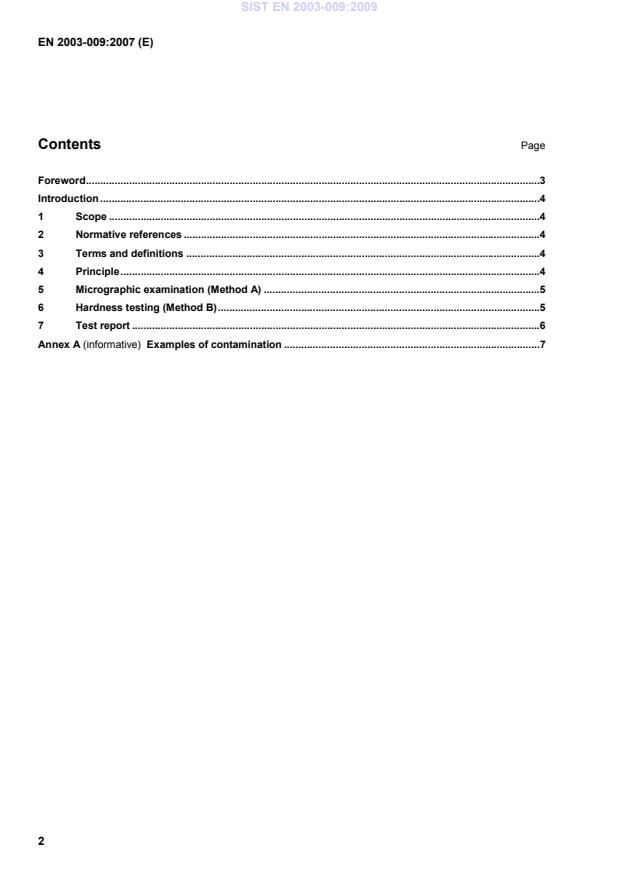
Examples of contamination.7
...