

EN 4862:2023
(Main)Aerospace series - Rotorcraft constant wear lifejackets - Requirements, testing and marking
- Abstract
This document specifies requirements for constant wear lifejackets for use by helicopter crew members and passengers in the event of a ditching or water impact, to ensure minimum levels of performance. It only applies to constant wear lifejackets for use by adults and that are intended to be manually inflated after leaving the helicopter.
Helicopter constant wear lifejackets are sometimes designed to be worn with or without a helicopter immersion suit and/or emergency breathing system.
- Status
- Published
- Publication Date
- 09-May-2023
- Technical Committee
- ASD-STAN - Aerospace
- Drafting Committee
- ASD-STAN/D 12/WG 2 - Ditching Equipment
- Current Stage
- 6060 - Definitive text made available (DAV) - Publishing
- Start Date
- 10-May-2023
- Completion Date
- 10-May-2023

EN 4862:2023 - Overview
EN 4862:2023 is a CEN European Standard in the aerospace series that specifies requirements, testing and marking for rotorcraft constant wear lifejackets. Published May 2023 (approved 29 Aug 2022), it covers lifejackets intended for adult helicopter crew and passengers, designed to be worn continuously and manually inflated after leaving the helicopter. The standard aims to ensure minimum levels of performance during ditching or water-impact events and addresses use with or without helicopter immersion suits and/or an emergency breathing system (EBS).
Key topics and technical requirements
EN 4862:2023 defines comprehensive technical and test requirements, including:
- Design and materials: requirements for fabrics, webbing, sewing thread, metallic components, zippers, hardware and inflation chamber materials.
- Inflation systems: performance and testing of manual inflation assemblies, gas cylinders and overpressure relief valves.
- Accessories: specifications for sprayhoods, survivor locator lights, whistles, lifting loops, buddy lines and compatibility with EBS.
- Physical performance tests: temperature cycling, wear-and-tear, inflation reliability, buoyancy, overpressure, flammability and resistance to fuel.
- Strength and durability: horizontal/vertical load tests, attachment point tests, lifting-loop and buddy-line strength.
- Ergonomics and human factors: donning and fit, ride-up, helicopter escape, jump-into-water procedure, flotation angles, freeboard, self-righting, in-water stability, field of vision, freedom of movement, life-raft boarding and rescue/recovery.
- Conspicuity and marking: retroreflective material application, colour and product marking for identification and safety.
- Compatibility testing: performance when used with immersion suits, other crew equipment, and combined equipment configurations.
- Test methods: order of testing, magnetic properties, torque, sprayhood gas exchange and reporting requirements.
Applications
EN 4862:2023 is used to:
- Guide design and manufacture of rotorcraft constant wear lifejackets.
- Define type-approval and conformity testing for aviation safety certification.
- Support procurement specifications by helicopter operators, HEMS, offshore transport, search-and-rescue and military aviation units.
- Inform test laboratories performing performance and compliance tests.
- Help safety engineers and regulators set minimum performance benchmarks for ditching and water-impact survivability.
Who should use this standard
- Lifejacket and aerospace PPE manufacturers
- Aviation safety authorities and certification bodies
- Helicopter operators and safety managers (offshore, SAR, HEMS)
- Test houses and product conformity assessors
- Procurement teams specifying crew life-saving equipment
Related standards
EN 4862:2023 sits alongside other aviation and personal protective equipment standards covering life-saving appliances, immersion suits and emergency breathing systems. Consult applicable national and international aviation safety standards and normative references within EN 4862 for full compliance context.
Relations
- Effective Date
- 25-Aug-2026
- Effective Date
- 25-Aug-2026
- Effective Date
- 28-Jan-2026
- Refers
EN ISO 9227:2022 - Corrosion tests in artificial atmospheres - Salt spray tests (ISO 9227:2022) - Effective Date
- 28-Jan-2026
- Effective Date
- 28-Jan-2026
- Effective Date
- 28-Jan-2026
- Effective Date
- 28-Jan-2026
- Effective Date
- 28-Jan-2026
- Effective Date
- 28-Jan-2026
- Effective Date
- 28-Jan-2026
- Referred By
EN 4863:2023 - Aerospace series - Rotorcraft immersion suits - Requirements, testing and marking - Effective Date
- 28-Jan-2026
- Effective Date
- 28-Jan-2026
- Referred By
EN 4886:2024 - Aerospace series - Rotorcraft life raft - Requirements, testing and marking - Effective Date
- 28-Jan-2026
Get Certified
Connect with accredited certification bodies for this standard

CIS Institut d.o.o.
Personal Protective Equipment (PPE) certification body. Notified Body NB-2890 for EU Regulation 2016/425 PPE.

Kiwa BDA Testing
Building and construction product certification.
Kmetijski inštitut Slovenije
Agricultural Institute of Slovenia. Soil testing, plant health, agricultural product analysis.
Sponsored listings
Frequently Asked Questions
EN 4862:2023 is a standard published by the European Committee for Standardization (CEN). Its full title is "Aerospace series - Rotorcraft constant wear lifejackets - Requirements, testing and marking". This standard covers: This document specifies requirements for constant wear lifejackets for use by helicopter crew members and passengers in the event of a ditching or water impact, to ensure minimum levels of performance. It only applies to constant wear lifejackets for use by adults and that are intended to be manually inflated after leaving the helicopter. Helicopter constant wear lifejackets are sometimes designed to be worn with or without a helicopter immersion suit and/or emergency breathing system.
This document specifies requirements for constant wear lifejackets for use by helicopter crew members and passengers in the event of a ditching or water impact, to ensure minimum levels of performance. It only applies to constant wear lifejackets for use by adults and that are intended to be manually inflated after leaving the helicopter. Helicopter constant wear lifejackets are sometimes designed to be worn with or without a helicopter immersion suit and/or emergency breathing system.
EN 4862:2023 is classified under the following ICS (International Classification for Standards) categories: 13.340.10 - Protective clothing. The ICS classification helps identify the subject area and facilitates finding related standards.
EN 4862:2023 has the following relationships with other standards: It is inter standard links to ISO 105-A02:1993, ISO 2768-1:1989, EN ISO 105-X12:2016, EN ISO 9227:2022, EN 12631:1999, EN 772-19:2000, EN ISO 12402-8:2020, EN ISO 12401:2009, EN ISO 105-E02:2013, EN ISO 12402-7:2020, EN 4863:2023, EN 4856:2023, EN 4886:2024. Understanding these relationships helps ensure you are using the most current and applicable version of the standard.
EN 4862:2023 is available in PDF format for immediate download after purchase. The document can be added to your cart and obtained through the secure checkout process. Digital delivery ensures instant access to the complete standard document.
Standards Content (Sample)
SLOVENSKI STANDARD
01-julij-2023
Aeronavtika - Stalno nošeni rešilni jopiči v rotoplanih - Zahteve, preskušanje in
označevanje
Aerospace series - Rotorcraft constant wear lifejackets - Requirements, testing and
marking
Luft- und Raumfahrt - Drehflüglerrettungswesten zum ständigen Tragen -
Anforderungen, Prüfung und Kennzeichnung
Série aérospatiale - Gilets de sauvetage de port permanent de giravion - Exigences,
essais et marquage
Ta slovenski standard je istoveten z: EN 4862:2023
ICS:
13.340.10 Varovalna obleka Protective clothing
49.020 Letala in vesoljska vozila na Aircraft and space vehicles in
splošno general
2003-01.Slovenski inštitut za standardizacijo. Razmnoževanje celote ali delov tega standarda ni dovoljeno.
EN 4862
EUROPEAN STANDARD
NORME EUROPÉENNE
May 2023
EUROPÄISCHE NORM
ICS 13.340.10
English Version
Aerospace series - Rotorcraft constant wear lifejackets -
Requirements, testing and marking
Série aérospatiale - Gilets de sauvetage de port Luft- und Raumfahrt - Drehflüglerrettungswesten zum
permanent de giravion - Exigences, essais et marquage ständigen Tragen - Anforderungen, Prüfung und
Kennzeichnung
This European Standard was approved by CEN on 29 August 2022.
CEN members are bound to comply with the CEN/CENELEC Internal Regulations which stipulate the conditions for giving this
European Standard the status of a national standard without any alteration. Up-to-date lists and bibliographical references
concerning such national standards may be obtained on application to the CEN-CENELEC Management Centre or to any CEN
member.
This European Standard exists in three official versions (English, French, German). A version in any other language made by
translation under the responsibility of a CEN member into its own language and notified to the CEN-CENELEC Management
Centre has the same status as the official versions.
CEN members are the national standards bodies of Austria, Belgium, Bulgaria, Croatia, Cyprus, Czech Republic, Denmark, Estonia,
Finland, France, Germany, Greece, Hungary, Iceland, Ireland, Italy, Latvia, Lithuania, Luxembourg, Malta, Netherlands, Norway,
Poland, Portugal, Republic of North Macedonia, Romania, Serbia, Slovakia, Slovenia, Spain, Sweden, Switzerland, Türkiye and
United Kingdom.
EUROPEAN COMMITTEE FOR STANDARDIZATION
COMITÉ EUROPÉEN DE NORMALISATION
EUROPÄISCHES KOMITEE FÜR NORMUNG
CEN-CENELEC Management Centre: Rue de la Science 23, B-1040 Brussels
© 2023 CEN All rights of exploitation in any form and by any means reserved Ref. No. EN 4862:2023 E
worldwide for CEN national Members.
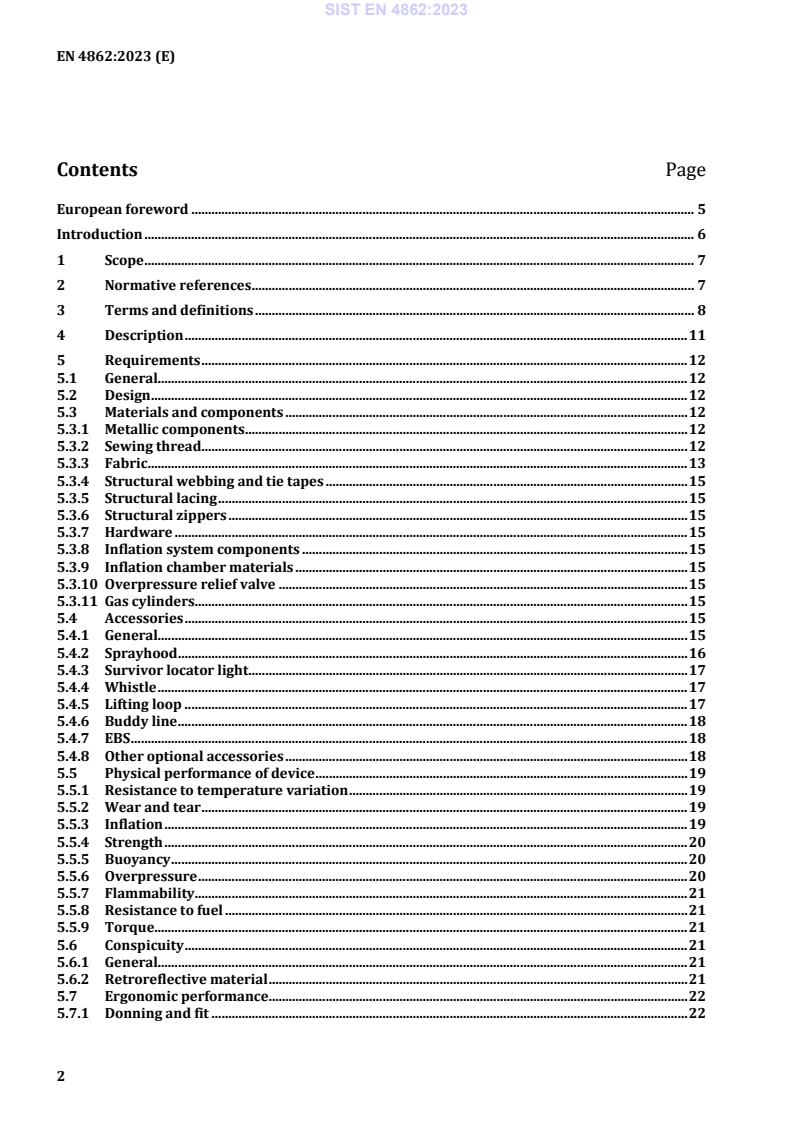
Contents Page
European foreword . 5
Introduction . 6
1 Scope . 7
2 Normative references . 7
3 Terms and definitions . 8
4 Description . 11
5 Requirements . 12
5.1 General. 12
5.2 Design . 12
5.3 Materials and components . 12
5.3.1 Metallic components . 12
5.3.2 Sewing thread . 12
5.3.3 Fabric . 13
5.3.4 Structural webbing and tie tapes . 15
5.3.5 Structural lacing . 15
5.3.6 Structural zippers . 15
5.3.7 Hardware . 15
5.3.8 Inflation system components . 15
5.3.9 Inflation chamber materials . 15
5.3.10 Overpressure relief valve . 15
5.3.11 Gas cylinders . 15
5.4 Accessories . 15
5.4.1 General. 15
5.4.2 Sprayhood . 16
5.4.3 Survivor locator light . 17
5.4.4 Whistle . 17
5.4.5 Lifting loop . 17
5.4.6 Buddy line . 18
5.4.7 EBS . 18
5.4.8 Other optional accessories . 18
5.5 Physical performance of device . 19
5.5.1 Resistance to temperature variation . 19
5.5.2 Wear and tear . 19
5.5.3 Inflation . 19
5.5.4 Strength . 20
5.5.5 Buoyancy . 20
5.5.6 Overpressure . 20
5.5.7 Flammability . 21
5.5.8 Resistance to fuel . 21
5.5.9 Torque. 21
5.6 Conspicuity . 21
5.6.1 General. 21
5.6.2 Retroreflective material . 21
5.7 Ergonomic performance . 22
5.7.1 Donning and fit . 22
5.7.2 Ride-up . 22
5.7.3 Helicopter escape . 22
5.7.4 Jump into water . 22
5.7.5 Flotation angles and freeboard . 22
5.7.6 Self-righting . 23
5.7.7 In-water stability . 23
5.7.8 Field of vision . 23
5.7.9 Freedom of movement and use of accessories . 23
5.7.10 Life raft boarding . 23
5.7.11 Rescue and recovery . 24
5.8 Compatibility . 24
5.8.1 General . 24
5.8.2 Performance of equipment combination(s) . 24
6 Testing . 27
6.1 Visual inspection . 27
6.2 Nominal values and tolerances . 27
6.3 Order of testing . 27
6.4 Magnetic properties testing . 27
6.5 Temperature cycling . 27
6.6 Wear and tear . 28
6.7 Retroreflective material application . 30
6.8 Inflation . 30
6.9 Strength tests . 32
6.9.1 Horizontal and vertical load . 32
6.9.2 Lifting loop test . 36
6.9.3 Buddy line . 36
6.9.4 Strength test of attachment points . 37
6.10 Buoyancy of device . 37
6.11 Overpressure test . 38
6.12 Flammability . 39
6.13 Resistance to fuel . 40
6.14 Sprayhood gas exchange test . 41
6.15 Torque test . 41
6.16 Ergonomic performance . 43
6.16.1 General . 43
6.16.2 Test subjects . 44
6.16.3 Donning and fit . 46
6.16.4 Ride-up assessment . 46
6.16.5 Helicopter underwater escape . 46
6.16.6 Jump into water . 47
6.16.7 Flotation angles . 47
6.16.8 Freeboard . 47
6.16.9 Turning . 48
6.16.10 Self-righting . 48
6.16.11 In-water stability test for lifejackets . 49
6.16.12 Field of vision. 49
6.16.13 Colour . 50
6.16.14 Freedom of movement and use of accessories . 50
6.16.15 Life raft boarding . 51
6.16.16 Rescue and recovery . 51
6.16.17 Escape buoyancy . 52
6.17 Compatibility and performance of equipment combination(s) . 53
6.17.1 General. 53
6.17.2 Test subjects . 53
6.17.3 Clothing. 53
6.17.4 Compatibility and immersion suit system performance testing . 53
6.18 Crew equipment compatibility . 54
6.19 Reporting . 55
7 Marking . 55
8 Information supplied by the manufacturer . 56
Bibliography . 58
European foreword
This document (EN 4862:2023) has been prepared by the Aerospace and Defence Industries
Association of Europe — Standardization (ASD-STAN).
After enquiries and votes carried out in accordance with the rules of this Association, this document has
received the approval of the National Associations and the Official Services of the member countries of
ASD-STAN, prior to its presentation to CEN.
This European Standard shall be given the status of a national standard, either by publication of an
identical text or by endorsement, at the latest by November 2023, and conflicting national standards
shall be withdrawn at the latest by November 2023.
Attention is drawn to the possibility that some of the elements of this document may be the subject of
patent rights. CEN shall not be held responsible for identifying any or all such patent rights.
Any feedback and questions on this document should be directed to the users’ national standards body.
A complete listing of these bodies can be found on the CEN website.
According to the CEN-CENELEC Internal Regulations, the national standards organizations of the
following countries are bound to implement this European Standard: Austria, Belgium, Bulgaria,
Croatia, Cyprus, Czech Republic, Denmark, Estonia, Finland, France, Germany, Greece, Hungary, Iceland,
Ireland, Italy, Latvia, Lithuania, Luxembourg, Malta, Netherlands, Norway, Poland, Portugal, Republic of
North Macedonia, Romania, Serbia, Slovakia, Slovenia, Spain, Sweden, Switzerland, Türkiye and the
United Kingdom.
Introduction
This document prescribes the minimum standards of design and performance for rotorcraft constant
wear lifejackets, used to reduce the risks of drowning following evacuation or escape from a rotorcraft.
Lifejackets are designed to support the user in water, keep the head above the water, protect the
airways from wave splash and provide some stability in the face-up position. Depending upon the
conditions of use a lifejacket may turn the user from a face-down to a face-up position in the water.
Lifejackets are also equipped with items intended to aid in the location of a survivor in the water. These
include a survivor locator light, whistle and retroreflective material.
The document aims to ensure that the equipment user is able to carry out the necessary emergency
procedures whilst being provided with an appropriate level of protection under foreseeable conditions
of use. It aims to ensure that the equipment presents a minimal hazard in relation to escape from the
rotorcraft, and that the equipment has no detrimental effect on the health and safety of the user or on
the performance of other equipment. There is also a need to ensure that the lifejacket does not prevent
or hinder crew members from carrying out all normal operating procedures and allows them to access
all flight controls.
This document is applicable to all rotorcraft. Rotorcraft include helicopters, tilt rotor/wing and
gyroplanes. For the purpose of this document the term helicopter is used generically hereinafter.
1 Scope
This document specifies requirements for constant wear lifejackets for use by helicopter crew members
and passengers in the event of a ditching or water impact, to ensure minimum levels of performance. It
only applies to constant wear lifejackets for use by adults and that are intended to be manually inflated
after leaving the helicopter.
Helicopter constant wear lifejackets are sometimes designed to be worn with or without a helicopter
immersion suit and/or emergency breathing system.
2 Normative references
The following documents are referred to in the text in such a way that some or all of their content
constitutes requirements of this document. For dated references, only the edition cited applies. For
undated references, the latest edition of the referenced document (including any amendments) applies.
EN 4856, Aerospace series — Rotorcraft Emergency Breathing Systems (EBS) — Requirements, testing
and marking
EN 4863, Aerospace series — Rotorcraft immersion suits — Requirements, testing and marking
EN 4886, Aerospace series — Rotorcraft life raft — Requirements, testing and marking
EN ISO 105-E02, Textiles — Tests for colour fastness — Part E02: Colour fastness to sea water
(ISO 105-E02)
EN ISO 105-X12, Textiles — Tests for colour fastness — Part X12: Colour fastness to rubbing
(ISO 105-X12)
EN ISO 9227, Corrosion tests in artificial atmospheres — Salt spray tests (ISO 9227)
EN ISO 12401, Small craft — Deck safety harness and safety line — Safety requirements and test methods
(ISO 12401)
EN ISO 12402-7, Personal flotation devices — Part 7: Materials and components — Safety requirements
and test methods (ISO 12402-7)
EN ISO 12402-8, Personal flotation devices — Part 8: Accessories — Safety requirements and test methods
(ISO 12402-8)
ISO 105-A02, Textiles — Tests for colour fastness — Part A02: Grey scale for assessing change in colour
ISO 2768-1, General tolerances — Part 1: Tolerances for linear and angular dimensions without individual
tolerance indications
ASTM D1655-21b, Standard Specification for Aviation Turbine Fuels
CIE publication No. 15, Colorimetry
DEF STAN 91-091, Turbine Fuel, Kerosine Type, JET A-1; NATO Code: F-35; JSD: AVTUR
EASA, Certification Specifications and Acceptable Means of Compliance for Large Aeroplanes, CS-25,
Book 1 — Appendix F
Under preparation.
EASA, ETSO-C85b, Survivor Locator Lights
IATA, Guidance Material (Kerosene Type), NATO Code F-35
IMO, Resolution A.658(16), Use and Fitting of Retro-Reflective Materials on Life-Saving Appliances
IMO, International Life-Saving Appliance (LSA) Code, adopted by Resolution MSC.48(66), (as amended)
IMO, Resolution MSC.81(70) (adopted on 11 December 1998) Revised recommendation on testing of life-
saving appliances
MIL-STD-3009, Lighting, Aircraft, Night Vision Imaging System (NVIS) Compatible
SAE ARP5825A, Design Requirements and Test Procedures for Dual Mode Exterior Lights
SAE AS4492A, Survivor Locator Lights
3 Terms and definitions
For the purposes of this document, the following terms and definitions apply.
ISO and IEC maintain terminology databases for use in standardization at the following addresses:
— ISO Online browsing platform: available at https://www.iso.org/obp/
— IEC Electropedia: available at https://www.electropedia.org/
3.1
lifejacket
garment or device which, when correctly worn and used in water will provide the user with buoyancy
positioned to provide protection from drowning and increase the likelihood of survival and rescue
3.2
helicopter constant wear lifejacket
lifejacket worn on the body throughout a helicopter flight, provided to protect the user in the event of a
ditching or water impact
3.3
buoyancy chamber
inflatable component of a lifejacket or integrated immersion suit
3.4
immersion suit
garment designed to protect the user’s body from the cooling effects of unintended immersion in water
Note 1 to entry: Cooling effects include cold shock and hypothermia.
Note 2 to entry: An immersion suit may be integrated or worn with a separate constant wear lifejacket.
3.5
integrated immersion suit
immersion suit that incorporates the functionality of a lifejacket
3.6
buoyancy element
inflatable chamber incorporated into an integrated immersion suit that, when inflated, provides the suit
with the functionality of a lifejacket
3.7
helicopter immersion suit
immersion suit worn on the body throughout a helicopter flight, provided to protect the user in the
event of a ditching or water impact
3.8
immersion suit system
helicopter immersion suit (with or without thermal insulation) and its components and accessories
including either a constant wear lifejacket or buoyancy element and/or emergency breathing system, as
applicable
3.9
hood
covering for the head and neck with an opening for the face, worn for protection against cold
3.10
glove
covering for the hand which may have separate parts for each finger and the thumb, worn for
protection against cold
3.11
emergency breathing system
EBS
system that allows a person to breathe underwater, overcoming the need to breath-hold for the
complete duration of an underwater escape from a helicopter, that can be deployed under emergency
conditions
3.12
rotorcraft
heavier-than-air aircraft that depends principally for its support in flight on the lift generated by one or
more rotors
3.13
helicopter
rotorcraft that, for its horizontal motion, depends principally on its engine-driven rotors
3.14
ditching
controlled emergency landing on water, deliberately executed in accordance with Rotorcraft Flight
Manual procedures, with the intent of abandoning the rotorcraft as soon as practical
3.15
water impact
helicopter contact with water that is unintentional or exceeds the ditching capability of the helicopter
for water entry
3.16
crew member
person assigned by an operator to perform duties on board an aircraft
3.17
hardware
lifejacket components such as structural closures and adjusters and multi-eyelet guides used with
lacing
3.18
manual inflation system
means of inflation achieved by a person operating a mechanism that actively releases stored gas into
the buoyancy chamber(s)
3.19
fully inflated
inflation achieved by using the manual inflation system (stored gas) with no subsequent deflation
3.20
oral inflation system
means of inflation achieved by a person blowing expired air into the buoyancy chamber(s)
3.21
overpressure relief valve
safety device used to limit the pressure in an inflatable system, to avoid the likelihood of destruction
caused by excessive pressure
3.22
sprayhood
cover that can be brought in front of the face, incorporating an area of transparent material, used to
protect the airways from water and wave splash, intended to increase the likelihood of survival in
rough water conditions
3.23
survivor locator light
device which emits light intended to aid in the location of the user in an emergency
3.24
whistle
device which, when blown by mouth, produces an audible sound intended to aid in the location of the
user
3.25
lifting loop
device which facilitates manual recovery of a person from water
3.26
buddy line
length of cord or webbing which can be tied or otherwise fixed to another person or to that person’s
lifejacket or other objects, so as to keep the user in the vicinity of that person or object, aiding in the
location of the user
3.27
retroreflective material
material that reflects light beams back to their point of origin with a low level of scattering
3.28
infrared
IR
electromagnetic radiation at the red end of the spectrum at wavelengths from 800 nm to 1 mm (longer
than those of visible red light but shorter than microwaves)
3.29
personal locator device
PLD
device carried on the body that is able to transmit a signal to enable electronic detection and location of
a person in the water
Note 1 to entry: In the maritime environment a PLD may be known as an Autonomous Maritime Rescue Device
(AMRD).
3.30
escape buoyancy
buoyancy of an equipment combination, with the lifejacket uninflated, that must be overcome when
escaping from an immersed helicopter
Note 1 to entry: It includes the inherent buoyancy of the components of the immersion suit system and entrapped
air but excludes the inflated buoyancy elements.
4 Description
The main features of a constant wear lifejacket are a buoyancy chamber(s), inflation system and means
of attachment to the body.
The following accessories are mandatory features of a constant wear lifejacket:
— sprayhood;
— survivor locator light;
— whistle;
— lifting loop;
— buddy line;
— retroreflective material.
Optional accessories include but are not limited to:
— EBS;
— PLD;
— overpressure relief valves;
— other signalling devices;
— infrared (IR) reflective material.
NOTE A constant wear lifejacket is hereinafter referred to as a ‘lifejacket’.
5 Requirements
5.1 General
The lifejacket and its attached equipment/accessories shall be designed, and the materials used in their
construction chosen, to have no features which would be likely to have any detrimental effect on the
functioning of the lifejacket or on the operation of any helicopter or its equipment.
The lifejacket shall be practicable in use and light in weight without prejudice to the design strength
and performance.
When worn, the lifejacket shall not be unduly bulky, or uncomfortable when tested in accordance with
6.16.
5.2 Design
5.2.1 The lifejacket shall have two separate means of inflation, a primary manual inflation system and
an oral inflation system capable of repeated use, as well as a means of deflation.
Automatic inflation systems shall not be used.
The design of the lifejacket shall be such that the inherent buoyancy is minimized when the lifejacket is
uninflated.
Testing shall be carried out in accordance with 6.1.
5.2.2 The lifejacket shall not contain any component nor use any method of component attachment
which in normal use is likely to cause injury to the user or damage the lifejacket. The lifejacket shall not
have any sharp edges or protruding parts which may injure the user, or damage the helicopter
immersion suit or other emergency equipment. Testing shall be carried out in accordance with 6.1, 6.16,
6.17 and 6.18 as applicable.
NOTE A helicopter immersion suit is hereinafter referred to as an ‘immersion suit’.
5.2.3 The lifejacket design shall enable correct positioning on the body when used according to the
manufacturer’s instructions. Testing shall be carried out in accordance with 6.1 and 6.16.3.
5.2.4 The lifejacket design shall not tend to channel water into the user’s face, giving consideration to
dynamic water conditions (wave action). Testing shall be carried out in accordance with 6.1, 6.16 and
6.17.
5.3 Materials and components
5.3.1 Metallic components
All metallic components shall be made of corrosion-resistant materials or be protected from corrosion.
Metallic components shall not be significantly affected by corrosion when tested in accordance with the
neutral salt spray (NSS) test of EN ISO 9227 for a period of 160 h. After the test, the components shall
still operate as designed.
The lifejacket shall not affect a magnetic compass by more than 1° when placed 300 mm from the
compass. Testing shall be carried out in accordance with 6.4.
5.3.2 Sewing thread
Sewing thread shall meet the requirements of and be tested in accordance with the relevant clause of
EN ISO 12402-7.
5.3.3 Fabric
5.3.3.1 Fabrics which are structural to maintain the performance of the product shall be tested.
Decorative and other fabrics do not need to be tested.
5.3.3.2 Fabric performance shall meet the requirements of and be tested in accordance with the
relevant clause of EN ISO 12402-7. Exposure to accelerated weathering is not required, with the
exception of fabric used for buoyancy chambers that do not have a protective cover, in which case the
fabric shall be exposed to accelerated weathering.
5.3.3.3 The fabric used for the lifejacket’s outer cover and its means of retention and security on the
user shall be of low flammability. The cover fabric shall as a minimum meet the vertical test of EASA
CS-25, Appendix F, Part 1 (a)(1)(iv) (or as amended) with the exception of products that do not have a
protective cover, in which case the buoyancy chamber fabric shall meet this requirement. Fabrics such
as webbing used to retain or secure the lifejacket on the user shall as a minimum meet the horizontal
test of EASA CS-25, Appendix F, Part 1 (a)(1)(iv) (or as amended).
5.3.3.4 The colour of the exposed portions (excluding components such as webbing, zips and other
fittings) of a lifejacket when deployed in the normal floating position shall be in the colour range from
yellow to red; the chromaticity for non-fluorescent colours shall lie within one of the areas defined in
Table 1 and the luminance factor shall exceed the corresponding minimum in Table 1. The chromaticity
coordinates and the minimum luminance factor for fluorescent colours shall comply with Table 2.
Table 1 — Chromaticity coordinates x and y and luminance factor β for yellow, orange and red
non-fluorescent colours of lifejacket material
Chromaticity coordinates Luminance factor
Colour
x y β
0,389 0,610
0,320 0,490
Yellow > 0,35
0,405 0,400
0,500 0,500
0,500 0,500
0,405 0,400
Orange > 0,25
0,470 0,330
0,600 0,400
0,600 0,400
0,470 0,330
Red > 0,15
0,525 0,270
0,700 0,300
Table 2 — Chromaticity coordinates x and y and luminance factor β for yellow, yellow-orange,
orange and orange-red and red fluorescent colours of lifejacket material
Chromaticity coordinates Luminance factor
Colour
x y β
0,380 0,610
0,320 0,490
Fluorescent
> 0,60
yellow
0,370 0,440
0,440 0,550
0,440 0,550
0,370 0,440
Fluorescent
> 0,50
yellow-orange
0,420 0,390
0,505 0,490
0,505 0,490
0,420 0,390
Fluorescent
> 0,40
orange
0,460 0,350
0,575 0,425
0,575 0,425
0,460 0,350
Fluorescent
> 0,30
orange-red
0,488 0,320
0,630 0,360
0,630 0,360
0,488 0,320
Fluorescent red > 0,20
0,525 0,280
0,695 0,300
The colour of the material samples shall be measured with the procedures defined in CIE publication
No. 15 with polychromatic illumination D , 45/0 geometry and 2° standard observer. The specimen
shall have a black underlay with reflectance of less than 0,04. The specimens shall be conditioned for at
least 24 h at (20 ± 2) °C and (65 ± 5) % relative humidity. If the test is carried out in other conditions,
the test shall be conducted within 5 min after withdrawal from the conditioning atmosphere.
NOTE The results from the different test machines may vary ±5 %.
The colour fastness (dry and wet) of lifejacket material when determined in accordance with
ISO 105-A02 shall be resistant to rubbing (wet and dry), when tested in accordance with
EN ISO 105-X12 to at least step 4, and to salt water when tested in accordance with EN ISO 105-E02 to
at least step 4.
5.3.4 Structural webbing and tie tapes
Structural webbing and tie tapes shall meet the requirements of and be tested in accordance with the
relevant clause of EN ISO 12402-7, with the exception of exposure to accelerated weathering.
5.3.5 Structural lacing
Structural lacing shall meet the requirements of and be tested in accordance with the relevant clause of
EN ISO 12402-7, with the exception of exposure to accelerated weathering.
5.3.6 Structural zippers
Structural zippers shall meet the requirements of and be tested in accordance with the relevant
requirements of EN ISO 12402-7, with the exception of exposure to accelerated weathering.
5.3.7 Hardware
Hardware shall meet the requirements of and be tested in accordance with the relevant clause of
EN ISO 12402-7, with the exception of exposure to accelerated weathering.
5.3.8 Inflation system components
5.3.8.1 Manual inflation system
Manual inflation system components shall meet the requirements of and be tested in accordance with
the relevant clause of EN ISO 12402-7 relating to inflation systems, with the exception of exposure to
accelerated weathering.
5.3.8.2 Oral inflation system
The oral inflation system components shall meet the requirements of and be tested in accordance with
the relevant clauses of EN ISO 12402-7.
5.3.9 Inflation chamber materials
Inflation chamber materials shall meet the requirements of and be tested in accordance with the
relevant clause of EN ISO 12402-7, with the following exception: the fabric of buoyancy chambers with
a protective cover do not need to be exposed to accelerated weathering. The fabric of buoyancy
chambers that do not have a protective cover shall be exposed to accelerated weathering.
5.3.10 Overpressure relief valve
Overpressure relief valves, if fitted, shall meet the requirements of and be tested in accordance with the
relevant requirements of EN ISO 12402-7.
5.3.11 Gas cylinders
Gas cylinders shall meet the requirements of and be tested in accordance with the relevant
requirements of EN ISO 12402-7.
5.4 Accessories
5.4.1 General
A combination of a lifejacket and accessories shall not impair the performance of either item. This shall
be established by testing the lifejacket and accessories in combination, in accordance with 6.1, 6.16,
6.17 and 6.18 as applicable.
The requirements for accessories are identified in Table 3.
Table 3 — Lifejacket accessories
Accessory Mandatory Optional Requirement
Sprayhood x 5.4.2
Survivor locator light x 5.4.3
Whistle x 5.4.4
Lifting loop x 5.4.5
Buddy line x 5.4.6
Retroreflective material x 5.6.2
EBS a 5.4.7, 5.8
x
Overpressure relief valve x 5.3.10, 5.5.6
Other signalling devices x 5.4.8
Infrared (IR) reflective material x 5.6.1, 5.4.8
Other x 5.4.8
a
EBS are only mandatory for helicopter operations in a hostile offshore environment
[Commission Regulation (EU) No 965/2012, amended by Commission Regulation (EU)
2016/1199, SPA.HOFO.165(c)]. EBS may or may not be attached to the lifejacket.
5.4.2 Sprayhood
5.4.2.1 The lifejacket shall be fitted with a permanently attached sprayhood.
5.4.2.2 The materials used in the sprayhood’s construction shall be compatible with those of the
lifejacket and shall in no way be able to cause damage to the buoyancy chambers or any other part of
the lifejacket.
When deployed the sprayhood shall protect the airway from water and wave splash whilst the user is in
the water with the lifejacket fully inflated. Once deployed, a means shall be provided to secure the
sprayhood in place.
The user shall be able to deploy the sprayhood within 20 s when wearing the fully inflated lifejacket in
or out of the water.
When stowed or deployed:
— the sprayhood shall not impair the performance of the lifejacket;
— the sprayhood shall be clear of the face, shall not impede breathing or retain water;
— field of vision shall not be unduly restricted;
— the ability to swim and manoeuvre shall not be impaired;
— the lifejacket’s survivor locator light shall not be masked by the sprayhood;
— if, when deployed, the sprayhood reduces the effectiveness of any retroreflective material (5.6.2)
on the lifejacket itself, additional retroreflective material of an area at least equal to that obscured
shall be placed on the sprayhood;
— it shall be possible to remove the sprayhood from the face to a position where it does not impede
winching or other rescue and recovery activities.
Testing shall be carried out in accordance with 6.1, 6.16.12 and 6.16.14.6.
5.4.2.3 The level of carbon dioxide in the deployed sprayhood shall not exceed 5 % at any time and
the average value of carbon dioxide shall not exceed 2,5 % in any 1 min when tested in accordance with
6.14.
5.4.3 Survivor locator light
5.4.3.1 The lifejacket shall
...