

EN 4156:2013
(Main)Aerospace series - Rod ends, with self-aligning double row ball bearings and threaded shank in steel - Inner ring and balls in corrosion resisting steel - Dimensions and loads - Inch series
General Information
- Abstract
This European Standard specifies the characteristics of adjustable rod ends with self-aligning double row ball bearing and threaded shank in steel, inner ring and balls in corrosion resisting steel.
They consist of:
a rod end comprising:
either seals or shields;
an optional longitudinal groove for locking purpose;
an inner ring with balls.
These rod ends are intended for use with flight control rods or rods for aerospace structures.
They are intended to be used in the temperature range: – 54 °C to 150 °C.
However, being lubricated with the following greases:
very high pressure grease, ester type (code A), operational range – 73 °C to 121 °C according MIL PRF 23827 type II
very high pressure grease, synthetic hydrocarbons, general purpose (code B), operational range 54 °C to 177 °C (see EN 2067), according MIL-PRF-81322.
very hight pressure grease, lithium type (code C) operational range – 73 °C to 121 °C according MIL PRF-23827 type I.
Their field of application when lubricated with code A grease is limited to 121 °C.
- Status
- Published
- Publication Date
- 17-Dec-2013
- Withdrawal Date
- 29-Jun-2014
- Technical Committee
- ASD-STAN - Aerospace
- Drafting Committee
- ASD-STAN/D 3 - Mechanical
- Current Stage
- 9093 - Decision to confirm - Review Enquiry
- Start Date
- 21-Jan-2024
- Completion Date
- 30-Sep-2026

Overview
EN 4156:2013 is a European Standard developed by CEN, specifying the characteristics, dimensions, and load capacities of aerospace-grade rod ends. These rod ends feature self-aligning double row ball bearings and threaded shanks in steel, with inner rings and balls made from corrosion-resistant steel. Designed as part of the aerospace series, these rod ends are intended primarily for use with flight control rods and other aerospace structural rods, supporting critical applications within the aerospace industry.
The standard governs adjustable rod ends with either seals or shields, an optional longitudinal groove for locking, and defines performance requirements across a temperature range from –54 °C to 150 °C. Lubrication compatibility includes various very high-pressure greases, ensuring reliable operation under aerospace environmental conditions.
Key Topics
Design and Construction
- Rod ends comprise self-aligning double row ball bearings.
- Threaded shank in steel with corrosion-resistant inner ring and balls.
- Optional seals or shields for contamination protection.
- Longitudinal groove options for locking purposes.
Materials and Surface Treatment
- Rod ends made from hardened and tempered steels meeting EN 2099 or EN 2135.
- Inner ring and rolling elements constructed of stainless steels per EN 2030.
- Outer rod surfaces cadmium plated and chromated for corrosion resistance.
- Protected with high-quality PTFE or glass-fiber reinforced PTFE seals or corrosion-resistant shields.
Dimensions and Performance
- Inch series dimensions standardized with tight tolerances.
- Static radial and axial load limits defined for safe aerospace operations.
- Starting torque and clearance values specified.
- Operating temperature conditions ranging from –54 °C to 150 °C depending on grease type.
Lubrication Standards
- Compatibility with very high-pressure greases:
- Ester type (code A): –73 °C to 121 °C operational range.
- Synthetic hydrocarbons (code B): –54 °C to 177 °C operational range.
- Lithium type (code C): –73 °C to 121 °C operational range.
- Use of specified greases ensures proper performance and longevity in aerospace environments.
- Compatibility with very high-pressure greases:
Quality and Compliance
- Qualification aligned with EN 9133 standards.
- Marking conforms to EN 2424, allowing traceability and verification.
- Testing methods harmonized with EN 2067 for load, torque, and seal retention.
Applications
Flight Control Rods
These rod ends are ideal for use in flight control systems, where reliability, precision alignment, and corrosion resistance are paramount to maintain flight safety and performance.Aerospace Structural Components
Suitable for various aerospace structural rods requiring adjustability and load-bearing capacity, especially where exposure to temperature extremes and harsh environments occur.Actuation Mechanisms
Used in aerospace actuation linkages that demand self-aligning capabilities to accommodate misalignment without compromising structural integrity.
Related Standards
EN 2067: Aerospace series - Rod ends with self-aligning ball bearings - Technical specification.
Governs technical details and testing procedures related to rod ends in aerospace use.EN 9133: Aerospace series - Quality management systems - Qualification procedure for aerospace standard parts.
Sets qualification protocols ensuring components meet aerospace reliability standards.EN 2030: Aerospace series - Steel specifications for corrosion-resistant components.
Defines material characteristics crucial for aerospace-grade rod ends.EN 2099 & EN 2135: Aerospace series - Hardened and tempered steels for rod end components.
Outline material treatments essential for durability and mechanical strength.EN 2424: Aerospace series - Marking of aerospace products.
Establishes marking requirements for traceability.ISO 1132-1: Rolling bearings - Tolerances, terms, and definitions relevant to self-aligning ball bearings.
Supports standardization of bearing dimensions and performance.
Practical Value
EN 4156:2013 ensures that aerospace rod ends possess the reliability, dimensional accuracy, corrosion resistance, and mechanical strength required for critical aerospace applications. Compliance with this standard enables manufacturers and users to guarantee safety, functional integrity, and longevity of components in demanding aerospace environments. Using this standard supports optimal selection, quality assurance, and lifecycle management of rod ends integral to flight control and aerospace structural systems.
By adhering to EN 4156:2013, aerospace engineers and suppliers maintain high safety and quality benchmarks, ensuring compatibility with international aerospace manufacturing and maintenance protocols.
Relations
- Effective Date
- 25-Aug-2026
- Effective Date
- 25-Aug-2026
- Effective Date
- 25-Aug-2026
- Effective Date
- 25-Aug-2026
- Effective Date
- 28-Jan-2026
- Effective Date
- 28-Jan-2026
- Effective Date
- 28-Jan-2026
- Effective Date
- 28-Jan-2026
- Effective Date
- 28-Jan-2026
- Effective Date
- 28-Jan-2026
- Effective Date
- 28-Jan-2026
- Effective Date
- 28-Jan-2026
Get Certified
Connect with accredited certification bodies for this standard

BUREAU VERITAS Certification Germany
Bureau Veritas certification in Germany.

Element Materials Technology
Materials testing and product certification.

AQMS Ltd.
AQMS provides ISO certification to SMEs across the UK.
Sponsored listings
Frequently Asked Questions
EN 4156:2013 is a standard published by the European Committee for Standardization (CEN). Its full title is "Aerospace series - Rod ends, with self-aligning double row ball bearings and threaded shank in steel - Inner ring and balls in corrosion resisting steel - Dimensions and loads - Inch series". This standard covers: This European Standard specifies the characteristics of adjustable rod ends with self-aligning double row ball bearing and threaded shank in steel, inner ring and balls in corrosion resisting steel. They consist of: a rod end comprising: either seals or shields; an optional longitudinal groove for locking purpose; an inner ring with balls. These rod ends are intended for use with flight control rods or rods for aerospace structures. They are intended to be used in the temperature range: – 54 °C to 150 °C. However, being lubricated with the following greases: very high pressure grease, ester type (code A), operational range – 73 °C to 121 °C according MIL PRF 23827 type II very high pressure grease, synthetic hydrocarbons, general purpose (code B), operational range 54 °C to 177 °C (see EN 2067), according MIL-PRF-81322. very hight pressure grease, lithium type (code C) operational range – 73 °C to 121 °C according MIL PRF-23827 type I. Their field of application when lubricated with code A grease is limited to 121 °C.
This European Standard specifies the characteristics of adjustable rod ends with self-aligning double row ball bearing and threaded shank in steel, inner ring and balls in corrosion resisting steel. They consist of: a rod end comprising: either seals or shields; an optional longitudinal groove for locking purpose; an inner ring with balls. These rod ends are intended for use with flight control rods or rods for aerospace structures. They are intended to be used in the temperature range: – 54 °C to 150 °C. However, being lubricated with the following greases: very high pressure grease, ester type (code A), operational range – 73 °C to 121 °C according MIL PRF 23827 type II very high pressure grease, synthetic hydrocarbons, general purpose (code B), operational range 54 °C to 177 °C (see EN 2067), according MIL-PRF-81322. very hight pressure grease, lithium type (code C) operational range – 73 °C to 121 °C according MIL PRF-23827 type I. Their field of application when lubricated with code A grease is limited to 121 °C.
EN 4156:2013 is classified under the following ICS (International Classification for Standards) categories: 49.035 - Components for aerospace construction. The ICS classification helps identify the subject area and facilitates finding related standards.
EN 4156:2013 has the following relationships with other standards: It is inter standard links to ISO 1132-1:2000, ISO 3161:1999, ISO 8075:1985, ISO 3353-1:2002, EN 2133:2020, EN 9133:2018, EN 2030:2013, EN 13522:2001, EN 10244-1:2009, EN 2067:1996, CEN/TS 13130-12:2005, EN 2424:2008. Understanding these relationships helps ensure you are using the most current and applicable version of the standard.
EN 4156:2013 is available in PDF format for immediate download after purchase. The document can be added to your cart and obtained through the secure checkout process. Digital delivery ensures instant access to the complete standard document.
Standards Content (Sample)
2003-01.Slovenski inštitut za standardizacijo. Razmnoževanje celote ali delov tega standarda ni dovoljeno.DOQLPLYHGEDLuft- und Raumfahrt - Ösenköpfe mit zweireihigem Pendelkugellager und Gewindeschaft aus Stahl - Innenring und Wälzkörper aus korrosionsbeständigem Stahl - Maße und Belastungen - Zoll ReiheSérie aérospatiale - Embouts à rotule sur deux rangées de billes et à tige filetée en acier - Bague intérieure et billes en acier résistant à la corrosion - Dimensions et charges - Série en inchesAerospace series - Rod ends, with self-aligning double row ball bearings and threaded shank in steel - Inner ring and balls in corrosion resisting steel - Dimensions and loads - Inch series49.035Sestavni deli za letalsko in vesoljsko gradnjoComponents for aerospace construction49.025.10JeklaSteelsICS:Ta slovenski standard je istoveten z:EN 4156:2013SIST EN 4156:2014en,fr,de01-marec-2014SIST EN 4156:2014SLOVENSKI
STANDARD
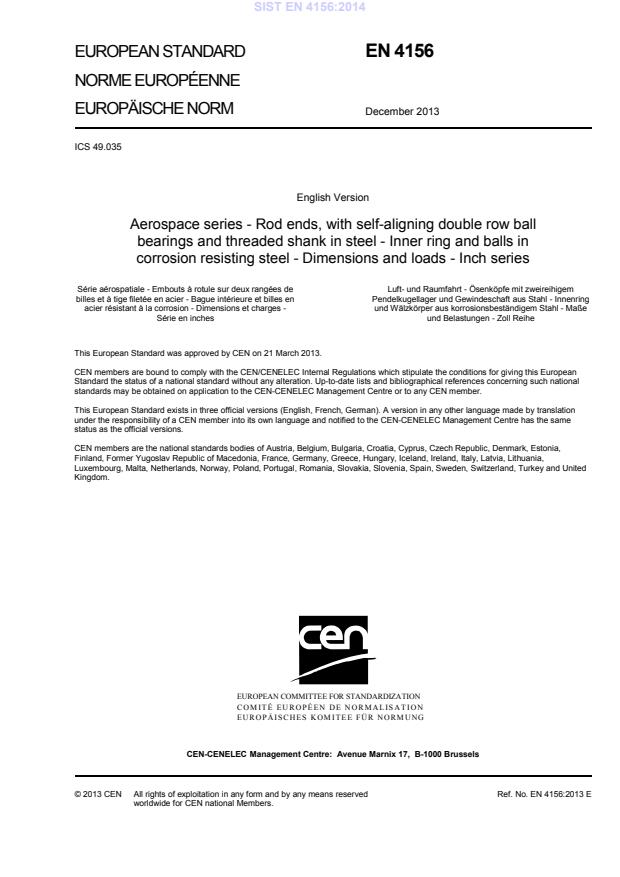
EUROPEAN STANDARD NORME EUROPÉENNE EUROPÄISCHE NORM
EN 4156
December 2013 ICS 49.035 English Version
Aerospace series - Rod ends, with self-aligning double row ball bearings and threaded shank in steel - Inner ring and balls in corrosion resisting steel - Dimensions and loads - Inch series
Série aérospatiale - Embouts à rotule sur deux rangées de billes et à tige filetée en acier - Bague intérieure et billes en acier résistant à la corrosion - Dimensions et charges - Série en inches
Luft- und Raumfahrt - Ösenköpfe mit zweireihigem Pendelkugellager und Gewindeschaft aus Stahl - Innenring und Wälzkörper aus korrosionsbeständigem Stahl - Maße und Belastungen - Zoll Reihe This European Standard was approved by CEN on 21 March 2013.
CEN members are bound to comply with the CEN/CENELEC Internal Regulations which stipulate the conditions for giving this European Standard the status of a national standard without any alteration. Up-to-date lists and bibliographical references concerning such national standards may be obtained on application to the CEN-CENELEC Management Centre or to any CEN member.
This European Standard exists in three official versions (English, French, German). A version in any other language made by translation under the responsibility of a CEN member into its own language and notified to the CEN-CENELEC Management Centre has the same status as the official versions.
CEN members are the national standards bodies of Austria, Belgium, Bulgaria, Croatia, Cyprus, Czech Republic, Denmark, Estonia, Finland, Former Yugoslav Republic of Macedonia, France, Germany, Greece, Hungary, Iceland, Ireland, Italy, Latvia, Lithuania, Luxembourg, Malta, Netherlands, Norway, Poland, Portugal, Romania, Slovakia, Slovenia, Spain, Sweden, Switzerland, Turkey and United Kingdom.
EUROPEAN COMMITTEE FOR STANDARDIZATION
COMITÉ EUROPÉEN DE NORMALISATION EUROPÄISCHES KOMITEE FÜR NORMUNG
CEN-CENELEC Management Centre:
Avenue Marnix 17,
B-1000 Brussels © 2013 CEN All rights of exploitation in any form and by any means reserved worldwide for CEN national Members. Ref. No. EN 4156:2013 ESIST EN 4156:2014
EN 2067, Aerospace series — Rod ends with self-aligning ball bearings — Technical specification EN 2099, Aerospace series — Steel FE-PL71 — Carburized, hardened and tempered — Bars De ≤ 100 mm 1)
EN 2133, Aerospace series — C
...