


EN 12722:2009+A1:2013
(Main + Amendment)Furniture - Assessment of surface resistance to dry heat
General Information
- Abstract
This European Standard specifies a method for the assessment of the resistance to dry heat of all rigid furniture surfaces regardless of materials.
It does not apply to leather and textile surfaces.
The test is intended to be carried out on a part of the finished furniture, but can be carried out on test panels of the same material, finished in an identical manner to the finished product, and of a size sufficient to meet the requirements of the test.
The test should be carried out on unused surfaces.
Annex A (informative) describes a direct light source.
- Status
- Published
- Publication Date
- 22-Oct-2013
- Withdrawal Date
- 29-Apr-2014
- Technical Committee
- CEN/TC 207 - Furniture
- Drafting Committee
- CEN/TC 207/WG 7 - Surfaces and surface finishes of furniture
- Current Stage
- 9093 - Decision to confirm - Review Enquiry
- Start Date
- 11-Jun-2026
- Completion Date
- 17-Sep-2026

Overview
EN 12722:2009+A1:2013 is a European Standard developed by CEN that specifies a reliable and standardized method for assessing the resistance of rigid furniture surfaces to dry heat. This standard is critical for manufacturers and quality controllers who need to validate the durability of furniture surfaces when exposed to dry heat conditions. It applies to all rigid furniture surfaces, regardless of the materials used, except leather and textile surfaces.
The testing outlined in EN 12722 evaluates how furniture surfaces respond to heat exposure by simulating dry heat conditions using a standardized aluminium heat source. Results are assessed to ensure surfaces maintain their structural and aesthetic integrity. This method helps improve product quality and consumer safety by ensuring furniture can withstand typical dry heat exposures without damage.
Key Topics
- Scope: Applies to rigid furniture surfaces, including wood, laminates, and synthetic materials, but excludes leather and textiles.
- Sample Preparation: Testing is performed on unused finished furniture parts or dedicated test panels finished identically to the product.
- Testing Method: A heated aluminium alloy block is placed on the test surface for 20 minutes at a controlled temperature. Post-exposure, the surface is examined after a rest period under specific lighting.
- Test Temperatures: Ranges from 55 °C to 200 °C, depending on product specifications.
- Assessment Criteria: Visual and tactile inspection to identify discoloration, gloss changes, blistering, swelling, or other defects.
- Rating Scale: Numerical rating from 1 (strong change/damage) to 5 (no change), based on detailed descriptive criteria.
- Equipment Specifications: Includes precise requirements for the heat source block, temperature measurement tools, cleaning materials, and diffuse light sources.
- Conditioning: Test surfaces must be conditioned for at least one week at defined temperature and humidity levels before testing.
- Test Reporting: Comprehensive documentation of test conditions, results, and deviations required for conformity.
Applications
- Furniture Manufacturers: Use this standard to verify the heat resistance of rigid furniture surfaces ensuring durability and consumer confidence.
- Quality Control Labs: Standardize testing procedures to consistently evaluate and certify product compliance with European heat resistance requirements.
- Product Development: Assess materials and surface finishes’ suitability for environments with potential dry heat exposure (e.g., kitchens, offices).
- Regulatory Compliance: Demonstrate conformity with European furniture safety standards as part of market access requirements.
- Material Suppliers: Validate surface treatments and coatings designed to improve heat resistance.
Related Standards
- EN ISO 4287:1998 & EN ISO 4288:1997: Standards on surface texture measurement and assessment used for defining roughness parameters relevant to the heat source block.
- ISO 209:2007: Specifies aluminium alloy composition used for the heat source block.
- ISO 1770:1981: Defines thermometer specifications necessary for accurate temperature measurement during testing.
- EN ISO 3668:2001: Provides color matching and visual comparison guidelines to assist in the evaluation of discoloration and gloss change after heat exposure.
Practical Value
Implementing EN 12722:2009+A1:2013 enables furniture manufacturers and testing bodies to:
- Ensure high-quality standards for furniture surfaces under heat stress.
- Prevent post-market failures related to heat exposure.
- Enhance product durability and aesthetic longevity.
- Align with European regulations facilitating trade and consumer safety.
- Employ a clear numerical rating system for objective and reproducible test results.
By following this recognized standard, stakeholders can confidently evaluate the resistance of rigid furniture surfaces to dry heat, promoting product excellence and maintaining compliance with European furniture industry benchmarks.
Relations
- Effective Date
- 19-Jan-2023
- Effective Date
- 19-Jan-2023
- Effective Date
- 17-Jun-2026
- Effective Date
- 17-Jun-2026
- Effective Date
- 28-Jan-2026
- Refers
EN 13262:2004/FprA2 - Railway applications - Wheelsets and bogies - Wheels - Product requirements - Effective Date
- 28-Jan-2026
- Effective Date
- 28-Jan-2026
- Effective Date
- 28-Jan-2026
- Effective Date
- 28-Jan-2026
- Effective Date
- 28-Jan-2026
- Effective Date
- 28-Jan-2026
- Effective Date
- 14-Aug-2013
- Effective Date
- 14-Aug-2013
Frequently Asked Questions
EN 12722:2009+A1:2013 is a standard published by the European Committee for Standardization (CEN). Its full title is "Furniture - Assessment of surface resistance to dry heat". This standard covers: This European Standard specifies a method for the assessment of the resistance to dry heat of all rigid furniture surfaces regardless of materials. It does not apply to leather and textile surfaces. The test is intended to be carried out on a part of the finished furniture, but can be carried out on test panels of the same material, finished in an identical manner to the finished product, and of a size sufficient to meet the requirements of the test. The test should be carried out on unused surfaces. Annex A (informative) describes a direct light source.
This European Standard specifies a method for the assessment of the resistance to dry heat of all rigid furniture surfaces regardless of materials. It does not apply to leather and textile surfaces. The test is intended to be carried out on a part of the finished furniture, but can be carried out on test panels of the same material, finished in an identical manner to the finished product, and of a size sufficient to meet the requirements of the test. The test should be carried out on unused surfaces. Annex A (informative) describes a direct light source.
EN 12722:2009+A1:2013 is classified under the following ICS (International Classification for Standards) categories: 97.140 - Furniture. The ICS classification helps identify the subject area and facilitates finding related standards.
EN 12722:2009+A1:2013 has the following relationships with other standards: It is inter standard links to EN 12722:2009/FprA1, EN 12722:2009, ISO 1770:1981, ISO 209:2007, EN ISO 4287:1998, EN 13262:2004/FprA2, EN ISO 4288:1997, EN 12238:2001, EN 438-8:2009, CEN/TS 16209:2022, CEN/TS 16209:2011, EN 12721:2009/FprA1, EN 12721:2009. Understanding these relationships helps ensure you are using the most current and applicable version of the standard.
EN 12722:2009+A1:2013 is available in PDF format for immediate download after purchase. The document can be added to your cart and obtained through the secure checkout process. Digital delivery ensures instant access to the complete standard document.
Standards Content (Sample)
2003-01.Slovenski inštitut za standardizacijo. Razmnoževanje celote ali delov tega standarda ni dovoljeno.Möbel - Bewertung der Beständigkeit von Oberflächen gegen trockene HitzeMeubles - Évaluation de la résistance de la surface à la chaleur sècheFurniture - Assessment of surface resistance to dry heat97.140PohištvoFurnitureICS:Ta slovenski standard je istoveten z:EN 12722:2009+A1:2013SIST EN 12722:2009+A1:2014en,fr,de01-januar-2014SIST EN 12722:2009+A1:2014SLOVENSKI
STANDARDSIST EN 12722:20091DGRPHãþD
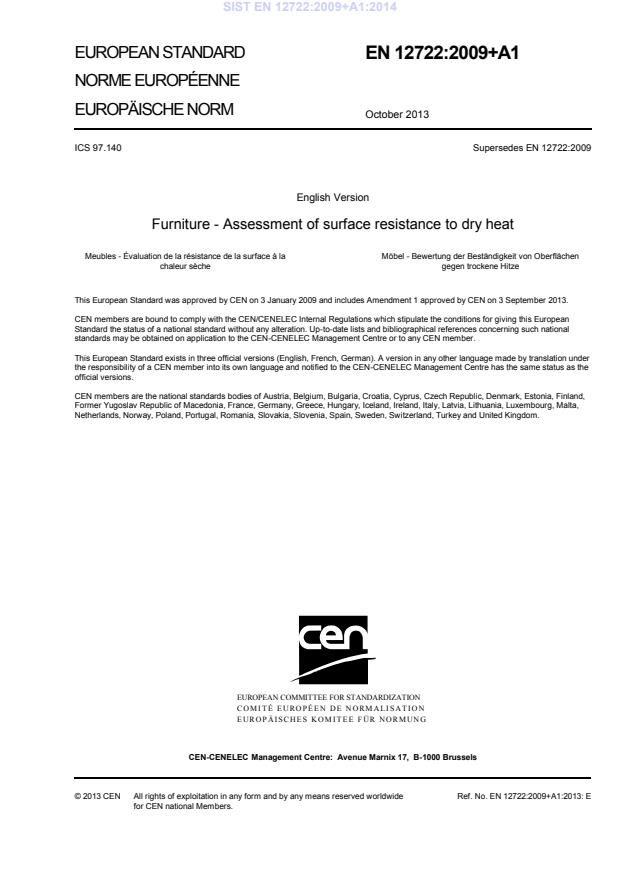
EUROPEAN STANDARD NORME EUROPÉENNE EUROPÄISCHE NORM
EN 12722:2009+A1
October 2013 ICS 97.140 Supersedes EN 12722:2009
English Version
Furniture - Assessment of surface resistance to dry heat
Meubles - Évaluation de la résistance de la surface à la chaleur sèche
Möbel - Bewertung der Beständigkeit von Oberflächen gegen trockene Hitze This European Standard was approved by CEN on 3 January 2009 and includes Amendment 1 approved by CEN on 3 September 2013.
CEN members are bound to comply with the CEN/CENELEC Internal Regulations which stipulate the conditions for giving this European Standard the status of a national standard without any alteration. Up-to-date lists and bibliographical references concerning such national standards may be obtained on application to the CEN-CENELEC Management Centre or to any CEN member.
This European Standard exists in three official versions (English, French, German). A version in any other language made by translation under the responsibility of a CEN member into its own language and notified to the CEN-CENELEC Management Centre has the same status as the official versions.
CEN members are the national standards bodies of Austria, Belgium, Bulgaria, Croatia, Cyprus, Czech Republic, Denmark, Estonia, Finland, Former Yugoslav Republic of Macedonia, France, Germany, Greece, Hungary, Iceland, Ireland, Italy, Latvia, Lithuania, Luxembourg, Malta, Netherlands, Norway, Poland, Portugal, Romania, Slovakia, Slovenia, Spain, Sweden, Switzerland, Turkey and United Kingdom.
EUROPEAN COMMITTEE FOR STANDARDIZATION
COMITÉ EUROPÉEN DE NORMALISATION
EUROPÄISCHES KOMITEE FÜR NORMUNG
CEN-CENELEC Management Centre:
Avenue Marnix 17,
B-1000 Brussels © 2013 CEN All rights of exploitation in any form and by any means reserved worldwide for CEN national Members. Ref. No. EN 12722:2009+A1:2013: E SIST EN 12722:2009+A1:2014
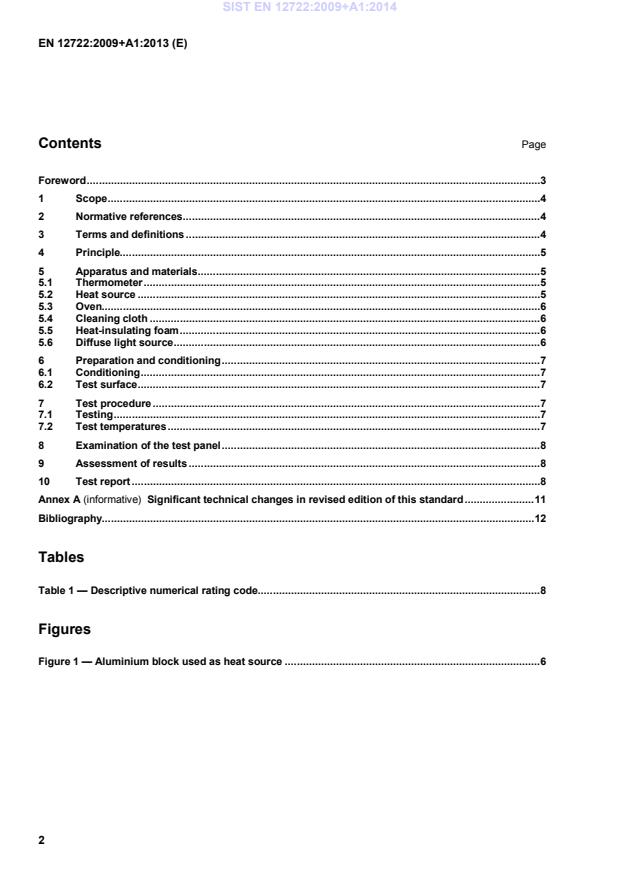
Significant technical changes in revised edition of this standard . 11 Bibliography. 12
Tables Table 1 — Descriptive numerical rating code . 8
Figures Figure 1 — Aluminium block used as heat source . 6
Informative !Annex A" provides details of significant technical changes between this European Standard and the previous edition. According to the CEN/CENELEC Internal Regulations, the national standards organizations of the following countries are bound to implement this European Standard: Austria, Belgium, Bulgaria, Cyprus, Czech Republic, Denmark, Estonia, Finland, Former Yugoslav Republic of Macedonia, France, Germany, Greece, Hungary, Iceland, Ireland, Italy, Latvia, Lithuania, Luxembourg, Malta, Netherlands, Norway, Poland, Portugal, Romania, Slovakia, Slovenia, Spain, Sweden, Switzerland, Turkey and the United Kingdom. SIST EN 12722:2009+A1:2014
1 Scope This European Standard specifies a method for the assessment of the resistance to dry heat of all rigid furniture surfaces regardless of materials. It does not apply to leather and textile surfaces. The test is intended to be carried out on a part of the finished furniture, but can be carried out on test panels of the same material, finished in an identical manner to the finished product, and of a size sufficient to meet the requirements of the test. The test should be carried out on unused surfaces. !deleted text" 2 Normative references !The following documents, in whole or in part, are normatively referenced in this document and are indispensable for its application. For dated references, only the edition cited applies. For undated references, the latest edition of the referenced document (including any amendments) applies." EN ISO 4287:1998, Geometrical Product Specifications (GPS) – Surface texture: Profile method – Terms, definitions and surface texture parameters (ISO 4287:1997) EN ISO 4288:1997, G
...