

EN 15649-4:2010
(Main)Floating leisure articles for use on and in the water - Part 4: Additional specific safety requirements and test methods for Class B devices
- Abstract
This European Standard specifies safety requirements and test methods related to materials, safety, performance and consumer information for classified floating leisure articles for use on or in water according to EN 15649-1.
This document is applicable with EN 15649-1 and EN 15649-2.
This European Standard is applicable for Class B floating leisure articles for use on or in water according to EN 15649-1 regardless whether the buoyancy is achieved by inflation or inherent buoyant material.
Class B devices provide a buoyant structure with one or more body openings into which the user is positioned partly immersed.
NOTE 1 Typical products forming Class B (see Annex B):
- floating rafts with interior body holding system ("swim seats") mostly in circular or square shape, fantasy shape for playing purposes;
- floating fantasy shaped (animal adaptations) structures with one or more openings to host a child's body, with or without body holding system;
- floating with slits or openings to put legs through any shape (animal, car imitation, etc.);
- floating rings with interior seat segments inside the circular body opening.
NOTE 2 Typical places for application:
- pools;
- protected areas of lakes, ponds;
- protected area sea shore (no offshore winds, no currents).
- Status
- Withdrawn
- Publication Date
- 12-Jan-2010
- Withdrawal Date
- 10-Jan-2012
- Technical Committee
- CEN/TC 136 - Sports, playground and other recreational equipment
- Drafting Committee
- CEN/TC 136/WG 13 - Floating leisure articles for use on water
- Current Stage
- 9960 - Withdrawal effective - Withdrawal
- Start Date
- 11-Jan-2012
- Completion Date
- 11-Jan-2012
- Directive
- 2001/95/EC - General product safety

Relations
- Effective Date
- 12-Nov-2011
- Effective Date
- 14-May-2011
Frequently Asked Questions
EN 15649-4:2010 is a standard published by the European Committee for Standardization (CEN). Its full title is "Floating leisure articles for use on and in the water - Part 4: Additional specific safety requirements and test methods for Class B devices". This standard covers: This European Standard specifies safety requirements and test methods related to materials, safety, performance and consumer information for classified floating leisure articles for use on or in water according to EN 15649-1. This document is applicable with EN 15649-1 and EN 15649-2. This European Standard is applicable for Class B floating leisure articles for use on or in water according to EN 15649-1 regardless whether the buoyancy is achieved by inflation or inherent buoyant material. Class B devices provide a buoyant structure with one or more body openings into which the user is positioned partly immersed. NOTE 1 Typical products forming Class B (see Annex B): - floating rafts with interior body holding system ("swim seats") mostly in circular or square shape, fantasy shape for playing purposes; - floating fantasy shaped (animal adaptations) structures with one or more openings to host a child's body, with or without body holding system; - floating with slits or openings to put legs through any shape (animal, car imitation, etc.); - floating rings with interior seat segments inside the circular body opening. NOTE 2 Typical places for application: - pools; - protected areas of lakes, ponds; - protected area sea shore (no offshore winds, no currents).
This European Standard specifies safety requirements and test methods related to materials, safety, performance and consumer information for classified floating leisure articles for use on or in water according to EN 15649-1. This document is applicable with EN 15649-1 and EN 15649-2. This European Standard is applicable for Class B floating leisure articles for use on or in water according to EN 15649-1 regardless whether the buoyancy is achieved by inflation or inherent buoyant material. Class B devices provide a buoyant structure with one or more body openings into which the user is positioned partly immersed. NOTE 1 Typical products forming Class B (see Annex B): - floating rafts with interior body holding system ("swim seats") mostly in circular or square shape, fantasy shape for playing purposes; - floating fantasy shaped (animal adaptations) structures with one or more openings to host a child's body, with or without body holding system; - floating with slits or openings to put legs through any shape (animal, car imitation, etc.); - floating rings with interior seat segments inside the circular body opening. NOTE 2 Typical places for application: - pools; - protected areas of lakes, ponds; - protected area sea shore (no offshore winds, no currents).
EN 15649-4:2010 is classified under the following ICS (International Classification for Standards) categories: 97.220.40 - Outdoor and water sports equipment. The ICS classification helps identify the subject area and facilitates finding related standards.
EN 15649-4:2010 has the following relationships with other standards: It is inter standard links to EN 15649-4:2010+A1:2012, EN 15649-4:2010/FprA1. Understanding these relationships helps ensure you are using the most current and applicable version of the standard.
EN 15649-4:2010 is associated with the following European legislation: EU Directives/Regulations: 2001/95/EC; Standardization Mandates: M/372. When a standard is cited in the Official Journal of the European Union, products manufactured in conformity with it benefit from a presumption of conformity with the essential requirements of the corresponding EU directive or regulation.
EN 15649-4:2010 is available in PDF format for immediate download after purchase. The document can be added to your cart and obtained through the secure checkout process. Digital delivery ensures instant access to the complete standard document.
Standards Content (Sample)
2003-01.Slovenski inštitut za standardizacijo. Razmnoževanje celote ali delov tega standarda ni dovoljeno.%Schwimmende Freizeitartikel zum Gebrauch auf und im Wasser - Teil 4: Zusätzliche spezifische sicherheitstechnische Anforderungen und Prüfverfahren für Klasse B-GeräteArticles de loisirs flottants à utiliser sur ou dans l'eau - Partie 4: Exigences de sécurité et méthodes d'essai com-plémentaires propres aux dispositifs de classe BFloating leisure articles for use on and in the water - Part 4: Additional specific safety requirements and test methods for Class B devices97.220.40Oprema za športe na prostem in vodne športeOutdoor and water sports equipmentICS:Ta slovenski standard je istoveten z:EN 15649-4:2010SIST EN 15649-4:2010en,fr01-april-2010SIST EN 15649-4:2010SLOVENSKI
STANDARD
EUROPEAN STANDARD NORME EUROPÉENNE EUROPÄISCHE NORM
EN 15649-4
January 2010 ICS 97.220.40 English Version
Floating leisure articles for use on and in the water - Part 4: Additional specific safety requirements and test methods for Class B devices
Articles de loisirs flottants à utiliser sur ou dans l'eau - Partie 4 : Exigences de sécurité et méthodes d'essai complémentaires propres aux dispositifs de classe B
Schwimmende Freizeitartikel zum Gebrauch auf und im Wasser - Teil 4: Zusätzliche spezifische sicherheitstechnische Anforderungen und Prüfverfahren für Klasse B-Geräte This European Standard was approved by CEN on 4 December 2009.
CEN members are bound to comply with the CEN/CENELEC Internal Regulations which stipulate the conditions for giving this European Standard the status of a national standard without any alteration. Up-to-date lists and bibliographical references concerning such national standards may be obtained on application to the CEN Management Centre or to any CEN member.
This European Standard exists in three official versions (English, French, German). A version in any other language made by translation under the responsibility of a CEN member into its own language and notified to the CEN Management Centre has the same status as the official versions.
CEN members are the national standards bodies of Austria, Belgium, Bulgaria, Croatia, Cyprus, Czech Republic, Denmark, Estonia, Finland, France, Germany, Greece, Hungary, Iceland, Ireland, Italy, Latvia, Lithuania, Luxembourg, Malta, Netherlands, Norway, Poland, Portugal, Romania, Slovakia, Slovenia, Spain, Sweden, Switzerland and United Kingdom.
EUROPEAN COMMITTEE FOR STANDARDIZATION
COMITÉ EUROPÉEN DE NORMALISATION EUROPÄISCHES KOMITEE FÜR NORMUNG
Management Centre:
Avenue Marnix 17,
B-1000 Brussels © 2010 CEN All rights of exploitation in any form and by any means reserved worldwide for CEN national Members. Ref. No. EN 15649-4:2010: ESIST EN 15649-4:2010
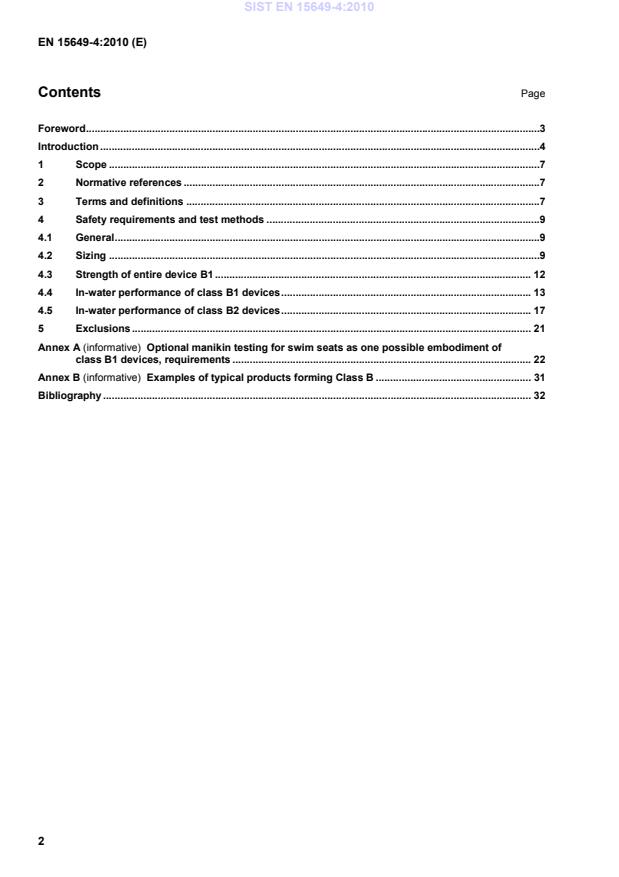
Optional manikin testing for swim seats as one possible embodiment of class B1 devices, requirements . 22Annex B (informative)
Examples of typical products forming Class B . 31Bibliography . 32 SIST EN 15649-4:2010
Compliance of a product to this standard requires that the relevant specific part and additionally the EN 15649-1 and EN 15649-2 are met. If a product includes multiple use related to several classes it should meet the requirements of all these classes. According to the CEN/CENELEC Internal Regulations, the national standards organizations of the following countries are bound to implement this European Standard: Austria, Belgium, Bulgaria, Croatia, Cyprus, Czech Republic, Denmark, Estonia, Finland, France, Germany, Greece, Hungary, Iceland, Ireland, Italy, Latvia, Lithuania, Luxembourg, Malta, Netherlands, Norway, Poland, Portugal, Romania, Slovakia, Slovenia, Spain, Sweden, Switzerland and the United Kingdom. SIST EN 15649-4:2010
The development of new products in this area is progressing. Beyond the classical swim seat rafts for more dynamic action on and in the water different body postures and extended user groups have been developed.
Class B2 products do not provide this kind of support to the user. Even if they have the circumferential buoy-ant structure in common with the Class B1 products — and thus the entrapment risk if this fit becomes too tight — flotation of the user depends on his ability to hold himself by hands or body inside the very loosely sur-rounding buoyant structure.
Both classes of products include also adult use. Activities may reach from passive floating to actions like wave surfing, tubing, balancing, swinging, etc. The devices are linked with the identified risks given in Table 1.
Standardisation is aiming for more safety with regard to all foreseeable uses. Dealing with a partly intentionally immersed human body leads to the question of loads to be applied for ap-propriate testing. For the purpose of this standard load resulting from the body weight are set with 75 % of the body weight of the heaviest foreseeable or specified user even when in certain circumstances this immersed body weight may be reduced to roughly 10 %. In cases where the devices can be used for sitting on top (e.g. big rings) the maximum body weight out of the stipulated user group should be applied. It should be noted that this standard is not related to the one and only technically clearly determined product but to a whole diverse product group including two major design principles B1 and B2 as laid down in the classification, see Clause 4, for Class B floating leisure articles. Children testing
See Annex A and EN 15649-1:2009, Clause 4, as alternative. Use of Class B products includes children from four years of age and above. Some essential requirement ensuring safety in use and in dangerous situations which may occur
e. g. a capsize
cannot be simulated and verified via the application of forces or other instrumental procedures but only by practical testing involving human test subjects or test dummies which suf-ficiently represent the envisaged user groups. Children in testing increase the nearness to real life situation but may lead to subjective results. An increased number of test cycles are an appropriate means to get an average result which makes the subjective test more objective. The application of test dummies reduces the nearness to real life situation but increases reproducibility of testing. Costs and expenses are high in the be-ginning (production costs) but may pay off in long term in comparison to the expenses of repeated provision and operation of human test subjects. The worst alternative is to eliminate certain requirements if they cannot be verified for the reason of lacking either test dummies or human test subjects. It goes without saying that any involvement of human test subjects and thus in particular child testing is ac-companied with all necessary precautions, surveillance and safety measures. This standard refers amongst others to children as test subjects. The anthropometric requirements related to these test subjects are based on children five years and nine years of age with a body height of 126 cm and 149 cm and a body weight of 25 kg/38 kg. Children of 14 years of age and above can be represented by the smallest adult female person representing the fifth percentile of the anthropometric range. SIST EN 15649-4:2010
Table 1 — Introductory risk analysis No. Typical prod-ucts Place of use Function; range of usage; target/age group Type of movement/propulsionPosition of user in regard to the equipment, ele-vation above water Predict-able mis-use Partial risk related to water environ-ment Fi-nal riskProtection aims standard/ regulation B (B1, B2)
floating struc-tures with circum-ferential buoy-ancy cham-bers around user's body, body opening with or without interior body holding system, various body postures depending on age group and capability to swim: pool, close to shore, lake, pond children; adoles-cents; large vari-ety with regard to age and use (max. 16 years to 18 years); no infants mainly drift-ing; propul-sion only by swimming strokes; third party acting, moving by hand pad-dling, action in waves for adolescents in-water position; main parts of body are below the water sur-face; no elevation above water level, sitting kneeling, stand-ing, laying dangerous distance from bank/ shore; use in currents and/or dangerous offshore winds; use by non-swimmers (B2); cap-sizing (B1); wrong size allocation (user wedged in device); lack of su-pervision Capsizing, entrapment, entangle-ment; cap-sizing in combination with entrap-ment can lead to fatal accidents; drifting away through cur-rant or wind DROWNING avoidance of entrapment/ entangle-ment; float-ing stability; residual buoyancy; warning notes; easy escape in the case of capsizing; adult super-vision; suit-able sizing system
NOTE 1 Rings and ring shaped tubes dealt with in this standard are in no case swim rings as means to learn to swim (see EN 13138-2) but water leisure articles for hanging in or sitting on. NOTE 2 The minimum length or width is 1,2 m and the corresponding dimension is ≥ 1,2 m. SIST EN 15649-4:2010
[EN ISO 12402-1:2005, 3.1] 3.31) device providing static floating stability product so designed that the user does not need to care about floating stability by his own skills NOTE One or several users may be safely on or in the device even if the weight is not evenly distributed. 3.41)
device to be balanced by the user product of which the upright floating depends on user's skill and sense to balance it 3.5 escape easy and complete separation between the user and the device in case of capsizing of the device or system without hindrance through any part or feature of the floating device 3.6 swim seat buoyant device intended to introduce the user to the aquatic environment and to build water confidence as a pre-requisite to learning to swim, which provides safety for the user but no guarantied protection against drowning NOTE Swim seats are learning aids and should not be mistaken with aquatic toys as defined in EN 71-1. [EN 13138-3:2007, 3.13] 3.7 body holding system system which is constituted by any means inside the circumferential buoyant structure which supports the us-ers body NOTE The body holding systems enable the user(s) to stay in the partly immersed position without need to hold him-self for not slipping through the opening into the water. The body holding system might be designed to allow a sitting, kneeling, standing or lying posture. It might be integrated in the interior opening of the buoyant structure or added as a separable component. 3.8 integral part of the device part of the device without which the system or component does not function and can therefore not arbitrarily be used or omitted 3.9 multiple use product any product that is intended to be used for more than one purpose (jumping, resting, climbing, etc.)
1) In accordance with intended use. SIST EN 15649-4:2010
Age range
Torso probe dimen-sions Aa × Ba × Ca Thigh probe diameter Da b kg years mm × mm × mm mm (mm) 22 to 25 4 to 5 260 × 210 × 400 140 (168c)
28 to 34 6 to 8 310 × 240 × 450 160 (192c) 38 to 48 9 to 11 330 × 250 × 500
185 (222c) 54 to 61 12 to 13 350 × 260 × 550 220 (264c) 69 and above 14 and above The 14 year child user may be represented by the human adult test subject 4 as specified in EN 15649-1:2009, 5.6. Test subjects above 14 years of age see at the same place Table 2.
a 95th percentile, male, oldest child of age range. b Cylindrical probe of appropriate length, 95th percentile, female, diameter value outside the brackets. c Anthropometric data + 20 % safety margin (applicable test value).
Key A, B, C Torso probe dimensions, in millimetres (mm) D
Thigh probe diameter, in millimetres (mm) R
Radius, in millimetres (mm) NOTE Material: wood or similar rigid materials, e.g. Styrofoam. Figure 1 — Test probes for torso and thighs The interior size of the device corresponds to the relevant body weight as specified in Table 1. This size (des-ignated user(s)) shall be labelled on the product and on the packaging. It shall comprise the body weight by applying safety information symbols: "user's body weight range" and "size designation for interior size". The safety information symbols: "risk of getting entrapped if size is not appropriate" and "avoid entrapment ensure loose fit" of EN 15649-2 shall be applied additionally. 4.2.1.2 Test method Application of torso and leg probes, check whether the required safety information symbols have been applied by visual verification. SIST EN 15649-4:2010
4.2.2.2 Test method Application of torso probes, visual verification checks whether the required safety information symbols have been applied. 4.2.3 Sizing of B2.2 (Sitting on type) devices, loose fit to the body 4.2.3.1 Requirements The interior space of B2.2 devices is deemed to prevent the user from sagging in and thus body entrapment, if appropriate requirements a), b) and c) are met. a) the interior space dimensions are in accordance with Table 3 and labelled according to this standard (safety information symbol: "size designation for interior size"); b) safety information symbols: "risk of getting entrapped if size is not appropriate", "avoid entrapment ensure loose fit" and "user's body weight range" have been applied; c) entrapment shall not be permitted. The sizing of devices shall be designed accordingly. The intended user shall be able to slip vertically through the opening or shall not be able to become entrapped when sagging down into the opening from a "SIT ON POSITION". NOTE If B2.2 devices are equipped with a bottom (sheet, mesh, etc.), these are dealt with in EN 15649-3.
6 xx-large 500b 69 to 120 Adult, 14 and above
a 95th percentile, male × 1,2 = min. inner diameter. b Obese adult persons, biggest available clothing size, for more extreme body built warning shall be obeyed. 4.2.3.2 Test method Measurement of inner width by test probes according to Table 3. 4.3 Strength of entire device B1 4.3.1 Requirement When tested in accordance with 4.3.2 no part or component of the B1 device e.g. body holding system, straps, seat pants or their attachment to the buoyant structure (welding seams) shall break or show any deficiency compromising safety. Loads shall be applied according to Figure 2 for the vertical force or according to Fig-ure 3 for the load application.
Key 1 test board, opening in compliance with the contour of B1 device to be tested 2 load (body mass of max. designated user)
3 B1 device (swim seat)
X radius of test board's upper edge Figure 2 — B1, Strength of entire device, load application by single load SIST EN 15649-4:2010
Key 1 test board, opening in compliance with the contour of B1 device to be tested 2 load, test dummy according to max. designated user 3 B1 device (swim seat)
a radius of test board's upper edge (see Figure 2) Figure 3 — B1, strength of entire device, test dummy application 4.3.2 Strength of entire device B1, Test method Place the device on an appropriate even surface in a way that the buoyancy structure is completely supported and the body holding system hangs freely downwards where applicable. Load the body holding system with a dead weight representing the body mass of the maximum user of the designated body weight range. Load duration: 10 min, ambient temperature 20 °C. Alternatively the test dummies as specified in Annex A may be applied as near to reality load where applicable. 4.4 In-water performance of class B1 devices 4.4.1 In water behaviour, static floating stability of B1 devices for children of four years to five years and six years to eight years 4.4.1.1 Requirements With the appropriate loading device in position as specified 4.4.1.2 Class B1 products for children up to five years or up to eight years of age shall not capsize when subjected to the test as specified in 4.4.1.2. Al-ternatively the test manikins and test procedures as specified in Annex A may be applied for products for this age group. SIST EN 15649-4:2010
Material: Wood or similar rigid material. Dimensions: adjustable in length, fixed width of 200 mm, rounded edges. Features: adjustable straps for attachment to buoyant device (including single and multiple user dev
...